

- Market Size (2026)
- USD 645.4 Mn
- Forecast (2036)
- USD 1.5 Bn
- CAGR (2026 to 2036)
- 8.8%
Toughening Nanoparticle Additives for Epoxy Composites Market Size, Forecast, and Outlook By FMI
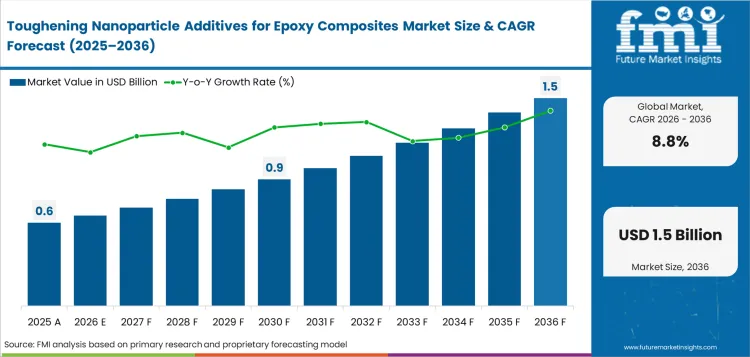
The toughening nanoparticle additives for epoxy composites market was valued at USD 0.6 billion in 2025. The market is expected to reach USD 645.4 million by 2026-end and grow at a CAGR of 8.8% between 2026 and 2036 to reach USD 1.5 billion by 2036.
Summary of the Toughening Nanoparticle Additives for Epoxy Composites Market
- Demand and Growth Drivers
- Wind blade manufacturing creates steady demand for tougher epoxy matrices as blade length raises fatigue exposure.
- EV battery housings increase the use of epoxy composites in protective structures needing impact control.
- Aerospace composite reinforces demand for stable nano dispersion and repeatable fracture performance.
- Product and Segment View
- Core-shell rubber is expected to lead the additive type segment with 34.0% share in 2026, reflecting crack resistance needs.
- Pre-dispersed masterbatch is expected to lead particle form demand with 48.0% share in 2026, reflecting lower mixing risk.
- Structural laminates are expected to lead the application segment with 38.0% share in 2026, reflecting aircraft and wind blade use.
- Geography and Competitive Outlook
- China is expected to record a CAGR of 10.8% through 2036 as wind energy and EV output deepen epoxy composite use.
- India is projected to expand at 10.1% CAGR by 2036 as wind capacity and local composite processing expand.
- Companies combining particle dispersion skill with epoxy formulation depth are strengthening placement during the forecast period.
- Analyst Opinion
- Nikhil Kaitwade, Principal Consultant for Chemicals and Materials at FMI says, “Toughening nanoparticle additives are moving into plant-level formulation. Aerospace and wind blade teams need fracture toughness without viscosity problems. Industrial composites face cost pressure while low-loading performance and dispersion records reduce qualification risk. Batch consistency is a long-term approval filter.”
- Toughening Nanoparticle Additives for Epoxy Composites Market Value Analysis
- The toughening nanoparticle additives for epoxy composites market is moving from specialty formulation work into a structured performance additive base.
- Crack resistance needs across wind blades and aerospace laminate systems are increasing use of nano toughening additives.
- The market is benefiting from deeper use of epoxy composite systems across structural materials.
- Demand is backed by resin qualification records meeting fatigue and impact needs. These records help composite manufacturers reduce rework during part approval.
Key Takeaways, Market Size, and Forecast
- The toughening nanoparticle additives for epoxy composites market was valued at USD 0.6 billion in 2025.
- By 2036, the toughening nanoparticle additives for epoxy composites market is expected to be worth USD 1.5 billion.
- From 2026 to 2036, the market is projected to expand at a CAGR of 8.8%.
- The market is projected to create an incremental opportunity of USD 854.6 million between 2026 and 2036.
- In 2026, pre-dispersed masterbatch is expected to account for 48.0% of particle form demand.
- China is projected to record 10.8% CAGR through 2036, and India follows at 10.1% with stronger composite manufacturing activity.
Epoxy composite users are asking for tougher resin systems without extra mixing problems or cure uncertainty. Evonik’s January 2026 NANOPOX® HP 140 data sheet lists 20 nm average SiO₂ particle size and 50 nm maximum diameter. Defined particle control helps formulators screen nano silica with lower agglomeration risk during laminate qualification. Conductive epoxy forms a separate opportunity area apart from wind blade toughening and structural laminate repair. OCSiAl lists 0.1% concentrate loading for TUBALL™ MATRIX in epoxy systems. Low loading helps battery and electronics users add conductivity without overfilling the resin system. Cabot’s September 2024 DOE award negotiation of up to USD 50 million points to stronger USA supply for carbon nanotube dispersions. Regional supply is important as EV battery and grid material programs need shorter sourcing chains. Wind blade demand adds the volume base, with GWEC reporting 117 GW of new wind capacity in 2024.
Toughening Nanoparticle Additives for Epoxy Composites Market Definition
The toughening nanoparticle additives for epoxy composites market includes nano-scale additives used to improve fracture resistance in epoxy-based composite systems. Scope includes core-shell rubber, nano silica, carbon nanotube, graphene, and hybrid additives sold as dispersions or masterbatches. These additives serve structural laminates, composite adhesives, potting compounds, and resin infusion systems. Finished composite parts, neat epoxy resins, and bulk micron fillers are outside the scope.
Toughening Nanoparticle Additives for Epoxy Composites Market Inclusions
Market scope covers all commercially traded toughening nanoparticle additives for epoxy composites categorized by additive type, including core-shell rubber, nano silica, carbon nanotubes, graphene, and hybrid additives; particle form, including pre-dispersed masterbatch, liquid dispersion, dry powder, and paste concentrate; resin system, including bisphenol-A epoxy, cycloaliphatic epoxy, novolac epoxy, and bio-based epoxy; applications, including structural laminates, composite adhesives, potting compounds, prepreg systems, and resin infusion; and end users, including aerospace defense, wind energy, automotive, electronics, and industrial equipment. Revenue scope covers 2026 to 2036. The key stakeholders include nanoparticle additive manufacturers, epoxy resin formulators, dispersion technology providers, composite processors, aerospace material suppliers, wind blade manufacturers, automotive component makers, electronics encapsulation companies, industrial equipment producers, distributors, testing laboratories, and regulatory bodies.
Toughening Nanoparticle Additives for Epoxy Composites Market Exclusions
Scope does not include finished composite parts, standard epoxy resins, micron mineral fillers, non-epoxy polymer additives, or neat rubber modifiers.
Toughening Nanoparticle Additives for Epoxy Composites Market Research Methodology
- Primary Research: FMI analysts talked to epoxy formulators, composite processors, additive producers, and technical distributors in major manufacturing markets.
- Desk Research: Research combined company product data, technical papers, patent activity, and public statistics on wind energy and EV demand.
- Market sizing and forecasting: The model added additive loading across resin systems and checked prices across dispersion formats.
- Data validation: Forecasts were cross-checked every three months against epoxy resin demand and composite resin use patterns.
Why is the Toughening Nanoparticle Additives for Epoxy Composites Market Growing?
- Wind blade producers need stronger epoxy matrices as longer blades face repeated flexing during service.
- EV manufacturers use composite housings and bonded parts needing impact strength and lower part weight.
- Aerospace programs value nano tougheners with stable cure behavior and repeatable mechanical evidence.
Wind blade manufacturing is creating a practical demand base for toughened epoxy systems. GWEC reported 117 GW of new wind capacity installed worldwide in 2024. This scale raises demand for composite blades exposed to repeated fatigue loads. Nano tougheners can help resin suppliers improve crack deflection without full resin redesign. Additive suppliers with stable dispersions gain stronger access to blade resin qualification programs.
Electric vehicle output adds a second demand base for epoxy composite additives. IEA reported electric car sales above 17 million worldwide in 2024, with sales share exceeding 20%. Battery housings and lightweight structures create demand for tougher resin systems used with carbon fiber composites. Additive suppliers benefit as composite programs need impact resistance and lower weight in one approved material package.
Market Segmentation Analysis
- Core-shell rubber is projected to capture 34.0% of additive type demand in 2026, as epoxy laminate producers prioritize reliable crack control.
- Pre-dispersed masterbatch is expected to represent 48.0% of particle form share in 2026 through lower mixing variation during composite production.
- Bisphenol-A epoxy is forecast to hold 41.0% of the resin system segment in 2026, helped by broad familiarity across processing lines.
- Structural laminates are anticipated to make up 38.0% of application share in 2026, driven by higher use in advanced composite parts.
- Aerospace defense is estimated to contribute 31.0% of end-use value in 2026, reflecting stricter damage tolerance requirements.
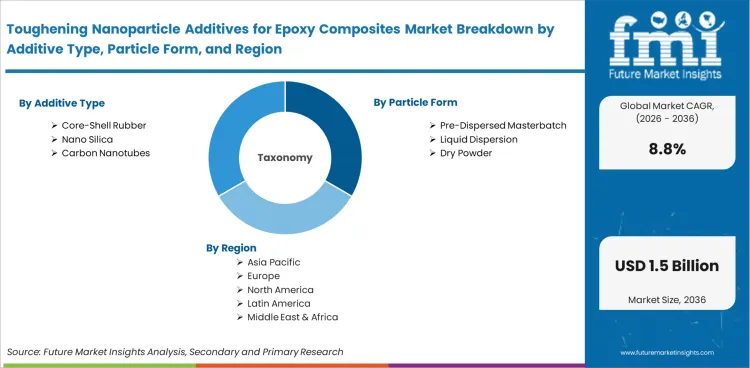
The market for toughening nanoparticle additives for epoxy composites is divided into five primary segment groups based on additive type, particle form, resin system, application, and end use. Additive type includes core-shell rubber, nano silica, carbon nanotubes, graphene, and hybrid additives. Particle form includes pre-dispersed masterbatch, liquid dispersion, dry powder, and paste concentrate. Resin system includes bisphenol-aBisphenol-A epoxy, cycloaliphatic epoxy, novolac epoxy, and bio-based epoxy. Application includes structural laminates, composite adhesives, potting compounds, prepreg systems, and resin infusion.
Insights into Toughening Nanoparticle Additives for Epoxy Composites Market by Additive Type
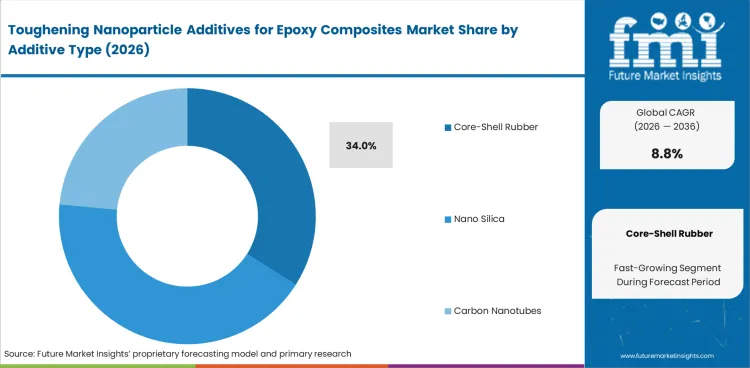
- In 2026, core-shell rubber is estimated to make up 34.0% of the additive type segment. Core-shell particles help epoxy formulators improve crack resistance without forcing major resin system changes.
- Nano silica and carbon nanotube options address selected performance needs. Their use improves in formulations needing stiffness control or added electrical performance.
Insights into Toughening Nanoparticle Additives for Epoxy Composites Market by Particle Form
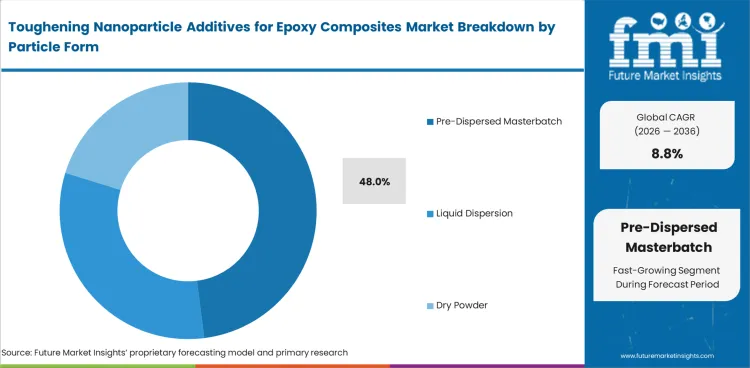
- Pre-dispersed masterbatch is expected to hold 48.0% of the particle form segment in 2026. Ready-to-use formats reduce particle clumping and lower mixing risk during composite production.
- Dry powder and liquid dispersion formats serve more selective formulation needs. Their value improves in plants with stronger mixing control and deeper technical handling skill.
Insights into Toughening Nanoparticle Additives for Epoxy Composites Market by Resin System
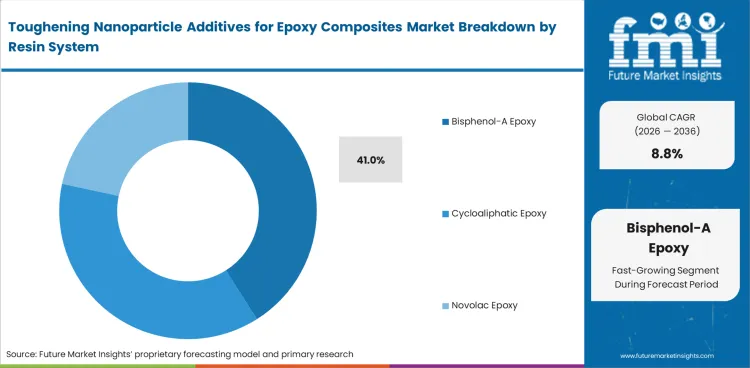
- In 2026, bisphenol-aBisphenol-A epoxy is forecast to hold 41.0% of the resin system segment. Its broad processing familiarity helps additive suppliers qualify nano tougheners across established composite workflows.
- Novolac and cycloaliphatic epoxy systems address higher-temperature or electrical uses. These systems need closer additive screening since cure behavior can affect final part performance.
Insights into Toughening Nanoparticle Additives for Epoxy Composites Market by Application
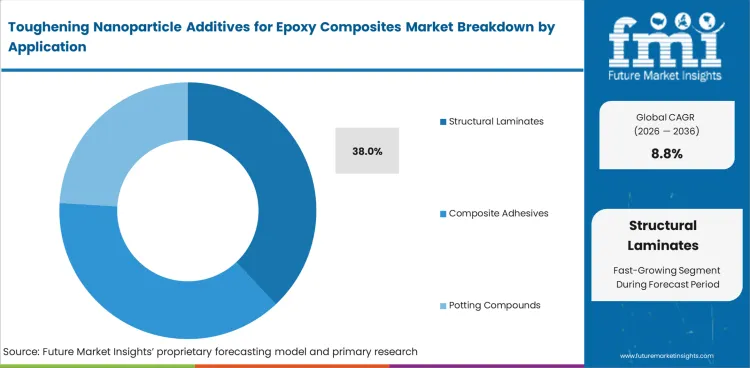
- Structural laminates are projected to account for 38.0% of the application segment in 2026. Aircraft panels and wind blade skins need tougher epoxy matrices to manage fatigue stress.
- Composite adhesives and prepreg systems create additional demand pockets. Their use improves in bonded assemblies and high-specification parts needing better damage tolerance.
Insights into Toughening Nanoparticle Additives for Epoxy Composites Market by End Use
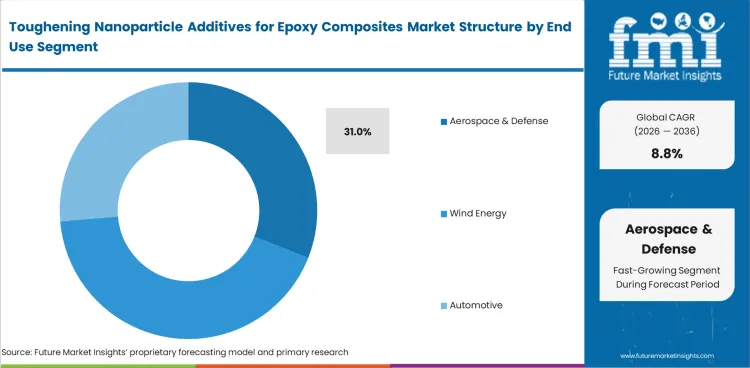
- Aerospace defense is estimated to contribute 31.0% share of the end-use segment in 2026. Composite material approval relies on repeatable impact performance and stable cure behavior.
- Wind energy and automotive applications add volume depth to the market. Their demand is strongest in blade structures and lightweight parts requiring lower failure risk.
Toughening Nanoparticle Additives for Epoxy Composites Market Drivers, Restraints, and Opportunities
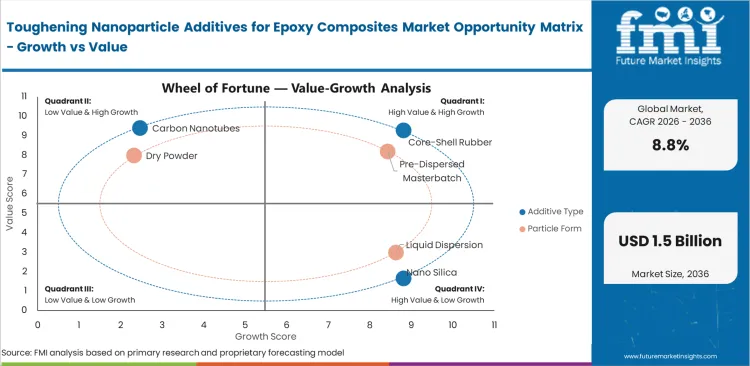
- Resin infusion pressure is creating structured demand for low-viscosity toughening additives across large composite parts.
- The requirement for dispersion control and technical service creates pricing pressure for smaller additive suppliers.
- Conductive toughening creates service opportunity across battery housings and electronic potting systems.
Toughening nanoparticle additives for epoxy composites keep growing as wind blades and aerospace laminates need stronger crack resistance and longer service life. Cost pressure and dispersion difficulty can slow adoption in price-sensitive industrial composite programs. Growth continues through pre-dispersed masterbatches and qualified epoxy systems used in structural laminate applications.
Oil Volatility Is Lifting Dispersion Premiums
For toughening nanoparticle additives supplied as epoxy ready dispersions the pricing risk in 2026 is shifting beyond particle cost alone. It is moving toward the resin and solvent layer which also includes energy and freight factors surrounding the additive. In May 2026, the USA Energy Information Administration reported Brent crude averaging US$117/b in April after touching US$138/b on April 7, with prices expected near US$106/b in May and June before easing to US$89/b in 4Q26. This volatility holds signficancesignificance as epoxy-compatible nanoparticle additives require milling and surface treatment for stable performance. They need carrier resin compatibility and controlled logistics to ensure consistent quality through demanding production and delivery conditions. Buyers may see suppliers protect margins through formulation surcharges instead of transparent nanoparticle price hikes.
Silica Feedstock Softness Is Improving Buyer Leverage
For nanosilica-toughened epoxy composites, 2025 pricing signals point to softer upstream silica pressure instead of broad additive deflation. In February 2026, USGS estimated USA industrial sand and gravel sold or used at 120 million tons valued at US$4.5 billion in 2025, with quantity down 5% and value down 16% versus 2024; the average value fell to US$36 per metric ton from US$40.90 in 2024. For toughening nanoparticle additives, this creates a negotiation window for formulators on silica-derived inputs. Finished additive prices may not decrease proportionately as dispersion quality and silane functionalization still involve premium processing costs.
Analysis of Toughening Nanoparticle Additives for Epoxy Composites Market By Key Countries
.webp "Top Country Growth Comparison Toughening Nanoparticle Additives For Epoxy Composites Market Cagr (2026 2036)")
| Country | CAGR |
|---|---|
| China | 10.8% |
| India | 10.1% |
| USA | 8.6% |
| Germany | 7.4% |
| UK | 6.8% |
Source: Future Market Insights, 2026.
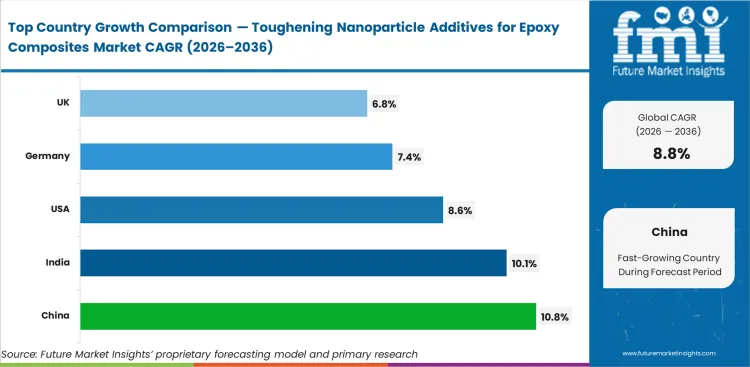
Toughening Nanoparticle Additives for Epoxy Composites Market CAGR Analysis By Country
- China is projected to record 10.8% CAGR through 2036 as wind blade output and EV platforms deepen composite material use.
- India is expected to expand at 10.1% CAGR during the assessment period, backed by wind capacity additions and local epoxy composite processing.
- In the USA, 8.6% CAGR is linked to aerospace qualification work and EV battery material programs over the forecast horizon.
- Germany at 7.4% and the UK at 6.8% indicate mature composite bases with measured demand expansion by 2036.
Demand for toughening nanoparticle additives for epoxy composites is forecast to rise at 8.8% CAGR from 2026 to 2036. Country-level analysis covers major markets contributing to this forecast, with key markets listed below.
Demand Outlook for Toughening Nanoparticle Additives for Epoxy Composites Market in China
Toughening nanoparticle additives for epoxy composites industry in China is projected to record a CAGR of 10.8% through 2036. IEA Wind reported China installed 87.25 GW of new wind power capacity in 2024, excluding Taiwan. This manufacturing base strengthens demand for China toughening nanoparticle additives for epoxy composites. Local resin formulators can gain from wind blade producers seeking tougher epoxy systems for long blade programs.
- Wind blade production creates demand for nano silica and core-shell rubber tougheners in epoxy resin systems.
- Electric vehicle battery enclosures add demand for conductive and impact-resistant composite formulations.
- Domestic additive suppliers benefit from short lead times and direct work with blade resin formulators.
Sales Analysis of Toughening Nanoparticle Additives for Epoxy Composites Market in India
The toughening nanoparticle additives for epoxy composites sector in India is expected to expand at a CAGR of 10.1% during the assessment period. India’s wind energy capacity reached 50.04 GW after 4.15 GW of new additions in FY 2024-25. This capacity base backs demand for India toughening nanoparticle additives for epoxy composites. Local formulators can serve blade resin users seeking lower mixing risk and better fatigue control.
- Local blade manufacturing favors pre-dispersed masterbatches with stable quality during large part processing.
- EV component makers need tougher epoxy adhesives for lightweight housings and bonded assemblies.
- India’s price sensitivity keeps additive loading discipline central to supplier selection.
Demand Outlook for Toughening Nanoparticle Additives for Epoxy Composites Market in the United States
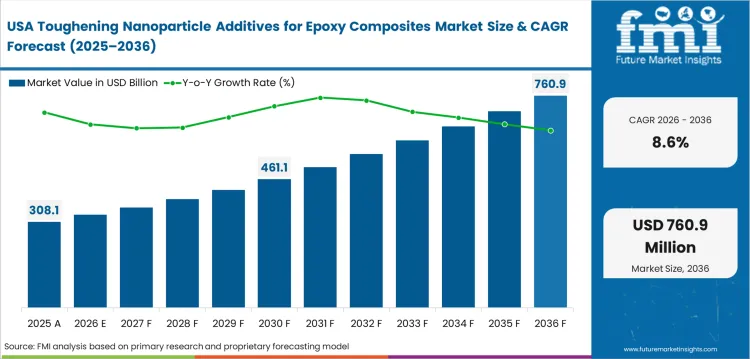
The USA toughening nanoparticle additives for epoxy composites industry is forecast to grow at a CAGR of 8.6% by 2036. EIA reported wind power generated 464,000 GWh of USA electricity in 2025, up 3% from 2024. Aerospace and energy users value epoxy additives with proven fracture and fatigue records. This favors suppliers offering ready dispersions for certified composite workflows.
- Aerospace composite users need additive records across cure behavior and damage tolerance.
- Battery material programs raise interest in carbon nanotube dispersions for conductive composite systems.
- Domestic resin formulators prefer suppliers with technical service and reliable regional inventory.
Opportunity Analysis of Toughening Nanoparticle Additives for Epoxy Composites Market in Germany
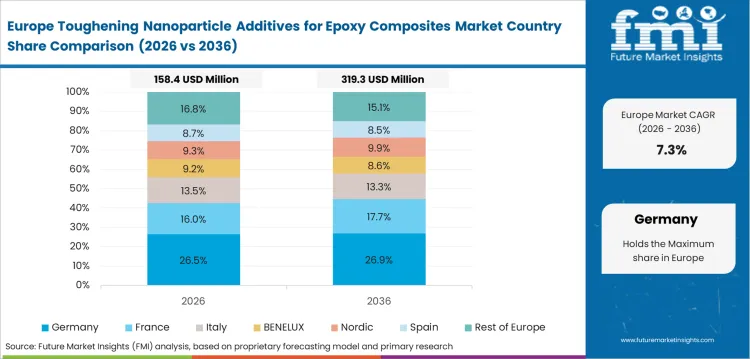
The toughening nanoparticle additives for epoxy composites segment in Germany is projected to advance at 7.4% CAGR over the forecast years. IEA Wind reported 2,405 onshore wind turbines with 14,056 MW were newly approved in Germany during 2024. This project flow strengthens demand for Germany toughening nanoparticle additives for epoxy composites. Testing demand is strongest for high-quality epoxy systems in wind and automotive parts.
- Wind project approvals reinforce demand for blade materials with fatigue-resistant epoxy systems.
- Automotive lightweighting creates steady pull for carbon fiber reinforced plastic parts.
- German processors prioritize dispersion quality and documented resin behavior over low raw additive price.
Future Outlook for Toughening Nanoparticle Additives for Epoxy Composites Market in the United Kingdom
The UK toughening nanoparticle additives for epoxy composites industry is expected to post 6.8% CAGR through 2036. IEA Wind reported the UK generated over 84 TWh of electricity from wind in 2024. This favors UK toughening nanoparticle additives for epoxy composites as offshore wind blades and repair materials need better fatigue control. Suppliers with proven resin infusion guidance can serve blade makers and repair specialists.
- Offshore wind blade repair creates demand for toughened epoxy adhesives and laminate repair systems.
- Composite processors need low-viscosity dispersions for reliable wet-out in large molded parts.
- UK aerospace activity sustains higher-value demand for certified composite airframes materials.
Competitive Landscape and Strategic Positioning
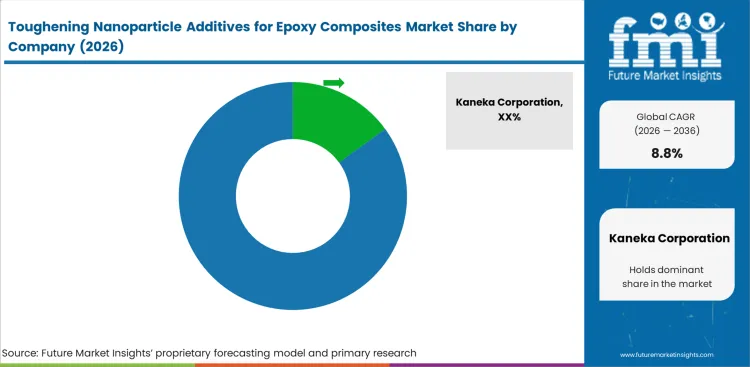
- Kaneka Corporation competes from a strong position in pre-dispersed core-shell rubber systems for epoxy-compatible thermoset formulations.
- Evonik Industries and Cabot Corporation compete on nano silica depth and carbon nanotube dispersion capability for composite resin users.
- Specialist suppliers serve conductive epoxy applications through graphene nanotubes and tailored concentrates for battery housings or electronic encapsulation.
Competition in this market centers on proven dispersion formats and resin compatibility for qualified composite programs. Kaneka Corporation holds a strong position through KANEACE™KANE ACE™ MX masterbatch products for thermosetting resins. KANEACE™KANE ACE™ MX uses nano-sized core-shell rubber particles pre-dispersed at high concentration in epoxy and other thermoset resins. Evonik Industries serves composite users with NANOPOX® nano silica epoxy systems for toughness and processing control. Cabot Corporation adds carbon nanotube dispersion capacity for battery supply chains. OCSiAl serves conductive epoxy resin users through TUBALL™ MATRIX concentrate for permanent conductivity.
Entry barriers are high as suppliers need dispersion equipment and resin compatibility testing before customer approval. Customer qualification periods can be long across structural composite programs with strict performance needs. Competitive priorities include stable particle size and repeatable batch performance across approved resin systems. Buyers favor suppliers offering masterbatches and technical guidance for 2K epoxy adhesives or laminate systems. Suppliers with deeper epoxy formulation knowledge are better placed to reduce coordination work for composite manufacturers.
Key Companies in the Toughening Nanoparticle Additives for Epoxy Composites Market
Key global companies leading the toughening nanoparticle additives for epoxy composites market include:
- Kaneka Corporation, Evonik Industries, and Cabot Corporation have strong additive infrastructure for epoxy dispersion and composite formulation service.
- Huntsman Corporation, Westlake Epoxy, and BYK serve manufacturers through epoxy system knowledge and additive handling depth.
- OCSiAl, NanoXplore, and Nanocyl hold specialist positions across carbon nanotubes and graphene-based epoxy concentrates.
Competitive Benchmarking: Toughening Nanoparticle Additives for Epoxy Composites Market
| Company | Epoxy Dispersion Depth | Composite Qualification Fit | Application Support | Geographic Footprint |
|---|---|---|---|---|
| Kaneka Corporation | High | High | Strong | Japan-based global network across Asia, Europe, Africa, Middle East, and the Americas. |
| Evonik Industries | High | High | Strong | Global reach across Asia-Pacific, Europe, North America, South America, Middle East, Turkey, and Africa. |
| Cabot Corporation | High | Medium | Strong | Global footprint across Asia Pacific, Europe, Middle East, Africa, North America, and South America. |
| Huntsman Corporation | Medium | High | Strong | Global operations across about 25 countries with locations across the Americas, Europe, and Asia Pacific. |
| Westlake Epoxy | Medium | High | Strong | Manufacturing and distribution presence across North America, Europe, Asia, Middle East, and the Americas. |
| BYK | Medium | Medium | Strong | Worldwide production, sales, research, and distributor network across major industrial regions. |
| OCSiAl | High | Medium | Medium | Europe-centered nanotube production with Serbia facility and Luxembourg corporate base. |
| NanoXplore | Medium | Medium | Moderate | North America and Europe footprint with headquarters in Montreal and manufacturing in Canada, the United States, and Europe. |
| Nanocyl | Medium | Medium | Moderate | Belgium-based carbon nanotube producer with worldwide sales reach for CNT powders and formulated products. |
| Arkema | Medium | Strong | Medium | Global specialty materials footprint across 55 countries with balanced coverage across North America, Europe, and Asia. |
Source: Future Market Insights, 2026.
Key Developments in Toughening Nanoparticle Additives for Epoxy Composites Market
- In June 2025, Westlake Epoxy announced collaboration with Alpha Recyclage Composites to scale carbon fiber composite recycling capacity. The collaboration helps composite customers manage production scrap and end-of-life material options.
- In July 2025, Evonik transitioned epoxy curing agent production sites to 100% renewable electricity. The move improves supply credentials for epoxy systems serving composites and adhesives.
- In September 2024, Cabot Corporation was selected for award negotiation of up to USD 50 million from the USA Department of Energy. The project covers a commercial-scale carbon nanotube and conductive additive dispersions facility.
Key Players in the Toughening Nanoparticle Additives for Epoxy Composites Market
Major Global Players
- Kaneka Corporation
- Evonik Industries
- Cabot Corporation
- Huntsman Corporation
- Westlake Epoxy
- BYK
- Arkema
Specialist Players
- OCSiAl
- NanoXplore
- Nanocyl
Report Scope and Coverage
| Parameter | Details |
|---|---|
| Quantitative Units | USD 0.7 billion to USD 1.5 billionUSD 645.4 million to USD 1.5 billion, at a CAGR of 8.8% |
| Market Definition | The market encompasses nano-scale additives used to improve fracture toughness in epoxy composite systems. |
| Regions Covered | North America, Latin America, Europe, East Asia, South Asia and Pacific, Middle East and Africa |
| Countries Covered | USA, UK, Germany, China, India, Japan, South Korea, and 30 plus countriesUSA, UK, Germany, China, India, and 30 plus countries |
| Key Companies Profiled | Kaneka Corporation, Evonik Industries, Cabot Corporation, Huntsman Corporation, Westlake Epoxy, BYK, OCSiAl |
| Forecast Period | 2026 to 2036 |
| Approach | Hybrid bottom-up and top-down methodology starting with additive loading and verified epoxy composite use patterns. |
Toughening Nanoparticle Additives for Epoxy Composites Market by Segments
Toughening Nanoparticle Additives for Epoxy Composites Market Segmented by Additive Type:
- Core-Shell Rubber
- Nano Silica
- Carbon Nanotubes
- Graphene
- Hybrid Additives
Toughening Nanoparticle Additives for Epoxy Composites Market Segmented by Particle Form:
- Pre-Dispersed Masterbatch
- Liquid Dispersion
- Dry Powder
- Paste Concentrate
Toughening Nanoparticle Additives for Epoxy Composites Market Segmented by Resin System:
- Bisphenol-A Epoxy
- Cycloaliphatic Epoxy
- Novolac Epoxy
- Bio-Based Epoxy
Toughening Nanoparticle Additives for Epoxy Composites Market Segmented by Application:
- Structural Laminates
- Composite Adhesives
- Potting Compounds
- Prepreg Systems
- Resin Infusion
Toughening Nanoparticle Additives for Epoxy Composites Market Segmented by End Use:
- Aerospace DefenseAerospace & Defense
- Wind Energy
- Automotive
- Electronics
- Industrial Equipment
Toughening Nanoparticle Additives for Epoxy Composites Market by Region:
- North America
- USA
- Canada
- Mexico
- Latin America
- Brazil
- Chile
- Rest of Latin America
- Europe
- Germany
- UK
- Italy
- Spain
- France
- Rest of Europe
- East Asia
- China
- Japan
- South Korea
- South Asia and Pacific
- India
- ASEAN
- Australia & New Zealand
- Rest of South Asia and Pacific
- Middle East and Africa
- Saudi Arabia
- Other GCC Countries
- South Africa
- Rest of Middle East and Africa
Research Sources and Bibliography
- USA Geological Survey. (2026, February). Sand and gravel (industrial). In Mineral commodity summaries 2026. USA Department of the Interior. https://pubs.usgs.gov/periodicals/mcs2026/mcs2026-sand-industrial.pdf
- USA Energy Information Administration. (2026, May). Short-Term Energy Outlook. USA Department of Energy. https://www.eia.gov/outlooks/steo/pdf/steo_full.pdf
- Cabot Corporation. (2024, September 20). Cabot Corporation selected for award negotiation for USD 50 million from the USA Department of Energy. Cabot Corporation. Source link: https://investor.cabot-corp.com/news-releases/news-release-details/cabot-corporation-selected-award-negotiation-50-million-us
- Evonik Operations GmbH. (2026, January 16). NANOPOX® HP 140 technical data sheet. Evonik Operations GmbH. Source link: https://products.evonik.com/assets/n_/us/NANOPOX_HP_140_EN_TDS_GEN_52057261_en_US.pdf
- Evonik Industries. (2025, July 30). Evonik transitions its epoxy curing agent production to run on renewable electricity. Evonik Industries. Source link: https://www.evonik.com/en/news/press-releases/2025/07/evonik-transitions-its-epoxy-curing-agent-production-to-run-on-r.html
- Global Wind Energy Council. (2025, April 23). Global Wind Report 2025. Global Wind Energy Council. Source link: https://26973329.fs1.hubspotusercontent-eu1.net/hubfs/26973329/2.%20Reports/Global%20Wind%20Report/GWEC%20Global%20Wind%20Report%202025.pdf
- International Energy Agency. (2025, May 14). Global EV Outlook 2025. International Energy Agency. Source link: https://www.iea.org/reports/global-ev-outlook-2025
- International Energy Agency Wind TCP. (2025, November). United Kingdom annual report 2024. IEA Wind TCP. Source link: https://iea-wind.org/wp-content/uploads/2025/11/UK.AnnualReport2024.Publish.pdf
- International Energy Agency Wind TCP. (2025, November). China annual report 2024. IEA Wind TCP. Source link: https://iea-wind.org/wp-content/uploads/2025/11/CWEA.Annual.Report.2024.Publish.pdf
- International Energy Agency Wind TCP. (2025, December). Germany annual report 2024. IEA Wind TCP. Source link: https://iea-wind.org/wp-content/uploads/2025/12/Germany.AnnualReport2024.Publish.pdf
- Ministry of New and Renewable Energy. (2025, April 10). India’s renewable energy capacity achieves historic milestone. Press Information Bureau. Source link: https://www.pib.gov.in/PressReleseDetailm.aspx?PRID=2120729
- USA Energy Information Administration. (2026, March 20). Wind and solar generated a record 17% of USA electricity in 2025. USA Energy Information Administration. Source link: https://www.eia.gov/todayinenergy/detail.php?id=67367
- Westlake Corporation. (2025, June 11). Westlake Epoxy announces strategic collaboration with Alpha Recyclage Composites. Westlake Corporation. Source link: https://www.westlake.com/news/westlake-epoxy-announces-strategic-collaboration-alpha-recyclage-composites-advance-composites
This Report Answers
- What is the expected value of toughening nanoparticle additives for epoxy composites in 2026?
- How large will the toughening nanoparticle additives for epoxy composites market become by 2036?
- Which particle form is expected to lead demand in 2026?
- Which resin system is expected to lead material demand in 2026?
- Which application segment creates the strongest use base for nano tougheners?
- Which countries are expected to record faster CAGR through 2036?
- Which companies are active across epoxy-ready nano additive supply?
- How does FMI estimate and validate the market forecast?
Frequently Asked Questions
What is the global market demand for toughening nanoparticle additives for epoxy composites in 2026?
In 2026, the global market for toughening nanoparticle additives for epoxy composites is expected to be worth USD 0.7 billion worth USD 645.4 million.
How big will the market for toughening nanoparticle additives for epoxy composites be in 2036?
By 2036, the market for toughening nanoparticle additives for epoxy composites is expected to be worth USD 1.5 billion.
How much is demand for toughening nanoparticle additives for epoxy composites expected to expand between 2026 and 2036?
Between 2026 and 2036, demand for toughening nanoparticle additives for epoxy composites is expected to expand at a CAGR of 8.8%.
Which particle form segment is likely to be the best seller globally by 2026?
Pre-Dispersed Masterbatch will make up Pre-Dispersed Masterbatch is expected to make up 48.0% of the particle form segment in 2026.
What is causing demand to rise in China?
China toughening nanoparticle additives for epoxy composites demand is projected to record 10.8% CAGR through 2036, backed by wind and EV output.
What is causing demand to rise in India?
India toughening nanoparticle additives for epoxy composites demand is projected to expand at 10.1% CAGR through 2036, backed by wind capacity additions.
What does this report mean by toughening nanoparticle additives for epoxy composites Market definition?
The market includes nano-scale additives used to improve fracture toughness and crack resistance in epoxy composite systems.
How does FMI make the toughening nanoparticle additives for epoxy composites forecast and check it?
Forecasting models use a hybrid bottom-up and top-down approach, starting with additive loading and checking it against epoxy composite use patterns.
Preview the report firsthand - request a free sample
Get SampleGet the brochure for pricing and purchase details.
Get PDFTable of Content
- Executive Summary
- Global Market Outlook
- Demand-side Trends
- Supply-side Trends
- Technology Roadmap Analysis
- Analysis and Recommendations
- Market Overview
- Market Coverage / Taxonomy
- Market Definition / Scope / Limitations
- Research Methodology
- Chapter Orientation
- Analytical Lens and Working Hypotheses
- Market Structure, Signals, and Trend Drivers
- Benchmarking and Cross-market Comparability
- Market Sizing, Forecasting, and Opportunity Mapping
- Research Design and Evidence Framework
- Desk Research Programme (Secondary Evidence)
- Company Annual and Sustainability Reports
- Peer-reviewed Journals and Academic Literature
- Corporate Websites, Product Literature, and Technical Notes
- Earnings Decks and Investor Briefings
- Statutory Filings and Regulatory Disclosures
- Technical White Papers and Standards Notes
- Trade Journals, Industry Magazines, and Analyst Briefs
- Conference Proceedings, Webinars, and Seminar Materials
- Government Statistics Portals and Public Data Releases
- Press Releases and Reputable Media Coverage
- Specialist Newsletters and Curated Briefings
- Sector Databases and Reference Repositories
- FMI Internal Proprietary Databases and Historical Market Datasets
- Subscription Datasets and Paid Sources
- Social Channels, Communities, and Digital Listening Inputs
- Additional Desk Sources
- Expert Input and Fieldwork (Primary Evidence)
- Primary Modes
- Qualitative Interviews and Expert Elicitation
- Quantitative Surveys and Structured Data Capture
- Blended Approach
- Why Primary Evidence is Used
- Field Techniques
- Interviews
- Surveys
- Focus Groups
- Observational and In-context Research
- Social and Community Interactions
- Stakeholder Universe Engaged
- C-suite Leaders
- Board Members
- Presidents and Vice Presidents
- R&D and Innovation Heads
- Technical Specialists
- Domain Subject-matter Experts
- Scientists
- Physicians and Other Healthcare Professionals
- Governance, Ethics, and Data Stewardship
- Research Ethics
- Data Integrity and Handling
- Primary Modes
- Tooling, Models, and Reference Databases
- Desk Research Programme (Secondary Evidence)
- Data Engineering and Model Build
- Data Acquisition and Ingestion
- Cleaning, Normalisation, and Verification
- Synthesis, Triangulation, and Analysis
- Quality Assurance and Audit Trail
- Market Background
- Market Dynamics
- Drivers
- Restraints
- Opportunity
- Trends
- Scenario Forecast
- Demand in Optimistic Scenario
- Demand in Likely Scenario
- Demand in Conservative Scenario
- Opportunity Map Analysis
- Product Life Cycle Analysis
- Supply Chain Analysis
- Investment Feasibility Matrix
- Value Chain Analysis
- PESTLE and Porter’s Analysis
- Regulatory Landscape
- Regional Parent Market Outlook
- Production and Consumption Statistics
- Import and Export Statistics
- Market Dynamics
- Global Market Analysis 2021 to 2025 and Forecast, 2026 to 2036
- Historical Market Size Value (USD Million) Analysis, 2021 to 2025
- Current and Future Market Size Value (USD Million) Projections, 2026 to 2036
- Y-o-Y Growth Trend Analysis
- Absolute $ Opportunity Analysis
- Global Market Pricing Analysis 2021 to 2025 and Forecast 2026 to 2036
- Global Market Analysis 2021 to 2025 and Forecast 2026 to 2036, By Additive Type
- Introduction / Key Findings
- Historical Market Size Value (USD Million) Analysis By Additive Type , 2021 to 2025
- Current and Future Market Size Value (USD Million) Analysis and Forecast By Additive Type , 2026 to 2036
- Core-Shell Rubber
- Nano Silica
- Carbon Nanotubes
- Core-Shell Rubber
- Y-o-Y Growth Trend Analysis By Additive Type , 2021 to 2025
- Absolute $ Opportunity Analysis By Additive Type , 2026 to 2036
- Global Market Analysis 2021 to 2025 and Forecast 2026 to 2036, By Particle Form
- Introduction / Key Findings
- Historical Market Size Value (USD Million) Analysis By Particle Form, 2021 to 2025
- Current and Future Market Size Value (USD Million) Analysis and Forecast By Particle Form, 2026 to 2036
- Pre-Dispersed Masterbatch
- Liquid Dispersion
- Dry Powder
- Pre-Dispersed Masterbatch
- Y-o-Y Growth Trend Analysis By Particle Form, 2021 to 2025
- Absolute $ Opportunity Analysis By Particle Form, 2026 to 2036
- Global Market Analysis 2021 to 2025 and Forecast 2026 to 2036, By Resin System
- Introduction / Key Findings
- Historical Market Size Value (USD Million) Analysis By Resin System, 2021 to 2025
- Current and Future Market Size Value (USD Million) Analysis and Forecast By Resin System, 2026 to 2036
- Bisphenol-A Epoxy
- Cycloaliphatic Epoxy
- Novolac Epoxy
- Bisphenol-A Epoxy
- Y-o-Y Growth Trend Analysis By Resin System, 2021 to 2025
- Absolute $ Opportunity Analysis By Resin System, 2026 to 2036
- Global Market Analysis 2021 to 2025 and Forecast 2026 to 2036, By Application
- Introduction / Key Findings
- Historical Market Size Value (USD Million) Analysis By Application, 2021 to 2025
- Current and Future Market Size Value (USD Million) Analysis and Forecast By Application, 2026 to 2036
- Structural Laminates
- Composite Adhesives
- Potting Compounds
- Structural Laminates
- Y-o-Y Growth Trend Analysis By Application, 2021 to 2025
- Absolute $ Opportunity Analysis By Application, 2026 to 2036
- Global Market Analysis 2021 to 2025 and Forecast 2026 to 2036, By End Use
- Introduction / Key Findings
- Historical Market Size Value (USD Million) Analysis By End Use, 2021 to 2025
- Current and Future Market Size Value (USD Million) Analysis and Forecast By End Use, 2026 to 2036
- Aerospace & Defense
- Wind Energy
- Automotive
- Aerospace & Defense
- Y-o-Y Growth Trend Analysis By End Use, 2021 to 2025
- Absolute $ Opportunity Analysis By End Use, 2026 to 2036
- Global Market Analysis 2021 to 2025 and Forecast 2026 to 2036, By Region
- Introduction
- Historical Market Size Value (USD Million) Analysis By Region, 2021 to 2025
- Current Market Size Value (USD Million) Analysis and Forecast By Region, 2026 to 2036
- North America
- Latin America
- Western Europe
- Eastern Europe
- East Asia
- South Asia and Pacific
- Middle East & Africa
- Market Attractiveness Analysis By Region
- North America Market Analysis 2021 to 2025 and Forecast 2026 to 2036, By Country
- Historical Market Size Value (USD Million) Trend Analysis By Market Taxonomy, 2021 to 2025
- Market Size Value (USD Million) Forecast By Market Taxonomy, 2026 to 2036
- By Country
- USA
- Canada
- Mexico
- By Additive Type
- By Particle Form
- By Resin System
- By Application
- By End Use
- By Country
- Market Attractiveness Analysis
- By Country
- By Additive Type
- By Particle Form
- By Resin System
- By Application
- By End Use
- Key Takeaways
- Latin America Market Analysis 2021 to 2025 and Forecast 2026 to 2036, By Country
- Historical Market Size Value (USD Million) Trend Analysis By Market Taxonomy, 2021 to 2025
- Market Size Value (USD Million) Forecast By Market Taxonomy, 2026 to 2036
- By Country
- Brazil
- Chile
- Rest of Latin America
- By Additive Type
- By Particle Form
- By Resin System
- By Application
- By End Use
- By Country
- Market Attractiveness Analysis
- By Country
- By Additive Type
- By Particle Form
- By Resin System
- By Application
- By End Use
- Key Takeaways
- Western Europe Market Analysis 2021 to 2025 and Forecast 2026 to 2036, By Country
- Historical Market Size Value (USD Million) Trend Analysis By Market Taxonomy, 2021 to 2025
- Market Size Value (USD Million) Forecast By Market Taxonomy, 2026 to 2036
- By Country
- Germany
- UK
- Italy
- Spain
- France
- Nordic
- BENELUX
- Rest of Western Europe
- By Additive Type
- By Particle Form
- By Resin System
- By Application
- By End Use
- By Country
- Market Attractiveness Analysis
- By Country
- By Additive Type
- By Particle Form
- By Resin System
- By Application
- By End Use
- Key Takeaways
- Eastern Europe Market Analysis 2021 to 2025 and Forecast 2026 to 2036, By Country
- Historical Market Size Value (USD Million) Trend Analysis By Market Taxonomy, 2021 to 2025
- Market Size Value (USD Million) Forecast By Market Taxonomy, 2026 to 2036
- By Country
- Russia
- Poland
- Hungary
- Balkan & Baltic
- Rest of Eastern Europe
- By Additive Type
- By Particle Form
- By Resin System
- By Application
- By End Use
- By Country
- Market Attractiveness Analysis
- By Country
- By Additive Type
- By Particle Form
- By Resin System
- By Application
- By End Use
- Key Takeaways
- East Asia Market Analysis 2021 to 2025 and Forecast 2026 to 2036, By Country
- Historical Market Size Value (USD Million) Trend Analysis By Market Taxonomy, 2021 to 2025
- Market Size Value (USD Million) Forecast By Market Taxonomy, 2026 to 2036
- By Country
- China
- Japan
- South Korea
- By Additive Type
- By Particle Form
- By Resin System
- By Application
- By End Use
- By Country
- Market Attractiveness Analysis
- By Country
- By Additive Type
- By Particle Form
- By Resin System
- By Application
- By End Use
- Key Takeaways
- South Asia and Pacific Market Analysis 2021 to 2025 and Forecast 2026 to 2036, By Country
- Historical Market Size Value (USD Million) Trend Analysis By Market Taxonomy, 2021 to 2025
- Market Size Value (USD Million) Forecast By Market Taxonomy, 2026 to 2036
- By Country
- India
- ASEAN
- Australia & New Zealand
- Rest of South Asia and Pacific
- By Additive Type
- By Particle Form
- By Resin System
- By Application
- By End Use
- By Country
- Market Attractiveness Analysis
- By Country
- By Additive Type
- By Particle Form
- By Resin System
- By Application
- By End Use
- Key Takeaways
- Middle East & Africa Market Analysis 2021 to 2025 and Forecast 2026 to 2036, By Country
- Historical Market Size Value (USD Million) Trend Analysis By Market Taxonomy, 2021 to 2025
- Market Size Value (USD Million) Forecast By Market Taxonomy, 2026 to 2036
- By Country
- Kingdom of Saudi Arabia
- Other GCC Countries
- Turkiye
- South Africa
- Other African Union
- Rest of Middle East & Africa
- By Additive Type
- By Particle Form
- By Resin System
- By Application
- By End Use
- By Country
- Market Attractiveness Analysis
- By Country
- By Additive Type
- By Particle Form
- By Resin System
- By Application
- By End Use
- Key Takeaways
- Key Countries Market Analysis
- USA
- Pricing Analysis
- Market Share Analysis, 2025
- By Additive Type
- By Particle Form
- By Resin System
- By Application
- By End Use
- Canada
- Pricing Analysis
- Market Share Analysis, 2025
- By Additive Type
- By Particle Form
- By Resin System
- By Application
- By End Use
- Mexico
- Pricing Analysis
- Market Share Analysis, 2025
- By Additive Type
- By Particle Form
- By Resin System
- By Application
- By End Use
- Brazil
- Pricing Analysis
- Market Share Analysis, 2025
- By Additive Type
- By Particle Form
- By Resin System
- By Application
- By End Use
- Chile
- Pricing Analysis
- Market Share Analysis, 2025
- By Additive Type
- By Particle Form
- By Resin System
- By Application
- By End Use
- Germany
- Pricing Analysis
- Market Share Analysis, 2025
- By Additive Type
- By Particle Form
- By Resin System
- By Application
- By End Use
- UK
- Pricing Analysis
- Market Share Analysis, 2025
- By Additive Type
- By Particle Form
- By Resin System
- By Application
- By End Use
- Italy
- Pricing Analysis
- Market Share Analysis, 2025
- By Additive Type
- By Particle Form
- By Resin System
- By Application
- By End Use
- Spain
- Pricing Analysis
- Market Share Analysis, 2025
- By Additive Type
- By Particle Form
- By Resin System
- By Application
- By End Use
- France
- Pricing Analysis
- Market Share Analysis, 2025
- By Additive Type
- By Particle Form
- By Resin System
- By Application
- By End Use
- India
- Pricing Analysis
- Market Share Analysis, 2025
- By Additive Type
- By Particle Form
- By Resin System
- By Application
- By End Use
- ASEAN
- Pricing Analysis
- Market Share Analysis, 2025
- By Additive Type
- By Particle Form
- By Resin System
- By Application
- By End Use
- Australia & New Zealand
- Pricing Analysis
- Market Share Analysis, 2025
- By Additive Type
- By Particle Form
- By Resin System
- By Application
- By End Use
- China
- Pricing Analysis
- Market Share Analysis, 2025
- By Additive Type
- By Particle Form
- By Resin System
- By Application
- By End Use
- Japan
- Pricing Analysis
- Market Share Analysis, 2025
- By Additive Type
- By Particle Form
- By Resin System
- By Application
- By End Use
- South Korea
- Pricing Analysis
- Market Share Analysis, 2025
- By Additive Type
- By Particle Form
- By Resin System
- By Application
- By End Use
- Russia
- Pricing Analysis
- Market Share Analysis, 2025
- By Additive Type
- By Particle Form
- By Resin System
- By Application
- By End Use
- Poland
- Pricing Analysis
- Market Share Analysis, 2025
- By Additive Type
- By Particle Form
- By Resin System
- By Application
- By End Use
- Hungary
- Pricing Analysis
- Market Share Analysis, 2025
- By Additive Type
- By Particle Form
- By Resin System
- By Application
- By End Use
- Kingdom of Saudi Arabia
- Pricing Analysis
- Market Share Analysis, 2025
- By Additive Type
- By Particle Form
- By Resin System
- By Application
- By End Use
- Turkiye
- Pricing Analysis
- Market Share Analysis, 2025
- By Additive Type
- By Particle Form
- By Resin System
- By Application
- By End Use
- South Africa
- Pricing Analysis
- Market Share Analysis, 2025
- By Additive Type
- By Particle Form
- By Resin System
- By Application
- By End Use
- USA
- Market Structure Analysis
- Competition Dashboard
- Competition Benchmarking
- Market Share Analysis of Top Players
- By Regional
- By Additive Type
- By Particle Form
- By Resin System
- By Application
- By End Use
- Competition Analysis
- Competition Deep Dive
- Kaneka Corporation
- Overview
- Product Portfolio
- Profitability by Market Segments (Product/Age /Sales Channel/Region)
- Sales Footprint
- Strategy Overview
- Marketing Strategy
- Product Strategy
- Channel Strategy
- Evonik Industries
- Cabot Corporation
- Huntsman Corporation
- Westlake Epoxy
- BYK
- Kaneka Corporation
- Competition Deep Dive
- Assumptions & Acronyms Used


