

- Industry Size (2026)
- USD 1.23 Bn
- Forecast (2036)
- USD 2.4 Bn
- CAGR (2026 to 2036)
- 7.0%
Toughening Nanoparticle Additives Market Forecast and Outlook 2026 to 2036
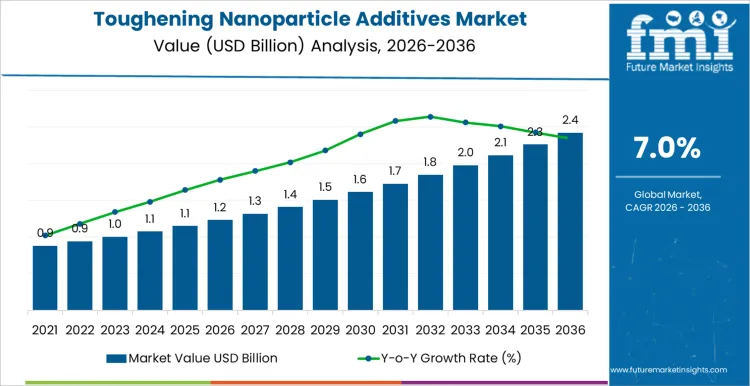
The toughening nanoparticle additives market is projected to expand from USD 1.23 billion in 2026 to USD 2.4 billion by 2036, advancing at a CAGR of 7.0% over the forecast period. Market performance is shaped by value-driven adoption rather than bulk volume growth, with capital increasingly directed toward high-performance applications where mechanical reliability directly influences product lifetime. Investment intensity is concentrated in nanoparticle surface treatment, dispersion technology, and application-specific formulation support, as these capabilities determine differentiation and pricing leverage.
Returns are typically realized over longer qualification cycles, especially in automotive, aerospace, wind energy, and electronics, where additives become embedded in approved material platforms. End-use dependency on composites, structural adhesives, and engineered polymers provides relatively stable demand anchored to lightweighting and durability requirements rather than short-term cycles.
As cost-sensitive applications remain selective, capital allocation favors scalable production of low-dosage, high-efficiency additives that deliver measurable toughness gains. Between 2026 and 2036, firms that balance materials science investment with disciplined capacity expansion are best positioned to capture sustained, margin-led growth.
Quick Stats for Toughening Nanoparticle Additives Market
- Toughening Nanoparticle Additives Market Value (2026): USD 1.23 Billion
- Toughening Nanoparticle Additives Market Forecast Value (2036): USD 2.4 Billion
- Toughening Nanoparticle Additives Market Forecast CAGR 2026 to 2036: 7.0%
- Leading Resin System in Toughening Nanoparticle Additives Market: Epoxy Resins (42% share)
- Key Growth Regions in Toughening Nanoparticle Additives Market: Asia Pacific, North America, Europe, Latin America, Middle East & Africa
- Top Key Players in Toughening Nanoparticle Additives Market: 3M Advanced Materials, Evonik Industries AG, Cabot Corporation, Arkema, BASF SE, Wacker Chemie AG, Momentive Performance Materials, Dow, Henkel, DSM Coating Resins (Covestro)
Toughening Nanoparticle Additives Market Key Takeaways
| Metric | Value |
|---|---|
| Toughening Nanoparticle Additives Market Value (2026) | USD 1.23 Billion |
| Toughening Nanoparticle Additives Market Forecast Value (2036) | USD 2.4 Billion |
| Toughening Nanoparticle Additives Market Forecast CAGR 2026 to 2036 | 7.0% |
How are Impact Resistance Targets and Lightweighting Trends Driving the Toughening Nanoparticle Additives Market?
The toughening nanoparticle additives market is expanding as manufacturers seek to improve fracture toughness and impact resistance without sacrificing stiffness or adding excessive weight. Nanoparticles such as rubber-modified cores, silica, and nano-elastomers are incorporated at low loadings to arrest crack propagation and dissipate energy under stress. For compounders and composite producers, this enables performance enhancement in engineering plastics, epoxies, and thermoset systems while maintaining processability and part geometry.
Qualification and dispersion control are central to adoption. Effective toughening requires uniform nanoparticle distribution to avoid agglomeration that can degrade surface finish or mechanical properties. Buyers prioritize suppliers that provide surface-treated nanoparticles, masterbatch formats, and application-specific guidance to ensure consistent dispersion across extrusion, molding, and resin infusion processes. Demonstrated improvements in impact strength, fatigue resistance, and long-term durability are increasingly required during material qualification.
Scale economics and application breadth are further supporting market growth. Demand from automotive lightweighting, electronics housings, wind energy composites, and industrial equipment is sustaining volume expansion. As manufacturers standardize advanced materials across platforms, they favor additives that deliver predictable performance at low dosage and are compatible with existing formulations. For additive suppliers, competitive advantage increasingly depends on materials science expertise, technical support, and reliable supply positioning toughening nanoparticle additives as a steady-growth enabler in high-performance, lightweight material systems.
How is the Toughening Nanoparticle Additives Market Structured by Resin System and Application?
The toughening nanoparticle additives market is segmented by resin system and application, reflecting how fracture resistance, impact performance, and end-use stress conditions influence additive selection. By resin system, epoxy resins represent the leading segment, as nanoparticle toughening is widely applied to improve crack resistance and mechanical durability in high-performance epoxy formulations. Other resin systems include polyesters and vinyl esters, thermoplastics, and other polymer matrices where impact modification is required. By application, composites and structural adhesives account for the largest demand, followed by coatings and flooring, electronics encapsulation and packaging, and other uses where mechanical reinforcement and reliability are critical.
Why Do Epoxy Resins Lead Resin System Adoption in the Toughening Nanoparticle Additives Market?
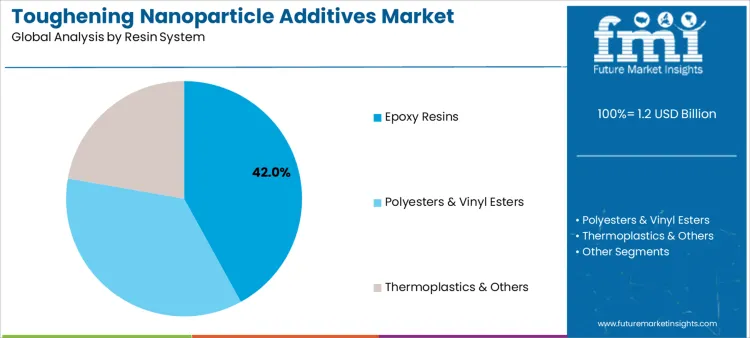
Epoxy resins account for 42% share of the toughening nanoparticle additives market because they are extensively used in high-stress applications where brittleness must be controlled without sacrificing strength. Nanoparticle additives improve fracture toughness, fatigue resistance, and crack propagation behavior in epoxy systems used for aerospace, automotive, wind energy, and industrial bonding. These additives disperse at the nanoscale, enhancing performance while maintaining viscosity and processability. Manufacturers favor epoxy-based systems due to predictable curing behavior and strong adhesion characteristics. The widespread use of epoxies in structural applications explains their leading adoption.
Why Do Composites And Structural Adhesives Dominate Application Demand In The Toughening Nanoparticle Additives Market?
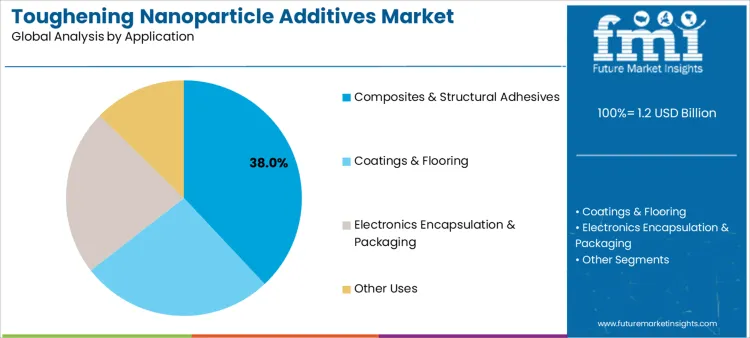
Composites and structural adhesives hold 38% share of the toughening nanoparticle additives market because these applications are highly sensitive to impact, fatigue, and long-term mechanical stress. Nanoparticle toughening improves load transfer and damage tolerance in fiber-reinforced composites and bonded joints. Industries such as aerospace, automotive, construction, and renewable energy rely on reinforced composites to meet strength and durability requirements. Structural adhesives also benefit from improved peel strength and crack resistance. High performance expectations and increasing composite usage across industries explain why this application segment remains dominant.
What are the Key Dynamics of the Toughening Nanoparticle Additives Market?
The toughening nanoparticle additives market is driven by demand for high-performance materials that require enhanced mechanical toughness, impact resistance, and fatigue life across end-use industries such as automotive, aerospace, industrial equipment, and consumer electronics. Toughening nanoparticle additives such as silica nanoparticles, core-shell elastomers, nanoclay, graphene derivatives, and rubber-based nano-domains are formulated to improve polymer and composite performance without significantly compromising stiffness or thermal properties. For additive manufacturers and compounders, particle surface chemistry, dispersibility, compatibility with diverse polymer matrices, and scalable production quality are essential factors that influence buyer selection and long-term formulation use.
How do Technology and Application Trends Shape This Market?
Technology and application trends are shaping the toughening nanoparticle additives market through increasing use of lightweight composites, multifunctional polymers, and refined processing technologies. In automotive and electric mobility sectors, toughened polymers contribute to reduced vehicle weight while improving crashworthiness and durability. Electronics and consumer devices demand materials with enhanced drop performance and fatigue resistance.
Advances in nanoparticle surface functionalization, reactive compatibilizers, and processing aids improve nanoparticle dispersion at micro- and nano-scales, enabling more consistent toughening effects. Adoption of twin-screw extrusion, reactive extrusion, and advanced compounding systems helps formulators achieve uniform additive distribution, expanding use cases across production environments.
Why do Dispersion Challenges and Cost Constraints Restrain Market Growth?
Dispersion challenges and cost constraints restrain growth in the toughening nanoparticle additives market because effective mechanical enhancement depends on achieving uniform particle distribution without agglomeration. Poor dispersion can lead to stress concentrations, defects, or inconsistent property gains, requiring sophisticated processing, compatibilizers, and quality control, which add to formulation complexity and cost.
Nanoparticle additives especially engineered or surface-modified grades often carry higher unit costs than conventional fillers or rubber tougheners, which can limit uptake in price-sensitive applications. Qualification cycles for critical applications (e.g., structural automotive, aerospace) are lengthy and require extensive mechanical testing, adding barriers for both additive suppliers and compounders.
How is the Toughening Nanoparticle Additives Market Growing across Key Countries?
The toughening nanoparticle additives market is expanding as manufacturers seek to enhance impact resistance, fracture toughness, and durability of polymers, composites, coatings, and adhesives without compromising stiffness or thermal performance. These additives commonly based on silica, rubber-modified particles, and core shell nanoparticles are increasingly used in automotive components, aerospace composites, electronics encapsulation, industrial coatings, and high-performance plastics. Country-wise growth varies depending on advanced material adoption, composite manufacturing intensity, and demand for lightweight yet durable materials. High-growth markets are supported by expanding industrial production, while mature regions emphasize material optimization and performance-driven applications.
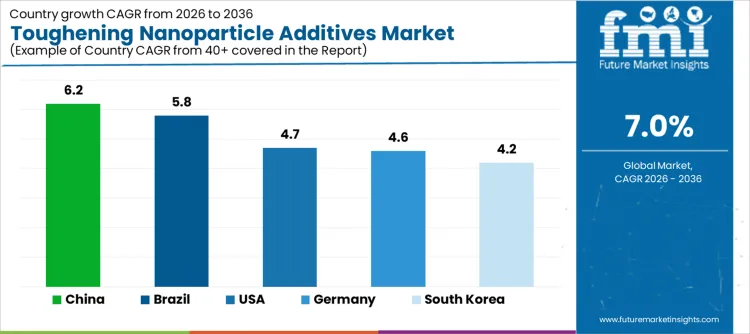
| Country | CAGR (%) |
|---|---|
| China | 6.2 |
| Brazil | 5.8 |
| United States | 4.7 |
| Germany | 4.6 |
| South Korea | 4.2 |
Why Is China Leading the Toughening Nanoparticle Additives Market?
China’s toughening nanoparticle additives market is expanding at a CAGR of 6.2% during 2026 to 2036, driven by rapid growth in automotive manufacturing, industrial coatings, electronics, and composite materials production. Chinese manufacturers increasingly incorporate nanoparticle additives into polymers and resins to improve impact strength, crack resistance, and fatigue performance in high-volume applications. Demand is strong in automotive interiors and exteriors, electrical housings, construction materials, and wind energy composites.
Chinese formulators prioritize nanoparticle additives that offer uniform dispersion, compatibility with epoxy, thermoplastic, and polyurethane systems, and scalability for large-batch processing. Domestic material suppliers benefit from expanding nanomaterial production capacity and improving dispersion technologies, enabling competitive pricing and reliable supply. Procurement decisions emphasize cost efficiency, dispersion stability, and consistency across production batches.
Why Is Brazil Seeing Growing Adoption of Toughening Nanoparticle Additives?
Brazil’s toughening nanoparticle additives market is growing at a CAGR of 5.8% during 2026 to 2036, supported by rising demand from automotive components, construction materials, and industrial coatings. Manufacturers are increasingly using nanoparticle additives to enhance durability and impact resistance of polymers used in flooring, protective coatings, adhesives, and composite structures. Brazilian buyers value additives that improve mechanical performance under high temperature and humidity conditions while maintaining processability.
Toughening nanoparticles are particularly attractive for industrial flooring, infrastructure coatings, and composite parts used in transportation and energy applications. Adoption is gradual, reflecting cost sensitivity and the need for formulation validation. Procurement decisions often favor suppliers offering technical support for dispersion and formulation optimization, as well as reliable local distribution. As industrial and infrastructure projects expand, demand for advanced material additives is expected to rise steadily.
What Is Driving Demand for Toughening Nanoparticle Additives in the United States?
The United States toughening nanoparticle additives market is expanding at a CAGR of 4.7% during 2026 to 2036, driven by demand from aerospace, automotive, electronics, and high-performance composite applications. U.S. manufacturers use nanoparticle additives to improve fracture toughness and durability in advanced resin systems without sacrificing stiffness or thermal properties. Buyers emphasize consistent particle size, dispersion quality, and predictable performance across production cycles. Demand is strongest in aerospace composites, electronic encapsulation materials, industrial coatings, and specialty adhesives. Adoption is performance-driven and focused on high-value applications rather than high-volume usage. Procurement decisions prioritize supplier reliability, detailed technical documentation, and long-term material consistency. Market growth is shaped by continued innovation in advanced materials, defense and aerospace programs, and increasing use of lightweight composite structures.
How Is Germany Supporting Growth in the Toughening Nanoparticle Additives Market?
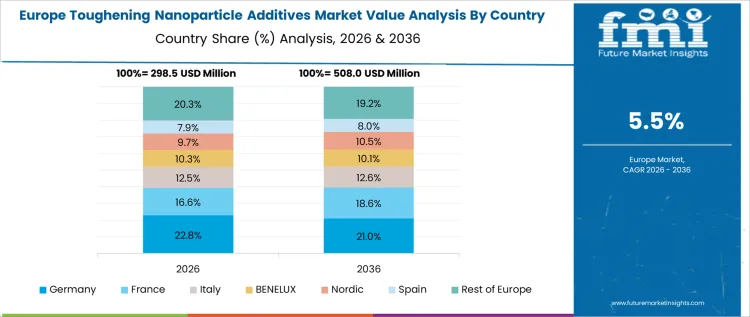
Germany’s toughening nanoparticle additives market is growing at a CAGR of 4.6% during 2026 to 2036, supported by demand from automotive engineering, industrial manufacturing, and advanced composites. German manufacturers emphasize precision material design, durability, and long service life, making nanoparticle-based toughening solutions attractive for high-specification applications. Buyers prioritize additives that deliver controlled toughening effects, stable dispersion, and compatibility with engineered polymer systems.
Applications include automotive structural components, industrial machinery parts, and high-performance coatings. Adoption is driven by performance optimization rather than cost reduction. Procurement decisions favor suppliers with strong quality systems, reproducible material properties, and the ability to support customized formulations. Market growth is reinforced by Germany’s leadership in engineering-intensive industries and continuous material innovation.
How Is South Korea Expanding Use of Toughening Nanoparticle Additives?

South Korea’s toughening nanoparticle additives market is expanding at a CAGR of 4.2% during 2026 to 2036, driven by demand from electronics manufacturing, automotive components, and advanced materials production. Nanoparticle additives are increasingly used to enhance mechanical reliability and impact resistance in compact and high-precision components. Buyers emphasize dispersion stability, compatibility with high-performance resins, and suitability for automated manufacturing processes. Adoption is strongest in export-oriented electronics and automotive applications where material performance and consistency are critical. Procurement decisions are influenced by supplier technical capability, consistent supply quality, and alignment with global material standards. Market growth is supported by steady industrial expansion and continued demand for advanced polymer and composite materials.
How are Companies Competing in the Toughening Nanoparticle Additives Market?
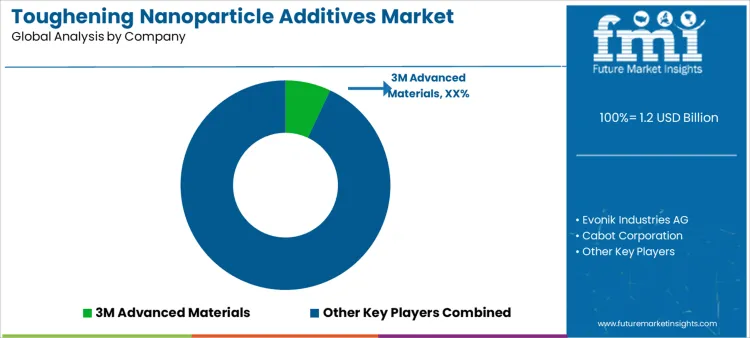
Competition in the toughening nanoparticle additives market is shaped by nanoparticle dispersion quality, reinforcement efficiency, and compatibility with diverse polymer matrices - factors that matter to materials engineers, compounders, and OEM formulators. These additives are designed to enhance impact resistance, fracture toughness, and durability in advanced coatings, adhesives, elastomers, and high-performance plastics without compromising stiffness or processability. 3M Advanced Materials anchors the market with engineered nanoparticle systems that emphasize uniform dispersion, scalable processing, and demonstrable mechanical performance gains in both thermoset and thermoplastic systems.
Specialty and performance chemical leaders differentiate through tailored surface chemistries and multifunctional performance. Evonik Industries AG and Cabot Corporation compete by offering nanoparticle additives optimized for matrix interaction and stress transfer, supported by technical data on impact improvement and fatigue resistance. Arkema and BASF SE emphasize formulations designed for automotive, packaging, and durable goods applications, where balance between toughness and other functional properties is critical.
Global material suppliers extend competitive breadth through broad polymer additive portfolios. Wacker Chemie AG, Momentive Performance Materials, and Dow provide nanoparticle functionalities engineered for elastomer and high-temperature thermoplastic systems, with focus on manufacturability and dispersion control. Henkel and DSM Coating Resins (Covestro lineage) differentiate through system-level solutions where toughening additives are paired with resin systems for coatings or adhesive platforms. Across the market, competitive advantage is defined by additive performance consistency, dispersion technology, and formulation support rather than additive price alone.
Key Players in Toughening Nanoparticle Additives Market
- 3M Advanced Materials
- Evonik Industries AG
- Cabot Corporation
- Arkema
- BASF SE
- Wacker Chemie AG
- Momentive Performance Materials
- Dow
- Henkel (toughened systems)
- DSM Coating Resins (Covestro)
Scope of Report
| Attribute | Details |
|---|---|
| Market Size Unit | USD Million |
| Resin System Covered | Epoxy Resins, Polyesters & Vinyl Esters, Thermoplastics, Other Toughenable Resin Systems |
| Application Covered | Composites & Structural Adhesives, Coatings & Flooring Systems, Electronics Encapsulation & Packaging, Other Industrial and Specialty Applications |
| Countries Covered | China, Japan, South Korea, India, Australia & New Zealand, ASEAN, Rest of Asia Pacific, Germany, United Kingdom, France, Italy, Spain, Nordic, BENELUX, Rest of Europe, United States, Canada, Mexico, Brazil, Chile, Rest of Latin America, Kingdom of Saudi Arabia, Other GCC Countries, Turkey, South Africa, Other African Union, Rest of Middle East & Africa |
| Regions Covered | Asia Pacific, Europe, North America, Latin America, Middle East & Africa |
| Key Companies Profiled | 3M Advanced Materials, Evonik Industries AG, Cabot Corporation, Arkema, BASF SE, Wacker Chemie AG, Momentive Performance Materials, Dow, Henkel, DSM Coating Resins (Covestro) |
| Additional Attributes | Dollar sales by resin system and application are assessed across composite, coating, and electronics markets. The scope evaluates impact resistance improvement, fracture toughness, dispersion efficiency, and compatibility with host resins. Country-level analysis reflects composite manufacturing growth, lightweight material adoption, electronics miniaturization, and demand for high-performance toughened material systems. |
Toughening Nanoparticle Additives Market by Key Segments
Resin System:
- Epoxy Resins
- Polyesters & Vinyl Esters
- Thermoplastics & Others
Application:
- Composites & Structural Adhesives
- Coatings & Flooring
- Electronics Encapsulation & Packaging
- Other Uses
Region:
- Asia Pacific
- China
- Japan
- South Korea
- India
- Australia & New Zealand
- ASEAN
- Rest of Asia Pacific
- Europe
- Germany
- United Kingdom
- France
- Italy
- Spain
- Nordic
- BENELUX
- Rest of Europe
- North America
- United States
- Canada
- Mexico
- Latin America
- Brazil
- Chile
- Rest of Latin America
- Middle East & Africa
- Kingdom of Saudi Arabia
- Other GCC Countries
- Turkey
- South Africa
- Other African Union
- Rest of Middle East & Africa
Bibliography
- United Nations Environment Programme. (2024). Sustainability and safety considerations for nanomaterials in industrial applications. UNEP.
- National Institute of Standards and Technology. (2024). Measurement challenges and dispersion characterization of nanoparticle‑reinforced polymers. NIST.
- Royal Society of Chemistry. (2024). Nanoscale toughening strategies for high‑performance polymer systems. Nanoscale, 16(7), 4125-4146.
- Zhou, Y., Wang, L., & Li, J. (2024). Toughening mechanisms of nanoparticle‑modified epoxy and thermoplastic systems: A critical review. Progress in Materials Science, 139, 101098.
- United Nations Industrial Development Organization. (2024). Advanced materials and nanotechnology adoption in lightweight manufacturing systems. UNIDO.
Frequently Asked Questions
How big is the toughening nanoparticle additives market in 2026?
The global toughening nanoparticle additives market is estimated to be valued at USD 1.2 billion in 2026.
What will be the size of toughening nanoparticle additives market in 2036?
The market size for the toughening nanoparticle additives market is projected to reach USD 2.4 billion by 2036.
How much will be the toughening nanoparticle additives market growth between 2026 and 2036?
The toughening nanoparticle additives market is expected to grow at a 7.0% CAGR between 2026 and 2036.
What are the key product types in the toughening nanoparticle additives market?
The key product types in toughening nanoparticle additives market are epoxy resins, polyesters & vinyl esters and thermoplastics & others.
Which application segment to contribute significant share in the toughening nanoparticle additives market in 2026?
In terms of application, composites & structural adhesives segment to command 38.0% share in the toughening nanoparticle additives market in 2026.
Preview the report firsthand - request a free sample
Get SampleGet the brochure for pricing and purchase details.
Get PDFTable of Content
- Executive Summary
- Global Market Outlook
- Demand-side Trends
- Supply-side Trends
- Technology Roadmap Analysis
- Analysis and Recommendations
- Market Overview
- Market Coverage / Taxonomy
- Market Definition / Scope / Limitations
- Market Background
- Market Dynamics
- Drivers
- Restraints
- Opportunity
- Trends
- Scenario Forecast
- Demand in Optimistic Scenario
- Demand in Likely Scenario
- Demand in Conservative Scenario
- Opportunity Map Analysis
- Product Life Cycle Analysis
- Supply Chain Analysis
- Investment Feasibility Matrix
- Value Chain Analysis
- PESTLE and Porter’s Analysis
- Regulatory Landscape
- Regional Parent Market Outlook
- Production and Consumption Statistics
- Import and Export Statistics
- Market Dynamics
- Global Market Analysis 2021 to 2025 and Forecast, 2026 to 2036
- Historical Market Size Value (USD Million) Analysis, 2021 to 2025
- Current and Future Market Size Value (USD Million) Projections, 2026 to 2036
- Y-o-Y Growth Trend Analysis
- Absolute $ Opportunity Analysis
- Global Market Pricing Analysis 2021 to 2025 and Forecast 2026 to 2036
- Global Market Analysis 2021 to 2025 and Forecast 2026 to 2036, By Resin System
- Introduction / Key Findings
- Historical Market Size Value (USD Million) Analysis By Resin System , 2021 to 2025
- Current and Future Market Size Value (USD Million) Analysis and Forecast By Resin System , 2026 to 2036
- Epoxy Resins
- Polyesters & Vinyl Esters
- Thermoplastics & Others
- Epoxy Resins
- Y-o-Y Growth Trend Analysis By Resin System , 2021 to 2025
- Absolute $ Opportunity Analysis By Resin System , 2026 to 2036
- Global Market Analysis 2021 to 2025 and Forecast 2026 to 2036, By Application
- Introduction / Key Findings
- Historical Market Size Value (USD Million) Analysis By Application, 2021 to 2025
- Current and Future Market Size Value (USD Million) Analysis and Forecast By Application, 2026 to 2036
- Composites & Structural Adhesives
- Coatings & Flooring
- Electronics Encapsulation & Packaging
- Other Uses
- Composites & Structural Adhesives
- Y-o-Y Growth Trend Analysis By Application, 2021 to 2025
- Absolute $ Opportunity Analysis By Application, 2026 to 2036
- Global Market Analysis 2021 to 2025 and Forecast 2026 to 2036, By Region
- Introduction
- Historical Market Size Value (USD Million) Analysis By Region, 2021 to 2025
- Current Market Size Value (USD Million) Analysis and Forecast By Region, 2026 to 2036
- North America
- Latin America
- Western Europe
- Eastern Europe
- East Asia
- South Asia and Pacific
- Middle East & Africa
- Market Attractiveness Analysis By Region
- North America Market Analysis 2021 to 2025 and Forecast 2026 to 2036, By Country
- Historical Market Size Value (USD Million) Trend Analysis By Market Taxonomy, 2021 to 2025
- Market Size Value (USD Million) Forecast By Market Taxonomy, 2026 to 2036
- By Country
- USA
- Canada
- Mexico
- By Resin System
- By Application
- By Country
- Market Attractiveness Analysis
- By Country
- By Resin System
- By Application
- Key Takeaways
- Latin America Market Analysis 2021 to 2025 and Forecast 2026 to 2036, By Country
- Historical Market Size Value (USD Million) Trend Analysis By Market Taxonomy, 2021 to 2025
- Market Size Value (USD Million) Forecast By Market Taxonomy, 2026 to 2036
- By Country
- Brazil
- Chile
- Rest of Latin America
- By Resin System
- By Application
- By Country
- Market Attractiveness Analysis
- By Country
- By Resin System
- By Application
- Key Takeaways
- Western Europe Market Analysis 2021 to 2025 and Forecast 2026 to 2036, By Country
- Historical Market Size Value (USD Million) Trend Analysis By Market Taxonomy, 2021 to 2025
- Market Size Value (USD Million) Forecast By Market Taxonomy, 2026 to 2036
- By Country
- Germany
- UK
- Italy
- Spain
- France
- Nordic
- BENELUX
- Rest of Western Europe
- By Resin System
- By Application
- By Country
- Market Attractiveness Analysis
- By Country
- By Resin System
- By Application
- Key Takeaways
- Eastern Europe Market Analysis 2021 to 2025 and Forecast 2026 to 2036, By Country
- Historical Market Size Value (USD Million) Trend Analysis By Market Taxonomy, 2021 to 2025
- Market Size Value (USD Million) Forecast By Market Taxonomy, 2026 to 2036
- By Country
- Russia
- Poland
- Hungary
- Balkan & Baltic
- Rest of Eastern Europe
- By Resin System
- By Application
- By Country
- Market Attractiveness Analysis
- By Country
- By Resin System
- By Application
- Key Takeaways
- East Asia Market Analysis 2021 to 2025 and Forecast 2026 to 2036, By Country
- Historical Market Size Value (USD Million) Trend Analysis By Market Taxonomy, 2021 to 2025
- Market Size Value (USD Million) Forecast By Market Taxonomy, 2026 to 2036
- By Country
- China
- Japan
- South Korea
- By Resin System
- By Application
- By Country
- Market Attractiveness Analysis
- By Country
- By Resin System
- By Application
- Key Takeaways
- South Asia and Pacific Market Analysis 2021 to 2025 and Forecast 2026 to 2036, By Country
- Historical Market Size Value (USD Million) Trend Analysis By Market Taxonomy, 2021 to 2025
- Market Size Value (USD Million) Forecast By Market Taxonomy, 2026 to 2036
- By Country
- India
- ASEAN
- Australia & New Zealand
- Rest of South Asia and Pacific
- By Resin System
- By Application
- By Country
- Market Attractiveness Analysis
- By Country
- By Resin System
- By Application
- Key Takeaways
- Middle East & Africa Market Analysis 2021 to 2025 and Forecast 2026 to 2036, By Country
- Historical Market Size Value (USD Million) Trend Analysis By Market Taxonomy, 2021 to 2025
- Market Size Value (USD Million) Forecast By Market Taxonomy, 2026 to 2036
- By Country
- Kingdom of Saudi Arabia
- Other GCC Countries
- Turkiye
- South Africa
- Other African Union
- Rest of Middle East & Africa
- By Resin System
- By Application
- By Country
- Market Attractiveness Analysis
- By Country
- By Resin System
- By Application
- Key Takeaways
- Key Countries Market Analysis
- USA
- Pricing Analysis
- Market Share Analysis, 2025
- By Resin System
- By Application
- Canada
- Pricing Analysis
- Market Share Analysis, 2025
- By Resin System
- By Application
- Mexico
- Pricing Analysis
- Market Share Analysis, 2025
- By Resin System
- By Application
- Brazil
- Pricing Analysis
- Market Share Analysis, 2025
- By Resin System
- By Application
- Chile
- Pricing Analysis
- Market Share Analysis, 2025
- By Resin System
- By Application
- Germany
- Pricing Analysis
- Market Share Analysis, 2025
- By Resin System
- By Application
- UK
- Pricing Analysis
- Market Share Analysis, 2025
- By Resin System
- By Application
- Italy
- Pricing Analysis
- Market Share Analysis, 2025
- By Resin System
- By Application
- Spain
- Pricing Analysis
- Market Share Analysis, 2025
- By Resin System
- By Application
- France
- Pricing Analysis
- Market Share Analysis, 2025
- By Resin System
- By Application
- India
- Pricing Analysis
- Market Share Analysis, 2025
- By Resin System
- By Application
- ASEAN
- Pricing Analysis
- Market Share Analysis, 2025
- By Resin System
- By Application
- Australia & New Zealand
- Pricing Analysis
- Market Share Analysis, 2025
- By Resin System
- By Application
- China
- Pricing Analysis
- Market Share Analysis, 2025
- By Resin System
- By Application
- Japan
- Pricing Analysis
- Market Share Analysis, 2025
- By Resin System
- By Application
- South Korea
- Pricing Analysis
- Market Share Analysis, 2025
- By Resin System
- By Application
- Russia
- Pricing Analysis
- Market Share Analysis, 2025
- By Resin System
- By Application
- Poland
- Pricing Analysis
- Market Share Analysis, 2025
- By Resin System
- By Application
- Hungary
- Pricing Analysis
- Market Share Analysis, 2025
- By Resin System
- By Application
- Kingdom of Saudi Arabia
- Pricing Analysis
- Market Share Analysis, 2025
- By Resin System
- By Application
- Turkiye
- Pricing Analysis
- Market Share Analysis, 2025
- By Resin System
- By Application
- South Africa
- Pricing Analysis
- Market Share Analysis, 2025
- By Resin System
- By Application
- USA
- Market Structure Analysis
- Competition Dashboard
- Competition Benchmarking
- Market Share Analysis of Top Players
- By Regional
- By Resin System
- By Application
- Competition Analysis
- Competition Deep Dive
- 3M Advanced Materials
- Overview
- Product Portfolio
- Profitability by Market Segments (Product/Age /Sales Channel/Region)
- Sales Footprint
- Strategy Overview
- Marketing Strategy
- Product Strategy
- Channel Strategy
- Evonik Industries AG
- Cabot Corporation
- Arkema
- BASF SE
- Wacker Chemie AG
- Momentive Performance Materials
- Dow
- Henkel (toughened systems)
- DSM Coating Resins (Covestro)
- 3M Advanced Materials
- Competition Deep Dive
- Assumptions & Acronyms Used
- Research Methodology


