

- Industry Size (2025)
- USD 698.9 Mn
- Forecast (2035)
- USD 1845.7 Mn
- CAGR (2025 to 2035)
- 10%
Lipid Nanoparticle Reagents Kits Market Forecast and Outlook 2025 to 2035
The global lipid nanoparticle reagents kits market is projected to reach USD 1,845.7 million by 2035, recording an absolute increase of USD 1,146.8 million over the forecast period. This market is valued at USD 698.9 million in 2025 and is set to rise at a CAGR of 10% during the assessment period. Overall size is anticipated to expand during this timeframe, supported by rising investments in mRNA-based vaccine development, gene therapy platforms, and next-generation drug delivery research across biotechnology and pharmaceutical sectors globally.
Technological advancements in lipid composition optimization, microfluidic mixing systems, and formulation stability are reshaping the lipid nanoparticle reagents kits landscape. Modern kits integrate proprietary cationic and ionizable lipid formulations designed for improved endosomal escape and payload release, while modular reagent systems support flexible screening of lipid ratios to achieve desired physicochemical properties. Compatibility with leading automated synthesis and analytical platforms including microfluidic mixers, nanoparticle tracking analyzers, and dynamic light scattering systems facilitates seamless integration into preclinical and process development workflows.
Quick Stats for Lipid Nanoparticle Reagents Kits Market
- Lipid Nanoparticle Reagents Kits Market Value (2025): USD 698.9 million
- Lipid Nanoparticle Reagents Kits Market Forecast Value (2035): USD 1,845.7 million
- Lipid Nanoparticle Reagents Kits Market Forecast CAGR: 10%
- Leading Product Type in Lipid Nanoparticle Reagents Kits Market: Lipid Formulation Kits with 38.5% share
- Key Growth Regions in Lipid Nanoparticle Reagents Kits Market: Asia Pacific, Europe, and North America
- Top Players in Lipid Nanoparticle Reagents Kits Market: Precision NanoSystems (Danaher), Evonik Industries AG, Polymun Scientific, Acuitas Therapeutics, Merck KGaA, Avanti Polar Lipids (Croda), CordenPharma International, BioNTech Manufacturing Services, Nitto Denko/Reprocell
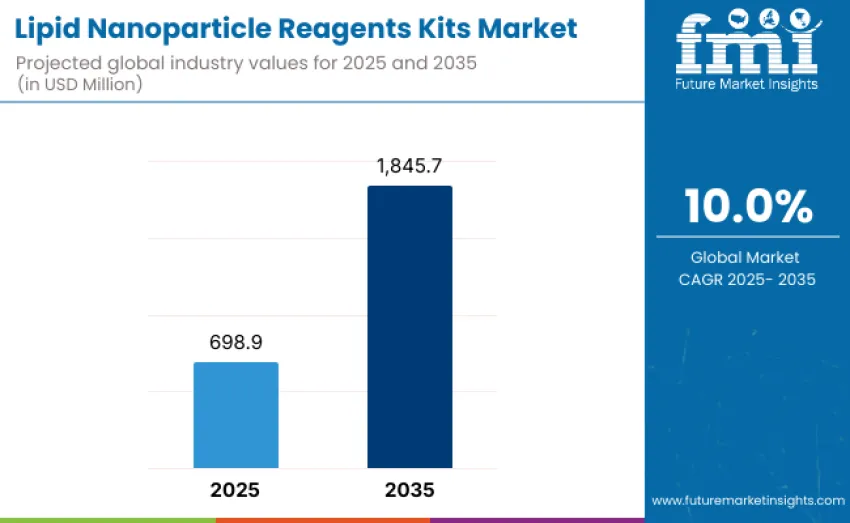
Government funding for RNA-based therapeutic development, along with public-private partnerships supporting pandemic preparedness and personalized medicine research, are accelerating growth. Academic and translational research institutions increasingly adopt LNP reagent kits to support RNA delivery studies, oncology research, and vaccine platform development, while biotechnology companies leverage them to streamline early-stage formulation screening. The continued expansion of mRNA vaccine pipelines, gene therapy clinical trials, and nanomedicine innovation programs across North America, Europe, and Asia-Pacific sustains long-term demand for high-quality reagent kits.
Lipid Nanoparticle Reagents Kits Market Year-over-Year Forecast (2025 to 2035)
Between 2025 and 2030, the Lipid Nanoparticle Reagents Kits Market is projected to expand from USD 698.9 million to USD 1,182 million, resulting in a value increase of USD 483.1 million, which represents 42.1% of total forecast growth for the decade. This phase will be shaped by rising demand for mRNA-based vaccine research, increasing adoption of lipid nanoparticle delivery systems in gene therapy and RNA interference studies, and expanding use of LNP formulation kits in preclinical and translational research laboratories.
From 2030 to 2035, growth is forecast from USD 1,182 million to USD 1,845.7 million, adding USD 663.7 million, which constitutes 57.9% of overall ten-year expansion. This period is expected to be characterized by commercial maturation of RNA-based therapeutics, large-scale adoption of LNP technologies in gene therapy manufacturing, and integration of automated formulation and analytical platforms into drug development workflows. Strategic collaborations between biotechnology companies, academic research centers, and reagent manufacturers will drive innovation in lipid chemistry, process scalability, and reproducibility.
Lipid Nanoparticle Reagents Kits Market Key Takeaways
| Metric | Value |
|---|---|
| Market Value (2025) | USD 698.9 million |
| Market Forecast Value (2035) | USD 1,845.7 million |
| Forecast CAGR (2025 to 2035) | 10% |
Why Is the Lipid Nanoparticle Reagents Kits Market Growing Worldwide?
The Lipid Nanoparticle Reagents Kits Market is growing worldwide by enabling biotechnology and pharmaceutical researchers to achieve superior precision and formulation efficiency in developing RNA-based therapeutics and advanced drug delivery systems. Scientists and process engineers face increasing pressure to produce stable, high-performance lipid nanoparticle formulations that ensure efficient nucleic acid delivery, consistent encapsulation, and reproducible particle size distribution across large-scale research and production environments. LNP reagent kits provide optimized lipid mixtures and standardized formulation protocols that improve workflow efficiency by 30-50% compared to conventional formulation methods.
Government initiatives promoting biopharmaceutical research and national vaccine self-reliance programs are driving adoption across academic institutions, contract research organizations, and clinical-stage biotech firms. Public-private collaborations supporting pandemic preparedness, oncology research, and personalized medicine development stimulate the use of LNP reagent kits in translational and applied research projects. The global shift toward advanced RNA therapeutics, accelerated by continuous progress in microfluidic formulation systems and automated process technologies, reinforces long-term demand for these reagents.
How Is the Lipid Nanoparticle Reagents Kits Market Segmented by Product Type, Application, and Region?
The lipid nanoparticle reagents kits market is segmented by product type, application, and region. By product type, division includes lipid formulation kits, nucleic acid encapsulation reagents, stabilization & cryoprotectant kits, surface functionalization reagents, and purification & characterization kits. Based on application, categorization covers mRNA vaccines, gene therapy & siRNA delivery, drug delivery research, cell therapy manufacturing, and protein replacement therapy. Regionally, segmentation spans Asia Pacific, Europe, North America, Latin America, and Middle East & Africa.
By Product Type, Lipid Formulation Kits Account for Largest Share
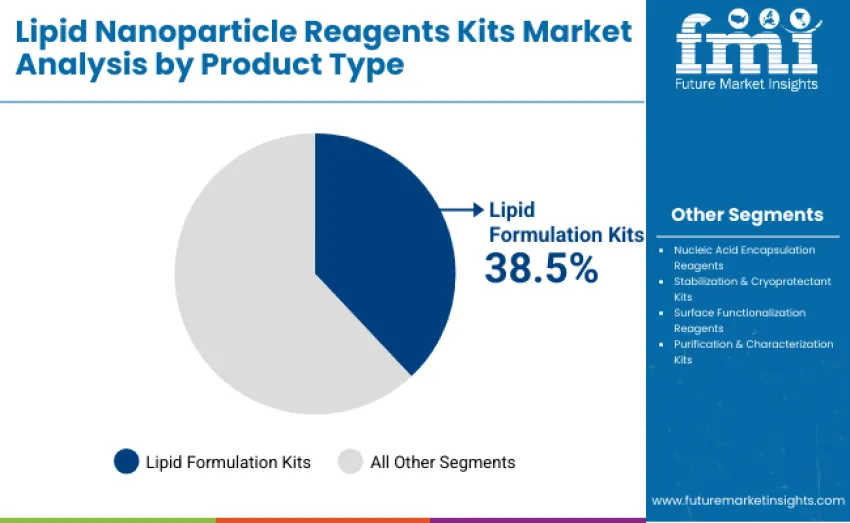
The lipid formulation kits segment represents the dominant force, capturing approximately 38.5% of total share in 2025. This advanced category encompasses essential lipid component mixtures designed to optimize nanoparticle formation, control particle uniformity, and enhance nucleic acid encapsulation efficiency, delivering consistent performance across research, clinical, and large-scale biomanufacturing applications. Leadership stems from its critical role in enabling reproducible formulation of mRNA vaccines, gene therapies, and RNA-based therapeutics where stability, scalability, and delivery efficiency determine project success.
The nucleic acid encapsulation reagents segment maintains a substantial 26.0% share, serving researchers and biopharmaceutical manufacturers developing RNA and DNA-based delivery systems that require precise encapsulation ratios and enhanced payload protection. Stabilization and cryoprotectant kits account for 13.0%, supporting long-term LNP preservation, cold-chain stability, and bioactivity retention during storage and transportation. Surface functionalization reagents contribute 12.5%, while purification & characterization kits represent 10.0% of revenue.
Key advantages driving the lipid formulation kits segment include:
- High formulation precision supporting consistent particle size and lipid composition critical for reproducible therapeutic performance
- Compatibility with diverse lipid chemistries enabling flexible formulation design for mRNA, siRNA, and gene delivery platforms
- Scalability across R&D to GMP manufacturing workflows ensuring seamless process translation
By Application, mRNA Vaccines Account for Largest Share
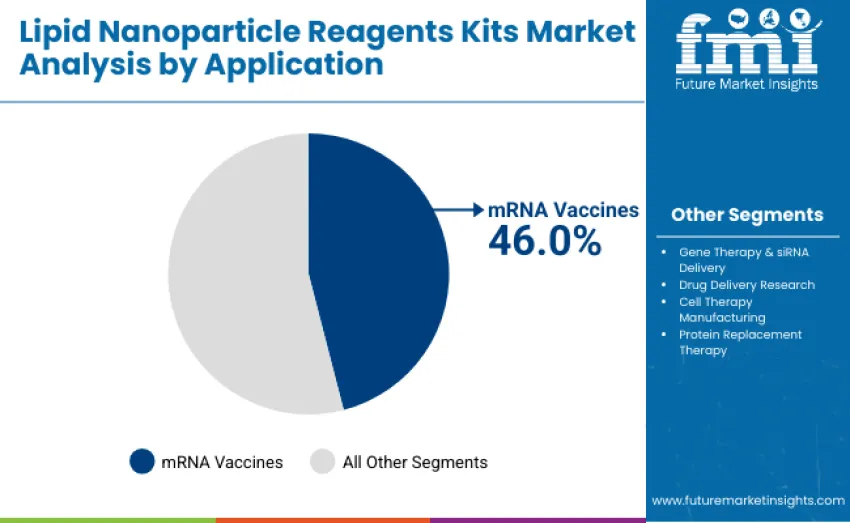
The mRNA vaccines segment dominates, capturing approximately 46.0% of total share in 2025. This leadership is attributed to the expanding adoption of mRNA vaccine platforms across infectious diseases, oncology, and pandemic preparedness programs. Pharmaceutical and biotech companies continue to invest heavily in lipid formulation optimization and scalable reagent systems that ensure high encapsulation efficiency and stability for mRNA payloads. Strong performance is reinforced by ongoing global vaccination initiatives and next-generation mRNA pipelines targeting influenza, RSV, cytomegalovirus, and personalized cancer vaccines.
The gene therapy and siRNA delivery segment follows with 26.5%, supported by increasing utilization of lipid nanoparticles in delivering genetic payloads for rare diseases, immune disorders, and gene-editing applications. Drug delivery research accounts for 15.0%, cell therapy manufacturing contributes 7.5%, and protein replacement therapy represents 5.0% of revenue.
Key market dynamics supporting application preferences include:
- Strong pipeline growth in mRNA-based vaccines targeting influenza, RSV, Zika, and cancer neoantigens, reinforcing large-scale adoption of lipid nanoparticle reagent kits
- Expansion of gene therapy research utilizing lipid-based vectors for safe and efficient genetic material delivery
- Increased investment by CDMOs and biopharma companies in scalable lipid nanoparticle manufacturing capabilities for clinical and commercial supply
What Are the Major Drivers, Restraints, and Emerging Trends Influencing the Lipid Nanoparticle Reagents Kits Market?
The lipid nanoparticle reagents kits market is driven by three concrete demand factors tied to the rapid evolution of biopharmaceutical research and therapeutic development workflows. Expansion of mRNA-based vaccine and therapeutics pipelines creates sustained requirements for standardized lipid nanoparticle formulation tools, with global RNA-based drug development activities growing by 10-15% annually and demanding proven reagent technologies that ensure encapsulation efficiency, reproducibility, and scalability. Acceleration of gene therapy and RNA interference research drives adoption of LNP reagent kits across both academic and industrial research programs, as these products enable streamlined formulation optimization.
What Are the Major Restraints Limiting Adoption in the LNP Reagents Kits Market?
Restraints in the market stem primarily from the high costs linked to specialized lipid components and formulation-grade reagents, which pose financial challenges for smaller laboratories, academic groups, and early-stage biotechnology companies operating with limited budgets. These expenses can restrict experimental scale, slow project timelines, and hinder broader adoption of advanced formulation technologies. Additionally, the need for precise handling conditions, strict environmental controls, and highly trained technical personnel further limits accessibility. Many low-resource research environments also lack the advanced instrumentation required, creating operational barriers and reducing opportunities for wider technology implementation.
What Emerging Trends Are Shaping the Lipid Nanoparticle Reagent Kits Market?
Key trends indicate accelerated adoption of lipid nanoparticle reagent kits in North America, Europe, and Asia-Pacific, particularly in countries investing heavily in RNA-based drug development and translational medicine infrastructure. Increasing integration of automation, microfluidic mixing, and sophisticated formulation design tools transforms the LNP preparation landscape by improving precision, reducing waste, and shortening optimization cycles. Collaborative research models between pharmaceutical companies, reagent manufacturers, and academic institutions advance next-generation lipid chemistries with enhanced endosomal escape and targeted tissue delivery capabilities.
How Are Leading Countries Driving Growth in the Lipid Nanoparticle Reagents Kits Market?
| Country | CAGR (2025 to 2035)% |
|---|---|
| United States | 10.2 |
| Brazil | 8.8 |
| China | 10.6 |
| India | 11.0 |
| Europe | 9.3 |
| Germany | 9.0 |
| United Kingdom | 8.5 |
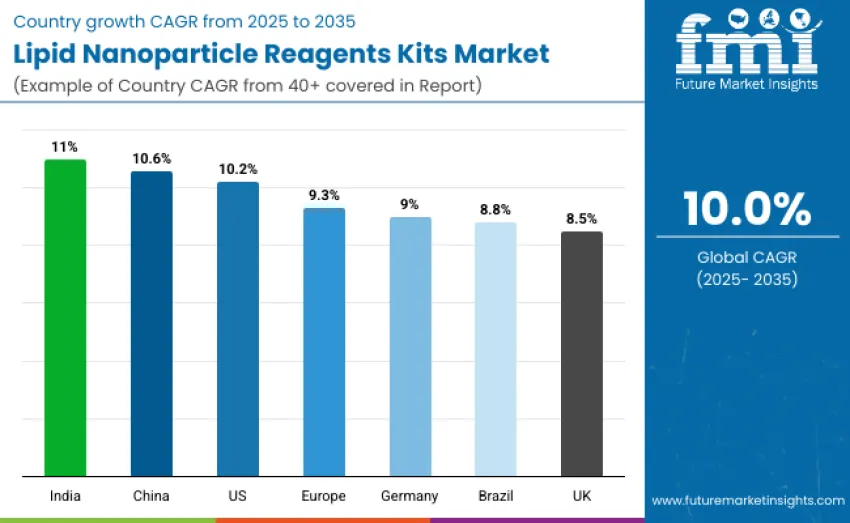
The lipid nanoparticle reagent kits market is expanding globally, with India leading at an 11.0% CAGR due to its growing biotech ecosystem, vaccine self-reliance programs, and strengthened LNP research capabilities. China follows at 10.6%, driven by government-backed RNA therapeutic initiatives and rising reagent manufacturing capacity. The U.S. grows at 10.2% through strong mRNA vaccine, gene therapy, and biomanufacturing investments. Europe records 9.3% growth, with Germany at 9.0% supported by pharmaceutical research strength and translational medicine programs. Brazil advances at 8.8%, while the U.K. grows at 8.5% through academic–industry partnerships and oncology-focused LNP adoption.
The report covers an in-depth analysis of 40+ countries top-performing countries are highlighted below.
How Is Biotechnology and Therapeutic Research Infrastructure Accelerating Growth in China?
China demonstrates the strongest growth potential with a CAGR of 10.6% through 2035. Leadership stems from large-scale investment in mRNA vaccine and gene therapy research, expanding biopharmaceutical industrial parks, and government programs promoting biotechnology innovation that drive adoption of standardized LNP reagent kits. Growth is concentrated in major research and industrial hubs, including Beijing, Shanghai, Shenzhen, and Suzhou, where academic institutions, contract research organizations, and pharmaceutical companies are equipping research teams with LNP reagent kits for formulation optimization.
Distribution channels through specialized life sciences suppliers, e-commerce platforms, and direct manufacturer partnerships expand deployment across commercial labs, academic research centers, and translational medicine facilities. The country's "Made in China 2025" initiative provides policy support for high-value pharmaceutical research, including subsidies for lab equipment procurement, research funding, and biotechnology startup incubation programs. Large-scale biotechnology and RNA therapeutics research in eastern provinces includes researchers engaged in vaccine, gene therapy, and RNAi formulation studies.
Why Are Creative Skill Development Programs Enhancing Adoption in India?
India's lipid nanoparticle reagents kits market demonstrates strong growth momentum with a CAGR of 11% through 2035, linked to comprehensive pharmaceutical sector diversification into RNA therapeutics and increasing focus on advanced drug delivery capability development. Indian researchers and biopharma companies are implementing standardized LNP formulation workflows and reagent systems to serve global therapeutic development pipelines while meeting regulatory and quality standards required for clinical applications. Leading biotechnology and research clusters, including Bangalore, Hyderabad, Mumbai, and Pune, drive LNP reagent kit adoption.
Government incentive programs enable funding support for laboratory infrastructure, reagent procurement, and skill development through national and state biotechnology promotion schemes. Technology collaboration agreements accelerate adoption with international reagent manufacturers establishing distribution partnerships and local technical support infrastructure. Policy support through DBT Translational Research programs, Biotechnology Industry Research Assistance Council initiatives, and skill development training programs provide equipment access, technical education, and hands-on formulation training. National biotechnology development programs and vaccine innovation initiatives create sustained demand.
How Does Biotechnology and Pharmaceutical Research Excellence Sustain Leadership in Germany?
Germany's advanced biotechnology and pharmaceutical research ecosystem demonstrates sophisticated implementation of lipid nanoparticle reagent kits, with documented case studies showing improvement in formulation workflow efficiency through standardized kit adoption across academic laboratories, contract research organizations, and industrial research facilities. Research infrastructure in major biotech hubs, including Berlin, Munich, Hamburg, and Frankfurt regions, showcases integration of LNP reagent kits with existing laboratory workflows, leveraging expertise in precision chemistry, process development, and quality assurance traditions.
German researchers and companies emphasize reagent quality, reproducibility, and regulatory compliance, creating demand for premium LNP kits that support rigorous experimental protocols and meet strict GMP and clinical research standards. Growth maintains steady momentum through focus on professional research institutions and premium product segments, with a CAGR of 9.0% through 2035. Academic and industrial laboratories implement standardized LNP formulation workflows with comprehensive training programs. Strategic collaborations between European distributors and international manufacturers ensure reliable product availability.
Why Is Expanding Biotechnology and Research Community Fueling Demand in Brazil?
The Brazilian lipid nanoparticle reagents kits market leads Latin American adoption based on expansion of biotechnology research infrastructure and the growing community of academic and industrial researchers supporting domestic RNA therapeutic development and international collaboration projects. Growth shows solid potential with a CAGR of 8.8% through 2035, driven by investment in translational medicine, vaccine research, and growing demand for standardized LNP formulation reagents across São Paulo, Rio de Janeiro, Brasília, and Porto Alegre metropolitan areas.
Brazilian scientists and biopharma teams are adopting lipid nanoparticle reagent kits for mRNA vaccine development, gene therapy studies, and RNAi applications, supporting both domestic research programs and global therapeutic pipelines. Academic laboratories and contract research organizations implement standardized LNP formulation workflows for clinical and preclinical projects. Technology partnerships with international reagent manufacturers enable Brazilian access through localized pricing strategies and flexible procurement options addressing budget constraints. Strategic collaborations between biotechnology associations, research networks, and equipment suppliers enable group purchasing programs.
How Do Established Biotechnology and Pharmaceutical Industries Strengthen Performance in the United States?
The USA Lipid Nanoparticle Reagents Kits Market demonstrates mature implementation focused on established biopharmaceutical companies, academic research institutions, and contract research organization adoption, with documented integration across major mRNA vaccine developers, gene therapy companies, and RNA therapeutics research centers operating throughout California, Massachusetts, New York, and Texas biotech clusters. Growth maintains steady momentum with a CAGR of 10.2% through 2035, driven by continued expansion of RNA-based therapeutic pipelines, robust preclinical and clinical research activity, and a mature biotechnology ecosystem.
Professional adoption across biopharmaceutical research teams includes standardized LNP reagent kit protocols ensuring reproducible formulation performance and regulatory compliance. Established distribution infrastructure through specialized life sciences suppliers and online marketplaces provides competitive pricing, rapid delivery, and technical support services. Collaboration between industry associations, academic consortia, and reagent manufacturers enables product testing, protocol optimization, and feedback integration into next-generation kit development. Emphasis on workflow efficiency, scalability, and reagent reliability drives professional preference for premium kits.
How Is Biotechnology and Therapeutic Research Expansion Supporting Growth in the United Kingdom?
In London, Cambridge, Oxford, and Edinburgh biotechnology and pharmaceutical research clusters, academic institutions, contract research organizations, and pharmaceutical companies are implementing lipid nanoparticle reagent kit workflows to address research and therapeutic development requirements in mRNA vaccines, gene therapy, and RNAi applications. Growth shows solid potential with a CAGR of 8.5% through 2035, linked to the UK biotechnology sector's economic contribution and increasing emphasis on translational research, nanomedicine innovation, and RNA therapeutic development programs.
British researchers and biopharma companies are adopting standardized LNP reagent workflows and formulation techniques to maintain competitive positioning in European and global therapeutic development while advancing domestic research capabilities. Laboratory adoption across pharmaceutical and academic research centers implements standardized LNP formulation workflows with comprehensive team training and protocol standardization programs. Educational partnerships between universities, graduate programs, and reagent manufacturers provide student and early-career researcher access through subsidized or academic pricing schemes.
How Are Regional R&D Investments Driving Expansion Across Europe?
The Lipid Nanoparticle Reagents Kits Market in Europe is projected to grow from USD 206.1 million in 2025 to USD 498.3 million by 2035, registering a CAGR of 9.3% over the forecast period. Germany leads the regional landscape with a CAGR of 9.0%, backed by a robust biotechnology base and extensive investment in RNA and gene delivery innovation. The country's strong academic-industry collaborations, particularly across Berlin, Munich, and Heidelberg, foster advancements in lipid formulation, nucleic acid encapsulation, and nanocarrier optimization.
France follows closely with a CAGR of 8.8%, supported by increasing government-backed research programs in nanomedicine and expanding biotech clusters around Paris and Lyon. Growing participation of domestic firms in global mRNA and siRNA development projects enhances outlook. The United Kingdom demonstrates a CAGR of 8.5%, driven by its mature life sciences sector and expanding research investments in advanced therapeutics manufacturing. Innovation hubs across Oxford, Cambridge, and London play a central role in integrating lipid nanoparticle technologies into clinical-stage drug delivery and vaccine development pipelines.
How Competitive Is the Global Lipid Nanoparticle Reagents Kits Market and What Defines Its Structure?
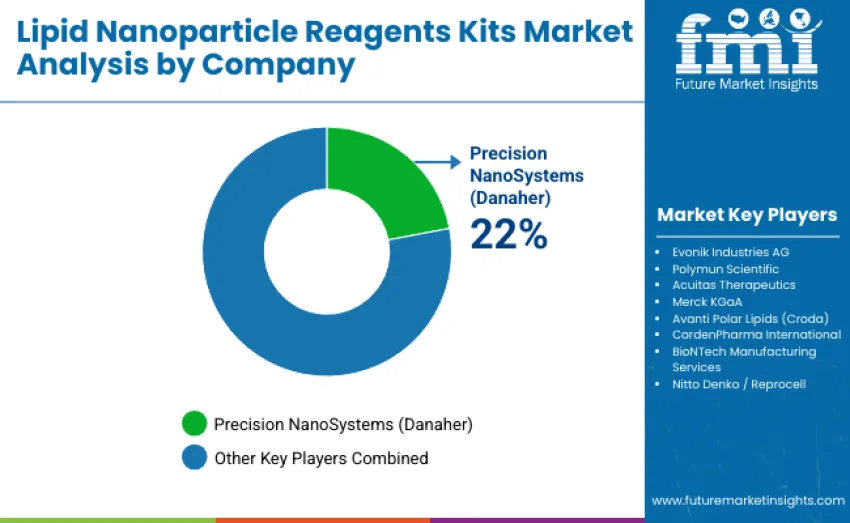
The Lipid Nanoparticle Reagent Kits Market is moderately concentrated, with 12–15 participants shaping global competition. The top three companies collectively command around 55–60% of global share, supported by strong technological expertise, validated formulation platforms, and long-term partnerships with pharmaceutical and academic institutions. Precision NanoSystems (Danaher) leads with a 22% share, leveraging advanced lipid chemistry capabilities, proprietary nanoparticle technologies, and robust cGMP-compliant production capacities. Competition is driven by formulation precision, reagent consistency, clinical scalability, and comprehensive technical support rather than pricing alone.
Precision NanoSystems, Evonik Industries AG, and Polymun Scientific dominate the landscape through extensive lipid formulation portfolios, scalable reagent systems, and deep integration with global mRNA and gene therapy manufacturing workflows. Their innovations in microfluidic assembly systems, ionizable lipid optimization, and encapsulation efficiency ensure high reproducibility across preclinical and clinical environments.
Challengers such as Acuitas Therapeutics, Merck KGaA, and Avanti Polar Lipids compete through specialized lipid chemistry expertise, proprietary lipid libraries, and flexible formulation capabilities supporting both academic and commercial therapeutic pipelines. Additional players including CordenPharma International, BioNTech Manufacturing Services, and Nitto Denko/Reprocell strengthen market depth through custom lipid synthesis, encapsulation process optimization, and contract manufacturing solutions, enhancing global development and production capacity.
Key Players in the Lipid Nanoparticle Reagents Kits Market
- Precision NanoSystems (Danaher)
- Evonik Industries AG
- Polymun Scientific
- Acuitas Therapeutics
- Merck KGaA
- Avanti Polar Lipids (Croda)
- CordenPharma International
- BioNTech Manufacturing Services
- Nitto Denko / Reprocell
Scope of the Report
| Items | Values |
|---|---|
| Quantitative Units | USD 698.9 million |
| Product Type | Lipid Formulation Kits, Nucleic Acid Encapsulation Reagents, Stabilization & Cryoprotectant Kits, Surface Functionalization Reagents, Purification & Characterization Kits |
| Application | mRNA Vaccines, Gene Therapy & siRNA Delivery, Drug Delivery Research, Cell Therapy Manufacturing, Protein Replacement Therapy |
| Regions Covered | North America, Europe, East Asia, South Asia & Pacific, Latin America, Middle East & Africa |
| Country Covered | China, India, Germany, Brazil, USA, UK, Japan, and 40+ countries |
| Key Companies Profiled | Precision NanoSystems (Danaher), Evonik Industries AG, Polymun Scientific, Acuitas Therapeutics, Merck KGaA, Avanti Polar Lipids (Croda), CordenPharma International, BioNTech Manufacturing Services, Nitto Denko/ Reprocell |
| Additional Attributes | Dollar sales by product type and application, regional trends across Asia Pacific, Europe, and North America, competitive landscape of LNP reagent kit manufacturers, technical specifications, integration with microfluidic and mRNA workflows, innovations in ionizable lipids and stabilization, and development of scalable, high-efficiency LNP kits |
Lipid Nanoparticle Reagents Kits Market by Segments
By Product Type:
- Lipid Formulation Kits
- Nucleic Acid Encapsulation Reagents
- Stabilization & Cryoprotectant Kits
- Surface Functionalization Reagents
- Purification & Characterization Kits
By Application:
- mRNA Vaccines
- Gene Therapy & siRNA Delivery
- Drug Delivery Research
- Cell Therapy Manufacturing
- Protein Replacement Therapy
By Region:
- Asia Pacific
- China
- India
- Japan
- South Korea
- Vietnam
- Australia & New Zealand
- ASEAN
- Rest of Asia Pacific
- Europe
- Germany
- United Kingdom
- France
- Italy
- Spain
- Netherlands
- Nordic
- BENELUX
- Rest of Europe
- North America
- United States
- Canada
- Mexico
- Latin America
- Brazil
- Argentina
- Rest of Latin America
- Middle East & Africa
- Kingdom of Saudi Arabia
- Other GCC Countries
- Turkey
- South Africa
- Other African Union
- Rest of Middle East & Africa
Frequently Asked Questions
How big is the lipid nanoparticle reagents kits market in 2025?
The global lipid nanoparticle reagents kits market is valued at USD 698.9 million in 2025.
What will be the size of the lipid nanoparticle reagents kits market in 2035?
The market is projected to reach USD 1,845.7 million by 2035.
How fast will the lipid nanoparticle reagents kits market grow between 2025 and 2035?
The market will grow at a CAGR of 10% from 2025 to 2035.
Which product type leads the lipid nanoparticle reagents kits market in 2025?
Lipid formulation kits lead the market with a 38.5% share in 2025.
Who are the major players in the lipid nanoparticle reagents kits market?
Key players include Precision NanoSystems, Evonik Industries, Polymun Scientific, Acuitas Therapeutics, Merck KGaA, Avanti Polar Lipids, CordenPharma, BioNTech Manufacturing Services, and Nitto Denko/Reprocell.
Preview the report firsthand - request a free sample
Get SampleGet the brochure for pricing and purchase details.
Get PDFTable of Content
- Executive Summary
- Regional Level Market Outlook
- Demand-side Trends
- Supply-side Trends
- Technology Roadmap Analysis
- Analysis and Recommendations
- Market Overview
- Market Coverage / Taxonomy
- Market Definition / Scope / Limitations
- Market Background
- Market Dynamics
- Drivers
- Restraints
- Opportunity
- Trends
- Scenario Forecast
- Demand in Optimistic Scenario
- Demand in Likely Scenario
- Demand in Conservative Scenario
- Opportunity Assessment
- Products Market Assessment
- Value Chain Analysis
- Participants and their Roles
- Raw Material Suppliers
- Manufacturers
- Mid-Level Participants
- Wholesalers and Distributors
- Profit Margin Analysis
- Operating Margins By Region
- Notes on Value Added at Each Node in the Value Chain
- Participants and their Roles
- Strategic Divestments/ Investments
- Market Trade Assessment
- Import-Export Analysis
- Supply Demand Gap Assessment
- White –Space Opportunity Assessment and Mapping
- PESTLE and Porter’s Analysis
- Regulatory Landscape
- By Key Regions
- By Key Countries
- Regional Parent Market Outlook
- Product Launches & Development
- Technology Innovation/Advancement
- Joint Ventures, M&A, Licensing & Partnerships
- Market Dynamics
- Regional Level Market Analysis 2020 to 2024 and Forecast, 2025 to 2035
- Historical Market Size USD Million Analysis, 2020 to 2024
- Current and Future Market Size USD Million Projections, 2025 to 2035
- Y-o-Y Growth Trend Analysis
- Absolute $ Opportunity Analysis
- Regional Level Market Analysis 2020 to 2024 and Forecast 2025 to 2035, By Product Type
- Introduction / Key Findings
- Historical Market Size USD Million Analysis By Product Type, 2020 to 2024
- Current and Future Market Size USD Million Analysis and Forecast By Product Type, 2025 to 2035
- Lipid Formulation Kits
- Nucleic Acid Encapsulation Reagents
- Stabilization & Cryoprotectant Kits
- Surface Functionalization Reagents
- Purification & Characterization Kits
- Y-o-Y Growth Trend Analysis By Product Type, 2020 to 2024
- Absolute $ Opportunity Analysis By Product Type, 2025 to 2035
- Regional Level Market Analysis 2020 to 2024 and Forecast 2025 to 2035, By Application
- Introduction / Key Findings
- Historical Market Size USD Million Analysis By Application, 2020 to 2024
- Current and Future Market Size USD Million Analysis and Forecast By Application, 2025 to 2035
- mRNA Vaccines
- Gene Therapy & siRNA Delivery
- Drug Delivery Research
- Cell Therapy Manufacturing
- Protein Replacement Therapy
- Y-o-Y Growth Trend Analysis By Application, 2020 to 2024
- Absolute $ Opportunity Analysis By Application, 2025 to 2035
- Regional Level Market Analysis 2020 to 2024 and Forecast 2025 to 2035, By Technology
- Introduction / Key Findings
- Historical Market Size USD Million Analysis By Technology, 2020 to 2024
- Current and Future Market Size USD Million Analysis and Forecast By Technology, 2025 to 2035
- Microfluidic Mixing Systems
- Ethanol Injection / Solvent Exchange
- pH Gradient-Based Assembly
- TFF & Size-Exclusion Purification Kits
- Hybrid AI/ML Formulation Platforms
- Y-o-Y Growth Trend Analysis By Technology, 2020 to 2024
- Absolute $ Opportunity Analysis By Technology, 2025 to 2035
- Regional Level Market Analysis 2020 to 2024 and Forecast 2025 to 2035, By End User
- Introduction / Key Findings
- Historical Market Size USD Million Analysis By End User, 2020 to 2024
- Current and Future Market Size USD Million Analysis and Forecast By End User, 2025 to 2035
- Pharma & Biotech Companies
- Academic & Research Institutes
- CDMOs / CROs
- Reagent Manufacturers & Distributors
- Y-o-Y Growth Trend Analysis By End User, 2020 to 2024
- Absolute $ Opportunity Analysis By End User, 2025 to 2035
- Regional Level Market Analysis 2020 to 2024 and Forecast 2025 to 2035, By Region
- Introduction
- Historical Market Size USD Million Analysis By Region, 2020 to 2024
- Current Market Size USD Million Analysis and Forecast By Region, 2025 to 2035
- North America
- Latin America
- East Asia
- South Asia
- Western Europe
- Eastern Europe
- Middle East & Africa
- Market Attractiveness Analysis By Region
- North America Market Analysis 2020 to 2024 and Forecast 2025 to 2035, By Country
- Historical Market Size USD Million Trend Analysis By Market Taxonomy, 2020 to 2024
- Market Size USD Million Forecast By Market Taxonomy, 2025 to 2035
- By Country
- USA
- Canada
- Mexico
- By Product Type
- By Application
- By Technology
- By End User
- By Country
- Market Attractiveness Analysis
- By Country
- By Product Type
- By Application
- By Technology
- By End User
- Key Takeaways
- Latin America Market Analysis 2020 to 2024 and Forecast 2025 to 2035, By Country
- Historical Market Size USD Million Trend Analysis By Market Taxonomy, 2020 to 2024
- Market Size USD Million Forecast By Market Taxonomy, 2025 to 2035
- By Country
- Brazil
- Argentina
- Rest of Latin America
- By Product Type
- By Application
- By Technology
- By End User
- By Country
- Market Attractiveness Analysis
- By Country
- By Product Type
- By Application
- By Technology
- By End User
- Key Takeaways
- East Asia Market Analysis 2020 to 2024 and Forecast 2025 to 2035, By Country
- Historical Market Size USD Million Trend Analysis By Market Taxonomy, 2020 to 2024
- Market Size USD Million Forecast By Market Taxonomy, 2025 to 2035
- By Country
- China
- Japan
- South Korea
- By Product Type
- By Application
- By Technology
- By End User
- By Country
- Market Attractiveness Analysis
- By Country
- By Product Type
- By Application
- By Technology
- By End User
- Key Takeaways
- South Asia Market Analysis 2020 to 2024 and Forecast 2025 to 2035, By Country
- Historical Market Size USD Million Trend Analysis By Market Taxonomy, 2020 to 2024
- Market Size USD Million Forecast By Market Taxonomy, 2025 to 2035
- By Country
- India
- ASEAN Countries
- Australia & New Zealand
- Rest of South Asia
- By Product Type
- By Application
- By Technology
- By End User
- By Country
- Market Attractiveness Analysis
- By Country
- By Product Type
- By Application
- By Technology
- By End User
- Key Takeaways
- Western Europe Market Analysis 2020 to 2024 and Forecast 2025 to 2035, By Country
- Historical Market Size USD Million Trend Analysis By Market Taxonomy, 2020 to 2024
- Market Size USD Million Forecast By Market Taxonomy, 2025 to 2035
- By Country
- Germany
- UK
- France
- Italy
- Spain
- BENELUX
- Nordic Countries
- Rest of Western Europe
- By Product Type
- By Application
- By Technology
- By End User
- By Country
- Market Attractiveness Analysis
- By Country
- By Product Type
- By Application
- By Technology
- By End User
- Key Takeaways
- Eastern Europe Market Analysis 2020 to 2024 and Forecast 2025 to 2035, By Country
- Historical Market Size USD Million Trend Analysis By Market Taxonomy, 2020 to 2024
- Market Size USD Million Forecast By Market Taxonomy, 2025 to 2035
- By Country
- Russia
- Hungary
- Poland
- Rest of Eastern Europe
- By Product Type
- By Application
- By Technology
- By End User
- By Country
- Market Attractiveness Analysis
- By Country
- By Product Type
- By Application
- By Technology
- By End User
- Key Takeaways
- Middle East & Africa Market Analysis 2020 to 2024 and Forecast 2025 to 2035, By Country
- Historical Market Size USD Million Trend Analysis By Market Taxonomy, 2020 to 2024
- Market Size USD Million Forecast By Market Taxonomy, 2025 to 2035
- By Country
- Saudi Arabia
- Other GCC Countries
- Türkiye
- South Africa
- Rest of MEA
- By Product Type
- By Application
- By Technology
- By End User
- By Country
- Market Attractiveness Analysis
- By Country
- By Product Type
- By Application
- By Technology
- By End User
- Key Takeaways
- Market Structure Analysis
- Competition Dashboard
- Competition Benchmarking
- Market Share Analysis of Top Players
- By Regional
- By Product Type
- By Application
- By Technology
- By End User
- Competition Analysis
- Competition Deep Dive
- Precision NanoSystems (Danaher)
- Overview
- Product Portfolio
- Key Financials
- Key Developments
- Global/Regional Footprint
- Strategy Overview
- Marketing Strategy
- SWOT
- Analyst Comment
- Evonik Industries AG
- Overview
- Product Portfolio
- Key Financials
- Key Developments
- Global/Regional Footprint
- Strategy Overview
- Marketing Strategy
- SWOT
- Analyst Comment
- Polymun Scientific
- Overview
- Product Portfolio
- Key Financials
- Key Developments
- Global/Regional Footprint
- Strategy Overview
- Marketing Strategy
- SWOT
- Analyst Comment
- Acuitas Therapeutics
- Overview
- Product Portfolio
- Key Financials
- Key Developments
- Global/Regional Footprint
- Strategy Overview
- Marketing Strategy
- SWOT
- Analyst Comment
- Merck KGaA
- Overview
- Product Portfolio
- Key Financials
- Key Developments
- Global/Regional Footprint
- Strategy Overview
- Marketing Strategy
- SWOT
- Analyst Comment
- Avanti Polar Lipids (Croda)
- Overview
- Product Portfolio
- Key Financials
- Key Developments
- Global/Regional Footprint
- Strategy Overview
- Marketing Strategy
- SWOT
- Analyst Comment
- CordenPharma International
- Overview
- Product Portfolio
- Key Financials
- Key Developments
- Global/Regional Footprint
- Strategy Overview
- Marketing Strategy
- SWOT
- Analyst Comment
- BioNTech Manufacturing Services
- Overview
- Product Portfolio
- Key Financials
- Key Developments
- Global/Regional Footprint
- Strategy Overview
- Marketing Strategy
- SWOT
- Analyst Comment
- Nitto Denko / Reprocell
- Overview
- Product Portfolio
- Key Financials
- Key Developments
- Global/Regional Footprint
- Strategy Overview
- Marketing Strategy
- SWOT
- Analyst Comment
- Precision NanoSystems (Danaher)
- Competition Deep Dive
- Assumptions & Acronyms Used
- Research Methodology


