

- Industry Size (2026)
- USD 41.2 Bn
- Forecast (2036)
- USD 73.8 Bn
- CAGR (2026 to 2036)
- 6.0%
Lipid Metabolism Modulators Market Forecast and Outlook 2026 to 2036
The lipid metabolism modulators market is projected to reach USD 41.2 billion in 2026 and expand to USD 73.8 billion by 2036, at a CAGR of 6.0%. Growth reflects sustained reliance on pharmacological lipid control to reduce long-term cardiovascular risk across high-prevalence patient populations. Prescribing volume remains anchored in chronic management of hypercholesterolemia, supported by guideline-driven escalation beyond first-line statin therapy in patients with residual lipid risk, intolerance, or genetic dyslipidemia. Market expansion is volume-led rather than episodic, driven by continuous treatment duration, repeat dispensing cycles, and long-term adherence requirements rather than short-course therapeutic use.
Outlook over the forecast period is shaped by preventive cardiology practices, expanded population screening, and integration of lipid modulation within broader cardiometabolic risk frameworks. Therapy utilization increasingly reflects stratified risk assessment, where non-statin agents complement established statin use in high-risk cohorts rather than replacing existing regimens. Primary care and specialist coordination sustains prescribing continuity, while generic availability stabilizes access in cost-sensitive settings. Growth trajectory remains steady, supported by chronic disease burden, aging populations, and persistence of lipid-related cardiovascular risk despite lifestyle intervention, rather than rapid innovation-driven displacement of existing therapeutic classes.
Quick Stats for Lipid Metabolism Modulators Market
- Lipid Metabolism Modulators Market Value (2026): USD 41.2 billion
- Lipid Metabolism Modulators Market Forecast Value (2036): USD 73.8 billion
- Lipid Metabolism Modulators Market Forecast CAGR 2026 to 2036: 6.0%
- Leading Product Category by Demand Share: Statins
- Fastest-Growing Countries: India, China, Brazil, USA, UK
- Top Players in Global Demand: Amgen, AstraZeneca, Pfizer, Novartis, Sanofi
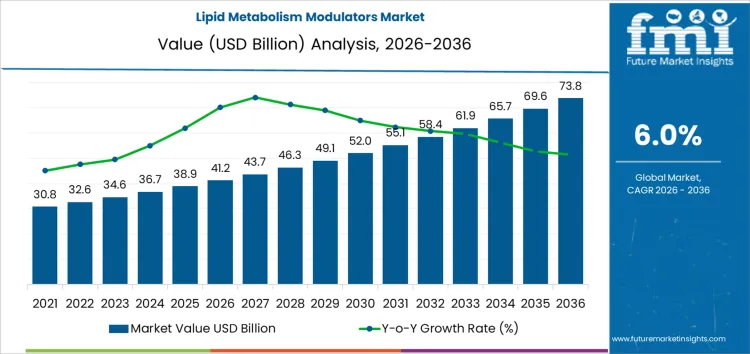
Lipid Metabolism Modulators Market Key Takeaways
| Metric | Value |
|---|---|
| Market Value (2026) | USD 41.2 billion |
| Market Forecast Value (2036) | USD 73.8 billion |
| Forecast CAGR 2026 to 2036 | 6.0% |
Why is the Demand for Lipid Metabolism Modulators Growing?
Demand for lipid metabolism modulators is increasing as clinicians and healthcare systems seek therapies that address dyslipidemia and associated cardiovascular risk with precision and improved safety profiles. These modulators include agents that influence cholesterol synthesis, absorption, and lipid transport pathways to reduce atherogenic lipoproteins in patients with elevated low-density lipoprotein and triglyceride levels. Cardiologists specify these therapies when standard statin regimens do not achieve target lipid profiles or when patients have intolerance to existing agents. Procurement teams evaluate clinical evidence of risk reduction, tolerability, long-term outcome data, and formulary compatibility to ensure that selected modulators support guideline-directed care. Growth in prevalence of metabolic syndrome and persistent burden of cardiovascular disease encourages adoption of treatment strategies that integrate lipid modulation as part of comprehensive risk management.
Expansion of clinical research linking residual lipid risk to adverse cardiovascular events reinforces use of novel modulators that target distinct metabolic pathways. Endocrinologists and preventive medicine specialists incorporate these agents into personalized care plans where genetic profiles, comorbid conditions, and patient response patterns influence therapy selection. Payers and health systems assess cost-effectiveness analyses alongside real-world utilization data to support coverage policies that align with evidence-based endpoints such as reduced myocardial infarction and stroke rates. Education among prescribers on mechanistic differences and clinical positioning of modulators further supports informed therapeutic decisions. These clinical and operational factors are contributing to sustained demand growth in the lipid metabolism modulators market.
How Are the Segments Classified in the Lipid Metabolism Modulators Market?
Demand for lipid metabolism modulators is shaped by cardiovascular risk reduction priorities, long-term cholesterol management needs, and guideline-driven therapy escalation. Clinical practice emphasizes sustained lipid control to reduce atherosclerotic events across broad patient populations. Adoption aligns with rising prevalence of dyslipidemia, preventive cardiology focus, and expanded access to chronic therapies. Product selection prioritizes efficacy, tolerability, and compatibility with lifelong use. Segment classification reflects differentiation by pharmacological product category, lipid disorder application, and sales channel influencing prescribing behavior, access convenience, and therapy continuity.
Which Product Category Holds the Largest Share in Lipid Metabolism Modulators?
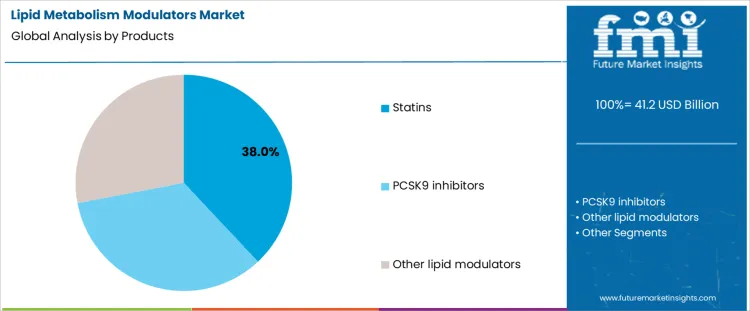
Statins account for 38.0%, representing the largest share among product categories due to established first-line use. Extensive clinical evidence supports statin efficacy in lowering LDL cholesterol and reducing cardiovascular events. Generic availability improves affordability and long-term adherence. Clear dosing protocols support widespread prescribing across risk categories. PCSK9 inhibitors follow with potent LDL reduction for high-risk or statin-intolerant patients. Other lipid modulators address triglyceride and mixed lipid abnormalities. Product segmentation reflects reliance on proven therapies forming the backbone of lipid management strategies.
Key Points
- Statins remain the primary first-line lipid therapy.
- Long-term evidence supports cardiovascular risk reduction.
- Other agents address high-risk or complex lipid profiles.
How Does Application Segmentation Influence Therapy Utilization?
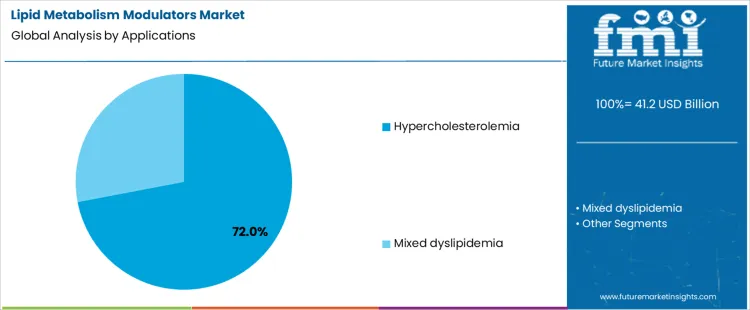
Hypercholesterolemia accounts for 72.0%, representing the largest share among applications due to prevalence. Elevated LDL cholesterol remains the most common lipid abnormality requiring pharmacological intervention. Preventive treatment guidelines emphasize early and sustained lipid lowering. Structured risk stratification supports consistent therapy initiation. Mixed dyslipidemia requires combination or adjunctive approaches with narrower patient pools. Application segmentation reflects concentration where disease prevalence, screening programs, and guideline clarity sustain high utilization of lipid metabolism modulators.
Key Points
- Hypercholesterolemia drives primary therapy demand.
- Preventive guidelines support early intervention.
- Mixed dyslipidemia involves more selective treatment.
What Role Does Sales Channel Distribution Play in Therapy Access?
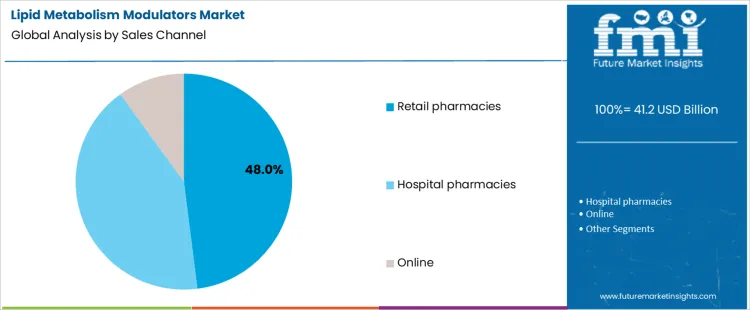
Retail pharmacies account for 48.0%, representing the largest share among sales channels. Chronic outpatient management favors community-based dispensing for convenience. Refill frequency supports ongoing patient engagement and adherence. Hospital pharmacies support initiation and specialist-directed therapy adjustments. Online channels provide supplemental access with limited penetration. Sales channel segmentation reflects dominance where accessibility, refill continuity, and patient convenience support sustained long-term therapy utilization.
Key Points
- Retail pharmacies support chronic therapy access.
- Community dispensing improves adherence continuity.
- Other channels address initiation or supplementary access.
What are the Key Dynamics in the Lipid Metabolism Modulators Market?
Demand for lipid metabolism modulators reflects therapeutic requirements to manage dyslipidemia and cardiometabolic risk through targeted biochemical pathway intervention. Adoption concentrates in cardiology, endocrinology, and primary care settings. Global scope aligns with chronic disease management and long-term risk reduction strategies. Usage centers on agents that regulate cholesterol synthesis, lipid transport, triglyceride metabolism, and lipoprotein clearance across defined patient populations.
How do cardiometabolic risk stratification and pathway-specific efficacy shape adoption?
Clinical management of dyslipidemia requires tailoring therapy to lipid fractions and underlying metabolic drivers. Demand increases where residual cardiovascular risk persists despite standard therapy. Modulators targeting LDL receptors, PCSK9 pathways, bile acid metabolism, and triglyceride synthesis enable differentiated lipid control. High-risk patients with familial hypercholesterolemia or statin intolerance drive use of non-statin mechanisms. Combination therapy supports additive lipid lowering while addressing heterogeneous metabolic profiles. Oral agents favor adherence in chronic use, while injectable biologics serve patients requiring intensive LDL reduction. Treatment selection depends on baseline lipid levels, comorbid diabetes, and prior cardiovascular events. Adoption reflects pathway-specific efficacy aligned with individualized risk management objectives.
How does safety monitoring, cost exposure, and adherence constraints influence market scalability?
Lipid metabolism modulation can affect hepatic function, muscle integrity, and glucose regulation, requiring laboratory surveillance. Demand sensitivity rises where adverse effects limit dose escalation or persistence. Injectable therapies introduce administration burden and cold chain requirements. High acquisition cost influences reimbursement thresholds and prior authorization intensity. Long-term adherence remains variable in asymptomatic populations, affecting real-world effectiveness. Drug-drug interaction potential complicates use in polypharmacy settings. Outcome-based evidence requirements extend market access timelines. Manufacturing complexity for biologics affects supply consistency. Scalability remains constrained by safety oversight needs, payer controls, and sustained adherence challenges in chronic preventive therapy contexts.
How Is Demand for Lipid Metabolism Modulators Evolving Globally?
Demand for lipid metabolism modulators is expanding globally due to rising cardiometabolic disease prevalence, broader screening, and long-term therapy adherence. Primary care integration and specialist protocols support sustained prescribing across dyslipidemia and related risk conditions. Oral administration and combination use with lifestyle management reinforce continuity. Reimbursement scope and generic availability influence access patterns. Growth rates in India at 7.7%, China at 7.5%, Brazil at 7.2%, USA at 6.6%, and the UK at 5.5% indicate steady expansion driven by patient identification, chronic therapy persistence, and guideline alignment rather than rapid class substitution.
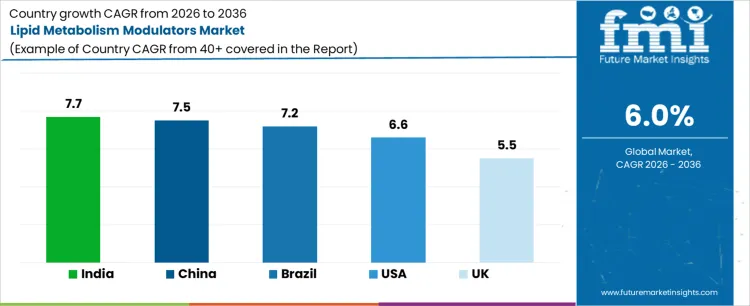
| Country | CAGR (%) |
|---|---|
| India | 7.7% |
| China | 7.5% |
| Brazil | 7.2% |
| USA | 6.6% |
| UK | 5.5% |
What Is Driving Expansion of Lipid Modulator Demand in India?
Demand for lipid metabolism modulators in India is growing at a CAGR of 7.7%, supported by increasing screening and primary care engagement. Urbanization and lifestyle shifts elevate dyslipidemia diagnosis rates. Public and private insurance schemes improve access to long-term therapy. Generic availability lowers cost barriers and sustains adherence. Physician emphasis on cardiovascular risk reduction increases initiation and persistence. Growth reflects access expansion and chronic disease management scale-up rather than accelerated uptake of premium therapies.
- Expanding lipid screening in primary care
- Insurance coverage improving therapy access
- High generic penetration supporting adherence
- Cardiovascular risk reduction emphasis
Why Is China Sustaining Growth in Lipid Metabolism Modulator Use?
Lipid metabolism modulator demand in China is expanding at a CAGR of 7.5%, driven by preventive care programs and standardized treatment pathways. Population screening initiatives increase early diagnosis. Reimbursement inclusion supports sustained utilization across hospital networks. Domestic manufacturing ensures supply consistency. Management of comorbid diabetes and hypertension reinforces combination therapy use. Growth reflects system-level prevention focus and protocol adherence rather than short-term therapy switching.
- Population-level lipid screening initiatives
- Reimbursement support across hospital networks
- Domestic manufacturing supply reliability
- Comorbidity-driven combination therapy use
How Is Brazil Supporting Growth in Lipid Modulator Prescriptions?
Demand for lipid metabolism modulators in Brazil is growing at a CAGR of 7.2%, supported by public healthcare delivery and cardiovascular prevention programs. National guidelines prioritize lipid control for high-risk populations. Public pharmacies improve access to essential agents. Rising obesity and diabetes prevalence sustain long-term prescribing. Physician-led monitoring supports adherence. Growth reflects public system scale and guideline-driven prevention rather than rapid innovation adoption.
- National cardiovascular prevention guidelines
- Public pharmacy access to essential agents
- Rising metabolic comorbidity prevalence
- Physician monitoring supporting adherence
What Factors Are Driving Lipid Modulator Demand in United States?
Lipid metabolism modulator demand in the United States is expanding at a CAGR of 6.6%, supported by widespread screening and chronic disease management. Broad insurance coverage enables access across therapy classes. Primary care and cardiology coordination sustains long-term treatment. Combination regimens address complex risk profiles. Large treated populations maintain stable volume growth. Expansion reflects therapy persistence and patient volume stability rather than reliance on newly launched agents.
- Widespread lipid screening practices
- Insurance-supported access across therapies
- Primary care and cardiology coordination
- Large chronic treatment population
Why Is the UK Showing Moderate Growth in Lipid Metabolism Modulators?
Demand for lipid metabolism modulators in United Kingdom is growing at a CAGR of 5.5%, driven by NHS prevention strategies and guideline adherence. Primary care-led risk assessment supports early initiation. Cost-effectiveness frameworks influence therapy selection. Stable access to established agents sustains adherence. Aging demographics increase treated population size. Growth remains moderate, reflecting structured adoption and budget-managed expansion rather than rapid intensification of therapy use.
- NHS cardiovascular prevention strategies
- Primary care risk assessment pathways
- Cost-effectiveness guided therapy selection
- Aging population increasing treatment volumes
What is the competitive landscape of demand for the lipid metabolism modulators market globally?
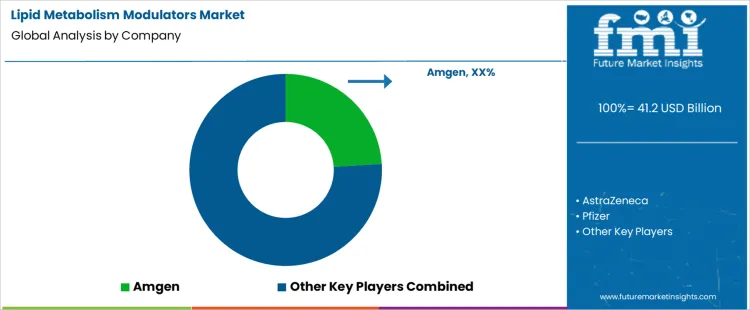
Demand for lipid metabolism modulators is driven by cardiovascular risk management priorities and expanding dyslipidemia screening programs. Prescribers evaluate LDL reduction magnitude, outcome data, dosing frequency, safety profile, and suitability for long-term adherence. Payers and hospital buyers assess guideline positioning, population eligibility, budget impact, and differentiation versus generic statins. Procurement behavior emphasizes reimbursement alignment, supply reliability, and real-world effectiveness across high-risk cohorts. Purchasing decisions favor therapies demonstrating incremental risk reduction beyond standard care. Trend in the lipid metabolism modulators market shows rising uptake of advanced biologics and RNA-based agents alongside stable statin utilization.
Amgen leads competitive positioning through PCSK9 inhibitor therapies delivering substantial LDL reduction for high-risk and statin-intolerant populations. AstraZeneca maintains relevance through legacy statin presence and combination approaches supporting broad primary care reach. Novartis competes via long-acting RNA-based modulation offering infrequent dosing and strong adherence potential. Sanofi participates through lipid-lowering biologics integrated within cardiovascular specialty portfolios. Pfizer supports demand through established lipid agents embedded in global hospital and outpatient formularies. Competitive differentiation centers on clinical outcomes evidence, dosing convenience, access negotiations, and alignment with evolving cardiovascular treatment algorithms.
Key Players in the Lipid Metabolism Modulators Market
- Amgen
- AstraZeneca
- Pfizer
- Novartis
- Sanofi
- Others
Scope of the Report
| Items | Values |
|---|---|
| Quantitative Units | USD billion |
| Products | Statins; PCSK9 inhibitors; Other lipid modulators |
| Applications | Hypercholesterolemia; Mixed dyslipidemia |
| Sales Channel | Retail pharmacies; Hospital pharmacies; Online |
| Regions Covered | Asia Pacific, Europe, North America, Latin America, Middle East & Africa |
| Countries Covered | India, China, Brazil, USA, UK, and 40+ countries |
| Key Companies Profiled | Amgen; AstraZeneca; Pfizer; Novartis; Sanofi; Others |
| Additional Attributes | Dollar sales by product class, application, and sales channel; LDL-C reduction efficacy and cardiovascular risk management across statins and PCSK9 inhibitors; treatment adherence patterns influenced by dosing frequency and administration route; pricing and reimbursement variability between branded biologics and generics; channel mix reflecting chronic therapy refills through retail pharmacies, hospital initiation protocols, and growing online fulfillment for long-term lipid management. |
Lipid Metabolism Modulators Market by Segment
Products:
- Statins
- PCSK9 inhibitors
- Other lipid modulators
Applications:
- Hypercholesterolemia
- Mixed dyslipidemia
Sales Channel:
- Retail pharmacies
- Hospital pharmacies
- Online
Region:
- Asia Pacific
- China
- Japan
- South Korea
- India
- Australia & New Zealand
- ASEAN
- Rest of Asia Pacific
- Europe
- Germany
- United Kingdom
- France
- Italy
- Spain
- Nordic
- BENELUX
- Rest of Europe
- North America
- United States
- Canada
- Mexico
- Latin America
- Brazil
- Chile
- Rest of Latin America
- Middle East & Africa
- Kingdom of Saudi Arabia
- Other GCC Countries
- Turkey
- South Africa
- Other African Union
- Rest of Middle East & Africa
Bibliography
- World Health Organization. (2025). Global report on cardiovascular disease prevention and lipid management in primary care. World Health Organization.
- European Society of Cardiology. (2024). ESC guidelines for the management of dyslipidaemias: Lipid modification to reduce cardiovascular risk (2024 update). European Heart Journal, 45(9), 1102–1189.
- U.S. Food and Drug Administration. (2024). Guidance for industry: Clinical evaluation and labeling of lipid-lowering therapies including statins, PCSK9 inhibitors, and RNA-based agents. U.S. Department of Health and Human Services.
Frequently Asked Questions
How big is the lipid metabolism modulators market in 2026?
The global lipid metabolism modulators market is estimated to be valued at USD 41.2 billion in 2026.
What will be the size of lipid metabolism modulators market in 2036?
The market size for the lipid metabolism modulators market is projected to reach USD 73.8 billion by 2036.
How much will be the lipid metabolism modulators market growth between 2026 and 2036?
The lipid metabolism modulators market is expected to grow at a 6.0% CAGR between 2026 and 2036.
What are the key product types in the lipid metabolism modulators market?
The key product types in lipid metabolism modulators market are statins, pcsk9 inhibitors and other lipid modulators.
Which applications segment to contribute significant share in the lipid metabolism modulators market in 2026?
In terms of applications, hypercholesterolemia segment to command 72.0% share in the lipid metabolism modulators market in 2026.
Preview the report firsthand - request a free sample
Get SampleGet the brochure for pricing and purchase details.
Get PDFTable of Content
- Executive Summary
- Global Market Outlook
- Demand-side Trends
- Supply-side Trends
- Technology Roadmap Analysis
- Analysis and Recommendations
- Market Overview
- Market Coverage / Taxonomy
- Market Definition / Scope / Limitations
- Market Background
- Market Dynamics
- Drivers
- Restraints
- Opportunity
- Trends
- Scenario Forecast
- Demand in Optimistic Scenario
- Demand in Likely Scenario
- Demand in Conservative Scenario
- Opportunity Map Analysis
- Product Life Cycle Analysis
- Supply Chain Analysis
- Investment Feasibility Matrix
- Value Chain Analysis
- PESTLE and Porter’s Analysis
- Regulatory Landscape
- Regional Parent Market Outlook
- Production and Consumption Statistics
- Import and Export Statistics
- Market Dynamics
- Global Market Analysis 2021 to 2025 and Forecast, 2026 to 2036
- Historical Market Size Value (USD Million) Analysis, 2021 to 2025
- Current and Future Market Size Value (USD Million) Projections, 2026 to 2036
- Y-o-Y Growth Trend Analysis
- Absolute $ Opportunity Analysis
- Global Market Pricing Analysis 2021 to 2025 and Forecast 2026 to 2036
- Global Market Analysis 2021 to 2025 and Forecast 2026 to 2036, By Products
- Introduction / Key Findings
- Historical Market Size Value (USD Million) Analysis By Products , 2021 to 2025
- Current and Future Market Size Value (USD Million) Analysis and Forecast By Products , 2026 to 2036
- Statins
- PCSK9 inhibitors
- Other lipid modulators
- Statins
- Y-o-Y Growth Trend Analysis By Products , 2021 to 2025
- Absolute $ Opportunity Analysis By Products , 2026 to 2036
- Global Market Analysis 2021 to 2025 and Forecast 2026 to 2036, By Applications
- Introduction / Key Findings
- Historical Market Size Value (USD Million) Analysis By Applications, 2021 to 2025
- Current and Future Market Size Value (USD Million) Analysis and Forecast By Applications, 2026 to 2036
- Hypercholesterolemia
- Mixed dyslipidemia
- Hypercholesterolemia
- Y-o-Y Growth Trend Analysis By Applications, 2021 to 2025
- Absolute $ Opportunity Analysis By Applications, 2026 to 2036
- Global Market Analysis 2021 to 2025 and Forecast 2026 to 2036, By Sales Channel
- Introduction / Key Findings
- Historical Market Size Value (USD Million) Analysis By Sales Channel, 2021 to 2025
- Current and Future Market Size Value (USD Million) Analysis and Forecast By Sales Channel, 2026 to 2036
- Retail pharmacies
- Hospital pharmacies
- Online
- Retail pharmacies
- Y-o-Y Growth Trend Analysis By Sales Channel, 2021 to 2025
- Absolute $ Opportunity Analysis By Sales Channel, 2026 to 2036
- Global Market Analysis 2021 to 2025 and Forecast 2026 to 2036, By Region
- Introduction
- Historical Market Size Value (USD Million) Analysis By Region, 2021 to 2025
- Current Market Size Value (USD Million) Analysis and Forecast By Region, 2026 to 2036
- North America
- Latin America
- Western Europe
- Eastern Europe
- East Asia
- South Asia and Pacific
- Middle East & Africa
- Market Attractiveness Analysis By Region
- North America Market Analysis 2021 to 2025 and Forecast 2026 to 2036, By Country
- Historical Market Size Value (USD Million) Trend Analysis By Market Taxonomy, 2021 to 2025
- Market Size Value (USD Million) Forecast By Market Taxonomy, 2026 to 2036
- By Country
- USA
- Canada
- Mexico
- By Products
- By Applications
- By Sales Channel
- By Country
- Market Attractiveness Analysis
- By Country
- By Products
- By Applications
- By Sales Channel
- Key Takeaways
- Latin America Market Analysis 2021 to 2025 and Forecast 2026 to 2036, By Country
- Historical Market Size Value (USD Million) Trend Analysis By Market Taxonomy, 2021 to 2025
- Market Size Value (USD Million) Forecast By Market Taxonomy, 2026 to 2036
- By Country
- Brazil
- Chile
- Rest of Latin America
- By Products
- By Applications
- By Sales Channel
- By Country
- Market Attractiveness Analysis
- By Country
- By Products
- By Applications
- By Sales Channel
- Key Takeaways
- Western Europe Market Analysis 2021 to 2025 and Forecast 2026 to 2036, By Country
- Historical Market Size Value (USD Million) Trend Analysis By Market Taxonomy, 2021 to 2025
- Market Size Value (USD Million) Forecast By Market Taxonomy, 2026 to 2036
- By Country
- Germany
- UK
- Italy
- Spain
- France
- Nordic
- BENELUX
- Rest of Western Europe
- By Products
- By Applications
- By Sales Channel
- By Country
- Market Attractiveness Analysis
- By Country
- By Products
- By Applications
- By Sales Channel
- Key Takeaways
- Eastern Europe Market Analysis 2021 to 2025 and Forecast 2026 to 2036, By Country
- Historical Market Size Value (USD Million) Trend Analysis By Market Taxonomy, 2021 to 2025
- Market Size Value (USD Million) Forecast By Market Taxonomy, 2026 to 2036
- By Country
- Russia
- Poland
- Hungary
- Balkan & Baltic
- Rest of Eastern Europe
- By Products
- By Applications
- By Sales Channel
- By Country
- Market Attractiveness Analysis
- By Country
- By Products
- By Applications
- By Sales Channel
- Key Takeaways
- East Asia Market Analysis 2021 to 2025 and Forecast 2026 to 2036, By Country
- Historical Market Size Value (USD Million) Trend Analysis By Market Taxonomy, 2021 to 2025
- Market Size Value (USD Million) Forecast By Market Taxonomy, 2026 to 2036
- By Country
- China
- Japan
- South Korea
- By Products
- By Applications
- By Sales Channel
- By Country
- Market Attractiveness Analysis
- By Country
- By Products
- By Applications
- By Sales Channel
- Key Takeaways
- South Asia and Pacific Market Analysis 2021 to 2025 and Forecast 2026 to 2036, By Country
- Historical Market Size Value (USD Million) Trend Analysis By Market Taxonomy, 2021 to 2025
- Market Size Value (USD Million) Forecast By Market Taxonomy, 2026 to 2036
- By Country
- India
- ASEAN
- Australia & New Zealand
- Rest of South Asia and Pacific
- By Products
- By Applications
- By Sales Channel
- By Country
- Market Attractiveness Analysis
- By Country
- By Products
- By Applications
- By Sales Channel
- Key Takeaways
- Middle East & Africa Market Analysis 2021 to 2025 and Forecast 2026 to 2036, By Country
- Historical Market Size Value (USD Million) Trend Analysis By Market Taxonomy, 2021 to 2025
- Market Size Value (USD Million) Forecast By Market Taxonomy, 2026 to 2036
- By Country
- Kingdom of Saudi Arabia
- Other GCC Countries
- Turkiye
- South Africa
- Other African Union
- Rest of Middle East & Africa
- By Products
- By Applications
- By Sales Channel
- By Country
- Market Attractiveness Analysis
- By Country
- By Products
- By Applications
- By Sales Channel
- Key Takeaways
- Key Countries Market Analysis
- USA
- Pricing Analysis
- Market Share Analysis, 2025
- By Products
- By Applications
- By Sales Channel
- Canada
- Pricing Analysis
- Market Share Analysis, 2025
- By Products
- By Applications
- By Sales Channel
- Mexico
- Pricing Analysis
- Market Share Analysis, 2025
- By Products
- By Applications
- By Sales Channel
- Brazil
- Pricing Analysis
- Market Share Analysis, 2025
- By Products
- By Applications
- By Sales Channel
- Chile
- Pricing Analysis
- Market Share Analysis, 2025
- By Products
- By Applications
- By Sales Channel
- Germany
- Pricing Analysis
- Market Share Analysis, 2025
- By Products
- By Applications
- By Sales Channel
- UK
- Pricing Analysis
- Market Share Analysis, 2025
- By Products
- By Applications
- By Sales Channel
- Italy
- Pricing Analysis
- Market Share Analysis, 2025
- By Products
- By Applications
- By Sales Channel
- Spain
- Pricing Analysis
- Market Share Analysis, 2025
- By Products
- By Applications
- By Sales Channel
- France
- Pricing Analysis
- Market Share Analysis, 2025
- By Products
- By Applications
- By Sales Channel
- India
- Pricing Analysis
- Market Share Analysis, 2025
- By Products
- By Applications
- By Sales Channel
- ASEAN
- Pricing Analysis
- Market Share Analysis, 2025
- By Products
- By Applications
- By Sales Channel
- Australia & New Zealand
- Pricing Analysis
- Market Share Analysis, 2025
- By Products
- By Applications
- By Sales Channel
- China
- Pricing Analysis
- Market Share Analysis, 2025
- By Products
- By Applications
- By Sales Channel
- Japan
- Pricing Analysis
- Market Share Analysis, 2025
- By Products
- By Applications
- By Sales Channel
- South Korea
- Pricing Analysis
- Market Share Analysis, 2025
- By Products
- By Applications
- By Sales Channel
- Russia
- Pricing Analysis
- Market Share Analysis, 2025
- By Products
- By Applications
- By Sales Channel
- Poland
- Pricing Analysis
- Market Share Analysis, 2025
- By Products
- By Applications
- By Sales Channel
- Hungary
- Pricing Analysis
- Market Share Analysis, 2025
- By Products
- By Applications
- By Sales Channel
- Kingdom of Saudi Arabia
- Pricing Analysis
- Market Share Analysis, 2025
- By Products
- By Applications
- By Sales Channel
- Turkiye
- Pricing Analysis
- Market Share Analysis, 2025
- By Products
- By Applications
- By Sales Channel
- South Africa
- Pricing Analysis
- Market Share Analysis, 2025
- By Products
- By Applications
- By Sales Channel
- USA
- Market Structure Analysis
- Competition Dashboard
- Competition Benchmarking
- Market Share Analysis of Top Players
- By Regional
- By Products
- By Applications
- By Sales Channel
- Competition Analysis
- Competition Deep Dive
- Amgen
- Overview
- Product Portfolio
- Profitability by Market Segments (Product/Age /Sales Channel/Region)
- Sales Footprint
- Strategy Overview
- Marketing Strategy
- Product Strategy
- Channel Strategy
- AstraZeneca
- Pfizer
- Novartis
- Sanofi
- Others
- Amgen
- Competition Deep Dive
- Assumptions & Acronyms Used
- Research Methodology


