

- Industry Size (2026)
- USD 1950.0 Mn
- Forecast (2036)
- USD 4209.9 Mn
- CAGR (2026 to 2036)
- 8.0%
Sweetness Modulators Market Forecast and Outlook 2026 to 2036
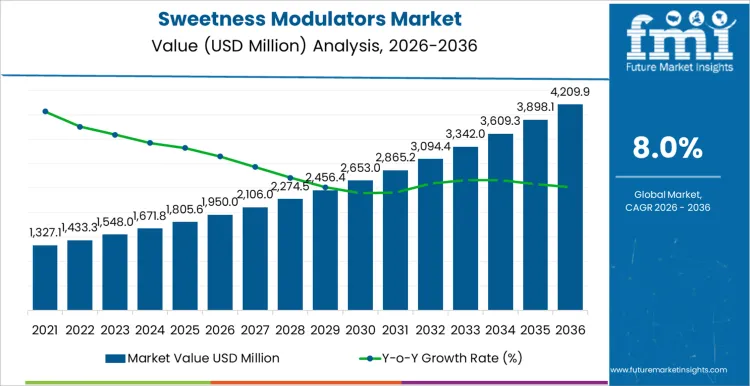
The sweetness modulators market is projected to be valued at USD 1,950.0 million in 2026 and likely to reach USD 4,209.9 million by 2036, at a CAGR of 8.0% over the forecast period. Growth is anchored in sustained reformulation activity across beverages, confectionery, dairy, and bakery products where sugar reduction targets directly affect taste acceptance. Sweetness modulators enable formulators to amplify perceived sweetness while lowering sucrose inclusion, supporting compliance with nutrition labeling rules and sugar taxation frameworks. Their role extends beyond sweetness enhancement, addressing flavor rounding, bitterness suppression, and temporal sweetness balance in reduced-sugar recipes. Beverage manufacturers apply modulators to stabilize sweetness perception in zero-sugar carbonated drinks and flavored waters, while bakery producers use them to compensate for sweetness loss caused by sugar removal affecting browning and flavor release.
Clean-label positioning and consumer scrutiny of ingredient lists push adoption of plant-derived and fermentation-based modulators, particularly in products marketed for wellness and metabolic health. Regulatory divergence across regions influences selection, as permitted usage levels and labeling definitions vary, requiring portfolio flexibility from ingredient suppliers. Sensory performance under different pH, temperature, and processing conditions remains a key evaluation criterion, especially in dairy and ready-to-drink formats. Manufacturers also assess modulators for compatibility with stevia, monk fruit, and other high-intensity sweeteners to optimize cost and flavor outcomes. Ongoing investment in sensory science, application labs, and scale-ready production underpins adoption, positioning sweetness modulators as formulation tools tied to long-term sugar reduction strategies rather than short-term reformulation cycles.
Quick Stats for Sweetness Modulators Market
- Sweetness Modulators Market Value (2026): USD 1,950.0 million
- Sweetness Modulators Market Forecast Value (2036): USD 4,209.9 million
- Sweetness Modulators Market Forecast CAGR (2026 to 2036): 8.0%
- Leading Product Type by Demand Share: Natural sweetness modulators
- Fastest-Growing Countries: India, China, Brazil, USA, UK
- Top Players in Global Demand: Cargill, Ingredion, Tate & Lyle, ADM, DuPont (IFF)
Sweetness Modulators Market Key Takeaways
| Metric | Value |
|---|---|
| Market Value (2026) | USD 1,950.0 million |
| Market Forecast Value (2036) | USD 4,209.9 million |
| Forecast CAGR 2026 to 2036 | 8.0% |
Why is the Demand for Sweetness Modulators Market Growing?
Demand for sweetness modulators is expanding as food and beverage formulators pursue strategies to reduce caloric content while preserving taste profiles that meet consumer preferences. Manufacturers of soft drinks, confectionery, dairy desserts, and snack products reformulate recipes to lower sugar levels in response to dietary guidelines and public health initiatives that emphasize reduced sugar consumption. Sweetness modulators provide targeted taste enhancement by interacting with sweet receptors, enabling formulators to achieve desirable sweetness intensity with minimal use of nutritive sugars. Beverage producers integrate these modulators into zero sugar and reduced sugar variants to maintain familiar flavor characteristics across carbonated and still formats. In beverage reformulation, sweetness enhancers are frequently paired with modulators to reduce sweetener load while keeping brand-equivalent taste. Product developers in the bakery sector use modulators to counteract the flavor dilution that can occur when sugar is reduced for nutritional positioning. In baked and dairy systems, mouthfeel recovery additives are frequently used alongside sweetness modulators to replace sucrose bulk and lubrication.
Regulatory environments in several regions influence procurement because labeling requirements and sugar taxation policies encourage manufacturers to innovate with alternative sweetening solutions. Reformulation roadmaps typically compare sweetness modulators against broader sugar substitutes strategies to select the lowest-risk pathway by category. Consumer interest in wellness oriented products with balanced sweetness without off-notes drives development of modulators compatible with natural and clean label applications. When high-intensity sweeteners are used, aftertaste masking becomes a parallel requirement to keep reduced-sugar SKUs organoleptically stable. Ingredient suppliers invest in scalable production processes that deliver consistent quality and sensory performance for global formulation needs. Research laboratories conduct sensory trials to calibrate modulator usage levels that align with texture and mouthfeel targets in diverse product categories. A flavor modulator is often added at low ppm to smooth harsh notes that surface after sucrose reduction in complex matrices. Retail growth of reduced sugar offerings supports continuous uptake of sweetness modulators across mainstream and niche segments.
How Is the Sweetness Modulators Industry Segmented by Product Type, Application, and Form?
Demand for sweetness modulators is shaped by sugar reduction targets, clean-label formulation priorities, and regulatory pressure on caloric intake. Food and beverage manufacturers evaluate taste optimization, flavor masking efficiency, and formulation flexibility when selecting modulators. Adoption varies by product category based on sweetness intensity, processing conditions, and stability requirements. Utilization also reflects reformulation activity across beverages, bakery items, and dairy products. Segmentation clarifies how modulator origin, end-use formulation, and physical form influence integration across food, beverage, and pharmaceutical production workflows.
Which Product Type Holds the Largest Share in Sweetness Modulators?
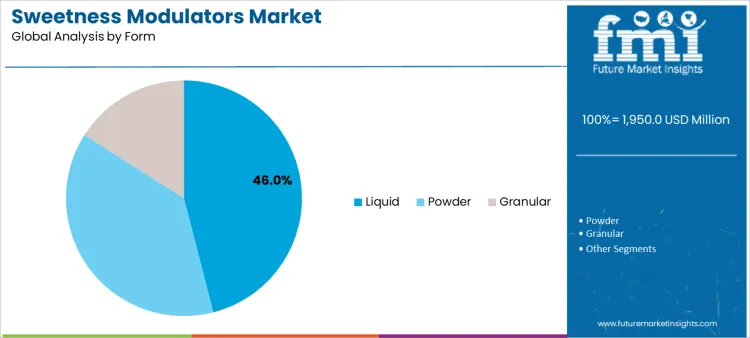
Natural sweetness modulators hold 48.0%, reflecting strong preference for plant-derived and fermentation-based solutions aligned with clean-label positioning. These modulators support sugar reduction while maintaining sensory profiles in reformulated products. Artificial sweetness modulators at 32.0% remain relevant in cost-sensitive formulations requiring consistent performance across batches. Blended sweetness modulators represent 20.0%, combining natural and artificial components to balance taste, stability, and cost. Product type segmentation indicates higher adoption where label transparency and consumer acceptance drive formulation decisions, while blends address technical constraints in complex recipes.
Key Points
- Natural modulators align with clean-label formulation strategies.
- Artificial options support cost and performance consistency.
- Blends balance sensory performance and formulation flexibility.
How Do Application Areas Influence Demand for Sweetness Modulators?
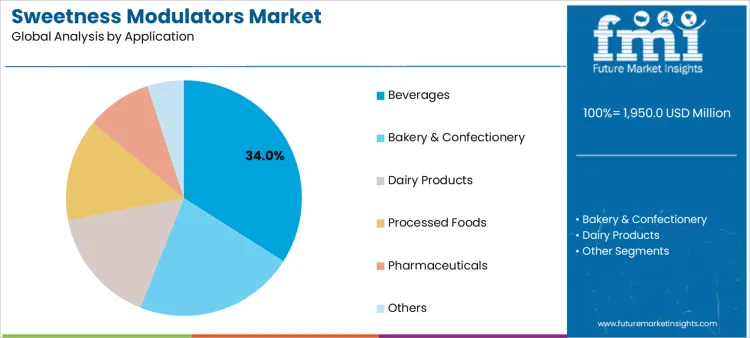
Beverages account for 34.0%, driven by high sugar reduction activity in carbonated drinks, juices, and functional beverages. Bakery and confectionery applications at 22.0% require modulators to manage sweetness intensity and aftertaste in baked matrices. Dairy products represent 16.0%, focusing on flavor balance in yogurts and flavored milk. Processed foods at 14.0% apply modulators to sauces, snacks, and ready meals. Pharmaceuticals at 9.0% use modulators for palatability improvement. Other applications at 5.0% reflect niche uses. Application segmentation highlights concentration where sugar reformulation pressure is highest.
Key Points
- Beverages lead due to aggressive sugar reduction initiatives.
- Bakery formulations require sweetness control under heat.
- Dairy applications focus on flavor balance and mouthfeel.
Which Form Is Most Widely Used for Sweetness Modulators?
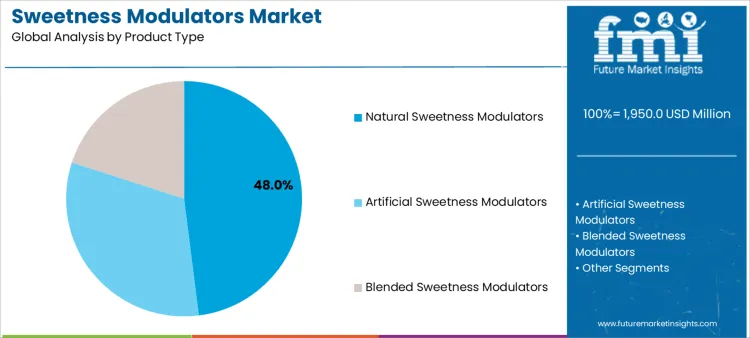
Liquid forms account for 46.0%, reflecting ease of incorporation into beverage and syrup-based formulations. These forms enable precise dosing and uniform dispersion during processing. Powder forms represent 38.0%, supporting dry mixes, bakery applications, and shelf-stable formulations. Granular forms at 16.0% are used where controlled release or specific handling properties are required. Form-based segmentation shows preference driven by processing compatibility, dosing accuracy, and storage considerations across different manufacturing environments.
Key Points
- Liquid forms integrate easily into beverage systems.
- Powders support dry and baked formulations.
- Granular formats serve specialized processing needs.
What are the Key Dynamics in the sweetness modulators market?
Demand dynamics in the sweetness modulators market are driven by reformulation activity in food and beverage manufacturing aimed at reducing caloric sugar content while maintaining taste profiles. Market activity focuses on applications in beverages, dairy, confectionery, and bakery products where sweetness quality must meet consumer expectations with lower glycemic impact. Value depends on modulators’ ability to enhance or replace sucrose without off-notes, deliver stability during processing, and comply with regional food additive regulations. Ingredient selection aligns with sensory performance, cost efficiency, and formulation compatibility in complex matrices.
How do sugar reduction trends and sensory performance requirements shape adoption?
Adoption of sweetness modulators expands where food formulators encounter pressure to reduce added sugars while preserving desirable taste attributes. Beverage producers reformulating carbonated drinks, juices, and flavored waters require modulators that maintain sweetness intensity and onset without introducing bitterness or lingering aftertaste. Dairy dessert and yogurt formulations benefit from modulators that function under acidic pH and varying temperatures during processing and storage. Bakery applications demand stability under heat and retention of sweetness over shelf life. Consumer demand for products with clean label positioning and lower calories intensifies selection criteria toward modulators with recognizable ingredient profiles. Functional performance in combination with other sweeteners and flavor systems is critical for maintaining consumer acceptance and brand equity.
How do regulatory landscapes and technical limitations influence market scalability?
Market scalability is influenced by divergent regulatory landscapes and intrinsic technical limitations of sweetness modulators. Regulatory acceptance varies across regions, with distinct permitted use levels and labeling requirements that affect global formulation strategies. Technical challenges include achieving optimal sweetness equivalence to sucrose without texture alteration or cost escalation. Some modulators exhibit sensitivity to pH, temperature, or interaction with other food components, which restricts their use in specific product categories. Cost considerations arise from higher dosage requirements or complex supply chains for novel modulators. Sensory risk, where off-flavors emerge at certain concentrations, increases formulation complexity. These constraints require formulators to balance performance, compliance, and cost when scaling modulator usage across diverse product lines.
How Is Demand for the Sweetness Modulators Market Evolving Globally?
Global demand for sweetness modulators is rising as food and beverage manufacturers reformulate products to reduce added sugar while preserving taste profiles. Growth reflects regulatory pressure on sugar reduction, rising incidence of metabolic disorders, and brand repositioning toward healthier formulations. Demand expansion remains closely linked to clean label strategies, cost management of high-intensity sweeteners, and sensory optimization across processed foods. India records 9.6% CAGR, China records 9.3% CAGR, Brazil records 8.8% CAGR, USA records 7.8% CAGR, and UK records 7.6% CAGR. Adoption remains driven by reformulation intensity rather than volume expansion in finished food consumption.
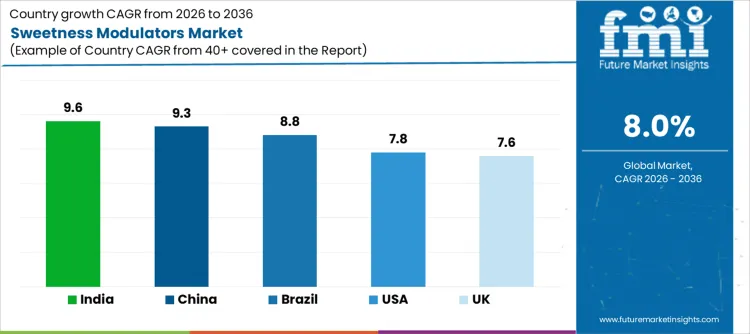
| Country | CAGR (%) |
|---|---|
| India | 9.6% |
| China | 9.3% |
| Brazil | 8.8% |
| USA | 7.8% |
| UK | 7.6% |
What is driving growth of sweetness modulators demand in India?
Demand for sweetness modulators in India is expanding as packaged food and beverage producers respond to sugar reduction targets and changing dietary preferences. Growth at 9.6% CAGR reflects rising penetration of low sugar beverages, dairy alternatives, and nutraceutical formulations. Regulatory scrutiny on sugar content encourages manufacturers to improve sweetness perception without increasing caloric load. Domestic formulation activity prioritizes modulators compatible with stevia and other natural sweeteners. Cost sensitivity drives interest in solutions that optimize sweetener usage rates. Demand concentrates among beverage concentrates, confectionery, and functional foods targeting urban consumers.
- Sugar reduction compliance pressure
- Expansion of low sugar beverages
- Growth of nutraceutical formulations
- Cost optimization of sweetener systems
Why is China seeing expansion in sweetness modulators adoption?
Sweetness modulators demand in China is rising as large food processors reformulate products to align with public health objectives. Growth at 9.3% CAGR reflects strong activity in ready-to-drink beverages, dairy products, and functional nutrition categories. Government guidance on sugar intake accelerates reformulation timelines. Manufacturers emphasize taste masking and sweetness enhancement for high-intensity sweeteners. Domestic ingredient suppliers scale production to meet industrial demand. Application focus centers on beverages, yogurt, and nutritional drinks. Demand strength remains tied to regulatory alignment and large-scale processing capabilities rather than artisanal food segments.
- Public health driven sugar guidelines
- High reformulation activity in beverages
- Industrial scale food processing
- Demand for sweetness masking solutions
What factors are shaping sweetness modulators sales in Brazil?
Sales of sweetness modulators in Brazil are increasing as food manufacturers adapt to evolving nutrition labeling and sugar disclosure requirements. Growth at 8.8% CAGR reflects strong reformulation activity within beverages, confectionery, and flavored dairy products. Rising consumer awareness of sugar intake influences brand strategies toward reduced sugar offerings. Tropical flavor profiles require modulators that preserve sweetness intensity and mouthfeel. Local beverage producers invest in sensory optimization to maintain taste acceptance. Demand remains concentrated in carbonated drinks, juices, and powdered beverage mixes serving mass markets.
- Nutrition labeling compliance
- Reformulation of carbonated beverages
- Preservation of tropical flavor profiles
- Consumer sensitivity to sugar intake
How is the USA supporting growth of sweetness modulators demand?
Sweetness modulators market demand in the USA is advancing as food and beverage companies intensify sugar reduction programs. Growth at 7.8% CAGR reflects widespread reformulation across soft drinks, snacks, and functional nutrition products. Regulatory guidance on added sugars shapes ingredient selection strategies. Manufacturers seek modulators that improve sweetness perception of stevia, monk fruit, and other non-nutritive sweeteners. Demand remains driven by taste optimization and brand risk management rather than volume growth. Adoption is strongest among large multinational food brands managing complex reformulation portfolios.
- Added sugar disclosure requirements
- High adoption of natural sweeteners
- Large scale reformulation programs
- Focus on taste consistency
What is driving expansion of sweetness modulators demand in the UK?
Demand for sweetness modulators in the UK is rising as sugar taxation and public health initiatives influence product formulation. Growth at 7.6% CAGR reflects sustained reformulation across beverages, bakery, and dairy alternatives. Manufacturers prioritize modulators that enable sugar reduction without compromising taste or texture. Retail pressure on nutritional profiles accelerates adoption. Ingredient selection emphasizes clean label compatibility and regulatory approval. Demand strength remains linked to compliance with sugar reduction frameworks and retailer acceptance standards rather than consumption growth.
- Sugar levy compliance
- Retail driven reformulation pressure
- Expansion of dairy alternatives
- Clean label ingredient preference
What is the competitive landscape of demand for the sweetness modulators market globally?
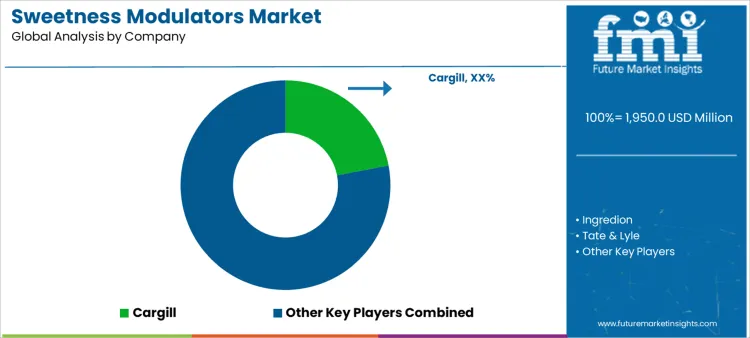
Demand for sweetness modulators is driven by sugar reduction mandates, reformulation targets, and consumer preference for lower calorie profiles. Food and beverage formulators evaluate sweetness enhancement efficiency, flavor masking performance, stability across pH and temperature ranges, and compatibility with high intensity sweeteners. Buyer assessment includes clean label alignment, regulatory acceptance, sensory consistency across batches, and scalability in beverage and dairy matrices. Procurement behavior favors suppliers offering application support, sensory validation, and reliable global supply. Trend in the sweetness modulators market reflects broader reformulation activity across beverages, baked goods, and nutritional products targeting reduced sugar content without taste compromise.
Cargill leads competitive positioning through extensive ingredient systems combining sweetness modulation with texturizers and flavor solutions. Ingredion competes by offering modulators integrated into starch and specialty carbohydrate platforms supporting sugar reduction strategies. Tate and Lyle supports demand with sweetness enhancement technologies aligned with clean label and fiber based formulations. ADM maintains relevance by leveraging formulation expertise and broad customer reach across packaged food segments. DuPont IFF participates through taste modulation solutions supported by sensory science and application development capabilities. Competitive differentiation centers on sensory performance reliability, formulation flexibility, regulatory coverage, and depth of customer co development support.
Key Players in the Sweetness Modulators Market
- Cargill
- Ingredion
- Tate & Lyle
- ADM
- DuPont (IFF)
- Others
Scope of the Report
| Items | Values |
|---|---|
| Quantitative Units | USD million |
| Product Type | Natural Sweetness Modulators; Artificial Sweetness Modulators; Blended Sweetness Modulators |
| Application | Beverages; Bakery & Confectionery; Dairy Products; Processed Foods; Pharmaceuticals; Others |
| Form | Liquid; Powder; Granular |
| End User | Food & Beverage Manufacturers; Pharmaceutical Companies; Others |
| Regions Covered | Asia Pacific, Europe, North America, Latin America, Middle East & Africa |
| Countries Covered | India, China, Brazil, USA, UK, and 40+ countries |
| Key Companies Profiled | Cargill; Ingredion; Tate & Lyle; ADM; DuPont (IFF); Others |
| Additional Attributes | Dollar sales by product type, application, form, and end user; sweetness enhancement efficiency and taste modulation performance across natural, artificial, and blended solutions; role in sugar reduction and clean-label formulation strategies; stability and solubility behavior in liquid and solid food matrices; regulatory acceptance across food and pharmaceutical applications; procurement dynamics shaped by large-scale food processing demand and formulation-driven supplier partnerships. |
Sweetness Modulators Market by Segment
Product Type:
- Natural Sweetness Modulators
- Artificial Sweetness Modulators
- Blended Sweetness Modulators
Application:
- Beverages
- Bakery & Confectionery
- Dairy Products
- Processed Foods
- Pharmaceuticals
- Others
Form:
- Liquid
- Powder
- Granular
End User:
- Food & Beverage Manufacturers
- Pharmaceutical Companies
- Others
Region:
- Asia Pacific
- China
- Japan
- South Korea
- India
- Australia & New Zealand
- ASEAN
- Rest of Asia Pacific
- Europe
- Germany
- United Kingdom
- France
- Italy
- Spain
- Nordic
- BENELUX
- Rest of Europe
- North America
- United States
- Canada
- Mexico
- Latin America
- Brazil
- Chile
- Rest of Latin America
- Middle East & Africa
- Kingdom of Saudi Arabia
- Other GCC Countries
- Turkey
- South Africa
- Other African Union
- Rest of Middle East & Africa
Bibliography
- Food and Agriculture Organization of the United Nations. (2023). Guidelines on the use of non‑sugar sweeteners and sweetness modulation in food reformulation. FAO.
- World Health Organization. (2023). WHO guideline on non‑sugar sweeteners and the reduction of free sugars in foods and beverages. World Health Organization.
- U.S. Food and Drug Administration. (2024). Guidance for industry: Use of sweeteners, flavor modifiers, and taste modulators in food and beverage products. U.S. Department of Health and Human Services.
Frequently Asked Questions
How big is the sweetness modulators market in 2026?
The global sweetness modulators market is estimated to be valued at USD 1,950.0 million in 2026.
What will be the size of sweetness modulators market in 2036?
The market size for the sweetness modulators market is projected to reach USD 4,209.9 million by 2036.
How much will be the sweetness modulators market growth between 2026 and 2036?
The sweetness modulators market is expected to grow at a 8.0% CAGR between 2026 and 2036.
What are the key product types in the sweetness modulators market?
The key product types in sweetness modulators market are natural sweetness modulators, artificial sweetness modulators and blended sweetness modulators.
Which application segment to contribute significant share in the sweetness modulators market in 2026?
In terms of application, beverages segment to command 34.0% share in the sweetness modulators market in 2026.
Preview the report firsthand - request a free sample
Get SampleGet the brochure for pricing and purchase details.
Get PDFTable of Content
- Executive Summary
- Global Market Outlook
- Demand-side Trends
- Supply-side Trends
- Technology Roadmap Analysis
- Analysis and Recommendations
- Market Overview
- Market Coverage / Taxonomy
- Market Definition / Scope / Limitations
- Market Background
- Market Dynamics
- Drivers
- Restraints
- Opportunity
- Trends
- Scenario Forecast
- Demand in Optimistic Scenario
- Demand in Likely Scenario
- Demand in Conservative Scenario
- Opportunity Map Analysis
- Product Life Cycle Analysis
- Supply Chain Analysis
- Investment Feasibility Matrix
- Value Chain Analysis
- PESTLE and Porter’s Analysis
- Regulatory Landscape
- Regional Parent Market Outlook
- Production and Consumption Statistics
- Import and Export Statistics
- Market Dynamics
- Global Market Analysis 2021 to 2025 and Forecast, 2026 to 2036
- Historical Market Size Value (USD Million) Analysis, 2021 to 2025
- Current and Future Market Size Value (USD Million) Projections, 2026 to 2036
- Y-o-Y Growth Trend Analysis
- Absolute $ Opportunity Analysis
- Global Market Pricing Analysis 2021 to 2025 and Forecast 2026 to 2036
- Global Market Analysis 2021 to 2025 and Forecast 2026 to 2036, By Product Type
- Introduction / Key Findings
- Historical Market Size Value (USD Million) Analysis By Product Type , 2021 to 2025
- Current and Future Market Size Value (USD Million) Analysis and Forecast By Product Type , 2026 to 2036
- Natural Sweetness Modulators
- Artificial Sweetness Modulators
- Blended Sweetness Modulators
- Natural Sweetness Modulators
- Y-o-Y Growth Trend Analysis By Product Type , 2021 to 2025
- Absolute $ Opportunity Analysis By Product Type , 2026 to 2036
- Global Market Analysis 2021 to 2025 and Forecast 2026 to 2036, By Application
- Introduction / Key Findings
- Historical Market Size Value (USD Million) Analysis By Application, 2021 to 2025
- Current and Future Market Size Value (USD Million) Analysis and Forecast By Application, 2026 to 2036
- Beverages
- Bakery & Confectionery
- Dairy Products
- Processed Foods
- Pharmaceuticals
- Others
- Beverages
- Y-o-Y Growth Trend Analysis By Application, 2021 to 2025
- Absolute $ Opportunity Analysis By Application, 2026 to 2036
- Global Market Analysis 2021 to 2025 and Forecast 2026 to 2036, By Form
- Introduction / Key Findings
- Historical Market Size Value (USD Million) Analysis By Form, 2021 to 2025
- Current and Future Market Size Value (USD Million) Analysis and Forecast By Form, 2026 to 2036
- Liquid
- Powder
- Granular
- Liquid
- Y-o-Y Growth Trend Analysis By Form, 2021 to 2025
- Absolute $ Opportunity Analysis By Form, 2026 to 2036
- Global Market Analysis 2021 to 2025 and Forecast 2026 to 2036, By End User
- Introduction / Key Findings
- Historical Market Size Value (USD Million) Analysis By End User, 2021 to 2025
- Current and Future Market Size Value (USD Million) Analysis and Forecast By End User, 2026 to 2036
- Food & Beverage Manufacturers
- Pharmaceutical Companies
- Others
- Food & Beverage Manufacturers
- Y-o-Y Growth Trend Analysis By End User, 2021 to 2025
- Absolute $ Opportunity Analysis By End User, 2026 to 2036
- Global Market Analysis 2021 to 2025 and Forecast 2026 to 2036, By Region
- Introduction
- Historical Market Size Value (USD Million) Analysis By Region, 2021 to 2025
- Current Market Size Value (USD Million) Analysis and Forecast By Region, 2026 to 2036
- North America
- Latin America
- Western Europe
- Eastern Europe
- East Asia
- South Asia and Pacific
- Middle East & Africa
- Market Attractiveness Analysis By Region
- North America Market Analysis 2021 to 2025 and Forecast 2026 to 2036, By Country
- Historical Market Size Value (USD Million) Trend Analysis By Market Taxonomy, 2021 to 2025
- Market Size Value (USD Million) Forecast By Market Taxonomy, 2026 to 2036
- By Country
- USA
- Canada
- Mexico
- By Product Type
- By Application
- By Form
- By End User
- By Country
- Market Attractiveness Analysis
- By Country
- By Product Type
- By Application
- By Form
- By End User
- Key Takeaways
- Latin America Market Analysis 2021 to 2025 and Forecast 2026 to 2036, By Country
- Historical Market Size Value (USD Million) Trend Analysis By Market Taxonomy, 2021 to 2025
- Market Size Value (USD Million) Forecast By Market Taxonomy, 2026 to 2036
- By Country
- Brazil
- Chile
- Rest of Latin America
- By Product Type
- By Application
- By Form
- By End User
- By Country
- Market Attractiveness Analysis
- By Country
- By Product Type
- By Application
- By Form
- By End User
- Key Takeaways
- Western Europe Market Analysis 2021 to 2025 and Forecast 2026 to 2036, By Country
- Historical Market Size Value (USD Million) Trend Analysis By Market Taxonomy, 2021 to 2025
- Market Size Value (USD Million) Forecast By Market Taxonomy, 2026 to 2036
- By Country
- Germany
- UK
- Italy
- Spain
- France
- Nordic
- BENELUX
- Rest of Western Europe
- By Product Type
- By Application
- By Form
- By End User
- By Country
- Market Attractiveness Analysis
- By Country
- By Product Type
- By Application
- By Form
- By End User
- Key Takeaways
- Eastern Europe Market Analysis 2021 to 2025 and Forecast 2026 to 2036, By Country
- Historical Market Size Value (USD Million) Trend Analysis By Market Taxonomy, 2021 to 2025
- Market Size Value (USD Million) Forecast By Market Taxonomy, 2026 to 2036
- By Country
- Russia
- Poland
- Hungary
- Balkan & Baltic
- Rest of Eastern Europe
- By Product Type
- By Application
- By Form
- By End User
- By Country
- Market Attractiveness Analysis
- By Country
- By Product Type
- By Application
- By Form
- By End User
- Key Takeaways
- East Asia Market Analysis 2021 to 2025 and Forecast 2026 to 2036, By Country
- Historical Market Size Value (USD Million) Trend Analysis By Market Taxonomy, 2021 to 2025
- Market Size Value (USD Million) Forecast By Market Taxonomy, 2026 to 2036
- By Country
- China
- Japan
- South Korea
- By Product Type
- By Application
- By Form
- By End User
- By Country
- Market Attractiveness Analysis
- By Country
- By Product Type
- By Application
- By Form
- By End User
- Key Takeaways
- South Asia and Pacific Market Analysis 2021 to 2025 and Forecast 2026 to 2036, By Country
- Historical Market Size Value (USD Million) Trend Analysis By Market Taxonomy, 2021 to 2025
- Market Size Value (USD Million) Forecast By Market Taxonomy, 2026 to 2036
- By Country
- India
- ASEAN
- Australia & New Zealand
- Rest of South Asia and Pacific
- By Product Type
- By Application
- By Form
- By End User
- By Country
- Market Attractiveness Analysis
- By Country
- By Product Type
- By Application
- By Form
- By End User
- Key Takeaways
- Middle East & Africa Market Analysis 2021 to 2025 and Forecast 2026 to 2036, By Country
- Historical Market Size Value (USD Million) Trend Analysis By Market Taxonomy, 2021 to 2025
- Market Size Value (USD Million) Forecast By Market Taxonomy, 2026 to 2036
- By Country
- Kingdom of Saudi Arabia
- Other GCC Countries
- Turkiye
- South Africa
- Other African Union
- Rest of Middle East & Africa
- By Product Type
- By Application
- By Form
- By End User
- By Country
- Market Attractiveness Analysis
- By Country
- By Product Type
- By Application
- By Form
- By End User
- Key Takeaways
- Key Countries Market Analysis
- USA
- Pricing Analysis
- Market Share Analysis, 2025
- By Product Type
- By Application
- By Form
- By End User
- Canada
- Pricing Analysis
- Market Share Analysis, 2025
- By Product Type
- By Application
- By Form
- By End User
- Mexico
- Pricing Analysis
- Market Share Analysis, 2025
- By Product Type
- By Application
- By Form
- By End User
- Brazil
- Pricing Analysis
- Market Share Analysis, 2025
- By Product Type
- By Application
- By Form
- By End User
- Chile
- Pricing Analysis
- Market Share Analysis, 2025
- By Product Type
- By Application
- By Form
- By End User
- Germany
- Pricing Analysis
- Market Share Analysis, 2025
- By Product Type
- By Application
- By Form
- By End User
- UK
- Pricing Analysis
- Market Share Analysis, 2025
- By Product Type
- By Application
- By Form
- By End User
- Italy
- Pricing Analysis
- Market Share Analysis, 2025
- By Product Type
- By Application
- By Form
- By End User
- Spain
- Pricing Analysis
- Market Share Analysis, 2025
- By Product Type
- By Application
- By Form
- By End User
- France
- Pricing Analysis
- Market Share Analysis, 2025
- By Product Type
- By Application
- By Form
- By End User
- India
- Pricing Analysis
- Market Share Analysis, 2025
- By Product Type
- By Application
- By Form
- By End User
- ASEAN
- Pricing Analysis
- Market Share Analysis, 2025
- By Product Type
- By Application
- By Form
- By End User
- Australia & New Zealand
- Pricing Analysis
- Market Share Analysis, 2025
- By Product Type
- By Application
- By Form
- By End User
- China
- Pricing Analysis
- Market Share Analysis, 2025
- By Product Type
- By Application
- By Form
- By End User
- Japan
- Pricing Analysis
- Market Share Analysis, 2025
- By Product Type
- By Application
- By Form
- By End User
- South Korea
- Pricing Analysis
- Market Share Analysis, 2025
- By Product Type
- By Application
- By Form
- By End User
- Russia
- Pricing Analysis
- Market Share Analysis, 2025
- By Product Type
- By Application
- By Form
- By End User
- Poland
- Pricing Analysis
- Market Share Analysis, 2025
- By Product Type
- By Application
- By Form
- By End User
- Hungary
- Pricing Analysis
- Market Share Analysis, 2025
- By Product Type
- By Application
- By Form
- By End User
- Kingdom of Saudi Arabia
- Pricing Analysis
- Market Share Analysis, 2025
- By Product Type
- By Application
- By Form
- By End User
- Turkiye
- Pricing Analysis
- Market Share Analysis, 2025
- By Product Type
- By Application
- By Form
- By End User
- South Africa
- Pricing Analysis
- Market Share Analysis, 2025
- By Product Type
- By Application
- By Form
- By End User
- USA
- Market Structure Analysis
- Competition Dashboard
- Competition Benchmarking
- Market Share Analysis of Top Players
- By Regional
- By Product Type
- By Application
- By Form
- By End User
- Competition Analysis
- Competition Deep Dive
- Cargill
- Overview
- Product Portfolio
- Profitability by Market Segments (Product/Age /Sales Channel/Region)
- Sales Footprint
- Strategy Overview
- Marketing Strategy
- Product Strategy
- Channel Strategy
- Ingredion
- Tate & Lyle
- ADM
- DuPont (IFF)
- Others
- Cargill
- Competition Deep Dive
- Assumptions & Acronyms Used
- Research Methodology


