

- Industry Size (2026)
- USD 2640.0 Mn
- Forecast (2036)
- USD 5144.9 Mn
- CAGR (2026 to 2036)
- 6.9%
Natural Flavor Modulators Market Forecast and Outlook 2026 to 2036
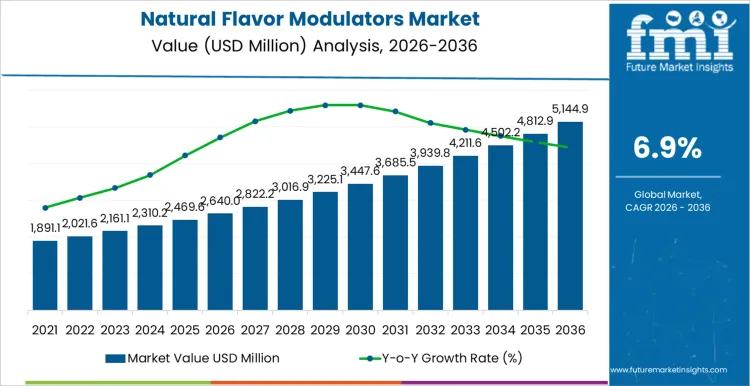
The natural flavor modulators market is projected to reach USD 2,640.0 million in 2026 and reach USD 5,144.9 million by 2036 at 6.9% CAGR. Value movement reflects structural dependence on sensory correction within clean-label reformulation rather than incremental flavor enhancement. Use cases expand where botanical extracts, plant proteins, and natural sweeteners introduce variability in taste intensity and aftertaste. Manufacturers apply modulators to stabilize flavor perception across seasonal raw material shifts, thermal processing, and shelf-life exposure. Spending concentrates in beverages, dairy alternatives, and fortified foods where minor deviations in sweetness or bitterness materially affect repeat purchase. Product economics favor modulators that operate at low inclusion rates, preserving margin while meeting regulatory and label expectations tied to natural positioning.
Adoption patterns are shaped by interaction limits, regulatory interpretation, and production consistency requirements. Many natural modulators perform within narrow pH or temperature ranges, restricting universal deployment across diverse matrices. Differences in how “natural” is defined across regions influence sourcing decisions and slow cross-border standardization. Sugar reduction and mineral fortification elevate bitterness and metallic notes, increasing reliance on precise modulation rather than bulk masking. Cost sensitivity constrains multi-component systems to premium or compliance-driven reformulation programs. Procurement favors suppliers able to provide sensory validation, batch-to-batch consistency, and reformulation support aligned with large production runs. Demand remains anchored in performance assurance and regulatory fit, reinforcing disciplined adoption across portfolios where taste stability protects brand equity over extended lifecycle horizons.
Quick Stats for Natural Flavor Modulators Market
- Natural Flavor Modulators Market Value (2026): USD 2,640.0 million
- Natural Flavor Modulators Market Forecast Value (2036): USD 5,144.9 million
- Natural Flavor Modulators Market Forecast CAGR 2026 to 2036: 6.9%
- Leading Functional Role by Demand Share: Bitterness reduction
- Fastest-Growing Countries: India, China, Brazil, USA, UK
- Top Players in Global Demand: Givaudan, IFF, Symrise, DSM-Firmenich, Sensient Technologies
Natural Flavor Modulators Market Key Takeaways
| Metric | Value |
|---|---|
| Market Value (2026) | USD 2,640.0 million |
| Market Forecast Value (2036) | USD 5,144.9 million |
| Forecast CAGR 2026 to 2036 | 6.9% |
Why is the Demand for Natural Flavor Modulators Market Growing?
Food and beverage companies facing diverse raw material sources require tools that shape sensory perception without masking desired natural profile characteristics. Natural flavor modulators adjust intensity, round off harsh notes, and enhance specific attributes in complex matrices such as plant proteins, botanical extracts, and fortified beverages. Developers of juices, dairy alternatives, and functional drinks integrate modulators to maintain varietal character while managing fluctuations in ingredient quality caused by seasonal or regional supply differences. Beverage formulators working with botanicals and minimal processing criteria rely on these ingredients to balance product flavor without synthetic alternatives.
Suppliers with expertise in plant-derived modulators provide solutions tailored to fruit forward, creamy, or spice driven profiles that meet clean label expectations. Processors who reformulate for vegetable content, whole grain inclusion, or reduced sugar focus on natural flavor modulators to preserve consumer accepted taste benchmarks. Sensory scientists conduct profiling to determine effective application rates across pH and temperature ranges typical of thermal processing and cold fill lines. Growth in ethnic and premium flavored snacks motivates adoption of modulators that maintain complexity without overwhelming balance. Ingredient manufacturers refine extraction and stabilization techniques that sustain activity throughout shelf life, supporting consistent sensory performance across production lots.
How Is the Natural Flavor Modulators Industry Segmented by Source Type, Functional Role, and Application?
Demand for natural flavor modulators is shaped by clean-label reformulation, sugar reduction initiatives, and rising use of plant-based ingredients. Manufacturers assess modulation solutions based on botanical origin, processing compatibility, and sensory precision across diverse food systems. Regulatory acceptance and supply scalability influence sourcing strategies. Segmentation by source type, functional role, and application explains how formulation priorities differ across beverages, dairy alternatives, bakery products, and nutritionally positioned foods requiring controlled sensory outcomes.
Which Source Type Accounts for the Largest Share in Natural Flavor Modulators?
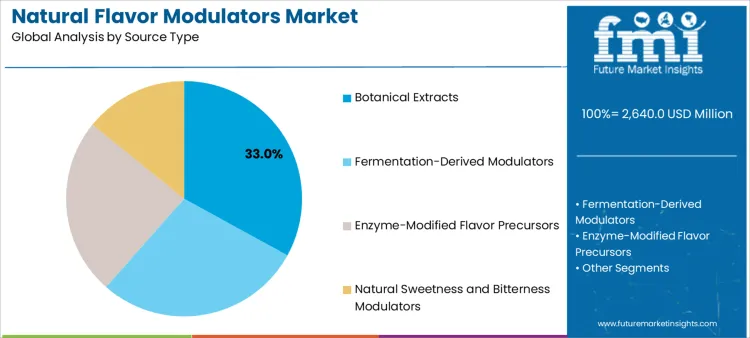
Botanical extracts account for 33.0%, supported by established regulatory status, natural positioning, and broad compatibility across food and beverage formulations. Fermentation-derived modulators represent 27.0%, reflecting controlled production methods and consistent sensory performance. Enzyme-modified flavor precursors hold 21.0%, applied where targeted biochemical conversion improves flavor perception. Natural sweetness and bitterness modulators account for 19.0%, enabling fine sensory adjustments without adding bulk sweeteners. Source-type segmentation reflects formulation decisions balancing origin claims, processing tolerance, and sensory accuracy.
Key Points:
- Botanical extracts align with clean-label sourcing expectations.
- Fermentation-derived modulators support consistency and scalability.
- Enzymatic systems enable targeted sensory refinement.
How Does Functional Role Influence the Use of Natural Flavor Modulators?
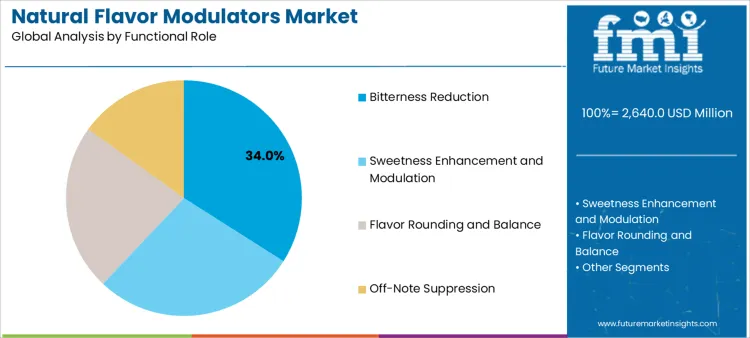
Bitterness reduction represents 34.0%, driven by reformulation of plant-based, fortified, and reduced-sugar products. Sweetness enhancement and modulation account for 28.0%, supporting sugar reduction while maintaining palatability. Flavor rounding and balance hold 22.0%, addressing harsh or unbalanced sensory profiles in complex formulations. Off-note suppression represents 16.0%, targeting metallic, beany, or astringent perceptions linked to proteins and minerals. Functional role segmentation highlights how sensory challenges vary by ingredient complexity and nutritional positioning.
Key Points:
- Bitterness management remains a primary formulation driver.
- Sweetness modulation supports reduced-sugar strategies.
- Flavor rounding improves overall sensory cohesion.
Which Applications Drive Demand for Natural Flavor Modulators?
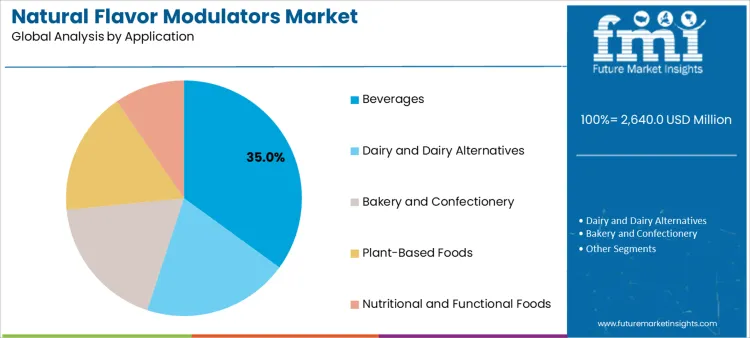
Beverages represent 35.0%, reflecting high sensitivity to bitterness, sweetness imbalance, and aftertaste perception. Dairy and dairy alternatives account for 22.0%, requiring modulators compatible with protein and fat systems. Bakery and confectionery hold 18.0%, where flavor balance and persistence influence consumer acceptance. Plant-based foods represent 15.0%, driven by off-note management from alternative proteins. Nutritional and functional foods account for 10.0%, emphasizing taste optimization alongside active ingredient inclusion.
Key Points:
- Beverage systems require precise modulation control.
- Dairy alternatives demand protein-compatible solutions.
- Functional foods balance sensory quality with nutrition.
What are the Key Dynamics in the natural flavor modulators market?
Demand in the natural flavor modulators market is defined by food and beverage manufacturers seeking to fine-tune sensory profiles while retaining clean-label positioning. Growth is concentrated in segments where authentic taste experience is essential, such as premium beverages, dairy desserts, confectionery, and high-protein nutrition products. Natural modulators are selected based on their ability to interact with specific flavor chemistries, enhance desired notes, and temper unwanted ones without artificial additives. Ingredient performance under processing stresses and alignment with regional regulatory classifications for “natural” status is central to procurement criteria.
How do consumer taste expectations in clean-label products shape adoption?
Food and beverage developers confront heightened consumer scrutiny of ingredient lists and sensory quality expectations. Natural flavor modulators are increasingly applied in reduced-sugar and reduced-salt products where reformulation can compromise taste balance. In plant-based beverages and yogurts, these modulators help elevate fruit or vanilla notes while softening bitter or green undertones inherent to botanical proteins. Craft beverage producers use modulators to refine botanical bitterness in functional drinks and herbal infusions, ensuring perceived quality matches premium positioning. Healthy snack categories, especially bars and nutrition bites, benefit when modulators maintain fruit and nut flavor integrity without introducing sweetness that conflicts with product positioning. Trial outcomes that demonstrate stability through heat, shear, and shelf life are significant drivers of repeat specification.
How do regulatory classifications and ingredient interaction constraints influence scalability?
Scalability in the natural flavor modulators market is shaped by the diversity of regional regulatory interpretations of “natural” and by the interaction behavior of modulators in complex matrices. Certain botanical modulators perform effectively only within a narrow pH range or lose efficacy under high heat or extended storage, requiring careful pairing with other flavor systems. Differences in ingredient naming conventions for clean-label claims influence where developers can deploy specific modulators without triggering consumer concerns or labeling complications. Price sensitivity emerges when multi-component solutions are required to balance enhancement with stability, which affects adoption in value-oriented categories. Sensory evaluation protocols that measure nuanced impact on taste perception extend product development timelines, influencing where and how extensively natural flavor modulators are used across global product lines.
How Is Demand for the Natural Flavor Modulators Market Evolving Globally?
Global demand for natural flavor modulators is increasing as food and beverage manufacturers pursue clean label reformulation while managing taste balance challenges. Growth reflects rising use of natural sweeteners, plant proteins, and functional actives that alter flavor perception. Natural modulators support sweetness enhancement, bitterness reduction, and flavor rounding without artificial additives. Demand expansion remains tied to regulatory scrutiny, clean label positioning, and sensory optimization across reformulated products. India records 8.0% CAGR, China records 7.7% CAGR, Brazil records 7.3% CAGR, USA records 6.1% CAGR, and UK records 5.9% CAGR. Adoption intensity is driven by formulation precision requirements rather than finished product volume growth.
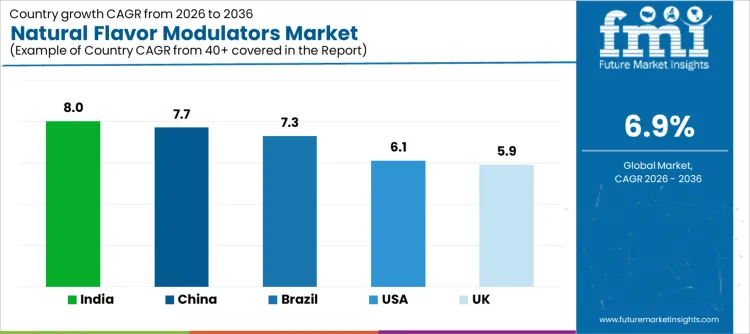
| Country | CAGR (%) |
|---|---|
| India | 8.0% |
| China | 7.7% |
| Brazil | 7.3% |
| USA | 6.1% |
| UK | 5.9% |
What is driving growth of natural flavor modulators demand in India?
Demand for natural flavor modulators in India is expanding as packaged food, beverage, and nutraceutical manufacturers shift toward clean label ingredient systems. Growth at 8.0% CAGR reflects rising use of stevia, herbal extracts, and plant-based actives that introduce bitterness and off-notes. Natural modulators support sweetness balance and flavor masking within functional beverages, syrups, and fortified foods. Cost sensitivity encourages solutions delivering perceptible impact at low inclusion levels. Domestic formulators prioritize modulators compatible with heat processing and traditional flavor profiles. Demand remains concentrated within urban health-oriented products and mass-market functional beverages.
- Expansion of clean label reformulation
- Rising use of natural sweeteners
- Need for bitterness and off-note control
- Cost-efficient sensory optimization
Why is China seeing expansion in natural flavor modulators adoption?
Natural flavor modulators demand in China is rising as large food processors align formulations with clean label and sugar reduction objectives. Growth at 7.7% CAGR reflects strong application across ready-to-drink beverages, functional dairy, and nutrition powders. High-volume manufacturing requires consistent flavor modulation across batches. Natural sweeteners and protein enrichment create taste imbalance requiring precise modulation. Domestic ingredient suppliers scale botanical and fermentation-derived modulators for industrial use. Demand remains centered on centralized processing facilities supplying modern retail and health-focused consumer segments.
- Clean label driven reformulation activity
- High-volume beverage and dairy processing
- Flavor balance in reduced sugar products
- Expansion of domestic natural ingredient supply
What factors are shaping natural flavor modulators sales in Brazil?
Sales of natural flavor modulators in Brazil are increasing as manufacturers respond to nutrition labeling rules and consumer preference for natural ingredients. Growth at 7.3% CAGR reflects reformulation across beverages, confectionery, and dairy products. Reduced sugar formulations amplify bitterness and acidity, increasing reliance on natural modulators. Tropical flavor systems require careful modulation to preserve sweetness perception. Local producers focus on maintaining taste acceptance within mass-market products. Demand remains strongest in beverages and flavored dairy targeting price-sensitive consumers.
- Nutrition labeling driven reformulation
- Preference for natural ingredient positioning
- Sweetness balance in tropical flavors
- Focus on mass-market taste acceptance
How is the USA supporting growth of natural flavor modulators demand?
Natural flavor modulators market demand in the USA is advancing as brands pursue clean label and reduced sugar strategies. Growth at 6.1% CAGR reflects adoption across functional beverages, snacks, dairy alternatives, and supplements. Natural sweeteners and plant proteins introduce bitterness and lingering aftertaste requiring modulation. Regulatory scrutiny on ingredient labeling influences selection toward natural modulators. Large manufacturers prioritize solutions preserving established flavor profiles during reformulation. Demand is driven by portfolio-wide reformulation and clean label risk management rather than new product launches.
- Clean label and reduced sugar reformulation
- High adoption of natural sweeteners
- Flavor consistency across reformulated portfolios
- Regulatory driven ingredient transparency
What is driving expansion of natural flavor modulators demand in the UK?
Demand for natural flavor modulators in the UK is rising as sugar taxation and clean label expectations shape formulation strategies. Growth at 5.9% CAGR reflects reformulation across beverages, dairy alternatives, and functional foods. Natural modulators support sweetness enhancement and bitterness suppression without artificial additives. Retail acceptance standards emphasize ingredient transparency and sensory quality. Manufacturers prioritize modulators aligned with regulatory approval and label simplicity. Demand remains linked to compliance-driven reformulation cycles rather than changes in overall food consumption.
- Sugar levy driven reformulation
- Clean label ingredient requirements
- Retail sensory quality benchmarks
- Growth of dairy alternative formulations
What is the competitive landscape of demand for the natural flavor modulators market globally?
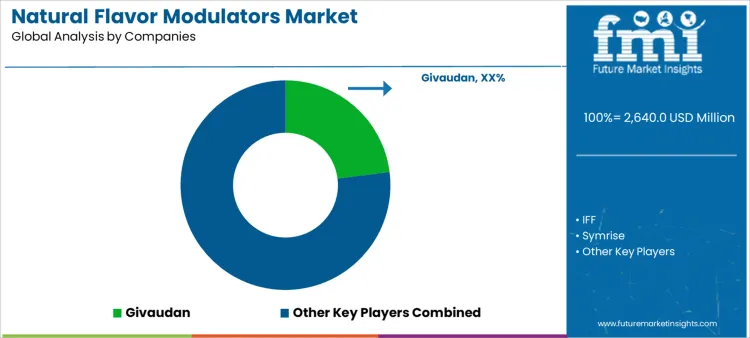
Natural positioning in packaged foods and beverages is accelerating demand for natural flavor modulators across reformulation programs. Developers evaluate modulation efficacy, flavor balance preservation, stability under heat and pH stress, and matrix compatibility. Buyer assessment includes clean label definitions, regional regulatory acceptance, dosage efficiency, and sensory consistency across batches. Procurement behavior reflects long development timelines, reliance on sensory panels, and preference for suppliers offering application validation. Purchasing decisions emphasize minimizing off-notes while maintaining authentic taste profiles in reduced sugar and plant-based products. Trend in the natural flavor modulators market reflects broader replacement of artificial modifiers with nature-derived solutions.
Givaudan leads competitive positioning through proprietary natural modulation platforms supported by extensive sensory science and botanical libraries. IFF competes by integrating natural modulators within comprehensive taste systems addressing sweetness, bitterness, and temporal balance. Symrise supports demand with natural modulators optimized for beverages, savory applications, and alternative protein formulations. DSM-Firmenich maintains relevance through nature-based modulation technologies aligned with processing stability and global compliance. Sensient Technologies participates with scalable natural modulators emphasizing color and flavor harmony across manufacturing sites. Competitive differentiation centers on sensory precision, regulatory clarity, customization capability, and collaborative development depth.
Key Players in the Natural Flavor Modulators Market
- Givaudan
- IFF
- Symrise
- DSM-Firmenich
- Sensient Technologies
- Others
Scope of the Report
| Items | Values |
|---|---|
| Quantitative Units | USD million |
| Source Type | Botanical Extracts; Fermentation-Derived Modulators; Enzyme-Modified Flavor Precursors; Natural Sweetness and Bitterness Modulators |
| Functional Role | Bitterness Reduction; Sweetness Enhancement and Modulation; Flavor Rounding and Balance; Off-Note Suppression |
| Application | Beverages; Dairy and Dairy Alternatives; Bakery and Confectionery; Plant-Based Foods; Nutritional and Functional Foods |
| Regions Covered | Asia Pacific, Europe, North America, Latin America, Middle East & Africa |
| Countries Covered | India, China, Brazil, USA, UK, and 40+ countries |
| Key Companies Profiled | Givaudan; IFF; Symrise; DSM-Firmenich; Sensient Technologies; Others |
| Additional Attributes | Dollar sales by source type, functional role, application, and sales channel; performance of botanical, fermentation-derived, and enzyme-modified systems in balancing sweetness and suppressing bitterness; stability across heat, pH, and processing stress; alignment with clean-label expectations and regulatory frameworks; formulation adoption shaped by beverage, dairy alternative, and plant-based innovation pipelines and long-term flavor house collaborations. |
Natural Flavor Modulators Market by Segment
Source Type:
- Botanical Extracts
- Fermentation-Derived Modulators
- Enzyme-Modified Flavor Precursors
- Natural Sweetness and Bitterness Modulators
Functional Role:
- Bitterness Reduction
- Sweetness Enhancement and Modulation
- Flavor Rounding and Balance
- Off-Note Suppression
Application:
- Beverages
- Dairy and Dairy Alternatives
- Bakery and Confectionery
- Plant-Based Foods
- Nutritional and Functional Foods
Region:
- Asia Pacific
- China
- Japan
- South Korea
- India
- Australia & New Zealand
- ASEAN
- Rest of Asia Pacific
- Europe
- Germany
- United Kingdom
- France
- Italy
- Spain
- Nordic
- BENELUX
- Rest of Europe
- North America
- United States
- Canada
- Mexico
- Latin America
- Brazil
- Chile
- Rest of Latin America
- Middle East & Africa
- Kingdom of Saudi Arabia
- Other GCC Countries
- Turkey
- South Africa
- Other African Union
- Rest of Middle East & Africa
Bibliography
- European Food Safety Authority. (2023). Guidance on the assessment of flavouring substances and natural flavour modifiers under Regulation (EC) No 1334/2008. EFSA Journal, 21(9).
- Food and Agriculture Organization of the United Nations. (2023). Natural flavouring substances and flavour modulation in clean-label food systems. FAO Food and Nutrition Paper.
- International Organization for Standardization. (2023). ISO 5492: Sensory analysis - Vocabulary (terms relevant to flavour modulation, bitterness, and sweetness perception). ISO.
- McClements, D. J. (2023). Modulation of flavour perception in complex food matrices using natural ingredients. Food Hydrocolloids, 139, 108486.
- Roland, W. S. U., Vincken, J.-P., & Gruppen, H. (2023). Natural taste modulators: Mechanisms of sweetness enhancement and bitterness suppression. Trends in Food Science & Technology, 137, 256-268.
Frequently Asked Questions
How big is the natural flavor modulators market in 2026?
The global natural flavor modulators market is estimated to be valued at USD 2,640.0 million in 2026.
What will be the size of natural flavor modulators market in 2036?
The market size for the natural flavor modulators market is projected to reach USD 5,144.9 million by 2036.
How much will be the natural flavor modulators market growth between 2026 and 2036?
The natural flavor modulators market is expected to grow at a 6.9% CAGR between 2026 and 2036.
What are the key product types in the natural flavor modulators market?
The key product types in natural flavor modulators market are botanical extracts, fermentation-derived modulators, enzyme-modified flavor precursors and natural sweetness and bitterness modulators.
Which functional role segment to contribute significant share in the natural flavor modulators market in 2026?
In terms of functional role, bitterness reduction segment to command 34.0% share in the natural flavor modulators market in 2026.
Preview the report firsthand - request a free sample
Get SampleGet the brochure for pricing and purchase details.
Get PDFTable of Content
- Executive Summary
- Global Market Outlook
- Demand-side Trends
- Supply-side Trends
- Technology Roadmap Analysis
- Analysis and Recommendations
- Market Overview
- Market Coverage / Taxonomy
- Market Definition / Scope / Limitations
- Market Background
- Market Dynamics
- Drivers
- Restraints
- Opportunity
- Trends
- Scenario Forecast
- Demand in Optimistic Scenario
- Demand in Likely Scenario
- Demand in Conservative Scenario
- Opportunity Map Analysis
- Product Life Cycle Analysis
- Supply Chain Analysis
- Investment Feasibility Matrix
- Value Chain Analysis
- PESTLE and Porter’s Analysis
- Regulatory Landscape
- Regional Parent Market Outlook
- Production and Consumption Statistics
- Import and Export Statistics
- Market Dynamics
- Global Market Analysis 2021 to 2025 and Forecast, 2026 to 2036
- Historical Market Size Value (USD Million) Analysis, 2021 to 2025
- Current and Future Market Size Value (USD Million) Projections, 2026 to 2036
- Y-o-Y Growth Trend Analysis
- Absolute $ Opportunity Analysis
- Global Market Pricing Analysis 2021 to 2025 and Forecast 2026 to 2036
- Global Market Analysis 2021 to 2025 and Forecast 2026 to 2036, By Source Type
- Introduction / Key Findings
- Historical Market Size Value (USD Million) Analysis By Source Type , 2021 to 2025
- Current and Future Market Size Value (USD Million) Analysis and Forecast By Source Type , 2026 to 2036
- Botanical Extracts
- Fermentation-Derived Modulators
- Enzyme-Modified Flavor Precursors
- Natural Sweetness and Bitterness Modulators
- Botanical Extracts
- Y-o-Y Growth Trend Analysis By Source Type , 2021 to 2025
- Absolute $ Opportunity Analysis By Source Type , 2026 to 2036
- Global Market Analysis 2021 to 2025 and Forecast 2026 to 2036, By Functional Role
- Introduction / Key Findings
- Historical Market Size Value (USD Million) Analysis By Functional Role, 2021 to 2025
- Current and Future Market Size Value (USD Million) Analysis and Forecast By Functional Role, 2026 to 2036
- Bitterness Reduction
- Sweetness Enhancement and Modulation
- Flavor Rounding and Balance
- Off-Note Suppression
- Bitterness Reduction
- Y-o-Y Growth Trend Analysis By Functional Role, 2021 to 2025
- Absolute $ Opportunity Analysis By Functional Role, 2026 to 2036
- Global Market Analysis 2021 to 2025 and Forecast 2026 to 2036, By Application
- Introduction / Key Findings
- Historical Market Size Value (USD Million) Analysis By Application, 2021 to 2025
- Current and Future Market Size Value (USD Million) Analysis and Forecast By Application, 2026 to 2036
- Beverages
- Dairy and Dairy Alternatives
- Bakery and Confectionery
- Plant-Based Foods
- Nutritional and Functional Foods
- Beverages
- Y-o-Y Growth Trend Analysis By Application, 2021 to 2025
- Absolute $ Opportunity Analysis By Application, 2026 to 2036
- Global Market Analysis 2021 to 2025 and Forecast 2026 to 2036, By Region
- Introduction
- Historical Market Size Value (USD Million) Analysis By Region, 2021 to 2025
- Current Market Size Value (USD Million) Analysis and Forecast By Region, 2026 to 2036
- North America
- Latin America
- Western Europe
- Eastern Europe
- East Asia
- South Asia and Pacific
- Middle East & Africa
- Market Attractiveness Analysis By Region
- North America Market Analysis 2021 to 2025 and Forecast 2026 to 2036, By Country
- Historical Market Size Value (USD Million) Trend Analysis By Market Taxonomy, 2021 to 2025
- Market Size Value (USD Million) Forecast By Market Taxonomy, 2026 to 2036
- By Country
- USA
- Canada
- Mexico
- By Source Type
- By Functional Role
- By Application
- By Country
- Market Attractiveness Analysis
- By Country
- By Source Type
- By Functional Role
- By Application
- Key Takeaways
- Latin America Market Analysis 2021 to 2025 and Forecast 2026 to 2036, By Country
- Historical Market Size Value (USD Million) Trend Analysis By Market Taxonomy, 2021 to 2025
- Market Size Value (USD Million) Forecast By Market Taxonomy, 2026 to 2036
- By Country
- Brazil
- Chile
- Rest of Latin America
- By Source Type
- By Functional Role
- By Application
- By Country
- Market Attractiveness Analysis
- By Country
- By Source Type
- By Functional Role
- By Application
- Key Takeaways
- Western Europe Market Analysis 2021 to 2025 and Forecast 2026 to 2036, By Country
- Historical Market Size Value (USD Million) Trend Analysis By Market Taxonomy, 2021 to 2025
- Market Size Value (USD Million) Forecast By Market Taxonomy, 2026 to 2036
- By Country
- Germany
- UK
- Italy
- Spain
- France
- Nordic
- BENELUX
- Rest of Western Europe
- By Source Type
- By Functional Role
- By Application
- By Country
- Market Attractiveness Analysis
- By Country
- By Source Type
- By Functional Role
- By Application
- Key Takeaways
- Eastern Europe Market Analysis 2021 to 2025 and Forecast 2026 to 2036, By Country
- Historical Market Size Value (USD Million) Trend Analysis By Market Taxonomy, 2021 to 2025
- Market Size Value (USD Million) Forecast By Market Taxonomy, 2026 to 2036
- By Country
- Russia
- Poland
- Hungary
- Balkan & Baltic
- Rest of Eastern Europe
- By Source Type
- By Functional Role
- By Application
- By Country
- Market Attractiveness Analysis
- By Country
- By Source Type
- By Functional Role
- By Application
- Key Takeaways
- East Asia Market Analysis 2021 to 2025 and Forecast 2026 to 2036, By Country
- Historical Market Size Value (USD Million) Trend Analysis By Market Taxonomy, 2021 to 2025
- Market Size Value (USD Million) Forecast By Market Taxonomy, 2026 to 2036
- By Country
- China
- Japan
- South Korea
- By Source Type
- By Functional Role
- By Application
- By Country
- Market Attractiveness Analysis
- By Country
- By Source Type
- By Functional Role
- By Application
- Key Takeaways
- South Asia and Pacific Market Analysis 2021 to 2025 and Forecast 2026 to 2036, By Country
- Historical Market Size Value (USD Million) Trend Analysis By Market Taxonomy, 2021 to 2025
- Market Size Value (USD Million) Forecast By Market Taxonomy, 2026 to 2036
- By Country
- India
- ASEAN
- Australia & New Zealand
- Rest of South Asia and Pacific
- By Source Type
- By Functional Role
- By Application
- By Country
- Market Attractiveness Analysis
- By Country
- By Source Type
- By Functional Role
- By Application
- Key Takeaways
- Middle East & Africa Market Analysis 2021 to 2025 and Forecast 2026 to 2036, By Country
- Historical Market Size Value (USD Million) Trend Analysis By Market Taxonomy, 2021 to 2025
- Market Size Value (USD Million) Forecast By Market Taxonomy, 2026 to 2036
- By Country
- Kingdom of Saudi Arabia
- Other GCC Countries
- Turkiye
- South Africa
- Other African Union
- Rest of Middle East & Africa
- By Source Type
- By Functional Role
- By Application
- By Country
- Market Attractiveness Analysis
- By Country
- By Source Type
- By Functional Role
- By Application
- Key Takeaways
- Key Countries Market Analysis
- USA
- Pricing Analysis
- Market Share Analysis, 2025
- By Source Type
- By Functional Role
- By Application
- Canada
- Pricing Analysis
- Market Share Analysis, 2025
- By Source Type
- By Functional Role
- By Application
- Mexico
- Pricing Analysis
- Market Share Analysis, 2025
- By Source Type
- By Functional Role
- By Application
- Brazil
- Pricing Analysis
- Market Share Analysis, 2025
- By Source Type
- By Functional Role
- By Application
- Chile
- Pricing Analysis
- Market Share Analysis, 2025
- By Source Type
- By Functional Role
- By Application
- Germany
- Pricing Analysis
- Market Share Analysis, 2025
- By Source Type
- By Functional Role
- By Application
- UK
- Pricing Analysis
- Market Share Analysis, 2025
- By Source Type
- By Functional Role
- By Application
- Italy
- Pricing Analysis
- Market Share Analysis, 2025
- By Source Type
- By Functional Role
- By Application
- Spain
- Pricing Analysis
- Market Share Analysis, 2025
- By Source Type
- By Functional Role
- By Application
- France
- Pricing Analysis
- Market Share Analysis, 2025
- By Source Type
- By Functional Role
- By Application
- India
- Pricing Analysis
- Market Share Analysis, 2025
- By Source Type
- By Functional Role
- By Application
- ASEAN
- Pricing Analysis
- Market Share Analysis, 2025
- By Source Type
- By Functional Role
- By Application
- Australia & New Zealand
- Pricing Analysis
- Market Share Analysis, 2025
- By Source Type
- By Functional Role
- By Application
- China
- Pricing Analysis
- Market Share Analysis, 2025
- By Source Type
- By Functional Role
- By Application
- Japan
- Pricing Analysis
- Market Share Analysis, 2025
- By Source Type
- By Functional Role
- By Application
- South Korea
- Pricing Analysis
- Market Share Analysis, 2025
- By Source Type
- By Functional Role
- By Application
- Russia
- Pricing Analysis
- Market Share Analysis, 2025
- By Source Type
- By Functional Role
- By Application
- Poland
- Pricing Analysis
- Market Share Analysis, 2025
- By Source Type
- By Functional Role
- By Application
- Hungary
- Pricing Analysis
- Market Share Analysis, 2025
- By Source Type
- By Functional Role
- By Application
- Kingdom of Saudi Arabia
- Pricing Analysis
- Market Share Analysis, 2025
- By Source Type
- By Functional Role
- By Application
- Turkiye
- Pricing Analysis
- Market Share Analysis, 2025
- By Source Type
- By Functional Role
- By Application
- South Africa
- Pricing Analysis
- Market Share Analysis, 2025
- By Source Type
- By Functional Role
- By Application
- USA
- Market Structure Analysis
- Competition Dashboard
- Competition Benchmarking
- Market Share Analysis of Top Players
- By Regional
- By Source Type
- By Functional Role
- By Application
- Competition Analysis
- Competition Deep Dive
- Givaudan
- Overview
- Product Portfolio
- Profitability by Market Segments (Product/Age /Sales Channel/Region)
- Sales Footprint
- Strategy Overview
- Marketing Strategy
- Product Strategy
- Channel Strategy
- IFF
- Symrise
- DSM-Firmenich
- Sensient Technologies
- Others
- Givaudan
- Competition Deep Dive
- Assumptions & Acronyms Used
- Research Methodology


