

- Market Size (2026)
- USD 192.8 Mn
- Forecast (2036)
- USD 448.1 Mn
- CAGR (2026 to 2036)
- 8.8%
Citrus-Based Sugar-Reduction Flavor Modulators Market Size, Market Forecast and Outlook By FMI
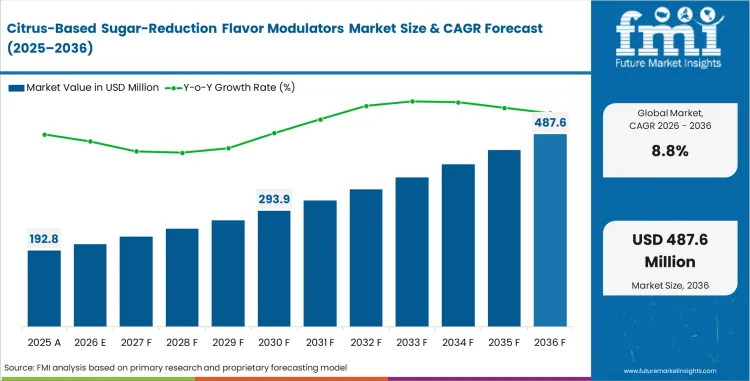
The citrus-based sugar-reduction flavor modulators market was USD 177.2 million in 2025. Demand is estimated to surpass USD 192.8 million in 2026 at a CAGR of 8.8% during the forecast period. Sustained investment carries total valuation to USD 448.1 million through 2036.
Summary of Citrus-Based Sugar-Reduction Flavor Modulators Market
- Market Snapshot
- The citrus-based sugar-reduction flavor modulators market valuation was USD 177.2 million in 2025 and is projected to reach USD 448.1 million by 2036.
- The market is expected to expand at 8.8% CAGR from 2026 to 2036, creating an incremental opportunity of USD 255.3 million over the decade.
- This market covers a narrow natural-modulation ingredient niche within the broader taste-modulator space, focused on citrus-derived systems used to restore sweetness, mask off-notes, and improve sensory balance in reduced-sugar formulations.
- Market growth depends more on clean-label pressure, beverage reformulation activity, and citrus raw-material availability than on overall sweetener volumes.
- Demand and Growth Drivers
- Demand is rising as food and beverage manufacturers work to cut added sugar without weakening taste acceptance, especially in beverages, dairy, and confectionery.
- Citrus-based modulation is drawing greater interest because sweet-orange aroma compounds and odor-linked sweetness enhancement can support sugar reduction without sharply weakening sensory appeal.
- Clean-label preference is supporting wider use, since citrus-based systems fit more comfortably into “natural,” FTNF, and botanical flavor declarations than many synthetic correction approaches.
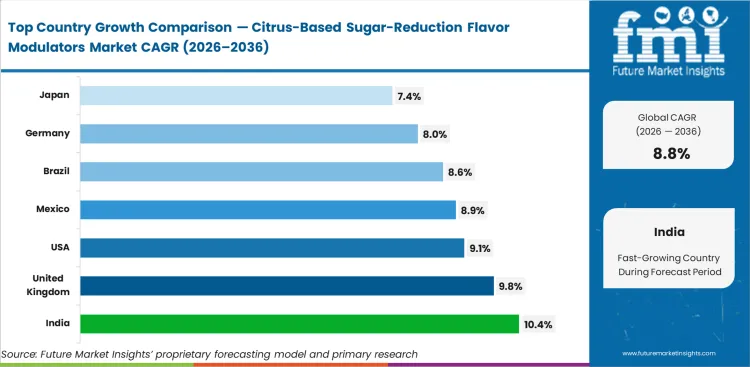
- Among key countries, India leads at 10.4% CAGR, followed by the United Kingdom at 9.8%, the United States at 9.1%, Mexico at 8.9%, Brazil at 8.6%, Germany at 8.0%, and Japan at 7.4%.
- Growth is checked by citrus-crop volatility, formulation complexity, and matrix-dependent performance, since the same modulator does not deliver the same sweetness effect across all beverages and foods.
- Product and Segment View
- The market includes citrus-derived flavor modulation systems used for sweetness enhancement, masking, mouthfeel restoration, and acidity balancing in reduced-sugar products.
- Use spans beverages, dairy, confectionery, bakery, and supplements, with beverages setting the pace for reformulation work.
- Orange leads the source segment with 43.0% share, supported by raw-material scale and the depth of sweet-orange aroma research associated with sweetness enhancement.
- Sweetness enhancers lead the function segment with 41.0% share, reflecting their central role in sugar-reduction formulation.
- Beverages lead the application segment with 47.0% share, as sugar taxes, label disclosure pressure, and taste retention are most visible in drink reformulation.
- Liquids lead the form segment with 62.0% share, matching dosing formats widely used in beverage, syrup, and concentrate systems.
- Natural dominates the label type segment with 68.0% share, reflecting clean-label preference and stronger acceptance of citrus-derived flavor solutions.
- Market scope includes industrial ingredient systems sold to food, beverage, and nutrition manufacturers, while excluding bulk citrus juices, standalone sweeteners, retail citrus oils, and finished consumer drinks.
- Geography and Competitive Outlook
- India, the United Kingdom, and the United States are the strongest growth markets in this niche, while Brazil stays important because its citrus-processing base supports ingredient supply as well as domestic demand.
- Suppliers compete less on citrus access alone and more on their ability to combine sweetness correction, masking, mouthfeel recovery, and regulatory fit in one formulation-ready solution.
- Key companies active in this niche include Givaudan, dsm-firmenich, Kerry Group, IFF, Symrise, and Sensient Technologies.
- The market remains moderately fragmented, even with a few leading companies, because buyers value formulation capability and solution range more than control over a single citrus input stream.
Key Takeaways, Market Size, and Forecast
- Citrus-Based Sugar-Reduction Flavor Modulators Market is projected to grow from USD 192.8 million in 2026 to USD 448.1 million by 2036, at a CAGR of 8.8%.
- The citrus-based sugar-reduction flavor modulators market was valued at USD 177.2 million in 2025.
- By 2036, the Citrus-Based Sugar-Reduction Flavor Modulators Market is expected to be worth USD 448.1 million.
- From 2026 to 2036, the market is projected to expand at a CAGR of 8.8%.
- The market is projected to create an incremental opportunity of USD 255.3 million between 2026 and 2036.
- In 2026, Orange is expected to account for 43.0% of the source segment.
- India (10.4%) and United Kingdom (9.8%) are two of the fastest growing markets.
Citrus-Based Sugar-Reduction Flavor Modulators Market Key Takeaways
| Metric | Details |
|---|---|
| Industry Size (2026) | USD 192.8 million |
| Industry Value (2036) | USD 448.1 million |
| CAGR (2026–2036) | 8.8% |
Source: Future Market Insights (FMI) analysis, based on proprietary forecasting model and primary research
Sugar reduction across packaged food and beverage lines is giving citrus-based flavor modulators a more important place in product development. Early commercial use stayed limited and focused on masking sweetness loss. Current demand reflects broader reformulation challenges in reduced-sugar products. Once sugar is reduced, taste rarely changes in just one way. Body becomes thinner, aroma loses lift, acidity can feel sharper, bitterness stands out more easily, and finish often disappears too quickly. Citrus-based modulation systems are gaining use because they help correct several of these sensory gaps without pushing the product toward an unfamiliar flavor profile.
Commercial value comes more from taste recovery than from sugar-reduction claims alone. A reduced-sugar launch may attract first-time buyers through label appeal, though repeat purchase depends on whether the flavor still feels complete after repeated use. Citrus flavors, peel extracts, and related natural modulation systems help restore freshness while reducing metallic, bitter, or hollow notes left behind by stevia, monk fruit, allulose, soluble fiber systems, or mixed sweetener platforms. Formulators also gain more control over top-note brightness, mid-palate roundness, and finish length without overrelying on synthetic masking tools.
India is expected to register a 10.4% CAGR during the forecast period, driven by a shift from informal street beverages to packaged formats, rising health-conscious purchase patterns, and expanding regional bottling capacity. The United Kingdom is estimated to expand at a 9.8% CAGR over the forecast period, aided by tighter sugar-reduction pressure, cleaner-label demand, and advanced domestic processing capability. Demand is projected to rise at a 9.1% CAGR in the United States, 8.9% in Mexico, 8.6% in Brazil, 8.0% in Germany, and 7.4% in Japan. Growth reflects added-sugars disclosure pressure in the United States, front-of-pack warning labels in Mexico, flavor-processing depth in Brazil, additive scrutiny in Germany, and preference for scientifically validated natural solutions in Japan.
Segmental Analysis
Citrus-Based Sugar-Reduction Flavor Modulators Market Analysis by Source
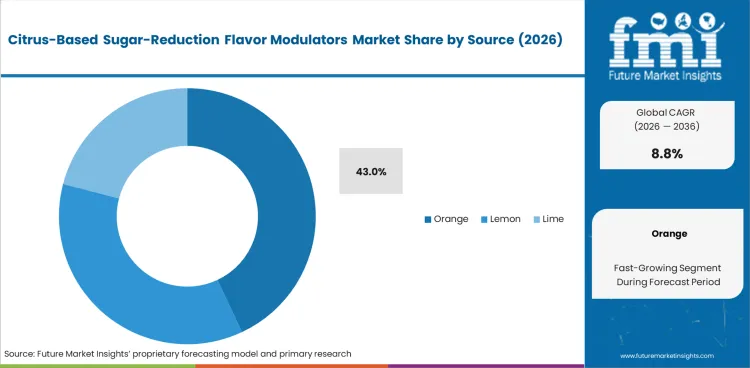
Orange keeps getting picked first in reduced-sugar formulation work because a familiar citrus smell helps bring back sweetness cues without pushing a recipe into a sour corner. Raw-material availability also matters, owing to broader orange-processing streams and steadier supply than narrower citrus routes such as lime fractions. Product teams also return to orange because bench work moves faster with a profile already familiar across drinks, dairy, confectionery, and syrup systems. Familiar handling of citrus oils also supports easier extract use in flavor development. The orange category is expected to hold 43.0% share in 2026, driven by wider sensory acceptance and supported by an easier extraction scale. Risk still stays in view, since crop disease, seasonal swings, and quality shifts can raise input costs and tighten availability across long production cycles. Even with such pressure, orange keeps a stronger place in this market because product teams get a safer balance of supply reach, taste comfort, and formulation ease.
- Formulation testing: Sensory teams often start early prototype work with orange fractions because profile balance stays broad enough for many product types without adding sharp acidity. Bench comparison work moves faster under this route, and first-pass screening gets a cleaner baseline.
- Scale validation: Pilot operators test extract behavior under shear, heat, and blending stress to confirm aroma survival during commercial processing. Supply planning matters here too, since single-origin dependence can weaken stability across long contracts.
- Portfolio integration: Brand teams often extend orange-derived modulators across nearby launches to keep a familiar taste signature. Factory teams then adjust dosing settings to manage viscosity changes due to natural citrus extracts.
Citrus-Based Sugar-Reduction Flavor Modulators Market Analysis by Function
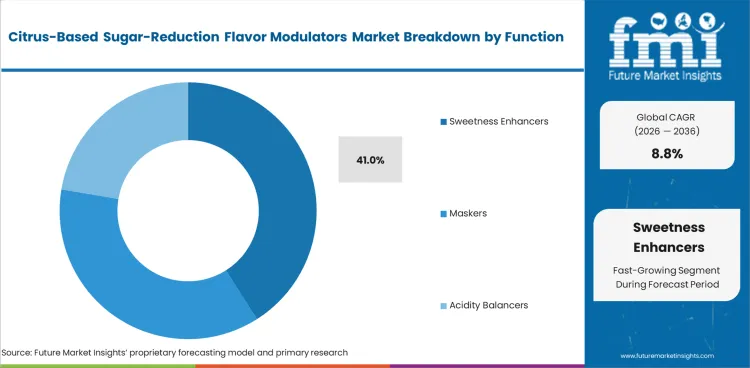
Sweetness support matters in sugar-reduction work because lower sugar rarely affects only one part of taste. Lower sugar can leave a thin body, shorter finish, hollow middle notes, and sharper off-notes from stevia, monk fruit, or bulking systems. Citrus-linked enhancers help address several of these gaps at once, giving formulators a practical tool across drinks, dairy, confectionery, and nutrition products. Sweetness enhancers segment is anticipated to capture 41.0% of the market in 2026, due to broad use across many recipes and supported by a strong role in keeping flavor balance intact after sugar comes down. Another benefit is the ability to stay closer to legacy taste expectations without moving back toward higher sugar levels. Performance still changes under heat, acid, and process style, so wrong profile selection can raise waste, slow launches, and push extra bench work into later stages. Category leadership comes from a clear commercial advantage: reduced-sugar products perform better when taste still feels full and familiar.
- Taxation triggers: Sugar limits in beverage policy keep pushing reformulation work onto shorter timelines. Product teams often need enhancer systems fast, especially across drink lines facing label pressure or tax exposure due to carbohydrate content.
- Performance benchmarking: Analytical and sensory panels compare enhancer systems against full-sugar controls to test aroma lift, finish quality, and sweetness perception. Commercial approval usually moves forward only after parity reaches an acceptable range.
- Contract finalization: Multi-year supply agreements gain more weight after a profile proves workable across scaled recipes. Volume security matters more at this stage because citrus-linked inputs remain exposed to crop shifts and raw-material variability.
Citrus-Based Sugar-Reduction Flavor Modulators Market Analysis by Application
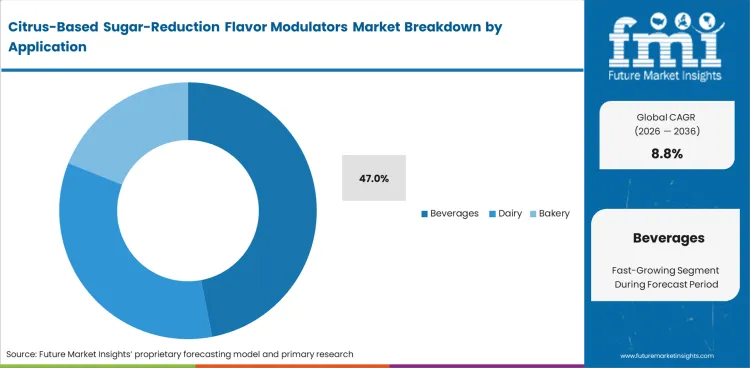
Drinks lose sensory balance faster than many solid foods because sugar supports more than sweetness in a liquid system. Mouthfeel can turn thin, finish can fall away, acidity can feel harsher, and flavor depth often drops once carbohydrate content comes down. Citrus-based modulators are gaining traction here because bright top notes and off-note control help correct several sensory weaknesses in a single dosing step. Beverage formulators also value easy fit across carbonated drinks, flavored water, juices, sports beverages, and functional hydration lines. The beverages segment is poised to garner 47.0% share in 2026, driven by faster low-sugar drink rollout and supported by a stronger need for sensory repair in liquid formats. Acid balance adds another layer of pressure, since a low-sugar drink can drift away from a stable flavor system under cold-fill or shelf-life stress. Related use of flavor modulator systems and specialty flavor drops also reflects demand for precise dosing across liquid recipes. Growth remains supported by mainstream beverage reformulation programs trying to cut sugar without hurting repeat purchase.
- Carbonation stability: Sparkling systems put more pressure on delicate citrus fractions than still drinks. Formulation teams often build extra aroma headroom into a recipe so sensory lift stays alive after storage.
- Thermal degradation: Pasteurization can reduce volatile performance before a product reaches market. Process teams account for this loss early, especially across juice drinks and shelf-stable nutritional beverages.
- pH buffering: Sugar reduction changes a beverage matrix in ways beyond sweetness. Microbial stability, preservative balance, and flavor brightness can all shift, so plant teams recalibrate process controls to keep shelf performance reliable.
Citrus-Based Sugar-Reduction Flavor Modulators Market Analysis by Form
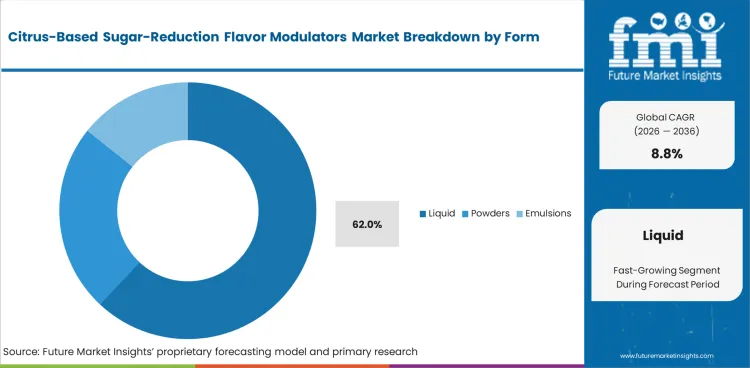
Liquid formats keep a clear edge in this market because most beverage and syrup systems already use setups built for pumpable flavor inputs. Dispersion speed matters here, since a liquid modulator moves into an aqueous matrix faster, cuts longer mixing cycles, and lowers friction on high-speed production lines. Factory settings also favor this route because current flavor-house infrastructure already supports liquid transfer in many plants. The liquids segment is expected to account for 62.0% share in 2026, driven by easier plant integration and broader use across water-based formulations. Powder formats can help on freight economics or dry-blend use, yet reconstitution errors and uneven mixing create avoidable trouble in wet processing. Transfer loss, storage conditions, and emulsion stability still need close control on liquid systems, so leadership does not mean low complexity. Even so, strong line compatibility keeps this format ahead in high-volume sugar-reduction programs.
- Freight optimization: Liquid modulators often need colder, more controlled transit conditions than dry alternatives. Logistics costs therefore carry more weight in margin planning, especially across long-distance supply routes.
- Storage footprint: Some liquid systems call for tighter warehousing controls because volatile carriers and citrus oils need careful handling. Facility planning becomes more important under this setup, particularly in larger manufacturing hubs.
- Yield loss: Viscous botanical liquids can stay on tote walls, pipe surfaces, or transfer equipment during fast production runs. Finance teams watch this closely because small losses repeated across annual volume add up quickly.
Citrus-Based Sugar-Reduction Flavor Modulators Market Analysis by Label Type
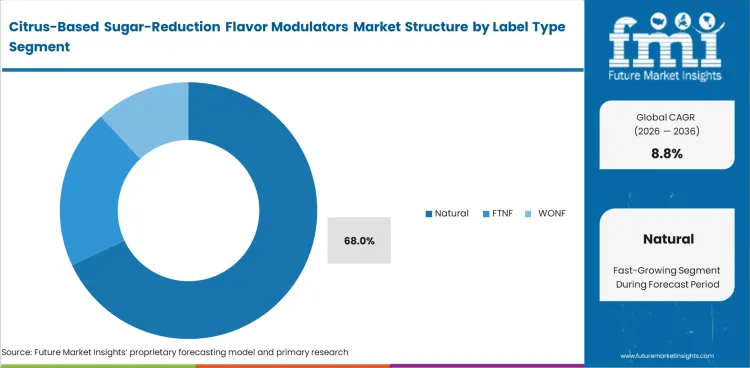
Natural claims matter more here because sugar reduction already puts a product under closer shopper review. Once a pack starts talking about lower sugar, ingredient wording gets more attention, and unfamiliar additive language can hurt trust before the first trial. Citrus-based modulators fit clean-label positioning more easily because fruit-linked sourcing is easier for consumers to understand than many synthetic masking tools. Familiar use of lemon-derived ingredients adds further support to natural flavor positioning. Retail acceptance adds another pull across wellness drinks, hydration mixes, family products, and premium low-sugar lines. The natural segment is likely to account for 68.0% share in 2026, due to stronger clean-label appeal and supported by wider fit across premium reformulation programs. Natural supply, however, still brings extra audit pressure, longer qualification cycles, crop variability, and tighter traceability demands. Even with added work on sourcing and verification, buyers keep leaning toward this route because a cleaner ingredient story can support pricing and repeat acceptance.
- Scale providers: Large flavor houses maintain extraction assets across multiple crop regions, giving brand owners a steadier supply base. Geographic spread reduces dependence on one harvest zone and improves continuity across annual contracts.
- Harvest volatility: Disease pressure, weather shifts, and variable fruit quality can narrow access to premium feedstock. Long-term supply planning therefore gains more weight for brands carrying natural claims across core portfolios.
- Processing consolidation: Advanced sensory extraction needs capital, technical depth, and steady raw-material access. Smaller extractors often struggle under these demands, leaving more influence with suppliers able to combine scale, traceability, and application support.
Citrus-Based Sugar-Reduction Flavor Modulators Market Drivers, Restraints, and Opportunities
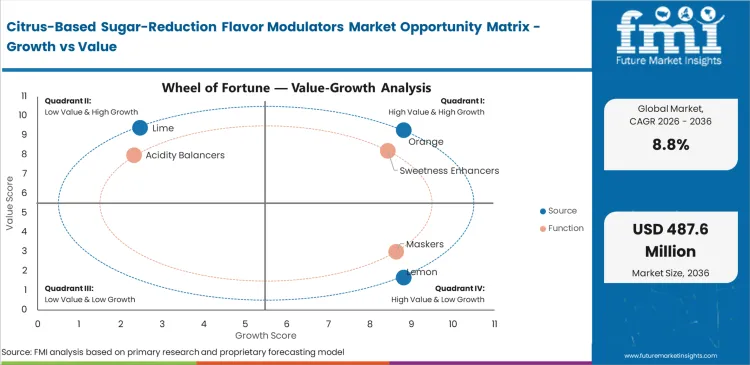
Front-of-pack warning label rules are pushing beverage companies to cut sugar in long-running product lines at a much faster pace. Once sugar content stays above defined limits, on-pack warning symbols can affect shelf appeal and make reformulation harder to delay. Product teams therefore face shorter timelines than usual, with less room for gradual testing or extended ingredient review. Sourcing teams cannot wait for future sweetener approvals or slower pipeline changes, so they often move toward available modulation systems that help protect taste in current recipes. This pressure is increasing interest in yuzu flavor extracts and related citrus-based modulators, especially in beverage portfolios trying to lower sugar without weakening flavor quality.
Performance differences across product formats create a separate challenge and slow wider use beyond drinks. A botanical modulator may work well in clear sparkling water, yet lose effectiveness in dairy systems or baked applications where fat, protein, heat, or texture change flavor behavior. Product development teams then need fresh adjustment work for each recipe instead of carrying one solution across multiple stock keeping units. Extra bench time, sensory testing, and pilot validation can delay expansion into broader food categories, even though beverage use remains active. New sensory modeling tools are helping teams understand matrix effects more clearly, though physical testing still does most of the work before commercial launch.
Opportunities in the Citrus-Based Sugar-Reduction Flavor Modulators Market
- Cross-category matrix modeling: Flavor teams study botanical fraction behavior across baked goods, dairy products, plus other complex food systems. Strong execution builds proprietary know-how in bakery and dairy reformulation, giving suppliers a stronger role in specialized sugar-reduction projects.
- Aroma-sweetness synergy isolation: Extraction groups identify flavor fractions boosting sweetness perception without added sugar. Product developers using such fractions can push sugar reduction further while keeping taste closer to familiar brand expectations.
- Waste-stream valorization: Citrus plus botanical peel streams once treated as leftovers now serve as feedstock for active modulation ingredients. Use of such sources brings lower raw-material cost, cleaner sourcing value, plus less exposure to wider swings in agricultural input pricing.
Regional Analysis
.webp "Top Country Growth Comparison Citrus Based Sugar Reduction Flavor Modulators Market Cagr (2026 2036)")
Based on regional analysis, the citrus-based sugar-reduction flavor modulators market is segmented into North America, Europe, Asia Pacific, Latin America, and Middle East & Africa, across 40 plus countries.
| Country | CAGR (2026 to 2036) |
|---|---|
| India | 10.4% |
| United Kingdom | 9.8% |
| United States | 9.1% |
| Mexico | 8.9% |
| Brazil | 8.6% |
| Germany | 8.0% |
| Japan | 7.4% |
Source: Future Market Insights (FMI) analysis, based on proprietary forecasting model and primary research
Asia Pacific Citrus-Based Sugar-Reduction Flavor Modulators Market Analysis
Asia Pacific shows strong demand for citrus-based sugar-reduction flavor modulators because packaged beverages are replacing many sugar-heavy informal drink habits across major urban centers. Taste remains a sensitive issue across this region, since buyers still expect fruit-forward familiarity even after sugar comes down. Heat exposure, long transport cycles, and uneven storage conditions add extra pressure on formulation work, so product teams place more value on citrus systems keeping aroma lift and sweetness support intact through commercial handling. Regional momentum therefore comes from a mix of health-led reformulation, faster packaged beverage penetration, and a practical need for stable flavor correction in warm-climate distribution chains.
- India: India has moved quickly from sugar-led local beverage habits toward packaged hydration, flavored water, and lower-sugar juice drinks carrying cleaner ingredient stories. Buyers across this market still expect a full taste profile, so sugar reduction cannot come at the cost of sharp aftertaste or weak finish. Demand for citrus-based sugar-reduction flavor modulators in India is anticipated to rise at a CAGR of 10.4% from 2026 to 2036, driven by premium beverage expansion and wider bottling capacity across major consumption centers. Citrus-based systems gain ground here due to stronger masking of sweetener off-notes and better alignment with fruit-led flavor profiles already common in packaged drinks.
- Japan: Japan follows a more measured path, though category movement remains steady because reduced-sugar products need refinement rather than loud sweetness correction. Product teams across this market pay close attention to aroma balance, finish quality, and aftertaste softness, especially in functional beverages, teas, and premium refreshment lines. Adoption of citrus-based sugar-reduction flavor modulators in Japan is projected to rise at a 7.4% CAGR through 2036, driven by stronger interest in metabolic-friendly beverage profiles and supported by advanced extraction know-how. Citrus-led modulation fits well here due to cleaner flavor lift and a more polished sensory profile across premium low-sugar portfolios.
Europe Citrus-Based Sugar-Reduction Flavor Modulators Market Analysis
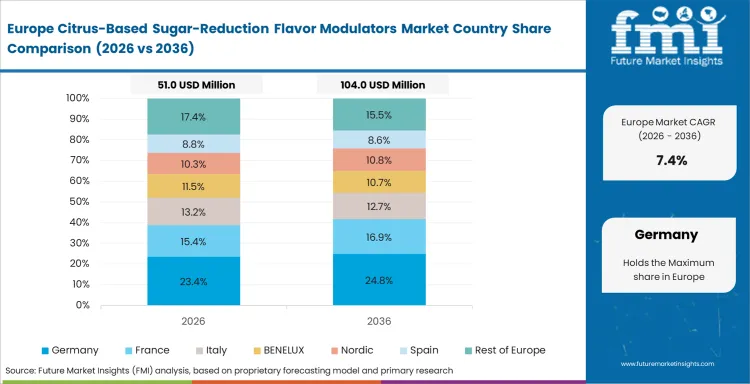
Europe remains one of the more structured markets for citrus-based sugar-reduction flavor modulators because sugar-reduction economics now extend beyond brand messaging to taxation and retail compliance pressure. Beverage makers across this region need lower-sugar formulas carrying enough taste depth to hold shelf position without moving toward unfamiliar additive language. Cleaner-label expectations add another layer, since shoppers across several European markets continue to read ingredient panels closely and reject chemical-sounding solutions more quickly than before. Regional growth therefore rests on a combination of levy pressure, label scrutiny, and demand for natural-origin systems capable of rebuilding sweetness perception in familiar drink formats.
- United Kingdom: United Kingdom continues to move at a faster pace because sugar levy pressure has changed beverage reformulation from a gradual exercise into an immediate commercial priority. Product teams are trying to reduce sugar while preserving familiarity across carbonated drinks, flavored waters, and mainstream refreshment lines. Sales in the United Kingdom are expected to increase at a CAGR of 9.8% during forecast period, supported by levy-linked recipe pressure and mature flavor-house capability. Citrus fractions gain traction here due to a stronger ability to rebuild sweetness perception while keeping labels closer to clean-label expectations.
- Germany: Germany takes a steadier route determined by natural-origin preference, careful ingredient reading, and broader acceptance of premium low-sugar beverages carrying botanical positioning. Buyers across this market often reject synthetic-sounding ingredients, so fruit-linked modulation gains a clearer route into hydration, malt drinks, and functional refreshment lines. Germany is set to record a CAGR of 8.0% in citrus-based sugar-reduction flavor modulators during the assessment period, due to additive skepticism and premium beverage demand. Market direction gains further support from sustainability-linked sourcing choices, giving citrus-derived systems added strength in cleaner-label reformulation work.
North America Citrus-Based Sugar-Reduction Flavor Modulators Market Analysis
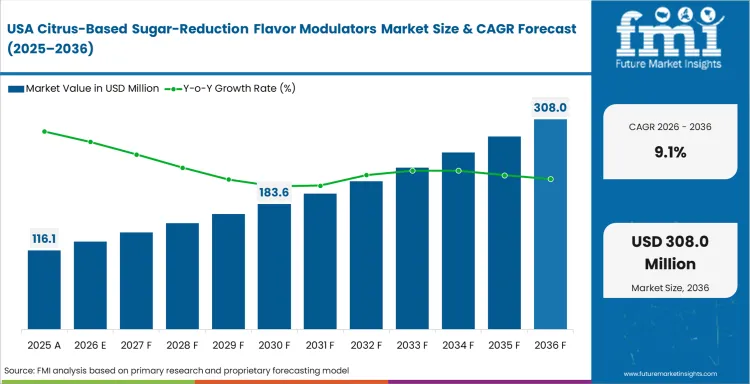
North America gives citrus-based sugar-reduction flavor modulators a broad commercial runway because label visibility around added sugars now shapes buying decisions more directly across mainstream beverage categories. Long-running brands no longer receive the same protection from habit alone once sugar declarations look too high on pack. Product teams therefore keep revisiting formulas in sports drinks, flavored water, carbonated beverages, and functional hydration lines in search of lower sugar levels without a noticeable drop in taste quality. Regional demand stays firm because citrus-linked systems offer a practical way to support sweetness perception while working within large-scale bottling and distribution structures.
- United States: United States remains central to category movement because beverage portfolios run across many plants, climate conditions, and pack sizes, making sensory consistency a major commercial concern. Added-sugars disclosure continues to pressure older formulas, while sports nutrition and hydration categories keep adding fresh low-sugar development work. The country is projected to witness a 9.1% CAGR in the citrus-based sugar-reduction flavor modulators market through 2036, driven by portfolio renovation across established drink brands and supported by broad flavor-house presence. Citrus-based modulation keeps drawing attention here due to better taste recovery in scaled drink systems carrying familiar flavor expectations.
Latin America Citrus-Based Sugar-Reduction Flavor Modulators Market Analysis
Latin American markets support this category through a different mix of forces, with visible warning-label systems pushing reformulation while strong fruit-processing depth improves access to botanical feedstock. Beverage brands across this region need practical taste-repair tools because lower-sugar products still need enough mouthfeel, sweetness impression, and flavor length to remain competitive in high-volume drink categories. Institutional buying rules and school-channel limits add more pressure, narrowing room for delay once a formula carries front-of-pack warnings. Regional momentum therefore comes from a blend of local citrus availability, label pressure, and a stronger need for low-sugar drink reformulation across mainstream portfolios.
- Mexico: Mexico moves faster because visible warning labels can weaken shelf appeal and leave brands with limited time to adjust long-running beverage formulas. Soda and refreshment lines need lower-sugar recipes carrying enough mouthfeel and flavor length to remain competitive after sugar comes down. Citrus-based sugar-reduction flavor modulator demand across Mexico is set to rise at 8.9% CAGR from 2026 to 2036, owing to warning-label pressure and close blending links with North America supply networks. Citrus systems fit local beverage work well due to stronger flavor brightness and a practical role in rebuilding sweetness cues across reformulated soft drinks.
- Brazil: Brazil benefits from a stronger domestic citrus and extraction base, giving formulators easier access to citrus-linked inputs without as much dependence on imported synthetic systems. Cost control remains important across this market because beverage makers still need lower-sugar recipes carrying broad-market appeal rather than a narrow premium-only reach. Brazil is likely to post a CAGR of 8.6% in citrus-based sugar-reduction flavor modulators by 2036, owing to domestic extraction strength and improved spray-drying and emulsion capability. Demand also gains support from rising health awareness, while local citrus availability gives formulators more room to test natural modulation routes at commercial scale through adjacent citrus powder and citrus molasses value chains.
Competitive Aligners for Market Players
Commercial strength in this market comes less from raw citrus access and more from solving taste problems inside reduced-sugar drinks. Big flavor houses like Givaudan and dsm-firmenich stay ahead because beverage brands rarely look for one aroma fraction alone. Sugar reduction usually changes more than sweetness. Mouthfeel gets thinner, off-notes show up faster, and finish fades sooner than expected. Buyers move toward suppliers offering complete beverage flavoring systems built to handle sweetness lift, masking, and texture support in one package. Such support cuts lab time, reduces repeat trials, and gives brands a faster path from bench work to launch.
Another advantage comes from approvals, ingredient status, and file readiness across several sales regions. Kerry Group and IFF gain ground here because large beverage companies often want one formula ready for use across multiple markets with fewer changes. Natural status, FTNF positioning, and GRAS acceptance take time to build, and smaller suppliers rarely carry the same depth of records for review. A brand planning a broad launch does not want delays linked to missing files, weak documentation, or extra legal review. Strong compliance records therefore matter almost as much as taste performance, since a working formula loses value if market entry slows down. Similar pressure also shapes supplier choice across flavor compounds used in wider beverage reformulation work.
Large beverage companies also try to avoid depending too much on one supplier. Symrise and Sensient Technologies often go through side-by-side sensory checks because buyers want a second source before signing long contracts. Even then, close matching is difficult. Small process changes, protected extraction methods, and proprietary formulation steps preserve performance differences, giving established suppliers more room to defend pricing and retain key accounts.
Key Players in Citrus-Based Sugar-Reduction Flavor Modulators Market
- Givaudan
- dsm-firmenich
- Kerry Group
- IFF
- Symrise
- Sensient Technologies
Scope of the Report
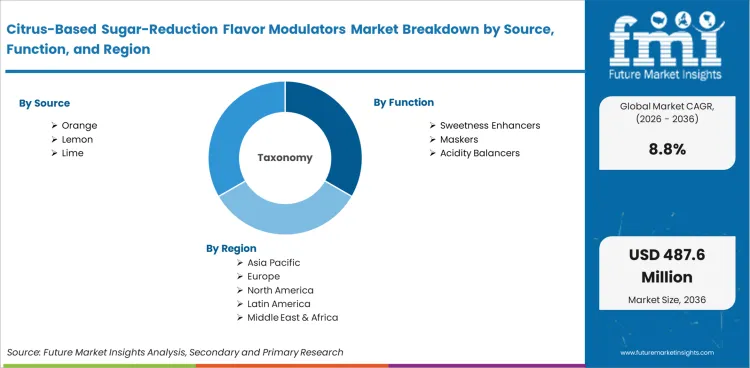
| Metric | Value |
|---|---|
| Quantitative Units | USD 192.8 million to USD 448.1 million, at a CAGR of 8.8% |
| Market Definition | Botanical extraction fractions engineered to manipulate olfactory and gustatory receptors, restoring sweetness perception and masking formulation off-notes without adding caloric load. |
| Segmentation | Source, Function, Application, Form, Label type, and Region |
| Regions Covered | Asia Pacific, Europe, North America, Latin America |
| Countries Covered | India, United Kingdom, United States, Mexico, Brazil, Germany, Japan |
| Key Companies Profiled | Givaudan, dsm-firmenich, Kerry Group, IFF, Symrise, Sensient Technologies |
| Forecast Period | 2026 to 2036 |
| Approach | Flavor house formulation volume contracts and commercial beverage reformulation launch frequencies |
Source: Future Market Insights (FMI) analysis, based on proprietary forecasting model and primary research
Citrus-Based Sugar-Reduction Flavor Modulators Market Analysis by Segments
Source
- Orange
- Lemon
- Lime
- Grapefruit
- Blends
Function
- Sweetness enhancers
- Maskers
- Mouthfeel builders
- Acidity balancers
Application
- Beverages
- Dairy
- Confectionery
- Bakery
- Supplements
Form
- Liquids
- Powders
- Emulsions
Label type
- Natural
- FTNF
- WONF
Region
- Asia Pacific
- Europe
- North America
- Latin America
- Middle East and Africa
Bibliography
- USA Department of Agriculture, Foreign Agricultural Service. (2026). Citrus: World Markets and Trade.
- Xiaoyun Zhao, Lili Zhao, and Bing Cui. (2025). Strategies and mechanisms of sweetness enhancement in food. International Journal of Food Science and Technology, 60(2), vvaf207.
- Nela Dragomir, Daniela-Mihaela Grigore, and Elena Narcisa Pogurschi (2025). Beyond Sugar: A Holistic Review of Sweeteners and Their Role in Modern Nutrition. Foods, 14(18), 3182.
- USA Food and Drug Administration. (2026). Human Foods Program 2026 Priority Deliverables.
This bibliography is provided for reader reference. The full FMI report contains the complete reference list with primary source documentation.
The Report Addresses
- Planning long-term orange extract supply under crop disease pressure and uneven harvest output.
- Using citrus fractions to improve sweetness perception without adding more sugar to beverage formulas.
- Choosing liquid emulsion formats for easier dosing, quicker mixing, and fewer plant-floor issues.
- Replacing synthetic masking systems with natural FTNF-compliant citrus extracts in clean-label products.
- Managing pH balance and flavor stability in pasteurized and cold-fill beverage lines.
- Reformulating drink recipes to move below sugar-related tax thresholds.
- Studying sweetness perception across dairy, beverages, and other harder-to-balance product systems.
- Locking in supply for validated sweet-orange profiles used in reduced-sugar commercial recipes.
Frequently Asked Questions
What are citrus-based sugar-reduction flavor modulators?
These are citrus-derived flavor ingredients used to make lower-sugar products taste fuller and more balanced. Their main job is to bring back part of the sweetness impression and soften off-notes after sugar comes down. Extra sugar does not need to be added for this effect to matter.
What is the market size of citrus-based sugar-reduction flavor modulators?
Demand stands at USD 192.8 million in 2026. Market value is projected to reach USD 448.1 million by 2036. Wider use across beverages, dairy products, confectionery, and nutrition lines is pushing this increase over time.
How do citrus flavor modulators reduce sugar without losing taste?
Citrus flavor modulators do not replace sugar in a direct one-for-one way. Instead, they help rebuild sweetness perception, brighten flavor, and soften bitter or hollow notes left behind after sugar reduction. A recipe can then feel closer to its older taste profile.
Who are the top companies in citrus sugar-reduction flavor modulators?
Key companies include Givaudan, dsm-firmenich, Kerry Group, IFF, Symrise, and Sensient Technologies. Stronger positions come from formulation skill, regulatory readiness, and long-running supply links with large beverage brands.
Why are beverage brands using citrus modulators for sugar reduction?
Beverage brands need lower-sugar formulas without making a drink taste flat, sharp, or thin. Tax pressure, warning-label risk, and added-sugars disclosure have made taste repair more important in product reformulation. Citrus systems help brands move in this direction with less flavor damage.
What drives the strong preference for natural label types?
Natural wording matters more here because shoppers often check ingredient lists more closely on lower-sugar products. Brands use botanical systems to support cleaner labels and avoid ingredient terms that sound too synthetic. Familiar fruit-based language also helps product acceptance.
How does India outpace broader market growth?
India benefits from a fast shift toward packaged drinks, wider use of lower-sugar beverage formats, and rising interest in cleaner-label products. Citrus-based systems also fit well with fruit-led flavor profiles common in local drink development. This makes adoption easier across a broad part of the beverage market.
Why does the United Kingdom expand faster than mainland Europe?
Sugar levy pressure has pushed beverage makers in the United Kingdom to reformulate more quickly. Citrus modulators gain value in this setting because taste needs to stay close to familiar drinking habits even after sugar drops. This keeps demand active across mainstream drink lines.
How does Brazil benefit from domestic supply strength?
Brazil gains from local cultivation and processing depth, giving beverage makers easier access to citrus-derived inputs. This helps keep costs steadier and cuts dependence on longer import routes. Local supply also gives formulators more room to test natural systems at commercial scale.
How do sensory prediction tools help product launches?
Sensory models help teams narrow down likely formula options before full pilot work begins. This saves some time at early stages and can reduce wasted bench trials. Real product testing still does most of the real work before launch approval moves ahead.
Why do formulations change across temperature states?
Flavor performance can shift under cold-fill, ambient storage, or heat processing. A system working well in chilled drinks may behave very differently after pasteurization or long shelf exposure. Temperature therefore remains a major part of formula checking.
What keeps synthetic maskers from taking more share?
Many brands still prefer botanical routes because ingredient familiarity matters more in reduced-sugar products. Natural citrus systems fit clean-label goals more easily than synthetic masking tools. Shopper trust plays a big role in this preference.
How do warning labels shape commercial strategy in Mexico?
Visible warning symbols can weaken shelf appeal and push brands to lower sugar more quickly in mainstream drink lines. Citrus-based modulators help support taste during this change. Product teams use them to protect flavor while trying to avoid warning-led sales pressure.
Why is waste-stream valorization getting more attention?
Peel biomass and other citrus side streams are gaining value as lower-cost feedstock for active modulation ingredients. This route makes better use of raw material and also gives brands a stronger sourcing message. Cost control and cleaner resource use both add appeal here.
Preview the report firsthand - request a free sample
Get SampleGet the brochure for pricing and purchase details.
Get PDFTable of Content
- Executive Summary
- Global Market Outlook
- Demand-side Trends
- Supply-side Trends
- Technology Roadmap Analysis
- Analysis and Recommendations
- Market Overview
- Market Coverage / Taxonomy
- Market Definition / Scope / Limitations
- Research Methodology
- Chapter Orientation
- Analytical Lens and Working Hypotheses
- Market Structure, Signals, and Trend Drivers
- Benchmarking and Cross-market Comparability
- Market Sizing, Forecasting, and Opportunity Mapping
- Research Design and Evidence Framework
- Desk Research Programme (Secondary Evidence)
- Company Annual and Sustainability Reports
- Peer-reviewed Journals and Academic Literature
- Corporate Websites, Product Literature, and Technical Notes
- Earnings Decks and Investor Briefings
- Statutory Filings and Regulatory Disclosures
- Technical White Papers and Standards Notes
- Trade Journals, Industry Magazines, and Analyst Briefs
- Conference Proceedings, Webinars, and Seminar Materials
- Government Statistics Portals and Public Data Releases
- Press Releases and Reputable Media Coverage
- Specialist Newsletters and Curated Briefings
- Sector Databases and Reference Repositories
- FMI Internal Proprietary Databases and Historical Market Datasets
- Subscription Datasets and Paid Sources
- Social Channels, Communities, and Digital Listening Inputs
- Additional Desk Sources
- Expert Input and Fieldwork (Primary Evidence)
- Primary Modes
- Qualitative Interviews and Expert Elicitation
- Quantitative Surveys and Structured Data Capture
- Blended Approach
- Why Primary Evidence is Used
- Field Techniques
- Interviews
- Surveys
- Focus Groups
- Observational and In-context Research
- Social and Community Interactions
- Stakeholder Universe Engaged
- C-suite Leaders
- Board Members
- Presidents and Vice Presidents
- R&D and Innovation Heads
- Technical Specialists
- Domain Subject-matter Experts
- Scientists
- Physicians and Other Healthcare Professionals
- Governance, Ethics, and Data Stewardship
- Research Ethics
- Data Integrity and Handling
- Primary Modes
- Tooling, Models, and Reference Databases
- Desk Research Programme (Secondary Evidence)
- Data Engineering and Model Build
- Data Acquisition and Ingestion
- Cleaning, Normalisation, and Verification
- Synthesis, Triangulation, and Analysis
- Quality Assurance and Audit Trail
- Market Background
- Market Dynamics
- Drivers
- Restraints
- Opportunity
- Trends
- Scenario Forecast
- Demand in Optimistic Scenario
- Demand in Likely Scenario
- Demand in Conservative Scenario
- Opportunity Map Analysis
- Product Life Cycle Analysis
- Supply Chain Analysis
- Investment Feasibility Matrix
- Value Chain Analysis
- PESTLE and Porter’s Analysis
- Regulatory Landscape
- Regional Parent Market Outlook
- Production and Consumption Statistics
- Import and Export Statistics
- Market Dynamics
- Global Market Analysis 2021 to 2025 and Forecast, 2026 to 2036
- Historical Market Size Value (USD Million) Analysis, 2021 to 2025
- Current and Future Market Size Value (USD Million) Projections, 2026 to 2036
- Y-o-Y Growth Trend Analysis
- Absolute $ Opportunity Analysis
- Global Market Pricing Analysis 2021 to 2025 and Forecast 2026 to 2036
- Global Market Analysis 2021 to 2025 and Forecast 2026 to 2036, By Source
- Introduction / Key Findings
- Historical Market Size Value (USD Million) Analysis By Source , 2021 to 2025
- Current and Future Market Size Value (USD Million) Analysis and Forecast By Source , 2026 to 2036
- Orange
- Lemon
- Lime
- Orange
- Y-o-Y Growth Trend Analysis By Source , 2021 to 2025
- Absolute $ Opportunity Analysis By Source , 2026 to 2036
- Global Market Analysis 2021 to 2025 and Forecast 2026 to 2036, By Function
- Introduction / Key Findings
- Historical Market Size Value (USD Million) Analysis By Function, 2021 to 2025
- Current and Future Market Size Value (USD Million) Analysis and Forecast By Function, 2026 to 2036
- Sweetness Enhancers
- Maskers
- Acidity Balancers
- Sweetness Enhancers
- Y-o-Y Growth Trend Analysis By Function, 2021 to 2025
- Absolute $ Opportunity Analysis By Function, 2026 to 2036
- Global Market Analysis 2021 to 2025 and Forecast 2026 to 2036, By Application
- Introduction / Key Findings
- Historical Market Size Value (USD Million) Analysis By Application, 2021 to 2025
- Current and Future Market Size Value (USD Million) Analysis and Forecast By Application, 2026 to 2036
- Beverages
- Dairy
- Bakery
- Beverages
- Y-o-Y Growth Trend Analysis By Application, 2021 to 2025
- Absolute $ Opportunity Analysis By Application, 2026 to 2036
- Global Market Analysis 2021 to 2025 and Forecast 2026 to 2036, By Form
- Introduction / Key Findings
- Historical Market Size Value (USD Million) Analysis By Form, 2021 to 2025
- Current and Future Market Size Value (USD Million) Analysis and Forecast By Form, 2026 to 2036
- Liquid
- Powders
- Emulsions
- Liquid
- Y-o-Y Growth Trend Analysis By Form, 2021 to 2025
- Absolute $ Opportunity Analysis By Form, 2026 to 2036
- Global Market Analysis 2021 to 2025 and Forecast 2026 to 2036, By Label Type
- Introduction / Key Findings
- Historical Market Size Value (USD Million) Analysis By Label Type, 2021 to 2025
- Current and Future Market Size Value (USD Million) Analysis and Forecast By Label Type, 2026 to 2036
- Natural
- FTNF
- WONF
- Natural
- Y-o-Y Growth Trend Analysis By Label Type, 2021 to 2025
- Absolute $ Opportunity Analysis By Label Type, 2026 to 2036
- Global Market Analysis 2021 to 2025 and Forecast 2026 to 2036, By Region
- Introduction
- Historical Market Size Value (USD Million) Analysis By Region, 2021 to 2025
- Current Market Size Value (USD Million) Analysis and Forecast By Region, 2026 to 2036
- North America
- Latin America
- Western Europe
- Eastern Europe
- East Asia
- South Asia and Pacific
- Middle East & Africa
- Market Attractiveness Analysis By Region
- North America Market Analysis 2021 to 2025 and Forecast 2026 to 2036, By Country
- Historical Market Size Value (USD Million) Trend Analysis By Market Taxonomy, 2021 to 2025
- Market Size Value (USD Million) Forecast By Market Taxonomy, 2026 to 2036
- By Country
- USA
- Canada
- Mexico
- By Source
- By Function
- By Application
- By Form
- By Label Type
- By Country
- Market Attractiveness Analysis
- By Country
- By Source
- By Function
- By Application
- By Form
- By Label Type
- Key Takeaways
- Latin America Market Analysis 2021 to 2025 and Forecast 2026 to 2036, By Country
- Historical Market Size Value (USD Million) Trend Analysis By Market Taxonomy, 2021 to 2025
- Market Size Value (USD Million) Forecast By Market Taxonomy, 2026 to 2036
- By Country
- Brazil
- Chile
- Rest of Latin America
- By Source
- By Function
- By Application
- By Form
- By Label Type
- By Country
- Market Attractiveness Analysis
- By Country
- By Source
- By Function
- By Application
- By Form
- By Label Type
- Key Takeaways
- Western Europe Market Analysis 2021 to 2025 and Forecast 2026 to 2036, By Country
- Historical Market Size Value (USD Million) Trend Analysis By Market Taxonomy, 2021 to 2025
- Market Size Value (USD Million) Forecast By Market Taxonomy, 2026 to 2036
- By Country
- Germany
- UK
- Italy
- Spain
- France
- Nordic
- BENELUX
- Rest of Western Europe
- By Source
- By Function
- By Application
- By Form
- By Label Type
- By Country
- Market Attractiveness Analysis
- By Country
- By Source
- By Function
- By Application
- By Form
- By Label Type
- Key Takeaways
- Eastern Europe Market Analysis 2021 to 2025 and Forecast 2026 to 2036, By Country
- Historical Market Size Value (USD Million) Trend Analysis By Market Taxonomy, 2021 to 2025
- Market Size Value (USD Million) Forecast By Market Taxonomy, 2026 to 2036
- By Country
- Russia
- Poland
- Hungary
- Balkan & Baltic
- Rest of Eastern Europe
- By Source
- By Function
- By Application
- By Form
- By Label Type
- By Country
- Market Attractiveness Analysis
- By Country
- By Source
- By Function
- By Application
- By Form
- By Label Type
- Key Takeaways
- East Asia Market Analysis 2021 to 2025 and Forecast 2026 to 2036, By Country
- Historical Market Size Value (USD Million) Trend Analysis By Market Taxonomy, 2021 to 2025
- Market Size Value (USD Million) Forecast By Market Taxonomy, 2026 to 2036
- By Country
- China
- Japan
- South Korea
- By Source
- By Function
- By Application
- By Form
- By Label Type
- By Country
- Market Attractiveness Analysis
- By Country
- By Source
- By Function
- By Application
- By Form
- By Label Type
- Key Takeaways
- South Asia and Pacific Market Analysis 2021 to 2025 and Forecast 2026 to 2036, By Country
- Historical Market Size Value (USD Million) Trend Analysis By Market Taxonomy, 2021 to 2025
- Market Size Value (USD Million) Forecast By Market Taxonomy, 2026 to 2036
- By Country
- India
- ASEAN
- Australia & New Zealand
- Rest of South Asia and Pacific
- By Source
- By Function
- By Application
- By Form
- By Label Type
- By Country
- Market Attractiveness Analysis
- By Country
- By Source
- By Function
- By Application
- By Form
- By Label Type
- Key Takeaways
- Middle East & Africa Market Analysis 2021 to 2025 and Forecast 2026 to 2036, By Country
- Historical Market Size Value (USD Million) Trend Analysis By Market Taxonomy, 2021 to 2025
- Market Size Value (USD Million) Forecast By Market Taxonomy, 2026 to 2036
- By Country
- Kingdom of Saudi Arabia
- Other GCC Countries
- Turkiye
- South Africa
- Other African Union
- Rest of Middle East & Africa
- By Source
- By Function
- By Application
- By Form
- By Label Type
- By Country
- Market Attractiveness Analysis
- By Country
- By Source
- By Function
- By Application
- By Form
- By Label Type
- Key Takeaways
- Key Countries Market Analysis
- USA
- Pricing Analysis
- Market Share Analysis, 2025
- By Source
- By Function
- By Application
- By Form
- By Label Type
- Canada
- Pricing Analysis
- Market Share Analysis, 2025
- By Source
- By Function
- By Application
- By Form
- By Label Type
- Mexico
- Pricing Analysis
- Market Share Analysis, 2025
- By Source
- By Function
- By Application
- By Form
- By Label Type
- Brazil
- Pricing Analysis
- Market Share Analysis, 2025
- By Source
- By Function
- By Application
- By Form
- By Label Type
- Chile
- Pricing Analysis
- Market Share Analysis, 2025
- By Source
- By Function
- By Application
- By Form
- By Label Type
- Germany
- Pricing Analysis
- Market Share Analysis, 2025
- By Source
- By Function
- By Application
- By Form
- By Label Type
- UK
- Pricing Analysis
- Market Share Analysis, 2025
- By Source
- By Function
- By Application
- By Form
- By Label Type
- Italy
- Pricing Analysis
- Market Share Analysis, 2025
- By Source
- By Function
- By Application
- By Form
- By Label Type
- Spain
- Pricing Analysis
- Market Share Analysis, 2025
- By Source
- By Function
- By Application
- By Form
- By Label Type
- France
- Pricing Analysis
- Market Share Analysis, 2025
- By Source
- By Function
- By Application
- By Form
- By Label Type
- India
- Pricing Analysis
- Market Share Analysis, 2025
- By Source
- By Function
- By Application
- By Form
- By Label Type
- ASEAN
- Pricing Analysis
- Market Share Analysis, 2025
- By Source
- By Function
- By Application
- By Form
- By Label Type
- Australia & New Zealand
- Pricing Analysis
- Market Share Analysis, 2025
- By Source
- By Function
- By Application
- By Form
- By Label Type
- China
- Pricing Analysis
- Market Share Analysis, 2025
- By Source
- By Function
- By Application
- By Form
- By Label Type
- Japan
- Pricing Analysis
- Market Share Analysis, 2025
- By Source
- By Function
- By Application
- By Form
- By Label Type
- South Korea
- Pricing Analysis
- Market Share Analysis, 2025
- By Source
- By Function
- By Application
- By Form
- By Label Type
- Russia
- Pricing Analysis
- Market Share Analysis, 2025
- By Source
- By Function
- By Application
- By Form
- By Label Type
- Poland
- Pricing Analysis
- Market Share Analysis, 2025
- By Source
- By Function
- By Application
- By Form
- By Label Type
- Hungary
- Pricing Analysis
- Market Share Analysis, 2025
- By Source
- By Function
- By Application
- By Form
- By Label Type
- Kingdom of Saudi Arabia
- Pricing Analysis
- Market Share Analysis, 2025
- By Source
- By Function
- By Application
- By Form
- By Label Type
- Turkiye
- Pricing Analysis
- Market Share Analysis, 2025
- By Source
- By Function
- By Application
- By Form
- By Label Type
- South Africa
- Pricing Analysis
- Market Share Analysis, 2025
- By Source
- By Function
- By Application
- By Form
- By Label Type
- USA
- Market Structure Analysis
- Competition Dashboard
- Competition Benchmarking
- Market Share Analysis of Top Players
- By Regional
- By Source
- By Function
- By Application
- By Form
- By Label Type
- Competition Analysis
- Competition Deep Dive
- Competition Deep Dive
- Assumptions & Acronyms Used


