

- Industry Size (2026)
- USD 3560.0 Mn
- Forecast (2036)
- USD 7135.1 Mn
- CAGR (2026 to 2036)
- 7.2%
Flavor Encapsulation Ingredients Market Forecast and Outlook 2026 to 2036
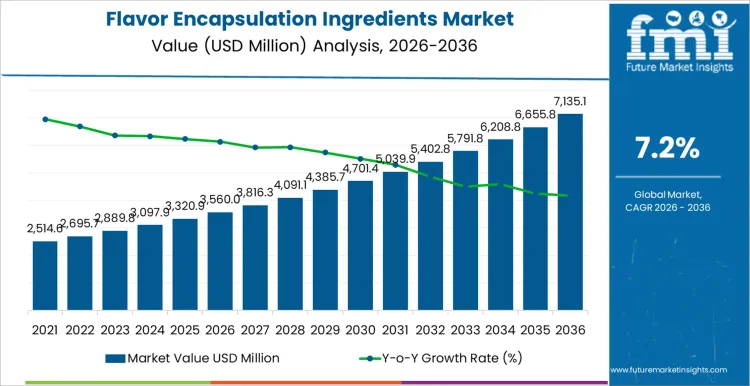
The flavor encapsulation ingredients market is expected to reach USD 3,560.0 million in 2026 and expand to USD 7,135.1 million by 2036, at a CAGR of 7.2%. Growth reflects increasing reliance on encapsulation to protect volatile and oxidation-sensitive flavor compounds across beverages, bakery, confectionery, dairy alternatives, and nutrition products. Processing steps such as spray drying, extrusion, baking, and pasteurization expose flavors to heat, shear, and moisture, accelerating aroma loss and profile distortion. Encapsulation systems preserve flavor integrity by isolating sensitive compounds until consumption, while also enabling controlled release that supports sensory impact. Demand is reinforced by powdered drink mixes, instant foods, and shelf-stable products where flavor consistency determines repeat purchase.
Manufacturers prioritize encapsulation materials that balance protection efficiency, release kinetics, and compatibility with existing matrices while meeting clean-label and cost constraints. Sugar reduction, protein fortification, and functional ingredient addition increase flavor management challenges, raising dependence on encapsulated systems to mask off-notes and stabilize aroma delivery. Regional manufacturing variability and extended distribution chains further elevate the role of encapsulation in maintaining uniform taste profiles. Ingredient selection increasingly reflects performance under real processing stress, regulatory acceptance, and scalability across global production networks, anchoring sustained demand for encapsulation technologies in mainstream and functional food portfolios.
Quick Stats for Flavor Encapsulation Ingredients Market
- Flavor Encapsulation Ingredients Market Value (2026): USD 3,560.0 million
- Flavor Encapsulation Ingredients Market Forecast Value (2036): USD 7,135.1 million
- Flavor Encapsulation Ingredients Market Forecast CAGR 2026 to 2036: 7.2%
- Leading Encapsulation Material by Demand Share: Carbohydrates and modified starches
- Fastest-Growing Countries: India, China, Brazil, USA, UK
- Top Players in Global Demand: Ingredion, Cargill, Givaudan, IFF, Tate & Lyle
Flavor Encapsulation Ingredients Market Key Takeaways
| Metric | Value |
|---|---|
| Market Value (2026) | USD 3560.0 million |
| Market Forecast Value (2036) | USD 7135.1 million |
| Forecast CAGR 2026 to 2036 | 7.2% |
Why is the Demand for Flavor Encapsulation Ingredients Growing?
Flavor encapsulation ingredients are attracting demand as food and beverage developers work to protect volatile and sensitive flavor compounds during processing and shelf life. Beverages infused with delicate fruit essences, dairy based drinks with aromatics, and snack seasonings all require encapsulation technologies that lock in profile integrity until consumption. Encapsulation helps mask off notes and control release when products undergo thermal treatment, high shear mixing, or extended storage. Manufacturers of powdered drink mixes and dry seasoning blends depend on these ingredients to prevent flavor loss and maintain consistency across production lots. Encapsulation supports targeted flavor delivery in confectionery and chewing gum formats where timing of flavor release influences consumer appeal.
Procurement of flavor encapsulation ingredients is supported by expanding portfolios of functional and fortified foods that integrate nutrients with sensory elements. Sports nutrition beverages, probiotic enriched dairy alternatives, and high fiber snacks deploy encapsulated flavor systems to balance taste while protecting sensitive actives. Ingredient scientists refine wall material compositions and particle size distributions to align with specific processing conditions and interaction with base matrices. Global brand owners seeking consistent regional taste profiles source encapsulation solutions that adapt to local raw material variability. Sensory evaluation guides selection of encapsulated flavors that sustain desired impact during consumption occasions.
How Is the Flavor Encapsulation Ingredients Industry Segmented by Encapsulation Material and Application?
Demand for flavor encapsulation ingredients is driven by stability requirements, controlled flavor release, and protection against processing stress. Food and beverage formulators prioritize encapsulation to manage volatility, oxidation, and interaction with other ingredients during storage and thermal treatment. Ingredient selection reflects solubility behavior, release kinetics, and compatibility with target formulations. Segmentation by encapsulation material and application clarifies how functional performance expectations differ across product categories and processing environments within the food and nutrition industry.
By Encapsulation Material, Carbohydrates and Modified Starches Hold the Largest Share
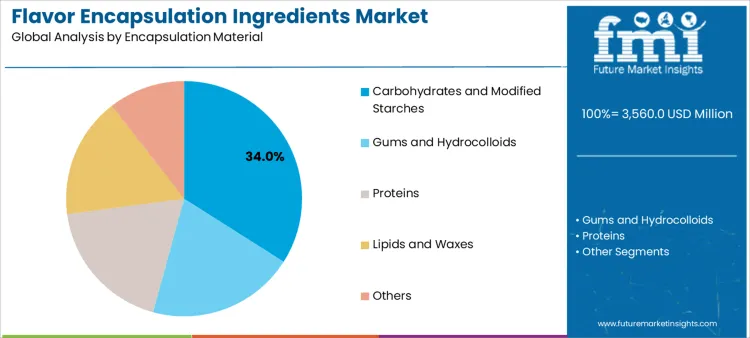
Carbohydrates and modified starches hold 34.0%, supported by their cost efficiency, neutral sensory profile, and strong film-forming capability. Gums and hydrocolloids account for 27.0%, applied where controlled release and moisture management are required. Proteins represent 19.0%, offering emulsification and matrix binding advantages in complex formulations. Lipids and waxes hold 14.0%, used to delay release and enhance thermal protection. Other materials account for 6.0%, addressing specialized stability or regulatory needs. Material segmentation reflects formulation priorities related to processing tolerance, release control, and ingredient compatibility.
Key Points
- Starch systems provide economical and versatile encapsulation.
- Hydrocolloids enable moisture and release management.
- Lipid matrices support delayed flavor release profiles.
By Application, Beverages Represent the Largest Area of Utilization
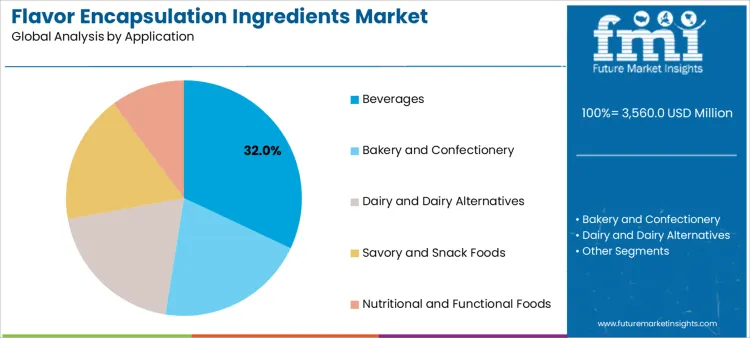
Beverages represent 32.0%, reflecting high sensitivity of liquid formulations to flavor loss and oxidation. Bakery and confectionery applications account for 24.0%, where encapsulation protects flavors during baking and extended shelf life. Dairy and dairy alternatives hold 18.0%, requiring stability across fat and protein systems. Savory and snack foods represent 16.0%, supporting flavor retention through extrusion and frying processes. Nutritional and functional foods account for 10.0%, emphasizing controlled release and taste masking. Application segmentation highlights how processing intensity and storage conditions shape encapsulation demand.
Key Points
- Beverage formulations require strong flavor protection.
- Bakery products rely on thermal stability.
- Functional foods prioritize controlled release behavior.
What are the Key Dynamics in the Flavor Encapsulation Ingredients Market?
Demand in the flavor encapsulation ingredients market is driven by the need to preserve volatile aromatic compounds through processing, storage, and distribution in food, beverage, and nutritional products. Manufacturers of powdered beverages, extruded snacks, dairy formulas, seasonings, and ready-to-mix products rely on encapsulation systems that protect heat-sensitive flavors and allow controlled release at consumption. Value creation is linked to retention of target aroma profiles after high temperature processing, extended shelf life without sensory degradation, and ease of integration with existing formulation equipment. Procurement decisions focus on encapsulant performance with specific flavor chemistries rather than general binding functionality.
How do high temperature processing and flavor stability challenges influence adoption?
Adoption rates for flavor encapsulation ingredients increase where production processes expose flavors to high temperature, shear, or moisture conditions that cause rapid loss of key aromatic compounds. Beverage manufacturers producing instant drink powders require encapsulation systems that maintain citrus, fruit, and herbal notes through spray drying and extended storage. Cereal and snack extruders use encapsulants that prevent oxidation and volatilization during high shear cooking, ensuring that seasonings deliver consistent taste at point of use. Dairy and plant-based formula makers select encapsulation systems that minimize development of off-notes in products subjected to homogenization and pasteurization. Sensory quality teams evaluate encapsulated flavor performance by measuring retention, release at rehydration, and impact on mouthfeel. Compatibility with carriers, sweeteners, and emulsifiers typical of the target matrix directly shapes ingredient choice and shelf life expectations.
How do regulatory labeling requirements and functional limits affect market growth?
Market growth in flavor encapsulation ingredients is shaped by regulatory labeling requirements and the functional behavior of encapsulants in complex food systems. Certain encapsulation materials must be declared under specific names on product labels depending on regional food additive and ingredient guidelines, which influences choice for brands targeting clean label positioning. Some encapsulants perform poorly under low pH or high ionic strength conditions, limiting their use in acidic beverages or fortified nutrition products unless paired with additional stabilizers. Cost exposure emerges where multi-component encapsulation systems are required to balance flavor protection with release performance in demanding matrices, placing pressure on product pricing in mainstream categories. Sensory evaluation and accelerated shelf life testing extend development cycles for products relying on encapsulated flavors, influencing decisions about where and how extensively encapsulation is applied in global product lines.
How Is Demand for the Flavor Encapsulation Ingredients Market Evolving Globally?
Global demand for flavor encapsulation ingredients is increasing as food, beverage, and nutrition manufacturers seek improved flavor stability, controlled release, and shelf life protection. Growth reflects rising use of sensitive flavors in beverages, functional foods, supplements, and processed products exposed to heat, moisture, and oxidation. Encapsulation supports masking, delayed release, and flavor protection during processing and storage. India records 8.6% CAGR, China records 8.3% CAGR, Brazil records 7.9% CAGR, USA records 6.6% CAGR, and UK records 6.3% CAGR. Adoption intensity remains linked to formulation complexity, processing severity, and sensory consistency requirements rather than finished product volume expansion.
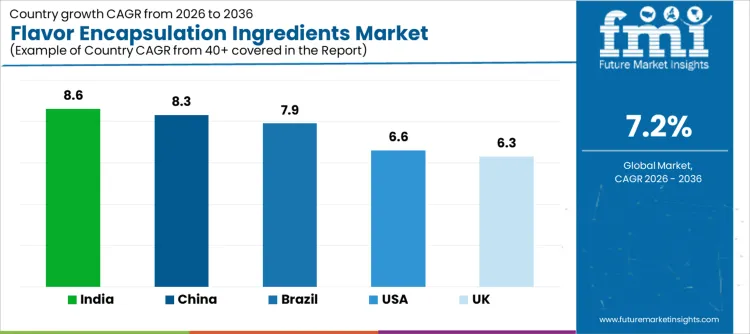
| Country | CAGR (%) |
|---|---|
| India | 8.6% |
| China | 8.3% |
| Brazil | 7.9% |
| USA | 6.6% |
| UK | 6.3% |
What is driving growth of flavor encapsulation ingredients demand in India?
Demand for flavor encapsulation ingredients in India is expanding as packaged foods, beverages, and nutraceuticals increase usage of volatile and heat-sensitive flavors. Growth at 8.6% CAGR reflects strong demand from powdered beverages, instant mixes, fortified foods, and oral nutrition products. High ambient temperatures and extended distribution chains increase flavor degradation risks, driving encapsulation adoption. Manufacturers prioritize encapsulated flavors to improve stability during spray drying and thermal processing. Cost sensitivity supports use of systems delivering protection and controlled release at low inclusion rates. Demand remains concentrated within mass-market beverages, nutrition powders, and flavored dairy products targeting urban consumers.
- High use of powdered and instant formulations
- Need for heat and moisture protection
- Expansion of fortified and nutrition products
- Cost-efficient flavor stability solutions
Why is China seeing expansion in flavor encapsulation ingredients adoption?
Flavor encapsulation ingredients demand in China is rising as large-scale food processors focus on flavor consistency across industrial production. Growth at 8.3% CAGR reflects strong application in ready-to-drink beverages, dairy products, and functional nutrition. High-volume manufacturing requires controlled flavor release and protection during processing and storage. Encapsulation supports masking of off-notes in fortified and reduced sugar products. Domestic ingredient suppliers scale spray-dried and matrix-encapsulated systems for industrial use. Demand remains centered on centralized processing facilities supplying national retail and foodservice channels.
- Industrial-scale beverage and dairy production
- Need for consistent flavor release
- Growth of functional and fortified foods
- Expansion of domestic encapsulation capacity
What factors are shaping flavor encapsulation ingredients sales in Brazil?
Sales of flavor encapsulation ingredients in Brazil are increasing as food and beverage manufacturers reformulate products to improve flavor durability. Growth at 7.9% CAGR reflects rising use in beverages, confectionery, and powdered drink mixes. Tropical climate conditions accelerate flavor volatility, increasing reliance on encapsulated systems. Manufacturers prioritize encapsulation to maintain aroma intensity and sweetness perception across shelf life. Demand remains strongest in mass-market beverages and confectionery products serving price-sensitive consumers. Encapsulation selection emphasizes stability under ambient storage and compatibility with regional flavor profiles.
- Climate-driven flavor stability challenges
- Expansion of beverage and confectionery use
- Need for aroma and sweetness retention
- Focus on mass-market sensory acceptance
How is the USA supporting growth of flavor encapsulation ingredients demand?
Flavor encapsulation ingredients market demand in the USA is advancing as manufacturers manage flavor stability across reformulated and fortified products. Growth at 6.6% CAGR reflects adoption in functional beverages, supplements, snacks, and protein products. Encapsulation supports masking of bitterness, protection of volatile flavors, and controlled release during consumption. Clean label expectations influence encapsulation material selection. Large brands prioritize systems ensuring consistent sensory performance across national distribution. Demand is driven by formulation reliability and shelf life management rather than new flavor innovation volume.
- Growth of functional and fortified foods
- Need for bitterness masking solutions
- Clean label encapsulation materials
- Nationwide distribution stability requirements
What is driving expansion of flavor encapsulation ingredients demand in the UK?
Demand for flavor encapsulation ingredients in the UK is rising as manufacturers reformulate products to meet nutritional targets while preserving flavor impact. Growth at 6.3% CAGR reflects usage in beverages, bakery fillings, dairy alternatives, and supplements. Sugar reduction and protein fortification increase flavor management complexity, supporting encapsulation adoption. Retail quality standards emphasize consistent aroma and taste across shelf life. Ingredient selection prioritizes regulatory approval and label transparency. Demand remains linked to compliance-driven reformulation rather than changes in overall food consumption patterns.
- Sugar reduction driven reformulation
- Growth of dairy alternative applications
- Retail sensory consistency requirements
- Regulatory compliant encapsulation systems
What is the competitive landscape of demand for the flavor encapsulation ingredients market globally?
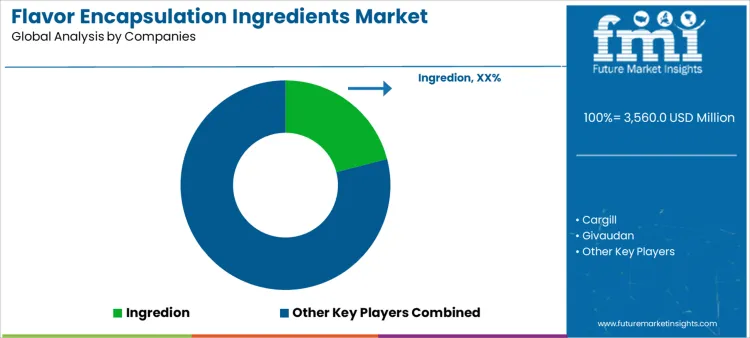
Encapsulation demand rises as flavor volatility, oxidation sensitivity, and controlled release requirements shape processed foods and beverages. Formulators assess encapsulant selection, payload protection, release kinetics, and survivability through spray drying, extrusion, and baking. Buyer assessment covers carrier solubility, particle size control, hygroscopicity, and compatibility with sweeteners, acids, and fats. Procurement behavior emphasizes application trials, shelf life validation, and suppliers supporting scale-up across regional plants. Purchasing decisions prioritize flavor retention during storage, masking of off-notes, and cost efficiency per delivered intensity. Trend in the flavor encapsulation ingredients market reflects broader use in nutrition powders, beverages, and snacks requiring stability under distribution stress.
Ingredion leads competitive positioning with carbohydrate-based matrices enabling protection, controlled release, and clean label alignment. Cargill competes using starches and gums engineered for robustness across drying technologies and global manufacturing consistency. Givaudan supports demand by pairing encapsulation carriers with flavor creation expertise for targeted sensory delivery. IFF maintains relevance through integrated encapsulation platforms addressing volatility management and timed release in beverages and confections. Tate and Lyle participates with specialty carbohydrates optimized for solubility and release control. Competitive differentiation centers on protection efficiency, release precision, regulatory acceptance, and depth of collaborative formulation support.
Key Players in the Flavor Encapsulation Ingredients Market
- Ingredion
- Cargill
- Givaudan
- IFF
- Tate & Lyle
- Others
Scope of the Report
| Items | Values |
|---|---|
| Quantitative Units | USD million |
| Encapsulation Material | Carbohydrates and Modified Starches; Gums and Hydrocolloids; Proteins; Lipids and Waxes; Others |
| Application | Beverages; Bakery and Confectionery; Dairy and Dairy Alternatives; Savory and Snack Foods; Nutritional and Functional Foods |
| End User | Food and Beverage Manufacturers; Flavor Houses and Compounders; Nutrition and Supplement Brands |
| Regions Covered | Asia Pacific, Europe, North America, Latin America, Middle East & Africa |
| Countries Covered | India, China, Brazil, USA, UK, and 40+ countries |
| Key Companies Profiled | Ingredion; Cargill; Givaudan; IFF; Tate & Lyle; Others |
| Additional Attributes | Dollar sales by encapsulation material, application, and end user; protection efficiency against oxidation, volatilization, and processing losses; controlled flavor release triggered by heat, shear, moisture, or pH changes; impact on flavor intensity, shelf stability, and masking performance; suitability for dry and liquid food systems; procurement dynamics driven by reformulation needs, flavor system customization, and long-term supplier collaborations. |
Flavor Encapsulation Ingredients Market by Segment
Encapsulation Material:
- Carbohydrates and Modified Starches
- Gums and Hydrocolloids
- Proteins
- Lipids and Waxes
- Others
Application:
- Beverages
- Bakery and Confectionery
- Dairy and Dairy Alternatives
- Savory and Snack Foods
- Nutritional and Functional Foods
End User:
- Food and Beverage Manufacturers
- Flavor Houses and Compounders
- Nutrition and Supplement Brands
Region:
- Asia Pacific
- China
- Japan
- South Korea
- India
- Australia & New Zealand
- ASEAN
- Rest of Asia Pacific
- Europe
- Germany
- United Kingdom
- France
- Italy
- Spain
- Nordic
- BENELUX
- Rest of Europe
- North America
- United States
- Canada
- Mexico
- Latin America
- Brazil
- Chile
- Rest of Latin America
- Middle East & Africa
- Kingdom of Saudi Arabia
- Other GCC Countries
- Turkey
- South Africa
- Other African Union
- Rest of Middle East & Africa
Bibliography
- Food and Agriculture Organization of the United Nations. (2023). Flavor stability and protection technologies in processed foods. FAO Food and Nutrition Paper.
- International Organization for Standardization. (2023). ISO 12099: Sensory analysis - Methodology for evaluating flavor retention and release in food matrices (current edition). ISO.
- International Organization for Standardization. (2024). ISO 11036: Sensory analysis - Texture profile analysis (applications to encapsulated flavor release). ISO.
- McClements, D. J. (2023). Encapsulation technologies for improving flavor stability and controlled release in foods. Food Hydrocolloids, 135, 108146.
- Gouin, S., & Voilley, A. (2024). Flavor encapsulation: Physicochemical principles and food applications. Trends in Food Science & Technology, 145, 104-117.
- Zuidam, N. J., & Nedović, V. A. (2023). Encapsulation technologies for active food ingredients and flavors (2nd ed.). Springer.
Frequently Asked Questions
How big is the flavor encapsulation ingredients market in 2026?
The global flavor encapsulation ingredients market is estimated to be valued at USD 3,560.0 million in 2026.
What will be the size of flavor encapsulation ingredients market in 2036?
The market size for the flavor encapsulation ingredients market is projected to reach USD 7,135.1 million by 2036.
How much will be the flavor encapsulation ingredients market growth between 2026 and 2036?
The flavor encapsulation ingredients market is expected to grow at a 7.2% CAGR between 2026 and 2036.
What are the key product types in the flavor encapsulation ingredients market?
The key product types in flavor encapsulation ingredients market are carbohydrates and modified starches, gums and hydrocolloids, proteins, lipids and waxes and others.
Which application segment to contribute significant share in the flavor encapsulation ingredients market in 2026?
In terms of application, beverages segment to command 32.0% share in the flavor encapsulation ingredients market in 2026.
Preview the report firsthand - request a free sample
Get SampleGet the brochure for pricing and purchase details.
Get PDFTable of Content
- Executive Summary
- Global Market Outlook
- Demand-side Trends
- Supply-side Trends
- Technology Roadmap Analysis
- Analysis and Recommendations
- Market Overview
- Market Coverage / Taxonomy
- Market Definition / Scope / Limitations
- Market Background
- Market Dynamics
- Drivers
- Restraints
- Opportunity
- Trends
- Scenario Forecast
- Demand in Optimistic Scenario
- Demand in Likely Scenario
- Demand in Conservative Scenario
- Opportunity Map Analysis
- Product Life Cycle Analysis
- Supply Chain Analysis
- Investment Feasibility Matrix
- Value Chain Analysis
- PESTLE and Porter’s Analysis
- Regulatory Landscape
- Regional Parent Market Outlook
- Production and Consumption Statistics
- Import and Export Statistics
- Market Dynamics
- Global Market Analysis 2021 to 2025 and Forecast, 2026 to 2036
- Historical Market Size Value (USD Million) Analysis, 2021 to 2025
- Current and Future Market Size Value (USD Million) Projections, 2026 to 2036
- Y-o-Y Growth Trend Analysis
- Absolute $ Opportunity Analysis
- Global Market Pricing Analysis 2021 to 2025 and Forecast 2026 to 2036
- Global Market Analysis 2021 to 2025 and Forecast 2026 to 2036, By Encapsulation Material
- Introduction / Key Findings
- Historical Market Size Value (USD Million) Analysis By Encapsulation Material , 2021 to 2025
- Current and Future Market Size Value (USD Million) Analysis and Forecast By Encapsulation Material , 2026 to 2036
- Carbohydrates and Modified Starches
- Gums and Hydrocolloids
- Proteins
- Lipids and Waxes
- Others
- Carbohydrates and Modified Starches
- Y-o-Y Growth Trend Analysis By Encapsulation Material , 2021 to 2025
- Absolute $ Opportunity Analysis By Encapsulation Material , 2026 to 2036
- Global Market Analysis 2021 to 2025 and Forecast 2026 to 2036, By Application
- Introduction / Key Findings
- Historical Market Size Value (USD Million) Analysis By Application, 2021 to 2025
- Current and Future Market Size Value (USD Million) Analysis and Forecast By Application, 2026 to 2036
- Beverages
- Bakery and Confectionery
- Dairy and Dairy Alternatives
- Savory and Snack Foods
- Nutritional and Functional Foods
- Beverages
- Y-o-Y Growth Trend Analysis By Application, 2021 to 2025
- Absolute $ Opportunity Analysis By Application, 2026 to 2036
- Global Market Analysis 2021 to 2025 and Forecast 2026 to 2036, By End User
- Introduction / Key Findings
- Historical Market Size Value (USD Million) Analysis By End User, 2021 to 2025
- Current and Future Market Size Value (USD Million) Analysis and Forecast By End User, 2026 to 2036
- Food and Beverage Manufacturers
- Flavor Houses and Compounders
- Nutrition and Supplement Brands
- Food and Beverage Manufacturers
- Y-o-Y Growth Trend Analysis By End User, 2021 to 2025
- Absolute $ Opportunity Analysis By End User, 2026 to 2036
- Global Market Analysis 2021 to 2025 and Forecast 2026 to 2036, By Region
- Introduction
- Historical Market Size Value (USD Million) Analysis By Region, 2021 to 2025
- Current Market Size Value (USD Million) Analysis and Forecast By Region, 2026 to 2036
- North America
- Latin America
- Western Europe
- Eastern Europe
- East Asia
- South Asia and Pacific
- Middle East & Africa
- Market Attractiveness Analysis By Region
- North America Market Analysis 2021 to 2025 and Forecast 2026 to 2036, By Country
- Historical Market Size Value (USD Million) Trend Analysis By Market Taxonomy, 2021 to 2025
- Market Size Value (USD Million) Forecast By Market Taxonomy, 2026 to 2036
- By Country
- USA
- Canada
- Mexico
- By Encapsulation Material
- By Application
- By End User
- By Country
- Market Attractiveness Analysis
- By Country
- By Encapsulation Material
- By Application
- By End User
- Key Takeaways
- Latin America Market Analysis 2021 to 2025 and Forecast 2026 to 2036, By Country
- Historical Market Size Value (USD Million) Trend Analysis By Market Taxonomy, 2021 to 2025
- Market Size Value (USD Million) Forecast By Market Taxonomy, 2026 to 2036
- By Country
- Brazil
- Chile
- Rest of Latin America
- By Encapsulation Material
- By Application
- By End User
- By Country
- Market Attractiveness Analysis
- By Country
- By Encapsulation Material
- By Application
- By End User
- Key Takeaways
- Western Europe Market Analysis 2021 to 2025 and Forecast 2026 to 2036, By Country
- Historical Market Size Value (USD Million) Trend Analysis By Market Taxonomy, 2021 to 2025
- Market Size Value (USD Million) Forecast By Market Taxonomy, 2026 to 2036
- By Country
- Germany
- UK
- Italy
- Spain
- France
- Nordic
- BENELUX
- Rest of Western Europe
- By Encapsulation Material
- By Application
- By End User
- By Country
- Market Attractiveness Analysis
- By Country
- By Encapsulation Material
- By Application
- By End User
- Key Takeaways
- Eastern Europe Market Analysis 2021 to 2025 and Forecast 2026 to 2036, By Country
- Historical Market Size Value (USD Million) Trend Analysis By Market Taxonomy, 2021 to 2025
- Market Size Value (USD Million) Forecast By Market Taxonomy, 2026 to 2036
- By Country
- Russia
- Poland
- Hungary
- Balkan & Baltic
- Rest of Eastern Europe
- By Encapsulation Material
- By Application
- By End User
- By Country
- Market Attractiveness Analysis
- By Country
- By Encapsulation Material
- By Application
- By End User
- Key Takeaways
- East Asia Market Analysis 2021 to 2025 and Forecast 2026 to 2036, By Country
- Historical Market Size Value (USD Million) Trend Analysis By Market Taxonomy, 2021 to 2025
- Market Size Value (USD Million) Forecast By Market Taxonomy, 2026 to 2036
- By Country
- China
- Japan
- South Korea
- By Encapsulation Material
- By Application
- By End User
- By Country
- Market Attractiveness Analysis
- By Country
- By Encapsulation Material
- By Application
- By End User
- Key Takeaways
- South Asia and Pacific Market Analysis 2021 to 2025 and Forecast 2026 to 2036, By Country
- Historical Market Size Value (USD Million) Trend Analysis By Market Taxonomy, 2021 to 2025
- Market Size Value (USD Million) Forecast By Market Taxonomy, 2026 to 2036
- By Country
- India
- ASEAN
- Australia & New Zealand
- Rest of South Asia and Pacific
- By Encapsulation Material
- By Application
- By End User
- By Country
- Market Attractiveness Analysis
- By Country
- By Encapsulation Material
- By Application
- By End User
- Key Takeaways
- Middle East & Africa Market Analysis 2021 to 2025 and Forecast 2026 to 2036, By Country
- Historical Market Size Value (USD Million) Trend Analysis By Market Taxonomy, 2021 to 2025
- Market Size Value (USD Million) Forecast By Market Taxonomy, 2026 to 2036
- By Country
- Kingdom of Saudi Arabia
- Other GCC Countries
- Turkiye
- South Africa
- Other African Union
- Rest of Middle East & Africa
- By Encapsulation Material
- By Application
- By End User
- By Country
- Market Attractiveness Analysis
- By Country
- By Encapsulation Material
- By Application
- By End User
- Key Takeaways
- Key Countries Market Analysis
- USA
- Pricing Analysis
- Market Share Analysis, 2025
- By Encapsulation Material
- By Application
- By End User
- Canada
- Pricing Analysis
- Market Share Analysis, 2025
- By Encapsulation Material
- By Application
- By End User
- Mexico
- Pricing Analysis
- Market Share Analysis, 2025
- By Encapsulation Material
- By Application
- By End User
- Brazil
- Pricing Analysis
- Market Share Analysis, 2025
- By Encapsulation Material
- By Application
- By End User
- Chile
- Pricing Analysis
- Market Share Analysis, 2025
- By Encapsulation Material
- By Application
- By End User
- Germany
- Pricing Analysis
- Market Share Analysis, 2025
- By Encapsulation Material
- By Application
- By End User
- UK
- Pricing Analysis
- Market Share Analysis, 2025
- By Encapsulation Material
- By Application
- By End User
- Italy
- Pricing Analysis
- Market Share Analysis, 2025
- By Encapsulation Material
- By Application
- By End User
- Spain
- Pricing Analysis
- Market Share Analysis, 2025
- By Encapsulation Material
- By Application
- By End User
- France
- Pricing Analysis
- Market Share Analysis, 2025
- By Encapsulation Material
- By Application
- By End User
- India
- Pricing Analysis
- Market Share Analysis, 2025
- By Encapsulation Material
- By Application
- By End User
- ASEAN
- Pricing Analysis
- Market Share Analysis, 2025
- By Encapsulation Material
- By Application
- By End User
- Australia & New Zealand
- Pricing Analysis
- Market Share Analysis, 2025
- By Encapsulation Material
- By Application
- By End User
- China
- Pricing Analysis
- Market Share Analysis, 2025
- By Encapsulation Material
- By Application
- By End User
- Japan
- Pricing Analysis
- Market Share Analysis, 2025
- By Encapsulation Material
- By Application
- By End User
- South Korea
- Pricing Analysis
- Market Share Analysis, 2025
- By Encapsulation Material
- By Application
- By End User
- Russia
- Pricing Analysis
- Market Share Analysis, 2025
- By Encapsulation Material
- By Application
- By End User
- Poland
- Pricing Analysis
- Market Share Analysis, 2025
- By Encapsulation Material
- By Application
- By End User
- Hungary
- Pricing Analysis
- Market Share Analysis, 2025
- By Encapsulation Material
- By Application
- By End User
- Kingdom of Saudi Arabia
- Pricing Analysis
- Market Share Analysis, 2025
- By Encapsulation Material
- By Application
- By End User
- Turkiye
- Pricing Analysis
- Market Share Analysis, 2025
- By Encapsulation Material
- By Application
- By End User
- South Africa
- Pricing Analysis
- Market Share Analysis, 2025
- By Encapsulation Material
- By Application
- By End User
- USA
- Market Structure Analysis
- Competition Dashboard
- Competition Benchmarking
- Market Share Analysis of Top Players
- By Regional
- By Encapsulation Material
- By Application
- By End User
- Competition Analysis
- Competition Deep Dive
- Ingredion
- Overview
- Product Portfolio
- Profitability by Market Segments (Product/Age /Sales Channel/Region)
- Sales Footprint
- Strategy Overview
- Marketing Strategy
- Product Strategy
- Channel Strategy
- Cargill
- Givaudan
- IFF
- Tate & Lyle
- Others
- Ingredion
- Competition Deep Dive
- Assumptions & Acronyms Used
- Research Methodology


