

- Market Size (2026)
- USD 194.1 Mn
- Forecast (2036)
- USD 319.4 Mn
- CAGR (2026 to 2036)
- 5.1%
Sea Urchin and Roe Flavor Ingredients Market Size, Market Forecast and Outlook By FMI
Summary of the Sea Urchin and Roe Flavor Ingredients Market
- Demand and Growth Drivers
- Premium seafood sauce makers use roe flavors to create higher-priced sauces, increasing ingredient value per formulation.
- Snack brands test uni-style seasonings to move roe flavor demand beyond restaurants into packaged retail products.
- Foodservice kitchens prefer concentrated roe bases as lower waste and faster preparation support repeat commercial buying.
- Clean-label formulation raises demand for natural food flavors as brands replace artificial marine flavors with traceable ingredients.
- Product and Segment View
- Natural extracts are projected to account for 41.8% of product type in 2026 with premium label positioning.
- In form, liquid ingredients are expected to record 46.5% share in 2026 from easy blending in sauces.
- In 2026, sauces are projected to capture 38.7% of application sales from ramen bases and seafood condiments.
- Sea urchin source ingredients are expected to contribute 44.2% market share in 2026 through strong uni taste recognition.
- Geography and Competitive Outlook
- Japan is forecast to post the fastest growth with 6.3% CAGR by 2036.
- The United States is likely to advance at 5.6% CAGR by 2036 through Asian sauces and seafood snacks.
- Givaudan and Kerry hold larger account access through savory flavor systems and global food maker access.
- T. Hasegawa and Symrise use regional taste work and application support across Asia and America.
- Analyst Opinion
- Nandini Roy Choudhury, Principal Consultant at FMI states: “The sea urchin and roe flavor ingredients market is expanding through premium sauces and seafood snacks. Processed foods favor these ingredients, as a creamy marine taste can be achieved without handling fresh roe. Foodservice kitchens need bases with lower waste and repeatable flavor output. Packaged food companies need ingredients suitable for allergen review and label approval. Long-term turnover comes from stable dosage and source documentation. End users need products able to work in sauces, snack coatings, and ready meals. Competitive advantage comes from taste accuracy and processing stability instead of broad seafood flavor claims.”
- Sea Urchin and Roe Flavor Ingredients Market Value Analysis
- Natural extracts serve premium seafood sauce and snack concepts seeking real marine source positioning.
- Liquid ingredients are used because sauce makers need smooth dispersion before heating and packing.
- Sauce applications create recurring sales through ramen bases and premium condiments.
- Foodservice sales rely on suppliers combining taste accuracy with allergen documentation and stable sourcing.
- Cost pressure remains as roe raw material costs change with landings and import supply.
Key Takeaways, Market Size, and Forecast
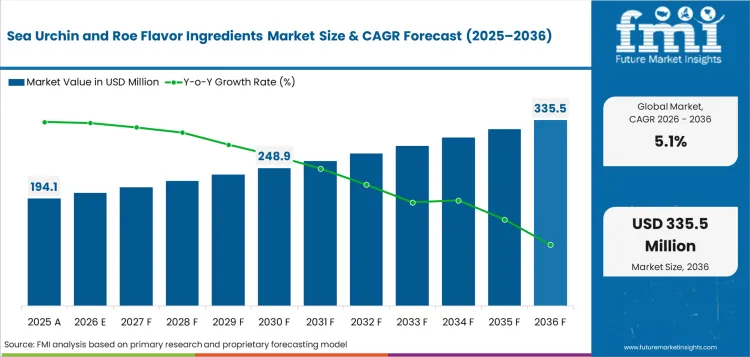
- Sea urchin and roe flavor ingredients market valuation was USD 184.6 million in 2025.
- Revenue is expected to reach USD 319.4 million by 2036.
- Sales are projected to expand at 5.1% CAGR across 2026 to 2036.
- Incremental opportunity across 2026 to 2036 is expected to reach USD 125.3 million.
- Natural extracts are expected to lead product type with 41.8% share in 2026.
- Japan is projected to witness 6.3% CAGR in the market through 2036.
- Liquid ingredients are projected to account for 46.5% share in 2026.
Sea urchin and roe flavor ingredients are expected to move from fresh delicacy use into shelf-stable sauces, spreads and savory snacks. In April 2026, Angou et al. evaluated freeze-dried sea urchin roe powder through volatile GC-MS and sensory profiling. This supports use in dry flavor systems where fresh roe is difficult to handle. Feed control is also improving raw material quality because Bauer et al. linked macroalgae-derived free amino acids with gonad taste in 2025. In June 2025, Kita-Sanriku Factory reported a Uni Miso Onigiri launch across about 100 Seven-Eleven stores. That retail use shows practical demand beyond sushi. EU HACCP certification in December 2024 also supports wider export channels for processed uni ingredients.
Sea Urchin and Roe Flavor Ingredients Market Definition
Sea urchin and roe flavor ingredients include commercial extracts and concentrates used in processed food production. Scope includes liquid bases and powder blends designed for seafood taste in sauces and snacks. Paste concentrates and oil infusions are included within prepared food use. These products serve ramen bases and seafood condiments. Ready meals and foodservice kitchens create separate sales pools. Fresh sea urchin trays and chilled roe packs remain outside this ingredient scope.
Sea Urchin and Roe Flavor Ingredients Market Inclusions
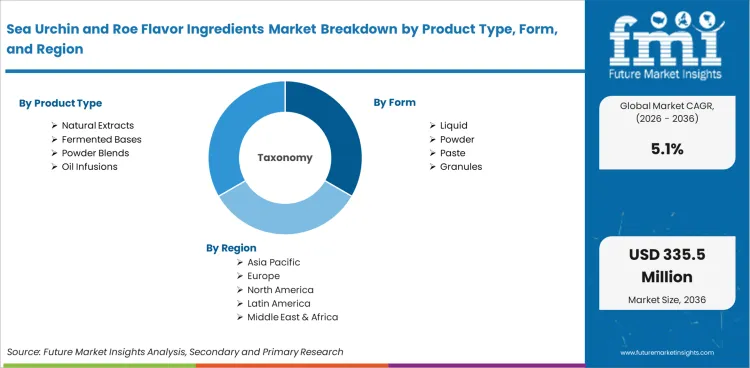
Market scope covers all commercially traded sea urchin and roe flavor ingredients categorized by product type, including natural extracts, fermented bases, powder blends, and oil infusions. Coverage includes forms such as liquid ingredients, powders, pastes, and granules. Applications include sauces, snacks, ready meals, and foodservice preparations using marine flavor systems. Revenue scope covers 2026 to 2036. The key stakeholders include flavor ingredient manufacturers, seafood extract suppliers, seasoning blend producers, food manufacturers, foodservice suppliers, specialty distributors, sauce makers, snack producers, ready meal companies, culinary development teams, and food safety authorities.
Scope includes natural extracts and fermented bases. Powder blends and oil infusions are included. Liquid ingredients and paste concentrates are within scope. Sauces and snacks are covered. Ready meals and foodservice applications are included. Food manufacturers and specialty distributors are included.
Sea Urchin and Roe Flavor Ingredients Market Exclusions
Scope excludes fresh sea urchins and retail roe trays. Caviar service products and live seafood are outside market scope. Pet food palatants and non-food marine aroma ingredients are excluded. Pharmaceutical marine extracts are outside the market scope.
Sea Urchin and Roe Flavor Ingredients Market Research Methodology
- Primary Research: FMI analysts reviewed flavor houses and seafood ingredient suppliers. Seasoning blenders and foodservice distributors were reviewed separately. The research focused on dosage needs and approval cycles. It reviewed flavor stability and allergen documentation needs.
- Desk Research: Desk research covered seafood production data and food flavor regulations. Company product literature and official seafood trade references helped define the product scope. Roe extract applications and savory seasoning systems were reviewed separately.
- Market Sizing and Forecasting: The sizing model combined ingredient pricing and estimated use rates. Application mix and country cuisine patterns were considered after segment review. Forecasts were cross-checked with seafood consumption and sauce production signals. Snack seasoning and foodservice trials were reviewed as separate checks.
- Data Validation: Validation compared company portfolios and public seafood supply signals. End-use product activity and regional cuisine patterns were checked separately. Forecasts were adjusted for clean-label adoption and marine raw material exposure.
Why is the Sea Urchin and Roe Flavor Ingredients Market Growing?
- Premium sauce brands use roe flavor bases to create richer seafood taste with lower fresh roe cost exposure.
- Snack companies use uni-style notes in seaweed crisps and seafood chips for higher shelf appeal.
- Foodservice operators use concentrated bases to reduce kitchen prep time across repeatable menu items.
- Ready meal producers need stable marine taste for pasta bowls and seafood rice products.
- Natural extracts appeal to brands seeking seafood-derived flavor systems with traceable source records.
Premium sauce makers are a larger sales source for sea urchin and roe flavor ingredients. Ramen bases and seafood condiments need creamy marine taste in small and controlled doses. The sauces and condiments sector creates wider use for liquid bases in retail and foodservice formats. Roe notes can lift perceived quality without using costly fresh seafood in every batch. Food makers benefit from easier storage and better portion control. Suppliers with stable taste after heating can secure repeat contracts.
Snack manufacturers create another sales outlet through dry seasoning and coating systems. Seaweed snacks and seafood chips need strong aroma release at low inclusion levels. Adjacent ready to eat seafood snacks activity points to wider interest in premium marine taste. Powder blends work well here since low moisture protects texture and shelf life. Flavor houses must control salty and metallic notes during seasoning design. Companies with snack application labs can shorten testing time for customers.
Market Segmentation Analysis
- Natural extracts are forecast to account for 41.8% share in 2026.
- In 2026, liquid formats are likely to hold 46.5% share.
- Sauces are anticipated to capture 38.7% of application sales in 2026.
- Sea urchin sources are forecast to represent 44.2% of source sales in 2026.
- Food manufacturers are estimated to contribute 52.8% in 2026.
The market is divided into product type, form, application, source, and sales channel. Product type covers natural extracts and fermented bases. Powder blends and oil infusions are included as well. Form includes liquid and powder. Paste and granules are covered. Application includes sauces and snacks. Ready meals and foodservice are included. Source includes sea urchin and fish roe. Blended marine ingredients are covered as well.
Insights into the Natural Extracts Product Type Segment
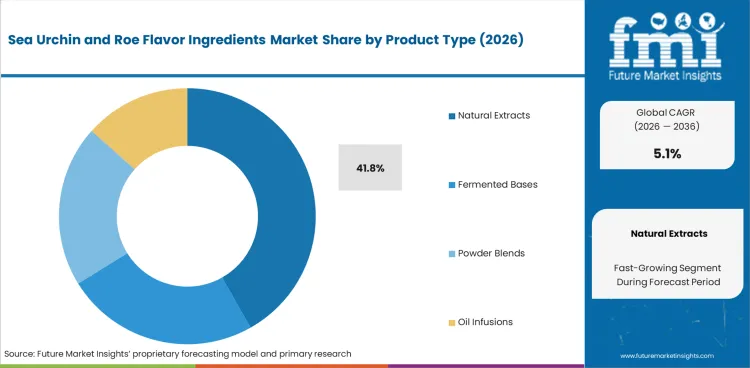
- In 2026, natural extracts are estimated to account for 41.8% of product type sales with clearer source recognition.
- Fermented bases follow as food makers seek marine umami with lower fishy impact across sauces and ready meals.
Insights into the Liquid Form Segment
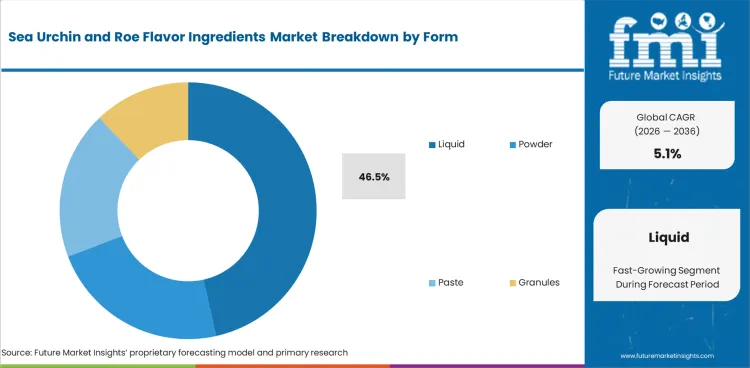
- Liquid ingredients are expected to represent 46.5% of form sales in 2026 from easy blending in sauce systems.
- Powder formats remain important in snacks since coating drums need dry seasoning with stable aroma release.
Insights into the Sauces Application Segment
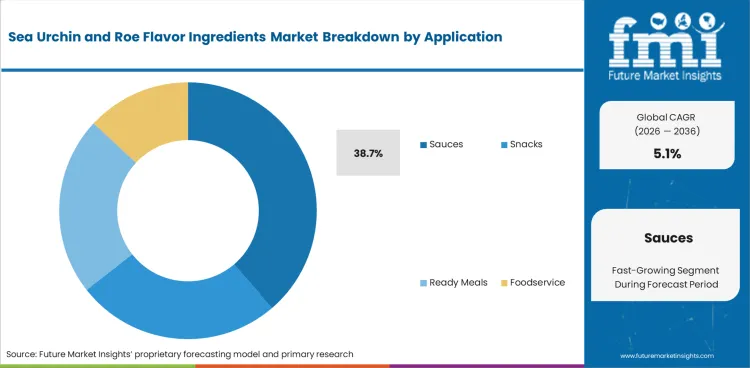
- Sauces are anticipated to represent 38.7% of application sales in 2026 through ramen bases and seafood condiments.
- Snack applications offer higher trial activity as brands test uni butter and seaweed seasoning profiles.
Insights into the Sea Urchin Source Segment
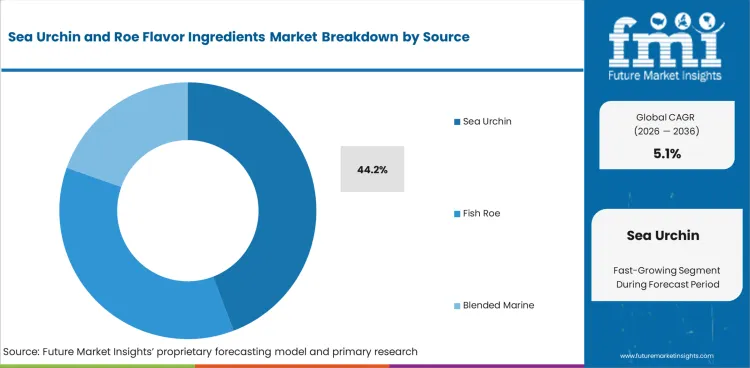
- Sea urchin ingredients are estimated to account for 44.2% of source sales in 2026 through premium uni positioning.
- Fish roe ingredients serve broader cost-sensitive formulas since the taste profile can work in sauces and fillings.
Insights into the Food Manufacturers Sales Channel Segment
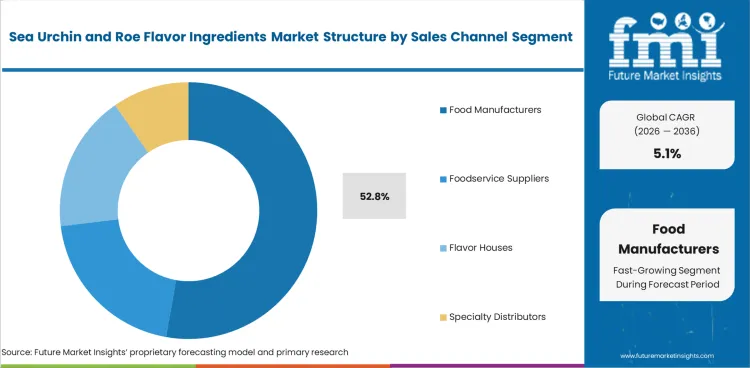
- Food manufacturers are forecast to account for 52.8% of sales channel revenue in 2026 through packaged sauce and snack use.
- Foodservice suppliers remain important for trial orders since chefs often test roe bases before retail launches.
Sea Urchin and Roe Flavor Ingredients Market Drivers, Restraints, and Opportunities
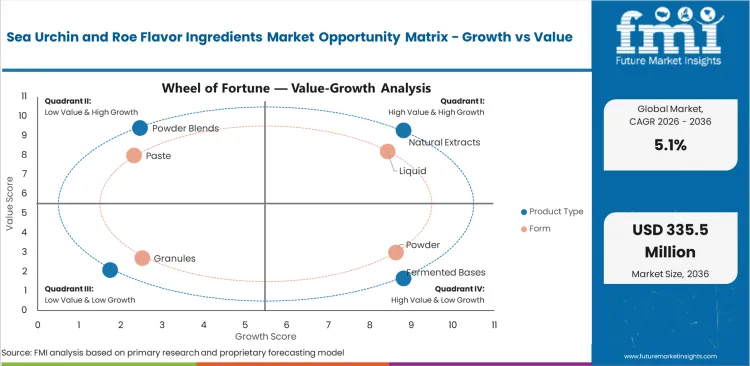
- Premium sauce launches lift ingredient use as brands seek creamy seafood taste with controlled dosage.
- Snack seasoning trials raise powder blend sales through seaweed crisps and seafood chip formats.
- Seafood allergen approval limits faster adoption in plants serving broad retail channels.
- Fermented marine bases create opportunity for umami-rich formulas with lower salt levels.
- Traceable origin documentation improves supplier selection in premium seafood flavor programs.
Premium Sauce Dose Control
Sauce makers create the strongest sales outlet for concentrated roe flavor ingredients. These products allow food makers to build seafood intensity without adding fresh roe to each batch. Culinary sauces provide a practical channel for liquid bases and paste concentrates. A small dosage can raise perceived premium quality while limiting raw material exposure. Product teams can adjust intensity across ramen bases and seafood dips without changing core recipes. Suppliers able to protect taste during heating can defend higher pricing.
Snack Seasoning Marine Notes
Snack brands are using uni-style notes to create premium taste in simple formats. Powder blends fit this work since dry seasoning lines need low moisture and even coating. Savoury flavour blends offer a nearby reference for seasoning design across crisps and coated snacks. Marine notes need careful balancing with chili or butter to avoid harsh finish. Application support becomes important during trial batches and shelf-life checks. Suppliers with snack coating knowledge can win repeat projects from brands testing seafood profiles.
Traceability Records Are Becoming Buyer Proof
Regulatory compliance is increasing demand for seafood flavor ingredients with lot-level traceability and allergen control files. FDA states that Section 204 of the Food Safety Modernization Act requires FDA to designate foods for which additional recordkeeping requirements are appropriate and necessary to protect public health. The Food Traceability List page was current as of 04/01/2026. It lists Finfish fresh frozen and previously frozen. It also lists Smoked finfish refrigerated frozen and previously frozen. It lists Crustaceans fresh frozen and previously frozen. It lists Molluscan shellfish bivalves fresh frozen and previously frozen. This matters for roe and seafood flavor systems because buyers need harvest identity, cold chain records, allergen controls, and ingredient form proof before approval.
Analysis of Sea Urchin and Roe Flavor Ingredients Market By Key Countries
.webp "Top Country Growth Comparison Sea Urchin And Roe Flavor Ingredients Market Cagr (2026 2036)")
| Country | CAGR |
|---|---|
| Japan | 6.3% |
| United States | 5.6% |
| South Korea | 5.4% |
| China | 5.2% |
| France | 4.9% |
| Germany | 4.7% |
| United Kingdom | 4.5% |
Source: FMI analysis based on primary research and internal forecasting model.
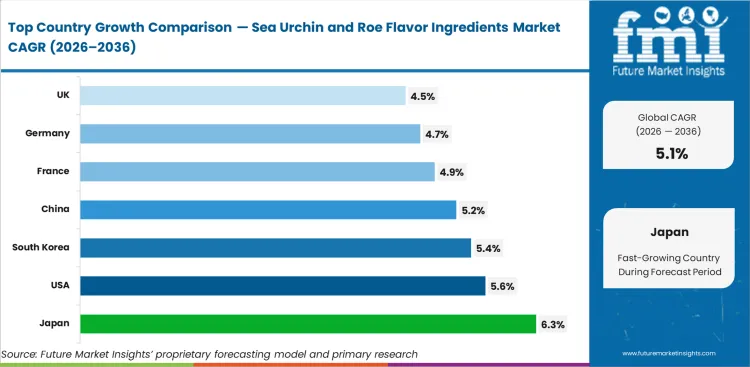
Sea Urchin and Roe Flavor Ingredients CAGR Analysis By Country
- Demand for sea urchin and roe flavor ingredients in Japan is anticipated to rise at a CAGR of 6.3% through 2036.
- Sales of sea urchin and roe flavor ingredients in the United States are expected to increase at a CAGR of 5.6% during the forecast period.
- The sea urchin and roe flavor ingredients market in South Korea is poised to expand at a CAGR of 5.4% through 2036.
- China is set to record a CAGR of 5.2% in sea urchin and roe flavor ingredients during the assessment period.
- Sea urchin and roe flavor ingredient adoption in France is likely to advance at a CAGR of 4.9% by 2036.
- Germany is projected to witness 4.7% CAGR in the sea urchin and roe flavor ingredients market through 2036.
- The market for sea urchin and roe flavor ingredients in the United Kingdom is expected to grow at a CAGR of 4.5% during the study period.
Demand Outlook for Sea Urchin and Roe Flavor Ingredients in Japan
Japan’s market position depends on strong uni familiarity and advanced seasoning work. Sushi and ramen channels make sea urchin taste easier for consumers to understand. Japan is anticipated to see sea urchin and roe flavor ingredients grow at a CAGR of 6.3% over the forecast period. Tokyo foodservice operators often test uni sauces before retail concepts reach wider shelves. Hokkaido seafood identity gives marine ingredients a stronger origin story. Local suppliers secure orders through small-batch taste accuracy and faster technical service. Foreign flavor houses retain an advantage in global customer programs and documentation.
- Ramen and pasta chains create early testing space for creamy uni-style sauce bases.
- Seafood identity strengthens higher-price placement for sea urchin extract concepts.
- Seasoning houses use marine notes across snack blends and convenience-store sauce formats.
Sales Analysis of Sea Urchin and Roe Flavor Ingredients in the United States
The United States has positive prospects through Asian sauces and seafood snacks. West Coast restaurants make uni taste visible in sushi and pasta menus. Sea urchin and roe flavor ingredient sales across the United States are set to rise at 5.6% CAGR through 2036. Food makers often test roe flavor in limited runs before broader rollout. Marine flavor ingredients work best in products needing a premium taste cue without high seafood content. Suppliers with application labs and allergen files can move faster through customer approval.
- Sushi and coastal dining channels influence early uni sauce and seafood butter concepts.
- Foodservice distributors create access for premium Asian sauce lines and marine bases.
- Seafood channels help suppliers connect marine origin cues with retail storylines.
Demand Analysis of Sea Urchin and Roe Flavor Ingredients in South Korea
South Korea’s opportunity is shaped by seafood familiarity and fast snack development. Convenience retailers give brands a strong trial channel for seasonal seafood flavors. South Korea is likely to post a CAGR of 5.4% in sea urchin and roe flavor ingredients by 2036. Roe flavor ingredients often work with chili and seaweed notes in Korean products. Powder blends fit snack coatings while liquids work better in sauces. Suppliers with Korean taste design skills can reduce reformulation time for customers.
- Convenience retail channels create trial space for seaweed crisps and seafood snack concepts.
- Seafood identity strengthens the cultural fit for marine sauces and roe-style ingredients.
- Ramen makers can use creamy marine notes across premium broth and sauce formats.
Opportunity Analysis of Sea Urchin and Roe Flavor Ingredients in China
China offers scale through sauce production and broad seafood dining. Coastal cuisine gives marine taste a familiar base across several food formats. Demand for sea urchin and roe flavor ingredients in China is anticipated to rise at a CAGR of 5.2% through 2036. Roe flavor systems can reduce reliance on fresh seafood in packaged food. National brands need stable supply and allergen records before moving into larger runs. Regional suppliers can win smaller accounts through fast sampling and lower order sizes.
- Premium restaurants create visibility for seafood sauces and creamy marine menu items.
- National cuisine gives marine flavor bases a practical fit in sauces and seafood condiments.
- Snack companies need allergen control before using seafood-derived seasoning blends.
Future Outlook for Sea Urchin and Roe Flavor Ingredients in France
France offers smaller volume but higher premium potential across seafood sauces. Culinary teams focus on taste quality and source wording before scaling packaged products. Sales of sea urchin and roe flavor ingredients in France are forecast to increase at a CAGR of 4.9% during the forecast period. Roe flavor ingredients can work in butter sauces and seafood spreads. Retail adoption in France needs mild flavor design and clean ingredient statements. Suppliers need chef validation before broader retail movement gains pace.
- Seafood culture creates a natural reference point for marine sauces and spread concepts.
- Foodservice channels influence premium seafood sauce ideas before retail trials begin.
- Clean-label expectations make source description and allergen statements central to approval.
Demand Outlook for Sea Urchin and Roe Flavor Ingredients in Germany
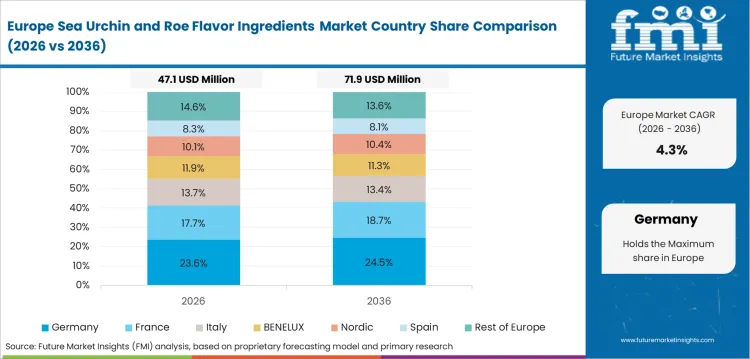
Germany is a selective market for roe flavor ingredients. Food makers focus on clean-label wording and cost control before adding seafood-derived extracts. The sea urchin and roe flavor ingredients market in Germany is forecast to expand at a CAGR of 4.7% through 2036. Natural flavors create a useful comparison point for seafood extracts and yeast-based umami systems. Marine profiles need mild taste and strong documentation for broader use. Hamburg and northern seafood channels provide the best early entry point.
- Seafood trade links create practical entry routes for marine ingredient testing.
- Food culture gives milder roe profiles better acceptance in sauces.
- Private-label requirements raise the need for allergen files and batch consistency.
In-depth Analysis of Sea Urchin and Roe Flavor Ingredients in the United Kingdom
The United Kingdom offers moderate prospects through meal kits and chilled sauces. London restaurants influence early seafood flavor ideas before packaged food teams test them. Sea urchin and roe flavor ingredient adoption in the United Kingdom is forecast to advance at a CAGR of 4.5% by 2036. Ready meals offer a practical outlet for controlled seafood flavor dosing. Retailers need mild profiles and cost discipline before listing wider ranges. Suppliers with stable liquid bases can serve chilled sauce and pasta meal producers.
- Restaurant groups influence uni pasta and seafood small plate concepts before retail trials.
- Seafood channels create interest in premium marine sauce formats.
- Chilled meal producers need heat-stable bases for pasta sauces and seafood trays.
Competitive Landscape and Strategic Positioning
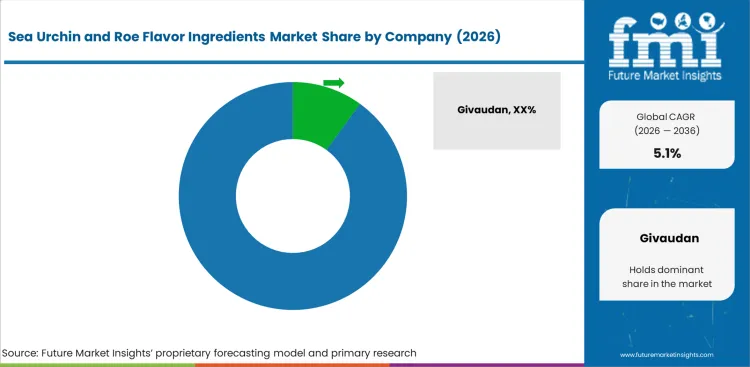
- Competition is moderately concentrated because global flavor houses serving large food maker accounts.
- Smaller suppliers win projects through seafood extract skill and faster sample preparation.
- Entry barriers include allergen documentation and stable marine raw material access.
- Regional players can secure foodservice accounts if taste work and order sizes meet kitchen needs.
Supplier selection begins with proof of taste accuracy across sauces and snack systems. Food makers test dosage and heat performance before approving suppliers. Marine extracts must avoid harsh finish after heating or drying. Givaudan and Kerry hold strong positions through savory application work and global customer access. Symrise and T. Hasegawa bring regional taste translation and product development support. Specialist suppliers can win projects with strong source control and focused seafood knowledge.
Established companies use broader savory portfolios and documentation systems. Food flavors programs often need allergen checks and application trials before first order approval. Large flavor houses can manage these steps across several regions. Smaller seafood extract companies have an advantage in authenticity and sample speed. Their challenge is scaling quality files for national retail accounts. This creates a competitive structure based on application proof and customer approval readiness.
Specialist suppliers win accounts in accounts needing clear marine identity. Natural extract makers can serve premium sauce and foodservice customers seeking a direct seafood source. Savory ingredients suppliers can extend into roe profiles through umami systems and seasoning blends. Entry remains difficult since seafood allergens require plant-level review and clear labels. Suppliers with batch records and stable sensory output can defend price better across long-term programs.
Key Companies in the Sea Urchin and Roe Flavor Ingredients Market
Sea urchin and roe flavor ingredients competition includes global flavor houses, seafood extract specialists, and regional seasoning developers.
- Global flavor houses: Givaudan and Kerry serve large food makers through savory application labs and global account teams. Symrise adds seafood and umami development support across processed food channels. T. Hasegawa strengthens Asia and America coverage through regional flavor development. These companies hold larger account access in sauces and snacks needing documentation and repeatable production.
- Seafood extract specialists: Nikken Foods and Kanegrade compete through natural extract capability and flexible batch work. Their strength is highest in premium foodservice and specialty packaged foods. These suppliers can deliver stronger marine identity for brands seeking clear seafood source cues. Expansion relies on documentation quality and supply planning.
- Regional seasoning developers: Takasago and Sensient serve customers needing local taste adaptation and fast formulation. Snack seasoning work requires powder handling and balanced seafood notes. Sauce projects need liquid stability and clean finish after heating. These companies gain an edge when regional taste work matters more than global network size.
Competitive Benchmarking: Sea Urchin and Roe Flavor Ingredients Market
| Company | Marine Extract Validation Depth | Sauce Application Skill | Allergen Documentation | Geographic Footprint |
|---|---|---|---|---|
| Givaudan | High | High | High | Global |
| Kerry | High | High | High | Global |
| Symrise | High | High | High | Global |
| T. Hasegawa | Medium | High | High | Japan and America |
| Takasago | Medium | High | High | Asia and global |
| Nikken Foods | High | Medium | Moderate | Japan and America |
| Kanegrade | Medium | Medium | Moderate | Europe |
| Sensient | Medium | High | High | Global |
Source: Future Market Insights competitive analysis, 2026. Ratings reflect relative placement based on marine extract validation depth and sauce application skill. Allergen documentation forms a separate scoring input.
Key Developments in Sea Urchin and Roe Flavor Ingredients Market
- In October 2024, Givaudan broke ground on a new production facility in Cikarang, Indonesia. The site includes an initial CHF 50 million investment and supports regional taste production for Southeast Asian food makers.
- In January 2024, Kerry released its 2024 Taste Charts for global product development. The release guides savory flavor planning and seafood seasoning concepts across food and beverage development.
- In January 2025, Symrise reported 2024 Group sales of €4,999 million and organic sales expansion of 8.7%. The scale strengthens broader savory flavor development and customer service capacity.
- In September 2024, T. Hasegawa USA acquired Abelei Flavors. The purchase broadens its flavor portfolio within North America and strengthens customer support.
Key Players in the Sea Urchin and Roe Flavor Ingredients Market
Global Flavor Houses
- Givaudan
- Kerry
- Symrise
- T. Hasegawa
- Takasago
Seafood Extract Specialists
- Nikken Foods
- Kanegrade
Regional Seasoning Developers
- Sensient
- Mane
- Ajinomoto
Report Scope and Coverage
| Parameter | Details |
|---|---|
| Quantitative Units | USD 194.1 million in 2026 to USD 319.4 million by 2036 at 5.1% CAGR |
| Market Definition | Commercial marine flavor ingredients used to deliver sea urchin and roe taste in processed foods |
| Regions Covered | North America, Latin America, Western Europe, Eastern Europe, East Asia, South Asia and Pacific, Middle East and Africa |
| Countries Covered | Japan, United States, South Korea, China, France, Germany, United Kingdom and 30+ countries |
| Key Companies Profiled | Givaudan, Kerry, Symrise, T. Hasegawa, Takasago, Nikken Foods and Kanegrade |
| Forecast Period | 2026 to 2036 |
| Approach | Hybrid bottom-up and top-down method using application use rates, ingredient pricing and country cuisine checks |
Sea Urchin and Roe Flavor Ingredients by Segments
Sea Urchin and Roe Flavor Ingredients Market Segmented by Product Type
- Natural Extracts
- Fermented Bases
- Powder Blends
- Oil Infusions
Sea Urchin and Roe Flavor Ingredients Market Segmented by Form
- Liquid
- Powder
- Paste
- Granules
Sea Urchin and Roe Flavor Ingredients Market Segmented by Application
- Sauces
- Snacks
- Ready Meals
- Foodservice
Sea Urchin and Roe Flavor Ingredients Market Segmented by Source
- Sea Urchin
- Fish Roe
- Blended Marine
Sea Urchin and Roe Flavor Ingredients Market Segmented by Sales Channel
- Food Manufacturers
- Foodservice Suppliers
- Flavor Houses
- Specialty Distributors
Research Sources and Bibliography
- United States Food and Drug Administration. (2026, April 1). Food Traceability List.
- Food and Agriculture Organization of the United Nations. (2024, June). The State of World Fisheries and Aquaculture 2024.
- National Oceanic and Atmospheric Administration Fisheries. (2026, March). Fisheries of the United States.
- United States Department of Agriculture Economic Research Service. (2024, April). Seafood consumption per capita drifts higher in the United States.
- Givaudan. (2024, October). Givaudan Taste & Wellbeing breaks ground on new production facility in Indonesia.
- Kerry. (2024, January). Using the Kerry Taste Charts to launch winning products.
- Symrise. (2025, January). Symrise achieves significant sales growth in 2024 with a strong increase in profitability.
- T. Hasegawa USA. (2024, September). T. Hasegawa USA, Inc. acquires Abelei Flavors, Inc.
This Report Answers
- What is the projected size of the sea urchin and roe flavor ingredients market in 2026 and 2036?
- Which product type is projected to lead sea urchin and roe flavor ingredient sales in 2026?
- Which form is expected to account for the highest share in 2026?
- Which applications create larger sales across sauces, snacks, ready meals and foodservice?
- Which countries are forecast to record faster expansion by 2036?
- Which companies hold larger account access in marine flavor and savory ingredient systems?
- What is included and excluded from the sea urchin and roe flavor ingredients scope?
- What method supports FMI’s market size and country-level forecast view?
Frequently Asked Questions
What is the global size of the sea urchin and roe flavor ingredients market in 2026?
For 2026, the global sea urchin and roe flavor ingredients market is estimated at USD 194.1 million.
What is the projected valuation of the sea urchin and roe flavor ingredients market by 2036?
By 2036, the valuation is forecast to reach USD 319.4 million through wider use in sauces and snacks.
What CAGR is expected for the sea urchin and roe flavor ingredients market between 2026 and 2036?
The market is forecast to expand at 5.1% CAGR between 2026 and 2036 across global food applications.
Which product type is projected to lead in 2026?
Natural extracts are estimated to account for 41.8% share in 2026 through premium source positioning.
Which form is anticipated to lead in 2026?
Liquid ingredients are forecast to represent 46.5% share in 2026 through wide use in sauce production.
Which country is forecast to expand fastest by 2036?
Japan is forecast to witness 6.3% CAGR in the sea urchin and roe flavor ingredients market through 2036.
What is included in the sea urchin and roe flavor ingredients market?
The scope includes extracts, powder blends, and paste formats used in commercial food production.
What method supports the forecast?
FMI used ingredient pricing, country cuisine patterns and supplier portfolio checks to validate the forecast.
Preview the report firsthand - request a free sample
Get SampleGet the brochure for pricing and purchase details.
Get PDFTable of Content
- Executive Summary
- Global Market Outlook
- Demand-side Trends
- Supply-side Trends
- Technology Roadmap Analysis
- Analysis and Recommendations
- Market Overview
- Market Coverage / Taxonomy
- Market Definition / Scope / Limitations
- Research Methodology
- Chapter Orientation
- Analytical Lens and Working Hypotheses
- Market Structure, Signals, and Trend Drivers
- Benchmarking and Cross-market Comparability
- Market Sizing, Forecasting, and Opportunity Mapping
- Research Design and Evidence Framework
- Desk Research Programme (Secondary Evidence)
- Company Annual and Sustainability Reports
- Peer-reviewed Journals and Academic Literature
- Corporate Websites, Product Literature, and Technical Notes
- Earnings Decks and Investor Briefings
- Statutory Filings and Regulatory Disclosures
- Technical White Papers and Standards Notes
- Trade Journals, Industry Magazines, and Analyst Briefs
- Conference Proceedings, Webinars, and Seminar Materials
- Government Statistics Portals and Public Data Releases
- Press Releases and Reputable Media Coverage
- Specialist Newsletters and Curated Briefings
- Sector Databases and Reference Repositories
- FMI Internal Proprietary Databases and Historical Market Datasets
- Subscription Datasets and Paid Sources
- Social Channels, Communities, and Digital Listening Inputs
- Additional Desk Sources
- Expert Input and Fieldwork (Primary Evidence)
- Primary Modes
- Qualitative Interviews and Expert Elicitation
- Quantitative Surveys and Structured Data Capture
- Blended Approach
- Why Primary Evidence is Used
- Field Techniques
- Interviews
- Surveys
- Focus Groups
- Observational and In-context Research
- Social and Community Interactions
- Stakeholder Universe Engaged
- C-suite Leaders
- Board Members
- Presidents and Vice Presidents
- R&D and Innovation Heads
- Technical Specialists
- Domain Subject-matter Experts
- Scientists
- Physicians and Other Healthcare Professionals
- Governance, Ethics, and Data Stewardship
- Research Ethics
- Data Integrity and Handling
- Primary Modes
- Tooling, Models, and Reference Databases
- Desk Research Programme (Secondary Evidence)
- Data Engineering and Model Build
- Data Acquisition and Ingestion
- Cleaning, Normalisation, and Verification
- Synthesis, Triangulation, and Analysis
- Quality Assurance and Audit Trail
- Market Background
- Market Dynamics
- Drivers
- Restraints
- Opportunity
- Trends
- Scenario Forecast
- Demand in Optimistic Scenario
- Demand in Likely Scenario
- Demand in Conservative Scenario
- Opportunity Map Analysis
- Product Life Cycle Analysis
- Supply Chain Analysis
- Investment Feasibility Matrix
- Value Chain Analysis
- PESTLE and Porter’s Analysis
- Regulatory Landscape
- Regional Parent Market Outlook
- Production and Consumption Statistics
- Import and Export Statistics
- Market Dynamics
- Global Market Analysis 2021 to 2025 and Forecast, 2026 to 2036
- Historical Market Size Value (USD Million) Analysis, 2021 to 2025
- Current and Future Market Size Value (USD Million) Projections, 2026 to 2036
- Y-o-Y Growth Trend Analysis
- Absolute $ Opportunity Analysis
- Global Market Pricing Analysis 2021 to 2025 and Forecast 2026 to 2036
- Global Market Analysis 2021 to 2025 and Forecast 2026 to 2036, By Product Type
- Introduction / Key Findings
- Historical Market Size Value (USD Million) Analysis By Product Type , 2021 to 2025
- Current and Future Market Size Value (USD Million) Analysis and Forecast By Product Type , 2026 to 2036
- Natural Extracts
- Fermented Bases
- Powder Blends
- Oil Infusions
- Natural Extracts
- Y-o-Y Growth Trend Analysis By Product Type , 2021 to 2025
- Absolute $ Opportunity Analysis By Product Type , 2026 to 2036
- Global Market Analysis 2021 to 2025 and Forecast 2026 to 2036, By Form
- Introduction / Key Findings
- Historical Market Size Value (USD Million) Analysis By Form, 2021 to 2025
- Current and Future Market Size Value (USD Million) Analysis and Forecast By Form, 2026 to 2036
- Liquid
- Powder
- Paste
- Granules
- Liquid
- Y-o-Y Growth Trend Analysis By Form, 2021 to 2025
- Absolute $ Opportunity Analysis By Form, 2026 to 2036
- Global Market Analysis 2021 to 2025 and Forecast 2026 to 2036, By Application
- Introduction / Key Findings
- Historical Market Size Value (USD Million) Analysis By Application, 2021 to 2025
- Current and Future Market Size Value (USD Million) Analysis and Forecast By Application, 2026 to 2036
- Sauces
- Snacks
- Ready Meals
- Foodservice
- Sauces
- Y-o-Y Growth Trend Analysis By Application, 2021 to 2025
- Absolute $ Opportunity Analysis By Application, 2026 to 2036
- Global Market Analysis 2021 to 2025 and Forecast 2026 to 2036, By Source
- Introduction / Key Findings
- Historical Market Size Value (USD Million) Analysis By Source, 2021 to 2025
- Current and Future Market Size Value (USD Million) Analysis and Forecast By Source, 2026 to 2036
- Sea Urchin
- Fish Roe
- Blended Marine
- Sea Urchin
- Y-o-Y Growth Trend Analysis By Source, 2021 to 2025
- Absolute $ Opportunity Analysis By Source, 2026 to 2036
- Global Market Analysis 2021 to 2025 and Forecast 2026 to 2036, By Sales Channel
- Introduction / Key Findings
- Historical Market Size Value (USD Million) Analysis By Sales Channel, 2021 to 2025
- Current and Future Market Size Value (USD Million) Analysis and Forecast By Sales Channel, 2026 to 2036
- Food Manufacturers
- Foodservice Suppliers
- Flavor Houses
- Specialty Distributors
- Food Manufacturers
- Y-o-Y Growth Trend Analysis By Sales Channel, 2021 to 2025
- Absolute $ Opportunity Analysis By Sales Channel, 2026 to 2036
- Global Market Analysis 2021 to 2025 and Forecast 2026 to 2036, By Region
- Introduction
- Historical Market Size Value (USD Million) Analysis By Region, 2021 to 2025
- Current Market Size Value (USD Million) Analysis and Forecast By Region, 2026 to 2036
- North America
- Latin America
- Western Europe
- Eastern Europe
- East Asia
- South Asia and Pacific
- Middle East & Africa
- Market Attractiveness Analysis By Region
- North America Market Analysis 2021 to 2025 and Forecast 2026 to 2036, By Country
- Historical Market Size Value (USD Million) Trend Analysis By Market Taxonomy, 2021 to 2025
- Market Size Value (USD Million) Forecast By Market Taxonomy, 2026 to 2036
- By Country
- USA
- Canada
- Mexico
- By Product Type
- By Form
- By Application
- By Source
- By Sales Channel
- By Country
- Market Attractiveness Analysis
- By Country
- By Product Type
- By Form
- By Application
- By Source
- By Sales Channel
- Key Takeaways
- Latin America Market Analysis 2021 to 2025 and Forecast 2026 to 2036, By Country
- Historical Market Size Value (USD Million) Trend Analysis By Market Taxonomy, 2021 to 2025
- Market Size Value (USD Million) Forecast By Market Taxonomy, 2026 to 2036
- By Country
- Brazil
- Chile
- Rest of Latin America
- By Product Type
- By Form
- By Application
- By Source
- By Sales Channel
- By Country
- Market Attractiveness Analysis
- By Country
- By Product Type
- By Form
- By Application
- By Source
- By Sales Channel
- Key Takeaways
- Western Europe Market Analysis 2021 to 2025 and Forecast 2026 to 2036, By Country
- Historical Market Size Value (USD Million) Trend Analysis By Market Taxonomy, 2021 to 2025
- Market Size Value (USD Million) Forecast By Market Taxonomy, 2026 to 2036
- By Country
- Germany
- UK
- Italy
- Spain
- France
- Nordic
- BENELUX
- Rest of Western Europe
- By Product Type
- By Form
- By Application
- By Source
- By Sales Channel
- By Country
- Market Attractiveness Analysis
- By Country
- By Product Type
- By Form
- By Application
- By Source
- By Sales Channel
- Key Takeaways
- Eastern Europe Market Analysis 2021 to 2025 and Forecast 2026 to 2036, By Country
- Historical Market Size Value (USD Million) Trend Analysis By Market Taxonomy, 2021 to 2025
- Market Size Value (USD Million) Forecast By Market Taxonomy, 2026 to 2036
- By Country
- Russia
- Poland
- Hungary
- Balkan & Baltic
- Rest of Eastern Europe
- By Product Type
- By Form
- By Application
- By Source
- By Sales Channel
- By Country
- Market Attractiveness Analysis
- By Country
- By Product Type
- By Form
- By Application
- By Source
- By Sales Channel
- Key Takeaways
- East Asia Market Analysis 2021 to 2025 and Forecast 2026 to 2036, By Country
- Historical Market Size Value (USD Million) Trend Analysis By Market Taxonomy, 2021 to 2025
- Market Size Value (USD Million) Forecast By Market Taxonomy, 2026 to 2036
- By Country
- China
- Japan
- South Korea
- By Product Type
- By Form
- By Application
- By Source
- By Sales Channel
- By Country
- Market Attractiveness Analysis
- By Country
- By Product Type
- By Form
- By Application
- By Source
- By Sales Channel
- Key Takeaways
- South Asia and Pacific Market Analysis 2021 to 2025 and Forecast 2026 to 2036, By Country
- Historical Market Size Value (USD Million) Trend Analysis By Market Taxonomy, 2021 to 2025
- Market Size Value (USD Million) Forecast By Market Taxonomy, 2026 to 2036
- By Country
- India
- ASEAN
- Australia & New Zealand
- Rest of South Asia and Pacific
- By Product Type
- By Form
- By Application
- By Source
- By Sales Channel
- By Country
- Market Attractiveness Analysis
- By Country
- By Product Type
- By Form
- By Application
- By Source
- By Sales Channel
- Key Takeaways
- Middle East & Africa Market Analysis 2021 to 2025 and Forecast 2026 to 2036, By Country
- Historical Market Size Value (USD Million) Trend Analysis By Market Taxonomy, 2021 to 2025
- Market Size Value (USD Million) Forecast By Market Taxonomy, 2026 to 2036
- By Country
- Kingdom of Saudi Arabia
- Other GCC Countries
- Turkiye
- South Africa
- Other African Union
- Rest of Middle East & Africa
- By Product Type
- By Form
- By Application
- By Source
- By Sales Channel
- By Country
- Market Attractiveness Analysis
- By Country
- By Product Type
- By Form
- By Application
- By Source
- By Sales Channel
- Key Takeaways
- Key Countries Market Analysis
- USA
- Pricing Analysis
- Market Share Analysis, 2025
- By Product Type
- By Form
- By Application
- By Source
- By Sales Channel
- Canada
- Pricing Analysis
- Market Share Analysis, 2025
- By Product Type
- By Form
- By Application
- By Source
- By Sales Channel
- Mexico
- Pricing Analysis
- Market Share Analysis, 2025
- By Product Type
- By Form
- By Application
- By Source
- By Sales Channel
- Brazil
- Pricing Analysis
- Market Share Analysis, 2025
- By Product Type
- By Form
- By Application
- By Source
- By Sales Channel
- Chile
- Pricing Analysis
- Market Share Analysis, 2025
- By Product Type
- By Form
- By Application
- By Source
- By Sales Channel
- Germany
- Pricing Analysis
- Market Share Analysis, 2025
- By Product Type
- By Form
- By Application
- By Source
- By Sales Channel
- UK
- Pricing Analysis
- Market Share Analysis, 2025
- By Product Type
- By Form
- By Application
- By Source
- By Sales Channel
- Italy
- Pricing Analysis
- Market Share Analysis, 2025
- By Product Type
- By Form
- By Application
- By Source
- By Sales Channel
- Spain
- Pricing Analysis
- Market Share Analysis, 2025
- By Product Type
- By Form
- By Application
- By Source
- By Sales Channel
- France
- Pricing Analysis
- Market Share Analysis, 2025
- By Product Type
- By Form
- By Application
- By Source
- By Sales Channel
- India
- Pricing Analysis
- Market Share Analysis, 2025
- By Product Type
- By Form
- By Application
- By Source
- By Sales Channel
- ASEAN
- Pricing Analysis
- Market Share Analysis, 2025
- By Product Type
- By Form
- By Application
- By Source
- By Sales Channel
- Australia & New Zealand
- Pricing Analysis
- Market Share Analysis, 2025
- By Product Type
- By Form
- By Application
- By Source
- By Sales Channel
- China
- Pricing Analysis
- Market Share Analysis, 2025
- By Product Type
- By Form
- By Application
- By Source
- By Sales Channel
- Japan
- Pricing Analysis
- Market Share Analysis, 2025
- By Product Type
- By Form
- By Application
- By Source
- By Sales Channel
- South Korea
- Pricing Analysis
- Market Share Analysis, 2025
- By Product Type
- By Form
- By Application
- By Source
- By Sales Channel
- Russia
- Pricing Analysis
- Market Share Analysis, 2025
- By Product Type
- By Form
- By Application
- By Source
- By Sales Channel
- Poland
- Pricing Analysis
- Market Share Analysis, 2025
- By Product Type
- By Form
- By Application
- By Source
- By Sales Channel
- Hungary
- Pricing Analysis
- Market Share Analysis, 2025
- By Product Type
- By Form
- By Application
- By Source
- By Sales Channel
- Kingdom of Saudi Arabia
- Pricing Analysis
- Market Share Analysis, 2025
- By Product Type
- By Form
- By Application
- By Source
- By Sales Channel
- Turkiye
- Pricing Analysis
- Market Share Analysis, 2025
- By Product Type
- By Form
- By Application
- By Source
- By Sales Channel
- South Africa
- Pricing Analysis
- Market Share Analysis, 2025
- By Product Type
- By Form
- By Application
- By Source
- By Sales Channel
- USA
- Market Structure Analysis
- Competition Dashboard
- Competition Benchmarking
- Market Share Analysis of Top Players
- By Regional
- By Product Type
- By Form
- By Application
- By Source
- By Sales Channel
- Competition Analysis
- Competition Deep Dive
- Givaudan
- Overview
- Product Portfolio
- Profitability by Market Segments (Product/Age /Sales Channel/Region)
- Sales Footprint
- Strategy Overview
- Marketing Strategy
- Product Strategy
- Channel Strategy
- Kerry
- Symrise
- T. Hasegawa
- Takasago
- Nikken Foods
- Kanegrade
- Sensient
- Givaudan
- Competition Deep Dive
- Assumptions & Acronyms Used


