

- Market Size (2026)
- USD 4.2 Bn
- Forecast (2036)
- USD 7.5 Bn
- CAGR (2026 to 2036)
- 6.1%
Seat Comfort and Lumbar Actuator Systems Market Size, Market Forecast and Outlook By FMI
Summary of the Seat Comfort and Lumbar Actuator Systems Market
- Demand and Growth Drivers
- Seat comfort spending is moving beyond luxury cars as automakers use powered adjustment to improve trim value. Lumbar systems gain demand because they improve comfort with limited seat redesign.
- SUV growth adds actuator content because these vehicles often carry power recline and multi-way driver adjustment. Elevated cabin expectations in electric vehicles are raising the need for quieter motors and smoother gear movement.
- Product and Segment View
- Lumbar actuators lead product area because of better posture control and front-seat comfort. Passenger cars lead as powered seats across mid-level and premium trims.
- Electric actuators hold a clear role as automakers need compact and low noise movement systems inside thinner seat frames. OEM supply stays the main sales route as seat movement systems are planned during vehicle platform design.
- Geography and Competitive Outlook
- China holds a clear market position as domestic automakers add smart cabin functions and powered comfort features. India show high growth as compact SUVs add powered driver-seat functions in higher trims.
- The United States and Brazil are likely to benefit from SUV demand, while Germany and Japan sustain demand through premium seat engineering.
- Companies that can combine quiet motor design, compact packaging and seat integration capability are likely to gain traction during the forecast period.Top of Form
- Analyst Opinion
- Nikhil Kaitwade, Principal Consultant at FMI says, “Seat comfort systems are becoming more important inside vehicle programs because vehicle owners judge cabin value during every drive. Clear opportunity in powered lumbar systems and compact electric actuators used across SUVs and higher trims of passenger cars.”
- Seat Comfort and Lumbar Actuator Systems Market Value Analysis
- The seat comfort and lumbar actuator systems market is moving from premium vehicle programs into a wider comfort feature base.
- Adoption is being driven by wider use of powered seat adjustment across passenger cars and SUVs.
- The market gain value from lumbar systems that improve posture comfort without major seat redesign.
- Demand is further supports electric vehicle cabins where quieter movement and compact actuator design carry higher importance.
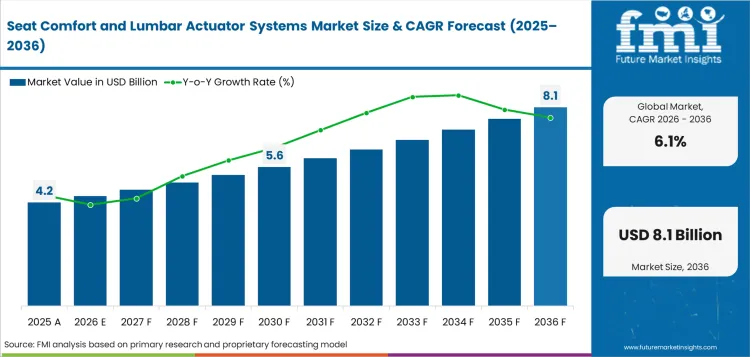
Key Takeaways, Market Size, and Forecast
- The seat comfort and lumbar actuator systems market was valued at USD 3.9 billion in 2025.
- By 2036, the market is forecast to reach USD 7.5 billion driven by wider use of powered adjustment functions in passenger vehicles.
- Between 2026 and 2036, demand is expected to advance at a 6.1% CAGR.
- The market is anticipated to create an incremental opportunity of USD 3.4 billion between 2026 and 2036.
- Lumbar actuators are estimated to capture 34.0% share in 2026 as posture comfort becomes a practical upgrade in front-row seating.
- Passenger cars are forecast to account for 46.0% share in 2026.
- India (7.8% CAGR) and China (7.4% CAGR) are forecast to record the fastest growth through 2036.
Seat Comfort and Lumbar Actuator Systems Market Definition
The seat comfort and lumbar actuator systems market includes motorized systems used to adjust lumbar position, seat tilt, backrest angle, cushion height, and massage movement inside vehicles.
Seat Comfort and Lumbar Actuator Systems Market Inclusions
Market scope includes lumbar actuators, tilt actuators, cushion actuators, backrest actuators, massage actuators, electric systems, pneumatic systems, smart systems, OEM supply, aftermarket replacement, passenger cars, SUVs, luxury cars, electric vehicles, and commercial vehicles.
Seat Comfort and Lumbar Actuator Systems Market Exclusions
The scope excludes manual adjustment hardware, passive cushion inserts, non-automotive recliner systems, orthopedic furniture actuators, aftermarket seat covers, and full seat assemblies sold without separate actuator value.
Seat Comfort and Lumbar Actuator Systems Market Research Methodology
- Primary research: It covered seat system suppliers, actuator manufacturers, vehicle platform engineers, and automotive interior component distributors across major production markets. FMI reviewed how automakers specify seat movement functions during platform planning and trim development.
- Desk research: It used vehicle production data, automotive component references, supplier product information, and public safety guidance. The study also reviewed comfort feature fitment across passenger cars, SUVs, luxury vehicles, and electric vehicles.
- Market sizing: It combined vehicle output, powered seat fitment rates, actuator count per seat, average selling price, and country-level comfort package penetration. Forecasting factored in SUV growth, electric vehicle interior upgrades, and cost pressure in compact models.
- Data validation: It compared forecast assumptions against supplier portfolios, seat system design trends and observed comfort feature movement across 2024 to 2026. Final values were checked against company participation and regional vehicle mix.
Why is the Seat Comfort and Lumbar Actuator Systems Market Growing?
- Seat comfort systems are spreading as automakers treat the front seat as a visible part of cabin value.
- Vehicle owners compare interior finish and screen quality, since seat comfort becomes noticeable during every drive.
- The automotive seating systems value chain shows how seats are moving from structural parts toward comfort platforms.
- Lumbar actuators benefit from this shift because posture control can be added without redesigning the entire seat.
- Suppliers with compact motors and low-noise operation can win more platform work.
Growth improves when comfort functions can be added without raising vehicle cost too sharply. Automakers usually need one actuator family across several trims to control part complexity. Power seat adjustment motors fit naturally into this demand path because small motor performance decides movement speed and sound quality. Reliable gear motion helps brands avoid warranty claims tied to seat rattle. Automakers prefer suppliers with proven seat integration and stable delivery across vehicle programs.
Electric vehicles are adding another demand path because cabin quietness makes actuator sound easier to notice. A seat motor that feels acceptable in a combustion vehicle can sound rough in an electric cabin. The automotive electric actuators value chain is important here because motor smoothness affects the comfort experience. Seat suppliers need smaller and more durable actuator units. This creates stronger demand for suppliers with high motor control accuracy.
Market Segmentation Analysis
- Lumbar actuators contribute 34.0% of projected 2026 revenue. Automakers use them to improve posture comfort without changing the full seat frame.
- Passenger cars represent 46.0% of projected 2026 demand. Their production scale gives actuator suppliers the widest route to volume.
- Electric actuators make up 58.0% of projected 2026 sales. Compact motor design and simple electronic control make them suitable for modern seat structures.
- OEM supply covers 72.0% of projected 2026 sales. Seat actuator selection usually happens before wiring and frame layouts are finalized.
The market is segmented by product type, vehicle type, technology, sales channel, and region. Product type includes Lumbar Actuators, Seat Tilt Actuators, Cushion Actuators, Backrest Actuators, and Massage Actuators. Vehicle type includes Passenger Cars, SUVs, Luxury Cars, Electric Vehicles, and Commercial Vehicles. Technology includes Electric Actuators, Pneumatic Actuators, Smart Actuators, and Memory Actuators. Sales channel includes OEM Supply, Aftermarket, and Service Centers. Demand depends on seat platform design, buyer comfort expectations, trim strategy, and actuator packaging limits.
Insights into the Lumbar Actuators Product Type Segment
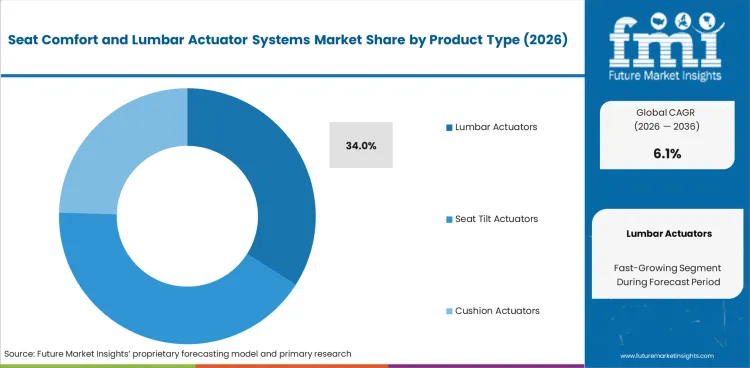
- Lumbar actuators contribute 34.0% of projected 2026 product demand. Automakers use them as a practical comfort upgrade because they improve driver posture without heavy system complexity.
- Seat tilt and cushion actuators gain use in higher trims as automakers offer wider seat adjustment. Backrest actuators matter most in vehicles with power recline and memory seating.
Insights into the Passenger Cars Vehicle Type Segment
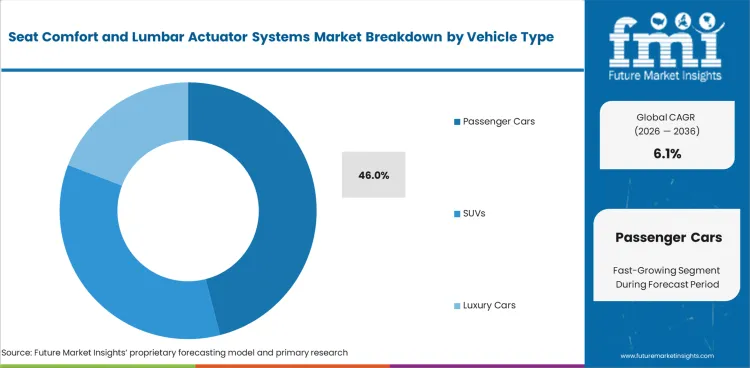
- Passenger cars contribute 46.0% of projected 2026 vehicle-based demand. High production volume gives this vehicle group the strongest base for powered seat systems.
- SUVs carry higher actuator value per vehicle. Many models combine lumbar control with powered recline in premium trims.
Insights into the Electric Actuators Technology Segment
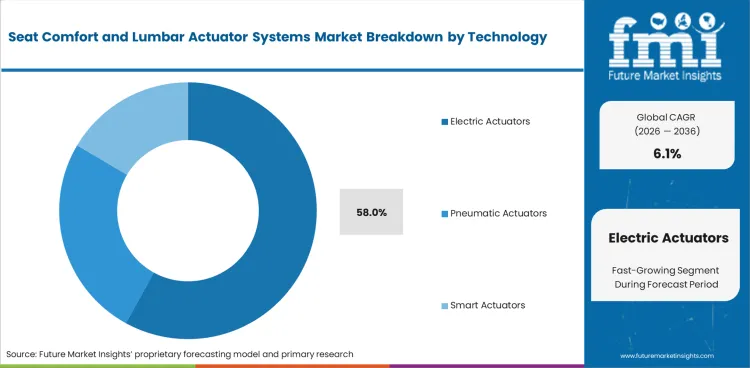
- Electric actuators represent 58.0% of projected 2026 technology demand. Their compact form and predictable movement make them the preferred choice for powered seat adjustment.
- Pneumatic systems appear more often in massage and premium seating. Their softer movement supports comfort functions, with cost limiting wider use.
Seat Comfort and Lumbar Actuator Systems Market Drivers, Restraints, and Opportunities
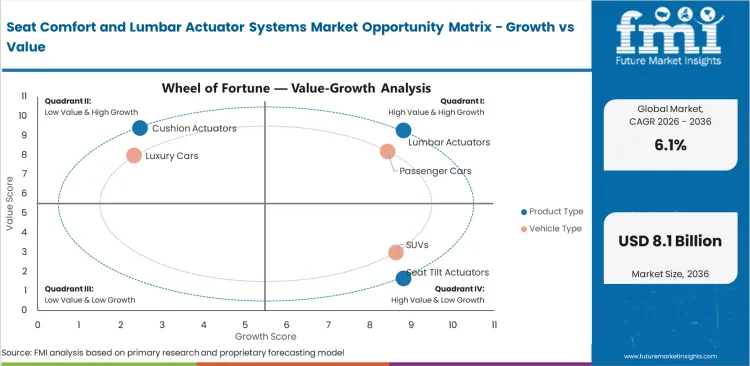
- Higher comfort content in passenger cars supports actuator demand across mid and upper trims.
- SUV platform growth creates demand for power seat adjustment and multi-way lumbar support.
- Cost pressure limits actuator count in entry vehicles, especially across price-sensitive markets.
- Electric vehicle cabin differentiation creates opportunity for quieter and lighter actuator systems.
Powered Seat Trim Expansion
Powered seat features are moving into more mid-range vehicles as automakers use comfort to improve trim value. The shift helps lumbar actuators because the feature adds clear driver benefit at a manageable cost. Automotive seat heater demand follows a similar path, with comfort hardware moving beyond premium vehicles. Actuator suppliers benefit when seat platforms use common motor units across several models. Standardized actuator families help automakers reduce cost and simplify service parts.
SUV Comfort Package Growth
SUVs create higher actuator demand per vehicle because vehicle owners expect smooth seat movement and improved posture comfort. IEA data published in May 2024 shows SUVs accounted for 48.0% of global car sales in 2023, reaching a record level. This makes SUVs one of the strongest vehicle groups for powered seat content because their larger cabins can carry lumbar motors, recline motors, and memory seating more easily. Larger seat structures give engineers more space for compact actuators and control modules. Premium SUVs often add massage and memory functions in upper trims, which improves supplier opportunity per vehicle.
Cost and Noise Pressure
Actuator suppliers face pressure to reduce noise and price at the same time. Seat movement must feel smooth because harsh motor sound can weaken cabin quality. Automotive actuator demand reflects this need because motion control quality affects many interior functions. Entry vehicles create a strict challenge since cost targets limit feature depth. Suppliers need quiet gears and durable motors to expand adoption.
Analysis of Seat Comfort and Lumbar Actuator Systems Market by Key Countries
.webp "Top Country Growth Comparison Seat Comfort And Lumbar Actuator Systems Market Cagr (2026 2036)")
| Country | CAGR |
|---|---|
| UK | 5.4% |
| USA | 6.3% |
| Japan | 5.1% |
| China | 7.4% |
| India | 7.8% |
| Germany | 5.6% |
| France | 5.3% |
| Brazil | 6.6% |
Source: FMI analysis based on primary research and proprietary forecasting model.
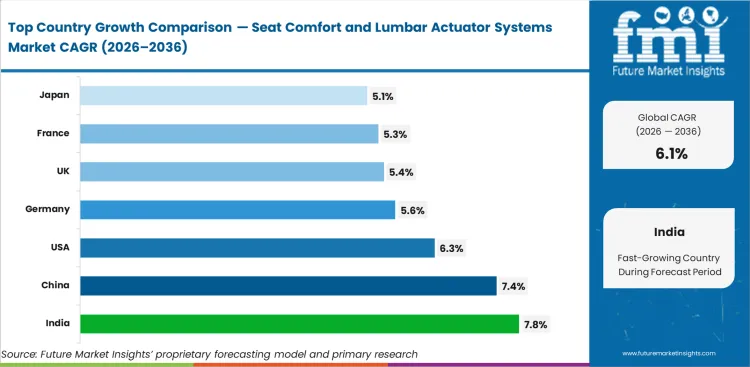
Seat Comfort and Lumbar Actuator Systems Market CAGR Analysis by Country
- India is in the leading position with a 7.8% CAGR. Compact SUVs are adding powered driver-seat functions across higher trims.
- China at 7.4% CAGR shows strong demand as domestic automakers use smart cabin features to improve vehicle appeal.
- Brazil (6.6% CAGR) and the USA (6.3% CAGR) keep growing as SUVs and higher-trim passenger vehicles add more powered seat functions.
- Germany at 5.6% CAGR and France at 5.3% CAGR show steady demand from premium vehicles, electric models, and hybrid platforms.
- The UK at 5.4% CAGR benefits from premium hatchbacks and SUVs, while Japan at 5.1% CAGR reflects demand for quiet motion and compact actuator design.
- The global seat comfort and lumbar actuator systems market is expected to grow at 6.1% CAGR from 2026 to 2036.
Demand Outlook for Seat Comfort and Lumbar Actuator Systems Market in the UK
Premium compact cars and SUVs in the UK are adding more powered comfort functions across higher trims. The country records 5.4% CAGR through 2036 as automakers use seat comfort to separate upper trims from base models. Automotive interior leather aligns with the same cabin upgrade pattern and powered adjustment are often sold together. Longer commuter travel increases the need for lumbar support in front seats. Compact motors and reliable service access will guide supplier selection.
- London commuter traffic creates more need for better driving posture in premium and fleet vehicles.
- Midlands automotive activity gives suppliers access to seat and interior component networks.
- UK luxury SUV demand creates a stronger case for powered lumbar and memory seating in higher trims.
Sales Analysis of Seat Comfort and Lumbar Actuator Systems Market in the USA
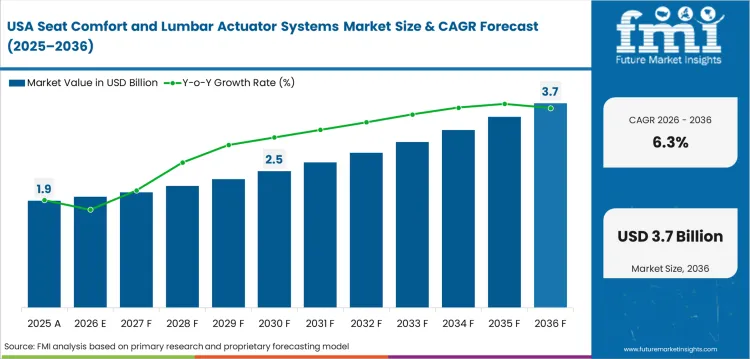
The market grows at 6.3% CAGR from 2026 to 2036 as long-distance driving adds value to front-row posture support. USA SUVs and pickup trucks are carrying more powered seat content, especially in crew cab and premium models. Large cabins allow more space for power adjustment and multi-way lumbar systems. Automotive interior spending connects with this shift because cabin comfort remains central to trim pricing. Suppliers with North American production and seat integration capability can improve program access.
- Michigan seat engineering centers help platform-level sourcing for actuator modules.
- Texas and California SUV sales increase the use of power seat content across higher trims.
- Crew cab pickup trucks often use premium seating packages to improve driver comfort.
In-depth Analysis of Seat Comfort and Lumbar Actuator Systems Market in Japan
Japanese automakers place high value on quiet motion and compact packaging inside passenger vehicles. Seat actuators must meet strict cabin quality expectations, especially in smaller domestic models. Japan advances at 5.1% CAGR by 2036 as automotive actuator design priorities favor precise movement and longer service life. Smaller cabins create tighter size limits for lumbar assemblies. Suppliers that reduce motor noise and improve gear durability can gain better access.
- Aichi’s automotive cluster helps seat system development for major domestic OEM programs.
- Kei car packaging limits actuator size, which favors compact lumbar mechanisms.
- Tokyo and Osaka commuter patterns increase the need for daily-use comfort in passenger vehicles.
Sales Analysis of Seat Comfort and Lumbar Actuator Systems Market in China
China’s smart cabin trend is increasing the use of powered comfort functions across passenger cars. Domestic EV brands use seat comfort to improve perceived cabin value. At 7.4% CAGR through 2036, China benefits from premium SUVs and new energy vehicles adding stronger actuator volumes. Automotive interior plastic components support this shift because powered seat switches and trim housings need durable materials. Local suppliers gain when they combine actuator cost control with fast platform support.
- Shanghai and Guangdong give the market a strong base through EV and component clusters.
- New energy vehicle brands use powered seating to improve interior value.
- Tier-one suppliers in Jiangsu and Zhejiang help local actuator sourcing for seat makers.
Demand Analysis of Seat Comfort and Lumbar Actuator Systems Market in India
India has the fastest listed outlook as compact SUVs add powered driver-seat functions in higher trims. Mid-priced vehicles are adding powered seats to improve cabin value without moving fully into luxury pricing. Automotive seating reflects the same movement of comfort features into passenger vehicles. The country records 7.8% CAGR through 2036 as automakers shift premium functions into mass-market SUVs. Local assembly and cost-efficient motor sourcing will decide supplier success.
- Pune and Chennai give suppliers access to large passenger vehicle manufacturing clusters.
- Compact SUVs sold in Delhi NCR and Bengaluru carry higher comfort content in top trims.
- Domestic component programs help local sourcing for motors and seat mechanisms.
Opportunity Analysis of Seat Comfort and Lumbar Actuator Systems Market in Germany
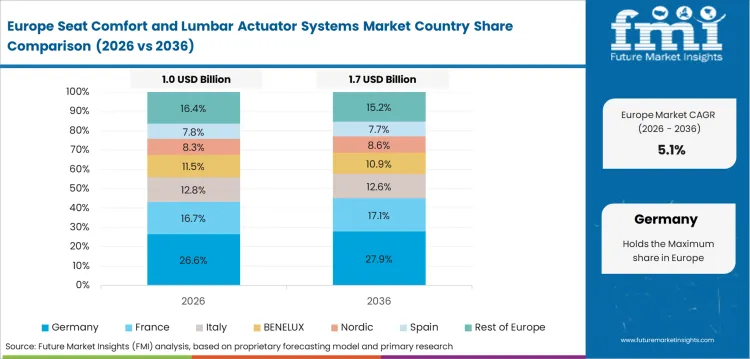
Premium vehicle engineering keeps seat adjustment quality high across Germany. Seat comfort is part of brand identity in luxury sedans and SUVs. German demand carries 5.6% CAGR from 2026 to 2036 as OEMs expect quiet movement and long-cycle durability from actuator suppliers. Automotive interior polypropylene laminates connects with lighter cabin design because seat trim and interior weight affect vehicle efficiency. Engineering depth gives established suppliers an advantage.
- Bavaria and Baden-Württemberg drive demand through premium OEM engineering centers.
- Autobahn driving patterns increase value for stable posture control in front seats.
- German luxury EV programs raise the need for multi-way adjustment and memory seat content.
Future Outlook for Seat Comfort and Lumbar Actuator Systems Market in France
France is expected to grow at 5.3% CAGR by 2036 as shared platforms make comfort packages easier to offer. French electric and hybrid models are carrying more cabin comfort equipment across compact and midsize vehicles. Automakers use powered seat features to improve perceived value without making the cabin feel overbuilt. Automotive headliner belongs in the same cabin refinement path because soft interior surfaces and seat comfort influence user feel. Suppliers need cost control to serve French volume programs.
- Île-de-France and Hauts-de-France bring together vehicle design and component supply activity.
- French compact EV programs create demand for light and quiet comfort systems.
- Urban fleet vehicles need durable seat adjustment parts with lower service risk.
In-depth Analysis of Seat Comfort and Lumbar Actuator Systems Market in Brazil
Higher-trim passenger vehicles in Brazil are adding powered seat features as SUVs gain more consumer attention. Local vehicle owners tend to favor practical comfort upgrades over complex massage functions. Brazil grows at 6.6% CAGR through 2036 as front-seat comfort becomes more common in upper trims. Automotive racing seats relates to specialized seating needs where design and body hold influence driving feel. Suppliers with regional distribution and service capability can gain replacement opportunities.
- São Paulo gives the market a strong base through vehicle production and supplier activity.
- Minas Gerais and Paraná add demand through passenger vehicle assembly.
- Brazilian SUV owners favor front-seat comfort packages in higher trims.
Competitive Landscape and Strategic Positioning
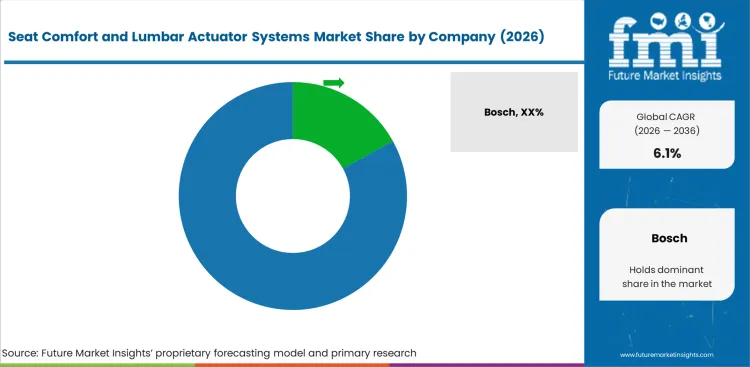
- The market is moderately concentrated, with global actuator and seat system suppliers holding stronger access to OEM programs.
- Leading companies compete on motor noise with seat integration and long-cycle durability.
- Specialist suppliers can win smaller programs when they offer compact mechanisms at controlled cost.
- Entry barriers include platform approval time, validation cost and strict quality expectations from automakers.
Competition depends on the ability to supply reliable actuator units across several seat movements. Large companies hold an advantage because automakers prefer suppliers with proven quality systems and multi-region delivery. Bosch, Brose, Continental and MinebeaMitsumi have relevant actuator and motor capability for automotive use. Seat system companies such as Toyota Boshoku and Leggett & Platt add value through integration knowledge. Automakers prefer suppliers that can solve noise and packaging issues before launch.
Established suppliers depend on design input during early seat platform planning. A lumbar actuator must fit foam shape, backrest frame and wiring design. Automotive electric actuator is relatable because motor design depth decides smooth movement and service life. Smaller suppliers can compete when they offer low-cost assemblies for regional vehicle programs. Premium platforms usually demand tighter testing and stronger warranty backing.
Electric vehicles are changing competitive priorities because cabin quietness exposes small actuator noise. A motor that feels acceptable in a combustion vehicle may sound rough in an EV cabin. Automotive charge port actuator demand shows the same need for smooth motion in electrified vehicles. Seat actuator suppliers need better gear control and lower sound output. This creates opportunity for companies with stronger motor engineering.
Key Companies in the Seat Comfort and Lumbar Actuator Systems Market
Key companies are assessed by motor design, seat integration and platform-level supply relationships.
- Global Leaders include Bosch, Brose, Continental and Nidec. These companies hold strong positions through automotive actuator capability and global OEM access.
- Seat System Specialists include Toyota Boshoku, Leggett & Platt and Adient. These companies depend on seating system knowledge and comfort module integration.
- Component Specialists include MinebeaMitsumi, Johnson Electric, and HI-LEX. These companies compete through compact motors and small motion control parts.
Competitive Benchmarking: Seat Comfort and Lumbar Actuator Systems Market
| Company | Seat Actuator Depth | Motor Noise Control | OEM Platform Access | Geographic Footprint |
|---|---|---|---|---|
| Bosch | High | Strong | Strong | Global |
| Brose | High | Strong | Strong | Global |
| Continental | Medium | Strong | Strong | Global |
| Nidec | High | Strong | Moderate | Global |
| MinebeaMitsumi | High | Strong | Moderate | Global |
| Johnson Electric | Medium | Strong | Moderate | Global |
| Leggett & Platt | High | Medium | Strong | North America, Europe |
| Toyota Boshoku | Medium | Medium | Strong | Asia, Global |
| Adient | Medium | Medium | Strong | Global |
| HI-LEX | Medium | Moderate | Moderate | Asia, North America |
Source: Future Market Insights competitive analysis, 2026.
Key Developments in Seat Comfort and Lumbar Actuator Systems Market
- In July 2025, Adient launched a mechanical massage seat solution in GAC-Trumpchi’s M8 PHEV. The system supplied three-row seats and introduced an industry-first mechanical massage solution for automotive seating comfort.
- In March 2025, Toyota Boshoku completed the full acquisition of Toyota Boshoku Device India Private Limited by acquiring the remaining 20% stake held by Aisin Shiroki.
Key Players in the Seat Comfort and Lumbar Actuator Systems Market
Global Leaders
- Bosch
- Brose
- Continental
- Nidec
Seat System Specialists
- Toyota Boshoku
- Leggett & Platt
- Adient
Component Specialists
- MinebeaMitsumi
- Johnson Electric
- HI-LEX
Report Scope and Coverage
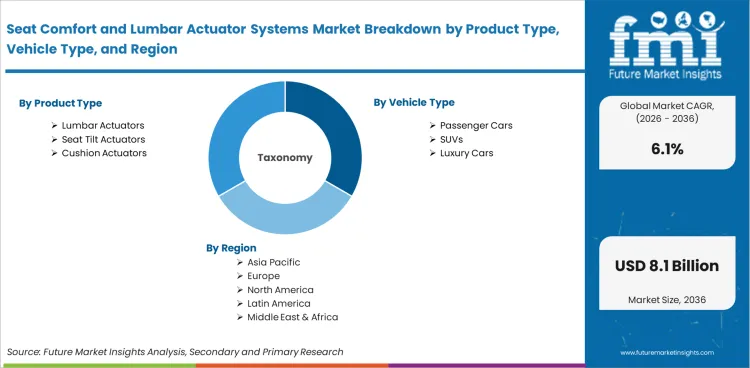
| Parameter | Details |
|---|---|
| Quantitative Units | USD 4.2 billion to USD 7.5 billion, at a 6.1% CAGR from 2026 to 2036 |
| Market Definition | Motorized systems used to adjust lumbar position, backrest angle, cushion height, seat tilt, and powered comfort movement inside vehicles |
| Regions Covered | North America, Latin America, Europe, East Asia, South Asia and Pacific, Middle East and Africa |
| Countries Covered | UK, USA, Japan, China, India, Germany, France, Brazil, 30 plus countries |
| Key Companies Profiled | Bosch, Brose, Continental, Nidec, MinebeaMitsumi, Johnson Electric, Leggett & Platt, Toyota Boshoku, Adient, HI-LEX |
| Forecast Period | 2026 to 2036 |
| Approach | Hybrid bottom-up and top-down methodology using vehicle production, comfort fitment, actuator pricing, and platform adoption rates |
Seat Comfort and Lumbar Actuator Systems Market by Segments
Seat Comfort and Lumbar Actuator Systems Market segmented as Product Type:
- Lumbar Actuators
- Seat Tilt Actuators
- Cushion Actuators
- Backrest Actuators
- Massage Actuators
Seat Comfort and Lumbar Actuator Systems Market classified by Vehicle Type:
- Passenger Cars
- SUVs
- Luxury Cars
- Electric Vehicles
- Commercial Vehicles
Seat Comfort and Lumbar Actuator Systems Market analysed by Technology:
- Electric Actuators
- Pneumatic Actuators
- Smart Actuators
- Memory Actuators
Seat Comfort and Lumbar Actuator Systems Market classified by Sales Channel:
- OEM Supply
- Aftermarket
- Service Centers
Seat Comfort and Lumbar Actuator Systems Market by Region and Country:
- North America
- USA
- Canada
- Mexico
- Latin America
- Brazil
- Chile
- Rest of Latin America
- Western Europe
- Germany
- UK
- Italy
- Spain
- France
- Nordic
- BENELUX
- Rest of Western Europe
- Eastern Europe
- Russia
- Poland
- Hungary
- Balkan & Baltic
- Rest of Eastern Europe
- East Asia
- China
- Japan
- South Korea
- South Asia and Pacific
- India
- ASEAN
- Australia & New Zealand
- Rest of South Asia and Pacific
- Middle East & Africa
- Kingdom of Saudi Arabia
- Other GCC Countries
- Turkiye
- South Africa
- Other African Union
- Rest of Middle East & Africa
Research Sources and Bibliography
- Adient. (2025, July 15). Adient launches mechanical massage seating innovation. Adient Investor Relations.
- Toyota Boshoku Corporation. (2025, March 25). Notice regarding the full acquisition of Toyota Boshoku Device India Private Limited.
- International Energy Agency. (2024, May 28). SUVs are setting new sales records each year and so are their emissions.
- Brose Sitech. (2024, November 29). Joyson Safety Systems and Brose partner to create vehicle seating options for the future.
- Somnigroup International Inc., & Leggett & Platt Incorporated. (2026, April 13). Leggett & Platt to be Acquired by Somnigroup
- Nidec Corporation. (2024, June 3). Nidec develops new automotive air suspension motor.
- Continental. (2025, January 8). As Printed: Continental Presents Customizable Emotional Cockpit with E Ink Prism Display.
This Report Answers
- What is the current and future size of the seat comfort and lumbar actuator systems market?
- How fast will demand grow between 2026 and 2036?
- Which product type will account for the highest share in 2026?
- Which vehicle type will create the largest demand base in 2026?
- What factors are driving powered seat comfort adoption across global vehicle programs?
- How are electric vehicles changing seat actuator design needs?
- Why are India and China forecast to grow faster than mature automotive markets?
- Which companies are active in seat comfort and lumbar actuator systems?
- What products are included in the market definition?
- How does FMI estimate and validate the market forecast?
Frequently Asked Questions
What is the global market demand for seat comfort and lumbar actuator systems in 2026?
In 2026, the global market is forecast to reach USD 4.2 billion, helped by wider powered seat fitment.
How big will the market be by 2036?
By 2036, the market is forecast to reach USD 7.5 billion as comfort systems enter more vehicle platforms.
What CAGR is forecast between 2026 and 2036?
Demand is forecast to grow at a 6.1% CAGR between 2026 and 2036.
Which product type will lead demand in 2026?
Lumbar actuators are forecast to account for 34.0% share in 2026 because posture support has clear user value.
Which vehicle type will lead demand in 2026?
Passenger cars are forecast to hold 46.0% share in 2026 due to large production volume.
Why does India record the fastest outlook?
India is forecast at 7.8% CAGR through 2036 as SUV trims add powered driver-seat features.
What does the market include?
The market includes motorized systems for lumbar adjustment, backrest movement and powered comfort functions.
How does FMI build the forecast?
FMI uses vehicle output, actuator fitment rates and supplier portfolio review to estimate future demand.
Preview the report firsthand - request a free sample
Get SampleGet the brochure for pricing and purchase details.
Get PDFTable of Content
- Executive Summary
- Global Market Outlook
- Demand-side Trends
- Technology Roadmap Analysis
- Analysis and Recommendations
- Market Overview
- Market Coverage / Taxonomy
- Market Definition / Scope / Limitations
- Research Methodology
- Chapter Orientation
- Analytical Lens and Working Hypotheses
- Market Structure, Signals, and Trend Drivers
- Benchmarking and Cross-market Comparability
- Desk Research Programme (Secondary Evidence)
- Company Annual and Sustainability Reports
- Peer-reviewed Journals and Academic Literature
- Corporate Websites, Product Literature, and Technical Notes
- Earnings Decks and Investor Briefings
- Statutory Filings and Regulatory Disclosures
- Technical White Papers and Standards Notes
- Trade Journals, Industry Magazines, and Analyst Briefs
- Conference Proceedings, Webinars, and Seminar Materials
- Government Statistics Portals and Public Data Releases
- Press Releases and Reputable Media Coverage
- Specialist Newsletters and Curated Briefings
- Sector Databases and Reference Repositories
- FMI Internal Proprietary Databases and Historical Market Datasets
- Subscription Datasets and Paid Sources
- Social Channels, Communities, and Digital Listening Inputs
- Additional Desk Sources
- Expert Input and Fieldwork (Primary Evidence)
- Primary Modes
- Qualitative Interviews and Expert Elicitation
- Quantitative Surveys and Structured Data Capture
- Blended Approach
- Why Primary Evidence is Used
- Field Techniques
- Interviews
- Surveys
- Focus Groups
- Observational and In-context Research
- Social and Community Interactions
- Stakeholder Universe Engaged
- C-suite Leaders
- Board Members
- Opportunity
- Trends
- Scenario Forecast
- Demand in Optimistic Scenario
- Demand in Likely Scenario
- Demand in Conservative Scenario
- Opportunity Map Analysis
- Product Life Cycle Analysis
- Supply Chain Analysis
- Investment Feasibility Matrix
- Value Chain Analysis
- PESTLE and Porter’s Analysis
- Regulatory Landscape
- Regional Parent Market Outlook
- Production and Consumption Statistics
- Import and Export Statistics
- Primary Modes
- Global Market Analysis 2021 to 2025 and Forecast, 2026 to 2036
- Historical Market Size Value (USD Million) Analysis, 2021 to 2025
- Current and Future Market Size Value (USD Million) Projections, 2026 to 2036
- Y-o-Y Growth Trend Analysis
- Absolute $ Opportunity Analysis
- Global Market Pricing Analysis 2021 to 2025 and Forecast 2026 to 2036
- Global Market Analysis 2021 to 2025 and Forecast 2026 to 2036, By Product Type
- Introduction / Key Findings
- Historical Market Size Value (USD Million) Analysis By Product Type , 2021 to 2025
- Current and Future Market Size Value (USD Million) Analysis and Forecast By Product Type , 2026 to 2036
- Lumbar Actuators
- Seat Tilt Actuators
- Cushion Actuators
- Lumbar Actuators
- Y-o-Y Growth Trend Analysis By Product Type , 2021 to 2025
- Absolute $ Opportunity Analysis By Product Type , 2026 to 2036
- Global Market Analysis 2021 to 2025 and Forecast 2026 to 2036, By Vehicle Type
- Introduction / Key Findings
- Historical Market Size Value (USD Million) Analysis By Vehicle Type, 2021 to 2025
- Current and Future Market Size Value (USD Million) Analysis and Forecast By Vehicle Type, 2026 to 2036
- Passenger Cars
- SUVs
- Luxury Cars
- Passenger Cars
- Y-o-Y Growth Trend Analysis By Vehicle Type, 2021 to 2025
- Absolute $ Opportunity Analysis By Vehicle Type, 2026 to 2036
- Global Market Analysis 2021 to 2025 and Forecast 2026 to 2036, By Technology
- Introduction / Key Findings
- Historical Market Size Value (USD Million) Analysis By Technology, 2021 to 2025
- Current and Future Market Size Value (USD Million) Analysis and Forecast By Technology, 2026 to 2036
- Electric Actuators
- Pneumatic Actuators
- Smart Actuators
- Electric Actuators
- Y-o-Y Growth Trend Analysis By Technology, 2021 to 2025
- Absolute $ Opportunity Analysis By Technology, 2026 to 2036
- Global Market Analysis 2021 to 2025 and Forecast 2026 to 2036, By Sales Channel
- Introduction / Key Findings
- Historical Market Size Value (USD Million) Analysis By Sales Channel, 2021 to 2025
- Current and Future Market Size Value (USD Million) Analysis and Forecast By Sales Channel, 2026 to 2036
- OEM Supply
- Aftermarket
- Service Centers
- OEM Supply
- Y-o-Y Growth Trend Analysis By Sales Channel, 2021 to 2025
- Absolute $ Opportunity Analysis By Sales Channel, 2026 to 2036
- Global Market Analysis 2021 to 2025 and Forecast 2026 to 2036, By Region
- Introduction
- Historical Market Size Value (USD Million) Analysis By Region, 2021 to 2025
- Current Market Size Value (USD Million) Analysis and Forecast By Region, 2026 to 2036
- North America
- Latin America
- Western Europe
- Eastern Europe
- East Asia
- South Asia and Pacific
- Middle East & Africa
- Market Attractiveness Analysis By Region
- North America Market Analysis 2021 to 2025 and Forecast 2026 to 2036, By Country
- Historical Market Size Value (USD Million) Trend Analysis By Market Taxonomy, 2021 to 2025
- Market Size Value (USD Million) Forecast By Market Taxonomy, 2026 to 2036
- By Country
- USA
- Canada
- Mexico
- By Product Type
- By Vehicle Type
- By Technology
- By Sales Channel
- By Country
- Market Attractiveness Analysis
- By Country
- By Product Type
- By Vehicle Type
- By Technology
- By Sales Channel
- Key Takeaways
- Latin America Market Analysis 2021 to 2025 and Forecast 2026 to 2036, By Country
- Historical Market Size Value (USD Million) Trend Analysis By Market Taxonomy, 2021 to 2025
- Market Size Value (USD Million) Forecast By Market Taxonomy, 2026 to 2036
- By Country
- Brazil
- Chile
- Rest of Latin America
- By Product Type
- By Vehicle Type
- By Technology
- By Sales Channel
- By Country
- Market Attractiveness Analysis
- By Country
- By Product Type
- By Vehicle Type
- By Technology
- By Sales Channel
- Key Takeaways
- Western Europe Market Analysis 2021 to 2025 and Forecast 2026 to 2036, By Country
- Historical Market Size Value (USD Million) Trend Analysis By Market Taxonomy, 2021 to 2025
- Market Size Value (USD Million) Forecast By Market Taxonomy, 2026 to 2036
- By Country
- Germany
- UK
- Italy
- Spain
- France
- Nordic
- BENELUX
- Rest of Western Europe
- By Product Type
- By Vehicle Type
- By Technology
- By Sales Channel
- By Country
- Market Attractiveness Analysis
- By Country
- By Product Type
- By Vehicle Type
- By Technology
- By Sales Channel
- Key Takeaways
- Eastern Europe Market Analysis 2021 to 2025 and Forecast 2026 to 2036, By Country
- Historical Market Size Value (USD Million) Trend Analysis By Market Taxonomy, 2021 to 2025
- Market Size Value (USD Million) Forecast By Market Taxonomy, 2026 to 2036
- By Country
- Russia
- Poland
- Hungary
- Balkan & Baltic
- Rest of Eastern Europe
- By Product Type
- By Vehicle Type
- By Technology
- By Sales Channel
- By Country
- Market Attractiveness Analysis
- By Country
- By Product Type
- By Vehicle Type
- By Technology
- By Sales Channel
- Key Takeaways
- East Asia Market Analysis 2021 to 2025 and Forecast 2026 to 2036, By Country
- Historical Market Size Value (USD Million) Trend Analysis By Market Taxonomy, 2021 to 2025
- Market Size Value (USD Million) Forecast By Market Taxonomy, 2026 to 2036
- By Country
- China
- Japan
- South Korea
- By Product Type
- By Vehicle Type
- By Technology
- By Sales Channel
- By Country
- Market Attractiveness Analysis
- By Country
- By Product Type
- By Vehicle Type
- By Technology
- By Sales Channel
- Key Takeaways
- South Asia and Pacific Market Analysis 2021 to 2025 and Forecast 2026 to 2036, By Country
- Historical Market Size Value (USD Million) Trend Analysis By Market Taxonomy, 2021 to 2025
- Market Size Value (USD Million) Forecast By Market Taxonomy, 2026 to 2036
- By Country
- India
- ASEAN
- Australia & New Zealand
- Rest of South Asia and Pacific
- By Product Type
- By Vehicle Type
- By Technology
- By Sales Channel
- By Country
- Market Attractiveness Analysis
- By Country
- By Product Type
- By Vehicle Type
- By Technology
- By Sales Channel
- Key Takeaways
- Middle East & Africa Market Analysis 2021 to 2025 and Forecast 2026 to 2036, By Country
- Historical Market Size Value (USD Million) Trend Analysis By Market Taxonomy, 2021 to 2025
- Market Size Value (USD Million) Forecast By Market Taxonomy, 2026 to 2036
- By Country
- Kingdom of Saudi Arabia
- Other GCC Countries
- Turkiye
- South Africa
- Other African Union
- Rest of Middle East & Africa
- By Product Type
- By Vehicle Type
- By Technology
- By Sales Channel
- By Country
- Market Attractiveness Analysis
- By Country
- By Product Type
- By Vehicle Type
- By Technology
- By Sales Channel
- Key Takeaways
- Key Countries Market Analysis
- USA
- Pricing Analysis
- Market Share Analysis, 2025
- By Product Type
- By Vehicle Type
- By Technology
- By Sales Channel
- Canada
- Pricing Analysis
- Market Share Analysis, 2025
- By Product Type
- By Vehicle Type
- By Technology
- By Sales Channel
- Mexico
- Pricing Analysis
- Market Share Analysis, 2025
- By Product Type
- By Vehicle Type
- By Technology
- By Sales Channel
- Brazil
- Pricing Analysis
- Market Share Analysis, 2025
- By Product Type
- By Vehicle Type
- By Technology
- By Sales Channel
- Chile
- Pricing Analysis
- Market Share Analysis, 2025
- By Product Type
- By Vehicle Type
- By Technology
- By Sales Channel
- Germany
- Pricing Analysis
- Market Share Analysis, 2025
- By Product Type
- By Vehicle Type
- By Technology
- By Sales Channel
- UK
- Pricing Analysis
- Market Share Analysis, 2025
- By Product Type
- By Vehicle Type
- By Technology
- By Sales Channel
- Italy
- Pricing Analysis
- Market Share Analysis, 2025
- By Product Type
- By Vehicle Type
- By Technology
- By Sales Channel
- Spain
- Pricing Analysis
- Market Share Analysis, 2025
- By Product Type
- By Vehicle Type
- By Technology
- By Sales Channel
- France
- Pricing Analysis
- Market Share Analysis, 2025
- By Product Type
- By Vehicle Type
- By Technology
- By Sales Channel
- India
- Pricing Analysis
- Market Share Analysis, 2025
- By Product Type
- By Vehicle Type
- By Technology
- By Sales Channel
- ASEAN
- Pricing Analysis
- Market Share Analysis, 2025
- By Product Type
- By Vehicle Type
- By Technology
- By Sales Channel
- Australia & New Zealand
- Pricing Analysis
- Market Share Analysis, 2025
- By Product Type
- By Vehicle Type
- By Technology
- By Sales Channel
- China
- Pricing Analysis
- Market Share Analysis, 2025
- By Product Type
- By Vehicle Type
- By Technology
- By Sales Channel
- Japan
- Pricing Analysis
- Market Share Analysis, 2025
- By Product Type
- By Vehicle Type
- By Technology
- By Sales Channel
- South Korea
- Pricing Analysis
- Market Share Analysis, 2025
- By Product Type
- By Vehicle Type
- By Technology
- By Sales Channel
- Russia
- Pricing Analysis
- Market Share Analysis, 2025
- By Product Type
- By Vehicle Type
- By Technology
- By Sales Channel
- Poland
- Pricing Analysis
- Market Share Analysis, 2025
- By Product Type
- By Vehicle Type
- By Technology
- By Sales Channel
- Hungary
- Pricing Analysis
- Market Share Analysis, 2025
- By Product Type
- By Vehicle Type
- By Technology
- By Sales Channel
- Kingdom of Saudi Arabia
- Pricing Analysis
- Market Share Analysis, 2025
- By Product Type
- By Vehicle Type
- By Technology
- By Sales Channel
- Turkiye
- Pricing Analysis
- Market Share Analysis, 2025
- By Product Type
- By Vehicle Type
- By Technology
- By Sales Channel
- South Africa
- Pricing Analysis
- Market Share Analysis, 2025
- By Product Type
- By Vehicle Type
- By Technology
- By Sales Channel
- USA
- Market Structure Analysis
- Competition Dashboard
- Competition Benchmarking
- Market Share Analysis of Top Players
- By Regional
- By Product Type
- By Vehicle Type
- By Technology
- By Sales Channel
- Competition Analysis
- Competition Deep Dive
- Bosch
- Overview
- Product Portfolio
- Profitability by Market Segments (Product/Age /Sales Channel/Region)
- Sales Footprint
- Strategy Overview
- Marketing Strategy
- Product Strategy
- Channel Strategy
- Brose
- Continental
- Nidec
- Toyota Boshoku
- Leggett & Platt
- Bosch
- Competition Deep Dive
- Assumptions & Acronyms Used


