

- Market Size (2026)
- USD 454.8 Mn
- Forecast (2036)
- USD 1.03 Bn
- CAGR (2026 to 2036)
- 8.5%
Battery Pack Cooling Valve Actuator Systems Market Size, Market Forecast and Outlook By FMI
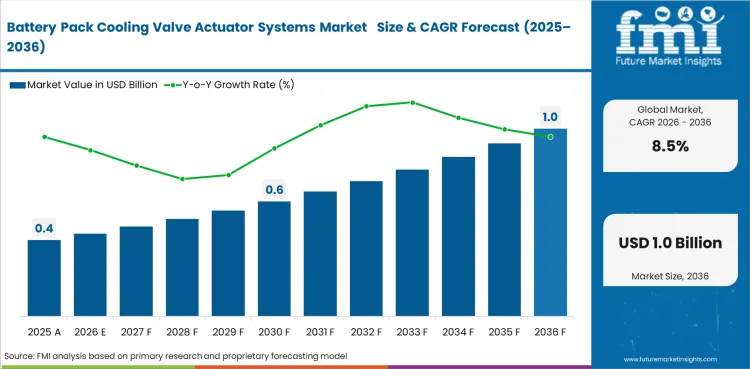
The battery pack cooling valve actuator systems market was valued at USD 412.6 million in 2025. The industry is expected to reach USD 454.8 million by the end of 2026 and advance at a CAGR of 8.5% from 2026 to 2036 to reach USD 1.03 billion by 2036. Liquid coolant loops are projected to lead with a 62.0% share, while battery electric passenger cars are expected to account for a 51.0% share in 2026.
Summary of the Battery Pack Cooling Valve Actuator Systems Market
- Demand and Growth Drivers
- Fast charging and larger battery packs are increasing the need for tighter coolant routing control across EV battery systems.
- Integrated thermal modules are increasing demand for compact valve actuator assemblies that fit into broader heat-management layouts.
- Growing focus on battery protection is supporting more reliable fluid-control hardware across electric vehicle programs.
- Product and Segment View
- Liquid coolant loops remain lead the cooling-circuit segment because active liquid thermal control is central to mainstream EV pack design.
- Battery electric passenger cars hold the largest share because global electric vehicle output centers on passenger platforms.
- Electric motor actuators lead because OEMs want smoother actuation and better flow precision in battery cooling branches.
- Geography and Competitive Outlook
- China is the strongest expansion market because vehicle scale and EV model activity are high.
- Germany and the United Kingdom benefit from BEV penetration, while France and South Korea are steady growth markets.
- Analyst Opinion
- Nikhil Kaitwade, Principal Consultant at FMI says, “Companies that can improve coolant routing precision, support compact thermal packaging, and deliver dependable actuator performance are likely to strengthen their position over the forecast period, as EV makers keep raising expectations around charging efficiency, battery durability, and pack thermal stability.”
- Battery Pack Cooling Valve Actuator Systems Market Value Analysis
- The market is moving from a narrow thermal control niche into a clearer part of EV systems spending.
- Demand is rising as battery packs carry higher thermal loads and require better temperature consistency during charging and discharge cycles.
- Adoption is also supported by the wider use of cold plates and battery thermal materials in EV pack design.
- Spending remains linked to vehicle electrification, battery safety work, and better thermal efficiency inside integrated cooling architectures.
Key Takeaways
- The battery pack cooling valve actuator systems market was valued at USD 412.6 million in 2025.
- By 2036, the battery pack cooling valve actuator systems market is expected to be worth USD 1.03 billion.
- From 2026 to 2036, the market is projected to expand at a CAGR of 8.5%.
- The market is projected to create an incremental opportunity of USD 575.2 million between 2026 and 2036.
- In 2026, liquid coolant loops are expected to account for 62.0% of the cooling circuit segment, supported by wider use of active battery thermal control in EV platforms.
- China (9.7%) and Germany (8.9%) are two of the fastest growing markets in the world.
Battery Pack Cooling Valve Actuator Systems Market Definition
The battery pack cooling valve actuator systems market includes actuator-controlled coolant valves used within electric vehicle battery thermal management architectures. These systems regulate coolant movement between battery packs, chillers, bypass routes, and related cooling branches under changing vehicle operating conditions.
Battery Pack Cooling Valve Actuator Systems Market Inclusions
Included within scope are switching valves, proportional coolant valves, shut-off valves, and related electromechanical valve assemblies used in battery cooling circuits. Coverage includes products supplied as standalone valve blocks and products integrated into wider EV thermal modules where battery coolant routing remains the direct function.
Battery Pack Cooling Valve Actuator Systems Market Exclusions
Excluded from scope are complete battery packs, pumps without valve actuation content, cabin-only refrigerant valves, standalone chillers, cooling plates sold without valve function, and full thermal systems where the battery cooling valve assembly cannot be separately attributed.
Battery Pack Cooling Valve Actuator Systems Market Research Methodology
- Primary Research: FMI assesses supplier participation, valve design trends, thermal integration patterns, and OEM demand structure through official company material tied directly to EV battery cooling and thermal module development.
- Desk Research: The study uses non-commercial sources including the IEA, ACEA, NHTSA, the Federal Register, SMMT, CAAM, and official supplier disclosures connected to EV battery cooling, thermal systems, and safety regulation.
- Market Sizing and Forecasting: The market is sized through bottom-up allocation of EV thermal hardware demand across active battery cooling architectures, valve content per platform, and rising use of integrated thermal modules.
- Data Validation and Update Cycle: Forecast assumptions are cross-checked against EV deployment data, battery demand indicators, registration trends, and recent supplier activity across 2024 to 2026.
Why Is the Battery Pack Cooling Valve Actuator Systems Market Growing?
- Higher battery energy and faster charging are increasing the need for controlled coolant flow around EV packs.
- More thermal integration in electric vehicles is increasing the value of compact valve actuator assemblies.
- Battery protection work in regulation is supporting wider use of dependable thermal control hardware.
Battery thermal design now has higher importance inside electric vehicle engineering because pack temperature directly influences charging speed and service life. Wider EV deployment is expanding demand for battery cooling valves that can route coolant across changing load conditions. This demand pattern is gaining strength as manufacturers rely more heavily on EV battery heating systems and related pack-temperature controls to maintain stable battery operation across hot and cold environments.
Battery cooling hardware is increasingly being integrated with wider thermal modules. This is increasing demand for actuators that can switch reliably and fit tight packaging limits. They also need to work smoothly with multi-branch cooling layouts. This favors products that align with automotive e-compressors and related thermal-routing components already used in EV heat-management systems. As thermal architectures become more compact, the battery cooling valve becomes a clear engineering choice.
Market Segmentation Analysis
- Liquid coolant loops lead cooling-circuit demand with 62.0% share because active liquid battery cooling remains the preferred route in mainstream EVs.
- Battery electric passenger cars account for 51.0% of vehicle-type demand while electric motor actuators hold 46.0% of actuation-type demand in 2026.
- OEM line-fit remains the dominant sales route with 84.0% share because battery cooling valve systems are chosen during platform engineering.
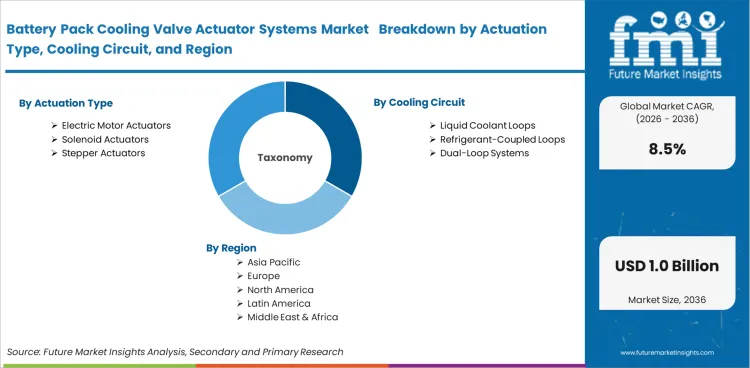
The battery pack cooling valve actuator systems market is segmented by actuation type, cooling circuit, vehicle type, sales channel, and region. Actuation type covers electric motor actuators, solenoid actuators, and stepper actuators. Cooling circuit includes liquid coolant loops, refrigerant-coupled loops, and dual-loop systems. Vehicle type includes battery electric passenger cars, plug-in hybrid cars, electric buses, electric light commercial vehicles, and electric trucks. Sales channel covers OEM line-fit, Tier 1 module supply, and replacement aftermarket.
Insights into the Electric Motor Actuators Segment
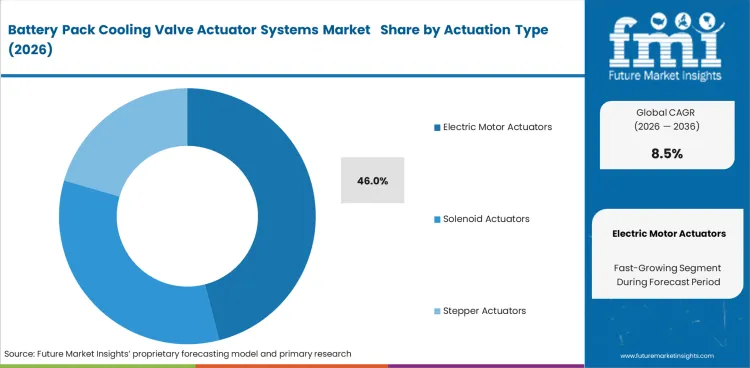
- Electric motor actuators are anticipated to represent 46.0% of the actuation-type segment in 2026. This reflects stronger demand for smoother switching and more precise coolant control in battery cooling branches.
- Motorized actuation works well in integrated thermal layouts and in systems where coolant flow must respond accurately to changing pack conditions. Solenoid systems serve simpler layouts. Motorized formats hold an advantage in programs where precision and repeatability matter more.
Insights into the Liquid Coolant Loops Segment
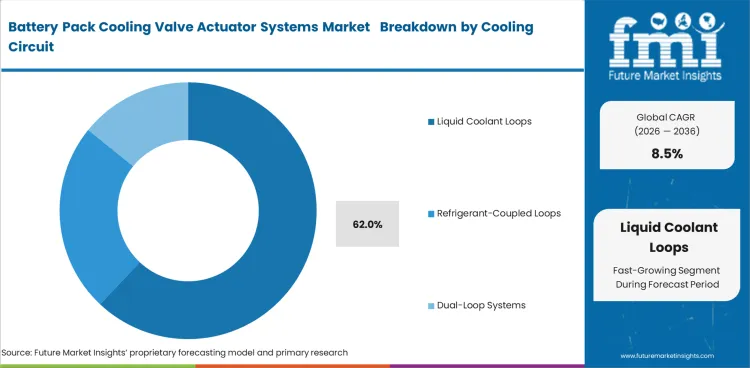
- Liquid coolant loops are likely to secure 62.0% share in 2026 because liquid cooling is the practical choice for battery packs operating under high thermal loads and faster charging conditions.
- As EVs move toward tighter thermal operating windows, battery cooling increasingly depends on active coolant circulation. Simpler passive approaches carry less value in this setup. Demand aligns with high-thermal-conductivity gap-fill adhesives for EV cooling plates. These products work toward the same broad objective of maintaining controlled and uniform battery temperature across the pack.
Insights into the Battery Electric Passenger Cars Segment
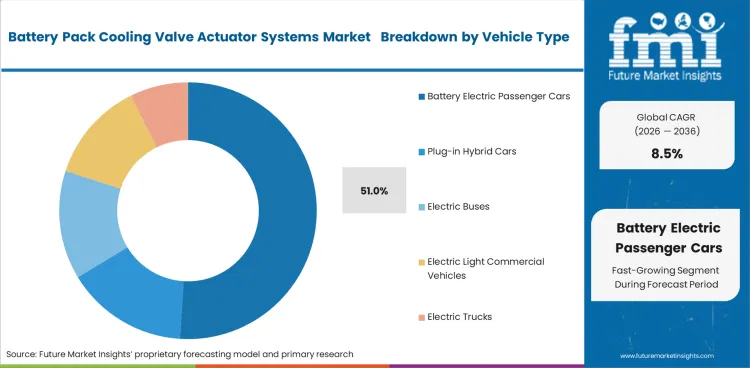
- Battery electric passenger cars are set to make up 51.0% of the vehicle-type segment in 2026 as passenger EVs represent the largest base for electrified vehicle production and registrations across key regions.
- Their scale drive more unit demand for battery cooling valves than buses or trucks, even though larger commercial vehicles can carry greater thermal load per vehicle.
Insights into the OEM Line-Fit Segment
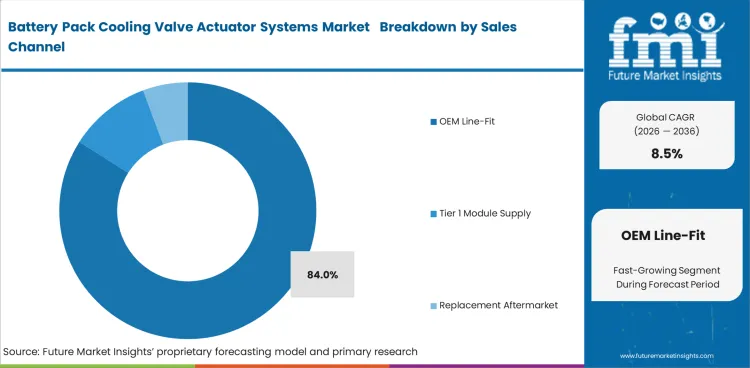
- OEM line-fit is expected to account for 84.0% share in 2026. Battery cooling valve actuator systems are specified during the vehicle development stage and aligned to the thermal layout and control strategy of the platform.
- The strength of this channel also fits with broader spending in zonal heat pump cabin HVAC systems. Line-fit integration carries higher importance than later replacement. In both cases, engineering alignment at the platform stage determines much of the component value.
Battery Pack Cooling Valve Actuator Systems Market Drivers, Restraints, and Opportunities
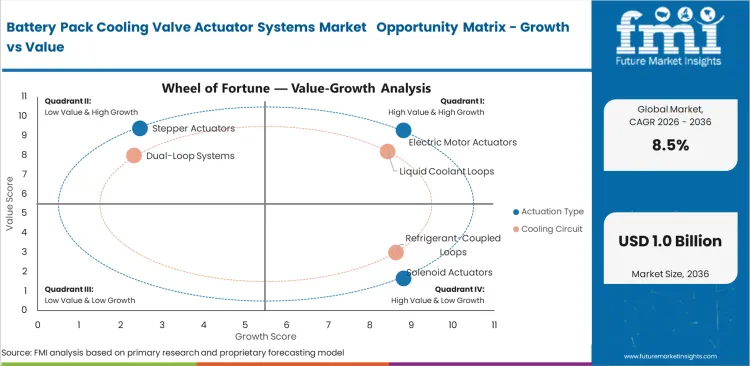
- Rising EV battery heat loads are increasing the need for accurate and durable coolant switching assemblies.
- Platform-specific validation work can slow standardization and raise engineering cost for suppliers.
- Integrated thermal modules are creating room for suppliers that can deliver compact multi-function coolant control hardware.
The battery pack cooling valve actuator systems market is expanding because EV battery performance depends more strongly on stable thermal control. Fast charging and greater sensitivity to pack temperature increase the value of controlled coolant routing. The supporting pattern can be seen in adjacent spending around automotive immersion cooling dielectric fluids, where higher thermal stress is pushing the whole battery cooling space toward more deliberate engineering choices.
Thermal Efficiency and Pack Performance
Vehicle makers are increasing pressure on battery thermal systems because charging time and usable range both depend on tighter temperature control. This is raising the importance of valve actuator systems that can direct coolant quickly and consistently under changing battery loads. This broader push toward thermal efficiency is increasing the link between suppliers active in electric vehicle insulation and pack-level heat-control materials are becoming more closely tied to valve actuator demand. Better insulation and better coolant routing work together in the same thermal strategy.
Cost and Validation Pressure
Engineering cost is a restraint because battery cooling valves must pass durability and switching validation under demanding automotive conditions. Each OEM program can call for a different package size and routing layout. That reduces the degree of part standardization available to suppliers and can extend development cycles. Smaller firms can win program positions.
Battery Pack Cooling Valve Actuator Systems Market CAGR Analysis by Country
.webp "Top Country Growth Comparison Battery Pack Cooling Valve Actuator Systems Market Cagr (2026 2036)")
| Country | CAGR |
|---|---|
| China | 9.7% |
| Germany | 8.9% |
| United Kingdom | 8.4% |
| France | 8.2% |
| South Korea | 8.1% |
| United States | 7.8% |
| Japan | 7.1% |
Source: FMI analysis based on primary research and proprietary forecasting model.
Battery Pack Cooling Valve Actuator Systems Market Analysis by Country
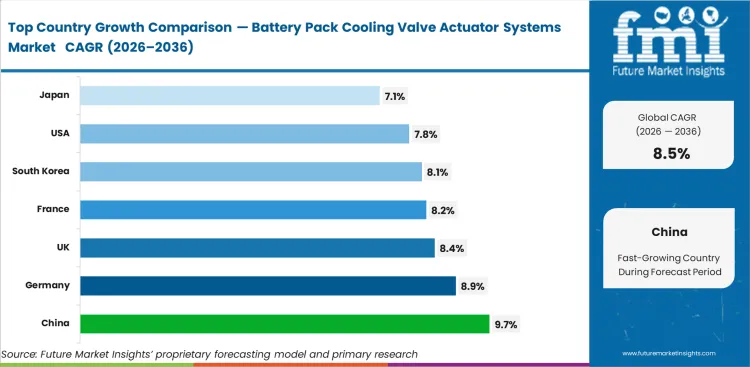
- China is expected to lead major country growth with a 9.7% CAGR through 2036, while Germany is projected at 8.9% and the United Kingdom at 8.4%.
- France is forecast to post 8.2% CAGR and South Korea is projected at 8.1%, keeping both countries close to the global pace.
- The United States is likely to record 7.8% CAGR through 2036, while Japan is expected to expand at 7.1% during the same period.
- The global market is projected to rise at a CAGR of 8.5% over the forecast period.
Opportunity Analysis of Battery Pack Cooling Valve Actuator Systems Market in China
The China battery pack cooling valve actuator systems market is projected to grow at a CAGR of 9.7% through 2036. This market leads major country growth because China is the largest center for EV production and new energy vehicle supply-chain activity. Large program volume and fast model turnover expand the installed base for battery cooling hardware at a faster pace than most other countries.
- Large EV scale supports broader line-fit demand for battery cooling valves.
- Supplier density keeps local sourcing active across thermal hardware.
- Program volume gives China the strongest near-term expansion profile.
Opportunity Analysis of Battery Pack Cooling Valve Actuator Systems Market in Germany
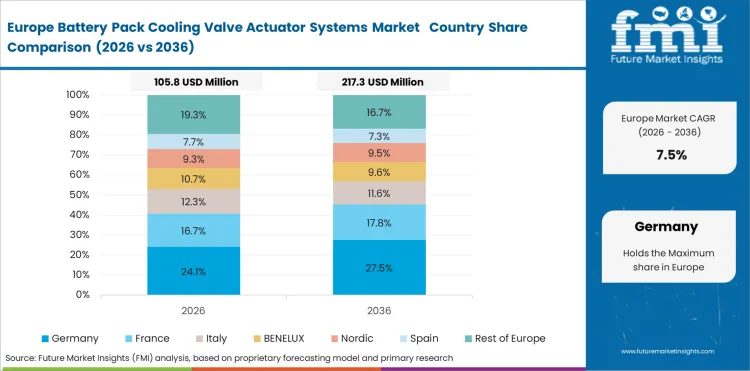
The Germany battery pack cooling valve actuator systems market is projected to grow at a CAGR of 8.9% through 2036. Demand is strong because Germany combines premium EV engineering with rising battery electric registrations and deep supplier capability in thermal systems. That combination supports higher-value demand for compact and durable battery cooling valves used in refined EV thermal architectures. Germany is important for suppliers that can meet strict qualification expectations and deliver battery cooling hardware with stable actuation performance.
- Premium EV engineering supports higher thermal content per vehicle.
- Strong supplier capability keeps Germany important for qualification-heavy programs.
- Demand remains healthy across premium and upper-volume EV platforms.
Opportunity Analysis of Battery Pack Cooling Valve Actuator Systems Market in the United Kingdom
The United Kingdom battery pack cooling valve actuator systems market is projected to grow at a CAGR of 8.4% through 2036. Expansion in the UK comes mainly from rising BEV penetration and steady electrification across passenger vehicle demand. The market is smaller than leading manufacturing bases. The adoption curve keeps local demand relevant for actuator-controlled battery cooling hardware. UK growth depends mainly on EV uptake and vehicle mix.
- BEV adoption is increasing the local base for battery cooling content.
- Vehicle mix remains an important support factor for thermal hardware demand.
- The UK holds steady relevance through electrification progress.
Opportunity Analysis of Battery Pack Cooling Valve Actuator Systems Market in France
The France battery pack cooling valve actuator systems market is projected to grow at a CAGR of 8.2% through 2036. France benefits from wider European EV expansion and from supply-chain participation across regional automotive production. France is commercially relevant as part of the broader European EV build cycle and offers steady demand for qualified battery cooling components.
- French EV growth supports ongoing sourcing of thermal assemblies.
- Supply-chain participation strengthens local relevance in Europe.
- Demand remains tied to the wider European BEV cycle.
Opportunity Analysis of Battery Pack Cooling Valve Actuator Systems Market in South Korea
The South Korea battery pack cooling valve actuator systems market is projected to grow at a CAGR of 8.1% through 2036. Growth is supported by strong supplier capability and continued EV thermal development among Korean automotive firms. South Korea is important through engineering depth and system capability. Local EV demand adds more support. That profile makes the country important for battery cooling hardware linked to compact module design and integrated thermal systems.
- Korean suppliers remain active in integrated EV thermal modules.
- Engineering capability keeps the country relevant for higher-value components.
- Growth stays supported by both domestic and export-linked EV programs.
Opportunity Analysis of Battery Pack Cooling Valve Actuator Systems Market in the United States
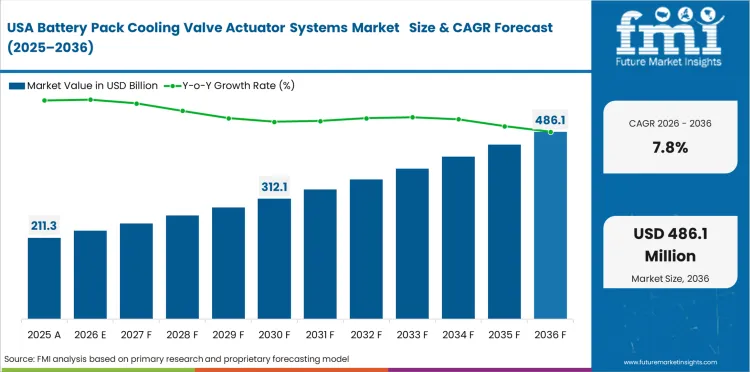
The United States battery pack cooling valve actuator systems market is projected to grow at a CAGR of 7.8% through 2036. U.S. demand is supported by higher value EV platforms and stronger engineering attention to battery protection. The commercial opportunity in this country is driven by better component value per vehicle across heavier and more feature rich EV platforms. Suppliers with strong validation support and dependable actuator durability hold a strong position in this market.
- Larger EV formats help support better value per battery cooling assembly.
- Battery protection work raises the relevance of stable thermal control.
- U.S. demand remains strong in higher-content vehicle programs.
Opportunity Analysis of Battery Pack Cooling Valve Actuator Systems Market in Japan
The Japan battery pack cooling valve actuator systems market is projected to grow at a CAGR of 7.1% through 2036. Expansion is moderate because battery electric rollout is moving more gradually. China or the stronger European EV markets are expanding faster. Japan is important through engineering quality and supplier participation in electrified thermal architectures.
- Japan remains relevant through engineering-led automotive programs.
- EV thermal development supports steady component demand.
- The market carries a more measured expansion pace than leading EV regions.
Competitive Landscape
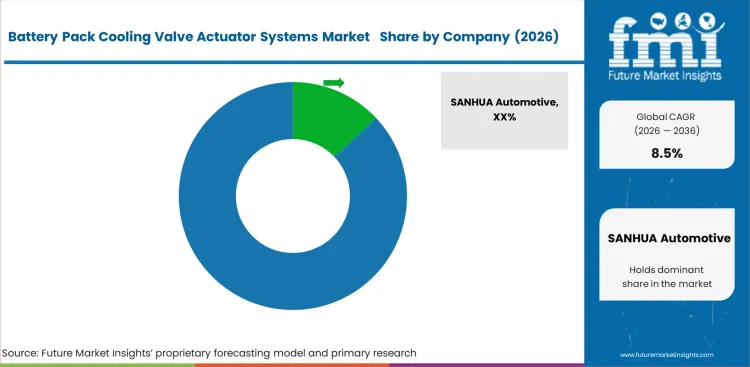
- The market remains moderately fragmented with a mix of broad thermal suppliers and fluid-control specialists.
- Leading companies compete on thermal integration depth, actuator durability, and fit within OEM battery cooling architectures.
- Specialist suppliers can still win where packaging flexibility and coolant-routing expertise carry more weight than full system breadth.
Competition in this market is shaped less by headline scale and more by fit within EV thermal architectures. SANHUA Automotive, DENSO, MAHLE, Hanon Systems, Rheinmetall, BorgWarner, and VOSS Automotive remain visible because each has a relevant position in thermal control, pack cooling hardware, or adjacent EV heat-management systems. Companies with stronger participation in EV thermal system design and battery thermal plate supply are benefiting from a broader move toward integrated battery cooling packages rather than isolated valve sourcing.
Durability and application support continue to separate suppliers in this category. OEMs look for stable actuation and smooth fit inside battery cooling layouts that are often unique to each platform. Suppliers that can support validation and broader thermal integration hold a stronger commercial position. Those advantages become more visible when the product also fits naturally with EV battery pack thermal interface materials because battery cooling performance depends on the full heat-management path rather than a single component in isolation.
Major Industry Players
- DENSO, MAHLE, Hanon Systems, Rheinmetall, and BorgWarner fit this group because they combine automotive reach with visible participation in EV thermal hardware.
- SANHUA Automotive and VOSS Automotive fit this group because they hold strong positions in thermal and fluid-management systems with growing EV relevance.
- Thermal module integrators and EV coolant-routing specialists remain relevant where OEMs want compact battery cooling hardware with application-specific packaging support.
Competitive Benchmarking: Battery Pack Cooling Valve Actuator Systems Market
| Company | Thermal Integration Depth | Coolant Valve Capability | OEM Program Access | Geographic Footprint |
|---|---|---|---|---|
| SANHUA Automotive | High | High | Strong | Global |
| DENSO | High | Medium | Strong | Global |
| MAHLE | High | Medium | Strong | Global |
| Hanon Systems | High | Medium | Strong | Global |
| Rheinmetall | Medium | High | Strong | Europe, Global |
| BorgWarner | Medium | Medium | Strong | Global |
| VOSS Automotive | Medium | Medium | Moderate | Europe, Global |
| Bosch | Medium | Low | Strong | Global |
| Valeo | Medium | Low | Strong | Global |
| Eaton | Low | Medium | Moderate | North America, Europe |
Source: Future Market Insights competitive analysis, 2026.
Key Developments in the Battery Pack Cooling Valve Actuator Systems Market
- In March 2026, Hanon Systems said its highly integrated cooling entity was first deployed in BMW’s fully electric iX3 SUV and was designed to manage the thermal needs of multiple vehicle subsystems.
- In October 2024, BorgWarner announced new high-voltage coolant heater programs in China, Korea, and Japan for electric vehicle applications.
Key Players in the Battery Pack Cooling Valve Actuator Systems Market
Major global players
- SANHUA Automotive
- DENSO
- MAHLE
- Hanon Systems
- Rheinmetall
- BorgWarner
- VOSS Automotive
Emerging players / specialists
- Bosch
- Valeo
- Eaton
Report Scope and Coverage
| Parameter | Details |
|---|---|
| Quantitative Units | USD 454.8 million in 2026 to USD 1.03 billion by 2036, at a CAGR of 8.5 |
| Market Definition | The battery pack cooling valve actuator systems market includes actuator-controlled coolant valves used in EV battery thermal management architectures. |
| Regions Covered | North America, Europe, East Asia, South Asia and Pacific |
| Countries Covered | China, Germany, United Kingdom, France, South Korea, United States, Japan, and 30+ countries |
| Key Companies Profiled | SANHUA Automotive, DENSO, MAHLE, Hanon Systems, Rheinmetall, BorgWarner, VOSS Automotive, Bosch, Valeo, Eaton |
| Forecast Period | 2026 to 2036 |
| Approach | Hybrid bottom-up and top-down methodology built on EV deployment, thermal architecture adoption, battery safety treatment, and supplier participation. |
Battery Pack Cooling Valve Actuator Systems Market by Segments
Battery Pack Cooling Valve Actuator Systems Market by Actuation Type
- Electric Motor Actuators
- Solenoid Actuators
- Stepper Actuators
Battery Pack Cooling Valve Actuator Systems Market by Cooling Circuit
- Liquid Coolant Loops
- Refrigerant-Coupled Loops
- Dual-Loop Systems
Battery Pack Cooling Valve Actuator Systems Market by Vehicle Type
- Battery Electric Passenger Cars
- Plug-in Hybrid Cars
- Electric Buses
- Electric Light Commercial Vehicles
- Electric Trucks
Battery Pack Cooling Valve Actuator Systems Market by Sales Channel
- OEM Line-Fit
- Tier 1 Module Supply
- Replacement Aftermarket
Battery Pack Cooling Valve Actuator Systems Market by Region
- North America
- United States
- Canada
- Mexico
- Europe
- Germany
- United Kingdom
- France
- Italy
- Spain
- Rest of Europe
- East Asia
- China
- Japan
- South Korea
- South Asia and Pacific
- India
- ASEAN
- Australia & New Zealand
- Rest of South Asia and Pacific
Bibliography
- Hanon Systems. (2026, March 31). Hanon Systems Supplies Highly Integrated Cooling Entity for BMW iX3 SUV.
- BorgWarner. (2024, October 31). BorgWarner Secures New High Voltage Coolant Heater Programs in China, Korea and Japan.
- MAHLE. (2024, April 12). MAHLE successful with major orders for thermal management modules.
- VOSS Automotive. (2025, June 10). Review of EVTech 2025: VOSS Sets New Standards in Thermal Management and Ultra-Fast Charging.
This bibliography is provided for reader reference.
This Report Answers
- What is the current and future size of the battery pack cooling valve actuator systems market?
- How fast is the battery pack cooling valve actuator systems market expected to grow between 2026 and 2036?
- Which cooling circuit is likely to lead the market by 2026?
- Which vehicle type is expected to account for the highest demand by 2026?
- What factors are driving demand for battery pack cooling valve actuator systems globally?
- How are integrated thermal modules influencing product demand?
- Why is active liquid battery cooling supporting higher valve actuator penetration in EV platforms?
- How are battery safety rules supporting the need for more dependable thermal control hardware?
- Which countries are projected to show the fastest growth through 2036?
- What is driving market expansion in China and Germany?
- Who are the key companies active in the battery pack cooling valve actuator systems market?
- How does FMI estimate and validate the market forecast?
Frequently Asked Questions
What is the market size in 2026?
What is the market size in 2026? The battery pack cooling valve actuator systems market is estimated at USD 454.8 million in 2026.
What is the forecast market value for 2036?
The market is projected to reach USD 1.03 billion by 2036.
What is the CAGR from 2026 to 2036?
The market is forecast to expand at a CAGR of 8.5% through 2036.
Which cooling circuit leads the market?
Liquid coolant loops are expected to lead with about 62.0% share in 2026.
Liquid coolant loops are expected to lead with about 62.0% share in 2026.
Battery electric passenger cars are expected to account for about 51.0% of total demand in 2026.
Which sales channel leads demand?
OEM line-fit is projected to remain the leading channel with about 84.0% share in 2026.
Which country is expected to grow the fastest?
China is expected to remain the fastest-growing major market with a projected 9.7% CAGR through 2036.
Preview the report firsthand - request a free sample
Get SampleGet the brochure for pricing and purchase details.
Get PDFTable of Content
- Executive Summary
- Global Market Outlook
- Demand-side Trends
- Supply-side Trends
- Technology Roadmap Analysis
- Analysis and Recommendations
- Market Overview
- Market Coverage / Taxonomy
- Market Definition / Scope / Limitations
- Research Methodology
- Chapter Orientation
- Analytical Lens and Working Hypotheses
- Market Structure, Signals, and Trend Drivers
- Benchmarking and Cross-market Comparability
- Research Design and Evidence Framework
- Desk Research Programme (Secondary Evidence)
- Company Annual and Sustainability Reports
- Peer-reviewed Journals and Academic Literature
- Corporate Websites, Product Literature, and Technical Notes
- Earnings Decks and Investor Briefings
- Statutory Filings and Regulatory Disclosures
- Technical White Papers and Standards Notes
- Trade Journals, Industry Magazines, and Analyst Briefs
- Conference Proceedings, Webinars, and Seminar Materials
- Government Statistics Portals and Public Data Releases
- Press Releases and Reputable Media Coverage
- Specialist Newsletters and Curated Briefings
- Sector Databases and Reference Repositories
- FMI Internal Proprietary Databases and Historical Market Datasets
- Subscription Datasets and Paid Sources
- Social Channels, Communities, and Digital Listening Inputs
- Additional Desk Sources
- Expert Input and Fieldwork (Primary Evidence)
- Primary Modes
- Qualitative Interviews and Expert Elicitation
- Quantitative Surveys and Structured Data Capture
- Blended Approach
- Why Primary Evidence is Used
- Field Techniques
- Interviews
- Surveys
- R&D and Innovation Heads
- Technical Specialists
- Domain Subject-matter Experts
- Scientists
- Physicians and Other Healthcare Professionals
- Governance, Ethics, and Data Stewardship
- Research Ethics
- Data Integrity and Handling
- Primary Modes
- Tooling, Models, and Reference Databases
- Desk Research Programme (Secondary Evidence)
- Data Engineering and Model Build
- Data Acquisition and Ingestion
- Cleaning, Normalisation, and Verification
- Synthesis, Triangulation, and Analysis
- Quality Assurance and Audit Trail
- Market Background
- Market Dynamics
- Drivers
- Restraints
- Opportunity
- Trends
- Scenario Forecast
- Demand in Optimistic Scenario
- Demand in Likely Scenario
- Demand in Conservative Scenario
- Opportunity Map Analysis
- Product Life Cycle Analysis
- Supply Chain Analysis
- Investment Feasibility Matrix
- Value Chain Analysis
- PESTLE and Porter’s Analysis
- Regulatory Landscape
- Regional Parent Market Outlook
- Production and Consumption Statistics
- Import and Export Statistics
- Market Dynamics
- Global Market Analysis 2021 to 2025 and Forecast, 2026 to 2036
- Historical Market Size Value (USD Million) Analysis, 2021 to 2025
- Current and Future Market Size Value (USD Million) Projections, 2026 to 2036
- Y-o-Y Growth Trend Analysis
- Absolute $ Opportunity Analysis
- Global Market Pricing Analysis 2021 to 2025 and Forecast 2026 to 2036
- Global Market Analysis 2021 to 2025 and Forecast 2026 to 2036, By Actuation Type
- Introduction / Key Findings
- Historical Market Size Value (USD Million) Analysis By Actuation Type , 2021 to 2025
- Current and Future Market Size Value (USD Million) Analysis and Forecast By Actuation Type , 2026 to 2036
- Electric Motor Actuators
- Solenoid Actuators
- Stepper Actuators
- Electric Motor Actuators
- Y-o-Y Growth Trend Analysis By Actuation Type , 2021 to 2025
- Absolute $ Opportunity Analysis By Actuation Type , 2026 to 2036
- Global Market Analysis 2021 to 2025 and Forecast 2026 to 2036, By Cooling Circuit
- Introduction / Key Findings
- Historical Market Size Value (USD Million) Analysis By Cooling Circuit, 2021 to 2025
- Current and Future Market Size Value (USD Million) Analysis and Forecast By Cooling Circuit, 2026 to 2036
- Liquid Coolant Loops
- Refrigerant-Coupled Loops
- Dual-Loop Systems
- Liquid Coolant Loops
- Y-o-Y Growth Trend Analysis By Cooling Circuit, 2021 to 2025
- Absolute $ Opportunity Analysis By Cooling Circuit, 2026 to 2036
- Global Market Analysis 2021 to 2025 and Forecast 2026 to 2036, By Vehicle Type
- Introduction / Key Findings
- Historical Market Size Value (USD Million) Analysis By Vehicle Type, 2021 to 2025
- Current and Future Market Size Value (USD Million) Analysis and Forecast By Vehicle Type, 2026 to 2036
- Battery Electric Passenger Cars
- Plug-in Hybrid Cars
- Electric Buses
- Electric Light Commercial Vehicles
- Electric Trucks
- Battery Electric Passenger Cars
- Y-o-Y Growth Trend Analysis By Vehicle Type, 2021 to 2025
- Absolute $ Opportunity Analysis By Vehicle Type, 2026 to 2036
- Global Market Analysis 2021 to 2025 and Forecast 2026 to 2036, By Sales Channel
- Introduction / Key Findings
- Historical Market Size Value (USD Million) Analysis By Sales Channel, 2021 to 2025
- Current and Future Market Size Value (USD Million) Analysis and Forecast By Sales Channel, 2026 to 2036
- OEM Line-Fit
- Tier 1 Module Supply
- Replacement Aftermarket
- OEM Line-Fit
- Y-o-Y Growth Trend Analysis By Sales Channel, 2021 to 2025
- Absolute $ Opportunity Analysis By Sales Channel, 2026 to 2036
- Global Market Analysis 2021 to 2025 and Forecast 2026 to 2036, By Region
- Introduction
- Historical Market Size Value (USD Million) Analysis By Region, 2021 to 2025
- Current Market Size Value (USD Million) Analysis and Forecast By Region, 2026 to 2036
- North America
- Latin America
- Western Europe
- Eastern Europe
- East Asia
- South Asia and Pacific
- Middle East & Africa
- Market Attractiveness Analysis By Region
- North America Market Analysis 2021 to 2025 and Forecast 2026 to 2036, By Country
- Historical Market Size Value (USD Million) Trend Analysis By Market Taxonomy, 2021 to 2025
- Market Size Value (USD Million) Forecast By Market Taxonomy, 2026 to 2036
- By Country
- USA
- Canada
- Mexico
- By Actuation Type
- By Cooling Circuit
- By Vehicle Type
- By Sales Channel
- By Country
- Market Attractiveness Analysis
- By Country
- By Actuation Type
- By Cooling Circuit
- By Vehicle Type
- By Sales Channel
- Key Takeaways
- Latin America Market Analysis 2021 to 2025 and Forecast 2026 to 2036, By Country
- Historical Market Size Value (USD Million) Trend Analysis By Market Taxonomy, 2021 to 2025
- Market Size Value (USD Million) Forecast By Market Taxonomy, 2026 to 2036
- By Country
- Brazil
- Chile
- Rest of Latin America
- By Actuation Type
- By Cooling Circuit
- By Vehicle Type
- By Sales Channel
- By Country
- Market Attractiveness Analysis
- By Country
- By Actuation Type
- By Cooling Circuit
- By Vehicle Type
- By Sales Channel
- Key Takeaways
- Western Europe Market Analysis 2021 to 2025 and Forecast 2026 to 2036, By Country
- Historical Market Size Value (USD Million) Trend Analysis By Market Taxonomy, 2021 to 2025
- Market Size Value (USD Million) Forecast By Market Taxonomy, 2026 to 2036
- By Country
- Germany
- UK
- Italy
- Spain
- France
- Nordic
- BENELUX
- Rest of Western Europe
- By Actuation Type
- By Cooling Circuit
- By Vehicle Type
- By Sales Channel
- By Country
- Market Attractiveness Analysis
- By Country
- By Actuation Type
- By Cooling Circuit
- By Vehicle Type
- By Sales Channel
- Key Takeaways
- Eastern Europe Market Analysis 2021 to 2025 and Forecast 2026 to 2036, By Country
- Historical Market Size Value (USD Million) Trend Analysis By Market Taxonomy, 2021 to 2025
- Market Size Value (USD Million) Forecast By Market Taxonomy, 2026 to 2036
- By Country
- Russia
- Poland
- Hungary
- Balkan & Baltic
- Rest of Eastern Europe
- By Actuation Type
- By Cooling Circuit
- By Vehicle Type
- By Sales Channel
- By Country
- Market Attractiveness Analysis
- By Country
- By Actuation Type
- By Cooling Circuit
- By Vehicle Type
- By Sales Channel
- Key Takeaways
- East Asia Market Analysis 2021 to 2025 and Forecast 2026 to 2036, By Country
- Historical Market Size Value (USD Million) Trend Analysis By Market Taxonomy, 2021 to 2025
- Market Size Value (USD Million) Forecast By Market Taxonomy, 2026 to 2036
- By Country
- China
- Japan
- South Korea
- By Actuation Type
- By Cooling Circuit
- By Vehicle Type
- By Sales Channel
- By Country
- Market Attractiveness Analysis
- By Country
- By Actuation Type
- By Cooling Circuit
- By Vehicle Type
- By Sales Channel
- Key Takeaways
- South Asia and Pacific Market Analysis 2021 to 2025 and Forecast 2026 to 2036, By Country
- Historical Market Size Value (USD Million) Trend Analysis By Market Taxonomy, 2021 to 2025
- Market Size Value (USD Million) Forecast By Market Taxonomy, 2026 to 2036
- By Country
- India
- ASEAN
- Australia & New Zealand
- Rest of South Asia and Pacific
- By Actuation Type
- By Cooling Circuit
- By Vehicle Type
- By Sales Channel
- By Country
- Market Attractiveness Analysis
- By Country
- By Actuation Type
- By Cooling Circuit
- By Vehicle Type
- By Sales Channel
- Key Takeaways
- Middle East & Africa Market Analysis 2021 to 2025 and Forecast 2026 to 2036, By Country
- Historical Market Size Value (USD Million) Trend Analysis By Market Taxonomy, 2021 to 2025
- Market Size Value (USD Million) Forecast By Market Taxonomy, 2026 to 2036
- By Country
- Kingdom of Saudi Arabia
- Other GCC Countries
- Turkiye
- South Africa
- Other African Union
- Rest of Middle East & Africa
- By Actuation Type
- By Cooling Circuit
- By Vehicle Type
- By Sales Channel
- By Country
- Market Attractiveness Analysis
- By Country
- By Actuation Type
- By Cooling Circuit
- By Vehicle Type
- By Sales Channel
- Key Takeaways
- Key Countries Market Analysis
- USA
- Pricing Analysis
- Market Share Analysis, 2025
- By Actuation Type
- By Cooling Circuit
- By Vehicle Type
- By Sales Channel
- Canada
- Pricing Analysis
- Market Share Analysis, 2025
- By Actuation Type
- By Cooling Circuit
- By Vehicle Type
- By Sales Channel
- Mexico
- Pricing Analysis
- Market Share Analysis, 2025
- By Actuation Type
- By Cooling Circuit
- By Vehicle Type
- By Sales Channel
- Brazil
- Pricing Analysis
- Market Share Analysis, 2025
- By Actuation Type
- By Cooling Circuit
- By Vehicle Type
- By Sales Channel
- Chile
- Pricing Analysis
- Market Share Analysis, 2025
- By Actuation Type
- By Cooling Circuit
- By Vehicle Type
- By Sales Channel
- Germany
- Pricing Analysis
- Market Share Analysis, 2025
- By Actuation Type
- By Cooling Circuit
- By Vehicle Type
- By Sales Channel
- UK
- Pricing Analysis
- Market Share Analysis, 2025
- By Actuation Type
- By Cooling Circuit
- By Vehicle Type
- By Sales Channel
- Italy
- Pricing Analysis
- Market Share Analysis, 2025
- By Actuation Type
- By Cooling Circuit
- By Vehicle Type
- By Sales Channel
- Spain
- Pricing Analysis
- Market Share Analysis, 2025
- By Actuation Type
- By Cooling Circuit
- By Vehicle Type
- By Sales Channel
- France
- Pricing Analysis
- Market Share Analysis, 2025
- By Actuation Type
- By Cooling Circuit
- By Vehicle Type
- By Sales Channel
- India
- Pricing Analysis
- Market Share Analysis, 2025
- By Actuation Type
- By Cooling Circuit
- By Vehicle Type
- By Sales Channel
- ASEAN
- Pricing Analysis
- Market Share Analysis, 2025
- By Actuation Type
- By Cooling Circuit
- By Vehicle Type
- By Sales Channel
- Australia & New Zealand
- Pricing Analysis
- Market Share Analysis, 2025
- By Actuation Type
- By Cooling Circuit
- By Vehicle Type
- By Sales Channel
- China
- Pricing Analysis
- Market Share Analysis, 2025
- By Actuation Type
- By Cooling Circuit
- By Vehicle Type
- By Sales Channel
- Japan
- Pricing Analysis
- Market Share Analysis, 2025
- By Actuation Type
- By Cooling Circuit
- By Vehicle Type
- By Sales Channel
- South Korea
- Pricing Analysis
- Market Share Analysis, 2025
- By Actuation Type
- By Cooling Circuit
- By Vehicle Type
- By Sales Channel
- Russia
- Pricing Analysis
- Market Share Analysis, 2025
- By Actuation Type
- By Cooling Circuit
- By Vehicle Type
- By Sales Channel
- Poland
- Pricing Analysis
- Market Share Analysis, 2025
- By Actuation Type
- By Cooling Circuit
- By Vehicle Type
- By Sales Channel
- Hungary
- Pricing Analysis
- Market Share Analysis, 2025
- By Actuation Type
- By Cooling Circuit
- By Vehicle Type
- By Sales Channel
- Kingdom of Saudi Arabia
- Pricing Analysis
- Market Share Analysis, 2025
- By Actuation Type
- By Cooling Circuit
- By Vehicle Type
- By Sales Channel
- Turkiye
- Pricing Analysis
- Market Share Analysis, 2025
- By Actuation Type
- By Cooling Circuit
- By Vehicle Type
- By Sales Channel
- South Africa
- Pricing Analysis
- Market Share Analysis, 2025
- By Actuation Type
- By Cooling Circuit
- By Vehicle Type
- By Sales Channel
- USA
- Market Structure Analysis
- Competition Dashboard
- Competition Benchmarking
- Market Share Analysis of Top Players
- By Regional
- By Actuation Type
- By Cooling Circuit
- By Vehicle Type
- By Sales Channel
- Competition Analysis
- Competition Deep Dive
- SANHUA Automotive
- Overview
- Product Portfolio
- Profitability by Market Segments (Product/Age /Sales Channel/Region)
- Sales Footprint
- Strategy Overview
- Marketing Strategy
- Product Strategy
- Channel Strategy
- DENSO
- MAHLE
- Hanon Systems
- Rheinmetall
- BorgWarner
- VOSS Automotive
- Bosch
- Valeo
- Eaton
- SANHUA Automotive
- Competition Deep Dive
- Assumptions & Acronyms Used


