

- Market Size (2026)
- USD 3.46 Bn
- Forecast (2036)
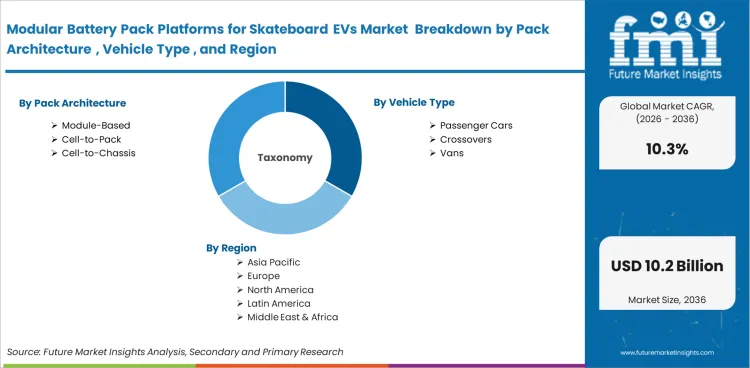
- USD 9.22 Bn
- CAGR (2026 to 2036)
- 10.3%
Modular Battery Pack Platforms for Skateboard EVs Market Size, Market Forecast and Outlook by FMI
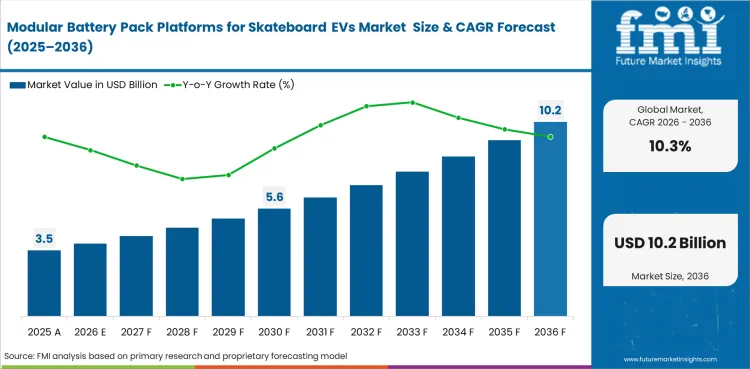
The modular battery pack platforms for skateboard EVs market was valued at USD 3.14 billion in 2025 and is projected to reach USD 3.46 billion in 2026 before rising to USD 9.22 billion by 2036. This reflects a CAGR of 10.3% across the forecast period and an incremental opportunity of USD 5.76 billion. The expansion pace is supported by rising electric car production and higher content per vehicle as battery packs take on stronger structural and thermal roles.
Summary of Modular Battery Pack Platforms for Skateboard EVs Market
- Industry value is projected at USD 3.46 billion in 2026.
- The market size is projected to reach around USD 9.22 billion by 2036.
- The industry is expected to rise at a CAGR of 10.3% between 2026 and 2036.
- The market value was USD 3.14 billion in 2025.
- Incremental opportunity between 2026 and 2036 is projected at USD 5.76 billion.
- Module-based architecture is expected to remain the leading pack layout in 2026.
- Passenger cars are projected to account for the largest vehicle fit by platform.
- OEM direct sourcing is expected to lead supply route demand as pack integration stays close to vehicle development.
- China remains the fastest scaling country while Europe and the United States retain large engineering depth.
Key Takeaways, Market Size, and Forecast
- Modular Battery Pack Platforms for Skateboard EVs Market is projected to grow from USD 3.46 billion in 2026 to USD 9.22 billion by 2036, at a CAGR of 10.3%.
- The modular battery pack platforms for skateboard EVs market was valued at USD 3.14 billion in 2025.
- By 2036, the Modular Battery Pack Platforms for Skateboard EVs Market is expected to be worth USD 9.22 billion.
- From 2026 to 2036, the market is anticipated to expand at a CAGR of 10.3%.
- The market is predicted to create an incremental opportunity of USD 5.76 billion between 2026 and 2036.
- In 2026, Module-based Platform is expected to account for 44.0% of the architecture segment.
- China (11.8%) and India (11.4%) are projected to be two of the fastest growing markets.
Modular Battery Pack Platforms for Skateboard EVs Market Key Takeaways
| Parameter | Details |
|---|---|
| Market value (2026) | USD 3.46 billion |
| Forecast value (2036) | USD 9.22 billion |
| CAGR (2026 to 2036) | 10.3% |
| Estimated market value (2025) | USD 3.14 billion |
| Incremental opportunity | USD 5.76 billion |
| Leading architecture | Module-based platform, 44% share |
| Leading vehicle fit | Passenger cars, 48% share |
| Leading voltage class | 400V systems, 58% share |
| Leading supply route | OEM direct, 52% share |
| Key players | CATL, BYD, LG Energy Solution, Samsung SDI, SK On, REE Automotive, Magna International |
Source: Future Market Insights, 2026
Pack platform demand is driven by spread of dedicated EV underbodies that let automakers use one battery footprint across several body styles and wheelbases. That approach lowers redesign work and helps assembly plants keep better part commonality across launch waves. Rising use of liquid cooled designs and mixed chemistry roadmaps also increases demand for pack structures that leave room for module changes without rewriting the whole floor system.
China is expected to post 11.8% CAGR through 2036 while India is projected at 11.4% and Brazil is estimated at 10.9%. Southeast Asia is anticipated to advance at 10.6% and the United States is likely to rise at 10.0% during the same period. The European Union is expected to expand at 9.6% while the United Kingdom is projected at 9.3% as legacy subsidy resets keep the curve more measured than high growth emerging regions.
Modular Battery Pack Platforms for Skateboard EVs Market Definition
This industry covers modular battery pack platforms engineered for skateboard EV architectures where the battery system forms the flat structural base of a dedicated electric vehicle. It includes pack frames, module layouts, enclosure concepts, cooling provisions, mounting provisions, service access design, and scalable electrical layouts used across more than one vehicle program.
Modular Battery Pack Platforms for Skateboard EVs Market Inclusions
Included in scope are module based packs, cell to pack capable platforms, mixed chemistry compatible layouts, 400V and 800V pack platforms, liquid cooled designs, and supply programs serving passenger cars, crossovers, vans, and selected pickup platforms. Engineering services tied directly to scalable pack integration are also included.
Modular Battery Pack Platforms for Skateboard EVs Market Exclusions
Standalone cells, stationary storage packs, battery raw materials, generic battery trays sold outside vehicle programs, and charging hardware are excluded from this boundary. Converted internal combustion vehicle battery retrofits and low speed micro mobility packs also fall outside the scope unless they use a true skateboard style dedicated EV platform.
Modular Battery Pack Platforms for Skateboard EVs Market Research Methodology
- Primary Research: Interviews with battery system engineers, enclosure suppliers, EV platform planners, and automotive sourcing teams were used to test segment assumptions and design priorities.
- Desk Research: Public data from the IEA and official company releases were reviewed to map electric vehicle output, battery demand, platform launches, and regional program direction.
- Market Sizing and Forecasting: A bottom up model linked dedicated EV production and platform adoption to pack platform content value, then tested results against adjacent battery hardware categories.
- Data Validation and Update Cycle: Values were checked against production trends, battery demand growth, trade direction, and supplier activity, with assumptions updated to reflect current policy and product signals.
Why Is the Modular Battery Pack Platforms for Skateboard EVs Market Growing?
- Dedicated EV programs are replacing converted vehicle architectures in more model lines.
- Modular pack layouts help automakers reuse engineering across several wheelbases and body styles.
- Higher voltage systems and stronger thermal demands raise the content value of each pack platform.
Global electric vehicle adoption has reached a scale where battery pack platforms are now foundational vehicle systems. Electric car sales surpassed 17 million units in 2024 and were on track to exceed 20 million in 2025, rapidly expanding the installed base for dedicated skateboard architectures. Much of this growth is concentrated in flat‑floor BEV designs, where the battery pack now defines vehicle structure and crash load paths. This structural role elevates the importance of modular pack platforms, pushing automakers to treat battery integration as a core platform decision instead of a downstream packaging exercise.
Rising battery demand is another significant driver for the modular battery packing industry. Global EV battery requirements reached approximately 1 TWh in 2024 and are projected to exceed 3 TWh by 2030, reflecting larger pack sizes and higher energy density targets. As these demands increase, suppliers must manage volume growth and tighter expectations around structural stiffness and thermal control. The launch of CATL’s Bedrock Chassis in December 2024 illustrates this convergence, signaling a shift toward architectures where battery systems and vehicle platforms are engineered as a single, integrated product layer.
Segmental Analysis
- Module-based platforms are expected to account for 44% share in 2026 because they still suit multi-model programs.
- Passenger cars are projected to remain the largest vehicle fit while crossover and van programs expand steadily.
- OEM direct sourcing is anticipated to lead the supply route segment as automakers keep pack engineering close to core vehicle programs.
The segmentation for this industry reflects how automakers choose pack structure, electrical layout, chemistry flexibility, vehicle fit, and commercial sourcing route at the program planning stage. A modular platform is not defined by one feature alone because it must balance cost, manufacturing speed, service access, crash protection, cooling design, and upgrade room across several planned models. Some companies continue to prefer module based layouts because they simplify repair and chemistry migration, while others move toward tighter cell integration to reduce mass and free packaging space.
Insights into the Pack Architecture Segment
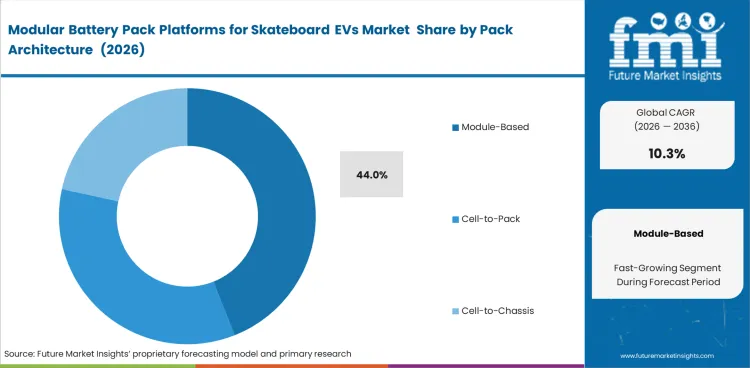
Module-based platforms are expected to account for 44% share in 2026. This lead remains in place because many automakers still need a pack design that can stretch across multiple brands and body styles without locking them into a single cell format too early. The modular route also helps with service access and validation because changes can be limited to selected modules rather than the full pack floor.
Insights into the Vehicle Type Segment
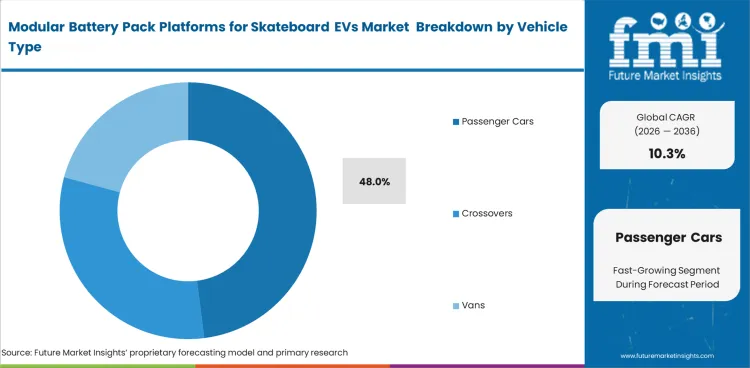
Passenger cars are projected to contribute 48% of total market share in 2026. Large sedan and hatchback programs moved first into skateboard architectures, and those vehicle lines still provide the cleanest fit for flat floor packs with common wheelbase tooling. Crossovers and SUVs are gaining weight in new launches because they can absorb larger battery footprints and higher selling prices, while electric vans create a second useful channel for modular platforms.
Insights into the Voltage Class Segment
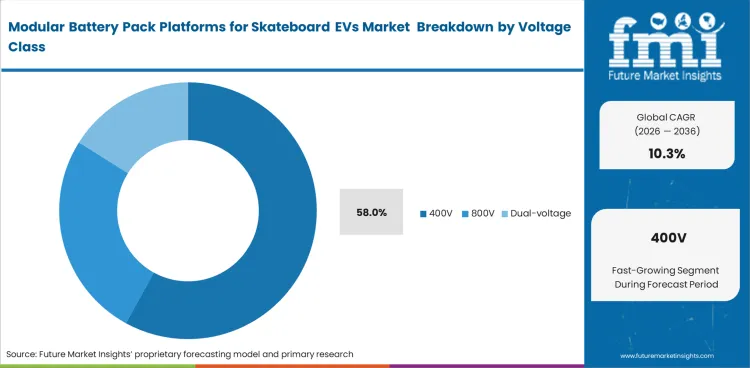
Market estimates place 400V systems at 58% share in 2026. This position reflects the reality that most high volume EV programs still balance charging performance and cost within the 400V range, especially in mainstream passenger models. Demand for 800V compatible modular platforms is still rising because faster charging and lower cable mass create clear value in premium and performance oriented programs.
Insights into the Battery Chemistry Compatibility Segment
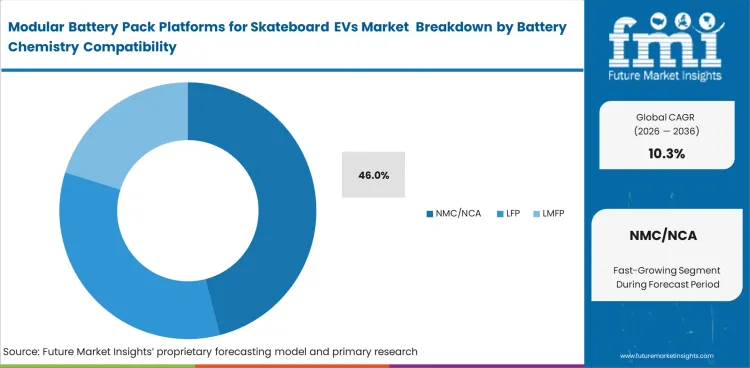
NMC and NCA compatible platforms are anticipated to represent 46% of the market in 2026. Their lead remains meaningful because many long range EV programs in Europe and North America still use nickel rich chemistries to support energy density targets and higher driving range claims. LFP compatible modular platforms are catching up quickly as cost pressure pushes automakers toward lower cost chemistry choices.
Insights into the Thermal System Segment
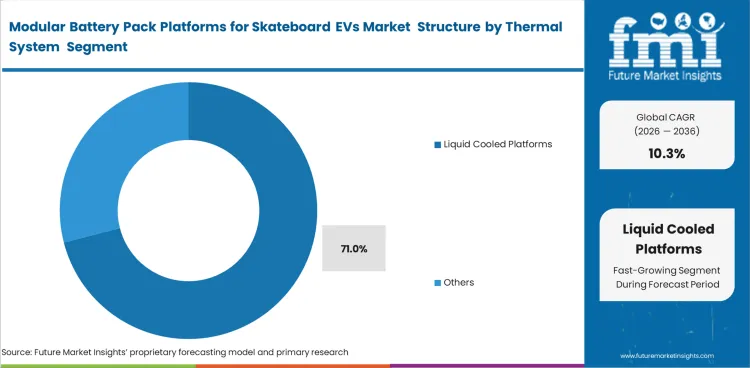
Liquid cooled platforms are likely to secure 71% share in 2026. That dominance comes from the combination of range targets, fast charging requirements, and safety expectations in modern skateboard EV programs where thermal uniformity affects both performance and life. Air cooled systems remain limited to smaller applications because they struggle to support larger pack capacities and repeated fast charge cycles.
Insights into the Supply Route Segment
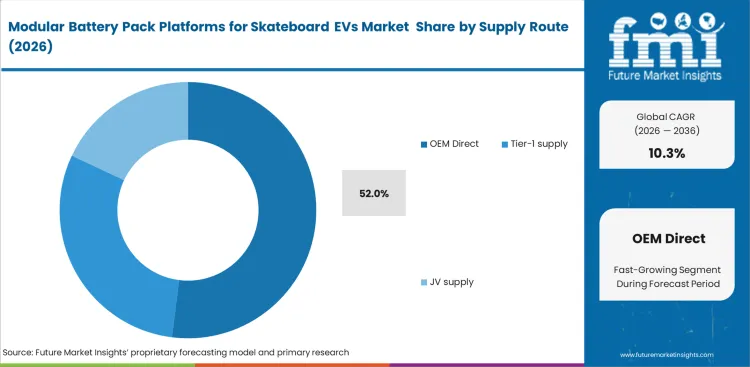
OEM direct sourcing is set to make up 52% of the market in 2026. Battery pack platform choices touch vehicle geometry, crash engineering, thermal design, and manufacturing planning, which means many automakers prefer to control the specification closely and award work through direct development programs. Tier 1 supply partners still hold an important role where the automaker wants outside help in enclosure design, pack validation, or regional assembly.
Related FMI coverage includes skateboard harness modules, thermal interface materials, battery pack adhesives.
What Are the Drivers, Restraints, and Key Trends in the Modular Battery Pack Platforms for Skateboard EVs Market?
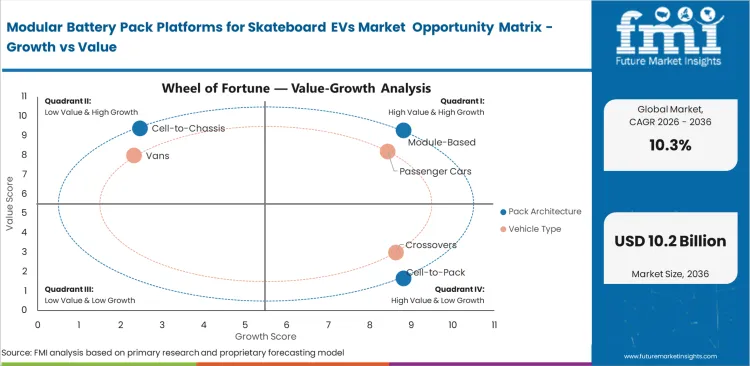
- Higher EV production and larger pack demand keep raising the addressable base for skateboard pack platforms.
- Cost pressure and rapid chemistry change increase the risk of redesigns and delayed supplier awards.
- Platform launches now link pack structure, charging speed, and software integration more closely than before.
Global electric vehicle production reached 17.3 million units in 2024, underlining the scale that now supports standardized battery pack platform development. China accounted for 12.4 million vehicles, giving platform suppliers an unmatched volume base to amortize engineering investment and deploy common pack architectures at scale. At the same time, Europe produced 2.4 million electric cars, retaining its role as a key engineering and validation hub for dedicated EV platforms even as output growth moderated. This combination of high‑volume production centers and engineering‑led regions increasingly shapes the market’s trajectory, favoring battery platform families that can be reused across multiple body styles, wheelbases, and regional launch programs.
Expansion is constrained by persistent input cost pressure. Platform suppliers must now design around rapidly changing cell formats, divergent chemistry roadmaps, and evolving fast‑charging requirements while preventing pack mass and enclosure costs from rising too sharply. Battery demand growth highlights this imbalance: consumption increased by over 30% in China and around 20% in the United States in 2024, while demand in the European Union stalled. Such uneven regional momentum complicates long‑term tooling and capacity decisions, particularly for suppliers serving multiple markets simultaneously. As a result, success across the industry increasingly depends on cost‑controlled battery pack designs that can absorb regional demand swings without forcing repeated redesigns.
Analysis of Modular Battery Pack Platforms for Skateboard EVs Market by Key Countries
- China is expected to register 11.8% CAGR through 2036 on the back of scale, cost position, and wider local platform launches.
- India is projected to post 11.4% CAGR as policy support and local assembly plans lift EV platform development.
- Brazil is estimated at 10.9% CAGR because imported EV growth is creating a base for broader dedicated platform adoption.
- The European Union is likely to expand at 9.6% CAGR as engineering depth stays strong despite a slower subsidy environment.
.webp "Top Country Growth Comparison Modular Battery Pack Platforms For Skateboard Evs Market Cagr (2026 2036)")
| Country | CAGR |
|---|---|
| China | 11.8% |
| India | 11.4% |
| Brazil | 10.9% |
| United States | 10.0% |
| European Union | 9.6% |
| United Kingdom | 9.3% |
Source: FMI analysis based on primary research and proprietary forecasting model
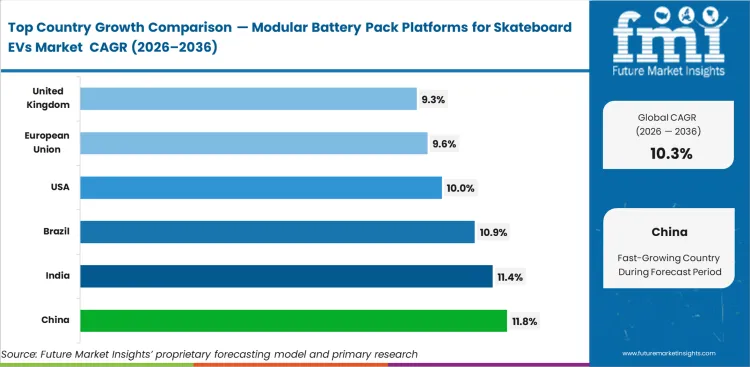
The country outlook reflects a split between scale leaders, policy supported growth geographies, and mature regions adjusting to subsidy changes. China remains the strongest base because it combines very large EV sales, battery supply depth, and domestic platform innovation. India, Brazil, and Southeast Asia rise faster from smaller bases as imported EV programs and new local manufacturing steps widen the addressable opportunity.
Demand outlook for Modular Battery Pack Platforms for Skateboard EVs Market in China
China is expected to record a CAGR of 11.8% in this industry through 2036. Electric car sales crossed 11 million units in 2024, and that scale gives automakers a strong base for shared skateboard platforms across sedans, crossovers, vans, and battery swap vehicles. Demand for modular battery pack platforms is rising because manufacturers need underbody layouts that can carry different battery capacities and vehicle sizes on one core structure. This supports wider use of battery platforms and battery swap hardware, where pack dimensions and service access stay important for platform planning. Suppliers with strong structural integration and efficient thermal packaging are likely to find steady program demand in China.
- Local OEM scale supports repeat use of common pack layouts.
- Battery swap activity increases the need for standard pack dimensions.
- Cost discipline keeps lightweight platform design in focus.
In-depth analysis of Modular Battery Pack Platforms for Skateboard EVs Market in India
India is forecast to post 11.4% CAGR in this industry over the study period. The country is still building its electric car base, so automakers are placing greater focus on skateboard platforms that can support several range options and vehicle trims from one pack structure. Modular battery pack systems suit India because cost control remains important across passenger vehicle launches, and shared underbody designs help reduce engineering duplication across programs. Companies that can support scalable pack footprints and practical localization plans should gain better program access in India.
- Duty relief supports local battery and pack integration plans.
- Lower-cost chemistry remains important in volume vehicle programs.
- Shared pack footprints help reduce tooling and development expense.
Sales analysis of Modular Battery Pack Platforms for Skateboard EVs Market in Brazil
Brazil is likely to see 10.9% CAGR in this industry through 2036. Electric car sales rose to 125,000 units in 2024, which shows that the local EV base is reaching a level where broader platform planning becomes useful for future model rollouts. Demand for modular battery pack platforms in Brazil is still influenced by imported EV programs because foreign brands remain central to current vehicle supply and technical specification. This makes Brazil relevant for future assembly expansion tied to EV powertrain systems and electric vehicle drive motors, where pack design will need to match locally assembled and imported vehicles across several price points. Suppliers that offer common components and practical pack adaptation should stand in a better position as the country expands its EV base.
- Import-led EV growth creates an entry path for modular platform suppliers.
- Local assembly expansion can raise demand for pack adaptation work.
- Price-sensitive programs favour common parts across several vehicle lines.
Modular Battery Pack Platforms for Skateboard EVs Market analysis in the United States
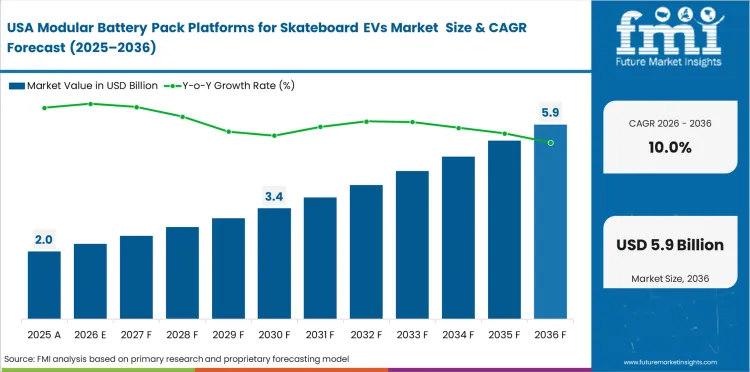
The United States is expected to register 10.0% CAGR in this industry through 2036. Electric car sales increased by around 10% in 2024 and reached over one in ten cars sold, while vehicle imports also moved higher during the year. That demand profile supports modular battery pack platforms because larger average battery sizes are common in pickups, SUVs, and delivery vans, and these vehicles need stronger structural packaging and cooling design. Suppliers with localisation readiness and experience in large-pack vehicle programs should remain competitive in the United States.
- Larger packs increase the value of cooling and structural integration.
- Localisation remains important for supply continuity and policy alignment.
- Commercial vehicle programs support flat and scalable pack demand.
Demand outlook for Modular Battery Pack Platforms for Skateboard EVs Market in the European Union
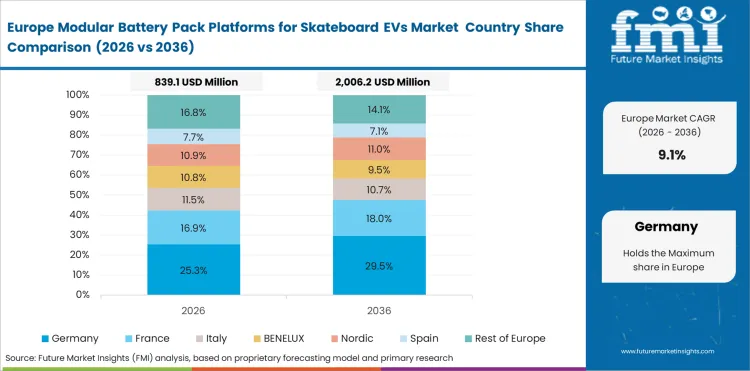
The European Union is set to expand at a CAGR of 9.6% over the assessment period. Electric car production in the region stood at around 2.4 million units in 2024, while exports also moved up, which shows that Europe remains an important engineering and vehicle supply base. Demand for modular battery pack platforms is supported by the need for skateboard structures that can serve domestic EV launches and export programs across several vehicle classes. This trend also links with lithium-ion batteries and lithium, nickel and cobalt recovery from EV batteries under EU batteries regulation, where chemistry choice and battery lifecycle regulation are shaping pack architecture decisions. Europe should retain a strong role in advanced platform engineering across premium and export-focused EV programs.
- Export vehicle programs support advanced skateboard platform development.
- Emissions policy continues to support dedicated EV launch activity.
- Nickel-rich battery formats remain important in longer-range applications.
In-depth analysis of Modular Battery Pack Platforms for Skateboard EVs Market in the United Kingdom
The United Kingdom is expected to register 9.3% CAGR in this industry through 2036. Electric car output declined in 2024, though the country holds prominent value for modular battery pack platforms through premium vehicle engineering and export-oriented product development. Demand in the United Kingdom is shaped by programs that need flexible skateboard structures for different battery sizes and performance levels across a focused number of vehicle platforms. This outlook fits with linked demand in luxury electric vehicles and electric vehicle battery connectors, where higher-spec architecture and advanced electrical integration support stronger pack value per vehicle. Import dependence also keeps compatibility important across cell formats, module layouts, and charging systems.
- Premium vehicle programs continue to need scalable pack layouts.
- Regulation supports a higher zero-emission vehicle mix this decade.
- Import dependence increases the need for compatibility across pack formats.
Competitive Landscape of Modular Battery Pack Platforms for Skateboard EVs Market
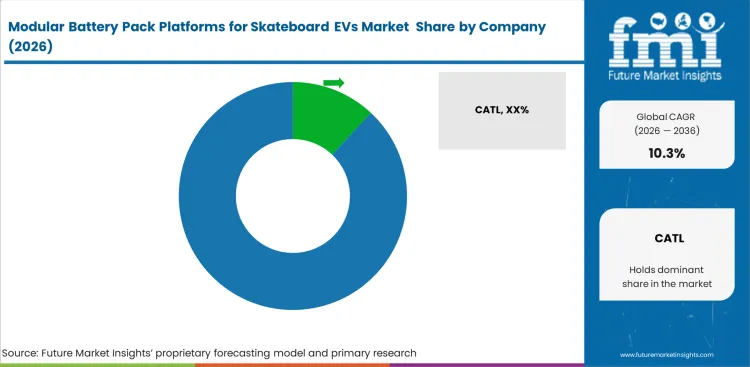
- Competition is moderately concentrated because a limited number of battery leaders and platform specialists control the highest value programs.
- Large incumbents benefit from battery manufacturing scale, pack engineering depth, and existing OEM relationships.
- Specialists still find room where skateboard design, software integration, or niche vehicle formats demand focused engineering.
Competition in this industry is shaped by the ability to deliver a pack platform that works across several vehicle programs without causing packaging or validation delays. Large battery companies such as CATL, BYD, LG Energy Solution, Samsung SDI, and SK On hold an advantage because they already operate close to automaker platform teams and can link cell roadmaps with pack design choices. Scale also matters because platform awards often require multi-region support and long launch windows.
Pack specialists and vehicle platform firms can still win where the buyer wants a ready base rather than only a battery supply contract. REE Automotive sits in this smaller but useful segment because its flat by wire platform approach serves fleets and commercial formats that need room for bodies and upfits above the battery floor. Magna also stays relevant because enclosure, structural integration, and contract manufacturing depth can matter as much as cell access in some platform programs.
Entry remains difficult because platform suppliers must pass crash, thermal, durability, and manufacturing tests while staying cost competitive. CATL's March 2025 partnership with NIO on battery swapping and the December 2024 Spain joint venture with Stellantis both show how winning suppliers now secure not just product contracts but also ecosystem positions. BYD also strengthened its competitive weight with the Super e-Platform launch in 2025, which raised the bar on charging architecture and pack integration.
Major Industry Players
- Global Player: CATL, BYD, LG Energy Solution, Samsung SDI, and SK On fit this group because they combine battery scale, broad OEM relationships, and the ability to align pack design with cell roadmaps across several regions.
- Regional Player: Magna International and REE Automotive sit here because they hold focused strength in enclosure integration, flat platform engineering, or commercial vehicle applications without matching the cell scale of the largest battery groups.
- Emerging Players: REE Automotive and selected skateboard focused platform developers remain important because they target software defined chassis layouts, serviceable flat platforms, and niche commercial use cases.
Competitive Benchmarking: Modular Battery Pack Platforms for Skateboard EVs Market
| Company | Pack Integration Depth | Platform Flexibility | OEM Access | Geographic Footprint |
|---|---|---|---|---|
| CATL | High | High | Strong | Global |
| BYD | High | Medium | Strong | Global |
| LG Energy Solution | High | Medium | Strong | Global |
| Samsung SDI | Medium | Medium | Moderate | Global |
| SK On | Medium | Medium | Moderate | Multi-region |
| Magna International | Medium | High | Moderate | Global |
| REE Automotive | Medium | High | Low | Multi-region |
| Stellantis | High | High | Strong | Global |
| NIO | Medium | Medium | Moderate | Regional |
| BAIC Group | Medium | Medium | Moderate | Regional |
Source: Future Market Insights competitive analysis, 2026. Ratings reflect relative positioning based on pack engineering capability, scalability across skateboard layouts, and access to major vehicle programs.
Key Developments in Modular Battery Pack Platforms for Skateboard EVs Market
- In March 2025, BYD launched the Super e-Platform with 1 megawatt charging power and a claimed 400 kilometres of range in five minutes.
- In July 2024, LG Energy Solution signed a five year contract to supply 39 GWh of LFP batteries to Ampere for next generation EVs.
- In May 2024, REE introduced the P7-S platform aimed at delivery fleets and linked it to its certified P7-C product family.
- In January 2024, Stellantis unveiled STLA Large with up to 800 kilometres of range to support a broad set of BEV programs.
Key Players in the Modular Battery Pack Platforms for Skateboard EVs Market
Major Global Players
- CATL
- BYD
- LG Energy Solution
- Samsung SDI
- SK On
- Magna International
Key Emerging Players/Startups
- REE Automotive
- NIO
- BAIC Group
Scope of the Report
| Metric | Value |
|---|---|
| Quantitative Units | USD Billion |
| Market Definition | Modular battery pack platforms designed for dedicated skateboard EV underbodies across passenger and selected commercial vehicles. |
| Segmentation | Pack Architecture: Module-based, Cell-to-pack, Cell-to-chassis, Swappable packs; Vehicle Type: Passenger cars, Crossovers, Vans, Pickup; Voltage Class: 400V, 800V, Dual-voltage; Chemistry Compatibility: NMC/NCA, LFP, LMFP, Mixed chemistry; Thermal System: Liquid-cooled, Refrigerant-assisted, Air-cooled; Supply Route: OEM direct, Tier-1 supply, JV supply |
| Regions Covered | China, United States, European Union, United Kingdom, India, Southeast Asia, Brazil |
| Countries Covered | China, United States, United Kingdom, India, Brazil plus regional blocks for the European Union and Southeast Asia |
| Key Companies Profiled | CATL, BYD, LG Energy Solution, Samsung SDI, SK On, REE Automotive, Magna International |
| Forecast Period | 2026 to 2036 |
| Approach | Bottom up modelling using EV sales, battery demand, platform adoption rates, and pack content assumptions validated against adjacent EV battery hardware categories. |
Modular Battery Pack Platforms for Skateboard EVs Market by Segments
Modular Battery Pack Platforms for Skateboard EVs Market Segmented as Pack Architecture
- Module-based
- Cell-to-pack
- Cell-to-chassis
- Swappable packs
Modular Battery Pack Platforms for Skateboard EVs Market Classified by Vehicle Type
- Passenger cars
- Crossovers
- Vans
- Pickup
Modular Battery Pack Platforms for Skateboard EVs Market Analysed by Voltage Class
- 400V
- 800V
- Dual-voltage
Modular Battery Pack Platforms for Skateboard EVs Market Classified by Chemistry Compatibility
- NMC/NCA
- LFP
- LMFP
- Mixed chemistry
Modular Battery Pack Platforms for Skateboard EVs Market Classified by Supply Route
- OEM direct
- Tier-1 supply
- JV supply
Modular Battery Pack Platforms for Skateboard EVs Market by Region and Country
- China - China
- North America - United States
- Europe - European Union
- Europe - United Kingdom
- South Asia - India
- Latin America - Brazil
- Southeast Asia - Southeast Asia
Bibliography
- International Energy Agency. (2025). Global EV Outlook 2025.
- International Energy Agency. (2025). Outlook for electric mobility.
- Contemporary Amperex Technology Co., Limited. (2024, December 24). CATL launches the Bedrock Chassis that withstands 120 km/h impact without catching fire or exploding.
- International Energy Agency. (2025). Electric vehicle batteries.
- Contemporary Amperex Technology Co., Limited. (2024, June 19). CATL works with BAIC Group to develop skateboard chassis and battery-swappable models.
- Contemporary Amperex Technology Co., Limited. (2025, March 18). CATL and NIO form strategic partnership on battery swapping.
- International Energy Agency. (2025). Trends in the electric car industry.
- Stellantis. (2024, January 19). Stellantis unveils BEV-native STLA Large platform with 800 km/500 mile range and the ultimate flexibility to cover a wide spectrum of vehicles.
- Stellantis. (2024, November 19). Stellantis launches third all-new multi-energy platform STLA Frame offers best-in-class 690-mile electrified range or 500-mile BEV range towing and payload.
- International Energy Agency. (2025). Executive summary.
- International Energy Agency. (2025). Electric vehicle charging.
- Stellantis. (2024, December 10). Stellantis and CATL to invest up to €4.1 billion in joint venture for large-scale LFP battery plant in Spain.
- BYD. (2025, March 17). BYD unveils Super e-Platform with megawatt flash charging for electric vehicles, matching refueling speeds.
- LG Energy Solution. (2024, July 2). LG Energy Solution to supply LFP EV batteries to Renault Group's Ampere.
- REE Automotive. (2024, January 11). REE completes USA certification of full-by-wire vehicles and begins customer deliveries of its P7-C electric truck.
- REE Automotive. (2024, May 21). REE unveils a next gen software-driven electric commercial vehicle platform designed with leading delivery fleet.
This bibliography is provided for reader reference.
This Report Addresses
- Revenue sizing and forecast analysis for modular battery pack platforms used in skateboard EV architectures from 2026 to 2036.
- Segment analysis across pack architecture, vehicle type, voltage class, chemistry compatibility, thermal system, and supply route.
- Regional and country level assessment covering China, the United States, Europe, India, Brazil, and Southeast Asia.
- Competitive review covering major battery suppliers, platform specialists, and recent industry developments.
- Product and integration analysis covering serviceability, charging architecture, and thermal management priorities.
- Supply chain direction across cell suppliers, pack integrators, automakers, and platform partnerships.
- Market boundary guidance identifying what is included and excluded from the present study.
- Benchmarking of leading firms against pack integration depth, platform flexibility, and OEM access.
Frequently Asked Questions
How large is the market in 2026?
The industry is projected to reach USD 3.46 billion in 2026 as dedicated EV platforms expand across passenger and selected commercial programs.
What will be the size of the market by 2036?
The industry is forecast to reach USD 9.22 billion by 2036 as modular pack architectures spread across more skateboard based vehicle families.
What is the expected CAGR between 2026 and 2036?
The industry is expected to expand at a CAGR of 10.3% between 2026 and 2036 under the present base case forecast.
Which segment leads by architecture?
Module-based platforms lead the architecture segment with an estimated 44% share in 2026 because they still suit broad multi-model vehicle programs.
Which vehicle fit leads the industry?
Passenger cars remain the leading vehicle fit with an estimated 48% share in 2026 due to wider use of dedicated EV underbodies.
Which geography is projected to grow fastest?
China leads the growth ranking with an expected 11.8% CAGR through 2036, followed by India and Brazil in this study.
What does the market include?
It includes scalable battery pack structures, module layouts, cooling provisions, mounting systems, and compatible electrical layouts for skateboard EV architectures.
How was the forecast built?
The forecast was built from EV production, battery demand, platform adoption rates, and supplier activity cross checked with adjacent pack hardware categories.
Preview the report firsthand - request a free sample
Get SampleGet the brochure for pricing and purchase details.
Get PDFTable of Content
- Executive Summary
- Global Market Outlook
- Demand-side Trends
- Supply-side Trends
- Technology Roadmap Analysis
- Analysis and Recommendations
- Market Overview
- Market Coverage / Taxonomy
- Market Definition / Scope / Limitations
- Research Methodology
- Chapter Orientation
- Analytical Lens and Working Hypotheses
- Market Structure, Signals, and Trend Drivers
- Benchmarking and Cross-market Comparability
- Market Sizing, Forecasting, and Opportunity Mapping
- Research Design and Evidence Framework
- Desk Research Programme (Secondary Evidence)
- Company Annual and Sustainability Reports
- Peer-reviewed Journals and Academic Literature
- Corporate Websites, Product Literature, and Technical Notes
- Earnings Decks and Investor Briefings
- Statutory Filings and Regulatory Disclosures
- Technical White Papers and Standards Notes
- Trade Journals, Industry Magazines, and Analyst Briefs
- Conference Proceedings, Webinars, and Seminar Materials
- Government Statistics Portals and Public Data Releases
- Press Releases and Reputable Media Coverage
- Specialist Newsletters and Curated Briefings
- Sector Databases and Reference Repositories
- FMI Internal Proprietary Databases and Historical Market Datasets
- Subscription Datasets and Paid Sources
- Social Channels, Communities, and Digital Listening Inputs
- Additional Desk Sources
- Expert Input and Fieldwork (Primary Evidence)
- Primary Modes
- Qualitative Interviews and Expert Elicitation
- Quantitative Surveys and Structured Data Capture
- Blended Approach
- Why Primary Evidence is Used
- Field Techniques
- Interviews
- Surveys
- Focus Groups
- Observational and In-context Research
- Social and Community Interactions
- Stakeholder Universe Engaged
- C-suite Leaders
- Board Members
- Presidents and Vice Presidents
- R&D and Innovation Heads
- Technical Specialists
- Domain Subject-matter Experts
- Scientists
- Physicians and Other Healthcare Professionals
- Governance, Ethics, and Data Stewardship
- Research Ethics
- Data Integrity and Handling
- Primary Modes
- Tooling, Models, and Reference Databases
- Desk Research Programme (Secondary Evidence)
- Data Engineering and Model Build
- Data Acquisition and Ingestion
- Cleaning, Normalisation, and Verification
- Synthesis, Triangulation, and Analysis
- Quality Assurance and Audit Trail
- Market Background
- Market Dynamics
- Drivers
- Restraints
- Opportunity
- Trends
- Scenario Forecast
- Demand in Optimistic Scenario
- Demand in Likely Scenario
- Demand in Conservative Scenario
- Opportunity Map Analysis
- Product Life Cycle Analysis
- Supply Chain Analysis
- Investment Feasibility Matrix
- Value Chain Analysis
- PESTLE and Porter’s Analysis
- Regulatory Landscape
- Regional Parent Market Outlook
- Production and Consumption Statistics
- Import and Export Statistics
- Market Dynamics
- Global Market Analysis 2021 to 2025 and Forecast, 2026 to 2036
- Historical Market Size Value (USD Million) Analysis, 2021 to 2025
- Current and Future Market Size Value (USD Million) Projections, 2026 to 2036
- Y-o-Y Growth Trend Analysis
- Absolute $ Opportunity Analysis
- Global Market Pricing Analysis 2021 to 2025 and Forecast 2026 to 2036
- Global Market Analysis 2021 to 2025 and Forecast 2026 to 2036, By Pack Architecture
- Introduction / Key Findings
- Historical Market Size Value (USD Million) Analysis By Pack Architecture , 2021 to 2025
- Current and Future Market Size Value (USD Million) Analysis and Forecast By Pack Architecture , 2026 to 2036
- Module-Based
- Cell-to-Pack
- Cell-to-Chassis
- Module-Based
- Y-o-Y Growth Trend Analysis By Pack Architecture , 2021 to 2025
- Absolute $ Opportunity Analysis By Pack Architecture , 2026 to 2036
- Global Market Analysis 2021 to 2025 and Forecast 2026 to 2036, By Vehicle Type
- Introduction / Key Findings
- Historical Market Size Value (USD Million) Analysis By Vehicle Type, 2021 to 2025
- Current and Future Market Size Value (USD Million) Analysis and Forecast By Vehicle Type, 2026 to 2036
- Passenger Cars
- Crossovers
- Vans
- Passenger Cars
- Y-o-Y Growth Trend Analysis By Vehicle Type, 2021 to 2025
- Absolute $ Opportunity Analysis By Vehicle Type, 2026 to 2036
- Global Market Analysis 2021 to 2025 and Forecast 2026 to 2036, By Voltage Class
- Introduction / Key Findings
- Historical Market Size Value (USD Million) Analysis By Voltage Class, 2021 to 2025
- Current and Future Market Size Value (USD Million) Analysis and Forecast By Voltage Class, 2026 to 2036
- 400V
- 800V
- Dual-voltage
- 400V
- Y-o-Y Growth Trend Analysis By Voltage Class, 2021 to 2025
- Absolute $ Opportunity Analysis By Voltage Class, 2026 to 2036
- Global Market Analysis 2021 to 2025 and Forecast 2026 to 2036, By Battery Chemistry Compatibility
- Introduction / Key Findings
- Historical Market Size Value (USD Million) Analysis By Battery Chemistry Compatibility, 2021 to 2025
- Current and Future Market Size Value (USD Million) Analysis and Forecast By Battery Chemistry Compatibility, 2026 to 2036
- NMC/NCA
- LFP
- LMFP
- NMC/NCA
- Y-o-Y Growth Trend Analysis By Battery Chemistry Compatibility, 2021 to 2025
- Absolute $ Opportunity Analysis By Battery Chemistry Compatibility, 2026 to 2036
- Global Market Analysis 2021 to 2025 and Forecast 2026 to 2036, By Thermal System
- Introduction / Key Findings
- Historical Market Size Value (USD Million) Analysis By Thermal System, 2021 to 2025
- Current and Future Market Size Value (USD Million) Analysis and Forecast By Thermal System, 2026 to 2036
- Liquid Cooled Platforms
- Others
- Liquid Cooled Platforms
- Y-o-Y Growth Trend Analysis By Thermal System, 2021 to 2025
- Absolute $ Opportunity Analysis By Thermal System, 2026 to 2036
- Global Market Analysis 2021 to 2025 and Forecast 2026 to 2036, By Supply Route
- Introduction / Key Findings
- Historical Market Size Value (USD Million) Analysis By Supply Route, 2021 to 2025
- Current and Future Market Size Value (USD Million) Analysis and Forecast By Supply Route, 2026 to 2036
- OEM Direct
- Tier-1 supply
- JV supply
- OEM Direct
- Y-o-Y Growth Trend Analysis By Supply Route, 2021 to 2025
- Absolute $ Opportunity Analysis By Supply Route, 2026 to 2036
- Global Market Analysis 2021 to 2025 and Forecast 2026 to 2036, By Region
- Introduction
- Historical Market Size Value (USD Million) Analysis By Region, 2021 to 2025
- Current Market Size Value (USD Million) Analysis and Forecast By Region, 2026 to 2036
- North America
- Latin America
- Western Europe
- Eastern Europe
- East Asia
- South Asia and Pacific
- Middle East & Africa
- Market Attractiveness Analysis By Region
- North America Market Analysis 2021 to 2025 and Forecast 2026 to 2036, By Country
- Historical Market Size Value (USD Million) Trend Analysis By Market Taxonomy, 2021 to 2025
- Market Size Value (USD Million) Forecast By Market Taxonomy, 2026 to 2036
- By Country
- USA
- Canada
- Mexico
- By Pack Architecture
- By Vehicle Type
- By Voltage Class
- By Battery Chemistry Compatibility
- By Thermal System
- By Supply Route
- By Country
- Market Attractiveness Analysis
- By Country
- By Pack Architecture
- By Vehicle Type
- By Voltage Class
- By Battery Chemistry Compatibility
- By Thermal System
- By Supply Route
- Key Takeaways
- Latin America Market Analysis 2021 to 2025 and Forecast 2026 to 2036, By Country
- Historical Market Size Value (USD Million) Trend Analysis By Market Taxonomy, 2021 to 2025
- Market Size Value (USD Million) Forecast By Market Taxonomy, 2026 to 2036
- By Country
- Brazil
- Chile
- Rest of Latin America
- By Pack Architecture
- By Vehicle Type
- By Voltage Class
- By Battery Chemistry Compatibility
- By Thermal System
- By Supply Route
- By Country
- Market Attractiveness Analysis
- By Country
- By Pack Architecture
- By Vehicle Type
- By Voltage Class
- By Battery Chemistry Compatibility
- By Thermal System
- By Supply Route
- Key Takeaways
- Western Europe Market Analysis 2021 to 2025 and Forecast 2026 to 2036, By Country
- Historical Market Size Value (USD Million) Trend Analysis By Market Taxonomy, 2021 to 2025
- Market Size Value (USD Million) Forecast By Market Taxonomy, 2026 to 2036
- By Country
- Germany
- UK
- Italy
- Spain
- France
- Nordic
- BENELUX
- Rest of Western Europe
- By Pack Architecture
- By Vehicle Type
- By Voltage Class
- By Battery Chemistry Compatibility
- By Thermal System
- By Supply Route
- By Country
- Market Attractiveness Analysis
- By Country
- By Pack Architecture
- By Vehicle Type
- By Voltage Class
- By Battery Chemistry Compatibility
- By Thermal System
- By Supply Route
- Key Takeaways
- Eastern Europe Market Analysis 2021 to 2025 and Forecast 2026 to 2036, By Country
- Historical Market Size Value (USD Million) Trend Analysis By Market Taxonomy, 2021 to 2025
- Market Size Value (USD Million) Forecast By Market Taxonomy, 2026 to 2036
- By Country
- Russia
- Poland
- Hungary
- Balkan & Baltic
- Rest of Eastern Europe
- By Pack Architecture
- By Vehicle Type
- By Voltage Class
- By Battery Chemistry Compatibility
- By Thermal System
- By Supply Route
- By Country
- Market Attractiveness Analysis
- By Country
- By Pack Architecture
- By Vehicle Type
- By Voltage Class
- By Battery Chemistry Compatibility
- By Thermal System
- By Supply Route
- Key Takeaways
- East Asia Market Analysis 2021 to 2025 and Forecast 2026 to 2036, By Country
- Historical Market Size Value (USD Million) Trend Analysis By Market Taxonomy, 2021 to 2025
- Market Size Value (USD Million) Forecast By Market Taxonomy, 2026 to 2036
- By Country
- China
- Japan
- South Korea
- By Pack Architecture
- By Vehicle Type
- By Voltage Class
- By Battery Chemistry Compatibility
- By Thermal System
- By Supply Route
- By Country
- Market Attractiveness Analysis
- By Country
- By Pack Architecture
- By Vehicle Type
- By Voltage Class
- By Battery Chemistry Compatibility
- By Thermal System
- By Supply Route
- Key Takeaways
- South Asia and Pacific Market Analysis 2021 to 2025 and Forecast 2026 to 2036, By Country
- Historical Market Size Value (USD Million) Trend Analysis By Market Taxonomy, 2021 to 2025
- Market Size Value (USD Million) Forecast By Market Taxonomy, 2026 to 2036
- By Country
- India
- ASEAN
- Australia & New Zealand
- Rest of South Asia and Pacific
- By Pack Architecture
- By Vehicle Type
- By Voltage Class
- By Battery Chemistry Compatibility
- By Thermal System
- By Supply Route
- By Country
- Market Attractiveness Analysis
- By Country
- By Pack Architecture
- By Vehicle Type
- By Voltage Class
- By Battery Chemistry Compatibility
- By Thermal System
- By Supply Route
- Key Takeaways
- Middle East & Africa Market Analysis 2021 to 2025 and Forecast 2026 to 2036, By Country
- Historical Market Size Value (USD Million) Trend Analysis By Market Taxonomy, 2021 to 2025
- Market Size Value (USD Million) Forecast By Market Taxonomy, 2026 to 2036
- By Country
- Kingdom of Saudi Arabia
- Other GCC Countries
- Turkiye
- South Africa
- Other African Union
- Rest of Middle East & Africa
- By Pack Architecture
- By Vehicle Type
- By Voltage Class
- By Battery Chemistry Compatibility
- By Thermal System
- By Supply Route
- By Country
- Market Attractiveness Analysis
- By Country
- By Pack Architecture
- By Vehicle Type
- By Voltage Class
- By Battery Chemistry Compatibility
- By Thermal System
- By Supply Route
- Key Takeaways
- Key Countries Market Analysis
- USA
- Pricing Analysis
- Market Share Analysis, 2025
- By Pack Architecture
- By Vehicle Type
- By Voltage Class
- By Battery Chemistry Compatibility
- By Thermal System
- By Supply Route
- Canada
- Pricing Analysis
- Market Share Analysis, 2025
- By Pack Architecture
- By Vehicle Type
- By Voltage Class
- By Battery Chemistry Compatibility
- By Thermal System
- By Supply Route
- Mexico
- Pricing Analysis
- Market Share Analysis, 2025
- By Pack Architecture
- By Vehicle Type
- By Voltage Class
- By Battery Chemistry Compatibility
- By Thermal System
- By Supply Route
- Brazil
- Pricing Analysis
- Market Share Analysis, 2025
- By Pack Architecture
- By Vehicle Type
- By Voltage Class
- By Battery Chemistry Compatibility
- By Thermal System
- By Supply Route
- Chile
- Pricing Analysis
- Market Share Analysis, 2025
- By Pack Architecture
- By Vehicle Type
- By Voltage Class
- By Battery Chemistry Compatibility
- By Thermal System
- By Supply Route
- Germany
- Pricing Analysis
- Market Share Analysis, 2025
- By Pack Architecture
- By Vehicle Type
- By Voltage Class
- By Battery Chemistry Compatibility
- By Thermal System
- By Supply Route
- UK
- Pricing Analysis
- Market Share Analysis, 2025
- By Pack Architecture
- By Vehicle Type
- By Voltage Class
- By Battery Chemistry Compatibility
- By Thermal System
- By Supply Route
- Italy
- Pricing Analysis
- Market Share Analysis, 2025
- By Pack Architecture
- By Vehicle Type
- By Voltage Class
- By Battery Chemistry Compatibility
- By Thermal System
- By Supply Route
- Spain
- Pricing Analysis
- Market Share Analysis, 2025
- By Pack Architecture
- By Vehicle Type
- By Voltage Class
- By Battery Chemistry Compatibility
- By Thermal System
- By Supply Route
- France
- Pricing Analysis
- Market Share Analysis, 2025
- By Pack Architecture
- By Vehicle Type
- By Voltage Class
- By Battery Chemistry Compatibility
- By Thermal System
- By Supply Route
- India
- Pricing Analysis
- Market Share Analysis, 2025
- By Pack Architecture
- By Vehicle Type
- By Voltage Class
- By Battery Chemistry Compatibility
- By Thermal System
- By Supply Route
- ASEAN
- Pricing Analysis
- Market Share Analysis, 2025
- By Pack Architecture
- By Vehicle Type
- By Voltage Class
- By Battery Chemistry Compatibility
- By Thermal System
- By Supply Route
- Australia & New Zealand
- Pricing Analysis
- Market Share Analysis, 2025
- By Pack Architecture
- By Vehicle Type
- By Voltage Class
- By Battery Chemistry Compatibility
- By Thermal System
- By Supply Route
- China
- Pricing Analysis
- Market Share Analysis, 2025
- By Pack Architecture
- By Vehicle Type
- By Voltage Class
- By Battery Chemistry Compatibility
- By Thermal System
- By Supply Route
- Japan
- Pricing Analysis
- Market Share Analysis, 2025
- By Pack Architecture
- By Vehicle Type
- By Voltage Class
- By Battery Chemistry Compatibility
- By Thermal System
- By Supply Route
- South Korea
- Pricing Analysis
- Market Share Analysis, 2025
- By Pack Architecture
- By Vehicle Type
- By Voltage Class
- By Battery Chemistry Compatibility
- By Thermal System
- By Supply Route
- Russia
- Pricing Analysis
- Market Share Analysis, 2025
- By Pack Architecture
- By Vehicle Type
- By Voltage Class
- By Battery Chemistry Compatibility
- By Thermal System
- By Supply Route
- Poland
- Pricing Analysis
- Market Share Analysis, 2025
- By Pack Architecture
- By Vehicle Type
- By Voltage Class
- By Battery Chemistry Compatibility
- By Thermal System
- By Supply Route
- Hungary
- Pricing Analysis
- Market Share Analysis, 2025
- By Pack Architecture
- By Vehicle Type
- By Voltage Class
- By Battery Chemistry Compatibility
- By Thermal System
- By Supply Route
- Kingdom of Saudi Arabia
- Pricing Analysis
- Market Share Analysis, 2025
- By Pack Architecture
- By Vehicle Type
- By Voltage Class
- By Battery Chemistry Compatibility
- By Thermal System
- By Supply Route
- Turkiye
- Pricing Analysis
- Market Share Analysis, 2025
- By Pack Architecture
- By Vehicle Type
- By Voltage Class
- By Battery Chemistry Compatibility
- By Thermal System
- By Supply Route
- South Africa
- Pricing Analysis
- Market Share Analysis, 2025
- By Pack Architecture
- By Vehicle Type
- By Voltage Class
- By Battery Chemistry Compatibility
- By Thermal System
- By Supply Route
- USA
- Market Structure Analysis
- Competition Dashboard
- Competition Benchmarking
- Market Share Analysis of Top Players
- By Regional
- By Pack Architecture
- By Vehicle Type
- By Voltage Class
- By Battery Chemistry Compatibility
- By Thermal System
- By Supply Route
- Competition Analysis
- Competition Deep Dive
- CATL
- Overview
- Product Portfolio
- Profitability by Market Segments (Product/Age /Sales Channel/Region)
- Sales Footprint
- Strategy Overview
- Marketing Strategy
- Product Strategy
- Channel Strategy
- BYD
- LG Energy Solution
- Samsung SDI
- SK On
- Magna International
- CATL
- Competition Deep Dive
- Assumptions & Acronyms Used


