

- Industry Size (2026)
- USD 0.4 Bn
- Forecast (2036)
- USD 1.1 Bn
- CAGR (2026 to 2036)
- 10.4%
Hybrid Silane-Terminated Polymer Adhesives for EV Battery Pack Assembly Market Size, Market Forecast and Outlook By FMI
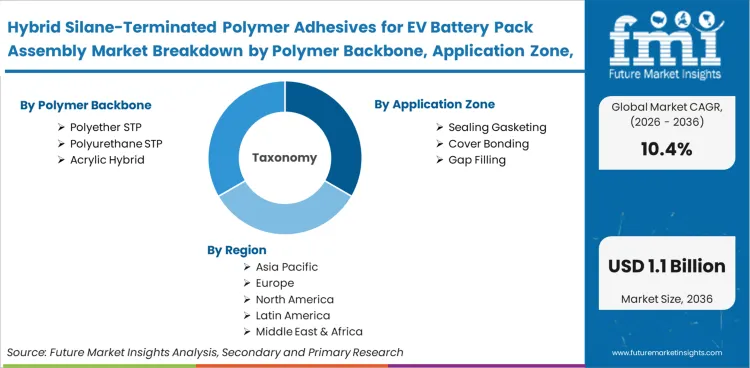
The hybrid silane-terminated polymer adhesives for EV battery pack assembly market was valued at USD 0.3 billion in 2025. Sales are expected to cross USD 0.4 billion in 2026 at a CAGR of 10.4% during this forecast period. Revenue expansion lifts the cumulative EV battery adhesive market forecast 2036 valuation to USD 1.1 billion through the decade as automotive OEMs transition toward cell-to-pack designs requiring high-elongation structural sealing across extreme thermal gradients.
Battery engineering teams face conflicting mandates between rapid automated manufacturing speeds and strict end-of-life dismantlability requirements. Rigid polyurethanes provide rapid green strength but routinely fail serviceability protocols when modules require repair. This specific friction forces procurement directors to evaluate an isocyanate-free adhesive for battery pack assembly alongside silane modified polymer binders capable of maintaining structural integrity while permitting targeted debonding. Failure to qualify a debondable hybrid adhesive for EV batteries leaves manufacturers exposed to excessive warranty replacement costs when localized cell failures necessitate total pack replacement.
Summary of Hybrid Silane-Terminated Polymer Adhesives for EV Battery Pack Assembly Market
- Hybrid Silane-Terminated Polymer Adhesives for EV Battery Pack Assembly Market Definition
- The hybrid silane-terminated polymer adhesives for EV battery pack assembly market encompasses specialized reactive materials utilizing moisture-sensitive end-groups to bond and seal electric vehicle energy enclosures. These formulations provide required viscoelasticity, dielectric strength, and serviceability without relying on hazardous isocyanate chemistry.
- Demand Drivers in the Market
- End-of-life serviceability directives force structural engineers to replace permanent rigid epoxies with materials permitting controlled debonding.
- High-speed robotic manufacturing targets push assembly line managers to adopt primerless formulations eliminating secondary surface preparation stations.
- Environmental compliance officers increasingly mandate a low-VOC adhesive for EV battery packs to meet stringent plant safety standards.
- Key Segments Analyzed in the FMI Report
- Polyether STP: This segment is anticipated to hold 61.0% share in 2026, serving as the dominant STP adhesive market for battery packs driven by inherent hydrolysis resistance.
- Sealing Gasketing: This segment is projected to lead Application Zone dynamics, as OEMs consolidate structural fastening and environmental sealing into single-step dispensing.
- 1K Moisture: This segment is set to dominate Cure System choices, functioning as the premier moisture-cure adhesive for EV battery assembly.
- Cell-to-Pack: This segment is estimated to capture 44.0% share, demanding continuous large-volume adhesive interfaces.
- Passenger EV: This segment is poised to retain 74.0% share, dictating baseline performance specifications.
- India: India records 14.1% compound growth, anchored by rapid electrification of localized two-wheeler fleets operating in high-humidity environments.
- Analyst Opinion at FMI
- Nikhil Kaitwade, Principal Analyst, Automotive, at FMI, states that, "Thermal cycling tests capture adhesive failure under laboratory extremes accurately. Standard metrics miss entirely what happens when automated dispensing nozzles sit idle during line stoppages. Procurement directors obsess over tensile strength specifications, while factory floor managers desperately need formulations avoiding premature crosslinking inside pumping equipment after thirty-minute pauses. This hidden operational friction dictates actual supplier selection far more than laboratory lap-shear data suggests."
- Strategic Implications / Executive Takeaways
- Formulation chemists face intense pressure to widen application windows without sacrificing ultimate cure speed.
- Dispensing equipment integrators secure distinct advantages by co-developing custom pump designs matched to specific silane rheology.
- Tier-one suppliers risk contract loss if their hybrid formulations cannot pass emerging OEM automated disassembly validation protocols.
- Methodology
- Primary Research: Direct consultation with materials scientists and automotive pack designers.
- Desk Research: Analysis of OEM material specification sheets and recycling directive frameworks.
- Market-Sizing and Forecasting: Adhesive volume per vehicle platform anchors base demand.
- Data Validation and Update Cycle: Tier-one supplier earnings and capacity expansion announcements verify growth trajectories.
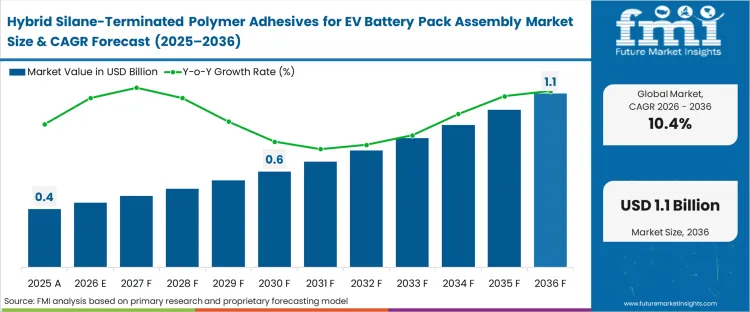
Hybrid Silane-Terminated Polymer Adhesives for EV Battery Pack Assembly Market Key Takeaways
| Metric | Details |
|---|---|
| Industry Size (2026) | USD 0.4 billion |
| Industry Value (2036) | USD 1.1 billion |
| CAGR (2026 to 2036) | 10.4% |
Source: Future Market Insights (FMI) analysis, based on proprietary forecasting model and primary research
When automotive recycling directives mandate automated robotic disassembly protocols, hybrid adhesive for EV battery pack sealing systems transition from optional alternatives to baseline qualification standards. This legislative shift redefines formulation priorities away from absolute tensile strength toward controlled elasticity and predictable failure modes. Component suppliers subsequently restructure product portfolios around specific separation thresholds.
India leads geographic expansion at 14.1% CAGR as local two-wheeler pack assembly in high-humidity zones exposes conventional epoxies to rapid degradation. China expands at 13.2% based on massive localized cell-to-pack manufacturing volumes. South Korea advances at 10.8% driven by tier-one supplier consolidation. Brazil tracks at 9.6% through early-stage local manufacturing integration. United States progresses at 8.7% supported by federal localization incentives. Germany grows at 8.5% anchored by premium platform transitions. The United Kingdom records 8.2% through specialty vehicle production. Regional adoption curves bifurcate sharply along atmospheric moisture gradients, heavily influencing the hybrid STP adhesive CAGR across distinct climates.
Hybrid Silane-Terminated Polymer Adhesives for EV Battery Pack Assembly Market Definition
The hybrid silane-terminated polymer adhesives for EV battery pack assembly market encompasses reactive formulations, operating specifically as a silane-terminated polymer adhesive market for EV batteries, combining polymer backbones with moisture-sensitive silane end-groups designed for structural joining within electric vehicle energy storage systems. These compounds deliver specific viscoelastic profiles allowing simultaneous load transfer, vibration damping, and environmental sealing without requiring isocyanate-driven curing pathways parallel to non isocyanate sealants for vehicle glazing.
Hybrid Silane-Terminated Polymer Adhesives for EV Battery Pack Assembly Market Inclusions
Scope covers polyether and polyurethane backbones modified with terminal siloxy groups deployed specifically within vehicle battery enclosures. Coverage captures both single-component moisture-cure materials and two-component reactive systems utilized as EV battery pack assembly adhesive market variants for structural bonding, gap filling, and gasket formation. FMI incorporates formulations overlapping with general automotive adhesives sealants only when expressly certified as EV battery sealant and adhesive market solutions for high-voltage environments.
Hybrid Silane-Terminated Polymer Adhesives for EV Battery Pack Assembly Market Exclusions
Standard unmodified polyurethanes, conventional silicones lacking structural capabilities, and rigid epoxy systems fall outside this parameter. General-purpose industrial sealants utilized outside vehicle energy storage enclosures are excluded because they lack specific dielectric and thermal cycling certifications required for a dedicated silyl modified polymer battery adhesive market component.
Hybrid Silane-Terminated Polymer Adhesives for EV Battery Pack Assembly Market Research Methodology
- Primary Research: Battery pack design engineers, automated dispensing equipment integrators, and tier-one materials procurement directors.
- Desk Research: Automotive material qualification registries, patent filings for silane-modified macromers, and OEM disassembly protocol documentation.
- Market-Sizing and Forecasting: Global electric vehicle production volume baselines cross-referenced against average adhesive mass per cell-to-pack architecture.
- Data Validation and Update Cycle: Independent capital expenditure reports from major formulation facilities validate projected supply capacities.
Segmental Analysis
Hybrid Silane-Terminated Polymer Adhesives for EV Battery Pack Assembly Market Analysis by Polymer Backbone
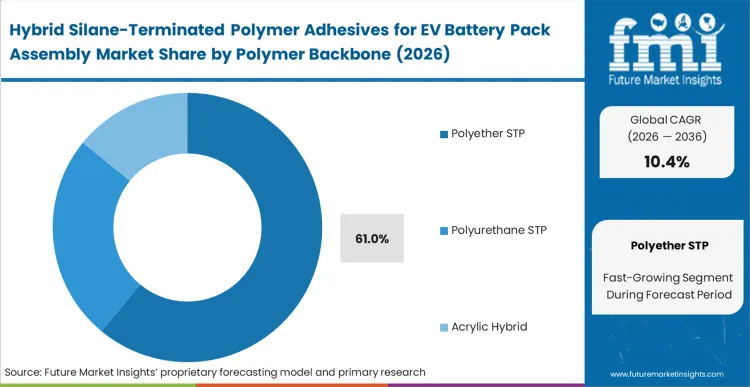
Inherent hydrolysis resistance under sustained thermal loading drives baseline chemical selection when evaluating an STP vs polyurethane adhesive for EV battery packs. Polyether STP segment is anticipated to command 61.0% share in 2026, driving robust compound growth as packaging engineers leverage specific molecular stability against coolant fluid exposure. This dominance traces back to fundamental backbone flexibility outperforming polyurethane variants when subjected to continuous vibration. FMI analysis indicates material procurement teams routinely default to polyether formulations for massive cell-to-pack designs requiring extensive perimeter sealing. What technical datasheets rarely highlight is that production managers actually select polyether variants primarily for their lower pre-cure viscosity, which drastically reduces mechanical wear on precision pumping equipment. Specifying incorrect backbone chemistry forces early pump stator replacements, silently destroying per-unit manufacturing margins while maintaining perfectly acceptable finished-pack performance.
- Displacement dynamic: High-viscosity legacy materials severely limit line speeds. Process engineers specify lower-viscosity polyether hybrids specifically to accelerate robot traverse rates alongside electrically conductive adhesives.
- Thermal resilience: Continuous heat generation degrades inferior molecular backbones. Reliability directors utilize specific polyether stability profiles to ensure decade-long seal integrity.
- Equipment wear: Highly filled formulations destroy pump stators rapidly. Maintenance supervisors demand specific rheological profiles preventing catastrophic equipment failure during peak production shifts.
Hybrid Silane-Terminated Polymer Adhesives for EV Battery Pack Assembly Market Analysis by Application Zone
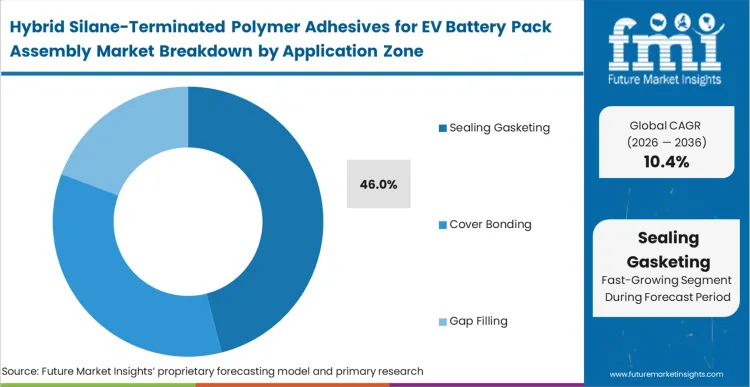
Consolidating physical fastening and environmental isolation into single manufacturing steps fundamentally alters assembly economics. Eliminating rigid fasteners removes concentrated stress points across composite enclosures, driving demand for a dedicated EV battery pack gasketing adhesive market application. FMI's assessment confirms battery pack sealants must now pass combined hydrostatic and multi-axial fatigue testing simultaneously. A non-obvious reality is that gasket formulation density actually serves a secondary acoustic dampening function, suppressing high-frequency inverter whine from reaching passenger compartments. The sealing gasketing segment is expected to hold 46.0% share in 2026, supporting overall market CAGR by reflecting the way design teams utilize these materials to replace traditional mechanical bolts. Overlooking these EV battery pack sealing and gasketing materials during value engineering exercises frequently results in completed vehicles failing noise-vibration-harshness audits, requiring expensive secondary dampening interventions.
- Fastener elimination: Traditional bolted flanges require extensive machining. Structural engineers implement formed-in-place gaskets eliminating costly aluminum milling operations entirely.
- Acoustic suppression: Inverter frequencies penetrate poorly sealed enclosures. Acoustic technicians rely on specifically formulated battery enclosure gasketing materials to absorb irritating high-frequency noise profiles.
- Stress distribution: Point-loads cause composite cover micro-cracking. Mechanical designers utilize continuous adhesive beads to distribute torsional forces evenly across broad surface areas.
Hybrid Silane-Terminated Polymer Adhesives for EV Battery Pack Assembly Market Analysis by Cure System
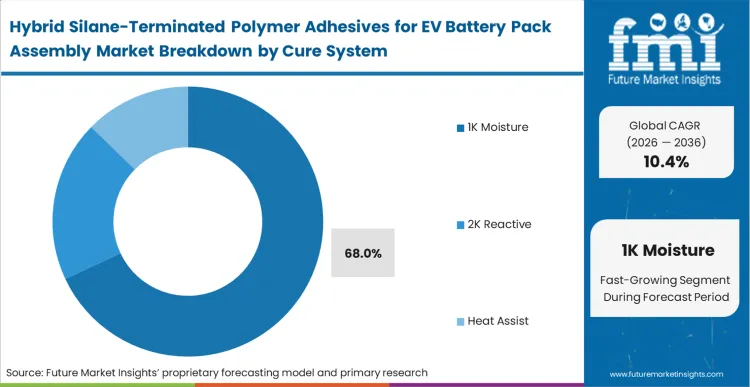
Eliminating mixing-nozzle purge waste dictates high-volume production viability. Single-component formulations remove complex volumetric ratio monitoring equipment from factory floors. Based on FMI's projection, electronic sealants relying on ambient humidity face significant challenges in deeply enclosed architectures, yet dominate perimeter applications. Practitioners understand that while 1K systems boast simplified handling, their reliance on ambient factory humidity makes cure times highly susceptible to seasonal weather variations unless climate control systems operate perfectly. 1K Moisture curing systems segment is projected to secure 68.0% share in 2026, anchoring the segment's steady CAGR as automated line architects prioritize continuous dispensing capability. Delaying investment in adequate factory HVAC infrastructure forces unpredictable staging times, creating massive floor-space bottlenecks while waiting for deep adhesive sections to crosslink.
- Waste reduction: Two-component systems demand frequent nozzle purging. Line operators deploy single-component materials specifically to eliminate expensive chemical waste during shift changes.
- Ratio monitoring: Complex metering systems drift out of calibration. Quality directors prefer 1K systems avoiding catastrophic failures caused by slight mixing irregularities.
- Climate dependency: Deep section curing requires specific atmospheric water content. Facilities managers must install precise humidity control infrastructure preventing unpredictable seasonal bottlenecking.
Hybrid Silane-Terminated Polymer Adhesives for EV Battery Pack Assembly Market Analysis by Pack Architecture
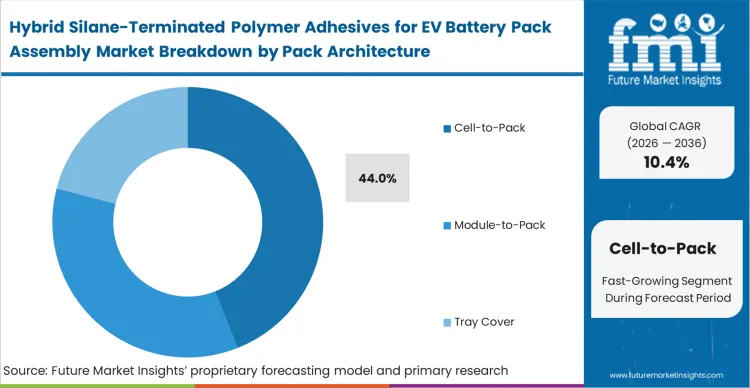
Removing modular housing structures demands extensive structural adhesive volumes directly connecting cells to cooling plates. Cell-to-Pack designs segment is poised to capture 44.0% share in 2026, driving significant compound growth while compelling thermal management teams to specify EV battery pack thermal interface materials TIM exhibiting dual functional roles alongside heat shield coatings for EV battery trays. These extreme interfacial areas require formulations providing both structural rigidity and slight elastomeric give, especially when serving as a flexible adhesive for EV battery tray cover integration. FMI observes that engineers increasingly push silane hybrids into roles demanding incidental fire-propagation retardation, a function these polymers were never originally optimized to perform. Designing massive unified packs with inadequate adhesive elongation thresholds guarantees microscopic sheer failures during aggressive fast-charging cycles, eventually allowing moisture ingress and total electrical fault.
- Volume multiplier: Direct cell bonding eliminates intermediate frames. Procurement managers must secure massive volumetric adhesive allocations accommodating these extensive unified surface areas.
- Swelling accommodation: Lithium-ion cells physically expand during charging. Pack designers specify exact elastomeric profiles preventing adhesive rupture during maximum cell dilation.
- Thermal bridging: Direct bonding demands efficient heat transfer. Thermal engineers integrate specific highly filled hybrid formulations guaranteeing immediate heat rejection into underlying cooling channels.
Hybrid Silane-Terminated Polymer Adhesives for EV Battery Pack Assembly Market Analysis by Vehicle Class
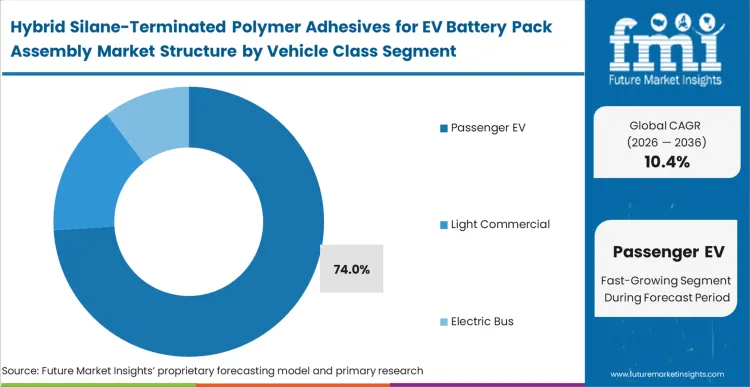
Baseline specification parameters originate almost entirely from light-duty platform requirements. This massive scale drives supplier formulation economics. According to FMI's estimates, heavy-duty applications demand specialized polymer solutions for high voltage battery separator chemistries alongside these external pack adhesives. While passenger cars dictate global volume capacity, light commercial delivery vans actually establish extreme vibration-damping specifications due to their harsh urban operating profiles, necessitating a truly crash-resistant flexible battery adhesive. Adopting passenger-car adhesive specifications directly onto commercial delivery platforms frequently results in premature structural joint failure under continuous rough-road daily service routes. Passenger EV applications segment is anticipated to command 74.0% share in 2026, sustaining long-term CAGR trajectories as platform architects standardize modular skateboard designs across dozens of consumer models.
- Platform scaling: Consumer platforms utilize identical lower chassis structures. Manufacturing directors standardize specific hybrid formulations across multiple vehicle badges streamlining global procurement.
- Vibration severity: Commercial routes generate intense continuous road shock. Chassis engineers demand distinct high-damping silane variants preventing structural fatigue in commercial delivery fleets.
- Cycle frequency: Delivery vehicles undergo rapid daily fast-charging. Fleet operators require specific adhesive resilience enduring continuous thermal expansion cycles without developing micro-fissures.
Hybrid Silane-Terminated Polymer Adhesives for EV Battery Pack Assembly Market Drivers, Restraints, and Opportunities
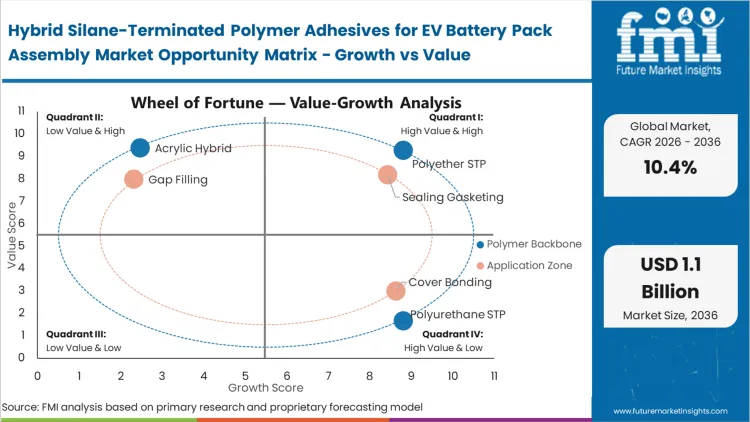
Impending European vehicle end-of-life directives compel automakers to rethink structural permanence. Traditional epoxies create indestructible joints rendering individual cell extraction impossible. This regulatory pressure forces mechanical engineers to deploy hybrid adhesives for electric vehicle power batteries permitting localized thermal or chemical debonding. Failure to implement reversible bonding architectures exposes OEMs to massive future recycling penalties and prevents lucrative secondary-life battery harvesting. This urgency accelerates silane-terminated polymer qualification processes from multi-year cycles down to eighteen months.
Lengthy ambient cure requirements introduce severe factory floor bottlenecks, placing stress on any thermal shock resistant pack sealant relying on humidity. While single-component moisture-cure hybrids offer unmatched dispensing simplicity, complete crosslinking across deep geometries often requires days. Plant managers cannot afford staging hundreds of vehicle packs in holding areas waiting for structural strength development. Current acceleration techniques involve expensive heating ovens or transitioning back toward complex multicomponent systems.
Opportunities in the Hybrid Silane-Terminated Polymer Adhesives for EV Battery Pack Assembly Market
- Debonding on command: Reversible adhesion triggers activate under specific electrical currents. Formulators developing these stimuli-responsive life cycle safe battery production chemicals capture massive premium pricing power from OEMs seeking automated disassembly compliance.
- Rapid green-strength formulations: Immediate handling strength eliminates staging bottlenecks. R&D directors focusing entirely on accelerating initial tack profiles solve critical floor-space constraints facing high-volume automotive plants.
- Case sealing consolidation: Utilizing a unified battery pack case sealing adhesive provides dual structural and thermal functionality. Materials scientists engineering highly loaded silane matrices capable of rapid heat dissipation eliminate secondary thermal paste applications entirely, complementing battery electrode dry coating materials.
Regional Analysis
Based on regional analysis, the hybrid silane-terminated polymer adhesives for EV battery pack assembly market is segmented into North America, Europe, Asia Pacific, Latin America, and Middle East & Africa across 40 plus countries.
.webp "Top Country Growth Comparison Hybrid Silane Terminated Polymer Adhesives For Ev Battery Pack Assembly Market Cagr (2026 2036)")
| Country | CAGR (2026 to 2036) |
|---|---|
| India | 14.1% |
| China | 13.2% |
| South Korea | 10.8% |
| Brazil | 9.6% |
| United States | 8.7% |
| Germany | 8.5% |
| United Kingdom | 8.2% |
Source: Future Market Insights (FMI) analysis, based on proprietary forecasting model and primary research
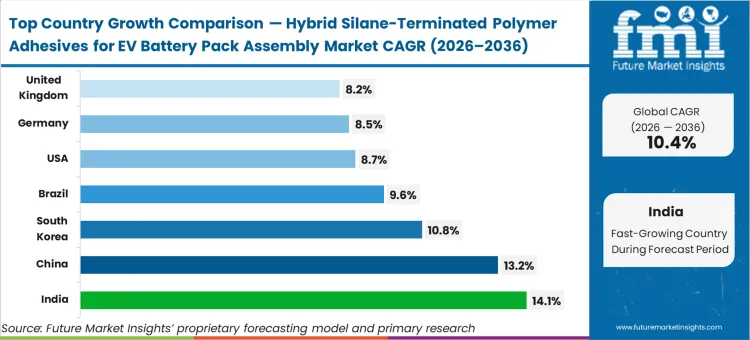
Asia Pacific Hybrid Silane-Terminated Polymer Adhesives for EV Battery Pack Assembly Market Analysis
Extreme ambient humidity coupled with rapid electrification defines local application dynamics across the regional battery pack manufacturing sector. Factory floors operating without sophisticated climate control systems experience unpredictable cure rates utilizing traditional moisture-sensitive chemistries. This environmental reality forces assembly planners to demand highly customized silane variants maintaining stable pot-lives despite elevated atmospheric water content. According to FMI's estimates, regional battery integrators prioritize ambient stability over absolute structural yield strength.
- India: Local two-wheeler pack assembly in high-humidity zones exposes conventional epoxies to rapid degradation. Quality control managers face 14.1% compound growth demands, a CAGR supported by rapid two-wheeler electrification and formulations specifically tuned for tropical manufacturing climates. Securing these adapted materials ensures early dominance in booming micro-mobility supply chains utilizing PFAS free EV battery fire protection coatings.
- China: Gigafactory integrators demand immense volumetric supply commitments. Production line supervisors navigating 13.2% compound growth prioritize primerless adhesion across diverse aluminum alloys to support soaring China EV battery adhesive market demand, fostering a robust CAGR. Securing exclusive localized supply contracts blocks international competitors from accessing massive domestic vehicle platforms.
- South Korea: Concentrated battery cell manufacturing forces deep material partnerships. R&D directors driving 10.8% compound growth co-develop specific battery binder resins ensuring compatibility with adjacent silane sealants, cementing continuous regional CAGR advancement. Achieving this chemical synergy lowers overall pack failure rates dramatically.
North America Hybrid Silane-Terminated Polymer Adhesives for EV Battery Pack Assembly Market Analysis
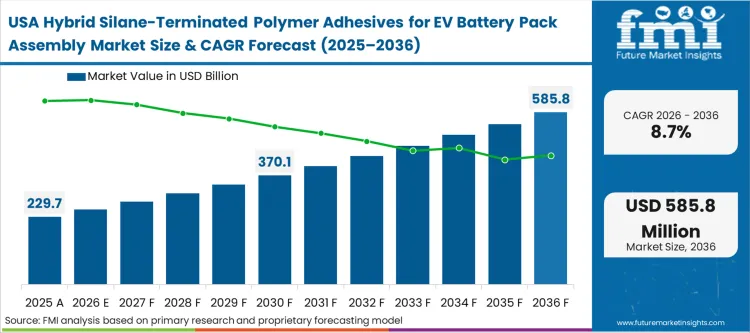
Federal localization incentives fundamentally reshape material sourcing strategies across the regional automotive supply chain. Automakers establishing domestic supply networks reject imported adhesive formulations to satisfy strict origin-content mandates. This political pressure compels global chemical conglomerates to replicate complex hybrid polymerization infrastructure locally. Based on FMI's assessment, local compliance requirements heavily outweigh marginal unit cost advantages previously gained through international sourcing.
- United States: Domestic battery plant construction requires localized adhesive compounding. Supply chain directors tracking 8.7% compound growth aggressively map United States EV battery pack adhesive suppliers to prevent critical supply disruptions, accelerating national CAGR trends. Achieving localized certification guarantees inclusion on upcoming heavy-duty electric truck platforms incorporating battery pack foils.
Europe Hybrid Silane-Terminated Polymer Adhesives for EV Battery Pack Assembly Market Analysis
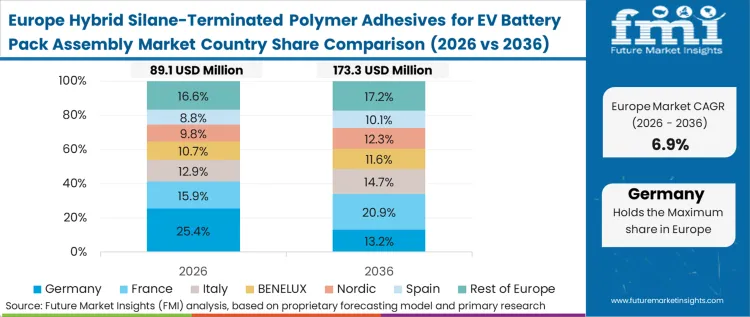
European vehicle end-of-life directives compel automakers to rethink structural permanence across the continent. Traditional epoxies create indestructible joints rendering individual cell extraction impossible, driving regulatory pressure that forces mechanical engineers to deploy reversible hybrid formulations.
- Germany: Automakers utilize these structural foundations to standardize compliance ahead of continental mandates. Premium platform transitions establish a robust 8.5% CAGR, supported by intense localization of cell-to-pack manufacturing capacities.
- United Kingdom: Specialty vehicle production and localized fleet electrification drive an 8.2% CAGR. Design engineers implement specific high-elongation dampening sealants to accommodate unique chassis stress profiles in niche commercial platforms.
Latin America Hybrid Silane-Terminated Polymer Adhesives for EV Battery Pack Assembly Market Analysis
Emerging electrification policies push global automotive brands to localize assembly operations within the region. Establishing dependable material sourcing networks remains paramount for maintaining production schedules in humid climates.
- Brazil: Early-stage local manufacturing integration supports a 9.6% CAGR as international automakers establish localized battery assembly hubs. Securing reliable moisture-cure materials eliminates long-distance supply chain risks across tropical operating environments.
FMI's report includes detailed assessments covering the broader Middle East & Africa and other expanding territories. Distinct winter temperature extremes across Nordic regions mandate specific cold-weather elongation modifications integrating high thermal stability separator polymers for fast charging batteries not required elsewhere.
Competitive Aligners for Market Players
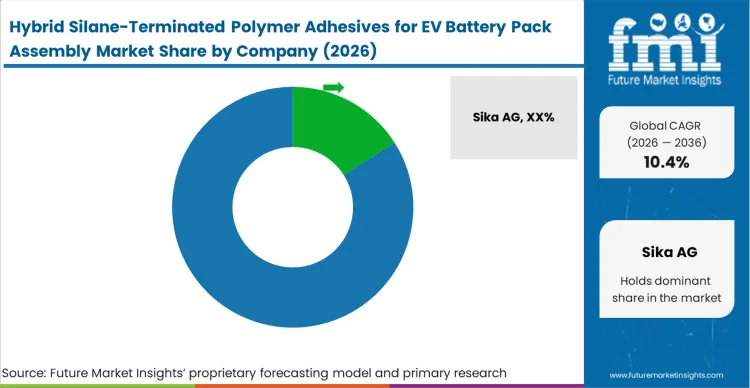
Extreme formulation concentration defines tier-one chemical supply dynamics. Giants including Sika AG, Henkel AG & Co. KGaA, and Arkema S.A. control underlying prepolymer synthesis, while regional formulators merely blend and package final products. Purchasing directors at major automakers map STP adhesive suppliers for EV battery pack assembly carefully, refusing to qualify suppliers lacking full backward integration into basic silane chemistry. This risk-averse behavior isolates blending-only operations into lower-tier aftermarket repair roles exclusively, mirroring dynamics in adhesives for hydrogen tank composite wraps.
Incumbents possess deep libraries containing decade-long cyclic fatigue data across diverse temperature profiles. Challengers simply cannot simulate ten years of real-world road vibration mathematically. FMI analysts note that successful EV battery pack sealing adhesive manufacturers instead attack specific manufacturing friction points, such as developing intumescent sealants for ev battery fire barriers utilizing hybrid technology. Offering unique functional combinations allows new entrants to bypass established structural adhesive contracts entirely.
Automotive procurement teams actively resist single-source material lock-in across critical structural components. Engineers deliberately publish broad performance windows ensuring multiple global chemical firms can supply acceptable formulations. Sustained competitive advantage requires passing strict battery pack assembly adhesive OEM qualification protocols, embedding proprietary rheological profiles matching automaker pump equipment precisely, similar to battery separator coatings.
Key Players in Hybrid Silane-Terminated Polymer Adhesives for EV Battery Pack Assembly Market
- Sika AG
- Henkel AG & Co. KGaA
- Arkema S.A. (Bostik)
- WACKER Chemie AG
- Kaneka Corporation
- H.B. Fuller Company
- ThreeBond Holdings Co., Ltd.
Scope of the Report
| Metric | Value |
|---|---|
| Quantitative Units | USD 0.4 billion to USD 1.1 billion, at a CAGR of 10.4% |
| Market Definition | The hybrid silane-terminated polymer adhesives for EV battery pack assembly market encompasses reactive formulations combining polymer backbones with moisture-sensitive silane end-groups designed for structural joining within electric vehicle energy storage systems. These compounds deliver specific viscoelastic profiles allowing simultaneous load transfer, vibration damping, and environmental sealing without requiring isocyanate-driven curing pathways. |
| Segmentation | Polymer Backbone, Application Zone, Cure Cure System, Pack Architecture, Vehicle Class |
| Regions Covered | North America, Europe, Asia Pacific, Latin America, Middle East & Africa |
| Countries Covered | United States, Canada, Brazil, Mexico, Germany, United Kingdom, France, Italy, Spain, Russia, Poland, China, Japan, South Korea, India, ASEAN, Australia, New Zealand, GCC Countries, South Africa |
| Key Companies Profiled | Sika AG, Henkel AG & Co. KGaA, Arkema S.A. (Bostik), WACKER Chemie AG, Kaneka Corporation, H.B. Fuller Company, ThreeBond Holdings Co., Ltd. |
| Forecast Period | 2026 to 2036 |
| Approach | Global electric vehicle production volume baselines cross-referenced against average adhesive mass per cell-to-pack architecture. |
Source: Future Market Insights (FMI) analysis, based on proprietary forecasting model and primary research
Hybrid Silane-Terminated Polymer Adhesives for EV Battery Pack Assembly Market Analysis by Segments
Polymer Backbone:
- Polyether STP
- Polyurethane STP
- Acrylic Hybrid
Application Zone:
- Sealing Gasketing
- Cover Bonding
- Edge Bonding
- Gap Filling
- Thermal Bonding
Cure System:
- 1K Moisture
- 2K Reactive
- Heat Assist
Pack Architecture:
- Cell-to-Pack
- Module-to-Pack
- Tray Cover
Vehicle Class:
- Passenger EV
- Light Commercial
- Electric Bus
Region:
- North America
- United States
- Canada
- Europe
- Germany
- United Kingdom
- France
- Italy
- Spain
- Russia
- Sweden
- Asia Pacific
- China
- Japan
- India
- South Korea
- Australia
- New Zealand
- Indonesia
- Thailand
- Malaysia
- Latin America
- Brazil
- Mexico
- Middle East & Africa
- GCC Countries
- South Africa
- North Africa
Bibliography
- Rodrigues, V. C. M. B., Kasaei, M. M., Marques, E. A. S., Carbas, R. J. C., & da Silva, L. F. M. (2025, June). Adhesive bonding in automotive battery pack manufacturing and dismantling: A review. Discover Mechanical Engineering.
- Gilich, J., et al. (2025, December). Solvolytically debondable adhesive systems - Potentials and challenges for repair and recycling. The Journal of Adhesion.
- Henkel. (2024, May). Discover Henkel’s innovations for sustainable battery design and assembly at the Battery Show Europe 2024.
- Henkel. (2024, September). Driving sustainability, performance and efficiency with material solutions across the battery electric vehicle lifecycle.
- Wacker Chemie AG. (2025, October). WACKER showcases next-generation thermally conductive adhesives for e-mobility at The Battery Show North America 2025.
- DuPont. (2024, August). DuPont BETAFORCE™ elastic structural adhesive wins R&D 100 Award.
This bibliography is provided for reader reference. The full FMI report contains the complete reference list with primary source documentation.
Frequently Asked Questions
What is the EV battery adhesive market size for hybrid STP solutions?
Demand is estimated to reach USD 0.4 billion in 2026. This figure signals intense global scaling as automakers transition rapidly away from bolted mechanical fasteners toward formed-in-place structural sealing across massive vehicle platforms.
What cumulative opportunity exists through 2036?
Revenue expansion lifts total opportunity to USD 1.1 billion by 2036. This trajectory reflects increasing adhesive volumes per vehicle as cell-to-pack architectures replace traditional modular housings entirely.
What growth rate applies to this automotive battery pack adhesive market?
A compound annual growth rate of 10.4% defines the decade. This sustained expansion relies heavily upon incoming European dismantling directives forcing reversible bonding solutions into standard vehicle production.
Why use STP adhesives instead of polyurethane in battery packs?
Inherent backbone flexibility combined with exceptional hydrolysis resistance ensures decades of stability under continuous thermal loading. Production floor managers specifically prefer polyether variants preventing rapid stator wear inside automated dispensing pumps.
Where are STP adhesives used in battery pack assembly?
Consolidating physical joint securing and environmental isolation into single manufacturing steps alters assembly economics permanently. These specific formulated beads distribute torsional chassis forces while simultaneously absorbing high-frequency inverter noise in sealing zones.
Why do 1K Moisture systems hold primary market share?
Single-component formulations eliminate complex volumetric ratio monitoring equipment entirely. Removing mixing-nozzle purging sequences drastically reduces expensive chemical waste during mandatory shift changes across high-volume assembly lines.
How does Cell-to-Pack architecture influence formulation requirements?
Direct cell bonding removes intermediate aluminum framing, demanding massive volumetric adhesive applications. Pack designers require exact elastomeric profiles ensuring materials stretch rather than rupture during maximum lithium-ion cell swelling phases.
Why do Passenger EV platforms dictate baseline specifications?
Automakers standardize modular skateboard designs across dozens of consumer models simultaneously. This enormous unified scale drives supplier formulation economics, establishing baseline performance parameters utilized across secondary heavy-duty vehicle classes later.
What structural difference drives India's 14.1% expansion?
Extreme ambient humidity severely complicates conventional moisture-cure chemistry. Local two-wheeler pack integrators require highly customized silane variants maintaining stable pot-lives despite elevated atmospheric water content inside unconditioned factory spaces.
How does China's 13.2% trajectory differ structurally?
Massive gigafactory scale prioritizes zero-stringing rheology maximizing robotic traverse speeds. Regional formulators focus entirely on shaving seconds off production cycle times rather than pushing ultimate material elongation limits further.
What drives South Korea's 10.8% compound growth?
Concentrated battery cell manufacturing forces deep localized material partnerships. R&D directors co-develop specific binder systems ensuring absolute chemical compatibility with adjacent silane sealants, lowering overall pack failure rates dramatically.
What dictates North America adoption rates?
Federal localization incentives fundamentally reshape material sourcing strategies. Automakers establishing domestic supply networks reject imported adhesive formulations completely, compelling global chemical conglomerates to replicate complex hybrid polymerization infrastructure locally.
What limits rapid adoption across smaller facilities?
Lengthy ambient cure requirements introduce severe factory floor bottlenecks. While single-component systems offer unmatched dispensing simplicity, waiting days for deep geometries to fully crosslink creates unacceptable staging delays requiring expensive HVAC interventions.
How does debondability affect recycling and repair economics?
Impending directives force automakers to implement reversible bonding architectures allowing safe localized cell extraction. This legal pressure accelerates silane-terminated polymer qualification processes from multi-year cycles down to eighteen months.
What role does acoustic dampening play during adhesive selection?
High-frequency inverter whine penetrates poorly sealed enclosures easily. Acoustic technicians rely on specifically formulated gasket density profiles absorbing irritating noise frequencies before they reach passenger compartments, preventing failed audit inspections.
How does pre-cure viscosity influence purchasing decisions?
Highly filled viscous formulations destroy precision pump stators rapidly. Maintenance supervisors demand specific rheological profiles preventing catastrophic equipment failure during peak production shifts, often overriding laboratory lap-shear test results entirely.
compare STP, silicone, epoxy, and polyurethane for EV battery pack assembly?
Designing massive unified battery packs requires balancing rigidity and flexibility. Epoxies offer high strength but zero reworkability. Polyurethanes cure fast but fail under extreme thermal stress. Silicones handle heat but lack structural grip. STP bridges these gaps, providing structural strength, thermal resilience, and controlled elasticity.
Why do commercial delivery vans establish vibration standards?
Urban commercial routes generate intense continuous road shock daily. Chassis engineers demand distinct high-damping silane variants preventing structural fatigue across delivery fleets, exceeding standard passenger-car resilience specifications significantly.
Which companies supply hybrid adhesives for EV battery pack sealing?
Purchasing directors at major automakers rely on backward-integrated giants like Sika AG, Henkel AG & Co. KGaA, and Arkema S.A. This extreme risk-averse behavior isolates blending-only formulation operations into much smaller aftermarket repair roles exclusively.
How do formulators achieve rapid green strength?
Immediate handling strength eliminates critical factory staging bottlenecks. R&D directors solve floor-space constraints by engineering immediate tack profiles allowing robotic handling minutes after initial adhesive application without requiring expensive heating ovens.
What drives demand for thermally conductive hybrids?
Integrating ceramic fillers provides dual structural bonding and heat dissipation functionality. Materials scientists engineering highly loaded silane matrices eliminate secondary thermal paste applications entirely, streamlining overall pack assembly processes.
How does mixing ratio complexity impact line efficiency?
Two-component systems demand continuous precise volumetric monitoring. Quality control directors prefer single-component systems avoiding catastrophic adhesion failures caused when complex metering systems drift slightly out of calibration unnoticed.
Are STP adhesives better for low-VOC and isocyanate-free manufacturing?
Yes. Deep section curing requirements meet strict indoor air quality mandates when utilizing silane-terminated polymers. Facilities managers avoid the respiratory hazards associated with isocyanates while maintaining high-performance structural bonds.
best adhesive for EV battery pack sealing to avoid single-source material lock-in?
Automotive procurement teams deliberately publish broad performance windows ensuring multiple global chemical firms can supply acceptable formulations. Sustained competitive advantage requires formulators to embed proprietary rheological profiles matching automaker pump equipment perfectly.
Preview the report firsthand - request a free sample
Get SampleGet the brochure for pricing and purchase details.
Get PDFTable of Content
- Executive Summary
- Global Market Outlook
- Demand-side Trends
- Supply-side Trends
- Technology Roadmap Analysis
- Analysis and Recommendations
- Market Overview
- Market Coverage / Taxonomy
- Market Definition / Scope / Limitations
- Research Methodology
- Chapter Orientation
- Analytical Lens and Working Hypotheses
- Market Structure, Signals, and Trend Drivers
- Benchmarking and Cross-market Comparability
- Market Sizing, Forecasting, and Opportunity Mapping
- Research Design and Evidence Framework
- Desk Research Programme (Secondary Evidence)
- Company Annual and Sustainability Reports
- Peer-reviewed Journals and Academic Literature
- Corporate Websites, Product Literature, and Technical Notes
- Earnings Decks and Investor Briefings
- Statutory Filings and Regulatory Disclosures
- Technical White Papers and Standards Notes
- Trade Journals, Industry Magazines, and Analyst Briefs
- Conference Proceedings, Webinars, and Seminar Materials
- Government Statistics Portals and Public Data Releases
- Press Releases and Reputable Media Coverage
- Specialist Newsletters and Curated Briefings
- Sector Databases and Reference Repositories
- FMI Internal Proprietary Databases and Historical Market Datasets
- Subscription Datasets and Paid Sources
- Social Channels, Communities, and Digital Listening Inputs
- Additional Desk Sources
- Expert Input and Fieldwork (Primary Evidence)
- Primary Modes
- Qualitative Interviews and Expert Elicitation
- Quantitative Surveys and Structured Data Capture
- Blended Approach
- Why Primary Evidence is Used
- Field Techniques
- Interviews
- Surveys
- Focus Groups
- Observational and In-context Research
- Social and Community Interactions
- Stakeholder Universe Engaged
- C-suite Leaders
- Board Members
- Presidents and Vice Presidents
- R&D and Innovation Heads
- Technical Specialists
- Domain Subject-matter Experts
- Scientists
- Physicians and Other Healthcare Professionals
- Governance, Ethics, and Data Stewardship
- Research Ethics
- Data Integrity and Handling
- Primary Modes
- Tooling, Models, and Reference Databases
- Desk Research Programme (Secondary Evidence)
- Data Engineering and Model Build
- Data Acquisition and Ingestion
- Cleaning, Normalisation, and Verification
- Synthesis, Triangulation, and Analysis
- Quality Assurance and Audit Trail
- Market Background
- Market Dynamics
- Drivers
- Restraints
- Opportunity
- Trends
- Scenario Forecast
- Demand in Optimistic Scenario
- Demand in Likely Scenario
- Demand in Conservative Scenario
- Opportunity Map Analysis
- Product Life Cycle Analysis
- Supply Chain Analysis
- Investment Feasibility Matrix
- Value Chain Analysis
- PESTLE and Porter’s Analysis
- Regulatory Landscape
- Regional Parent Market Outlook
- Production and Consumption Statistics
- Import and Export Statistics
- Market Dynamics
- Global Market Analysis 2021 to 2025 and Forecast, 2026 to 2036
- Historical Market Size Value (USD Million) Analysis, 2021 to 2025
- Current and Future Market Size Value (USD Million) Projections, 2026 to 2036
- Y-o-Y Growth Trend Analysis
- Absolute $ Opportunity Analysis
- Global Market Pricing Analysis 2021 to 2025 and Forecast 2026 to 2036
- Global Market Analysis 2021 to 2025 and Forecast 2026 to 2036, By Polymer Backbone
- Introduction / Key Findings
- Historical Market Size Value (USD Million) Analysis By Polymer Backbone , 2021 to 2025
- Current and Future Market Size Value (USD Million) Analysis and Forecast By Polymer Backbone , 2026 to 2036
- Polyether STP
- Polyurethane STP
- Acrylic Hybrid
- Polyether STP
- Y-o-Y Growth Trend Analysis By Polymer Backbone , 2021 to 2025
- Absolute $ Opportunity Analysis By Polymer Backbone , 2026 to 2036
- Global Market Analysis 2021 to 2025 and Forecast 2026 to 2036, By Application Zone
- Introduction / Key Findings
- Historical Market Size Value (USD Million) Analysis By Application Zone, 2021 to 2025
- Current and Future Market Size Value (USD Million) Analysis and Forecast By Application Zone, 2026 to 2036
- Sealing Gasketing
- Cover Bonding
- Gap Filling
- Sealing Gasketing
- Y-o-Y Growth Trend Analysis By Application Zone, 2021 to 2025
- Absolute $ Opportunity Analysis By Application Zone, 2026 to 2036
- Global Market Analysis 2021 to 2025 and Forecast 2026 to 2036, By Cure System
- Introduction / Key Findings
- Historical Market Size Value (USD Million) Analysis By Cure System, 2021 to 2025
- Current and Future Market Size Value (USD Million) Analysis and Forecast By Cure System, 2026 to 2036
- 1K Moisture
- 2K Reactive
- Heat Assist
- 1K Moisture
- Y-o-Y Growth Trend Analysis By Cure System, 2021 to 2025
- Absolute $ Opportunity Analysis By Cure System, 2026 to 2036
- Global Market Analysis 2021 to 2025 and Forecast 2026 to 2036, By Pack Architecture
- Introduction / Key Findings
- Historical Market Size Value (USD Million) Analysis By Pack Architecture, 2021 to 2025
- Current and Future Market Size Value (USD Million) Analysis and Forecast By Pack Architecture, 2026 to 2036
- Cell-to-Pack
- Module-to-Pack
- Tray Cover
- Cell-to-Pack
- Y-o-Y Growth Trend Analysis By Pack Architecture, 2021 to 2025
- Absolute $ Opportunity Analysis By Pack Architecture, 2026 to 2036
- Global Market Analysis 2021 to 2025 and Forecast 2026 to 2036, By Vehicle Class
- Introduction / Key Findings
- Historical Market Size Value (USD Million) Analysis By Vehicle Class, 2021 to 2025
- Current and Future Market Size Value (USD Million) Analysis and Forecast By Vehicle Class, 2026 to 2036
- Passenger EV
- Light Commercial
- Electric Bus
- Passenger EV
- Y-o-Y Growth Trend Analysis By Vehicle Class, 2021 to 2025
- Absolute $ Opportunity Analysis By Vehicle Class, 2026 to 2036
- Global Market Analysis 2021 to 2025 and Forecast 2026 to 2036, By Region
- Introduction
- Historical Market Size Value (USD Million) Analysis By Region, 2021 to 2025
- Current Market Size Value (USD Million) Analysis and Forecast By Region, 2026 to 2036
- North America
- Latin America
- Western Europe
- Eastern Europe
- East Asia
- South Asia and Pacific
- Middle East & Africa
- Market Attractiveness Analysis By Region
- North America Market Analysis 2021 to 2025 and Forecast 2026 to 2036, By Country
- Historical Market Size Value (USD Million) Trend Analysis By Market Taxonomy, 2021 to 2025
- Market Size Value (USD Million) Forecast By Market Taxonomy, 2026 to 2036
- By Country
- USA
- Canada
- Mexico
- By Polymer Backbone
- By Application Zone
- By Cure System
- By Pack Architecture
- By Vehicle Class
- By Country
- Market Attractiveness Analysis
- By Country
- By Polymer Backbone
- By Application Zone
- By Cure System
- By Pack Architecture
- By Vehicle Class
- Key Takeaways
- Latin America Market Analysis 2021 to 2025 and Forecast 2026 to 2036, By Country
- Historical Market Size Value (USD Million) Trend Analysis By Market Taxonomy, 2021 to 2025
- Market Size Value (USD Million) Forecast By Market Taxonomy, 2026 to 2036
- By Country
- Brazil
- Chile
- Rest of Latin America
- By Polymer Backbone
- By Application Zone
- By Cure System
- By Pack Architecture
- By Vehicle Class
- By Country
- Market Attractiveness Analysis
- By Country
- By Polymer Backbone
- By Application Zone
- By Cure System
- By Pack Architecture
- By Vehicle Class
- Key Takeaways
- Western Europe Market Analysis 2021 to 2025 and Forecast 2026 to 2036, By Country
- Historical Market Size Value (USD Million) Trend Analysis By Market Taxonomy, 2021 to 2025
- Market Size Value (USD Million) Forecast By Market Taxonomy, 2026 to 2036
- By Country
- Germany
- UK
- Italy
- Spain
- France
- Nordic
- BENELUX
- Rest of Western Europe
- By Polymer Backbone
- By Application Zone
- By Cure System
- By Pack Architecture
- By Vehicle Class
- By Country
- Market Attractiveness Analysis
- By Country
- By Polymer Backbone
- By Application Zone
- By Cure System
- By Pack Architecture
- By Vehicle Class
- Key Takeaways
- Eastern Europe Market Analysis 2021 to 2025 and Forecast 2026 to 2036, By Country
- Historical Market Size Value (USD Million) Trend Analysis By Market Taxonomy, 2021 to 2025
- Market Size Value (USD Million) Forecast By Market Taxonomy, 2026 to 2036
- By Country
- Russia
- Poland
- Hungary
- Balkan & Baltic
- Rest of Eastern Europe
- By Polymer Backbone
- By Application Zone
- By Cure System
- By Pack Architecture
- By Vehicle Class
- By Country
- Market Attractiveness Analysis
- By Country
- By Polymer Backbone
- By Application Zone
- By Cure System
- By Pack Architecture
- By Vehicle Class
- Key Takeaways
- East Asia Market Analysis 2021 to 2025 and Forecast 2026 to 2036, By Country
- Historical Market Size Value (USD Million) Trend Analysis By Market Taxonomy, 2021 to 2025
- Market Size Value (USD Million) Forecast By Market Taxonomy, 2026 to 2036
- By Country
- China
- Japan
- South Korea
- By Polymer Backbone
- By Application Zone
- By Cure System
- By Pack Architecture
- By Vehicle Class
- By Country
- Market Attractiveness Analysis
- By Country
- By Polymer Backbone
- By Application Zone
- By Cure System
- By Pack Architecture
- By Vehicle Class
- Key Takeaways
- South Asia and Pacific Market Analysis 2021 to 2025 and Forecast 2026 to 2036, By Country
- Historical Market Size Value (USD Million) Trend Analysis By Market Taxonomy, 2021 to 2025
- Market Size Value (USD Million) Forecast By Market Taxonomy, 2026 to 2036
- By Country
- India
- ASEAN
- Australia & New Zealand
- Rest of South Asia and Pacific
- By Polymer Backbone
- By Application Zone
- By Cure System
- By Pack Architecture
- By Vehicle Class
- By Country
- Market Attractiveness Analysis
- By Country
- By Polymer Backbone
- By Application Zone
- By Cure System
- By Pack Architecture
- By Vehicle Class
- Key Takeaways
- Middle East & Africa Market Analysis 2021 to 2025 and Forecast 2026 to 2036, By Country
- Historical Market Size Value (USD Million) Trend Analysis By Market Taxonomy, 2021 to 2025
- Market Size Value (USD Million) Forecast By Market Taxonomy, 2026 to 2036
- By Country
- Kingdom of Saudi Arabia
- Other GCC Countries
- Turkiye
- South Africa
- Other African Union
- Rest of Middle East & Africa
- By Polymer Backbone
- By Application Zone
- By Cure System
- By Pack Architecture
- By Vehicle Class
- By Country
- Market Attractiveness Analysis
- By Country
- By Polymer Backbone
- By Application Zone
- By Cure System
- By Pack Architecture
- By Vehicle Class
- Key Takeaways
- Key Countries Market Analysis
- USA
- Pricing Analysis
- Market Share Analysis, 2025
- By Polymer Backbone
- By Application Zone
- By Cure System
- By Pack Architecture
- By Vehicle Class
- Canada
- Pricing Analysis
- Market Share Analysis, 2025
- By Polymer Backbone
- By Application Zone
- By Cure System
- By Pack Architecture
- By Vehicle Class
- Mexico
- Pricing Analysis
- Market Share Analysis, 2025
- By Polymer Backbone
- By Application Zone
- By Cure System
- By Pack Architecture
- By Vehicle Class
- Brazil
- Pricing Analysis
- Market Share Analysis, 2025
- By Polymer Backbone
- By Application Zone
- By Cure System
- By Pack Architecture
- By Vehicle Class
- Chile
- Pricing Analysis
- Market Share Analysis, 2025
- By Polymer Backbone
- By Application Zone
- By Cure System
- By Pack Architecture
- By Vehicle Class
- Germany
- Pricing Analysis
- Market Share Analysis, 2025
- By Polymer Backbone
- By Application Zone
- By Cure System
- By Pack Architecture
- By Vehicle Class
- UK
- Pricing Analysis
- Market Share Analysis, 2025
- By Polymer Backbone
- By Application Zone
- By Cure System
- By Pack Architecture
- By Vehicle Class
- Italy
- Pricing Analysis
- Market Share Analysis, 2025
- By Polymer Backbone
- By Application Zone
- By Cure System
- By Pack Architecture
- By Vehicle Class
- Spain
- Pricing Analysis
- Market Share Analysis, 2025
- By Polymer Backbone
- By Application Zone
- By Cure System
- By Pack Architecture
- By Vehicle Class
- France
- Pricing Analysis
- Market Share Analysis, 2025
- By Polymer Backbone
- By Application Zone
- By Cure System
- By Pack Architecture
- By Vehicle Class
- India
- Pricing Analysis
- Market Share Analysis, 2025
- By Polymer Backbone
- By Application Zone
- By Cure System
- By Pack Architecture
- By Vehicle Class
- ASEAN
- Pricing Analysis
- Market Share Analysis, 2025
- By Polymer Backbone
- By Application Zone
- By Cure System
- By Pack Architecture
- By Vehicle Class
- Australia & New Zealand
- Pricing Analysis
- Market Share Analysis, 2025
- By Polymer Backbone
- By Application Zone
- By Cure System
- By Pack Architecture
- By Vehicle Class
- China
- Pricing Analysis
- Market Share Analysis, 2025
- By Polymer Backbone
- By Application Zone
- By Cure System
- By Pack Architecture
- By Vehicle Class
- Japan
- Pricing Analysis
- Market Share Analysis, 2025
- By Polymer Backbone
- By Application Zone
- By Cure System
- By Pack Architecture
- By Vehicle Class
- South Korea
- Pricing Analysis
- Market Share Analysis, 2025
- By Polymer Backbone
- By Application Zone
- By Cure System
- By Pack Architecture
- By Vehicle Class
- Russia
- Pricing Analysis
- Market Share Analysis, 2025
- By Polymer Backbone
- By Application Zone
- By Cure System
- By Pack Architecture
- By Vehicle Class
- Poland
- Pricing Analysis
- Market Share Analysis, 2025
- By Polymer Backbone
- By Application Zone
- By Cure System
- By Pack Architecture
- By Vehicle Class
- Hungary
- Pricing Analysis
- Market Share Analysis, 2025
- By Polymer Backbone
- By Application Zone
- By Cure System
- By Pack Architecture
- By Vehicle Class
- Kingdom of Saudi Arabia
- Pricing Analysis
- Market Share Analysis, 2025
- By Polymer Backbone
- By Application Zone
- By Cure System
- By Pack Architecture
- By Vehicle Class
- Turkiye
- Pricing Analysis
- Market Share Analysis, 2025
- By Polymer Backbone
- By Application Zone
- By Cure System
- By Pack Architecture
- By Vehicle Class
- South Africa
- Pricing Analysis
- Market Share Analysis, 2025
- By Polymer Backbone
- By Application Zone
- By Cure System
- By Pack Architecture
- By Vehicle Class
- USA
- Market Structure Analysis
- Competition Dashboard
- Competition Benchmarking
- Market Share Analysis of Top Players
- By Regional
- By Polymer Backbone
- By Application Zone
- By Cure System
- By Pack Architecture
- By Vehicle Class
- Competition Analysis
- Competition Deep Dive
- Sika AG
- Overview
- Product Portfolio
- Profitability by Market Segments (Product/Age /Sales Channel/Region)
- Sales Footprint
- Strategy Overview
- Marketing Strategy
- Product Strategy
- Channel Strategy
- Henkel AG & Co. KGaA
- Arkema S.A. (Bostik)
- WACKER Chemie AG
- Kaneka Corporation
- H.B. Fuller Company
- Sika AG
- Competition Deep Dive
- Assumptions & Acronyms Used


