

- Industry Size (2026)
- USD 0.6 Bn
- Forecast (2036)
- USD 3.0 Bn
- CAGR (2026 to 2036)
- 18.8%
EV Battery Passport Market Size, Market Forecast and Outlook By FMI
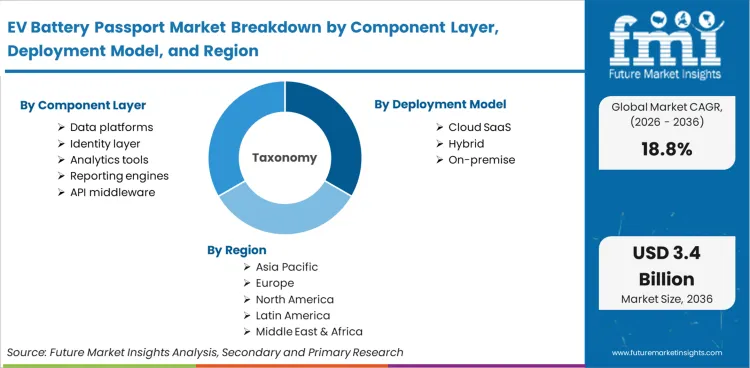
In 2025, the EV battery passport market was assessed to have claimed USD 0.4 billion revenue growth and is now poised to surpass USD 0.6 billion in 2026 at a CAGR of 18.8% during this forecast period. Regulatory pressure lifts market valuation to USD 3.0 billion through 2036 as automotive original equipment manufacturers face mandatory serial-number traceability requirements across continental borders, determining the ultimate market size.
Compliance officers inside automotive manufacturing face extreme commercial risk if cell-level supply data remains siloed inside tier-three cathode facilities. European mandates will block non-compliant packs from port entry starting early next decade, pushing brands toward a unified battery passport compliance platform. Procurement teams know EU battery passport solutions supply mandatory lifecycle documentation required for customs clearance. Delaying integration means delayed vehicle launches. Missing origin records directly prevents fleet operators from claiming critical tax incentives, destroying competitive pricing advantages.
Summary of EV Battery Passport Market
- EV Battery Passport Market Definition
- Serialized software infrastructure captures carbon footprints, material sourcing details, and lifecycle metrics into immutable ledgers, allowing automotive manufacturers to prove regulatory compliance and establish circular economy workflows.
- Demand Drivers in the Market
- European Union regulatory deadlines compel automotive compliance teams to implement verifiable pack-level traceability before import bans take effect.
- Corporate sustainability targets force fleet operators to require granular carbon footprint calculations for all incoming commercial vehicles.
- Secondary life valuation pressure pushes vehicle leasing firms to demand immutable state-of-health ledgers prior to resale.
- Key Segments Analyzed in the FMI Report
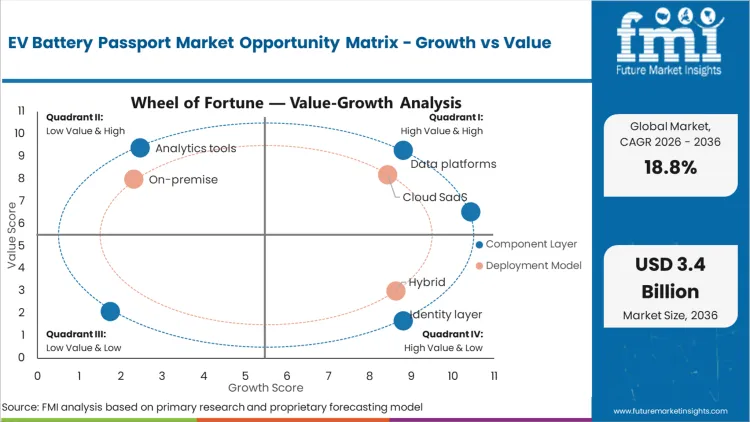
- Data Platforms: 38% share in 2026, driven by OEMs requiring unified ledgers across fragmented supplier networks.
- Cloud SaaS: projected to lead by Deployment model, as continuous regulatory updates require instantaneous system-wide compliance patching.
- BEV Packs: 58% share, reflecting pure passenger vehicle volume and strict regulatory focus.
- OEMs: 41% share, as final assembly entities bear ultimate legal responsibility for market entry compliance.
- Carbon Data: 29% share, representing the most urgent regulatory metric requiring verification.
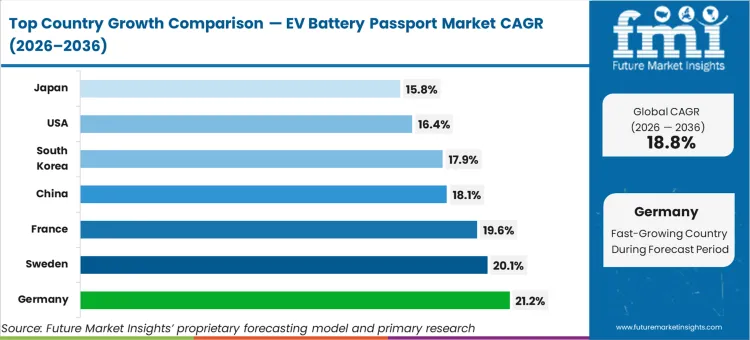
- Germany: A 21.2% of CAGR, driven by premium automaker consortiums establishing unified tracking standards ahead of regional mandates.
- Analyst Opinion at FMI
- Nikhil Kaitwade, Principal Analyst, Automotive, at FMI, observes that, "Automotive procurement teams assume tracing raw materials back to mining sources represents their biggest hurdle. In reality, convincing tier-three cathode suppliers to share proprietary energy-mix data into a shared ledger proves vastly more difficult. Software integration moves fast; commercial trust moves slowly. Platforms surviving early pilot phases succeed not through better blockchain encryption, but by offering granular access controls protecting supplier trade secrets while satisfying OEM compliance mandates."
- Strategic Implications / Executive Takeaways
- OEM procurement directors must abandon manual spreadsheet compliance tracking or face immediate port blockages for next-generation vehicle platforms.
- Tier-one battery suppliers gain significant competitive advantage by presenting verified lifecycle data proactively rather than waiting for OEM audits.
- Recycling facility operators capture premium pricing for black mass by feeding verified recovered material data back into central passport ledgers.
- Methodology
- FMI maps software licensing adoption against regional EV production targets and specific regulatory enforcement deadlines.
- Analyst teams interview supply chain digitization leads to verify actual platform deployment rates versus announced pilot programs.
- Proprietary models cross-reference SaaS revenue streams with automotive sustainability compliance budgets to validate baseline valuations.
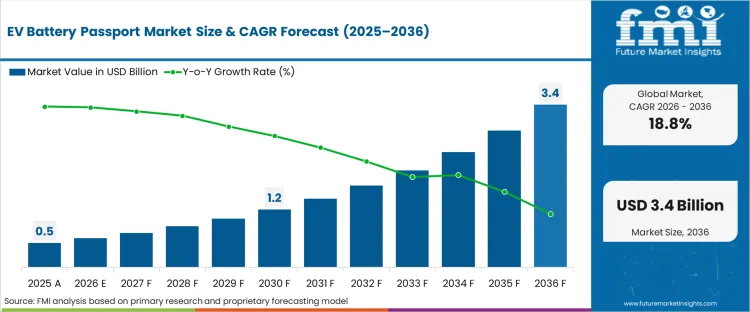
Automated data feeds from cell manufacturers trigger rapid traceability scaling. Cell makers uploading granular material metrics directly into unified ledgers eliminates manual auditing bottlenecks, shifting the industry toward a continuous battery passport traceability system. This exact transition turns battery supply chain traceability from an expensive consulting exercise into automated background compliance.
Germany leads the EV battery passport CAGR metrics at 21.2% as domestic premium automakers integrate direct cathode tracking, while Sweden tracks at 20.1% based on massive localized cell manufacturing footprint expansions. France follows closely at 19.6%. China expands at 18.1% driven by aggressive export documentation requirements. South Korea grows at 17.9%, United States advances at 16.4%, and Japan scales at 15.8% as legacy suppliers digitize historical material flow records.
EV Battery Passport Market Definition
Answering what an EV battery passport is requires looking beyond simple software labels; digital twins linking physical battery units to verifiable origin data define this category. Serialized software architecture captures carbon footprints, material sourcing details, and state-of-health metrics into immutable ledgers. This infrastructure allows automotive brands to prove regulatory compliance across multiple jurisdictions simultaneously using a centralized digital battery passport solution. Early adopters leverage digital product passport platforms to establish transparent circular economy workflows for end-of-life processing. Buyers purchase access to securely authenticated supplier networks rather than standalone database licenses.
EV Battery Passport Market Inclusions
Cloud-based tracking registries and zero-knowledge proof identity layers fall within scope. Scope covers API middleware connecting factory floor enterprise resource planning systems to external compliance repositories, forming the core of EV battery passport software. Recycled content validation tools and real-time EV battery carbon footprint reporting modules represent core components. Systems must trace materials from raw extraction through vehicle integration. Lifecycle documentation software built specifically for automotive energy storage fits this boundary. Buyers frequently bundle digital product passport software with lifecycle analysis consulting modules.
EV Battery Passport Market Exclusions
Standalone warehouse management software lacking material provenance tracking sits outside scope. General hardware sensors, physical radio-frequency identification tags, and barcode scanners are excluded because they represent physical data collection rather than passport architecture. Battery management systems controlling voltage inside vehicles fall outside this boundary. Diagnostic hardware used by mechanics to check battery health does not qualify. Exclusions deliberately separate compliance data layers from physical operating hardware.
EV Battery Passport Market Research Methodology
- Primary Research: Chief compliance officers, supply chain digitization directors, and sustainability vice presidents at global automotive OEMs.
- Desk Research: European Commission delegated acts, Global Battery Alliance pilot disclosures, and raw material certification registries.
- Market-Sizing and Forecasting: Annual EV pack production volumes anchored against compliance-ready software licensing fees per unit.
- Data Validation and Update Cycle: Software-as-a-service recurring revenue disclosures from primary platform providers cross-verified against OEM sustainability reports.
Segmental Analysis
EV Battery Passport Market Analysis By Component Layer
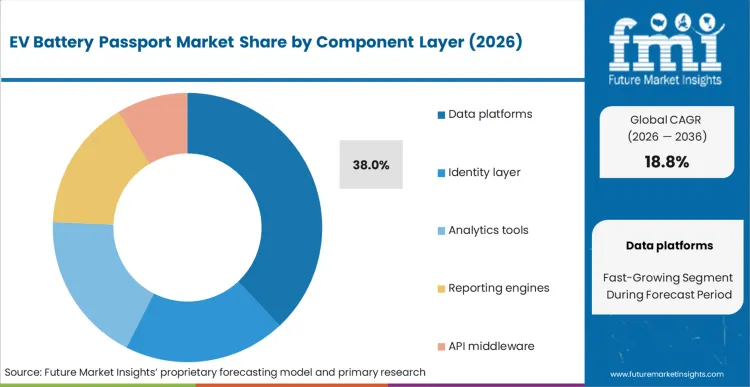
Systems connecting disparate supplier inputs into unified records dominate early adoption cycles. FMI notes Data platforms capture 38% share in 2026 as chief compliance officers prioritize central aggregation over specialized analytics. Securing material origin data across multiple supplier tiers requires massive integration capabilities. Supply chain directors face catastrophic delays if cathode manufacturers format emission data differently than cell assemblers. What standalone share figures obscure is how heavily battery passport software providers rely on proprietary application programming interfaces to maintain vendor lock-in. Once an automotive brand forces its entire supplier network onto one specific compliance and traceability solution, switching providers requires renegotiating data-sharing agreements with hundreds of individual companies. Chief information officers evaluating EV battery passport platform pricing discover that delaying platform selection causes massive accelerated integration costs as regulatory deadlines compress implementation timelines into unrealistic windows.
- Aggregation Dominance: Unified ledgers eliminate manual data reconciliation across tier-two and tier-three material providers. Chief compliance officers avoid disjointed reporting audits and secure verifiable documentation.
- API Integration Costs: Custom connections between factory enterprise resource planning tools and central platforms create significant switching friction. Supply chain directors face massive vendor lock-in once suppliers standardize specific data formats.
- Reporting Automation: Standardized output modules generate regulatory documents instantly based on aggregated supplier inputs. Regulatory affairs managers prevent port delays by presenting flawless origin certification upon request.
EV Battery Passport Market Analysis By Deployment Model
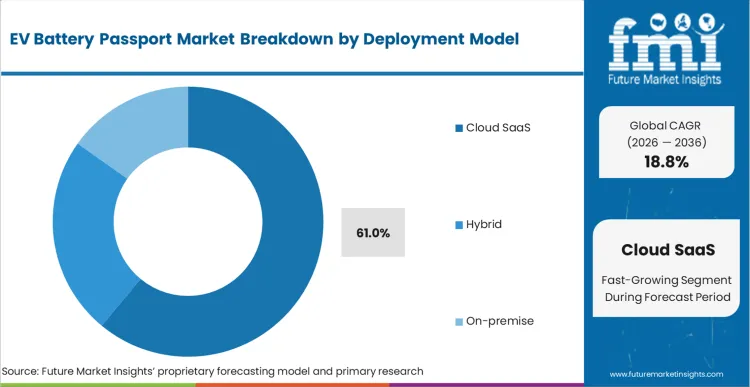
Generalist assumptions suggest OEMs prefer on-premise systems for security; however, practitioners evaluating the best battery passport platform know track and trace solutions demand constant schema updates matching new legislative definitions, making cloud delivery mandatory. Security architects choosing isolated local deployments discover their custom networks cannot interface with national customs databases, forcing expensive migrations. Continuous regulatory shifts require instant infrastructure updates across all participating entities simultaneously. FMI observes Cloud SaaS holds 61% share globally. On-premise solutions fail because they isolate data within single corporate firewalls, directly contradicting transparent traceability requirements. IT directors managing multi-continent supply chains demand architectures capable of syncing carbon data from Asian cell plants with European assembly facilities instantly.
- Instant Schema Updates: Centralized servers push regulatory definition changes to all users simultaneously without local downtime. IT directors maintain continuous compliance regardless of shifting regional legislation.
- Cross-Border Syncing: Distributed cloud nodes allow Asian battery manufacturers to upload data accessible instantly by European automotive plants. Supply chain managers avoid latency issues during critical customs clearance procedures.
- Multi-Tenant Isolation: Virtual partitions protect proprietary supplier manufacturing metrics while exposing necessary compliance points. Supplier compliance officers satisfy OEM data requests without surrendering sensitive yield rate intelligence.
EV Battery Passport Market Analysis By Battery Scope
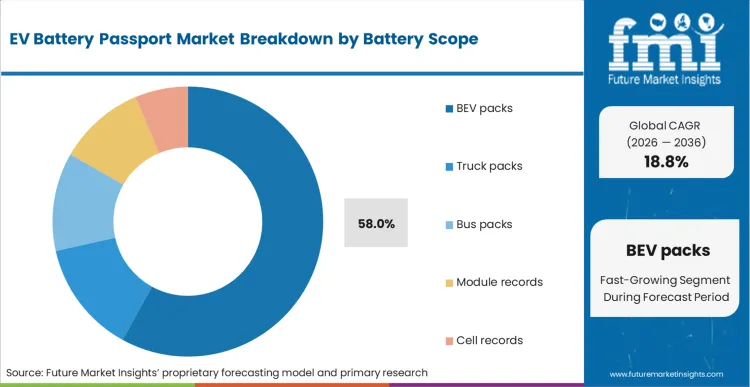
Passenger vehicle regulations dictate early architecture development. Based on FMI's assessment, BEV packs command 58% share. Commercial truck legislation lags passenger vehicle rules significantly. Fleet operators require specific data sets regarding battery degradation, but passenger automotive brands face immediate existential threats from import bans. Procurement directors prioritize passenger electric vehicle battery compliance first to secure core revenue streams. What component-level data misses entirely is how heavily module-level tracking impacts recycling economics; packs designed without accessible digital module records suffer severe value penalties at end-of-life. Recycling facility managers discount packs lacking verified module histories because manual testing destroys their margin. OEMs ignoring granular module tracking discover their secondary market pack valuations collapse compared to fully documented competitors.
- Passenger Volume Scaling: Massive consumer vehicle production runs justify expensive initial platform integration costs. Procurement directors distribute software licensing fees across millions of units, minimizing per-vehicle cost impact.
- Residual Value Preservation: Immutable state-of-health records follow physical packs into secondary applications. Leasing company fleet managers secure premium resale prices by proving exact battery degradation curves.
- End-Of-Life Processing: Digital module maps tell recyclers exactly what chemistry resides inside specific sub-components. Recycling facility operators skip expensive manual chemistry testing, improving processing margins drastically.
EV Battery Passport Market Analysis By End Use
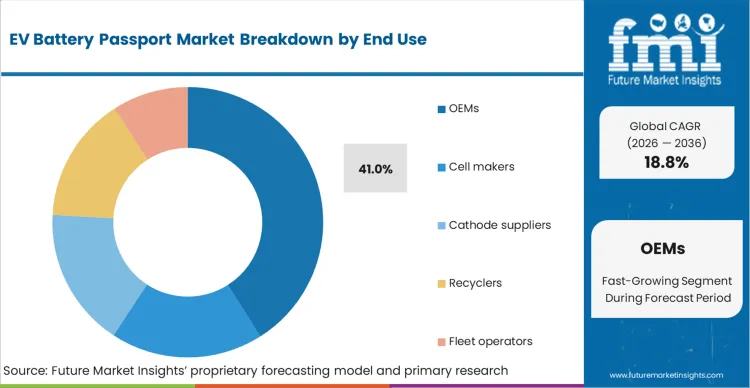
Final assembly entities bear total legal responsibility for vehicle compliance regardless of supplier failures. Component manufacturers supply data, but automakers pay for overarching platform orchestration. Chief sustainability officers inside battery electric vehicle (BEV) manufacturing face massive fines if a tier-three supplier misreports cobalt origin. Interestingly, while the debate over whether should EV OEMs build or buy battery passport software dominates IT strategy meetings, actual platform stickiness depends entirely on tier-two supplier adoption rates; platforms failing to provide frictionless supplier portals face rapid OEM abandonment. Sourcing directors forcing complex, abrasive software onto small mining operations quickly face data blockages. FMI analysts note OEMs hold 41% share across this category with OEMs selecting platforms with high supplier friction miss critical regulatory windows as their supply chain simply refuses to upload necessary documentation.
- Legal Liability Concentration: Assembly brands answer directly to national regulators for entire supply chain violations. Chief compliance officers deploy overarching platforms to audit every underlying component claim systematically.
- Supplier Portal Friction: Simple web interfaces allow small upstream material providers to upload data without complex API integrations. Sourcing directors secure high participation rates by minimizing supplier technical burden.
- Secondary Market Handover: Automakers transfer digital passport ownership rights to subsequent buyers or recyclers. Fleet managers leverage uk battery management system architectures alongside passport records to maximize residual vehicle values.
EV Battery Passport Market Analysis By Compliance Focus
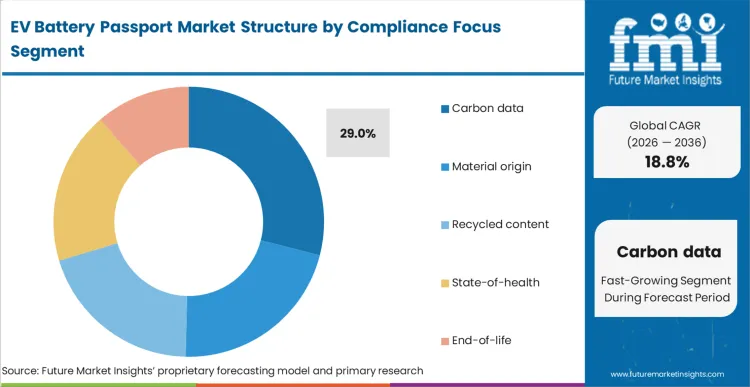
Environmental legislation isolates greenhouse gas emissions as the primary enforcement mechanism for cross-border taxation. According to FMI's estimates, Carbon data controls 29% share. Measuring dynamic energy mixes at remote cathode baking facilities presents massive mathematical challenges. Sustainability directors require platforms capable of calculating real-time carbon intensity rather than relying on generic regional averages. Surface metrics suggest material origin tracking drives adoption, yet practitioners understand calculating precise scope-three emissions dictates platform selection. Platforms using outdated regional emission factors trigger severe financial penalties under border adjustment mechanisms. Compliance managers relying on static industrial battery spreadsheets face crippling carbon tax assessments when auditors demand dynamic, site-specific energy mix documentation.
- Dynamic Emission Calculating: Algorithms process fluctuating local grid energy mixes at specific manufacturing sites during production windows. Sustainability directors avoid generic high-carbon penalties by proving actual clean energy utilization.
- Origin Tracing Authentication: Zero-knowledge proofs verify material provenance without exposing exact supplier pricing agreements. Procurement officers satisfy regulatory origin rules without giving regulators full commercial transparency.
- Recycled Ratio Verification: Platforms track exact percentages of recovered lithium and cobalt mixed into new cells. Production engineers prove incoming batches meet strict minimum recycled content mandates using South Korea battery management architectures linked to local secondary processing centers.
EV Battery Passport Market Drivers, Restraints, and Opportunities
Incoming European import bans force automotive procurement directors to deploy verifiable tracking architecture immediately. Answering what regulations drive EV battery passport adoption points directly to the impending European Union battery directive. Without functioning digital passports, brands face zero commercial access to massive continental markets starting in early 2027. Delaying implementation risks billions in stranded inventory sitting at ports awaiting manual documentation clearance. Automakers cannot afford multi-year pilot programs; they must execute full-scale production rollouts covering every supplier tier instantly to maintain operational continuity. Supply chain velocity depends entirely on battery management system data merging seamlessly with external origin ledgers.
Tier-two and tier-three suppliers actively resist uploading granular production data into central OEM-controlled ledgers. Cathode manufacturers fear OEMs will weaponize efficiency metrics and energy-mix data during future price negotiations. This structural trust deficit paralyzes implementation even when technical integration proves simple. Partial solutions involving zero-knowledge proofs attempt to verify compliance without exposing raw data, but smaller material processors still view any mandatory digital connection as a severe commercial risk.
Opportunities in the EV Battery Passport Market
- Secondary Market Valuation: Independent battery brokers leverage verified state-of-health data to price used packs accurately. Fleet leasing directors capture massive premium returns by selling fully documented units to stationary storage operators.
- Recycling Stream Optimization: Black mass processors scan digital passports to verify exact chemical compositions before dismantling. Recycling facility managers achieve higher extraction yields by tuning automotive battery management hardware recovery lines to precise incoming pack specifications.
- Dynamic Carbon Pricing: Platforms tracking real-time renewable energy usage during manufacturing allow automakers to claim lower border carbon taxes. Sustainability executives save millions annually by proving actual factory emission rates beat regional averages.
Regional Analysis
Regulatory frameworks and localized supply chain dynamics dictate the adoption of traceability software across different geographies. FMI's regional assessment highlights how varying environmental mandates and export pressures shape distinct implementation strategies worldwide. The market is segmented into North America, Latin America, Western Europe, Eastern Europe, East Asia, South Asia and Pacific, and Middle East and Africa across 40 plus countries.
.webp "Top Country Growth Comparison Ev Battery Passport Market Cagr (2026 2036)")
| Country | CAGR (2026 to 2036) |
|---|---|
| Germany | 21.2% |
| Sweden | 20.1% |
| France | 19.6% |
| China | 18.1% |
| South Korea | 17.9% |
| United States | 16.4% |
| Japan | 15.8% |
Source: Future Market Insights (FMI) analysis, based on proprietary forecasting model and primary research
Europe EV Battery Passport Market Analysis
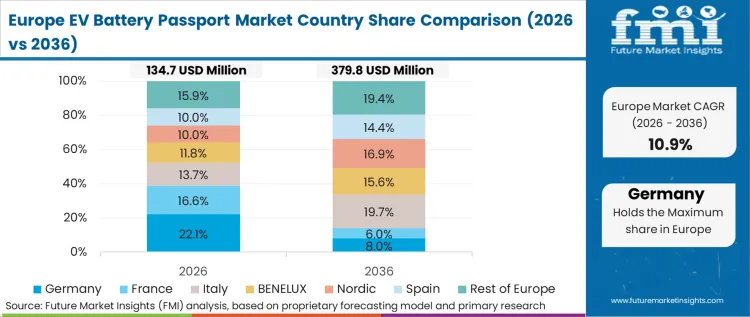
Fierce commercial rivals are being forced into unprecedented collaboration as policy mandates across European jurisdictions pivot from voluntary guidelines to hard port-entry barriers. Realizing that fragmented tracking guarantees customs failures, supply chain directors rely on heavy consortium efforts driven by premium automotive brands headquartered locally. The battery testing inspection certification workflows, as a result, now deeply embed digital passport issuance as a non-negotiable final assembly checkpoint.
- Germany: Global suppliers face a stark choice: adopt localized data standards or forfeit massive continental contracts. Chief compliance officers within domestic premium automakers coordinate rigorous supplier mandates, establishing baseline traceability requirements that reach deep into foreign mineral processing tiers. Reflecting an aggressive push in software development, the Germany EV battery passport sector achieves a 21.2% CAGR. This unified operational front effectively dictates terms to the broader automotive supply chain.
- Sweden: Factory operations directors embed tracking APIs directly into production hardware from day one to support massive greenfield cell manufacturing investments. Verified low-carbon production profiles grant Swedish cells significant pricing leverage over Asian imports. Regional industry revenue expands at a notable 20.1% CAGR, because gigafactories are scaling rapidly with built-in digital tracing.
- France: Growing at a 19.6% CAGR, the domestic landscape heavily prioritizes specific environmental metrics tied to aggressive government subsidy rules. Procurement directors strictly favor platforms that guarantee accurate carbon calculations across complex logistics chains. Missing verifiable lifecycle emission documentation immediately disqualifies vehicles from critical consumer rebate programs, tying software integration directly to retail competitiveness.
FMI notes that as Western European automakers finalize their passport architectures, they set a de facto global standard. Suppliers failing to align with these stringent European data requirements will find themselves entirely locked out of the continent's lucrative automotive ecosystem.
Asia-Pacific EV Battery Passport Market Analysis
European and North American buyers' threats to block undocumented cells have prompted massive internal software investments from dominant regional battery manufacturers. Treating passport integration as a core capability rather than an IT afterthought, export compliance directors deploy tracing platforms primarily as defensive commercial shields. Producers are increasingly leveraging EV battery formation testing data to feed initial passport records, proving baseline cell health to skeptical Western importers.
- China: Export directors ensure every outgoing pack carries required European data formatting to maintain market access. Major cell manufacturers push proprietary tracking software deep into massive domestic raw material networks. Propelling the market forward at an 18.1% CAGR, adoption focuses ruthlessly on satisfying foreign regulators. Processors that successfully digitize material origin instantly capture dominant shares of export-bound supply agreements.
- South Korea: To overcome the disadvantage of high local grid emission factors, supply chain vice presidents utilize precise carbon tracking software. Advanced chemical processors integrate blockchain identity layers directly into cathode manufacturing operations. Local platform adoption to a 17.9% CAGR are pushed by automakers relying on these suppliers dodge massive European carbon border adjustment penalties.
- Japan: Scaling at a 15.8% CAGR, Japan's infrastructure systematically connects deep-tier hybrid supply chains. Quality assurance directors merge traditional physical auditing methodologies with continuous digital verification. Legacy automotive brands are currently digitizing decades of complex, informal supplier relationships into modern ledger formats, securing long-term sourcing stability amid turbulent international regulatory shifts.
FMI analyses, the aggressive digitization sweep across East Asian battery producers fundamentally shifts the balance of supply chain transparency. By weaponizing compliance data, these manufacturers transition from being passive exporters to active controllers of global traceability standards.
North America EV Battery Passport Market Analysis
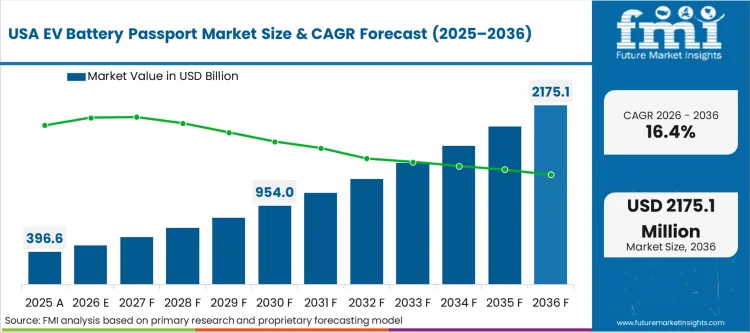
Exact mineral origin verification is no longer optional for US automakers seeking to claim critical consumer tax credits under strict federal domestic sourcing requirements. Sourcing directors frantically implement specialized tracing software to prove critical mineral percentages originate exclusively from approved free-trade partners. This intense compliance pressure redefines vendor selection criteria, prioritizing data transparency over traditional cost metrics.
- United States: Procurement teams demand flawless material provenance tracing as a fundamental prerequisite for securing domestic subsidy qualification. Chief financial officers mandate immediate platform integration before authorizing any new supplier contracts. Software deployments advance at a 16.4% CAGR, focusing ruthlessly on origin verification because failing to prove exact mineral extraction locations costs automakers thousands of dollars in pricing parity per vehicle.
FMI's report includes additional countries not detailed in the bullets above. Moving forward, comprehensive recycling mandates across emerging markets will inevitably force EV battery recycling operators to transform from passive document consumers into primary lifecycle data generators.
Competitive Aligners for Market Players
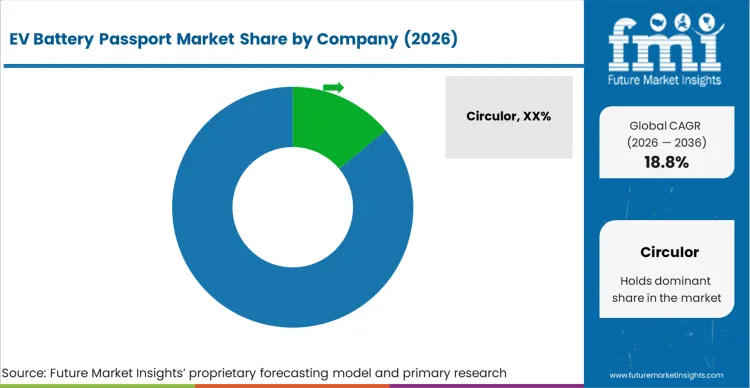
Software providers compete entirely on their ability to minimize supplier onboarding friction. Early platform iterations required complex coding from tier-three material processors, resulting in massive failure rates. Modern competitors build highly intuitive web portals allowing small mining operations to upload compliance data without hiring dedicated software engineers. Circulor and Minespider aggressively target this exact integration simplicity, understanding OEM procurement directors choose platforms based on supplier network adoption speeds rather than theoretical blockchain encryption depth.
Evaluating which companies lead the EV battery passport development reveals that incumbent tracing platforms possess massive pre-integrated supplier networks representing an insurmountable barrier for new entrants. Once a platform connects hundreds of cathode, anode, and separator manufacturers into a standardized data schema, competing EV battery passport vendors cannot convince those same suppliers to undertake a second, completely different integration process. These established networks turn battery materials recycling participants into captive ecosystem members. Challengers must build entirely novel value propositions, like integrating advanced battery technology diagnostics, to justify displacing embedded ledger systems.
Automakers resist catastrophic single-vendor lock-in by supporting open-source data standards orchestrated by massive industry consortiums. Chief information officers demand interoperability guarantees ensuring they can migrate core compliance data if a software provider attempts predatory pricing. Independent battery platforms must prove seamless API connectivity with rival systems to pass initial OEM procurement screening. Smaller battery leasing service operators leverage this interoperability to pull state-of-health records across different manufacturer ecosystems without paying redundant licensing fees.
Key Players in EV Battery Passport Market
- Circulor
- Minespider
- AVL
- Siemens
- OPTEL Group
- iPoint-systems
- Circularise
Scope of the Report
| Metric | Value |
|---|---|
| Quantitative Units | USD 0.6 billion to USD 3.0 billion, at a CAGR of 18.8% |
| Market Definition | Serialized software infrastructure captures carbon footprints, material sourcing details, and lifecycle metrics into immutable ledgers, allowing automotive manufacturers to prove regulatory compliance and establish circular economy workflows. |
| Segmentation | Component layer, Deployment model, Battery scope, End user, Compliance focus |
| Regions Covered | North America, Latin America, Western Europe, Eastern Europe, East Asia, South Asia and Pacific, Middle East and Africa |
| Countries Covered | Germany, Sweden, France, China, South Korea, United States, Japan |
| Key Companies Profiled | Circulor, Minespider, AVL, Siemens, OPTEL Group, iPoint-systems, Circularise |
| Forecast Period | 2026 to 2036 |
| Approach | Annual EV pack production volumes anchored against compliance-ready software licensing fees per unit |
Source: Future Market Insights (FMI) analysis, based on proprietary forecasting model and primary research
EV Battery Passport Market Segments
Component Layer:
- Data platforms
- Identity layer
- Analytics tools
- Reporting engines
- API middleware
Deployment Model:
- Cloud SaaS
- Hybrid
- On-premise
Battery Scope:
- BEV packs
- Truck packs
- Bus packs
- Module records
- Cell records
End Use:
- OEMs
- Cell makers
- Cathode suppliers
- Recyclers
- Fleet operators
Compliance Focus:
- Carbon data
- Material origin
- Recycled content
- State-of-health
- End-of-life
Regions:
- North America & Latin America
- United States
- Canada
- Mexico
- Brazil
- Argentina
- Chile
- Europe
- Germany
- United Kingdom
- France
- Italy
- Spain
- Asia-Pacific
- China
- Japan
- South Korea
- India
- ASEAN
- ANZ
- Middle East & Africa
- UAE
- Saudi Arabia
- South Africa
Bibliography
- Center for European Policy Studies. (2024, May). Implementing the EU digital battery passport.
- Global Battery Alliance. (2024, April). The GBA battery passport 2024 pilots.
- Global Battery Alliance. (2024, June). An overview.
- International Council on Clean Transportation. (2025, December). European vehicle market statistics 2025/26.
- International Energy Agency. (2025, April). Global EV outlook 2025.
- Soavi, F., & Martini, C. (2026, March). The European battery regulation and digital battery passport.
- The Battery Pass Consortium. (2024, March). Battery passport technical guidance.
- Association des Constructeurs Européens d’Automobiles. (2026, January). New car registrations: +1.8% in 2025; battery-electric 17.4% market share.
This bibliography is provided for reader reference. The full FMI report contains the complete reference list with primary source documentation.
Frequently Asked Questions
What is an EV battery passport?
Serialized software architecture captures carbon footprints, material sourcing details, and state-of-health metrics into immutable ledgers, acting as digital twins that allow brands to prove regulatory compliance globally.
When will EV battery passports be mandatory?
Incoming European import bans will block undocumented vehicle packs at continental borders starting in early 2027, forcing automotive procurement directors to deploy verifiable tracking architecture immediately.
What data is in a battery passport?
These ledgers contain exact material sourcing details, carbon footprints calculated from local grid energy mixes, recycled content percentages, and immutable state-of-health metrics spanning from raw extraction to vehicle integration.
How much does a battery passport cost?
Automakers distribute multimillion-dollar platform licensing fees across millions of BEV units, minimizing the per-vehicle compliance cost and making initial software integration financially viable despite enormous upfront capital requirements.
Battery passport vs digital product passport: what is the difference?
While a digital product passport serves as a broad framework for circular economy tracking across multiple consumer goods, a battery passport is a legally mandated subset designed explicitly to capture complex cell chemistry, dynamic energy mix metrics, and state-of-health degradation.
Explain the EV battery passport market outlook to 2036?
Regulatory pressure from mandatory serial-number traceability requirements across continental borders lifts cumulative valuation to USD 3.0 billion through 2036, advancing at a CAGR of 18.8%.
Which companies lead the EV battery passport market?
Incumbent tracing platforms like Circulor, Minespider, and Circularise dominate early adoption cycles by leveraging massive pre-integrated supplier networks and intuitive web portals that minimize supplier onboarding friction.
What regulations drive EV battery passport adoption?
European Union battery directives isolate greenhouse gas emissions and material provenance as the primary enforcement mechanisms for cross-border taxation, immediately disqualifying undocumented vehicles from critical consumer rebate programs.
Should EV OEMs build or buy battery passport software?
Chief information officers overwhelmingly choose to buy existing platforms because securing material origin data across multiple supplier tiers requires massive, pre-built API integration capabilities that custom in-house connections cannot scale quickly enough to deliver.
What limits rapid supplier integration into traceability ledgers?
Tier-three mineral processors actively resist uploading proprietary manufacturing yields and energy-mix data due to fears that automakers will weaponize this efficiency transparency during future contract price negotiations.
Why do Data platforms command leading component layer share?
OEMs prioritize central data platforms over specialized analytics tools because harmonizing conflicting input schemas across thousands of global suppliers presents the most critical and immediate integration challenge.
How do digital passports impact secondary pack resale value?
Brokerage firms discount undocumented units heavily, whereas fully traced packs command premium pricing from stationary storage operators demanding verified degradation histories.
Why does carbon data verification create significant compliance friction?
Because static regional emission averages fail modern regulatory audits, sustainability directors must deploy software capable of processing fluctuating local grid energy mixes during specific manufacturing windows.
What specific advantage do cloud delivery models provide over localized networks?
Cloud deployment ensures continuous schema updates and immediate regulatory patching across multi-continent production facilities simultaneously, a strict requirement for synchronizing Asian manufacturing datasets with European import systems.
Why does Germany grow faster than neighboring European markets?
Massive domestic premium automotive brands drive aggressive industry consortium efforts that establish stringent baseline traceability requirements ahead of official government deadlines, forcing global suppliers to adopt German data standards early.
How does domestic sourcing legislation shift North American adoption dynamics?
Automakers frantically integrate tracing platforms to prove exact origin provenance because federal tax credits demand strict mineral extraction percentages from approved trade partners, and failing to document this flow destroys vehicle pricing parity.
What commercial risk do OEMs face if they delay platform rollout?
Brands lacking verifiable lifecycle documentation face catastrophic port delays and zero commercial access to massive regional passenger vehicle consumer bases once incoming import bans take effect.
How do module-level records improve recycling facility operations?
Digital module maps allow facility managers to skip expensive manual destructive testing and tune recovery lines to precise incoming specifications, drastically improving extraction margins.
What defensive capability do East Asian cell manufacturers gain through tracing?
By deploying robust origin tracking platforms defensively to prove baseline cell health and material provenance, these producers satisfy foreign regulators and capture dominant shares of export-bound supply agreements.
How does zero-knowledge proof technology alleviate supplier reluctance?
Cryptographic verification protects smaller firms by allowing them to prove exact origin or recycled content mandates without exposing raw pricing or vulnerable vendor networks to strict OEM compliance audits.
Why do standalone warehouse management systems fail regulatory criteria?
General inventory software only represents physical data collection, whereas strict compliance demands verified chemical origin tracing, carbon footprint calculations, and state-of-health linking that standalone logs cannot orchestrate.
What forces fleet operators to demand verified carbon footprints?
Procurement teams must demand exact manufacturing footprints before purchasing because corporate sustainability targets require granular scope-three emission calculations that cannot rely on generic vehicle averages.
How does high supplier friction destroy platform utility?
When sourcing directors force complex API integrations onto small mining operations, it causes massive data blockages that render the overarching OEM-funded compliance platform useless for final reporting.
Why does API middleware represent a critical platform differentiator?
Platforms providing seamless middleware eliminate the need for expensive dedicated integration coding between legacy factory enterprise resource planning tools and external compliance repositories, accelerating deployment timelines for time-constrained supply chains.
Preview the report firsthand - request a free sample
Get SampleGet the brochure for pricing and purchase details.
Get PDFTable of Content
- Executive Summary
- Global Market Outlook
- Demand-side Trends
- Supply-side Trends
- Technology Roadmap Analysis
- Analysis and Recommendations
- Market Overview
- Market Coverage / Taxonomy
- Market Definition / Scope / Limitations
- Research Methodology
- Chapter Orientation
- Analytical Lens and Working Hypotheses
- Market Structure, Signals, and Trend Drivers
- Benchmarking and Cross-market Comparability
- Market Sizing, Forecasting, and Opportunity Mapping
- Research Design and Evidence Framework
- Desk Research Programme (Secondary Evidence)
- Company Annual and Sustainability Reports
- Peer-reviewed Journals and Academic Literature
- Corporate Websites, Product Literature, and Technical Notes
- Earnings Decks and Investor Briefings
- Statutory Filings and Regulatory Disclosures
- Technical White Papers and Standards Notes
- Trade Journals, Industry Magazines, and Analyst Briefs
- Conference Proceedings, Webinars, and Seminar Materials
- Government Statistics Portals and Public Data Releases
- Press Releases and Reputable Media Coverage
- Specialist Newsletters and Curated Briefings
- Sector Databases and Reference Repositories
- FMI Internal Proprietary Databases and Historical Market Datasets
- Subscription Datasets and Paid Sources
- Social Channels, Communities, and Digital Listening Inputs
- Additional Desk Sources
- Expert Input and Fieldwork (Primary Evidence)
- Primary Modes
- Qualitative Interviews and Expert Elicitation
- Quantitative Surveys and Structured Data Capture
- Blended Approach
- Why Primary Evidence is Used
- Field Techniques
- Interviews
- Surveys
- Focus Groups
- Observational and In-context Research
- Social and Community Interactions
- Stakeholder Universe Engaged
- C-suite Leaders
- Board Members
- Presidents and Vice Presidents
- R&D and Innovation Heads
- Technical Specialists
- Domain Subject-matter Experts
- Scientists
- Physicians and Other Healthcare Professionals
- Governance, Ethics, and Data Stewardship
- Research Ethics
- Data Integrity and Handling
- Primary Modes
- Tooling, Models, and Reference Databases
- Desk Research Programme (Secondary Evidence)
- Data Engineering and Model Build
- Data Acquisition and Ingestion
- Cleaning, Normalisation, and Verification
- Synthesis, Triangulation, and Analysis
- Quality Assurance and Audit Trail
- Market Background
- Market Dynamics
- Drivers
- Restraints
- Opportunity
- Trends
- Scenario Forecast
- Demand in Optimistic Scenario
- Demand in Likely Scenario
- Demand in Conservative Scenario
- Opportunity Map Analysis
- Product Life Cycle Analysis
- Supply Chain Analysis
- Investment Feasibility Matrix
- Value Chain Analysis
- PESTLE and Porter’s Analysis
- Regulatory Landscape
- Regional Parent Market Outlook
- Production and Consumption Statistics
- Import and Export Statistics
- Market Dynamics
- Global Market Analysis 2021 to 2025 and Forecast, 2026 to 2036
- Historical Market Size Value (USD Million) Analysis, 2021 to 2025
- Current and Future Market Size Value (USD Million) Projections, 2026 to 2036
- Y-o-Y Growth Trend Analysis
- Absolute $ Opportunity Analysis
- Global Market Pricing Analysis 2021 to 2025 and Forecast 2026 to 2036
- Global Market Analysis 2021 to 2025 and Forecast 2026 to 2036, By Component Layer
- Introduction / Key Findings
- Historical Market Size Value (USD Million) Analysis By Component Layer , 2021 to 2025
- Current and Future Market Size Value (USD Million) Analysis and Forecast By Component Layer , 2026 to 2036
- Data platforms
- Identity layer
- Analytics tools
- Reporting engines
- API middleware
- Data platforms
- Y-o-Y Growth Trend Analysis By Component Layer , 2021 to 2025
- Absolute $ Opportunity Analysis By Component Layer , 2026 to 2036
- Global Market Analysis 2021 to 2025 and Forecast 2026 to 2036, By Deployment Model
- Introduction / Key Findings
- Historical Market Size Value (USD Million) Analysis By Deployment Model, 2021 to 2025
- Current and Future Market Size Value (USD Million) Analysis and Forecast By Deployment Model, 2026 to 2036
- Cloud SaaS
- Hybrid
- On-premise
- Cloud SaaS
- Y-o-Y Growth Trend Analysis By Deployment Model, 2021 to 2025
- Absolute $ Opportunity Analysis By Deployment Model, 2026 to 2036
- Global Market Analysis 2021 to 2025 and Forecast 2026 to 2036, By Battery Scope
- Introduction / Key Findings
- Historical Market Size Value (USD Million) Analysis By Battery Scope, 2021 to 2025
- Current and Future Market Size Value (USD Million) Analysis and Forecast By Battery Scope, 2026 to 2036
- BEV packs
- Truck packs
- Bus packs
- Module records
- Cell records
- BEV packs
- Y-o-Y Growth Trend Analysis By Battery Scope, 2021 to 2025
- Absolute $ Opportunity Analysis By Battery Scope, 2026 to 2036
- Global Market Analysis 2021 to 2025 and Forecast 2026 to 2036, By End Use
- Introduction / Key Findings
- Historical Market Size Value (USD Million) Analysis By End Use, 2021 to 2025
- Current and Future Market Size Value (USD Million) Analysis and Forecast By End Use, 2026 to 2036
- OEMs
- Cell makers
- Cathode suppliers
- Recyclers
- Fleet operators
- OEMs
- Y-o-Y Growth Trend Analysis By End Use, 2021 to 2025
- Absolute $ Opportunity Analysis By End Use, 2026 to 2036
- Global Market Analysis 2021 to 2025 and Forecast 2026 to 2036, By Compliance Focus
- Introduction / Key Findings
- Historical Market Size Value (USD Million) Analysis By Compliance Focus, 2021 to 2025
- Current and Future Market Size Value (USD Million) Analysis and Forecast By Compliance Focus, 2026 to 2036
- Carbon data
- Material origin
- Recycled content
- State-of-health
- End-of-life
- Carbon data
- Y-o-Y Growth Trend Analysis By Compliance Focus, 2021 to 2025
- Absolute $ Opportunity Analysis By Compliance Focus, 2026 to 2036
- Global Market Analysis 2021 to 2025 and Forecast 2026 to 2036, By Region
- Introduction
- Historical Market Size Value (USD Million) Analysis By Region, 2021 to 2025
- Current Market Size Value (USD Million) Analysis and Forecast By Region, 2026 to 2036
- North America
- Latin America
- Western Europe
- Eastern Europe
- East Asia
- South Asia and Pacific
- Middle East & Africa
- Market Attractiveness Analysis By Region
- North America Market Analysis 2021 to 2025 and Forecast 2026 to 2036, By Country
- Historical Market Size Value (USD Million) Trend Analysis By Market Taxonomy, 2021 to 2025
- Market Size Value (USD Million) Forecast By Market Taxonomy, 2026 to 2036
- By Country
- USA
- Canada
- Mexico
- By Component Layer
- By Deployment Model
- By Battery Scope
- By End Use
- By Compliance Focus
- By Country
- Market Attractiveness Analysis
- By Country
- By Component Layer
- By Deployment Model
- By Battery Scope
- By End Use
- By Compliance Focus
- Key Takeaways
- Latin America Market Analysis 2021 to 2025 and Forecast 2026 to 2036, By Country
- Historical Market Size Value (USD Million) Trend Analysis By Market Taxonomy, 2021 to 2025
- Market Size Value (USD Million) Forecast By Market Taxonomy, 2026 to 2036
- By Country
- Brazil
- Chile
- Rest of Latin America
- By Component Layer
- By Deployment Model
- By Battery Scope
- By End Use
- By Compliance Focus
- By Country
- Market Attractiveness Analysis
- By Country
- By Component Layer
- By Deployment Model
- By Battery Scope
- By End Use
- By Compliance Focus
- Key Takeaways
- Western Europe Market Analysis 2021 to 2025 and Forecast 2026 to 2036, By Country
- Historical Market Size Value (USD Million) Trend Analysis By Market Taxonomy, 2021 to 2025
- Market Size Value (USD Million) Forecast By Market Taxonomy, 2026 to 2036
- By Country
- Germany
- UK
- Italy
- Spain
- France
- Nordic
- BENELUX
- Rest of Western Europe
- By Component Layer
- By Deployment Model
- By Battery Scope
- By End Use
- By Compliance Focus
- By Country
- Market Attractiveness Analysis
- By Country
- By Component Layer
- By Deployment Model
- By Battery Scope
- By End Use
- By Compliance Focus
- Key Takeaways
- Eastern Europe Market Analysis 2021 to 2025 and Forecast 2026 to 2036, By Country
- Historical Market Size Value (USD Million) Trend Analysis By Market Taxonomy, 2021 to 2025
- Market Size Value (USD Million) Forecast By Market Taxonomy, 2026 to 2036
- By Country
- Russia
- Poland
- Hungary
- Balkan & Baltic
- Rest of Eastern Europe
- By Component Layer
- By Deployment Model
- By Battery Scope
- By End Use
- By Compliance Focus
- By Country
- Market Attractiveness Analysis
- By Country
- By Component Layer
- By Deployment Model
- By Battery Scope
- By End Use
- By Compliance Focus
- Key Takeaways
- East Asia Market Analysis 2021 to 2025 and Forecast 2026 to 2036, By Country
- Historical Market Size Value (USD Million) Trend Analysis By Market Taxonomy, 2021 to 2025
- Market Size Value (USD Million) Forecast By Market Taxonomy, 2026 to 2036
- By Country
- China
- Japan
- South Korea
- By Component Layer
- By Deployment Model
- By Battery Scope
- By End Use
- By Compliance Focus
- By Country
- Market Attractiveness Analysis
- By Country
- By Component Layer
- By Deployment Model
- By Battery Scope
- By End Use
- By Compliance Focus
- Key Takeaways
- South Asia and Pacific Market Analysis 2021 to 2025 and Forecast 2026 to 2036, By Country
- Historical Market Size Value (USD Million) Trend Analysis By Market Taxonomy, 2021 to 2025
- Market Size Value (USD Million) Forecast By Market Taxonomy, 2026 to 2036
- By Country
- India
- ASEAN
- Australia & New Zealand
- Rest of South Asia and Pacific
- By Component Layer
- By Deployment Model
- By Battery Scope
- By End Use
- By Compliance Focus
- By Country
- Market Attractiveness Analysis
- By Country
- By Component Layer
- By Deployment Model
- By Battery Scope
- By End Use
- By Compliance Focus
- Key Takeaways
- Middle East & Africa Market Analysis 2021 to 2025 and Forecast 2026 to 2036, By Country
- Historical Market Size Value (USD Million) Trend Analysis By Market Taxonomy, 2021 to 2025
- Market Size Value (USD Million) Forecast By Market Taxonomy, 2026 to 2036
- By Country
- Kingdom of Saudi Arabia
- Other GCC Countries
- Turkiye
- South Africa
- Other African Union
- Rest of Middle East & Africa
- By Component Layer
- By Deployment Model
- By Battery Scope
- By End Use
- By Compliance Focus
- By Country
- Market Attractiveness Analysis
- By Country
- By Component Layer
- By Deployment Model
- By Battery Scope
- By End Use
- By Compliance Focus
- Key Takeaways
- Key Countries Market Analysis
- USA
- Pricing Analysis
- Market Share Analysis, 2025
- By Component Layer
- By Deployment Model
- By Battery Scope
- By End Use
- By Compliance Focus
- Canada
- Pricing Analysis
- Market Share Analysis, 2025
- By Component Layer
- By Deployment Model
- By Battery Scope
- By End Use
- By Compliance Focus
- Mexico
- Pricing Analysis
- Market Share Analysis, 2025
- By Component Layer
- By Deployment Model
- By Battery Scope
- By End Use
- By Compliance Focus
- Brazil
- Pricing Analysis
- Market Share Analysis, 2025
- By Component Layer
- By Deployment Model
- By Battery Scope
- By End Use
- By Compliance Focus
- Chile
- Pricing Analysis
- Market Share Analysis, 2025
- By Component Layer
- By Deployment Model
- By Battery Scope
- By End Use
- By Compliance Focus
- Germany
- Pricing Analysis
- Market Share Analysis, 2025
- By Component Layer
- By Deployment Model
- By Battery Scope
- By End Use
- By Compliance Focus
- UK
- Pricing Analysis
- Market Share Analysis, 2025
- By Component Layer
- By Deployment Model
- By Battery Scope
- By End Use
- By Compliance Focus
- Italy
- Pricing Analysis
- Market Share Analysis, 2025
- By Component Layer
- By Deployment Model
- By Battery Scope
- By End Use
- By Compliance Focus
- Spain
- Pricing Analysis
- Market Share Analysis, 2025
- By Component Layer
- By Deployment Model
- By Battery Scope
- By End Use
- By Compliance Focus
- France
- Pricing Analysis
- Market Share Analysis, 2025
- By Component Layer
- By Deployment Model
- By Battery Scope
- By End Use
- By Compliance Focus
- India
- Pricing Analysis
- Market Share Analysis, 2025
- By Component Layer
- By Deployment Model
- By Battery Scope
- By End Use
- By Compliance Focus
- ASEAN
- Pricing Analysis
- Market Share Analysis, 2025
- By Component Layer
- By Deployment Model
- By Battery Scope
- By End Use
- By Compliance Focus
- Australia & New Zealand
- Pricing Analysis
- Market Share Analysis, 2025
- By Component Layer
- By Deployment Model
- By Battery Scope
- By End Use
- By Compliance Focus
- China
- Pricing Analysis
- Market Share Analysis, 2025
- By Component Layer
- By Deployment Model
- By Battery Scope
- By End Use
- By Compliance Focus
- Japan
- Pricing Analysis
- Market Share Analysis, 2025
- By Component Layer
- By Deployment Model
- By Battery Scope
- By End Use
- By Compliance Focus
- South Korea
- Pricing Analysis
- Market Share Analysis, 2025
- By Component Layer
- By Deployment Model
- By Battery Scope
- By End Use
- By Compliance Focus
- Russia
- Pricing Analysis
- Market Share Analysis, 2025
- By Component Layer
- By Deployment Model
- By Battery Scope
- By End Use
- By Compliance Focus
- Poland
- Pricing Analysis
- Market Share Analysis, 2025
- By Component Layer
- By Deployment Model
- By Battery Scope
- By End Use
- By Compliance Focus
- Hungary
- Pricing Analysis
- Market Share Analysis, 2025
- By Component Layer
- By Deployment Model
- By Battery Scope
- By End Use
- By Compliance Focus
- Kingdom of Saudi Arabia
- Pricing Analysis
- Market Share Analysis, 2025
- By Component Layer
- By Deployment Model
- By Battery Scope
- By End Use
- By Compliance Focus
- Turkiye
- Pricing Analysis
- Market Share Analysis, 2025
- By Component Layer
- By Deployment Model
- By Battery Scope
- By End Use
- By Compliance Focus
- South Africa
- Pricing Analysis
- Market Share Analysis, 2025
- By Component Layer
- By Deployment Model
- By Battery Scope
- By End Use
- By Compliance Focus
- USA
- Market Structure Analysis
- Competition Dashboard
- Competition Benchmarking
- Market Share Analysis of Top Players
- By Regional
- By Component Layer
- By Deployment Model
- By Battery Scope
- By End Use
- By Compliance Focus
- Competition Analysis
- Competition Deep Dive
- Circulor
- Overview
- Product Portfolio
- Profitability by Market Segments (Product/Age /Sales Channel/Region)
- Sales Footprint
- Strategy Overview
- Marketing Strategy
- Product Strategy
- Channel Strategy
- Minespider
- AVL
- Siemens
- OPTEL Group
- iPoint-systems
- Circularise
- Circulor
- Competition Deep Dive
- Assumptions & Acronyms Used


