

- Market Size (2026)
- USD 34 Mn
- Forecast (2036)
- USD 118 Mn
- CAGR (2026 to 2036)
- 13.30%
Second-Life EV Battery Module Qualification Test Systems Market Size, Market Forecast and Outlook By FMI
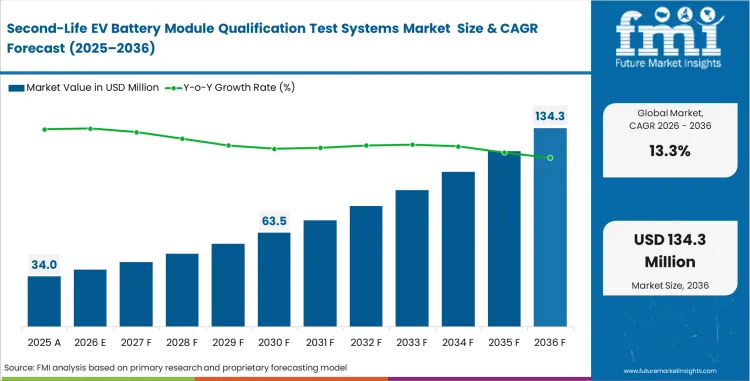
The second-life EV battery module qualification test systems market was valued at USD 30 million in 2025 and is expected to reach USD 34 million in 2026. Industry is projected to expand at a 13.30% CAGR and reach USD 118 million by 2036. Market value is rising as retired EV modules move beyond uneven pilot screening and enter a more formal qualification process built on repeatable testing, safety control, and usable state-of-health evidence.
Summary of Second-Life EV Battery Module Qualification Test Systems Market
- Second-Life EV Battery Module Qualification Test Systems Market Snapshot
- The second-life EV battery module qualification test systems market is valued at USD 30 million in 2025 and is projected to reach USD 118 million by 2036.
- The industry is expected to grow at a 13.30% CAGR from 2026 to 2036, creating an incremental opportunity of USD 84.3 million over the period.
- This category remains a specification-led battery test systems space where module grading speed, safety assurance, and traceable decision records shape buyer selection.
- Qualification demand sits between battery reuse and battery recycling because modules that fail repurposing screens still need a documented route into downstream handling.
- Second-Life EV Battery Module Qualification Test Systems Market Demand and Growth Drivers
- Demand rises as second-life projects move from engineering pilots toward repeatable screening routines that can sort mixed retired modules without relying on technician judgment alone.
- State-of-health and pulse-based diagnostics are drawing stronger demand because buyers need faster evidence on remaining capacity, usable power, and module viability before pack redesign begins.
- Country growth remains strongest where EV deployment has already created a visible future stream of retired batteries and where storage applications can absorb graded modules.
- Among key countries, China leads at 15% CAGR by 2036, followed by India at 14.6%, the USA at 14%, Germany at 13.4%, South Korea at 13%, Japan at 12%, and the UK at 11.5%.
- Certification cost and battery-family variability still slow larger rollouts because each workflow needs reliable evidence, consistent handling, and a defensible acceptance threshold.
- Second-Life EV Battery Module Qualification Test Systems Market Product and Segment View
- The market covers module qualification benches, cyclers, pulse and impedance tools, safety control layers, and software used to screen EV modules for second-life deployment.
- Systems serve repurposing facilities, OEM engineering groups, independent labs, and recycling-adjacent operators that need a clear pass, downgrade, or reject decision.
- State-of-health leads the test type segment with 34% share because buyers must first determine whether a used module is worth any deeper qualification work.
- Multi-station rigs lead the system format segment with 46% share because repurposers need throughput across mixed module streams rather than isolated one-bench studies.
- Since mixed battery families still require operator oversight even when throughput pressure rises, semi-automated platforms lead the automation segment with 42% share.
- Repurposers lead end use with 39% share because they sit closest to the economic decision on reuse versus dismantling.
- As first-life data can shorten screening time and tighten qualification logic when records are usable, BMS-integrated platforms lead software layer with 47% share.
- Scope includes module-level qualification hardware and software for second-life decisions, while broad TIC services, non-EV battery test systems, and finished stationary storage products remain outside scope.
- Second-Life EV Battery Module Qualification Test Systems Market Geography and Competitive Outlook
- China, India, and the USA represent the fastest-expanding demand pools, while Germany remains a disciplined European base for standards-led qualification activity.
- Competition favors vendors that can combine cyclers, diagnostics, safety hardware, and data capture in one workflow rather than sell disconnected instruments.
- The field remains fragmented, with the leading vendor estimated at 10.1% share, because buyer requirements vary by chemistry, module format, data access, and qualification protocol.
Key Takeaways, Market Size, and Forecast
- Second-Life EV Battery Module Qualification Test Systems Market is projected to rise from USD 34 million in 2026 to USD 118 million by 2036, at a CAGR of 13.3%.
- The second-life EV battery module qualification test systems market was valued at USD 30 million in 2025.
- By 2036, the Second-Life EV Battery Module Qualification Test Systems Market is expected to reach USD 118 million.
- From 2026 to 2036, the market is predicted to expand at a CAGR of 13.3%.
- The market is forecast to create an incremental opportunity of USD 84.3 million over the study period.
- In 2026, Multi-station rigs are expected to account for 46% of the system format segment.
- China (15.0% CAGR) and India (14.6% CAGR) are likely to remain the fastest growing markets.
Qualification decisions in this industry are no longer centered on whether used EV batteries can be reused at all. Focus has moved to a more immediate screening task of identifying which modules can clear qualification fast enough for second-life storage and which ones should move directly into recycling. Spending is therefore moving toward systems that combine electrical diagnostics, batch handling, and data continuity within one workflow, instead of relying on standalone lab instruments. A late move here does not just postpone one equipment decision. It can leave a repurposing line too dependent on manual judgment, with records too limited for bankable deployment and too slow for commercial throughput.
Qualification becomes easier to scale when repurposers can test mixed module streams under one controlled workflow instead of maintaining a separate method for each battery family. OEM service groups, repurposers, and independent labs push the industry in that direction when acceptance logic is aligned across cyclers, safety systems, and pass-fail records. Once that stage is reached, equipment selection moves closer to capacity planning and further away from one-off engineering trials. From that point, line speed, traceability, and workflow control carry more weight in how the industry is evaluated.
China is projected to record 15% CAGR through 2036 as EV retirement volumes and reuse economics bring qualification activity closer to industrial scale. In India, second-life deployment economics still favor careful module grading before stationary use, supporting an industry outlook of 14.6% CAGR. The USA is expected to advance at 14% CAGR, with qualification decisions shaped by certification requirements, installed test capacity, and access to first-life battery records. Germany, where the industry is forecast to rise at 13.4% CAGR, reflects a more controlled path as repurposing plans are weighed against validation discipline. In South Korea, reuse potential is expanding alongside tighter validation needs, supporting 13% CAGR through 2036. Japan is likely to see a more measured rise, with the sector reaching 12% CAGR over the forecast period. The UK stands at 11.5% CAGR, as qualification activity continues to develop within the limits set by test readiness, certification demands, and data access.
Second-Life EV Battery Module Qualification Test Systems Market Market Key Takeaways
| Metric | Details |
|---|---|
| Industry Size (2026) | USD 34 million |
| Industry Value (2036) | USD 118 million |
| CAGR (2026-2036) | 13.30% |
Source: Future Market Insights (FMI) analysis, based on proprietary forecasting model and primary research
Segmental Analysis
Second-Life EV Battery Module Qualification Test Systems Market Market Analysis by Test Type
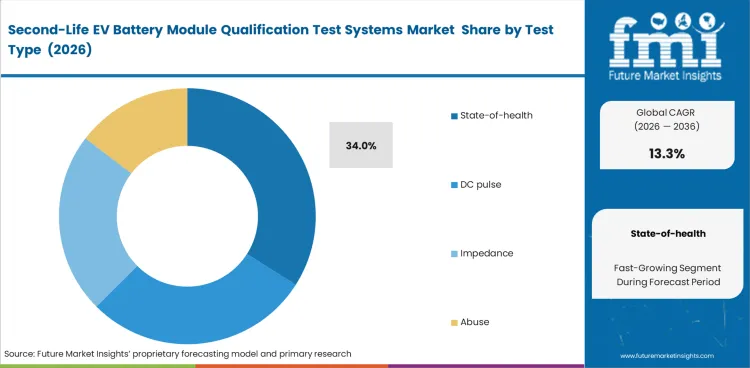
Qualification budgets are increasingly moving toward battery testing equipment that can remove non-viable modules before engineering time is spent on units with limited reuse potential. Screening begins with a basic commercial question, whether the module is still worth deeper qualification before redesign work starts. Early equipment spending is therefore directed less toward the widest lab menu and more toward a test flow that can remove obvious failures and sort borderline units without slowing intake. State-of-health testing is expected to account for 34% share in 2026 because it sits at that first commercial checkpoint. Once capacity retention and usable power fall into a narrow gray zone, the rest of the qualification path becomes slower, more expensive, and harder to justify. Repurposers and labs still add DC pulse, impedance, and abuse testing where needed, but those stages usually come after the first economic screen. A weak first-pass assessment can force the same module through repeated handling, which raises labor intensity and makes the final reuse decision less clear.
- Triaging value: State-of-health testing gives repurposers an early go-or-no-go signal. That keeps borderline inventory from taking up bench time meant for modules with clearer second-life potential.
- Pulse follow-up: DC pulse methods add short-duration performance insight once a module clears basic screening. This helps teams judge whether a pack concept can absorb transient duty without unnecessary oversizing.
- Safety proof: Impedance and abuse routines become more important when qualification must hold up under customer review. Leaving out that layer can delay acceptance and increase rework.
Second-Life EV Battery Module Qualification Test Systems Market Market Analysis by System Format
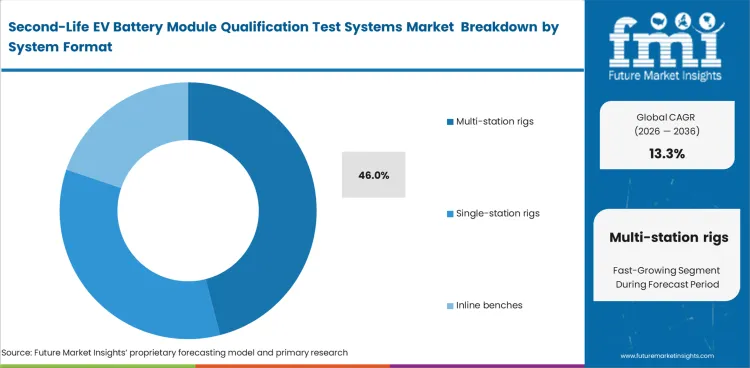
Throughput pressure is moving qualification away from single-bench engineering routines and toward work cells that can handle mixed inflows under one control setup. Multi-station rigs are expected to account for 46% of system format share in 2026 because repurposers rarely receive one clean and uniform stream of retired modules. These rigs are being selected less for visible automation claims and more for better queue control, method consistency, and smoother operator handoff across shifts. Single-station rigs still fit deep validation and pilot work, while inline benches remain suitable for narrower production settings. Commercial repurposing lines cannot depend on those formats alone once intake volume starts expanding. A weak format decision can leave expensive test channels idle at one stage and overloaded at another, which reduces visibility into both capacity use and yield. Battery cyclers still remain part of this setup, but they are increasingly being used within broader work cells rather than as standalone assets.
- Queue control: Multi-station layouts reduce waiting time between electrical checks, visual inspection, and safety signoff. That gives operations a steadier daily output instead of uneven peaks in bench use.
- Method discipline: Shared control architecture keeps acceptance logic aligned across several channels. This becomes more important when technicians rotate across shifts or when customers ask how modules were graded.
- Pilot depth: Single-station and inline formats still support engineering studies and targeted validation. Their limitation becomes clearer when mixed-volume intake requires faster bench turnover.
Second-Life EV Battery Module Qualification Test Systems Market Market Analysis by Automation
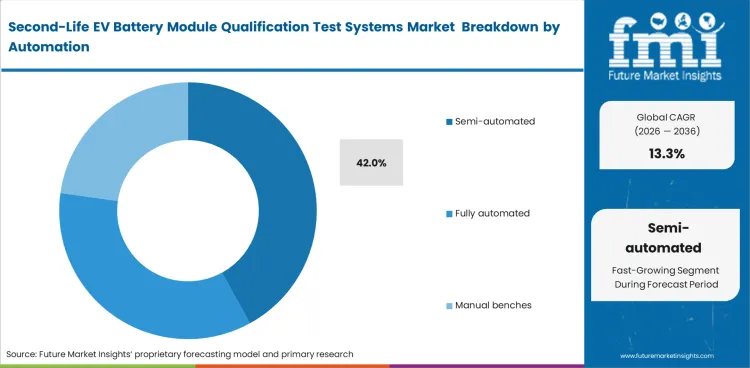
Semi-automated systems are expected to hold 42% share in 2026 for that reason. Labor still remains part of the qualification loop because used EV modules do not enter the line with one uniform condition, one documentation level, or one safe handling profile. Operations want barcode capture, repeatable test sequencing, and automated logging, while technicians still need to stay close to the module when connector condition, casting damage, or data mismatch requires a judgment call. This reflects an in-between operating model rather than a weak technology base. Fully automated platforms are likely to advance where module uniformity improves and acceptance rules become more stable. Manual benches still serve troubleshooting work and small lots, but they become expensive when incoming volume rises faster than technician capacity. Formation testing and automotive battery testers follow a similar pattern, where automated logging still works alongside operator intervention.
- Operator oversight: Semi-automated benches allow technician intervention when used modules arrive in uncertain condition. That balance improves handling control while keeping traceability intact.
- Logging discipline: Automated sequencing strengthens record quality across charge, discharge, and diagnostic steps. Consistent logging matters when reuse customers ask for screening evidence.
- Volume ceiling: Manual benches can still validate small lots and investigate anomalies. Their limitation becomes clearer when intake variability starts colliding with commercial throughput targets.
Second-Life EV Battery Module Qualification Test Systems Market Market Analysis by End Use
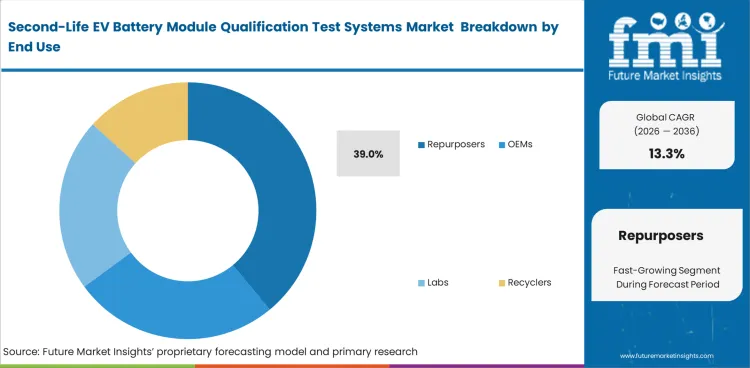
Repurposing economics are set at the point where a used module is either cleared for a second assignment or diverted away from reuse. Repurposers are expected to account for 39% of end-use share in 2026 because they handle that decision most directly. OEMs and independent labs still remain important participants, especially when early qualification methods are being built, refined, or challenged, but repurposers face the clearest daily pressure to turn uncertain inventory into a documented outcome. In this segment, time to decision matters almost as much as test accuracy. Recycling-linked operators also assess modules, although their spending logic is more closely tied to rejection confidence than to reuse optimization. A slow end-user workflow can lock working capital into inventory that has not yet secured either a reuse route or a dismantling decision. Battery recycling and black mass processing remain the practical fallback when reuse thresholds are not cleared.
- Disposition speed: Repurposers need qualification data that can support a fast keep, downgrade, or reject decision. Delay at this point leaves cash tied up in inventory with no productive path.
- Engineering assurance: OEM and lab activity remains linked to method development, warranty learning, and validation support. Their equipment use is usually deeper per bench but narrower in routine intake volume.
- Reject confidence: Recycling-linked operators still need clear evidence when modules are removed from reuse. Strong qualification records help reduce dispute risk across intake relationships.
Second-Life EV Battery Module Qualification Test Systems Market Market Analysis by Software Layer
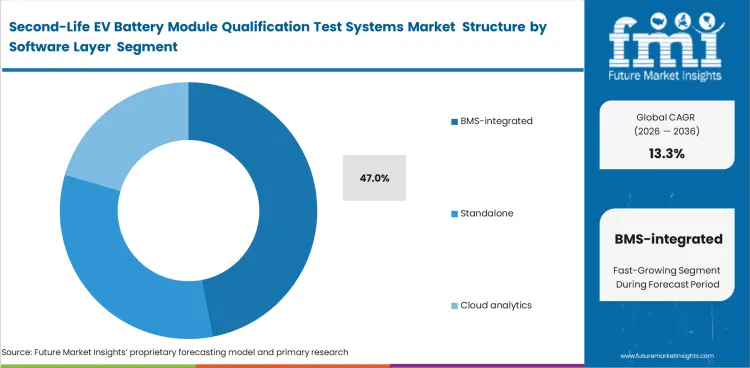
Data quality is now part of equipment selection because a second-life decision carries less weight when first-life history is missing, inconsistent, or scattered across separate systems. BMS-integrated platforms are expected to account for 47.0% share in 2026 as operators try to combine live diagnostics with whatever reliable operating history can still be recovered. Physical testing does not become less important in that setup. It becomes easier to direct toward modules that genuinely deserve deeper review, while acceptance thresholds become easier to justify. Standalone platforms still fit sites where dependable data access remains limited, and cloud analytics supports portfolio-level review along with remote oversight. Ignoring software architecture can leave operations with acceptable electrical readings but weak qualification records, which makes downstream acceptance harder to secure. Traceability systems and battery passport requirements are also making software decisions harder to delay.
- History access: BMS-linked platforms help operators use first-life records when data is available and credible. That can shorten screening time for modules that clearly fall inside or outside reuse criteria.
- Evidence chain: Integrated software keeps test results tied to serial identity, operator actions, and final disposition. That record chain matters when qualification logic is reviewed later.
- Remote review: Cloud analytics adds value when fleets, labs, and repurposers need a shared view of module status. It still cannot make up for weak local test discipline.
Second-Life EV Battery Module Qualification Test Systems Market Market Drivers, Restraints, and Opportunities
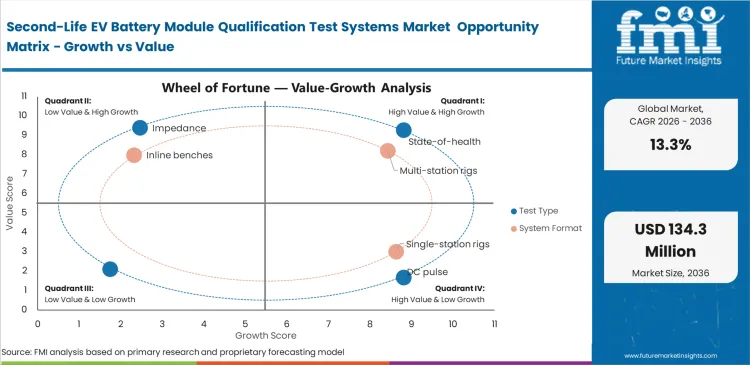
Qualification purchases are being shaped by one clear commercial issue. A second-life battery business cannot run on uncertain grading logic. Repurposers, OEM service groups, and independent labs need equipment that can sort mixed module inflows into usable, repairable, and reject classes without forcing a workflow reset every time chemistry, format, or data access changes. Ev batteries continue to expand the future pool of retired modules, while battery energy storage and behind-the-meter storage are widening the range of second-life applications. As a result, qualification is moving closer to an intake control function rather than remaining a narrow technical task.
Battery-family variation continues to hold the industry back. Used modules arrive with uneven documentation, different thermal histories, and inconsistent connector condition, which makes one common acceptance logic difficult to apply across every intake stream. This issue can be reduced through tighter data capture, safer fixturing, and better workflow design. Even so, a practical limit remains when first-life records are incomplete or when module condition requires skilled intervention before automated routines can begin. Testing certification adds another layer of difficulty, because a weak evidence trail can undermine a reuse candidate that may otherwise appear suitable.
Opportunities in the Second-Life EV Battery Module Qualification Test Systems Market
- Portfolio grading: Portfolio grading allows operators handling several OEM battery families to capture more value from benches that support shared acceptance logic across mixed module streams. That reduces retesting pressure and helps keep intake lanes moving.
- Storage pairing: Integrators serving commercial and utility reuse applications can connect qualification data more closely with downstream pack design. Stationary flow storage and BESS test platforms both indicate a rising need for evidence-rich module screening before deployment.
- Safety screening: Vendors that combine electrical diagnostics with enclosure checks, swelling review, and handling safeguards are better placed where one controlled workflow is preferred over several disconnected test steps. Swelling measurement becomes more relevant when physical condition must be recorded alongside electrical results.
Regional Analysis
Based on the regional analysis, the Second-Life EV Battery Module Qualification Test Systems Market is segmented into North America, Europe, and Asia Pacific across 40 plus countries.
| Country | CAGR (2026 to 2036) |
|---|---|
| China | 15% |
| India | 14.6% |
| USA | 14% |
| Germany | 13.4% |
| South Korea | 13% |
| Japan | 12% |
| UK | 11.5% |
Source: Future Market Insights (FMI) analysis, based on proprietary forecasting model and primary research
North America Second-Life EV Battery Module Qualification Test Systems Market Market Analysis
North America is being shaped less by battery volume alone and more by how carefully qualification decisions are documented. Regional demand is tied to whether a used module can move through a controlled review process with clear safety handling, repeatable test logic, and records that remain credible when challenged later. Equipment selection therefore leans toward integrated setups that can support consistent grading rather than isolated bench tools built only for technical checks. Solid-state safety testing and battery technology also point to a regional preference for equipment that reduces rework risk early, especially where qualification errors can slow deployment, raise liability concerns, or weaken confidence in second-life battery use.
-
United States: DOE-backed reuse and recycling activity keeps the USA closely tied to commercial qualification rather than pure lab experimentation. Demand for second-life EV battery module qualification test systems in the country is projected to advance at a 14% CAGR through 2036. Equipment decisions are being shaped by one practical issue, whether screening records can support a reuse decision without leaving gaps in safety evidence or condition history. Engineering teams still need reliable electrical diagnostics, but clean documentation carries almost equal weight because customer acceptance and certification review depend on it. A weak evidence chain can slow approval, delay repurposing programs, and leave viable modules waiting longer than the economics can comfortably absorb.
FMI's report includes Canada and additional North American countries not detailed above. Regional demand outside the USA remains tied to whether battery reuse is treated as an engineered energy asset or as an uncertain salvage exercise, which is why qualification depth matters early in the buying cycle.
Europe Second-Life EV Battery Module Qualification Test Systems Market Market Analysis
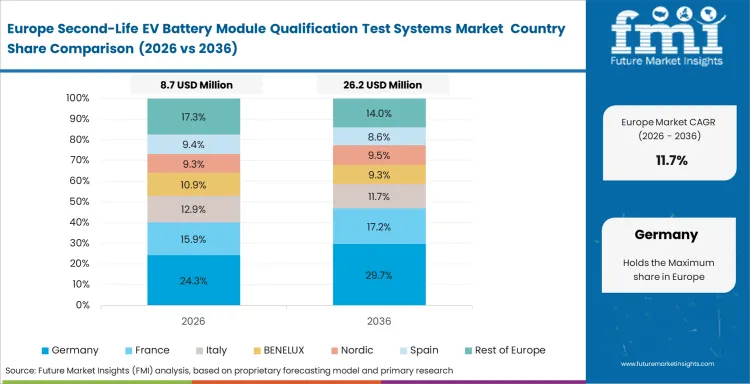
Europe is defined by tighter expectations around battery life-cycle records, reuse eligibility, and deployment accountability. Regional demand is not being shaped only by whether a module still performs adequately, but also by whether the full qualification path can be explained and defended with enough clarity to support customer acceptance. Workflow discipline matters more here because weak documentation can undermine a usable module long before performance becomes the main issue. EU passport solutions and traceability systems are reinforcing that direction by making software records, serial identity, and pass-fail evidence more central to equipment selection. Vendors with stronger documentation logic are therefore better placed than suppliers offering hardware without a clear evidence trail.
- Germany: Germany treats module qualification as part of a broader engineering validation process, not merely as an intake screen. Industrial demand in the country is forecast to register a 13.4% CAGR during the assessment period, but the commercial logic behind that number is rooted in process discipline rather than speed alone. Engineering groups usually expect test equipment to support repeatability, defensible records, and safe handling under controlled conditions. Purchasing cycles can therefore take longer, especially when workflows need review across several technical functions before a system is approved. That slower pace does not weaken the outlook. It reflects a preference for qualification setups that reduce ambiguity, lower rework exposure, and fit established technical standards from the start.
- United Kingdom: Project developers in the UK continue to show clear interest in circular battery use, though equipment choices still need to make sense under modest scale and careful cost control. Second-life EV battery module qualification test systems in the UK are expected to expand at a 11.5% CAGR through 2036. Financial discipline remains important because small or mid-scale repurposing activity cannot absorb repeated grading errors or long review cycles without damaging project economics. Traceability matters for the same reason. Where records are thin, customer acceptance tends to take longer and qualification decisions become harder to defend. Suppliers that can combine testing, logging, and serial-level evidence within one controlled process are better aligned with how this country is likely to buy.
FMI's report includes France, Italy, Spain, the Nordics, and additional European countries not detailed above. Europe rewards vendors that can link diagnostics, software records, and customer-facing evidence into one defensible qualification sequence rather than sell test hardware as a stand-alone answer.
Asia Pacific Second-Life EV Battery Module Qualification Test Systems Market Market Analysis
Asia Pacific carries the widest spread between scale, readiness, and commercial maturity. Some countries are already dealing with large future pools of retired EV modules and therefore need qualification systems that can handle rising intake pressure. Others are still building the business case for organized repurposing and remain more cautious in how quickly they commit to formal module grading. That gap leaves room for both high-throughput systems and flexible semi-automated benches, depending on how far each country has moved from pilot work toward repeatable intake operations. BEV demand continues to enlarge the future retirement base, while battery passport requirements are adding more pressure around data quality, software traceability, and confidence in downstream reuse decisions.
- China: China has the clearest near-term case for scalable module grading because of its large installed EV base and stronger circular battery activity. 15% CAGR is expected for second-life EV battery module qualification test systems in China through 2036, supported by the need to move retired modules through qualification with more speed and less ambiguity. Scale alone does not make that easy. Repurposing lines still need equipment that can manage mixed battery families, keep grading logic consistent, and document outcomes well enough for commercial deployment. Where qualification remains too dependent on manual judgment, intake quality can fall behind volume. That creates a costly gap between reuse ambition and the actual reliability of clearance decisions.
- India: Cost-sensitive deployment models keep India focused on extracting the maximum usable value from each accepted module, which gives careful screening a direct commercial role. Demand for second-life EV battery module qualification test systems in the country is likely to rise at a 14.6% CAGR through 2036. Intake quality matters because field issues are far more expensive than disciplined grading at the start of the workflow. Teams evaluating used modules need equipment that can sort usable, repairable, and reject classes without forcing repeated handling or unclear judgments. Where first-pass qualification is weak, economic value erodes quickly through rework, slower turnaround, and less confidence in downstream deployment. Careful intake control is therefore likely to remain central to the country’s second-life economics.
- South Korea: Battery manufacturing depth gives South Korea an advantage in technical familiarity, but it also raises expectations around method discipline and record quality. Second-life EV battery module qualification test systems in South Korea are expected to record 13% CAGR through 2036. Equipment acceptance is likely to depend less on broad automation claims and more on whether a system fits strict internal engineering expectations. That includes repeatable procedures, reliable data capture, and clear alignment between electrical diagnostics and final disposition logic. Pilot use alone is not enough in this setting. Suppliers need to show that qualification tools can move into routine use without weakening internal control standards. Commercial adoption stays healthier where that proof is established early and clearly.
- Japan: Industry outlook for second-life EV battery module qualification test systems in Japan points to 12% CAGR by 2036, with demand shaped by the preference for dependable workflow performance over rushed intake expansion. Japanese users usually place more weight on method reliability, operator discipline, and long-run equipment stability than on aggressive throughput claims. Qualification equipment is expected to support clear decision logic, careful handling, and records that remain usable across long operating cycles. Systems that add another layer of bench work without reducing uncertainty are less likely to fit local expectations. Vendors that simplify grading while preserving control are better aligned with how the country is likely to evaluate second-life battery equipment over the forecast period.
FMI's report includes ASEAN, Australia, and New Zealand along with additional Asia Pacific countries not detailed above. Regional divergence comes less from headline EV adoption and more from how quickly buyers can connect retired battery supply, screening discipline, and a credible second-life business case.
Competitive Aligners for Market Players
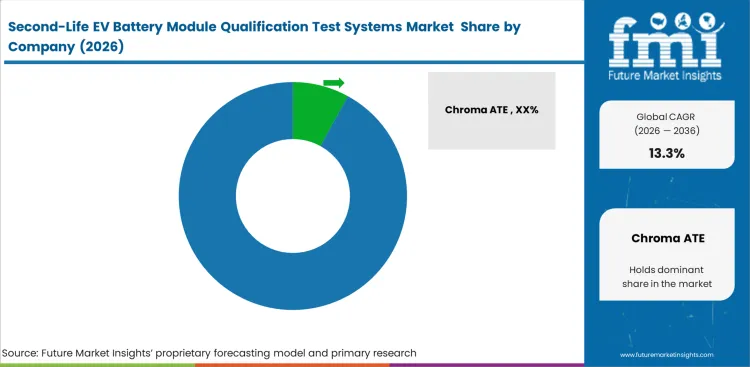
This field remains fragmented because supplier selection is rarely based on instrument count alone. Buyers compare workflow fit, safe module handling, record quality, and each vendor’s ability to work with mixed module conditions without requiring a separate engineering method for every intake stream. Chroma ATE, Arbin Instruments, AVL, DIGATRON, Keysight Technologies, Bitrode, and Maccor all compete across adjacent battery test categories, but second-life qualification puts more weight on grading logic and module-handling discipline. Battery testing equipment and testing certification point to the same commercial concern. A capable bench does not carry enough value when the acceptance record will face later review.
Established suppliers hold an advantage when they can bring together electrical test hardware, software control, safety features, and application support within one qualification flow. Smaller challengers can still win business, although they usually need to show either faster workflow tailoring for mixed module streams or stronger support in data capture and test scripting. Battery cyclers and formation testing show a similar buying pattern, where familiarity with battery test environments matters even when the second-life use case still needs custom setup. Commercial preference stays with vendors that can reduce adaptation effort without weakening grading discipline.
Large accounts are likely to keep resisting hard vendor lock-in by asking for cleaner data export, adaptable test logic, and support that continues beyond factory acceptance. Vendors, in turn, will keep defending margin through software dependence, higher-value service layers, and familiarity with the customer’s qualification process. This category is expected to remain moderately fragmented through 2036 because rising repurposing volume should widen the addressable base, while no single supplier is likely to fit every combination of chemistry, module design, and evidence requirement. Battery passport and second-life storage will keep attention fixed on records that remain usable after testing is complete.
Key Players in Second-Life EV Battery Module Qualification Test Systems Market
- Chroma ATE
- Arbin Instruments
- AVL
- DIGATRON
- Keysight Technologies
- Bitrode
- Maccor
Scope of the Report
| Metric | Value |
|---|---|
| Quantitative Units | USD 34 million to USD 118 million, at a CAGR of 13.30% |
| Market Definition | Module-level hardware and software used to qualify retired EV battery modules for second-life deployment, including electrical diagnostics, safety handling, and recordable acceptance logic. |
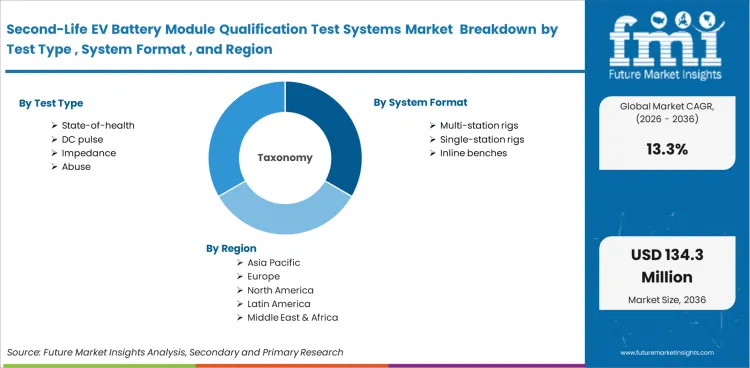
| Test Type Segmentation | State-of-health, DC pulse, Impedance, Abuse |
| System Format Segmentation | Multi-station rigs, Single-station rigs, Inline benches |
| Automation Segmentation | Semi-automated, fully automated, Manual benches |
| End Use Segmentation | Repurposers, OEMs, Labs, Recyclers |
| Software Layer Segmentation | BMS-integrated, Standalone, Cloud analytics |
| Regions Covered | North America, Europe, Asia Pacific |
| Countries Covered | China, India, USA, Germany, South Korea, Japan, UK, and 40 plus countries |
| Key Companies Profiled | Chroma ATE, Arbin Instruments, AVL, DIGATRON, Keysight Technologies, Bitrode, Maccor |
Source: Future Market Insights (FMI) analysis, based on proprietary forecasting model and primary research
Second-Life EV Battery Module Qualification Test Systems Market Market Analysis by Segments
By Test Type
- State-of-health
- DC pulse
- Impedance
- Abuse
By System Format
- Multi-station rigs
- Single-station rigs
- Inline benches
By Automation
- Semi-automated
- Fully automated
- Manual benches
By End Use
- Repurposers
- OEMs
- Labs
- Recyclers
By Software Layer
- BMS-integrated
- Standalone
- Cloud analytics
Region
- North America
- USA
- Europe
- Germany
- UK
- Asia Pacific
- China
- India
- South Korea
- Japan
Bibliography
- International Electrotechnical Commission. (2024, June). IEC 63330-1:2024 Repurposing of secondary batteries - Part 1: General requirements.
- International Energy Agency. (2025, May). Global EV Outlook 2025.
- American Council for an Energy-Efficient Economy. (2025, July). Repurposing EV Batteries for Second-Life Stationary Storage: Market Landscape and Key Challenges.
- WRI India. (2025, July 30). Second Charge: Unlocking Second-Life Potential of EV Batteries.
- CEN-CENELEC. (2025, September 16). Giving EV Batteries a Second Life: New European Standard Sets the Framework.
This bibliography is provided for reader reference and is not exhaustive. The full report contains the complete reference list and detailed citations.
This Report Addresses
- How second-life module qualification differs from general battery testing equipment demand.
- Why qualification speed matters to repurposers handling mixed EV battery streams.
- Which test types sit closest to the economic decision on reuse versus rejection.
- How system format and automation choices affect throughput and labor burden.
- Why BMS-linked software is gaining weight in qualification workflows.
- Which countries are creating the strongest demand for second-life qualification systems.
- How competitive selection shifts from instrument count to workflow fit and evidence quality.
- What operational barriers still prevent faster scale-up in second-life battery deployment.
Frequently Asked Questions
What does this market cover?
It covers module-level systems used to test, sort, and document retired EV battery modules before a second-life deployment decision is made.
Why is this market still small in value?
Qualification systems sit inside a narrow equipment niche. Buyers spend only after a reuse program becomes arranged enough to justify repeatable intake screening.
Why is growth still relatively fast?
The addressable pool of retired EV batteries is widening, and repurposing lines need more formal screening methods once intake volumes rise.
What is the main commercial driver?
Repurposers need faster keep, downgrade, or reject decisions. Weak grading logic ties up labor, inventory, and customer commitments.
Which test type leads spending?
State-of-health testing leads because it tells buyers whether deeper qualification work is worth the time and cost.
Why do multi-station rigs lead system format?
Mixed module streams create queue pressure. Buyers need several controlled test channels rather than one isolated validation bench.
Why do semi-automated systems lead automation?
Used modules still arrive with uneven condition and uneven documentation. Buyers want recordable routines with room for technician judgment.
Why do repurposers lead end use?
They sit closest to the economic decision on reuse versus dismantling, so qualification speed directly affects their cash cycle.
Why is software architecture important?
Electrical results alone do not settle the reuse decision. Buyers need serial-linked records that can support internal review and customer acceptance.
What makes China the fastest-growing country?
China combines a large EV installed base with strong circular-battery activity, which gives qualification equipment a clearer path into routine use.
Why is India close behind?
Indian buyers remain highly sensitive to value recovery, so careful module grading becomes central before a reused battery is put into service.
Why does the U.S. stay strong?
Programs around reuse, recycling, and validation keep demand focused on defensible screening methods rather than informal engineering trials.
Why is Germany important in Europe?
German buyers tend to treat qualification as part of an engineering validation chain, which supports disciplined equipment spending.
What slows adoption the most?
Battery-family variation and weak first-life data still complicate the creation of one universal qualification method.
Can BMS data replace physical testing?
No. It can shorten screening and improve prioritization, though buyers still need physical evidence before a reuse decision becomes defensible.
How do buyers compare vendors?
They compare workflow fit, safety handling, data continuity, service support, and the ability to manage mixed module conditions.
Is this market concentrated?
No. It remains moderately fragmented because no single vendor fits every chemistry, module architecture, and qualification protocol.
What happens when buyers choose the wrong system?
Bench utilization falls out of balance, rehandling increases, and acceptance logic becomes harder to explain to customers.
How is this linked to stationary storage demand?
Second-life modules need a downstream use case. Wider storage deployment makes it easier to justify better qualification infrastructure.
Will full automation take over soon?
Not immediately. Automation will rise, though mixed module conditions still keep operator oversight relevant in many workflows.
Why does traceability matter so much?
A reused battery carries more risk when qualification records are incomplete. Buyers need evidence that can travel with the asset after testing.
What changes by 2036?
Qualification should look less like one-off engineering work and more like an intake control function built around consistent grading, safer handling, and stronger data discipline.
Preview the report firsthand - request a free sample
Get SampleGet the brochure for pricing and purchase details.
Get PDFTable of Content
- Executive Summary
- Global Market Outlook
- Demand-side Trends
- Supply-side Trends
- Technology Roadmap Analysis
- Analysis and Recommendations
- Market Overview
- Market Coverage / Taxonomy
- Market Definition / Scope / Limitations
- Research Methodology
- Chapter Orientation
- Analytical Lens and Working Hypotheses
- Market Structure, Signals, and Trend Drivers
- Benchmarking and Cross-market Comparability
- Market Sizing, Forecasting, and Opportunity Mapping
- Research Design and Evidence Framework
- Desk Research Programme (Secondary Evidence)
- Company Annual and Sustainability Reports
- Peer-reviewed Journals and Academic Literature
- Corporate Websites, Product Literature, and Technical Notes
- Earnings Decks and Investor Briefings
- Statutory Filings and Regulatory Disclosures
- Technical White Papers and Standards Notes
- Trade Journals, Industry Magazines, and Analyst Briefs
- Conference Proceedings, Webinars, and Seminar Materials
- Government Statistics Portals and Public Data Releases
- Press Releases and Reputable Media Coverage
- Specialist Newsletters and Curated Briefings
- Sector Databases and Reference Repositories
- FMI Internal Proprietary Databases and Historical Market Datasets
- Subscription Datasets and Paid Sources
- Social Channels, Communities, and Digital Listening Inputs
- Additional Desk Sources
- Expert Input and Fieldwork (Primary Evidence)
- Primary Modes
- Qualitative Interviews and Expert Elicitation
- Quantitative Surveys and Structured Data Capture
- Blended Approach
- Why Primary Evidence is Used
- Field Techniques
- Interviews
- Surveys
- Focus Groups
- Observational and In-context Research
- Social and Community Interactions
- Stakeholder Universe Engaged
- C-suite Leaders
- Board Members
- Presidents and Vice Presidents
- R&D and Innovation Heads
- Technical Specialists
- Domain Subject-matter Experts
- Scientists
- Physicians and Other Healthcare Professionals
- Governance, Ethics, and Data Stewardship
- Research Ethics
- Data Integrity and Handling
- Primary Modes
- Tooling, Models, and Reference Databases
- Desk Research Programme (Secondary Evidence)
- Data Engineering and Model Build
- Data Acquisition and Ingestion
- Cleaning, Normalisation, and Verification
- Synthesis, Triangulation, and Analysis
- Quality Assurance and Audit Trail
- Market Background
- Market Dynamics
- Drivers
- Restraints
- Opportunity
- Trends
- Scenario Forecast
- Demand in Optimistic Scenario
- Demand in Likely Scenario
- Demand in Conservative Scenario
- Opportunity Map Analysis
- Product Life Cycle Analysis
- Supply Chain Analysis
- Investment Feasibility Matrix
- Value Chain Analysis
- PESTLE and Porter’s Analysis
- Regulatory Landscape
- Regional Parent Market Outlook
- Production and Consumption Statistics
- Import and Export Statistics
- Market Dynamics
- Global Market Analysis 2021 to 2025 and Forecast, 2026 to 2036
- Historical Market Size Value (USD Million) Analysis, 2021 to 2025
- Current and Future Market Size Value (USD Million) Projections, 2026 to 2036
- Y-o-Y Growth Trend Analysis
- Absolute $ Opportunity Analysis
- Global Market Pricing Analysis 2021 to 2025 and Forecast 2026 to 2036
- Global Market Analysis 2021 to 2025 and Forecast 2026 to 2036, By Test Type
- Introduction / Key Findings
- Historical Market Size Value (USD Million) Analysis By Test Type , 2021 to 2025
- Current and Future Market Size Value (USD Million) Analysis and Forecast By Test Type , 2026 to 2036
- State-of-health
- DC pulse
- Impedance
- Abuse
- State-of-health
- Y-o-Y Growth Trend Analysis By Test Type , 2021 to 2025
- Absolute $ Opportunity Analysis By Test Type , 2026 to 2036
- Global Market Analysis 2021 to 2025 and Forecast 2026 to 2036, By System Format
- Introduction / Key Findings
- Historical Market Size Value (USD Million) Analysis By System Format, 2021 to 2025
- Current and Future Market Size Value (USD Million) Analysis and Forecast By System Format, 2026 to 2036
- Multi-station rigs
- Single-station rigs
- Inline benches
- Multi-station rigs
- Y-o-Y Growth Trend Analysis By System Format, 2021 to 2025
- Absolute $ Opportunity Analysis By System Format, 2026 to 2036
- Global Market Analysis 2021 to 2025 and Forecast 2026 to 2036, By Automation
- Introduction / Key Findings
- Historical Market Size Value (USD Million) Analysis By Automation, 2021 to 2025
- Current and Future Market Size Value (USD Million) Analysis and Forecast By Automation, 2026 to 2036
- Semi-automated
- Fully automated
- Manual benches
- Semi-automated
- Y-o-Y Growth Trend Analysis By Automation, 2021 to 2025
- Absolute $ Opportunity Analysis By Automation, 2026 to 2036
- Global Market Analysis 2021 to 2025 and Forecast 2026 to 2036, By End Use
- Introduction / Key Findings
- Historical Market Size Value (USD Million) Analysis By End Use, 2021 to 2025
- Current and Future Market Size Value (USD Million) Analysis and Forecast By End Use, 2026 to 2036
- Repurposers
- OEMs
- Labs
- Recyclers
- Repurposers
- Y-o-Y Growth Trend Analysis By End Use, 2021 to 2025
- Absolute $ Opportunity Analysis By End Use, 2026 to 2036
- Global Market Analysis 2021 to 2025 and Forecast 2026 to 2036, By Software Layer
- Introduction / Key Findings
- Historical Market Size Value (USD Million) Analysis By Software Layer, 2021 to 2025
- Current and Future Market Size Value (USD Million) Analysis and Forecast By Software Layer, 2026 to 2036
- BMS-integrated
- Standalone
- Cloud analytics
- BMS-integrated
- Y-o-Y Growth Trend Analysis By Software Layer, 2021 to 2025
- Absolute $ Opportunity Analysis By Software Layer, 2026 to 2036
- Global Market Analysis 2021 to 2025 and Forecast 2026 to 2036, By Region
- Introduction
- Historical Market Size Value (USD Million) Analysis By Region, 2021 to 2025
- Current Market Size Value (USD Million) Analysis and Forecast By Region, 2026 to 2036
- North America
- Latin America
- Western Europe
- Eastern Europe
- East Asia
- South Asia and Pacific
- Middle East & Africa
- Market Attractiveness Analysis By Region
- North America Market Analysis 2021 to 2025 and Forecast 2026 to 2036, By Country
- Historical Market Size Value (USD Million) Trend Analysis By Market Taxonomy, 2021 to 2025
- Market Size Value (USD Million) Forecast By Market Taxonomy, 2026 to 2036
- By Country
- USA
- Canada
- Mexico
- By Test Type
- By System Format
- By Automation
- By End Use
- By Software Layer
- By Country
- Market Attractiveness Analysis
- By Country
- By Test Type
- By System Format
- By Automation
- By End Use
- By Software Layer
- Key Takeaways
- Latin America Market Analysis 2021 to 2025 and Forecast 2026 to 2036, By Country
- Historical Market Size Value (USD Million) Trend Analysis By Market Taxonomy, 2021 to 2025
- Market Size Value (USD Million) Forecast By Market Taxonomy, 2026 to 2036
- By Country
- Brazil
- Chile
- Rest of Latin America
- By Test Type
- By System Format
- By Automation
- By End Use
- By Software Layer
- By Country
- Market Attractiveness Analysis
- By Country
- By Test Type
- By System Format
- By Automation
- By End Use
- By Software Layer
- Key Takeaways
- Western Europe Market Analysis 2021 to 2025 and Forecast 2026 to 2036, By Country
- Historical Market Size Value (USD Million) Trend Analysis By Market Taxonomy, 2021 to 2025
- Market Size Value (USD Million) Forecast By Market Taxonomy, 2026 to 2036
- By Country
- Germany
- UK
- Italy
- Spain
- France
- Nordic
- BENELUX
- Rest of Western Europe
- By Test Type
- By System Format
- By Automation
- By End Use
- By Software Layer
- By Country
- Market Attractiveness Analysis
- By Country
- By Test Type
- By System Format
- By Automation
- By End Use
- By Software Layer
- Key Takeaways
- Eastern Europe Market Analysis 2021 to 2025 and Forecast 2026 to 2036, By Country
- Historical Market Size Value (USD Million) Trend Analysis By Market Taxonomy, 2021 to 2025
- Market Size Value (USD Million) Forecast By Market Taxonomy, 2026 to 2036
- By Country
- Russia
- Poland
- Hungary
- Balkan & Baltic
- Rest of Eastern Europe
- By Test Type
- By System Format
- By Automation
- By End Use
- By Software Layer
- By Country
- Market Attractiveness Analysis
- By Country
- By Test Type
- By System Format
- By Automation
- By End Use
- By Software Layer
- Key Takeaways
- East Asia Market Analysis 2021 to 2025 and Forecast 2026 to 2036, By Country
- Historical Market Size Value (USD Million) Trend Analysis By Market Taxonomy, 2021 to 2025
- Market Size Value (USD Million) Forecast By Market Taxonomy, 2026 to 2036
- By Country
- China
- Japan
- South Korea
- By Test Type
- By System Format
- By Automation
- By End Use
- By Software Layer
- By Country
- Market Attractiveness Analysis
- By Country
- By Test Type
- By System Format
- By Automation
- By End Use
- By Software Layer
- Key Takeaways
- South Asia and Pacific Market Analysis 2021 to 2025 and Forecast 2026 to 2036, By Country
- Historical Market Size Value (USD Million) Trend Analysis By Market Taxonomy, 2021 to 2025
- Market Size Value (USD Million) Forecast By Market Taxonomy, 2026 to 2036
- By Country
- India
- ASEAN
- Australia & New Zealand
- Rest of South Asia and Pacific
- By Test Type
- By System Format
- By Automation
- By End Use
- By Software Layer
- By Country
- Market Attractiveness Analysis
- By Country
- By Test Type
- By System Format
- By Automation
- By End Use
- By Software Layer
- Key Takeaways
- Middle East & Africa Market Analysis 2021 to 2025 and Forecast 2026 to 2036, By Country
- Historical Market Size Value (USD Million) Trend Analysis By Market Taxonomy, 2021 to 2025
- Market Size Value (USD Million) Forecast By Market Taxonomy, 2026 to 2036
- By Country
- Kingdom of Saudi Arabia
- Other GCC Countries
- Turkiye
- South Africa
- Other African Union
- Rest of Middle East & Africa
- By Test Type
- By System Format
- By Automation
- By End Use
- By Software Layer
- By Country
- Market Attractiveness Analysis
- By Country
- By Test Type
- By System Format
- By Automation
- By End Use
- By Software Layer
- Key Takeaways
- Key Countries Market Analysis
- USA
- Pricing Analysis
- Market Share Analysis, 2025
- By Test Type
- By System Format
- By Automation
- By End Use
- By Software Layer
- Canada
- Pricing Analysis
- Market Share Analysis, 2025
- By Test Type
- By System Format
- By Automation
- By End Use
- By Software Layer
- Mexico
- Pricing Analysis
- Market Share Analysis, 2025
- By Test Type
- By System Format
- By Automation
- By End Use
- By Software Layer
- Brazil
- Pricing Analysis
- Market Share Analysis, 2025
- By Test Type
- By System Format
- By Automation
- By End Use
- By Software Layer
- Chile
- Pricing Analysis
- Market Share Analysis, 2025
- By Test Type
- By System Format
- By Automation
- By End Use
- By Software Layer
- Germany
- Pricing Analysis
- Market Share Analysis, 2025
- By Test Type
- By System Format
- By Automation
- By End Use
- By Software Layer
- UK
- Pricing Analysis
- Market Share Analysis, 2025
- By Test Type
- By System Format
- By Automation
- By End Use
- By Software Layer
- Italy
- Pricing Analysis
- Market Share Analysis, 2025
- By Test Type
- By System Format
- By Automation
- By End Use
- By Software Layer
- Spain
- Pricing Analysis
- Market Share Analysis, 2025
- By Test Type
- By System Format
- By Automation
- By End Use
- By Software Layer
- France
- Pricing Analysis
- Market Share Analysis, 2025
- By Test Type
- By System Format
- By Automation
- By End Use
- By Software Layer
- India
- Pricing Analysis
- Market Share Analysis, 2025
- By Test Type
- By System Format
- By Automation
- By End Use
- By Software Layer
- ASEAN
- Pricing Analysis
- Market Share Analysis, 2025
- By Test Type
- By System Format
- By Automation
- By End Use
- By Software Layer
- Australia & New Zealand
- Pricing Analysis
- Market Share Analysis, 2025
- By Test Type
- By System Format
- By Automation
- By End Use
- By Software Layer
- China
- Pricing Analysis
- Market Share Analysis, 2025
- By Test Type
- By System Format
- By Automation
- By End Use
- By Software Layer
- Japan
- Pricing Analysis
- Market Share Analysis, 2025
- By Test Type
- By System Format
- By Automation
- By End Use
- By Software Layer
- South Korea
- Pricing Analysis
- Market Share Analysis, 2025
- By Test Type
- By System Format
- By Automation
- By End Use
- By Software Layer
- Russia
- Pricing Analysis
- Market Share Analysis, 2025
- By Test Type
- By System Format
- By Automation
- By End Use
- By Software Layer
- Poland
- Pricing Analysis
- Market Share Analysis, 2025
- By Test Type
- By System Format
- By Automation
- By End Use
- By Software Layer
- Hungary
- Pricing Analysis
- Market Share Analysis, 2025
- By Test Type
- By System Format
- By Automation
- By End Use
- By Software Layer
- Kingdom of Saudi Arabia
- Pricing Analysis
- Market Share Analysis, 2025
- By Test Type
- By System Format
- By Automation
- By End Use
- By Software Layer
- Turkiye
- Pricing Analysis
- Market Share Analysis, 2025
- By Test Type
- By System Format
- By Automation
- By End Use
- By Software Layer
- South Africa
- Pricing Analysis
- Market Share Analysis, 2025
- By Test Type
- By System Format
- By Automation
- By End Use
- By Software Layer
- USA
- Market Structure Analysis
- Competition Dashboard
- Competition Benchmarking
- Market Share Analysis of Top Players
- By Regional
- By Test Type
- By System Format
- By Automation
- By End Use
- By Software Layer
- Competition Analysis
- Competition Deep Dive
- Chroma ATE
- Overview
- Product Portfolio
- Profitability by Market Segments (Product/Age /Sales Channel/Region)
- Sales Footprint
- Strategy Overview
- Marketing Strategy
- Product Strategy
- Channel Strategy
- Arbin Instruments
- AVL
- DIGATRON
- Keysight Technologies
- Bitrode
- Maccor
- Chroma ATE
- Competition Deep Dive
- Assumptions & Acronyms Used


