

- Industry Size (2026)
- USD 1546.4 Mn
- Forecast (2036)
- USD 3627.4 Mn
- CAGR (2026 to 2036)
- 8.9%
EV Battery Pack Structural Fasteners Market Forecast and Outlook 2026 to 2036
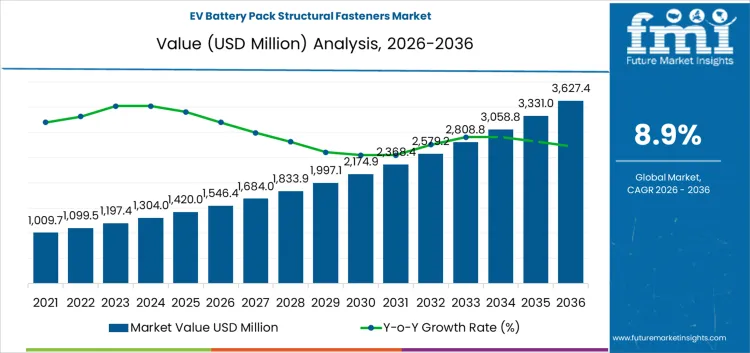
The EV battery pack structural fasteners market is valued at USD 1,546.4 million in 2026 and is projected to reach USD 3,627.4 million by 2036, expanding at a CAGR of 8.9%. Value creation is directly tied to the structural role of battery packs within electric vehicle platforms rather than to incremental fastening substitution. Battery enclosures increasingly function as load-bearing elements within skateboard architectures, making fasteners integral to crash integrity, pack stiffness, and long-term dimensional stability. Each pack design embeds a defined number of structural joints, fixing unit demand to pack size, architecture, and integration philosophy rather than to discretionary design choices.
Growth through the forecast period reflects platform scaling and engineering validation depth instead of rapid design churn. Structural fasteners are safety-critical components subject to stringent testing for vibration, fatigue, thermal cycling, and crash load retention, which constrains rapid standardization across platforms. Material selection, coating systems, and insulation requirements vary with pack voltage, enclosure materials, and regional safety norms, sustaining parallel specifications across OEM programs.
Replacement demand remains concentrated in controlled service, refurbishment, and collision repair activities rather than routine wear cycles. Procurement decisions emphasize clamp-load retention, torque accuracy, traceability, and long-term supply assurance, reinforcing steady value expansion driven by electrification scale and structural integration requirements rather than short-term production volatility.
Quick Stats for EV Battery Pack Structural Fasteners Market
- EV Battery Pack Structural Fasteners Market Value (2026): USD 1,546.4 million
- EV Battery Pack Structural Fasteners Market Forecast Value (2036): USD 3,627.4 million
- EV Battery Pack Structural Fasteners Market Forecast CAGR 2026 to 2036: 8.9%
- Leading Fastener Type by Demand Share: High-Strength Bolts and Screws
- Fastest-Growing Countries: China, India, South Korea, USA, Mexico
- Top Players in Global Demand: Stanley Engineered Fastening, KAMAX, LISI Automotive, Böllhoff, MeiraGTx Automotive Fasteners, Bossard Group, Sundram Fasteners, Bulten, SFS Group, Tianjin Meike
EV Battery Pack Structural Fasteners Market Key Takeaways
| Metric | Value |
|---|---|
| Market Value (2026) | USD 1,546.4 million |
| Market Forecast Value (2036) | USD 3,627.4 million |
| Forecast CAGR 2026 to 2036 | 8.9% |
Why is the Demand for EV Battery Pack Structural Fasteners Growing?
Demand for EV battery pack structural fasteners is rising as electric vehicle manufacturers prioritize secure, durable attachment of battery modules and protective enclosures within vehicle chassis. Battery packs experience dynamic loads from acceleration, braking, and road irregularities, and fasteners must maintain clamping force and dimensional integrity under these conditions. Engineers specify fasteners with high tensile strength, fatigue resistance, and corrosion protection to support safety and performance criteria established in battery system design. Procurement teams assess material composition, thread form precision, and compatibility with lightweight alloys and composite mounting points to ensure reliable assembly.
Regulatory frameworks for crashworthiness and component retention under extreme conditions influence selection of certified fastener systems that align with EV manufacturing standards for durability and serviceability. Growth in EV production volumes and diversified platform architectures reinforces uptake of specialized structural fasteners that support scalable battery pack integration. OEMs coordinate with fastener suppliers to validate performance through simulation and physical testing aligned with pack cooling, sealing, and assembly process requirements. Maintenance planners and service networks require access to replacement fasteners that match engineering specifications to support repair and refurbishment of battery modules over vehicle life. These technical and operational priorities contribute to sustained demand growth for EV battery pack structural fastener solutions.
How Are the Segments Classified in the EV Battery Pack Structural Fasteners Market?
Demand for EV battery pack structural fasteners is shaped by mechanical integrity requirements, thermal stability expectations, and crash safety standards. Battery packs require robust fastening to maintain structural alignment under vibration, thermal cycling, and impact loads. Adoption aligns with evolution of battery architectures emphasizing pack rigidity and manufacturing efficiency. Fastener selection prioritizes tensile strength, insulation compatibility, and corrosion resistance. Segment classification reflects differentiation by fastener function, battery structural design, and material composition. Structure highlights how load-bearing role, pack architecture choice, and metallurgy influence specification priorities, assembly consistency, and deployment intensity across electric vehicle battery systems.
Which Fastener Type Represents the Largest Share of Demand?
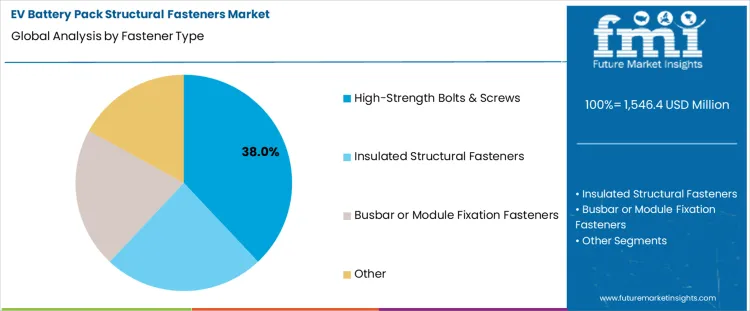
High-strength bolts and screws hold 38.0%, representing the largest share among fastener types due to primary load-bearing responsibility. These fasteners secure battery enclosures, frames, and cross members subject to mechanical stress. High clamping force ensures pack rigidity and dimensional stability during vehicle operation. Standardized bolt geometries support automation and torque-controlled assembly processes. Insulated structural fasteners address electrical isolation needs in selected locations. Busbar and module fixation fasteners support internal electrical and mechanical retention. Fastener type segmentation reflects reliance on conventional high-strength solutions where structural integrity and assembly repeatability remain critical.
Key Points
- High-strength bolts provide primary structural load retention.
- Torque-controlled assembly supports manufacturing consistency.
- Other fasteners address insulation and internal fixation needs.
Which Battery Architecture Accounts for the Highest Share of Demand?
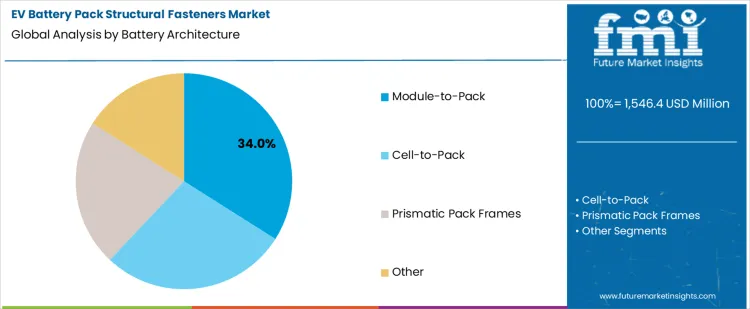
Module-to-pack architectures hold 34.0%, representing the largest share among battery structural designs due to balance of modularity and structural rigidity. This approach retains discrete modules while integrating them directly into the pack frame. Fasteners support module retention, frame stiffness, and service accessibility. Manufacturing flexibility aligns with platform scalability across vehicle variants. Cell-to-pack designs reduce component count with different fastening strategies. Prismatic pack frames apply fasteners to maintain geometric stability. Battery architecture segmentation reflects preference for configurations balancing structural performance, manufacturability, and service considerations.
Key Points
- Module-to-pack balances rigidity with modular assembly.
- Fasteners support frame stiffness and service access.
- Other architectures require alternative fastening strategies.
Which Material Accounts for the Highest Share of Demand?
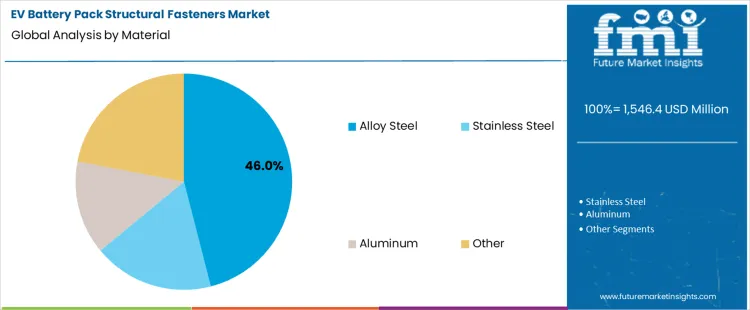
Alloy steel holds 46.0%, representing the largest share among materials used for EV battery pack fasteners. Alloy steels deliver high tensile strength and fatigue resistance under dynamic loading. Thermal stability supports performance across battery operating temperature ranges. Proven manufacturing processes enable consistent quality at scale. Stainless steel and aluminum fasteners address corrosion resistance and weight reduction priorities with trade-offs in strength. Other materials serve niche insulation or specialty requirements. Material segmentation reflects preference for high-strength alloys where structural reliability and safety margins remain paramount.
Key Points
- Alloy steel offers strength and fatigue resistance.
- Thermal stability supports battery operating conditions.
- Other materials address corrosion or weight optimization needs.
What are the Key Dynamics in the EV Battery Pack Structural Fasteners Market?
Demand for EV battery pack structural fasteners reflects safety-critical requirements for securing battery enclosures within electric vehicle platforms. Adoption spans passenger electric vehicles, commercial electric vehicles, and electric buses using skateboard and modular battery architectures. Global scope aligns with vehicle electrification and structural integration of battery systems. Usage centers on high-strength bolts, screws, studs, and hybrid fasteners designed for load bearing, sealing integrity, and crash performance.
How do battery pack integration and safety requirements shape adoption?
Battery packs function as structural elements contributing to vehicle stiffness and crash energy management. Demand increases as pack designs shift toward load-bearing enclosures mounted directly to vehicle floors. Structural fasteners must withstand vibration, thermal expansion, and high mechanical loads without loosening. Fire containment and ingress protection requirements elevate importance of consistent clamping force and sealing compatibility. Electrified platforms introduce mixed-material joints combining aluminum housings, steel frames, and composite shields. Fastener performance directly affects pack alignment, serviceability, and assembly repeatability. OEMs prioritize fasteners compatible with automated torque control and traceability systems. Adoption reflects non-discretionary safety and structural compliance requirements.
How does material selection, cost pressure, and validation complexity influence market scalability?
Fasteners require high-strength steel or advanced alloys to balance load capacity and weight targets. Demand sensitivity rises where premium materials increase bill of materials cost. Corrosion resistance requirements elevate coating and surface treatment complexity. Validation testing for vibration, thermal cycling, crash load, and fatigue extends development timelines. Design customization across battery platforms limits standardization. Repair and service access constraints affect fastener selection and replacement strategy. Supply chain dependence on precision fastener manufacturing affects lead time stability. Warranty exposure linked to battery pack integrity constrains aggressive cost optimization.
How Is Demand for EV Battery Pack Structural Fasteners Evolving Globally?
Demand for EV battery pack structural fasteners is expanding globally due to electrification scale-up, safety requirements, and platform-level standardization of battery enclosures. Usage aligns with structural load management, crash integrity, and thermal interface stability within pack assemblies. OEMs specify fasteners supporting mixed-material joining, corrosion resistance, and repeatable torque retention. Localization of battery assembly increases sourcing depth across regions. Growth rates in China at 10.2%, India at 9.4%, South Korea at 8.9%, USA at 8.5%, and Mexico at 8.0% indicate sustained expansion driven by EV production growth, platform consolidation, and lifecycle servicing needs.
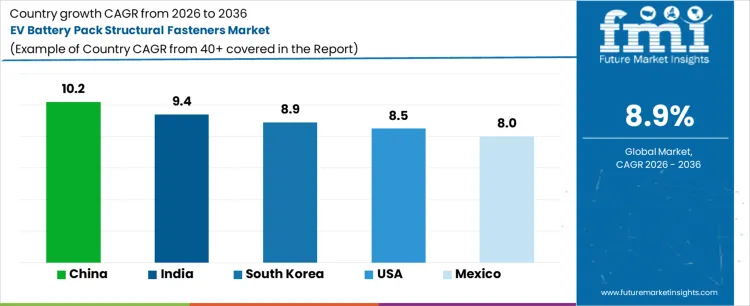
| Country | CAGR (%) |
|---|---|
| China | 10.2% |
| India | 9.4% |
| South Korea | 8.9% |
| USA | 8.5% |
| Mexico | 8.0% |
What Is Driving Rapid Expansion of EV Battery Pack Fastener Demand in China?
EV battery pack structural fastener demand in China is growing at a CAGR of 10.2%, supported by large-scale EV manufacturing and standardized pack architectures. High production volumes amplify fastener consumption per vehicle. Battery enclosures increasingly use aluminum and composite materials, requiring specialized joining solutions. Safety regulations emphasize structural integrity under crash and vibration loads. Domestic battery supply chains favor localized fastener sourcing with tight tolerance control. Demand growth reflects platform standardization and volume scaling rather than customization-driven variation.
- Large-scale EV and battery pack production
- Aluminum and composite enclosure architectures
- Safety-driven structural integrity requirements
- Localized battery and fastener supply chains
Why Is India Showing Strong Growth in EV Battery Structural Fastener Demand?
EV battery pack structural fastener demand in India is expanding at a CAGR of 9.4%, driven by rapid EV platform localization and cost-optimized design strategies. OEMs introduce modular battery packs across two-wheelers, passenger vehicles, and commercial EVs. Structural fasteners balance strength, corrosion resistance, and cost efficiency. Domestic assembly increases demand for locally sourced fasteners meeting global safety norms. Policy-led electrification accelerates platform rollout. Demand growth reflects localization depth and multi-segment EV adoption rather than single-category expansion.
- Modular battery packs across multiple EV segments
- Cost-optimized structural fastening requirements
- Localization of battery pack assembly
- Policy-led acceleration of EV platform deployment
How Is South Korea Supporting Sustained Demand for EV Battery Pack Fasteners?
EV battery pack structural fastener demand in South Korea is growing at a CAGR of 8.9%, shaped by advanced battery engineering and export-oriented EV platforms. OEMs emphasize structural rigidity, thermal stability, and vibration resistance within packs. High energy-density batteries require precise clamping and torque retention. Supplier integration enables consistent fastener quality across global programs. Demand growth aligns with global platform supply rather than domestic EV volume expansion alone.
- Advanced battery engineering and pack design
- High energy-density cells requiring precise clamping
- Export-oriented EV platform production
- Strong OEM-supplier integration
What Factors Are Sustaining EV Battery Fastener Demand in the USA?
EV battery pack structural fastener demand in the USA is expanding at a CAGR of 8.5%, supported by domestic battery manufacturing and platform consolidation. OEMs adopt large-format battery packs integrated into vehicle structures. Fasteners support load-bearing and crash management functions. Climate variation influences corrosion protection and material choice. Federal incentives encourage localized sourcing across battery ecosystems. Demand growth reflects platform scale-up and structural integration trends rather than short-term model proliferation.
- Large-format structural battery pack designs
- Load-bearing and crash management requirements
- Climate-driven corrosion protection needs
- Incentives supporting localized battery ecosystems
Why Is Mexico Experiencing Steady Growth in EV Battery Pack Fastener Demand?
EV battery pack structural fastener demand in Mexico is growing at a CAGR of 8.0%, driven by export-focused EV assembly and regional supply chain integration. Manufacturing plants support battery pack assembly for North American markets. Fastener specifications align with global OEM standards for strength and durability. Consistent production volumes sustain predictable OEM demand. Supplier co-location improves logistics efficiency. Growth reflects export platform continuity and regional integration rather than domestic EV penetration growth.
- Export-oriented EV and battery pack assembly
- Alignment with global OEM fastener standards
- Predictable demand from consistent production volumes
- Regional supply chain integration and co-location
What is the competitive landscape of demand for the EV battery pack structural fasteners market globally?
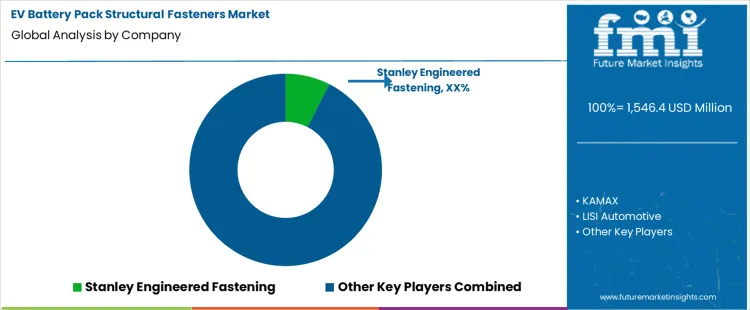
Demand for EV battery pack structural fasteners is driven by rising electric vehicle production, stringent safety standards, and requirements for high-strength, lightweight joining solutions in battery enclosures. Battery pack fasteners must ensure mechanical integrity under vibration, thermal cycling, and crash loads, while supporting efficient assembly processes. Buyers evaluate material strength, torque tolerance, corrosion resistance, dimensional precision, and compatibility with composite and aluminum structures common in EV battery modules. Procurement teams prioritize suppliers with proven OEM approvals, quality management systems (such as IATF 16949), global production capacity, and engineering support for application-specific joint design. Trend in the global market reflects accelerated EV adoption, integration of multi-material battery architectures, and emphasis on fastening technologies that enhance structural rigidity and safety.
Stanley Engineered Fastening holds leading positioning through a broad portfolio of high-performance fasteners and fastening systems engineered for battery pack structural applications and global OEM programs. KAMAX supports demand with precision-manufactured high-strength fasteners optimized for EV battery module and pack assemblies. LISI Automotive contributes automotive-grade fasteners and fastening solutions designed for mixed material EV chassis and battery integrations. Böllhoff participates with fastening technologies and installation support tailored to demanding structural loads and quality expectations. MeiraGTx Automotive Fasteners supplies specialized high-performance fasteners and application engineering support aimed at EV battery structural requirements. Competitive differentiation depends on material performance under dynamic loads, joint reliability, corrosion resistance, and ability to meet stringent automotive safety and manufacturing standards.
Key Players in the EV Battery Pack Structural Fasteners Market
- Stanley Engineered Fastening
- KAMAX
- LISI Automotive
- Böllhoff
- MeiraGTx Automotive Fasteners
- Bossard Group
- Sundram Fasteners
- Bulten
- SFS Group
- Tianjin Meike
Scope of the Report
| Items | Values |
|---|---|
| Quantitative Units | USD million |
| Fastener Type | High-Strength Bolts & Screws; Insulated Structural Fasteners; Busbar or Module Fixation Fasteners; Other |
| Battery Architecture | Module-to-Pack; Cell-to-Pack; Prismatic Pack Frames; Other |
| Material | Alloy Steel; Stainless Steel; Aluminum; Other |
| Sales Channel | OEM Direct; Tier-1 Pack Integrators; Aftermarket; Other |
| Regions Covered | Asia Pacific, Europe, North America, Latin America, Middle East & Africa |
| Countries Covered | China, India, South Korea, USA, Mexico, and 40+ countries |
| Key Companies Profiled | Stanley Engineered Fastening; KAMAX; LISI Automotive; Böllhoff; MeiraGTx Automotive Fasteners; Bossard Group; Sundram Fasteners; Bulten; SFS Group; Tianjin Meike |
| Additional Attributes | Dollar sales by fastener type and battery architecture; adoption trends for insulated and electrically isolated fasteners supporting high-voltage safety; clamp load retention, vibration resistance, and fatigue life performance metrics; electrical isolation, corrosion resistance, and galvanic compatibility considerations; suitability for module-to-pack and cell-to-pack designs with automated assembly; torque accuracy, traceability, and reworkability requirements; compliance with OEM battery safety standards, crash integrity targets, and thermal cycling validation influencing structural fastener selection. |
EV Battery Pack Structural Fasteners Market by Segment
Fastener Type:
- High-Strength Bolts & Screws
- Insulated Structural Fasteners
- Busbar or Module Fixation Fasteners
- Other
Battery Architecture:
- Module-to-Pack
- Cell-to-Pack
- Prismatic Pack Frames
- Other
Material:
- Alloy Steel
- Stainless Steel
- Aluminum
- Other
Sales Channel:
- OEM Direct
- Tier-1 Pack Integrators
- Aftermarket
- Other
Region:
- Asia Pacific
- China
- Japan
- South Korea
- India
- Australia & New Zealand
- ASEAN
- Rest of Asia Pacific
- Europe
- Germany
- United Kingdom
- France
- Italy
- Spain
- Nordic
- BENELUX
- Rest of Europe
- North America
- United States
- Canada
- Mexico
- Latin America
- Brazil
- Chile
- Rest of Latin America
- Middle East & Africa
- Kingdom of Saudi Arabia
- Other GCC Countries
- Turkey
- South Africa
- Other African Union
- Rest of Middle East & Africa
Bibliography
European Parliament and Council of the European Union. (2019, November 27). Regulation (EU) 2019/2144 on type-approval requirements for motor vehicles and their trailers, and systems, components and separate technical units intended therefor, as regards general safety and the protection of vehicle occupants and vulnerable road users, amending Regulation (EU) 2018/858. Official Journal of the European Union. (Consolidated text available via EUR-Lex.)
United Nations Economic Commission for Europe. (2017). UN Regulation No. 10: Uniform provisions concerning the approval of vehicles with regard to electromagnetic compatibility. UNECE (WP.29).
United Nations Economic Commission for Europe. (2017). UN Regulation No. 100, Revision 3: Uniform provisions concerning the approval of vehicles with regard to specific requirements for the electric power train. UNECE (WP.29).
International Organization for Standardization. (2023). ISO 16750-1:2023—Road vehicles—Environmental conditions and testing for electrical and electronic equipment—Part 1: General. ISO.
Frequently Asked Questions
How big is the ev battery pack structural fasteners market in 2026?
The global ev battery pack structural fasteners market is estimated to be valued at USD 1,546.4 million in 2026.
What will be the size of ev battery pack structural fasteners market in 2036?
The market size for the ev battery pack structural fasteners market is projected to reach USD 3,627.4 million by 2036.
How much will be the ev battery pack structural fasteners market growth between 2026 and 2036?
The ev battery pack structural fasteners market is expected to grow at a 8.9% CAGR between 2026 and 2036.
What are the key product types in the ev battery pack structural fasteners market?
The key product types in ev battery pack structural fasteners market are high-strength bolts & screws, insulated structural fasteners, busbar or module fixation fasteners and other.
Which battery architecture segment to contribute significant share in the ev battery pack structural fasteners market in 2026?
In terms of battery architecture, module-to-pack segment to command 34.0% share in the ev battery pack structural fasteners market in 2026.
Preview the report firsthand - request a free sample
Get SampleGet the brochure for pricing and purchase details.
Get PDFTable of Content
- Executive Summary
- Global Market Outlook
- Demand-side Trends
- Supply-side Trends
- Technology Roadmap Analysis
- Analysis and Recommendations
- Market Overview
- Market Coverage / Taxonomy
- Market Definition / Scope / Limitations
- Market Background
- Market Dynamics
- Drivers
- Restraints
- Opportunity
- Trends
- Scenario Forecast
- Demand in Optimistic Scenario
- Demand in Likely Scenario
- Demand in Conservative Scenario
- Opportunity Map Analysis
- Product Life Cycle Analysis
- Supply Chain Analysis
- Investment Feasibility Matrix
- Value Chain Analysis
- PESTLE and Porter’s Analysis
- Regulatory Landscape
- Regional Parent Market Outlook
- Production and Consumption Statistics
- Import and Export Statistics
- Market Dynamics
- Global Market Analysis 2021 to 2025 and Forecast, 2026 to 2036
- Historical Market Size Value (USD Million) Analysis, 2021 to 2025
- Current and Future Market Size Value (USD Million) Projections, 2026 to 2036
- Y-o-Y Growth Trend Analysis
- Absolute $ Opportunity Analysis
- Global Market Pricing Analysis 2021 to 2025 and Forecast 2026 to 2036
- Global Market Analysis 2021 to 2025 and Forecast 2026 to 2036, By Fastener Type
- Introduction / Key Findings
- Historical Market Size Value (USD Million) Analysis By Fastener Type , 2021 to 2025
- Current and Future Market Size Value (USD Million) Analysis and Forecast By Fastener Type , 2026 to 2036
- High-Strength Bolts & Screws
- Insulated Structural Fasteners
- Busbar or Module Fixation Fasteners
- Other
- High-Strength Bolts & Screws
- Y-o-Y Growth Trend Analysis By Fastener Type , 2021 to 2025
- Absolute $ Opportunity Analysis By Fastener Type , 2026 to 2036
- Global Market Analysis 2021 to 2025 and Forecast 2026 to 2036, By Battery Architecture
- Introduction / Key Findings
- Historical Market Size Value (USD Million) Analysis By Battery Architecture, 2021 to 2025
- Current and Future Market Size Value (USD Million) Analysis and Forecast By Battery Architecture, 2026 to 2036
- Module-to-Pack
- Cell-to-Pack
- Prismatic Pack Frames
- Other
- Module-to-Pack
- Y-o-Y Growth Trend Analysis By Battery Architecture, 2021 to 2025
- Absolute $ Opportunity Analysis By Battery Architecture, 2026 to 2036
- Global Market Analysis 2021 to 2025 and Forecast 2026 to 2036, By Material
- Introduction / Key Findings
- Historical Market Size Value (USD Million) Analysis By Material, 2021 to 2025
- Current and Future Market Size Value (USD Million) Analysis and Forecast By Material, 2026 to 2036
- Alloy Steel
- Stainless Steel
- Aluminum
- Other
- Alloy Steel
- Y-o-Y Growth Trend Analysis By Material, 2021 to 2025
- Absolute $ Opportunity Analysis By Material, 2026 to 2036
- Global Market Analysis 2021 to 2025 and Forecast 2026 to 2036, By Sales Channel
- Introduction / Key Findings
- Historical Market Size Value (USD Million) Analysis By Sales Channel, 2021 to 2025
- Current and Future Market Size Value (USD Million) Analysis and Forecast By Sales Channel, 2026 to 2036
- OEM Direct
- Tier-1 Pack Integrators
- Aftermarket
- Other
- OEM Direct
- Y-o-Y Growth Trend Analysis By Sales Channel, 2021 to 2025
- Absolute $ Opportunity Analysis By Sales Channel, 2026 to 2036
- Global Market Analysis 2021 to 2025 and Forecast 2026 to 2036, By Region
- Introduction
- Historical Market Size Value (USD Million) Analysis By Region, 2021 to 2025
- Current Market Size Value (USD Million) Analysis and Forecast By Region, 2026 to 2036
- North America
- Latin America
- Western Europe
- Eastern Europe
- East Asia
- South Asia and Pacific
- Middle East & Africa
- Market Attractiveness Analysis By Region
- North America Market Analysis 2021 to 2025 and Forecast 2026 to 2036, By Country
- Historical Market Size Value (USD Million) Trend Analysis By Market Taxonomy, 2021 to 2025
- Market Size Value (USD Million) Forecast By Market Taxonomy, 2026 to 2036
- By Country
- USA
- Canada
- Mexico
- By Fastener Type
- By Battery Architecture
- By Material
- By Sales Channel
- By Country
- Market Attractiveness Analysis
- By Country
- By Fastener Type
- By Battery Architecture
- By Material
- By Sales Channel
- Key Takeaways
- Latin America Market Analysis 2021 to 2025 and Forecast 2026 to 2036, By Country
- Historical Market Size Value (USD Million) Trend Analysis By Market Taxonomy, 2021 to 2025
- Market Size Value (USD Million) Forecast By Market Taxonomy, 2026 to 2036
- By Country
- Brazil
- Chile
- Rest of Latin America
- By Fastener Type
- By Battery Architecture
- By Material
- By Sales Channel
- By Country
- Market Attractiveness Analysis
- By Country
- By Fastener Type
- By Battery Architecture
- By Material
- By Sales Channel
- Key Takeaways
- Western Europe Market Analysis 2021 to 2025 and Forecast 2026 to 2036, By Country
- Historical Market Size Value (USD Million) Trend Analysis By Market Taxonomy, 2021 to 2025
- Market Size Value (USD Million) Forecast By Market Taxonomy, 2026 to 2036
- By Country
- Germany
- UK
- Italy
- Spain
- France
- Nordic
- BENELUX
- Rest of Western Europe
- By Fastener Type
- By Battery Architecture
- By Material
- By Sales Channel
- By Country
- Market Attractiveness Analysis
- By Country
- By Fastener Type
- By Battery Architecture
- By Material
- By Sales Channel
- Key Takeaways
- Eastern Europe Market Analysis 2021 to 2025 and Forecast 2026 to 2036, By Country
- Historical Market Size Value (USD Million) Trend Analysis By Market Taxonomy, 2021 to 2025
- Market Size Value (USD Million) Forecast By Market Taxonomy, 2026 to 2036
- By Country
- Russia
- Poland
- Hungary
- Balkan & Baltic
- Rest of Eastern Europe
- By Fastener Type
- By Battery Architecture
- By Material
- By Sales Channel
- By Country
- Market Attractiveness Analysis
- By Country
- By Fastener Type
- By Battery Architecture
- By Material
- By Sales Channel
- Key Takeaways
- East Asia Market Analysis 2021 to 2025 and Forecast 2026 to 2036, By Country
- Historical Market Size Value (USD Million) Trend Analysis By Market Taxonomy, 2021 to 2025
- Market Size Value (USD Million) Forecast By Market Taxonomy, 2026 to 2036
- By Country
- China
- Japan
- South Korea
- By Fastener Type
- By Battery Architecture
- By Material
- By Sales Channel
- By Country
- Market Attractiveness Analysis
- By Country
- By Fastener Type
- By Battery Architecture
- By Material
- By Sales Channel
- Key Takeaways
- South Asia and Pacific Market Analysis 2021 to 2025 and Forecast 2026 to 2036, By Country
- Historical Market Size Value (USD Million) Trend Analysis By Market Taxonomy, 2021 to 2025
- Market Size Value (USD Million) Forecast By Market Taxonomy, 2026 to 2036
- By Country
- India
- ASEAN
- Australia & New Zealand
- Rest of South Asia and Pacific
- By Fastener Type
- By Battery Architecture
- By Material
- By Sales Channel
- By Country
- Market Attractiveness Analysis
- By Country
- By Fastener Type
- By Battery Architecture
- By Material
- By Sales Channel
- Key Takeaways
- Middle East & Africa Market Analysis 2021 to 2025 and Forecast 2026 to 2036, By Country
- Historical Market Size Value (USD Million) Trend Analysis By Market Taxonomy, 2021 to 2025
- Market Size Value (USD Million) Forecast By Market Taxonomy, 2026 to 2036
- By Country
- Kingdom of Saudi Arabia
- Other GCC Countries
- Turkiye
- South Africa
- Other African Union
- Rest of Middle East & Africa
- By Fastener Type
- By Battery Architecture
- By Material
- By Sales Channel
- By Country
- Market Attractiveness Analysis
- By Country
- By Fastener Type
- By Battery Architecture
- By Material
- By Sales Channel
- Key Takeaways
- Key Countries Market Analysis
- USA
- Pricing Analysis
- Market Share Analysis, 2025
- By Fastener Type
- By Battery Architecture
- By Material
- By Sales Channel
- Canada
- Pricing Analysis
- Market Share Analysis, 2025
- By Fastener Type
- By Battery Architecture
- By Material
- By Sales Channel
- Mexico
- Pricing Analysis
- Market Share Analysis, 2025
- By Fastener Type
- By Battery Architecture
- By Material
- By Sales Channel
- Brazil
- Pricing Analysis
- Market Share Analysis, 2025
- By Fastener Type
- By Battery Architecture
- By Material
- By Sales Channel
- Chile
- Pricing Analysis
- Market Share Analysis, 2025
- By Fastener Type
- By Battery Architecture
- By Material
- By Sales Channel
- Germany
- Pricing Analysis
- Market Share Analysis, 2025
- By Fastener Type
- By Battery Architecture
- By Material
- By Sales Channel
- UK
- Pricing Analysis
- Market Share Analysis, 2025
- By Fastener Type
- By Battery Architecture
- By Material
- By Sales Channel
- Italy
- Pricing Analysis
- Market Share Analysis, 2025
- By Fastener Type
- By Battery Architecture
- By Material
- By Sales Channel
- Spain
- Pricing Analysis
- Market Share Analysis, 2025
- By Fastener Type
- By Battery Architecture
- By Material
- By Sales Channel
- France
- Pricing Analysis
- Market Share Analysis, 2025
- By Fastener Type
- By Battery Architecture
- By Material
- By Sales Channel
- India
- Pricing Analysis
- Market Share Analysis, 2025
- By Fastener Type
- By Battery Architecture
- By Material
- By Sales Channel
- ASEAN
- Pricing Analysis
- Market Share Analysis, 2025
- By Fastener Type
- By Battery Architecture
- By Material
- By Sales Channel
- Australia & New Zealand
- Pricing Analysis
- Market Share Analysis, 2025
- By Fastener Type
- By Battery Architecture
- By Material
- By Sales Channel
- China
- Pricing Analysis
- Market Share Analysis, 2025
- By Fastener Type
- By Battery Architecture
- By Material
- By Sales Channel
- Japan
- Pricing Analysis
- Market Share Analysis, 2025
- By Fastener Type
- By Battery Architecture
- By Material
- By Sales Channel
- South Korea
- Pricing Analysis
- Market Share Analysis, 2025
- By Fastener Type
- By Battery Architecture
- By Material
- By Sales Channel
- Russia
- Pricing Analysis
- Market Share Analysis, 2025
- By Fastener Type
- By Battery Architecture
- By Material
- By Sales Channel
- Poland
- Pricing Analysis
- Market Share Analysis, 2025
- By Fastener Type
- By Battery Architecture
- By Material
- By Sales Channel
- Hungary
- Pricing Analysis
- Market Share Analysis, 2025
- By Fastener Type
- By Battery Architecture
- By Material
- By Sales Channel
- Kingdom of Saudi Arabia
- Pricing Analysis
- Market Share Analysis, 2025
- By Fastener Type
- By Battery Architecture
- By Material
- By Sales Channel
- Turkiye
- Pricing Analysis
- Market Share Analysis, 2025
- By Fastener Type
- By Battery Architecture
- By Material
- By Sales Channel
- South Africa
- Pricing Analysis
- Market Share Analysis, 2025
- By Fastener Type
- By Battery Architecture
- By Material
- By Sales Channel
- USA
- Market Structure Analysis
- Competition Dashboard
- Competition Benchmarking
- Market Share Analysis of Top Players
- By Regional
- By Fastener Type
- By Battery Architecture
- By Material
- By Sales Channel
- Competition Analysis
- Competition Deep Dive
- Stanley Engineered Fastening
- Overview
- Product Portfolio
- Profitability by Market Segments (Product/Age /Sales Channel/Region)
- Sales Footprint
- Strategy Overview
- Marketing Strategy
- Product Strategy
- Channel Strategy
- KAMAX
- LISI Automotive
- Böllhoff
- MeiraGTx Automotive Fasteners
- Bossard Group
- Sundram Fasteners
- Bulten
- SFS Group
- Tianjin Meike
- Stanley Engineered Fastening
- Competition Deep Dive
- Assumptions & Acronyms Used
- Research Methodology


