

- Industry Size (2026)
- USD 1.5 Bn
- Forecast (2036)
- USD 3.6 Bn
- CAGR (2026 to 2036)
- 9.0%
Battery Pack Sealants Market Forecast and Outlook 2026 to 2036
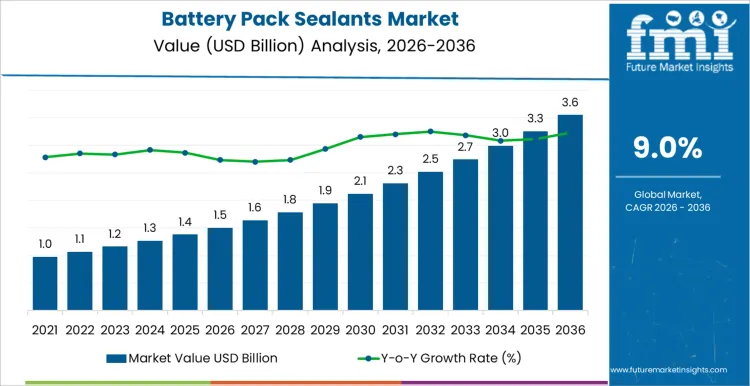
The battery pack sealants market is projected to grow from USD 1.5 billion in 2026 to USD 3.6 billion by 2036, with a CAGR of 9.0%. This growth is driven by the increasing demand for effective thermal management, structural integrity, and safety in electric vehicle (EV) battery systems. Battery pack sealants play a critical role in preventing moisture, dust, and vibration ingress while maintaining temperature stability, thus contributing to the longevity and performance of the battery packs. As EV manufacturers focus on higher energy density, fast charging, and improved battery life, sealants have become an essential component in sealing and protecting battery modules and enclosures. Pack perimeter gasketing is the primary application, followed by cell-to-cell or module potting and thermal gap filling. As battery designs become more integrated, manufacturers are increasingly seeking sealants that support automated assembly processes, have high precision, and provide long-term reliability. Challenges like material compatibility, qualification, and cost control may slow adoption, but innovation in sealing technologies will continue to drive market expansion across regions.
Quick Stats for Battery Pack Sealants Market
- Battery Pack Sealants Market Value (2026): USD 1.5 Billion
- Battery Pack Sealants Market Forecast Value (2036): USD 3.6 Billion
- Battery Pack Sealants Market Forecast CAGR (2026 to 2036): 9.0%
- Leading Chemistry in Battery Pack Sealants Market: Silicone-Based Sealants (42% share)
- Key Growth Regions in Battery Pack Sealants Market: Asia Pacific, Europe, North America, Latin America, Middle East & Africa
- Top Key Players in Battery Pack Sealants Market: Dow, Wacker Chemie, Henkel, 3M, Sika, Momentive, H.B. Fuller, DuPont, Saint-Gobain, Shin-Etsu
Battery Pack Sealants Market Key Takeaways
| Metric | Value |
|---|---|
| Battery Pack Sealants Market Value (2026) | USD 1.5 Billion |
| Battery Pack Sealants Market Forecast Value (2036) | USD 3.6 Billion |
| Battery Pack Sealants Market Forecast CAGR (2026 to 2036) | 9.0% |
How are Pack Integrity Requirements and High-Volume EV Manufacturing Driving the Battery Pack Sealants Market?
The battery pack sealants market is expanding as EV manufacturers place greater emphasis on pack-level protection against moisture ingress, dust, vibration, and thermal cycling. Sealants play a critical role in maintaining IP-rated enclosures, preventing corrosion of sensitive components, and ensuring long-term electrical isolation. As battery packs become structural elements in cell-to-pack and cell-to-chassis designs, sealants are no longer auxiliary materials but core contributors to safety, durability, and warranty performance.
Manufacturing compatibility and process efficiency are shaping supplier selection. OEMs and Tier-1s favor sealants that support automated dispensing, fast cure times, and consistent bead geometry to keep takt times low on high-volume assembly lines. High-volume takt time targets are also accelerating qualification of adhesives for electric vehicle power batteries that can run on the same dispensing and cure infrastructure as pack sealing beads. Adhesion to mixed substrates aluminum, steel, plastics, and composites under wide temperature ranges is a key qualification requirement. Suppliers that can tailor rheology, cure chemistry, and reworkability to specific pack architectures are gaining early involvement in platform development.
Lifecycle reliability and regulatory validation are further accelerating demand. Battery packs must withstand years of vibration, thermal expansion, and exposure to coolants or electrolytes without seal degradation. Interface durability is increasingly engineered alongside battery thermal plates because plate flatness, coolant routing, and clamp loads influence long-term gasket compression and leak risk. This is driving preference for sealants with proven aging performance, flame resistance, and compliance with automotive safety standards. Materials teams are also evaluating PFAS-free EV battery fire protection coatings where regulatory scrutiny and fire performance targets intersect in pack-level safety designs. Thermal-event mitigation is also raising interest in heat-shield coatings for EV battery trays to reduce heat transfer into enclosure walls and protect seal lines during localized failure. Pack safety packages increasingly pair sealing with EV battery safety vents to control both moisture ingress and pressure release behavior under abnormal events. For material suppliers, competitive advantage in the battery pack sealants market increasingly depends on co-engineering capability, validated durability data, and the ability to scale production globally positioning sealants as a foundational material in next-generation EV battery systems.
How Is The Battery Pack Sealants Market Structured By Chemistry And Application Area?
The battery pack sealants market is segmented by chemistry and application area, reflecting how sealing performance, durability, and serviceability requirements vary across battery pack designs. By chemistry, silicone-based sealants lead the market, as they offer flexibility, thermal stability, and long-term sealing performance under dynamic operating conditions. Other chemistries include polyurethane, epoxy, and specialized formulations selected based on rigidity, adhesion strength, and cure characteristics. By application area, pack perimeter gasketing represents the primary use case, while cell-to-cell or module potting, thermal gap filling, and service reseal applications address internal protection, heat transfer, and maintenance needs within battery packs.
Why Does Silicone Lead Chemistry Adoption In The Battery Pack Sealants Market?
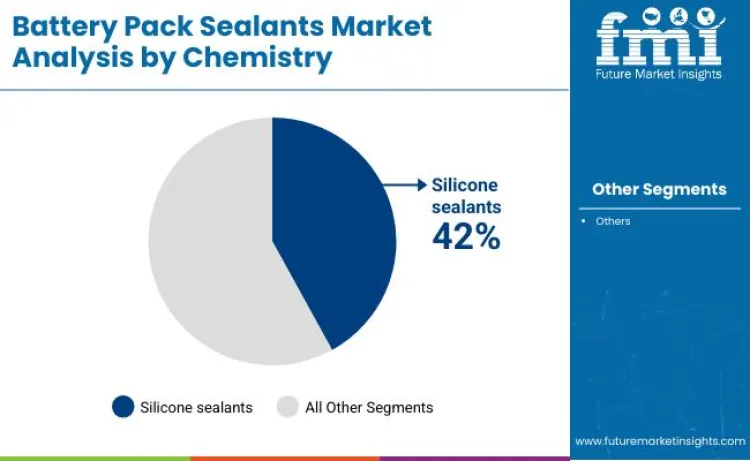
Silicone sealants account for 42% share of the battery pack sealants market because they maintain elasticity and sealing integrity across wide temperature ranges and repeated thermal cycling. The same cycling constraints are shaping selection of thermal management materials for EV batteries, which must remain stable against oils, coolants, and long-duration heat exposure. Battery packs experience vibration, expansion, and contraction during operation and charging, making flexible sealants essential. Silicone materials provide strong resistance to moisture ingress, dust, and chemical exposure without becoming brittle over time. OEMs favor silicone for its compatibility with aluminum housings and composite enclosures. Ease of application and reworkability further support adoption. These durability, flexibility, and processing advantages explain why silicone remains the dominant chemistry in battery pack sealing solutions.
Why Does Pack Perimeter Gasketing Dominate Application Demand In The Battery Pack Sealants Market?
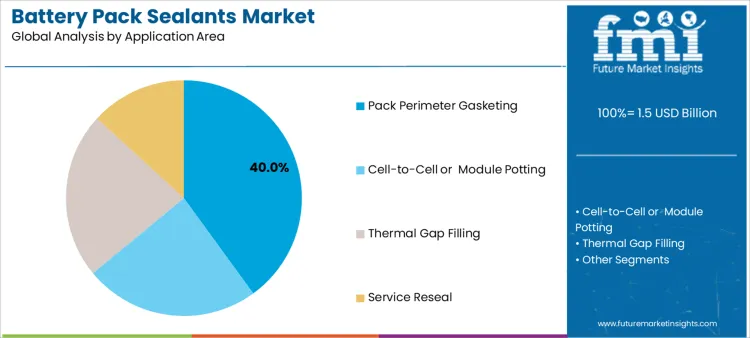
Pack perimeter gasketing holds 40% share of the battery pack sealants market because sealing the outer enclosure is critical for protecting internal cells and electronics from environmental exposure. The pack perimeter is the first barrier against water ingress, dust, and road debris in electric vehicles. Manufacturers prioritize robust gasketing to ensure long-term enclosure integrity throughout the vehicle lifecycle. This application requires sealants that maintain compression set and adhesion over time. High pack volumes across EV platforms drive consistent demand. These protection-critical and volume-driven factors explain why pack perimeter gasketing remains the leading application area.
What Are The Key Dynamics Of The Battery Pack Sealants Market?
The battery pack sealants market is driven by the rapid expansion of electric vehicles (EVs), energy storage systems (ESS), and portable electronics where environmental protection, mechanical integrity, and safety of battery enclosures are critical. Sealants prevent moisture, dust, and corrosive ingress, support vibration damping, and contribute to thermal management, making them essential for lithium-ion and emerging battery chemistries. For material suppliers, compounders, and battery pack integrators, sealant adhesion strength, chemical resistance, cure time, thermal stability, compatibility with coatings and substrates, and assembly process integration are key performance and procurement factors. Supply reliability and technical support also influence long-term adoption and qualification.
How Are Battery Technology And Assembly Trends Shaping This Market?
Battery technology and assembly trends are shaping the battery pack sealants market through growing demand for lighter, tighter, and more integrated battery systems. As EV architectures evolve toward higher energy densities and more compact pack designs, sealants must maintain performance under thermal cycling, vibration, and long service life conditions. Trends such as module-level liquid cooling, solid-state battery prototypes, and increased use of structural adhesives influence sealant formulation requirements. Automated dispensing systems and in-line cure monitoring help manufacturers maintain quality and throughput. Sealant vendors that provide tailored formulations, automated application process support, and compatibility with automation lines strengthen competitiveness and shorten qualification cycles with OEMs and pack assemblers.
Why Do Qualification, Material Compatibility, And Cost Challenges Restrain Market Growth?
Qualification, material compatibility, and cost challenges restrain growth in the battery pack sealants market due to the rigorous demands of automotive and energy production environments. Sealants used in EV packs must pass extensive reliability and performance testing to meet safety standards, adding time and expense to development. Varying substrates such as aluminum housings, coated steels, plastics, and composite materials require sealants with broad adhesion profiles, increasing formulation complexity. Achieving performance without excessive material or processing cost is essential in competitive markets; high-performance chemistries often carry higher raw material costs that temper adoption in cost-sensitive segments. These factors can extend qualification timelines and total cost of ownership for pack manufacturers.
Country-Wise Growth Outlook for the Cabin Radar Sensors Market
The cabin radar sensors market is expanding rapidly as automotive OEMs integrate advanced in-cabin sensing technologies to enhance safety, comfort, and regulatory compliance. Cabin radar sensors enable functions such as child presence detection, occupant monitoring, gesture recognition, and driver status sensing, even in low-light or obstructed conditions. Growth across countries is influenced by vehicle safety regulations, penetration of advanced driver assistance systems (ADAS), and adoption of premium and connected vehicle platforms. High-growth markets are driven by large-scale vehicle production and rapid feature adoption, while mature automotive economies emphasize sensor accuracy, system integration, and long-term reliability.
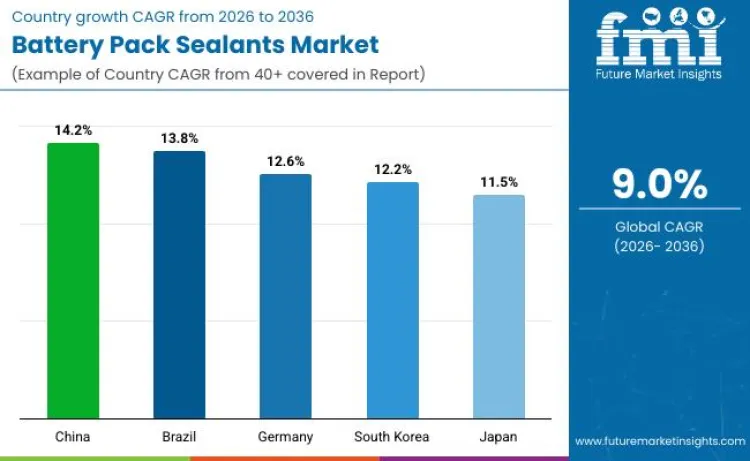
| Country | CAGR (%) |
|---|---|
| China | 14.2 |
| Brazil | 13.8 |
| Germany | 12.6 |
| South Korea | 12.2 |
| Japan | 11.5 |
Why Is China Leading the Cabin Radar Sensors Market?
Demand for cabin radar sensors in China is expanding at a CAGR of 14.2% during 2026 to 2036, driven by high vehicle production volumes and rapid adoption of intelligent cockpit technologies. Chinese OEMs are aggressively integrating cabin radar sensors to enable child presence detection, occupancy classification, and gesture-based controls, particularly in electric and connected vehicles. Regulatory momentum around occupant safety and rising consumer expectations for smart interiors are accelerating deployment. Buyers prioritize cost-effective radar modules with reliable detection accuracy and seamless integration into vehicle electronic architectures. Domestic suppliers benefit from strong semiconductor and sensor manufacturing ecosystems, enabling rapid scaling and competitive pricing. Procurement decisions favor suppliers that can support high-volume programs, offer localized production, and meet evolving automotive safety and EMC standards.
Why Is Brazil Experiencing Rising Adoption of Cabin Radar Sensors?
Sales of cabin radar sensors in Brazil is growing at a CAGR of 13.8% during 2026 to 2036, supported by increasing adoption of advanced safety features in passenger vehicles. As OEMs upgrade vehicle platforms to meet global safety norms, cabin radar sensors are being introduced for occupant detection and driver monitoring applications. Growth is strongest in mid-range and premium vehicles, as well as fleet and shared mobility segments. Buyers emphasize robustness, affordability, and reliable performance under diverse operating conditions. Given the cost-sensitive nature of the market, suppliers offering modular and scalable radar solutions gain preference. Procurement decisions are influenced by local technical support, compatibility with existing vehicle electronics, and compliance with regional automotive standards.
How Is Germany Driving Demand for High-Precision Cabin Radar Sensors?
Germany’s cabin radar sensors market is expanding at a CAGR of 12.6% during 2026 to 2036, driven by the country’s leadership in premium and technologically advanced vehicles. German OEMs deploy high-resolution cabin radar sensors to support sophisticated occupant monitoring, driver distraction detection, and future autonomous cabin functions. Precision, reliability, and seamless integration with ADAS and interior electronics are critical selection criteria. Buyers prioritize sensor accuracy, low false detection rates, and long-term performance stability. Regulatory focus on child safety and driver monitoring further supports adoption. Procurement decisions favor suppliers capable of delivering automotive-grade radar systems that meet strict quality, cybersecurity, and certification requirements.
How Is South Korea Advancing Cabin Radar Sensor Integration?
Demand for cabin radar sensors in South Korea is growing at a CAGR of 12.2% during 2026 to 2036, supported by strong EV production and rapid adoption of smart cockpit technologies. OEMs increasingly integrate cabin radar sensors for occupant detection, gesture control, and driver monitoring in connected and electric vehicles. Compact sensor designs with high detection sensitivity are preferred to support space-efficient interior layouts. Buyers emphasize system integration capability, semiconductor quality, and alignment with next-generation vehicle architectures. Collaboration between automakers, electronics suppliers, and semiconductor firms accelerates adoption. Procurement decisions are driven by innovation capability, production scalability, and compliance with global automotive standards.
What Is Driving Cabin Radar Sensor Adoption in Japan?
Sales of cabin radar sensors in Japan is expanding at a CAGR of 11.5% during 2026 to 2036, driven by a strong focus on safety, reliability, and occupant protection. Japanese OEMs adopt cabin radar sensors to enhance child presence detection and driver monitoring, particularly in hybrid and compact vehicles. Buyers emphasize proven sensor performance, low error rates, and long validation cycles. Integration with conservative yet highly reliable vehicle electronics architectures is a key requirement. Adoption is gradual but steady, reflecting Japan’s emphasis on quality and durability over rapid feature rollouts. Procurement decisions favor suppliers with established automotive track records and consistent manufacturing precision.
How Are Materials and Adhesive Suppliers Competing in the Battery Pack Sealants Market?
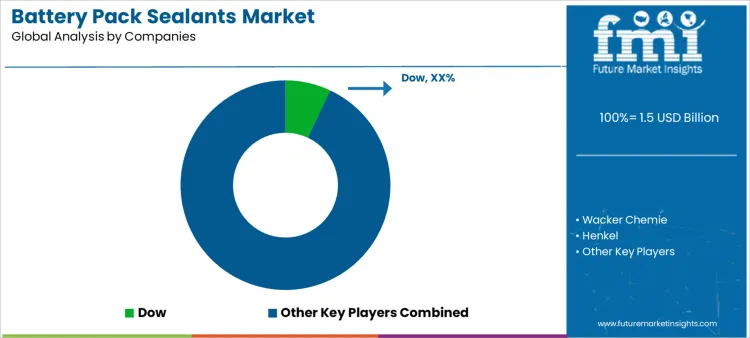
Competition in the battery pack sealants market is driven by thermal stability, long-term elasticity, dielectric performance, and resistance to vibration, moisture, and chemical exposure within EV battery enclosures. As battery packs evolve toward higher energy density and faster charging, sealants must maintain structural integrity across wide temperature ranges while supporting serviceability and safety requirements. Dow positions its silicone-based sealants around high thermal endurance, low outgassing, and consistent sealing performance under thermal cycling. Its materials are widely specified for pack housings and lid sealing where durability and process consistency are critical.
Silicone and elastomer specialists emphasize purity and performance consistency. Wacker Chemie and Shin-Etsu compete through advanced silicone sealants engineered for high-voltage insulation, compression set resistance, and stable adhesion to aluminum and composite battery enclosures. Momentive differentiates with sealants designed to balance flexibility and mechanical strength, supporting both permanent sealing and rework-friendly designs. DuPont adds competitive depth through specialty elastomers and materials with strong chemical resistance and dielectric properties.
Adhesive and construction-material leaders strengthen positioning through system-level solutions. Henkel and Sika focus on sealants that integrate sealing, bonding, and gap-filling functions, enabling simplified pack assembly and improved structural stiffness. 3M competes through engineered tapes and hybrid sealants offering rapid processing and clean application in high-volume EV production lines. H.B. Fuller targets OEMs seeking tailored chemistries for automated dispensing.
Materials specialists expand the competitive landscape. Saint-Gobain brings expertise in high-performance sealing systems and insulation materials for harsh environments. Across the market, competitive advantage is defined by seal durability, thermal and electrical performance, and compatibility with automated battery pack manufacturing rather than material cost alone.
Key Players in Battery Pack Sealants Market
- Dow
- Wacker Chemie
- Henkel
- 3M
- Sika
- Momentive
- H.B. Fuller
- DuPont
- Saint‑Gobain
- Shin‑Etsu
Scope of Report
| Attribute | Details |
|---|---|
| Market Size Unit | USD Billion |
| Frequency Covered | 60-64 GHz Radar Sensors, 76-81 GHz Radar Sensors, Other In-Cabin Radar Frequencies |
| Channel Covered | OEM Factory-Fit Installation, Aftermarket Integration |
| Countries Covered | China, Japan, South Korea, India, Australia & New Zealand, ASEAN, Rest of Asia Pacific, Germany, United Kingdom, France, Italy, Spain, Nordic, BENELUX, Rest of Europe, United States, Canada, Mexico, Brazil, Chile, Rest of Latin America, Kingdom of Saudi Arabia, Other GCC Countries, Turkey, South Africa, Other African Union, Rest of Middle East & Africa |
| Regions Covered | Asia Pacific, Europe, North America, Latin America, Middle East & Africa |
| Key Companies Profiled | Vayyar, Infineon Technologies, NXP Semiconductors, Texas Instruments, Aptiv, Hella (Forvia), Denso, Hyundai Mobis, SmartRadar, Uhnder |
| Additional Attributes | Dollar sales by frequency band and channel are evaluated across passenger vehicle and commercial vehicle cabins. The scope analyzes child presence detection, occupant monitoring, vital sign sensing, and integration with ADAS and safety systems. Country-level assessment reflects regulatory mandates, OEM safety adoption, and deployment of radar-based in-cabin sensing architectures. |
Battery Pack Sealants Market by Key Segments
Chemistry:
- Silicone
- Polyurethane
- Epoxy
- Other
Application Area:
- Pack Perimeter Gasketing
- Cell‑to‑Cell or Module Potting
- Thermal Gap Filling
- Service Reseal
Region:
- Asia Pacific
- China
- Japan
- South Korea
- India
- Australia & New Zealand
- ASEAN
- Rest of Asia Pacific
- Europe
- Germany
- United Kingdom
- France
- Italy
- Spain
- Nordic
- BENELUX
- Rest of Europe
- North America
- United States
- Canada
- Mexico
- Latin America
- Brazil
- Chile
- Rest of Latin America
- Middle East & Africa
- Kingdom of Saudi Arabia
- Other GCC Countries
- Turkey
- South Africa
- Other African Union
- Rest of Middle East & Africa
Bibliography
- United States Department of Energy. (2024). Battery pack design, safety, and manufacturing for electric vehicles. U.S. Department of Energy.
- SAE International. (2024). Battery pack enclosure design and environmental sealing requirements for electric vehicles. SAE International.
- United Nations Economic Commission for Europe. (2023). UN Regulation No. 100: Uniform provisions concerning the approval of vehicles with regard to electric power train safety. UNECE.
Frequently Asked Questions
How big is the battery pack sealants market in 2026?
The global battery pack sealants market is estimated to be valued at USD 1.5 billion in 2026.
What will be the size of battery pack sealants market in 2036?
The market size for the battery pack sealants market is projected to reach USD 3.6 billion by 2036.
How much will be the battery pack sealants market growth between 2026 and 2036?
The battery pack sealants market is expected to grow at a 9.0% CAGR between 2026 and 2036.
What are the key product types in the battery pack sealants market?
The key product types in battery pack sealants market are silicone, polyurethane, epoxy and other.
Which application area segment to contribute significant share in the battery pack sealants market in 2026?
In terms of application area, pack perimeter gasketing segment to command 40.0% share in the battery pack sealants market in 2026.
Preview the report firsthand - request a free sample
Get SampleGet the brochure for pricing and purchase details.
Get PDFTable of Content
- Executive Summary
- Global Market Outlook
- Demand-side Trends
- Supply-side Trends
- Technology Roadmap Analysis
- Analysis and Recommendations
- Market Overview
- Market Coverage / Taxonomy
- Market Definition / Scope / Limitations
- Market Background
- Market Dynamics
- Drivers
- Restraints
- Opportunity
- Trends
- Scenario Forecast
- Demand in Optimistic Scenario
- Demand in Likely Scenario
- Demand in Conservative Scenario
- Opportunity Map Analysis
- Product Life Cycle Analysis
- Supply Chain Analysis
- Investment Feasibility Matrix
- Value Chain Analysis
- PESTLE and Porter’s Analysis
- Regulatory Landscape
- Regional Parent Market Outlook
- Production and Consumption Statistics
- Import and Export Statistics
- Market Dynamics
- Global Market Analysis 2021 to 2025 and Forecast, 2026 to 2036
- Historical Market Size Value (USD Million) Analysis, 2021 to 2025
- Current and Future Market Size Value (USD Million) Projections, 2026 to 2036
- Y-o-Y Growth Trend Analysis
- Absolute $ Opportunity Analysis
- Global Market Pricing Analysis 2021 to 2025 and Forecast 2026 to 2036
- Global Market Analysis 2021 to 2025 and Forecast 2026 to 2036, By Chemistry
- Introduction / Key Findings
- Historical Market Size Value (USD Million) Analysis By Chemistry , 2021 to 2025
- Current and Future Market Size Value (USD Million) Analysis and Forecast By Chemistry , 2026 to 2036
- Silicone
- Polyurethane
- Epoxy
- Other
- Silicone
- Y-o-Y Growth Trend Analysis By Chemistry , 2021 to 2025
- Absolute $ Opportunity Analysis By Chemistry , 2026 to 2036
- Global Market Analysis 2021 to 2025 and Forecast 2026 to 2036, By Application Area
- Introduction / Key Findings
- Historical Market Size Value (USD Million) Analysis By Application Area, 2021 to 2025
- Current and Future Market Size Value (USD Million) Analysis and Forecast By Application Area, 2026 to 2036
- Pack Perimeter Gasketing
- Cell‑to‑Cell or Module Potting
- Thermal Gap Filling
- Service Reseal
- Pack Perimeter Gasketing
- Y-o-Y Growth Trend Analysis By Application Area, 2021 to 2025
- Absolute $ Opportunity Analysis By Application Area, 2026 to 2036
- Global Market Analysis 2021 to 2025 and Forecast 2026 to 2036, By Region
- Introduction
- Historical Market Size Value (USD Million) Analysis By Region, 2021 to 2025
- Current Market Size Value (USD Million) Analysis and Forecast By Region, 2026 to 2036
- North America
- Latin America
- Western Europe
- Eastern Europe
- East Asia
- South Asia and Pacific
- Middle East & Africa
- Market Attractiveness Analysis By Region
- North America Market Analysis 2021 to 2025 and Forecast 2026 to 2036, By Country
- Historical Market Size Value (USD Million) Trend Analysis By Market Taxonomy, 2021 to 2025
- Market Size Value (USD Million) Forecast By Market Taxonomy, 2026 to 2036
- By Country
- USA
- Canada
- Mexico
- By Chemistry
- By Application Area
- By Country
- Market Attractiveness Analysis
- By Country
- By Chemistry
- By Application Area
- Key Takeaways
- Latin America Market Analysis 2021 to 2025 and Forecast 2026 to 2036, By Country
- Historical Market Size Value (USD Million) Trend Analysis By Market Taxonomy, 2021 to 2025
- Market Size Value (USD Million) Forecast By Market Taxonomy, 2026 to 2036
- By Country
- Brazil
- Chile
- Rest of Latin America
- By Chemistry
- By Application Area
- By Country
- Market Attractiveness Analysis
- By Country
- By Chemistry
- By Application Area
- Key Takeaways
- Western Europe Market Analysis 2021 to 2025 and Forecast 2026 to 2036, By Country
- Historical Market Size Value (USD Million) Trend Analysis By Market Taxonomy, 2021 to 2025
- Market Size Value (USD Million) Forecast By Market Taxonomy, 2026 to 2036
- By Country
- Germany
- UK
- Italy
- Spain
- France
- Nordic
- BENELUX
- Rest of Western Europe
- By Chemistry
- By Application Area
- By Country
- Market Attractiveness Analysis
- By Country
- By Chemistry
- By Application Area
- Key Takeaways
- Eastern Europe Market Analysis 2021 to 2025 and Forecast 2026 to 2036, By Country
- Historical Market Size Value (USD Million) Trend Analysis By Market Taxonomy, 2021 to 2025
- Market Size Value (USD Million) Forecast By Market Taxonomy, 2026 to 2036
- By Country
- Russia
- Poland
- Hungary
- Balkan & Baltic
- Rest of Eastern Europe
- By Chemistry
- By Application Area
- By Country
- Market Attractiveness Analysis
- By Country
- By Chemistry
- By Application Area
- Key Takeaways
- East Asia Market Analysis 2021 to 2025 and Forecast 2026 to 2036, By Country
- Historical Market Size Value (USD Million) Trend Analysis By Market Taxonomy, 2021 to 2025
- Market Size Value (USD Million) Forecast By Market Taxonomy, 2026 to 2036
- By Country
- China
- Japan
- South Korea
- By Chemistry
- By Application Area
- By Country
- Market Attractiveness Analysis
- By Country
- By Chemistry
- By Application Area
- Key Takeaways
- South Asia and Pacific Market Analysis 2021 to 2025 and Forecast 2026 to 2036, By Country
- Historical Market Size Value (USD Million) Trend Analysis By Market Taxonomy, 2021 to 2025
- Market Size Value (USD Million) Forecast By Market Taxonomy, 2026 to 2036
- By Country
- India
- ASEAN
- Australia & New Zealand
- Rest of South Asia and Pacific
- By Chemistry
- By Application Area
- By Country
- Market Attractiveness Analysis
- By Country
- By Chemistry
- By Application Area
- Key Takeaways
- Middle East & Africa Market Analysis 2021 to 2025 and Forecast 2026 to 2036, By Country
- Historical Market Size Value (USD Million) Trend Analysis By Market Taxonomy, 2021 to 2025
- Market Size Value (USD Million) Forecast By Market Taxonomy, 2026 to 2036
- By Country
- Kingdom of Saudi Arabia
- Other GCC Countries
- Turkiye
- South Africa
- Other African Union
- Rest of Middle East & Africa
- By Chemistry
- By Application Area
- By Country
- Market Attractiveness Analysis
- By Country
- By Chemistry
- By Application Area
- Key Takeaways
- Key Countries Market Analysis
- USA
- Pricing Analysis
- Market Share Analysis, 2025
- By Chemistry
- By Application Area
- Canada
- Pricing Analysis
- Market Share Analysis, 2025
- By Chemistry
- By Application Area
- Mexico
- Pricing Analysis
- Market Share Analysis, 2025
- By Chemistry
- By Application Area
- Brazil
- Pricing Analysis
- Market Share Analysis, 2025
- By Chemistry
- By Application Area
- Chile
- Pricing Analysis
- Market Share Analysis, 2025
- By Chemistry
- By Application Area
- Germany
- Pricing Analysis
- Market Share Analysis, 2025
- By Chemistry
- By Application Area
- UK
- Pricing Analysis
- Market Share Analysis, 2025
- By Chemistry
- By Application Area
- Italy
- Pricing Analysis
- Market Share Analysis, 2025
- By Chemistry
- By Application Area
- Spain
- Pricing Analysis
- Market Share Analysis, 2025
- By Chemistry
- By Application Area
- France
- Pricing Analysis
- Market Share Analysis, 2025
- By Chemistry
- By Application Area
- India
- Pricing Analysis
- Market Share Analysis, 2025
- By Chemistry
- By Application Area
- ASEAN
- Pricing Analysis
- Market Share Analysis, 2025
- By Chemistry
- By Application Area
- Australia & New Zealand
- Pricing Analysis
- Market Share Analysis, 2025
- By Chemistry
- By Application Area
- China
- Pricing Analysis
- Market Share Analysis, 2025
- By Chemistry
- By Application Area
- Japan
- Pricing Analysis
- Market Share Analysis, 2025
- By Chemistry
- By Application Area
- South Korea
- Pricing Analysis
- Market Share Analysis, 2025
- By Chemistry
- By Application Area
- Russia
- Pricing Analysis
- Market Share Analysis, 2025
- By Chemistry
- By Application Area
- Poland
- Pricing Analysis
- Market Share Analysis, 2025
- By Chemistry
- By Application Area
- Hungary
- Pricing Analysis
- Market Share Analysis, 2025
- By Chemistry
- By Application Area
- Kingdom of Saudi Arabia
- Pricing Analysis
- Market Share Analysis, 2025
- By Chemistry
- By Application Area
- Turkiye
- Pricing Analysis
- Market Share Analysis, 2025
- By Chemistry
- By Application Area
- South Africa
- Pricing Analysis
- Market Share Analysis, 2025
- By Chemistry
- By Application Area
- USA
- Market Structure Analysis
- Competition Dashboard
- Competition Benchmarking
- Market Share Analysis of Top Players
- By Regional
- By Chemistry
- By Application Area
- Competition Analysis
- Competition Deep Dive
- Dow
- Overview
- Product Portfolio
- Profitability by Market Segments (Product/Age /Sales Channel/Region)
- Sales Footprint
- Strategy Overview
- Marketing Strategy
- Product Strategy
- Channel Strategy
- Wacker Chemie
- Henkel
- 3M
- Sika
- Momentive
- H.B. Fuller
- DuPont
- Saint‑Gobain
- Shin‑Etsu
- Dow
- Competition Deep Dive
- Assumptions & Acronyms Used
- Research Methodology


