

- Industry Size (2026)
- USD 2.9 Bn
- Forecast (2036)
- USD 8.2 Bn
- CAGR (2026 to 2036)
- 11.0%
Battery Thermal Plates Market Forecast and Outlook 2026 to 2036
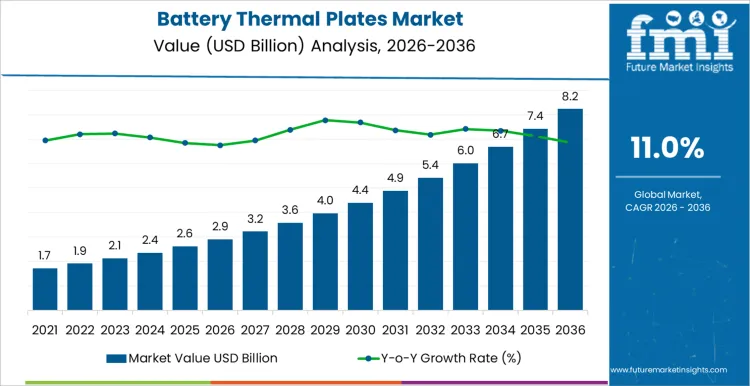
Battery thermal plates represent USD 2.9 billion in 2026 market value and are expected to scale to USD 8.2 billion by 2036 at an 11.0% CAGR. Procurement behavior in this market is being shaped by the critical role thermal plate’s play in battery safety, fast-charging capability, and long-term pack reliability. Selection decisions are increasingly driven by validated thermal performance, leak integrity, and manufacturing consistency rather than unit pricing alone. Risk aversion is evident, as battery thermal plates are embedded deep within battery packs, making post-installation failure costly and disruptive.
Preference is therefore given to suppliers with proven automotive-grade processes, long qualification histories, and established relationships with OEMs and pack integrators. Vendor lock-in is reinforced once a thermal plate design is approved, as switching requires revalidation of pack architecture, sealing systems, and cooling loops. Switching costs are further elevated by tooling specificity, customized channel geometries, and integration with proprietary battery platforms.
Quick Stats for Battery Thermal Plates Market
- Battery Thermal Plates Market Value (2026): USD 2.9 Billion
- Battery Thermal Plates Market Forecast Value (2036): USD 8.2 Billion
- Battery Thermal Plates Market Forecast CAGR (2026 to 2036): 11.0%
- Leading Plate Type in Battery Thermal Plates Market: Stamped Two-Sheet Thermal Plates (46% share)
- Key Growth Regions in Battery Thermal Plates Market: Asia Pacific, Europe, North America, Latin America, Middle East & Africa
- Top Key Players in Battery Thermal Plates Market: Valeo, Modine, MAHLE, Hanon Systems, Dana, VOSS Automotive, Boyd Corporation, Meiller, Sanhua Automotive, Zhengzhou Yutong (components)
Battery Thermal Plates Market Key Takeaways
| Metric | Value |
|---|---|
| Battery Thermal Plates Market Value (2026) | USD 2.9 Billion |
| Battery Thermal Plates Market Forecast Value (2036) | USD 8.2 Billion |
| Battery Thermal Plates Market Forecast CAGR (2026 to 2036) | 11.00% |
How are Fast-Charging Demands and Pack Integration Strategies Driving the Battery Thermal Plates Market?
The battery thermal plates market is expanding as EV manufacturers push higher charge rates, greater energy density, and tighter thermal operating windows. Thermal plates-typically liquid-cooled aluminum or composite structures are central to maintaining uniform cell temperatures during fast charging and high-power discharge. For OEMs, effective heat spreading and low thermal resistance directly translate into improved battery longevity, safety margins, and usable performance, making thermal plates a critical structural-thermal interface rather than a passive component.
Design integration and manufacturability are shaping supplier selection. Battery pack architects increasingly prefer thermal plates that combine cooling channels, structural support, and sealing features into a single integrated part. This reduces part count, assembly time, and leak risk while supporting scalable pack designs. Suppliers capable of delivering high-precision channel geometries, consistent brazing or extrusion quality, and compatibility with cell-to-pack and cell-to-chassis architectures are gaining early involvement in platform development cycles.
Scale economics and platform reuse are further accelerating demand. As OEMs standardize battery platforms across multiple vehicle models, thermal plate designs must balance performance with cost and global manufacturability. Lightweighting, corrosion resistance, and recyclability are becoming secondary but increasingly relevant design criteria. For manufacturers, competitive advantage in the battery thermal plates market increasingly depends on co-engineering capability, validated thermal performance, and the ability to scale production reliably across regions positioning thermal plates as a core enabler of high-performance, fast-charging EV batteries.
How Is The Battery Thermal Plates Market Structured By Plate Type And Coolant?
The battery thermal plates market is segmented by plate type and coolant, reflecting how heat dissipation efficiency, manufacturability, and system integration requirements influence design selection. By plate type, stamped two-sheet thermal plates lead the market, as they are widely adopted for uniform cooling and scalable production in electric vehicle battery packs. Other plate types include roll-bonded plates, extruded or channel plates, and additive-manufactured designs, each serving specific performance, cost, or customization needs. By coolant, water-glycol solutions dominate usage, while dielectric fluids and other coolants are applied in specialized battery architectures requiring electrical isolation or enhanced thermal stability.
Why Do Stamped Two-Sheet Plates Lead Plate Type Adoption in the Battery Thermal Plates Market?
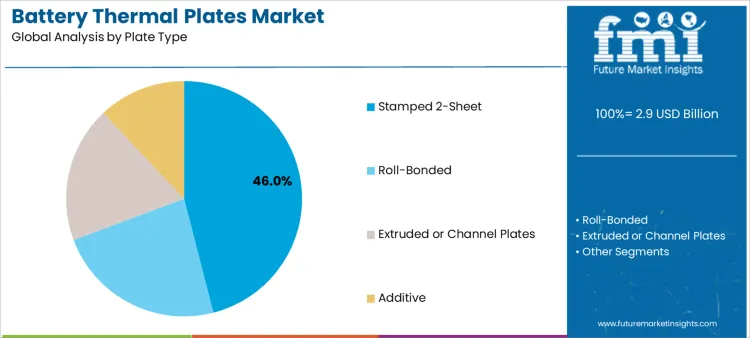
Stamped two-sheet plates account for 46% share of the battery thermal plates market because they offer an effective balance between thermal performance, weight, and manufacturing scalability. These plates are formed by bonding two stamped metal sheets to create internal flow channels that distribute coolant evenly across battery modules. OEMs favor this design due to consistent cooling performance and compatibility with high-volume automotive production lines. The lightweight structure supports overall battery pack efficiency, while the flat geometry simplifies integration into prismatic and pouch cell layouts. Cost efficiency at scale and reliable thermal control explain why stamped two-sheet plates remain the leading plate type.
Why Does Water-Glycol Dominate Coolant Selection In The Battery Thermal Plates Market?
Water-glycol coolants account for 78% share of the battery thermal plates market because they provide high heat transfer efficiency and proven reliability across automotive thermal management systems. This coolant type is widely used in vehicle cooling loops, enabling seamless integration between battery, power electronics, and drivetrain thermal systems. Water-glycol mixtures offer stable performance across a broad temperature range and are compatible with common plate materials such as aluminum. OEMs prefer this coolant due to established supply chains, predictable behavior, and ease of maintenance. These performance consistency and system integration advantages explain why water-glycol remains the dominant coolant choice.
What Are The Key Dynamics Of The Battery Thermal Plates Market?
The battery thermal plates market is driven by the rapid expansion of electric vehicles (EVs), energy storage systems (ESS), and high-performance portable and industrial power applications where effective thermal management is critical. Battery thermal plates regulate cell and module temperatures to maximize efficiency, extend service life, and prevent thermal runaway events. For thermal plate manufacturers and system suppliers, thermal conductivity, manufacturability, mechanical strength, compatibility with coolant systems, and integration ease with battery packs are decisive factors that influence design adoption. Partnerships with battery makers, pack integrators, and OEMs directly shape specification trends and volume forecasts.
How Are Technology And Cooling Architecture Trends Shaping This Market?
Technology advancements and cooling architecture trends are shaping the battery thermal plates market through a shift toward high-efficiency cooling solutions, advanced materials, and integrated thermal systems. Liquid cooling remains dominant in high-power applications, requiring plates with optimized internal fluid channels, uniform temperature distribution, and minimal pressure drop. Procurement specs for liquid cold plates are tightening around leak integrity, flatness, and repeatable channel geometry at scale. Emerging architectures utilize composite materials, metal foams, and microchannel designs to enhance heat transfer while reducing weight. Increased use of 800 V systems, fast charging, and high-discharge applications in EVs and ESS further elevate thermal demands. For suppliers, offering modular plates that integrate with sensors for temperature monitoring and support predictive thermal management enhances product appeal.
Why Do Cost, Material, And Integration Challenges Restrain Market Growth?
Cost, material, and integration challenges restrain growth in the battery thermal plates market because advanced materials and precision fabrication add to manufacturing expense and complexity. High-performance thermal plates often use aluminum, copper, or specialized composites that raise material costs, while internal channel machining and joining methods (brazing, welding) require tight quality control. Integrating thermal plates into densely packed battery modules without affecting structural integrity or electrical isolation demands detailed engineering and validation effort. Compatibility with diverse coolant chemistries and assembly methods across OEM platforms adds technical variation. These factors can slow design cycles, increase total cost of ownership, and temper adoption among cost-sensitive manufacturers.
What is The Country-Wise Growth Outlook for the Battery Thermal Plates Market?
The battery thermal plates market is expanding steadily as EV manufacturers focus on maintaining optimal battery temperature control to improve safety, charging speed, and lifecycle performance. Battery thermal plates are critical components within liquid-cooled battery packs, enabling uniform heat dissipation and efficient thermal regulation under high-load and fast-changing conditions. Growth varies by country depending on EV production scale, penetration of high-energy-density battery packs, and adoption of advanced thermal management architectures. High-growth markets are driven by large-scale EV manufacturing and rapid platform upgrades, while mature automotive regions emphasize performance optimization and long-term reliability. Market value is shaped by thermal efficiency, material selection, manufacturability, and integration with battery pack design.
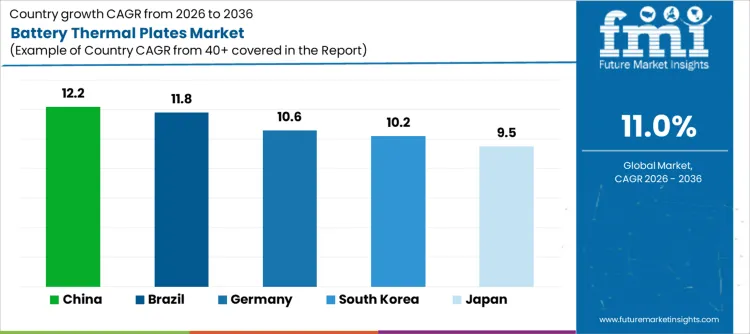
| Country | CAGR (%) |
|---|---|
| China | 12.2 |
| Brazil | 11.8 |
| Germany | 10.6 |
| South Korea | 10.2 |
| Japan | 9.5 |
Why Is China Leading The Battery Thermal Plates Market?
Demand for battery thermal plates in China is expanding at a CAGR of 12.2% during 2026 to 2036, driven by the rapid growth of the electric vehicle (EV) sector and the country’s dominance in battery pack manufacturing. As China leads in EV production, particularly in electric cars, buses, and two-wheelers, there is growing demand for high-performance battery thermal management systems to optimize battery life and fast charging. Thermal plates are integrated into liquid-cooled battery packs to manage heat dissipation effectively, preventing overheating during high-load operations and fast-charging cycles. Buyers prioritize high thermal conductivity, cost-efficiency, and lightweight design, especially as battery pack designs evolve to accommodate higher energy densities. The rapid scaling of production in China is supported by robust domestic manufacturing capabilities, which help keep costs competitive while ensuring consistent quality. Procurement decisions are influenced by supplier reliability, local manufacturing capacity, and compliance with automotive standards.
Why Is Brazil Seeing Steady Adoption Of Battery Thermal Plates?
Sale of battery thermal plates in Brazil is growing at a CAGR of 11.8% during 2026 to 2036, fueled by the gradual electrification of the automotive sector and increased interest in EVs. As local manufacturers begin to produce more EVs and hybrid vehicles, the need for effective thermal management solutions for battery systems is becoming critical. In Brazil, the growing EV fleet requires more efficient cooling solutions to manage heat buildup, particularly for fast-charging stations and fleet-based applications. Battery thermal plates, typically integrated into liquid-cooling systems, are crucial for maintaining battery health and extending lifespan. Buyers prioritize performance, durability, and cost-effectiveness, especially given the price-sensitive nature of the Brazilian market. Adoption is primarily driven by fleet operators and premium vehicle manufacturers who seek to optimize performance and charging speed. Procurement decisions often favor suppliers with strong local support and a demonstrated track record of meeting OEM quality standards.
What Is Driving Growth Of Battery Thermal Plates In The United States?
The United States battery thermal plates market is expanding at a CAGR of 10.7% during 2026 to 2036, driven by the increasing adoption of high-performance electric vehicles and the continued growth of EV infrastructure. As American automakers scale up their EV production and electrify their fleets, battery thermal management systems, including thermal plates, are critical for ensuring the batteries maintain optimal performance and safety, especially during high-load or fast-charging operations. The emphasis on maximizing vehicle range, minimizing overheating risks, and improving battery life is driving the adoption of high-efficiency thermal plates made from lightweight yet thermally conductive materials. Buyers focus on high-quality standards, energy efficiency, and the ability to integrate seamlessly with advanced cooling systems. Procurement decisions are influenced by system scalability, performance testing, and long-term reliability, with OEMs requiring solutions that align with their evolving vehicle architectures.
How Is Germany Leveraging Battery Thermal Plates For Premium EV Production?
Sale of battery thermal plates in Germany market is growing at a CAGR of 10.6% during 2026 to 2036, supported by the country’s strong position in premium vehicle manufacturing and ongoing investments in EV production. German OEMs are increasingly using advanced battery thermal management systems, including high-performance thermal plates, to meet the demands of next-generation electric vehicles, particularly high-end sedans and luxury EVs. These vehicles require precision-engineered thermal plates that can support larger battery packs, ensure efficient cooling, and prevent overheating during high-performance driving or rapid charging. Buyers emphasize thermal efficiency, product durability, and integration with cutting-edge battery systems. In Germany, where environmental standards and automotive quality requirements are stringent, procurement decisions favor suppliers who can meet high certification standards and offer scalable, customizable solutions.
How Is South Korea Adopting Advanced Thermal Plates In EV Production?
Sale of battery thermal plates in South Korea is expanding at a CAGR of 10.2% during 2026 to 2036, driven by the country's leading position in EV production and its focus on next-generation battery technologies. South Korean OEMs are adopting more advanced battery thermal management solutions, including high-efficiency thermal plates, to enhance EV performance, increase range, and reduce charging time. Buyers emphasize compact designs, superior thermal conductivity, and integration with liquid-cooling systems that can efficiently manage the heat generated by high-performance batteries, particularly in electric vehicles designed for long-distance travel. Adoption is mainly seen in premium and high-performance models, which require precise temperature control to optimize battery longevity and safety. Procurement decisions are driven by the need for high-precision components and collaboration with leading battery manufacturers and cooling solution providers.
How are Suppliers Competing in the Battery Thermal Plates Market?
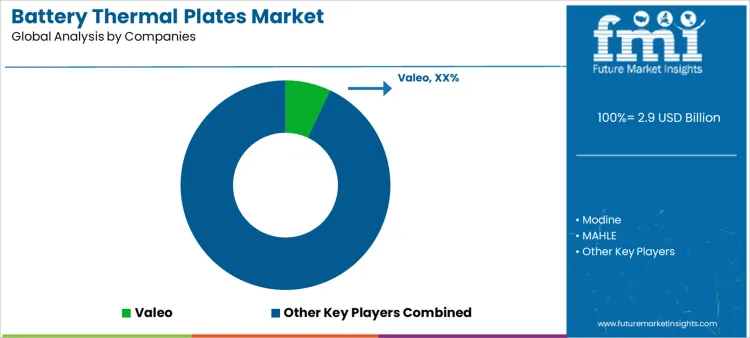
Competition in the battery thermal plates market is defined by heat transfer efficiency, weight optimization, manufacturability, and integration with complete battery thermal management systems. As EV battery packs scale in energy density and charging speed, thermal plates are required to deliver uniform temperature control while fitting into increasingly compact pack designs. Valeo positions its thermal plates as part of fully integrated battery thermal management architectures, emphasizing optimized coolant flow paths, lightweight aluminum constructions, and compatibility with both liquid and refrigerant-based cooling concepts. Modine competes through advanced cold plate designs that focus on high heat flux removal and corrosion resistance, targeting fast-charging EV platforms and commercial vehicles.
Tier-1 automotive suppliers strengthen positioning through system-level integration. MAHLE and Hanon Systems emphasize scalable thermal plate designs engineered for mass production, with attention to uniform cell temperature distribution and low pressure drop. Dana differentiates by embedding thermal plates within complete e-drive and battery pack solutions, focusing on modularity and OEM-specific customization. Sanhua Automotive adds competitive pressure through cost-efficient, high-volume thermal plate manufacturing aligned with domestic EV OEM demand.
Specialized component and regional suppliers broaden the competitive landscape. VOSS Automotive focuses on thermal plate assemblies with integrated fluid connections and leak-resistant interfaces. Boyd Corporation competes on advanced materials and precision-machined cold plates suited for high-performance battery modules. Meiller and Zhengzhou Yutong (component divisions) address heavy-duty and bus battery platforms with robust, serviceable thermal plate designs. Across the market, competitive advantage is driven by thermal uniformity, lightweight construction, and seamless integration into OEM battery pack architectures rather than component pricing alone.
Key Players in Battery Thermal Plates Market
- Valeo
- Modine
- MAHLE
- Hanon Systems
- Dana
- VOSS Automotive
- Zhengzhou Yutong (components)
- Boyd Corporation
- Meiller
- Sanhua Automotive
Scope of Report
| Attribute | Details |
|---|---|
| Market Size Unit | USD Billion |
| Plate Type Covered | Stamped Two-Sheet Thermal Plates, Roll-Bonded Thermal Plates, Extruded or Channel Thermal Plates, Additive-Manufactured Thermal Plates |
| Coolant Type Covered | Water-Glycol Coolants, Dielectric Fluids, Other Advanced Coolants |
| Countries Covered | China, Japan, South Korea, India, Australia & New Zealand, ASEAN, Rest of Asia Pacific, Germany, United Kingdom, France, Italy, Spain, Nordic, BENELUX, Rest of Europe, United States, Canada, Mexico, Brazil, Chile, Rest of Latin America, Kingdom of Saudi Arabia, Other GCC Countries, Turkey, South Africa, Other African Union, Rest of Middle East & Africa |
| Regions Covered | Asia Pacific, Europe, North America, Latin America, Middle East & Africa |
| Key Companies Profiled | Valeo, Modine, MAHLE, Hanon Systems, Dana, VOSS Automotive, Zhengzhou Yutong (components), Boyd Corporation, Meiller, Sanhua Automotive |
| Additional Attributes | Dollar sales by plate type and coolant system are evaluated across electric passenger vehicles, commercial EVs, and battery energy storage platforms. The scope analyzes thermal uniformity, pressure drop, material selection, and manufacturability. Country-level assessment reflects EV battery localization, adoption of high-energy-density packs, and integration of advanced battery thermal management architectures. |
Battery Thermal Plates Market by Key Segments
Plate Type:
- Stamped 2‑Sheet
- Roll‑Bonded
- Extruded or Channel Plates
- Additive
Coolant:
- Water‑Glycol
- Dielectric Fluids
- Other
Region:
- Asia Pacific
- China
- Japan
- South Korea
- India
- Australia & New Zealand
- ASEAN
- Rest of Asia Pacific
- Europe
- Germany
- United Kingdom
- France
- Italy
- Spain
- Nordic
- BENELUX
- Rest of Europe
- North America
- United States
- Canada
- Mexico
- Latin America
- Brazil
- Chile
- Rest of Latin America
- Middle East & Africa
- Kingdom of Saudi Arabia
- Other GCC Countries
- Turkey
- South Africa
- Other African Union
- Rest of Middle East & Africa
Bibliography
- Liu, R., Qin, Z., Ji, J., et al. (2024). Numerical analysis of topology-optimized cold plates for enhanced thermal management of lithium-ion batteries
- Xu, Y., & Wang, R. (2023). Liquid cooling plate for battery thermal management system: X-shaped configuration for Li-ion battery pack.
- Chen, J., Xu, W., Tian, H., Cao, Y., Gu, J., Zhou, H., & Jin, Y. (2025). Review on lithium-ion battery heat dissipation based on microchannel-PCM coupling technology.
- Alawi, O. A., Abdelkareem, M. A., Sayed, E. T., Wilberforce, T., & Olabi, A. G. (2025). Recent advancements in battery thermal management systems for enhanced performance of Li-ion batteries:
- Fan, et al. (2024). Study on the cooling performance of a new secondary-flow serpentine liquid cooling plate used for lithium battery thermal management.
Frequently Asked Questions
How big is the battery thermal plates market in 2026?
The global battery thermal plates market is estimated to be valued at USD 2.9 billion in 2026.
What will be the size of battery thermal plates market in 2036?
The market size for the battery thermal plates market is projected to reach USD 8.2 billion by 2036.
How much will be the battery thermal plates market growth between 2026 and 2036?
The battery thermal plates market is expected to grow at a 11.0% CAGR between 2026 and 2036.
What are the key product types in the battery thermal plates market?
The key product types in battery thermal plates market are stamped 2‑sheet, roll‑bonded, extruded or channel plates and additive.
Which coolant segment to contribute significant share in the battery thermal plates market in 2026?
In terms of coolant, water‑glycol segment to command 78.0% share in the battery thermal plates market in 2026.
Preview the report firsthand - request a free sample
Get SampleGet the brochure for pricing and purchase details.
Get PDFTable of Content
- Executive Summary
- Global Market Outlook
- Demand-side Trends
- Supply-side Trends
- Technology Roadmap Analysis
- Analysis and Recommendations
- Market Overview
- Market Coverage / Taxonomy
- Market Definition / Scope / Limitations
- Market Background
- Market Dynamics
- Drivers
- Restraints
- Opportunity
- Trends
- Scenario Forecast
- Demand in Optimistic Scenario
- Demand in Likely Scenario
- Demand in Conservative Scenario
- Opportunity Map Analysis
- Product Life Cycle Analysis
- Supply Chain Analysis
- Investment Feasibility Matrix
- Value Chain Analysis
- PESTLE and Porter’s Analysis
- Regulatory Landscape
- Regional Parent Market Outlook
- Production and Consumption Statistics
- Import and Export Statistics
- Market Dynamics
- Global Market Analysis 2021 to 2025 and Forecast, 2026 to 2036
- Historical Market Size Value (USD Million) Analysis, 2021 to 2025
- Current and Future Market Size Value (USD Million) Projections, 2026 to 2036
- Y-o-Y Growth Trend Analysis
- Absolute $ Opportunity Analysis
- Global Market Pricing Analysis 2021 to 2025 and Forecast 2026 to 2036
- Global Market Analysis 2021 to 2025 and Forecast 2026 to 2036, By Plate Type
- Introduction / Key Findings
- Historical Market Size Value (USD Million) Analysis By Plate Type , 2021 to 2025
- Current and Future Market Size Value (USD Million) Analysis and Forecast By Plate Type , 2026 to 2036
- Stamped 2‑Sheet
- Roll‑Bonded
- Extruded or Channel Plates
- Additive
- Stamped 2‑Sheet
- Y-o-Y Growth Trend Analysis By Plate Type , 2021 to 2025
- Absolute $ Opportunity Analysis By Plate Type , 2026 to 2036
- Global Market Analysis 2021 to 2025 and Forecast 2026 to 2036, By Coolant
- Introduction / Key Findings
- Historical Market Size Value (USD Million) Analysis By Coolant, 2021 to 2025
- Current and Future Market Size Value (USD Million) Analysis and Forecast By Coolant, 2026 to 2036
- Water‑Glycol
- Dielectric Fluids
- Other
- Water‑Glycol
- Y-o-Y Growth Trend Analysis By Coolant, 2021 to 2025
- Absolute $ Opportunity Analysis By Coolant, 2026 to 2036
- Global Market Analysis 2021 to 2025 and Forecast 2026 to 2036, By Region
- Introduction
- Historical Market Size Value (USD Million) Analysis By Region, 2021 to 2025
- Current Market Size Value (USD Million) Analysis and Forecast By Region, 2026 to 2036
- North America
- Latin America
- Western Europe
- Eastern Europe
- East Asia
- South Asia and Pacific
- Middle East & Africa
- Market Attractiveness Analysis By Region
- North America Market Analysis 2021 to 2025 and Forecast 2026 to 2036, By Country
- Historical Market Size Value (USD Million) Trend Analysis By Market Taxonomy, 2021 to 2025
- Market Size Value (USD Million) Forecast By Market Taxonomy, 2026 to 2036
- By Country
- USA
- Canada
- Mexico
- By Plate Type
- By Coolant
- By Country
- Market Attractiveness Analysis
- By Country
- By Plate Type
- By Coolant
- Key Takeaways
- Latin America Market Analysis 2021 to 2025 and Forecast 2026 to 2036, By Country
- Historical Market Size Value (USD Million) Trend Analysis By Market Taxonomy, 2021 to 2025
- Market Size Value (USD Million) Forecast By Market Taxonomy, 2026 to 2036
- By Country
- Brazil
- Chile
- Rest of Latin America
- By Plate Type
- By Coolant
- By Country
- Market Attractiveness Analysis
- By Country
- By Plate Type
- By Coolant
- Key Takeaways
- Western Europe Market Analysis 2021 to 2025 and Forecast 2026 to 2036, By Country
- Historical Market Size Value (USD Million) Trend Analysis By Market Taxonomy, 2021 to 2025
- Market Size Value (USD Million) Forecast By Market Taxonomy, 2026 to 2036
- By Country
- Germany
- UK
- Italy
- Spain
- France
- Nordic
- BENELUX
- Rest of Western Europe
- By Plate Type
- By Coolant
- By Country
- Market Attractiveness Analysis
- By Country
- By Plate Type
- By Coolant
- Key Takeaways
- Eastern Europe Market Analysis 2021 to 2025 and Forecast 2026 to 2036, By Country
- Historical Market Size Value (USD Million) Trend Analysis By Market Taxonomy, 2021 to 2025
- Market Size Value (USD Million) Forecast By Market Taxonomy, 2026 to 2036
- By Country
- Russia
- Poland
- Hungary
- Balkan & Baltic
- Rest of Eastern Europe
- By Plate Type
- By Coolant
- By Country
- Market Attractiveness Analysis
- By Country
- By Plate Type
- By Coolant
- Key Takeaways
- East Asia Market Analysis 2021 to 2025 and Forecast 2026 to 2036, By Country
- Historical Market Size Value (USD Million) Trend Analysis By Market Taxonomy, 2021 to 2025
- Market Size Value (USD Million) Forecast By Market Taxonomy, 2026 to 2036
- By Country
- China
- Japan
- South Korea
- By Plate Type
- By Coolant
- By Country
- Market Attractiveness Analysis
- By Country
- By Plate Type
- By Coolant
- Key Takeaways
- South Asia and Pacific Market Analysis 2021 to 2025 and Forecast 2026 to 2036, By Country
- Historical Market Size Value (USD Million) Trend Analysis By Market Taxonomy, 2021 to 2025
- Market Size Value (USD Million) Forecast By Market Taxonomy, 2026 to 2036
- By Country
- India
- ASEAN
- Australia & New Zealand
- Rest of South Asia and Pacific
- By Plate Type
- By Coolant
- By Country
- Market Attractiveness Analysis
- By Country
- By Plate Type
- By Coolant
- Key Takeaways
- Middle East & Africa Market Analysis 2021 to 2025 and Forecast 2026 to 2036, By Country
- Historical Market Size Value (USD Million) Trend Analysis By Market Taxonomy, 2021 to 2025
- Market Size Value (USD Million) Forecast By Market Taxonomy, 2026 to 2036
- By Country
- Kingdom of Saudi Arabia
- Other GCC Countries
- Turkiye
- South Africa
- Other African Union
- Rest of Middle East & Africa
- By Plate Type
- By Coolant
- By Country
- Market Attractiveness Analysis
- By Country
- By Plate Type
- By Coolant
- Key Takeaways
- Key Countries Market Analysis
- USA
- Pricing Analysis
- Market Share Analysis, 2025
- By Plate Type
- By Coolant
- Canada
- Pricing Analysis
- Market Share Analysis, 2025
- By Plate Type
- By Coolant
- Mexico
- Pricing Analysis
- Market Share Analysis, 2025
- By Plate Type
- By Coolant
- Brazil
- Pricing Analysis
- Market Share Analysis, 2025
- By Plate Type
- By Coolant
- Chile
- Pricing Analysis
- Market Share Analysis, 2025
- By Plate Type
- By Coolant
- Germany
- Pricing Analysis
- Market Share Analysis, 2025
- By Plate Type
- By Coolant
- UK
- Pricing Analysis
- Market Share Analysis, 2025
- By Plate Type
- By Coolant
- Italy
- Pricing Analysis
- Market Share Analysis, 2025
- By Plate Type
- By Coolant
- Spain
- Pricing Analysis
- Market Share Analysis, 2025
- By Plate Type
- By Coolant
- France
- Pricing Analysis
- Market Share Analysis, 2025
- By Plate Type
- By Coolant
- India
- Pricing Analysis
- Market Share Analysis, 2025
- By Plate Type
- By Coolant
- ASEAN
- Pricing Analysis
- Market Share Analysis, 2025
- By Plate Type
- By Coolant
- Australia & New Zealand
- Pricing Analysis
- Market Share Analysis, 2025
- By Plate Type
- By Coolant
- China
- Pricing Analysis
- Market Share Analysis, 2025
- By Plate Type
- By Coolant
- Japan
- Pricing Analysis
- Market Share Analysis, 2025
- By Plate Type
- By Coolant
- South Korea
- Pricing Analysis
- Market Share Analysis, 2025
- By Plate Type
- By Coolant
- Russia
- Pricing Analysis
- Market Share Analysis, 2025
- By Plate Type
- By Coolant
- Poland
- Pricing Analysis
- Market Share Analysis, 2025
- By Plate Type
- By Coolant
- Hungary
- Pricing Analysis
- Market Share Analysis, 2025
- By Plate Type
- By Coolant
- Kingdom of Saudi Arabia
- Pricing Analysis
- Market Share Analysis, 2025
- By Plate Type
- By Coolant
- Turkiye
- Pricing Analysis
- Market Share Analysis, 2025
- By Plate Type
- By Coolant
- South Africa
- Pricing Analysis
- Market Share Analysis, 2025
- By Plate Type
- By Coolant
- USA
- Market Structure Analysis
- Competition Dashboard
- Competition Benchmarking
- Market Share Analysis of Top Players
- By Regional
- By Plate Type
- By Coolant
- Competition Analysis
- Competition Deep Dive
- Valeo
- Overview
- Product Portfolio
- Profitability by Market Segments (Product/Age /Sales Channel/Region)
- Sales Footprint
- Strategy Overview
- Marketing Strategy
- Product Strategy
- Channel Strategy
- Modine
- MAHLE
- Hanon Systems
- Dana
- VOSS Automotive
- Zhengzhou Yutong (components)
- Boyd Corporation
- Meiller
- Sanhua Automotive
- Valeo
- Competition Deep Dive
- Assumptions & Acronyms Used
- Research Methodology


