

- Market Size (2026)
- USD 184.7 Mn
- Forecast (2036)
- USD 487.9 Mn
- CAGR (2026 to 2036)
- 10.2%
Battery Module Gas Propagation and Venting Test Systems Market Size, Market Forecast and Outlook By FMI
The battery module gas propagation and venting test systems market was valued at USD 167.6 million in 2025 and is expected to reach USD 184.7 million in 2026. It is projected to expand at a CAGR of 10.2% between 2026 and 2036 and reach USD 487.9 million by 2036. Propagation chambers are expected to lead with a 34.0% share in 2026, while electric vehicle battery programs remain the largest end-use segment with a 47.0% share.
Summary of the Battery Module Gas Propagation and Venting Test Systems Market
- Demand and Growth Drivers
- Demand is rising as battery developers need clearer evidence on gas release, pressure build-up, and thermal event spread before designs move toward approval or scale-up.
- Spending is increasing across electric vehicle and stationary storage programs. This keeps demand closely tied to adjacent work in battery testing inspection and certification.
- Product and Segment View
- Propagation chambers are expected to lead the system type, accounting for 34.0% share in 2026, as developers continue to prefer enclosed systems built for repeatable monitoring of heat and gas behavior.
- Module-level testing is projected to contribute 44.0% of total demand in 2026, while electric vehicle battery programs are likely to stay the largest end-use segment with a 47.0% share.
- Geography and Competitive Outlook
- China is expected to stay a major growth market due to its scale in battery production and heavy validation activity. India is set to post strong growth as domestic storage and battery manufacturing programs expand.
- The United States holds a strong position as large storage deployments and code-facing safety work support spending. This keeps system demand linked with broader battery testing equipment investment across labs and engineering centers.
- Analyst Opinion
- Nikhil Kaitwade, Associate Vice President at FMI says, “Suppliers that can deliver repeatable gas propagation evidence, strong safety controls, and faster integration into battery validation workflows are likely to strengthen their position over the forecast period.”
- Battery Module Gas Propagation and Venting Test Systems Market Value Analysis
- This market is moving from basic abuse testing toward more specialized safety validation systems built for gas release, pressure rise, and propagation analysis.
- Demand is strengthening as EV and storage developers expand spending on battery testing equipment used for engineering and compliance review.
- Value is also rising as buyers favor integrated chambers with better data capture, gas handling, and safety controls.
- Procurement remains focused on systems that can deliver repeatable and defensible evidence during battery safety work.
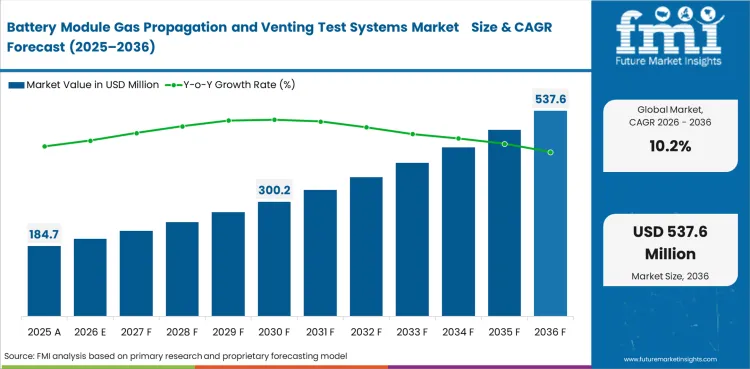
Key Takeaways
- Battery module gas propagation and venting test systems market was valued at USD 167.6 million in 2025.
- Market value is projected to reach USD 487.9 million by 2036.
- Growth is expected at a 10.2% CAGR from 2026 to 2036, as tighter validation needs continue to lift spending across battery testing inspection and certification workflows.
- The market is set to create an incremental opportunity of USD 303.2 million over the forecast period.
- In 2026, propagation chambers are expected to lead with a 34.0% share, while stronger use of gas sensors keeps instrumentation depth central to system design.
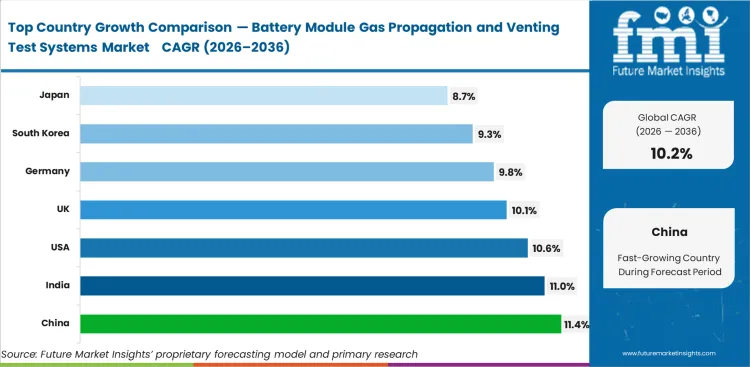
- China (11.4%) and India (11.0%) are set to post the fastest growth through 2036, while the United States remains a major demand center due to larger battery energy storage system validation activity.
Battery Module Gas Propagation and Venting Test Systems Market Definition
The market covers dedicated systems used to test thermal propagation, gas venting, vent gas ignition, enclosure pressure response, and related safety behavior in battery modules and adjacent pack-level assemblies.
Battery Module Gas Propagation and Venting Test Systems Market Inclusions
Included in scope are module and sub-pack propagation chambers, venting rigs, gas handling and sampling assemblies, pressure relief hardware, event-trigger systems, dedicated controls, software interfaces, and turnkey installations configured for lithium-ion and closely related high-energy rechargeable batteries.
Battery Module Gas Propagation and Venting Test Systems Market Exclusions
Excluded from scope are routine cyclers, formation equipment, generic environmental chambers without battery-specific propagation or venting capability, and pure software products sold without associated test hardware.
Battery Module Gas Propagation and Venting Test Systems Market Research Methodology
- Primary Research: Interviews with battery test engineers, abuse lab operators, system integrators, and safety specialists were used to identify configuration priorities, test-cell sizing patterns, and purchase criteria across EV and stationary storage programs.
- Desk Research: The study used current government, standards, and industry sources covering EV sales, stationary storage additions, battery safety codes, and public announcements from active test system suppliers and certification organizations.
- Market Sizing and Forecasting: Revenue was modeled from the installed and planned demand base for module safety validation systems, then cross-checked against parent categories such as battery testing equipment, battery safety chambers, and BESS validation platforms.
- Data Validation and Update Cycle: Forecasts were checked against current regulatory developments, deployment indicators, supplier activity, and program timing assumptions, with values normalized to a 2026 to 2036 revenue framework in USD million.
Why is the Battery Module Gas Propagation and Venting Test Systems Market Growing?
- Higher battery energy density and stricter safety validation requirements are creating stronger demand for systems that can measure gas release and propagation behavior with repeatable evidence.
- Standards-linked safety work such as UL 9540A is increasing the need for dedicated chambers and venting systems that can document ignition risk and exhaust behavior.
- China leads growth with 11.4% because the country combines large battery production scale with heavy validation activity across electric vehicle and storage battery programs.
The battery module gas propagation and venting test systems market is growing steadily because battery developers now need more than simple pass or fail abuse testing. Developers want systems that can capture gas release and thermal spread with stronger repeatability during engineering and compliance review. This is raising demand across electric vehicle programs and stationary storage work that require more defensible safety evidence.
Electric vehicle battery programs are the biggest part of this market. Automotive developers and battery suppliers keep running repeated validation work as module layouts and pack architectures continue to change. Module-level testing stays central because it is the point where cell interaction and vent routing begin to create realistic propagation behavior that smaller cell tests often cannot show clearly.
Formal battery safety requirements are a structural growth driver. Labs and engineers increasingly need synchronized gas and pressure data that can support internal design reviews and third-party assessment. As battery fire review work becomes more demanding across transport and stationary storage applications, integrated propagation chambers and venting systems are taking the place of simpler abuse setups in more validation workflows.
Market Segmental Analysis
- Propagation Chambers, Venting Rigs, Deflagration Chambers, and Integrated Test Cells; propagation chambers lead with 34.0% share in 2026.
- Module, Pack, Unit, and Installation; module-level testing remains highest with 44.0% share in 2026.
- EV Batteries, Stationary ESS, Commercial Vehicles, and Industrial Batteries; EV batteries account for 47.0% share in 2026.
- Direct Sales, Turnkey Integration, Lab Services, and Retrofit Upgrades; direct sales lead with 58.0% share in 2026.
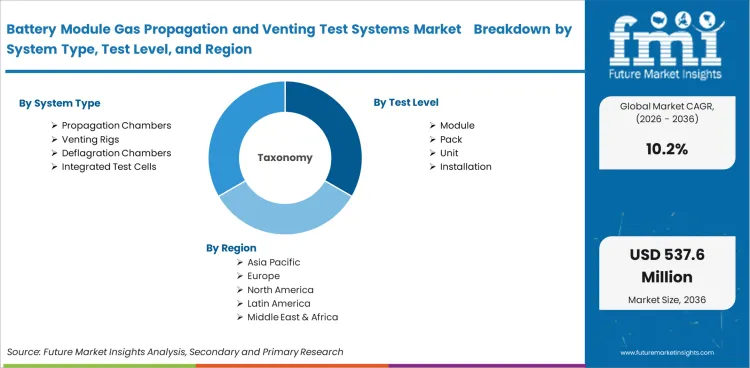
The market for battery module gas propagation and venting test systems is divided into groups based on system type, test level, trigger method, instrumentation, safety architecture, standards alignment, end use, sales channel, and region. There are Propagation Chambers, Venting Rigs, Deflagration Chambers, and Integrated Test Cells under system type. By test level, the market includes Module, Pack, Unit, and Installation. By trigger method, it covers Heater, Overcharge, Nail, Crush, and External Short. By instrumentation, the market includes Gas Analysis, Pressure, Temperature, Heat Release, and Video Monitoring. By safety architecture, it covers Blast Panels, Vent Ducts, Gas Extraction, Fire Suppression, and Inerting. By standards alignment, the market includes UL 9540A, UL 2580, UNECE R100, IEC 62619, and SAE J2929. By end use, it is segmented into EV Batteries, Stationary ESS, Commercial Vehicles, and Industrial Batteries. By sales channel, the market includes Direct Sales, Turnkey Integration, Lab Services, and Retrofit Upgrades.
Insights into the propagation chambers segment
- Propagation chambers are expected to account for 34.0% share in 2026. Their lead comes from the core question battery developers need to answer, which is whether a triggered event stays localized or moves across adjacent cells inside the module.
- Chambers built for this work usually carry reinforced walls and gas extraction features that a standard climate cabinet does not provide.
Insights into the module-level testing segment
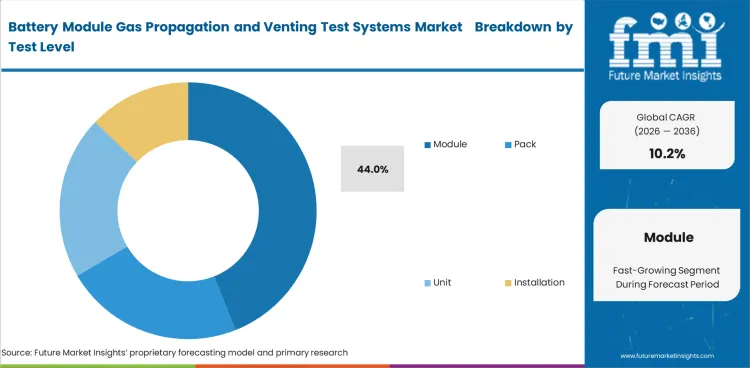
- In 2026 module-level testing is projected to contribute 44.0% of total market share. Module work sits at the center of most development programs because it is the point where cell interaction and vent routing first combine in a way that can produce realistic propagation behavior.
- Cell tests are cheaper and faster, though they rarely resolve pressure and gas distribution questions that emerge once multiple cells are assembled. Pack tests deliver richer system evidence. They are more expensive and harder to repeat during design iteration.
Insights into the electric vehicle batteries segment
- Electric vehicle battery programs are anticipated to represent 47.0% of the market in 2026. Automotive development cycles produce sustained demand because OEMs and cell suppliers run repeated design checks across changing module layouts and platform variants.
- Passenger EV and broader vehicle battery development programs keep system demand steady because battery developers need clearer evidence on gas release and propagation behavior before pack-level approval and commercial scale-up.
Insights into the direct sales segment
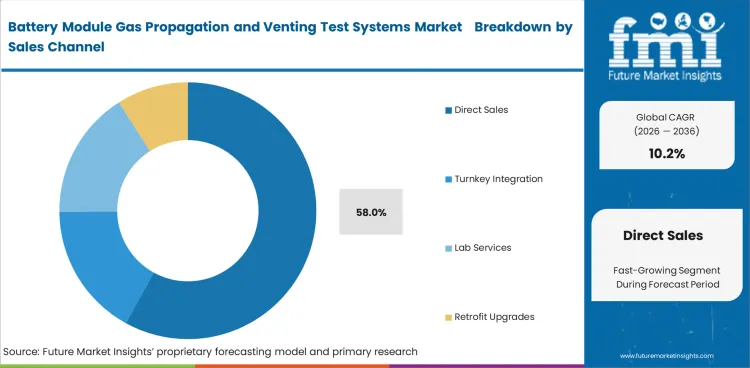
- Direct sales are likely to secure 58.0% share in 2026. Most purchases in this niche involve site preparation and safety review that distributors are less equipped to scope on their own.
- After-sales support matters just as much as the original install, since operators often need sensor replacement and calibration as programs evolve.
Battery Module Gas Propagation and Venting Test Systems Market Drivers, Restraints, and Opportunities
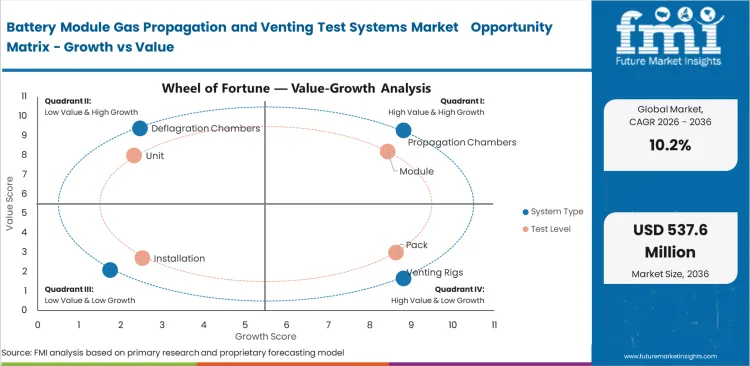
- Higher battery energy density and stricter fire safety evidence are expanding validation demand.
- Large chambers with gas handling and blast protection remain expensive and slow to deploy.
- Integrated gas analytics and enclosure safety packages are replacing single-purpose abuse setups.
Growth is driven by multiple regulatory and technical factors. The market depends on of program scale and code compliance along with the limits of legacy abuse rigs. Battery developers that once relied on temperature logging and basic visual evidence now need synchronized gas and pressure data that can stand up in design reviews and third-party discussions.
Certification burden
Formal battery safety work increasingly requires proof that extends beyond pass or fail language. UL explains that UL 9540A testing is recognized across multiple standards and codes and remains central to large-scale fire evaluation for stationary energy storage. NHTSA's REESS thermal propagation proposal likewise asks manufacturers to document how designs mitigate risk from a single-cell event and how warnings are triggered before hazardous conditions arise.
Testing and validation needs
Vented gas behavior has become a more important purchasing filter as authorities and engineering teams focus on what happens after the first cell fails. UL notes that updated guidance around UL 9540A and NFPA 855 highlights vent-gas ignition, large-scale fire behavior, and sprinkler performance under more realistic conditions. That pushes buyers toward systems with sampling lines, fast-response analyzers, pressure transducers, optical access, and better exhaust management.
Production scale shift
Supplier activity shows that battery testing capacity is expanding in step with customer program size. UL Solutions opened its Europe Advanced Battery Laboratory in Aachen in May 2025 to support automotive and stationary battery research, safety, and performance work. ESPEC said it aims to grow revenue around its Aichi Next-Generation Mobility Test Lab, which opened in February 2025. AVL also announced battery cell test infrastructure for PowerCo in Germany, with completion targeted in 2025.
Analysis of Battery Module Gas Propagation and Venting Test Systems Market by Key Countries
.webp "Top Country Growth Comparison Battery Module Gas Propagation And Venting Test Systems Market Cagr (2026 2036)")
| Country | CAGR |
|---|---|
| China | 11.4% |
| United States | 10.6% |
| India | 11.0% |
| United Kingdom | 10.1% |
| Germany | 9.8% |
| South Korea | 9.3% |
| Japan | 8.7% |
Source: FMI analysis based on primary research and proprietary forecasting model
Battery Module Gas Propagation and Venting Test Systems Market CAGR Analysis by Country
- China leads at 11.4%, while India follows at 11.0%, supported by battery scale-up and wider spending on battery testing equipment.
- The United States at 10.6% remains a strong market due to storage deployment, safety review pressure, and rising battery testing inspection and certification needs.
- The United Kingdom at 10.1% and Germany at 9.8% continue to grow as battery safety validation moves closer to battery fire and explosion containment test chambers procurement.
- South Korea at 9.3% and Japan at 8.7% keep advancing through export-led battery programs and stronger use of gas sensors in validation workflows.
The global market is expected to expand at a 10.2% CAGR from 2026 to 2036, with demand also supported by growth in battery energy storage systems.
Demand Outlook for Battery Module Gas Propagation and Venting Test Systems Market in the United States
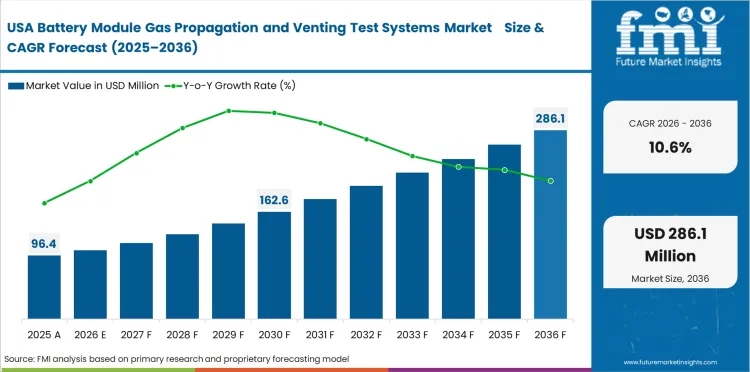
Battery Module Gas Propagation and Venting Test Systems Market in United States is projected to grow at a 10.6% CAGR through 2036. Demand stays firm as large storage projects and EV validation programs raise the need for systems that can document gas release and pressure response. System demand stays close to battery off-gas detection and early warning test solutions used in advanced safety workflows.
- Stationary storage build-out supports larger vent-gas and propagation test programs.
- EV engineering teams need module evidence before pack-level sign-off.
- Independent labs and OEM centers both support equipment purchases.
Future Outlook for Battery Module Gas Propagation and Venting Test Systems Market in the United Kingdom
Revenue from battery module gas propagation and venting test systems in United Kingdom is expected to expand at a 10.1% CAGR through 2036, based on the supplied forecast. Demand is supported by active engineering work and certification activity. Closer alignment with battery testing and certification requirements is pushing labs toward cleaner data capture and safer chamber setups.
- Engineering service networks keep validation demand steady.
- Flexible chambers are valued across automotive and storage programs.
- Certification work favors stronger reporting and controls.
Opportunity Analysis of Battery Module Gas Propagation and Venting Test Systems Market in Germany
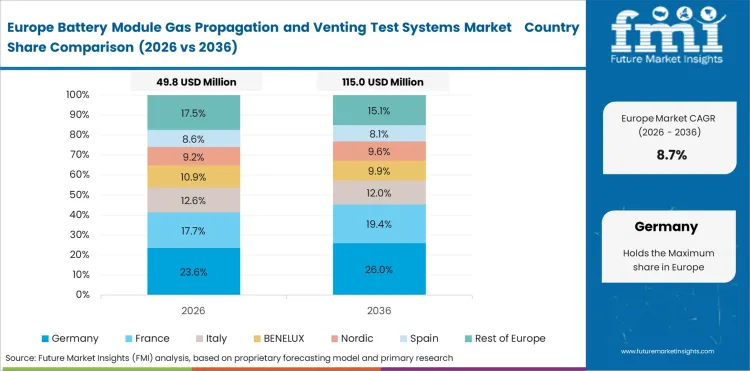
Germany is projected to grow at a 9.8% CAGR through 2036. Demand is tied to automotive engineering depth and formal validation needs. Developers often compare new projects with wider spending on battery fire and explosion containment test chambers when selecting system capability and chamber safety features.
- Premium vehicle programs require dense instrumentation and repeatability.
- European compliance work supports structured validation purchases.
- Buyers value engineering confidence more than entry price.
In-depth Analysis of Battery Module Gas Propagation and Venting Test Systems Market in Japan
Japan is forecast to grow at a 8.7% CAGR from 2026 to 2036. Demand depends on battery reliability work and export-facing engineering. Interest is rising in systems linked with integrated battery emissions and off-gassing characterization systems for richer event analysis.
- Battery developers place strong weight on repeatable testing.
- Detailed documentation remains important in purchase decisions.
- Second-life battery work supports added validation demand.
Sales Analysis of Battery Module Gas Propagation and Venting Test Systems Market in China
China is projected to record a 11.4% CAGR by 2036. Strong battery output and heavy development throughput keep the country ahead. System demand stays closely linked with broader electric vehicle battery formation and testing investment across local battery and vehicle programs.
- Large domestic program volume keeps module validation active.
- Export programs raise demand for documented safety evidence.
- Local buyers want faster service and fixture adaptation.
In-depth Analysis of Battery Module Gas Propagation and Venting Test Systems Market in India
India is expected to grow at a 11.0% CAGR from 2026 to 2036. Demand is rising as storage programs expand and domestic battery manufacturing gains policy support. Spending increasingly follows adjacent needs in battery energy storage systems where system-level safety evidence is gaining important.
- Policy-backed storage projects improve the long-term demand base.
- Domestic manufacturing increases need for module abuse testing.
- Labs prefer versatile systems serving multiple battery programs.
Sales Outlook for Battery Module Gas Propagation and Venting Test Systems Market in South Korea
South Korea is likely to expand at a 9.3% CAGR through 2036. Demand is supported by export-oriented battery programs and disciplined engineering practice. Equipment linked to gas detection equipment used in hazardous event monitoring and safety validation adds relevance in this market.
- Export programs support steady validation spending.
- Buyers prefer compact layouts with precise controls.
- Fast regional service remains an important buying factor.
Competitive landscape of Battery Module Gas Propagation and Venting Test Systems Market
- Competition is moderately concentrated around chamber specialists, battery test integrators, and a few global validation brands.
- Leading suppliers compete on containment quality, gas measurement depth, controls integration, and application engineering support.
- Room remains for specialists that can solve high-risk venting work faster than broad catalog chamber vendors.
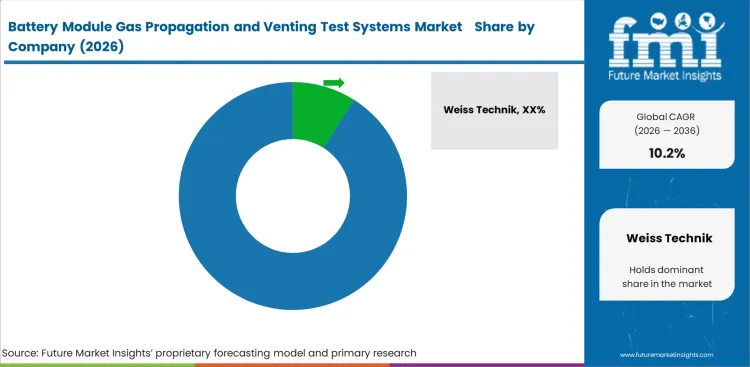
Developers in this niche evaluate whether a supplier can manage hazardous gas release and enclosure safety without forcing the laboratory to solve critical design issues after delivery. That favors manufacturers with deep experience in environmental simulation or battery abuse systems. They are more likely to handle reinforced chamber construction and exhaust design in a practical way. Weiss Technik, ESPEC, AVL, Binder, Thermotron, Angelantoni Test Technologies, and CSZ all benefit from this pattern to different degrees. Global reach matters, though so does the ability to deliver project engineering and commissioning support that fits the customer’s facility and safety review process.
Major Industry Players
Competition spans global environmental simulation firms, battery test integrators, and certification-linked technical organizations.
- Weiss Technik, ESPEC, AVL, and Binder fit this group because they combine broad test equipment portfolios with strong battery relevance and recognized engineering support. Weiss and ESPEC bring deep chamber experience and visible battery program references, while AVL adds system integration strength tied to battery development infrastructure.
- Thermotron, Angelantoni Test Technologies, CSZ, and selected TÜV-oriented engineering partners sit here because they hold meaningful positions in defined geographies or application clusters.
- UL Solutions, Intertek-linked engineering groups, and specialist subsystem providers are important because the market is moving toward integrated validation ecosystems rather than stand-alone hardware decisions.
Competitive benchmarking: Battery Module Gas Propagation and Venting Test Systems Market
| Company | Battery Abuse Capability | Gas Analytics Depth | Turnkey Integration | Geographic Footprint |
|---|---|---|---|---|
| Weiss Technik | High | Medium | Strong | Global |
| ESPEC | High | Medium | Strong | Global |
| AVL | High | High | Strong | Global |
| Binder | Medium | Medium | Moderate | Global |
| Thermotron | Medium | Medium | Moderate | North America |
| Angelantoni Test Technologies | Medium | Medium | Moderate | Europe |
| CSZ | Medium | Low | Moderate | North America |
| UL Solutions | High | High | Strong | Global |
| Intertek | Medium | High | Moderate | Multi-region |
| TUV Rheinland | Medium | High | Moderate | Multi-region |
Source: Future Market Insights competitive analysis, 2026.
Key developments in Battery Module Gas Propagation and Venting Test Systems market
- In May 2025, UL Solutions opened its Europe Advanced Battery Laboratory in Aachen to serve automotive and stationary battery safety, simulation, and certification work.
- In February 2025, ESPEC opened the Aichi Next-Generation Mobility Test Lab and linked growth plans to EV and battery testing demand in Japan.
Key players in the Battery Module Gas Propagation and Venting Test Systems Market
Major global players
- Weiss Technik
- ESPEC
- AVL
- Binder
- UL Solutions
- Intertek
Key emerging players/startups
- Thermotron
- Angelantoni Test Technologies
- CSZ
- Selected specialist gas analytics and chamber integration firms
Scope of the report
| Parameter | Details |
|---|---|
| Quantitative Units | USD 312.5 million to USD 774.4 million, at a CAGR of 9.5% |
| Market Definition | Covers equipment and software used to harden and validate vehicle OTA update paths before release, with demand rising alongside automotive cybersecurity programs across connected vehicle development. |
| Regions Covered | North America, Europe, and Asia Pacific, with investment patterns moving in step with broader connected vehicle technology adoption across major automotive engineering centers. |
| Countries Covered | United States, United Kingdom, Germany, China, India, Japan, South Korea |
| Key Companies Profiled | Keysight Technologies, Rohde & Schwarz, Vector Informatik, dSPACE, ETAS, AVL, AUTOCRYPT, VicOne, PlaxidityX, and C2A Security, with several participants also active in vehicle cybersecurity management and adjacent validation work. |
| Forecast Period | 2026 to 2036 |
| Approach | Hybrid top-down assessment built on connected vehicle deployment, software-defined vehicle adoption, regulatory intensity, and supplier verification, with benchmark support taken from automotive network testing and homologation-linked engineering demand. |
Battery Module Gas Propagation and Venting Test Systems Market by Segments
Battery Module Gas Propagation and Venting Test Systems Market segmented as System Type
- Propagation Chambers
- Venting Rigs
- Deflagration Chambers
- Integrated Test Cells
Battery Module Gas Propagation and Venting Test Systems Market classified by Test Level
- Module
- Pack
- Unit
- Installation
Battery Module Gas Propagation and Venting Test Systems Market analyzed by Trigger Method
- Heater
- Overcharge
- Nail
- Crush
- External Short
Battery Module Gas Propagation and Venting Test Systems Market classified by Instrumentation
- Gas Analysis
- Pressure
- Temperature
- Heat Release
- Video Monitoring
Battery Module Gas Propagation and Venting Test Systems Market classified by Safety Architecture
- Blast Panels
- Vent Ducts
- Gas Extraction
- Fire Suppression
- Inerting
Battery Module Gas Propagation and Venting Test Systems Market classified by Standards Alignment
- UL 9540A
- UL 2580
- UNECE R100
- IEC 62619
- SAE J2929
Battery Module Gas Propagation and Venting Test Systems Market classified by End Use
- EV Batteries
- Stationary ESS
- Commercial Vehicles
- Industrial Batteries
Battery Module Gas Propagation and Venting Test Systems Market classified by Sales Channel
- Direct Sales
- Turnkey Integration
- Lab Services
- Retrofit Upgrades
Battery Module Gas Propagation and Venting Test Systems Market by Region and Country
- North America
- USA
- Canada
- Mexico
- Latin America
- Brazil
- Chile
- Rest of Latin America
- Western Europe
- Germany
- UK
- Italy
- Spain
- France
- Nordic
- BENELUX
- Rest of Western Europe
- Eastern Europe
- Russia
- Poland
- Hungary
- Balkan & Baltic
- Rest of Eastern Europe
- East Asia
- China
- Japan
- South Korea
- South Asia and Pacific
- India
- ASEAN
- Australia & New Zealand
- Rest of South Asia and Pacific
- Middle East & Africa
- Kingdom of Saudi Arabia
- Other GCC Countries
- Turkiye
- South Africa
- Other African Union
- Rest of Middle East & Africa
Bibliography
- UL Solutions. (2025, May 15). UL Solutions launches advanced battery testing center in Europe.
- AVL. (2024, December). AVL establishes test infrastructure for battery cells in Germany.
- Intertek. (2026, January 28). Intertek among the first accredited towards Notified Body status under the EU Battery Regulation (EU 2023/1542).
- International Energy Agency. (2025, May 14). Global EV Outlook 2025.
The bibliography is provided for reader reference.
This Report Addresses
- Market sizing for 2025, 2026, and 2036 with forecast commentary grounded in current battery deployment and safety validation trends.
- Detailed segmentation across system type, test level, trigger method, instrumentation, safety architecture, standards alignment, end use, and sales channel.
- Country analysis covering mature validation hubs and faster-rising demand centers tied to EV and stationary storage activity.
- Competitive assessment of chamber suppliers, test integrators, and certification-linked organizations active in this niche.
- Review of standards and code influences including UL 9540A, NFPA 855, NHTSA thermal propagation work, and EU battery regulation effects.
- Discussion of investment priorities such as gas analytics, pressure management, turnkey system design, and facility integration requirements.
- Scope mapping that clarifies what is included in module propagation and venting systems and what remains outside this market boundary.
- Commercial insights on where specialists can win against broader environmental chamber suppliers and service-led competitors.
Frequently Asked Questions
What is the market size in 2026?
Battery Module Gas Propagation and Venting Test Systems is estimated at USD 184.7 million in 2026.
How large can the market become by 2036?
The market is projected to reach USD 487.9 million by 2036 as battery safety validation activity expands.
What is the forecast CAGR from 2026 to 2036?
The market is expected to expand at a CAGR of 10.2% during the 2026 to 2036 forecast period.
Which end-use area contributes the most revenue?
Electric vehicle battery programs generate the largest demand pool due to ongoing module redesign and validation cycles.
Which countries are advancing fastest?
China and India show the faster growth profiles, while the United States also remains strong due to stationary storage demand.
Preview the report firsthand - request a free sample
Get SampleGet the brochure for pricing and purchase details.
Get PDFTable of Content
- Executive Summary
- Global Market Outlook
- Demand-side Trends
- Supply-side Trends
- Technology Roadmap Analysis
- Analysis and Recommendations
- Market Overview
- Market Coverage / Taxonomy
- Market Definition / Scope / Limitations
- Research Methodology
- Chapter Orientation
- Analytical Lens and Working Hypotheses
- Market Structure, Signals, and Trend Drivers
- Benchmarking and Cross-market Comparability
- Market Sizing, Forecasting, and Opportunity Mapping
- Research Design and Evidence Framework
- Desk Research Programme (Secondary Evidence)
- Company Annual and Sustainability Reports
- Peer-reviewed Journals and Academic Literature
- Corporate Websites, Product Literature, and Technical Notes
- Earnings Decks and Investor Briefings
- Statutory Filings and Regulatory Disclosures
- Technical White Papers and Standards Notes
- Trade Journals, Industry Magazines, and Analyst Briefs
- Conference Proceedings, Webinars, and Seminar Materials
- Government Statistics Portals and Public Data Releases
- Press Releases and Reputable Media Coverage
- Specialist Newsletters and Curated Briefings
- Sector Databases and Reference Repositories
- FMI Internal Proprietary Databases and Historical Market Datasets
- Subscription Datasets and Paid Sources
- Social Channels, Communities, and Digital Listening Inputs
- Additional Desk Sources
- Expert Input and Fieldwork (Primary Evidence)
- Primary Modes
- Qualitative Interviews and Expert Elicitation
- Quantitative Surveys and Structured Data Capture
- Blended Approach
- Why Primary Evidence is Used
- Field Techniques
- Interviews
- Surveys
- Domain Subject-matter Experts
- Scientists
- Physicians and Other Healthcare Professionals
- Governance, Ethics, and Data Stewardship
- Research Ethics
- Data Integrity and Handling
- Primary Modes
- Tooling, Models, and Reference Databases
- Desk Research Programme (Secondary Evidence)
- Data Engineering and Model Build
- Data Acquisition and Ingestion
- Cleaning, Normalisation, and Verification
- Synthesis, Triangulation, and Analysis
- Quality Assurance and Audit Trail
- Market Background
- Market Dynamics
- Drivers
- Restraints
- Opportunity
- Trends
- Scenario Forecast
- Demand in Optimistic Scenario
- Demand in Likely Scenario
- Demand in Conservative Scenario
- Opportunity Map Analysis
- Product Life Cycle Analysis
- Supply Chain Analysis
- Investment Feasibility Matrix
- Value Chain Analysis
- PESTLE and Porter’s Analysis
- Regulatory Landscape
- Regional Parent Market Outlook
- Production and Consumption Statistics
- Import and Export Statistics
- Market Dynamics
- Global Market Analysis 2021 to 2025 and Forecast, 2026 to 2036
- Historical Market Size Value (USD Million) Analysis, 2021 to 2025
- Current and Future Market Size Value (USD Million) Projections, 2026 to 2036
- Y-o-Y Growth Trend Analysis
- Absolute $ Opportunity Analysis
- Global Market Pricing Analysis 2021 to 2025 and Forecast 2026 to 2036
- Global Market Analysis 2021 to 2025 and Forecast 2026 to 2036, By System Type
- Introduction / Key Findings
- Historical Market Size Value (USD Million) Analysis By System Type , 2021 to 2025
- Current and Future Market Size Value (USD Million) Analysis and Forecast By System Type , 2026 to 2036
- Propagation Chambers
- Venting Rigs
- Deflagration Chambers
- Integrated Test Cells
- Propagation Chambers
- Y-o-Y Growth Trend Analysis By System Type , 2021 to 2025
- Absolute $ Opportunity Analysis By System Type , 2026 to 2036
- Global Market Analysis 2021 to 2025 and Forecast 2026 to 2036, By Test Level
- Introduction / Key Findings
- Historical Market Size Value (USD Million) Analysis By Test Level, 2021 to 2025
- Current and Future Market Size Value (USD Million) Analysis and Forecast By Test Level, 2026 to 2036
- Module
- Pack
- Value (USD Million)
- Installation
- Module
- Y-o-Y Growth Trend Analysis By Test Level, 2021 to 2025
- Absolute $ Opportunity Analysis By Test Level, 2026 to 2036
- Global Market Analysis 2021 to 2025 and Forecast 2026 to 2036, By End Use
- Introduction / Key Findings
- Historical Market Size Value (USD Million) Analysis By End Use, 2021 to 2025
- Current and Future Market Size Value (USD Million) Analysis and Forecast By End Use, 2026 to 2036
- EV Batteries
- Stationary ESS
- Commercial Vehicles
- Industrial Batteries
- EV Batteries
- Y-o-Y Growth Trend Analysis By End Use, 2021 to 2025
- Absolute $ Opportunity Analysis By End Use, 2026 to 2036
- Global Market Analysis 2021 to 2025 and Forecast 2026 to 2036, By Sales Channel
- Introduction / Key Findings
- Historical Market Size Value (USD Million) Analysis By Sales Channel, 2021 to 2025
- Current and Future Market Size Value (USD Million) Analysis and Forecast By Sales Channel, 2026 to 2036
- Direct Sales
- Turnkey Integration
- Lab Services
- Retrofit Upgrades
- Direct Sales
- Y-o-Y Growth Trend Analysis By Sales Channel, 2021 to 2025
- Absolute $ Opportunity Analysis By Sales Channel, 2026 to 2036
- Global Market Analysis 2021 to 2025 and Forecast 2026 to 2036, By Region
- Introduction
- Historical Market Size Value (USD Million) Analysis By Region, 2021 to 2025
- Current Market Size Value (USD Million) Analysis and Forecast By Region, 2026 to 2036
- North America
- Latin America
- Western Europe
- Eastern Europe
- East Asia
- South Asia and Pacific
- Middle East & Africa
- Market Attractiveness Analysis By Region
- North America Market Analysis 2021 to 2025 and Forecast 2026 to 2036, By Country
- Historical Market Size Value (USD Million) Trend Analysis By Market Taxonomy, 2021 to 2025
- Market Size Value (USD Million) Forecast By Market Taxonomy, 2026 to 2036
- By Country
- USA
- Canada
- Mexico
- By System Type
- By Test Level
- By End Use
- By Sales Channel
- By Country
- Market Attractiveness Analysis
- By Country
- By System Type
- By Test Level
- By End Use
- By Sales Channel
- Key Takeaways
- Latin America Market Analysis 2021 to 2025 and Forecast 2026 to 2036, By Country
- Historical Market Size Value (USD Million) Trend Analysis By Market Taxonomy, 2021 to 2025
- Market Size Value (USD Million) Forecast By Market Taxonomy, 2026 to 2036
- By Country
- Brazil
- Chile
- Rest of Latin America
- By System Type
- By Test Level
- By End Use
- By Sales Channel
- By Country
- Market Attractiveness Analysis
- By Country
- By System Type
- By Test Level
- By End Use
- By Sales Channel
- Key Takeaways
- Western Europe Market Analysis 2021 to 2025 and Forecast 2026 to 2036, By Country
- Historical Market Size Value (USD Million) Trend Analysis By Market Taxonomy, 2021 to 2025
- Market Size Value (USD Million) Forecast By Market Taxonomy, 2026 to 2036
- By Country
- Germany
- UK
- Italy
- Spain
- France
- Nordic
- BENELUX
- Rest of Western Europe
- By System Type
- By Test Level
- By End Use
- By Sales Channel
- By Country
- Market Attractiveness Analysis
- By Country
- By System Type
- By Test Level
- By End Use
- By Sales Channel
- Key Takeaways
- Eastern Europe Market Analysis 2021 to 2025 and Forecast 2026 to 2036, By Country
- Historical Market Size Value (USD Million) Trend Analysis By Market Taxonomy, 2021 to 2025
- Market Size Value (USD Million) Forecast By Market Taxonomy, 2026 to 2036
- By Country
- Russia
- Poland
- Hungary
- Balkan & Baltic
- Rest of Eastern Europe
- By System Type
- By Test Level
- By End Use
- By Sales Channel
- By Country
- Market Attractiveness Analysis
- By Country
- By System Type
- By Test Level
- By End Use
- By Sales Channel
- Key Takeaways
- East Asia Market Analysis 2021 to 2025 and Forecast 2026 to 2036, By Country
- Historical Market Size Value (USD Million) Trend Analysis By Market Taxonomy, 2021 to 2025
- Market Size Value (USD Million) Forecast By Market Taxonomy, 2026 to 2036
- By Country
- China
- Japan
- South Korea
- By System Type
- By Test Level
- By End Use
- By Sales Channel
- By Country
- Market Attractiveness Analysis
- By Country
- By System Type
- By Test Level
- By End Use
- By Sales Channel
- Key Takeaways
- South Asia and Pacific Market Analysis 2021 to 2025 and Forecast 2026 to 2036, By Country
- Historical Market Size Value (USD Million) Trend Analysis By Market Taxonomy, 2021 to 2025
- Market Size Value (USD Million) Forecast By Market Taxonomy, 2026 to 2036
- By Country
- India
- ASEAN
- Australia & New Zealand
- Rest of South Asia and Pacific
- By System Type
- By Test Level
- By End Use
- By Sales Channel
- By Country
- Market Attractiveness Analysis
- By Country
- By System Type
- By Test Level
- By End Use
- By Sales Channel
- Key Takeaways
- Middle East & Africa Market Analysis 2021 to 2025 and Forecast 2026 to 2036, By Country
- Historical Market Size Value (USD Million) Trend Analysis By Market Taxonomy, 2021 to 2025
- Market Size Value (USD Million) Forecast By Market Taxonomy, 2026 to 2036
- By Country
- Kingdom of Saudi Arabia
- Other GCC Countries
- Turkiye
- South Africa
- Other African Union
- Rest of Middle East & Africa
- By System Type
- By Test Level
- By End Use
- By Sales Channel
- By Country
- Market Attractiveness Analysis
- By Country
- By System Type
- By Test Level
- By End Use
- By Sales Channel
- Key Takeaways
- Key Countries Market Analysis
- USA
- Pricing Analysis
- Market Share Analysis, 2025
- By System Type
- By Test Level
- By End Use
- By Sales Channel
- Canada
- Pricing Analysis
- Market Share Analysis, 2025
- By System Type
- By Test Level
- By End Use
- By Sales Channel
- Mexico
- Pricing Analysis
- Market Share Analysis, 2025
- By System Type
- By Test Level
- By End Use
- By Sales Channel
- Brazil
- Pricing Analysis
- Market Share Analysis, 2025
- By System Type
- By Test Level
- By End Use
- By Sales Channel
- Chile
- Pricing Analysis
- Market Share Analysis, 2025
- By System Type
- By Test Level
- By End Use
- By Sales Channel
- Germany
- Pricing Analysis
- Market Share Analysis, 2025
- By System Type
- By Test Level
- By End Use
- By Sales Channel
- UK
- Pricing Analysis
- Market Share Analysis, 2025
- By System Type
- By Test Level
- By End Use
- By Sales Channel
- Italy
- Pricing Analysis
- Market Share Analysis, 2025
- By System Type
- By Test Level
- By End Use
- By Sales Channel
- Spain
- Pricing Analysis
- Market Share Analysis, 2025
- By System Type
- By Test Level
- By End Use
- By Sales Channel
- France
- Pricing Analysis
- Market Share Analysis, 2025
- By System Type
- By Test Level
- By End Use
- By Sales Channel
- India
- Pricing Analysis
- Market Share Analysis, 2025
- By System Type
- By Test Level
- By End Use
- By Sales Channel
- ASEAN
- Pricing Analysis
- Market Share Analysis, 2025
- By System Type
- By Test Level
- By End Use
- By Sales Channel
- Australia & New Zealand
- Pricing Analysis
- Market Share Analysis, 2025
- By System Type
- By Test Level
- By End Use
- By Sales Channel
- China
- Pricing Analysis
- Market Share Analysis, 2025
- By System Type
- By Test Level
- By End Use
- By Sales Channel
- Japan
- Pricing Analysis
- Market Share Analysis, 2025
- By System Type
- By Test Level
- By End Use
- By Sales Channel
- South Korea
- Pricing Analysis
- Market Share Analysis, 2025
- By System Type
- By Test Level
- By End Use
- By Sales Channel
- Russia
- Pricing Analysis
- Market Share Analysis, 2025
- By System Type
- By Test Level
- By End Use
- By Sales Channel
- Poland
- Pricing Analysis
- Market Share Analysis, 2025
- By System Type
- By Test Level
- By End Use
- By Sales Channel
- Hungary
- Pricing Analysis
- Market Share Analysis, 2025
- By System Type
- By Test Level
- By End Use
- By Sales Channel
- Kingdom of Saudi Arabia
- Pricing Analysis
- Market Share Analysis, 2025
- By System Type
- By Test Level
- By End Use
- By Sales Channel
- Turkiye
- Pricing Analysis
- Market Share Analysis, 2025
- By System Type
- By Test Level
- By End Use
- By Sales Channel
- South Africa
- Pricing Analysis
- Market Share Analysis, 2025
- By System Type
- By Test Level
- By End Use
- By Sales Channel
- USA
- Market Structure Analysis
- Competition Dashboard
- Competition Benchmarking
- Market Share Analysis of Top Players
- By Regional
- By System Type
- By Test Level
- By End Use
- By Sales Channel
- Competition Analysis
- Competition Deep Dive
- Weiss Technik
- Overview
- Product Portfolio
- Profitability by Market Segments (Product/Age /Sales Channel/Region)
- Sales Footprint
- Strategy Overview
- Marketing Strategy
- Product Strategy
- Channel Strategy
- ESPEC
- AVL
- Binder
- UL Solutions
- Intertek
- Thermotron
- Angelantoni Test Technologies
- CSZ
- Selected specialist gas analytics and chamber integration firms
- Weiss Technik
- Competition Deep Dive
- Assumptions & Acronyms Used


