

- Industry Size (2026)
- USD 182.4 Mn
- Forecast (2036)
- USD 603.8 Mn
- CAGR (2026 to 2036)
- 12.70%
Battery Off-Gas Detection and Early Warning Test Solutions Market Size, Market Forecast and Outlook By FMI
The Battery Off-Gas Detection and Early Warning Test Solutions market crossed a valuation of USD 161.8 million in 2025. Demand is set to cross USD 182.4 million in 2026 at a CAGR of 12.70% during this forecast period. Continuous capital injection propels cumulative revenue to USD 603.8 million through 2036 as grid integrators formalize thermal propagation criteria using advanced battery off-gas detection systems.
Safety directors at utility-scale installations face immediate pressure to intercept catastrophic cell failures before irreversible propagation occurs. Waiting for temperature spikes ensures adjacent module loss. This reality forces developers to qualify lithium battery off-gas monitoring solutions capable of detecting electrolyte solvent venting minutes ahead of actual combustion. A missed signal during initial venting cascades into multi-million dollar asset destruction. Identifying trace compounds fundamentally alters hazard profiles for a battery energy storage system. Procurement teams frequently underestimate how drastically airflow velocities inside sealed containers dilute critical early warning data.
Once a single pouch breaches its casing, stopping subsequent chain reactions becomes a matter of physical isolation rather than chemical suppression. Early warning networks trigger this exact containment boundary. Air handling systems shut down specifically because monitoring tiers identified parts-per-million solvent concentrations before physical heat transfer began. This sequence demonstrates how does off-gas detection prevent thermal runaway in practical applications.
Summary of Battery Off-Gas Detection and Early Warning Test Solutions Market
- Battery Off-Gas Detection and Early Warning Test Solutions Market Definition
- This architecture isolates specific chemical signatures of electrolyte solvent venting that precede thermal runaway in lithium-ion cells. Instrumentation provides operators with critical intervention windows by identifying catastrophic failure precursors before detectable heat or smoke generation occurs.
- Demand Drivers in the Market
- Insurance underwriters compel utility-scale developers to implement active pre-combustion monitoring to maintain liability coverage on high-density urban installations.
- Destructive qualification protocols require automotive engineering teams to map exact off-gas concentrations during forced-failure testing.
- Municipal fire code updates force commercial building owners to install dedicated vapor networks inside indoor backup power rooms.
- Key Segments Analyzed in the FMI Report
- Equipment Type: VOC / electrolyte vapor sensing captures 38.0% share in 2026, driven by a distinct capacity to detect early stages of cell rupture across all lithium-ion chemistries.
- Deployment Stage: Chamber-integrated test systems records 34.0% share in 2026, as certification bodies standardize destructive testing protocols requiring sealed environments.
- End User: EV battery validation and certification accounts for 42.0% share in 2026, reflecting massive volumes of prototype qualification necessary for next-generation platforms.
- India: 15.6% compound growth, sustained by immediate mandates for continuous line-side monitoring across newly capitalized domestic gigafactories.
- Analyst Opinion at FMI
- Ronak Shah, Principal Analyst for Consumer Product at FMI, notes that, "Standard fire protection metrics capture temperature spikes accurately enough, but they miss critical diagnostic windows entirely. A thermal runaway event inside an ESS container is functionally unstoppable once heat transfer begins. The structural value across the battery safety testing solutions market rests on capturing invisible solvent vapor releases that happen ten to thirty minutes prior. Facilities engineers assume standard aspiration systems provide adequate safety coverage. In reality, traditional detectors require particulate sizes that only manifest during actual combustion, rendering them useless for preventative isolation. Facilities surviving cell failures are those equipped with cross-referenced VOC sensors that trigger electrical disconnects before first sparks ever occur."
- Strategic Implications / Executive Takeaways
- Component suppliers must validate sensor hardware against intense container airflow dynamics to guarantee performance for grid-scale operators.
- Automotive testing labs risk losing OEM qualification contracts if abuse chambers cannot measure specific parts-per-million solvent releases during forced thermal events.
- Retrofit integrators face immediate opportunities targeting older data center installations that currently rely on inadequate commercial smoke detection for UPS batteries.
- Methodology
- Primary Research: Structured interviews with testing lab directors and ESS safety engineers established actual implementation constraints.
- Desk Research: Certification standard updates and regulatory fire code revisions mapped compliance timelines for new detection requirements.
- Market-Sizing and Forecasting: Capital expenditure tracking for gigafactory safety equipment and utility-scale ESS deployments provided core volume anchors.
- Data Validation and Update Cycle: Cross-referencing grid storage interconnection queues with sensor hardware shipment records confirmed forward adoption trajectories.
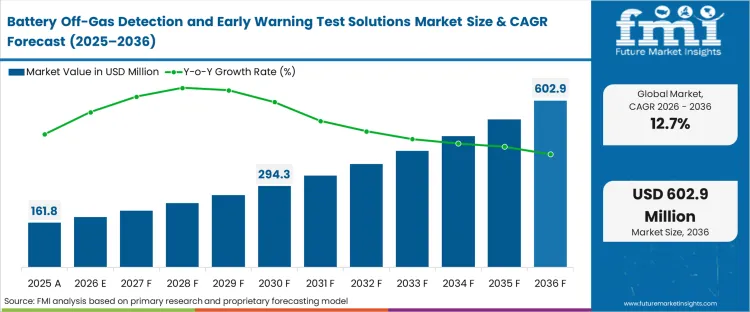
Battery Off-Gas Detection and Early Warning Test Solutions Market Key Takeaways
| Metric | Details |
|---|---|
| Industry Size (2026) | USD 182.4 million |
| Industry Value (2036) | USD 603.8 million |
| CAGR (2026 to 2036) | 12.70% |
Source: Future Market Insights (FMI) analysis, based on proprietary forecasting model and primary research
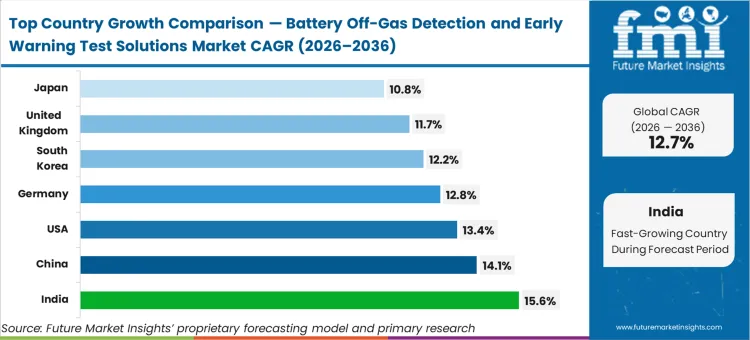
India expands at 15.6% as domestic cell facilities mandate continuous line-side abuse monitoring. China tracks at 14.1% following aggressive export compliance requirements for high-density packs. Validation labs maintain a 13.4% trajectory to satisfy UL 9540A off-gas detection testing destructive protocols. German automotive R&D centers hold a 12.8% pace by integrating continuous gas sampling directly into prototype vehicle chassis environments. South Korea advances at 12.2% alongside United Kingdom integration projects at 11.7%. Japan secures 10.8% growth through strict residential storage certification mandates. North American adoption focuses on certification testing, whereas Asian deployment prioritizes continuous operational monitoring at production tiers.
Battery Off-Gas Detection and Early Warning Test Solutions Definition
Identifying chemical precursors to lithium-ion cell failure defines this architecture. The instrumentation monitors environments for electrolyte solvent vapors released prior to thermal runaway. These specialized packages translate trace chemical signatures into immediate electrical isolation commands. The capability separates pre-combustion venting events from background environmental noise. Operators gain a measurable time window to execute mitigation protocols before physical fire propagation begins. Answering what is battery off-gas detection requires understanding this specific temporal advantage over reactive suppression.
Battery Off-Gas Detection and Early Warning Test Solutions Inclusions
Scope parameters strictly cover dedicated aspirated smoke detectors, direct-contact vapor sensors, and integrated controller hubs designed specifically for lithium-ion failure prediction. Data acquisition platforms processing these specific chemical signals and enclosed chamber rigs used to conduct destructive qualification tests form a core segment of the analysis. Retrofit kits engineered to upgrade existing stationary battery storage racks with battery vent-gas detection solutions fall fully within evaluation boundaries.
Battery Off-Gas Detection and Early Warning Test Solutions Exclusions
Conventional commercial fire alarms and standard building-grade carbon monoxide detectors sit entirely outside this framework. They react to active combustion rather than pre-thermal venting. General purpose temperature sensors, voltage monitoring circuits within battery management systems, and physical explosion-proof enclosures are omitted. Chemical fire suppression agents and mechanical deluge systems deploying them are excluded. They represent reactive mitigation layers rather than early-warning detection tiers.
Battery Off-Gas Detection and Early Warning Test Solutions Market Research Methodology
- Primary Research: System integration engineers, destructive testing lab directors, and safety certification officers provided direct operational feedback regarding false-positive rates and sensor longevity.
- Desk Research: UL 9540A testing registries, FM Global approval databases, and national laboratory thermal runaway characterization publications supplied fundamental performance baselines.
- Market-Sizing and Forecasting: Procurement volume for specialized abuse testing chambers and mandatory safety instrumentation across Tier-1 production lines anchored valuation baselines.
- Data Validation and Update Cycle: Megawatt-hour deployment figures for containerized energy storage cross-validated necessary hardware volume for operational rack monitoring networks.
Segmental Analysis
Battery Off-Gas Detection and Early Warning Test Solutions Market Analysis by Detection target
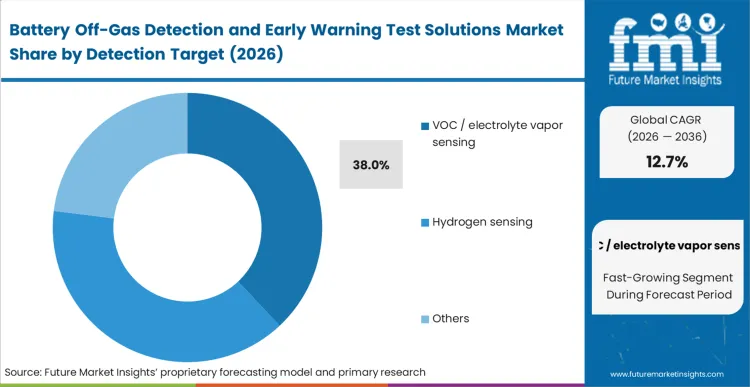
Detecting chemical precursors before physical combustion defines baseline requirements for any modern volatile organic compound gas sensor. The data indicates VOC / electrolyte vapor sensing commands 38.0% share in 2026. Facility managers at grid storage sites rely on VOC sensing for lithium-ion battery safety because it provides actionable warning before ruptured cells transition into thermal runaway. Evaluating which gases are monitored before battery thermal runaway reveals universal presence of these solvents across nearly all cathode chemistries makes them ideal early indicators. What testing lab directors rarely acknowledge is how severely environmental cross-sensitivity degrades VOC reliability. Nearby diesel generators can trigger multi-megawatt false trips. Integrators failing to position specialized reference nodes outside battery airflow pathways face continuous nuisance alarms.
- Initial screening: Baseline solvent detection validates earliest stages of physical cell failure for certification engineers. Facility managers avoid total asset loss by catching venting before heat generation starts.
- Hydrogen verification: Tracking secondary gas sensors data alongside VOC spikes allows R&D technicians to characterize exact heating timelines. Engineers deploying hydrogen sensing for battery thermal runaway satisfy stringent thermal containment regulations.
- Architecture evaluation: Maintaining documented histories of trace chemical levels proves operating environments remained completely stable prior to major grid interconnection upgrades. Analysts running models to compare VOC vs hydrogen sensors for battery early warning find project financiers require this exact data trail.
Battery Off-Gas Detection and Early Warning Test Solutions Market Analysis by Test configuration
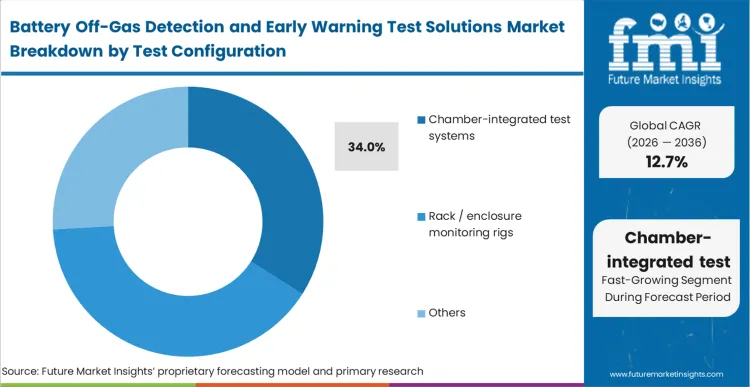
Legacy open-air abuse testing fails to capture exact volumetric gas releases necessary for accurate thermal propagation modeling. Chamber-integrated test systems maintain 34.0% share in 2026, driven directly by stringent documentation demands of UL 9540A certification. Test engineers at third-party validation labs must quantify total flammability limits of vented gas mixtures using a dedicated battery off-gas test chamber. Sealed environments provide controlled volumes where every cubic centimeter of vented lithium battery thermal runaway sensor modules data can be captured without atmospheric dilution. A major blind spot in current testing methodologies is that perfect chamber data rarely translates to real-world container dynamics. Labs relying on makeshift containment rigs consistently fail audit reviews because they cannot guarantee complete capture of highly diffusive gases during active battery abuse test gas detection system evaluations.
- Performance baseline: Sealed measurement validates exact volumes of combustible material generated during forced overcharge events. Over-reliance on theoretical models leaves safety directors exposed during actual compliance audits.
- Analyte expansion: Passing destructive testing phases requires proving off-gas volumes remain below lower flammability limits. Upgrading to a multi-gas battery safety test platform ensures engineers avoid immediate project cancellation.
- Edge condition gaps: Standard airflow rates inside test chambers fail to replicate aggressive HVAC turbulence present in live data centers. System integrators must manually recalculate required sensor density to account for this dilution.
Battery Off-Gas Detection and Early Warning Test Solutions Market Analysis by Battery level under test
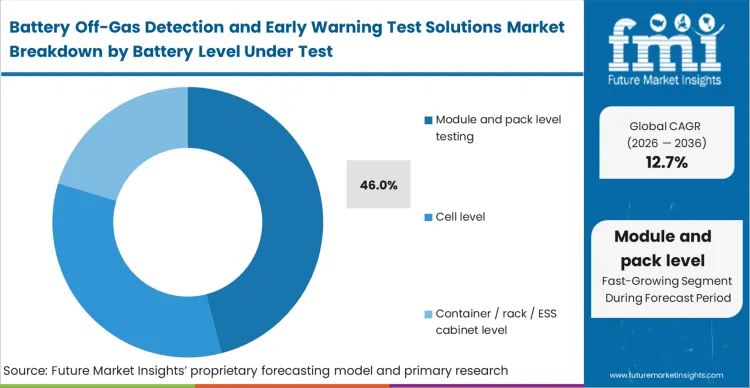
Evaluating entire grid containers simultaneously obscures precise origin points of failure events. Module and pack level testing secures 46.0% share in 2026 because this physical boundary represents primary units of thermal containment. Safety architects focus instrumentation at this tier to verify localized mitigation strategies actually prevent cell-to-cell propagation. When automotive tier-1 suppliers deploy early warning gas detection for lithium battery packs, critical metrics involve whether pack enclosures can temporarily trap vented gases away from passenger compartments. An uncomfortable reality for many system integrators is that module-level sensors often fail to detect internal venting if housing itself features high-pressure seals that hold until violent rupture. Procurement directors conducting analyses of off-gas detection vs temperature monitoring in battery packs routinely discover detection delays render automated suppression responses completely useless.
- Venting containment: High-pressure housing seals trap early solvent releases inside module casings. Automotive packaging engineers must design specific exhaust channels to route these vapors directly across sensing nodes.
- Internal propagation: Failures deep within multi-cell modules create localized heat that standard external monitoring cannot detect. Battery safety directors require internal aspiration points to identify exact failing cell blocks.
- Response activation: Full benefit requires linking detection signals directly to contactor relays. Software developers must ensure networks drop electrical loads milliseconds after automotive battery management system hardware registers verified VOC spikes.
Battery Off-Gas Detection and Early Warning Test Solutions Market Analysis by End use
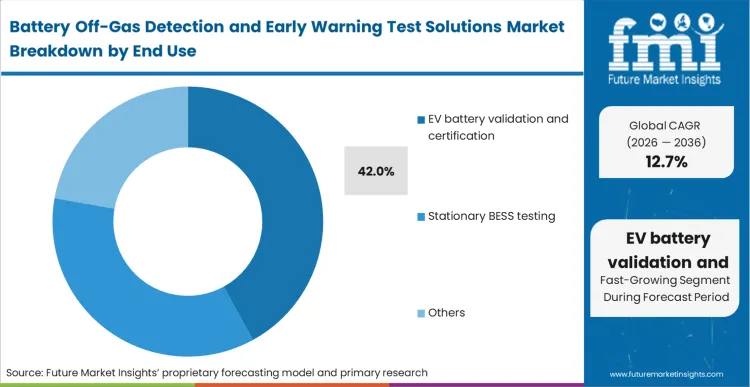
Automotive development cycles compress rapidly. This reality forces qualification teams to run simultaneous destructive test protocols across multiple prototype variants. EV battery validation and certification accounts for 42.0% share in 2026, shaped by regulatory demands for precise thermal runaway characterization before any vehicle platform reaches mass production. Powertrain engineering directors require absolute certainty regarding how specific pack geometries channel EV battery safety vents emissions during crash scenarios. Executing EV battery validation off-gas testing requires tracking exact sequences of gas release, heat transfer, and structural deformation. What investors evaluating these validation labs fail to recognize is the staggering consumable cost of this testing. Every destructive event heavily contaminates expensive mass spectrometers inside chambers. Laboratories attempting to increase throughput by shortening cleaning cycles inevitably produce corrupted gas concentration data.
- Procurement savings: Upfront investment in self-cleaning optical sensor arrays reduces long-term costs of replacing contaminated probe elements. Validation lab managers avoid continuous expenses of swapping saturated chemical sensors after thermal events.
- Compliance execution: Stringent guidelines dictate precise measurement of vented particulates. Testing facilities utilizing BESS off-gas detection testing protocols secure major qualification contracts from utility developers.
- Lifecycle comparison: Examining total ownership costs reveals automated aspiration networks ultimately cost less than maintaining manual battery free sensors arrays. Finance directors who authorize higher capital expenditures recover margins through drastically reduced chamber downtime.
Battery Off-Gas Detection and Early Warning Test Solutions Market Analysis by Offering
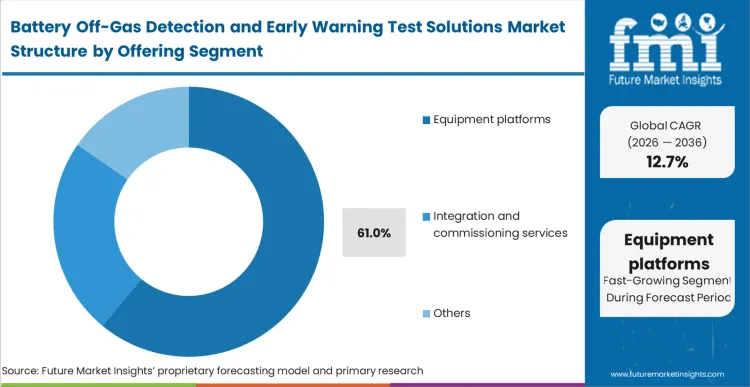
Physical hardware must survive incredibly hostile chemical environments while maintaining parts-per-million accuracy. Equipment platforms represent 61.0% share in 2026, sitting at intersections of diagnostic precision and industrial durability. Procurement managers prioritize durable analyzer hubs because software analytics provide zero value if physical sampling networks fail. Infrastructure must draw air samples continuously without clogging from ambient dust or degrading from trace battery technology outgassing. A structural irony in this equipment segment is that most sensitive laboratory-grade detection modules are frequently first components to fail when deployed in actual grid-edge environments due to humidity fluctuations. Purchasing teams issuing a battery gas detection RFQ often discover standard commercial HVAC aspiration pipes absorb critical solvent vapors, causing false negatives.
- Triggering conditions: Approving capital expenditures for specialized off-gas hardware begins when insurance providers refuse to underwrite facilities without it. Operations directors initiate purchases to clear regulatory hurdles.
- Supplier selection: Validating equipment requires proving aspiration pumps can maintain sufficient vacuum pressure across fully loaded containers. Sourcing from specialized battery off-gas detector suppliers guarantees air samples reach central detection chambers within mandated ten-second windows.
- Expansion criteria: Adding capacity to existing sites demands backward-compatible sensor nodes integrating into original control hubs. Site managers authorize system extensions only when battery early warning test system manufacturers guarantee new racks will not increase baseline false-alarm rates.
Battery Off-Gas Detection and Early Warning Test Solutions Market Drivers, Restraints, and Opportunities
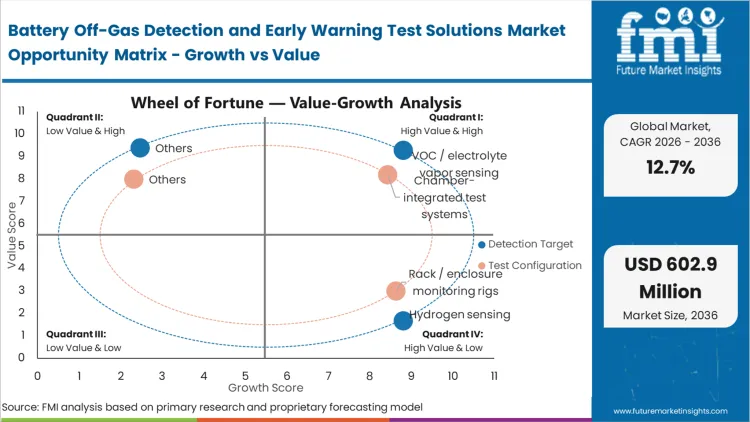
Liability risk and uninsurable asset exposure force utility-scale storage integrators to deploy active pre-combustion sensing networks. Single container fires destroy millions in hardware and guarantee severe regulatory penalties for operating utilities. Analyzing off-gas detection vs smoke detection for batteries reveals waiting for standard commercial fire alarms means accepting total asset loss, as thermal runaway cannot be extinguished once initiated. This exact commercial threat compels safety directors to specify highly sensitive VOC aspiration systems providing critical twenty-minute intervention windows. They must isolate failing modules electrically and trigger thermal runaway shields before localized venting accelerates into adjacent racks.
Differentiating actual electrolyte venting from environmental cross-contamination in industrial settings creates immense operational friction. Forklift exhaust, cleaning chemicals, and outgassing plastics frequently trigger false alarms that shut down entire multi-megawatt storage arrays. These costly nuisance trips force site operators to dial down sensor sensitivity, effectively neutralizing early warning capabilities entirely. Dual-sensor reference algorithms offer partial solutions by comparing rack-level air to ambient intake. However, complex baseline calibrations required for each unique facility footprint prevent rapid integration across legacy installations.
Opportunities in Battery Off-Gas Detection and Early Warning Test Solutions Market
- Algorithm upgrades: Developing machine learning filters that accurately distinguish battery solvent signatures from complex industrial background emissions prevents costly operational shutdowns for grid operators.
- Automotive integration: Embedding miniaturized automotive hydrogen leak detection sensors directly within passenger compartment HVAC intakes secures critical safety margins for next-generation vehicle platforms.
- Maintenance diagnostics: Deploying portable off-gas sniffer kits allows field service technicians to identify micro-leaking cells inside stationary enclosures during routine annual inspections.
Regional Analysis
.webp "Top Country Growth Comparison Battery Off Gas Detection And Early Warning Test Solutions Market Cagr (2026 2036)")
Based on regional analysis, Battery Off-Gas Detection and Early Warning Test Solutions is segmented into North America, Latin America, Western Europe, Eastern Europe, East Asia, South Asia and Pacific, and Middle East and Africa across 40 plus countries.
| Country | CAGR (2026 to 2036) |
|---|---|
| India | 15.6% |
| China | 14.1% |
| United States | 13.4% |
| Germany | 12.8% |
| South Korea | 12.2% |
| United Kingdom | 11.7% |
| Japan | 10.8% |
Source: Future Market Insights (FMI) analysis, based on proprietary forecasting model and primary research
East Asia Battery Off-Gas Detection and Early Warning Test Solutions Market Analysis
This strict regulatory stance forces domestic system integrators to embed off-gas aspiration networks into base designs of every new export-grade container. Grid-scale battery deployment mandates in East Asia now explicitly link project commissioning approvals to presence of dedicated thermal runaway prediction hardware. Transitioning away from basic temperature monitoring eliminates critical blind spots for operators managing high-density lithium iron phosphate installations. Planners managing massive urban energy storage rollouts refuse to authorize interconnections that rely solely on reactive fire suppression.
- China: Expanding at a 14.1% CAGR, the China battery off-gas detection market presents lucrative opportunities for stakeholders who secure major international qualification contracts by offering unparalleled throughput in dedicated destructive testing chambers. Export certification standards force domestic gigafactories to subject every new pack design to rigorous off-gas characterization testing.
- South Korea: Dense urban infrastructure severely restricts placement of large-scale battery reserves near residential zones. Consequently, driving a 12.2% CAGR, facilities managers deploy highly sensitive multi-gas monitoring arrays to satisfy local fire marshals. This reveals that localized sensor placement matters more than raw detector sensitivity in heavily ventilated enclosures.
- Japan: Stringent seismic safety codes require backup power systems to withstand intense physical shock without spontaneous internal shorting. Integrators actively retrofit older commercial installations with modern hydrogen detection systems to meet the ongoing refinement of safety parameters, thereby driving a steady 10.8% CAGR.
South Asia and Pacific Battery Off-Gas Detection and Early Warning Test Solutions Market Analysis
The lack of legacy safety infrastructure allows new facilities to leapfrog traditional smoke detection entirely. Operators running newly capitalized cell formation lines face immense pressure to identify micro-leaks before finished modules ship to automotive partners. Aggressive localization of battery manufacturing across South Asia forces production managers to rapidly upgrade line-side quality assurance testing. This region heavily imports specialized validation hardware to meet immediate production milestones, creating bottlenecks at independent testing laboratories.
- India: Registering a rapid 15.6% CAGR, the India battery thermal runaway testing market is expanding as quality assurance directors actively phase out manual inspection routines in favor of automated off-gas monitoring stations. Cell manufacturing subsidies require operators to implement world-class safety testing protocols across all domestic production lines.
North America Battery Off-Gas Detection and Early Warning Test Solutions Market Analysis
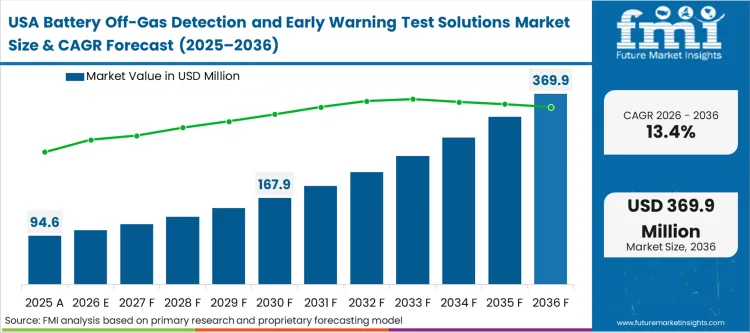
Absolute reliance on certification pathways creates massive demand for specialized instrumentation capable of quantifying precise gas release volumes during venting stages. System integrators cannot secure building permits in key municipal jurisdictions without presenting detailed off-gas dispersion models. Fire protection engineers rely on specific destructive testing data to prove initiated fires will not spread beyond single racks. Underwriters Laboratories standard UL 9540A forces North American developers to map exact thermal propagation mechanics before any commercial deployment.
- United States: Strict municipal fire codes in key energy hubs explicitly mandate pre-combustion detection for indoor battery rooms. Propelling a 13.4% CAGR over the forecast period, building engineers driving the United States battery early warning testing market fundamentally alter safety architectures by connecting off-gas sensor relays directly to primary structural exhaust fans.
Western Europe Battery Off-Gas Detection and Early Warning Test Solutions Market Analysis
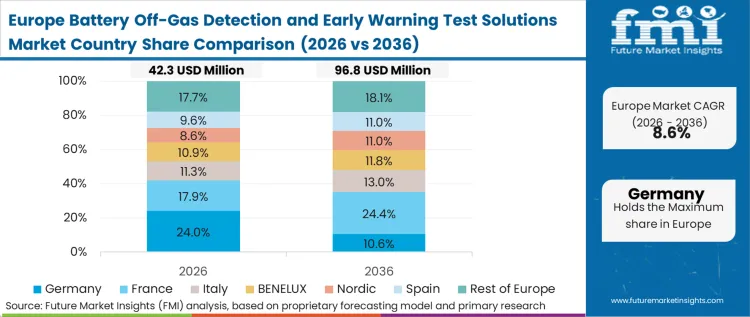
Physical density eliminates natural thermal dissipation, forcing mechanical engineers to rely on high-velocity forced air cooling. To compensate, regional developers heavily utilize sophisticated aspiration pipe networks that continuously draw air samples from every individual rack level. Urban footprint restrictions for energy storage installations across Western Europe require designers to stack battery modules in extremely tight configurations. These massive airflow volumes dilute off-gas signatures instantly, rendering point-source sensors completely ineffective.
- Germany: Automotive engineering centers execute continuous forced-failure testing to characterize safety boundaries of next-generation solid-state and high-silicon anode chemistries. R&D directors operating these chambers possess distinct advantages over global rivals by tightly integrating destructive gas analysis directly into early-stage EV sensors development, a trend ultimately generating a 12.8% CAGR.
- United Kingdom: Projected to grow at an 11.7% CAGR, the market here sees site operators deploy advanced predictive gas analytics to identify slowly degrading cells weeks before actual failure, capturing distinct cost advantages by scheduling targeted module replacements during planned maintenance windows. This is because grid balancing contracts mandate strict uptime guarantees that penalize developers for any offline capacity.
The analysis evaluates deployment trends across Canada, Mexico, Brazil, France, Italy, Spain, ASEAN, and ANZ. Localized divergence in regulatory definitions for acceptable pre-combustion intervention windows directly shapes required hardware sensitivity across expanding markets. These codes dictate whether integrators deploy basic United Kingdom battery management system upgrades or standalone analytical detection platforms.
Competitive Aligners for Market Players
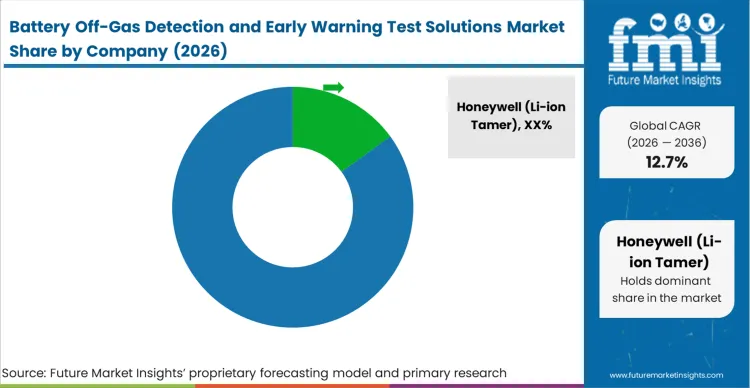
Operational barriers to entry in this specialized detection arena involve creating proprietary reference algorithms that filter out complex industrial background gases. Honeywell dominates stationary storage sectors specifically because its dual-sensor architecture successfully differentiates actual electrolyte solvent from pervasive ambient emissions found in diesel-backed data centers. Buyers evaluating who are the top battery off-gas detection companies do not select vendors based on theoretical parts-per-million sensitivity in cleanrooms. They demand proof that networks will not falsely trigger multi-megawatt shutdowns when maintenance crews use alcohol-based solvents nearby.
Established incumbents possess vast libraries of specific cell-venting chemical signatures captured across thousands of destructive testing events. Companies like Siemens and Dräger tap proprietary gas profile databases to pre-calibrate optical and aspiration systems for immediate deployment. Challengers attempting to enter this space might develop highly accurate battery thermal plates monitors, but lack historical validation data required to prove systems work across dozens of subtly different electrolyte blends used by major global cell manufacturers. Certification laboratories demand this exact historical cross-reference before approving hardware for critical safety paths.
Grid-scale developers exert immense procurement pressure by refusing to lock into proprietary, closed-loop detection networks. Large utility buyers mandate open Modbus or CAN bus communication protocols, ensuring they can pipe raw gas concentration data directly into centralized SCADA platforms. If early warning systems attempt forcing operators into restrictive software subscriptions, procurement teams executing a buy battery thermal runaway detection sensors strategy simply pivot to open-architecture hardware alternatives. Deployment of life cycle safe battery production chemicals will fundamentally shift baseline gas signatures these systems track, forcing equipment vendors to continually update firmware algorithms to recognize entirely new pre-combustion chemical markers.
Key Players in Battery Off-Gas Detection and Early Warning Test Solutions Market
- Honeywell (Li-ion Tamer)
- Johnson Controls (ANSUL)
- Siemens
- Amphenol Advanced Sensors
- Dräger
- UL Solutions
- TÜV Rheinland
Scope of the Report
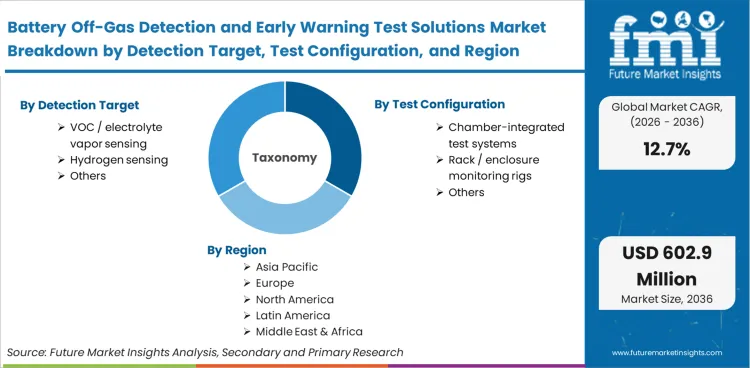
| Metric | Value |
|---|---|
| Quantitative Units | USD 182.4 million to USD 603.8 million, at a CAGR of 12.70% |
| Market Definition | Identifying chemical precursors to lithium-ion cell failure defines this architecture, monitoring environments for electrolyte solvent vapors released prior to thermal runaway. These specialized instrumentation packages translate trace chemical signatures into immediate electrical isolation commands. |
| Segmentation | By Detection target, By Test configuration, By Battery level under test, By End use, By Offering, and Region |
| Regions Covered | North America, Latin America, Western Europe, Eastern Europe, East Asia, South Asia and Pacific, Middle East and Africa |
| Countries Covered | United States, Canada, Germany, United Kingdom, France, Italy, Spain, Russia, China, Japan, South Korea, India, ASEAN, Brazil, Mexico, GCC Countries, South Africa |
| Key Companies Profiled | Honeywell (Li-ion Tamer), Johnson Controls (ANSUL), Siemens, Amphenol Advanced Sensors, Dräger, UL Solutions, TÜV Rheinland |
| Forecast Period | 2026 to 2036 |
| Approach | Procurement volume for specialized abuse testing chambers and mandatory safety instrumentation across Tier-1 production lines anchored valuation baselines. |
Source: Future Market Insights (FMI) analysis, based on proprietary forecasting model and primary research
Battery Off-Gas Detection and Early Warning Test Solutions Market Analysis by Segments
Detection target
- VOC / electrolyte vapor sensing
- Hydrogen sensing
- Carbon monoxide sensing
- Multi-gas sensing
- Off-gas particulate detection
Test configuration
- Chamber-integrated test systems
- Rack / enclosure monitoring rigs
- Pack abuse-test instrumentation bundles
- Portable validation kits
- Software-integrated analytics and alarm platforms
Battery level under test
- Module and pack level
- Cell level
- Container / rack / ESS cabinet level
- Vehicle-level integration testing
End use
- EV battery validation and certification
- Stationary BESS testing
- Battery manufacturing QA / pilot lines
- Data-center and UPS battery safety validation
- R&D institutes and national labs
Offering
- Equipment platforms
- Integration and commissioning services
- Test protocols and certification services
- Data acquisition and analytics software
- Retrofit sensor upgrades
Region
- North America
- Latin America
- Western Europe
- Eastern Europe
- East Asia
- South Asia and Pacific
- Middle East and Africa
Bibliography
- International Energy Agency. (2025, May 14). Global EV Outlook 2025. IEA.
- National Renewable Energy Laboratory. (2024). Defining the State of Safety (SOS) for Lithium-Ion Batteries in EVs – A Discussion. NREL.
- Pu, Z., et al. (2024). Thermal Runaway Warning of Lithium Battery Based on Electronic Nose and Machine Learning Algorithms. Batteries, 10(11), 390. MDPI.
- Qian, Y., Zhao, Y., Li, Z., Wang, Q., & Zhao, Y. (2025). Gas detection technology for thermal runaway of lithium-ion batteries. Frontiers in Physics, 13. Frontiers.
This bibliography is provided for reader reference. The full FMI report contains the complete reference list with primary source documentation.
This Report Addresses
- Detailed evaluation of VOC and electrolyte vapor sensing performance under intense HVAC airflow dilution.
- Specific instrumentation constraints required to achieve UL 9540A certification for grid-scale battery enclosures.
- Operational consequences of deploying rack-level gas monitoring without adequate environmental reference sensors.
- Hardware specifications necessary for chamber-integrated destructive testing of automotive cell modules.
- Changes in procurement criteria moving away from thermal detection toward active chemical pre-combustion monitoring.
- Total cost of ownership comparisons between standard optical sensors and self-cleaning mass spectrometer modules.
- Regulatory fire code implications for retrofitting indoor UPS battery rooms with advanced aspiration networks.
- Emerging hardware requirements for identifying trace hydrogen fluoride releases during continuous pilot-line manufacturing.
Frequently Asked Questions
Frequently Asked Questions What is battery off-gas detection?
This architecture monitors environments for electrolyte solvent vapors released prior to lithium-ion thermal runaway. These specialized packages translate trace chemical signatures into immediate electrical isolation commands, providing critical intervention windows before physical combustion begins.
How big is the battery off-gas detection market?
FMI modeling indicates a USD 182.4 million footprint in 2026. This metric signals structural shifts where grid integrators must embed active pre-combustion hardware to secure standard insurance underwriting for urban installations.
What is the growth projection through 2036?
Demand scales to USD 603.8 million by 2036, representing a 12.70% expansion rate. Trajectories rely on global fire codes formally mandating off-gas measurement prior to authorizing large-scale commercial interconnections.
What is the warning time for battery off-gas sensors?
Highly sensitive VOC aspiration systems provide critical ten-to-thirty minute intervention windows. This exact timeframe allows operators to electrically isolate failing modules and trigger suppression systems before localized venting accelerates.
Is off-gas detection required for UL 9540A?
Certification protocols demand precise flammability modeling of vented gases. Validation labs must install advanced mass spectrometry arrays to characterize exact chemical compositions released during forced thermal events.
Why are battery labs adding off-gas detection systems?
Automotive development cycles compress rapidly, forcing qualification teams to run simultaneous destructive test protocols. Powertrain engineering directors require absolute certainty regarding how specific pack geometries channel emissions during crash scenarios.
What standards matter for battery off-gas testing in 2026?
Underwriters Laboratories standard UL 9540A and NFPA fire codes explicitly mandate pre-combustion detection for indoor battery rooms. Building engineers retrofitting commercial towers fundamentally alter safety architectures to comply.
Which detection target commands highest share?
VOC and electrolyte vapor sensing secures 38.0% of volume. Specialized instrumentation dominates because it universally identifies exact solvent releases that occur minutes before actual cell rupture across nearly all chemistries.
Why do chamber-integrated test systems lead configuration segments?
Certification bodies require absolute documentation of vented gas volumes during destructive testing. Sealed chambers provide controlled environments where precise flammability limits can be verified without atmospheric dilution.
What drives demand at module and pack levels?
Automotive pack designs utilize high-pressure seals trapping internal venting. Safety engineers must position aspiration nodes directly within module casings to detect localized failures before entire pack housings violently breach.
What operational consequence pushes EV battery validation?
Destructive testing heavily contaminates laboratory gas sensors. Facilities must procure expensive self-cleaning optical arrays to maintain test throughput, as manual decontamination forces unacceptable delays in prototype qualification schedules.
What friction slows immediate adoption?
Industrial background emissions consistently trigger false alarms. Site operators frequently dial down network sensitivity to avoid multi-megawatt nuisance shutdowns caused by nearby forklift exhaust or cleaning solvents.
How does dual-sensor reference architecture work?
Controllers compare localized rack aspiration data against reference nodes positioned at ambient air intakes. Continuous cross-referencing allows systems to ignore external environmental pollutants while reacting instantly to internal solvent venting.
Why does India grow faster than United States?
Indian gigafactories capitalize new production lines from scratch, allowing them to embed continuous monitoring directly. USA markets heavily focus on destructive certification testing, creating narrower volume footprints.
How do high-velocity HVAC systems affect detection?
Aggressive cooling fans dilute trace vapor concentrations within seconds. Integrators must deploy highly dense aspiration pipe networks to capture parts-per-million solvent signatures before they exhaust out of containers.
Why do standard smoke detectors fail in this application?
Commercial smoke detectors require physical combustion particulates to register alarms. By the time lithium-ion cells generate actual smoke, thermal runaway has initiated and cannot be chemically suppressed.
What happens if integrators delay deployment?
Facilities relying on reactive suppression face total asset destruction during failure events. Local fire marshals increasingly reject building permits for commercial towers unless proactive vapor monitoring relays are installed.
How do proprietary gas profiles influence procurement?
Incumbent vendors possess vast databases of specific cell-venting signatures. Certification labs require historical cross-reference data to trust hardware, creating massive barriers for new optical sensor manufacturers.
What shifts in detection technology are anticipated toward 2036?
Integration of specialized solid-state chemistries alters baseline outgassing signatures. Sensor manufacturers must continually update firmware algorithms to recognize entirely new precursor compounds before they reach lower flammability limits.
How do automotive R&D centers utilize this equipment?
Powertrain engineering directors run continuous forced-failure testing on prototype chassis architectures. They track exact temporal sequences of gas release to prove vehicles can safely vent pressure away from passenger cabins.
Why is hydrogen sensing critical?
While VOCs indicate initial venting phases, sudden spikes in hydrogen concentration signal immediate onset of catastrophic thermal propagation. Tracking both gases provides operators exact timelines of internal cell degradation.
What challenge do portable validation kits address?
Field service technicians require mobile diagnostic capabilities during annual facility inspections. Portable sniffers allow them to identify microscopic cell leaks inside operational ESS racks without initiating full system teardowns.
How do communication protocols dictate vendor selection?
Grid operators refuse locked software ecosystems. They mandate open Modbus or CAN bus hardware that streams raw concentration metrics directly into centralized SCADA networks for unified facility monitoring.
What risk do uncalibrated systems present?
Sensors degraded by trace hydrogen fluoride exposure lose parts-per-million sensitivity. Operations directors skipping specialized maintenance cycles discover detection networks fail to trigger when actual venting events finally occur.
Preview the report firsthand - request a free sample
Get SampleGet the brochure for pricing and purchase details.
Get PDFTable of Content
- Executive Summary
- Global Market Outlook
- Demand-side Trends
- Supply-side Trends
- Technology Roadmap Analysis
- Analysis and Recommendations
- Market Overview
- Market Coverage / Taxonomy
- Market Definition / Scope / Limitations
- Research Methodology
- Chapter Orientation
- Analytical Lens and Working Hypotheses
- Market Structure, Signals, and Trend Drivers
- Benchmarking and Cross-market Comparability
- Market Sizing, Forecasting, and Opportunity Mapping
- Research Design and Evidence Framework
- Desk Research Programme (Secondary Evidence)
- Company Annual and Sustainability Reports
- Peer-reviewed Journals and Academic Literature
- Corporate Websites, Product Literature, and Technical Notes
- Earnings Decks and Investor Briefings
- Statutory Filings and Regulatory Disclosures
- Technical White Papers and Standards Notes
- Trade Journals, Industry Magazines, and Analyst Briefs
- Conference Proceedings, Webinars, and Seminar Materials
- Government Statistics Portals and Public Data Releases
- Press Releases and Reputable Media Coverage
- Specialist Newsletters and Curated Briefings
- Sector Databases and Reference Repositories
- FMI Internal Proprietary Databases and Historical Market Datasets
- Subscription Datasets and Paid Sources
- Social Channels, Communities, and Digital Listening Inputs
- Additional Desk Sources
- Expert Input and Fieldwork (Primary Evidence)
- Primary Modes
- Qualitative Interviews and Expert Elicitation
- Quantitative Surveys and Structured Data Capture
- Blended Approach
- Why Primary Evidence is Used
- Field Techniques
- Interviews
- Surveys
- Focus Groups
- Observational and In-context Research
- Social and Community Interactions
- Stakeholder Universe Engaged
- C-suite Leaders
- Board Members
- Presidents and Vice Presidents
- R&D and Innovation Heads
- Technical Specialists
- Domain Subject-matter Experts
- Scientists
- Physicians and Other Healthcare Professionals
- Governance, Ethics, and Data Stewardship
- Research Ethics
- Data Integrity and Handling
- Primary Modes
- Tooling, Models, and Reference Databases
- Desk Research Programme (Secondary Evidence)
- Data Engineering and Model Build
- Data Acquisition and Ingestion
- Cleaning, Normalisation, and Verification
- Synthesis, Triangulation, and Analysis
- Quality Assurance and Audit Trail
- Market Background
- Market Dynamics
- Drivers
- Restraints
- Opportunity
- Trends
- Scenario Forecast
- Demand in Optimistic Scenario
- Demand in Likely Scenario
- Demand in Conservative Scenario
- Opportunity Map Analysis
- Product Life Cycle Analysis
- Supply Chain Analysis
- Investment Feasibility Matrix
- Value Chain Analysis
- PESTLE and Porter’s Analysis
- Regulatory Landscape
- Regional Parent Market Outlook
- Production and Consumption Statistics
- Import and Export Statistics
- Market Dynamics
- Global Market Analysis 2021 to 2025 and Forecast, 2026 to 2036
- Historical Market Size Value (USD Million) Analysis, 2021 to 2025
- Current and Future Market Size Value (USD Million) Projections, 2026 to 2036
- Y-o-Y Growth Trend Analysis
- Absolute $ Opportunity Analysis
- Global Market Pricing Analysis 2021 to 2025 and Forecast 2026 to 2036
- Global Market Analysis 2021 to 2025 and Forecast 2026 to 2036, By Detection Target
- Introduction / Key Findings
- Historical Market Size Value (USD Million) Analysis By Detection Target , 2021 to 2025
- Current and Future Market Size Value (USD Million) Analysis and Forecast By Detection Target , 2026 to 2036
- VOC / electrolyte vapor sensing
- Hydrogen sensing
- Others
- VOC / electrolyte vapor sensing
- Y-o-Y Growth Trend Analysis By Detection Target , 2021 to 2025
- Absolute $ Opportunity Analysis By Detection Target , 2026 to 2036
- Global Market Analysis 2021 to 2025 and Forecast 2026 to 2036, By Test Configuration
- Introduction / Key Findings
- Historical Market Size Value (USD Million) Analysis By Test Configuration, 2021 to 2025
- Current and Future Market Size Value (USD Million) Analysis and Forecast By Test Configuration, 2026 to 2036
- Chamber-integrated test systems
- Rack / enclosure monitoring rigs
- Others
- Chamber-integrated test systems
- Y-o-Y Growth Trend Analysis By Test Configuration, 2021 to 2025
- Absolute $ Opportunity Analysis By Test Configuration, 2026 to 2036
- Global Market Analysis 2021 to 2025 and Forecast 2026 to 2036, By End Use
- Introduction / Key Findings
- Historical Market Size Value (USD Million) Analysis By End Use, 2021 to 2025
- Current and Future Market Size Value (USD Million) Analysis and Forecast By End Use, 2026 to 2036
- EV battery validation and certification
- Stationary BESS testing
- Others
- EV battery validation and certification
- Y-o-Y Growth Trend Analysis By End Use, 2021 to 2025
- Absolute $ Opportunity Analysis By End Use, 2026 to 2036
- Global Market Analysis 2021 to 2025 and Forecast 2026 to 2036, By Battery Level Under Test
- Introduction / Key Findings
- Historical Market Size Value (USD Million) Analysis By Battery Level Under Test, 2021 to 2025
- Current and Future Market Size Value (USD Million) Analysis and Forecast By Battery Level Under Test, 2026 to 2036
- Module and pack level testing
- Cell level
- Container / rack / ESS cabinet level
- Module and pack level testing
- Y-o-Y Growth Trend Analysis By Battery Level Under Test, 2021 to 2025
- Absolute $ Opportunity Analysis By Battery Level Under Test, 2026 to 2036
- Global Market Analysis 2021 to 2025 and Forecast 2026 to 2036, By Offering
- Introduction / Key Findings
- Historical Market Size Value (USD Million) Analysis By Offering, 2021 to 2025
- Current and Future Market Size Value (USD Million) Analysis and Forecast By Offering, 2026 to 2036
- Equipment platforms
- Integration and commissioning services
- Others
- Equipment platforms
- Y-o-Y Growth Trend Analysis By Offering, 2021 to 2025
- Absolute $ Opportunity Analysis By Offering, 2026 to 2036
- Global Market Analysis 2021 to 2025 and Forecast 2026 to 2036, By Region
- Introduction
- Historical Market Size Value (USD Million) Analysis By Region, 2021 to 2025
- Current Market Size Value (USD Million) Analysis and Forecast By Region, 2026 to 2036
- North America
- Latin America
- Western Europe
- Eastern Europe
- East Asia
- South Asia and Pacific
- Middle East & Africa
- Market Attractiveness Analysis By Region
- North America Market Analysis 2021 to 2025 and Forecast 2026 to 2036, By Country
- Historical Market Size Value (USD Million) Trend Analysis By Market Taxonomy, 2021 to 2025
- Market Size Value (USD Million) Forecast By Market Taxonomy, 2026 to 2036
- By Country
- USA
- Canada
- Mexico
- By Detection Target
- By Test Configuration
- By End Use
- By Battery Level Under Test
- By Offering
- By Country
- Market Attractiveness Analysis
- By Country
- By Detection Target
- By Test Configuration
- By End Use
- By Battery Level Under Test
- By Offering
- Key Takeaways
- Latin America Market Analysis 2021 to 2025 and Forecast 2026 to 2036, By Country
- Historical Market Size Value (USD Million) Trend Analysis By Market Taxonomy, 2021 to 2025
- Market Size Value (USD Million) Forecast By Market Taxonomy, 2026 to 2036
- By Country
- Brazil
- Chile
- Rest of Latin America
- By Detection Target
- By Test Configuration
- By End Use
- By Battery Level Under Test
- By Offering
- By Country
- Market Attractiveness Analysis
- By Country
- By Detection Target
- By Test Configuration
- By End Use
- By Battery Level Under Test
- By Offering
- Key Takeaways
- Western Europe Market Analysis 2021 to 2025 and Forecast 2026 to 2036, By Country
- Historical Market Size Value (USD Million) Trend Analysis By Market Taxonomy, 2021 to 2025
- Market Size Value (USD Million) Forecast By Market Taxonomy, 2026 to 2036
- By Country
- Germany
- UK
- Italy
- Spain
- France
- Nordic
- BENELUX
- Rest of Western Europe
- By Detection Target
- By Test Configuration
- By End Use
- By Battery Level Under Test
- By Offering
- By Country
- Market Attractiveness Analysis
- By Country
- By Detection Target
- By Test Configuration
- By End Use
- By Battery Level Under Test
- By Offering
- Key Takeaways
- Eastern Europe Market Analysis 2021 to 2025 and Forecast 2026 to 2036, By Country
- Historical Market Size Value (USD Million) Trend Analysis By Market Taxonomy, 2021 to 2025
- Market Size Value (USD Million) Forecast By Market Taxonomy, 2026 to 2036
- By Country
- Russia
- Poland
- Hungary
- Balkan & Baltic
- Rest of Eastern Europe
- By Detection Target
- By Test Configuration
- By End Use
- By Battery Level Under Test
- By Offering
- By Country
- Market Attractiveness Analysis
- By Country
- By Detection Target
- By Test Configuration
- By End Use
- By Battery Level Under Test
- By Offering
- Key Takeaways
- East Asia Market Analysis 2021 to 2025 and Forecast 2026 to 2036, By Country
- Historical Market Size Value (USD Million) Trend Analysis By Market Taxonomy, 2021 to 2025
- Market Size Value (USD Million) Forecast By Market Taxonomy, 2026 to 2036
- By Country
- China
- Japan
- South Korea
- By Detection Target
- By Test Configuration
- By End Use
- By Battery Level Under Test
- By Offering
- By Country
- Market Attractiveness Analysis
- By Country
- By Detection Target
- By Test Configuration
- By End Use
- By Battery Level Under Test
- By Offering
- Key Takeaways
- South Asia and Pacific Market Analysis 2021 to 2025 and Forecast 2026 to 2036, By Country
- Historical Market Size Value (USD Million) Trend Analysis By Market Taxonomy, 2021 to 2025
- Market Size Value (USD Million) Forecast By Market Taxonomy, 2026 to 2036
- By Country
- India
- ASEAN
- Australia & New Zealand
- Rest of South Asia and Pacific
- By Detection Target
- By Test Configuration
- By End Use
- By Battery Level Under Test
- By Offering
- By Country
- Market Attractiveness Analysis
- By Country
- By Detection Target
- By Test Configuration
- By End Use
- By Battery Level Under Test
- By Offering
- Key Takeaways
- Middle East & Africa Market Analysis 2021 to 2025 and Forecast 2026 to 2036, By Country
- Historical Market Size Value (USD Million) Trend Analysis By Market Taxonomy, 2021 to 2025
- Market Size Value (USD Million) Forecast By Market Taxonomy, 2026 to 2036
- By Country
- Kingdom of Saudi Arabia
- Other GCC Countries
- Turkiye
- South Africa
- Other African Union
- Rest of Middle East & Africa
- By Detection Target
- By Test Configuration
- By End Use
- By Battery Level Under Test
- By Offering
- By Country
- Market Attractiveness Analysis
- By Country
- By Detection Target
- By Test Configuration
- By End Use
- By Battery Level Under Test
- By Offering
- Key Takeaways
- Key Countries Market Analysis
- USA
- Pricing Analysis
- Market Share Analysis, 2025
- By Detection Target
- By Test Configuration
- By End Use
- By Battery Level Under Test
- By Offering
- Canada
- Pricing Analysis
- Market Share Analysis, 2025
- By Detection Target
- By Test Configuration
- By End Use
- By Battery Level Under Test
- By Offering
- Mexico
- Pricing Analysis
- Market Share Analysis, 2025
- By Detection Target
- By Test Configuration
- By End Use
- By Battery Level Under Test
- By Offering
- Brazil
- Pricing Analysis
- Market Share Analysis, 2025
- By Detection Target
- By Test Configuration
- By End Use
- By Battery Level Under Test
- By Offering
- Chile
- Pricing Analysis
- Market Share Analysis, 2025
- By Detection Target
- By Test Configuration
- By End Use
- By Battery Level Under Test
- By Offering
- Germany
- Pricing Analysis
- Market Share Analysis, 2025
- By Detection Target
- By Test Configuration
- By End Use
- By Battery Level Under Test
- By Offering
- UK
- Pricing Analysis
- Market Share Analysis, 2025
- By Detection Target
- By Test Configuration
- By End Use
- By Battery Level Under Test
- By Offering
- Italy
- Pricing Analysis
- Market Share Analysis, 2025
- By Detection Target
- By Test Configuration
- By End Use
- By Battery Level Under Test
- By Offering
- Spain
- Pricing Analysis
- Market Share Analysis, 2025
- By Detection Target
- By Test Configuration
- By End Use
- By Battery Level Under Test
- By Offering
- France
- Pricing Analysis
- Market Share Analysis, 2025
- By Detection Target
- By Test Configuration
- By End Use
- By Battery Level Under Test
- By Offering
- India
- Pricing Analysis
- Market Share Analysis, 2025
- By Detection Target
- By Test Configuration
- By End Use
- By Battery Level Under Test
- By Offering
- ASEAN
- Pricing Analysis
- Market Share Analysis, 2025
- By Detection Target
- By Test Configuration
- By End Use
- By Battery Level Under Test
- By Offering
- Australia & New Zealand
- Pricing Analysis
- Market Share Analysis, 2025
- By Detection Target
- By Test Configuration
- By End Use
- By Battery Level Under Test
- By Offering
- China
- Pricing Analysis
- Market Share Analysis, 2025
- By Detection Target
- By Test Configuration
- By End Use
- By Battery Level Under Test
- By Offering
- Japan
- Pricing Analysis
- Market Share Analysis, 2025
- By Detection Target
- By Test Configuration
- By End Use
- By Battery Level Under Test
- By Offering
- South Korea
- Pricing Analysis
- Market Share Analysis, 2025
- By Detection Target
- By Test Configuration
- By End Use
- By Battery Level Under Test
- By Offering
- Russia
- Pricing Analysis
- Market Share Analysis, 2025
- By Detection Target
- By Test Configuration
- By End Use
- By Battery Level Under Test
- By Offering
- Poland
- Pricing Analysis
- Market Share Analysis, 2025
- By Detection Target
- By Test Configuration
- By End Use
- By Battery Level Under Test
- By Offering
- Hungary
- Pricing Analysis
- Market Share Analysis, 2025
- By Detection Target
- By Test Configuration
- By End Use
- By Battery Level Under Test
- By Offering
- Kingdom of Saudi Arabia
- Pricing Analysis
- Market Share Analysis, 2025
- By Detection Target
- By Test Configuration
- By End Use
- By Battery Level Under Test
- By Offering
- Turkiye
- Pricing Analysis
- Market Share Analysis, 2025
- By Detection Target
- By Test Configuration
- By End Use
- By Battery Level Under Test
- By Offering
- South Africa
- Pricing Analysis
- Market Share Analysis, 2025
- By Detection Target
- By Test Configuration
- By End Use
- By Battery Level Under Test
- By Offering
- USA
- Market Structure Analysis
- Competition Dashboard
- Competition Benchmarking
- Market Share Analysis of Top Players
- By Regional
- By Detection Target
- By Test Configuration
- By End Use
- By Battery Level Under Test
- By Offering
- Competition Analysis
- Competition Deep Dive
- Honeywell (Li-ion Tamer)
- Overview
- Product Portfolio
- Profitability by Market Segments (Product/Age /Sales Channel/Region)
- Sales Footprint
- Strategy Overview
- Marketing Strategy
- Product Strategy
- Channel Strategy
- Johnson Controls (ANSUL)
- Siemens
- Amphenol Advanced Sensors
- Dräger
- UL Solutions
- Honeywell (Li-ion Tamer)
- Competition Deep Dive
- Assumptions & Acronyms Used


