

- Industry Size (2026)
- USD 50.0 Mn
- Forecast (2036)
- USD 370.0 Mn
- CAGR (2026 to 2036)
- 22.2%
Demand Analysis of LFP Battery Recycling Solutions for Stationary Storage in Europe Size, Market Forecast and Outlook By FMI
Europe LFP battery recycling solutions for stationary storage sector was valued at USD 40.9 million in 2025 and is expected to cross USD 50.0 million in 2026. The sector remains on a positive trend, with valuation projected to reach USD 370.0 million by 2036 as more utility-scale battery assets move into retirement and fall under stricter regional processing requirements. Shift is steadily widening the addressable recycling base across Europe and supporting a 22.2% CAGR from 2026 to 2036.
Summary of LFP Battery Recycling Solutions for Stationary Storage Market in Europe
- The market is estimated at USD 40.9 million in 2025.
- The market is projected to reach USD 370.0 million by 2036.
- The market is expected to grow at a CAGR of 22.2% from 2026 to 2036.
- The forecast period represents an incremental opportunity of USD 320.0 million.
- Hydrometallurgy leads the process route segment with a 44.0% share.
- Utility-scale systems dominate the source segment with a 49.0% share.
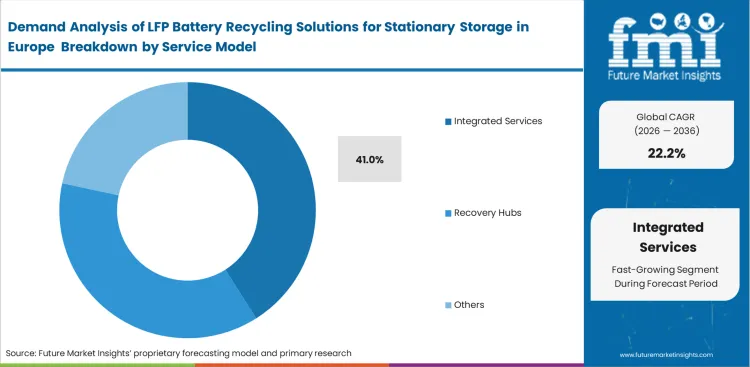
- Integrated services lead the service model segment with a 41.0% share.
- Black mass dominates the recovered output segment with a 46.0% share.
- Battery packs lead the format segment with a 52.0% share.
- Poland (25.8%), Spain (24.9%), and the Netherlands (24.2%) are among the fastest-growing markets.
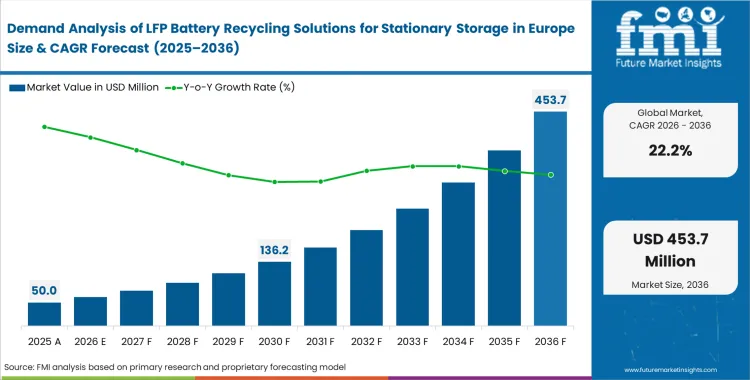
Demand Analysis of LFP Battery Recycling Solutions for Stationary Storage in Europe Key Takeaways
| Metric | Details |
|---|---|
| Industry Size (2026) | USD 50.0 million |
| Industry Value (2036) | USD 370.0 million |
| CAGR (2026-2036) | 22.2% |
Source: Future Market Insights (FMI) analysis, based on proprietary forecasting model and primary research
Asset managers retiring initial grid-scale storage blocks face an immediate arithmetic problem. Processing iron phosphate chemistry yields fractionally lower raw material value compared to nickel-based variants. Recyclers must monetize total physical mass rather than skimming high-value metals. Delaying extraction forces operators into prolonged hazardous waste compliance. Practitioners tracking the Europe battery recycling for BESS sector observe that localized pretreatment solves transport cost imbalances entirely.
Once regional processing hubs achieve continuous black mass throughput exceeding 5,000 tonnes annually, fixed-cost amortization drops below baseline tipping fees. Facility operators trigger this threshold by securing long-term offtake agreements with utility developers before breaking ground. Crossing this volume gate transitions operations from subsidized waste management into standalone profitable material production.
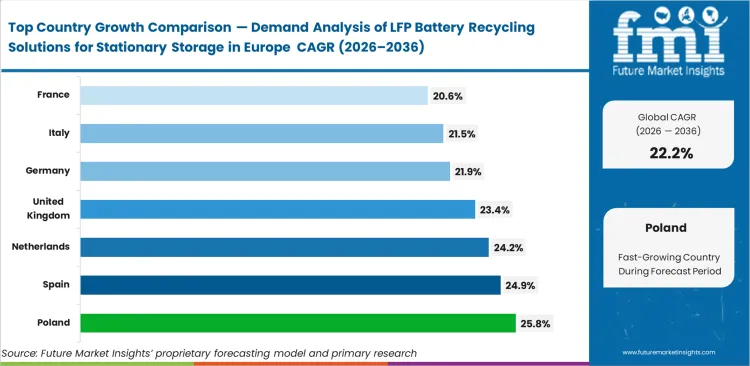
Poland is projected to lead the Europe stationary storage LFP battery recycling market with a CAGR of 25.8% from 2026 to 2036, supported by an early buildup in battery collection networks and a faster move toward formal processing capacity. Spain follows at 24.9% as utility-scale storage deployment expands the future pool of batteries entering managed end-of-life channels. Netherlands is expected to rise at 24.2% through 2036, aided by its strong cross-border logistics position and efficient movement of battery shipments within the regional recycling chain. United Kingdom is likely to expand at 23.4%, with grid-scale storage growth and tighter handling requirements supporting a stronger recycling outlook. Germany records 21.9%, backed by its large battery ecosystem and established industrial base. Italy is set to advance at 21.5% as regional recovery infrastructure continues to widen. France is projected to register 20.6%, where a steadier storage buildout keeps the industry on an upward track. Differences across these country markets reflect the uneven pace of storage deployment, collection readiness, and regulatory enforcement across Europe.
Segmental Analysis
Demand Analysis of LFP Battery Recycling Solutions for Stationary Storage in Europe Analysis by Process route
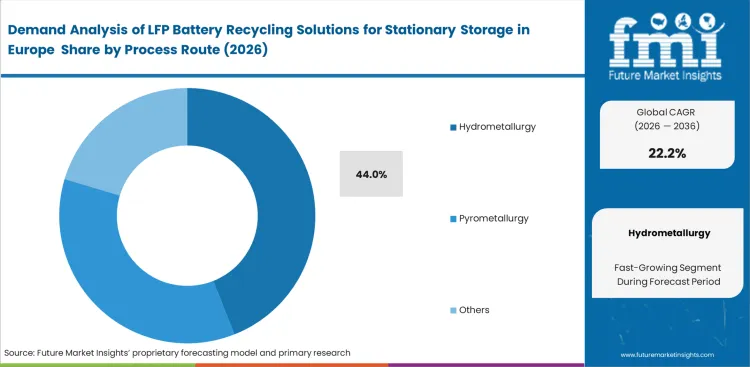
Aqueous chemical separation remains the leading process route because mechanical shredding alone leaves too much active material attached to current collector foils, which limits downstream recovery value. Hydrometallurgy for LFP batteries is anticipated to account for 44.0% of the segment’s market share in 2026, reflecting its stronger fit with lithium-focused recovery pathways. Its position is also supported by continued refinement of leaching and purification conditions for lithium iron phosphate battery feedstock, which improves material recovery and raises the value of the recovered stream. Pyrometallurgical routes remain less favorable in this segment because they offer weaker recovery economics for graphite and electrolyte-linked materials, while lower-capex mechanical systems often result in discounted black mass realization at the refining stage.
- Capital expenditure: Hydrometallurgical lines require high initial investment in corrosion-resistant tanks, separation units, filtration systems, and effluent treatment systems. Payback remains closely tied to throughput utilization and recovery efficiency.
- Operational overhead: Reagent consumption, wastewater treatment, and purification steps account for a large share of ongoing cost. Operating economics remain sensitive to the balance between input intensity and final lithium salt quality.
- Lifecycle realization: Industry valuation improves when facilities recover multiple usable outputs, especially lithium-bearing materials and graphite, rather than relying only on intermediate black mass sales. Sites with limited downstream recovery capability usually operate with lower realization per tonne.
Demand Analysis of LFP Battery Recycling Solutions for Stationary Storage in Europe Analysis by Source system
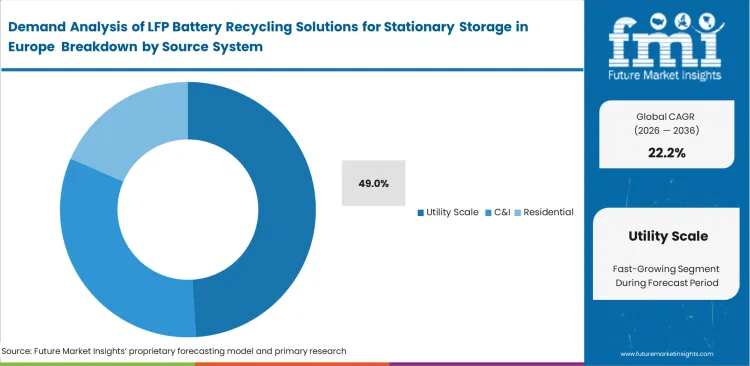
Grid-scale installations dictate volume flows because consolidated capacity drastically simplifies collection logistics. Utility scale battery recycling Europe is poised to represent 49.0% of total share in 2026. The decommissioning directors prioritize singular large contracts over fragmented commercial pickups. Transport coordinators managing lithium iron phosphate transfers avoid residential milk-run complexities, preferring massive single-site extractions. Concentrating collection efforts on megawatt installations minimizes per-kilogram transport overhead, shifting project economics from loss-making disposal into break-even raw material sourcing.
- Early adopters: Independent power producers testing early frequency regulation markets reach end-of-life parameters first. Site managers decommission these assets entirely to install higher-density replacements.
- Secondary wave: Commercial aggregators follow as mid-sized behind-the-meter installations degrade. Operations directors transition from warranty claims into final physical disposal protocols.
- Late arrivals: Residential unit aggregation remains fundamentally fractured until municipal collection networks mature. Waste management coordinators eventually capture these units through mandated public drop-off centers.
Demand Analysis of LFP Battery Recycling Solutions for Stationary Storage in Europe Analysis by Service model
Grid-scale installations set the direction of collection volumes because large battery assets are easier to trace, aggregate, and transport than fragmented smaller systems. Utility-scale is anticipated to account for 49.0% of the source system segment share in 2026, reflecting its central role in the Europe stationary storage LFP battery recycling market. Larger sites usually move through end-of-life handling under single contracts, which lowers collection complexity and improves transport efficiency per kilogram processed.
This makes utility-scale systems more attractive to recyclers, as concentrated recovery volumes support better plant utilization and more stable material flows. By comparison, commercial and residential storage remains more dispersed, which raises handling costs and slows the formation of efficient collection networks. The industry outlook therefore remains more favorable around megawatt-scale installations, where retirement activity is likely to enter formal recycling channels earlier than in smaller distributed assets.
- Liability transfer: Independent power projects deployed in the first wave of grid-balancing and frequency-response markets are more likely to enter replacement cycles earlier, creating the first meaningful utility-scale recycling volumes.
- Documentation friction: Mid-sized behind-the-meter and commercial storage systems follow later, adding to feedstock availability as installation cohorts age and replacement economics become clearer.
- Final resolution: Residential storage remains the most fragmented stream, so volume consolidation is likely to rise more gradually as collection systems and local take-back networks continue to expand.
Demand Analysis of LFP Battery Recycling Solutions for Stationary Storage in Europe Analysis by Recovered output
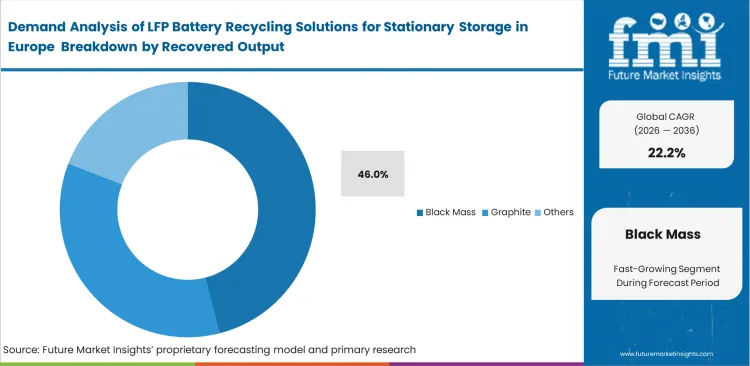
Black mass remains the leading recovered output because many recyclers in the Europe stationary storage LFP battery recycling sector still operate around pretreatment and intermediate-material sale rather than full chemical refining. Black mass from stationary storage batteries is estimated to account for 46.0% of the recovered output segment share in 2026, reflecting its stronger commercial fit for facilities that want liquidity without moving into battery-grade salt production. This route keeps capital intensity more manageable, shortens the cash-conversion cycle, and allows processors to expand shredding and separation capacity before committing to deeper downstream refining. Realization, however, depends heavily on output quality, as intermediate powders with aluminum or copper contamination trade at a sharp discount.
- Baseline acceptability: Downstream refiners usually require controlled particle size, stable composition, and low casing contamination before accepting intermediate shipments. Off-spec material often moves at lower realization or faces delayed offtake.
- Edge performance: Advanced sorting and separation systems improve output quality by isolating active-material fractions more effectively before chemical recovery. Better upstream separation usually supports stronger value capture at later stages.
- Qualification standards: Battery-grade end products require much tighter impurity control than intermediate black mass. Moving from tradable powder to refined chemical output therefore demands additional purification steps, stricter process control, and materially higher investment.
Demand Analysis of LFP Battery Recycling Solutions for Stationary Storage in Europe Analysis by Battery format
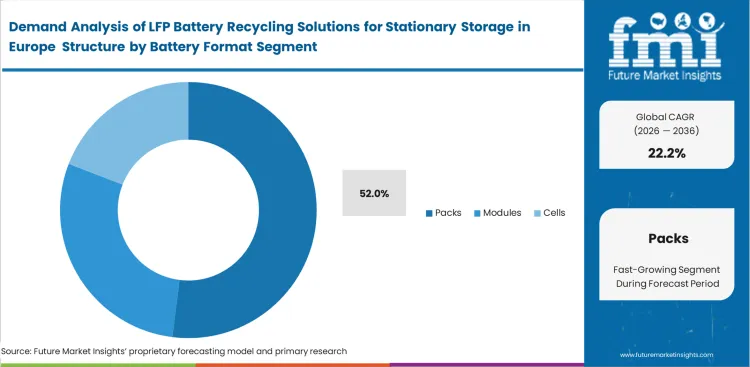
Pack-level processing remains the preferred format route because handling complete enclosures reduces dismantling time, lowers manual intervention, and improves line efficiency in European recycling facilities. Packs are projected to account for 52.0% of the format category share in 2026, reflecting the operational advantage of treating large stationary battery assemblies as single intake units rather than breaking them down first at module level. This approach also aligns with the rising use of automated shredding and controlled reduction systems, which make it easier to process steel housings and other enclosure materials under safer industrial conditions.
- Initial trigger: High labor costs continue to push facilities toward automated intake and reduction systems. Processing intact enclosures cuts manual handling requirements and supports more efficient line utilization.
- Validation gate: Safe pack-level shredding depends on inert processing environments, thermal control, and continuous monitoring before mechanical reduction begins. Facilities without these safeguards face tighter operating constraints.
- Expansion driver: Proven enclosure-level processing supports larger contract volumes because utility-scale battery owners favor recyclers that can manage high-throughput intake with limited manual exposure.
Demand Analysis of LFP Battery Recycling Solutions for Stationary Storage in Europe Drivers, Restraints, and Opportunities
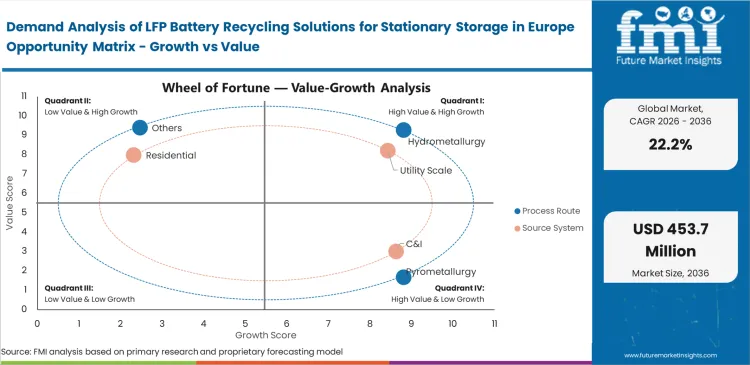
Extended producer responsibility rules across Europe are tightening the obligation to place degraded stationary batteries into formal end-of-life channels, which keeps the recycling outlook on an upward path for regional operators. Utility-scale battery owners can no longer treat disposal as an optional back-end activity, because compliance, traceability, and hazardous-handling rules increasingly require verified domestic or regulated regional processing routes. Delays in recycler selection also raise operating risk, as aging battery systems become harder and more expensive to transport once stability conditions deteriorate. This is steadily expanding the feedstock base available to battery-material recovery networks across Europe.
Conversion of that feedstock into processed volume is still slower than headline obligations suggest, because safe discharge and permitting remain meaningful bottlenecks before shredding or materials recovery can begin. Municipal approvals for deep-discharging facilities often move slowly, especially where local authorities apply stricter fire, industrial safety, and environmental controls to battery handling sites. Mobile discharge systems offer one route to ease this pressure, but local code fragmentation still limits wider deployment across European utility sites. The sector therefore remains on a positive trend, though actual material recovery is likely to rise in uneven steps as regulatory compliance advances faster than discharge and site-clearance capacity.
Opportunities in the Demand Analysis of LFP Battery Recycling Solutions for Stationary Storage in Europe
- Direct cathode regeneration: Direct replenishment is emerging as a practical route because it avoids full molecular breakdown and reduces processing intensity. Facilities using this method can lower energy use while returning usable cathode material to the battery supply chain.
- Graphite isolation protocols: Secondary flotation and separation steps are gaining importance as recyclers look to recover more value from the anode side of the feedstock. Successful graphite isolation improves material realization per processed lithium-ion battery and strengthens overall plant economics.
- Mobile pretreatment fleets: Truck-mounted discharge and shredding systems are attracting attention for utility-scale battery sites where on-site pretreatment can simplify handling. Converting packs into inert intermediate material before transport reduces logistical complexity and supports a more workable recovery chain.
Regional Analysis
Based on regional analysis, Demand Analysis of LFP Battery Recycling Solutions for Stationary Storage in Europe is segmented into Eastern Europe, Southern Europe, and Western Europe across 40 plus countries.
.webp "Top Country Growth Comparison Demand Analysis Of Lfp Battery Recycling Solutions For Stationary Storage In Europe Cagr (2026 2036)")
| Country | CAGR (2026 to 2036) |
|---|---|
| Poland | 25.8% |
| Spain | 24.9% |
| Netherlands | 24.2% |
| United Kingdom | 23.4% |
| Germany | 21.9% |
| Italy | 21.5% |
| France | 20.6% |
Source: Future Market Insights (FMI) analysis, based on proprietary forecasting model and primary research
Eastern Europe LFP Battery Recycling Solutions for Stationary Storage Industry Analysis
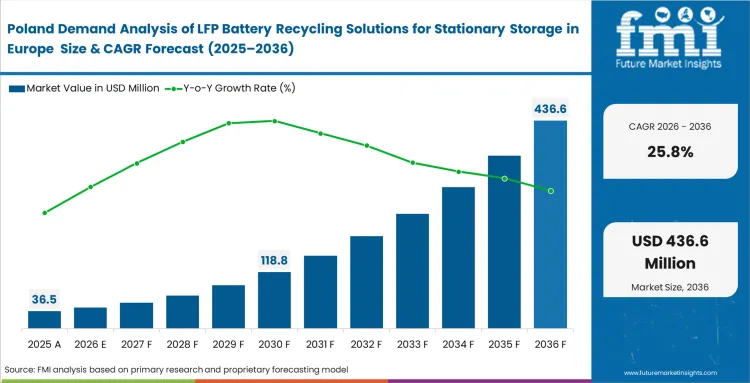
Eastern Europe is rising as an early processing base because battery manufacturing scrap is reaching recyclers well before large volumes of grid-scale stationary systems move into retirement. Feedstock availability in this region is therefore shaped more by pre-consumer material flows than by end-of-life utility assets. Poland and nearby manufacturing zones give processors a steadier utilization base, while industrial zoning and lower siting friction support faster build-out of shredding and hydrometallurgical capacity than in more tightly regulated parts of Europe. Recycling activity in this region is therefore moving ahead on manufacturing adjacency first, with grid-retirement volumes expected to become more relevant later in the forecast period.
- Poland: Poland benefits from direct proximity to battery cell manufacturing, which keeps processing schedules tied more closely to production scrap and defect volumes than to retired grid assets. Demand analysis for stationary storage battery recycling in Poland is anticipated to rise at a CAGR of 25.8% through 2036. Early capacity build-out also strengthens the country’s position as a regional processing base. Nearby factory output gives the market a more stable feedstock position and reduces reliance on fragmented collection systems.
FMI's report includes additional Eastern European nations establishing preliminary shredding bases. Cross-border scrap consolidation remains vital for facilities located away from primary manufacturing centers.
Southern Europe LFP Battery Recycling Solutions for Stationary Storage Industry Analysis
Southern Europe is advancing on the back of solar-plus-storage deployment, where distributed battery installations are creating a broader but more fragmented collection landscape. Recycling economics in this region depend less on single concentrated industrial streams and more on the ability to manage dispersed storage assets across multiple locations. Local permitting, fire-code compliance, and safe discharge requirements are shaping where preprocessing hubs can be established and how quickly degraded systems can move into formal recycling channels. Regional industry outlook is therefore improving through localized logistics strength rather than through large centralized recovery networks alone.
- Spain: Spain is set to record a CAGR of 24.9% in stationary LFP battery recycling during the assessment period. Early retirement handling in utility-scale projects is keeping the sector on a positive trend. The country is moving ahead from a strong solar-linked storage base, and higher heat exposure across early utility installations is likely to bring some systems into replacement cycles sooner than in cooler markets. Localized discharge and preprocessing capability is becoming more important as transport restrictions tighten around degraded packs.
- Italy: Fragmented grid networks force localized preprocessing investments. The Italy stationary battery recycling market is set to record a 21.5% CAGR during the forecast period. Italy remains shaped by a fragmented grid and a distributed storage footprint, both of which favor local preprocessing before material moves into larger recovery networks. Provincial compliance procedures and municipal permitting continue to influence how quickly handling capacity can expand.
FMI's report includes Portugal and Greece where early-stage regulatory frameworks currently shape initial planning. Island grid storage replacements provide isolated but highly lucrative processing contracts.
Western Europe LFP Battery Recycling Solutions for Stationary Storage Industry Analysis
Western Europe holds an early advantage because its existing automotive, chemical, and metallurgical base can be adapted more easily for stationary battery recycling. Established industrial capability shortens the path to commercial-scale shredding, discharge, and recovery operations, while stricter environmental controls keep facilities focused on higher-quality processing routes. Capital availability also remains stronger in this region, supporting expansion in advanced recycling systems and adjacent material-refining capacity. Industry valuation across Western Europe is on a positive trend, supported by industrial depth, tighter compliance standards, and better access to financing.
- Netherlands: Port logistics and cross-border material movement give the Netherlands a strong position in imported battery scrap as well as domestic stationary-storage retirements. Established chemical and industrial clusters also improve access to downstream processing inputs and export channels. The Netherlands battery recycling sector for BESS is projected to expand at a CAGR of 24.2% through 2036. Cross-border material consolidation remains central to the country’s market outlook.
- United Kingdom: The UK battery recycling industry for energy storage is likely to advance at a CAGR of 23.4% during the study period. A more self-contained recycling model continues to shape the country’s industry outlook. Domestic handling requirements carry more weight in the United Kingdom because the market cannot rely as easily on mainland European processing chains for every end-of-life flow. This keeps local discharge, shredding, and hydrometallurgical capacity strategically important for the sector.
- Germany: Germany enters this market with a strong industrial base, existing metallurgical expertise, and industrial assets that can be adapted for large stationary battery enclosures. Environmental compliance standards also favor processors capable of delivering higher recovery quality rather than simple shredding output alone. The Germany LFP battery recycling market is poised to expand at a CAGR of 21.9% through 2036. Existing industrial capability remains a key advantage in scaling utility-linked recycling activity.
- France: France is projected to witness a CAGR of 20.6% in battery material recovery through 2036. Progress in this market is likely to remain measured but consistent. France is building its position through domestic circularity priorities and a waste-management system that already operates under relatively mature compliance frameworks. Market expansion here depends less on rapid greenfield rollout and more on upgrading existing networks for battery-specific handling and recovery.
FMI's report includes Belgium and Nordic countries where advanced mechanical separation techniques lead early innovation cycles. Heavy investment in zero-emission transport logistics reshapes regional collection models.
Competitive Aligners for Market Players
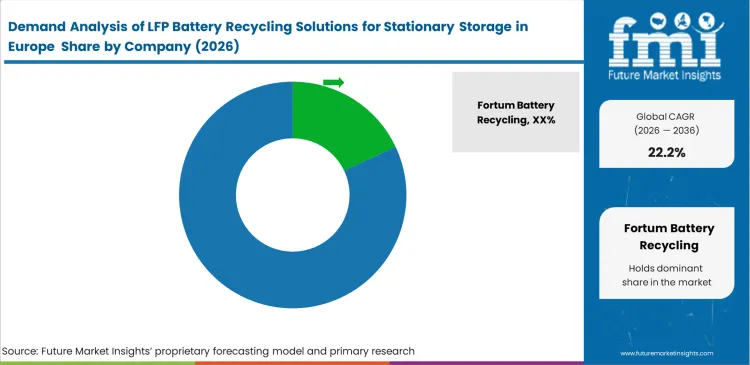
Technological maturity remains the main factor shaping competitive position in the Europe LFP battery recycling sector. Leading companies are building their position less through price competition and more through their ability to deliver higher-purity recovered materials that align with battery-grade processing requirements. This keeps the market tilted toward recyclers with stronger hydrometallurgical capability, tighter process control, and safer handling systems for large-format stationary batteries. Smaller players can still compete, but they are more often concentrated in pretreatment, inert shredding, or intermediate-material production rather than in full downstream refining.
Regulatory readiness also plays a central role in market shape. Established operators benefit from existing industrial sites, operating permits, and environmental compliance systems that shorten the path to scale compared with greenfield entrants. Newer companies are therefore under greater pressure to build lower-impact processing routes that can move through European permitting systems more efficiently. Industry outlook in this segment is consequently inclining toward platforms that combine technical recovery capability with a permitting model that is realistic for local regulatory conditions.
Full market consolidation remains unlikely in the near term because stationary battery flows are still unevenly distributed across countries and asset types. Centralized refining hubs remain important, but regional preprocessing networks continue to hold value where transport risk, discharge requirements, and hazardous-material handling costs limit long-distance movement. Competitive strength in this market therefore depends on both recovery performance and geographic control over feedstock channels.
Key Players in Demand Analysis of LFP Battery Recycling Solutions for Stationary Storage in Europe
- Fortum Battery Recycling
- Umicore Battery Recycling Solutions
- Duesenfeld
- cylib
- Hydrovolt
- Stena Recycling
- tozero
Scope of the Report
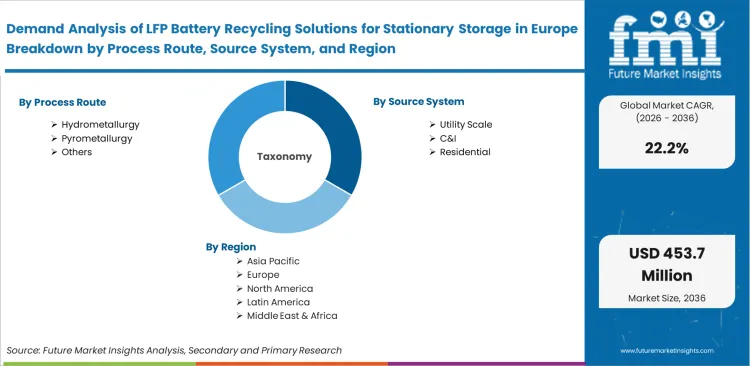
| Metric | Value |
|---|---|
| Quantitative Units | USD 50.0 million to USD 370.0 million, at a CAGR of 22.2% |
| Market Definition | Physical networks and chemical processes converting decommissioned grid-scale iron-phosphate batteries into secondary raw materials. Systems avoid thermal smelting by utilizing targeted mechanical separation and aqueous chemical extraction. |
| Segmentation | Process route, Source system, Service model, Recovered output, Battery format, and Region |
| Regions Covered | North America, Latin America, Europe, Asia Pacific, MEA |
| Countries Covered | Poland, Spain, Netherlands, United Kingdom, Germany, Italy, France |
| Key Companies Profiled | Fortum Battery Recycling, Umicore Battery Recycling Solutions, Duesenfeld, cylib, Hydrovolt, Stena Recycling, tozero |
| Forecast Period | 2026 to 2036 |
| Approach | Cumulative deployed capacity reaching ten-year warranty expiration thresholds across European grids. |
Source: Future Market Insights (FMI) analysis, based on proprietary forecasting model and primary research
Demand Analysis of LFP Battery Recycling Solutions for Stationary Storage in Europe Analysis by Segments
Process route
- Hydrometallurgy
- Mechanical pretreatment
- Direct recycling
- Pyrometallurgy
Source system
- Utility-scale
- C&I
- Residential
Service model
- Integrated services
- Spoke networks
- Recovery hubs
- Compliance logistics
Recovered output
- Black mass
- Lithium salts
- Graphite
- Iron phosphate
Battery format
- Packs
- Modules
- Cells
- Containers
Region
- North America
- Latin America
- Europe
- Asia Pacific
- MEA
Bibliography
- SolarPower Europe. (2025, May 7). European Market Outlook for Battery Storage 2025-2029. SolarPower Europe.
- International Energy Agency. (2025). Electric vehicle batteries. In Global EV Outlook 2025. IEA.
- Bobba, S., Latunussa, C., Manni, F. M., & Mathieux, F. (2025). Deep dive on critical raw materials for batteries in the EU. Publications Office of the European Union.
- Stephan, M. (2025, July 24). Recycling capacities for lithium-ion batteries will exceed demand in Europe for the time being. Fraunhofer Institute for Systems and Innovation Research ISI.
- Transport & Environment. (2024, December 12). From waste to value: the potential for battery recycling in Europe. Transport & Environment.
This bibliography is provided for reader reference. The full FMI report contains the complete reference list with primary source documentation.
This Report Addresses
- Identification of volume thresholds triggering profitable hydrometallurgical operations.
- Operational consequences for facilities lacking complete enclosure shredding capabilities.
- Margin distribution across black mass production versus battery-grade lithium synthesis.
- Assessment of European municipal fire codes restricting localized discharge deployments.
- Calculation of logistics overhead incurred during cross-border hazardous waste transport.
- Evaluation of direct cathode relithiation viability against total molecular breakdown.
- Analysis identifying utility preference for single-vendor integrated decommissioning contracts.
- Geographic tracking of early frequency regulation asset retirements in southern regions.
Frequently Asked Questions
What is the size of the LFP battery recycling solutions for stationary storage in Europe market?
The sector is valued at USD 50.0 million in 2026, reaching USD 370.0 million by 2036.
Why is LFP recycling difficult in Europe?
Iron phosphate yields lower material value, forcing operators to monetize total physical mass efficiently.
Which countries lead stationary battery recycling in Europe?
Poland, Spain, and the Netherlands lead adoption due to manufacturing proximity, early deployments, and ports.
How are stationary storage LFP batteries recycled?
Facilities use automated mechanical shredding under inert atmospheres followed by aqueous chemical leaching for extraction.
Is LFP battery recycling profitable in Europe?
Profitability emerges when regional hubs achieve 5,000 tonnes annually, dropping amortization below baseline tipping fees.
Which European recyclers are active in stationary storage LFP batteries?
Leading operators include Fortum Battery Recycling, Umicore, Duesenfeld, cylib, Hydrovolt, Stena Recycling, and tozero.
What materials can be recovered from LFP batteries?
Processors recover black mass, battery-grade lithium salts, graphite, and raw iron phosphate compounds.
What drives demand for LFP battery recycling solutions in European BESS?
Strict extended producer responsibility mandates force utility owners to finance complete domestic disposal networks immediately.
How do EU recycling rules change the market after 2025?
Subsidized domestic critical material quotas drive procurement officers to mandate secondary material integration locally.
Should operators choose second life or recycling for stationary batteries?
Degraded megawatt-scale assets require physical recycling, as fragmented repurposing networks destroy per-kilogram logistics economics.
What limits hydrometallurgical capacity expansion?
Strict municipal wastewater compliance approvals cap throughput across heavily regulated processing environments.
Why do utility managers prefer integrated service contracts?
Single-vendor contracts resolve hazardous material exposure immediately upon site removal, reducing corporate balance sheet risk.
What specific metric determines facility profitability?
Graphite recovery dictates economic viability since iron chemistry yields fractionally lower raw material value.
Why are mobile discharging units necessary?
Degraded cells become physically unstable. Fleet operators deploy truck-mounted units to transport only inert powders.
What drives black mass production preference?
Intermediate tradeable powders offer optimal liquidity while avoiding massive capital expenditures for deep chemical refining.
Why do facilities process entire intact enclosures?
Labor rates force complete intake automation. Avoiding module-level manual disassembly drastically reduces workforce safety incidents.
How do incumbents maintain competitive dominance?
Established processors possess massive regulatory permitting libraries, granting them an insurmountable timeline advantage over startups.
What prevents startups from aggressive greenfield expansion?
Venture capital timelines conflict with traditional heavy-acid regulatory friction, requiring novel low-impact chemical routes.
Why do buyers penalize pyrometallurgical outputs?
Thermal smelting burns away valuable graphite entirely. Processors sacrifice half the potential material value instantly.
How does Germany leverage existing automotive assets?
Deep metallurgical expertise transitions seamlessly. Plant operators repurpose existing industrial shredders for rapid utility volumes.
What determines quality control acceptance for intermediate powders?
Quality control engineers reject batches showing significant casing cross-contamination, demanding strict particle size distributions.
Why are early frequency regulation assets retiring now?
Independent power producers reach performance degradation limits first, decommissioning assets entirely for higher-density replacements.
Preview the report firsthand - request a free sample
Get SampleGet the brochure for pricing and purchase details.
Get PDFTable of Content
- Executive Summary
- Global Market Outlook
- Demand-side Trends
- Supply-side Trends
- Technology Roadmap Analysis
- Analysis and Recommendations
- Market Overview
- Market Coverage / Taxonomy
- Market Definition / Scope / Limitations
- Research Methodology
- Chapter Orientation
- Analytical Lens and Working Hypotheses
- Market Structure, Signals, and Trend Drivers
- Benchmarking and Cross-market Comparability
- Market Sizing, Forecasting, and Opportunity Mapping
- Research Design and Evidence Framework
- Desk Research Programme (Secondary Evidence)
- Company Annual and Sustainability Reports
- Peer-reviewed Journals and Academic Literature
- Corporate Websites, Product Literature, and Technical Notes
- Earnings Decks and Investor Briefings
- Statutory Filings and Regulatory Disclosures
- Technical White Papers and Standards Notes
- Trade Journals, Industry Magazines, and Analyst Briefs
- Conference Proceedings, Webinars, and Seminar Materials
- Government Statistics Portals and Public Data Releases
- Press Releases and Reputable Media Coverage
- Specialist Newsletters and Curated Briefings
- Sector Databases and Reference Repositories
- FMI Internal Proprietary Databases and Historical Market Datasets
- Subscription Datasets and Paid Sources
- Social Channels, Communities, and Digital Listening Inputs
- Additional Desk Sources
- Expert Input and Fieldwork (Primary Evidence)
- Primary Modes
- Qualitative Interviews and Expert Elicitation
- Quantitative Surveys and Structured Data Capture
- Blended Approach
- Why Primary Evidence is Used
- Field Techniques
- Interviews
- Surveys
- Focus Groups
- Observational and In-context Research
- Social and Community Interactions
- Stakeholder Universe Engaged
- C-suite Leaders
- Board Members
- Presidents and Vice Presidents
- R&D and Innovation Heads
- Technical Specialists
- Domain Subject-matter Experts
- Scientists
- Physicians and Other Healthcare Professionals
- Governance, Ethics, and Data Stewardship
- Research Ethics
- Data Integrity and Handling
- Primary Modes
- Tooling, Models, and Reference Databases
- Desk Research Programme (Secondary Evidence)
- Data Engineering and Model Build
- Data Acquisition and Ingestion
- Cleaning, Normalisation, and Verification
- Synthesis, Triangulation, and Analysis
- Quality Assurance and Audit Trail
- Market Background
- Market Dynamics
- Drivers
- Restraints
- Opportunity
- Trends
- Scenario Forecast
- Demand in Optimistic Scenario
- Demand in Likely Scenario
- Demand in Conservative Scenario
- Opportunity Map Analysis
- Product Life Cycle Analysis
- Supply Chain Analysis
- Investment Feasibility Matrix
- Value Chain Analysis
- PESTLE and Porter’s Analysis
- Regulatory Landscape
- Regional Parent Market Outlook
- Production and Consumption Statistics
- Import and Export Statistics
- Market Dynamics
- Global Market Analysis 2021 to 2025 and Forecast, 2026 to 2036
- Historical Market Size Value (USD Million) Analysis, 2021 to 2025
- Current and Future Market Size Value (USD Million) Projections, 2026 to 2036
- Y-o-Y Growth Trend Analysis
- Absolute $ Opportunity Analysis
- Global Market Pricing Analysis 2021 to 2025 and Forecast 2026 to 2036
- Global Market Analysis 2021 to 2025 and Forecast 2026 to 2036, By Process Route
- Introduction / Key Findings
- Historical Market Size Value (USD Million) Analysis By Process Route , 2021 to 2025
- Current and Future Market Size Value (USD Million) Analysis and Forecast By Process Route , 2026 to 2036
- Hydrometallurgy
- Pyrometallurgy
- Others
- Hydrometallurgy
- Y-o-Y Growth Trend Analysis By Process Route , 2021 to 2025
- Absolute $ Opportunity Analysis By Process Route , 2026 to 2036
- Global Market Analysis 2021 to 2025 and Forecast 2026 to 2036, By Source System
- Introduction / Key Findings
- Historical Market Size Value (USD Million) Analysis By Source System, 2021 to 2025
- Current and Future Market Size Value (USD Million) Analysis and Forecast By Source System, 2026 to 2036
- Utility Scale
- C&I
- Residential
- Utility Scale
- Y-o-Y Growth Trend Analysis By Source System, 2021 to 2025
- Absolute $ Opportunity Analysis By Source System, 2026 to 2036
- Global Market Analysis 2021 to 2025 and Forecast 2026 to 2036, By Service Model
- Introduction / Key Findings
- Historical Market Size Value (USD Million) Analysis By Service Model, 2021 to 2025
- Current and Future Market Size Value (USD Million) Analysis and Forecast By Service Model, 2026 to 2036
- Integrated Services
- Recovery Hubs
- Others
- Integrated Services
- Y-o-Y Growth Trend Analysis By Service Model, 2021 to 2025
- Absolute $ Opportunity Analysis By Service Model, 2026 to 2036
- Global Market Analysis 2021 to 2025 and Forecast 2026 to 2036, By Recovered Output
- Introduction / Key Findings
- Historical Market Size Value (USD Million) Analysis By Recovered Output, 2021 to 2025
- Current and Future Market Size Value (USD Million) Analysis and Forecast By Recovered Output, 2026 to 2036
- Black Mass
- Graphite
- Others
- Black Mass
- Y-o-Y Growth Trend Analysis By Recovered Output, 2021 to 2025
- Absolute $ Opportunity Analysis By Recovered Output, 2026 to 2036
- Global Market Analysis 2021 to 2025 and Forecast 2026 to 2036, By Battery Format
- Introduction / Key Findings
- Historical Market Size Value (USD Million) Analysis By Battery Format, 2021 to 2025
- Current and Future Market Size Value (USD Million) Analysis and Forecast By Battery Format, 2026 to 2036
- Packs
- Modules
- Cells
- Packs
- Y-o-Y Growth Trend Analysis By Battery Format, 2021 to 2025
- Absolute $ Opportunity Analysis By Battery Format, 2026 to 2036
- Global Market Analysis 2021 to 2025 and Forecast 2026 to 2036, By Region
- Introduction
- Historical Market Size Value (USD Million) Analysis By Region, 2021 to 2025
- Current Market Size Value (USD Million) Analysis and Forecast By Region, 2026 to 2036
- North America
- Latin America
- Western Europe
- Eastern Europe
- East Asia
- South Asia and Pacific
- Middle East & Africa
- Market Attractiveness Analysis By Region
- North America Market Analysis 2021 to 2025 and Forecast 2026 to 2036, By Country
- Historical Market Size Value (USD Million) Trend Analysis By Market Taxonomy, 2021 to 2025
- Market Size Value (USD Million) Forecast By Market Taxonomy, 2026 to 2036
- By Country
- USA
- Canada
- Mexico
- By Process Route
- By Source System
- By Service Model
- By Recovered Output
- By Battery Format
- By Country
- Market Attractiveness Analysis
- By Country
- By Process Route
- By Source System
- By Service Model
- By Recovered Output
- By Battery Format
- Key Takeaways
- Latin America Market Analysis 2021 to 2025 and Forecast 2026 to 2036, By Country
- Historical Market Size Value (USD Million) Trend Analysis By Market Taxonomy, 2021 to 2025
- Market Size Value (USD Million) Forecast By Market Taxonomy, 2026 to 2036
- By Country
- Brazil
- Chile
- Rest of Latin America
- By Process Route
- By Source System
- By Service Model
- By Recovered Output
- By Battery Format
- By Country
- Market Attractiveness Analysis
- By Country
- By Process Route
- By Source System
- By Service Model
- By Recovered Output
- By Battery Format
- Key Takeaways
- Western Europe Market Analysis 2021 to 2025 and Forecast 2026 to 2036, By Country
- Historical Market Size Value (USD Million) Trend Analysis By Market Taxonomy, 2021 to 2025
- Market Size Value (USD Million) Forecast By Market Taxonomy, 2026 to 2036
- By Country
- Germany
- UK
- Italy
- Spain
- France
- Nordic
- BENELUX
- Rest of Western Europe
- By Process Route
- By Source System
- By Service Model
- By Recovered Output
- By Battery Format
- By Country
- Market Attractiveness Analysis
- By Country
- By Process Route
- By Source System
- By Service Model
- By Recovered Output
- By Battery Format
- Key Takeaways
- Eastern Europe Market Analysis 2021 to 2025 and Forecast 2026 to 2036, By Country
- Historical Market Size Value (USD Million) Trend Analysis By Market Taxonomy, 2021 to 2025
- Market Size Value (USD Million) Forecast By Market Taxonomy, 2026 to 2036
- By Country
- Russia
- Poland
- Hungary
- Balkan & Baltic
- Rest of Eastern Europe
- By Process Route
- By Source System
- By Service Model
- By Recovered Output
- By Battery Format
- By Country
- Market Attractiveness Analysis
- By Country
- By Process Route
- By Source System
- By Service Model
- By Recovered Output
- By Battery Format
- Key Takeaways
- East Asia Market Analysis 2021 to 2025 and Forecast 2026 to 2036, By Country
- Historical Market Size Value (USD Million) Trend Analysis By Market Taxonomy, 2021 to 2025
- Market Size Value (USD Million) Forecast By Market Taxonomy, 2026 to 2036
- By Country
- China
- Japan
- South Korea
- By Process Route
- By Source System
- By Service Model
- By Recovered Output
- By Battery Format
- By Country
- Market Attractiveness Analysis
- By Country
- By Process Route
- By Source System
- By Service Model
- By Recovered Output
- By Battery Format
- Key Takeaways
- South Asia and Pacific Market Analysis 2021 to 2025 and Forecast 2026 to 2036, By Country
- Historical Market Size Value (USD Million) Trend Analysis By Market Taxonomy, 2021 to 2025
- Market Size Value (USD Million) Forecast By Market Taxonomy, 2026 to 2036
- By Country
- India
- ASEAN
- Australia & New Zealand
- Rest of South Asia and Pacific
- By Process Route
- By Source System
- By Service Model
- By Recovered Output
- By Battery Format
- By Country
- Market Attractiveness Analysis
- By Country
- By Process Route
- By Source System
- By Service Model
- By Recovered Output
- By Battery Format
- Key Takeaways
- Middle East & Africa Market Analysis 2021 to 2025 and Forecast 2026 to 2036, By Country
- Historical Market Size Value (USD Million) Trend Analysis By Market Taxonomy, 2021 to 2025
- Market Size Value (USD Million) Forecast By Market Taxonomy, 2026 to 2036
- By Country
- Kingdom of Saudi Arabia
- Other GCC Countries
- Turkiye
- South Africa
- Other African Union
- Rest of Middle East & Africa
- By Process Route
- By Source System
- By Service Model
- By Recovered Output
- By Battery Format
- By Country
- Market Attractiveness Analysis
- By Country
- By Process Route
- By Source System
- By Service Model
- By Recovered Output
- By Battery Format
- Key Takeaways
- Key Countries Market Analysis
- USA
- Pricing Analysis
- Market Share Analysis, 2025
- By Process Route
- By Source System
- By Service Model
- By Recovered Output
- By Battery Format
- Canada
- Pricing Analysis
- Market Share Analysis, 2025
- By Process Route
- By Source System
- By Service Model
- By Recovered Output
- By Battery Format
- Mexico
- Pricing Analysis
- Market Share Analysis, 2025
- By Process Route
- By Source System
- By Service Model
- By Recovered Output
- By Battery Format
- Brazil
- Pricing Analysis
- Market Share Analysis, 2025
- By Process Route
- By Source System
- By Service Model
- By Recovered Output
- By Battery Format
- Chile
- Pricing Analysis
- Market Share Analysis, 2025
- By Process Route
- By Source System
- By Service Model
- By Recovered Output
- By Battery Format
- Germany
- Pricing Analysis
- Market Share Analysis, 2025
- By Process Route
- By Source System
- By Service Model
- By Recovered Output
- By Battery Format
- UK
- Pricing Analysis
- Market Share Analysis, 2025
- By Process Route
- By Source System
- By Service Model
- By Recovered Output
- By Battery Format
- Italy
- Pricing Analysis
- Market Share Analysis, 2025
- By Process Route
- By Source System
- By Service Model
- By Recovered Output
- By Battery Format
- Spain
- Pricing Analysis
- Market Share Analysis, 2025
- By Process Route
- By Source System
- By Service Model
- By Recovered Output
- By Battery Format
- France
- Pricing Analysis
- Market Share Analysis, 2025
- By Process Route
- By Source System
- By Service Model
- By Recovered Output
- By Battery Format
- India
- Pricing Analysis
- Market Share Analysis, 2025
- By Process Route
- By Source System
- By Service Model
- By Recovered Output
- By Battery Format
- ASEAN
- Pricing Analysis
- Market Share Analysis, 2025
- By Process Route
- By Source System
- By Service Model
- By Recovered Output
- By Battery Format
- Australia & New Zealand
- Pricing Analysis
- Market Share Analysis, 2025
- By Process Route
- By Source System
- By Service Model
- By Recovered Output
- By Battery Format
- China
- Pricing Analysis
- Market Share Analysis, 2025
- By Process Route
- By Source System
- By Service Model
- By Recovered Output
- By Battery Format
- Japan
- Pricing Analysis
- Market Share Analysis, 2025
- By Process Route
- By Source System
- By Service Model
- By Recovered Output
- By Battery Format
- South Korea
- Pricing Analysis
- Market Share Analysis, 2025
- By Process Route
- By Source System
- By Service Model
- By Recovered Output
- By Battery Format
- Russia
- Pricing Analysis
- Market Share Analysis, 2025
- By Process Route
- By Source System
- By Service Model
- By Recovered Output
- By Battery Format
- Poland
- Pricing Analysis
- Market Share Analysis, 2025
- By Process Route
- By Source System
- By Service Model
- By Recovered Output
- By Battery Format
- Hungary
- Pricing Analysis
- Market Share Analysis, 2025
- By Process Route
- By Source System
- By Service Model
- By Recovered Output
- By Battery Format
- Kingdom of Saudi Arabia
- Pricing Analysis
- Market Share Analysis, 2025
- By Process Route
- By Source System
- By Service Model
- By Recovered Output
- By Battery Format
- Turkiye
- Pricing Analysis
- Market Share Analysis, 2025
- By Process Route
- By Source System
- By Service Model
- By Recovered Output
- By Battery Format
- South Africa
- Pricing Analysis
- Market Share Analysis, 2025
- By Process Route
- By Source System
- By Service Model
- By Recovered Output
- By Battery Format
- USA
- Market Structure Analysis
- Competition Dashboard
- Competition Benchmarking
- Market Share Analysis of Top Players
- By Regional
- By Process Route
- By Source System
- By Service Model
- By Recovered Output
- By Battery Format
- Competition Analysis
- Competition Deep Dive
- Fortum Battery Recycling
- Overview
- Product Portfolio
- Profitability by Market Segments (Product/Age /Sales Channel/Region)
- Sales Footprint
- Strategy Overview
- Marketing Strategy
- Product Strategy
- Channel Strategy
- Umicore Battery Recycling Solutions
- Duesenfeld
- cylib
- Hydrovolt
- Stena Recycling
- Fortum Battery Recycling
- Competition Deep Dive
- Assumptions & Acronyms Used


