

- Industry Size (2026)
- USD 31.5 Mn
- Forecast (2036)
- USD 148.8 Mn
- CAGR (2026 to 2036)
- 16.8%
Europe Battery Passport Data Integration Platforms for Recyclers Industry Size, Industry Forecast and Outlook By FMI
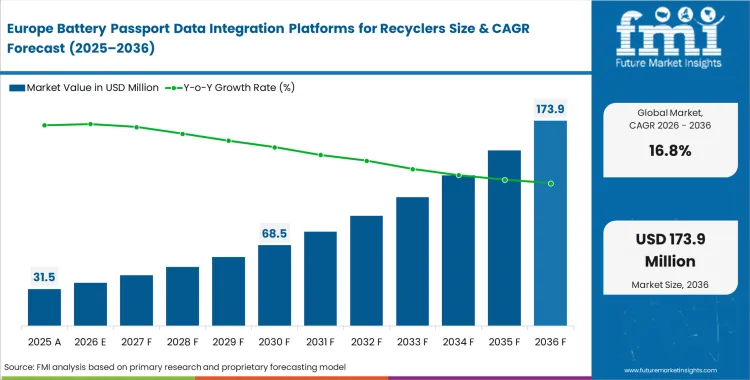
The battery passport data integration platforms industry for recyclers in Europe was valued at USD 27.0 million in 2025 and is expected to reach USD 31.5 million in 2026, reflecting a CAGR of 16.8% over the forecast period. With continued investment, the sector is projected to grow significantly, reaching USD 148.8 million by 2036. Expansion is being driven by recycling facility managers increasingly requiring automated data transfer from automakers before accepting end-of-life automotive battery packs.
Summary of Europe Battery Passport Data Integration Platforms for Recyclers
- Market Snapshot
- Europe battery passport data integration platforms for recyclers industry is estimated at USD 27.0 million in 2025 and is projected to reach USD 148.8 million by 2036, reflecting strong long-term expansion driven by regulatory and operational requirements.
- The industry is expected to grow at a CAGR of 16.8% between 2026 and 2036, generating an incremental opportunity of USD 117.3 million over the forecast period.
- This segment represents a compliance-driven industrial software category focused on enabling recyclers to capture, validate, exchange, and reuse battery lifecycle data across EV, industrial, and light mobility battery streams.
- Demand dynamics are being shaped by evolving regulatory requirements, including battery passport obligations aligned with Article 77 frameworks, QR-based data access, and interoperability standards, alongside 2025–2030 targets for recycling efficiency and material recovery that are increasing the operational importance of recycler-side data integration.
- Demand and Growth Drivers
- Battery passports demand is rising as they become mandatory from 2027 for EV, LMT, and industrial batteries above 2 kWh. This change makes structured battery data access a required part of recycler operations rather than a pilot or optional feature.
- Adoption is increasing as the Battery Pass technical framework includes recyclers as defined data users. It outlines requirements for interoperable data exchange, storage, identifiers, APIs, and trust layers that recycler systems need to connect with.
- Sector advancement is also supported by the rise of recycling infrastructure across Europe. Fraunhofer ISI estimates pretreatment capacity will reach around 420 kilotonnes per year by the end of 2026, adding more facilities and processes that depend on integrated data systems.
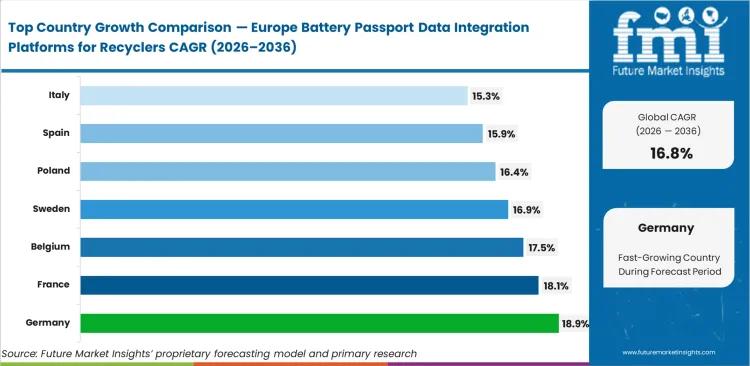
- Germany expands with a CAGR of 18.9%, followed by France at 18.1%, Belgium at 17.5%, Sweden at 16.9%, Poland at 16.4%, Spain at 15.9%, and Italy at 15.3%, indicating steady growth across key sectors.
- Progress is held back by issues related to restricted data access, uneven data quality, interoperability gaps, and unclear responsibility for managing battery passport data at the end-of-life stage.
- Product and Segment View
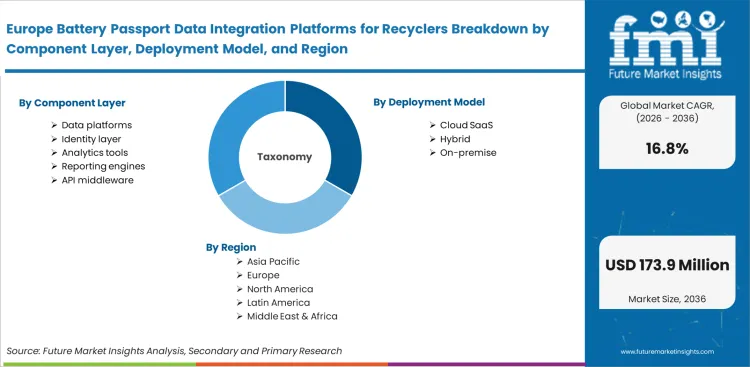
- The industry includes data platforms, identity layers, analytics tools, reporting systems, and API middleware that enable the flow of battery data from source systems into recycler-led compliance and recovery processes.
- These solutions are applied across key operational stages such as intake validation, sorting, dismantling, black-mass routing, recycled content reporting, and data exchange with regulatory authorities.
- Data platforms account for the largest share within the component layer at 34.8%, as recyclers require a centralized orchestration layer before deploying analytics and reporting capabilities.
- Cloud-based SaaS models hold a 58.6% share in deployment, supported by phased adoption across recycling sites and the ability of cloud infrastructure to ease integration with multiple suppliers and regulatory systems.
- End-of-life processes lead the compliance focus segment with a 27.4% share, reflecting the direct reliance of recycler operations on disassembly, material recovery, recycled content tracking, and passport data handover.
- ERP connectors represent 31.2% of the integration segment, as recyclers need to link battery passport data with existing plant operations, material tracking, and compliance systems.
- EV battery packs dominate the battery scope segment with a 46.1% share, given their higher regulatory requirements, detailed traceability needs, and greater recovery value within the EU battery framework.
- Battery passport software, identity and data linkage systems, integration middleware, recycler-facing dashboards, and compliance reporting tools come under the industry scope. It does not include battery hardware, standalone recycling equipment, or general ESG software that is not specifically designed for battery passport requirements.
- Geography and Competitive Outlook
- Germany, France, and Belgium continue to show the strongest growth momentum, supported by established automotive clusters and ongoing recycling capacity expansion, while Italy follows a more measured path in line with the overall pace of EU regulatory implementation rather than early-stage innovation.
- Industry competition is evolving around the transition from pilot initiatives to scaled deployments, with partnerships across OEMs and industrial battery players playing a central role. The ability to ensure interoperability and integrate recycler workflows with supplier and regulatory data systems remains a key differentiator.
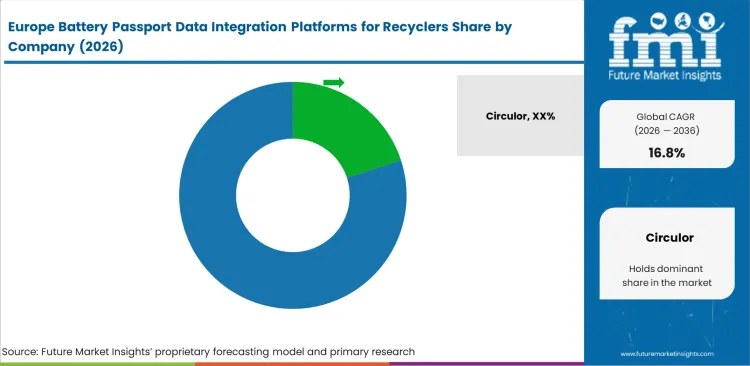
- A group of established players including Circulor, Minespider, Circularise, Siemens, SAP, iPoint-systems, and Avery Dennison atma.io, are actively shaping the sector, with Circulor currently demonstrating stronger visibility through its industrial-scale implementations.
- Vendor concentration remains limited, as no single company holds more than one-fifth of the industry. Selection criteria extend beyond compliance functionality to include trust architecture, API capability, end-to-end value chain integration, and ease of use within recycler environments.
Facility operators are facing immediate operational and commercial pressure when handling incoming EV battery modules. Accepting packs without proper identification creates a clear risk of non-compliance with the European regulatory framework. Delays in deploying automated compliance systems can result in materials being held up at dismantling sites, affecting throughput. EV Battery passport architecture helps address this by enabling direct transfer of material origin and compliance data into local ERP systems. For high-volume facilities, battery passport platform for recyclers system performance is critical, as any delay in API response times can disrupt dismantling operations and impact overall cost efficiency.
As major automotive OEMs begin standardizing Asset Administration Shell (AAS) connectors, smaller and independent recyclers are gaining easier access to the compliance data they need. This shift is accelerating the adoption of cloud-based identity and data management systems across the value chain. Data handover processes are moving away from manual methods such as spreadsheet uploads toward the automated battery passport end-of-life data exchange validation at this stage.
Germany leads with a growth rate of 18.9%, supported by strong automotive clusters and ongoing investments in recycling infrastructure. France follows at 18.1%, benefiting from well-established production networks in its northern regions. Belgium is expected to grow at 17.5%, driven by its advanced metals ecosystem and emphasis on material traceability. Sweden, at 16.9%, continues to benefit from its established position in the Nordic battery sector. Poland records growth of 16.4%, supported by expanding mid-scale dismantling capacity. Spain is projected to grow at 15.9% as compliance frameworks extend further into southern regions, while Italy, at 15.3%, reflects steady progress aligned with baseline regulatory enforcement.
Segmental Analysis
Europe Battery Passport Data Integration Platforms for Recyclers Market Analysis by Component Layer
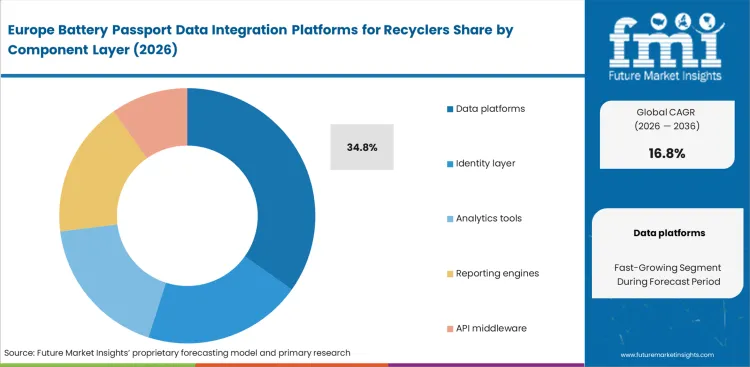
Decentralized data exchange is expected to become a core requirement for regulatory compliance within recovery facilities. Data platforms are estimated to hold a 34.8% share, as recycling operators move away from fragmented identity systems that lack integrated visibility. IT teams are prioritizing digital product passport software that can consolidate incoming data streams from multiple OEMs into a single system. Smaller processors relying on basic battery passport middleware approaches often struggle to meet 2026 audit requirements. Long-term platform reliability depends more on stable integration with existing ERP systems than on front-end analytics capabilities. Delays in standardizing platforms continue to create operational slowdowns, with dismantling teams forced into manual verification processes.
- Initial mandate: Chief compliance officers move quickly to implement centralized systems following regulatory audit concerns, as non-compliance risks direct disruption to operations.
- Validation protocol: System architects focus on API response times during testing phases, with slower data processing leading to immediate rejection of solutions.
- Expansion trigger: Facility managers extend deployments once offline functionality is proven to work consistently across distributed and remote sorting locations.
Europe Battery Passport Data Integration Platforms for Recyclers Market Analysis by Deployment Model
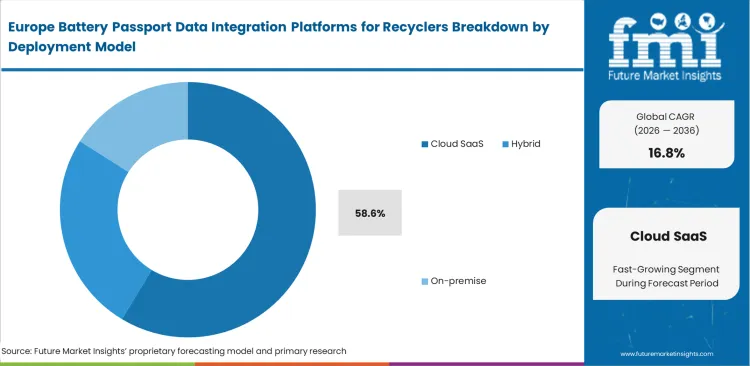
Variations in facility operations and site conditions are influencing how recyclers approach software architecture. Cloud-based SaaS is expected to capture a 58.6% share, as network teams avoid managing on-premise systems in complex industrial settings. Plant managers are focusing on digital product passport dpp platforms that can adapt quickly to ongoing EU regulatory changes. Dedicated digital product passport software delivered via cloud deployment eliminates synchronization delays, whereas local systems often fall short in querying external OEM databases at the speed required for continuous sorting workflows.
- Upfront licensing: Procurement teams are leaning toward subscription-based models to reduce capital spending, while faster rollout removes the need for extensive server setup.
- Hidden overhead: Operations teams often overlook the bandwidth demands of continuous blockchain synchronization, with required network upgrades sometimes surpassing initial software costs.
- Lifecycle parity: From a financial standpoint, cloud-hosted systems offer longer-term advantages through built-in regulatory updates, while maintaining on-premise systems tends to increase internal IT costs over time.
Europe Battery Passport Data Integration Platforms for Recyclers Market Analysis by Compliance Focus
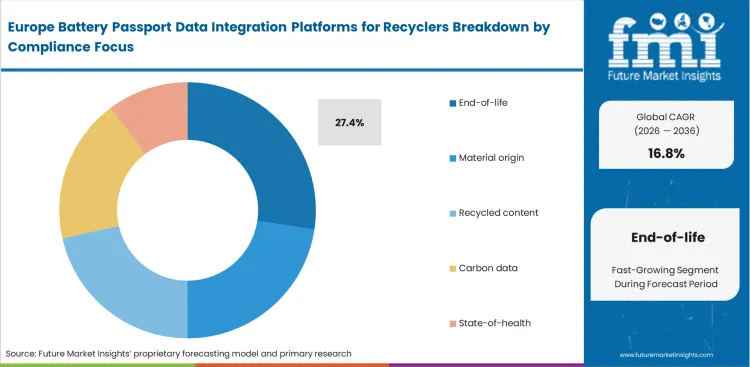
Operational priorities within recovery facilities remain focused on immediate processing and legal compliance rather than long-term carbon tracking. End-of-life credentials are estimated to hold a 27.4% share, as plant supervisors require this data before handling any battery pack. Compliance teams depend on battery material recycling parameters to validate proper dismantling procedures. In comparison, recycled content reporting for batteries continues to lag behind basic disposal documentation. Facilities that place greater emphasis on carbon tracking instead of verified module history face a higher risk of non-compliance. Additional challenges arise when incoming battery packs do not include standardized state-of-health degradation data.
- Audit vulnerability: Facilities without automated disposal logging systems face a higher risk of regulatory penalties, leading compliance teams to implement redundant logging mechanisms.
- Residual liability: Software alone cannot address issues arising from incomplete or inaccurate OEM data, requiring operations teams to establish manual override processes.
- Capture optimization: IT teams achieve more consistent reporting when physical barcode scanning systems are directly integrated into identity and data management layers.
Europe Battery Passport Data Integration Platforms for Recyclers Market Analysis by Integration Mode
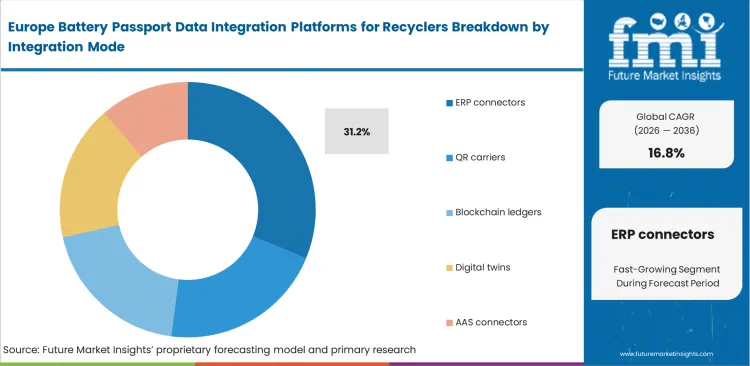
Fragmented software environments continue to increase manual data entry across recycling operations. ERP connectors are estimated to account for a 31.2% share, as finance teams require automated material tracking that links directly to revenue systems. Logistics teams depend on EV battery recycling and black mass processing workflows that require consistent inventory updates. Integrating dedicated battery passport APIs within dismantling plants helps reduce reliance on less reliable optical scanning methods. Direct connections with manufacturer databases offer greater consistency, while standalone blockchain systems without ERP integration often lead to significant reconciliation delays.
- Baseline functionality: Standard APIs support core compliance reporting, allowing line workers to process battery intake without major disruptions.
- Edge condition: Proprietary OEM interfaces frequently disrupt generic middleware, requiring system teams to invest additional effort in maintaining stable connections.
- Acceptability threshold: Finance teams do not accept integrations that fail to record recovered material values in central systems in real time.
Europe Battery Passport Data Integration Platforms for Recyclers Market Analysis by Battery Scope
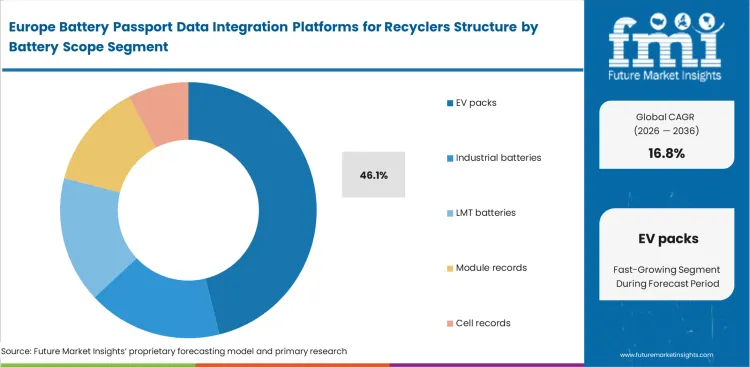
Rising volumes of end-of-life vehicles are reshaping dismantling capacity across recycling facilities. EV battery packs are expected to hold a 46.1% share, supported by the growing influx of automotive retirements. Supply chain teams are shifting from legacy lead-acid battery recycling systems toward more complex lithium-ion tracking requirements. Accurate pack-level intake data remains essential for reliable black mass reporting software, while tracking individual cells is still not commercially viable for most operations. Pack-level tracking continues to be the most practical approach. Delays in building readiness for EV pack processing are likely to translate into lost revenue opportunities.
- Primary targets: Tier-1 dismantling facilities are expected to adopt pack-level tracking first, driven by the scale of incoming automotive volumes and the need for immediate system upgrades.
- Secondary expansion: Mid-sized operators gradually transition to module-level tracking after initial compliance deadlines, as plant managers recognize the benefits of improved material recovery visibility.
- Final conversion: Cell-level tracking is anticipated to remain limited to specialized recovery environments, as high implementation and scanning costs continue to restrict broader adoption.
Europe Battery Passport Data Integration Platforms for Recyclers Industry Drivers, Restraints, and Opportunities
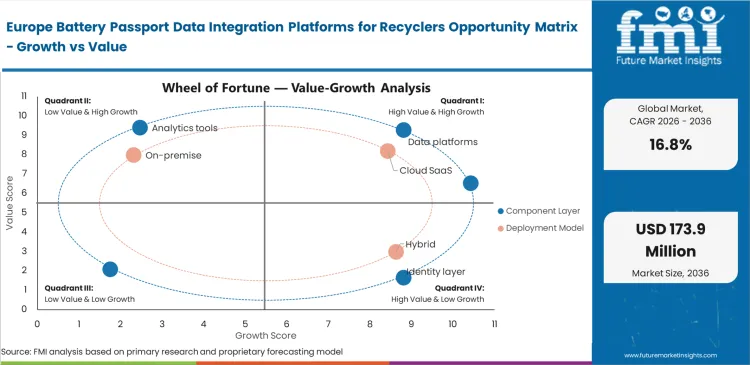
Imminent 2026 EU regulatory deadlines compel facility managers to overhaul archaic intake procedures. Accepting unidentified high-voltage modules creates catastrophic compliance liabilities. Understanding how recyclers use battery passports requires acknowledging the speed of physical conveyor belts. IT directors must deploy automated reporting layers capable of ingesting varied OEM data formats instantly. Failure to modernize completely stalls physical dismantling lines.
Disparate automotive manufacturer data formats create severe intake bottlenecks. Facilities struggle to ingest proprietary identity layers into unified electric vehicle battery systems. Seamless battery passport data interoperability remains years away. System architects face constant middleware patching requirements. Lack of unified standardization forces recyclers to shoulder heavy integration burdens.
Opportunities in the Europe Battery Passport Data Integration Platforms for Recyclers
- Legacy API modernization: Software vendors develop specialized middleware bridging archaic sorting systems with modern cloud ledgers to improve battery passport integration ROI.
- Offline caching tools: IT directors procure resilient databases capable of maintaining secure battery passport data sharing during intermittent warehouse network outages.
- Automated value reconciliation: Financial controllers seek platforms generating instant battery materials valuation reports directly from compliance ledgers.
Regional Analysis
Based on regional analysis, Europe Battery Passport Data Integration Platforms for Recyclers Market is segmented into Germany, France, Belgium, Sweden, Poland, Spain, and Italy across 40 plus countries.
.webp "Top Country Growth Comparison Europe Battery Passport Data Integration Platforms For Recyclers Cagr (2026 2036)")
| Country | CAGR (2026 to 2036) |
|---|---|
| Germany | 18.9% |
| France | 18.1% |
| Belgium | 17.5% |
| Sweden | 16.9% |
| Poland | 16.4% |
| Spain | 15.9% |
| Italy | 15.3% |
Source: Future Market Insights (FMI) analysis, based on proprietary forecasting model and primary research
Western Europe Battery Passport Data Integration Platforms for Recyclers Analysis
Strong local automotive consortiums are shaping software architecture decisions across domestic recycling hubs. Germany leads in this area, supported by close coordination between major automakers and tier-1 dismantling facilities. Network teams prioritize robust material passport systems for circular plastics that can manage high daily processing volumes. This environment requires tailored ERP connectors along with dedicated battery sorting data platforms. Facility managers in the region also place significant importance on vendors having immediate, on-ground support capabilities.
- Germany: Demand in Germany is shaped by tight integration with domestic OEM IT ecosystems, which is shortening deployment cycles across large automotive and industrial programs. IT leadership teams increasingly rely on pre-configured API frameworks, reducing dependence on bespoke development and lowering implementation risk. Revenue from these processing and integration services in Germany is expected to expand at a CAGR of 18.9% over the forecast period, reflecting steady contract conversion rather than one-off project wins. Companies that entered the industry early are already locking in multi‑year processing agreements, strengthening revenue visibility and raising switching barriers for late entrants.
- Belgium: Industrial demand in Belgium is strongly influenced by the intricate nature of metallurgical production chains, where off‑the‑shelf reporting systems rarely meet operational requirements. Plant managers place a premium on bespoke reporting architectures that deliver near‑perfect material traceability across multiple processing stages. Advanced reporting and traceability solutions are projected to expand at a 17.5% CAGR, as metals and specialty material producers continue to modernize control and valuation systems. Buyers in Belgium consistently achieve higher accuracy in raw material valuation than counterparts in adjacent sectors, reinforcing the business case for precision‑driven digital investments.
- France: In France, tightening audit schedules across regulated industries are accelerating the shift toward cloud-based SaaS platforms, particularly in facilities and compliance management. Sales of auditing and monitoring solutions in the country are anticipated to record a revenue CAGR of 18.1% over the forecast period, supported by rising demand from compliance officers for detailed, real-time state‑of‑health visibility. These users increasingly prioritize systems that move beyond checklist-based audits and instead offer continuous condition tracking at the asset and facility level. Vendors with stable, scalable platforms are proving better positioned to simplify recurring audits, reduce manual intervention, and align operational reporting with evolving regulatory expectations.
Northern Europe Battery Passport Data Integration Platforms for Recyclers Industry Analysis
Strong sustainability commitments across Nordic countries are driving stricter requirements for end-of-life battery tracking. Recycling networks in the region place greater emphasis on environmental transparency than on processing speed alone. There is a clear preference for localized digital ecosystems, often adapting PCR-based traceability principles from consumer goods to industrial applications. Network teams are selecting battery recycling compliance software hosted on low-carbon infrastructure, and vendors that do not align with these sustainability expectations are typically not considered.
- Sweden: Environmental disclosure requirements have become a decisive factor in procurement planning across the Nordic region, with particularly stringent expectations shaping system selection criteria. Operators in Sweden increasingly prioritize platforms capable of delivering auditable carbon footprint reporting across assets and supplier networks, as compliance officers respond to expanding regulatory scope. Midway through the forecast period, sales of environmental reporting and compliance solutions are projected to advance at an annual rate of 16.9% CAGR, reflecting policy‑driven adoption rather than discretionary upgrades. Beyond domestic compliance, Swedish enterprises continue to influence broader EU reporting norms, setting practical benchmarks that other member states are beginning to replicate as environmental oversight intensifies.
Central Europe Battery Passport Data Integration Platforms for Recyclers Industry Analysis
Ongoing expansion of mid-tier dismantling facilities is driving demand for modular and adaptable software solutions. In Poland, operators show a clear preference for subscription-based models that reduce upfront capital requirements. Current projections indicate that legacy lead-acid recyclers are steadily shifting toward lithium-ion capabilities to remain competitive. Financial teams are closely evaluating return on investment before approving cloud-based deployments, which is shaping purchasing decisions. Scalable data platforms are becoming the preferred choice across the region.
- Poland: Cost sensitivity remains a defining factor in modernization decisions, particularly among industrial facilities operating in Poland, where phased SaaS adoption models are increasingly preferred. Rather than large-scale system replacements, buyers opt for tiered deployments that keep capital exposure in check. This approach places added scrutiny on integration expenses, with finance teams closely assessing total implementation costs before sign-off. Reflecting these purchasing dynamics, revenue generated from facility and operations software solutions is anticipated to grow at a CAGR of 16.4% during the forecast period. Smaller manufacturers are capitalizing on this flexibility to take on surplus automotive volumes, allowing them to scale efficiently while reinforcing Poland’s role as a cost-competitive production hub.
Southern Europe Battery Passport Data Integration Platforms for Recyclers Sector Analysis
Recycling operations across southern corridors are progressing in line with baseline EU compliance timelines. IT teams in Spain tend to implement standardized reporting systems rather than investing in complex custom middleware. There is a clear preference for pre-configured software suites that support the transition from lead-acid to more advanced lead-acid battery systems. Facilities generally avoid experimental blockchain-based approaches, focusing instead on proven solutions. ERP connectors with reliable performance continue to secure most regional contracts.
- Spain: In Spain, clearly defined compliance schedules leave little room for experimentation when it comes to system selection. Procurement teams and IT directors tend to rely on familiar, well‑tested platforms that fit existing regulatory processes, rather than introducing new architectures that could disrupt operations. This cautious procurement approach has not slowed overall sector activity, as compliance‑ready operational support solutions are expected to expand at a 15.9% CAGR. Stable and predictable system integrations help facilities maintain consistent daily dismantling volumes, ensuring regulatory alignment does not interfere with routine operational output.
- Italy: Regulatory enforcement pressure is increasingly influencing software adoption decisions across Italian facilities. Many operators are moving quickly to implement compliance systems primarily to avoid financial penalties, often compressing deployment timelines. Compliance officers tend to concentrate on essential reporting features that satisfy inspection requirements, while broader functionality is deferred. In this operating environment, deployment activity for compliance‑oriented operational software in Italy is expected to advance at an average annual rate of 15.3% CAGR. These accelerated rollouts are also revealing actual compliance conditions at the facility level, bringing longstanding process gaps into clearer view rather than masking them behind manual reporting practices.
FMI’s report also extends coverage to adjacent European dismantling hubs, where regulatory divergence is beginning to create uneven technology adoption patterns across borders. Shifting enforcement mechanisms continue to reshape localized software procurement criteria, particularly around traceability and reporting depth. In the Netherlands, rising cross‑border vehicle and equipment inflows are strengthening the case for interoperable dismantling platforms, positioning the industry as a testing ground for standardized EU‑wide compliance models.
Competitive Aligners for Industry Players
Strong technical alliances are essential in determining software deployment outcomes across recycling hubs. Established participants secure early installations in tier-1 facilities through long-standing automotive partnerships. IT teams rarely consider standalone startup solutions, instead opting for integrated battery platforms that connect automotive OEM systems with industrial dismantling operations. Choosing reliable battery passport software vendors for recyclers is critical, as it helps ensure operational continuity under evolving compliance requirements.
Leading vendors bring extensive libraries of pre-built API connectors designed for specific automaker databases. New entrants are expected to demonstrate comparable technical capability by developing equivalent digital product passport modules. Network teams are reluctant to invest in experimental middleware and prefer solutions that are already proven in similar environments. Vendors that remain competitive are those that ensure smooth integration with existing ERP systems.
Large recycling consortiums are avoiding dependence on proprietary platforms. Supply chain teams are placing greater emphasis on open data export capabilities to maintain flexibility across systems. Facilities handling diverse EV battery recycled plastic casing processes require software that can adapt to varying operational needs. A clear divide is emerging between vendors offering standalone portals and those providing tools embedded directly into operational workflows.
Key Players in Europe Battery Passport Data Integration Platforms for Recyclers Industry
- Circulor
- Minespider
- Circularise
- Siemens
- SAP
- iPoint-systems
- Avery Dennison atma.io
Scope of the Report
| Metric | Value |
|---|---|
| Quantitative Units | USD 31.5 Million to USD 148.8 Million, at a CAGR of 16.8% |
| Market Definition | Statutory compliance requirements mandate strict tracking of end-of-life energy storage components. This software category facilitates secure exchange of carbon footprint and material origin credentials between original manufacturers and final recovery facilities. |
| Segmentation | Component Layer, Deployment Model, Compliance Focus, Integration Mode, Battery Scope, and Region |
| Regions Covered | North America, Latin America, Western Europe, Eastern Europe, Asia Pacific (APAC), Middle East and Africa (MEA) |
| Countries Covered | Germany, France, Belgium, Sweden, Poland, Spain, Italy |
| Key Companies Profiled | Circulor, Minespider, Circularise, Siemens, SAP, iPoint-systems, Avery Dennison atma.io |
| Forecast Period | 2026 to 2036 |
| Approach | Active recycling facility capacity coupled with projected EV pack retirement volumes. |
Source: Future Market Insights (FMI) analysis, based on proprietary forecasting model and primary research
Europe Battery Passport Data Integration Platforms for Recyclers Market Analysis by Segments
Component Layer:
- Data platforms
- Identity layer
- Analytics tools
- Reporting engines
- API middleware
Deployment Model:
- Cloud SaaS
- Hybrid
- On-premise
Compliance Focus:
- End-of-life
- Material origin
- Recycled content
- Carbon data
- State-of-health
Integration Mode:
- ERP connectors
- QR carriers
- Blockchain ledgers
- Digital twins
- AAS connectors
Battery Scope:
- EV packs
- Industrial batteries
- LMT batteries
- Module records
- Cell records
Region:
- North America
- Latin America
- Western Europe
- Eastern Europe
- Asia Pacific (APAC)
- Middle East and Africa (MEA)
Bibliography
- Centre for European Policy Studies. (2024, March). Implementing the EU digital battery passport: Opportunities and challenges for battery circularity. CEPS.
- European Commission. (2025, July). New rules to boost recycling efficiency from waste batteries. European Commission.
- Fraunhofer Institute for Systems and Innovation Research ISI. (2025, July). Recycling capacities for lithium-ion batteries will exceed demand in Europe for the time being. Fraunhofer ISI.
- Gianvincenzi, M., Marconi, M., Mosconi, E. M., & Tola, F. (2024). A standardized data model for the battery passport: Paving the way for sustainable battery management. Procedia CIRP.
- International Energy Agency. (2025). Electric vehicle batteries - Global EV Outlook 2025. IEA.
This bibliography is provided for reader reference. The full FMI report contains the complete reference list with primary source documentation.
This Report Addresses
- Procurement requirements established by IT directors across tier-1 recycling facilities.
- Latency challenges bottlenecking physical disassembly lines during peak end-of-life pack surges.
- Discrepancies between theoretical carbon tracking and immediate processing legalities.
- Operational friction generated when incoming packs lack standardized state-of-health degradation files.
- Financial liabilities resulting from proprietary automotive manufacturer data formats.
- Structural differences between localized German processing hubs and standardized Spanish operations.
- Strategic resistance mounted by large recycling consortiums against proprietary platform lock-in.
- Competitive positioning advantages held by vendors featuring offline caching capabilities.
Frequently Asked Questions
What is a battery passport platform for EU recyclers?
These platforms act as secure data bridges translating proprietary manufacturing records into standardized compliance ledgers. Facility managers rely on them to automatically ingest material origin and carbon footprint data required for lawful dismantling operations.
When do EU recyclers need battery passport integration?
Aggressive enforcement timelines begin taking effect in 2026. Facilities lacking automated data handover capabilities risk operational shutdowns as accepting unlabeled high-voltage modules creates severe compliance liabilities under new European guidelines.
Which batteries require a battery passport in Europe?
Regulatory mandates cover industrial, light means of transport (LMT), and electric vehicle (EV) batteries exceeding 2 kWh capacity. Massive incoming automotive retirement waves make EV packs the primary focus for current tracking infrastructure build-outs.
What data do recyclers need from a battery passport?
Recovery operators prioritize end-of-life credentials, material origin data, and state-of-health metrics. Plant supervisors require this immediate module history to authorize physical disassembly and comply with basic disposal documentation standards.
How do battery passports improve recycling planning?
Granular tracking allows logistics managers to anticipate precise material chemistry before packs arrive at sorting stations. This foresight optimizes recovery valuations and stabilizes daily dismantling throughput across the facility network.
Which vendors serve recycler battery-passport workflows?
Major participants include Circulor, Minespider, Circularise, Siemens, SAP, iPoint-systems, and Avery Dennison atma.io. These firms provide integrated software bridging automotive OEM ecosystems with industrial dismantling hardware.
Is cloud deployment better than on-premise for recycler use?
Cloud SaaS dominates with a projected 58.6% share because network administrators avoid on-premise server maintenance inside harsh industrial environments. Remote hosting ensures automatic regulatory updates and eliminates severe synchronization delays.
How large is the battery passport platform market for EU recyclers?
Financial controllers tracked USD 27.0 million in base revenue during 2025. System architects project a 16.8% compound growth trajectory reaching USD 148.8 million by 2036, driven by imminent compliance deadlines.
What are the key barriers to battery-passport interoperability?
Disparate automotive manufacturer data formats create severe intake bottlenecks. Custom proprietary OEM interfaces routinely break generic middleware scripts, forcing system architects to spend considerable resources patching connection drops.
How should a recycling plant prepare for EU battery passport compliance?
IT directors must overhaul archaic intake procedures by deploying resilient data platforms featuring offline caching capabilities. Securing ERP connectors that directly link compliance reporting to financial ledgers ensures operations survive shifting regulatory audits.
How do mid-tier Polish operators fund system upgrades?
Budget-conscious facility upgrades favor tiered SaaS deployments avoiding heavy upfront capital expenditures. Financial controllers mandate strict ROI calculations before approving cloud architectures across expanding mid-tier operations.
What triggers mass adoption among independent recyclers?
When major automotive OEMs standardize their AAS connectors, smaller operators immediately gain access to required compliance telemetry. This standardization eliminates manual spreadsheet uploads.
Why do strictly local deployments fail during peak surges?
Local instances cannot query external OEM databases quickly enough during massive incoming retirement waves. Network administrators document catastrophic syncing failures when attempting to process high-volume manual validations.
How do QR carriers perform in real-world dismantling environments?
Based on FMI's assessment, optical scanning frequently fails inside high-dust dismantling zones. Connectors bypassing external scanning entirely provide superior reliability during active material processing.
What happens when incoming packs lack state-of-health files?
True operational friction emerges when degradation files are missing. Operations managers must build manual override workflows to prevent entire disassembly lines from stalling indefinitely.
Why do large recycling consortiums resist specific vendors?
Supply chain directors increasingly demand open-source data export capabilities. Facilities possessing diversified processing lines aggressively resist proprietary platform lock-in that restricts operational flexibility.
How do challengers prove technical competence against incumbents?
Challengers must develop flawless equivalent modules demonstrating frictionless integration with legacy ERP environments. Network administrators refuse to fund experimental middleware development from unproven vendors.
What is the hidden overhead in these deployments?
Operations managers routinely underestimate bandwidth requirements for continuous blockchain ledger synchronization. Network upgrades frequently exceed initial software licensing fees significantly.
Why do custom on-premise patches destroy internal budgets?
Finance directors calculate long-term advantages favoring remote hosting due to automatic regulatory update inclusions. Custom patching requires extensive consulting hours dedicated entirely to tracking shifting regulatory text.
What defines baseline functionality for line workers?
Standard APIs must deliver basic compliance reporting without latency. Line workers execute pack intakes smoothly only when systems validate carbon footprints within strict three-second intervals.
How does automated value reconciliation impact revenue?
Financial controllers seek platforms generating instant material valuation reports. Seamless integration posts recovered material values into central ledgers instantly, closing the gap between physical recovery and financial recognition.
Why do ERP connectors dominate integration modes?
Financial controllers demand automated material tracking linked directly to revenue ledgers. Logistics managers reject QR carrier systems that frequently fail inside high-dust dismantling zones, forcing reliance on direct ERP hooks.
Preview the report firsthand - request a free sample
Get SampleGet the brochure for pricing and purchase details.
Get PDFTable of Content
- Executive Summary
- Global Market Outlook
- Demand-side Trends
- Supply-side Trends
- Technology Roadmap Analysis
- Analysis and Recommendations
- Market Overview
- Market Coverage / Taxonomy
- Market Definition / Scope / Limitations
- Research Methodology
- Chapter Orientation
- Analytical Lens and Working Hypotheses
- Market Structure, Signals, and Trend Drivers
- Benchmarking and Cross-market Comparability
- Market Sizing, Forecasting, and Opportunity Mapping
- Research Design and Evidence Framework
- Desk Research Programme (Secondary Evidence)
- Company Annual and Sustainability Reports
- Peer-reviewed Journals and Academic Literature
- Corporate Websites, Product Literature, and Technical Notes
- Earnings Decks and Investor Briefings
- Statutory Filings and Regulatory Disclosures
- Technical White Papers and Standards Notes
- Trade Journals, Industry Magazines, and Analyst Briefs
- Conference Proceedings, Webinars, and Seminar Materials
- Government Statistics Portals and Public Data Releases
- Press Releases and Reputable Media Coverage
- Specialist Newsletters and Curated Briefings
- Sector Databases and Reference Repositories
- FMI Internal Proprietary Databases and Historical Market Datasets
- Subscription Datasets and Paid Sources
- Social Channels, Communities, and Digital Listening Inputs
- Additional Desk Sources
- Expert Input and Fieldwork (Primary Evidence)
- Primary Modes
- Qualitative Interviews and Expert Elicitation
- Quantitative Surveys and Structured Data Capture
- Blended Approach
- Why Primary Evidence is Used
- Field Techniques
- Interviews
- Surveys
- Focus Groups
- Observational and In-context Research
- Social and Community Interactions
- Stakeholder Universe Engaged
- C-suite Leaders
- Board Members
- Presidents and Vice Presidents
- R&D and Innovation Heads
- Technical Specialists
- Domain Subject-matter Experts
- Scientists
- Physicians and Other Healthcare Professionals
- Governance, Ethics, and Data Stewardship
- Research Ethics
- Data Integrity and Handling
- Primary Modes
- Tooling, Models, and Reference Databases
- Desk Research Programme (Secondary Evidence)
- Data Engineering and Model Build
- Data Acquisition and Ingestion
- Cleaning, Normalisation, and Verification
- Synthesis, Triangulation, and Analysis
- Quality Assurance and Audit Trail
- Market Background
- Market Dynamics
- Drivers
- Restraints
- Opportunity
- Trends
- Scenario Forecast
- Demand in Optimistic Scenario
- Demand in Likely Scenario
- Demand in Conservative Scenario
- Opportunity Map Analysis
- Product Life Cycle Analysis
- Supply Chain Analysis
- Investment Feasibility Matrix
- Value Chain Analysis
- PESTLE and Porter’s Analysis
- Regulatory Landscape
- Regional Parent Market Outlook
- Production and Consumption Statistics
- Import and Export Statistics
- Market Dynamics
- Global Market Analysis 2021 to 2025 and Forecast, 2026 to 2036
- Historical Market Size Value (USD Million) Analysis, 2021 to 2025
- Current and Future Market Size Value (USD Million) Projections, 2026 to 2036
- Y-o-Y Growth Trend Analysis
- Absolute $ Opportunity Analysis
- Global Market Pricing Analysis 2021 to 2025 and Forecast 2026 to 2036
- Global Market Analysis 2021 to 2025 and Forecast 2026 to 2036, By Component Layer
- Introduction / Key Findings
- Historical Market Size Value (USD Million) Analysis By Component Layer , 2021 to 2025
- Current and Future Market Size Value (USD Million) Analysis and Forecast By Component Layer , 2026 to 2036
- Data platforms
- Identity layer
- Analytics tools
- Reporting engines
- API middleware
- Data platforms
- Y-o-Y Growth Trend Analysis By Component Layer , 2021 to 2025
- Absolute $ Opportunity Analysis By Component Layer , 2026 to 2036
- Global Market Analysis 2021 to 2025 and Forecast 2026 to 2036, By Deployment Model
- Introduction / Key Findings
- Historical Market Size Value (USD Million) Analysis By Deployment Model, 2021 to 2025
- Current and Future Market Size Value (USD Million) Analysis and Forecast By Deployment Model, 2026 to 2036
- Cloud SaaS
- Hybrid
- On-premise
- Cloud SaaS
- Y-o-Y Growth Trend Analysis By Deployment Model, 2021 to 2025
- Absolute $ Opportunity Analysis By Deployment Model, 2026 to 2036
- Global Market Analysis 2021 to 2025 and Forecast 2026 to 2036, By Compliance Focus
- Introduction / Key Findings
- Historical Market Size Value (USD Million) Analysis By Compliance Focus, 2021 to 2025
- Current and Future Market Size Value (USD Million) Analysis and Forecast By Compliance Focus, 2026 to 2036
- End-of-life
- Material origin
- Recycled content
- Carbon data
- State-of-health
- End-of-life
- Y-o-Y Growth Trend Analysis By Compliance Focus, 2021 to 2025
- Absolute $ Opportunity Analysis By Compliance Focus, 2026 to 2036
- Global Market Analysis 2021 to 2025 and Forecast 2026 to 2036, By Integration Mode
- Introduction / Key Findings
- Historical Market Size Value (USD Million) Analysis By Integration Mode, 2021 to 2025
- Current and Future Market Size Value (USD Million) Analysis and Forecast By Integration Mode, 2026 to 2036
- ERP connectors
- QR carriers
- Blockchain ledgers
- Digital twins
- AAS connectors
- ERP connectors
- Y-o-Y Growth Trend Analysis By Integration Mode, 2021 to 2025
- Absolute $ Opportunity Analysis By Integration Mode, 2026 to 2036
- Global Market Analysis 2021 to 2025 and Forecast 2026 to 2036, By Battery Scope
- Introduction / Key Findings
- Historical Market Size Value (USD Million) Analysis By Battery Scope, 2021 to 2025
- Current and Future Market Size Value (USD Million) Analysis and Forecast By Battery Scope, 2026 to 2036
- EV packs
- Industrial batteries
- LMT batteries
- Module records
- Cell records
- EV packs
- Y-o-Y Growth Trend Analysis By Battery Scope, 2021 to 2025
- Absolute $ Opportunity Analysis By Battery Scope, 2026 to 2036
- Global Market Analysis 2021 to 2025 and Forecast 2026 to 2036, By Region
- Introduction
- Historical Market Size Value (USD Million) Analysis By Region, 2021 to 2025
- Current Market Size Value (USD Million) Analysis and Forecast By Region, 2026 to 2036
- North America
- Latin America
- Western Europe
- Eastern Europe
- East Asia
- South Asia and Pacific
- Middle East & Africa
- Market Attractiveness Analysis By Region
- North America Market Analysis 2021 to 2025 and Forecast 2026 to 2036, By Country
- Historical Market Size Value (USD Million) Trend Analysis By Market Taxonomy, 2021 to 2025
- Market Size Value (USD Million) Forecast By Market Taxonomy, 2026 to 2036
- By Country
- USA
- Canada
- Mexico
- By Component Layer
- By Deployment Model
- By Compliance Focus
- By Integration Mode
- By Battery Scope
- By Country
- Market Attractiveness Analysis
- By Country
- By Component Layer
- By Deployment Model
- By Compliance Focus
- By Integration Mode
- By Battery Scope
- Key Takeaways
- Latin America Market Analysis 2021 to 2025 and Forecast 2026 to 2036, By Country
- Historical Market Size Value (USD Million) Trend Analysis By Market Taxonomy, 2021 to 2025
- Market Size Value (USD Million) Forecast By Market Taxonomy, 2026 to 2036
- By Country
- Brazil
- Chile
- Rest of Latin America
- By Component Layer
- By Deployment Model
- By Compliance Focus
- By Integration Mode
- By Battery Scope
- By Country
- Market Attractiveness Analysis
- By Country
- By Component Layer
- By Deployment Model
- By Compliance Focus
- By Integration Mode
- By Battery Scope
- Key Takeaways
- Western Europe Market Analysis 2021 to 2025 and Forecast 2026 to 2036, By Country
- Historical Market Size Value (USD Million) Trend Analysis By Market Taxonomy, 2021 to 2025
- Market Size Value (USD Million) Forecast By Market Taxonomy, 2026 to 2036
- By Country
- Germany
- UK
- Italy
- Spain
- France
- Nordic
- BENELUX
- Rest of Western Europe
- By Component Layer
- By Deployment Model
- By Compliance Focus
- By Integration Mode
- By Battery Scope
- By Country
- Market Attractiveness Analysis
- By Country
- By Component Layer
- By Deployment Model
- By Compliance Focus
- By Integration Mode
- By Battery Scope
- Key Takeaways
- Eastern Europe Market Analysis 2021 to 2025 and Forecast 2026 to 2036, By Country
- Historical Market Size Value (USD Million) Trend Analysis By Market Taxonomy, 2021 to 2025
- Market Size Value (USD Million) Forecast By Market Taxonomy, 2026 to 2036
- By Country
- Russia
- Poland
- Hungary
- Balkan & Baltic
- Rest of Eastern Europe
- By Component Layer
- By Deployment Model
- By Compliance Focus
- By Integration Mode
- By Battery Scope
- By Country
- Market Attractiveness Analysis
- By Country
- By Component Layer
- By Deployment Model
- By Compliance Focus
- By Integration Mode
- By Battery Scope
- Key Takeaways
- East Asia Market Analysis 2021 to 2025 and Forecast 2026 to 2036, By Country
- Historical Market Size Value (USD Million) Trend Analysis By Market Taxonomy, 2021 to 2025
- Market Size Value (USD Million) Forecast By Market Taxonomy, 2026 to 2036
- By Country
- China
- Japan
- South Korea
- By Component Layer
- By Deployment Model
- By Compliance Focus
- By Integration Mode
- By Battery Scope
- By Country
- Market Attractiveness Analysis
- By Country
- By Component Layer
- By Deployment Model
- By Compliance Focus
- By Integration Mode
- By Battery Scope
- Key Takeaways
- South Asia and Pacific Market Analysis 2021 to 2025 and Forecast 2026 to 2036, By Country
- Historical Market Size Value (USD Million) Trend Analysis By Market Taxonomy, 2021 to 2025
- Market Size Value (USD Million) Forecast By Market Taxonomy, 2026 to 2036
- By Country
- India
- ASEAN
- Australia & New Zealand
- Rest of South Asia and Pacific
- By Component Layer
- By Deployment Model
- By Compliance Focus
- By Integration Mode
- By Battery Scope
- By Country
- Market Attractiveness Analysis
- By Country
- By Component Layer
- By Deployment Model
- By Compliance Focus
- By Integration Mode
- By Battery Scope
- Key Takeaways
- Middle East & Africa Market Analysis 2021 to 2025 and Forecast 2026 to 2036, By Country
- Historical Market Size Value (USD Million) Trend Analysis By Market Taxonomy, 2021 to 2025
- Market Size Value (USD Million) Forecast By Market Taxonomy, 2026 to 2036
- By Country
- Kingdom of Saudi Arabia
- Other GCC Countries
- Turkiye
- South Africa
- Other African Union
- Rest of Middle East & Africa
- By Component Layer
- By Deployment Model
- By Compliance Focus
- By Integration Mode
- By Battery Scope
- By Country
- Market Attractiveness Analysis
- By Country
- By Component Layer
- By Deployment Model
- By Compliance Focus
- By Integration Mode
- By Battery Scope
- Key Takeaways
- Key Countries Market Analysis
- USA
- Pricing Analysis
- Market Share Analysis, 2025
- By Component Layer
- By Deployment Model
- By Compliance Focus
- By Integration Mode
- By Battery Scope
- Canada
- Pricing Analysis
- Market Share Analysis, 2025
- By Component Layer
- By Deployment Model
- By Compliance Focus
- By Integration Mode
- By Battery Scope
- Mexico
- Pricing Analysis
- Market Share Analysis, 2025
- By Component Layer
- By Deployment Model
- By Compliance Focus
- By Integration Mode
- By Battery Scope
- Brazil
- Pricing Analysis
- Market Share Analysis, 2025
- By Component Layer
- By Deployment Model
- By Compliance Focus
- By Integration Mode
- By Battery Scope
- Chile
- Pricing Analysis
- Market Share Analysis, 2025
- By Component Layer
- By Deployment Model
- By Compliance Focus
- By Integration Mode
- By Battery Scope
- Germany
- Pricing Analysis
- Market Share Analysis, 2025
- By Component Layer
- By Deployment Model
- By Compliance Focus
- By Integration Mode
- By Battery Scope
- UK
- Pricing Analysis
- Market Share Analysis, 2025
- By Component Layer
- By Deployment Model
- By Compliance Focus
- By Integration Mode
- By Battery Scope
- Italy
- Pricing Analysis
- Market Share Analysis, 2025
- By Component Layer
- By Deployment Model
- By Compliance Focus
- By Integration Mode
- By Battery Scope
- Spain
- Pricing Analysis
- Market Share Analysis, 2025
- By Component Layer
- By Deployment Model
- By Compliance Focus
- By Integration Mode
- By Battery Scope
- France
- Pricing Analysis
- Market Share Analysis, 2025
- By Component Layer
- By Deployment Model
- By Compliance Focus
- By Integration Mode
- By Battery Scope
- India
- Pricing Analysis
- Market Share Analysis, 2025
- By Component Layer
- By Deployment Model
- By Compliance Focus
- By Integration Mode
- By Battery Scope
- ASEAN
- Pricing Analysis
- Market Share Analysis, 2025
- By Component Layer
- By Deployment Model
- By Compliance Focus
- By Integration Mode
- By Battery Scope
- Australia & New Zealand
- Pricing Analysis
- Market Share Analysis, 2025
- By Component Layer
- By Deployment Model
- By Compliance Focus
- By Integration Mode
- By Battery Scope
- China
- Pricing Analysis
- Market Share Analysis, 2025
- By Component Layer
- By Deployment Model
- By Compliance Focus
- By Integration Mode
- By Battery Scope
- Japan
- Pricing Analysis
- Market Share Analysis, 2025
- By Component Layer
- By Deployment Model
- By Compliance Focus
- By Integration Mode
- By Battery Scope
- South Korea
- Pricing Analysis
- Market Share Analysis, 2025
- By Component Layer
- By Deployment Model
- By Compliance Focus
- By Integration Mode
- By Battery Scope
- Russia
- Pricing Analysis
- Market Share Analysis, 2025
- By Component Layer
- By Deployment Model
- By Compliance Focus
- By Integration Mode
- By Battery Scope
- Poland
- Pricing Analysis
- Market Share Analysis, 2025
- By Component Layer
- By Deployment Model
- By Compliance Focus
- By Integration Mode
- By Battery Scope
- Hungary
- Pricing Analysis
- Market Share Analysis, 2025
- By Component Layer
- By Deployment Model
- By Compliance Focus
- By Integration Mode
- By Battery Scope
- Kingdom of Saudi Arabia
- Pricing Analysis
- Market Share Analysis, 2025
- By Component Layer
- By Deployment Model
- By Compliance Focus
- By Integration Mode
- By Battery Scope
- Turkiye
- Pricing Analysis
- Market Share Analysis, 2025
- By Component Layer
- By Deployment Model
- By Compliance Focus
- By Integration Mode
- By Battery Scope
- South Africa
- Pricing Analysis
- Market Share Analysis, 2025
- By Component Layer
- By Deployment Model
- By Compliance Focus
- By Integration Mode
- By Battery Scope
- USA
- Market Structure Analysis
- Competition Dashboard
- Competition Benchmarking
- Market Share Analysis of Top Players
- By Region
- By Component Layer
- By Deployment Model
- By Compliance Focus
- By Integration Mode
- By Battery Scope
- Competition Analysis
- Competition Deep Dive
- Circulor
- Overview
- Product Portfolio
- Profitability by Market Segments (Product/Age /Sales Channel/Region)
- Sales Footprint
- Strategy Overview
- Marketing Strategy
- Product Strategy
- Channel Strategy
- Minespider
- Circularise
- Siemens
- SAP
- iPoint-systems
- Avery Dennison atma.io
- Circulor
- Competition Deep Dive
- Assumptions & Acronyms Used


