

- Market Size (2026)
- USD 6.4 Bn
- Forecast (2036)
- USD 16.0 Bn
- CAGR (2026 to 2036)
- 9.6%
EV-Specific Brake System Integration Platforms Market Size, Market Forecast and Outlook By FMI
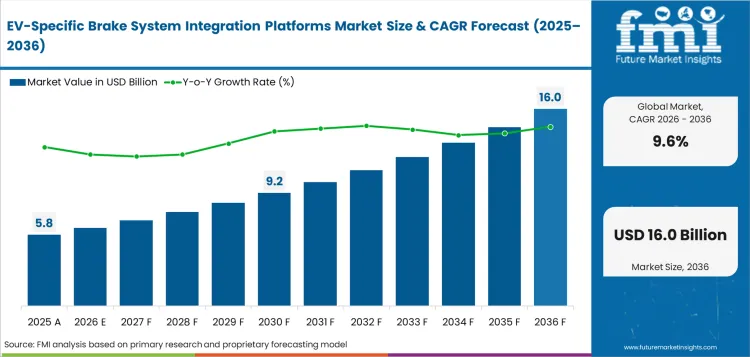
The EV-specific brake system integration platforms market size stood at USD 5.8 billion in 2025. Industry revenue is estimated at USD 6.4 billion in 2026 and reach USD 16.0 billion by 2036 at 9.6% CAGR. OEM integration is set to represent 82.4% share of integration model in 2026. By end user, automakers are predicted to account for 69.2% share in 2026.
Summary of EV-Specific Brake System Integration Platforms Market
- Demand and Growth Drivers
- Electric vehicle launches need friction and motor braking to feel like one system across everyday driving conditions.
- Brake-by-wire awards are shifting value toward software calibration and fail-safe control inside new electric platforms.
- Safety rules for automatic emergency braking make stable brake response a vehicle approval and validation concern.
- Product and Segment View
- OEM integration is projected to account for 82.4% share in 2026, influenced by validation work being locked before production starts.
- Automakers are expected to capture 69.2% share in 2026, led by platform control ownership and safety case approval.
- Passenger cars are projected to hold 66.1% share in 2026 as high-volume EV programs carry most brake integration work.
- Geography and Competitive Outlook
- China is likely to record 11.8% CAGR by 2036, driven by electric vehicle scale and local brake electronics content.
- India is anticipated to expand at 11.2% CAGR by 2036, influenced by rising passenger vehicle output and EV model rollout.
- ZF Friedrichshafen AG, Robert Bosch GmbH and Brembo N.V. anchor competition through brake-by-wire awards and platform validation depth.
- Analyst Opinion
- Nikhil Kaitwade, Principal Consultant for Automotive, at FMI, opines, “EV brake integration has moved beyond being a brake component sale. Automakers now want a control platform blending energy recovery and safety fallback before the vehicle reaches production. Suppliers with validated software and platform engineering support are expected to capture a higher share in this category.”
- EV-Specific Brake System Integration Platforms Market Value Analysis
- Market value in EV brake integration is tied to control software, brake actuators and validation work sold as one platform package.
- Supplier pricing reflects safety case evidence and calibration depth before an automaker accepts a program award for an automotive brake system.
- Revenue rises above traditional brake system value as x-by-wire architectures shift more content toward electronics and software.
- Engineering service value increases as regenerative braking systems must meet driver feel targets and battery protection limits together.
Key Takeaways, Market Size, and Forecast
- The EV-specific brake system integration platforms market was valued at USD 5.8 billion in 2025.
- Industry value is projected to reach USD 16.0 billion by 2036 as EV programs need brake blending and safety validation inside the vehicle platform.
- From 2026 to 2036, the sector is projected to expand at 9.6% CAGR.
- Industry revenue is projected to create incremental opportunity of USD 9.6 billion from 2026 to 2036.
- OEM integration is set to account for 82.4% share of integration model in 2026.
- Automakers are expected to capture 69.2% share of end user in 2026.
- Among the key country-set, China is projected to record an 11.8% CAGR, followed by India at 11.2% CAGR by 2036.
EV brake programs now face one main problem, brake systems are required to save energy without changing how the pedal feels. Continental’s April 2025 system shows why compact brake modules are becoming important. Its one-box brake-by-wire design reduces weight by nearly 30%, giving automakers a practical packaging gain during EV platform planning. Nexteer’s April 2025 Electro-Mechanical Brake system points to the next design step. Actuators at each wheel replace hydraulic fluid and mechanical links, moving braking closer to software control. General Motors shows the customer side of the same shift. Its November 2025 blended braking update states, energy recovery continues even when the driver only uses the brake pedal. Three one-pedal settings make brake calibration more visible to drivers. Suppliers therefore need to prove smooth handover between motor braking and friction braking. OEMs will favor partners reducing weight and keep pedal response predictable.
EV-Specific Brake System Integration Platforms Market Definition
The EV-specific brake system integration platforms cover hardware and software used to coordinate braking in electric vehicles. Scope includes EV brake system control and fail-safe actuation. Brake system powerpack and boosterless units and brake-by-wire pedal simulators are counted if sold as part of an EV control package. Standalone pads and discs are excluded unless bundled with platform integration work.
EV-Specific Brake System Integration Platforms Market Inclusions
Scope includes vehicle program integration for battery electric cars and plug-in hybrid cars. Included value covers controller hardware, actuator interface work and software calibration for blended hydraulic-regenerative brake systems. Engineering support for brake feel tuning and end-of-line validation is counted when billed with the platform package. Brake fluid accumulator and reservoir components are counted when they support redundant hydraulic pressure inside the integration package.
EV-Specific Brake System Integration Platforms Market Exclusions
Scope excludes standard friction parts sold outside platform integration. Automotive brake shims, standalone hoses and ordinary service fluids are outside scope. Automotive brake system and components sold as service parts are excluded unless brake blending is the direct revenue item. Mechanical parking brake parts and cabin switches are excluded unless tied to an EV brake control platform.
EV-Specific Brake System Integration Platforms Market Research Methodology
- Primary Research: FMI analysts reviewed EV brake integration needs with chassis engineers and validation service providers across Asia and Europe.
- Desk Research: Vehicle production data and braking safety rules supported platform demand checks from 2024 onward.
- Market Sizing and Forecasting: Forecast values used EV production exposure and platform software content per vehicle.
- Data Validation: Checks compared 2026 value with 2036 value and tested CAGR consistency across seven country rates.
Why is the EV-Specific Brake System Integration Platforms Market Growing?
- EV brake platforms must manage energy recovery and friction braking in one controlled stopping event.
- Brake-by-wire work is moving earlier into platform design as EV programs need fail-safe pedal sensing.
- Brake emissions rules are making friction-brake use and regenerative blending part of approval planning.
EV brake integration is becoming a platform decision since automakers need braking systems protecting range and keep pedal response predictable. In May 2024, Ford Global Technologies published a vehicle brake-by-wire control system patent with first and second brake-pedal sensors and a controller enabling one-pedal driving when sensor data differs beyond a threshold. Such evidence shows why validation is moving from hardware fitment toward software behavior and fallback control. In April 2026, Nexteer stated that its Electro-Mechanical Brake had completed development and validation after its 2025 debut. More than 20 customers completed test drives, pointing to active OEM evaluation of wheel-level electronic braking. United Nations Economic Commission for Europe adopted a global brake particle emissions standard in March 2026. Such regulation increases the value of blended hydraulic-regenerative brake systems and EV regenerative braking control systems since lower friction-brake use can support cleaner vehicle approval planning.
Market Segmentation Analysis
- Blended braking platforms are ready to account for 34.0% share in 2026 as EV programs need one control layer for motor recovery and wheel braking.
- Passenger cars are forecast to capture 66.1% share in 2026, reflected by high EV model volume and broader brake software content.
- OEM integration is projected to represent 82.4% share in 2026 since brake integration decisions are made during platform engineering.
- Electrohydraulic systems are anticipated to hold 55.8% share in 2026, influenced by combining electronic control with proven hydraulic wheel circuits.
- Automakers are projected to account for 69.2% share in 2026, led by safety case ownership stays with the vehicle program owner.
Segmentation is divided into five parent groups built around how EV brake platforms are specified. Platform type separates the control job performed inside the vehicle. Vehicle type shows the program group carrying the volume. Integration model explains how the package reaches production. System architecture reflects actuation design and fallback needs. End user identifies who approves the safety case and signs the program award.
Insights into EV-Specific Brake System Integration Platforms Market by Platform Type
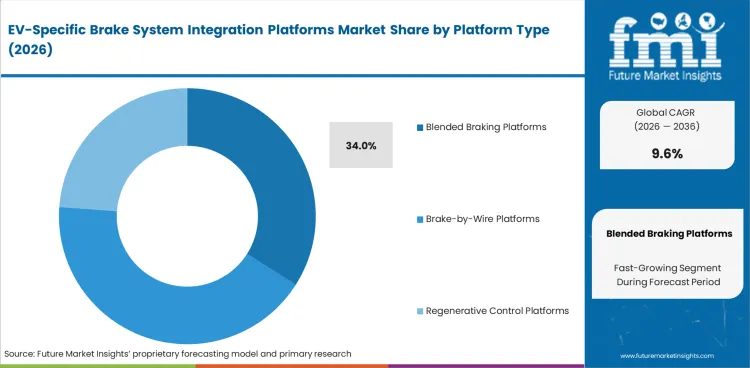
- Blended braking platforms are likely to account for 34.0% share in 2026 due to EVs needing stable handover between regenerative torque and friction pressure under changing battery limits.
- Brake-by-wire platforms gain value in premium electric cars as redundant control allows shorter pedal travel and tighter integration with vehicle motion control.
Insights into EV-Specific Brake System Integration Platforms Market by Vehicle Type
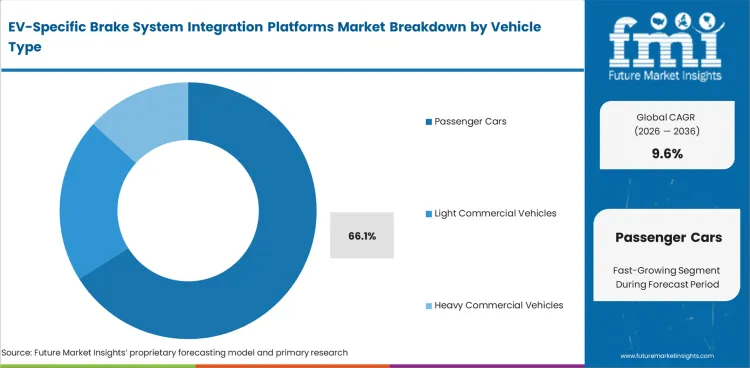
- Passenger cars are forecast to represent 66.1% share in 2026, led by high-volume EV programs carrying the broadest need for EV regenerative braking control systems.
- Light commercial vehicles use brake integration to protect range and service life during frequent delivery and fleet duty cycles.
Insights into EV-Specific Brake System Integration Platforms Market by Integration Model
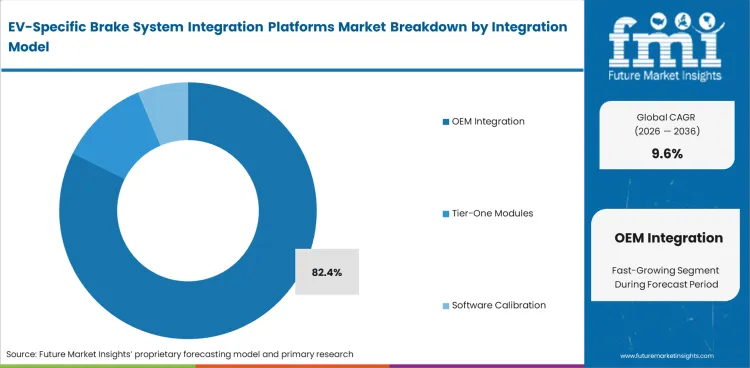
- OEM integration is expected to hold 82.4% share in 2026, reflected by safety validation and brake feel tuning being locked before vehicle production.
- Software calibration grows as brake system control ECU platforms need model-specific tuning for pedal response and low-speed transition behavior.
Insights into EV-Specific Brake System Integration Platforms Market by System Architecture
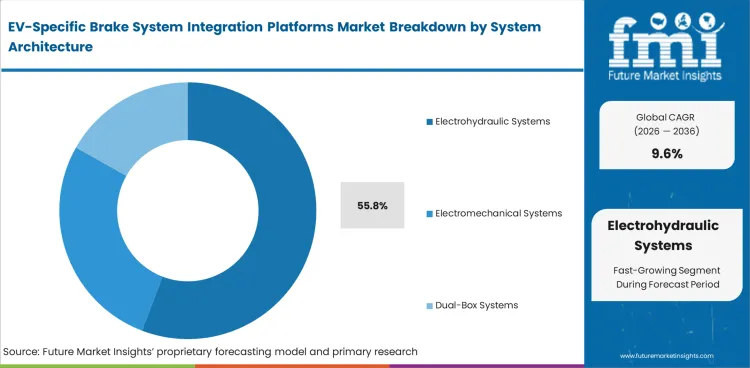
- Electrohydraulic systems are forecast to account for 55.8% share in 2026, driven by vehicle makers pairing electronic pressure control with familiar hydraulic hardware.
- Electromechanical systems attract attention in dry-brake designs led by automotive actuator content shifting closer to each wheel.
Insights into EV-Specific Brake System Integration Platforms Market by End User
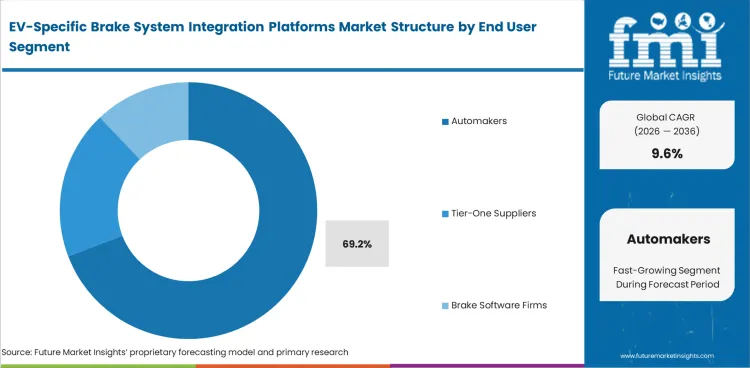
- Automakers are projected to account for 69.2% share in 2026 as EV brake control must clear vehicle-level safety and warranty approval.
- Tier-one suppliers stay central as digital brake control and antiskid systems require validated interaction between pressure control and stability functions.
EV-Specific Brake System Integration Platforms Market Drivers, Restraints and Opportunities
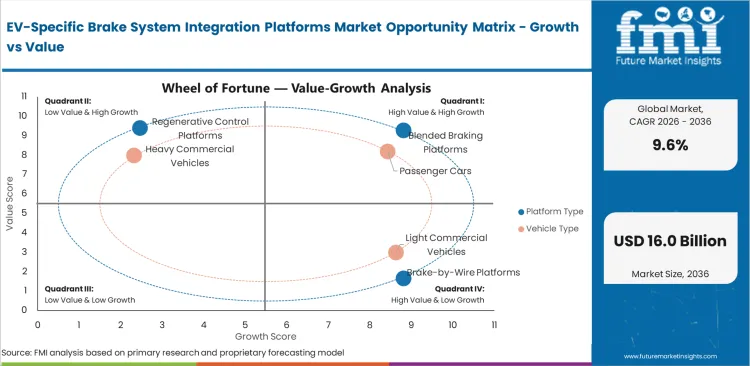
- Brake blending raises platform value as EV programs need one stopping response across motor recovery and wheel braking.
- Safety validation slows supplier awards as automakers need proof across pedal sensing, actuation and fallback behavior.
- Software tuning creates a new service route as brake feel and energy recovery settings change across model years.
Suppliers treating brake integration as part of the full vehicle control system are expected to gain stronger program access. ZF stated in July 2025, its dry brake-by-wire system uses electric motors at the wheel. It also states, its integrated brake control can act as stability control and central electronic control unit. The same release said ZF has produced more than 3 billion brake components over 50 years, providing OEMs a production-history signal when evaluating newer brake-by-wire platforms. Schaeffler stated in April 2025, more than 140 million ball screw drives had been produced since 2007. It also said it had received its first customer nomination for ball screw drives used in electromechanical brake systems. Such facts support a forward outlook in which brake-by-wire platforms and automotive actuator content gain value when suppliers can prove both software behavior and mechanical reliability.
Buyer Identification and Procurement Structure Analysis
EV brake integration platforms are bought through vehicle program teams. Chassis engineers define stopping behavior. Software teams test how brake response interacts with stability control and battery recovery. Hyundai Mobis stated in March 2026, about 100 representatives from 10 European and North American customers attended its Swedish winter testing event. It also said demo vehicles carried braking and steering systems, and its next-generation integrated braking system was scheduled for mass production later in 2026. Such evidence shows sourcing is moving toward live validation before award decisions. Buyers are expected to favor suppliers bringing brake system control ECU platforms and cold-weather test evidence in one package.
Regulatory Compliance and Operating Standards Analysis
EV brake integration is expected to stay tied to fail-safe control and software-defined vehicle approval work. Hyundai Mobis and Qualcomm Technologies stated in January 2026, they would co-develop next-generation solutions for software-defined vehicles and advanced driver assistance systems. It also said the work would use Hyundai Mobis system integration and perception with Qualcomm Technologies system-on-chip technology. This is important to brake integration since braking output must stay consistent as automated driving and stability functions move into shared software architectures. Suppliers serving automotive active safety systems will need evidence that pedal input and actuator response remain stable under driver and automated commands. Brake integration vendors with strong system validation are likely to acquire earlier involvement in EV platform planning.
Analysis of EV-Specific Brake System Integration Platforms Market by Key Countries
.webp "Top Country Growth Comparison Ev Specific Brake System Integration Platforms Market Cagr (2026 2036)")
| Country | CAGR |
|---|---|
| China | 11.8% |
| India | 11.2% |
| United States | 9.8% |
| Germany | 9.3% |
| South Korea | 8.9% |
| Japan | 8.4% |
| United Kingdom | 8.1% |
Source: Future Market Insights, 2026.
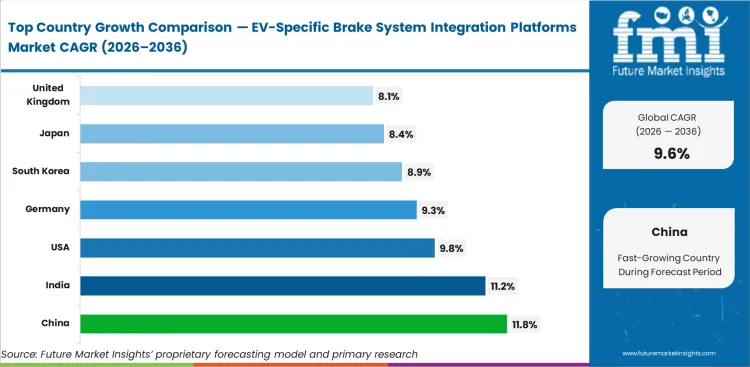
EV-Specific Brake System Integration Platforms Market CAGR Analysis by Country
- China is set to record 11.8% CAGR by 2036, influenced by EV production depth and local brake control software demand.
- India is expected to expand at 11.2% CAGR by 2036, led by passenger vehicle scale and new electric platform programs.
- United States is forecast to grow at 9.8% CAGR by 2036 through active safety rules and premium EV platform integration.
- Germany is expected to advance at 9.3% CAGR by 2036 as European emissions rules push more electrified vehicle launches.
- South Korea is projected to rise at 8.9% CAGR by 2036 with export-oriented EV programs and local chassis supplier depth.
- Japan is forecast at 8.4% CAGR by 2036 due to hybrid expertise and gradual EV platform migration shaping brake integration.
- United Kingdom is expected to post 8.1% CAGR by 2036 since zero-emission vehicle rules lift demand for EV-ready brake platforms.
Country performance differs by EV scale and local platform control depth. China and India are forecast above the global pace as vehicle volume expands the future control platform pool. United States tracks slightly above the global average through active safety mandates and premium EV content. Germany and South Korea grow at measured rates as validation depth guides supplier awards. Japan and United Kingdom follow a similar path through model cycle timing.
Demand Outlook for EV-Specific Brake System Integration Platforms in China
Demand in China is projected to record 11.8% CAGR by 2036, driven by a large EV program pool and local chassis electronics capacity. International Energy Agency reported in May 2026, more than 13 million electric cars were sold in China during 2025 and the electric sales share reached almost 55%. Scale gives brake platform suppliers a wide test bed for blended braking and dry-brake trials. Domestic automakers will expect low-cost control platforms handling rapid model refresh cycles without delaying launch approval.
- Domestic EV programs increase brake platform validation needs across passenger and light commercial models.
- Local software content raises demand for brake blending packages suited to short model cycles.
- Export-focused vehicle programs need validation documents supporting approval outside China.
Demand Analysis of EV-Specific Brake System Integration Platforms in India
Industry in India is expected to expand at 11.2% CAGR by 2036, led by larger passenger vehicle output and local EV model rollout. Society of Indian Automobile Manufacturers reported in April 2026, passenger vehicle sales reached 46.43 lakh units in FY 2025 to 2026. Higher vehicle output gives brake suppliers a broader path to EV-ready platform work. Local engineering teams will need simple validation packages as electric cars move from niche programs into wider price bands.
- Mass-market EV rollouts influence demand for lower-cost brake control packages with simple validation.
- Local supplier development increases the need for modular actuator and controller assemblies.
- Wider service networks require diagnostic routines separating sensor faults from brake platform faults.
Growth Outlook for EV-Specific Brake System Integration Platforms in the United States
Sector in the United States is forecast to grow at 9.8% CAGR by 2036 as active safety requirements move brake control deeper into platform validation. Argonne National Laboratory data available in March 2026 showed plug-in electric vehicles represented 9.1% of annual passenger vehicle sales in 2025. Regulation creates another test layer through automated emergency braking performance. Suppliers serving United States programs will need fault logging, software traceability and pressure control evidence before model launch.
- Active safety compliance raises pressure response requirements for EV brake platform suppliers.
- Established EV platforms increase demand for brake feel tuning and software traceability.
- Federal Motor Vehicle Safety Standard No. 127 raises braking proof needs for passenger cars and light trucks.
Sales Analysis of EV-Specific Brake System Integration Platforms in Germany
Sales in Germany are expected to scale at 9.3% CAGR by 2036 as electrified company cars and premium EV platforms need more brake control content. European Automobile Manufacturers’ Association stated in January 2026, Germany battery-electric registrations rose 43.2% in 2025. German suppliers already sell brake controllers and validation services into global platforms. Product approvals will depend on repeatable pedal feel and documentation aligned with European braking rules.
- Established electrified platforms influences demand for high-spec brake-by-wire HMI controller systems.
- European safety documentation increases buyer focus on repeatable pressure response.
- Vehicle motion control work keeps braking tied to steering and stability coordination.
Industry Outlook for EV-Specific Brake System Integration Platforms in South Korea
Industry in South Korea is projected to rise at 8.9% CAGR by 2036 due to local exporters increasing electrified vehicle content. South Korea industry ministry reported in March 2026, domestic eco-friendly vehicle sales rose 26.3% year-on-year to 76,000 units in February 2026. Export programs then carry Korean brake content into multiple regions. Suppliers will need modular platforms supporting both domestic models and export vehicle variants.
- Export-oriented EV programs need brake platforms accepted across multiple safety regimes.
- Domestic electronics capacity supports sensor and controller content inside integrated brake systems.
- Modular platform strategies raise demand for software calibration across several vehicle variants.
Demand Outlook for EV-Specific Brake System Integration Platforms in Japan
Demand in Japan is forecast at 8.4% CAGR by 2036, reflected by hybrid control skills carrying into EV brake integration. Japan Automobile Manufacturers Association reported in September 2025, motor vehicle production totaled 8.23 million units in 2024. Japanese automakers already manage fine brake feel in hybrid vehicles and automotive energy recovery systems used in blended braking. Suppliers will gain most in programs combining productivity gains with proven driver feel.
- Hybrid braking experience supports smooth handover between recovery braking and friction braking.
- Compact vehicle designs favor integrated controls reducing packaging space.
- Long product quality cycles increase supplier focus on durable pedal feel and fault handling.
Sales Outlook for EV-Specific Brake System Integration Platforms in the United Kingdom
Sales in the United Kingdom are expected to post 8.1% CAGR by 2036 through zero-emission vehicle rules pushing more EV-ready brake programs. United Kingdom Department for Transport guidance issued in November 2025 stated, zero-emission car targets start at 22% in 2024 and rise to 80% in 2030. Program pressure is expected to increase demand for control platforms support efficiency and automated braking. Suppliers serving right-hand-drive models must keep calibration work aligned with regional launch timing.
- Zero-emission vehicle rules push automakers to scale EV platform work.
- Right-hand-drive programs require calibration checks matched to local launch timing.
- Regular roadworthiness checks keep brake warning behavior visible in repair and validation planning.
Competitive Landscape and Strategic Positioning
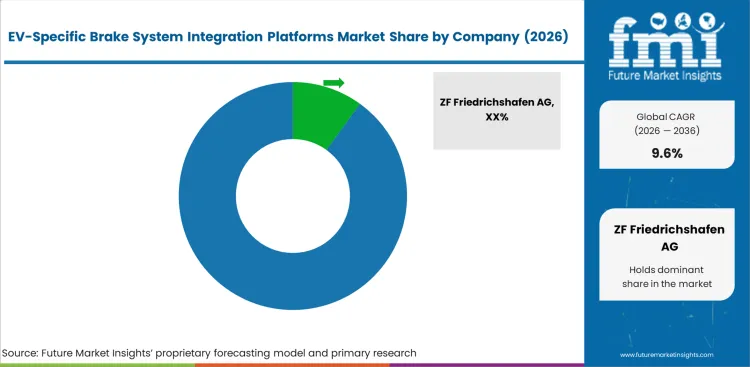
- Brake-by-wire suppliers hold advantage by proving redundant control and pressure response before program nomination.
- Regenerative control specialists gain ground with smoother handover and better battery protection during braking.
- Validation partners acquire work if test evidence shortens launch approval for EV brake platforms.
Competition is grouped between brake-by-wire suppliers and validation partners. ZF Friedrichshafen AG and Robert Bosch GmbH have the strongest evidence of near-term brake-by-wire production intent. Brembo N.V. has moved into intelligent braking production with a platform framed around software-defined vehicle needs. ADVICS Co., Ltd. supports Toyota hybrid and electric programs with cooperative regenerative braking. Astemo, Ltd. brings electrohydraulic and electromechanical options for future vehicle platforms.
Supplier choice depends on validation depth and regional engineering support. Automakers want a platform clearing safety reviews without adding late-stage calibration risk. Tier-one suppliers can gain share by tying actuator hardware to software behavior and test records. Smaller firms can participate through calibration tools or simulation support. Brake system integration will favor companies connecting friction braking and fault handling in one evidence package.
Key Companies in the EV-Specific Brake System Integration Platforms Market
Competitive structure is grouped by brake-by-wire suppliers, regenerative brake specialists and chassis control integrators.
- Brake-by-Wire Suppliers: ZF Friedrichshafen AG, Robert Bosch GmbH and Brembo N.V. support electronic actuation and redundant brake control.
- Regenerative Brake Specialists: ADVICS Co., Ltd. and Astemo, Ltd. support cooperative braking and EV-ready electrohydraulic systems.
- Chassis Control Integrators: AUMOVIO SE and Hyundai Mobis Co., Ltd. support platform-level chassis electronics and brake control integration.
Competitive Benchmarking: EV-Specific Brake System Integration Platforms Market
| Company | Brake-by-Wire Readiness | Regenerative Control Depth | Validation Support Fit | Geographic Footprint |
|---|---|---|---|---|
| ZF Friedrichshafen AG | High | High | High | Global |
| Robert Bosch GmbH | High | High | High | Global |
| Brembo N.V. | High | Medium | Medium | Europe and global |
| ADVICS Co., Ltd. | Medium | High | Medium | Japan and Asia |
| Astemo, Ltd. | Medium | High | Medium | Japan and global |
| AUMOVIO SE | High | Medium | High | Global |
| Hyundai Mobis Co., Ltd. | Medium | Medium | Medium | South Korea and global |
Source: Future Market Insights competitive analysis 2026. Ratings reflect relative positioning by brake-by-wire readiness, regenerative control depth and validation support fit.
Key Developments in EV-Specific Brake System Integration Platforms Market
- In January 2025, ZF Friedrichshafen AG secured brake-by-wire technology business for nearly 5 million light vehicles over the contract length.
- In January 2025, Robert Bosch GmbH completed a 2,050-mile brake-by-wire public road test and stated market launch was planned from fall 2025.
- In May 2026, Brembo N.V. announced SENSIFY entered production with a leading global vehicle manufacturer.
Key Players in the EV-Specific Brake System Integration Platforms Market
Major Global Players:
- ZF Friedrichshafen AG
- Robert Bosch GmbH
- AUMOVIO SE
- Brembo N.V.
- Hyundai Mobis Co., Ltd.
Specialist and Regional Players:
- ADVICS Co., Ltd.
- Astemo, Ltd.
Market Report Scope
| Parameter | Details |
|---|---|
| Quantitative units | USD 6.4 billion to USD 16.0 billion at 9.6% CAGR |
| Market definition | Integration platforms coordinating regenerative braking, brake-by-wire control and EV brake safety validation |
| By platform type | Blended braking platforms, brake-by-wire platforms, regenerative control platforms, electronic booster platforms, chassis domain platforms |
| By vehicle type | Passenger cars, light commercial vehicles, heavy commercial vehicles, electric buses, off-highway EVs |
| By integration model | OEM integration, tier-one modules, software calibration, retrofit integration, service validation |
| By system architecture | Electrohydraulic systems, electromechanical systems, dual-box systems, one-box systems, redundant circuits |
| By end user | Automakers, tier-one suppliers, brake software firms, engineering providers, service networks |
| Regions covered | North America, Latin America, Europe, East Asia, South Asia and Pacific, Middle East and Africa |
| Countries covered | China, India, United States, Germany, South Korea, Japan, United Kingdom |
| Key companies profiled | ZF Friedrichshafen AG, Robert Bosch GmbH, AUMOVIO SE, Brembo N.V., Hyundai Mobis Co. Ltd., ADVICS Co. Ltd., Astemo Ltd. |
| Forecast period | 2026 to 2036 |
| Approach | Hybrid top-down and bottom-up model using EV production exposure, brake control value and supplier award validation |
Source: Future Market Insights, 2026.
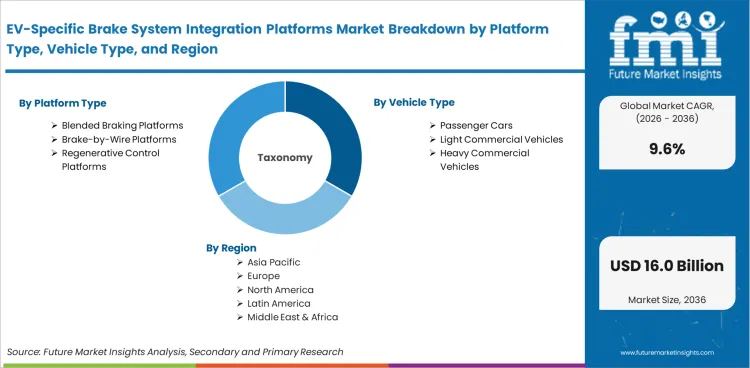
EV-Specific Brake System Integration Platforms Market Breakdown by Platform Type, Vehicle Type, Integration Model, System Architecture, End User, and Region
By Platform Type:
- Blended Braking Platforms
- Brake-by-Wire Platforms
- Regenerative Control Platforms
- Electronic Booster Platforms
- Chassis Domain Platforms
By Vehicle Type:
- Passenger Cars
- Light Commercial Vehicles
- Heavy Commercial Vehicles
- Electric Buses
- Off-Highway EVs
By Integration Model:
- OEM Integration
- Tier-One Modules
- Software Calibration
- Retrofit Integration
- Service Validation
By System Architecture:
- Electrohydraulic Systems
- Electromechanical Systems
- Dual-Box Systems
- One-Box Systems
- Redundant Circuits
By End User:
- Automakers
- Tier-One Suppliers
- Brake Software Firms
- Engineering Providers
- Service Networks
By Region:
- North America
- Latin America
- Europe
- East Asia
- South Asia and Pacific
- Middle East and Africa
Research Sources and Bibliography
- Continental AG. (2025, April 15). Safe, exciting, autonomous: Solutions for automated driving and light projection debut at Auto Shanghai.
- Nexteer Automotive. (2025, April 15). Nexteer launches brake-by-wire system.
- General Motors. (2025, November 5). Regeneration: How your EV goes farther by giving your brakes a break.
- European Union. (2024, April 24). Regulation (EU) 2024/1257 of the European Parliament and of the Council of 24 April 2024.
- Toyota Motor Europe. (2026, March 19). The all-new Toyota C-HR+: Stand-out design and superior BEV credentials.
- Ford Global Technologies, LLC. (2024, May 16). Vehicle brake-by-wire control system (USA Patent Application Publication No. US20240157915A1). Google Patents.
- Nexteer Automotive. (2026, April 21). Nexteer introduces market-ready EMB at Auto China 2026, advancing comprehensive motion control solutions.
- United Nations Economic Commission for Europe. (2026, March 11). UN adopts global standard to measure and limit brake particle emissions.
- Hyundai Mobis. (2026, January 8). Hyundai Mobis and Qualcomm sign comprehensive agreement to collaborate on SDV architecture for ADAS.
- Hyundai Mobis. (2026, March 3). Hyundai Mobis invites 10 global customers to Swedish winter testing ground to showcase core technologies in extreme cold conditions.
- Schaeffler AG. (2025, April 4). Schaeffler starts production of successful ball screw drive for Chinese EV manufacturer.
- ZF Friedrichshafen AG. (2025, July 10). Braking evolution: ZF brings to market a comprehensive brake-by-wire portfolio.
- International Energy Agency. (2026, May). Global EV Outlook 2026: Trends in electric cars.
- Society of Indian Automobile Manufacturers. (2026, April 14). Auto industry performance of Q4 (Jan-March 2026) and FY 2025-26.
- European Automobile Manufacturers’ Association. (2026, January 27). New car registrations: +1.8% in 2025; battery-electric 17.4% market share.
- Ministry of Trade, Industry and Resources, Republic of Korea. (2026, March 19). February 2026 automobile exports reach $4.8 billion.
- Japan Automobile Manufacturers Association. (2025, September 26). The motor industry of Japan 2025.
- United Kingdom Department for Transport. (2025, November 19). The vehicle emissions trading schemes: How to comply.
- United States National Highway Traffic Safety Administration. (2024, April 29). NHTSA finalizes key safety rule to reduce crashes and save lives.
- United Nations Economic Commission for Europe. (2026, April 13). UN Regulation No. 13-H: Uniform provisions concerning the approval of passenger cars with regard to braking.
- ZF Friedrichshafen AG. (2025, January 6). ZF secures substantial brake-by-wire technology business for light vehicles.
- Robert Bosch GmbH. (2025, January 30). With brake-by-wire from Bosch to the Arctic Circle.
- Brembo N.V. (2026, May 4). The new standard begins: SENSIFY by Brembo enters production.
- ADVICS Co., Ltd. (2025, December 24). ADVICS’ new cooperative regenerative braking system adopted for Toyota RAV4.
Bibliography uses official government and intergovernmental sources. Trade body and company sources were used only for dated evidence.
This Report Answers
- What is the current and forecast value of the EV-specific brake system integration platforms market?
- Which integration model is projected to hold a leading share in 2026?
- How do automakers shape EV brake integration platform demand?
- Which countries record faster growth for EV-specific brake system integration platforms?
- How do brake-by-wire validation and regenerative blending affect supplier positioning?
- Which companies compete in EV-specific brake system integration platforms?
Frequently Asked Questions
What is the EV-specific brake system integration platforms market value in 2026?
The EV-specific brake system integration platforms market value is estimated at USD 6.4 billion in 2026 and reach USD 16.0 billion by 2036.
What CAGR is projected for the EV-specific brake system integration platforms market?
The EV-specific brake system integration platforms sector is projected to expand at 9.6% CAGR from 2026 to 2036.
Which integration model leads the EV-specific brake system integration platforms market?
OEM integration is expected to account for 82.4% share in 2026, led by validation beginning during vehicle platform engineering.
Which end user is important for the EV-specific brake system integration platforms market?
Automakers are expected to hold 69.2% share in 2026 as they own safety case approval and warranty risk.
Which vehicle type is important for the EV-specific brake system integration platforms market?
Passenger cars are expected to account for 66.1% share in 2026 as high-volume EV programs need integrated brake control.
Who are key players in the EV-specific brake system integration platforms market?
ZF Friedrichshafen AG and Robert Bosch GmbH are active suppliers in brake-by-wire. Brembo S.p.A. competes through intelligent braking production.
Preview the report firsthand - request a free sample
Get SampleGet the brochure for pricing and purchase details.
Get PDFTable of Content
- Executive Summary
- Global Market Outlook
- Demand-side Trends
- Supply-side Trends
- Technology Roadmap Analysis
- Analysis and Recommendations
- Market Overview
- Market Coverage / Taxonomy
- Market Definition / Scope / Limitations
- Research Methodology
- Chapter Orientation
- Analytical Lens and Working Hypotheses
- Market Structure, Signals, and Trend Drivers
- Benchmarking and Cross-market Comparability
- Market Sizing, Forecasting, and Opportunity Mapping
- Research Design and Evidence Framework
- Desk Research Programme (Secondary Evidence)
- Company Annual and Sustainability Reports
- Peer-reviewed Journals and Academic Literature
- Corporate Websites, Product Literature, and Technical Notes
- Earnings Decks and Investor Briefings
- Statutory Filings and Regulatory Disclosures
- Technical White Papers and Standards Notes
- Trade Journals, Industry Magazines, and Analyst Briefs
- Conference Proceedings, Webinars, and Seminar Materials
- Government Statistics Portals and Public Data Releases
- Press Releases and Reputable Media Coverage
- Specialist Newsletters and Curated Briefings
- Sector Databases and Reference Repositories
- FMI Internal Proprietary Databases and Historical Market Datasets
- Subscription Datasets and Paid Sources
- Social Channels, Communities, and Digital Listening Inputs
- Additional Desk Sources
- Expert Input and Fieldwork (Primary Evidence)
- Primary Modes
- Qualitative Interviews and Expert Elicitation
- Quantitative Surveys and Structured Data Capture
- Blended Approach
- Why Primary Evidence is Used
- Field Techniques
- Interviews
- Surveys
- Focus Groups
- Observational and In-context Research
- Social and Community Interactions
- Stakeholder Universe Engaged
- C-suite Leaders
- Board Members
- Presidents and Vice Presidents
- R&D and Innovation Heads
- Technical Specialists
- Domain Subject-matter Experts
- Scientists
- Physicians and Other Healthcare Professionals
- Governance, Ethics, and Data Stewardship
- Research Ethics
- Data Integrity and Handling
- Primary Modes
- Tooling, Models, and Reference Databases
- Desk Research Programme (Secondary Evidence)
- Data Engineering and Model Build
- Data Acquisition and Ingestion
- Cleaning, Normalisation, and Verification
- Synthesis, Triangulation, and Analysis
- Quality Assurance and Audit Trail
- Market Background
- Market Dynamics
- Drivers
- Restraints
- Opportunity
- Trends
- Scenario Forecast
- Demand in Optimistic Scenario
- Demand in Likely Scenario
- Demand in Conservative Scenario
- Opportunity Map Analysis
- Product Life Cycle Analysis
- Supply Chain Analysis
- Investment Feasibility Matrix
- Value Chain Analysis
- PESTLE and Porter’s Analysis
- Regulatory Landscape
- Regional Parent Market Outlook
- Production and Consumption Statistics
- Import and Export Statistics
- Market Dynamics
- Global Market Analysis 2021 to 2025 and Forecast, 2026 to 2036
- Historical Market Size Value (USD Million) Analysis, 2021 to 2025
- Current and Future Market Size Value (USD Million) Projections, 2026 to 2036
- Y-o-Y Growth Trend Analysis
- Absolute $ Opportunity Analysis
- Global Market Pricing Analysis 2021 to 2025 and Forecast 2026 to 2036
- Global Market Analysis 2021 to 2025 and Forecast 2026 to 2036, By Platform Type
- Introduction / Key Findings
- Historical Market Size Value (USD Million) Analysis By Platform Type , 2021 to 2025
- Current and Future Market Size Value (USD Million) Analysis and Forecast By Platform Type , 2026 to 2036
- Blended Braking Platforms
- Brake-by-Wire Platforms
- Regenerative Control Platforms
- Blended Braking Platforms
- Y-o-Y Growth Trend Analysis By Platform Type , 2021 to 2025
- Absolute $ Opportunity Analysis By Platform Type , 2026 to 2036
- Global Market Analysis 2021 to 2025 and Forecast 2026 to 2036, By Vehicle Type
- Introduction / Key Findings
- Historical Market Size Value (USD Million) Analysis By Vehicle Type, 2021 to 2025
- Current and Future Market Size Value (USD Million) Analysis and Forecast By Vehicle Type, 2026 to 2036
- Passenger Cars
- Light Commercial Vehicles
- Heavy Commercial Vehicles
- Passenger Cars
- Y-o-Y Growth Trend Analysis By Vehicle Type, 2021 to 2025
- Absolute $ Opportunity Analysis By Vehicle Type, 2026 to 2036
- Global Market Analysis 2021 to 2025 and Forecast 2026 to 2036, By Integration Model
- Introduction / Key Findings
- Historical Market Size Value (USD Million) Analysis By Integration Model, 2021 to 2025
- Current and Future Market Size Value (USD Million) Analysis and Forecast By Integration Model, 2026 to 2036
- OEM Integration
- Tier-One Modules
- Software Calibration
- OEM Integration
- Y-o-Y Growth Trend Analysis By Integration Model, 2021 to 2025
- Absolute $ Opportunity Analysis By Integration Model, 2026 to 2036
- Global Market Analysis 2021 to 2025 and Forecast 2026 to 2036, By System Architecture
- Introduction / Key Findings
- Historical Market Size Value (USD Million) Analysis By System Architecture, 2021 to 2025
- Current and Future Market Size Value (USD Million) Analysis and Forecast By System Architecture, 2026 to 2036
- Electrohydraulic Systems
- Electromechanical Systems
- Dual-Box Systems
- Electrohydraulic Systems
- Y-o-Y Growth Trend Analysis By System Architecture, 2021 to 2025
- Absolute $ Opportunity Analysis By System Architecture, 2026 to 2036
- Global Market Analysis 2021 to 2025 and Forecast 2026 to 2036, By End User
- Introduction / Key Findings
- Historical Market Size Value (USD Million) Analysis By End User, 2021 to 2025
- Current and Future Market Size Value (USD Million) Analysis and Forecast By End User, 2026 to 2036
- Automakers
- Tier-One Suppliers
- Brake Software Firms
- Automakers
- Y-o-Y Growth Trend Analysis By End User, 2021 to 2025
- Absolute $ Opportunity Analysis By End User, 2026 to 2036
- Global Market Analysis 2021 to 2025 and Forecast 2026 to 2036, By Region
- Introduction
- Historical Market Size Value (USD Million) Analysis By Region, 2021 to 2025
- Current Market Size Value (USD Million) Analysis and Forecast By Region, 2026 to 2036
- North America
- Latin America
- Western Europe
- Eastern Europe
- East Asia
- South Asia and Pacific
- Middle East & Africa
- Market Attractiveness Analysis By Region
- North America Market Analysis 2021 to 2025 and Forecast 2026 to 2036, By Country
- Historical Market Size Value (USD Million) Trend Analysis By Market Taxonomy, 2021 to 2025
- Market Size Value (USD Million) Forecast By Market Taxonomy, 2026 to 2036
- By Country
- USA
- Canada
- Mexico
- By Platform Type
- By Vehicle Type
- By Integration Model
- By System Architecture
- By End User
- By Country
- Market Attractiveness Analysis
- By Country
- By Platform Type
- By Vehicle Type
- By Integration Model
- By System Architecture
- By End User
- Key Takeaways
- Latin America Market Analysis 2021 to 2025 and Forecast 2026 to 2036, By Country
- Historical Market Size Value (USD Million) Trend Analysis By Market Taxonomy, 2021 to 2025
- Market Size Value (USD Million) Forecast By Market Taxonomy, 2026 to 2036
- By Country
- Brazil
- Chile
- Rest of Latin America
- By Platform Type
- By Vehicle Type
- By Integration Model
- By System Architecture
- By End User
- By Country
- Market Attractiveness Analysis
- By Country
- By Platform Type
- By Vehicle Type
- By Integration Model
- By System Architecture
- By End User
- Key Takeaways
- Western Europe Market Analysis 2021 to 2025 and Forecast 2026 to 2036, By Country
- Historical Market Size Value (USD Million) Trend Analysis By Market Taxonomy, 2021 to 2025
- Market Size Value (USD Million) Forecast By Market Taxonomy, 2026 to 2036
- By Country
- Germany
- UK
- Italy
- Spain
- France
- Nordic
- BENELUX
- Rest of Western Europe
- By Platform Type
- By Vehicle Type
- By Integration Model
- By System Architecture
- By End User
- By Country
- Market Attractiveness Analysis
- By Country
- By Platform Type
- By Vehicle Type
- By Integration Model
- By System Architecture
- By End User
- Key Takeaways
- Eastern Europe Market Analysis 2021 to 2025 and Forecast 2026 to 2036, By Country
- Historical Market Size Value (USD Million) Trend Analysis By Market Taxonomy, 2021 to 2025
- Market Size Value (USD Million) Forecast By Market Taxonomy, 2026 to 2036
- By Country
- Russia
- Poland
- Hungary
- Balkan & Baltic
- Rest of Eastern Europe
- By Platform Type
- By Vehicle Type
- By Integration Model
- By System Architecture
- By End User
- By Country
- Market Attractiveness Analysis
- By Country
- By Platform Type
- By Vehicle Type
- By Integration Model
- By System Architecture
- By End User
- Key Takeaways
- East Asia Market Analysis 2021 to 2025 and Forecast 2026 to 2036, By Country
- Historical Market Size Value (USD Million) Trend Analysis By Market Taxonomy, 2021 to 2025
- Market Size Value (USD Million) Forecast By Market Taxonomy, 2026 to 2036
- By Country
- China
- Japan
- South Korea
- By Platform Type
- By Vehicle Type
- By Integration Model
- By System Architecture
- By End User
- By Country
- Market Attractiveness Analysis
- By Country
- By Platform Type
- By Vehicle Type
- By Integration Model
- By System Architecture
- By End User
- Key Takeaways
- South Asia and Pacific Market Analysis 2021 to 2025 and Forecast 2026 to 2036, By Country
- Historical Market Size Value (USD Million) Trend Analysis By Market Taxonomy, 2021 to 2025
- Market Size Value (USD Million) Forecast By Market Taxonomy, 2026 to 2036
- By Country
- India
- ASEAN
- Australia & New Zealand
- Rest of South Asia and Pacific
- By Platform Type
- By Vehicle Type
- By Integration Model
- By System Architecture
- By End User
- By Country
- Market Attractiveness Analysis
- By Country
- By Platform Type
- By Vehicle Type
- By Integration Model
- By System Architecture
- By End User
- Key Takeaways
- Middle East & Africa Market Analysis 2021 to 2025 and Forecast 2026 to 2036, By Country
- Historical Market Size Value (USD Million) Trend Analysis By Market Taxonomy, 2021 to 2025
- Market Size Value (USD Million) Forecast By Market Taxonomy, 2026 to 2036
- By Country
- Kingdom of Saudi Arabia
- Other GCC Countries
- Turkiye
- South Africa
- Other African Union
- Rest of Middle East & Africa
- By Platform Type
- By Vehicle Type
- By Integration Model
- By System Architecture
- By End User
- By Country
- Market Attractiveness Analysis
- By Country
- By Platform Type
- By Vehicle Type
- By Integration Model
- By System Architecture
- By End User
- Key Takeaways
- Key Countries Market Analysis
- USA
- Pricing Analysis
- Market Share Analysis, 2025
- By Platform Type
- By Vehicle Type
- By Integration Model
- By System Architecture
- By End User
- Canada
- Pricing Analysis
- Market Share Analysis, 2025
- By Platform Type
- By Vehicle Type
- By Integration Model
- By System Architecture
- By End User
- Mexico
- Pricing Analysis
- Market Share Analysis, 2025
- By Platform Type
- By Vehicle Type
- By Integration Model
- By System Architecture
- By End User
- Brazil
- Pricing Analysis
- Market Share Analysis, 2025
- By Platform Type
- By Vehicle Type
- By Integration Model
- By System Architecture
- By End User
- Chile
- Pricing Analysis
- Market Share Analysis, 2025
- By Platform Type
- By Vehicle Type
- By Integration Model
- By System Architecture
- By End User
- Germany
- Pricing Analysis
- Market Share Analysis, 2025
- By Platform Type
- By Vehicle Type
- By Integration Model
- By System Architecture
- By End User
- UK
- Pricing Analysis
- Market Share Analysis, 2025
- By Platform Type
- By Vehicle Type
- By Integration Model
- By System Architecture
- By End User
- Italy
- Pricing Analysis
- Market Share Analysis, 2025
- By Platform Type
- By Vehicle Type
- By Integration Model
- By System Architecture
- By End User
- Spain
- Pricing Analysis
- Market Share Analysis, 2025
- By Platform Type
- By Vehicle Type
- By Integration Model
- By System Architecture
- By End User
- France
- Pricing Analysis
- Market Share Analysis, 2025
- By Platform Type
- By Vehicle Type
- By Integration Model
- By System Architecture
- By End User
- India
- Pricing Analysis
- Market Share Analysis, 2025
- By Platform Type
- By Vehicle Type
- By Integration Model
- By System Architecture
- By End User
- ASEAN
- Pricing Analysis
- Market Share Analysis, 2025
- By Platform Type
- By Vehicle Type
- By Integration Model
- By System Architecture
- By End User
- Australia & New Zealand
- Pricing Analysis
- Market Share Analysis, 2025
- By Platform Type
- By Vehicle Type
- By Integration Model
- By System Architecture
- By End User
- China
- Pricing Analysis
- Market Share Analysis, 2025
- By Platform Type
- By Vehicle Type
- By Integration Model
- By System Architecture
- By End User
- Japan
- Pricing Analysis
- Market Share Analysis, 2025
- By Platform Type
- By Vehicle Type
- By Integration Model
- By System Architecture
- By End User
- South Korea
- Pricing Analysis
- Market Share Analysis, 2025
- By Platform Type
- By Vehicle Type
- By Integration Model
- By System Architecture
- By End User
- Russia
- Pricing Analysis
- Market Share Analysis, 2025
- By Platform Type
- By Vehicle Type
- By Integration Model
- By System Architecture
- By End User
- Poland
- Pricing Analysis
- Market Share Analysis, 2025
- By Platform Type
- By Vehicle Type
- By Integration Model
- By System Architecture
- By End User
- Hungary
- Pricing Analysis
- Market Share Analysis, 2025
- By Platform Type
- By Vehicle Type
- By Integration Model
- By System Architecture
- By End User
- Kingdom of Saudi Arabia
- Pricing Analysis
- Market Share Analysis, 2025
- By Platform Type
- By Vehicle Type
- By Integration Model
- By System Architecture
- By End User
- Turkiye
- Pricing Analysis
- Market Share Analysis, 2025
- By Platform Type
- By Vehicle Type
- By Integration Model
- By System Architecture
- By End User
- South Africa
- Pricing Analysis
- Market Share Analysis, 2025
- By Platform Type
- By Vehicle Type
- By Integration Model
- By System Architecture
- By End User
- USA
- Market Structure Analysis
- Competition Dashboard
- Competition Benchmarking
- Market Share Analysis of Top Players
- By Regional
- By Platform Type
- By Vehicle Type
- By Integration Model
- By System Architecture
- By End User
- Competition Analysis
- Competition Deep Dive
- ZF Friedrichshafen AG
- Overview
- Product Portfolio
- Profitability by Market Segments (Product/Age /Sales Channel/Region)
- Sales Footprint
- Strategy Overview
- Marketing Strategy
- Product Strategy
- Channel Strategy
- Robert Bosch GmbH
- AUMOVIO SE
- Brembo N.V.
- Hyundai Mobis Co., Ltd.
- ZF Friedrichshafen AG
- Competition Deep Dive
- Assumptions & Acronyms Used


