

- Industry Size (2026)
- USD 2.8 Bn
- Forecast (2036)
- USD 6.0 Bn
- CAGR (2026 to 2036)
- 8.0%
Blended Brake Systems Market Forecast and Outlook 2026 to 2036
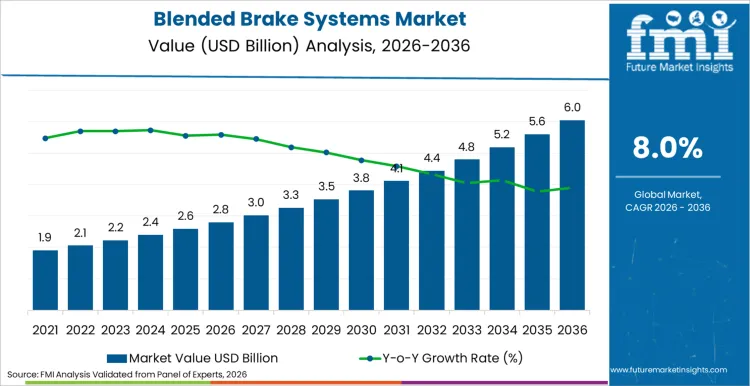
The blended brake systems market begins 2026 at USD 2.8 billion and is projected to reach USD 6.0 billion by 2036 at an 8.0% CAGR. Demand is driven by the need to coordinate friction braking and regenerative braking within unified vehicle control strategies.
Automakers specify blending strategies, pedal feel targets, and fallback behavior during platform definition. System architecture choices determine how hydraulic components, electric actuation, and control software interact under different driving conditions. Once a vehicle platform reaches production release, later changes to blending logic require renewed validation across safety, stability, and drivability programs. Volume growth follows expansion of electrified vehicle platforms and wider adoption of brake-by-wire and integrated chassis control systems.
Participation in the blended brake systems market is governed by platform governance, homologation schedules, and multi-year validation cycles. Access depends on inclusion within approved vehicle architectures rather than on replacement of individual subsystems. Evaluation criteria focus on transition smoothness between regenerative and friction braking, consistency of pedal response, and behavior under low-traction or fault conditions.
Approved systems remain in place for full model cycles because calibration sets and safety cases are tied to specific implementations. Supplier changes occur during platform renewals rather than mid-cycle sourcing actions. Revenue development reflects the number of vehicle programs adopting integrated braking strategies and centralized vehicle control architectures.
Blended Brake Systems Market Quick Stats
- Blended Brake Systems Market Value (2026): USD 2.8 billion
- Blended Brake Systems Market Forecast Value (2036): USD 6.0 billion
- Blended Brake Systems Market Forecast CAGR (2026–2036): 8.0%
- Leading System Type in Blended Brake Systems Market: Electro-Hydraulic Brake (EHB)
- Leading Vehicle Segment in Blended Brake Systems Market: Passenger EVs
- Key Growth Regions in Blended Brake Systems Market: China, USA, Germany, South Korea, Japan
- Top Players in Blended Brake Systems Market: Continental, Bosch, ZF Friedrichshafen, Hitachi Astemo, Brembo, Aptiv, Hyundai Mobis, Valeo, Denso, Nidec
What is the Growth Forecast for the Blended Brake Systems Market through 2036?
Pedal feel, energy recovery targets, and safety case architecture define how modern vehicles combine friction braking with regenerative functions. Blended brake systems sit at the junction of chassis control, power electronics, and battery management. In 2026, the blended brake systems market stands near USD 2.8 billion, supported by passenger EVs, plug in hybrids, and electrified commercial vehicles that require coordinated torque distribution across axles. Platform teams evaluate these systems through blending accuracy, fallback behavior, thermal management, and calibration stability across drive modes. Award decisions attach to vehicle programs rather than to component refresh cycles. The path to USD 6.0 billion by 2036 follows an 8.0% growth profile linked to higher integration levels and wider adoption of brake by wire architectures.
Vehicle architecture governance shapes commercial patterns in the blended brake systems market. Volumes move under multi-year platform contracts tied to homologation schedules and safety validation plans. Inventory exposure remains limited since value concentrates in control units, sensors, actuators, and software stacks. Cost structure reflects hardware redundancy, validation mileage, compliance testing, and long term software maintenance. OEM engineering groups track deceleration consistency, transition smoothness, and fault containment rather than unit price. Annual values pass through the mid and upper four billion during the early 2030s as more platforms converge on unified control domains. The rise to USD 6.0 billion by 2036 comes from higher system complexity, broader deployment in mass market vehicles, and longer platform lifetimes that lock these systems into core vehicle control layers.
Blended Brake Systems Market Key Takeaways
| Metric | Value |
|---|---|
| Market Value (2026) | USD 2.8 billion |
| Forecast Value (2036) | USD 6.0 billion |
| Forecast CAGR (2026–2036) | 8.0% |
Source: Future Market Insights’ proprietary forecasting model and primary research
How Is the Blended Brake Systems Market Being Used to Balance Driver Feel, Safety Requirements, and Energy Recovery in Modern Vehicles?
Blended brake systems combine regenerative braking with friction braking, which turns stopping into a coordination problem rather than a simple mechanical function. System designers must manage torque handover between electric motors and hydraulic brakes without changing pedal response or stopping distance. Vehicle programs focus on low speed behavior, transition smoothness, and fallback performance because these areas reveal most integration weaknesses. Hardware and software teams validate pressure buildup timing, sensor agreement, and failure handling since any mismatch creates noise, vibration, or inconsistent deceleration. Production calibration tracks differences between axle loads, tire types, and temperature conditions because each affects how blending thresholds behave. Qualification depends on predictable response under normal driving and during emergency events, not on theoretical recovery potential.
Planning for these systems centers on platform integration and certification stability rather than on component substitution. Automakers measure value through reduced revalidation cycles, stable pedal maps, and low field complaint rates. A blended system that requires frequent recalibration across variants slows vehicle rollout and increases engineering cost. Manufacturing teams also watch assembly tolerances and bleeding procedures because small mechanical differences change software behavior. Service organizations track diagnostic clarity and update management since many issues appear after software changes. Supplier selection favors groups that can support long term calibration ownership and documentation. Contracts define responsibility for software, hydraulics, and sensors as a combined function because braking behavior affects homologation, warranty exposure, and safety reputation more than any efficiency metric.
How does brake feel targets and platform integration constraints shape demand in the Blended Brake Systems Market by system type and vehicle segment in 2026?
In the Blended Brake Systems Market, platform selection starts from pedal response consistency, fault tolerance, and integration with stability and traction control rather than from component cost. Programs serving passenger electric vehicle platforms, premium vehicle architectures, and light commercial electric fleets require blending strategies that coordinate regenerative and friction braking without disturbing driver confidence. By system type, usage spans electro-hydraulic brake systems, electro-mechanical brake systems, vacuum plus eBooster blending, and other configurations. By vehicle segment, demand covers passenger EVs, premium and luxury vehicles, LCV EVs, and other categories. Portfolio structure reflects validation workload, packaging limits, and cross-platform reuse potential rather than hardware substitution flexibility.
Why Are Vehicle Efficiency and Wear Reduction Driving the Blended Brake Systems Market?
Blended Brake Systems Market demand is influenced by manufacturer requirements to improve braking efficiency and reduce overall system wear in passenger vehicles, commercial fleets, and electric drive platforms. Blended brake systems coordinate regenerative braking with conventional friction brakes, which reduces heat build-up in pads and discs and lengthens component life. Automotive engineers assess blended systems based on torque coordination logic, responsiveness, and performance across vehicle mass and speed ranges. Buyers focus on systems that deliver predictable brake feel, integrate with vehicle control modules, and support consistent performance across production variations. Value is measured in lower maintenance costs, improved energy recovery in electrified platforms, and consistent stopping behavior under varied driving conditions.
What Challenges Are Affecting Adoption and Implementation in the Blended Brake Systems Market?
Blended Brake Systems Market expansion is constrained by control calibration complexity, platform-specific integration requirements, and validation cycles within vehicle programs. Blending logic must balance regenerative and friction braking forces to meet safety expectations and driver feel criteria, which demands precise software tuning and extensive system testing. Variations in vehicle weight distribution, tire grip, and electronic stability control strategies require bespoke calibration for each model. Component cost pressures in competitive vehicle segments influence supplier selection and system architecture choices. Integration with vehicle networks, sensor alignment, and fault handling also shape adoption timelines and procurement decisions for OEM engineering teams.
How Are Product Configurations and Supply Strategies Shaping the Blended Brake Systems Market?
Blended Brake Systems Market offerings are being structured around defined control modules, interface standards, and performance validation data that help automotive teams match system capabilities to vehicle programs efficiently. Suppliers provide documentation on torque allocation profiles, integration requirements with antilock and traction systems, and test results across operating conditions. Portfolio segmentation by vehicle class and expected service load helps OEMs align subsystem selection with program targets. Commercial agreements increasingly include calibration support, software maintenance cycles, and multi-year supply commitments that secure production continuity. Technical collaboration focuses on control strategy optimization, integration checklists, and failure mode analysis to help manufacturers maintain braking quality and system reliability across diverse applications.
What is the Demand for Blended Brake Systems by Country?
| Country | CAGR (%) |
|---|---|
| USA | 7.6% |
| Japan | 6.8% |
| South Korea | 7.4% |
| Germany | 7.4% |
| China | 9.7% |
Source: Future Market Insights’ proprietary forecasting model and primary research
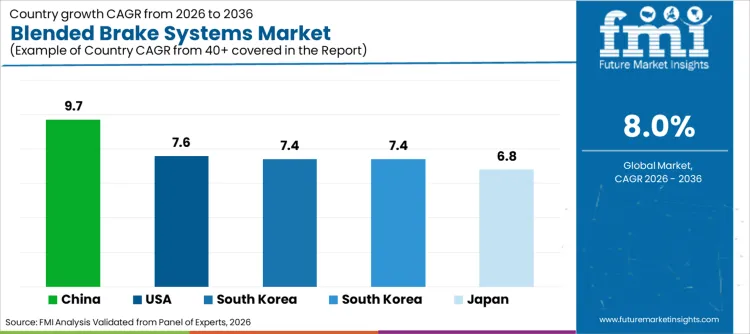
The demand for blended brake systems is increasing across passenger and commercial electric vehicles where integration of hydraulic, mechanical, and regenerative braking enhances energy efficiency and vehicle safety. China leads at 9.7% CAGR, supported by rapid EV adoption, government incentives, and OEM focus on advanced braking systems for energy recovery.
The USA grows at 7.6%, driven by expanding electric vehicle production and adoption of blended braking for improved efficiency. Germany records 7.4%, shaped by integration in hybrid and electric models across premium and mass market segments. South Korea advances at 7.4%, reflecting steady growth in EV and hybrid vehicle production. Japan posts 6.8%, within a mature EV market emphasizing reliability, performance, and integration with vehicle control systems.
How Do Assembly Line Calibration Needs Influence the Blended Brake Systems Market in the USA?
Performance requirements for integrated brake systems are shaping the blended brake systems market in the United States, which is expanding at a 7.6% CAGR. System approval depends on validated coordination between electro-hydraulic, vacuum, and regenerative braking components. Engineers test stopping consistency, pedal feedback, torque distribution, and thermal endurance under simulated and real-world conditions.
Once a configuration meets these criteria, deployment is standardized across multiple EV and hybrid platforms, limiting substitutions. Volume growth aligns with new model introductions, fleet expansion, and upgrades to premium lines. Supplier participation requires robust documentation, proven integration capabilities, and technical support readiness. Production planning follows scheduled vehicle assembly programs. Commercial success relies on reliable multi-platform performance, adherence to safety standards, and support for post-integration troubleshooting.
How Do Regulatory Compliance and Safety Testing Drive Adoption in the Blended Brake Systems Market in Japan?
In Japan, adoption of blended brake systems is growing at a 6.8% CAGR due to strict regulatory safety requirements. Approval depends on demonstrated braking efficiency, regenerative energy capture, and system stability during emergency maneuvers. Engineers evaluate control module response, pedal feel, system integration with electronic stability units, and component wear under high-cycle testing. Once a system is validated, it is implemented across multiple EV and hybrid vehicle lines. Supplier selection requires full compliance documentation, integration testing evidence, and alignment with national safety protocols. Volume growth follows fleet expansion, industrial partnerships, and new platform launches. Commercial positioning depends on consistent performance, regulatory adherence, and engineering support for seamless integration across production facilities.
How Do Vehicle Platform Standardization Policies Affect Scale in the Blended Brake Systems Market in South Korea?
Platform standardization is driving the blended brake systems market in South Korea at a 7.4% CAGR. Approved systems must integrate seamlessly with multiple vehicle variants on shared platforms, including electro-hydraulic and blended braking subsystems.
Testing focuses on energy recovery efficiency, braking torque stability, pedal modulation, and compatibility with traction control units. Once certified, a system is deployed across all compatible vehicles without requiring separate validations. Supplier access depends on technical alignment, documentation compliance, and performance verification. Volume growth corresponds with platform rollouts and fleet expansion rather than ad hoc adoption. Commercial success is linked to repeatable system performance, cross-model compatibility, and long-term support for assembly lines.
How Do Corporate Approval Processes Control Supplier Access in the Blended Brake Systems Market in Germany?
Centralized corporate approval processes are shaping the blended brake systems market in Germany at a 7.4% CAGR. Individual production facilities cannot independently introduce new systems. Validation emphasizes system reliability, integration with vehicle electronic networks, torque modulation, and thermal stability under repeated use.
Once a system is approved, deployment occurs across multiple assembly lines under uniform technical and safety standards. Volume growth follows new EV platform launches and fleet expansions. Supplier participation depends on audit performance, documentation quality, and technical support capabilities. Change management is formal and closely monitored. Commercial success relies on consistent system behavior, compliance with safety protocols, and reliable cross-site integration.
How Do Multi-Line Implementation Programs Drive Growth in the Blended Brake Systems Market in China?
Deployment across multiple assembly lines explains why the blended brake systems market in China is advancing at a 9.7% CAGR. Once a system demonstrates stable braking performance, energy recovery, and thermal management in a pilot facility, it is rolled out to parallel production lines with minimal redesign. Approval emphasizes repeatability, integration reliability, and operational safety.
Expansion teams rely on standardized testing protocols, qualification files, and commissioning procedures. Domestic suppliers gain advantage through proximity to large-scale assembly plants, while imported systems remain concentrated in high-specification applications. Volume growth results from fleet expansion and replication of validated configurations. Commercial advantage depends on early adoption in reference programs, consistent system performance, and robust post-deployment technical support.
How Do Suppliers Compete in the Blended Brake Systems Market?
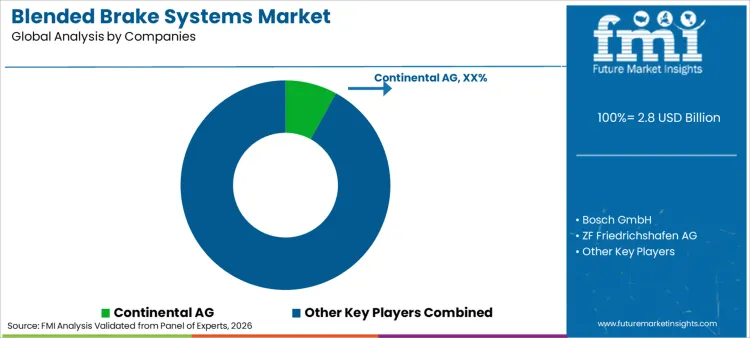
Energy efficiency, system integration, and braking performance guide adoption in the Blended Brake Systems Market. Continental, Bosch, ZF Friedrichshafen, Hitachi Astemo, Brembo, Aptiv, Hyundai Mobis, Valeo, Denso, and Nidec compete during component validation, vehicle-level testing, and control system calibration. Once integrated into EV and hybrid vehicles, modulation accuracy, regenerative energy recovery, and compatibility with electronic stability systems anchor supplier selection. Continental emphasizes modular blended braking solutions for passenger and commercial vehicles. Bosch delivers high-precision systems with integrated control algorithms. ZF Friedrichshafen focuses on scalable architectures for diverse EV platforms. Hitachi Astemo provides ready-to-install systems for multiple vehicle classes. Brembo supplies performance-oriented blended braking solutions. Aptiv offers electronic control integration for safety and efficiency. Hyundai Mobis and Valeo provide fully integrated modules. Denso and Nidec target reliability and OEM-specific compatibility.
Reliability, process consistency, and integration support determine competitive positioning in the Blended Brake Systems Market. OEM engineers evaluate braking torque response, regenerative energy efficiency, system calibration repeatability, and fail-safe mechanisms during validation. Suppliers capable of reproducible production and scalable deployment gain preference. Continental maintains adoption through industrial-scale testing and vehicle integration support. Bosch secures placements via OEM partnerships and software optimization. ZF Friedrichshafen captures share in high-volume EV programs. Hitachi Astemo supports multiple vehicle architectures. Brembo and Aptiv focus on performance and electronic integration. Hyundai Mobis and Valeo provide fully modular solutions. Denso and Nidec maintain positions in motor-integrated and OEM-specific systems. Market positions vary by vehicle type, system architecture, production volume, and regional automotive regulations.
Key Players in Blended Brake Systems Market
- Continental AG
- Bosch GmbH
- ZF Friedrichshafen AG
- Hitachi Astemo, Ltd.
- Brembo S.p.A.
- Aptiv PLC
- Hyundai Mobis Co., Ltd.
- Valeo SA
- Denso Corporation
- Nidec Corporation
Scope of the Report
| Items | Values |
|---|---|
| Quantitative Units (2026) | USD billion |
| System Type | Electro-hydraulic brake (EHB), electro-mechanical brake (EMB), vacuum + eBooster blending, other |
| Vehicle Segment | Passenger EVs, premium/luxury, LCV EVs, other |
| Integration Level | Brake-by-wire integrated, ABS/ESC integrated, powertrain domain integrated, other |
| Sales Channel | OEM line-fit, service/replacement, aftermarket, other |
| Regions Covered | Asia Pacific, Europe, North America, Latin America, Middle East & Africa |
| Countries Covered | United States, Canada, Mexico, Germany, United Kingdom, France, Italy, Spain, Nordics, BENELUX, China, Japan, South Korea, India, Australia & New Zealand, ASEAN, Brazil, Chile, Saudi Arabia, Turkey, South Africa, and other regional markets |
| Key Companies Profiled | Continental, Bosch, ZF Friedrichshafen, Hitachi Astemo, Brembo, Aptiv, Hyundai Mobis, Valeo, Denso, Nidec |
| Additional Attributes | Dollar sales by system type, vehicle segment, integration level, and sales channel, blending calibration complexity and safety validation scope, coordination between regenerative and friction braking, pedal feel consistency and transition smoothness, fallback behavior and fault containment, integration with stability and traction control systems, homologation and multi-year platform adoption cycles, software maintenance and update management, and regional demand patterns across passenger, premium, and commercial electrified vehicle platforms |
Blended Brake Systems Market Segmentation
System Type:
- Electro-Hydraulic Brake (EHB)
- Electro-Mechanical Brake (EMB)
- Vacuum + eBooster Blending
- Other
Vehicle Segment:
- Passenger EVs
- Premium/Luxury
- LCV EVs
- Other
Integration Level:
- Brake-by-Wire Integrated
- ABS/ESC Integrated
- Powertrain Domain Integrated
- Other
Sales Channel:
- OEM Line-Fit
- Service/Replacement
- Aftermarket
- Other
Region:
- Asia Pacific
- China
- Japan
- South Korea
- India
- Australia & New Zealand
- ASEAN
- Rest of Asia Pacific
- Europe
- Germany
- United Kingdom
- France
- Italy
- Spain
- Nordic
- BENELUX
- Rest of Europe
- North America
- United States
- Canada
- Mexico
- Latin America
- Brazil
- Chile
- Rest of Latin America
- Middle East & Africa
- Kingdom of Saudi Arabia
- Other GCC Countries
- Turkey
- South Africa
- Other African Union
- Rest of Middle East & Africa
References
- United Nations Economic Commission for Europe. (2023). UN Regulation No. 13-H: Uniform provisions concerning the approval of passenger cars with regard to braking. UNECE.
- United Nations Economic Commission for Europe. (2023). UN Regulation No. 79: Uniform provisions concerning the approval of vehicles with regard to steering equipment. UNECE. (This is confirmed as an official UNECE regulation)
- United Nations Economic Commission for Europe. (2023). UN Regulation No. 140: Uniform provisions concerning the approval of vehicles with regard to electronic stability control systems. UNECE. (Official UNECE regulatory item)
- United Nations Economic Commission for Europe. (2024). UN Regulation No. 152: Uniform provisions concerning the approval of motor vehicles with regard to advanced emergency braking systems (AEBS). UNECE. (Verified regulation)
-
FAQs
- How big is the blended brake systems market in 2026? The blended brake systems market is projected to be valued at USD 2.8 billion in 2026.
- What will be the size of the blended brake systems market in 2036? The market size for blended brake systems is projected to reach USD 6.0 billion by 2036.
- How much will the demand for blended brake systems grow between 2026 and 2036? Demand for blended brake systems is projected to grow at an 8.0% CAGR between 2026 and 2036.
- Which system type holds a significant share in the blended brake systems market in 2026? In terms of system type, electro-hydraulic brake (EHB) is expected to account for a 44% share in 2026.
- Which vehicle segment contributes a major share in the blended brake systems market in 2026? The passenger EVs segment is expected to command a 60% share in the blended brake systems market in 2026.
Preview the report firsthand - request a free sample
Get SampleGet the brochure for pricing and purchase details.
Get PDFTable of Content
- Executive Summary
- Global Market Outlook
- Demand-side Trends
- Supply-side Trends
- Technology Roadmap Analysis
- Analysis and Recommendations
- Market Overview
- Market Coverage / Taxonomy
- Market Definition / Scope / Limitations
- Market Background
- Market Dynamics
- Drivers
- Restraints
- Opportunity
- Trends
- Scenario Forecast
- Demand in Optimistic Scenario
- Demand in Likely Scenario
- Demand in Conservative Scenario
- Opportunity Map Analysis
- Product Life Cycle Analysis
- Supply Chain Analysis
- Investment Feasibility Matrix
- Value Chain Analysis
- PESTLE and Porter’s Analysis
- Regulatory Landscape
- Regional Parent Market Outlook
- Production and Consumption Statistics
- Import and Export Statistics
- Market Dynamics
- Global Market Analysis 2021 to 2025 and Forecast, 2026 to 2036
- Historical Market Size Value (USD Million) Analysis, 2021 to 2025
- Current and Future Market Size Value (USD Million) Projections, 2026 to 2036
- Y-o-Y Growth Trend Analysis
- Absolute $ Opportunity Analysis
- Global Market Pricing Analysis 2021 to 2025 and Forecast 2026 to 2036
- Global Market Analysis 2021 to 2025 and Forecast 2026 to 2036, By System Type
- Introduction / Key Findings
- Historical Market Size Value (USD Million) Analysis By System Type , 2021 to 2025
- Current and Future Market Size Value (USD Million) Analysis and Forecast By System Type , 2026 to 2036
- Electro-Hydraulic Brake (EHB)
- Electro-Mechanical Brake (EMB)
- Vacuum + eBooster Blending
- Other
- Electro-Hydraulic Brake (EHB)
- Y-o-Y Growth Trend Analysis By System Type , 2021 to 2025
- Absolute $ Opportunity Analysis By System Type , 2026 to 2036
- Global Market Analysis 2021 to 2025 and Forecast 2026 to 2036, By Vehicle Segment
- Introduction / Key Findings
- Historical Market Size Value (USD Million) Analysis By Vehicle Segment, 2021 to 2025
- Current and Future Market Size Value (USD Million) Analysis and Forecast By Vehicle Segment, 2026 to 2036
- Passenger EVs
- Premium/Luxury
- LCV EVs
- Other
- Passenger EVs
- Y-o-Y Growth Trend Analysis By Vehicle Segment, 2021 to 2025
- Absolute $ Opportunity Analysis By Vehicle Segment, 2026 to 2036
- Global Market Analysis 2021 to 2025 and Forecast 2026 to 2036, By Integration Level
- Introduction / Key Findings
- Historical Market Size Value (USD Million) Analysis By Integration Level, 2021 to 2025
- Current and Future Market Size Value (USD Million) Analysis and Forecast By Integration Level, 2026 to 2036
- Brake-by-Wire Integrated
- ABS/ESC Integrated
- Powertrain Domain Integrated
- Other
- Brake-by-Wire Integrated
- Y-o-Y Growth Trend Analysis By Integration Level, 2021 to 2025
- Absolute $ Opportunity Analysis By Integration Level, 2026 to 2036
- Global Market Analysis 2021 to 2025 and Forecast 2026 to 2036, By Sales Channel
- Introduction / Key Findings
- Historical Market Size Value (USD Million) Analysis By Sales Channel, 2021 to 2025
- Current and Future Market Size Value (USD Million) Analysis and Forecast By Sales Channel, 2026 to 2036
- OEM Line-Fit
- Service/Replacement
- Aftermarket
- Other
- OEM Line-Fit
- Y-o-Y Growth Trend Analysis By Sales Channel, 2021 to 2025
- Absolute $ Opportunity Analysis By Sales Channel, 2026 to 2036
- Global Market Analysis 2021 to 2025 and Forecast 2026 to 2036, By Region
- Introduction
- Historical Market Size Value (USD Million) Analysis By Region, 2021 to 2025
- Current Market Size Value (USD Million) Analysis and Forecast By Region, 2026 to 2036
- North America
- Latin America
- Western Europe
- Eastern Europe
- East Asia
- South Asia and Pacific
- Middle East & Africa
- Market Attractiveness Analysis By Region
- North America Market Analysis 2021 to 2025 and Forecast 2026 to 2036, By Country
- Historical Market Size Value (USD Million) Trend Analysis By Market Taxonomy, 2021 to 2025
- Market Size Value (USD Million) Forecast By Market Taxonomy, 2026 to 2036
- By Country
- USA
- Canada
- Mexico
- By System Type
- By Vehicle Segment
- By Integration Level
- By Sales Channel
- By Country
- Market Attractiveness Analysis
- By Country
- By System Type
- By Vehicle Segment
- By Integration Level
- By Sales Channel
- Key Takeaways
- Latin America Market Analysis 2021 to 2025 and Forecast 2026 to 2036, By Country
- Historical Market Size Value (USD Million) Trend Analysis By Market Taxonomy, 2021 to 2025
- Market Size Value (USD Million) Forecast By Market Taxonomy, 2026 to 2036
- By Country
- Brazil
- Chile
- Rest of Latin America
- By System Type
- By Vehicle Segment
- By Integration Level
- By Sales Channel
- By Country
- Market Attractiveness Analysis
- By Country
- By System Type
- By Vehicle Segment
- By Integration Level
- By Sales Channel
- Key Takeaways
- Western Europe Market Analysis 2021 to 2025 and Forecast 2026 to 2036, By Country
- Historical Market Size Value (USD Million) Trend Analysis By Market Taxonomy, 2021 to 2025
- Market Size Value (USD Million) Forecast By Market Taxonomy, 2026 to 2036
- By Country
- Germany
- UK
- Italy
- Spain
- France
- Nordic
- BENELUX
- Rest of Western Europe
- By System Type
- By Vehicle Segment
- By Integration Level
- By Sales Channel
- By Country
- Market Attractiveness Analysis
- By Country
- By System Type
- By Vehicle Segment
- By Integration Level
- By Sales Channel
- Key Takeaways
- Eastern Europe Market Analysis 2021 to 2025 and Forecast 2026 to 2036, By Country
- Historical Market Size Value (USD Million) Trend Analysis By Market Taxonomy, 2021 to 2025
- Market Size Value (USD Million) Forecast By Market Taxonomy, 2026 to 2036
- By Country
- Russia
- Poland
- Hungary
- Balkan & Baltic
- Rest of Eastern Europe
- By System Type
- By Vehicle Segment
- By Integration Level
- By Sales Channel
- By Country
- Market Attractiveness Analysis
- By Country
- By System Type
- By Vehicle Segment
- By Integration Level
- By Sales Channel
- Key Takeaways
- East Asia Market Analysis 2021 to 2025 and Forecast 2026 to 2036, By Country
- Historical Market Size Value (USD Million) Trend Analysis By Market Taxonomy, 2021 to 2025
- Market Size Value (USD Million) Forecast By Market Taxonomy, 2026 to 2036
- By Country
- China
- Japan
- South Korea
- By System Type
- By Vehicle Segment
- By Integration Level
- By Sales Channel
- By Country
- Market Attractiveness Analysis
- By Country
- By System Type
- By Vehicle Segment
- By Integration Level
- By Sales Channel
- Key Takeaways
- South Asia and Pacific Market Analysis 2021 to 2025 and Forecast 2026 to 2036, By Country
- Historical Market Size Value (USD Million) Trend Analysis By Market Taxonomy, 2021 to 2025
- Market Size Value (USD Million) Forecast By Market Taxonomy, 2026 to 2036
- By Country
- India
- ASEAN
- Australia & New Zealand
- Rest of South Asia and Pacific
- By System Type
- By Vehicle Segment
- By Integration Level
- By Sales Channel
- By Country
- Market Attractiveness Analysis
- By Country
- By System Type
- By Vehicle Segment
- By Integration Level
- By Sales Channel
- Key Takeaways
- Middle East & Africa Market Analysis 2021 to 2025 and Forecast 2026 to 2036, By Country
- Historical Market Size Value (USD Million) Trend Analysis By Market Taxonomy, 2021 to 2025
- Market Size Value (USD Million) Forecast By Market Taxonomy, 2026 to 2036
- By Country
- Kingdom of Saudi Arabia
- Other GCC Countries
- Turkiye
- South Africa
- Other African Union
- Rest of Middle East & Africa
- By System Type
- By Vehicle Segment
- By Integration Level
- By Sales Channel
- By Country
- Market Attractiveness Analysis
- By Country
- By System Type
- By Vehicle Segment
- By Integration Level
- By Sales Channel
- Key Takeaways
- Key Countries Market Analysis
- USA
- Pricing Analysis
- Market Share Analysis, 2025
- By System Type
- By Vehicle Segment
- By Integration Level
- By Sales Channel
- Canada
- Pricing Analysis
- Market Share Analysis, 2025
- By System Type
- By Vehicle Segment
- By Integration Level
- By Sales Channel
- Mexico
- Pricing Analysis
- Market Share Analysis, 2025
- By System Type
- By Vehicle Segment
- By Integration Level
- By Sales Channel
- Brazil
- Pricing Analysis
- Market Share Analysis, 2025
- By System Type
- By Vehicle Segment
- By Integration Level
- By Sales Channel
- Chile
- Pricing Analysis
- Market Share Analysis, 2025
- By System Type
- By Vehicle Segment
- By Integration Level
- By Sales Channel
- Germany
- Pricing Analysis
- Market Share Analysis, 2025
- By System Type
- By Vehicle Segment
- By Integration Level
- By Sales Channel
- UK
- Pricing Analysis
- Market Share Analysis, 2025
- By System Type
- By Vehicle Segment
- By Integration Level
- By Sales Channel
- Italy
- Pricing Analysis
- Market Share Analysis, 2025
- By System Type
- By Vehicle Segment
- By Integration Level
- By Sales Channel
- Spain
- Pricing Analysis
- Market Share Analysis, 2025
- By System Type
- By Vehicle Segment
- By Integration Level
- By Sales Channel
- France
- Pricing Analysis
- Market Share Analysis, 2025
- By System Type
- By Vehicle Segment
- By Integration Level
- By Sales Channel
- India
- Pricing Analysis
- Market Share Analysis, 2025
- By System Type
- By Vehicle Segment
- By Integration Level
- By Sales Channel
- ASEAN
- Pricing Analysis
- Market Share Analysis, 2025
- By System Type
- By Vehicle Segment
- By Integration Level
- By Sales Channel
- Australia & New Zealand
- Pricing Analysis
- Market Share Analysis, 2025
- By System Type
- By Vehicle Segment
- By Integration Level
- By Sales Channel
- China
- Pricing Analysis
- Market Share Analysis, 2025
- By System Type
- By Vehicle Segment
- By Integration Level
- By Sales Channel
- Japan
- Pricing Analysis
- Market Share Analysis, 2025
- By System Type
- By Vehicle Segment
- By Integration Level
- By Sales Channel
- South Korea
- Pricing Analysis
- Market Share Analysis, 2025
- By System Type
- By Vehicle Segment
- By Integration Level
- By Sales Channel
- Russia
- Pricing Analysis
- Market Share Analysis, 2025
- By System Type
- By Vehicle Segment
- By Integration Level
- By Sales Channel
- Poland
- Pricing Analysis
- Market Share Analysis, 2025
- By System Type
- By Vehicle Segment
- By Integration Level
- By Sales Channel
- Hungary
- Pricing Analysis
- Market Share Analysis, 2025
- By System Type
- By Vehicle Segment
- By Integration Level
- By Sales Channel
- Kingdom of Saudi Arabia
- Pricing Analysis
- Market Share Analysis, 2025
- By System Type
- By Vehicle Segment
- By Integration Level
- By Sales Channel
- Turkiye
- Pricing Analysis
- Market Share Analysis, 2025
- By System Type
- By Vehicle Segment
- By Integration Level
- By Sales Channel
- South Africa
- Pricing Analysis
- Market Share Analysis, 2025
- By System Type
- By Vehicle Segment
- By Integration Level
- By Sales Channel
- USA
- Market Structure Analysis
- Competition Dashboard
- Competition Benchmarking
- Market Share Analysis of Top Players
- By Regional
- By System Type
- By Vehicle Segment
- By Integration Level
- By Sales Channel
- Competition Analysis
- Competition Deep Dive
- Continental AG
- Overview
- Product Portfolio
- Profitability by Market Segments (Product/Age /Sales Channel/Region)
- Sales Footprint
- Strategy Overview
- Marketing Strategy
- Product Strategy
- Channel Strategy
- Bosch GmbH
- ZF Friedrichshafen AG
- Hitachi Astemo, Ltd.
- Brembo S.p.A.
- Aptiv PLC
- Hyundai Mobis Co., Ltd.
- Valeo SA
- Denso Corporation
- Nidec Corporation
- Continental AG
- Competition Deep Dive
- Assumptions & Acronyms Used
- Research Methodology


