

- Industry Size (2026)
- USD 1393.2 Mn
- Forecast (2036)
- USD 1909 Mn
- CAGR (2026 to 2036)
- 3.2%
Brake and Clutch Fluid Reservoirs Market Forecast and Outlook 2026 to 2036
The brake and clutch fluid reservoirs market is valued at USD 1,393.2 million in 2026 and is projected to reach USD 1,909 million by 2036, registering a CAGR of 3.2%. Value creation remains tied to the non-substitutable role of fluid storage within hydraulic braking and clutch actuation systems. Every vehicle platform requires reservoirs that maintain fluid availability, accommodate thermal expansion, and prevent contamination over extended service periods. Demand behavior reflects safety regulation intensity, braking system architecture complexity, and validation thresholds rather than discretionary component upgrades. OEM sourcing decisions emphasize material stability, permeability control, and compatibility with master cylinders and electronic braking modules.
Between 2026 and 2036, demand progression reflects incremental design refinement rather than structural change. Reservoir specifications evolve around cap sealing integrity, vent calibration, and readiness for fluid level sensing as braking systems integrate tighter diagnostics and monitoring logic. Electrification alters packaging constraints and underhood thermal profiles, influencing resin selection and mounting geometry without displacing core hydraulic requirements. Replacement demand remains governed by fluid aging, seal degradation, and inspection-driven servicing cycles. Manufacturing economics depend on molding precision, resin consistency, and defect control, which limit rapid cost compression. Growth remains compliance-led and maintenance-oriented, with limited sensitivity to short-term vehicle production volatility.
Quick Stats for Brake and Clutch Fluid Reservoirs Market
- Brake and Clutch Fluid Reservoirs Market Value (2026): USD 1,393.2 million
- Brake and Clutch Fluid Reservoirs Market Forecast Value (2036): USD 1,909 million
- Brake and Clutch Fluid Reservoirs Market Forecast CAGR 2026 to 2036: 3.2%
- Leading Material Type by Demand Share: Plastic
- Fastest-Growing Countries: China, Brazil, USA, Germany, South Korea
- Top Players in Global Demand: Bosch, Continental, ZF, Aisin, Hitachi Astemo, Marelli, FTE automotive, TRW (ZF), Aptiv, Valeo
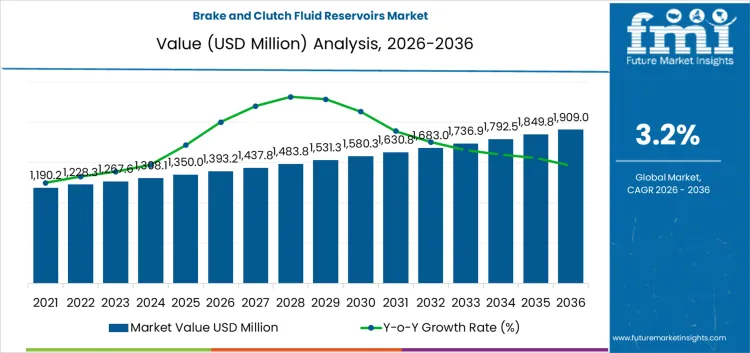
Brake and Clutch Fluid Reservoirs Market Key Takeaways
| Metric | Value |
|---|---|
| Market Value (2026) | USD 1,393.2 million |
| Market Forecast Value (2036) | USD 1,909 million |
| Forecast CAGR 2026 to 2036 | 3.2% |
Why is the Demand for Brake and Clutch Fluid Reservoirs Growing?
Demand for brake and clutch fluid reservoirs is increasing as vehicle manufacturers and fleet operators require reliable hydraulic systems that support consistent braking and clutch performance. Engineers specify reservoirs that meet criteria for material durability, dimensional accuracy, and resistance to thermal cycling because fluid containment and pressure stability are critical for safe operation. Procurement teams evaluate product compliance with automotive safety standards, compatibility with brake and clutch system architectures, and serviceability to ensure predictable maintenance intervals. Regulatory frameworks for vehicle safety and brake performance influence selection of certified components that maintain fluid integrity under varied ambient conditions.
Maintenance planners prioritize reservoirs with robust cap designs and venting systems to reduce contamination risk and support long term hydraulic system reliability. Growth in commercial transport activity and vehicle electrification reinforces uptake of high quality fluid reservoirs that align with evolving powertrain and braking technologies. OEMs and aftermarket specialists coordinate selection with reservoir mounting interfaces and sensor integration to support fluid level monitoring and diagnostic feedback. Workshops and fleet service facilities require consistent availability of replacement units that match engineering specifications to minimize downtime during scheduled service. These technical and operational priorities support sustained adoption of brake and clutch fluid reservoirs across passenger vehicles, commercial trucks, and specialty equipment applications.
How Are the Segments Classified in the Brake and Clutch Fluid Reservoirs Market?
Demand for brake and clutch fluid reservoirs is shaped by vehicle safety requirements, hydraulic system reliability, and regulatory compliance for braking performance. Reservoir integrity directly influences fluid availability, contamination control, and pressure stability during operation. Adoption aligns with increasing vehicle production, platform standardization, and extended service interval expectations. Material and design selection prioritize chemical resistance, thermal stability, and packaging compatibility. Segment classification reflects differentiation by reservoir material, vehicle application, and functional configuration. Structure highlights how material choice, vehicle duty profile, and reservoir architecture influence specification priorities, manufacturing scale, and installation patterns across automotive braking and clutch systems.
Which Material Represents the Largest Share of Demand?
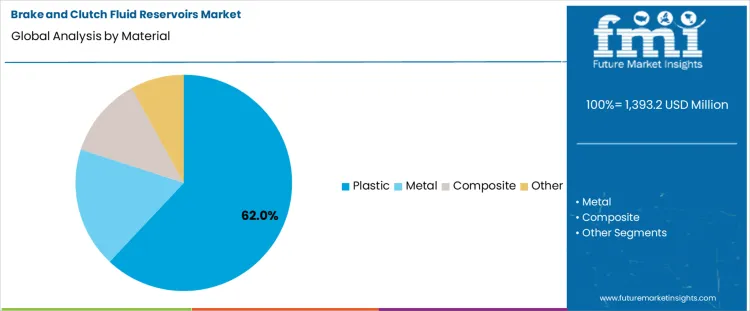
Plastic holds 62.0%, representing the largest share among materials used for brake and clutch fluid reservoirs. Polymer-based reservoirs provide corrosion resistance, lightweight construction, and design flexibility. Transparency enables visual fluid level inspection without additional sensors. Manufacturing scalability supports high-volume production with consistent dimensional accuracy. Plastic compatibility with modern brake fluids supports long-term chemical stability. Metal reservoirs address high-temperature durability requirements with increased weight and cost. Composite and other materials serve niche applications. Material segmentation reflects preference for lightweight, moldable solutions balancing performance, visibility, and cost efficiency across passenger and commercial vehicle platforms.
Key Points
- Plastic supports lightweight and corrosion-resistant reservoir design.
- Visual inspection capability improves maintenance efficiency.
- Other materials address specialized durability requirements.
Which Vehicle Segment Accounts for the Highest Share of Demand?
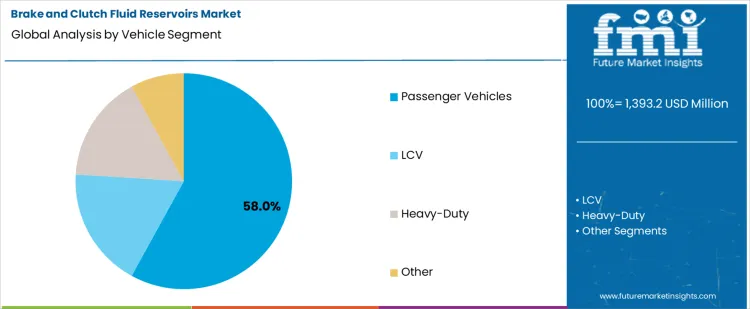
Passenger vehicles hold 58.0%, representing the largest share among vehicle segments using brake and clutch fluid reservoirs. High production volumes drive consistent demand for standardized hydraulic components. Safety regulations and comfort expectations reinforce reliable braking system design. Platform commonality supports reuse of reservoir designs across multiple models. Light commercial and heavy-duty vehicles operate under higher load conditions with lower unit volumes. Other segments contribute limited aggregate demand. Vehicle segmentation reflects concentration of reservoir consumption within passenger platforms where scale, regulatory oversight, and system standardization remain dominant.
Key Points
- Passenger vehicles drive volume-based reservoir consumption.
- Standardized platforms support scalable component integration.
- Other segments apply reservoirs under higher load profiles.
Which Reservoir Type Drives the Largest Share of Demand?
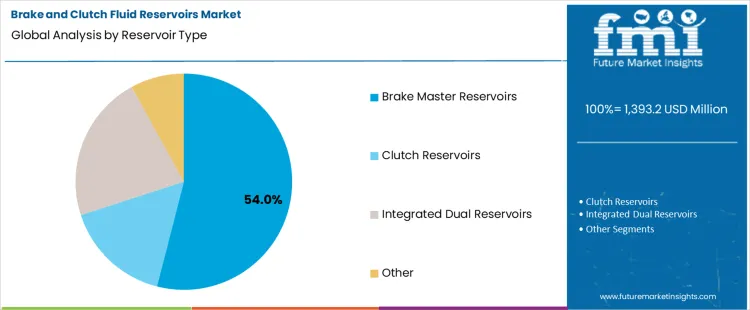
Brake master reservoirs hold 54.0%, representing the largest share among reservoir types due to primary safety function. These reservoirs supply hydraulic fluid to braking circuits requiring constant availability and pressure stability. Design emphasis includes leak prevention, level monitoring, and thermal resistance. Continuous operation and regulatory inspection increase specification priority. Integrated dual reservoirs support combined brake and clutch systems with space optimization. Clutch reservoirs serve lower-pressure actuation needs. Other reservoir types address auxiliary configurations. Reservoir type segmentation reflects dominance of braking-related fluid storage where safety-critical performance drives consistent demand.
Key Points
- Brake reservoirs support primary vehicle safety systems.
- Continuous operation increases reliability requirements.
- Other reservoir types serve secondary hydraulic functions.
What are the Key Dynamics in the Brake and Clutch Fluid Reservoirs Market?
Demand for brake and clutch fluid reservoirs reflects safety-critical requirements within hydraulic braking and clutch actuation systems. Adoption spans passenger vehicles, commercial vehicles, and off-highway equipment across OEM and replacement channels. Global scope aligns with regulated braking performance standards and increasing vehicle parc size. Usage centers on molded plastic reservoirs designed for fluid compatibility, pressure stability, and integration with master cylinders and electronic brake systems.
How do safety regulation and hydraulic system design shape adoption?
Brake and clutch systems rely on stable fluid supply to maintain consistent hydraulic pressure during operation. Demand increases as regulatory frameworks mandate stringent braking performance and fail-safe system behavior. Modern vehicle platforms adopt compact reservoir designs compatible with anti-lock braking systems, electronic stability control, and brake-by-wire architectures. Transparent and sensor-enabled reservoirs support fluid level monitoring and preventive maintenance. Commercial vehicles require higher-capacity reservoirs to accommodate heavier load cycles and extended duty operation. Integration with standardized master cylinder assemblies simplifies OEM installation and assembly efficiency. Adoption reflects non-discretionary inclusion driven by functional necessity and regulatory compliance rather than feature differentiation.
How does material selection, cost pressure, and durability constraints influence market scalability?
Reservoir materials must withstand brake fluid chemical aggressiveness, temperature variation, and vibration exposure. Demand sensitivity rises where higher-grade polymers increase component cost in volume-driven vehicle segments. Design complexity increases with integrated sensors and multi-chamber configurations. Leakage risk and sealing integrity drive strict quality assurance requirements. Aftermarket demand faces price competition from low-cost suppliers with variable durability performance. Regulatory compliance testing adds validation expense and time. Supply chain dependence on automotive-grade plastics exposes manufacturers to resin price volatility. Warranty risk associated with fluid loss or contamination constrains aggressive cost reduction strategies.
How Is Demand for Brake and Clutch Fluid Reservoirs Evolving Globally?
Demand for brake and clutch fluid reservoirs is expanding globally due to sustained vehicle utilization, safety compliance requirements, and maintenance-led replacement across passenger and commercial fleets. Consumption aligns with braking system durability, fluid integrity management, and regulatory inspection regimes. Design evolution toward sealed, sensor-integrated reservoirs supports compatibility with modern braking architectures. Aftermarket demand remains material where mileage accumulation is high. Growth rates in China at 4.2%, Brazil at 4.1%, USA at 3.0%, Germany at 2.9%, and South Korea at 2.7% indicate steady expansion driven by lifecycle servicing needs and safety-focused component standards rather than rapid platform change.
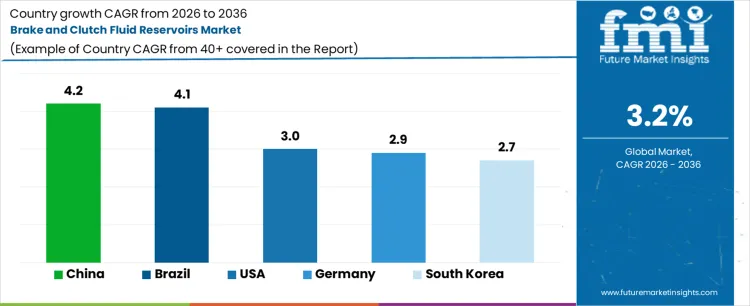
| Country | CAGR (%) |
|---|---|
| China | 4.2% |
| Brazil | 4.1% |
| USA | 3.0% |
| Germany | 2.9% |
| South Korea | 2.7% |
What Is Supporting Brake and Clutch Fluid Reservoir Demand Growth in China?
Brake and clutch fluid reservoir demand in China is growing at a CAGR of 4.2%, supported by high vehicle utilization across logistics, construction, and urban commuting. Frequent braking cycles increase thermal stress and fluid degradation, elevating replacement needs. OEMs specify reservoirs with improved sealing and level-sensing to meet safety compliance. Electrified powertrains and advanced braking systems add compatibility requirements for materials and fittings. Domestic vehicle production sustains OEM volumes, while inspection enforcement encourages timely maintenance. Growth remains maintenance-led, reflecting operating intensity and compliance oversight rather than expansion in vehicle counts.
- High braking cycle frequency in urban operation
- Safety compliance driving sensor-equipped reservoirs
- Electrification increasing material compatibility needs
- Stable OEM demand from domestic production
Why Is Brazil Experiencing Steady Expansion in Fluid Reservoir Demand?
Operating conditions shape brake and clutch fluid reservoir demand in Brazil, expanding at a CAGR of 4.1%. High temperatures and humidity accelerate fluid aging and seal wear. Long-distance freight and urban delivery increase braking frequency and heat exposure. Road conditions contribute to vibration-related stress on reservoir mounts and hoses. Fleet aging supports aftermarket replacement as operators prioritize safety and reliability. Growth reflects environmental exposure and maintenance requirements rather than growth in new vehicle registrations.
- Heat and humidity affecting fluid and seals
- Long-haul and urban delivery braking intensity
- Vibration stress from road conditions
- Aging fleets driving aftermarket replacement
How Is the USA Sustaining Demand for Brake and Clutch Fluid Reservoirs?
Brake and clutch fluid reservoir demand in the USA is expanding at a CAGR of 3.0%, driven by high mileage accumulation and preventive maintenance practices. Diverse climates increase exposure to thermal cycling and moisture ingress. Regulatory inspection standards emphasize brake system integrity and fluid level monitoring. Electrified and advanced driver assistance systems influence reservoir design and integration. Aftermarket replacement dominates due to long vehicle service life. Growth remains measured, aligned with maintenance cycles rather than increases in vehicle production.
- High mileage across passenger and commercial fleets
- Climate diversity increasing thermal cycling exposure
- Safety inspections emphasizing brake integrity
- Strong aftermarket replacement orientation
What Factors Are Shaping Brake and Clutch Fluid Reservoir Demand in Germany?
Engineering discipline shapes brake and clutch fluid reservoir demand in Germany, growing at a CAGR of 2.9%. High-quality materials and precise manufacturing extend service intervals. Strict safety and inspection standards influence reservoir specifications. Preventive maintenance schedules create predictable replacement demand. Export-driven logistics sustain consistent vehicle utilization. Growth reflects disciplined servicing within mature fleets rather than rapid adoption of new braking architectures.
- High material and manufacturing quality standards
- Strict safety and inspection requirements
- Predictable preventive maintenance cycles
- Stable utilization from export logistics
Why Is South Korea Showing Controlled Growth in Fluid Reservoir Demand?
Brake and clutch fluid reservoir demand in South Korea is growing at a CAGR of 2.7%, influenced by efficient fleet management and compact operating geography. Shorter driving distances reduce cumulative braking stress. Strong maintenance discipline limits premature component failure. Manufacturing and port logistics sustain steady vehicle usage. OEMs favor standardized reservoir designs with long service intervals. Growth remains controlled, reflecting efficient operations and scheduled replacement rather than expansion of vehicle populations.
- Shorter routes reducing cumulative braking stress
- Strong preventive maintenance discipline
- Manufacturing and port logistics activity
- Standardized long-life reservoir designs
What is the competitive landscape of demand for the brake and clutch fluid reservoirs market globally?
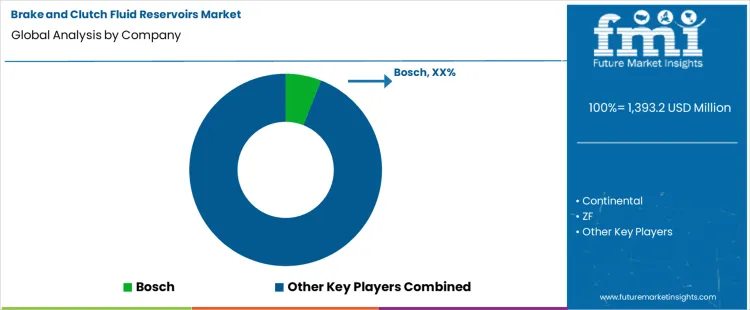
Demand for brake and clutch fluid reservoirs is driven by global vehicle production, safety regulations, and increasing adoption of electronic braking and clutch actuation systems. These reservoirs are essential for hydraulic systems, ensuring proper fluid supply, contamination control, and reliable operation of braking and clutch mechanisms across passenger cars, commercial vehicles, and motorcycles. Buyers evaluate material durability, resistance to hydraulic fluid degradation, thermal tolerance, integration compatibility, and compliance with automotive safety standards. Procurement teams prioritize suppliers with proven OEM qualifications, global manufacturing and supply chain reliability, and engineering support for system integration. Trend in the global market reflects growth of advanced driver assistance systems (ADAS), focus on vehicle safety, and consolidation of component architectures to improve manufacturing efficiency.
Bosch holds leading positioning through a broad portfolio of brake and clutch fluid reservoir systems integrated with braking and control modules for major automotive OEMs worldwide. Continental supports demand with engineered reservoir solutions and fluid management components aligned with modern braking system designs. ZF participates with reservoir products and hydraulic modules used in electronic braking and stability control across vehicle segments. Aisin contributes precision-engineered reservoirs and hydraulic components supporting reliability and long service life in diverse environmental conditions. Hitachi Astemo supplies fluid reservoir systems and ancillary components integrated with broader chassis and safety subsystems. Competitive differentiation depends on material performance under thermal and chemical stress, integration flexibility, quality validation, and ability to meet evolving OEM safety and performance benchmarks.
Key Players in the Brake and Clutch Fluid Reservoirs Market
- Bosch
- Continental
- ZF
- Aisin
- Hitachi Astemo
- Marelli
- FTE automotive
- TRW (ZF)
- Aptiv
- Valeo
Scope of the Report
| Items | Values |
|---|---|
| Quantitative Units | USD million |
| Material | Plastic; Metal; Composite; Other |
| Vehicle Segment | Passenger Vehicles; LCV; Heavy-Duty; Other |
| Reservoir Type | Brake Master Reservoirs; Clutch Reservoirs; Integrated Dual Reservoirs; Other |
| Sales Channel | OEM Line-Fit; Dealer or OES; Independent Aftermarket; Other |
| Regions Covered | Asia Pacific, Europe, North America, Latin America, Middle East & Africa |
| Countries Covered | China, Brazil, USA, Germany, South Korea, and 40+ countries |
| Key Companies Profiled | Bosch; Continental; ZF; Aisin; Hitachi Astemo; Marelli; FTE automotive; TRW; Aptiv; Valeo |
| Additional Attributes | Dollar sales by reservoir type and vehicle segment; adoption trends for plastic and integrated dual reservoirs to reduce weight and packaging volume; fluid compatibility, permeability, and thermal resistance performance metrics; cap sealing integrity, level sensing readiness, and contamination control considerations; compatibility with DOT brake fluids and hydraulic clutch systems; durability under vibration and temperature cycling; compliance with braking system safety standards and OEM validation requirements influencing reservoir specification. |
Brake and Clutch Fluid Reservoirs Market by Segment
Material:
- Plastic
- Metal
- Composite
- Other
Vehicle Segment:
- Passenger Vehicles
- LCV
- Heavy-Duty
- Other
Reservoir Type:
- Brake Master Reservoirs
- Clutch Reservoirs
- Integrated Dual Reservoirs
- Other
Sales Channel:
- OEM Line-Fit
- Dealer or OES
- Independent Aftermarket
- Other
Region:
- Asia Pacific
- China
- Japan
- South Korea
- India
- Australia & New Zealand
- ASEAN
- Rest of Asia Pacific
- Europe
- Germany
- United Kingdom
- France
- Italy
- Spain
- Nordic
- BENELUX
- Rest of Europe
- North America
- United States
- Canada
- Mexico
- Latin America
- Brazil
- Chile
- Rest of Latin America
- Middle East & Africa
- Kingdom of Saudi Arabia
- Other GCC Countries
- Turkey
- South Africa
- Other African Union
- Rest of Middle East & Africa
Bibliography
- Society of Automotive Engineers International. (2024).Hydraulic brake and clutch system design considerations: fluid reservoirs, materials, and durability. SAE Technical Papers.
- International Organization of Motor Vehicle Manufacturers (OICA). (2024).Global vehicle production, braking system adoption, and safety component demand. OICA Statistical Publications.
- European Automobile Manufacturers’ Association (ACEA). (2023).Brake system safety, hydraulic integrity, and regulatory compliance in passenger and commercial vehicles. ACEA Technical Reports.
- National Highway Traffic Safety Administration. (2023).Federal motor vehicle safety standards related to braking systems and hydraulic components. U.S. Department of Transportation Publications.
Frequently Asked Questions
How big is the brake and clutch fluid reservoirs market in 2026?
The global brake and clutch fluid reservoirs market is estimated to be valued at USD 1,393.2 million in 2026.
What will be the size of brake and clutch fluid reservoirs market in 2036?
The market size for the brake and clutch fluid reservoirs market is projected to reach USD 1,909.0 million by 2036.
How much will be the brake and clutch fluid reservoirs market growth between 2026 and 2036?
The brake and clutch fluid reservoirs market is expected to grow at a 3.2% CAGR between 2026 and 2036.
What are the key product types in the brake and clutch fluid reservoirs market?
The key product types in brake and clutch fluid reservoirs market are plastic, metal, composite and other.
Which vehicle segment segment to contribute significant share in the brake and clutch fluid reservoirs market in 2026?
In terms of vehicle segment, passenger vehicles segment to command 58.0% share in the brake and clutch fluid reservoirs market in 2026.
Preview the report firsthand - request a free sample
Get SampleGet the brochure for pricing and purchase details.
Get PDFTable of Content
- Executive Summary
- Global Market Outlook
- Demand-side Trends
- Supply-side Trends
- Technology Roadmap Analysis
- Analysis and Recommendations
- Market Overview
- Market Coverage / Taxonomy
- Market Definition / Scope / Limitations
- Market Background
- Market Dynamics
- Drivers
- Restraints
- Opportunity
- Trends
- Scenario Forecast
- Demand in Optimistic Scenario
- Demand in Likely Scenario
- Demand in Conservative Scenario
- Opportunity Map Analysis
- Product Life Cycle Analysis
- Supply Chain Analysis
- Investment Feasibility Matrix
- Value Chain Analysis
- PESTLE and Porter’s Analysis
- Regulatory Landscape
- Regional Parent Market Outlook
- Production and Consumption Statistics
- Import and Export Statistics
- Market Dynamics
- Global Market Analysis 2021 to 2025 and Forecast, 2026 to 2036
- Historical Market Size Value (USD Million) Analysis, 2021 to 2025
- Current and Future Market Size Value (USD Million) Projections, 2026 to 2036
- Y-o-Y Growth Trend Analysis
- Absolute $ Opportunity Analysis
- Global Market Pricing Analysis 2021 to 2025 and Forecast 2026 to 2036
- Global Market Analysis 2021 to 2025 and Forecast 2026 to 2036, By Material
- Introduction / Key Findings
- Historical Market Size Value (USD Million) Analysis By Material , 2021 to 2025
- Current and Future Market Size Value (USD Million) Analysis and Forecast By Material , 2026 to 2036
- Plastic
- Metal
- Composite
- Other
- Plastic
- Y-o-Y Growth Trend Analysis By Material , 2021 to 2025
- Absolute $ Opportunity Analysis By Material , 2026 to 2036
- Global Market Analysis 2021 to 2025 and Forecast 2026 to 2036, By Vehicle Segment
- Introduction / Key Findings
- Historical Market Size Value (USD Million) Analysis By Vehicle Segment, 2021 to 2025
- Current and Future Market Size Value (USD Million) Analysis and Forecast By Vehicle Segment, 2026 to 2036
- Passenger Vehicles
- LCV
- Heavy-Duty
- Other
- Passenger Vehicles
- Y-o-Y Growth Trend Analysis By Vehicle Segment, 2021 to 2025
- Absolute $ Opportunity Analysis By Vehicle Segment, 2026 to 2036
- Global Market Analysis 2021 to 2025 and Forecast 2026 to 2036, By Reservoir Type
- Introduction / Key Findings
- Historical Market Size Value (USD Million) Analysis By Reservoir Type, 2021 to 2025
- Current and Future Market Size Value (USD Million) Analysis and Forecast By Reservoir Type, 2026 to 2036
- Brake Master Reservoirs
- Clutch Reservoirs
- Integrated Dual Reservoirs
- Other
- Brake Master Reservoirs
- Y-o-Y Growth Trend Analysis By Reservoir Type, 2021 to 2025
- Absolute $ Opportunity Analysis By Reservoir Type, 2026 to 2036
- Global Market Analysis 2021 to 2025 and Forecast 2026 to 2036, By Sales Channel
- Introduction / Key Findings
- Historical Market Size Value (USD Million) Analysis By Sales Channel, 2021 to 2025
- Current and Future Market Size Value (USD Million) Analysis and Forecast By Sales Channel, 2026 to 2036
- OEM Line-Fit
- Dealer or OES
- Independent Aftermarket
- Other
- OEM Line-Fit
- Y-o-Y Growth Trend Analysis By Sales Channel, 2021 to 2025
- Absolute $ Opportunity Analysis By Sales Channel, 2026 to 2036
- Global Market Analysis 2021 to 2025 and Forecast 2026 to 2036, By Region
- Introduction
- Historical Market Size Value (USD Million) Analysis By Region, 2021 to 2025
- Current Market Size Value (USD Million) Analysis and Forecast By Region, 2026 to 2036
- North America
- Latin America
- Western Europe
- Eastern Europe
- East Asia
- South Asia and Pacific
- Middle East & Africa
- Market Attractiveness Analysis By Region
- North America Market Analysis 2021 to 2025 and Forecast 2026 to 2036, By Country
- Historical Market Size Value (USD Million) Trend Analysis By Market Taxonomy, 2021 to 2025
- Market Size Value (USD Million) Forecast By Market Taxonomy, 2026 to 2036
- By Country
- USA
- Canada
- Mexico
- By Material
- By Vehicle Segment
- By Reservoir Type
- By Sales Channel
- By Country
- Market Attractiveness Analysis
- By Country
- By Material
- By Vehicle Segment
- By Reservoir Type
- By Sales Channel
- Key Takeaways
- Latin America Market Analysis 2021 to 2025 and Forecast 2026 to 2036, By Country
- Historical Market Size Value (USD Million) Trend Analysis By Market Taxonomy, 2021 to 2025
- Market Size Value (USD Million) Forecast By Market Taxonomy, 2026 to 2036
- By Country
- Brazil
- Chile
- Rest of Latin America
- By Material
- By Vehicle Segment
- By Reservoir Type
- By Sales Channel
- By Country
- Market Attractiveness Analysis
- By Country
- By Material
- By Vehicle Segment
- By Reservoir Type
- By Sales Channel
- Key Takeaways
- Western Europe Market Analysis 2021 to 2025 and Forecast 2026 to 2036, By Country
- Historical Market Size Value (USD Million) Trend Analysis By Market Taxonomy, 2021 to 2025
- Market Size Value (USD Million) Forecast By Market Taxonomy, 2026 to 2036
- By Country
- Germany
- UK
- Italy
- Spain
- France
- Nordic
- BENELUX
- Rest of Western Europe
- By Material
- By Vehicle Segment
- By Reservoir Type
- By Sales Channel
- By Country
- Market Attractiveness Analysis
- By Country
- By Material
- By Vehicle Segment
- By Reservoir Type
- By Sales Channel
- Key Takeaways
- Eastern Europe Market Analysis 2021 to 2025 and Forecast 2026 to 2036, By Country
- Historical Market Size Value (USD Million) Trend Analysis By Market Taxonomy, 2021 to 2025
- Market Size Value (USD Million) Forecast By Market Taxonomy, 2026 to 2036
- By Country
- Russia
- Poland
- Hungary
- Balkan & Baltic
- Rest of Eastern Europe
- By Material
- By Vehicle Segment
- By Reservoir Type
- By Sales Channel
- By Country
- Market Attractiveness Analysis
- By Country
- By Material
- By Vehicle Segment
- By Reservoir Type
- By Sales Channel
- Key Takeaways
- East Asia Market Analysis 2021 to 2025 and Forecast 2026 to 2036, By Country
- Historical Market Size Value (USD Million) Trend Analysis By Market Taxonomy, 2021 to 2025
- Market Size Value (USD Million) Forecast By Market Taxonomy, 2026 to 2036
- By Country
- China
- Japan
- South Korea
- By Material
- By Vehicle Segment
- By Reservoir Type
- By Sales Channel
- By Country
- Market Attractiveness Analysis
- By Country
- By Material
- By Vehicle Segment
- By Reservoir Type
- By Sales Channel
- Key Takeaways
- South Asia and Pacific Market Analysis 2021 to 2025 and Forecast 2026 to 2036, By Country
- Historical Market Size Value (USD Million) Trend Analysis By Market Taxonomy, 2021 to 2025
- Market Size Value (USD Million) Forecast By Market Taxonomy, 2026 to 2036
- By Country
- India
- ASEAN
- Australia & New Zealand
- Rest of South Asia and Pacific
- By Material
- By Vehicle Segment
- By Reservoir Type
- By Sales Channel
- By Country
- Market Attractiveness Analysis
- By Country
- By Material
- By Vehicle Segment
- By Reservoir Type
- By Sales Channel
- Key Takeaways
- Middle East & Africa Market Analysis 2021 to 2025 and Forecast 2026 to 2036, By Country
- Historical Market Size Value (USD Million) Trend Analysis By Market Taxonomy, 2021 to 2025
- Market Size Value (USD Million) Forecast By Market Taxonomy, 2026 to 2036
- By Country
- Kingdom of Saudi Arabia
- Other GCC Countries
- Turkiye
- South Africa
- Other African Union
- Rest of Middle East & Africa
- By Material
- By Vehicle Segment
- By Reservoir Type
- By Sales Channel
- By Country
- Market Attractiveness Analysis
- By Country
- By Material
- By Vehicle Segment
- By Reservoir Type
- By Sales Channel
- Key Takeaways
- Key Countries Market Analysis
- USA
- Pricing Analysis
- Market Share Analysis, 2025
- By Material
- By Vehicle Segment
- By Reservoir Type
- By Sales Channel
- Canada
- Pricing Analysis
- Market Share Analysis, 2025
- By Material
- By Vehicle Segment
- By Reservoir Type
- By Sales Channel
- Mexico
- Pricing Analysis
- Market Share Analysis, 2025
- By Material
- By Vehicle Segment
- By Reservoir Type
- By Sales Channel
- Brazil
- Pricing Analysis
- Market Share Analysis, 2025
- By Material
- By Vehicle Segment
- By Reservoir Type
- By Sales Channel
- Chile
- Pricing Analysis
- Market Share Analysis, 2025
- By Material
- By Vehicle Segment
- By Reservoir Type
- By Sales Channel
- Germany
- Pricing Analysis
- Market Share Analysis, 2025
- By Material
- By Vehicle Segment
- By Reservoir Type
- By Sales Channel
- UK
- Pricing Analysis
- Market Share Analysis, 2025
- By Material
- By Vehicle Segment
- By Reservoir Type
- By Sales Channel
- Italy
- Pricing Analysis
- Market Share Analysis, 2025
- By Material
- By Vehicle Segment
- By Reservoir Type
- By Sales Channel
- Spain
- Pricing Analysis
- Market Share Analysis, 2025
- By Material
- By Vehicle Segment
- By Reservoir Type
- By Sales Channel
- France
- Pricing Analysis
- Market Share Analysis, 2025
- By Material
- By Vehicle Segment
- By Reservoir Type
- By Sales Channel
- India
- Pricing Analysis
- Market Share Analysis, 2025
- By Material
- By Vehicle Segment
- By Reservoir Type
- By Sales Channel
- ASEAN
- Pricing Analysis
- Market Share Analysis, 2025
- By Material
- By Vehicle Segment
- By Reservoir Type
- By Sales Channel
- Australia & New Zealand
- Pricing Analysis
- Market Share Analysis, 2025
- By Material
- By Vehicle Segment
- By Reservoir Type
- By Sales Channel
- China
- Pricing Analysis
- Market Share Analysis, 2025
- By Material
- By Vehicle Segment
- By Reservoir Type
- By Sales Channel
- Japan
- Pricing Analysis
- Market Share Analysis, 2025
- By Material
- By Vehicle Segment
- By Reservoir Type
- By Sales Channel
- South Korea
- Pricing Analysis
- Market Share Analysis, 2025
- By Material
- By Vehicle Segment
- By Reservoir Type
- By Sales Channel
- Russia
- Pricing Analysis
- Market Share Analysis, 2025
- By Material
- By Vehicle Segment
- By Reservoir Type
- By Sales Channel
- Poland
- Pricing Analysis
- Market Share Analysis, 2025
- By Material
- By Vehicle Segment
- By Reservoir Type
- By Sales Channel
- Hungary
- Pricing Analysis
- Market Share Analysis, 2025
- By Material
- By Vehicle Segment
- By Reservoir Type
- By Sales Channel
- Kingdom of Saudi Arabia
- Pricing Analysis
- Market Share Analysis, 2025
- By Material
- By Vehicle Segment
- By Reservoir Type
- By Sales Channel
- Turkiye
- Pricing Analysis
- Market Share Analysis, 2025
- By Material
- By Vehicle Segment
- By Reservoir Type
- By Sales Channel
- South Africa
- Pricing Analysis
- Market Share Analysis, 2025
- By Material
- By Vehicle Segment
- By Reservoir Type
- By Sales Channel
- USA
- Market Structure Analysis
- Competition Dashboard
- Competition Benchmarking
- Market Share Analysis of Top Players
- By Regional
- By Material
- By Vehicle Segment
- By Reservoir Type
- By Sales Channel
- Competition Analysis
- Competition Deep Dive
- Bosch
- Overview
- Product Portfolio
- Profitability by Market Segments (Product/Age /Sales Channel/Region)
- Sales Footprint
- Strategy Overview
- Marketing Strategy
- Product Strategy
- Channel Strategy
- Continental
- ZF
- Aisin
- Hitachi Astemo
- Marelli
- FTE automotive
- TRW (ZF)
- Aptiv
- Valeo
- Bosch
- Competition Deep Dive
- Assumptions & Acronyms Used
- Research Methodology


