

- Market Size (2026)
- USD 1.7 Bn
- Forecast (2036)
- USD 2.2 Bn
- CAGR (2026 to 2036)
- 2.6%
Brake Fluid Accumulator and Reservoir Components Market Size, Forecast, and Outlook By FMI
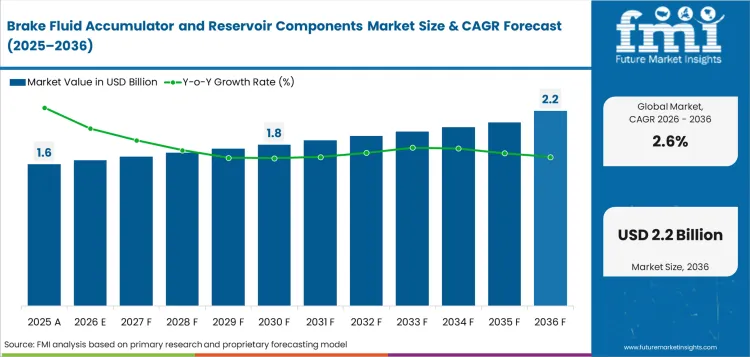
Brake fluid accumulator and reservoir component market reached a value of USD 1.6 billion in 2025 and is expected to reach USD 1.7 billion in 2026. By 2036, the market is projected to reach USD 2.2 billion, expanding at a 2.6% CAGR from 2026 onward.
Summary of the Brake Fluid Accumulator and Reservoir Components Market
- Demand and Growth Drivers
- Vehicle platform continuity creates steady demand for reservoirs as hydraulic brake circuits need fluid storage and level sensing.
- Electrohydraulic braking increases accumulator value as pressure storage becomes important in assisted brake control.
- Service replacement demand comes from reservoir cracking and sensor faults across older vehicles.
- Product and Segment View
- OEM fitment is expected to lead sales channel demand as brake fluid parts need approval during platform engineering.
- Hydraulic brake architecture accounts for the highest demand, with fluid-based braking central to passenger and commercial vehicle programs.
- Reservoir assemblies carry value weight in the component mix as fluid storage and level sensing need validation before vehicle release.
- Geography and Competitive Outlook
- China is expected to record a CAGR of 4.7% during the forecast period 2026-2036 as local vehicle output and brake system sourcing expand.
- India is projected to expand at 4.2% CAGR through 2036 as vehicle production and parts localization improve.
- Companies combining reservoir molding depth with brake system interface knowledge hold stronger supply positions during the forecast period.
- Analyst Opinion
- Nikhil Kaitwade, Principal Consultant for the Automotive domain at FMI, says, “Brake fluid accumulator and reservoir components face strict vehicle platform approval. Hydraulic brake continuity and electrohydraulic pressure control drive demand. Leak-proof molding and sensor integration reduce validation risk as brake-by-wire changes reservoir placement.”
- Brake Fluid Accumulator and Reservoir Components Market Value Analysis
- Brake fluid accumulator and reservoir components are gaining importance as vehicle braking systems need approved fluid storage and pressure control parts.
- Demand is strengthening as hydraulic brake platforms continue to require dependable reservoirs with stable sealing performance.
- Electrohydraulic brake designs are increasing the role of pressure accumulators across controlled brake response applications.
- OEM fitment and sensor-ready reservoir formats are increasing market value through platform approvals. Service replacement demand adds further value across aging vehicle fleets.
Key Takeaways, Market Size, and Forecast
- The brake fluid accumulator and reservoir components market was valued at USD 1.6 billion in 2025.
- By 2036, the brake fluid accumulator and reservoir components market is expected to be worth USD 2.2 billion.
- From 2026 to 2036, the market is projected to expand at a CAGR of 2.6%.
- The market is projected to create an incremental opportunity of USD 0.5 billion between 2026 and 2036.
- OEM fitment is expected to account for 72.0% of sales channel demand in 2026.
- China, with a 4.7% CAGR, and India, at 4.2%, rank among the more rapidly expanding country markets.
Brake fluid accumulator and reservoir suppliers need stronger validation as braking systems add automated control and by-wire functions. FMVSS No. 127 applies to light vehicles up to 10,000 pounds GVWR and sets a September 1, 2029 compliance date for most manufacturers, which raises the need for reliable brake fluid storage and pressure-control parts in safety-linked systems. Bosch’s hydraulic brake-by-wire system completed a 2,050-mile public-road test and uses two independent hydraulic brake actuators, so accumulator and reservoir interfaces become important in redundant brake layouts. ADVICS moved its cooperative regenerative braking pressure source from a gear pump to an electric cylinder in its Toyota RAV4 system, which points to new packaging needs around fluid control units. Brembo’s Sensify entered production as a fluid-free braking architecture fitted on 100% of vehicles in one program, so suppliers must track which platforms keep hydraulic fallback and which move toward fully electronic braking.
Brake Fluid Accumulator and Reservoir Components Market Definition
The brake fluid accumulator and reservoir components market includes fluid storage tanks, pressure accumulators, caps, level sensors, and mounting parts used in automotive brake fluid circuits. These components keep brake fluid available for master cylinders and electrohydraulic brake units. Scope includes OEM and aftermarket parts sold for passenger cars and commercial vehicles. Brake pads, brake fluid, full caliper assemblies, and complete ABS modules are outside the scope.
Brake Fluid Accumulator and Reservoir Components Market Inclusions
Market scope covers all commercially traded brake fluid accumulator and reservoir components categorized by component type, including reservoir assemblies, pressure accumulators, level sensors, reservoir caps, and mount brackets; material type, including plastic, aluminum, steel, and elastomers; vehicle type, including passenger cars, light commercial vehicles, heavy commercial vehicles, and two wheelers; sales channel, including OEM fitment and aftermarket replacement; and brake architecture, including hydraulic brakes, electrohydraulic brakes, brake-by-wire modules, and regenerative brakes. Revenue scope covers 2026 to 2036. The key stakeholders include brake system manufacturers, reservoir component suppliers, pressure accumulator producers, sensor providers, vehicle manufacturers, Tier 1 automotive suppliers, aftermarket distributors, service networks, testing laboratories, material suppliers, and regulatory bodies.
Brake Fluid Accumulator and Reservoir Components Market Exclusions
Scope does not include finished brake fluid, brake pads, brake discs, full calipers, complete master cylinders, complete ABS modules, or electronic control software.
Brake Fluid Accumulator and Reservoir Components Market Research Methodology
- Primary Research: Primary discussions were conducted with vehicle manufacturers, Tier 1 brake system suppliers, reservoir component producers, and aftermarket distributors across key markets.
- Desk Research: Combined data from vehicle safety rules, vehicle production statistics, brake system portfolios, and product references such as brake and clutch fluid reservoirs.
- Market sizing and forecasting: Added component use across automotive brake system components demand and platform-level brake architecture adoption.
- Data validation: Validated quarterly against vehicle output, service replacement demand, and adjacent automotive brake fluid consumption patterns.
Why is the Brake Fluid Accumulator and Reservoir Components Market Growing?
- Hydraulic brake layouts need fluid storage parts across passenger cars and commercial vehicles.
- Electrohydraulic systems increase the value of pressure accumulators in assisted brake control.
- Brake safety rules increase focus on complete system reliability across reservoirs and sensors.
Vehicle production gives this market a stable unit base as every hydraulic layout needs fluid storage hardware. IEA reported in May 2026 electric car sales exceeded 20 million in 2025 and reached 25% of total car sales. This electrified base uses hydraulic fallback or blended braking in many platforms. Reservoir and accumulator suppliers gain from platforms combining regenerative braking with hydraulic safety circuits.
Safety regulation adds another reason for high-confidence brake component validation. NHTSA finalized FMVSS No. 127 in April 2024 and made automatic emergency braking standard on cars and light trucks by September 2029. This rule increases system-level attention across braking hardware and control response. Component makers with stable sealing performance can protect platform approvals under stricter brake safety expectations.
Market Segmentation Analysis
- Reservoir assemblies are projected to lead the component type segment with a 44.0% share, supported by their role in fluid storage and level-control layouts.
- Plastic is expected to capture 63.0% of material preference, as molded reservoir designs support lighter weight and lower production cost.
- Passenger cars are expected to account for 57.0% of vehicle type share, reflecting their high-volume use across global platforms.
- OEM fitment is forecast to represent 72.0% of sales channel activity, since reservoir designs are usually approved early in vehicle development.
- Hydraulic brakes are projected to retain 66.0% of brake architecture share, backed by broad use across established vehicle systems.
The market for brake fluid accumulator and reservoir components is divided into five primary segment groups based on component type, material type, vehicle type, sales channel, and brake architecture. Component type includes reservoir assemblies, pressure accumulators, level sensors, reservoir caps, and mount brackets. Material type includes plastic, aluminum, steel, and elastomers. vehicle type includes passenger cars, light commercial vehicles, heavy commercial vehicles, and two wheelers. Sales channel includes oem fitment and aftermarket replacement. Brake architecture includes hydraulic brakes, electrohydraulic brakes, brake-by-wire modules, and regenerative brakes.
Insights into Brake Fluid Accumulator and Reservoir Components Market by Component Type
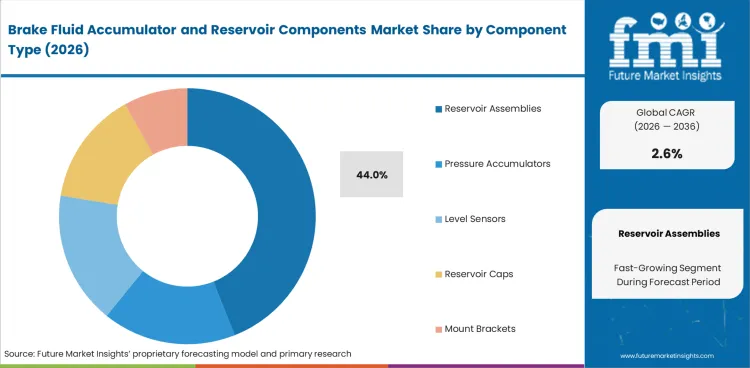
- Reservoir assemblies are expected to account for 44.0% of the component type segment in 2026. Their value reflects integrated fluid storage and matched cap fitment before platform release across brake system programs.
- Pressure accumulators address selected electrohydraulic brake needs. Their role improves in platforms requiring stored pressure for controlled brake response and redundancy planning.
Insights into Brake Fluid Accumulator and Reservoir Components Market by Material Type
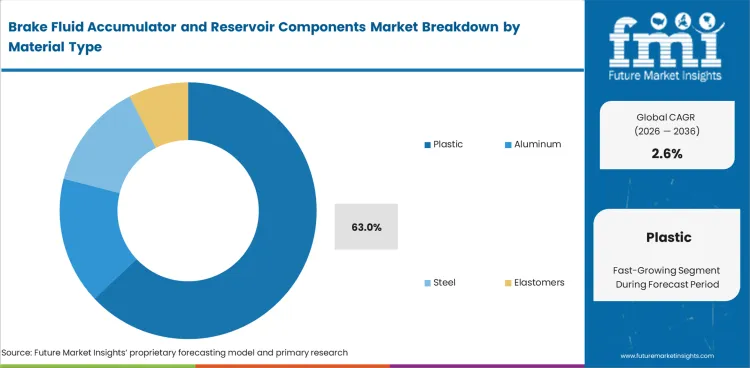
- Plastic is projected to account for 63.0% of the material type segment in 2026. Molded plastic reservoirs reduce weight and allow easier fluid-level inspection near master cylinder packaging.
- Aluminum and steel options serve higher-strength needs in selected brake layouts. Their use is stronger in pressure storage parts and mounting-sensitive assemblies.
Insights into Brake Fluid Accumulator and Reservoir Components Market by Vehicle Type
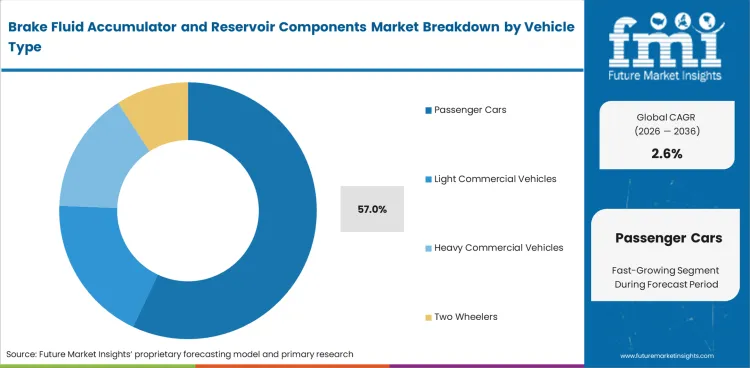
- Passenger cars are expected to represent 57.0% of the vehicle type segment in 2026. High platform volume keeps compact reservoirs and level sensors important across light vehicle programs.
- Commercial vehicles need larger fluid capacity and stronger mounting designs. Their demand carries higher part value in brake systems with heavier duty cycles.
Insights into Brake Fluid Accumulator and Reservoir Components Market by Sales Channel
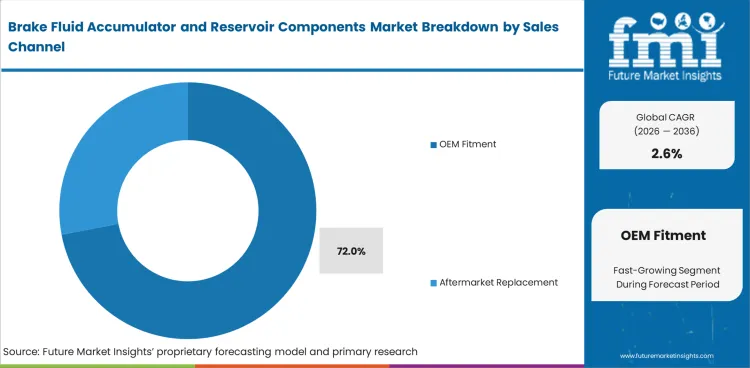
- OEM fitment is forecast to hold 72.0% of the sales channel segment in 2026. Vehicle manufacturers approve brake fluid parts during platform engineering for safety and fit validation.
- Aftermarket replacement serves cracked reservoirs and failed level sensors. Local parts access holds most importance for older vehicles needing fast brake system repair.
Insights into Brake Fluid Accumulator and Reservoir Components Market by Brake Architecture
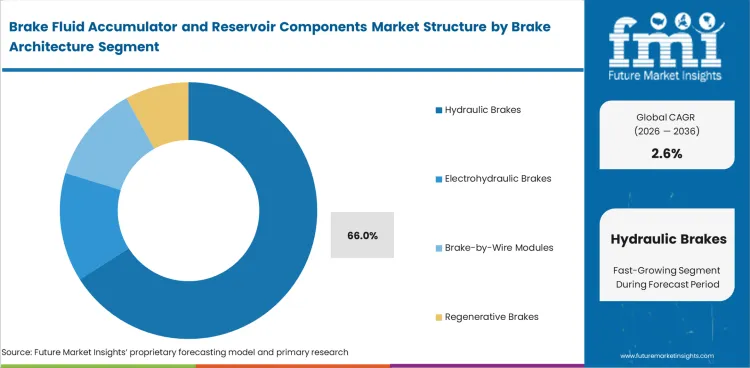
- Hydraulic brakes are expected to make up 66.0% of the brake architecture segment in 2026. Fluid-based braking keeps broad use across passenger cars and commercial vehicles.
- Brake-by-wire modules change pedal feel design and pressure control needs. Reservoirs and accumulators continue to serve blended brake layouts requiring hydraulic fallback.
Brake Fluid Accumulator and Reservoir Components Market Drivers, Restraints, and Opportunities
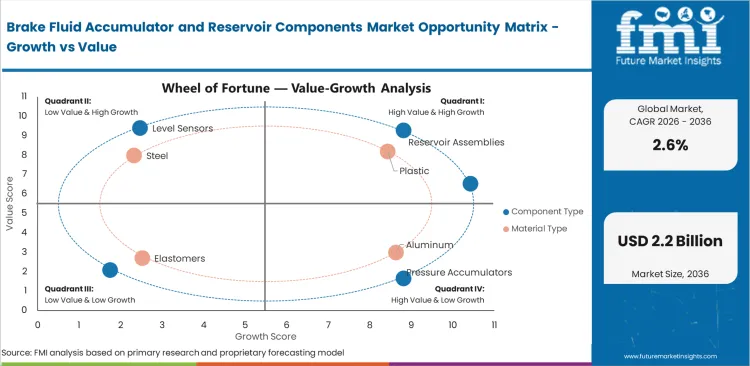
- Brake safety validation raises demand for leak-proof reservoirs and pressure storage parts.
- Plastic resin cost increases pricing pressure for suppliers serving high-volume molded reservoir programs.
- Regenerative braking system adoption improves accumulator opportunities in blended brake architectures.
Brake fluid accumulator and reservoir components keep growing because vehicle platforms need stable fluid storage and reliable pressure response across hydraulic brake systems. Cost pressure and tight validation requirements can slow broader use of sensor-ready reservoirs and higher-value accumulator assemblies. Growth continues through OEM fitment and electrohydraulic brake layouts as replacement demand adds service value.
Production Recovery Is Moderating Unit Quotes
Brake fluid accumulator and reservoir component pricing is being pulled in two directions by vehicle build recovery. In April 2026, OICA reported that global vehicle production rose from 92.7 million units in 2024 to 96.4 million units in 2025, and sales increased from 95.3 million to 99.8 million units. Higher build volumes can improve molding and machining cost absorption for reservoirs and caps. They can improve assembly and validation cost absorption for diaphragms and seals. The pricing benefit is not uniform because OICA noted growth concentration in Asia, while Europe stagnates, and the Americas face demand and production tension. Suppliers areexpected to protect regional quote structures and may avoid offering broad price reductions.
Powertrain Mix Is Repricing Brake Content
Brake fluid accumulator and reservoir pricing is also being reshaped by the uneven shift toward electrified vehicles. In February 2026, the USA Energy Information Administration stated that hybrid, battery electric, and plug-in hybrid vehicles accounted for about 22% of USA light-duty vehicle sales in 2025, up from 20% in 2024. Battery electric vehicle share reached 12% in September 2025 before falling below 6% in each remaining month of 2025. This volatility affects demand visibility for brake-by-wire reservoirs and electro-hydraulic accumulators across changing market conditions. It impacts fluid level sensing and packaging specific components, prompting suppliers to use shorter quote validity andhigher engineering cost recovery and tighter volume-band pricing.
Analysis of Brake Fluid Accumulator and Reservoir Components Market By Key Countries
.webp "Top Country Growth Comparison Brake Fluid Accumulator And Reservoir Components Market Cagr (2026 2036)")
| Country | CAGR |
|---|---|
| China | 4.7% |
| India | 4.2% |
| USA | 3.8% |
| Germany | 3.1% |
| UK | 2.8% |
Source: Future Market Insights, 2026.
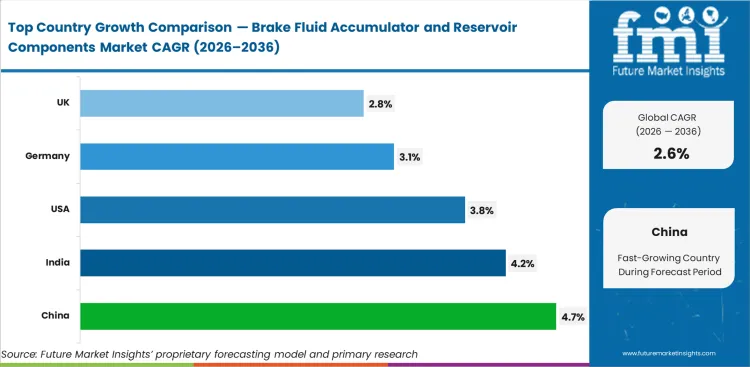
Brake Fluid Accumulator and Reservoir Components Market CAGR Analysis By Country
- China is set to lead country-level growth at a 4.7% CAGR through 2036, supported by rising vehicle output and stronger local sourcing of brake components.
- India is projected to advance at 4.2%, with recovery in vehicle manufacturing and greater auto parts localization improving demand visibility.
- In the USA, a 3.8% CAGR is linked to brake safety regulation and sustained exposure to light-truck assembly programs.
- Germany and the UK are expected to grow at 3.1% and 2.8%, respectively, as mature vehicle fleets create steady replacement-led demand.
Demand for brake fluid accumulator and reservoir components is forecast to rise at 2.6% CAGR from 2026 to 2036. Country-level analysis covers the major markets contributing to this forecast, with the key markets listed below.
Demand Outlook for Brake Fluid Accumulator and Reservoir Components Market in China
Brake fluid accumulator and reservoir components industry in China is projected to record a CAGR of 4.7% through 2036. China’s large vehicle manufacturing base leads to steady demand for brake fluid accumulator and reservoir components. Local vehicle platforms need molded reservoirs and level sensors across hydraulic brake layouts. Electrohydraulic brake systems add demand for caps and pressure-control parts. Local suppliers can gain from vehicle programs requiring reservoirs across hydraulic and electrohydraulic layouts.
- Local vehicle output raises high demand for molded reservoirs and pressure storage hardware.
- New energy vehicle scale increases blended braking needs across regenerative and hydraulic systems.
- Domestic brake suppliers need sensor-ready reservoirs for platform-level sourcing programs.
Sales Analysis of Brake Fluid Accumulator and Reservoir Components Market in India
The brake fluid accumulator and reservoir components sector in India is expected to expand at a CAGR of 4.2% during the assessment period. NITI Aayog’s January 2026 Trade Watch noted total vehicle production at 31.03 million units in FY2024-25. This manufacturing scale backs India brake fluid accumulator and reservoir components demand across two-wheelers and passenger cars. Local suppliers can improve their share through cost control and verified molding capability.
- Passenger vehicle output increases demand for compact reservoir assemblies and caps.
- Two-wheeler production raises demand for smaller hydraulic reservoir parts across brake systems.
- Component localization favors suppliers with stable polymer molding and brake fluid compatibility records.
Demand Outlook for Brake Fluid Accumulator and Reservoir Components Market in the United States
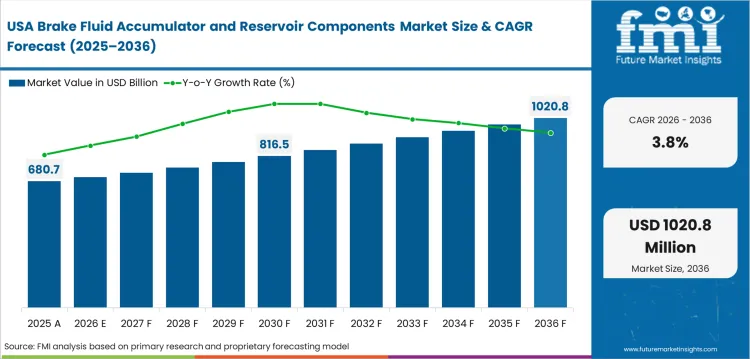
The USA brake fluid accumulator and reservoir components industry is forecast to grow at a CAGR of 3.8% by 2036. FRED reported total motor vehicle assemblies at an annualized 10.6922 million units in April 2026. This assembly base supports steady demand for USA brake fluid accumulator and reservoir components. Brake safety rules add further scrutiny to fluid storage and pressure control parts.
- Light vehicle production sustains demand for reservoirs used near master cylinder assemblies.
- Automatic emergency braking rules increase attention on complete brake system response.
- Aftermarket replacement demand comes from cracked tanks and failed fluid level sensors.
Opportunity Analysis of Brake Fluid Accumulator and Reservoir Components Market in Germany
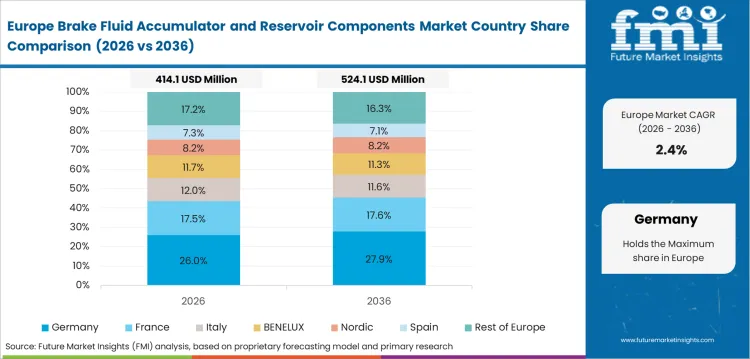
The brake fluid accumulator and reservoir components segment in Germany is expected to advance at 3.1% CAGR over the forecast years. Destatis reported motor vehicles and parts as Germany’s main export product in 2025 with 16.2% of exports. This export base increases demand for Germany brake fluid accumulator and reservoir components across premium platforms. Testing depth and validation records are more importantthan low-cost sourcing in this market.
- Premium vehicle platforms boost demand for high-reliability reservoir and accumulator parts.
- Export exposure increases the need for consistent documentation across global vehicle programs.
- X-by-wire adoption increases interest in semi-dry and electrohydraulic brake architecture.
Future Outlook for Brake Fluid Accumulator and Reservoir Components Market in the United Kingdom
The UK brake fluid accumulator and reservoir components industry is expected to post 2.8% CAGR through 2036. GOV.UK reported 2.617 million first vehicle registrations in 2025 and 528,000 first zero-emission vehicle registrations. This favors UK brake fluid accumulator and reservoir components demand through replacement and import-linked vehicle supply. Service channels are relevant as the licensed vehicle base ages.
- Replacement demand is tied to reservoir damage and warning-light faults in older vehicles.
- Zero-emission registrations lift interest in blended braking and automotive actuator content.
- Import-heavy vehicle supply makes aftermarket availability important for caps and level sensors.
Competitive Landscape and Strategic Positioning
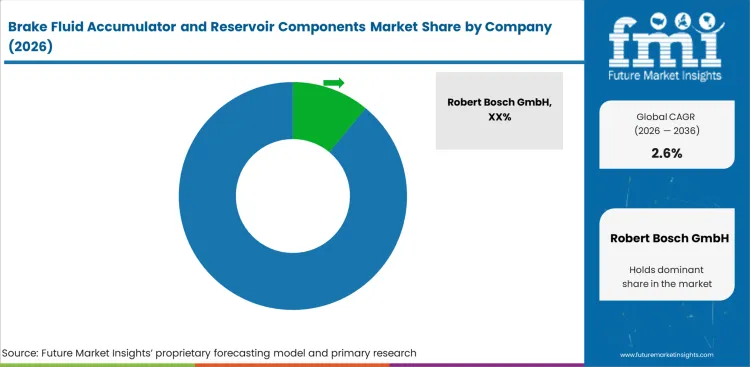
- Robert Bosch GmbH is a leading provider through braking system integration and hydraulic architecture knowledge.
- AUMOVIO and ZF emphasize electronic brake systems and chassis control depth.
- Specialist fluid component suppliers focus on molded reservoirs and sensor-ready parts for platform programs.
Bosch has strong positioning through integrated braking systems and brake-by-wire development depth. AUMOVIO offers electronic brake systems and transition-stage brake architecture coverage. ZF and Hitachi Astemo compete on chassis control and hydraulic system interface experience.
Barriers include validation cost and tight tolerance requirements across molded reservoir programs. Strategic priorities include leak-proof molding and stronger level sensor integration across platform lifecycles. Vehicle manufacturers favor suppliers offering fluid storage reliability and brake electronics fit with fewer coordination gaps. Suppliers with broader brake component menus can reduce sourcing complexity for global platforms.
Key Companies in the Brake Fluid Accumulator and Reservoir Components Market
Key global companies leading the brake fluid accumulator and reservoir components market include:
- Robert Bosch GmbH and AUMOVIO have strong braking system infrastructure for hydraulic and electronic brake programs.
- ZF Friedrichshafen AG and Hitachi Astemo Ltd. serve vehicle manufacturers through chassis control and brake module integration.
- ADVICS Co., Ltd. and HL Mando Corporation hold specialist positions across brake modules and fluid handling parts.
Competitive Benchmarking: Brake Fluid Accumulator and Reservoir Components Market
| Company | Reservoir Molding Depth | Pressure Storage Capability | Brake Electronics Fit | Geographic Footprint |
|---|---|---|---|---|
| Robert Bosch GmbH | High | High | Strong | Global presence across Europe, North America, and Asia Pacific |
| AUMOVIO | High | High | Strong | Strong footprint across Europe, North America, China, and Asia Pacific |
| ZF Friedrichshafen AG | Medium | High | Strong | Global footprint across Europe, North America, Asia Pacific, and Latin America |
| Hitachi Astemo Ltd. | Medium | High | Strong | Strong presence across Japan, North America, Europe, China, and Southeast Asia |
| ADVICS Co., Ltd. | Medium | Medium | Strong | Concentrated footprint across Japan, Asia Pacific, North America, and Europe |
| HL Mando Corporation | Medium | Medium | Strong | Strong footprint across South Korea, North America, China, Europe, and India |
Source: Future Market Insights, 2026.
Key Developments in Brake Fluid Accumulator and Reservoir Components Market
- In May 2026, Brembo announced that SENSIFY™, its intelligent braking platform, entered large-scale series production for a leading global vehicle manufacturer. The system is relevant to brake fluid accumulator and reservoir components becauseit signals a shift away from conventional hydraulic fluid circuits toward software-defined braking architectures.
- In January 2025, Bosch successfully tested its new hydraulic brake-by-wire system on public roads across a long-distance route to the Arctic Circle. The system removes the mechanical connection between the brake pedal and braking system, while using a by-wire brake actuator and ESP® to build brake pressure. This is highly relevant to brake fluid accumulator and reservoir components because it shifts hydraulic pressure control toward compact electrohydraulic actuator modules and more flexible brake fluid system packaging.
Key Players in the Brake Fluid Accumulator and Reservoir Components Market
Major Global Players:
- Robert Bosch GmbH
- AUMOVIO
- ZF Friedrichshafen AG
- Hitachi Astemo Ltd.
- ADVICS Co., Ltd.
- HL Mando Corporation
Specialist Players:
- Aisin Corporation
- FTE Automotive
- Valeo SA
Report Scope and Coverage
| Parameter | Details |
|---|---|
| Quantitative Units | USD 1.7 billion to USD 2.2 billion, at a CAGR of 2.6% |
| Market Definition | Brake fluid storage, pressure storage, and sensor-linked parts used in automotive hydraulic brake circuits. |
| Regions Covered | North America, Latin America, Europe, East Asia, South Asia and Pacific, Middle East and Africa |
| Countries Covered | USA, UK, Germany, China, India, Japan, South Korea, and 30 plus countries |
| Key Companies Profiled | Bosch, AUMOVIO, ZF, Hitachi Astemo, ADVICS, HL Mando |
| Forecast Period | 2026 to 2036 |
| Approach | Hybrid bottom-up and top-down methodology starting with vehicle platform demand and verified brake system use patterns. |
Brake Fluid Accumulator and Reservoir Components Market by Segments
Brake Fluid Accumulator and Reservoir Components Market Segmented by Component Type:
- Reservoir Assemblies
- Pressure Accumulators
- Level Sensors
- Reservoir Caps
- Mount Brackets
Brake Fluid Accumulator and Reservoir Components Market Segmented by Material Type:
- Plastic
- Aluminum
- Steel
- Elastomers
Brake Fluid Accumulator and Reservoir Components Market Segmented by Vehicle Type:
- Passenger Cars
- Light Commercial Vehicles
- Heavy Commercial Vehicles
- Two Wheelers
Brake Fluid Accumulator and Reservoir Components Market Segmented by Sales Channel:
- OEM Fitment
- Aftermarket Replacement
Brake Fluid Accumulator and Reservoir Components Market Segmented by Brake Architecture:
- Hydraulic Brakes
- Electrohydraulic Brakes
- Brake-by-Wire Modules
- Regenerative Brakes
Brake Fluid Accumulator and Reservoir Components Market by Region:
- North America
- USA
- Canada
- Mexico
- Latin America
- Brazil
- Chile
- Rest of Latin America
- Europe
- Germany
- UK
- Italy
- Spain
- France
- Rest of Europe
- East Asia
- China
- Japan
- South Korea
- South Asia and Pacific
- India
- ASEAN
- Australia & New Zealand
- Rest of South Asia and Pacific
- Middle East and Africa
- Saudi Arabia
- Other GCC Countries
- South Africa
- Rest of Middle East and Africa
Research Sources and Bibliography
- National Highway Traffic Safety Administration. (2024, April 29). NHTSA finalizes key safety rule to reduce crashes and save lives.
- International Energy Agency. (2026, May). Global EV Outlook 2026: Trends in electric cars.
- USA Bureau of Labor Statistics. (2026, May). Producer price indexes: Table 9.
- Federal Reserve Bank of St. Louis. (2026, May). Motor Vehicle Assemblies: Total Motor Vehicle Assemblies.
- National Institution for Transforming India. (2026, January). Trade Watch Quarterly April-June Q1 FY26.
- Department for Transport. (2026, April). Vehicle licensing statistics United Kingdom 2025.
- Federal Statistical Office of Germany. (2026, April). The main German export product: motor vehicles.
- Bosch Media Service. (2025, January). With brake-by-wire from Bosch to the Arctic Circle.
- Brembo Group. (2026, May). The new standard begins: Sensify by Brembo enters production.
- National Highway Traffic Safety Administration. (2024, May 9). Federal motor vehicle safety standards; Automatic emergency braking systems for light vehicles. Federal Register.
- ADVICS Co., Ltd. (2025, December 24). ADVICS’ new cooperative regenerative braking system adopted for Toyota RAV4.
- USA Energy Information Administration. (2026, February 9). Electric vehicle sales fell as hybrid vehicle sales continued to rise in 2025.
- International Organization of Motor Vehicle Manufacturers. (2026, April 23). Auto industry growth shifted east in 2025 amid global repositioning.
This Report Answers
- What is the current and future size of the brake fluid accumulator and reservoir components market?
- How fast is the brake fluid accumulator and reservoir components market expected to expand between 2026 and 2036?
- Which component type is expected to lead the market by 2026?
- Which material type is expected to account for the highest demand by 2026?
- What factors are driving demand for brake fluid accumulator and reservoir components globally?
- How are brake safety rules influencing reservoir and accumulator component validation?
- Why is OEM fitment the main demand base for brake fluid components?
- How areABS pump and modulator systems influencing hydraulic brake component design?
- Which countries are projected to record faster expansion through 2036?
- What is driving market expansion in China and India?
- Who are the key companies active in the brake fluid accumulator and reservoir components market?
- How does FMI estimate and validate the brake fluid accumulator and reservoir components forecast?
Frequently Asked Questions
What is the global market demand for brake fluid accumulator and reservoir components in 2026?
In 2026, the global market for brake fluid accumulator and reservoir components is expected to be worth USD 1.7 billion.
How big will the market for Brake Fluid Accumulator and Reservoir Components be in 2036?
By 2036, the market for brake fluid accumulator and reservoir components is expected to be worth USD 2.2 billion.
How much is demand for Brake Fluid Accumulator and Reservoir Components expected to expand between 2026 and 2036?
Between 2026 and 2036, demand for brake fluid accumulator and reservoir components is expected to expand at a CAGR of 2.6%.
Which component type segment isexpected to be the best seller globally by 2026?
Reservoir assemblies are expected to make up 44.0% of the component type segment in 2026.
What is causing demand to rise in China?
China brake fluid accumulator and reservoir components demand is projected to record 4.7% CAGR through 2036, driven by vehicle output and local brake system sourcing.
What is causing demand to rise in India?
India brake fluid accumulator and reservoir components demand is projected to expand at 4.2% CAGR through 2036, backed by vehicle production recovery and parts localization.
What does this report mean by Brake Fluid Accumulator and Reservoir Components Market definition?
The brake fluid accumulator and reservoir components market includes fluid storage tanks, pressure accumulators, caps, level sensors, and mounting parts used in automotive brake fluid circuits.
How does FMI make the Brake Fluid Accumulator and Reservoir Components forecast and check it?
Forecasting models use a hybrid bottom-up and top-down approach, starting with vehicle platform demand and checking results against brake system use patterns.
Preview the report firsthand - request a free sample
Get SampleGet the brochure for pricing and purchase details.
Get PDFTable of Content
- Executive Summary
- Global Market Outlook
- Demand-side Trends
- Supply-side Trends
- Technology Roadmap Analysis
- Analysis and Recommendations
- Market Overview
- Market Coverage / Taxonomy
- Market Definition / Scope / Limitations
- Research Methodology
- Chapter Orientation
- Analytical Lens and Working Hypotheses
- Market Structure, Signals, and Trend Drivers
- Benchmarking and Cross-market Comparability
- Market Sizing, Forecasting, and Opportunity Mapping
- Research Design and Evidence Framework
- Desk Research Programme (Secondary Evidence)
- Company Annual and Sustainability Reports
- Peer-reviewed Journals and Academic Literature
- Corporate Websites, Product Literature, and Technical Notes
- Earnings Decks and Investor Briefings
- Statutory Filings and Regulatory Disclosures
- Technical White Papers and Standards Notes
- Trade Journals, Industry Magazines, and Analyst Briefs
- Conference Proceedings, Webinars, and Seminar Materials
- Government Statistics Portals and Public Data Releases
- Press Releases and Reputable Media Coverage
- Specialist Newsletters and Curated Briefings
- Sector Databases and Reference Repositories
- FMI Internal Proprietary Databases and Historical Market Datasets
- Subscription Datasets and Paid Sources
- Social Channels, Communities, and Digital Listening Inputs
- Additional Desk Sources
- Expert Input and Fieldwork (Primary Evidence)
- Primary Modes
- Qualitative Interviews and Expert Elicitation
- Quantitative Surveys and Structured Data Capture
- Blended Approach
- Why Primary Evidence is Used
- Field Techniques
- Interviews
- Surveys
- Focus Groups
- Observational and In-context Research
- Social and Community Interactions
- Stakeholder Universe Engaged
- C-suite Leaders
- Board Members
- Presidents and Vice Presidents
- R&D and Innovation Heads
- Technical Specialists
- Domain Subject-matter Experts
- Scientists
- Physicians and Other Healthcare Professionals
- Governance, Ethics, and Data Stewardship
- Research Ethics
- Data Integrity and Handling
- Primary Modes
- Tooling, Models, and Reference Databases
- Desk Research Programme (Secondary Evidence)
- Data Engineering and Model Build
- Data Acquisition and Ingestion
- Cleaning, Normalisation, and Verification
- Synthesis, Triangulation, and Analysis
- Quality Assurance and Audit Trail
- Market Background
- Market Dynamics
- Drivers
- Restraints
- Opportunity
- Trends
- Scenario Forecast
- Demand in Optimistic Scenario
- Demand in Likely Scenario
- Demand in Conservative Scenario
- Opportunity Map Analysis
- Product Life Cycle Analysis
- Supply Chain Analysis
- Investment Feasibility Matrix
- Value Chain Analysis
- PESTLE and Porter’s Analysis
- Regulatory Landscape
- Regional Parent Market Outlook
- Production and Consumption Statistics
- Import and Export Statistics
- Market Dynamics
- Global Market Analysis 2021 to 2025 and Forecast, 2026 to 2036
- Historical Market Size Value (USD Million) Analysis, 2021 to 2025
- Current and Future Market Size Value (USD Million) Projections, 2026 to 2036
- Y-o-Y Growth Trend Analysis
- Absolute $ Opportunity Analysis
- Global Market Pricing Analysis 2021 to 2025 and Forecast 2026 to 2036
- Global Market Analysis 2021 to 2025 and Forecast 2026 to 2036, By Component Type
- Introduction / Key Findings
- Historical Market Size Value (USD Million) Analysis By Component Type , 2021 to 2025
- Current and Future Market Size Value (USD Million) Analysis and Forecast By Component Type , 2026 to 2036
- Reservoir Assemblies
- Pressure Accumulators
- Level Sensors
- Reservoir Caps
- Mount Brackets
- Reservoir Assemblies
- Y-o-Y Growth Trend Analysis By Component Type , 2021 to 2025
- Absolute $ Opportunity Analysis By Component Type , 2026 to 2036
- Global Market Analysis 2021 to 2025 and Forecast 2026 to 2036, By Material Type
- Introduction / Key Findings
- Historical Market Size Value (USD Million) Analysis By Material Type, 2021 to 2025
- Current and Future Market Size Value (USD Million) Analysis and Forecast By Material Type, 2026 to 2036
- Plastic
- Aluminum
- Steel
- Elastomers
- Plastic
- Y-o-Y Growth Trend Analysis By Material Type, 2021 to 2025
- Absolute $ Opportunity Analysis By Material Type, 2026 to 2036
- Global Market Analysis 2021 to 2025 and Forecast 2026 to 2036, By Vehicle Type
- Introduction / Key Findings
- Historical Market Size Value (USD Million) Analysis By Vehicle Type, 2021 to 2025
- Current and Future Market Size Value (USD Million) Analysis and Forecast By Vehicle Type, 2026 to 2036
- Passenger Cars
- Light Commercial Vehicles
- Heavy Commercial Vehicles
- Two Wheelers
- Passenger Cars
- Y-o-Y Growth Trend Analysis By Vehicle Type, 2021 to 2025
- Absolute $ Opportunity Analysis By Vehicle Type, 2026 to 2036
- Global Market Analysis 2021 to 2025 and Forecast 2026 to 2036, By Sales Channel
- Introduction / Key Findings
- Historical Market Size Value (USD Million) Analysis By Sales Channel, 2021 to 2025
- Current and Future Market Size Value (USD Million) Analysis and Forecast By Sales Channel, 2026 to 2036
- OEM Fitment
- Aftermarket Replacement
- OEM Fitment
- Y-o-Y Growth Trend Analysis By Sales Channel, 2021 to 2025
- Absolute $ Opportunity Analysis By Sales Channel, 2026 to 2036
- Global Market Analysis 2021 to 2025 and Forecast 2026 to 2036, By Brake Architecture
- Introduction / Key Findings
- Historical Market Size Value (USD Million) Analysis By Brake Architecture, 2021 to 2025
- Current and Future Market Size Value (USD Million) Analysis and Forecast By Brake Architecture, 2026 to 2036
- Hydraulic Brakes
- Electrohydraulic Brakes
- Brake-by-Wire Modules
- Regenerative Brakes
- Hydraulic Brakes
- Y-o-Y Growth Trend Analysis By Brake Architecture, 2021 to 2025
- Absolute $ Opportunity Analysis By Brake Architecture, 2026 to 2036
- Global Market Analysis 2021 to 2025 and Forecast 2026 to 2036, By Region
- Introduction
- Historical Market Size Value (USD Million) Analysis By Region, 2021 to 2025
- Current Market Size Value (USD Million) Analysis and Forecast By Region, 2026 to 2036
- North America
- Latin America
- Western Europe
- Eastern Europe
- East Asia
- South Asia and Pacific
- Middle East & Africa
- Market Attractiveness Analysis By Region
- North America Market Analysis 2021 to 2025 and Forecast 2026 to 2036, By Country
- Historical Market Size Value (USD Million) Trend Analysis By Market Taxonomy, 2021 to 2025
- Market Size Value (USD Million) Forecast By Market Taxonomy, 2026 to 2036
- By Country
- USA
- Canada
- Mexico
- By Component Type
- By Material Type
- By Vehicle Type
- By Sales Channel
- By Brake Architecture
- By Country
- Market Attractiveness Analysis
- By Country
- By Component Type
- By Material Type
- By Vehicle Type
- By Sales Channel
- By Brake Architecture
- Key Takeaways
- Latin America Market Analysis 2021 to 2025 and Forecast 2026 to 2036, By Country
- Historical Market Size Value (USD Million) Trend Analysis By Market Taxonomy, 2021 to 2025
- Market Size Value (USD Million) Forecast By Market Taxonomy, 2026 to 2036
- By Country
- Brazil
- Chile
- Rest of Latin America
- By Component Type
- By Material Type
- By Vehicle Type
- By Sales Channel
- By Brake Architecture
- By Country
- Market Attractiveness Analysis
- By Country
- By Component Type
- By Material Type
- By Vehicle Type
- By Sales Channel
- By Brake Architecture
- Key Takeaways
- Western Europe Market Analysis 2021 to 2025 and Forecast 2026 to 2036, By Country
- Historical Market Size Value (USD Million) Trend Analysis By Market Taxonomy, 2021 to 2025
- Market Size Value (USD Million) Forecast By Market Taxonomy, 2026 to 2036
- By Country
- Germany
- UK
- Italy
- Spain
- France
- Nordic
- BENELUX
- Rest of Western Europe
- By Component Type
- By Material Type
- By Vehicle Type
- By Sales Channel
- By Brake Architecture
- By Country
- Market Attractiveness Analysis
- By Country
- By Component Type
- By Material Type
- By Vehicle Type
- By Sales Channel
- By Brake Architecture
- Key Takeaways
- Eastern Europe Market Analysis 2021 to 2025 and Forecast 2026 to 2036, By Country
- Historical Market Size Value (USD Million) Trend Analysis By Market Taxonomy, 2021 to 2025
- Market Size Value (USD Million) Forecast By Market Taxonomy, 2026 to 2036
- By Country
- Russia
- Poland
- Hungary
- Balkan & Baltic
- Rest of Eastern Europe
- By Component Type
- By Material Type
- By Vehicle Type
- By Sales Channel
- By Brake Architecture
- By Country
- Market Attractiveness Analysis
- By Country
- By Component Type
- By Material Type
- By Vehicle Type
- By Sales Channel
- By Brake Architecture
- Key Takeaways
- East Asia Market Analysis 2021 to 2025 and Forecast 2026 to 2036, By Country
- Historical Market Size Value (USD Million) Trend Analysis By Market Taxonomy, 2021 to 2025
- Market Size Value (USD Million) Forecast By Market Taxonomy, 2026 to 2036
- By Country
- China
- Japan
- South Korea
- By Component Type
- By Material Type
- By Vehicle Type
- By Sales Channel
- By Brake Architecture
- By Country
- Market Attractiveness Analysis
- By Country
- By Component Type
- By Material Type
- By Vehicle Type
- By Sales Channel
- By Brake Architecture
- Key Takeaways
- South Asia and Pacific Market Analysis 2021 to 2025 and Forecast 2026 to 2036, By Country
- Historical Market Size Value (USD Million) Trend Analysis By Market Taxonomy, 2021 to 2025
- Market Size Value (USD Million) Forecast By Market Taxonomy, 2026 to 2036
- By Country
- India
- ASEAN
- Australia & New Zealand
- Rest of South Asia and Pacific
- By Component Type
- By Material Type
- By Vehicle Type
- By Sales Channel
- By Brake Architecture
- By Country
- Market Attractiveness Analysis
- By Country
- By Component Type
- By Material Type
- By Vehicle Type
- By Sales Channel
- By Brake Architecture
- Key Takeaways
- Middle East & Africa Market Analysis 2021 to 2025 and Forecast 2026 to 2036, By Country
- Historical Market Size Value (USD Million) Trend Analysis By Market Taxonomy, 2021 to 2025
- Market Size Value (USD Million) Forecast By Market Taxonomy, 2026 to 2036
- By Country
- Kingdom of Saudi Arabia
- Other GCC Countries
- Turkiye
- South Africa
- Other African Union
- Rest of Middle East & Africa
- By Component Type
- By Material Type
- By Vehicle Type
- By Sales Channel
- By Brake Architecture
- By Country
- Market Attractiveness Analysis
- By Country
- By Component Type
- By Material Type
- By Vehicle Type
- By Sales Channel
- By Brake Architecture
- Key Takeaways
- Key Countries Market Analysis
- USA
- Pricing Analysis
- Market Share Analysis, 2025
- By Component Type
- By Material Type
- By Vehicle Type
- By Sales Channel
- By Brake Architecture
- Canada
- Pricing Analysis
- Market Share Analysis, 2025
- By Component Type
- By Material Type
- By Vehicle Type
- By Sales Channel
- By Brake Architecture
- Mexico
- Pricing Analysis
- Market Share Analysis, 2025
- By Component Type
- By Material Type
- By Vehicle Type
- By Sales Channel
- By Brake Architecture
- Brazil
- Pricing Analysis
- Market Share Analysis, 2025
- By Component Type
- By Material Type
- By Vehicle Type
- By Sales Channel
- By Brake Architecture
- Chile
- Pricing Analysis
- Market Share Analysis, 2025
- By Component Type
- By Material Type
- By Vehicle Type
- By Sales Channel
- By Brake Architecture
- Germany
- Pricing Analysis
- Market Share Analysis, 2025
- By Component Type
- By Material Type
- By Vehicle Type
- By Sales Channel
- By Brake Architecture
- UK
- Pricing Analysis
- Market Share Analysis, 2025
- By Component Type
- By Material Type
- By Vehicle Type
- By Sales Channel
- By Brake Architecture
- Italy
- Pricing Analysis
- Market Share Analysis, 2025
- By Component Type
- By Material Type
- By Vehicle Type
- By Sales Channel
- By Brake Architecture
- Spain
- Pricing Analysis
- Market Share Analysis, 2025
- By Component Type
- By Material Type
- By Vehicle Type
- By Sales Channel
- By Brake Architecture
- France
- Pricing Analysis
- Market Share Analysis, 2025
- By Component Type
- By Material Type
- By Vehicle Type
- By Sales Channel
- By Brake Architecture
- India
- Pricing Analysis
- Market Share Analysis, 2025
- By Component Type
- By Material Type
- By Vehicle Type
- By Sales Channel
- By Brake Architecture
- ASEAN
- Pricing Analysis
- Market Share Analysis, 2025
- By Component Type
- By Material Type
- By Vehicle Type
- By Sales Channel
- By Brake Architecture
- Australia & New Zealand
- Pricing Analysis
- Market Share Analysis, 2025
- By Component Type
- By Material Type
- By Vehicle Type
- By Sales Channel
- By Brake Architecture
- China
- Pricing Analysis
- Market Share Analysis, 2025
- By Component Type
- By Material Type
- By Vehicle Type
- By Sales Channel
- By Brake Architecture
- Japan
- Pricing Analysis
- Market Share Analysis, 2025
- By Component Type
- By Material Type
- By Vehicle Type
- By Sales Channel
- By Brake Architecture
- South Korea
- Pricing Analysis
- Market Share Analysis, 2025
- By Component Type
- By Material Type
- By Vehicle Type
- By Sales Channel
- By Brake Architecture
- Russia
- Pricing Analysis
- Market Share Analysis, 2025
- By Component Type
- By Material Type
- By Vehicle Type
- By Sales Channel
- By Brake Architecture
- Poland
- Pricing Analysis
- Market Share Analysis, 2025
- By Component Type
- By Material Type
- By Vehicle Type
- By Sales Channel
- By Brake Architecture
- Hungary
- Pricing Analysis
- Market Share Analysis, 2025
- By Component Type
- By Material Type
- By Vehicle Type
- By Sales Channel
- By Brake Architecture
- Kingdom of Saudi Arabia
- Pricing Analysis
- Market Share Analysis, 2025
- By Component Type
- By Material Type
- By Vehicle Type
- By Sales Channel
- By Brake Architecture
- Turkiye
- Pricing Analysis
- Market Share Analysis, 2025
- By Component Type
- By Material Type
- By Vehicle Type
- By Sales Channel
- By Brake Architecture
- South Africa
- Pricing Analysis
- Market Share Analysis, 2025
- By Component Type
- By Material Type
- By Vehicle Type
- By Sales Channel
- By Brake Architecture
- USA
- Market Structure Analysis
- Competition Dashboard
- Competition Benchmarking
- Market Share Analysis of Top Players
- By Regional
- By Component Type
- By Material Type
- By Vehicle Type
- By Sales Channel
- By Brake Architecture
- Competition Analysis
- Competition Deep Dive
- Robert Bosch GmbH
- Overview
- Product Portfolio
- Profitability by Market Segments (Product/Age /Sales Channel/Region)
- Sales Footprint
- Strategy Overview
- Marketing Strategy
- Product Strategy
- Channel Strategy
- AUMOVIO
- ZF Friedrichshafen AG
- Hitachi Astemo Ltd.
- ADVICS Co., Ltd.
- HL Mando Corporation
- Robert Bosch GmbH
- Competition Deep Dive
- Assumptions & Acronyms Used


