

- Industry Size (2026)
- USD 165.0 Mn
- Forecast (2036)
- USD 980.0 Mn
- CAGR (2026 to 2036)
- 19.5%
Automotive Brake-by-Wire Pedal Simulator Market Size, Market Forecast and Outlook By FMI
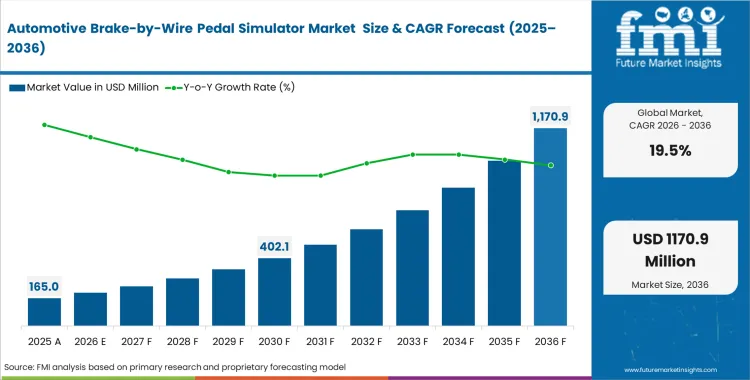
The automotive brake-by-wire pedal simulator market crossed a valuation of USD 138.1 million in 2025 and is projected to surpass USD 165.0 million in 2026, expanding at a CAGR of 19.5% during the forecast period. Strong demand drives total valuation to USD 980.0 million by 2036 as automakers fully decouple mechanical linkages to optimize regenerative energy recovery.
Summary of Automotive Brake-by-Wire Pedal Simulator Market
- The market is forecast to reach USD 980.0 million by 2036.
- The market is expected to grow at a CAGR of 19.5% from 2026 to 2036.
- The market was estimated at USD 138.1 million in 2025.
- The market is projected to generate an incremental opportunity of USD 842 million over the forecast period.
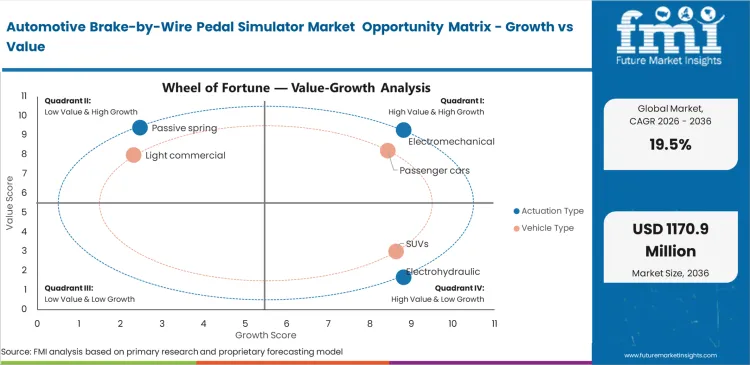
- Electromechanical systems lead by actuation type with a 43.0% share in 2026.
- Passenger cars dominate by vehicle type with a 71.0% share in 2026.
- Battery electric vehicles lead by propulsion type with a 49.0% share in 2026.
- One-box architecture dominates by system design with a 54.0% share in 2026.
- OEM channel leads by sales channel with a 91.0% share in 2026.
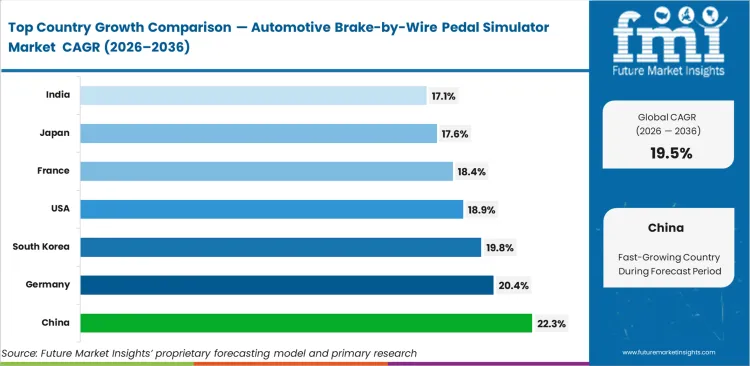
- China is the fastest-growing market at 22.3%, followed by Germany at 20.4% and South Korea at 19.8%.
- The market is driven by the shift toward fully electronic braking systems, rising electric vehicle adoption, and the need to replicate natural pedal feel in brake-by-wire architectures.
- Key companies in the market include FORVIA HELLA, Bosch, ZF Friedrichshafen, Continental, BOGE Rubber & Plastics, and CTS Corporation.
Consistent pedal feel remains a core requirement as electric vehicle braking systems become more software-led. Regenerative braking handles a large share of routine deceleration, which reduces direct reliance on friction brakes during normal driving. That shift makes pedal calibration more complex, since response can vary with battery state, energy recovery levels, and vehicle operating conditions. Automotive brake pedal simulator demand is rising as manufacturers work to deliver a uniform braking sensation that matches driver expectations across changing drive cycles.
X-by-wire architectures are gaining relevance because they let manufacturers manage pedal feedback through electronic control rather than through purely mechanical resistance. Digital pedal simulation helps recreate the familiar braking feel associated with conventional systems while supporting tighter coordination between regenerative and friction braking. Stronger interest in these systems also reflects the need for more precise control in vehicles equipped with advanced safety functions, where rapid and repeatable brake response carries growing importance.
China is estimated to record a CAGR of 22.3% in the automotive brake pedal simulator market during 2026 to 2036, supported by large-scale electric vehicle production and faster integration of software-defined vehicle platforms. Germany is projected to expand at a CAGR of 20.4% over the same period, reflecting continued focus on next-generation braking architecture across premium and performance vehicle programs. South Korea is expected to advance at a CAGR of 19.8% during 2026 to 2036, aided by concentrated OEM investment in electronically controlled braking systems. Demand in the United States is likely to rise at a CAGR of 18.9% through 2036, while France is anticipated to grow at 18.4%. Japan is forecasted to register a CAGR of 17.6% during the assessment period, and India is likely to expand at 17.1%, pointing to a broader industry shift toward braking systems that are less dependent on conventional vacuum-assisted layouts.
Segmental Analysis
Automotive Brake-by-Wire Pedal Simulator Market Analysis by Actuation Type
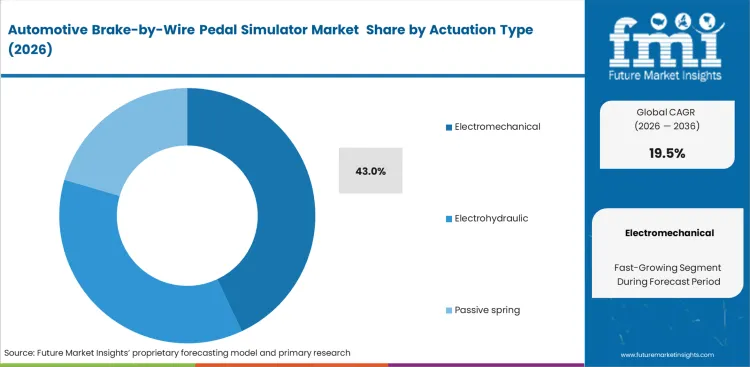
Active motor-driven resistance is rapidly replacing passive spring mechanisms as cars require continuous pedal feel adjustments. Electromechanical components are estimated to account for an anticipated 43.0% share in 2026, driven primarily by their superior software adaptability. Automotive engineers prefer these active units because they allow over-the-air updates to change braking feedback long after the car leaves the dealership. Relying on older passive springs severely limits a manufacturer's ability to add predictive collision avoidance features. Pure mechanical simulation struggles to communicate varying regenerative torque levels back to the driver during daily commutes. Full transition to dictates whether a brand can successfully offer selectable driving modes with distinct deceleration profiles.
- Dynamic Calibration: Software engineers adjust pedal firmness via over-the-air updates. Vehicle dynamics engineers avoid costly physical hardware revisions during mid-cycle vehicle refreshes.
- Regenerative Blending: Digital feedback masking hides the transition between motor generation and friction application. Drivers experience consistent deceleration without noticing underlying system changes.
- Algorithmic Intervention: Active force pushback warns drivers during autonomous emergency braking events. Safety groups achieve higher crash test ratings by integrating tactile driver alerts directly through the pedal.
Automotive Brake-by-Wire Pedal Simulator Market Analysis by Vehicle Type
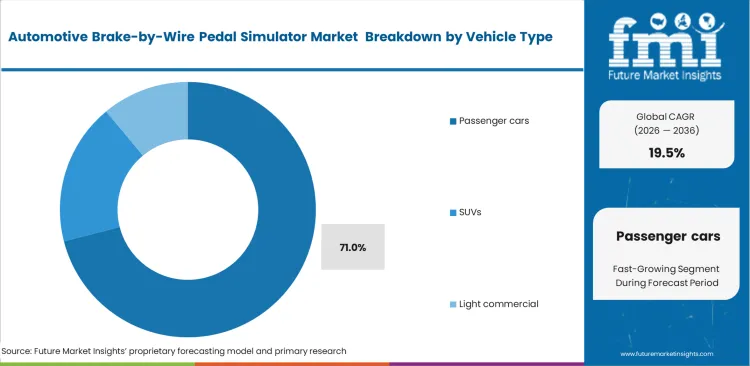
High-volume electrification determines where advanced digital hardware first reaches the road. Global automakers prioritize commuter vehicles everyday to spread out massive research and development costs across millions of units quickly. Sport utility platforms often borrow these exact electrical architectures to save money. Delaying cross-platform standardization forces manufacturers to support parallel supply chains for both old mechanical parts and new digital hardware. Based on current production schedules, the passenger cars segment is expected to hold a projected 71.0% share in 2026 as factory output scales globally. Mass market adoption ensures unit economics become profitable within just two production cycles.
- Volume Amortization: Mass market platforms absorb high initial component costs through sheer scale. Purchasing groups achieve workable unit economics within two production cycles.
- Platform Sharing: Modular electric skateboard designs utilize identical pedal boxes across multiple body styles. Assembly plants reduce complexity by eliminating physical hydraulic line routing through firewalls.
- Consumer Expectation: Sedan and hatchback buyers expect refined driving dynamics. Calibration engineers focus on eliminating pedal dead zones typical of early hybrid applications.
Automotive Brake-by-Wire Pedal Simulator Market Analysis by Propulsion
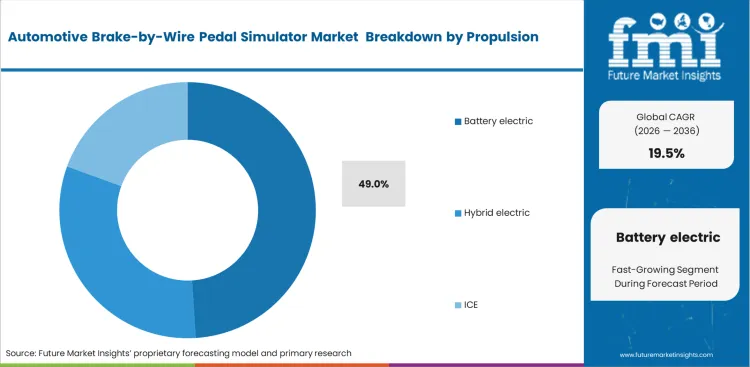
Battery electric platforms are estimated to account for 49.0% share of the market in 2026, reflecting how fully electric vehicle architecture changes the design logic of braking systems. Pure battery electric drivetrains do not carry the engine vacuum source that supported brake boosting in conventional vehicle layouts for years. This shift pushes manufacturers toward braking systems where pedal input, friction response, and regenerative control are managed with far greater precision. Automotive brake pedal simulator adoption gains strength in this segment because full electric platforms benefit more directly from electronically coordinated braking performance.
Complete decoupling between pedal feel and hydraulic friction delivery becomes more relevant in battery electric vehicles because it supports smoother regeneration management and more controlled energy recovery. That layout helps preserve braking consistency while allowing the vehicle to recover energy without relying too early on mechanical brake engagement. Hybrid architecture still operates with blended configurations, which can limit calibration freedom and create a more compromised pedal response. Conventional internal combustion platforms face less pressure to adopt full integration, since their braking architecture does not depend on the same level of electronic coordination. This gap continues to widen as vehicle programs place greater value on precise brake control within software-led platforms.
- Energy Maximization: Decoupled braking systems are expected to improve kinetic energy recovery by delaying unnecessary friction brake engagement. Better coordination between regenerative and mechanical braking also supports vehicle range optimization.
- Vacuum Elimination: Battery electric vehicles lack a natural vacuum source for traditional brake boosters, which increases the relevance of electronically controlled alternatives. Packaging flexibility from this shift can also support better space use within vehicle architecture.
- Transitional Limits: Plug-in hybrid systems often rely on blended braking layouts that create calibration complexity. Balancing mechanical braking requirements with regenerative performance remains more difficult in these intermediate configurations.
Automotive Brake-by-Wire Pedal Simulator Market Analysis by Architecture
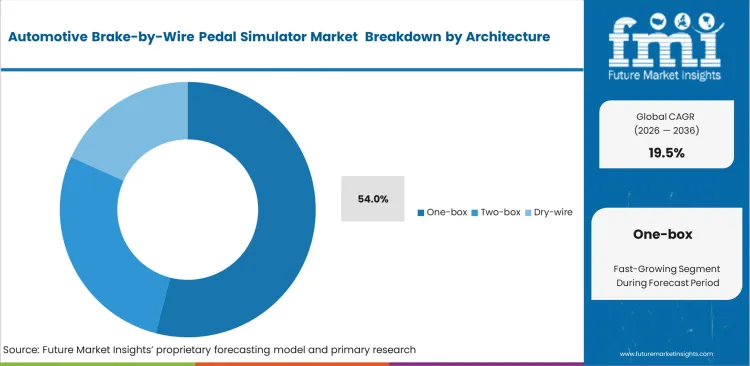
Under-hood packaging efficiency plays a central role in how braking hardware is configured in modern vehicles. Integrating the electronic stability control unit, booster, and master cylinder into a single module helps reduce space use and supports lighter system architecture. One-box systems are estimated to account for 54.0% share of the market in 2026, reflecting strong preference for compact braking layouts across high-volume vehicle production. This format also supports simpler vehicle integration, especially where manufacturers are working to manage weight more carefully in electric platforms.
Assembly advantages add to the appeal of one-box designs because a consolidated module reduces installation complexity compared with more distributed braking layouts. Fewer separate components can improve line efficiency and lower integration effort during vehicle assembly. Two-box systems still retain relevance in selected heavy commercial vehicle applications, where hydraulic redundancy and platform-specific braking requirements remain more important. Demand for one-box configurations is likely to stay stronger in mainstream passenger vehicle programs, where compact design and weight control continue to shape braking system decisions.
- Weight Reduction: One-box systems are expected to lower overall system mass by combining multiple braking components into a single housing. This benefit remains important in vehicle platforms where weight efficiency supports broader performance targets.
- Assembly Efficiency: Consolidated braking modules are likely to simplify installation by reducing component count and connection complexity. More streamlined assembly can improve manufacturing flow and reduce integration burden.
- Redundancy Challenges: One-box architectures require robust electronic backup strategies because more functions are concentrated within a single unit. Validation demands remain high to ensure braking reliability under fault conditions.
Automotive Brake-by-Wire Pedal Simulator Market Analysis by Sales Channel
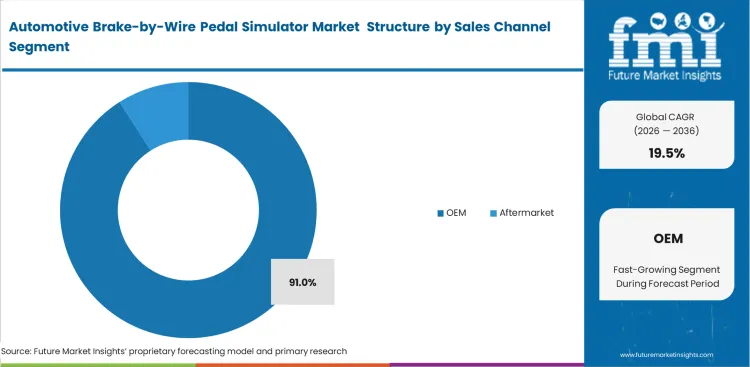
Complex safety-critical hardware demands strict factory-level installation and calibration. Digital pedal simulators must integrate directly into the core vehicle software matrix during initial assembly. Aftermarket replacements face severe technical barriers because proprietary encryption locks third-party parts out of the main vehicle network. Unauthorized modifications risk disabling autonomous emergency braking functions entirely. Repair shops must use authorized dealer diagnostic tools simply to bleed the hydraulic backup circuits after replacing a simulator. Due to these intense security locks, the OEM sales channel is projected to secure a forecasted 91.0% share in 2026 as automakers maintain tight hardware control. Independent suppliers will struggle to penetrate this space without direct factory partnerships.
- Network Encryption: Cybersecurity protocols prevent unauthorized hardware from sending deceleration commands. Software groups lock vehicle networks to prevent malicious manipulation of critical safety systems.
- Calibration Complexity: Initial factory setups map physical pedal stroke to specific digital output curves. End-of-line testing requires specialized dynamometers unavailable to independent repair facilities.
- Liability Containment: Automakers tightly control replacement parts to guarantee fail-safe operation. Legal groups limit aftermarket access to avoid responsibility for third-party component failures during crashes.
Automotive Brake-by-Wire Pedal Simulator Market Drivers, Restraints, and Opportunities
Car manufacturers face intense pressure to squeeze every possible mile of driving range out of electric vehicle batteries. Reaching these strict mileage targets requires completely separating the physical brake pedal from the traditional hydraulic fluid system. Decoupling the pedal allows the electric motor to capture much more energy during routine slowdowns. Falling behind on this switch means building cars that cannot compete on advertised battery range. New driver assistance features like self-parking also rely entirely on direct automotive active safety system inputs instead of physical human pressure.
Strict safety rules require physical backup systems just in case the electronics completely fail while driving. Building reliable mechanical fail-safes makes a fully wire-based braking setup incredibly difficult to design. Automakers struggle to fit bulky backup hydraulic circuits into tight spaces without creating new points of failure. Adding multiple layers of redundancy to an automatic emergency braking system pushes total assembly costs extremely high. High component prices force car brands to restrict this advanced hardware strictly to luxury vehicle lines until manufacturing scales up.
- Hardware Miniaturization: Upgraded micro-controllers shrink the physical size of the simulator box. Automotive designers use this saved space behind the dashboard to increase cabin legroom and improve driver comfort.
- Adaptive Software Calibration: Smart computer programs actively adjust pedal stiffness based on exactly how a specific person drives. Car brands can market this personalized pedal response as a premium software upgrade for future buyers.
- Commercial Truck Expansion: Transferring automotive regenerative braking logic into massive commercial trucks creates huge energy savings. Fleet owners earn their money back quickly through extended brake pad life and lower total fuel expenses.
Regional Analysis
Based on regional analysis, automotive brake-by-wire pedal simulator market is segmented into North America, Europe, Asia-Pacific, Latin America, and Middle East & Africa across 40 plus countries. Global adoption heavily depends on how fast local automakers shift to pure electric platforms and adapt to new safety regulations.
.webp "Top Country Growth Comparison Automotive Brake By Wire Pedal Simulator Market Cagr (2026 2036)")
| Country | CAGR (2026 to 2036) |
|---|---|
| China | 22.3% |
| Germany | 20.4% |
| South Korea | 19.8% |
| United States | 18.9% |
| France | 18.4% |
| Japan | 17.6% |
| India | 17.1% |
Source: Future Market Insights (FMI) analysis, based on proprietary forecasting model and primary research
Asia-Pacific Automotive Brake-by-Wire Pedal Simulator Market Analysis
Domestic production scale dictates how rapidly new braking architectures achieve cost parity with legacy mechanical systems. Automakers prioritize software-defined platforms over incremental hardware updates to stay competitive. Intense local competition drives rapid integration of advanced automotive sensors into baseline vehicle trims.
- China: High battery electric vehicle output keeps pressure on component costs and shortens platform development cycles. Automakers are embedding digital pedal simulators into modular vehicle architectures at an early stage, which is expected to support brake-by-wire pedal simulator demand in China at a CAGR of 22.3% during 2026 to 2036. Faster integration into high-volume vehicle programs continues to strengthen adoption across domestic production lines.
- South Korea: Concentrated vehicle manufacturing and rapid chassis development support quicker adoption of digitally controlled braking systems. Strong electronics engineering capabilities also help manufacturers refine pedal feel calibration with greater speed and consistency. Against this backdrop, demand for brake-by-wire pedal simulators in South Korea is projected to rise at a CAGR of 19.8% over 2026 to 2036. Close coordination across the supplier base keeps deployment cycles relatively efficient.
- Japan: Long validation cycles continue to shape adoption patterns in Japan, where manufacturers place high importance on durability, safety assurance, and system redundancy. Full electromechanical simulation is gaining ground, though the shift remains measured because hydraulic backup systems are not phased out quickly. Sales of brake-by-wire pedal simulators in Japan are estimated to increase at a CAGR of 17.6% during 2026 to 2036. Once programs move into production, strict validation standards tend to support stable long-term fitment.
- India: Passenger vehicle electrification is expanding gradually, though pricing discipline remains central to market acceptance. Manufacturers are giving greater attention to localized production of simpler pedal simulator designs that can support brake-by-wire adoption without raising vehicle costs too aggressively. India is forecast to record a CAGR of 17.1% in brake-by-wire pedal simulator demand through 2036. Broader market penetration will depend on how efficiently domestic supply chains scale with rising vehicle electrification.
Asia Pacific remains a diverse manufacturing base where cost control and advanced system integration are progressing at the same time. Suppliers are under steady pressure to deliver compact, integrated solutions that reduce assembly complexity and support faster vehicle platform rollout. Competitive strength in the region is likely to depend on how well manufacturers balance engineering performance, localization, and production efficiency.
Europe Automotive Brake-by-Wire Pedal Simulator Market Analysis
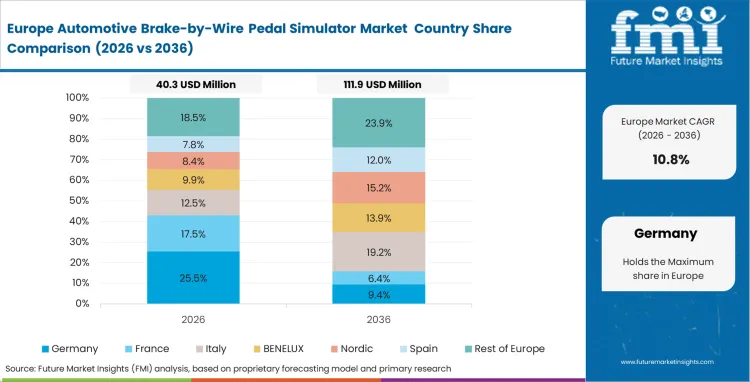
Europe’s shift away from internal combustion engines is pushing automakers to move faster on fully electric vehicle development. As braking systems become more software-led, pedal feel remains an important part of vehicle character, especially in segments where driving response still shapes brand identity. Demand is rising from both performance expectations and tighter engineering requirements around control systems.
- Germany: Performance-led vehicle development continues to support demand for advanced brake calibration in Germany. Manufacturers are placing clear emphasis on pedal response and resistance tuning so electric models can retain a familiar driving character. Brake-by-wire pedal simulator demand in Germany is projected to expand at a CAGR of 20.4% during 2026 to 2036. Calibration quality is likely to remain an important point of differentiation in premium electric platforms.
- France: Wider electric vehicle adoption is encouraging the use of simpler and more cost-efficient one-box braking systems across France. Manufacturers are working to bring digital braking functions into smaller vehicle formats while keeping pricing within reach of volume buyers. Demand for brake-by-wire pedal simulators in France is expected to rise at a CAGR of 18.4% over 2026 to 2036. Broader use in mass-market models is likely to shape the pace of adoption.
Safety requirements across Europe continue to raise the technical threshold for decoupled braking hardware. Manufacturers need systems that satisfy redundancy standards without losing the controlled and responsive feel expected in modern vehicles. Suppliers that can meet both conditions are likely to remain better placed in the regional market.
North America Automotive Brake-by-Wire Pedal Simulator Market Analysis
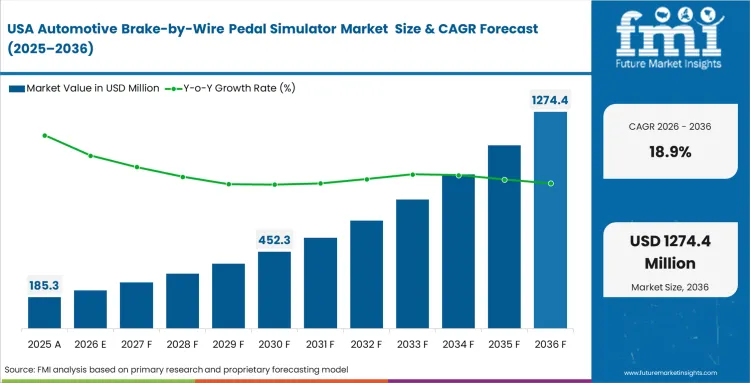
Heavy vehicle preferences shape how digital braking hardware must perform under extreme load conditions. Truck and sport utility vehicle platforms demand significantly higher heat dissipation and force resistance than smaller commuter cars. Local manufacturers prioritize precise trailer-towing integration within these new automotive electric actuator networks.
- United States: High adoption of large electric trucks necessitates specialized high-force pedal simulators. Vehicle engineers must synthesize heavy-duty braking feel while managing massive regenerative energy loads, driving United States brake-by-wire pedal simulator demand to register an expected CAGR of 18.9% from 2026 to 2036 to meet consumer towing expectations. Failing to replicate traditional truck pedal confidence severely damages brand loyalty among traditional buyers.
FMI analyses, North America market consumers expect electric trucks to perform identical tasks to their combustion counterparts without compromising safety. Designing hardware that survives these extreme operational limits defines success in this geography. Any compromise in pedal feedback immediately alerts buyers to underlying platform weaknesses.
Competitive Aligners for Market Players
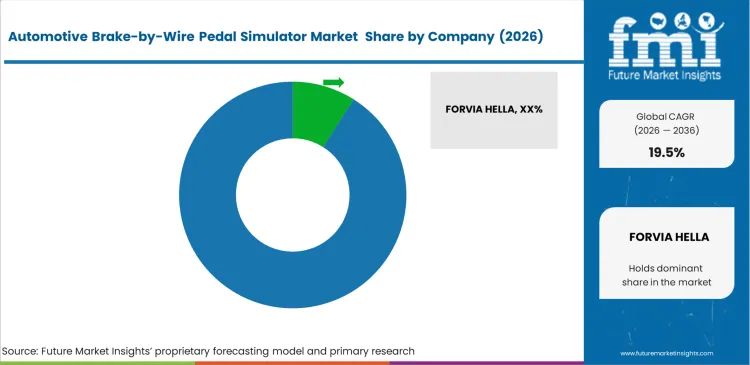
Automakers usually place safety-critical braking programs with suppliers that already have a long record in braking system validation. Established manufacturers carry years of hydraulic braking knowledge, and that experience helps them translate familiar pedal behavior into digital systems with less uncertainty during vehicle development. Brake-by-wire hardware still has to feel predictable to the driver, so proven performance matters as much as technical specification. New suppliers often face a harder path because additional validation work can slow platform approval.
Calibration depth also gives incumbent suppliers a clear advantage. Historical braking data helps engineers tune force feedback more accurately, especially in situations where the pedal has to respond naturally during both normal driving and sudden stops. Mechanical hardware is only part of the system. Real differentiation comes from control logic, software tuning, and the ability to recreate a convincing braking feel without instability or inconsistency. Limited validation history makes that harder for newer entrants to prove.
Automakers are still careful about giving away too much control, which keeps software flexibility important in this market. Hardware may come from established suppliers, though vehicle brands increasingly want to retain authority over final pedal calibration across different models. That shift is placing more value on integration capability and software compatibility than on the pedal assembly alone. Suppliers that can support stable hardware, adaptable interfaces, and clean integration into wider vehicle control systems are likely to stay in a stronger position.
Key Players in Automotive Brake-by-Wire Pedal Simulator Market
- FORVIA HELLA
- Bosch
- ZF Friedrichshafen
- Continental
- BOGE Rubber & Plastics
- CTS Corporation
Scope of the Report
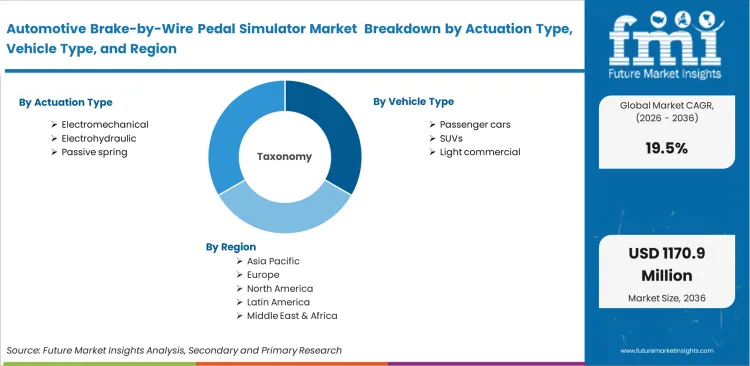
| Metric | Value |
|---|---|
| Quantitative Units | USD 165.0 million to USD 980.0 million, at a CAGR of 19.5% |
| Market Definition | Electronic feedback actuators replacing mechanical linkages generate synthetic resistance when drivers apply deceleration pressure. This hardware interprets input force and translates it into digital signals for brake controllers while mimicking traditional hydraulic resistance. |
| Segmentation | Actuation type, Vehicle type, Propulsion, Architecture, and Sales channel |
| Regions Covered | North America, Latin America, Europe, East Asia, South Asia & Pacific, Middle East & Africa |
| Countries Covered | China, Germany, South Korea, United States, France, Japan, India |
| Key Companies Profiled | FORVIA HELLA, Bosch, ZF Friedrichshafen, Continental, BOGE Rubber & Plastics, CTS Corporation |
| Forecast Period | 2026 to 2036 |
| Approach | Global electric and hybrid vehicle production volumes mapped against Tier-1 supplier component shipment logs. |
Source: Future Market Insights (FMI) analysis, based on proprietary forecasting model and primary research
Segments
By Actuation Type
- Electromechanical
- Electrohydraulic
- Passive spring
By Vehicle Type
- Passenger cars
- SUVs
- Light commercial
By Propulsion
- Battery electric
- Hybrid electric
- ICE
By Architecture
- One-box
- Two-box
- Dry-wire
By Sales Channel
- OEM
- Aftermarket
Regions:
- Asia Pacific
- India
- China
- Japan
- South Korea
- Indonesia
- Australia
- New Zealand
- ASEAN
- Rest of Asia Pacific
- Europe
- Germany
- Italy
- France
- United Kingdom
- Spain
- Benelux
- Nordics
- Central & Eastern Europe
- Rest of Europe
- North America
- United States
- Canada
- Mexico
- Latin America
- Brazil
- Argentina
- Chile
- Rest of Latin America
- Middle East & Africa
- Kingdom of Saudi Arabia
- United Arab Emirates
- South Africa
- Turkey
- Rest of Middle East & Africa
Bibliography
- He, C., Gong, X., & Xu, R. (2026). Design and control of active brake pedal simulator with brake feel index-based optimization. World Electric Vehicle Journal, 17(3), Article 116.
- Ji, Q., Zheng, L., Bi, Y., & Pang, H. (2024). Review of brake-by-wire technology for low-speed and autonomous vehicles. World Electric Vehicle Journal, 15(12), Article 581.
- Heydrich, M., Lenz, M., Ivanov, V., & Stoev, J. (2025). Concept of an electromechanical brake-by-wire system for battery-electric vehicles. SAE Technical Paper 2025-01-8804.
- Park, P., Choi, H., Lee, S., Jeong, S., & Lee, H. (2025). Development of a novel electro-mechanical brake motor thermal management system for nonuniform heating under extreme thermal conditions. Energy Conversion and Management, Article 119406.
- Çayci, N. O., Dinçmen, E., & İstif, İ. (2025). An investigation of driver brake pedal stroke input on regenerated braking energy in electric vehicles via dynamic programming. Dicle University Journal of Engineering, 16(3), 687-695.
This bibliography is provided for reader reference. The full FMI report contains the complete reference list with primary source documentation.
This Report Addresses
- Vehicle dynamics engineers managing pedal feedback calibration across hybrid and electric powertrains.
- Tier-1 chassis hardware suppliers transitioning from hydraulic boosters to fully decoupled electronic braking modules.
- Safety homologation groups navigating updated regulatory frameworks for algorithmic emergency interventions.
- Automotive manufacturing plants consolidating dispersed braking components into space-saving one-box architectures.
- Electric vehicle range optimization engineers maximizing kinetic energy recovery through blended braking software.
- Aftermarket service networks adapting to encrypted vehicle networks and specialized factory diagnostic protocols.
- Commercial fleet operators evaluating regenerative braking lifecycle cost reductions against heavy-duty hardware investments.
- Purchasing departments amortizing high-cost active force-feedback mechanisms across global modular skateboard platforms.
Frequently Asked Questions
What is an automotive brake-by-wire pedal simulator?
Electronic feedback actuators replacing mechanical linkages generate synthetic resistance when drivers apply deceleration pressure, translating input force into digital signals.
Why is a pedal simulator needed in brake-by-wire vehicles?
Regenerative optimization forces vehicle manufacturers to decouple friction braking from driver physical input to maximize energy recapture.
How large is the automotive brake-by-wire pedal simulator size in 2026 and 2036?
Sales are expected to cross USD 165.0 million in 2026 and carry a total valuation of USD 980.0 million through 2036.
Which suppliers are active in this sector today?
Prominent component manufacturers include FORVIA HELLA, Bosch, ZF Friedrichshafen, and Continental.
Which countries will grow fastest in brake-by-wire pedal simulator demand?
China is anticipated to see sales grow at an expected CAGR of 22.3% over the forecast period, seemingly trailed by Germany at a projected 20.4%.
What is the difference between one-box, two-box, and dry-wire brake architectures?
One-box consolidates three distinct hydraulic components into one housing, while two-box separates units for specific redundancy requirements, and dry-wire removes hydraulic fluid entirely.
How do pedal simulators improve regenerative braking feel?
Digital feedback masking hides the transition between motor generation and friction application, preventing pedal feel inconsistency.
What are the main failure modes and redundancy requirements?
Single-point failures in consolidated units require highly sophisticated electronic backups, and regulatory bodies demand mechanical backup links for true fail-safe operation.
Why do passenger EVs lead demand for brake-by-wire pedal simulators?
Pure electric models lack inherent vacuum sources for traditional boosters, forcing complete braking system redesigns across high-volume platforms.
What should OEMs evaluate when selecting a pedal simulator supplier?
Automakers prioritize legacy suppliers possessing decades of proprietary hydraulic braking data to perfectly synthesize traditional pedal feel.
What is the anticipated compound annual growth rate?
The sector is projected to expand at a projected CAGR of 19.50% from 2026 to 2036.
Which actuation type holds the largest share?
Electromechanical components are estimated to account for an anticipated 43.0% share in 2026.
Why do electromechanical simulators lead adoption?
Chassis engineers specify these active units because they allow software updates to alter braking characteristics post-sale.
Which vehicle type dominates hardware integration?
Passenger cars are expected to hold a predicted 71.0% share in 2026.
How does platform sharing affect this dominance?
Modular electric skateboard designs utilize identical pedal boxes across multiple body styles to rapidly amortize high initial component costs.
Which propulsion system drives primary demand?
Battery electric platforms are anticipated to capture a projected 49.0% of volume in 2026.
What architecture configuration captures the most volume?
One-box designs are poised to garner an expected 54.0% share in 2026.
What operational outcome favors one-box designs?
Consolidating components cuts significant mass and reduces factory assembly steps.
Which sales channel controls distribution?
OEM supply chains are set to represent an anticipated 91.0% of hardware distribution in 2026.
Why do OEMs monopolize these components?
Digital simulators integrate directly into the core vehicle software matrix during initial assembly, utilizing proprietary encryption that locks out aftermarket parts.
What structural condition accelerates adoption in China?
Explosive battery electric vehicle production scale forces rapid component cost reduction across agile local brands.
What drives integration among German automakers?
Premium brands invest heavily in proprietary pedal feel calibration to maintain their performance heritage against digital competitors.
What characterizes the South Korean trajectory?
Concentrated manufacturing output allows rapid deployment of new chassis architectures across millions of domestic units.
How do commercial vehicles differ in hardware requirements?
Truck platforms demand significantly higher heat dissipation and force resistance to synthesize heavy-duty braking feel.
Preview the report firsthand - request a free sample
Get SampleGet the brochure for pricing and purchase details.
Get PDFTable of Content
- Executive Summary
- Global Market Outlook
- Demand-side Trends
- Supply-side Trends
- Technology Roadmap Analysis
- Analysis and Recommendations
- Market Overview
- Market Coverage / Taxonomy
- Market Definition / Scope / Limitations
- Research Methodology
- Chapter Orientation
- Analytical Lens and Working Hypotheses
- Market Structure, Signals, and Trend Drivers
- Benchmarking and Cross-market Comparability
- Market Sizing, Forecasting, and Opportunity Mapping
- Research Design and Evidence Framework
- Desk Research Programme (Secondary Evidence)
- Company Annual and Sustainability Reports
- Peer-reviewed Journals and Academic Literature
- Corporate Websites, Product Literature, and Technical Notes
- Earnings Decks and Investor Briefings
- Statutory Filings and Regulatory Disclosures
- Technical White Papers and Standards Notes
- Trade Journals, Industry Magazines, and Analyst Briefs
- Conference Proceedings, Webinars, and Seminar Materials
- Government Statistics Portals and Public Data Releases
- Press Releases and Reputable Media Coverage
- Specialist Newsletters and Curated Briefings
- Sector Databases and Reference Repositories
- FMI Internal Proprietary Databases and Historical Market Datasets
- Subscription Datasets and Paid Sources
- Social Channels, Communities, and Digital Listening Inputs
- Additional Desk Sources
- Expert Input and Fieldwork (Primary Evidence)
- Primary Modes
- Qualitative Interviews and Expert Elicitation
- Quantitative Surveys and Structured Data Capture
- Blended Approach
- Why Primary Evidence is Used
- Field Techniques
- Interviews
- Surveys
- Focus Groups
- Observational and In-context Research
- Social and Community Interactions
- Stakeholder Universe Engaged
- C-suite Leaders
- Board Members
- Presidents and Vice Presidents
- R&D and Innovation Heads
- Technical Specialists
- Domain Subject-matter Experts
- Scientists
- Physicians and Other Healthcare Professionals
- Governance, Ethics, and Data Stewardship
- Research Ethics
- Data Integrity and Handling
- Primary Modes
- Tooling, Models, and Reference Databases
- Desk Research Programme (Secondary Evidence)
- Data Engineering and Model Build
- Data Acquisition and Ingestion
- Cleaning, Normalisation, and Verification
- Synthesis, Triangulation, and Analysis
- Quality Assurance and Audit Trail
- Market Background
- Market Dynamics
- Drivers
- Restraints
- Opportunity
- Trends
- Scenario Forecast
- Demand in Optimistic Scenario
- Demand in Likely Scenario
- Demand in Conservative Scenario
- Opportunity Map Analysis
- Product Life Cycle Analysis
- Supply Chain Analysis
- Investment Feasibility Matrix
- Value Chain Analysis
- PESTLE and Porter’s Analysis
- Regulatory Landscape
- Regional Parent Market Outlook
- Production and Consumption Statistics
- Import and Export Statistics
- Market Dynamics
- Global Market Analysis 2021 to 2025 and Forecast, 2026 to 2036
- Historical Market Size Value (USD Million) Analysis, 2021 to 2025
- Current and Future Market Size Value (USD Million) Projections, 2026 to 2036
- Y-o-Y Growth Trend Analysis
- Absolute $ Opportunity Analysis
- Global Market Pricing Analysis 2021 to 2025 and Forecast 2026 to 2036
- Global Market Analysis 2021 to 2025 and Forecast 2026 to 2036, By Actuation Type
- Introduction / Key Findings
- Historical Market Size Value (USD Million) Analysis By Actuation Type , 2021 to 2025
- Current and Future Market Size Value (USD Million) Analysis and Forecast By Actuation Type , 2026 to 2036
- Electromechanical
- Electrohydraulic
- Passive spring
- Electromechanical
- Y-o-Y Growth Trend Analysis By Actuation Type , 2021 to 2025
- Absolute $ Opportunity Analysis By Actuation Type , 2026 to 2036
- Global Market Analysis 2021 to 2025 and Forecast 2026 to 2036, By Vehicle Type
- Introduction / Key Findings
- Historical Market Size Value (USD Million) Analysis By Vehicle Type, 2021 to 2025
- Current and Future Market Size Value (USD Million) Analysis and Forecast By Vehicle Type, 2026 to 2036
- Passenger cars
- SUVs
- Light commercial
- Passenger cars
- Y-o-Y Growth Trend Analysis By Vehicle Type, 2021 to 2025
- Absolute $ Opportunity Analysis By Vehicle Type, 2026 to 2036
- Global Market Analysis 2021 to 2025 and Forecast 2026 to 2036, By Propulsion
- Introduction / Key Findings
- Historical Market Size Value (USD Million) Analysis By Propulsion, 2021 to 2025
- Current and Future Market Size Value (USD Million) Analysis and Forecast By Propulsion, 2026 to 2036
- Battery electric
- Hybrid electric
- ICE
- Battery electric
- Y-o-Y Growth Trend Analysis By Propulsion, 2021 to 2025
- Absolute $ Opportunity Analysis By Propulsion, 2026 to 2036
- Global Market Analysis 2021 to 2025 and Forecast 2026 to 2036, By Architecture
- Introduction / Key Findings
- Historical Market Size Value (USD Million) Analysis By Architecture, 2021 to 2025
- Current and Future Market Size Value (USD Million) Analysis and Forecast By Architecture, 2026 to 2036
- One-box
- Two-box
- Dry-wire
- One-box
- Y-o-Y Growth Trend Analysis By Architecture, 2021 to 2025
- Absolute $ Opportunity Analysis By Architecture, 2026 to 2036
- Global Market Analysis 2021 to 2025 and Forecast 2026 to 2036, By Sales Channel
- Introduction / Key Findings
- Historical Market Size Value (USD Million) Analysis By Sales Channel, 2021 to 2025
- Current and Future Market Size Value (USD Million) Analysis and Forecast By Sales Channel, 2026 to 2036
- OEM
- Aftermarket
- OEM
- Y-o-Y Growth Trend Analysis By Sales Channel, 2021 to 2025
- Absolute $ Opportunity Analysis By Sales Channel, 2026 to 2036
- Global Market Analysis 2021 to 2025 and Forecast 2026 to 2036, By Region
- Introduction
- Historical Market Size Value (USD Million) Analysis By Region, 2021 to 2025
- Current Market Size Value (USD Million) Analysis and Forecast By Region, 2026 to 2036
- North America
- Latin America
- Western Europe
- Eastern Europe
- East Asia
- South Asia and Pacific
- Middle East & Africa
- Market Attractiveness Analysis By Region
- North America Market Analysis 2021 to 2025 and Forecast 2026 to 2036, By Country
- Historical Market Size Value (USD Million) Trend Analysis By Market Taxonomy, 2021 to 2025
- Market Size Value (USD Million) Forecast By Market Taxonomy, 2026 to 2036
- By Country
- USA
- Canada
- Mexico
- By Actuation Type
- By Vehicle Type
- By Propulsion
- By Architecture
- By Sales Channel
- By Country
- Market Attractiveness Analysis
- By Country
- By Actuation Type
- By Vehicle Type
- By Propulsion
- By Architecture
- By Sales Channel
- Key Takeaways
- Latin America Market Analysis 2021 to 2025 and Forecast 2026 to 2036, By Country
- Historical Market Size Value (USD Million) Trend Analysis By Market Taxonomy, 2021 to 2025
- Market Size Value (USD Million) Forecast By Market Taxonomy, 2026 to 2036
- By Country
- Brazil
- Chile
- Rest of Latin America
- By Actuation Type
- By Vehicle Type
- By Propulsion
- By Architecture
- By Sales Channel
- By Country
- Market Attractiveness Analysis
- By Country
- By Actuation Type
- By Vehicle Type
- By Propulsion
- By Architecture
- By Sales Channel
- Key Takeaways
- Western Europe Market Analysis 2021 to 2025 and Forecast 2026 to 2036, By Country
- Historical Market Size Value (USD Million) Trend Analysis By Market Taxonomy, 2021 to 2025
- Market Size Value (USD Million) Forecast By Market Taxonomy, 2026 to 2036
- By Country
- Germany
- UK
- Italy
- Spain
- France
- Nordic
- BENELUX
- Rest of Western Europe
- By Actuation Type
- By Vehicle Type
- By Propulsion
- By Architecture
- By Sales Channel
- By Country
- Market Attractiveness Analysis
- By Country
- By Actuation Type
- By Vehicle Type
- By Propulsion
- By Architecture
- By Sales Channel
- Key Takeaways
- Eastern Europe Market Analysis 2021 to 2025 and Forecast 2026 to 2036, By Country
- Historical Market Size Value (USD Million) Trend Analysis By Market Taxonomy, 2021 to 2025
- Market Size Value (USD Million) Forecast By Market Taxonomy, 2026 to 2036
- By Country
- Russia
- Poland
- Hungary
- Balkan & Baltic
- Rest of Eastern Europe
- By Actuation Type
- By Vehicle Type
- By Propulsion
- By Architecture
- By Sales Channel
- By Country
- Market Attractiveness Analysis
- By Country
- By Actuation Type
- By Vehicle Type
- By Propulsion
- By Architecture
- By Sales Channel
- Key Takeaways
- East Asia Market Analysis 2021 to 2025 and Forecast 2026 to 2036, By Country
- Historical Market Size Value (USD Million) Trend Analysis By Market Taxonomy, 2021 to 2025
- Market Size Value (USD Million) Forecast By Market Taxonomy, 2026 to 2036
- By Country
- China
- Japan
- South Korea
- By Actuation Type
- By Vehicle Type
- By Propulsion
- By Architecture
- By Sales Channel
- By Country
- Market Attractiveness Analysis
- By Country
- By Actuation Type
- By Vehicle Type
- By Propulsion
- By Architecture
- By Sales Channel
- Key Takeaways
- South Asia and Pacific Market Analysis 2021 to 2025 and Forecast 2026 to 2036, By Country
- Historical Market Size Value (USD Million) Trend Analysis By Market Taxonomy, 2021 to 2025
- Market Size Value (USD Million) Forecast By Market Taxonomy, 2026 to 2036
- By Country
- India
- ASEAN
- Australia & New Zealand
- Rest of South Asia and Pacific
- By Actuation Type
- By Vehicle Type
- By Propulsion
- By Architecture
- By Sales Channel
- By Country
- Market Attractiveness Analysis
- By Country
- By Actuation Type
- By Vehicle Type
- By Propulsion
- By Architecture
- By Sales Channel
- Key Takeaways
- Middle East & Africa Market Analysis 2021 to 2025 and Forecast 2026 to 2036, By Country
- Historical Market Size Value (USD Million) Trend Analysis By Market Taxonomy, 2021 to 2025
- Market Size Value (USD Million) Forecast By Market Taxonomy, 2026 to 2036
- By Country
- Kingdom of Saudi Arabia
- Other GCC Countries
- Turkiye
- South Africa
- Other African Union
- Rest of Middle East & Africa
- By Actuation Type
- By Vehicle Type
- By Propulsion
- By Architecture
- By Sales Channel
- By Country
- Market Attractiveness Analysis
- By Country
- By Actuation Type
- By Vehicle Type
- By Propulsion
- By Architecture
- By Sales Channel
- Key Takeaways
- Key Countries Market Analysis
- USA
- Pricing Analysis
- Market Share Analysis, 2025
- By Actuation Type
- By Vehicle Type
- By Propulsion
- By Architecture
- By Sales Channel
- Canada
- Pricing Analysis
- Market Share Analysis, 2025
- By Actuation Type
- By Vehicle Type
- By Propulsion
- By Architecture
- By Sales Channel
- Mexico
- Pricing Analysis
- Market Share Analysis, 2025
- By Actuation Type
- By Vehicle Type
- By Propulsion
- By Architecture
- By Sales Channel
- Brazil
- Pricing Analysis
- Market Share Analysis, 2025
- By Actuation Type
- By Vehicle Type
- By Propulsion
- By Architecture
- By Sales Channel
- Chile
- Pricing Analysis
- Market Share Analysis, 2025
- By Actuation Type
- By Vehicle Type
- By Propulsion
- By Architecture
- By Sales Channel
- Germany
- Pricing Analysis
- Market Share Analysis, 2025
- By Actuation Type
- By Vehicle Type
- By Propulsion
- By Architecture
- By Sales Channel
- UK
- Pricing Analysis
- Market Share Analysis, 2025
- By Actuation Type
- By Vehicle Type
- By Propulsion
- By Architecture
- By Sales Channel
- Italy
- Pricing Analysis
- Market Share Analysis, 2025
- By Actuation Type
- By Vehicle Type
- By Propulsion
- By Architecture
- By Sales Channel
- Spain
- Pricing Analysis
- Market Share Analysis, 2025
- By Actuation Type
- By Vehicle Type
- By Propulsion
- By Architecture
- By Sales Channel
- France
- Pricing Analysis
- Market Share Analysis, 2025
- By Actuation Type
- By Vehicle Type
- By Propulsion
- By Architecture
- By Sales Channel
- India
- Pricing Analysis
- Market Share Analysis, 2025
- By Actuation Type
- By Vehicle Type
- By Propulsion
- By Architecture
- By Sales Channel
- ASEAN
- Pricing Analysis
- Market Share Analysis, 2025
- By Actuation Type
- By Vehicle Type
- By Propulsion
- By Architecture
- By Sales Channel
- Australia & New Zealand
- Pricing Analysis
- Market Share Analysis, 2025
- By Actuation Type
- By Vehicle Type
- By Propulsion
- By Architecture
- By Sales Channel
- China
- Pricing Analysis
- Market Share Analysis, 2025
- By Actuation Type
- By Vehicle Type
- By Propulsion
- By Architecture
- By Sales Channel
- Japan
- Pricing Analysis
- Market Share Analysis, 2025
- By Actuation Type
- By Vehicle Type
- By Propulsion
- By Architecture
- By Sales Channel
- South Korea
- Pricing Analysis
- Market Share Analysis, 2025
- By Actuation Type
- By Vehicle Type
- By Propulsion
- By Architecture
- By Sales Channel
- Russia
- Pricing Analysis
- Market Share Analysis, 2025
- By Actuation Type
- By Vehicle Type
- By Propulsion
- By Architecture
- By Sales Channel
- Poland
- Pricing Analysis
- Market Share Analysis, 2025
- By Actuation Type
- By Vehicle Type
- By Propulsion
- By Architecture
- By Sales Channel
- Hungary
- Pricing Analysis
- Market Share Analysis, 2025
- By Actuation Type
- By Vehicle Type
- By Propulsion
- By Architecture
- By Sales Channel
- Kingdom of Saudi Arabia
- Pricing Analysis
- Market Share Analysis, 2025
- By Actuation Type
- By Vehicle Type
- By Propulsion
- By Architecture
- By Sales Channel
- Turkiye
- Pricing Analysis
- Market Share Analysis, 2025
- By Actuation Type
- By Vehicle Type
- By Propulsion
- By Architecture
- By Sales Channel
- South Africa
- Pricing Analysis
- Market Share Analysis, 2025
- By Actuation Type
- By Vehicle Type
- By Propulsion
- By Architecture
- By Sales Channel
- USA
- Market Structure Analysis
- Competition Dashboard
- Competition Benchmarking
- Market Share Analysis of Top Players
- By Region
- By Actuation Type
- By Vehicle Type
- By Propulsion
- By Architecture
- By Sales Channel
- Competition Analysis
- Competition Deep Dive
- FORVIA HELLA
- Overview
- Product Portfolio
- Profitability by Market Segments (Product/Age /Sales Channel/Region)
- Sales Footprint
- Strategy Overview
- Marketing Strategy
- Product Strategy
- Channel Strategy
- Bosch
- ZF Friedrichshafen
- Continental
- BOGE Rubber & Plastics
- CTS Corporation
- FORVIA HELLA
- Competition Deep Dive
- Assumptions & Acronyms Used


