

- Market Size (2026)
- USD 4.5 Bn
- Forecast (2036)
- USD 8.4 Bn
- CAGR (2026 to 2036)
- 6.4%
Automotive ABS Motor Market Size, Market Forecast and Outlook By FMI
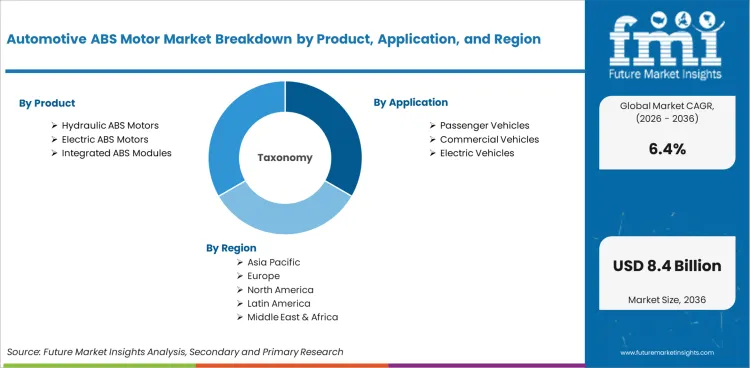
The automotive abs motor market was valued at USD 4.2 billion in 2025. The market is set to reach USD 4.5 billion by 2026-end and grow at a CAGR of 6.4% between 2026-2036 to reach USD 8.4 billion by 2036. Hydraulic ABS Motors will dominate with a 60.0% share, while Passenger Vehicles will lead with a 65.0% share.
Summary of the Automotive ABS Motor Market
- Demand and Growth Drivers
- Passenger vehicles account for 65.0% of application demand, reflecting mandatory ABS fitment requirements across passenger car segments in all major automotive markets.
- Hydraulic ABS motors account for 60.0% of product demand, as conventional hydraulic modulator-based systems remain the dominant ABS architecture for cost-effective compliance in mass-market vehicles.
- OEM integration accounts for 70.0% of end-use demand, as ABS is mandated as standard equipment rather than optional, making motor procurement a non-discretionary element of vehicle production.
- Product and Segment View
- Hydraulic ABS motors are expected to account for 60.0% of product demand, with hydraulic modulator systems providing cost-effective ABS compliance for mass-market vehicles.
- 60.0% of the demand is for passenger cars, being the largest production volume segment that needs ABS motor integration.
- Mandatory fitment of ABS makes motor procurement non-discretionary, accounting for 70.0% of end-use demand for OEM integration.
- Geography and Competitive Outlook
- China (8.64%) leads global growth, supported by the scale of domestic vehicle production and mandatory ABS requirements.
- Europe and North America sustain demand through advanced braking system specifications and integration with ESC and ADAS platforms.
- Hitachi Astemo (15.0%) leads through established automotive braking system supply and OEM integration expertise.
- Analyst Opinion
- Nikhil Kaitwade, Principal Consultant at FMI says, 'Tier-1 suppliers that integrate ABS motor design with electronic stability control and advanced driver assistance system requirements are likely to capture larger per-vehicle content value as braking system architecture evolves from standalone ABS to integrated vehicle dynamics platforms.'
- The automotive ABS motor market is shaped by regulatory mandates that make demand proportional to vehicle production volumes, creating predictable procurement tied to OEM build schedules.
- The introduction of the EV platform calls for a redefinition of the ABS motors to coordinate regenerative braking, which provides opportunities for the evolution of the specifications.
- Integration of ABS with ESC and ADAS systems is increasing per-vehicle braking electronics content value.
Key Takeaways, Market Size, and Forecast
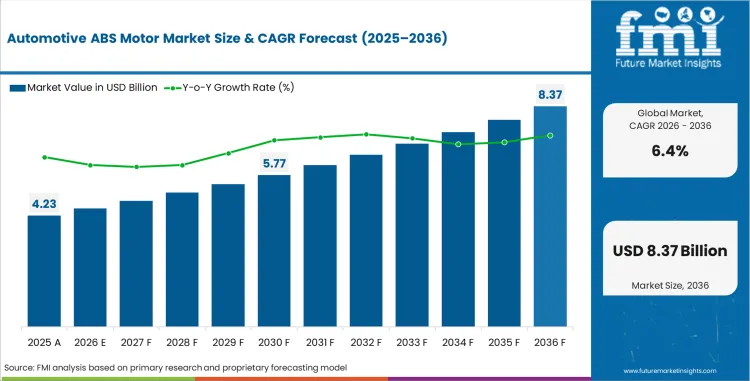
- The automotive abs motor market was valued at USD 4.23 billion in 2025.
- By 2036, the Automotive ABS Motor Market is expected to be worth USD 8.37 billion.
- From 2026 to 2036, the market is projected to expand at a CAGR of 6.4%.
- The market is projected to create an incremental opportunity of USD 3.87 billion between 2026 and 2036.
- In 2026, passenger vehicles is expected to account for 65% of the application segment, driven by mandatory vehicle safety regulations requiring anti-lock braking systems as standard equipment across passenger and commercial vehicles globally.
- China (8.64%) and India (8%) are two of the fastest growing markets in the world.
Automotive ABS Motor Market Definition
The automotive ABS motor market includes hydraulic, electric, and integrated anti-lock braking system motor and modulator assemblies supplied to vehicle manufacturers for passenger car, commercial vehicle, and electric vehicle applications.
Automotive ABS Motor Market Inclusions
Market scope encompasses all commercially traded automotive ABS motors categorized by product (hydraulic ABS motors, electric ABS motors, integrated ABS modules), application (passenger vehicles, commercial vehicles, electric vehicles), end use (OEMs, aftermarket), distribution channel (direct sales, distributors), and vehicle type (passenger cars, commercial vehicles, electric vehicles). Revenue estimates cover the period from 2026 to 2036.
Automotive ABS Motor Market Exclusions
The scope does not include motorcycle ABS systems, off-road vehicle braking systems, or aircraft anti-skid braking systems.
Automotive ABS Motor Market Research Methodology
- Primary Research: FMI’s analysts interviewed motor manufacturers of ABS, procurement teams for braking systems of automotive OEMs, and vehicle dynamics engineers in key markets.
- Desk research: Combining data from automotive industry production statistics, vehicle safety regulation databases and braking system technology publications.
- Market sizing and forecasting: bottom up aggregation from vehicle production data and ABS fitment rates, adjusted for regional regulatory mandate and EV adoption.
- Data validation: Reviewed quarterly data against global vehicle production stats, Tier-1 supplier revenue disclosures, and braking system shipment data.
Why is the Automotive ABS Motor Market Growing?
- The non-discretionary nature of procurement by OEMs is due to the mandatory ABS rule in all the major automotive markets, resulting in demand directly proportional to the volumes of vehicles produced.
- Specification evolution and upgrade opportunities for EV platform development due to re-design of ABS motor needed for integration of regenerative braking.
The automotive ABS motor market is estimated to be valued at USD 4.50 billion in 2026 and is projected to reach USD 8.37 billion by 2036, registering a CAGR of 6.4%. Demand is driven by vehicle production volumes, mandatory ABS regulation and the development of braking system technology. Hydraulic ABS motors represent 60.0% of product demand.
Established Tier-1 automotive braking system suppliers dominate the competitive landscape. Hitachi Astemo leads at 15.0%, with WABCO (ZF), Nidec and Hyundai Mobis maintaining strong competitive positions through OEM program integration.
China is leading with a CAGR of 8.64% due to scale of vehicle production and mandatory ABS requirements. India with 8.0% CAGR is set to benefit from the growing auto production and the enforcement of the ABS mandate.
Market Segmentation Analysis
- Hydraulic ABS motors account for 60.0% of product share. Conventional hydraulic modulator systems offer cost-effective compliance to mass-market vehicle segments.
- Passenger cars represent 65.0% of application demand and include all passenger car segments globally with mandatory ABS fitment.
- Distribution is dominated by direct sales at 65.0%, characteristic of the Tier-1 OEM supply model for braking system components.
The automotive ABS motor market is segmented on the basis of product, application, end use, distribution channel and type of vehicle. Demand patterns also reflect the geography of vehicle manufacturing, regulatory requirements and the evolution of braking system technology.
Insights into the Passenger Vehicles Application Segment
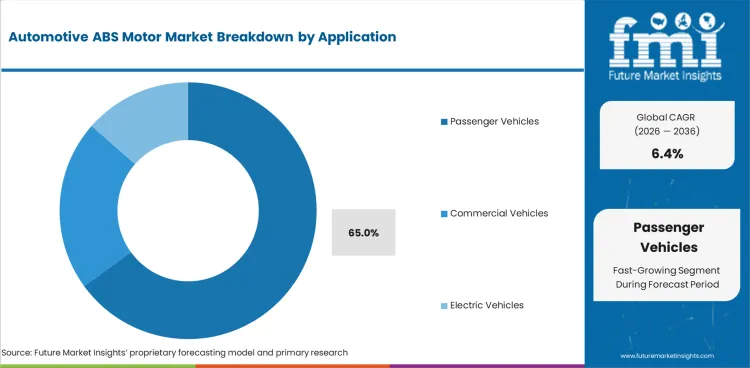
Passenger vehicles are estimated to hold a 65.0% share of the application segment in 2026. The passenger car segments have mandatory ABS requirements so the motors you buy should be proportional to the volumes you produce.
Electric vehicles are a growing sub-segment that demands ABS motor redesign for regenerative braking coordination, increasing specification complexity and per-unit content value.
Insights into the Hydraulic ABS Motors Product Segment
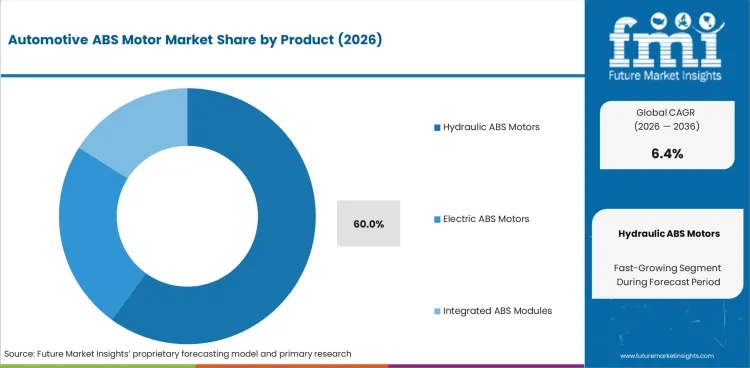
Hydraulic ABS motors are used to satisfy 60.0% of product demand. Conventional hydraulic modulators with electric motor driven pump assemblies provide a cost-effective ABS function for mass-market vehicle segments.
Integrated ABS modules, which combine the motor, modulator and electronic control into a single unit, are gaining market share in premium and EV segments where packaging efficiency and performance integration are emphasized.
Automotive ABS Motor Market Drivers, Restraints, and Opportunities
- The compulsory requirement for ABS generates a non-discretionary demand that is proportional to the volumes of vehicles produced globally.
- The integration of EV regenerative braking is driving the evolution of specifications, which increases the value and complexity per unit.
- Integration with ESC and ADAS increases the content of braking electronics per vehicle and the addressable value much more than standalone ABS.
The market is driven by regulatory mandates based on vehicle production, driven by the needs of the EV platform, and evolving through integration with advanced vehicle dynamics systems.
Regulatory Mandate Creates Non-Discretionary Demand
The market is driven by regulatory mandates based on vehicle production, driven by the needs of the EV platform, and evolving through integration with advanced vehicle dynamics systems.
EV Platform Integration
Electric vehicle platforms need ABS motor coordination with regenerative braking systems. This integration adds design complexity and higher per-unit value as braking systems must seamlessly blend regenerative and friction braking.
ESC and ADAS Integration
The integration of ABS with electronic stability control and advanced driver assistance systems is increasing the value of the braking electronics content per vehicle. This larger content is more a slice of the integrated vehicle dynamics platforms from Tier-1 suppliers.
Commercial Vehicle ABS Adoption
Emerging market commercial vehicle ABS mandates are generating incremental demand beyond passenger vehicles. ABS systems for trucks, buses and trailers must be designed to handle higher loads and different braking dynamics.
Analysis of Automotive ABS Motor Market By Key Countries
.webp "Top Country Growth Comparison Automotive Abs Motor Market Cagr (2026 2036)")
| Country | CAGR |
|---|---|
| China | 8.64% |
| India | 8% |
| Germany | 7.36% |
| Brazil | 6.72% |
| USA | 6.08% |
| UK | 5.44% |
| Japan | 4.8% |
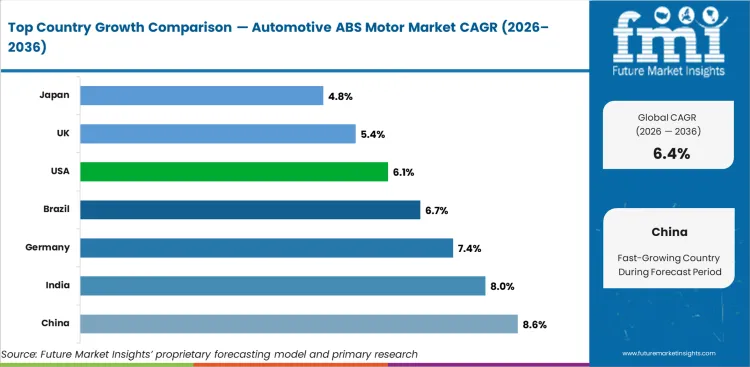
- China is leading with an 8.64% CAGR, driven by the volume of domestic vehicle production and the mandatory ABS requirement for all new vehicles.
- 8% for India indicates strong demand due to rising automotive production, mandatory ABS regulation and increasing awareness towards vehicle safety.
Regional demand reflects vehicle production volumes, ABS mandate enforcement, and automotive technology adoption. East Asia leads growth through production scale, while Europe drives specification complexity.
Sales Analysis of Automotive ABS Motor Market in China
China leads at 8.64% CAGR through 2036. Domestic vehicle production scale, mandatory ABS requirements, and growing EV production drive the largest procurement volumes globally.
- Vehicle production scale generates the largest ABS motor procurement volumes globally.
- EV production growth creates demand for redesigned ABS motors coordinating with regenerative braking.
- Domestic Tier-1 suppliers are expanding ABS motor manufacturing capacity to serve local OEMs.
Demand Outlook for Automotive ABS Motor Market in India
India is projected to grow at 8.0% CAGR through 2036. Mandatory ABS regulation, expanding automotive production, and growing vehicle safety awareness create sustained demand.
- Mandatory ABS regulation enforcement creates non-discretionary demand proportional to vehicle production.
- Automotive production expansion under PLI schemes increases the vehicle base requiring ABS motor integration.
- OEM localization of braking system manufacturing is reducing costs and improving supply chain proximity.
Opportunity Analysis of Automotive ABS Motor Market in Germany
Germany is projected to grow at 7.36% CAGR through 2036. Premium OEM concentration and advanced braking technology integration drive specification-grade demand.
- Premium OEM concentration from BMW, Mercedes-Benz, and VW Group drives advanced braking system specifications.
- ESC and ADAS integration increases per-vehicle braking electronics content value.
- Continental and Bosch maintain braking technology leadership through German R&D and manufacturing.
Future Outlook for Automotive ABS Motor Market in Brazil
Brazil is projected to grow at 6.72% CAGR through 2036. Vehicle production growth and ABS mandate enforcement create demand.
- ABS mandate enforcement creates non-discretionary demand across all new vehicle production.
- Vehicle production growth increases the base requiring ABS motor procurement.
- Commercial vehicle ABS adoption creates incremental demand beyond passenger car segments.
In-depth Analysis of Automotive ABS Motor Market in the United States
The USA is projected to grow at 6.08% CAGR through 2036. Vehicle production, ADAS integration, and EV adoption sustain demand.
- Vehicle production volumes sustain baseline ABS motor procurement through OEM supply programs.
- ADAS integration increases braking electronics content per vehicle, expanding addressable value.
- EV adoption creates demand for ABS motors redesigned for regenerative braking coordination.
Growth Analysis of Automotive ABS Motor Market in the United Kingdom
The UK is projected to grow at 5.44% CAGR through 2036. Vehicle production and EV transition sustain demand.
- UK vehicle production sustains baseline ABS motor procurement through OEM programs.
- EV transition creates specification evolution requirements for braking system integration.
- Advanced braking system specifications support higher per-unit content value.
Market Landscape for Automotive ABS Motor Market in Japan
Japan is projected to grow at 4.8% CAGR through 2036. Domestic manufacturer strength and advanced braking technology sustain demand.
- Hitachi Astemo, Advics, and domestic suppliers maintain competitive positions in ABS motor manufacturing.
- Advanced braking technology integration with ADAS sustains specification-grade development.
- Compact vehicle market requires optimized ABS motor designs for packaging efficiency.
Competitive Landscape and Strategic Positioning
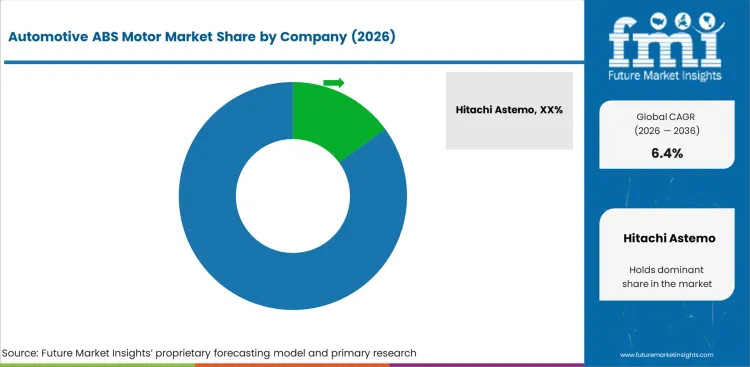
- Hitachi Astemo (15.0%) is ahead with existing automotive braking system supply, OEM integration know-how and global manufacturing footprint.
- WABCO (ZF), Nidec and Hyundai Mobis compete with diversified braking system portfolios and regional OEM relationships.
- High barriers to entry in the market due to market concentration among specialized Tier-1 braking suppliers.
Key Companies in the Automotive ABS Motor Market
Key global companies leading the automotive abs motor market include:
- Hitachi Astemo, WABCO (now part of ZF), Nidec Corporation maintain leading positions through established manufacturing infrastructure, distribution networks, and product breadth.
- Hyundai Mobis, HELLA GmbH & Co. KGaA, Knorr-Bremse AG, Mando Corp. hold strong regional or segment-specific positions with specialized capabilities.
- Advics Co., Ltd., BWI Group, Nissin Kogyo represent emerging players expanding through technology innovation and niche market positioning.
Competitive Benchmarking: Automotive ABS Motor Market
| Company | Braking System Integration | OEM Relationships | EV Capability | Geographic Coverage |
|---|---|---|---|---|
| Hitachi Astemo | Very High | Very Strong | Strong | Global |
| WABCO (ZF) | Very High | Very Strong | Strong | Global |
| Nidec Corporation | High | Strong | Strong | Global |
| Hyundai Mobis | High | Strong | Strong | Asia, Global |
| HELLA GmbH | Medium | Strong | Moderate | Europe, Global |
| Knorr-Bremse AG | High | Strong | Moderate | Global |
| Mando Corp. | High | Strong | Strong | Asia, Global |
| Advics Co., Ltd. | High | Strong | Strong | Asia |
Source: Future Market Insights competitive analysis, 2026.
Key Developments in Automotive ABS Motor Market
- In 2025, Hitachi Astemo (now Astemo) focused on advancing its electric motor and braking technologies for EVs, including developments in direct-drive systems and integration of braking with regenerative capabilities, supporting the growing electric vehicle platform demand.
- In 2025, ZF (WABCO) expanded its smart braking systems production in China by opening a new plant in Wuhan, increasing capacity for electronic braking components to serve the strong demand from Chinese OEMs and support regulatory compliance in the Asia-Pacific region.
Key Players in the Automotive ABS Motor Market
Major Global Players
- Hitachi Astemo
- WABCO (now part of ZF)
- Nidec Corporation
- Hyundai Mobis
- HELLA GmbH & Co. KGaA
- Knorr-Bremse AG
- Mando Corp.
Emerging Players/Startups
- Advics Co., Ltd.
- BWI Group
- Nissin Kogyo
- APG (Automotive Products Group)
- Trinova Automotive
Report Scope and Coverage
| Parameter | Details |
|---|---|
| Quantitative Units | USD 4.50 billion to USD 8.37 billion, at a CAGR of 6.4% |
| Market Definition | The automotive ABS motor market includes hydraulic, electric, and integrated anti-lock braking system motor and modulator assemblies supplied to vehicle manufacturers for passenger car, commercial vehicle, and electric vehicle applications. |
| Regions Covered | North America, Latin America, Europe, East Asia, South Asia and Pacific, Middle East and Africa |
| Countries Covered | China, India, Germany, Brazil, USA, UK, Japan, 30 plus countries |
| Key Companies Profiled | Hitachi Astemo, WABCO (now part of ZF), Nidec Corporation, Hyundai Mobis, HELLA GmbH & Co. KGaA, Knorr-Bremse AG, Mando Corp., Advics Co., Ltd., Brakes India, Johnson Electric |
| Forecast Period | 2026 to 2036 |
| Approach | Hybrid bottom-up and top-down methodology starting with verified transaction data, projecting adoption velocity across segments and regions. |
Market Segmentation Analysis
Automotive ABS Motor Market Segmented by Product:
- Hydraulic ABS Motors
- Two Channel ABS Motors
- Passenger Vehicle Systems
- Entry Level Safety Systems
- Four Channel ABS Motors
- Advanced Braking Systems
- Premium Vehicle Systems
- Two Channel ABS Motors
- Electric ABS Motors
- Brushless Motors
- High Efficiency Motors
- Low Noise Systems
- Brushed Motors
- Conventional ABS Systems
- Cost Effective Solutions
- Brushless Motors
- Integrated ABS Modules
- Electronic Brake Control Modules
- Integrated Safety Systems
- Smart Braking Systems
- Compact ABS Units
- Lightweight Modules
- Space Saving Systems
- Electronic Brake Control Modules
Automotive ABS Motor Market Segmented by Application:
- Passenger Vehicles
- Sedans And Hatchbacks
- Compact Cars
- Mid Size Cars
- Sport Utility Vehicles
- Compact Sport Utility Vehicles
- Luxury Sport Utility Vehicles
- Sedans And Hatchbacks
- Commercial Vehicles
- Light Commercial Vehicles
- Delivery Vans
- Pickup Trucks
- Heavy Commercial Vehicles
- Heavy Trucks
- Buses And Coaches
- Light Commercial Vehicles
- Electric Vehicles
- Battery Electric Vehicles
- Passenger Electric Vehicles
- Commercial Electric Vehicles
- Hybrid Vehicles
- Plug In Hybrid Vehicles
- Full Hybrid Vehicles
- Battery Electric Vehicles
Automotive ABS Motor Market Segmented by End Use:
- Original Equipment Manufacturers
- Passenger Vehicle Manufacturers
- Mass Market Vehicle Brands
- Premium Vehicle Brands
- Commercial Vehicle Manufacturers
- Truck Manufacturers
- Bus Manufacturers
- Passenger Vehicle Manufacturers
- Aftermarket
- Authorized Service Centers
- Original Parts Replacement
- Warranty Services
- Independent Repair Shops
- Low Cost Repairs
- Multi Brand Workshops
- Authorized Service Centers
Automotive ABS Motor Market Segmented by Distribution Channel:
- Direct Sales
- Original Equipment Supply
- Long Term Supply Contracts
- Platform Based Supply Agreements
- Tier One Suppliers
- Integrated Brake System Supply
- Customized Module Supply
- Original Equipment Supply
- Distributors
- Automotive Parts Distributors
- Regional Distributors
- Global Distributors
- Aftermarket Retailers
- Auto Parts Stores
- Online Automotive Platforms
- Automotive Parts Distributors
Automotive ABS Motor Market Segmented by Vehicle Type:
- Passenger Cars
- Compact Cars
- Entry Level Vehicles
- Urban Mobility Vehicles
- Luxury Cars
- Premium Sedans
- Sports Cars
- Compact Cars
- Commercial Vehicles
- Light Commercial Vehicles
- Delivery Vehicles
- Utility Vans
- Heavy Commercial Vehicles
- Heavy Trucks
- Intercity Buses
- Light Commercial Vehicles
- Electric Vehicles
- Battery Electric Vehicles
- Compact Electric Cars
- Electric Sport Utility Vehicles
- Hybrid Electric Vehicles
- Mild Hybrid Vehicles
- Plug In Hybrid Vehicles
- Battery Electric Vehicles
Automotive ABS Motor Market by Region:
- North America
- USA
- Canada
- Mexico
- Latin America
- Brazil
- Chile
- Rest of Latin America
- Western Europe
- Germany
- UK
- Italy
- Spain
- France
- Nordic
- BENELUX
- Rest of Western Europe
- Eastern Europe
- Russia
- Poland
- Hungary
- Balkan & Baltic
- Rest of Eastern Europe
- East Asia
- China
- Japan
- South Korea
- South Asia and Pacific
- India
- ASEAN
- Australia & New Zealand
- Rest of South Asia and Pacific
- Middle East & Africa
- Kingdom of Saudi Arabia
- Other GCC Countries
- Turkiye
- South Africa
- Other African Union
- Rest of Middle East & Africa
Research Sources and Bibliography
- 1. United Nations Economic Commission for Europe. (2025). UNECE Regulation No. 13-H: Braking of Motor Vehicles. UNECE.
- 2. European Commission. (2024). EU Vehicle Type Approval: ABS and ESC Requirements. EC.
- 3. Society of Automotive Engineers. (2025). SAE J2246: Anti-Lock Brake System Performance Standards. SAE.
- 4. International Organization of Motor Vehicle Manufacturers. (2025). OICA Global Vehicle Production and Safety Equipment Statistics. OICA.
- 5. National Highway Traffic Safety Administration. (2024). NHTSA FMVSS 135: Light Vehicle Brake Systems. NHTSA.
This bibliography is provided for reader reference. The full Future Market Insights report contains the complete reference list with publication dates, URLs, and supporting data for all cited works.
This Report Answers
- Estimating the size of the market and revenue projections from 2026 to 2036.
- Segmentation by product, application, end use, distribution channel, and vehicle type.
- Insights about more than 30 country markets.
- Analysis of EV integration and ADAS braking system evolution.
- Assessment of the competitive landscape and Tier-1 supplier positioning.
- Finding investment opportunities in EV braking, commercial vehicle, and emerging market segments.
- Tracking vehicle safety regulation developments and production volume trends.
- Delivery of data in PDF and Excel formats.
Frequently Asked Questions
How big is the automotive abs motor market in 2026?
The global automotive abs motor market is estimated to be valued at USD 4.50 billion in 2026.
What will be the size of automotive abs motor market in 2036?
The market size for the automotive abs motor market is projected to reach USD 8.37 billion by 2036.
How much will be the automotive abs motor market growth between 2026 and 2036?
The automotive abs motor market is expected to grow at a 6.4% CAGR between 2026 and 2036.
What are the key product types in the automotive abs motor market?
The key product types in automotive abs motor market are hydraulic abs motors, electric abs motors and integrated abs modules.
Which application segment is expected to contribute significant share in the automotive abs motor market in 2026?
In terms of application, passenger vehicles segment is expected to command 65.0% share in the automotive abs motor market in 2026.
Preview the report firsthand - request a free sample
Get SampleGet the brochure for pricing and purchase details.
Get PDFTable of Content
- Executive Summary
- Global Market Outlook
- Demand-side Trends
- Supply-side Trends
- Technology Roadmap Analysis
- Analysis and Recommendations
- Market Overview
- Market Coverage / Taxonomy
- Market Definition / Scope / Limitations
- Research Methodology
- Chapter Orientation
- Analytical Lens and Working Hypotheses
- Market Structure, Signals, and Trend Drivers
- Benchmarking and Cross-market Comparability
- Market Sizing, Forecasting, and Opportunity Mapping
- Research Design and Evidence Framework
- Desk Research Programme (Secondary Evidence)
- Company Annual and Sustainability Reports
- Peer-reviewed Journals and Academic Literature
- Corporate Websites, Product Literature, and Technical Notes
- Earnings Decks and Investor Briefings
- Statutory Filings and Regulatory Disclosures
- Technical White Papers and Standards Notes
- Trade Journals, Industry Magazines, and Analyst Briefs
- Conference Proceedings, Webinars, and Seminar Materials
- Government Statistics Portals and Public Data Releases
- Press Releases and Reputable Media Coverage
- Specialist Newsletters and Curated Briefings
- Sector Databases and Reference Repositories
- FMI Internal Proprietary Databases and Historical Market Datasets
- Subscription Datasets and Paid Sources
- Social Channels, Communities, and Digital Listening Inputs
- Additional Desk Sources
- Expert Input and Fieldwork (Primary Evidence)
- Primary Modes
- Qualitative Interviews and Expert Elicitation
- Quantitative Surveys and Structured Data Capture
- Blended Approach
- Why Primary Evidence is Used
- Field Techniques
- Interviews
- Surveys
- Focus Groups
- Observational and In-context Research
- Social and Community Interactions
- Stakeholder Universe Engaged
- C-suite Leaders
- Board Members
- Presidents and Vice Presidents
- R&D and Innovation Heads
- Technical Specialists
- Domain Subject-matter Experts
- Scientists
- Physicians and Other Healthcare Professionals
- Governance, Ethics, and Data Stewardship
- Research Ethics
- Data Integrity and Handling
- Primary Modes
- Tooling, Models, and Reference Databases
- Desk Research Programme (Secondary Evidence)
- Data Engineering and Model Build
- Data Acquisition and Ingestion
- Cleaning, Normalisation, and Verification
- Synthesis, Triangulation, and Analysis
- Quality Assurance and Audit Trail
- Market Background
- Market Dynamics
- Drivers
- Restraints
- Opportunity
- Trends
- Scenario Forecast
- Demand in Optimistic Scenario
- Demand in Likely Scenario
- Demand in Conservative Scenario
- Opportunity Map Analysis
- Product Life Cycle Analysis
- Supply Chain Analysis
- Investment Feasibility Matrix
- Value Chain Analysis
- PESTLE and Porter’s Analysis
- Regulatory Landscape
- Regional Parent Market Outlook
- Production and Consumption Statistics
- Import and Export Statistics
- Market Dynamics
- Global Market Analysis 2021 to 2025 and Forecast, 2026 to 2036
- Historical Market Size Value (USD Million) Analysis, 2021 to 2025
- Current and Future Market Size Value (USD Million) Projections, 2026 to 2036
- Y-o-Y Growth Trend Analysis
- Absolute $ Opportunity Analysis
- Global Market Pricing Analysis 2021 to 2025 and Forecast 2026 to 2036
- Global Market Analysis 2021 to 2025 and Forecast 2026 to 2036, By Product
- Introduction / Key Findings
- Historical Market Size Value (USD Million) Analysis By Product , 2021 to 2025
- Current and Future Market Size Value (USD Million) Analysis and Forecast By Product , 2026 to 2036
- Hydraulic ABS Motors
- Two Channel ABS Motors
- Passenger Vehicle Systems
- Entry Level Safety Systems
- Four Channel ABS Motors
- Advanced Braking Systems
- Premium Vehicle Systems
- Electric ABS Motors
- Brushless Motors
- High Efficiency Motors
- Low Noise Systems
- Brushed Motors
- Conventional ABS Systems
- Integrated ABS Modules
- Electronic Brake Control Modules
- Integrated Safety Systems
- Smart Braking Systems
- Compact ABS Value (USD Million)s
- Lightweight Modules
- Hydraulic ABS Motors
- Y-o-Y Growth Trend Analysis By Product , 2021 to 2025
- Absolute $ Opportunity Analysis By Product , 2026 to 2036
- Global Market Analysis 2021 to 2025 and Forecast 2026 to 2036, By Application
- Introduction / Key Findings
- Historical Market Size Value (USD Million) Analysis By Application, 2021 to 2025
- Current and Future Market Size Value (USD Million) Analysis and Forecast By Application, 2026 to 2036
- Passenger Vehicles
- Sedans And Hatchbacks
- Compact Cars
- Mid Size Cars
- Sport Utility Vehicles
- Compact Sport Utility Vehicles
- Luxury Sport Utility Vehicles
- Commercial Vehicles
- Light Commercial Vehicles
- Delivery Vans
- Pickup Trucks
- Heavy Commercial Vehicles
- Heavy Trucks
- Electric Vehicles
- Battery Electric Vehicles
- Passenger Electric Vehicles
- Commercial Electric Vehicles
- Hybrid Vehicles
- Plug In Hybrid Vehicles
- Passenger Vehicles
- Y-o-Y Growth Trend Analysis By Application, 2021 to 2025
- Absolute $ Opportunity Analysis By Application, 2026 to 2036
- Global Market Analysis 2021 to 2025 and Forecast 2026 to 2036, By End Use
- Introduction / Key Findings
- Historical Market Size Value (USD Million) Analysis By End Use, 2021 to 2025
- Current and Future Market Size Value (USD Million) Analysis and Forecast By End Use, 2026 to 2036
- Original Equipment Manufacturers
- Passenger Vehicle Manufacturers
- Mass Market Vehicle Brands
- Premium Vehicle Brands
- Commercial Vehicle Manufacturers
- Truck Manufacturers
- Bus Manufacturers
- Aftermarket
- Authorized Service Centers
- Original Parts Replacement
- Warranty Services
- Independent Repair Shops
- Low Cost Repairs
- Original Equipment Manufacturers
- Y-o-Y Growth Trend Analysis By End Use, 2021 to 2025
- Absolute $ Opportunity Analysis By End Use, 2026 to 2036
- Global Market Analysis 2021 to 2025 and Forecast 2026 to 2036, By Distribution Channel
- Introduction / Key Findings
- Historical Market Size Value (USD Million) Analysis By Distribution Channel, 2021 to 2025
- Current and Future Market Size Value (USD Million) Analysis and Forecast By Distribution Channel, 2026 to 2036
- Direct Sales
- Original Equipment Supply
- Long Term Supply Contracts
- Platform Based Supply Agreements
- Tier One Suppliers
- Integrated Brake System Supply
- Customized Module Supply
- Distributors
- Automotive Parts Distributors
- Regional Distributors
- Global Distributors
- Aftermarket Retailers
- Auto Parts Stores
- Direct Sales
- Y-o-Y Growth Trend Analysis By Distribution Channel, 2021 to 2025
- Absolute $ Opportunity Analysis By Distribution Channel, 2026 to 2036
- Global Market Analysis 2021 to 2025 and Forecast 2026 to 2036, By Vehicle Type
- Introduction / Key Findings
- Historical Market Size Value (USD Million) Analysis By Vehicle Type, 2021 to 2025
- Current and Future Market Size Value (USD Million) Analysis and Forecast By Vehicle Type, 2026 to 2036
- Passenger Cars
- Compact Cars
- Entry Level Vehicles
- Urban Mobility Vehicles
- Luxury Cars
- Premium Sedans
- Sports Cars
- Commercial Vehicles
- Light Commercial Vehicles
- Delivery Vehicles
- Utility Vans
- Heavy Commercial Vehicles
- Heavy Trucks
- Electric Vehicles
- Battery Electric Vehicles
- Compact Electric Cars
- Electric Sport Utility Vehicles
- Hybrid Electric Vehicles
- Mild Hybrid Vehicles
- Passenger Cars
- Y-o-Y Growth Trend Analysis By Vehicle Type, 2021 to 2025
- Absolute $ Opportunity Analysis By Vehicle Type, 2026 to 2036
- Global Market Analysis 2021 to 2025 and Forecast 2026 to 2036, By Region
- Introduction
- Historical Market Size Value (USD Million) Analysis By Region, 2021 to 2025
- Current Market Size Value (USD Million) Analysis and Forecast By Region, 2026 to 2036
- North America
- Latin America
- Western Europe
- Eastern Europe
- East Asia
- South Asia and Pacific
- Middle East & Africa
- Market Attractiveness Analysis By Region
- North America Market Analysis 2021 to 2025 and Forecast 2026 to 2036, By Country
- Historical Market Size Value (USD Million) Trend Analysis By Market Taxonomy, 2021 to 2025
- Market Size Value (USD Million) Forecast By Market Taxonomy, 2026 to 2036
- By Country
- USA
- Canada
- Mexico
- By Product
- By Application
- By End Use
- By Distribution Channel
- By Vehicle Type
- By Country
- Market Attractiveness Analysis
- By Country
- By Product
- By Application
- By End Use
- By Distribution Channel
- By Vehicle Type
- Key Takeaways
- Latin America Market Analysis 2021 to 2025 and Forecast 2026 to 2036, By Country
- Historical Market Size Value (USD Million) Trend Analysis By Market Taxonomy, 2021 to 2025
- Market Size Value (USD Million) Forecast By Market Taxonomy, 2026 to 2036
- By Country
- Brazil
- Chile
- Rest of Latin America
- By Product
- By Application
- By End Use
- By Distribution Channel
- By Vehicle Type
- By Country
- Market Attractiveness Analysis
- By Country
- By Product
- By Application
- By End Use
- By Distribution Channel
- By Vehicle Type
- Key Takeaways
- Western Europe Market Analysis 2021 to 2025 and Forecast 2026 to 2036, By Country
- Historical Market Size Value (USD Million) Trend Analysis By Market Taxonomy, 2021 to 2025
- Market Size Value (USD Million) Forecast By Market Taxonomy, 2026 to 2036
- By Country
- Germany
- UK
- Italy
- Spain
- France
- Nordic
- BENELUX
- Rest of Western Europe
- By Product
- By Application
- By End Use
- By Distribution Channel
- By Vehicle Type
- By Country
- Market Attractiveness Analysis
- By Country
- By Product
- By Application
- By End Use
- By Distribution Channel
- By Vehicle Type
- Key Takeaways
- Eastern Europe Market Analysis 2021 to 2025 and Forecast 2026 to 2036, By Country
- Historical Market Size Value (USD Million) Trend Analysis By Market Taxonomy, 2021 to 2025
- Market Size Value (USD Million) Forecast By Market Taxonomy, 2026 to 2036
- By Country
- Russia
- Poland
- Hungary
- Balkan & Baltic
- Rest of Eastern Europe
- By Product
- By Application
- By End Use
- By Distribution Channel
- By Vehicle Type
- By Country
- Market Attractiveness Analysis
- By Country
- By Product
- By Application
- By End Use
- By Distribution Channel
- By Vehicle Type
- Key Takeaways
- East Asia Market Analysis 2021 to 2025 and Forecast 2026 to 2036, By Country
- Historical Market Size Value (USD Million) Trend Analysis By Market Taxonomy, 2021 to 2025
- Market Size Value (USD Million) Forecast By Market Taxonomy, 2026 to 2036
- By Country
- China
- Japan
- South Korea
- By Product
- By Application
- By End Use
- By Distribution Channel
- By Vehicle Type
- By Country
- Market Attractiveness Analysis
- By Country
- By Product
- By Application
- By End Use
- By Distribution Channel
- By Vehicle Type
- Key Takeaways
- South Asia and Pacific Market Analysis 2021 to 2025 and Forecast 2026 to 2036, By Country
- Historical Market Size Value (USD Million) Trend Analysis By Market Taxonomy, 2021 to 2025
- Market Size Value (USD Million) Forecast By Market Taxonomy, 2026 to 2036
- By Country
- India
- ASEAN
- Australia & New Zealand
- Rest of South Asia and Pacific
- By Product
- By Application
- By End Use
- By Distribution Channel
- By Vehicle Type
- By Country
- Market Attractiveness Analysis
- By Country
- By Product
- By Application
- By End Use
- By Distribution Channel
- By Vehicle Type
- Key Takeaways
- Middle East & Africa Market Analysis 2021 to 2025 and Forecast 2026 to 2036, By Country
- Historical Market Size Value (USD Million) Trend Analysis By Market Taxonomy, 2021 to 2025
- Market Size Value (USD Million) Forecast By Market Taxonomy, 2026 to 2036
- By Country
- Kingdom of Saudi Arabia
- Other GCC Countries
- Turkiye
- South Africa
- Other African Union
- Rest of Middle East & Africa
- By Product
- By Application
- By End Use
- By Distribution Channel
- By Vehicle Type
- By Country
- Market Attractiveness Analysis
- By Country
- By Product
- By Application
- By End Use
- By Distribution Channel
- By Vehicle Type
- Key Takeaways
- Key Countries Market Analysis
- USA
- Pricing Analysis
- Market Share Analysis, 2025
- By Product
- By Application
- By End Use
- By Distribution Channel
- By Vehicle Type
- Canada
- Pricing Analysis
- Market Share Analysis, 2025
- By Product
- By Application
- By End Use
- By Distribution Channel
- By Vehicle Type
- Mexico
- Pricing Analysis
- Market Share Analysis, 2025
- By Product
- By Application
- By End Use
- By Distribution Channel
- By Vehicle Type
- Brazil
- Pricing Analysis
- Market Share Analysis, 2025
- By Product
- By Application
- By End Use
- By Distribution Channel
- By Vehicle Type
- Chile
- Pricing Analysis
- Market Share Analysis, 2025
- By Product
- By Application
- By End Use
- By Distribution Channel
- By Vehicle Type
- Germany
- Pricing Analysis
- Market Share Analysis, 2025
- By Product
- By Application
- By End Use
- By Distribution Channel
- By Vehicle Type
- UK
- Pricing Analysis
- Market Share Analysis, 2025
- By Product
- By Application
- By End Use
- By Distribution Channel
- By Vehicle Type
- Italy
- Pricing Analysis
- Market Share Analysis, 2025
- By Product
- By Application
- By End Use
- By Distribution Channel
- By Vehicle Type
- Spain
- Pricing Analysis
- Market Share Analysis, 2025
- By Product
- By Application
- By End Use
- By Distribution Channel
- By Vehicle Type
- France
- Pricing Analysis
- Market Share Analysis, 2025
- By Product
- By Application
- By End Use
- By Distribution Channel
- By Vehicle Type
- India
- Pricing Analysis
- Market Share Analysis, 2025
- By Product
- By Application
- By End Use
- By Distribution Channel
- By Vehicle Type
- ASEAN
- Pricing Analysis
- Market Share Analysis, 2025
- By Product
- By Application
- By End Use
- By Distribution Channel
- By Vehicle Type
- Australia & New Zealand
- Pricing Analysis
- Market Share Analysis, 2025
- By Product
- By Application
- By End Use
- By Distribution Channel
- By Vehicle Type
- China
- Pricing Analysis
- Market Share Analysis, 2025
- By Product
- By Application
- By End Use
- By Distribution Channel
- By Vehicle Type
- Japan
- Pricing Analysis
- Market Share Analysis, 2025
- By Product
- By Application
- By End Use
- By Distribution Channel
- By Vehicle Type
- South Korea
- Pricing Analysis
- Market Share Analysis, 2025
- By Product
- By Application
- By End Use
- By Distribution Channel
- By Vehicle Type
- Russia
- Pricing Analysis
- Market Share Analysis, 2025
- By Product
- By Application
- By End Use
- By Distribution Channel
- By Vehicle Type
- Poland
- Pricing Analysis
- Market Share Analysis, 2025
- By Product
- By Application
- By End Use
- By Distribution Channel
- By Vehicle Type
- Hungary
- Pricing Analysis
- Market Share Analysis, 2025
- By Product
- By Application
- By End Use
- By Distribution Channel
- By Vehicle Type
- Kingdom of Saudi Arabia
- Pricing Analysis
- Market Share Analysis, 2025
- By Product
- By Application
- By End Use
- By Distribution Channel
- By Vehicle Type
- Turkiye
- Pricing Analysis
- Market Share Analysis, 2025
- By Product
- By Application
- By End Use
- By Distribution Channel
- By Vehicle Type
- South Africa
- Pricing Analysis
- Market Share Analysis, 2025
- By Product
- By Application
- By End Use
- By Distribution Channel
- By Vehicle Type
- USA
- Market Structure Analysis
- Competition Dashboard
- Competition Benchmarking
- Market Share Analysis of Top Players
- By Regional
- By Product
- By Application
- By End Use
- By Distribution Channel
- By Vehicle Type
- Competition Analysis
- Competition Deep Dive
- Hitachi Astemo
- Overview
- Product Portfolio
- Profitability by Market Segments (Product/Age /Sales Channel/Region)
- Sales Footprint
- Strategy Overview
- Marketing Strategy
- Product Strategy
- Channel Strategy
- WABCO (now part of ZF)
- Nidec Corporation
- Hyundai Mobis
- HELLA GmbH & Co. KGaA
- Knorr-Bremse AG
- Mando Corp.
- Advics Co., Ltd.
- Brakes India
- Johnson Electric
- Hitachi Astemo
- Competition Deep Dive
- Assumptions & Acronyms Used


