

- Industry Size (2026)
- USD 1.5 Bn
- Forecast (2036)
- USD 7.8 Bn
- CAGR (2026 to 2036)
- 18.3%
Level 4 Autonomous Highway Trucking Market Size, Market Forecast and Outlook By FMI
The level 4 autonomous highway trucking market crossed a valuation of USD 1.2 billion in 2025. Sales for the level 4 autonomous trucking market are expected to cross USD 1.5 billion in 2026 at a CAGR of 18.3% during this forecast period. Tracking the heavy-duty autonomous truck market size, cumulative valuation lifts to USD 7.8 billion through 2036 as fleet operators abandon traditional driver-retention wage escalations.
Procurement directors at major logistics carriers face an immediate mathematical wall regarding human compensation. Delaying adoption of autonomous trucking for long-haul logistics means committing to margin compression that competitors will bypass using automated autonomous trucks. What looks like a technology upgrade actually represents a fundamental shift in capital allocation. Operations managers evaluating the driverless freight trucking market must now underwrite massive upfront hardware investments to secure predictable per-mile operating costs a decade out.
Summary of Level 4 Autonomous Highway Trucking Market
- Level 4 Autonomous Highway Trucking Market Definition
- Commercial freight operations executed by vehicles capable of complete driving autonomy within specific operational domains. Human presence inside cabins becomes completely unnecessary during highway segments.
- Demand Drivers in the Market
- Endemic driver shortages compel fleet executives to automate long-haul routes.
- Insurance premium escalations force risk managers to adopt perfectly compliant automated driving systems.
- Fuel efficiency mandates push sustainability directors toward algorithmically optimized acceleration profiles.
- Key Segments Analyzed in the FMI Report
- Equipment Type: Hardware platform and sensor stack is projected to hold 52.0% share in 2026, driven by redundant safety requirements.
- Deployment Sector: OEM-integrated autonomy-ready trucks are anticipated to account for 44.0% share in 2026, as fleets prefer factory warranties over retrofits.
- End User: Hub-to-hub interstate corridors is poised to capture 61.0% share in 2026, dominating hub-to-hub freight automation.
- UAE: 20.1% compound growth, fueled by Greenfield smart-city logistics planning.
- Analyst Opinion at FMI
- Nikhil Kaitwade, Principal Analyst, Automotive, at Future Market Insights, opines, “Through our recent assessment, we observed that regulatory alignment and infrastructure readiness remain critical to large-scale deployment. Autonomous highway trucking requires standardized safety frameworks, dedicated lanes, and digital infrastructure support. Stakeholders that collaborate across OEMs, regulators, and logistics providers will unlock the next phase of commercialization in autonomous freight transport.”
- Strategic Implications / Executive Takeaways
- Fleet procurement officers must secure early capacity allocations from software providers before exclusivity contracts lock up supply.
- Infrastructure planners need to design transfer hubs just outside complex urban environments.
- Insurance underwriters must develop entirely new actuarial models based on system versions rather than human driver histories.
- Methodology
- Primary Research: Fleet procurement directors, OEM engineering leads, and autonomous software architects
- Desk Research: Federal Motor Carrier Safety Administration exemption filings, state-level autonomous testing permits, and OEM safety reports
- Market-Sizing and Forecasting: Hardware sensor kit installations and software-as-a-service licensing contracts per active truck
- Data Validation and Update Cycle: Cross-referencing tier-1 supplier component shipments against fleet commercial deployment announcements
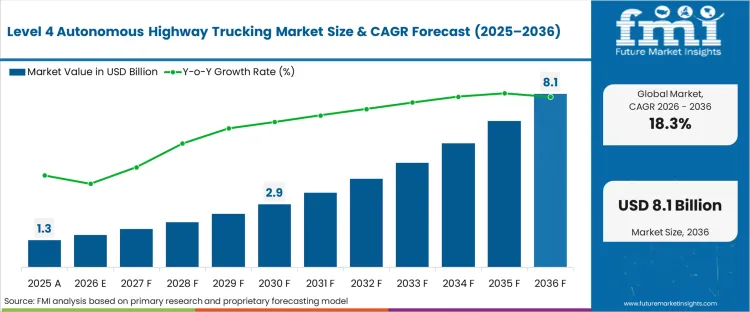
Level 4 Autonomous Highway Trucking Market Key Takeaways
| Metric | Details |
|---|---|
| Industry Size (2026) | USD 1.5 Billion |
| Industry Value (2036) | USD 7.8 Billion |
| CAGR (2026 to 2036) | 18.3% |
Source: Future Market Insights (FMI) analysis, based on proprietary forecasting model and primary research.
Once regulatory bodies finalize cross-state exemption frameworks, the driver-out trucking commercialization timeline accelerates rapidly. Federal standardization allows carriers to map continuous transcontinental freight lanes. Regulatory clarity transforms experimental pilot programs into permanent capital expenditure lines for major fleets.
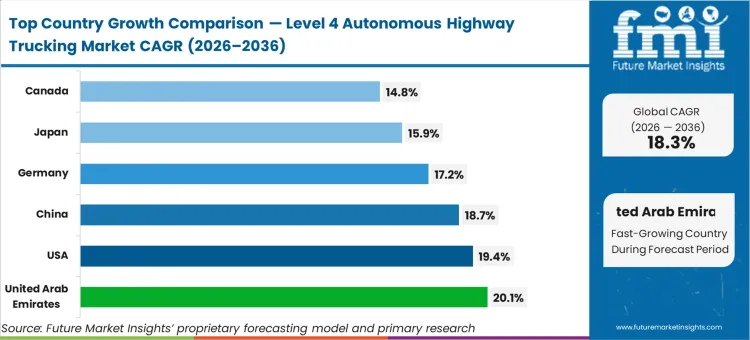
Geographic divergence shapes adoption speeds. The United States level 4 autonomous trucking market expands at 19.4% driven by severe long-haul labor shortages across interstate routes. Evaluating the China autonomous highway trucking market, demand accelerates at 18.7% through aggressively subsidized port-to-inland infrastructure projects. Germany tracks at 17.2% with strong automotive OEM partnerships pushing European standards. Japan registers 15.9% as aging demographics force rapid logistics automation. Canada expands at 14.8% targeting remote industrial paths. Diverging liability frameworks split adoption speeds between highly centralized economies and fragmented regulatory states.
Level 4 Autonomous Highway Trucking Market Definition
SAE level 4 truck autonomy market solutions constitute commercial freight autonomous vehicles operating without human intervention under specific operational design domains. Systems handle all driving tasks within mapped geographic boundaries and weather constraints. Operations require remote monitoring but no active human control inside cabin environments.
Level 4 Autonomous Highway Trucking Market Inclusions
Hardware platforms shaping the level 4 truck sensor stack market, processing units, and remote teleoperations command centers fall within scope. Factory-built autonomous tractors alongside aftermarket retrofit packages designed for heavy freight transport belong here. Infrastructure connectivity modules mounted on vehicles form a core inclusion.
Level 4 Autonomous Highway Trucking Market Exclusions
Advanced driver assistance systems requiring active human monitoring fall outside this analysis. Warehouse robotics, passenger autonomous vehicles, and last-mile delivery drones face exclusion because their regulatory pathways differ fundamentally from heavy highway freight. Static roadside infrastructure investment remains excluded.
Level 4 Autonomous Highway Trucking Market Research Methodology
- Primary Research: Fleet procurement directors, OEM engineering leads, and autonomous software architects
- Desk Research: Federal Motor Carrier Safety Administration exemption filings, state-level autonomous testing permits, and OEM safety reports
- Market-Sizing and Forecasting: Hardware sensor kit installations and software-as-a-service licensing contracts per active truck
- Data Validation and Update Cycle: Cross-referencing tier-1 supplier component shipments against fleet commercial deployment announcements
Segmental Analysis
Level 4 Autonomous Highway Trucking Market Analysis by Component
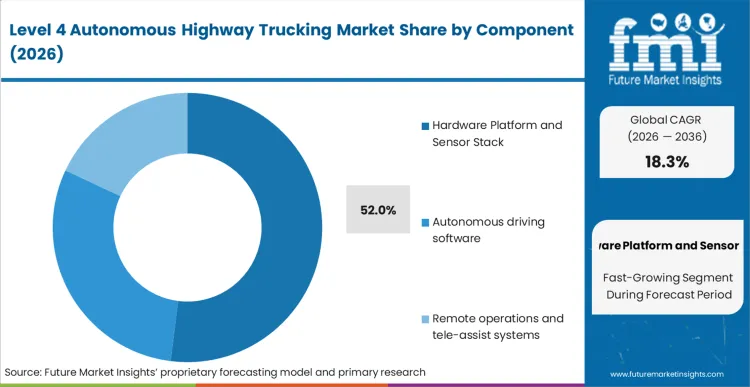
Redundant safety architectures dictate why hardware platform and sensor stack components command 52.0% share. Engineering leads prioritize overlapping radar arrays and optical systems over software alone. Physical sensors represent massive upfront capital requirements for every vehicle. Procurement teams sourcing from level 4 autonomous trucking suppliers accept high initial costs to guarantee functional safety. What traditional financial models miss is that sensor depreciation outpaces software obsolescence. FMI analysts observe that hardware becomes a depreciating liability while trained algorithms appreciate in value over time. Fleet managers who index too heavily on current-generation hardware find themselves saddled with uncompetitive operating costs when newer, cheaper solid state LiDAR sensor arrays enter commercial production.
- Physical redundancy constraints: Engineering directors mandate overlapping sensor modalities to handle adverse weather conditions across varied terrains. Fleets purchasing systems lacking triple-redundancy face immediate grounding during minor sensor failures, destroying any theoretical return on investment calculated during initial procurement phases.
- Obsolescence risk management: Procurement officers struggle balancing immediate deployment needs against rapid hardware depreciation curves inherent in early-stage technologies. Delaying purchases preserves capital but forfeits early data-gathering advantages necessary for algorithm training, leaving cautious carriers locked into an unrecoverable data deficit against aggressive early adopters.
- Integration workflow bottlenecks: Maintenance supervisors require entirely new training programs to service complex optical equipment and computing clusters. Failure to upskill technician workforces leads to extended vehicle downtime during routine recalibration procedures, negating any labor savings generated by driverless operation on highways.
Level 4 Autonomous Highway Trucking Market Analysis by Deployment model
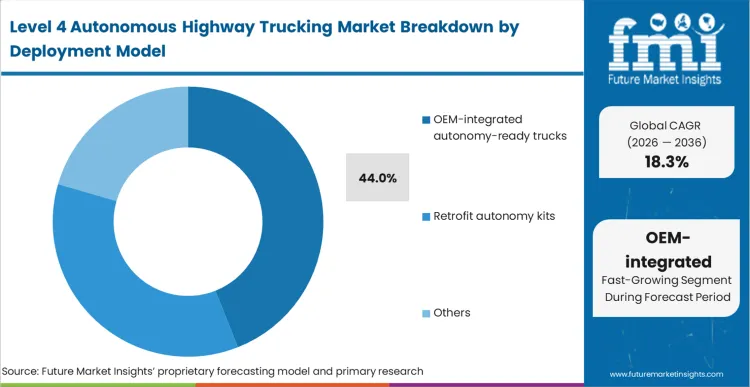
Risk transfer mechanisms explain why OEM-integrated autonomy-ready trucks hold 44.0% share. Fleet operators demand single-throat-to-choke warranty structures rather than divided liability between truck builders and software developers. Retrofitting existing chassis introduces integration liabilities that insurance underwriters strongly penalize. Purchasing directors actively avoid aftermarket installations. Based on FMI's assessment, factory-integrated platforms provide clear chains of accountability necessary for scaled commercial deployment. Generalist observers assume retrofit kits will dominate early adoption due to lower initial barriers. Real-world procurement behavior shows major carriers abandoning retrofit experiments because sensor calibration drifts during extended chassis flex on rough terrain. Carriers attempting piecemeal integration face crippling insurance premiums that destroy project economics entirely.
- Initial capitalization requirements: Chief financial officers confront massive upfront premiums for factory-integrated autonomous platforms compared to standard diesel tractors. This capital intensity forces carriers to extend depreciation schedules, fundamentally altering how logistics organizations calculate asset returns over ten-year operational lifespans.
- Hidden calibration expenses: Maintenance directors discover that aftermarket installations require constant fine-tuning after traversing poor interstate surfaces. These hidden labor costs erode expected margins quickly, pushing sophisticated buyers exclusively toward systematic reinforced OEM integrations designed specifically for autonomous operational stresses.
- Lifecycle salvage value: Asset managers struggle pricing automated tractors entering secondary markets after five years of intense usage. Uncertainty regarding algorithm transferability and sensor lifespan severely depresses residual values, requiring operators to extract maximum revenue during primary ownership phases.
Level 4 Autonomous Highway Trucking Market Analysis by Route type
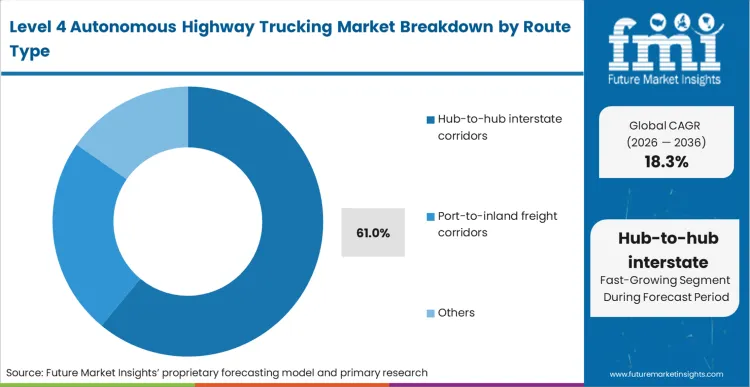
Hub-to-hub autonomous trucking economics dictate that eliminating complex urban edge cases maximizes ROI. Operational design domain limitations restrict early commercialization to highly predictable environments. Hub-to-hub interstate corridors capture 61.0% share because routing algorithms handle linear highway geometries easily while struggling with erratic pedestrian behavior. Network planners position transfer terminals strategically at city edges. FMI's analysis indicates this bifurcated logistics model separates tedious long-haul segments from dynamic last-mile delivery. Pure technology enthusiasts assume software will eventually solve all urban driving challenges. Practitioners understand that building dedicated transfer hubs proves vastly cheaper than funding endless software development for complex municipal navigation. Logistics companies refusing to build these peripheral transfer facilities cannot deploy automated assets effectively.
- Disengagement zone mitigation: Route planners specifically select interstate paths avoiding complex interchanges and construction zones. Vehicles forced into unexpected human-takeover situations create massive logistical cascading delays, meaning operations teams prioritize route simplicity over absolute distance minimization.
- Terminal bottleneck exposure: Facility managers face severe congestion at transfer hubs where autonomous tractors hand trailers to human drivers. Insufficient staging space creates terminal gridlock, nullifying velocity gains achieved during uninterrupted automated highway transit phases.
- Weather condition overrides: Dispatchers maintain constant meteorological surveillance across mapped automated corridors. Sudden severe weather events require immediate fleet grounding commands, forcing operations centers to maintain expensive human backup driver networks stationed strategically along primary routes.
Level 4 Autonomous Highway Trucking Market Analysis by Truck class
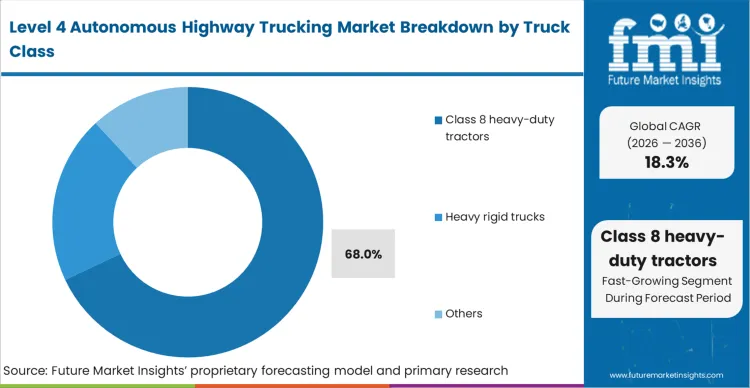
Unit economics dictate mass adoption across specific vehicle categories first. The class 8 autonomous trucking market maintains 68.0% share because maximum payload capacities dilute expensive hardware costs most effectively. Transporting eighty thousand pounds maximizes revenue per automated mile. Fleet executives calculating payback periods realize smaller vehicles cannot generate sufficient freight bills to justify automotive radar arrays. In FMI's view, heavy vehicles present extreme kinetic energy challenges requiring vastly longer sensor detection ranges. Surface analysis suggests automation works best on smaller platforms. Operations directors know heavy freight margins remain so thin that only maximum-capacity autonomous payloads generate acceptable profit margins. Shippers utilizing smaller autonomous platforms fail to reach economic break-even points.
- First-mover dry van adoption: Logistics directors deploy automation first on standard dry van trailers moving consumer goods across flat geographies. This predictable cargo profile simplifies vehicle dynamics calculations, allowing early adopters to build statistical safety cases before tackling complex loads.
- Liquid bulk delayed integration: Chemical transport managers resist early automation due to complex fluid slosh dynamics requiring highly nuanced braking profiles. These specialized carriers wait for software providers to perfect multi-physics autonomous driving virtual simulation platform tests before risking hazardous material transport.
- Flatbed load securement barriers: Industrial freight operators remain sidelined because automated systems cannot physically verify strap tension or load shifting mid-journey. This physical limitation prevents complete automation of flatbed operations, keeping human operators essential for specialized industrial cargo movements.
Level 4 Autonomous Highway Trucking Market Drivers, Restraints, and Opportunities
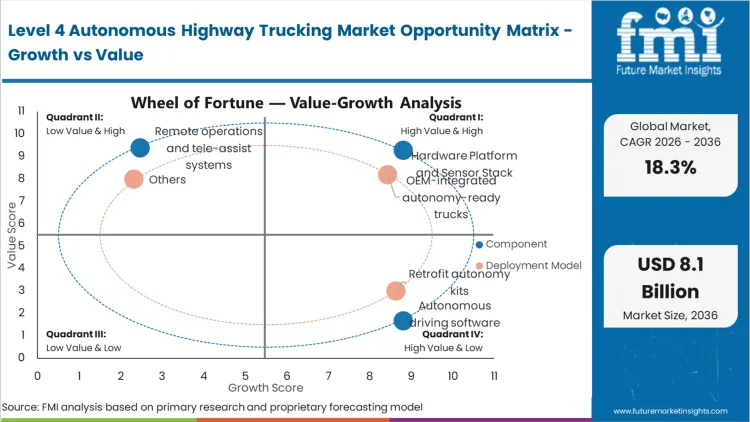
Driver wage inflation destroys historical operating margins across major carriers. Logistics executives evaluating autonomous trucking vs human-driven long haul economics face a binary choice: either raise freight rates drastically or remove human compensation from long-haul equations. Replacing human operators with intelligent driving technology solution packages transforms unpredictable labor costs into fixed hardware depreciation schedules. Delaying this transition leaves traditional carriers unable to compete on price against automated fleets running twenty hours per day. Asset utilization doubles when hours-of-service regulations no longer apply. This relentless pressure to maximize capital efficiency forces immediate evaluation of driverless platforms.
State-level regulatory fragmentation prevents seamless transcontinental automated freight movement. Operations directors cannot map continuous transcontinental routes when neighboring jurisdictions maintain contradictory liability frameworks. This legal patchwork requires carriers to pause autonomous operations at specific state borders. While industry coalitions lobby for federal standardization, individual states continue imposing unique testing requirements and reporting mandates. This administrative friction restricts deployment to regional loops rather than unlocking true national network efficiencies.
Opportunities in the Level 4 Autonomous Highway Trucking Market
- Dedicated transfer hub real estate: Real estate developers identifying industrial parcels exactly at highway exits outside major municipalities capture premium leases. Logistics carriers desperately need these specific staging yards to transition freight from automated heavy duty trucks to human-driven local delivery vehicles.
- Autonomous trucking tele-assist systems: Software integrators building highly secure command facilities secure lucrative recurring service contracts. Fleet managers willingly outsource this mandatory human oversight function to specialized firms possessing military-grade advanced driver assistance systems communication redundancies.
- Sensor calibration service networks: Maintenance organizations establishing dedicated optical alignment facilities along major interstate corridors unlock new revenue streams. Autonomous fleets require precision recalibration after minor impacts, creating massive demand for specialized automotive sensors diagnostic centers.
Regional Analysis
Based on regional analysis, Level 4 Autonomous Highway Trucking is segmented into North America, Latin America, Europe, East Asia, South Asia and Pacific, and Middle East and Africa across 40 plus countries.
.webp "Top Country Growth Comparison Level 4 Autonomous Highway Trucking Market Cagr (2026 2036)")
| Country | CAGR (2026 to 2036) |
|---|---|
| United Arab Emirates | 20.1% |
| United States | 19.4% |
| China | 18.7% |
| Germany | 17.2% |
| Japan | 15.9% |
| Canada | 14.8% |
Source: Future Market Insights (FMI) analysis, based on proprietary forecasting model and primary research .
Middle East and Africa Level 4 Autonomous Highway Trucking Market Analysis
Actual momentum stems from centralized regulatory authority issuing nationwide deployment permits simultaneously, contradicting Western assumptions that regional progress relies purely on capital. Transport ministries integrate dedicated autonomous freight lanes directly into new highway blueprints. Greenfield smart-city logistics planning allows Middle Eastern nations to bypass legacy infrastructure constraints. Separating automated heavy freight from human passenger traffic eliminates complex behavioral prediction variables entirely, FMI analysts note. Companies testing locally gather clean mobile LiDAR scanner data without navigating contradictory municipal ordinances. This clean-slate approach dramatically accelerates testing timelines.
- United Arab Emirates: Expanding at 20.1% annually, aggressive deployments force international logistics firms to adopt automated platforms rapidly to maintain regional operating licenses. State-owned port operators mandate automated freight corridors linking maritime terminals to inland distribution centers. Port logistics directors capture massive efficiency gains by running continuous twenty-four-hour autonomous drayage operations.
FMI's report includes Saudi Arabia and South Africa. Centralized infrastructure funding mechanisms allow rapid deployment of connected vehicle communication networks across major industrial zones.
North America Level 4 Autonomous Highway Trucking Market Analysis
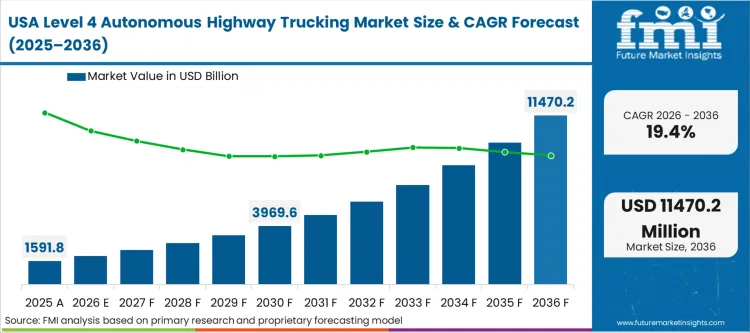
Driver demographics show massive retirement waves approaching with insufficient younger replacements entering long-haul routes. Procurement directors treat automated platforms not as efficiency upgrades, but as basic capacity preservation tools. Severe Endemic driver shortages dictate fleet automation timelines across North American interstates. State-level legislative competition creates favorable testing environments as individual jurisdictions fight to attract engineering talent and capital investment. Massive capital flows into autonomous trucking vendors cluster specifically around Sunbelt logistics hubs, as per FMI's projection. Mild weather patterns permit uninterrupted testing of ADAS sensors.
- United States: Carrier executives face unprecedented wage inflation while struggling to seat available tractors. Operations managers target specific sunbelt corridors connecting Texas and Arizona for initial commercial rollouts, growing at 19.4% through the forecast period. This specific geographic focus allows algorithms to master dry, predictable environments before developers attempt complex northern snow operations.
- Canada: Resource extraction companies demand robust automated transport linking isolated mining facilities to regional processing plants. Fleet managers deploy specialized LiDAR pulsed fiber laser systems capable of piercing heavy snowfall. These extreme-weather deployments push sensor manufacturers to harden components beyond standard commercial specifications, advancing at 14.8% annually.
FMI's report includes Mexico. Cross-border manufacturing integration drives localized demand for automated transfer operations near major industrial zones.
Europe Level 4 Autonomous Highway Trucking Market Analysis
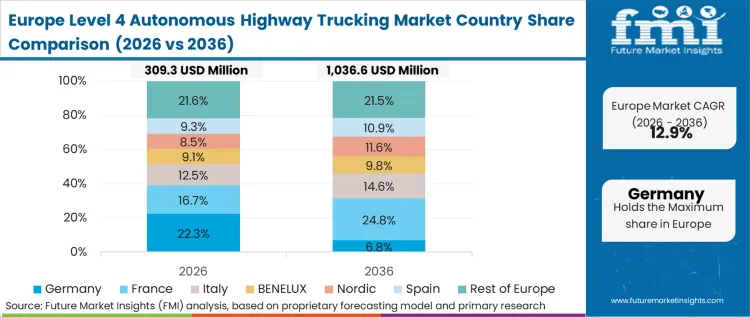
Strong automotive traditions collide with strict continental safety mandates across European jurisdictions. Regulators demand exhaustive multi-physics simulation proofs before permitting unmanned highway testing. FMI's analysis indicates this rigorous oversight forces software developers into deep partnerships with legacy truck builders who already understand localized homologation procedures. Public perception heavily influences transport ministry approvals, leading to highly controlled, point-to-point operational domains rather than open-network autonomy. Cross-border standardization efforts gain momentum as regulatory bodies draft unified liability frameworks for automated freight. Fleet operators prioritize sustainability goals alongside operational efficiency, heavily favoring aerodynamic autonomous chassis designs.
- Germany: Tracking a 17.2% CAGR, heavy vehicle manufacturers leverage deep industrial relationships to secure localized testing permits along the Autobahn network. Engineering directors at major automotive conglomerates push proprietary algorithms through rigorous state-sponsored validation loops. This tight integration between regulators and legacy builders effectively locks out pure-software startups lacking established homologation credentials.
FMI's report includes France and Italy. Alpine corridor logistics planners evaluate autonomous transfer hubs to manage complex gradient ascents.
East Asia Level 4 Autonomous Highway Trucking Market Analysis
Central economic planners direct massive capital toward 5G-enabled smart highways designed specifically for automated heavy freight. This infrastructure-heavy approach shifts computing burdens off vehicles and onto smart roads. Aggressively subsidized port-to-inland infrastructure projects define Asian commercialization curves. Western developers attempting purely vehicle-centric autonomy face severe disadvantages competing against heavily subsidized connected-corridor models. State-backed telecommunication monopolies deploy roadside edge-computing nodes precisely coordinated with vehicle AI based driving systems L2 to L5, FMI observes.
- China: Port authorities construct massive automated logistics networks moving shipping containers directly from docks to regional rail hubs. Supply chain directors leverage mandatory V2X communication protocols to coordinate dense vehicle platoons safely. This centralized coordination model sets aggressive global benchmarks for overall network efficiency rather than individual vehicle intelligence, accelerating at 18.7%.
- Japan: Registering 15.9% compound growth, severe demographic necessity forces regulators to fast-track commercial licensing procedures ahead of pure technological maturity. Plunging working-age populations force logistics providers to automate domestic freight routes aggressively. Fleet operators test Class 8 truck autonomy on dedicated nighttime highway lanes to minimize passenger vehicle interaction.
FMI's report includes South Korea. High-density coastal manufacturing corridors require precision automated logistics to connect tightly clustered electronics fabrication facilities.
Competitive Aligners for Market Players
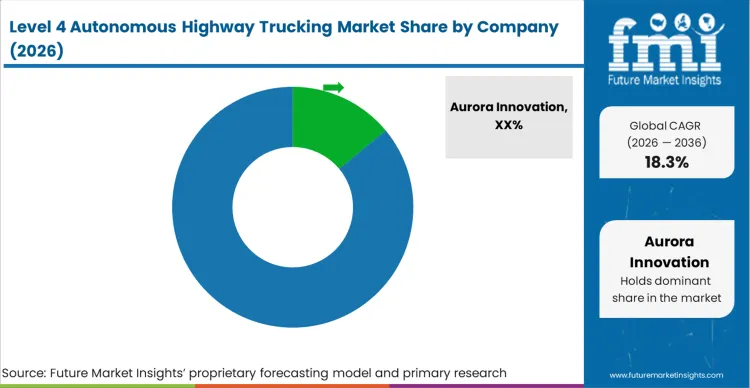
Data collection velocity separates viable software developers from stagnant engineering projects. Aurora Innovation and Kodiak Robotics maintain aggressive testing fleets to capture critical edge-case scenarios necessary for statistical safety validation. Buyers evaluate partners based strictly on total autonomous miles driven without critical disengagements. Marketing claims regarding AI in transportation vanish when fleet procurement teams demand hard safety disengagement logs. Companies possessing massive proprietary datasets build unassailable algorithmic advantages.
Incumbents hold deep chassis integration experience that pure software developers cannot easily replicate. Daimler Truck and Volvo Autonomous Solutions leverage decades of structural engineering knowledge to harden steering and braking actuators for computer control. New software entrants must partner with these legacy builders to access commercial-grade ADAS platforms. Building reliable heavy-duty hardware takes massive capital and deep supplier relationships.
Large logistics carriers actively resist vendor lock-in by mandating hardware-agnostic software architectures. Fleet managers refuse to chain their entire capital expenditure strategies to single proprietary ecosystems. This purchasing behavior forces autonomous software developers to ensure compatibility across multiple truck brands. Dominant tier-1 suppliers who attempt closed-ecosystem strategies face immediate rejection from sophisticated corporate buyers seeking operational flexibility.
Key Players in Level 4 Autonomous Highway Trucking Market
- Aurora Innovation
- Kodiak Robotics
- Daimler Truck / Torc Robotics
- PlusAI
- Waabi
- Volvo Autonomous Solutions
Scope of the Report
| Metric | Value |
|---|---|
| Quantitative Units | USD 1.5 Billion to USD 7.8 Billion, at a CAGR of 18.3% |
| Market Definition | Commercial freight vehicles operating without human intervention under specific operational design domains. Systems handle all driving tasks within mapped geographic boundaries. |
| Segmentation | Component, Deployment model, Route type, Truck class, Region |
| Regions Covered | North America, Latin America, Europe, East Asia, South Asia and Pacific, Middle East and Africa |
| Countries Covered | United States, Canada, Germany, China, Japan, United Arab Emirates |
| Key Companies Profiled | Aurora Innovation, Kodiak Robotics, Daimler Truck / Torc Robotics, PlusAI, Waabi, Volvo Autonomous Solutions |
| Forecast Period | 2026 to 2036 |
| Approach | Hardware sensor kit installations and software-as-a-service licensing contracts per active truck |
Source: Future Market Insights (FMI) analysis, based on proprietary forecasting model and primary research.
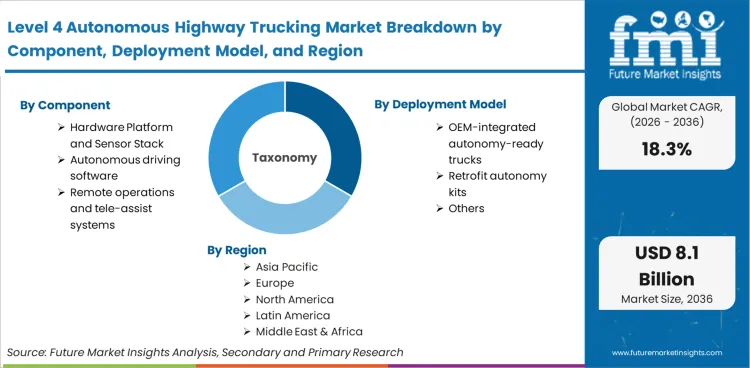
Level 4 Autonomous Highway Trucking Market Analysis by Segments
Component
- Hardware platform and sensor stack
- Autonomous driving software
- Remote operations and tele-assist systems
- Validation, mapping, and simulation services
Deployment model
- OEM-integrated autonomy-ready trucks
- Retrofit autonomy kits
- Driverless trucking-as-a-service
- Supervised pilot and validation programs
Route type
- Hub-to-hub interstate corridors
- Port-to-inland freight corridors
- Cross-border industrial lanes
- Dedicated private logistics networks
Truck class
- Class 8 heavy-duty tractors
- Heavy rigid trucks
- Vocational highway-specialty trucks
- Regional medium-heavy autonomous freight platforms
Region
- North America
- Latin America
- Europe
- East Asia
- South Asia and Pacific
- Middle East and Africa
Bibliography
- European Automobile Manufacturers’ Association. (2025, January 28). New commercial vehicle registrations: vans +8.3%, trucks -6.3%, buses +9.2% in 2024.
- American Association of Motor Vehicle Administrators. (2024). Guidelines for Regulating Vehicles with Automated Driving Systems, Edition 4.
- National Highway Traffic Safety Administration. (2024). NHTSA proposes national program for vehicles with automated driving systems. USA Department of Transportation.
- USA Department of Transportation. (2024, August). Understanding safety challenges of vehicles equipped with automated driving systems. Highly Automated Systems Safety Center of Excellence.
This bibliography is provided for reader reference. The full FMI report contains the complete reference list with primary source documentation.
This Report Addresses
- Fleet executives seeking to understand hardware validation requirements for autonomous deployments.
- Operations managers comparing factory-integrated platforms against retrofit kit economics.
- Procurement directors evaluating sensor redundancy costs across heavy-duty chassis.
- Risk officers modeling insurance premiums for driverless long-haul freight operations.
- Real estate planners identifying strategic locations for dedicated autonomous transfer hubs.
- Investors analyzing capital requirements for multi-physics simulation testing environments.
- Port authority directors assessing V2X communication infrastructure for smart logistics corridors.
- Supply chain strategists mapping predictable interstate routes suitable for early automation.
Frequently Asked Questions
What is the size of the level 4 autonomous trucking market?
Demand reaches USD 7.8 billion by 2036. This massive capital formation signals a complete transition from experimental technology to standard logistics procurement.
How fast is the level 4 autonomous highway trucking market growing?
Sales expand at 18.3% annually. This trajectory reflects rapid hardware cost depreciation combined with expanding regulatory approvals for driverless operations.
Which companies lead the level 4 autonomous trucking market?
Data collection velocity separates viable software developers. Companies possessing massive proprietary datasets, such as Aurora Innovation and Kodiak Robotics, maintain aggressive testing fleets to capture critical edge-case scenarios necessary for statistical safety validation.
Where are driverless trucks operating today?
Operations managers target specific sunbelt corridors connecting Texas and Arizona for initial commercial rollouts. This specific geographic focus allows algorithms to master dry, predictable environments before developers attempt complex northern snow operations.
Explain the level 4 autonomous highway trucking market by region?
Severe CDL driver deficits dictate fleet automation timelines across North American interstates. Meanwhile, aggressively subsidized port-to-inland infrastructure projects define Asian commercialization curves, separating regional adoption logic globally.
Who are the top suppliers in level 4 autonomous trucking and what differentiates them?
Incumbents hold deep chassis integration experience that pure software developers cannot easily replicate. Daimler Truck and Volvo Autonomous Solutions leverage decades of base-vehicle architecture experience to harden steering and braking actuators for computer control.
What assumptions should be used to model autonomous trucking adoption through 2036?
Autonomous long-haul truck market forecast models assume that driver wage inflation destroys historical operating margins across major carriers. Fleet executives calculating payback periods realize smaller vehicles cannot generate sufficient freight bills to justify arrays, consolidating adoption logic toward heavy-duty chassis.
Compare aurora kodiak torc plus and waabi in autonomous highway trucking?
Fleet managers evaluate partners based strictly on total autonomous miles driven without critical disengagements. Aurora and Kodiak scale testing miles aggressively, while Torc leverages deep OEM integration directly through Daimler to secure robust long-term platform reliability.
Which freight corridors will commercialize driverless trucks first?
Interstate corridors eliminate erratic urban pedestrian variables. Routing algorithms handle linear highway geometries safely while avoiding complex municipal intersections entirely.
Summarize regulatory barriers to level 4 trucking in the us europe and china?
Fragmented state regulations prevent continuous transcontinental operations. Carriers must pause automated freight at borders where liability frameworks remain legally undefined, contrasting heavily with unified mandates present in subsidized Asian port networks.
Which countries are adopting level 4 trucking first?
Centralized smart-city planning integrates dedicated autonomous lanes directly into infrastructure blueprints in the United Arab Emirates. Severe driver shortages simultaneously force American carriers to automate existing routes under fragmented state approvals.
How do we map autonomous trucking vs ADAS for heavy trucks?
Advanced driver assistance systems require active human monitoring, falling short of true commercial automation. Driverless highway deployments eliminate the human operator entirely during specific operational domains.
What friction slows immediate commercialization?
Fragmented state regulations prevent continuous transcontinental operations. Carriers must pause automated freight at borders where liability frameworks remain legally undefined.
How do incumbents protect their positions?
Legacy truck builders leverage proprietary chassis engineering knowledge. Software developers must partner with these incumbents to access commercial-grade braking and steering actuators.
How do large fleets avoid vendor lock-in?
Procurement directors mandate hardware-agnostic software architectures. Carriers require systems capable of operating across multiple different truck brands simultaneously.
What role do remote operations centers play?
Tele-assist facilities provide mandatory human oversight for edge cases. Fleet managers outsource this function to specialized firms operating secure, low-latency communication networks.
Why do flatbed trailers resist automation?
Automated systems cannot physically verify strap tension mid-journey. Human operators remain necessary to monitor load securement for complex industrial freight.
How do weather events impact automated routes?
Sudden severe weather forces immediate fleet grounding commands. Dispatchers must maintain human backup driver networks strategically positioned along primary automated corridors.
What happens to secondary market values?
Asset managers struggle pricing used autonomous tractors. Uncertainty regarding sensor lifespan and software transferability depresses residual values significantly.
Why do retrofit kits fail at scale?
Aftermarket sensor calibration drifts during extended chassis flex. Constant recalibration generates massive hidden labor costs that destroy operating margins.
How does China approach automation differently?
Central planners subsidize roadside edge-computing infrastructure. This approach shifts processing burdens off individual vehicles and onto connected smart highways.
What drives Japanese adoption urgency?
Plunging working-age demographics force rapid logistics automation. Fleet operators utilize dedicated nighttime lanes to maintain supply chains despite severe labor shortages.
How do companies prove statistical safety?
Engineering teams run billions of miles through multi-physics simulation platforms. Physical testing alone cannot cover enough edge cases to satisfy regulatory requirements.
Why are chemical transports delayed?
Liquid bulk slosh dynamics require complex algorithmic braking profiles. Specialized carriers await perfectly validated fluid-dynamics software before risking hazardous material transport.
Preview the report firsthand - request a free sample
Get SampleGet the brochure for pricing and purchase details.
Get PDFTable of Content
- Executive Summary
- Global Market Outlook
- Demand-side Trends
- Supply-side Trends
- Technology Roadmap Analysis
- Analysis and Recommendations
- Market Overview
- Market Coverage / Taxonomy
- Market Definition / Scope / Limitations
- Research Methodology
- Chapter Orientation
- Analytical Lens and Working Hypotheses
- Market Structure, Signals, and Trend Drivers
- Benchmarking and Cross-market Comparability
- Market Sizing, Forecasting, and Opportunity Mapping
- Research Design and Evidence Framework
- Desk Research Programme (Secondary Evidence)
- Company Annual and Sustainability Reports
- Peer-reviewed Journals and Academic Literature
- Corporate Websites, Product Literature, and Technical Notes
- Earnings Decks and Investor Briefings
- Statutory Filings and Regulatory Disclosures
- Technical White Papers and Standards Notes
- Trade Journals, Industry Magazines, and Analyst Briefs
- Conference Proceedings, Webinars, and Seminar Materials
- Government Statistics Portals and Public Data Releases
- Press Releases and Reputable Media Coverage
- Specialist Newsletters and Curated Briefings
- Sector Databases and Reference Repositories
- FMI Internal Proprietary Databases and Historical Market Datasets
- Subscription Datasets and Paid Sources
- Social Channels, Communities, and Digital Listening Inputs
- Additional Desk Sources
- Expert Input and Fieldwork (Primary Evidence)
- Primary Modes
- Qualitative Interviews and Expert Elicitation
- Quantitative Surveys and Structured Data Capture
- Blended Approach
- Why Primary Evidence is Used
- Focus Groups
- Observational and In-context Research
- Social and Community Interactions
- Primary Modes
- Stakeholder Universe Engaged
- C-suite Leaders
- Board Members
- Presidents and Vice Presidents
- R&D and Innovation Heads
- Technical Specialists
- Domain Subject-matter Experts
- Scientists
- Physicians and Other Healthcare Professionals
- Governance, Ethics, and Data Stewardship
- Research Ethics
- Data Integrity and Handling
- Desk Research Programme (Secondary Evidence)
- Tooling, Models, and Reference Databases
- Data Engineering and Model Build
- Data Acquisition and Ingestion
- Cleaning, Normalisation, and Verification
- Synthesis, Triangulation, and Analysis
- Quality Assurance and Audit Trail
- Market Background
- Market Dynamics
- Drivers
- Restraints
- Opportunity
- Trends
- Scenario Forecast
- Demand in Optimistic Scenario
- Demand in Likely Scenario
- Demand in Conservative Scenario
- Opportunity Map Analysis
- Product Life Cycle Analysis
- Supply Chain Analysis
- Investment Feasibility Matrix
- Value Chain Analysis
- PESTLE and Porter’s Analysis
- Regulatory Landscape
- Regional Parent Market Outlook
- Production and Consumption Statistics
- Import and Export Statistics
- Market Dynamics
- Global Market Analysis 2021 to 2025 and Forecast, 2026 to 2036
- Historical Market Size Value (USD Million) Analysis, 2021 to 2025
- Current and Future Market Size Value (USD Million) Projections, 2026 to 2036
- Y-o-Y Growth Trend Analysis
- Absolute $ Opportunity Analysis
- Global Market Pricing Analysis 2021 to 2025 and Forecast 2026 to 2036
- Global Market Analysis 2021 to 2025 and Forecast 2026 to 2036, By Component
- Introduction / Key Findings
- Historical Market Size Value (USD Million) Analysis By Component , 2021 to 2025
- Current and Future Market Size Value (USD Million) Analysis and Forecast By Component , 2026 to 2036
- Hardware Platform and Sensor Stack
- Autonomous driving software
- Remote operations and tele-assist systems
- Hardware Platform and Sensor Stack
- Y-o-Y Growth Trend Analysis By Component , 2021 to 2025
- Absolute $ Opportunity Analysis By Component , 2026 to 2036
- Global Market Analysis 2021 to 2025 and Forecast 2026 to 2036, By Deployment Model
- Introduction / Key Findings
- Historical Market Size Value (USD Million) Analysis By Deployment Model, 2021 to 2025
- Current and Future Market Size Value (USD Million) Analysis and Forecast By Deployment Model, 2026 to 2036
- OEM-integrated autonomy-ready trucks
- Retrofit autonomy kits
- Others
- OEM-integrated autonomy-ready trucks
- Y-o-Y Growth Trend Analysis By Deployment Model, 2021 to 2025
- Absolute $ Opportunity Analysis By Deployment Model, 2026 to 2036
- Global Market Analysis 2021 to 2025 and Forecast 2026 to 2036, By Route Type
- Introduction / Key Findings
- Historical Market Size Value (USD Million) Analysis By Route Type, 2021 to 2025
- Current and Future Market Size Value (USD Million) Analysis and Forecast By Route Type, 2026 to 2036
- Hub-to-hub interstate corridors
- Port-to-inland freight corridors
- Others
- Hub-to-hub interstate corridors
- Y-o-Y Growth Trend Analysis By Route Type, 2021 to 2025
- Absolute $ Opportunity Analysis By Route Type, 2026 to 2036
- Global Market Analysis 2021 to 2025 and Forecast 2026 to 2036, By Truck Class
- Introduction / Key Findings
- Historical Market Size Value (USD Million) Analysis By Truck Class, 2021 to 2025
- Current and Future Market Size Value (USD Million) Analysis and Forecast By Truck Class, 2026 to 2036
- Class 8 heavy-duty tractors
- Heavy rigid trucks
- Others
- Class 8 heavy-duty tractors
- Y-o-Y Growth Trend Analysis By Truck Class, 2021 to 2025
- Absolute $ Opportunity Analysis By Truck Class, 2026 to 2036
- Global Market Analysis 2021 to 2025 and Forecast 2026 to 2036, By Region
- Introduction
- Historical Market Size Value (USD Million) Analysis By Region, 2021 to 2025
- Current Market Size Value (USD Million) Analysis and Forecast By Region, 2026 to 2036
- North America
- Latin America
- Western Europe
- Eastern Europe
- East Asia
- South Asia and Pacific
- Middle East & Africa
- Market Attractiveness Analysis By Region
- North America Market Analysis 2021 to 2025 and Forecast 2026 to 2036, By Country
- Historical Market Size Value (USD Million) Trend Analysis By Market Taxonomy, 2021 to 2025
- Market Size Value (USD Million) Forecast By Market Taxonomy, 2026 to 2036
- By Country
- USA
- Canada
- Mexico
- By Component
- By Deployment Model
- By Route Type
- By Truck Class
- By Country
- Market Attractiveness Analysis
- By Country
- By Component
- By Deployment Model
- By Route Type
- By Truck Class
- Key Takeaways
- Latin America Market Analysis 2021 to 2025 and Forecast 2026 to 2036, By Country
- Historical Market Size Value (USD Million) Trend Analysis By Market Taxonomy, 2021 to 2025
- Market Size Value (USD Million) Forecast By Market Taxonomy, 2026 to 2036
- By Country
- Brazil
- Chile
- Rest of Latin America
- By Component
- By Deployment Model
- By Route Type
- By Truck Class
- By Country
- Market Attractiveness Analysis
- By Country
- By Component
- By Deployment Model
- By Route Type
- By Truck Class
- Key Takeaways
- Western Europe Market Analysis 2021 to 2025 and Forecast 2026 to 2036, By Country
- Historical Market Size Value (USD Million) Trend Analysis By Market Taxonomy, 2021 to 2025
- Market Size Value (USD Million) Forecast By Market Taxonomy, 2026 to 2036
- By Country
- Germany
- UK
- Italy
- Spain
- France
- Nordic
- BENELUX
- Rest of Western Europe
- By Component
- By Deployment Model
- By Route Type
- By Truck Class
- By Country
- Market Attractiveness Analysis
- By Country
- By Component
- By Deployment Model
- By Route Type
- By Truck Class
- Key Takeaways
- Eastern Europe Market Analysis 2021 to 2025 and Forecast 2026 to 2036, By Country
- Historical Market Size Value (USD Million) Trend Analysis By Market Taxonomy, 2021 to 2025
- Market Size Value (USD Million) Forecast By Market Taxonomy, 2026 to 2036
- By Country
- Russia
- Poland
- Hungary
- Balkan & Baltic
- Rest of Eastern Europe
- By Component
- By Deployment Model
- By Route Type
- By Truck Class
- By Country
- Market Attractiveness Analysis
- By Country
- By Component
- By Deployment Model
- By Route Type
- By Truck Class
- Key Takeaways
- East Asia Market Analysis 2021 to 2025 and Forecast 2026 to 2036, By Country
- Historical Market Size Value (USD Million) Trend Analysis By Market Taxonomy, 2021 to 2025
- Market Size Value (USD Million) Forecast By Market Taxonomy, 2026 to 2036
- By Country
- China
- Japan
- South Korea
- By Component
- By Deployment Model
- By Route Type
- By Truck Class
- By Country
- Market Attractiveness Analysis
- By Country
- By Component
- By Deployment Model
- By Route Type
- By Truck Class
- Key Takeaways
- South Asia and Pacific Market Analysis 2021 to 2025 and Forecast 2026 to 2036, By Country
- Historical Market Size Value (USD Million) Trend Analysis By Market Taxonomy, 2021 to 2025
- Market Size Value (USD Million) Forecast By Market Taxonomy, 2026 to 2036
- By Country
- India
- ASEAN
- Australia & New Zealand
- Rest of South Asia and Pacific
- By Component
- By Deployment Model
- By Route Type
- By Truck Class
- By Country
- Market Attractiveness Analysis
- By Country
- By Component
- By Deployment Model
- By Route Type
- By Truck Class
- Key Takeaways
- Middle East & Africa Market Analysis 2021 to 2025 and Forecast 2026 to 2036, By Country
- Historical Market Size Value (USD Million) Trend Analysis By Market Taxonomy, 2021 to 2025
- Market Size Value (USD Million) Forecast By Market Taxonomy, 2026 to 2036
- By Country
- Kingdom of Saudi Arabia
- Other GCC Countries
- Turkiye
- South Africa
- Other African Union
- Rest of Middle East & Africa
- By Component
- By Deployment Model
- By Route Type
- By Truck Class
- By Country
- Market Attractiveness Analysis
- By Country
- By Component
- By Deployment Model
- By Route Type
- By Truck Class
- Key Takeaways
- Key Countries Market Analysis
- USA
- Pricing Analysis
- Market Share Analysis, 2025
- By Component
- By Deployment Model
- By Route Type
- By Truck Class
- Canada
- Pricing Analysis
- Market Share Analysis, 2025
- By Component
- By Deployment Model
- By Route Type
- By Truck Class
- Mexico
- Pricing Analysis
- Market Share Analysis, 2025
- By Component
- By Deployment Model
- By Route Type
- By Truck Class
- Brazil
- Pricing Analysis
- Market Share Analysis, 2025
- By Component
- By Deployment Model
- By Route Type
- By Truck Class
- Chile
- Pricing Analysis
- Market Share Analysis, 2025
- By Component
- By Deployment Model
- By Route Type
- By Truck Class
- Germany
- Pricing Analysis
- Market Share Analysis, 2025
- By Component
- By Deployment Model
- By Route Type
- By Truck Class
- UK
- Pricing Analysis
- Market Share Analysis, 2025
- By Component
- By Deployment Model
- By Route Type
- By Truck Class
- Italy
- Pricing Analysis
- Market Share Analysis, 2025
- By Component
- By Deployment Model
- By Route Type
- By Truck Class
- Spain
- Pricing Analysis
- Market Share Analysis, 2025
- By Component
- By Deployment Model
- By Route Type
- By Truck Class
- France
- Pricing Analysis
- Market Share Analysis, 2025
- By Component
- By Deployment Model
- By Route Type
- By Truck Class
- India
- Pricing Analysis
- Market Share Analysis, 2025
- By Component
- By Deployment Model
- By Route Type
- By Truck Class
- ASEAN
- Pricing Analysis
- Market Share Analysis, 2025
- By Component
- By Deployment Model
- By Route Type
- By Truck Class
- Australia & New Zealand
- Pricing Analysis
- Market Share Analysis, 2025
- By Component
- By Deployment Model
- By Route Type
- By Truck Class
- China
- Pricing Analysis
- Market Share Analysis, 2025
- By Component
- By Deployment Model
- By Route Type
- By Truck Class
- Japan
- Pricing Analysis
- Market Share Analysis, 2025
- By Component
- By Deployment Model
- By Route Type
- By Truck Class
- South Korea
- Pricing Analysis
- Market Share Analysis, 2025
- By Component
- By Deployment Model
- By Route Type
- By Truck Class
- Russia
- Pricing Analysis
- Market Share Analysis, 2025
- By Component
- By Deployment Model
- By Route Type
- By Truck Class
- Poland
- Pricing Analysis
- Market Share Analysis, 2025
- By Component
- By Deployment Model
- By Route Type
- By Truck Class
- Hungary
- Pricing Analysis
- Market Share Analysis, 2025
- By Component
- By Deployment Model
- By Route Type
- By Truck Class
- Kingdom of Saudi Arabia
- Pricing Analysis
- Market Share Analysis, 2025
- By Component
- By Deployment Model
- By Route Type
- By Truck Class
- Turkiye
- Pricing Analysis
- Market Share Analysis, 2025
- By Component
- By Deployment Model
- By Route Type
- By Truck Class
- South Africa
- Pricing Analysis
- Market Share Analysis, 2025
- By Component
- By Deployment Model
- By Route Type
- By Truck Class
- USA
- Market Structure Analysis
- Competition Dashboard
- Competition Benchmarking
- Market Share Analysis of Top Players
- By Regional
- By Component
- By Deployment Model
- By Route Type
- By Truck Class
- Competition Analysis
- Competition Deep Dive
- Aurora Innovation
- Overview
- Product Portfolio
- Profitability by Market Segments (Product/Age /Sales Channel/Region)
- Sales Footprint
- Strategy Overview
- Marketing Strategy
- Product Strategy
- Channel Strategy
- Kodiak Robotics
- Daimler Truck / Torc Robotics
- PlusAI
- Waabi
- Volvo Autonomous Solutions
- Aurora Innovation
- Competition Deep Dive
- Assumptions & Acronyms Used


