

- Industry Size (2026)
- USD 1260 Mn
- Forecast (2036)
- USD 4480 Mn
- CAGR (2026 to 2036)
- 13.5%
Autonomous Sorting for Flexible Plastic Waste Market Forecast and Outlook 2026 to 2036
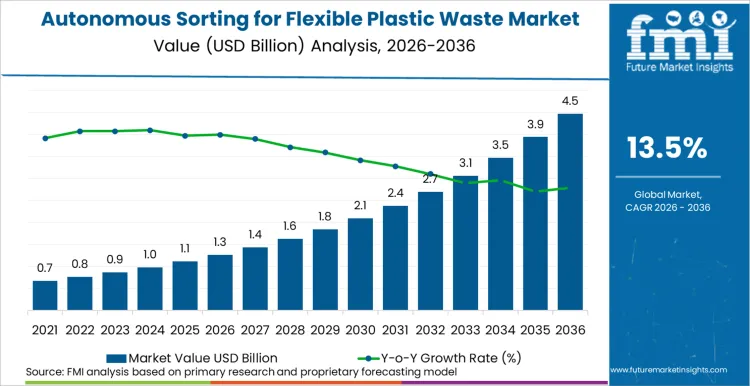
Autonomous sorting for flexible plastic waste market revenue is projected to total USD 1,260 million in 2026, increasing to USD 4,480 million by 2036, at a CAGR of 13.5%. FMI analysis indicates the market is undergoing a fundamental shift from standalone robotic pickers to fully integrated, cognitive sorting lines that make real-time material classification and destination decisions.
Growth is anchored in the acute economic challenge of manually sorting low-value, high-volume flexible plastic waste. Film and flexible packaging streams are labor-intensive to handle, prone to contamination, and difficult to recover consistently through manual picking, particularly in high-wage regions where labor availability and cost volatility undermine operational viability. This economic pressure has become a primary driver of capital deployment into autonomous sorting systems, where return on investment is increasingly assessed through labor cost avoidance, higher throughput stability, and the ability to generate cleaner polymer fractions that command improved offtake value.
TOMRA Recycling has continued advancing sensor-based and AI-enabled sorting solutions for flexible plastics during 2024-2025, combining optical detection technologies with machine-learning-driven material recognition. Rather than relying on single-sensor approaches, TOMRA’s development trajectory emphasizes multi-sensor fusion and continuously expanding material libraries to improve identification of contaminated, printed, and multilayer films. These capabilities are positioned to raise recovery efficiency and polymer purity in large material recovery facilities and plastics recovery parks, where conventional NIR systems alone have struggled with flexible waste variability.
Technical innovation across the competitive landscape is increasingly centered on robotic speed, adaptability, and decision latency. AMP Robotics has publicly demonstrated the scalability of AI-driven robotic sorting across multiple waste streams, including flexible plastics, with systems designed to operate continuously at industrial throughput levels. While specific pick-rate figures vary by application, AMP’s emphasis on rapid object recognition and coordinated robotic motion addresses a long-standing bottleneck in flexible packaging recovery, where slow manual sorting historically constrained line efficiency.
System integrators are also embedding intelligence deeper into quality control functions. Bulk Handling Systems (BHS) has expanded the role of its MAX-AI® platform beyond primary sorting into autonomous quality control and residue management. By integrating real-time vision analytics and adaptive sorting logic, these systems enable facilities to dynamically respond to fluctuations in inbound flexible waste composition, improving capture rates and reducing downstream contamination without constant manual recalibration.
Robotics suppliers are enabling more modular automation strategies suitable for space-constrained facilities. Yaskawa Electric Corporation continues to advance high-speed industrial robotic arms combined with 3D vision systems that are increasingly adopted in recycling and material handling environments. This trend supports the deployment of compact, retrofit-friendly robotic sorting cells, particularly in mature markets where existing MRF layouts limit the feasibility of large-scale infrastructure expansion.
Summary of Autonomous Sorting for Flexible Plastic Waste Market
- The autonomous sorting for flexible plastic waste market comprises AI-enabled optical sorters, robotic picking systems, soft-gripper technologies, and integrated autonomous sorting cells deployed across material recovery facilities and recycling parks to enable high-purity separation of post-consumer and commercial flexible plastic streams.
- The defined scope follows FMI taxonomy, covering autonomous and semi-autonomous sorting equipment and software applied to flexible plastic films, multilayer laminates, and engineered flexible packaging waste, while excluding manual sorting labor, downstream recycling conversion processes, and baling or washing infrastructure.
- The autonomous sorting for flexible plastic waste market is projected to grow at a CAGR of 13.5% from 2026 to 2036, expanding from USD 1,260 million in 2026 to USD 4,480 million by 2036, based on FMI proprietary bottom-up revenue modeling incorporating global film waste generation, regulatory recycling targets, capital expenditure trends, and primary interviews with MRF operators and technology integrators.
- The sector is transitioning from robot-assisted sorting lines toward fully autonomous sorting halls optimized for low-margin, high-volume flexible plastics, with increasing solution specialization for dirty post-consumer film, retail and commercial backhaul film, and high-precision sorting of complex laminates requiring dedicated AI training datasets and end-effector configurations.
- Competition is concentrated among advanced sorting technology providers and robotics integrators, with differentiation driven by AI vision accuracy, throughput economics, and system integration capability.
- India records the fastest growth at 15.2% CAGR through 2036, supported by formalization of waste sorting infrastructure and rising labor costs, while China remains a high-growth anchor market driven by large film waste volumes and state-led modernization of recycling parks.
Autonomous Sorting for Flexible Plastic Waste Market Key Takeaways
| Metrics | Values |
|---|---|
| Expected Value (2026E) | USD 1,260 million |
| Projected Value (2036F) | USD 4,480 million |
| CAGR (2026-2036) | 13.5% |
Source: Future Market Insights (FMI) analysis, based on proprietary forecasting model and primary research
Why is the Autonomous Sorting for Flexible Plastic Waste Market Growing?
The failure of traditional air classifiers and screening to effectively separate two-dimensional films from three-dimensional containers is creating a massive sorting bottleneck. Autonomous systems, particularly vision-guided robots, are the only technology capable of performing this precise separational task at high speed, addressing a fundamental mechanical limitation in MRF design.
The economics of chemical recycling are heavily dependent on feedstock purity. Advanced recycling plants for pyrolysis or depolymerization require exceptionally clean polyolefin feedstocks to avoid reactor fouling and catalyst poisoning. Autonomous sorters, with their high-precision material identification, are becoming the essential gatekeepers for this growing downstream sector, enabling a value uplift for sorted film that justifies the automation investment.
Insurance and risk management are emerging as indirect drivers. Manual sorting lines have high rates of workplace injury. The deployment of autonomous cells mitigates this operational risk, leading to lower insurance premiums and reduced liability, a tangible financial benefit that is factored into procurement decisions by large, corporate waste management operators.
How is the Autonomous Sorting for Flexible Plastic Waste Market Segmented?
The autonomous sorting market for flexible plastics is segmented by the degree of human oversight, the specific material stream targeted, and the core technological architecture deployed. This segmentation reflects the trade-off between capital expenditure, operational complexity, and the required purity of output material.
Fully autonomous sorting lines, which require minimal human intervention for entire process streams, command the highest value share (50%), as they represent the definitive solution for labor cost elimination and throughput maximization in high-volume settings. In contrast, robot-assisted and embedded AI solutions serve as modular entry points or specialized components within broader, hybrid sorting infrastructures.
How is the Dominance of Vision AI + Robotics Sustained in Technologically Advanced Markets?
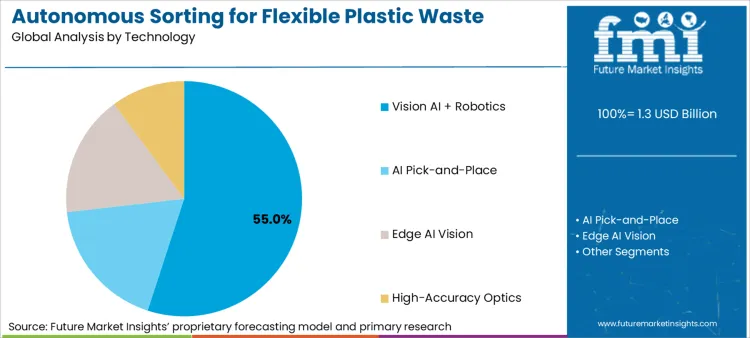
The integration of advanced vision-based artificial intelligence with high-speed robotics accounts for a leading revenue share of approximately 55%. This dominance is rooted not merely in automation but in the system's cognitive capability to manage extreme variability. Flexible plastic waste, particularly post-consumer film, presents a unique challenge: items are non-rigid, often crumpled or soiled, and feature rapidly evolving packaging compositions with complex laminates. Traditional NIR sorters struggle with accurate identification under these conditions.
Vision AI + Robotics systems overcome this by moving beyond spectral analysis alone. They employ multi-sensor data fusion, combining hyperspectral imaging, high-resolution RGB cameras, and sometimes 3D shape detection, processed by deep learning algorithms trained on millions of material images. This allows for identification based on visual features, texture, labels, and even dirt patterns, enabling the accurate sorting of materials that confound conventional technology. The commercial premium for these systems is justified by their ability to produce purer output bales and adapt to new packaging formats without hardware changes, future-proofing the operator’s investment.
Which Economic and Regulatory Factors are Preserving PE/PP Films as the Primary Material Focus?
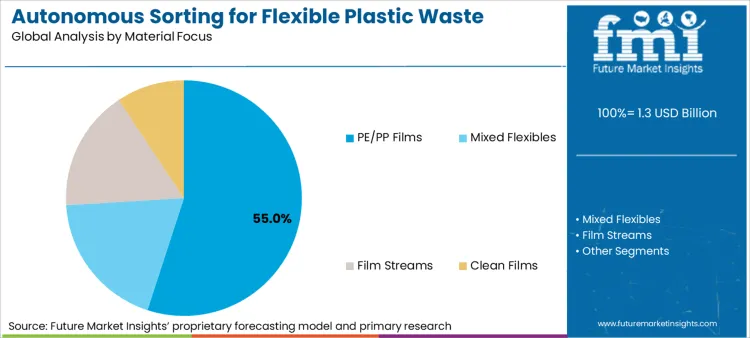
PE and PP films collectively represent over 55% of the market's material focus, a dominance anchored in volume, legislation, and downstream demand economics. These polyolefins constitute the largest fraction of flexible plastic waste generated globally, from shopping bags and stretch wrap to food packaging. Beyond volume, their dominance is reinforced by binding regulatory frameworks. The European Union’s Packaging and Packaging Waste Regulation (PPWR), for instance, sets specific and escalating mandatory recycled content targets for plastic packaging, with a significant focus on films.
This legislation transforms the sorting of PE/PP from a voluntary activity into a compliance necessity, creating a guaranteed, legislated demand for sorted polyolefin flakes. Consequently, R&D investment and system optimization are channeled towards maximizing the yield and purity of these polymers. While sorting mixed flexibles or engineered films presents technical intrigue, the size of the addressable market and the certainty of demand for PE/PP outputs concentrate commercial efforts and technological innovation on this segment.
What Role does the Film & Flexible Waste Segment Play in Defining Technical Requirements and Competitive Intensity?
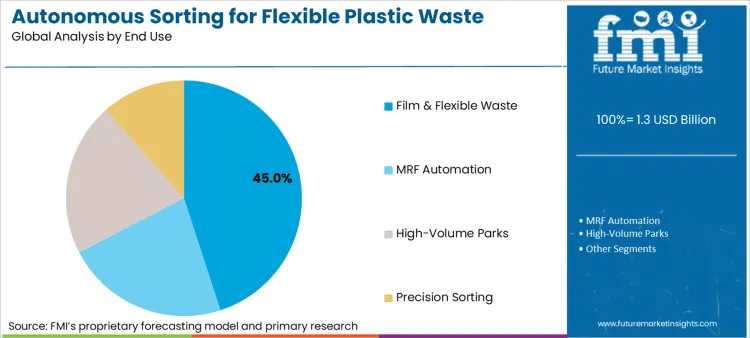
The Film & Flexible Waste end-use segment is the central arena for technological validation, accounting for about 45% of total demand. This segment’s predominance stems from it presenting the most severe combination of economic and technical challenges in waste sorting. Films are lightweight, prone to air-current disruption, and easily wrap around machinery shafts. They are also heavily contaminated and arrive in a non-uniform, crumpled state.
A sorting solution that proves effective in this high-difficulty environment is immediately credible for less challenging waste streams. Therefore, technology providers compete aggressively to demonstrate superiority in film sorting, as success here defines market leadership. Competitive differentiation hinges on key performance indicators unique to flexibles: high pick rates for two-dimensional items, the ability to handle stickies, and robotic end-effectors designed to grasp and release non-rigid, clinging materials without dropping or tearing. The competition in this segment drives rapid iteration in gripper design, AI training for contaminant recognition, and material handling logistics, setting the pace of innovation for the entire autonomous sorting industry.
What Drivers, Restraints, Opportunities, and Trends Prevail in the Market?
Market expansion is supported by the creation of digital quality certificates for sorted bales. Autonomous systems generate vast amounts of data on each sortation decision. Pioneering MRFs are using this data to create digital twins of their output bales, providing buyers with guaranteed purity levels and chain-of-custody information, thereby securing higher prices.
While demand is robust, a critical restraint is the "black box" nature of advanced AI. Some MRF operators are hesitant to cede control to systems whose decision-making logic is not fully transparent, especially when sorting errors can lead to costly downstream contamination. This is slowing adoption among conservative operators.
Technical innovation is defined by the move from sorting to material orchestration. Next-generation systems do not just pick and place; they analyze the entire stream flow, predict the composition of upcoming material, and dynamically reallocate robots or adjust air jets to optimize total system recovery, representing a shift from discrete automation to systemic intelligence.
The emergence of standardized, pre-trained AI models for common contaminants represents a disruptive opportunity. Start-ups are offering subscription-based access to constantly updated material libraries, reducing the need for individual MRFs to undertake the lengthy and expensive process of training their own AI from scratch, thereby lowering the barrier to entry.
Analysis of Autonomous Sorting Market by Key Countries
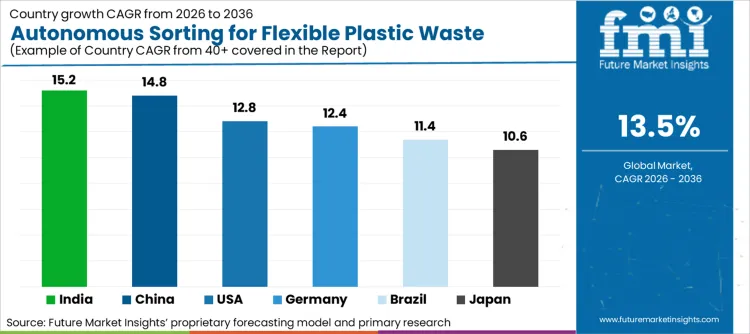
| Country | CAGR (2026-2036) |
|---|---|
| China | 14.8% |
| USA | 12.8% |
| Germany | 12.4% |
| Japan | 10.6% |
| India | 15.2% |
| Brazil | 11.4% |
Source: Future Market Insights (FMI) analysis, based on proprietary forecasting model and primary research
How is Vertical Integration and State-Led Modernization Shaping China's Adoption Pathway?
China’s market, projected to grow at a 14.8% CAGR, is characterized by deployment within large, state-favored recycling parks and vertically integrated waste conglomerates. Unlike Western markets driven by labor costs, the primary driver in China is the strategic imperative to upgrade the quality and scale of recycled feedstock to supply its massive domestic plastics manufacturing sector. The government’s Zero-Waste Cities and Internet Plus initiatives provide direct funding and policy support for the construction of intelligent recycling bases where autonomous sorting is a centerpiece technology.
Furthermore, major waste management companies, which often control collection, sorting, and pelletization, view advanced autonomous sorting as a captive investment. By ensuring a consistent, high-purity supply of PE/PP flake for their own recycling plants, they reduce dependency on the volatile quality and pricing of the open market for recyclables. This dynamic favors domestic robotics giants like Hikrobot and Bozhon, which can deliver cost-competitive, high-volume systems tailored to the specific contamination profiles of Chinese municipal solid waste, often integrating sorting data directly with broader smart city management platforms.
Which Procurement and Financing Innovations are defining USA’s Market Landscape?
The USA, expanding at a 12.8% CAGR, exhibits a market shaped by innovative procurement models and a focus on operational data monetization. High labor costs and stringent quality requirements for output bales are clear drivers, but the adoption curve is steepened by new financing mechanisms. Performance-based contracts, where technology providers like AMP Robotics share in the revenue generated from increased recovery yields or reduced contamination, are mitigating the capital risk for MRF operators. This aligns vendor success directly with customer outcomes, accelerating proof-of-concept.
Leading MRFs are beginning to treat the granular data generated by autonomous systems, detailed breakdowns of captured material types and contaminant streams, as a valuable asset. This data is anonymized and aggregated to provide brand owners with unparalleled insight into packaging recyclability failures in the real world, creating a new revenue stream and positioning MRFs as critical partners in the circular economy rather than mere waste processors.
What Role do Standardization and Quality Infrastructure Play in Germany's Market Evolution?
Germany’s growth at a 12.4% CAGR is underpinned by its systematic approach to engineering the "quality infrastructure" around autonomous sorting. The German market is less about being the first adopter and more about defining the standards that ensure sorted output meets the exacting specifications of its high-end mechanical and chemical recycling sectors. German research institutes and engineering associations are leading efforts to standardize the interfaces between autonomous cells from different vendors, the data formats for reporting purity, and the test methods for validating AI recognition claims.
This focus on interoperability and verification builds trust in the technology’s output. It assures downstream recyclers that bales certified by an autonomous system comply with strict quality protocols, enabling the premium pricing of recycled polymers. German engineering firms leverage this environment to develop systems renowned for precision, reliability, and seamless integration with highly automated, existing MRF infrastructure, competing on engineering excellence rather than cost alone.
How are Japan's Precision Manufacturing and Space Constraints Driving Niche Innovation?
Japan’s market, growing at a 10.6% CAGR, is uniquely driven by the need for ultra-precision in sorting high-value flexible waste and by severe spatial limitations. The focus extends beyond post-consumer packaging film to specialized streams like multi-layer laminates from electronics manufacturing scrap or composite films from automotive components. Recovering specific, high-performance polymers from these streams requires sorting at a fidelity that standard systems cannot achieve.
Japanese robotics leaders like Yaskawa respond by developing compact, hyper-accurate sorting cells equipped with micro-resolution vision systems and delicate, sensor-rich grippers that can manipulate fragile materials. These systems are designed for integration into tight industrial settings, not large MRF halls. Consequently, Japan’s autonomous sorting market is a high-margin, niche sector defined by cutting-edge manipulation technology and bespoke AI training for low-volume, high-complexity material streams, reflecting the country’s broader industrial ethos.
How is India's Market Pioneering "Frugal Automation" for Scalable Deployment?
India exhibits the highest CAGR at 15.2%, a rate fueled by the imperative to build formal sorting capacity at scale and the innovative pursuit of "frugal automation." The driver is not labor replacement but the creation of basic, consistent sorting capability where little exists. The market bypasses the most expensive, fully integrated Western systems in favor of robust, simplified autonomous cells.
These systems often use locally sourced hardware components, simplified vision systems that focus on distinguishing a few key material categories (e.g., clear PE, colored PE, contamination), and AI models trained specifically on the distinct composition of Indian municipal and commercial waste. This approach dramatically lowers the capital and maintenance cost barrier, making automation viable for the first generation of large-scale MRFs being developed under India’s Extended Producer Responsibility (EPR) framework. It represents a parallel innovation track focused on scalability and ruggedness over maximum feature complexity.
Which Agro-Industrial and Trade Dynamics are Shaping Brazil's Adoption Profile?
Brazil’s market expansion at an 11.4% CAGR is significantly influenced by its powerful agro-industrial sector and its role as a regional manufacturing hub. A key driver is the need to efficiently and safely process large volumes of agricultural plastic waste, such as silage films, pesticide containers, and irrigation tubing. These streams are often heavily contaminated with organic matter and chemical residues, presenting unique sorting challenges.
Autonomous systems are adopted and adapted to handle these specific feedstocks, with AI trained to identify and separate different types of agro-plastics despite heavy soiling. Furthermore, as a major plastics producer for the Mercosur region, Brazilian recyclers invest in autonomous sorting to guarantee the consistency and quality of recycled content used in export-grade products. The technology serves as a tool for quality assurance in regional trade, ensuring that Brazilian recycled polymers meet the evolving standards of neighboring countries, thus securing market access and premium pricing.
What is the Competition Outlook for Autonomous Sorting?
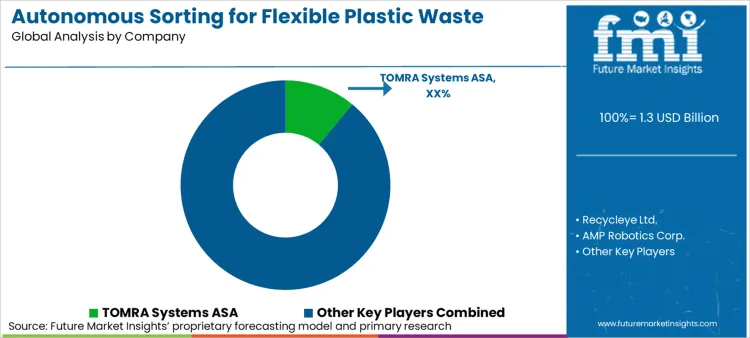
Competitive intensity in autonomous sorting reflects the convergence of robotics, computer vision, AI software, and conventional waste equipment engineering. The market is increasingly bifurcated between end-to-end solution providers such as TOMRA, which supplies complete sensor-based and robotic sorting systems and specialist AI developers that focus on vision, material recognition, and robotic picking software while partnering with system integrators and MRF operators. This structure allows rapid innovation while maintaining compatibility with existing sorting infrastructure.
A key competitive differentiator is the depth and diversity of proprietary material datasets used to train AI models. Flexible plastic waste presents extreme variability in film thickness, coloration, print density, contamination, and deformation making real-world training data a decisive asset. Companies with long operating histories and global installed bases benefit from continuous feedback loops that improve recognition accuracy over time, particularly for low-value and hard-to-identify flexible formats.
The dominant commercial model is shifting toward bundled hardware deployment supported by recurring software and analytics services. Rather than relying solely on capital equipment margins, leading providers increasingly generate value through software licensing, AI model updates, remote performance monitoring, and continuous algorithm retraining. This approach creates predictable revenue streams and embeds technology providers deeply into MRF operations, raising switching costs and strengthening long-term customer relationships.
Key Developments:
- TOMRA continued expanding its autonomous and sensor-based sorting capabilities for flexible plastics during 2024-2025, integrating AI-driven object recognition with established near-infrared and optical sorting platforms. The company has publicly emphasized improving film detection, polymer identification, and purity levels for post-consumer flexible packaging as a prerequisite for scaling mechanical recycling of PE films.
- Recycleye expanded commercial deployments of its AI-powered vision and robotic picking systems across Europe in 2024-2025, highlighting the role of advanced material recognition and data analytics in improving capture rates for flexible plastics. The company has also emphasized analytics and performance insights derived from vision systems as a pathway for MRFs to optimize operations and justify further automation investments.
Key Players Profiled
- TOMRA Systems ASA
- Recycleye Ltd.
- AMP Robotics Corp.
- Bulk Handling Systems (BHS)
- Hikrobot Co., Ltd.
- Bozhon Precision Industry Technology Co., Ltd.
- Yaskawa Electric Corporation
- ZenRobotics Ltd.
- Machinex Industries Inc.
- Stadler Anlagenbau GmbH
Market Definition
The autonomous sorting for flexible plastic waste market comprises revenue generated from the sale, integration, and servicing of automated systems that use sensors, artificial intelligence, and robotic actuators to identify, classify, and separate flexible plastic materials from waste streams without continuous human operation. This includes revenue from robotic sorting cells, integrated AI vision software, advanced conveyor and feeding systems specifically designed for films, and associated maintenance and data analytics services.
The market scope covers systems deployed in material recovery facilities, plastic recovery parks, and dedicated film sorting plants. It excludes traditional optical sorters without AI-driven decision-making, manual or semi-automated picking stations, and bulk separation technologies like air classifiers or screens unless they are sold as an integrated component of an autonomous sorting solution.
Scope of Report
| Items | Values |
|---|---|
| Quantitative Units | USD 1,260 million |
| Automation Level | Fully Autonomous Sorting, Robot-Assisted Sorting, Embedded AI Sorters, Compact Autonomous Cells, Others |
| Material Focus | PE/PP Films, Mixed Flexibles, Film Streams, Clean Films, Others |
| Technology | Vision AI + Robotics, AI Pick-and-Place, Edge AI Vision, High-Accuracy Optics, Others |
| End Use | Film & Flexible Waste, MRF Automation, High-Volume Parks, Precision Sorting, Emerging MRFs, Others |
| Regions Covered | North America, Western Europe, Eastern Europe, East Asia, South Asia & Pacific, Latin America, Middle East & Africa |
| Countries | China, USA, Germany, Japan, India, Brazil and 40+ countries |
| Key Companies | TOMRA, Recycleye, AMP Robotics, Bulk Handling Systems, Hikrobot, Bozhon, Yaskawa, ZenRobotics, Machinex, Stadler |
Source: Future Market Insights (FMI) analysis, based on proprietary forecasting model and primary research
Autonomous Sorting for Flexible Plastic Waste Market Key Segments
By Automation Level
- Fully Autonomous Sorting
- Robot-Assisted Sorting
- Embedded AI Sorters
- Compact Autonomous Cells
- Others
By Material Focus
- PE/PP Films
- Mixed Flexibles
- Film Streams
- Clean Films
- Others
By Technology
- Vision AI + Robotics
- AI Pick-and-Place
- Edge AI Vision
- High-Accuracy Optics
- Others
By End Use
- Film & Flexible Waste
- MRF Automation
- High-Volume Parks
- Precision Sorting
- Emerging MRFs
- Others
By Region
- North America
- Western Europe
- Eastern Europe
- East Asia
- South Asia & Pacific
- Latin America
- Middle East & Africa
Bibliography
- International Solid Waste Association (ISWA). (2025). Artificial Intelligence and Robotics in Waste Sorting and Material Recovery. ISWA.
- Fraunhofer Institute for Material Flow and Logistics (IML). (2025). Cognitive Sorting Systems for Complex Waste Streams. Fraunhofer Verlag.
- National Waste & Recycling Association (NWRA). (2026). Automation, Labor Substitution, and Productivity Gains in USA Material Recovery Facilities. NWRA.
- China National Resources Recycling Association (CNRRA). (2025). Roadmap for Intelligent Sorting and Recycling Infrastructure Development. CNRRA.
- Japan Ministry of Economy, Trade and Industry (METI). (2025). Robotics and AI Applications in Environmental and Resource Recovery Systems. Government of Japan.
- Brazilian Association of Public Cleaning and Special Waste Companies (ABRELPE). (2025). Post-Consumer Flexible Plastics: Sorting Challenges and Technology Pathways. ABRELPE.
- European Committee for Standardization (CEN). (2026). Automation and Quality Requirements for Plastics Sorting Facilities. CEN.
Frequently Asked Questions
How big is the autonomous sorting for flexible plastic waste market in 2026?
The global autonomous sorting for flexible plastic waste market is estimated to be valued at USD 1.3 billion in 2026.
What will be the size of autonomous sorting for flexible plastic waste market in 2036?
The market size for the autonomous sorting for flexible plastic waste market is projected to reach USD 4.5 billion by 2036.
How much will be the autonomous sorting for flexible plastic waste market growth between 2026 and 2036?
The autonomous sorting for flexible plastic waste market is expected to grow at a 13.5% CAGR between 2026 and 2036.
What are the key product types in the autonomous sorting for flexible plastic waste market?
The key product types in autonomous sorting for flexible plastic waste market are vision ai + robotics, ai pick-and-place, edge ai vision and high-accuracy optics.
Which material focus segment to contribute significant share in the autonomous sorting for flexible plastic waste market in 2026?
In terms of material focus, pe/pp films segment to command 55.0% share in the autonomous sorting for flexible plastic waste market in 2026.
Preview the report firsthand - request a free sample
Get SampleGet the brochure for pricing and purchase details.
Get PDFTable of Content
- Global Market Outlook
- Demand-side Trends
- Supply-side Trends
- Technology Roadmap Analysis
- Analysis and Recommendations
- Market Overview
- Market Coverage / Taxonomy
- Market Definition / Scope / Limitations
- Research Methodology
- Chapter Orientation
- Analytical Lens and Working Hypotheses
- Market Structure, Signals, and Trend Drivers
- Benchmarking and Cross-market Comparability
- Market Sizing, Forecasting, and Opportunity Mapping
- Research Design and Evidence Framework
- Desk Research Programme (Secondary Evidence)
- Company Annual and Sustainability Reports
- Peer-reviewed Journals and Academic Literature
- Corporate Websites, Product Literature, and Technical Notes
- Earnings Decks and Investor Briefings
- Statutory Filings and Regulatory Disclosures
- Technical White Papers and Standards Notes
- Trade Journals, Industry Magazines, and Analyst Briefs
- Conference Proceedings, Webinars, and Seminar Materials
- Government Statistics Portals and Public Data Releases
- Press Releases and Reputable Media Coverage
- Specialist Newsletters and Curated Briefings
- Social Channels, Communities, and Digital Listening Inputs
- Additional Desk Sources
- Expert Input and Fieldwork (Primary Evidence)
- Primary Modes
- Qualitative Interviews and Expert Elicitation
- Quantitative Surveys and Structured Data Capture
- Blended Approach
- Why Primary Evidence is Used
- Field Techniques
- Interviews
- Surveys
- Focus Groups
- Observational and In-context Research
- Social and Community Interactions
- Stakeholder Universe Engaged
- C-suite Leaders
- Board Members
- Presidents and Vice Presidents
- R&D and Innovation Heads
- Technical Specialists
- Domain Subject-matter Experts
- Scientists
- Physicians and Other Healthcare Professionals
- Governance, Ethics, and Data Stewardship
- Research Ethics
- Data Integrity and Handling
- Primary Modes
- Tooling, Models, and Reference Databases
- Desk Research Programme (Secondary Evidence)
- Data Engineering and Model Build
- Data Acquisition and Ingestion
- Cleaning, Normalisation, and Verification
- Synthesis, Triangulation, and Analysis
- Quality Assurance and Audit Trail
- Market Background
- Market Dynamics
- Drivers
- Restraints
- Opportunity
- Trends
- Scenario Forecast
- Demand in Optimistic Scenario
- Demand in Likely Scenario
- Demand in Conservative Scenario
- Opportunity Map Analysis
- Product Life Cycle Analysis
- Supply Chain Analysis
- Investment Feasibility Matrix
- Value Chain Analysis
- PESTLE and Porter’s Analysis
- Regulatory Landscape
- Regional Parent Market Outlook
- Production and Consumption Statistics
- Import and Export Statistics
- Market Dynamics
- Global Market Analysis 2021 to 2025 and Forecast, 2026 to 2036
- Historical Market Size Value (USD Million) Analysis, 2021 to 2025
- Current and Future Market Size Value (USD Million) Projections, 2026 to 2036
- Y-o-Y Growth Trend Analysis
- Absolute $ Opportunity Analysis
- Global Market Pricing Analysis 2021 to 2025 and Forecast 2026 to 2036
- Global Market Analysis 2021 to 2025 and Forecast 2026 to 2036, By Technology
- Introduction / Key Findings
- Historical Market Size Value (USD Million) Analysis By Technology , 2021 to 2025
- Current and Future Market Size Value (USD Million) Analysis and Forecast By Technology , 2026 to 2036
- Vision AI + Robotics
- AI Pick-and-Place
- Edge AI Vision
- High-Accuracy Optics
- Vision AI + Robotics
- Y-o-Y Growth Trend Analysis By Technology , 2021 to 2025
- Absolute $ Opportunity Analysis By Technology , 2026 to 2036
- Global Market Analysis 2021 to 2025 and Forecast 2026 to 2036, By Material Focus
- Introduction / Key Findings
- Historical Market Size Value (USD Million) Analysis By Material Focus, 2021 to 2025
- Current and Future Market Size Value (USD Million) Analysis and Forecast By Material Focus, 2026 to 2036
- PE/PP Films
- Mixed Flexibles
- Film Streams
- Clean Films
- PE/PP Films
- Y-o-Y Growth Trend Analysis By Material Focus, 2021 to 2025
- Absolute $ Opportunity Analysis By Material Focus, 2026 to 2036
- Global Market Analysis 2021 to 2025 and Forecast 2026 to 2036, By End Use
- Introduction / Key Findings
- Historical Market Size Value (USD Million) Analysis By End Use, 2021 to 2025
- Current and Future Market Size Value (USD Million) Analysis and Forecast By End Use, 2026 to 2036
- Film & Flexible Waste
- MRF Automation
- High-Volume Parks
- Precision Sorting
- Film & Flexible Waste
- Y-o-Y Growth Trend Analysis By End Use, 2021 to 2025
- Absolute $ Opportunity Analysis By End Use, 2026 to 2036
- Global Market Analysis 2021 to 2025 and Forecast 2026 to 2036, By Region
- Introduction
- Historical Market Size Value (USD Million) Analysis By Region, 2021 to 2025
- Current Market Size Value (USD Million) Analysis and Forecast By Region, 2026 to 2036
- North America
- Latin America
- Western Europe
- Eastern Europe
- East Asia
- South Asia and Pacific
- Middle East & Africa
- Market Attractiveness Analysis By Region
- North America Market Analysis 2021 to 2025 and Forecast 2026 to 2036, By Country
- Historical Market Size Value (USD Million) Trend Analysis By Market Taxonomy, 2021 to 2025
- Market Size Value (USD Million) Forecast By Market Taxonomy, 2026 to 2036
- By Country
- USA
- Canada
- Mexico
- By Technology
- By Material Focus
- By End Use
- By Country
- Market Attractiveness Analysis
- By Country
- By Technology
- By Material Focus
- By End Use
- Key Takeaways
- Latin America Market Analysis 2021 to 2025 and Forecast 2026 to 2036, By Country
- Historical Market Size Value (USD Million) Trend Analysis By Market Taxonomy, 2021 to 2025
- Market Size Value (USD Million) Forecast By Market Taxonomy, 2026 to 2036
- By Country
- Brazil
- Chile
- Rest of Latin America
- By Technology
- By Material Focus
- By End Use
- By Country
- Market Attractiveness Analysis
- By Country
- By Technology
- By Material Focus
- By End Use
- Key Takeaways
- Western Europe Market Analysis 2021 to 2025 and Forecast 2026 to 2036, By Country
- Historical Market Size Value (USD Million) Trend Analysis By Market Taxonomy, 2021 to 2025
- Market Size Value (USD Million) Forecast By Market Taxonomy, 2026 to 2036
- By Country
- Germany
- UK
- Italy
- Spain
- France
- Nordic
- BENELUX
- Rest of Western Europe
- By Technology
- By Material Focus
- By End Use
- By Country
- Market Attractiveness Analysis
- By Country
- By Technology
- By Material Focus
- By End Use
- Key Takeaways
- Eastern Europe Market Analysis 2021 to 2025 and Forecast 2026 to 2036, By Country
- Historical Market Size Value (USD Million) Trend Analysis By Market Taxonomy, 2021 to 2025
- Market Size Value (USD Million) Forecast By Market Taxonomy, 2026 to 2036
- By Country
- Russia
- Poland
- Hungary
- Balkan & Baltic
- Rest of Eastern Europe
- By Technology
- By Material Focus
- By End Use
- By Country
- Market Attractiveness Analysis
- By Country
- By Technology
- By Material Focus
- By End Use
- Key Takeaways
- East Asia Market Analysis 2021 to 2025 and Forecast 2026 to 2036, By Country
- Historical Market Size Value (USD Million) Trend Analysis By Market Taxonomy, 2021 to 2025
- Market Size Value (USD Million) Forecast By Market Taxonomy, 2026 to 2036
- By Country
- China
- Japan
- South Korea
- By Technology
- By Material Focus
- By End Use
- By Country
- Market Attractiveness Analysis
- By Country
- By Technology
- By Material Focus
- By End Use
- Key Takeaways
- South Asia and Pacific Market Analysis 2021 to 2025 and Forecast 2026 to 2036, By Country
- Historical Market Size Value (USD Million) Trend Analysis By Market Taxonomy, 2021 to 2025
- Market Size Value (USD Million) Forecast By Market Taxonomy, 2026 to 2036
- By Country
- India
- ASEAN
- Australia & New Zealand
- Rest of South Asia and Pacific
- By Technology
- By Material Focus
- By End Use
- By Country
- Market Attractiveness Analysis
- By Country
- By Technology
- By Material Focus
- By End Use
- Key Takeaways
- Middle East & Africa Market Analysis 2021 to 2025 and Forecast 2026 to 2036, By Country
- Historical Market Size Value (USD Million) Trend Analysis By Market Taxonomy, 2021 to 2025
- Market Size Value (USD Million) Forecast By Market Taxonomy, 2026 to 2036
- By Country
- Kingdom of Saudi Arabia
- Other GCC Countries
- Turkiye
- South Africa
- Other African Union
- Rest of Middle East & Africa
- By Technology
- By Material Focus
- By End Use
- By Country
- Market Attractiveness Analysis
- By Country
- By Technology
- By Material Focus
- By End Use
- Key Takeaways
- Key Countries Market Analysis
- USA
- Pricing Analysis
- Market Share Analysis, 2025
- By Technology
- By Material Focus
- By End Use
- Canada
- Pricing Analysis
- Market Share Analysis, 2025
- By Technology
- By Material Focus
- By End Use
- Mexico
- Pricing Analysis
- Market Share Analysis, 2025
- By Technology
- By Material Focus
- By End Use
- Brazil
- Pricing Analysis
- Market Share Analysis, 2025
- By Technology
- By Material Focus
- By End Use
- Chile
- Pricing Analysis
- Market Share Analysis, 2025
- By Technology
- By Material Focus
- By End Use
- Germany
- Pricing Analysis
- Market Share Analysis, 2025
- By Technology
- By Material Focus
- By End Use
- UK
- Pricing Analysis
- Market Share Analysis, 2025
- By Technology
- By Material Focus
- By End Use
- Italy
- Pricing Analysis
- Market Share Analysis, 2025
- By Technology
- By Material Focus
- By End Use
- Spain
- Pricing Analysis
- Market Share Analysis, 2025
- By Technology
- By Material Focus
- By End Use
- France
- Pricing Analysis
- Market Share Analysis, 2025
- By Technology
- By Material Focus
- By End Use
- India
- Pricing Analysis
- Market Share Analysis, 2025
- By Technology
- By Material Focus
- By End Use
- ASEAN
- Pricing Analysis
- Market Share Analysis, 2025
- By Technology
- By Material Focus
- By End Use
- Australia & New Zealand
- Pricing Analysis
- Market Share Analysis, 2025
- By Technology
- By Material Focus
- By End Use
- China
- Pricing Analysis
- Market Share Analysis, 2025
- By Technology
- By Material Focus
- By End Use
- Japan
- Pricing Analysis
- Market Share Analysis, 2025
- By Technology
- By Material Focus
- By End Use
- South Korea
- Pricing Analysis
- Market Share Analysis, 2025
- By Technology
- By Material Focus
- By End Use
- Russia
- Pricing Analysis
- Market Share Analysis, 2025
- By Technology
- By Material Focus
- By End Use
- Poland
- Pricing Analysis
- Market Share Analysis, 2025
- By Technology
- By Material Focus
- By End Use
- Hungary
- Pricing Analysis
- Market Share Analysis, 2025
- By Technology
- By Material Focus
- By End Use
- Kingdom of Saudi Arabia
- Pricing Analysis
- Market Share Analysis, 2025
- By Technology
- By Material Focus
- By End Use
- Turkiye
- Pricing Analysis
- Market Share Analysis, 2025
- By Technology
- By Material Focus
- By End Use
- South Africa
- Pricing Analysis
- Market Share Analysis, 2025
- By Technology
- By Material Focus
- By End Use
- USA
- Market Structure Analysis
- Competition Dashboard
- Competition Benchmarking
- Market Share Analysis of Top Players
- By Regional
- By Technology
- By Material Focus
- By End Use
- Competition Analysis
- Competition Deep Dive
- TOMRA Systems ASA
- Overview
- Product Portfolio
- Profitability by Market Segments (Product/Age /Sales Channel/Region)
- Sales Footprint
- Strategy Overview
- Marketing Strategy
- Product Strategy
- Channel Strategy
- Recycleye Ltd.
- AMP Robotics Corp.
- Bulk Handling Systems (BHS)
- Hikrobot Co., Ltd.
- TOMRA Systems ASA
- Competition Deep Dive
- Assumptions & Acronyms Used


