

- Industry Size (2026)
- USD 1.1 Bn
- Forecast (2036)
- USD 2.4 Bn
- CAGR (2026 to 2036)
- 8.3%
Treaty-Aligned Low-Additive Flexible Plastic Packaging Market Forecast and Outlook 2026 to 2036
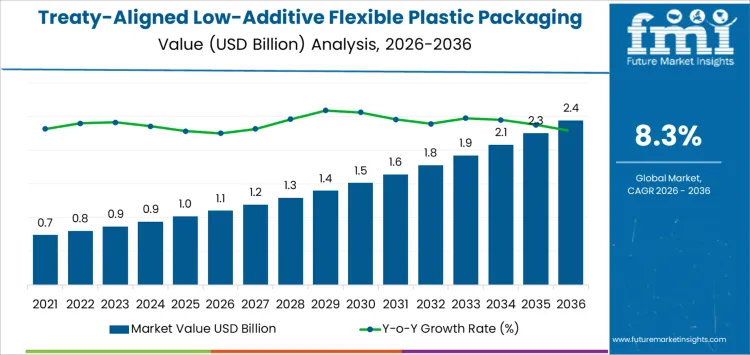
The treaty-aligned low-additive flexible plastic packaging market is expected to grow from USD 1.1 billion in 2026 to USD 2.4 billion by 2036, reflecting a compound annual growth rate (CAGR) of 8.3%. This market involves flexible packaging solutions that comply with environmental and regulatory standards aimed at minimizing additives and harmful chemicals in plastic packaging materials. These packaging materials are increasingly favored by industries focused on sustainability and eco-friendly practices. Growing demand for low-additive flexible plastics in the food, beverage, and pharmaceutical industries is driving the market, as companies seek to comply with stricter regulations and align with global treaties aimed at reducing environmental impact.
The market’s growth is further supported by the rising consumer demand for sustainable packaging solutions, increased investments in environmentally friendly technologies, and the introduction of alternative packaging materials that maintain product quality while reducing ecological footprints. As governments and regulatory bodies continue to enforce stricter sustainability standards, the adoption of low-additive flexible packaging is expected to accelerate, positioning the market for substantial growth over the next decade.
Quick Stats of the Treaty-Aligned Low-Additive Flexible Plastic Packaging Market
- Treaty-Aligned Low-Additive Flexible Plastic Packaging Market Value (2026): USD 1.1 billion
- Treaty-Aligned Low-Additive Flexible Plastic Packaging Market Forecast Value (2036): USD 2.4 billion
- Treaty-Aligned Low-Additive Flexible Plastic Packaging Market Global Forecast CAGR (2026-2036): 8.3%
- Treaty-Aligned Low-Additive Flexible Plastic Packaging Market Leading Segment: Technology (Minimal-additive extrusion + clean barrier coatings) 55%
- Key Growth Regions in Treaty-Aligned Low-Additive Flexible Plastic Packaging Market: North America, Asia Pacific, and Europe
- Top Players in Treaty-Aligned Low-Additive Flexible Plastic Packaging Market: Amcor, Huhtamaki, GreenPak, UFlex, Klabin, Toray, Sealed Air, Mondi
What is the Growth Forecast for the Treaty-Aligned Low-Additive Flexible Plastic Packaging Market through 2036?
The peak-to-trough analysis for the treaty-aligned low-additive flexible plastic packaging market shows a gradual increase with a few fluctuations. Starting at USD 1.1 billion in 2026, the market grows to USD 1.2 billion in 2027 and USD 1.3 billion in 2028, reflecting steady early-stage growth as companies begin adopting low-additive solutions to comply with environmental regulations. From 2028 to 2030, the market continues its gradual expansion, reaching USD 1.4 billion in 2029 and USD 1.6 billion in 2030, driven by rising consumer and regulatory pressure for more sustainable packaging.
Between 2030 and 2035, the market sees more substantial growth, reaching USD 1.7 billion in 2031, USD 1.9 billion in 2032, and USD 2.1 billion in 2033, reflecting a stronger adoption curve as the demand for eco-friendly packaging solutions becomes more widespread. By 2035, the market is projected to reach USD 2.3 billion, with the final value of USD 2.4 billion expected in 2036. The peak-to-trough analysis indicates that while the market initially experiences moderate growth, the pace accelerates significantly in the later years, driven by increasing sustainability efforts, regulatory compliance, and growing consumer demand for greener packaging solutions.
Treaty-Aligned Low-Additive Flexible Plastic Packaging Market Key Takeaways
| Metric | Value |
|---|---|
| Industry Sales Value (2026) | USD 1.1 billion |
| Industry Forecast Value (2036) | USD 2.4 billion |
| Industry Forecast CAGR (2026-2036) | 8.3% |
What Is Driving the Demand for the Treaty Aligned Low Additive Flexible Plastic Packaging Market in the US and Globally?
The demand for treaty-aligned low-additive flexible plastic packaging is driven by tightening global regulations aimed at reducing hazardous additives in packaging and improving material circularity. International treaties and regional regulations, such as the Stockholm Convention on Persistent Organic Pollutants and emerging national restrictions on certain plastic additives (e.g., PFAS, phthalates, heavy stabilisers), are encouraging manufacturers to reformulate flexible films, pouches, bags, and wraps with fewer or safer additive chemistries. Brands and converters are aligning packaging portfolios with compliance timelines to mitigate risk, maintain market access, and satisfy investor, retailer, and consumer expectations for safer, more sustainable materials. Low-additive formulations reduce reliance on substances of concern while preserving critical performance properties such as flexibility, seal integrity, and barrier protection. Consumer awareness of chemical safety and environmental impact, amplified by media and NGO campaigns, further accelerates adoption of plastics with reduced additive loads. Retailers in food, personal care, and consumer goods sectors are requiring suppliers to minimise additives, support recyclability targets, and demonstrate compliance with treaty obligations and national substance controls. This has created demand for certified low-additive films and resins that can integrate into existing packaging lines while meeting performance and regulatory criteria.
Future demand for treaty-aligned, low-additive, flexible plastic packaging is expected to grow as regulatory frameworks expand and circular economy commitments strengthen. Ongoing evolution of international and national standards will prompt broader reformulation efforts and adoption of low-additive resins and processing practices across markets such as North America, Europe, and Asia Pacific. Advances in additive technology, including safer stabilisers, antioxidants, and processing aids, will enable flexible packaging to maintain performance while reducing chemical complexity. Growth in recycling infrastructure and improved sorting technologies will make low-additive films more compatible with material recovery streams, reinforcing their appeal to brands pursuing certified recyclable or compostable formats. Economic incentives, such as tax credits or procurement preferences for compliant materials, may further encourage uptake. Continued engagement by retailers, certification bodies, and sustainability standards organisations will support development of low-additive specifications that align with treaty objectives and market expectations. As companies seek both regulatory compliance and a market advantage in safety-conscious segments, the treaty-aligned low-additive flexible plastic packaging market is expected to expand steadily.
What is the Segment Analysis for the Treaty-Aligned Low-Additive Flexible Plastic Packaging Market?
The treaty-aligned low-additive flexible plastic packaging market is primarily shaped by two key segments: material types and technology. Among the material types, low-additive PE/PP dominates the market, accounting for 50% of the share, followed by bio-modified PE, low-additive PE blends, and other materials. These materials are chosen for their environmentally friendly properties and reduced impact on packaging quality while ensuring compliance with international treaties focused on minimizing additives and improving sustainability. In terms of technology, minimal-additive extrusion with clean barrier coatings leads the market with a 55% share, followed by solvent-free coating, high-speed additive-free lamination, and economical coating methods.
These technologies focus on reducing the use of additives, enhancing material performance, and providing the necessary protection for packaged goods without compromising environmental standards. The growing demand for sustainable packaging solutions, particularly in the food and beverage, pharmaceuticals, and consumer goods sectors, is driving market growth. Regional factors, particularly in Europe and North America, are accelerating the adoption of treaty-aligned packaging solutions, as companies increasingly prioritize eco-friendly materials and production methods to meet both consumer and regulatory expectations.
What is Driving Growth in the Low-Additive PE/PP Segment of the Flexible Plastic Packaging Market?
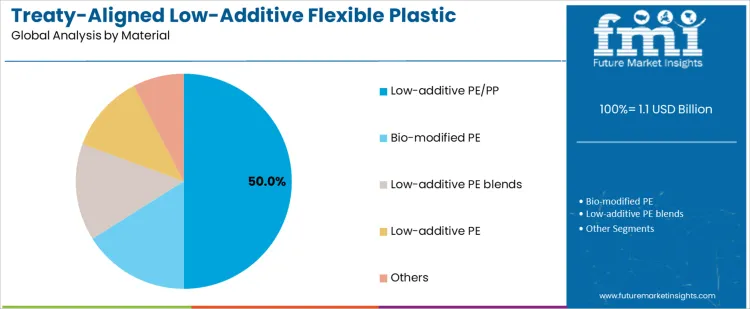
The low-additive PE/PP segment is the largest material category in the treaty-aligned low-additive flexible plastic packaging market, comprising 50% of the market share. This material is widely used in the packaging industry due to its strong balance of durability, flexibility, and cost-effectiveness, while adhering to strict environmental standards. Low-additive PE/PP offers reduced additive content, which aligns with the growing consumer demand for sustainable packaging solutions. This material is particularly popular in food and beverage packaging,
where it provides an effective barrier to moisture and air, preserving product quality while minimizing its environmental footprint. The demand for low-additive PE/PP is also driven by international regulations aimed at reducing plastic waste and enhancing recyclability, which further boosts its adoption. Furthermore, low-additive PE/PP can be easily processed using various manufacturing methods such as extrusion and lamination, making it highly versatile for a wide range of applications. As the packaging industry continues to focus on eco-friendly alternatives, the low-additive PE/PP segment is expected to maintain its leading position in the market, driven by the demand for both sustainability and performance.
What is Contributing to the Growth of Minimal-Additive Extrusion + Clean Barrier Coatings Technology in the Packaging Market?
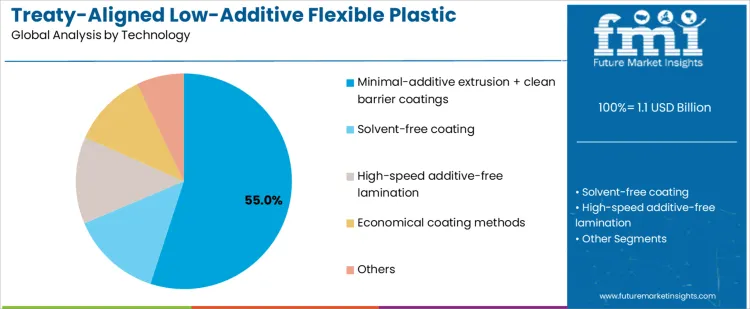
Minimal-additive extrusion with clean barrier coatings technology is the leading technology in the treaty-aligned low-additive flexible plastic packaging market, holding a 55% market share. This technology plays a critical role in producing flexible packaging solutions that meet the growing demand for sustainability and performance. By using minimal additives and focusing on clean barrier coatings, this technology allows for the creation of packaging materials that provide the necessary protection to products, especially food and beverages, without the use of harmful chemicals or excessive additives.
The clean barrier coatings help maintain product integrity by offering protection against moisture, oxygen, and light, while also ensuring that the packaging material is recyclable and environmentally friendly. The adoption of minimal-additive extrusion technologies is increasing, as it aligns with global regulations promoting reduced plastic usage and waste. Additionally, the cost-effectiveness and speed of production with this technology make it an attractive option for manufacturers looking to meet both environmental and economic goals. As consumer demand for sustainable packaging grows, the minimal-additive extrusion with clean barrier coatings technology is expected to continue driving market growth, especially in sectors that require high-performance packaging with a low environmental impact.
What are the Key Dynamics of the Global Treaty Aligned Low Additive Flexible Plastic Packaging Market?
The global treaty aligned low additive flexible plastic packaging market is growing as brands and converters adopt materials and processes that meet emerging international commitments on pollution reduction, chemical safety and circularity. Low additive films use fewer processing aids, stabilizers and colorants while maintaining performance, making them more compatible with recycling and end of life targets in plastic treaties and regulatory frameworks. Growth is driven by demand for packaging that supports sustainability goals without sacrificing barrier, strength and print quality. Adoption spans food and beverage, personal care and consumer goods sectors worldwide.
What are the Key Drivers for the Global Treaty Aligned Low Additive Flexible Plastic Packaging Market?
One driver is rising regulatory pressure linked to global plastics agreements and national laws that restrict harmful additives and promote recyclability. Packaging producers are reformulating flexible films to reduce additive load while ensuring functionality, helping brands meet compliance and reporting requirements. Consumer expectations for safer, lower toxicity packaging that aligns with environmental commitments are motivating adoption. Advances in polymer and compounding technologies support performance with fewer additives. Brand commitments to circular packaging goals and participation in extended producer responsibility programmes further accelerate integration of low additive solutions.
What are the Restraints for the Global Treaty Aligned Low Additive Flexible Plastic Packaging Market?
One restraint is the technical challenge of maintaining essential properties such as barrier performance, flexibility and processability when additive content is reduced. Developing formulations that meet both functional and compliance criteria can require significant research, testing and validation. Higher upfront cost for specialty resins and reformulation may limit adoption among cost sensitive converters and brands. Infrastructure gaps in recycling systems in some regions reduce immediate value of treaty aligned packaging, influencing investment decisions. Variation in global standards for additives and recyclability complicates universal specification and slows pace of harmonised uptake across markets.
What is the Key Trends in the Global Treaty Aligned Low Additive Flexible Plastic Packaging Market?
A key trend is innovation in additive free or low additive film chemistries that leverage advanced polymers, intrinsic barrier materials and surface treatments to achieve required performance. Collaboration between material developers, packaging converters and brand owners is increasing to co design packaging that meets treaty and regulatory frameworks while optimizing manufacturing efficiency. Growth in certification and eco label schemes that verify lower additive content and recyclability helps build market confidence. Investment in sorting and recycling technologies that accept low additive flexible films is rising, supporting circular supply chain strategies. Transparent communication about material composition and sustainability attributes influences purchase decisions in consumer and retail channels.
What are the Global Insights from the Treaty-Aligned Low-Additive Flexible Plastic Packaging Market Analysis?
The treaty-aligned low-additive flexible plastic packaging market is expected to grow steadily, driven by increasing consumer demand for eco-friendly and sustainable packaging solutions. These packaging products, which comply with international treaties and regulations on additives, are becoming increasingly important as governments and businesses focus on reducing the environmental impact of packaging materials. The market for low-additive flexible plastic packaging is growing across regions as manufacturers adapt to stricter regulations and consumer preferences for safer, more sustainable packaging. Countries like India and China are projected to experience high growth due to expanding industrialization and heightened awareness of environmental concerns. In developed markets such as the USA and Germany, growth is driven by regulations, technological advancements, and an increasing focus on sustainability within the packaging sector.
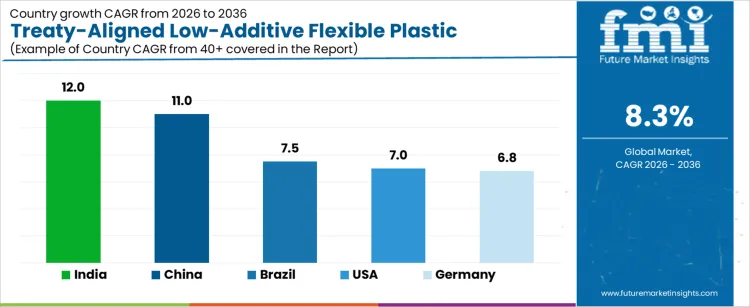
| Country | CAGR (2026-2036) |
|---|---|
| USA | 7% |
| Germany | 6.8% |
| China | 11% |
| India | 12% |
| Brazil | 7.5% |
What is the Growth Outlook for the Treaty-Aligned Low-Additive Flexible Plastic Packaging Market in the USA?
The treaty-aligned low-additive flexible plastic packaging market in the United States is expected to grow at a moderate pace, with a projected CAGR of 7%. This growth is driven by increasing consumer demand for sustainable packaging solutions and the growing regulatory focus on reducing the environmental impact of plastic packaging. U.S. manufacturers are adopting low-additive packaging to comply with stricter environmental standards, ensuring that their products meet sustainability goals. Additionally, consumer preference for packaging that uses fewer additives and is safer for both the environment and human health is fueling demand. The continued focus on improving the sustainability of the packaging industry and complying with global treaties and regulations will likely contribute to steady market growth in the U.S.
What is the Market Outlook for the Treaty-Aligned Low-Additive Flexible Plastic Packaging Market in Germany?
The market for treaty-aligned low-additive flexible plastic packaging in Germany is expected to grow at a moderate rate, with a projected CAGR of 6.8%. Germany is a leader in the European packaging sector, and its strong emphasis on sustainability and environmental protection is driving the adoption of low-additive packaging solutions. With increasing regulatory pressures, particularly within the European Union, businesses are turning to sustainable alternatives that reduce environmental impact without compromising on functionality. Germany's well-established industrial base, particularly in the food and beverage and consumer goods sectors, continues to push for the use of flexible plastic packaging that aligns with environmental and safety regulations. As sustainability becomes more of a priority, the demand for treaty-aligned low-additive packaging will continue to rise.
What is the Growth Forecast for the Treaty-Aligned Low-Additive Flexible Plastic Packaging Market in China?
The treaty-aligned low-additive flexible plastic packaging market in China is expected to grow rapidly, with a projected CAGR of 11%. China’s fast-growing manufacturing and e-commerce sectors are driving the demand for flexible plastic packaging solutions that comply with global environmental treaties and regulations. As the country faces increasing pressure to reduce its environmental footprint, both government and industry stakeholders are adopting more sustainable practices in packaging. The demand for low-additive packaging solutions is particularly high in the food, pharmaceutical, and consumer goods industries, where product safety and sustainability are increasingly prioritized. As China continues to industrialize and shift toward more sustainable practices, it is expected to experience robust market growth in this sector.
What is the Market Outlook for the Treaty-Aligned Low-Additive Flexible Plastic Packaging Market in India?
The treaty-aligned low-additive flexible plastic packaging market in India is projected to grow at the highest rate globally, with a CAGR of 12%. India’s growing middle class, expanding industrial sector, and increasing awareness of environmental issues are key drivers behind this growth. With the increasing demand for packaged goods, particularly in the food, beverage, and pharmaceutical sectors, there is a strong push for sustainable packaging solutions that reduce the use of additives. India’s regulatory landscape is evolving, with stricter guidelines being introduced to limit the environmental impact of plastic packaging. As businesses in India look to meet these new standards and respond to growing consumer demand for eco-friendly products, the market for low-additive flexible plastic packaging is expected to experience substantial growth.
What are the Growth Prospects for the Treaty-Aligned Low-Additive Flexible Plastic Packaging Market in Brazil?
The treaty-aligned low-additive flexible plastic packaging market in Brazil is expected to grow at a moderate pace, with a projected CAGR of 7.5%. As sustainability becomes an increasingly important issue, particularly in industries like food, beverages, and consumer goods, Brazil is seeing a rise in demand for packaging solutions that comply with global environmental standards. Although Brazil faces economic challenges that may slow down the pace of market adoption, there is a growing recognition of the need for eco-friendly and low-additive packaging solutions. Brazilian manufacturers are gradually shifting toward more sustainable packaging as a response to both regulatory pressures and consumer demand. This shift is expected to contribute to steady market growth over the coming years.
What is the Competitive Landscape for the Treaty-Aligned Low-Additive Flexible Plastic Packaging Market?
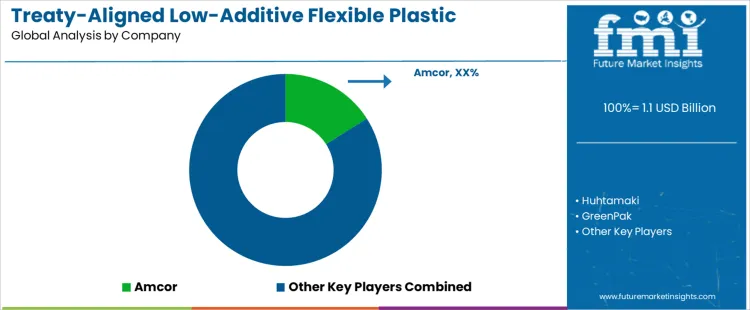
The treaty-aligned low-additive flexible plastic packaging market is expanding as industries demand sustainable, compliant packaging solutions that meet international environmental and safety standards. Amcor leads the market with its innovative low-additive flexible packaging solutions, focusing on minimizing the use of additives while ensuring regulatory compliance across various global markets. Their commitment to sustainability and eco-friendly packaging solutions positions them at the forefront of the industry. Huhtamaki, GreenPak, and UFlex are key competitors, each providing low-additive flexible packaging products designed to meet the growing demand for environmentally conscious and regulatory-compliant solutions. Huhtamaki focuses on sustainable packaging solutions, while GreenPak and UFlex offer high-quality, low-additive packaging that caters to diverse industries.
Klabin, Toray, Sealed Air, and Mondi further intensify the competition by offering a variety of flexible plastic packaging solutions. Klabin provides flexible packaging materials with a focus on sustainable production processes, while Toray focuses on high-performance materials for packaging with minimal additives. Sealed Air offers innovative solutions in flexible packaging that meet both environmental and regulatory standards, and Mondi focuses on sustainable packaging solutions that reduce the environmental impact of plastic use. These companies compete by focusing on product innovation, sustainability, and compliance with global standards, offering flexible packaging that balances performance with environmental responsibility in the low-additive plastic packaging space.
Key Players of the Treaty-Aligned Low-Additive Flexible Plastic Packaging Market
- Amcor
- Huhtamaki
- GreenPak
- UFlex
- Klabin
- Toray
- Sealed Air
- Mondi
Scope of the Report
| Items | Values |
|---|---|
| Quantitative Units (2026) | USD Billion |
| End-use / Application | Organic & Clean-Label Foods, Premium FMCG, Retail Packaged Foods, Spices, Staples, Local FMCG, Others |
| Packaging Format / Type | Mono-Material Pouches, Recyclable Films, Pillow Packs, Sachets, Others |
| Material | Low-Additive PE/PP, Bio-Modified PE, Low-Additive PE Blends, Others |
| Technology | Minimal-Additive Extrusion + Clean Barrier Coatings, Solvent-Free Coating, High-Speed Additive-Free Lamination, Economical Coating Methods |
| Companies | Amcor, Huhtamaki, GreenPak, UFlex, Klabin, Toray, Sealed Air, Mondi |
| Regions Covered | North America, Latin America, Western Europe, Eastern Europe, South Asia and Pacific, East Asia, Middle East & Africa |
| Countries Covered | United States, Canada, Mexico, Brazil, Argentina, Germany, France, United Kingdom, Italy, Spain, Netherlands, China, India, Japan, South Korea, ANZ, GCC Countries, South Africa |
| Additional Attributes | Dollar by sales by end-use/application, packaging format/type, material, technology, and region. Includes market trends in low-additive flexible plastic packaging, focusing on mono-material pouches, recyclable films, pillow packs, and sachets. Highlights the role of minimal-additive extrusion, solvent-free coatings, and high-speed lamination in clean-label, organic foods, premium FMCG, and retail packaged foods. Focus on regulatory compliance, market share, and competitive positioning of key companies in treaty-aligned packaging solutions. |
Treaty-Aligned Low-Additive Flexible Plastic Packaging Market Segmentation
End-use / Application:
- Organic & clean-label foods
- Premium FMCG
- Retail packaged foods
- Spices, staples
- Local FMCG
- Others
Packaging Format / Type:
- Mono-material pouches
- Recyclable films
- Pillow packs
- Sachets
- Others
Material:
- Low-additive PE/PP
- Bio-modified PE
- Low-additive PE blends
- Low-additive PE
- Others
Technology:
- Minimal-additive extrusion + clean barrier coatings
- Solvent-free coating
- High-speed additive-free lamination
- Economical coating methods
- Others
Region:
- Asia Pacific
- China
- Japan
- South Korea
- India
- Australia & New Zealand
- ASEAN
- Rest of Asia Pacific
- Europe
- Germany
- United Kingdom
- France
- Italy
- Spain
- Nordic
- BENELUX
- Rest of Europe
- North America
- United States
- Canada
- Mexico
- Latin America
- Brazil
- Chile
- Rest of Latin America
- Middle East & Africa
- Kingdom of Saudi Arabia
- Other GCC Countries
- Turkey
- South Africa
- Other African Union
- Rest of Middle East & Africa
Frequently Asked Questions
How big is the treaty-aligned low-additive flexible plastic packaging market in 2026?
The global treaty-aligned low-additive flexible plastic packaging market is estimated to be valued at USD 1.1 billion in 2026.
What will be the size of treaty-aligned low-additive flexible plastic packaging market in 2036?
The market size for the treaty-aligned low-additive flexible plastic packaging market is projected to reach USD 2.4 billion by 2036.
How much will be the treaty-aligned low-additive flexible plastic packaging market growth between 2026 and 2036?
The treaty-aligned low-additive flexible plastic packaging market is expected to grow at a 8.3% CAGR between 2026 and 2036.
What are the key product types in the treaty-aligned low-additive flexible plastic packaging market?
The key product types in treaty-aligned low-additive flexible plastic packaging market are organic & clean-label foods, premium fmcg, retail packaged foods, spices, staples, local FMCG and others.
Which packaging format segment to contribute significant share in the treaty-aligned low-additive flexible plastic packaging market in 2026?
In terms of packaging format, mono-material pouches segment to command 40.0% share in the treaty-aligned low-additive flexible plastic packaging market in 2026.
Preview the report firsthand - request a free sample
Get SampleGet the brochure for pricing and purchase details.
Get PDFTable of Content
- Executive Summary
- Global Market Outlook
- Demand-side Trends
- Supply-side Trends
- Technology Roadmap Analysis
- Analysis and Recommendations
- Market Overview
- Market Coverage / Taxonomy
- Market Definition / Scope / Limitations
- Market Background
- Market Dynamics
- Drivers
- Restraints
- Opportunity
- Trends
- Scenario Forecast
- Demand in Optimistic Scenario
- Demand in Likely Scenario
- Demand in Conservative Scenario
- Opportunity Map Analysis
- Product Life Cycle Analysis
- Supply Chain Analysis
- Investment Feasibility Matrix
- Value Chain Analysis
- PESTLE and Porter’s Analysis
- Regulatory Landscape
- Regional Parent Market Outlook
- Production and Consumption Statistics
- Import and Export Statistics
- Market Dynamics
- Global Market Analysis 2021 to 2025 and Forecast, 2026 to 2036
- Historical Market Size Value (USD Million) Analysis, 2021 to 2025
- Current and Future Market Size Value (USD Million) Projections, 2026 to 2036
- Y-o-Y Growth Trend Analysis
- Absolute $ Opportunity Analysis
- Global Market Pricing Analysis 2021 to 2025 and Forecast 2026 to 2036
- Global Market Analysis 2021 to 2025 and Forecast 2026 to 2036, By End-use
- Introduction / Key Findings
- Historical Market Size Value (USD Million) Analysis By End-use , 2021 to 2025
- Current and Future Market Size Value (USD Million) Analysis and Forecast By End-use , 2026 to 2036
- Organic & clean-label foods
- Premium FMCG
- Retail packaged foods
- Spices, staples
- Local FMCG
- Others
- Y-o-Y Growth Trend Analysis By End-use , 2021 to 2025
- Absolute $ Opportunity Analysis By End-use , 2026 to 2036
- Global Market Analysis 2021 to 2025 and Forecast 2026 to 2036, By Packaging Format
- Introduction / Key Findings
- Historical Market Size Value (USD Million) Analysis By Packaging Format, 2021 to 2025
- Current and Future Market Size Value (USD Million) Analysis and Forecast By Packaging Format, 2026 to 2036
- Mono-material pouches
- Recyclable films
- Pillow packs
- Sachets
- Others
- Y-o-Y Growth Trend Analysis By Packaging Format, 2021 to 2025
- Absolute $ Opportunity Analysis By Packaging Format, 2026 to 2036
- Global Market Analysis 2021 to 2025 and Forecast 2026 to 2036, By Material
- Introduction / Key Findings
- Historical Market Size Value (USD Million) Analysis By Material, 2021 to 2025
- Current and Future Market Size Value (USD Million) Analysis and Forecast By Material, 2026 to 2036
- Low-additive PE/PP
- Bio-modified PE
- Low-additive PE blends
- Low-additive PE
- Others
- Y-o-Y Growth Trend Analysis By Material, 2021 to 2025
- Absolute $ Opportunity Analysis By Material, 2026 to 2036
- Global Market Analysis 2021 to 2025 and Forecast 2026 to 2036, By Technology
- Introduction / Key Findings
- Historical Market Size Value (USD Million) Analysis By Technology, 2021 to 2025
- Current and Future Market Size Value (USD Million) Analysis and Forecast By Technology, 2026 to 2036
- Minimal-additive extrusion + clean barrier coatings
- Solvent-free coating
- High-speed additive-free lamination
- Economical coating methods
- Others
- Y-o-Y Growth Trend Analysis By Technology, 2021 to 2025
- Absolute $ Opportunity Analysis By Technology, 2026 to 2036
- Global Market Analysis 2021 to 2025 and Forecast 2026 to 2036, By Region
- Introduction
- Historical Market Size Value (USD Million) Analysis By Region, 2021 to 2025
- Current Market Size Value (USD Million) Analysis and Forecast By Region, 2026 to 2036
- North America
- Latin America
- Western Europe
- Eastern Europe
- East Asia
- South Asia and Pacific
- Middle East & Africa
- Market Attractiveness Analysis By Region
- North America Market Analysis 2021 to 2025 and Forecast 2026 to 2036, By Country
- Historical Market Size Value (USD Million) Trend Analysis By Market Taxonomy, 2021 to 2025
- Market Size Value (USD Million) Forecast By Market Taxonomy, 2026 to 2036
- By Country
- USA
- Canada
- Mexico
- By End-use
- By Packaging Format
- By Material
- By Technology
- By Country
- Market Attractiveness Analysis
- By Country
- By End-use
- By Packaging Format
- By Material
- By Technology
- Key Takeaways
- Latin America Market Analysis 2021 to 2025 and Forecast 2026 to 2036, By Country
- Historical Market Size Value (USD Million) Trend Analysis By Market Taxonomy, 2021 to 2025
- Market Size Value (USD Million) Forecast By Market Taxonomy, 2026 to 2036
- By Country
- Brazil
- Chile
- Rest of Latin America
- By End-use
- By Packaging Format
- By Material
- By Technology
- By Country
- Market Attractiveness Analysis
- By Country
- By End-use
- By Packaging Format
- By Material
- By Technology
- Key Takeaways
- Western Europe Market Analysis 2021 to 2025 and Forecast 2026 to 2036, By Country
- Historical Market Size Value (USD Million) Trend Analysis By Market Taxonomy, 2021 to 2025
- Market Size Value (USD Million) Forecast By Market Taxonomy, 2026 to 2036
- By Country
- Germany
- UK
- Italy
- Spain
- France
- Nordic
- BENELUX
- Rest of Western Europe
- By End-use
- By Packaging Format
- By Material
- By Technology
- By Country
- Market Attractiveness Analysis
- By Country
- By End-use
- By Packaging Format
- By Material
- By Technology
- Key Takeaways
- Eastern Europe Market Analysis 2021 to 2025 and Forecast 2026 to 2036, By Country
- Historical Market Size Value (USD Million) Trend Analysis By Market Taxonomy, 2021 to 2025
- Market Size Value (USD Million) Forecast By Market Taxonomy, 2026 to 2036
- By Country
- Russia
- Poland
- Hungary
- Balkan & Baltic
- Rest of Eastern Europe
- By End-use
- By Packaging Format
- By Material
- By Technology
- By Country
- Market Attractiveness Analysis
- By Country
- By End-use
- By Packaging Format
- By Material
- By Technology
- Key Takeaways
- East Asia Market Analysis 2021 to 2025 and Forecast 2026 to 2036, By Country
- Historical Market Size Value (USD Million) Trend Analysis By Market Taxonomy, 2021 to 2025
- Market Size Value (USD Million) Forecast By Market Taxonomy, 2026 to 2036
- By Country
- China
- Japan
- South Korea
- By End-use
- By Packaging Format
- By Material
- By Technology
- By Country
- Market Attractiveness Analysis
- By Country
- By End-use
- By Packaging Format
- By Material
- By Technology
- Key Takeaways
- South Asia and Pacific Market Analysis 2021 to 2025 and Forecast 2026 to 2036, By Country
- Historical Market Size Value (USD Million) Trend Analysis By Market Taxonomy, 2021 to 2025
- Market Size Value (USD Million) Forecast By Market Taxonomy, 2026 to 2036
- By Country
- India
- ASEAN
- Australia & New Zealand
- Rest of South Asia and Pacific
- By End-use
- By Packaging Format
- By Material
- By Technology
- By Country
- Market Attractiveness Analysis
- By Country
- By End-use
- By Packaging Format
- By Material
- By Technology
- Key Takeaways
- Middle East & Africa Market Analysis 2021 to 2025 and Forecast 2026 to 2036, By Country
- Historical Market Size Value (USD Million) Trend Analysis By Market Taxonomy, 2021 to 2025
- Market Size Value (USD Million) Forecast By Market Taxonomy, 2026 to 2036
- By Country
- Kingdom of Saudi Arabia
- Other GCC Countries
- Turkiye
- South Africa
- Other African Union
- Rest of Middle East & Africa
- By End-use
- By Packaging Format
- By Material
- By Technology
- By Country
- Market Attractiveness Analysis
- By Country
- By End-use
- By Packaging Format
- By Material
- By Technology
- Key Takeaways
- Key Countries Market Analysis
- USA
- Pricing Analysis
- Market Share Analysis, 2025
- By End-use
- By Packaging Format
- By Material
- By Technology
- Canada
- Pricing Analysis
- Market Share Analysis, 2025
- By End-use
- By Packaging Format
- By Material
- By Technology
- Mexico
- Pricing Analysis
- Market Share Analysis, 2025
- By End-use
- By Packaging Format
- By Material
- By Technology
- Brazil
- Pricing Analysis
- Market Share Analysis, 2025
- By End-use
- By Packaging Format
- By Material
- By Technology
- Chile
- Pricing Analysis
- Market Share Analysis, 2025
- By End-use
- By Packaging Format
- By Material
- By Technology
- Germany
- Pricing Analysis
- Market Share Analysis, 2025
- By End-use
- By Packaging Format
- By Material
- By Technology
- UK
- Pricing Analysis
- Market Share Analysis, 2025
- By End-use
- By Packaging Format
- By Material
- By Technology
- Italy
- Pricing Analysis
- Market Share Analysis, 2025
- By End-use
- By Packaging Format
- By Material
- By Technology
- Spain
- Pricing Analysis
- Market Share Analysis, 2025
- By End-use
- By Packaging Format
- By Material
- By Technology
- France
- Pricing Analysis
- Market Share Analysis, 2025
- By End-use
- By Packaging Format
- By Material
- By Technology
- India
- Pricing Analysis
- Market Share Analysis, 2025
- By End-use
- By Packaging Format
- By Material
- By Technology
- ASEAN
- Pricing Analysis
- Market Share Analysis, 2025
- By End-use
- By Packaging Format
- By Material
- By Technology
- Australia & New Zealand
- Pricing Analysis
- Market Share Analysis, 2025
- By End-use
- By Packaging Format
- By Material
- By Technology
- China
- Pricing Analysis
- Market Share Analysis, 2025
- By End-use
- By Packaging Format
- By Material
- By Technology
- Japan
- Pricing Analysis
- Market Share Analysis, 2025
- By End-use
- By Packaging Format
- By Material
- By Technology
- South Korea
- Pricing Analysis
- Market Share Analysis, 2025
- By End-use
- By Packaging Format
- By Material
- By Technology
- Russia
- Pricing Analysis
- Market Share Analysis, 2025
- By End-use
- By Packaging Format
- By Material
- By Technology
- Poland
- Pricing Analysis
- Market Share Analysis, 2025
- By End-use
- By Packaging Format
- By Material
- By Technology
- Hungary
- Pricing Analysis
- Market Share Analysis, 2025
- By End-use
- By Packaging Format
- By Material
- By Technology
- Kingdom of Saudi Arabia
- Pricing Analysis
- Market Share Analysis, 2025
- By End-use
- By Packaging Format
- By Material
- By Technology
- Turkiye
- Pricing Analysis
- Market Share Analysis, 2025
- By End-use
- By Packaging Format
- By Material
- By Technology
- South Africa
- Pricing Analysis
- Market Share Analysis, 2025
- By End-use
- By Packaging Format
- By Material
- By Technology
- USA
- Market Structure Analysis
- Competition Dashboard
- Competition Benchmarking
- Market Share Analysis of Top Players
- By Regional
- By End-use
- By Packaging Format
- By Material
- By Technology
- Competition Analysis
- Competition Deep Dive
- Amcor
- Overview
- Product Portfolio
- Profitability by Market Segments (Product/Age /Sales Channel/Region)
- Sales Footprint
- Strategy Overview
- Marketing Strategy
- Product Strategy
- Channel Strategy
- Huhtamaki
- GreenPak
- UFlex
- Klabin
- Toray
- Sealed Air
- Mondi
- Amcor
- Competition Deep Dive
- Assumptions & Acronyms Used
- Research Methodology


