

- Industry Size (2026)
- USD 0.7 Bn
- Forecast (2036)
- USD 1.4 Bn
- CAGR (2026 to 2036)
- 6.4%
Plastic-Free Packaging for IT Accessories Market Forecast and Outlook 2026 to 2036
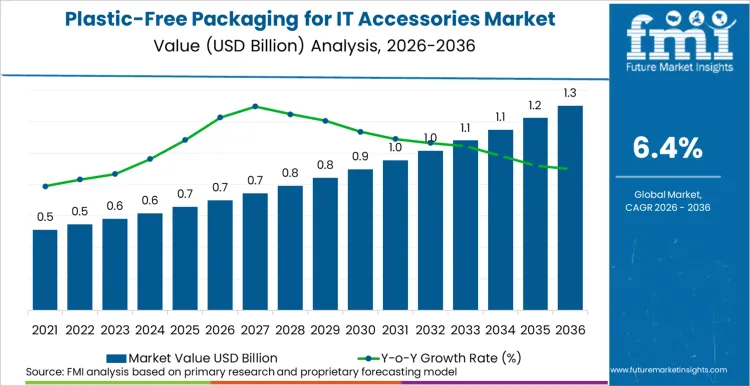
The plastic-free packaging for IT accessories market is estimated at USD 0.7 billion in 2026 and is predicted to reach USD 1.4 billion by 2036, at a 6.4% CAGR that signals where value concentrates as buyers tighten performance and proof requirements. As per FMI's projection, this growth curve is not merely about substitution but reflects a fundamental re-engineering of the unboxing experience, where packaging becomes a core component of the product's environmental bill of materials.
Capacity investments in next-generation fiber molding are scaling rapidly to meet this new demand profile, ensuring that supply can match the ambitious targets set by global tech giants. HP Inc. reported that during 2023, it shipped more than 49 million computers in molded fiber or hybrid foam/fiber packaging, representing nearly 97% of units shipped. This scale of adoption forces upstream converters to invest in high-throughput thermoforming equipment, moving the industry away from slow, wet-pulp processes toward faster, dry-molded technologies.
Corporate mandates are accelerating this volume shift, creating a hard ceiling for legacy foam and blister pack suppliers who cannot pivot to fiber-based alternatives. A Statement from Microsoft in their 2025 Environmental Report established the new baseline for the sector: “The Surface Copilot+ PCs now feature our most sustainable packaging design yet. Packaging from over 30,000 server racks was processed through recycling programs in FY24-diverting over 2,500 metric tons of waste from landfills” This declaration effectively ends the era of "transition" materials, signaling to the entire supply chain that future procurement contracts will depend entirely on the ability to deliver 100% plastic-free structural integrity at scale.
Summary of Plastic-Free Packaging for IT Accessories Market
What Is the Growth Outlook for the Plastic-Free Packaging for IT Accessories Market as per Future Market Insights Projection?
Future Market Insights projects the global plastic-free packaging for IT accessories market to grow from USD 0.7 billion in 2026 to USD 1.4 billion by 2036, representing a 6.4% CAGR over the forecast period. This expansion is underpinned by the simultaneous enforcement of stringent anti-plastic regulations in Europe and the voluntary "plastic-free" commitments of major North American tech conglomerates.
How Do FMI Analysts Perceive the Plastic-Free Packaging for IT Accessories Market to Evolve?
FMI analysts perceive the market transitioning away from "light-weighting" strategies toward complete material substitution using high-density molded fibers and agricultural residues. This evolution is driven by the need to replicate the shock-absorption properties of polymer foams without the environmental footprint, pushing innovation into "dry molded" technologies that reduce water usage.
Which Country Holds the Largest Share in the Global Plastic-Free Packaging for IT Accessories Market?
The United States currently commands a significant value share due to the concentration of global tech headquarters, but India is emerging as the fastest-growing region with an 8.2% CAGR. India's growth is supported by a burgeoning domestic electronics manufacturing sector and aggressive government mandates reducing single-use plastics in logistics.
How Large Will the Plastic-Free Packaging for IT Accessories Market Be by 2036?
The global plastic-free packaging for IT accessories market is expected to reach USD 1.4 billion by 2036, with the Molded Fiber & Pulp segment currently commanding a 38.00% share. The dominance of molded fiber is secured by its ability to form complex geometries required for holding intricate IT peripherals like mice, keyboards, and cables.
What Is the Definition of the Plastic-Free Packaging for IT Accessories Market?
The plastic-free packaging for IT accessories market encompasses revenue generated from commercial packaging solutions that contain zero petroleum-based plastics, designed specifically for information technology peripherals. This includes plastic free packaging formats such as molded fiber trays, folding cartons, and cellulose-based films used for protection and display.
What Are Globally Unique Trends Shaping the Plastic-Free Packaging for IT Accessories Market?
Globally, the sector is shaped by the "Fiber-Tech" revolution in developed markets and the "Agro-Waste" utilization trend in emerging economies. Manufacturers are increasingly integrating molded fiber packaging technologies that utilize non-wood fibers like bamboo and wheat straw to decouple packaging costs from volatile paper pulp prices.
Plastic-Free Packaging for IT Accessories Market Key Takeaways
| Metric | Value |
|---|---|
| Industry Size (2026) | USD 0.7 billion |
| Industry Value (2036) | USD 1.4 billion |
| CAGR (2026 to 2036) | 6.4% |
Source: Future Market Insights (FMI) analysis, based on proprietary forecasting model and primary research.
Why Material Engineering Is Replacing Design Reduction?
According to FMI's estimates, the primary driver for market acceleration is the shift from reducing plastic weight to engineering entirely new material properties that mimic plastic's performance. Brands are no longer satisfied with flimsy cardboard placeholders; they require high-fidelity structures that offer the same "premium feel" and drop protection as the EVA foams they replace. Apple Inc. recently secured a patent for "variably compressed fiber packaging," a technique that creates high and low-density regions within a single fiber tray to optimize cushioning without adding weight. This technological leap allows OEMs to maintain the structural integrity required for fragile electronics while completely eliminating polymer-based inserts.
The second major driver is the operational scaling of "Dry Molded Fiber" technologies, which solve the speed and water-intensity issues of traditional wet pulp molding. As sustainable packaging demand outstrips the capacity of legacy egg-carton style production, high-speed dry molding enables manufacturers to produce complex, smooth-surfaced trays at cycle times comparable to plastic thermoforming. The market is witnessing a race to validate these lines; once a machine is proven, it unlocks the ability to produce everything from raw material to finished product in a single pass, effectively removing the "green premium" associated with fiber packaging and allowing it to compete directly on unit cost in high-volume applications.
What is the Segmentation Outlook of Plastic-Free Packaging for IT Accessories?
The market is segmented by material type, packaging format, and sales channel, revealing a decisive shift toward structural fiber solutions over flexible papers. The analysis covers materials including molded fiber, paperboard, and cellulose films; formats like folding cartons and trays; and channels dominated by e-commerce. By 2036, the molded pulp packaging segment is expected to capture the majority of the high-value protective packaging spend, while e-commerce channels will dictate the specifications for durability and volume efficiency. Official data from Dell Technologies shows the company advanced to 96.4% recycled or renewable materials in its packaging in FY2024, confirming that the material transition is already well-entrenched among market leaders.
Why Molded Fiber & Pulp Dominates the Material Segment?
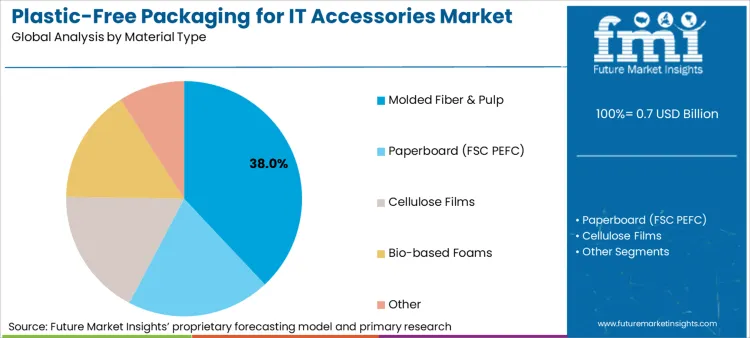
Molded fiber and pulp command a 38.00% share of the market, serving as the structural backbone for replacing complex plastic trays and inserts. This dominance is driven by the material's ability to be precision-molded into intricate shapes that securely hold devices like mice, webcams, and docking stations, preventing movement during transit. HP Inc.'s 2024 launch of the DesignJet T200/T600 series featured moulded fibre pulp packaging that minimized plastic waste by over 50%, illustrating how legacy product lines are being retrofitted with fiber solutions. Consequently, molded fiber is moving from a niche "eco-friendly" option to the default engineering standard for hardware protection.
How E-commerce Is Reshaping Sales Channel Demand?
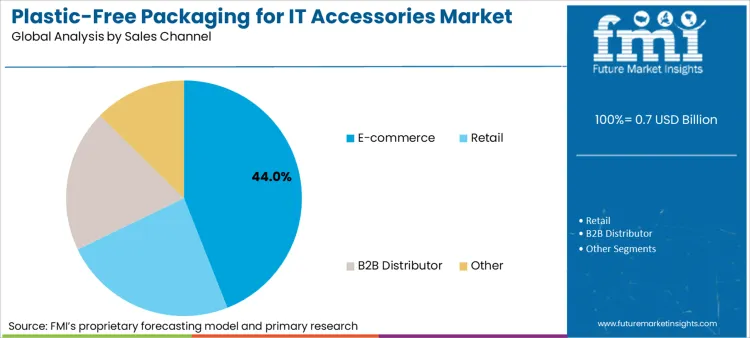
The e-commerce channel accounts for 44.00% of the market share, fundamentally altering packaging requirements from "shelf appeal" to "shipping survival." Online retailers are prioritizing recyclable packaging formats like curb-side recyclable mailers and frustration-free boxes that eliminate the need for secondary shipping cartons. Belkin reported in 2024 that since transitioning to post-consumer recycled materials and plastic-free designs, it has replaced 432 metric tons of virgin plastic, largely driven by the optimization of its packaging for online and retail distribution. This channel pressure forces suppliers to design packaging that is robust enough to withstand the logistics network without the crutch of bubble wrap or plastic air pillows.
Why Folding Cartons Maintain a Strong Format Share?
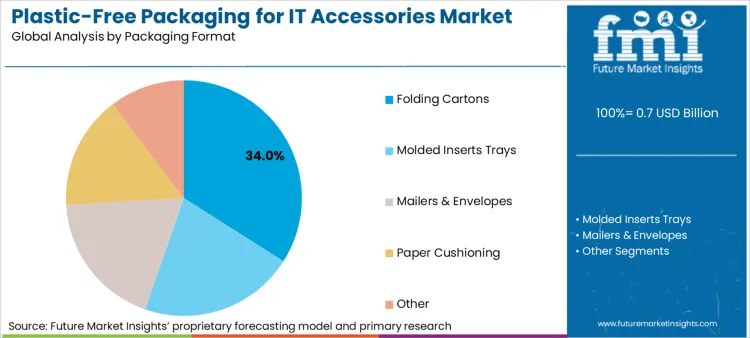
Folding cartons hold a 34.0% share, favored for their superior printability and compatibility with existing retail shelving infrastructure. Brands utilize this format to deliver high-impact branding and essential product information without the use of plastic laminates or windows. A clear indicator of this trend is the paper packaging shift seen in Apple's 2024 Apple Watch lineup, which featured 100% fiber-based packaging including the exterior box. This proves that folding cartons, when engineered with high-quality fibers, can deliver a luxury unboxing experience that meets the aesthetic standards of premium consumer electronics.
How Supply Chain Scaling Is Reducing the "Green Premium"
FMI analysts opine that the most critical development in the market is the massive industrial scaling of bio-material production, which is systematically dismantling the cost barriers to adoption. Historically, plastic-free alternatives carried a significant cost premium due to fragmented supply chains and low production volumes. However, recent capital injections into domestic manufacturing hubs are changing this equation. For instance, Genera broke ground in January 2024 on a USD 350 million expansion of its Sustainable Biomaterials Campus in Tennessee, adding 60 robotic thermoforming machines to its fleet. This level of capacity addition allows for the consistent, high-volume supply of biodegradable packaging materials required by global electronics OEMs, effectively enabling them to switch millions of SKUs to fiber without disrupting their supply lines.
The industry is grappling with the validation of these new production lines, a process that determines how quickly technologies can be commercialized. Sanna Fager, Chief Commercial Officer at PulPac, highlighted this validation challenge in October 2024:
"We know that we don’t have all the proofs for running a production line for [many] years. So we need to engage with a converter to see that. This is something new. It’s an exciting place to step into. Some are ready to do that, and some are not. We know that some people will wait and probably be interested when this is a mature technology. But we, on the PulPac side, need to find the ones that will be at the forefront." This statement underscores the critical "proof phase" the market is currently navigating, where successful pilot lines are the gateway to massive capital deployment and the eventual commoditization of dry molded fiber technologies.
How Regional Manufacturing Hubs Are Driving Localized Solutions?
The global plastic-free packaging for IT accessories market exhibits distinct regional drivers, from the "China Plus One" manufacturing shift in Asia to the strict regulatory environment in Europe. India is projected to lead with an 8.2% CAGR, driven by a booming domestic electronics sector and startups innovating with agro-waste materials. Vietnam follows closely with 7.6%, capitalizing on its growing role as a primary assembly hub for global tech brands. The mature markets of the USA and Germany are growing at 3.6% and 3.0% respectively, focused on optimizing industrial electronics packaging for circularity and curb-side recyclability.
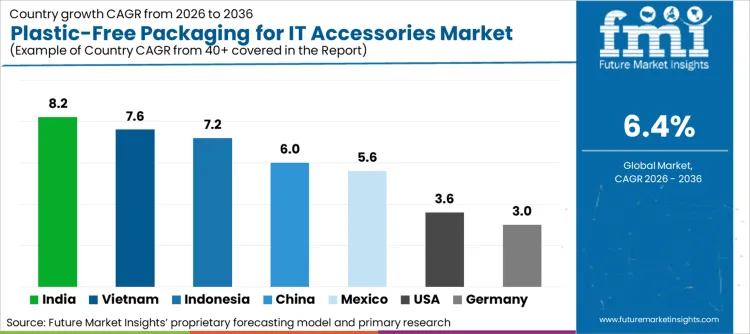
| Country | CAGR (2026 to 2036) |
|---|---|
| India | 8.20% |
| Vietnam | 7.60% |
| Indonesia | 7.20% |
| China | 6.00% |
| USA | 3.60% |
Source: Future Market Insights’ proprietary forecasting model and primary research.
Why India Is the Fastest Growing Market?
Demand for plastic-free packaging for IT accessories in India is anticipated to grow at an 8.20% CAGR, fueled by a burgeoning "Make in India" electronics ecosystem and a critical need for sustainable logistics solutions. Local procurement teams are increasingly turning to bamboo and wheat straw alternatives to replace plastic films, leveraging the country's abundant agricultural waste.
Vaibhav Anant, Founder & CEO of Bambrew, emphasized the urgency of this infrastructural shift in July 2025:
"The packaging industry is at a crossroads, and there’s an urgent need for solutions that go beyond surface-level sustainability. With this capital, we’re investing in the science, infrastructure, and scale required to replace plastic meaningfully, not just in India, but globally." This investment signals a maturing supply chain capable of supporting high-volume mobile phone accessories packaging requirements, proving that emerging markets are becoming the innovation engine for material science rather than just low-cost manufacturing hubs.
Why Vietnam Is Emerging as a Manufacturing Powerhouse?
Sales of plastic-free packaging for IT accessories in Vietnam are set to rise at a 7.60% CAGR, directly correlated with the migration of global electronics assembly lines to the region. As major OEMs like Apple and Samsung expand their Vietnamese operations, they are localizing their packaging supply chains to reduce carbon footprints and logistics costs. Vietnam's electronics exports for all of 2024 were approximately USD 126.5 billion, a volume that necessitates a massive, localized supply of compliant packaging. Consequently, regional converters are upgrading their facilities to produce high-specification molded fiber trays that meet international export standards.
Why China Remains Critical Despite Slower Growth?
The plastic-free packaging for IT accessories industry in China is projected to expand at a 6.00% CAGR, driven by aggressive corporate targets to decarbonize the massive domestic supply chain. While export growth moderates, the internal push for "green manufacturing" is forcing component suppliers to eliminate single-use plastics from their B2B shipments. Lenovo’s corporate report confirms a target that by FY 2025/26, 90% of PC products' plastic packaging will be made from recycled materials, with a broader shift toward fiber. This mandate ripples through the vast Chinese component ecosystem, compelling thousands of sub-suppliers to adopt biodegradable paper and plastic packaging alternatives to maintain their vendor status.
Why the USA Focuses on Premium Fiber Innovation?
The plastic-free packaging for IT accessories market in the USA is poised to register a 3.60% CAGR, characterized by a focus on premium, proprietary fiber technologies that enhance brand equity. American consumers increasingly view plastic-free packaging as a marker of product quality, prompting brands to invest in advanced "dust-free" paper solutions.
Lisa Jackson, VP of Environment, Policy, and Social Initiatives at Apple, noted in April 2024: "The proof of Apple’s commitment to climate action is in our progress: We’ve slashed emissions by more than half, all while serving more users than ever before." This highlights how US companies are using packaging innovation as a tangible demonstration of their climate commitments, driving value through differentiation and forcing competitors to match these visible sustainability cues to remain relevant on the shelf.
Why Germany Leads in Circular Policy Enforcement?
Plastic-free packaging for IT accessories in Germany is anticipated to grow at a 3.00% CAGR, underpinned by the rigorous enforcement of the EU Packaging and Packaging Waste Regulation (PPWR). German retailers are aggressively minimizing void space and banning specific plastic formats, forcing suppliers to adopt precise, custom-fit fiber solutions. Sony Group’s "Green Management 2030" plan, which targets the elimination of plastic packaging for small products, is particularly impactful in this region, setting a compliance benchmark for the entire industry. As a result, the German market serves as the testing ground for the most stringent circularity loops, where reusable packing and 100% fiber recyclability are prerequisites for market entry.
How Competitive Strategy Pivots from Volume to Value?
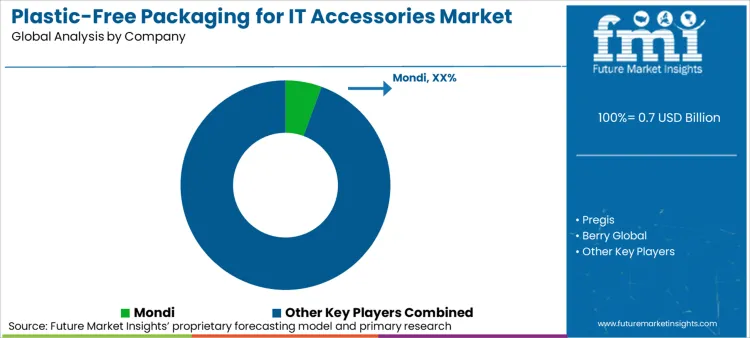
Competitive advantage in plastic-free packaging for IT accessories now depends less on brand breadth and more on who controls the constraint that gates scale, whether evidence, compliance, channel access, or capacity. Profit pools are moving toward players like Mondi and Berry Global who can offer integrated "substrate-to-box" solutions, reducing the complexity for electronics brands trying to navigate global compliance patchworks. Mondi, holding a 5.60% market share, exemplifies this consolidated approach by offering a portfolio that spans from raw kraft paper production to finished wearable device packaging. This vertical integration allows them to guarantee feedstock sustainability and trace-ability, a critical differentiator as clients face tighter audits on their "plastic-free" claims.
Rivalry inside the sector increasingly concentrates around control points that buyers cannot bypass, particularly in the realm of high-performance barrier coatings. Innovation leaders are scrambling to develop non-plastic coatings that provide moisture resistance without compromising recyclability. In October 2024, PulPac collaborated with Nordic Barrier Coating to develop PFAS-free and plastic-free barriers for molded fiber, directly addressing a key technical hurdle for electronics packaging. Such strategic partnerships enable nimble challengers to outmaneuver larger incumbents by solving specific engineering bottlenecks. Consequently, the market rewards companies that can prove their packaging not only eliminates plastic but also survives the rigors of the global supply chain.
Recent Developments:
- In April 2025, Logitech completed its transition to 100% paper-based packaging across its product lineup, eliminating plastic in favor of sustainable, recyclable alternatives for IT accessories such as mice, keyboards, and webcams. This move aligns with the company's Design for Sustainability goals, reducing environmental impact and setting a benchmark for eco-friendly packaging in the consumer electronics sector.
- In September 2024, Anker introduced plastic-free packaging for its new mobile charging accessories, including cables, chargers, power banks, and related IT products. This initiative significantly reduces plastic and petroleum usage by incorporating bio-based materials, supporting broader sustainability efforts in the tech accessories market.
Key Players in Plastic-Free Packaging for IT Accessories Market
- Mondi
- Pregis
- Berry Global
- Avery Dennison
- Ranpak
- NEFAB
- Smurfit WestRock
- International Paper / Amcor
- Genera
- PulPac
- Footprint
- Bambrew
- Stora Enso
- DS Smith
- Huhtamaki
Market Definition
The Plastic-Free Packaging for IT Accessories market encompasses the commercial exchange of packaging solutions specifically engineered for information technology peripherals and consumer electronics that contain zero petroleum-based plastic components. This market includes a diverse array of material technologies, primarily focusing on molded fiber, paperboard, recycled paper, and plant-based cellulose films. The scope covers the design, manufacturing, and sale of primary, secondary, and tertiary packaging used for products such as keyboards, mice, cables, webcams, docking stations, and wearable devices.
Market inclusion is defined by the strict absence of single-use plastics like expanded polystyrene (EPS), polyethylene (PE) bags, and PVC blister packs in the final packaging unit. It explicitly includes revenue generated from "plastic-free by design" innovations such as dry molded fiber trays, paper-based scratch protection layers, and bio-based adhesives that replace plastic tape. The market sizing also accounts for the value of specialized tooling and engineering services bundled with the supply of these packaging materials, as well as the sale of compostable mailers used specifically for the e-commerce distribution of IT accessories.
The market excludes packaging solutions that merely reduce plastic content (e.g., "hybrid" packs with plastic windows) or those that use "bioplastics" that are not home compostable or widely recyclable in standard paper streams. It also excludes general-purpose shipping boxes (RSC cartons) sold as commodities without specific customization for IT products, as well as packaging for large-format electronics like televisions or servers, unless explicitly categorized under accessory bundles. Furthermore, revenue from the raw material feedstock (e.g., raw pulp sales) is excluded to avoid double-counting, focusing instead on the value of the converted packaging product sold to the brand owner or distributor.
Report Scope
| Items | Values |
|---|---|
| Quantitative Units (2026) | USD 0.7 billion |
| Product Type | Molded Fiber, Folding Cartons, Cellulose Films, Bio-based Foams |
| Application or Procedure type | IT Accessories (Mice, Keyboards, Cables, Wearables) |
| End user | Electronics OEMs, Retailers, Distributors |
| Regions covered | North America, Latin America, Europe, East Asia, South Asia & Pacific, MEA |
| Countries covered | USA, India, Vietnam, China, Germany, and key global markets |
| Key companies profiled | Mondi, Pregis, Berry Global, Avery Dennison, Genera, PulPac |
| Additional attributes | Revenue analysis by segments, adoption trends across settings, regulatory and compliance landscape (as relevant), pricing and reimbursement considerations (when relevant), channel mix economics, supply chain exposure, and competitive positioning analysis |
Source: Future Market Insights (FMI) analysis, based on proprietary forecasting model and primary research.
Plastic-Free Packaging for IT Accessories Market by Segments
By Material Type:
- Molded Fiber & Pulp
- Paperboard (FSC/PEFC)
- Cellulose Films
- Bio-based Foams
- Other Plant-based Materials
By Packaging Format:
- Folding Cartons
- Molded Inserts / Trays
- Mailers & Envelopes
- Paper Cushioning
- Other Formats
By Sales Channel:
- E-commerce
- Retail
- B2B / Distributor
- Other Channels
By Region:
- North America
- Latin America
- Europe
- East Asia
- South Asia & Pacific
- Middle East & Africa
Bibliography
- European Chemicals Agency (ECHA). (2025). Guidance on substances in packaging materials under REACH and CLP. ECHA.
- USA National Institute of Standards and Technology (NIST). (2024). Measurement science for sustainable materials and packaging performance. NIST.
- Basel Convention Secretariat (UNEP). (2024). Technical guidelines on plastic waste transboundary movement and recycling. UNEP Basel Convention.
- UK Environment Agency. (2025). Extended Producer Responsibility (EPR) for packaging: Implementation guidance. GOV.UK.
- European Food Safety Authority (EFSA). (2024). Food contact materials and safety considerations for sustainable packaging. EFSA.
- International Labour Organization (ILO). (2024). Decent work in recycling and waste management value chains. ILO.
- National Renewable Energy Laboratory (NREL). (2025). Lifecycle assessment of biobased and recycled packaging materials. NREL.
Frequently Asked Questions
What is the current global market size for Plastic-Free Packaging for IT Accessories?
The global market is valued at USD 0.7 billion in 2026, reflecting the initial wave of mass adoption by major tech conglomerates like Apple and Dell.
What is the projected CAGR for the Plastic-Free Packaging for IT Accessories market?
The market is projected to grow at a robust 6.4% CAGR from 2026 to 2036, driven by regulatory pressure and the scaling of fiber molding technologies.
Which material segment dominates the market?
Molded Fiber & Pulp accounts for the largest share at 38.00%, as it is the only viable structural replacement for plastic trays in protecting sensitive electronics.
Which country is experiencing the fastest growth?
India is growing at the fastest rate of 8.2%, fueled by a rapid expansion in domestic electronics manufacturing and startups like Bambrew scaling local solutions.
Who are the leading players in the Plastic-Free Packaging for IT Accessories market?
Mondi leads the industry, followed by major converters like Pregis and innovative disruptors like Genera and PulPac.
Preview the report firsthand - request a free sample
Get SampleGet the brochure for pricing and purchase details.
Get PDFTable of Content
- Executive Summary
- Global Market Outlook
- Demand-side Trends
- Supply-side Trends
- Technology Roadmap Analysis
- Analysis and Recommendations
- Market Overview
- Market Coverage / Taxonomy
- Market Definition / Scope / Limitations
- Research Methodology
- Chapter Orientation
- Analytical Lens and Working Hypotheses
- Market Structure, Signals, and Trend Drivers
- Benchmarking and Cross-market Comparability
- Market Sizing, Forecasting, and Opportunity Mapping
- Research Design and Evidence Framework
- Desk Research Programme (Secondary Evidence)
- Company Annual and Sustainability Reports
- Peer-reviewed Journals and Academic Literature
- Corporate Websites, Product Literature, and Technical Notes
- Earnings Decks and Investor Briefings
- Statutory Filings and Regulatory Disclosures
- Technical White Papers and Standards Notes
- Trade Journals, Industry Magazines, and Analyst Briefs
- Conference Proceedings, Webinars, and Seminar Materials
- Government Statistics Portals and Public Data Releases
- Press Releases and Reputable Media Coverage
- Specialist Newsletters and Curated Briefings
- Sector Databases and Reference Repositories
- FMI Internal Proprietary Databases and Historical Market Datasets
- Subscription Datasets and Paid Sources
- Social Channels, Communities, and Digital Listening Inputs
- Additional Desk Sources
- Expert Input and Fieldwork (Primary Evidence)
- Primary Modes
- Qualitative Interviews and Expert Elicitation
- Quantitative Surveys and Structured Data Capture
- Blended Approach
- Why Primary Evidence is Used
- Field Techniques
- Interviews
- Surveys
- Focus Groups
- Observational and In-context Research
- Social and Community Interactions
- Stakeholder Universe Engaged
- C-suite Leaders
- Board Members
- Presidents and Vice Presidents
- R&D and Innovation Heads
- Technical Specialists
- Domain Subject-matter Experts
- Scientists
- Physicians and Other Healthcare Professionals
- Governance, Ethics, and Data Stewardship
- Research Ethics
- Data Integrity and Handling
- Primary Modes
- Tooling, Models, and Reference Databases
- Desk Research Programme (Secondary Evidence)
- Data Engineering and Model Build
- Data Acquisition and Ingestion
- Cleaning, Normalisation, and Verification
- Synthesis, Triangulation, and Analysis
- Quality Assurance and Audit Trail
- Market Background
- Market Dynamics
- Drivers
- Restraints
- Opportunity
- Trends
- Scenario Forecast
- Demand in Optimistic Scenario
- Demand in Likely Scenario
- Demand in Conservative Scenario
- Opportunity Map Analysis
- Product Life Cycle Analysis
- Supply Chain Analysis
- Investment Feasibility Matrix
- Value Chain Analysis
- PESTLE and Porter’s Analysis
- Regulatory Landscape
- Regional Parent Market Outlook
- Production and Consumption Statistics
- Import and Export Statistics
- Market Dynamics
- Global Market Analysis 2021 to 2025 and Forecast, 2026 to 2036
- Historical Market Size Value (USD Million) Analysis, 2021 to 2025
- Current and Future Market Size Value (USD Million) Projections, 2026 to 2036
- Y-o-Y Growth Trend Analysis
- Absolute $ Opportunity Analysis
- Global Market Pricing Analysis 2021 to 2025 and Forecast 2026 to 2036
- Global Market Analysis 2021 to 2025 and Forecast 2026 to 2036, By Material Type
- Introduction / Key Findings
- Historical Market Size Value (USD Million) Analysis By Material Type , 2021 to 2025
- Current and Future Market Size Value (USD Million) Analysis and Forecast By Material Type , 2026 to 2036
- Molded Fiber & Pulp
- Paperboard (FSC PEFC)
- Cellulose Films
- Bio-based Foams
- Other
- Molded Fiber & Pulp
- Y-o-Y Growth Trend Analysis By Material Type , 2021 to 2025
- Absolute $ Opportunity Analysis By Material Type , 2026 to 2036
- Global Market Analysis 2021 to 2025 and Forecast 2026 to 2036, By Packaging Format
- Introduction / Key Findings
- Historical Market Size Value (USD Million) Analysis By Packaging Format, 2021 to 2025
- Current and Future Market Size Value (USD Million) Analysis and Forecast By Packaging Format, 2026 to 2036
- Folding Cartons
- Molded Inserts Trays
- Mailers & Envelopes
- Paper Cushioning
- Other
- Folding Cartons
- Y-o-Y Growth Trend Analysis By Packaging Format, 2021 to 2025
- Absolute $ Opportunity Analysis By Packaging Format, 2026 to 2036
- Global Market Analysis 2021 to 2025 and Forecast 2026 to 2036, By Sales Channel
- Introduction / Key Findings
- Historical Market Size Value (USD Million) Analysis By Sales Channel, 2021 to 2025
- Current and Future Market Size Value (USD Million) Analysis and Forecast By Sales Channel, 2026 to 2036
- E-commerce
- Retail
- B2B Distributor
- Other
- E-commerce
- Y-o-Y Growth Trend Analysis By Sales Channel, 2021 to 2025
- Absolute $ Opportunity Analysis By Sales Channel, 2026 to 2036
- Global Market Analysis 2021 to 2025 and Forecast 2026 to 2036, By Region
- Introduction
- Historical Market Size Value (USD Million) Analysis By Region, 2021 to 2025
- Current Market Size Value (USD Million) Analysis and Forecast By Region, 2026 to 2036
- North America
- Latin America
- Western Europe
- Eastern Europe
- East Asia
- South Asia and Pacific
- Middle East & Africa
- Market Attractiveness Analysis By Region
- North America Market Analysis 2021 to 2025 and Forecast 2026 to 2036, By Country
- Historical Market Size Value (USD Million) Trend Analysis By Market Taxonomy, 2021 to 2025
- Market Size Value (USD Million) Forecast By Market Taxonomy, 2026 to 2036
- By Country
- USA
- Canada
- Mexico
- By Material Type
- By Packaging Format
- By Sales Channel
- By Country
- Market Attractiveness Analysis
- By Country
- By Material Type
- By Packaging Format
- By Sales Channel
- Key Takeaways
- Latin America Market Analysis 2021 to 2025 and Forecast 2026 to 2036, By Country
- Historical Market Size Value (USD Million) Trend Analysis By Market Taxonomy, 2021 to 2025
- Market Size Value (USD Million) Forecast By Market Taxonomy, 2026 to 2036
- By Country
- Brazil
- Chile
- Rest of Latin America
- By Material Type
- By Packaging Format
- By Sales Channel
- By Country
- Market Attractiveness Analysis
- By Country
- By Material Type
- By Packaging Format
- By Sales Channel
- Key Takeaways
- Western Europe Market Analysis 2021 to 2025 and Forecast 2026 to 2036, By Country
- Historical Market Size Value (USD Million) Trend Analysis By Market Taxonomy, 2021 to 2025
- Market Size Value (USD Million) Forecast By Market Taxonomy, 2026 to 2036
- By Country
- Germany
- UK
- Italy
- Spain
- France
- Nordic
- BENELUX
- Rest of Western Europe
- By Material Type
- By Packaging Format
- By Sales Channel
- By Country
- Market Attractiveness Analysis
- By Country
- By Material Type
- By Packaging Format
- By Sales Channel
- Key Takeaways
- Eastern Europe Market Analysis 2021 to 2025 and Forecast 2026 to 2036, By Country
- Historical Market Size Value (USD Million) Trend Analysis By Market Taxonomy, 2021 to 2025
- Market Size Value (USD Million) Forecast By Market Taxonomy, 2026 to 2036
- By Country
- Russia
- Poland
- Hungary
- Balkan & Baltic
- Rest of Eastern Europe
- By Material Type
- By Packaging Format
- By Sales Channel
- By Country
- Market Attractiveness Analysis
- By Country
- By Material Type
- By Packaging Format
- By Sales Channel
- Key Takeaways
- East Asia Market Analysis 2021 to 2025 and Forecast 2026 to 2036, By Country
- Historical Market Size Value (USD Million) Trend Analysis By Market Taxonomy, 2021 to 2025
- Market Size Value (USD Million) Forecast By Market Taxonomy, 2026 to 2036
- By Country
- China
- Japan
- South Korea
- By Material Type
- By Packaging Format
- By Sales Channel
- By Country
- Market Attractiveness Analysis
- By Country
- By Material Type
- By Packaging Format
- By Sales Channel
- Key Takeaways
- South Asia and Pacific Market Analysis 2021 to 2025 and Forecast 2026 to 2036, By Country
- Historical Market Size Value (USD Million) Trend Analysis By Market Taxonomy, 2021 to 2025
- Market Size Value (USD Million) Forecast By Market Taxonomy, 2026 to 2036
- By Country
- India
- ASEAN
- Australia & New Zealand
- Rest of South Asia and Pacific
- By Material Type
- By Packaging Format
- By Sales Channel
- By Country
- Market Attractiveness Analysis
- By Country
- By Material Type
- By Packaging Format
- By Sales Channel
- Key Takeaways
- Middle East & Africa Market Analysis 2021 to 2025 and Forecast 2026 to 2036, By Country
- Historical Market Size Value (USD Million) Trend Analysis By Market Taxonomy, 2021 to 2025
- Market Size Value (USD Million) Forecast By Market Taxonomy, 2026 to 2036
- By Country
- Kingdom of Saudi Arabia
- Other GCC Countries
- Turkiye
- South Africa
- Other African Union
- Rest of Middle East & Africa
- By Material Type
- By Packaging Format
- By Sales Channel
- By Country
- Market Attractiveness Analysis
- By Country
- By Material Type
- By Packaging Format
- By Sales Channel
- Key Takeaways
- Key Countries Market Analysis
- USA
- Pricing Analysis
- Market Share Analysis, 2025
- By Material Type
- By Packaging Format
- By Sales Channel
- Canada
- Pricing Analysis
- Market Share Analysis, 2025
- By Material Type
- By Packaging Format
- By Sales Channel
- Mexico
- Pricing Analysis
- Market Share Analysis, 2025
- By Material Type
- By Packaging Format
- By Sales Channel
- Brazil
- Pricing Analysis
- Market Share Analysis, 2025
- By Material Type
- By Packaging Format
- By Sales Channel
- Chile
- Pricing Analysis
- Market Share Analysis, 2025
- By Material Type
- By Packaging Format
- By Sales Channel
- Germany
- Pricing Analysis
- Market Share Analysis, 2025
- By Material Type
- By Packaging Format
- By Sales Channel
- UK
- Pricing Analysis
- Market Share Analysis, 2025
- By Material Type
- By Packaging Format
- By Sales Channel
- Italy
- Pricing Analysis
- Market Share Analysis, 2025
- By Material Type
- By Packaging Format
- By Sales Channel
- Spain
- Pricing Analysis
- Market Share Analysis, 2025
- By Material Type
- By Packaging Format
- By Sales Channel
- France
- Pricing Analysis
- Market Share Analysis, 2025
- By Material Type
- By Packaging Format
- By Sales Channel
- India
- Pricing Analysis
- Market Share Analysis, 2025
- By Material Type
- By Packaging Format
- By Sales Channel
- ASEAN
- Pricing Analysis
- Market Share Analysis, 2025
- By Material Type
- By Packaging Format
- By Sales Channel
- Australia & New Zealand
- Pricing Analysis
- Market Share Analysis, 2025
- By Material Type
- By Packaging Format
- By Sales Channel
- China
- Pricing Analysis
- Market Share Analysis, 2025
- By Material Type
- By Packaging Format
- By Sales Channel
- Japan
- Pricing Analysis
- Market Share Analysis, 2025
- By Material Type
- By Packaging Format
- By Sales Channel
- South Korea
- Pricing Analysis
- Market Share Analysis, 2025
- By Material Type
- By Packaging Format
- By Sales Channel
- Russia
- Pricing Analysis
- Market Share Analysis, 2025
- By Material Type
- By Packaging Format
- By Sales Channel
- Poland
- Pricing Analysis
- Market Share Analysis, 2025
- By Material Type
- By Packaging Format
- By Sales Channel
- Hungary
- Pricing Analysis
- Market Share Analysis, 2025
- By Material Type
- By Packaging Format
- By Sales Channel
- Kingdom of Saudi Arabia
- Pricing Analysis
- Market Share Analysis, 2025
- By Material Type
- By Packaging Format
- By Sales Channel
- Turkiye
- Pricing Analysis
- Market Share Analysis, 2025
- By Material Type
- By Packaging Format
- By Sales Channel
- South Africa
- Pricing Analysis
- Market Share Analysis, 2025
- By Material Type
- By Packaging Format
- By Sales Channel
- USA
- Market Structure Analysis
- Competition Dashboard
- Competition Benchmarking
- Market Share Analysis of Top Players
- By Regional
- By Material Type
- By Packaging Format
- By Sales Channel
- Competition Analysis
- Competition Deep Dive
- Mondi
- Overview
- Product Portfolio
- Profitability by Market Segments (Product/Age /Sales Channel/Region)
- Sales Footprint
- Strategy Overview
- Marketing Strategy
- Product Strategy
- Channel Strategy
- Pregis
- Berry Global
- Avery Dennison
- Ranpak
- NEFAB
- Smurfit WestRock
- International Paper Amcor
- Mondi
- Competition Deep Dive
- Assumptions & Acronyms Used


