

- Industry Size (2025)
- USD 32.3 Bn
- Forecast (2035)
- USD 50.7 Bn
- CAGR (2025 to 2035)
- 4.6%
Recyclable Packaging Market Size, Market Forecast and Outlook By FMI
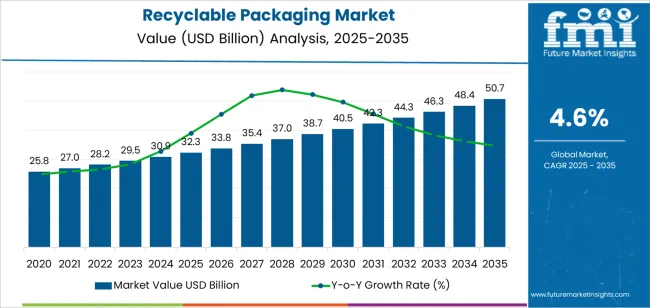
The recyclable packaging market is expected to expand from USD 32.3 billion in 2025 to USD 50.7 billion by 2035. The market is anticipated to register a 4.6% CAGR during the forecast period. Paper is likely to lead with a 36.1% share, and paper and cardboard are projected to account for 42.8% of packaging type revenue in 2025.
Summary of the Recyclable Packaging Market
- Demand and Growth Drivers
- Plastic waste rules are likely to strengthen the shift toward recyclable packaging formats.
- Brand sustainability targets are expected to guide material choices across retail packaging.
- Consumer preference for responsible packaging is anticipated to improve recyclable format acceptance.
- Product and Segment View
- Paper is likely to lead material use because recycling systems already support fiber recovery.
- Paper and cardboard are expected to remain preferred for shipping and retail packaging.
- Food and beverage applications are anticipated to anchor demand through high-volume packaged goods.
- Geography and Competitive Outlook
- North America is likely to benefit from recycling infrastructure and brand compliance programs.
- Asia Pacific is expected to see wider use as packaging demand expands across consumer goods.
- Europe is anticipated to stay important due to strict packaging waste rules and circularity targets.
- Analyst Opinion
- Ismail Sutaria,Principal Consultant for Packaging at FMI, suggests, “The recyclable packaging market is moving toward materials that balance compliance with practical packaging performance. Fiber-based formats are likely to gain preference because converters can scale them across food, retail and shipping applications without major system changes.”
- Recyclable Packaging Market Value Analysis
- The recyclable packaging market is shifting from voluntary sustainability claims toward compliance-ready packaging design.
- Demand is likely to improve as plastic restrictions push brands toward recyclable material formats.
- Adoption is expected to gain traction through fiber-based packaging and mono-material design.
- Spending is anticipated to rise as companies invest in recyclable formats for mainstream packaged goods.
Key Takeaways, Market Size, and Forecast
- The recyclable packaging market was valued at USD 32.3 billion in 2025.
- By 2035, the market is projected to reach USD 50.7 billion.
- From 2025 to 2035, the market is anticipated to expand at a 4.6% CAGR.
- Paper is likely to account for 36.1% of the material type segment in 2025.
- Paper and cardboard are forecast to hold 42.8% of the packaging type segment in 2025.
- North America, Asia Pacific and Europe are likely to remain key regional demand centers.
Segmental Analysis
The market is segmented by Material Type, Packaging Type, and End Use Industry and region. By Material Type, the market is divided into Paper, Glass, Plastic, Tinplate, Wood, Aluminum, Biodegradable Plastics, and Recycled Papers. In terms of Packaging Type, the market is classified into Paper & Cardboard, Bubble Wrap, Void Fill Packing, and Pouches & Envelopes. Based on End Use Industry, the market is segmented into Food & Beverage Industry, Healthcare Industry, and Personal Care Industry. Regionally, the market is classified into North America, Latin America, Western Europe, Eastern Europe, Balkan & Baltic Countries, Russia & Belarus, Central Asia, East Asia, South Asia & Pacific, and the Middle East & Africa.
Insights into the Material Type Segment: Paper
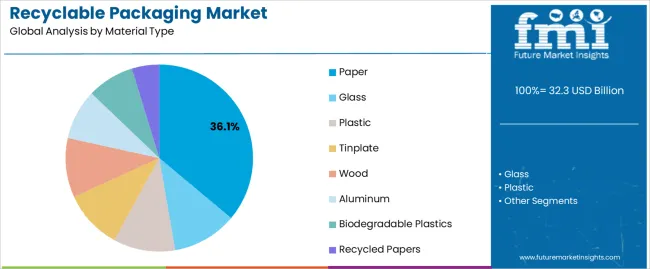
The Paper segment is projected to hold 36.1% of the recyclable packaging market revenue in 2025, establishing itself as the leading material category. This dominance has been supported by paper’s high recyclability rate, widespread availability, and biodegradability. Industry journals and packaging sustainability reports have cited strong adoption of paper in packaging due to its compatibility with a variety of formats including wraps, cartons, and pouches.
Packaging developers have increasingly utilized paper as a base material for coatings and barriers, allowing for performance enhancements while retaining recyclability. Moreover, regulatory pressures against plastic waste and consumer perception of paper as an eco-friendly option have encouraged brand owners to switch from synthetic polymers to paper-based alternatives.
As demand for low-carbon, renewable packaging materials continues to rise, the Paper segment is expected to maintain its leadership position, reinforced by advancements in fiber-based innovation and expansion of closed-loop recycling programs.
Insights into the Packaging Type Segment: Paper & Cardboard
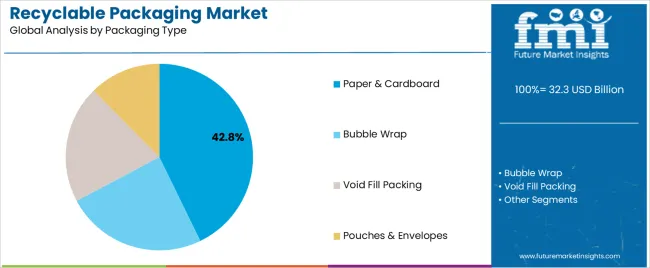
The Paper & Cardboard segment is expected to account for 42.8% of the recyclable packaging market revenue in 2025, maintaining its position as the dominant packaging type. Growth in this segment has been attributed to its durability, cost-effectiveness, and environmental performance across a wide range of applications.
Packaging industry updates have pointed to a sharp rise in e-commerce, retail, and foodservice demand, all of which heavily utilize corrugated cardboard and molded fiber trays for shipping and product protection. Paper & Cardboard formats have also gained traction due to their ease of separation in recycling systems and low contamination rates, making them ideal for municipal recycling programs.
Furthermore, manufacturers have optimized the design of fiber-based packaging to improve strength-to-weight ratios, reducing raw material use while preserving functionality. With increasing investments in recycled paper mills and innovations in water-resistant and grease-resistant paper coatings, the Paper & Cardboard segment is expected to sustain strong growth as a sustainable packaging solution.
Insights into the End Use Industry Segment: Food & Beverage Industry
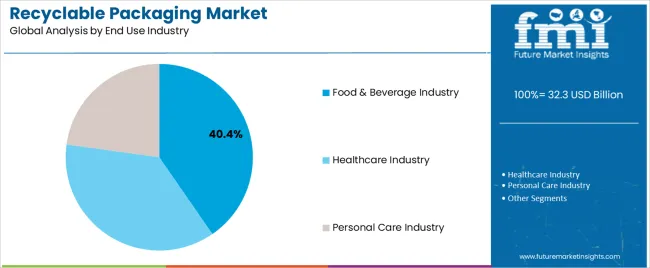
The Food & Beverage Industry segment is projected to capture 40.4% of the recyclable packaging market revenue in 2025, securing its position as the leading end-use category. This segment’s growth has been driven by the rising demand for sustainable packaging formats in retail food, ready-to-eat meals, and beverages.
Regulatory mandates on food-grade recyclables and industry-led commitments to reduce plastic waste have accelerated the adoption of recyclable materials within this sector. Packaging producers have developed new recyclable films, mono-material laminates, and fiber-based trays that meet food safety requirements while aligning with brand sustainability goals.
The sector’s reliance on high-volume packaging, from shelf-ready formats to on-the-go containers, has further amplified the need for scalable, recyclable solutions. Consumer demand for eco-labeled and transparent sourcing practices has also influenced the shift toward recyclable packaging in food and beverage applications. With growing urban populations and increasing convenience food consumption, the Food & Beverage Industry is expected to continue leading recyclable packaging adoption across global markets.
Recyclable Packaging Market Dynamics
Government regulations are playing a key role in promoting the use of recyclable packaging. Many countries are implementing stricter regulations on plastic use and mandating minimum recycled content in packaging materials. Such policies are further incentivizing the development and adoption of recyclable packaging solutions.
As consumers grow conscious of the environmental hazards of single-use plastic, several governments have banned such materials in the countries. Hence, the recyclable packaging options are on the rise in the packaging sector.
The recyclable packaging market is becoming a more attractive option for both manufacturers and consumers. Manufacturers benefit from meeting growing consumer demand and potentially complying with regulations. Consumers, on the other hand, can feel confident that their purchasing decisions are aligned with a more sustainable future. This confluence of environmental responsibility, consumer preference, and legislative pressure positions the recyclable packaging market for continued robust growth.
A significant factor is the shift in consumer lifestyles, bolstering the demand for recyclable packaging. Busier schedules and smaller living spaces lead to more frequent purchases of smaller quantities of goods. This creates a demand for packaging that caters to these individual-sized portions. Recyclable packaging offers a solution, allowing manufacturers to portion their products efficiently while minimizing waste.
Consumers are increasingly prioritizing eco-friendly options. With a heightened awareness of sustainability, products packaged with recyclable materials hold a growing appeal. This preference for "eco-friendly stamped" products further fuels the recyclable packaging market's growth in the forthcoming decade.
Manufacturers, distributors, and retailers are taking note, actively seeking materials that can be reused while retaining the paramount functions of packaging. These materials need to offer protection against light, heat, and moisture, ensuring product quality during transportation and storage. For the development of the consumer base for recyclable packaging, the manufacturers and other entities in the market are developing novel initiatives that are anticipated to augment market progression.
The introduction of bioplastics presents a promising innovation. These bio-based alternatives offer a smaller carbon footprint and lower energy consumption compared to conventional plastics. This not only benefits the environment but also aligns with consumer preference for sustainable choices.
Adding to the current momentum are growing regulations by global authorities. As concerns over waste generated from non-eco-friendly materials escalate, stricter regulations are being implemented. These measures create a supportive environment for the recyclable packaging market, propelling the adoption of sustainable solutions.
Country-wise Insights
Millennials tend towards Recyclable Packaging, offers Fertile Ground in the United States
The burgeoning demand for recyclable packaging in the United States is finding particularly fertile ground among millennial consumers. This generation, known for its environmental consciousness, actively seeks sustainable solutions across various aspects of their lives.
Consumers comprehend the detrimental impact of traditional packaging on the environment and are demonstrably willing to pay a premium for products that prioritize recyclable options. This shift in consumer preference is exerting significant pressure on manufacturers to prioritize the adoption of recyclable packaging solutions.
The recyclable packaging sector is witnessing a surge in innovation, with companies developing aesthetically pleasing and functionally sound packaging solutions that do not compromise product integrity. This confluence of evolving consumer demand and proactive industry response is paving the way for a future where recyclable packaging becomes the standard, not a mere alternative, within the United States.
Need for Recyclable Packaging Augments in the Chinese Ecosystem of Industries
China's industrial sector is gaining traction for recyclable packaging due to environmental concerns and the threat of plastic pollution. The growing awareness of environmental issues and the need for sustainable practices is driving industries to adopt recyclable packaging, which minimizes waste generation and promotes a circular economy. Landfills overflowing with non-recyclable materials are also causing concern.
China's stricter government regulations are promoting the use of environmentally friendly packaging materials, reducing plastic usage and encouraging the adoption of recyclable alternatives. This is driving industries to integrate recyclable packaging into their operations.
Additionally, consumer preferences are shifting towards eco-conscious choices, with products packaged in recyclable materials gaining traction. This shift in consumer behavior is incentivizing industries to adopt sustainable packaging solutions.
India Skyrockets the Demand for Recyclable Packaging
The need for recyclable packaging is rising in India because of government laws, environmental concerns, and public awareness of plastic pollution. Recyclable packaging encourages a circular economy and provides a way to reduce waste. Government restrictions on single-use plastics promote the use of recyclable materials, fostering a positive market climate and pressuring producers and brands to follow suit.
Recyclable packaging is in high demand in India since it is more affordable, requires less money to dispose of, and enhances brand recognition. By encouraging a sustainable approach to packaging and laying the path for a more responsible future, this trend establishes the nation as a leader in sustainable packaging solutions.
Category-wise Insights
Paper Packaging Is the Most Widespread Material
Paper packaging is the most widely used material in the recyclable packaging market due to its well-established recycling infrastructure, versatility, and cost-effectiveness.
Consumers benefit from familiarity with paper recycling programs, promoting responsible waste management. Paper is also adaptable for various packaging applications, from lightweight paperboard boxes to protective corrugated cardboard.
Advancements in paper technology are enhancing its properties, including strength, moisture resistance, and printability. Paper's natural and biodegradable nature aligns with the growing preference for sustainable packaging solutions, making it a leading material in the recyclable packaging market.
Personnel Care Industry Favours the Recyclable Packaging
The personal care industry is transforming the packaging industry by embracing recyclable packaging.
Consumers are increasingly seeking eco-friendly alternatives and are drawn to brands that prioritize eco-friendly practices. Recyclable packaging offers a tangible way to demonstrate this commitment. The industry uses a variety of product types, from delicate creams to bulky containers for shampoos and conditioners.
Advancements in technology are developing innovative recyclable materials that maintain product integrity, ensuring shelf life and preventing damage during transport. The personal care industry thrives on brand differentiation, and recyclable packaging allows companies to stand out in a crowded marketplace, appealing to environmentally conscious consumers and showcasing their commitment to sustainability.
Competitive Landscape
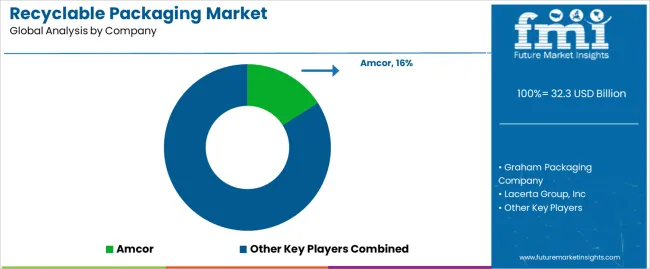
The recyclable packaging market is thriving, with companies focusing on innovation, collaboration, and education to address the potential drawbacks of traditional packaging. They are developing new, improved recyclable materials to address limitations like limited strength or moisture resistance.
Collaboration between material suppliers, manufacturers, and brand owners fosters knowledge-sharing and sustainable packaging solutions. Consumer education is also a key focus, raising awareness about the benefits of recyclable packaging and promoting responsible waste management practices.
Recyclable Packaging Market by Category
By Material:
In terms of material, the market encompasses paper, plastic, glass, tinplate, wood, aluminum, biodegradable plastics, and recycled paper.
By Packaging Type:
Packaging types used in recyclable packaging are categorized into paper and cardboard, bubble wrap, void fill packing, and pouches and envelopes.
By End Use:
The end use of freezer labels spans various sectors, with a primary focus on healthcare. Personal care and food and beverages industries.
By Region:
As per region, the industry is divided into North America, Latin America, Europe, Asia-Pacific, and the Middle East and Africa.
Frequently Asked Questions
How big is the recyclable packaging market in 2025?
The global recyclable packaging market is estimated to be valued at USD 32.3 billion in 2025.
What will be the size of recyclable packaging market in 2035?
The market size for the recyclable packaging market is projected to reach USD 50.7 billion by 2035.
How much will be the recyclable packaging market growth between 2025 and 2035?
The recyclable packaging market is expected to grow at a 4.6% CAGR between 2025 and 2035.
What are the key product types in the recyclable packaging market?
The key product types in recyclable packaging market are paper, glass, plastic, tinplate, wood, aluminum, biodegradable plastics and recycled papers.
Which packaging type segment to contribute significant share in the recyclable packaging market in 2025?
In terms of packaging type, paper & cardboard segment to command 42.8% share in the recyclable packaging market in 2025.
Preview the report firsthand - request a free sample
Get SampleGet the brochure for pricing and purchase details.
Get PDFTable of Content
- Executive Summary
- Global Market Outlook
- Demand-side Trends
- Supply-side Trends
- Technology Roadmap Analysis
- Analysis and Recommendations
- Market Overview
- Market Coverage / Taxonomy
- Market Definition / Scope / Limitations
- Market Background
- Market Dynamics
- Drivers
- Restraints
- Opportunity
- Trends
- Scenario Forecast
- Demand in Optimistic Scenario
- Demand in Likely Scenario
- Demand in Conservative Scenario
- Opportunity Map Analysis
- Product Life Cycle Analysis
- Supply Chain Analysis
- Investment Feasibility Matrix
- Value Chain Analysis
- PESTLE and Porter’s Analysis
- Regulatory Landscape
- Regional Parent Market Outlook
- Production and Consumption Statistics
- Import and Export Statistics
- Market Dynamics
- Global Market Analysis 2020 to 2024 and Forecast, 2025 to 2035
- Historical Market Size Value (USD Billion) Analysis, 2020 to 2024
- Current and Future Market Size Value (USD Billion) Projections, 2025 to 2035
- Y-o-Y Growth Trend Analysis
- Absolute $ Opportunity Analysis
- Global Market Pricing Analysis 2020 to 2024 and Forecast 2025 to 2035
- Global Market Analysis 2020 to 2024 and Forecast 2025 to 2035, By Material Type
- Introduction / Key Findings
- Historical Market Size Value (USD Billion) Analysis By Material Type , 2020 to 2024
- Current and Future Market Size Value (USD Billion) Analysis and Forecast By Material Type , 2025 to 2035
- Paper
- Glass
- Plastic
- Tinplate
- Wood
- Aluminum
- Biodegradable Plastics
- Recycled Papers
- Y-o-Y Growth Trend Analysis By Material Type , 2020 to 2024
- Absolute $ Opportunity Analysis By Material Type , 2025 to 2035
- Global Market Analysis 2020 to 2024 and Forecast 2025 to 2035, By Packaging Type
- Introduction / Key Findings
- Historical Market Size Value (USD Billion) Analysis By Packaging Type, 2020 to 2024
- Current and Future Market Size Value (USD Billion) Analysis and Forecast By Packaging Type, 2025 to 2035
- Paper & Cardboard
- Bubble Wrap
- Void Fill Packing
- Pouches & Envelopes
- Y-o-Y Growth Trend Analysis By Packaging Type, 2020 to 2024
- Absolute $ Opportunity Analysis By Packaging Type, 2025 to 2035
- Global Market Analysis 2020 to 2024 and Forecast 2025 to 2035, By End Use Industry
- Introduction / Key Findings
- Historical Market Size Value (USD Billion) Analysis By End Use Industry, 2020 to 2024
- Current and Future Market Size Value (USD Billion) Analysis and Forecast By End Use Industry, 2025 to 2035
- Food & Beverage Industry
- Healthcare Industry
- Personal Care Industry
- Y-o-Y Growth Trend Analysis By End Use Industry, 2020 to 2024
- Absolute $ Opportunity Analysis By End Use Industry, 2025 to 2035
- Global Market Analysis 2020 to 2024 and Forecast 2025 to 2035, By Region
- Introduction
- Historical Market Size Value (USD Billion) Analysis By Region, 2020 to 2024
- Current Market Size Value (USD Billion) Analysis and Forecast By Region, 2025 to 2035
- North America
- Latin America
- Western Europe
- Eastern Europe
- East Asia
- South Asia and Pacific
- Middle East & Africa
- Market Attractiveness Analysis By Region
- North America Market Analysis 2020 to 2024 and Forecast 2025 to 2035, By Country
- Historical Market Size Value (USD Billion) Trend Analysis By Market Taxonomy, 2020 to 2024
- Market Size Value (USD Billion) Forecast By Market Taxonomy, 2025 to 2035
- By Country
- USA
- Canada
- Mexico
- By Material Type
- By Packaging Type
- By End Use Industry
- By Country
- Market Attractiveness Analysis
- By Country
- By Material Type
- By Packaging Type
- By End Use Industry
- Key Takeaways
- Latin America Market Analysis 2020 to 2024 and Forecast 2025 to 2035, By Country
- Historical Market Size Value (USD Billion) Trend Analysis By Market Taxonomy, 2020 to 2024
- Market Size Value (USD Billion) Forecast By Market Taxonomy, 2025 to 2035
- By Country
- Brazil
- Chile
- Rest of Latin America
- By Material Type
- By Packaging Type
- By End Use Industry
- By Country
- Market Attractiveness Analysis
- By Country
- By Material Type
- By Packaging Type
- By End Use Industry
- Key Takeaways
- Western Europe Market Analysis 2020 to 2024 and Forecast 2025 to 2035, By Country
- Historical Market Size Value (USD Billion) Trend Analysis By Market Taxonomy, 2020 to 2024
- Market Size Value (USD Billion) Forecast By Market Taxonomy, 2025 to 2035
- By Country
- Germany
- UK
- Italy
- Spain
- France
- Nordic
- BENELUX
- Rest of Western Europe
- By Material Type
- By Packaging Type
- By End Use Industry
- By Country
- Market Attractiveness Analysis
- By Country
- By Material Type
- By Packaging Type
- By End Use Industry
- Key Takeaways
- Eastern Europe Market Analysis 2020 to 2024 and Forecast 2025 to 2035, By Country
- Historical Market Size Value (USD Billion) Trend Analysis By Market Taxonomy, 2020 to 2024
- Market Size Value (USD Billion) Forecast By Market Taxonomy, 2025 to 2035
- By Country
- Russia
- Poland
- Hungary
- Balkan & Baltic
- Rest of Eastern Europe
- By Material Type
- By Packaging Type
- By End Use Industry
- By Country
- Market Attractiveness Analysis
- By Country
- By Material Type
- By Packaging Type
- By End Use Industry
- Key Takeaways
- East Asia Market Analysis 2020 to 2024 and Forecast 2025 to 2035, By Country
- Historical Market Size Value (USD Billion) Trend Analysis By Market Taxonomy, 2020 to 2024
- Market Size Value (USD Billion) Forecast By Market Taxonomy, 2025 to 2035
- By Country
- China
- Japan
- South Korea
- By Material Type
- By Packaging Type
- By End Use Industry
- By Country
- Market Attractiveness Analysis
- By Country
- By Material Type
- By Packaging Type
- By End Use Industry
- Key Takeaways
- South Asia and Pacific Market Analysis 2020 to 2024 and Forecast 2025 to 2035, By Country
- Historical Market Size Value (USD Billion) Trend Analysis By Market Taxonomy, 2020 to 2024
- Market Size Value (USD Billion) Forecast By Market Taxonomy, 2025 to 2035
- By Country
- India
- ASEAN
- Australia & New Zealand
- Rest of South Asia and Pacific
- By Material Type
- By Packaging Type
- By End Use Industry
- By Country
- Market Attractiveness Analysis
- By Country
- By Material Type
- By Packaging Type
- By End Use Industry
- Key Takeaways
- Middle East & Africa Market Analysis 2020 to 2024 and Forecast 2025 to 2035, By Country
- Historical Market Size Value (USD Billion) Trend Analysis By Market Taxonomy, 2020 to 2024
- Market Size Value (USD Billion) Forecast By Market Taxonomy, 2025 to 2035
- By Country
- Kingdom of Saudi Arabia
- Other GCC Countries
- Turkiye
- South Africa
- Other African Union
- Rest of Middle East & Africa
- By Material Type
- By Packaging Type
- By End Use Industry
- By Country
- Market Attractiveness Analysis
- By Country
- By Material Type
- By Packaging Type
- By End Use Industry
- Key Takeaways
- Key Countries Market Analysis
- USA
- Pricing Analysis
- Market Share Analysis, 2024
- By Material Type
- By Packaging Type
- By End Use Industry
- Canada
- Pricing Analysis
- Market Share Analysis, 2024
- By Material Type
- By Packaging Type
- By End Use Industry
- Mexico
- Pricing Analysis
- Market Share Analysis, 2024
- By Material Type
- By Packaging Type
- By End Use Industry
- Brazil
- Pricing Analysis
- Market Share Analysis, 2024
- By Material Type
- By Packaging Type
- By End Use Industry
- Chile
- Pricing Analysis
- Market Share Analysis, 2024
- By Material Type
- By Packaging Type
- By End Use Industry
- Germany
- Pricing Analysis
- Market Share Analysis, 2024
- By Material Type
- By Packaging Type
- By End Use Industry
- UK
- Pricing Analysis
- Market Share Analysis, 2024
- By Material Type
- By Packaging Type
- By End Use Industry
- Italy
- Pricing Analysis
- Market Share Analysis, 2024
- By Material Type
- By Packaging Type
- By End Use Industry
- Spain
- Pricing Analysis
- Market Share Analysis, 2024
- By Material Type
- By Packaging Type
- By End Use Industry
- France
- Pricing Analysis
- Market Share Analysis, 2024
- By Material Type
- By Packaging Type
- By End Use Industry
- India
- Pricing Analysis
- Market Share Analysis, 2024
- By Material Type
- By Packaging Type
- By End Use Industry
- ASEAN
- Pricing Analysis
- Market Share Analysis, 2024
- By Material Type
- By Packaging Type
- By End Use Industry
- Australia & New Zealand
- Pricing Analysis
- Market Share Analysis, 2024
- By Material Type
- By Packaging Type
- By End Use Industry
- China
- Pricing Analysis
- Market Share Analysis, 2024
- By Material Type
- By Packaging Type
- By End Use Industry
- Japan
- Pricing Analysis
- Market Share Analysis, 2024
- By Material Type
- By Packaging Type
- By End Use Industry
- South Korea
- Pricing Analysis
- Market Share Analysis, 2024
- By Material Type
- By Packaging Type
- By End Use Industry
- Russia
- Pricing Analysis
- Market Share Analysis, 2024
- By Material Type
- By Packaging Type
- By End Use Industry
- Poland
- Pricing Analysis
- Market Share Analysis, 2024
- By Material Type
- By Packaging Type
- By End Use Industry
- Hungary
- Pricing Analysis
- Market Share Analysis, 2024
- By Material Type
- By Packaging Type
- By End Use Industry
- Kingdom of Saudi Arabia
- Pricing Analysis
- Market Share Analysis, 2024
- By Material Type
- By Packaging Type
- By End Use Industry
- Turkiye
- Pricing Analysis
- Market Share Analysis, 2024
- By Material Type
- By Packaging Type
- By End Use Industry
- South Africa
- Pricing Analysis
- Market Share Analysis, 2024
- By Material Type
- By Packaging Type
- By End Use Industry
- USA
- Market Structure Analysis
- Competition Dashboard
- Competition Benchmarking
- Market Share Analysis of Top Players
- By Regional
- By Material Type
- By Packaging Type
- By End Use Industry
- Competition Analysis
- Competition Deep Dive
- Amcor
- Overview
- Product Portfolio
- Profitability by Market Segments (Product/Age /Sales Channel/Region)
- Sales Footprint
- Strategy Overview
- Marketing Strategy
- Product Strategy
- Channel Strategy
- Graham Packaging Company
- Lacerta Group, Inc
- Ebro Color GmbH
- Salazar Packaging, Inc
- 3M Company
- American Packaging Corporation
- BASF SE
- Avery Dennison Corporation
- Amcor
- Competition Deep Dive
- Assumptions & Acronyms Used
- Research Methodology


