

- Industry Size (2026)
- USD 520 Mn
- Forecast (2036)
- USD 940 Mn
- CAGR (2026 to 2036)
- 6.1%
Shelf-Ready Packaging Solutions for IT Accessories Market Forecast and Outlook 2026 to 2036
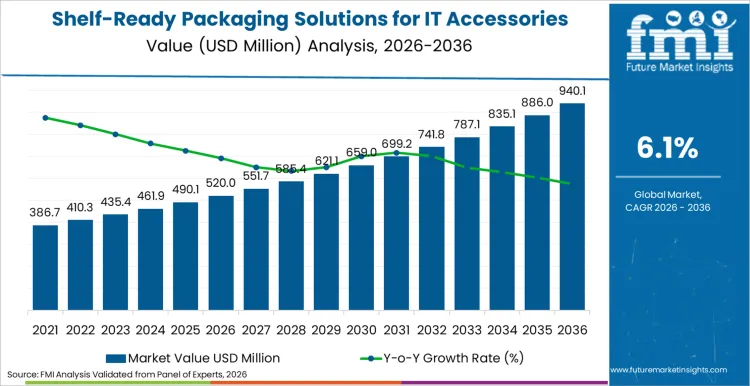
The shelf-ready packaging (SRP) solutions for IT accessories market is set to scale from USD 520 million in 2026 to USD 940 million by 2036 at 6.1% CAGR, with demand shaped by channel economics, compliance friction, and the ability to translate claims into repeat purchase.
As per FMI's projection, high-volume manufacturing hubs in Asia are forcing a redesign of transit packaging to ensure protection during intercontinental shipping while maintaining shelf aesthetics for Western retail. Smurfit Westrock, formed in 2024, now operates 500 converting operations globally, signalling that scale is becoming a prerequisite for servicing major electronics OEMs that require harmonized packaging across multiple continents.
Consolidation among suppliers is reshaping how retailers procure display units, shifting the focus from unit cost to total supply chain efficiency. Tony Smurfit, CEO of Smurfit Westrock, noted in July 2024: "Combining Smurfit Kappa and WestRock creates a world-leading sustainable packaging player, bringing together a tremendous depth of experience and expertise from both companies. We believe that this combination has created the 'go-to' leader and partner of choice in sustainable packaging."
Retailers are responding to this consolidation by demanding "unbox-free" formats that reduce store labor, effectively pushing packaging suppliers to integrate kitting services directly into the manufacturing line. Demand for electronics accessories continues to surge, creating downstream pressure for packaging that can handle high-velocity retail environments.
In 2024, retail sales of communication equipment in China increased 20.9 percent, a volume spike that exposes vulnerabilities in traditional manual shelving workflows. Brands are consequently pivoting toward pre-filled shippers and durable corrugated trays that move directly from the pallet to the shelf.
Summary of Shelf-Ready Packaging (SRP) Solutions for IT Accessories Market
What Is the Growth Outlook for the Shelf-Ready Packaging (SRP) Solutions for IT Accessories Market?
Future Market Insights projects the global shelf-ready packaging (SRP) solutions for IT accessories market to grow from USD 520 million in 2026 to USD 940 million by 2036, representing a 6.1% CAGR over the forecast period.
FMI Research Approach: Based on FMI’s proprietary global modeling framework incorporating major operator capex plans (Smurfit Westrock, DS Smith), retail sales indices for consumer electronics, and regulatory timelines for the EU Packaging and Packaging Waste Regulation (PPWR).
How Do FMI Analysts Perceive the Market to Evolve?
FMI analysts opine that the sector is transitioning away from labor-intensive manual stocking toward automated, "zero-touch" merchandising solutions.
FMI Research Approach: Developed using analysis of patent filings (Smart Packaging Systems), venture capital trends in material science (Papkot, Fedrigoni), and procurement data from major electronics retailers like Best Buy and MediaMarkt.
Which Country Holds the Largest Share in Growth Potential?
India holds a dominant growth potential, supported by a 77-fold increase in mobile phone exports and a domestic electronics production value of ₹9.52 trillion in 2023-24.
FMI Research Approach: Built using country-level export reports (PIB), analysis of manufacturing PLI schemes, and mapping of packaging facility investments by global players like Huhtamaki.
How Large Will the Market Be by 2036 and Which Segment Dominates?
The global market is expected to reach USD 940 million by 2036, with the Corrugated Board segment currently commanding a 58.0% share of material volume.
FMI Research Approach: Long-term forecasts rely on demographic trends (urbanization in APAC), disposable income projections for IT accessories, and the scaling of shelf display trays adoption in organized retail.
What Is the Definition of the Shelf-Ready Packaging (SRP) Solutions for IT Accessories Market?
The market encompasses revenue generated from secondary packaging designed to transition from transit to display without manual repacking, specifically for IT peripherals.
FMI Research Approach: Definition structured using FMI’s segmentation taxonomy covering carton display formats, material types, and end-use retail environments for products like chargers, cases, and cables.
What Are Globally Unique Trends Shaping the Market?
Globally, the sector is shaped by the "Plastic-to-Fiber" pivot in Europe and the "Transit-Robust" requirement in Asia, where packaging must survive long export journeys.
FMI Research Approach: Insights derived from global sustainability reports (DS Smith), startup funding patterns in plastic alternatives (CleanHub), and consumer behavior analysis regarding eco-friendly packaging preferences.
Shelf-Ready Packaging (SRP) Solutions for IT Accessories Market Key Takeaways
| Metric | Details |
|---|---|
| Industry Size (2026) | USD 520 million |
| Industry Value (2036) | USD 940 million |
| CAGR (2026 to 2036) | 6.1% |
Source: Future Market Insights (FMI) analysis, based on proprietary forecasting model and primary research.
How Retail Automation Forces Design Shifts?
Retailers are increasingly mandating display packaging formats that minimize labor costs, effectively transferring the burden of shelf management from store staff to the packaging supplier. According to FMI's estimates, store operations account for a significant portion of retail margin erosion, prompting chains to delist products that require time-consuming manual unpacking or hanging. Labor shortages in Western markets amplify this pressure, making "one-touch" merchandising a non-negotiable requirement for IT accessory brands seeking placement in high-traffic zones. Suppliers who fail to optimize for shelf velocity risk losing contract tiers with major mass merchandisers.
Sustainability mandates create a simultaneous pressure to eliminate waste, forcing a convergence between labor efficiency and material reduction. Nearly 1,200,000 tons of label release liners are dumped into landfills in North America each year, a statistic that underscores the massive waste footprint of traditional packaging components. Innovations in display pallets and tear-away corrugated hoods allow retailers to recycle the entire transport unit immediately after stocking. This shift compels manufacturers to engineer structural integrity using fiber alone, removing plastic shrink wraps that previously provided stability but complicated the disposal workflow for store personnel.
Which Segments Drive Value Concentration?
The segmentation landscape spans SRP types, material compositions, and retail channels, revealing a decided shift toward formats that combine structural rigidity with high-fidelity branding. The mix currently favors corrugated board and display trays, but 2036 will see strong gains for hybrid materials that offer plastic-like barrier properties without the regulatory penalty. The molded fiber market is expected to grow from USD 13.3 billion in 2023 to nearly USD 18 billion by 2028, signaling a broader industry move toward smooth-finish fiber solutions that premium IT brands now demand for their accessory lines.
Why Do Display Trays Control the Volume?
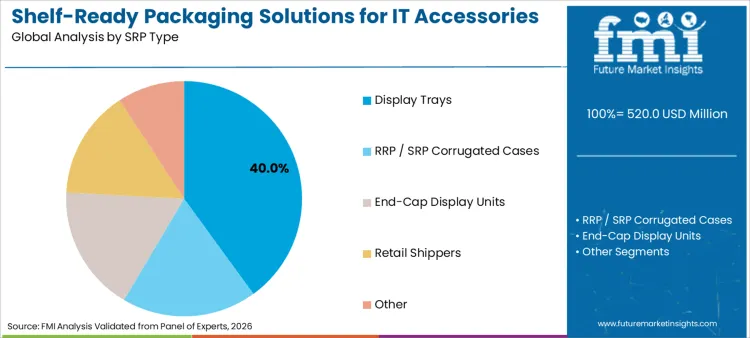
Display trays command a 40.0% share of the market, serving as the default format for high-turnover items like cables, chargers, and screen protectors in organized retail. Retailers favor this shelf adaptive geometry packs format because it maximizes product density per linear foot while maintaining organized presentation. Huhtamaki reported net sales of EUR 4.1 billion in 2024, a performance partly driven by the high volume of fiber-based trays supplying global retail chains. This dominance drives standardization, as tray dimensions are increasingly dictated by retailer planograms rather than brand preference.
How Does Corrugated Board Maintain Material Dominance?
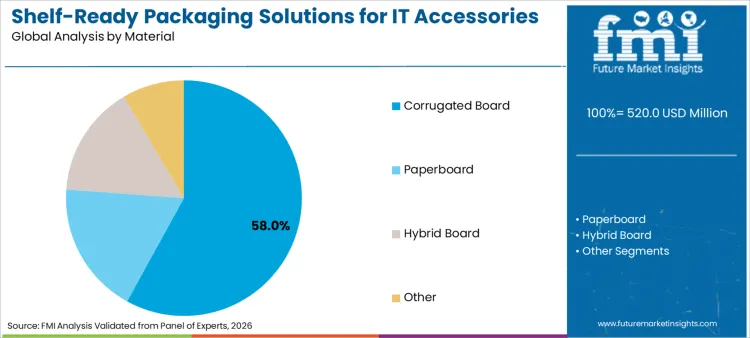
Corrugated board accounts for 58.0% of material usage, benefiting from its unmatched strength-to-weight ratio and full recyclability in existing municipal streams. As per FMI's estimates, the integration of consumer electronics packaging with transit-robust corrugated outers allows brands to ship directly from Asian factories to Western shelves without damage. DS Smith reported revenue of £6,051 million for FY 2025, validating the massive scale of fiber-based logistics networks. The material's dominance is further reinforced by new printing technologies that allow high-resolution graphics directly on the flute, eliminating the need for separate litho-laminated top sheets.
Why Is Electronics Specialty Retail the Primary Channel?
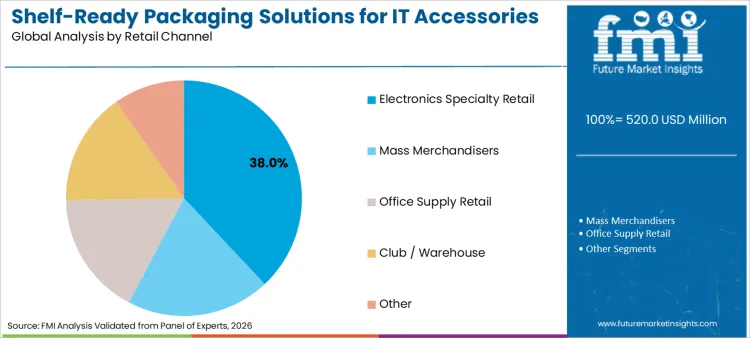
Electronics specialty retail holds a 38.0% market share, acting as the critical testing ground for premium, experience-led packaging formats. These environments require mobile phone accessories packaging that enhances the shopper journey, often utilizing specialized end-caps to disrupt traffic flow. China’s retail sales of communication equipment rose 20.9% in 2024, highlighting the sheer volume of accessories moving through specialized electronic outlets. Consequently, packaging in this channel must double as a silent salesperson, providing technical specifications and compatibility data clearly on the front face to aid consumer decision-making without staff intervention.
Why Plastic Replacement Redefines Material Sourcing?
The "Plastic-to-Fiber" transition is rapidly altering procurement strategies, as regulatory bodies in Europe and North America tighten restrictions on single-use plastics in retail environments. Brands are aggressively seeking industrial electronics packaging alternatives that offer the transparency and protection of plastic blisters but are derived from renewable sources. DS Smith has replaced over 1 billion units of plastic since May 2020, proving that fiber-based engineering can replicate the functional performance of polymers at scale. This shift forces upstream material suppliers to innovate in coatings and molded pulp technologies to prevent moisture ingress and abrasion during transit.
Innovative coating technologies are emerging as the key enabler for this transition, allowing fiber to perform in humid or demanding supply chains. Marco Nespolo, CEO of Fedrigoni Group, stated in February 2025: "This deal has enormous potential for Fedrigoni. We will have the opportunity to acquire disruptive technology in Plastic-to-Fiber, allowing us to increasingly support our customers in their efforts to develop mono-material and fully recyclable packaging. Fedrigoni will play a key role in accelerating the industrialization phase, which is essential for the scalability of the Papkot business model."
This capability allows for the creation of packaging inserts that are fully recyclable yet resistant to oil and water, removing the final technical barrier for brands hesitating to switch from plastic trays.
What is the Regional Outlook for Shelf-Ready Packaging (SRP) Solutions for IT Accessories Market?
Asia Pacific serves as the global production engine for IT accessories, driving a unique demand for SRP solutions that are robust enough for export yet refined enough for retail display. The region's growth is supported by massive infrastructure investments in India and Vietnam, which are converting local packaging industries into export-grade ecosystems. As corrugated boxes travel longer distances, the "transit-robust" quality becomes a primary differentiator for manufacturers. According to FMI's estimates, the ability to produce high-strength, lightweight SRP in close proximity to electronics assembly lines is shifting value pools toward integrated Asian suppliers who can offer vendor-managed inventory services.
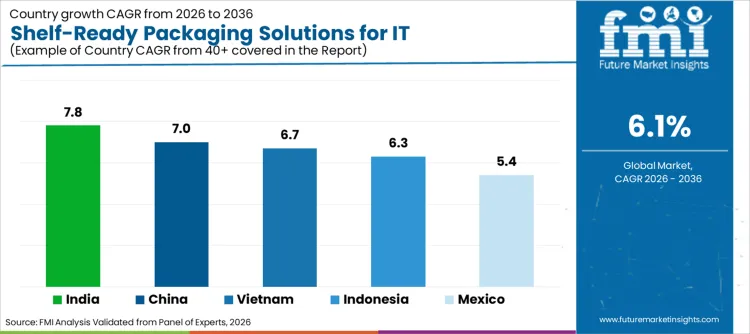
| Country | CAGR (2026 to 2036) |
|---|---|
| India | 7.8% |
| China | 7.0% |
| Vietnam | 6.7% |
| Indonesia | 6.3% |
| Mexico | 5.4% |
Source: FMI’s proprietary forecasting model and primary research.
Why Is India the Fastest Growing Market?
Shelf-ready packaging (SRP) solutions for IT accessories in India are set to rise at 7.8% CAGR, fueled by the government's aggressive push to localize electronics manufacturing and export capacity. Surge in production volume necessitates a parallel expansion in industrial high impact corrugated boxes capacity to support both domestic consumption and international shipments. The Ministry of Electronics & IT (MeitY) noted in March 2025:
"India has made rapid strides in electronics and semiconductor manufacturing, acknowledged the Ministry of Electronics and Information Technology (MeitY) recently. With a compound annual growth rate (CAGR) of 19.78%, the value of the country’s domestic electronics production touched ₹9.52 trillion in 2023-24, up from ₹5.54 trillion in 2020-21.” Local packaging players are upgrading machinery to meet global SRP standards, transforming India into a key hub for fiber-based retail packaging.
How Is China Balancing E-Commerce and Retail Demand?
Demand for shelf-ready packaging (SRP) solutions for IT accessories in China is anticipated to grow at 7.0% CAGR, driven by a dual-engine economy where online fulfillment competes with physical retail modernization. In 2024, online retail sales nationwide reached 15,522.5 billion yuan, creating immense demand for e-commerce packaging that is sturdy enough for courier networks. Simultaneously, premium offline retailers are demanding higher aesthetic standards for display units to differentiate from online commoditization. This divergence forces packaging converters to maintain flexible production lines capable of switching between rough-service shipping packs and high-gloss retail trays.
Why Is Vietnam Becoming the Export Packaging Hub?
Shelf-ready packaging (SRP) solutions for IT accessories in Vietnam are poised to register a 6.7% CAGR, mirroring the country's ascent as a primary alternative to China-based manufacturing. Cấn Văn Lực, an economic expert, emphasized in January 2025: “Vietnamese electronics enterprises should align with global trade and investment trends, leveraging key partnerships and support policies, such as tax incentives and interest rate reductions, to advance digital transformation and circular business models.”
With electronics exports reaching USD 126.5 billion in 2024, Vietnam is attracting significant foreign direct investment in packaging infrastructure. Manufacturers are increasingly co-locating SRP production facilities next to major electronics assembly parks to enable Just-in-Time delivery, reducing inventory costs for global brands.
What Role Does Indonesia Play in the Southeast Asian Market?
The shelf-ready packaging (SRP) solutions for IT accessories industry in Indonesia is projected to expand at 6.3% CAGR, supported by a growing domestic consumer class and expanding digital infrastructure. The USA International Trade Administration reports Indonesia's digital economy is projected to exceed USD 130 billion by 2025, driven by e-commerce growth that demands efficient SRP logistics. Regional trade flows indicate Indonesia is becoming a key node in the corrugated box market for Southeast Asia. The rapid urbanization of Java requires efficient retail logistics, pushing local modern trade outlets to adopt SRP formats that maximize shelf utilization in space-constrained stores. This modernization drives a shift from loose product stocking to disciplined, tray-based merchandising in Jakarta's malls and electronics centers.
How Is Mexico Integrating with North American Supply Chains?
Sales of shelf-ready packaging (SRP) solutions for IT accessories in Mexico are expected to grow at 5.4% CAGR, driven by nearshoring trends that are integrating Mexican production deeper into US retail supply chains. Smurfit Westrock’s rebranding of Victory Packaging in 2024 to harmonize operations across Mexico and the US highlights the cross-border nature of this demand. Packaging produced in Mexico must now meet the exact shelf display trays specifications of US big-box retailers like Walmart and Best Buy. This integration forces Mexican suppliers to adopt advanced structural design capabilities, ensuring that packs assembled in Tijuana arrive in perfect condition on shelves in Chicago.
How Consolidation Reshapes Supplier Profit Pools?
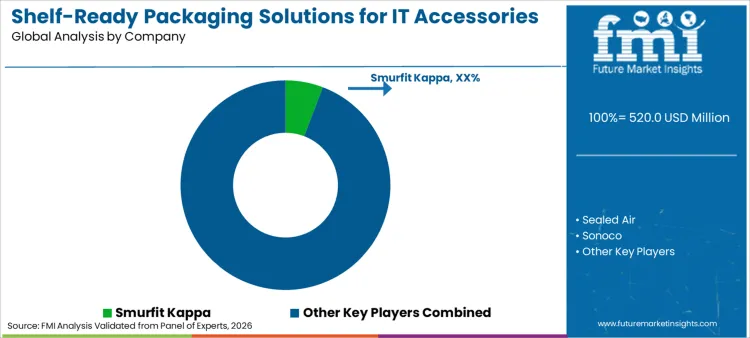
Competitive outlook in shelf-ready packaging (SRP) solutions for IT accessories now depends less on brand breadth and more on who controls the constraint that gates scale, whether evidence, compliance, channel access, or capacity. As per FMI's estimates, the merger of Smurfit Kappa and WestRock creates a dominant entity capable of dictating terms on sustainability and standardization across global markets. This consolidation bifurcates the landscape: massive integrated players capture the high-volume stationery kit and set packaging contracts for global OEMs, while agile specialists focus on material innovation and niche coating technologies. Profit pools are consequently migrating toward players who can offer a "one-stop-shop" for both transit and display packaging, squeezing out mid-sized converters who lack the geographic footprint to serve multi-national clients.
Strategy in the sector is set by a simple asymmetry: some players own distribution leverage, while others win through differentiated proof, capacity, or specialized workflows. DS Smith’s acquisition of Stora Enso De Hoop B.V. in late 2024 for £10 million exemplifies the race to secure raw material and energy assets to insulate operations from volatility. Meanwhile, innovators like Papkot are leveraging partnerships with giants like Fedrigoni to scale disruptive barrier technologies that challenge the traditional supremacy of plastic laminates. This dynamic forces incumbents to constantly acquire or partner with startups to access new sustainable materials, ensuring they remain relevant as regulations like the EU PPWR come into full force.
Recent Developments:
- In February 2025, Fedrigoni Group acquired a minority stake in Papkot to accelerate the industrialization of ceramic-based paper coatings for plastic-free packaging.
- In January 2025, Smurfit Westrock Packaging Solutions completed the rebranding of Victory Packaging, integrating US and Mexico operations for seamless kitting services.
- In November 2024, Huhtamaki opened a new smooth molded fiber production line in Northern Ireland, expanding capacity for premium sustainable packaging in Europe.
Key Players in Shelf-Ready Packaging (SRP) Solutions for IT Accessories Market
- Smurfit Westrock
- DS Smith
- Huhtamaki
- International Paper
- Sonoco Products Company
- Sealed Air Corporation
- Georgia-Pacific
- Mondi Group
- Menasha Packaging Company, LLC
- Pratt Industries, Inc.
- Graphic Packaging International
- Stora Enso
Market Definition
The Shelf-Ready Packaging (SRP) Solutions for IT Accessories market encompasses revenue generated from the sales of secondary packaging specifically engineered to transport products from manufacturer to retailer and display them on the shelf without manual repacking. This definition includes corrugated display trays, retail-ready cases, and end-cap units that serve a dual purpose of transit protection and in-store merchandising. The scope explicitly covers packaging for information technology peripherals such as mobile phone cases, chargers, cables, screen protectors, and wearable device accessories.
The market includes revenue from all material types used in the construction of these units, including corrugated board, paperboard, molded fiber, and hybrid substrates. It captures sales across all major retail channels, including electronics specialty stores, mass merchandisers, club warehouses, and office supply retailers. Services related to structural design, kitting, and co-packing are included when bundled with the physical packaging supply contract.
Excluded from this market definition are primary packaging units (the immediate box containing the product) unless they are integrated into a single-layer transit-display hybrid. General industrial transport packaging that is not intended for retail display, such as master shipping cartons that are discarded in the backroom, is also excluded. Furthermore, packaging for large electronic hardware like laptops, monitors, or desktop computers is outside the scope, as these categories typically do not utilize shelf-ready trays in the same manner as smaller accessories.
Report Scope
| Items | Values |
|---|---|
| Quantitative Units (2026) | USD 520 million |
| Product Type | Display Trays, RRP / SRP Corrugated Cases, End-Cap Display Units, Retail Shippers |
| Application or Procedure type | IT Accessories (Cables, Chargers, Cases, Wearables), Peripherals |
| End user | Electronics Specialty Retail, Mass Merchandisers, Office Supply Retail, Club / Warehouse |
| Regions covered | North America, Latin America, Europe, East Asia, South Asia & Pacific, Middle East & Africa |
| Countries covered | USA, India, China, Vietnam, Indonesia, Mexico, UK, Germany, France |
| Key companies profiled | Smurfit Westrock, DS Smith, Huhtamaki, International Paper |
| Additional attributes | Revenue analysis by segments, adoption trends across settings, regulatory and compliance landscape (as relevant), pricing and reimbursement considerations (when relevant), channel mix economics, supply chain exposure, and competitive positioning analysis |
Source: Future Market Insights’ proprietary forecasting model and primary research.
Shelf-Ready Packaging (SRP) Solutions for IT Accessories Market by Segments
By SRP Type:
- Display Trays
- RRP / SRP Corrugated Cases
- End-Cap Display Units
- Retail Shippers
By Material:
- Corrugated Board
- Paperboard
- Hybrid Board
- Other
By Retail Channel:
- Electronics Specialty Retail
- Mass Merchandisers
- Office Supply Retail
- Club / Warehouse
By Region:
- North America
- Latin America
- Europe
- East Asia
- South Asia & Pacific
- Middle East & Africa
Bibliography
- International Labour Organization (ILO). (2024). Sectoral brief: Electronics manufacturing, employment intensity, and global supply chains. ILO.
- World Customs Organization (WCO). (2024). Harmonized System data trends for electrical machinery and components. WCO.
- ASEAN Secretariat. (2024). ASEAN Statistical Yearbook: Electrical and electronics trade flows and regional integration. ASEAN.
- Japan Ministry of Economy, Trade and Industry (METI). (2025). White Paper on International Economy and Trade: Electronics supply chains and reshoring trends. Government of Japan.
- Australian Bureau of Statistics (ABS). (2024). Manufacturing industry statistics: Electronic equipment and components. Government of Australia.
- United Nations Environment Programme (UNEP). (2024). Circularity in electronics and packaging materials: Waste reduction pathways. UNEP.
- Basel Convention Secretariat. (2023). Technical guidelines on transboundary movement of e-waste and related materials. UNEP / Basel Convention.
Frequently Asked Questions
What is the current value of the Shelf-Ready Packaging (SRP) Solutions for IT Accessories Market?
The global market is valued at USD 520 million in 2026, driven by the increasing need for labor-saving packaging formats in organized retail sectors.
What is the projected CAGR for the market through 2036?
The market is projected to grow at a 6.1% CAGR from 2026 to 2036, supported by the expansion of electronics manufacturing in regions like India and Vietnam.
Which material segment currently dominates the market?
Corrugated Board accounts for the largest share at 58.0%, favored for its recyclability and structural strength suitable for both transit and display.
Which country is expected to experience the fastest growth?
India is growing at the fastest rate of 7.8%, fueled by the government's PLI schemes and a booming domestic electronics production ecosystem.
Who are the leading players in the Shelf-Ready Packaging (SRP) market?
Key players include Smurfit Westrock, DS Smith, Huhtamaki, and International Paper, who are consolidating the market through mergers and strategic acquisitions.
Preview the report firsthand - request a free sample
Get SampleGet the brochure for pricing and purchase details.
Get PDFTable of Content
- Executive Summary
- Global Market Outlook
- Demand-side Trends
- Supply-side Trends
- Technology Roadmap Analysis
- Analysis and Recommendations
- Market Overview
- Market Coverage / Taxonomy
- Market Definition / Scope / Limitations
- Market Background
- Market Dynamics
- Drivers
- Restraints
- Opportunity
- Trends
- Scenario Forecast
- Demand in Optimistic Scenario
- Demand in Likely Scenario
- Demand in Conservative Scenario
- Opportunity Map Analysis
- Product Life Cycle Analysis
- Supply Chain Analysis
- Investment Feasibility Matrix
- Value Chain Analysis
- PESTLE and Porter’s Analysis
- Regulatory Landscape
- Regional Parent Market Outlook
- Production and Consumption Statistics
- Import and Export Statistics
- Market Dynamics
- Global Market Analysis 2021 to 2025 and Forecast, 2026 to 2036
- Historical Market Size Value (USD Million) Analysis, 2021 to 2025
- Current and Future Market Size Value (USD Million) Projections, 2026 to 2036
- Y-o-Y Growth Trend Analysis
- Absolute $ Opportunity Analysis
- Global Market Pricing Analysis 2021 to 2025 and Forecast 2026 to 2036
- Global Market Analysis 2021 to 2025 and Forecast 2026 to 2036, By SRP Type
- Introduction / Key Findings
- Historical Market Size Value (USD Million) Analysis By SRP Type , 2021 to 2025
- Current and Future Market Size Value (USD Million) Analysis and Forecast By SRP Type , 2026 to 2036
- Display Trays
- RRP / SRP Corrugated Cases
- End-Cap Display Value (USD Million)s
- Retail Shippers
- Other
- Display Trays
- Y-o-Y Growth Trend Analysis By SRP Type , 2021 to 2025
- Absolute $ Opportunity Analysis By SRP Type , 2026 to 2036
- Global Market Analysis 2021 to 2025 and Forecast 2026 to 2036, By Material
- Introduction / Key Findings
- Historical Market Size Value (USD Million) Analysis By Material, 2021 to 2025
- Current and Future Market Size Value (USD Million) Analysis and Forecast By Material, 2026 to 2036
- Corrugated Board
- Paperboard
- Hybrid Board
- Other
- Corrugated Board
- Y-o-Y Growth Trend Analysis By Material, 2021 to 2025
- Absolute $ Opportunity Analysis By Material, 2026 to 2036
- Global Market Analysis 2021 to 2025 and Forecast 2026 to 2036, By Retail Channel
- Introduction / Key Findings
- Historical Market Size Value (USD Million) Analysis By Retail Channel, 2021 to 2025
- Current and Future Market Size Value (USD Million) Analysis and Forecast By Retail Channel, 2026 to 2036
- Electronics Specialty Retail
- Mass Merchandisers
- Office Supply Retail
- Club / Warehouse
- Other
- Electronics Specialty Retail
- Y-o-Y Growth Trend Analysis By Retail Channel, 2021 to 2025
- Absolute $ Opportunity Analysis By Retail Channel, 2026 to 2036
- Global Market Analysis 2021 to 2025 and Forecast 2026 to 2036, By Region
- Introduction
- Historical Market Size Value (USD Million) Analysis By Region, 2021 to 2025
- Current Market Size Value (USD Million) Analysis and Forecast By Region, 2026 to 2036
- North America
- Latin America
- Western Europe
- Eastern Europe
- East Asia
- South Asia and Pacific
- Middle East & Africa
- Market Attractiveness Analysis By Region
- North America Market Analysis 2021 to 2025 and Forecast 2026 to 2036, By Country
- Historical Market Size Value (USD Million) Trend Analysis By Market Taxonomy, 2021 to 2025
- Market Size Value (USD Million) Forecast By Market Taxonomy, 2026 to 2036
- By Country
- USA
- Canada
- Mexico
- By SRP Type
- By Material
- By Retail Channel
- By Country
- Market Attractiveness Analysis
- By Country
- By SRP Type
- By Material
- By Retail Channel
- Key Takeaways
- Latin America Market Analysis 2021 to 2025 and Forecast 2026 to 2036, By Country
- Historical Market Size Value (USD Million) Trend Analysis By Market Taxonomy, 2021 to 2025
- Market Size Value (USD Million) Forecast By Market Taxonomy, 2026 to 2036
- By Country
- Brazil
- Chile
- Rest of Latin America
- By SRP Type
- By Material
- By Retail Channel
- By Country
- Market Attractiveness Analysis
- By Country
- By SRP Type
- By Material
- By Retail Channel
- Key Takeaways
- Western Europe Market Analysis 2021 to 2025 and Forecast 2026 to 2036, By Country
- Historical Market Size Value (USD Million) Trend Analysis By Market Taxonomy, 2021 to 2025
- Market Size Value (USD Million) Forecast By Market Taxonomy, 2026 to 2036
- By Country
- Germany
- UK
- Italy
- Spain
- France
- Nordic
- BENELUX
- Rest of Western Europe
- By SRP Type
- By Material
- By Retail Channel
- By Country
- Market Attractiveness Analysis
- By Country
- By SRP Type
- By Material
- By Retail Channel
- Key Takeaways
- Eastern Europe Market Analysis 2021 to 2025 and Forecast 2026 to 2036, By Country
- Historical Market Size Value (USD Million) Trend Analysis By Market Taxonomy, 2021 to 2025
- Market Size Value (USD Million) Forecast By Market Taxonomy, 2026 to 2036
- By Country
- Russia
- Poland
- Hungary
- Balkan & Baltic
- Rest of Eastern Europe
- By SRP Type
- By Material
- By Retail Channel
- By Country
- Market Attractiveness Analysis
- By Country
- By SRP Type
- By Material
- By Retail Channel
- Key Takeaways
- East Asia Market Analysis 2021 to 2025 and Forecast 2026 to 2036, By Country
- Historical Market Size Value (USD Million) Trend Analysis By Market Taxonomy, 2021 to 2025
- Market Size Value (USD Million) Forecast By Market Taxonomy, 2026 to 2036
- By Country
- China
- Japan
- South Korea
- By SRP Type
- By Material
- By Retail Channel
- By Country
- Market Attractiveness Analysis
- By Country
- By SRP Type
- By Material
- By Retail Channel
- Key Takeaways
- South Asia and Pacific Market Analysis 2021 to 2025 and Forecast 2026 to 2036, By Country
- Historical Market Size Value (USD Million) Trend Analysis By Market Taxonomy, 2021 to 2025
- Market Size Value (USD Million) Forecast By Market Taxonomy, 2026 to 2036
- By Country
- India
- ASEAN
- Australia & New Zealand
- Rest of South Asia and Pacific
- By SRP Type
- By Material
- By Retail Channel
- By Country
- Market Attractiveness Analysis
- By Country
- By SRP Type
- By Material
- By Retail Channel
- Key Takeaways
- Middle East & Africa Market Analysis 2021 to 2025 and Forecast 2026 to 2036, By Country
- Historical Market Size Value (USD Million) Trend Analysis By Market Taxonomy, 2021 to 2025
- Market Size Value (USD Million) Forecast By Market Taxonomy, 2026 to 2036
- By Country
- Kingdom of Saudi Arabia
- Other GCC Countries
- Turkiye
- South Africa
- Other African Union
- Rest of Middle East & Africa
- By SRP Type
- By Material
- By Retail Channel
- By Country
- Market Attractiveness Analysis
- By Country
- By SRP Type
- By Material
- By Retail Channel
- Key Takeaways
- Key Countries Market Analysis
- USA
- Pricing Analysis
- Market Share Analysis, 2025
- By SRP Type
- By Material
- By Retail Channel
- Canada
- Pricing Analysis
- Market Share Analysis, 2025
- By SRP Type
- By Material
- By Retail Channel
- Mexico
- Pricing Analysis
- Market Share Analysis, 2025
- By SRP Type
- By Material
- By Retail Channel
- Brazil
- Pricing Analysis
- Market Share Analysis, 2025
- By SRP Type
- By Material
- By Retail Channel
- Chile
- Pricing Analysis
- Market Share Analysis, 2025
- By SRP Type
- By Material
- By Retail Channel
- Germany
- Pricing Analysis
- Market Share Analysis, 2025
- By SRP Type
- By Material
- By Retail Channel
- UK
- Pricing Analysis
- Market Share Analysis, 2025
- By SRP Type
- By Material
- By Retail Channel
- Italy
- Pricing Analysis
- Market Share Analysis, 2025
- By SRP Type
- By Material
- By Retail Channel
- Spain
- Pricing Analysis
- Market Share Analysis, 2025
- By SRP Type
- By Material
- By Retail Channel
- France
- Pricing Analysis
- Market Share Analysis, 2025
- By SRP Type
- By Material
- By Retail Channel
- India
- Pricing Analysis
- Market Share Analysis, 2025
- By SRP Type
- By Material
- By Retail Channel
- ASEAN
- Pricing Analysis
- Market Share Analysis, 2025
- By SRP Type
- By Material
- By Retail Channel
- Australia & New Zealand
- Pricing Analysis
- Market Share Analysis, 2025
- By SRP Type
- By Material
- By Retail Channel
- China
- Pricing Analysis
- Market Share Analysis, 2025
- By SRP Type
- By Material
- By Retail Channel
- Japan
- Pricing Analysis
- Market Share Analysis, 2025
- By SRP Type
- By Material
- By Retail Channel
- South Korea
- Pricing Analysis
- Market Share Analysis, 2025
- By SRP Type
- By Material
- By Retail Channel
- Russia
- Pricing Analysis
- Market Share Analysis, 2025
- By SRP Type
- By Material
- By Retail Channel
- Poland
- Pricing Analysis
- Market Share Analysis, 2025
- By SRP Type
- By Material
- By Retail Channel
- Hungary
- Pricing Analysis
- Market Share Analysis, 2025
- By SRP Type
- By Material
- By Retail Channel
- Kingdom of Saudi Arabia
- Pricing Analysis
- Market Share Analysis, 2025
- By SRP Type
- By Material
- By Retail Channel
- Turkiye
- Pricing Analysis
- Market Share Analysis, 2025
- By SRP Type
- By Material
- By Retail Channel
- South Africa
- Pricing Analysis
- Market Share Analysis, 2025
- By SRP Type
- By Material
- By Retail Channel
- USA
- Market Structure Analysis
- Competition Dashboard
- Competition Benchmarking
- Market Share Analysis of Top Players
- By Regional
- By SRP Type
- By Material
- By Retail Channel
- Competition Analysis
- Competition Deep Dive
- Smurfit Kappa
- Overview
- Product Portfolio
- Profitability by Market Segments (Product/Age /Sales Channel/Region)
- Sales Footprint
- Strategy Overview
- Marketing Strategy
- Product Strategy
- Channel Strategy
- Sealed Air
- Sonoco
- Huhtamaki
- DS Smith / Pregis
- Smurfit Kappa
- Competition Deep Dive
- Assumptions & Acronyms Used
- Research Methodology


