

- Industry Size (2026)
- USD 1.2 Bn
- Forecast (2036)
- USD 3.9 Bn
- CAGR (2026 to 2036)
- 12.40%
Stationery Kit and Set Packaging Market Forecast and Outlook 2026 to 2036
The global stationery kit and set packaging market reached USD 1.2 billion in 2026 and is forecast to reach USD 3.9 billion by 2036, expanding at 12.4% CAGR. As per Future Market Insights, surge in demand is primarily fueled by the dual rise of mass‑market school supply consumption in emerging economies and the premiumization of corporate gifting worldwide. As buyers increasingly expect eco‑friendly, aesthetically refined packaging, producers are compelled to modernize operations and differentiate through material innovation.
Growth trajectory is underpinned by industry-wide consolidation to achieve scale; as Tony Smurfit, CEO of the newly formed market leader, stated in July 2024: "We've got an immense, exciting future. Smurfit Westrock is going to conquer the world of sustainable, paper-based packaging." Broader economic indicators support this optimism, with the USA Census Bureau reporting a 3.6% year-over-year increase in retail sales in late 2025, signaling resilient consumer demand for discretionary goods. This economic resilience is compelling manufacturers to innovate rapidly, ensuring that packaging solutions meet both the volume requirements of the educational sector and the aesthetic demands of the corporate gifting sector.
Landscape offers substantial profit potential, fostering a dynamic flow of innovative presentation styles. The Bureau of Labor Statistics reported 8.1 million total job openings in November 2024, indicating sustained demand for professional onboarding kits. Manufacturers are responding to this requirement through strategic divestitures and acquisitions, exemplified by Sonoco divesting its plastics division in December 2024 to focus purely on fiber and metal solutions. This strategic pivot signals a decisive implication: companies that successfully leverage scale to provide plastic-free, highly printable stationery product solutions will dominate market share through 2036.
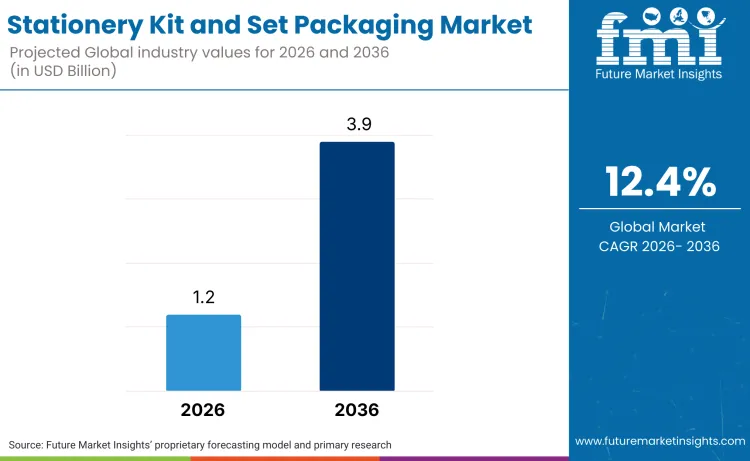
Summary of Stationery Kit and Set Packaging Market
Meta Title - Meta Description - keywords:What Is the Growth Outlook for the Stationery Kit and Set Packaging Market as per Future Market Insights Projection?
Future Market Insights projects the global Stationery Kit and Set Packaging Market to grow from USD 1.2 billion in 2026 to USD 3.9 billion by 2036, representing a strong 12.40% CAGR over the forecast period.
FMI Research Approach: Based on FMI’s proprietary global modeling framework incorporating enrollment‑linked demand trends, USA retail activity indicators validating consumption resilience, and corporate demand assessments informed by labor market data.
How Do FMI Analysts Perceive the Stationery Kit and Set Packaging Market to Evolve?
FMI analysts perceive the market transitioning away from commodity‑grade plastic packaging toward fiber‑based, premium, highly printable formats.
FMI Research Approach: Developed using analysis of EU PPWR regulatory requirements, examination of material innovation pipelines such as Mondi’s FunctionalBarrier Paper, and facility expansion disclosures from integrated paper and fiber manufacturers.
Which Country Holds the Largest Share in the Global Stationery Kit and Set Packaging Market?
The United States holds one of the highest value shares globally, supported by a strong corporate sector that drives continuous demand for professional onboarding kits and high‑value stationery sets.
FMI Research Approach: Built using country‑level corporate activity indicators from USA labor market data, analysis of packaging material shifts driven by sustainability mandates, and mapping of supplier concentration among North America’s integrated packaging manufacturers. Inputs also include evaluation of corporate gifting penetration and office‑supply purchasing behavior within Fortune‑grade enterprises.
How Large Will the Stationery Kit and Set Packaging Market Be by 2036?
The global stationery kit and set packaging market is expected to reach USD 3.9 billion by 2036, supported by sustained demand from school supply retail, which currently commands a 44% share.
FMI Research Approach: Long‑term forecasts rely on demographic and educational enrollment trends in India and China, industrial capacity expansion data supporting global paperboard availability, and channel‑specific scaling assumptions for premium packaging value.
What Is the Definition of the Stationery Kit and Set Packaging Market?
The stationery kit and set packaging Market encompasses all revenue generated from purpose‑designed primary and secondary packaging solutions used for bundling writing instruments, art supplies, office tools, and premium stationery items into organized retail or corporate kits. It includes folding cartons, rigid drawer boxes, metal tins, molded fiber trays, and specialty paper‑based formats marketed explicitly for stationery applications, while excluding generic transport boxes and unbundled stationery items sold individually.
FMI Research Approach: Definition structured using FMI’s segmentation taxonomy covering product types, end‑use channels, and material compositions. The classification draws from operational inclusion criteria for school supply kits, corporate onboarding kits, premium gift sets, and art & craft bundles, alongside explicit exclusions for non‑retail‑specific packaging categories.
What Are Globally Unique Trends Shaping the Stationery Kit and Set Packaging Market?
Globally, the sector is shaped by an ongoing shift away from plastics toward recyclable paperboard and molded fiber solutions, driven by tightening environmental regulations and rising consumer expectations for sustainable packaging.
FMI Research Approach: Insights derived from global regulatory tracking, sustainability performance disclosures from major manufacturers, portfolio‑level innovations in functional barrier papers and molded fiber technologies, and assessment of competitive reinvestment patterns across Europe, Asia, and North America.
Stationery Kit and Set Packaging Market Key Takeaways
| Metric | Details |
|---|---|
| Industry Size (2026) | USD 1.2 billion |
| Industry Value (2036) | USD 3.9 billion |
| CAGR (2026-2036) | 12.40% |
Source: Future Market Insights (FMI) analysis, based on proprietary forecasting model and primary research.
How Privatization of Education Fuels Volume Growth?
The rapid privatization of education in emerging economies is the primary engine for volume expansion, effectively creating a recurring demand for standardized student kits. The Ministry of Education in India confirmed this structural shift, reporting that private school enrolment rose to 9.59 crore in the 2024-25 academic year. This massive student base necessitates cost-effective, pre-packed stationery sets that simplify purchasing for parents. The USA Census Bureau reported that nonstore retailer sales (e-commerce) increased 7.2% in late 2025, validating the shift toward online bundle purchases. Consequently, brands are prioritizing converted paper products solutions that are durable enough for shipping yet sustainable enough to meet global standards.
How is the Stationery Kit and Set Packaging Market Segmented?
The stationery kit and set packaging market is segmented by end-use channel, material type, and packaging format. It is segmented by end‑use into school supply retail, corporate and office supply channels, and the art & craft sector, each requiring distinct levels of durability and presentation. The material landscape spans paperboard, rigid plastic, metal, and molded fiber, illustrating the industry’s balance between cost‑efficient mass‑market utility and the growing preference for premium, sustainable substrates. These segmentation layers define how manufacturers design, position, and supply packaging solutions tailored to both high‑volume student kits and increasingly refined corporate and creative‑segment stationery sets.
Why does School Supply Retail hold a dominant share?
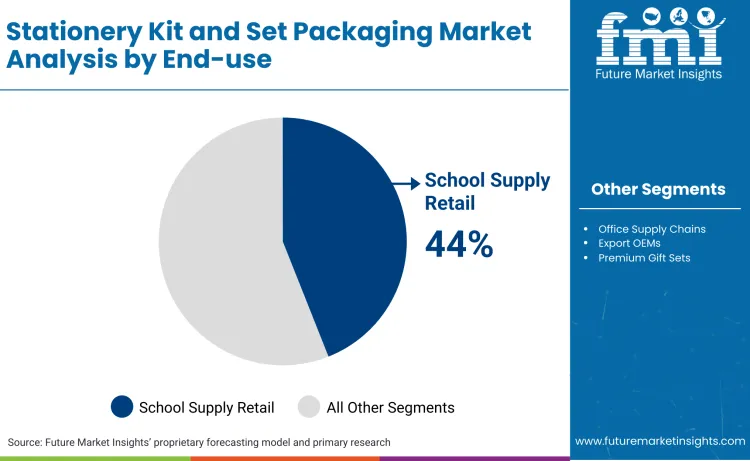
School supply retail commands the dominant share at 44%, fueled primarily by the extensive privatization of education in emerging markets. Brands utilize high-volume folding cartons to meet this demand, ensuring affordability for price-sensitive parents without compromising on shelf appeal. This trend is forcing packaging manufacturers to optimize their production lines for speed and scalability, as millions of units are required annually to meet the recurring academic cycle demand in high-growth regions like South Asia.
Why does Paperboard lead the material segment?
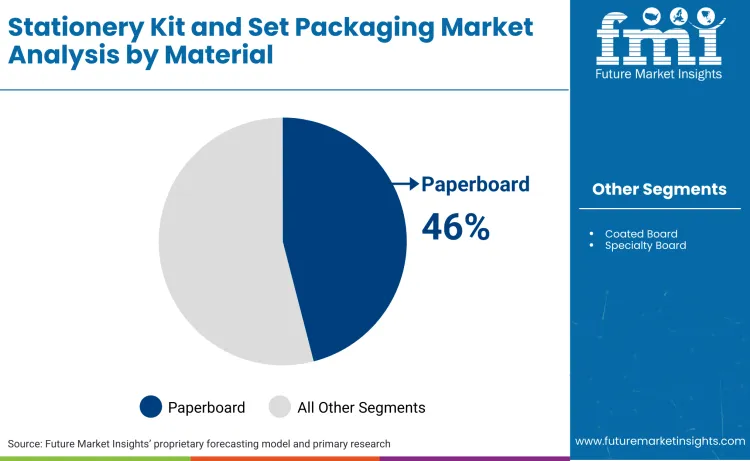
Paperboard leads the material segment with 46% share, a direct response to tightening environmental regulations that are effectively banning non-recyclable alternatives. With the European Council reporting a paper recycling rate of 75.1% in 2024, brands are aggressively phasing out plastics to align with circular economy goals. Mondi's 2024 launch of "FunctionalBarrier Paper" exemplifies this shift, enabling fiber-based packaging to replace plastic even for shelf-life sensitive items like glues and specialty inks. This transition is critical for complying with the EU's PPWR while satisfying consumer demand for recyclable paper goods. Due to this, converters are investing heavily in barrier coating technologies that allow paperboard to perform with the durability of plastic while remaining fully repulpable.
Why is the Packaging Format evolving toward Premium Boxes?
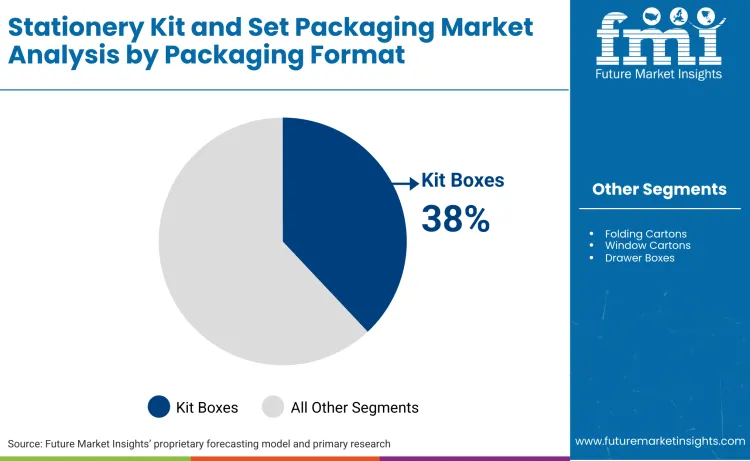
While kit boxes hold 38% share for mass-market school supplies, the drawer box and window carton formats are rapidly gaining traction in the Premium Gift Sets segment. This format diversification is driven by the ‘unboxing experience’ required for higher price-point items, where the packaging itself becomes part of the product's value proposition. Stora Enso's inauguration of a new consumer board line in Oulu (August 2025) specifically targets this high-end segment, producing lighter, stronger boards ideal for intricate litho laminated packaging and premium gift presentations. Brands are increasingly using these rigid formats to justify premium pricing for limited-edition artist collections and corporate gifts, effectively moving stationery packaging from a disposable wrapper to a keepsake storage solution.
Why Is the ‘Circular Pooling’ Model Gaining Traction?
Supply chain sustainability is moving beyond simple material choices to operational models, forcing companies to rethink how they manage secondary packaging logistics. Faber Group reported avoiding 40,000 tons of CO2 in 2024 through circular pooling initiatives, demonstrating the tangible environmental benefits of reusable pallet and box systems. This operational shift forces stationery brands to adopt reusable or circular secondary packaging systems for bulk retail delivery, reducing the carbon footprint associated with logistics.
Manufacturers are increasingly integrating these circular models to meet scope 3 emission targets while maintaining robust distribution networks for retail paper bags and transport packaging. This trend indicates a future where the ownership of packaging assets shifts from a single-use purchase model to a service-based rental model, significantly reducing waste across the supply chain.
How Are Financial Performance and Sustainability Linked?
Profitability in the paper sector is increasingly tied to sustainable product lines, as evidenced by the widening margin gap between commodity and specialty producers. Sappi Limited reported a Q3 2024 EBITDA of USD 151 million, a 40% year-over-year increase, driven by strong pricing power in specialty papers rather than standard graphic grades. This financial success validates the strategy of pivoting production toward high-margin, eco-friendly specialty paper grades, encouraging further investment in sustainable capacity. Companies leveraging this link are outperforming competitors who remain reliant on commodity grades, proving that sustainability is no longer a cost center but a primary driver of operational profitability and shareholder value in the modern packaging economy.
Why Is Metal Making a Comeback in Premium Kits?
While paper dominates mass markets, metal is reclaiming the ultra-premium segment as brands seek durability and distinctiveness on the shelf. Sonoco's acquisition of Eviosys created a USD 25 billion addressable market, positioning metal tins as a durable, high-value alternative for artistic and luxury stationery sets. This trend impacts the hinged lid tins sector, providing brands with a reusable packaging option that enhances the perceived value of the product inside. This resurgence allows premium brands to offer lasting value that justifies higher price points for limited edition sets, as consumers view the tin itself as a durable asset for long-term storage of art supplies or personal items, effectively extending the brand interaction lifecycle.
What is the Regional Outlook for Stationery Kit and Set Packaging Market?
The global Stationery Kit and Set Packaging Market exhibits a clear regional divide, with emerging markets expanding primarily on the strength of demographic scale, while developed markets grow through sustainability‑driven premiumization. In Asia, India and China serve as the primary growth engines, propelled by rapid educational sector expansion and large‑scale industrial capacity additions that enable high‑volume, cost‑efficient production, reflected in their robust CAGRs of 15.4% and 13.8%, respectively. These markets benefit from soaring school enrollments and expanding paperboard manufacturing ecosystems, creating sustained demand for standardized, affordable student stationery kits.
Western regions such as the USA and Germany, growing at 11.2% and 10.6%, are undergoing a structural pivot toward sustainable substrates, driven by corporate procurement standards and stringent packaging regulations that increasingly favor fiber‑based and premium formats. Markets like Brazil (11.2%) and Japan (9.2%) reflect more specialized dynamics, Brazil leveraging retail-driven premiumization trends and Japan focusing on sustainable luxury packaging aligned with cultural gifting expectations. Such regional patterns highlight a maturing global market where volume growth remains concentrated in Asia, while value growth is increasingly shaped by regulatory clarity, sustainability commitments, and rising demand for high-end packaging experiences across developed economies.
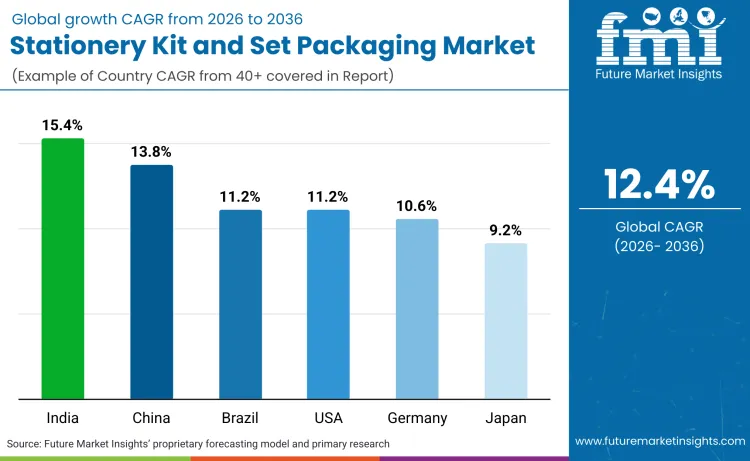
| Country | CAGR (2026 to 2036) |
|---|---|
| India | 15.4% |
| China | 13.8% |
| USA | 11.2% |
| Brazil | 11.2% |
| Germany | 10.6% |
| Japan | 9.2% |
Source: FMI historical analysis and forecast data.
Why is the USA Pivoting to Sustainable Substrates for Corporate value?
Expansion in the United States is forecast at a steady 11.2% CAGR through 2036, primarily anchored by the strategic pivot of major players toward fiber and metal solutions. Sonoco signaled a definitive shift in this market structure by divesting its plastics division in December 2024 to focus purely on sustainable substrates. This move aligns with a robust corporate sector, validated by Bureau of Labor Statistics data showing 8.1 million job openings in late 2024, which sustains demand for professional office supply kits. FMI analysis suggests that the corporate gifting channel will become the primary engine for value creation in the region, as businesses increasingly use high-quality, sustainable stationery sets as a tool for employee engagement and brand storytelling in a competitive labor market.
How is Regulatory Clarity Driving Innovation in Germany?
Demand for stationery kit and set packaging in Germany is projected at 10.6% CAGR, driven largely by strict adherence to new EU-wide packaging mandates that force rapid material substitution. The Council of the EU's formal adoption of the Packaging and Packaging Waste Regulation (PPWR) in December 2024 has effectively mandated a redesign of stationery packaging across the country. Manufacturers face rising compliance costs, Europe noted an 18% jump in secondary paper material prices in 2024, yet this regulatory clarity is driving innovation in folding cartons. German manufacturers are consequently positioned to lead the continent in integrating advanced paper recycling technologies into consumer goods, transforming compliance burdens into a competitive advantage by developing proprietary, high-efficiency recycling streams that smaller competitors cannot easily replicate.
Why is Japan Focusing on Sustainable Luxury Over Volume?
Development in Japan is estimated to register a 9.2% CAGR, reflecting a mature market that is aggressively pivoting toward sustainable luxury to maintain value despite demographic headwinds.
"Consumer packaging made from wood fibers has great potential to replace plastic packaging and our materials are designed for existing recycling streams," stated Hans Sohlström, CEO of Stora Enso, in August 2025. Such philosophy resonates deeply in Japan, where the "Premium Gift Sets" segment relies on high-quality drawer boxes and specialty boards. Industry here is increasingly defined by its focus on high-value gift boxes rather than volume, as cultural gifting norms drive demand for intricate, tactile packaging experiences that convey respect and prestige, allowing brands to command significant margins on lower unit volumes.
How is Industrial Capacity Securing China's Global Dominance?
The market in China is anticipated to surge at a 13.8% CAGR, sustained by the country's unparalleled industrial capacity and raw material availability which insulates it from global supply shocks. Data from the National Bureau of Statistics confirms this dominance, with paperboard production hitting a record 158.47 million tons in 2024.
Local giant Nine Dragons Paper is aggressively expanding, adding 2.0 million tonnes of capacity in 2025 to feed the "Window Cartons" segment. This massive scale ensures China will remain the global hub for export-oriented stationery packaging, as domestic manufacturers leverage this abundant supply to offer competitive pricing on complex packaging formats that Western producers struggle to match at scale.
What Role Does Education Play in India's Market Expansion?
Sales in India are expected to expand at a stellar 15.4% CAGR, making it the fastest-growing region globally due to fundamental demographic shifts in the academic sector. As literacy rates climb, the demand for standardized, affordable paperboard stationery sets is decoupling from broader economic trends. This demographic boom is creating a unique ecosystem for mass-market art and craft material packaging, where millions of new students entering the formal education system annually guarantee a baseline of recurring volume growth that no other global market can replicate.
How is Brazil Leveraging Retail Networks for Premiumization?
The industry in Brazil is projected to grow at an 11.2% CAGR, leveraging local retail networks to drive premiumization in the South American context. With the broader Brazilian packaging sector expanding at over 6% annually, stationery brands are pushing premium kits through established channels. BIC Group reinforced this direction in March 2025, with CEO Gonzalve Bich noting: "For us, sustainability is more than a commitment, it is a core responsibility that guides every aspect of our operations." This alignment suggests Brazil will be a key battleground for sustainable brand loyalty in the region, as middle-class consumers increasingly prefer brands that combine European-style sustainability commitments with local retail accessibility.
How Is Competition Evolving in the Stationery Kit and Set Packaging Market?
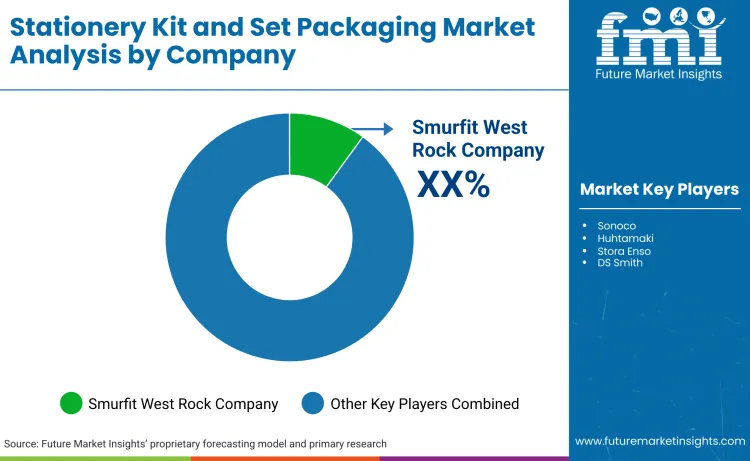
The competitive outlook is shifted to "Mega-Integrators" which focuses on absorbing capacity that also dictate pricing. Smurfit Westrock re-wrote the rulebook in July 2024, merging to create a trans-Atlantic giant capable of servicing global retail chains with unified sustainability metrics. This consolidation forces smaller players to specialize or exit. Sonoco responded by abandoning the mixed-material middle ground, divesting its plastics unit in December 2024 and acquiring Eviosys for USD 3.9 billion to seize the high ground in metal solutions.
Companies are fighting back through technical supremacy to eliminate plastic. Stora Enso deployed a €1 billion capital injection into its Oulu facility in August 2025, creating a defensive moat based on proprietary, high-yield consumer board. Huhtamaki opened a new front in Northern Ireland in November 2024, utilizing smooth molded fiber technology to directly target the last stronghold of plastic: the vacuum-formed insert tray.
Asian dominance continues to shape global capacity. Nine Dragons Paper is executing a sheer volume strategy, bringing 2.0 million tonnes of fresh board capacity online in 2025. This move effectively caps global paperboard prices, forcing Western competitors to compete on sustainability claims rather than cost. The European response has been defensive; DS Smith is fortifying its Eastern flank, investing €75 million across Poland and Portugal in late 2025 to create a regional buffer against Asian imports, impacting the availability of bookends packaging.
Recent Developments:
- In August 2025, Stora Enso inaugurated its new consumer board production line in Oulu, Finland, following a EUR 1 billion investment. This facility focuses on high-quality folding boxboard, enhancing the company's ability to serve premium stationery and gift packaging segments.
- In November 2024, Huhtamaki opened a new production line for smooth molded fiber lids in Northern Ireland. While initially targeting food service, this technology is being adapted for premium stationery inserts, offering a plastic-free alternative for digital pen packaging.
Key Players in Stationery Kit and Set Packaging Market
- Smurfit Westrock
- Sonoco Products Company
- Stora Enso
- Mondi Group
- Huhtamaki
- DS Smith
- Nine Dragons Paper
- BIC Group
- International Paper
- Sappi Limited
- Faber Group
- Graphic Packaging International
Market Definition
The stationery kit and set packaging market represents revenue generated from the sale of primary and secondary packaging materials designed specifically for bundling writing instruments, art supplies, and office tools into cohesive retail units. As operationally defined in the article, the market measures the commercial value of folding cartons, rigid boxes, molded fiber trays, and metal tins used for both mass-market school kits and premium corporate gift sets. Market sizing reflects the value of packaging sold to stationery brands and retailers, expressed in USD billion.
The market explicitly includes packaging solutions for school supply bundles, corporate onboarding kits, premium art sets, and gift-oriented stationery collections. Packaging materials must be specifically marketed and sold for stationery applications. Revenue from sustainability certifications and "circular pooling" logistics services is included where bundled with packaging sales. The market excludes revenues from general-purpose shipping boxes not designed for retail display. Loose writing instruments sold without kit packaging are excluded.
Scope of Report
| Items | Values |
|---|---|
| Quantitative Units (2026) | USD 1.2 billion |
| Product Type | Folding Cartons, Rigid Boxes (Drawer/Lid), Metal Tins, Molded Fiber Trays, Functional Barrier Papers |
| End-Use Channel | School Supply Retail (44%), Corporate/Office Supplies, Art & Craft, Gift & Premium Sets |
| Material Type | Paperboard (46%), Rigid Plastic, Metal, Molded Fiber |
| Regions Covered | North America, Europe, Asia Pacific, Latin America, Middle East & Africa |
| Countries Covered | United States, Germany, China, Japan, India, Brazil, and 35+ countries |
| Key Companies Profiled | Smurfit Westrock, Sonoco, Stora Enso, Mondi, Huhtamaki, DS Smith, Nine Dragons Paper |
| Additional Attributes | Revenue analysis by channel and material, regulatory impact assessment (EU PPWR), sustainable material penetration, circular pooling adoption trends, competitive consolidation analysis |
Source: FMI historical analysis and forecast data.
Stationery Kit and Set Packaging Market by Segments
By End-Use Channel:
- School Supply Retail
- Corporate/Office Supplies
- Art & Craft
- Gift & Premium Sets
By Material Composition:
- Paperboard and Cardboard
- Rigid Plastic
- Metal
- Molded Fiber
By Product Format:
- Folding Cartons
- Rigid Boxes (Drawer/Lid)
- Blister Packs & Clamshells
- Metal Tins
- Pouches & Bags
By Region:
- North America
- Europe
- Asia Pacific
- Latin America
- Middle East & Africa
Bibliography
- European Paper Recycling Council. (2024). Monitoring report 2024: Paper recycling rates in Europe. EPRC/CITPA.
- USA Census Bureau. (2025). Advance monthly retail trade report: November 2025. USA Department of Commerce.
- National Bureau of Statistics of China. (2024). Industrial production statistics: Paper and paperboard manufacturing output. NBS China Statistical Database.
- Ministry of Education, Government of India. (2025). UDISE+ report 2024-25: School enrolment statistics. UDISE+ Portal.
- Council of the European Union. (2024, December). Adoption of Regulation (EU) 2024/2829 on packaging and packaging waste. EUR-Lex.
- Bureau of Labor Statistics. (2024, November). Job Openings and Labor Turnover Survey (JOLTS). USA Department of Labor.
- Sonoco Products Company. (2024, June). Sonoco to acquire Eviosys. Sonoco Investor Relations.
Frequently Asked Questions
What is the current global market size for Stationery Kit and Set Packaging?
The global market is valued at USD 1.2 billion in 2026, driven by the privatization of education in emerging markets and corporate demand for premium onboarding kits.
What is the projected CAGR for the Stationery Kit and Set Packaging market?
Market revenues are projected to grow at a robust 12.4% CAGR from 2026 to 2036, significantly outpacing broader packaging indices due to the shift toward high-value formats.
Which material currently dominates the industry?
Paperboard holds the dominant 46% market share, supported by sustainability regulations like the EU's PPWR that discourage plastic usage and drive adoption of alternatives.
What are the primary drivers for adoption in emerging markets?
The privatization of education in markets like India and China is the primary volume driver, creating massive demand for standardized, cost-effective school supply kits.
Who are the leading players in the Stationery Kit and Set Packaging market?
Smurfit Westrock, Sonoco, and Stora Enso lead the sector, leveraging massive industrial scale and vertical integration to control costs.
Preview the report firsthand - request a free sample
Get SampleGet the brochure for pricing and purchase details.
Get PDFTable of Content
- Executive Summary
- Global Market Outlook
- Demand Side Trends
- Supply Side Trends
- Technology Roadmap Analysis
- Analysis and Recommendations
- Market Overview
- Market Coverage / Taxonomy
- Market Definition / Scope / Limitations
- Research Methodology
- Chapter Orientation
- Analytical Lens and Working Hypotheses
- Market Structure, Signals, and Trend Drivers
- Benchmarking and Cross-market Comparability
- Market Sizing, Forecasting, and Opportunity Mapping
- Research Design and Evidence Framework
- Desk Research Programme (Secondary Evidence)
- Company Annual and Sustainability Reports
- Peer-reviewed Journals and Academic Literature
- Corporate Websites, Product Literature, and Technical Notes
- Earnings Decks and Investor Briefings
- Statutory Filings and Regulatory Disclosures
- Technical White Papers and Standards Notes
- Trade Journals, Industry Magazines, and Analyst Briefs
- Conference Proceedings, Webinars, and Seminar Materials
- Government Statistics Portals and Public Data Releases
- Press Releases and Reputable Media Coverage
- Specialist Newsletters and Curated Briefings
- Sector Databases and Reference Repositories
- FMI Internal Knowledge Base and Historical Datasets
- Subscription Datasets and Paid Sources
- Social Channels, Communities, and Digital Listening Inputs
- Additional Desk Sources
- Expert Input and Fieldwork (Primary Evidence)
- Primary Modes
- Qualitative Interviews and Expert Elicitation
- Quantitative Surveys and Structured Data Capture
- Blended Approach
- Why Primary Evidence is Used
- Field Techniques
- Interviews
- Surveys
- Focus Groups
- Observational and In-context Research
- Social and Community Interactions
- Stakeholder Universe Engaged
- C-suite Leaders
- Board Members
- Presidents and Vice Presidents
- R&D and Innovation Heads
- Technical Specialists
- Domain Subject-matter Experts
- Scientists
- Retailers and Procurement Managers
- Governance, Ethics, and Data Stewardship
- Research Ethics
- Data Integrity and Handling
- Primary Modes
- Tooling, Models, and Reference Databases
- Desk Research Programme (Secondary Evidence)
- Data Engineering and Model Build
- Data Acquisition and Ingestion
- Cleaning, Normalisation, and Verification
- Synthesis, Triangulation, and Analysis
- Quality Assurance and Audit Trail
- Market Background
- Market Dynamics
- Drivers
- Restraints
- Opportunity
- Trends
- Scenario Forecast
- Demand in Optimistic Scenario
- Demand in Likely Scenario
- Demand in Conservative Scenario
- Opportunity Map Analysis
- Product Life Cycle Analysis
- Supply Chain Analysis
- Investment Feasibility Matrix
- Value Chain Analysis
- PESTLE and Porter's Analysis
- Regulatory Landscape
- Regional Parent Market Outlook
- Production and Consumption Statistics
- Import and Export Statistics
- Market Dynamics
- Global Market Analysis 2021 to 2025 and Forecast, 2026 to 2036
- Historical Market Size Value (USD Billion) Analysis, 2021 to 2025
- Current and Future Market Size Value (USD Billion) Projections, 2026 to 2036
- Y-o-Y Growth Trend Analysis
- Absolute $ Opportunity Analysis
- Global Market Pricing Analysis 2021 to 2025 and Forecast 2026 to 2036
- Y-o-Y Growth Trend Analysis 2021 to 2025
- Absolute $ Opportunity Analysis 2026 to 2036
- Global Market Analysis 2021 to 2025 and Forecast 2026 to 2036, By End-Use Channel
- Introduction / Key Findings
- Historical Market Size Value (USD Billion) Analysis By End-Use Channel, 2021 to 2025
- Current and Future Market Size Value (USD Billion) Analysis and Forecast By End-Use Channel, 2026 to 2036
- School Supply Retail
- Corporate/Office Supplies
- Art & Craft
- Gift & Premium Sets
- Y-o-Y Growth Trend Analysis By End-Use Channel, 2021 to 2025
- Absolute $ Opportunity Analysis By End-Use Channel, 2026 to 2036
- Global Market Analysis 2021 to 2025 and Forecast 2026 to 2036, By Material Composition
- Introduction / Key Findings
- Historical Market Size Value (USD Billion) Analysis By Material Composition, 2021 to 2025
- Current and Future Market Size Value (USD Billion) Analysis and Forecast By Material Composition, 2026 to 2036
- Paperboard and Cardboard
- Rigid Plastic
- Metal
- Molded Fiber
- Y-o-Y Growth Trend Analysis By Material Composition, 2021 to 2025
- Absolute $ Opportunity Analysis By Material Composition, 2026 to 2036
- Global Market Analysis 2021 to 2025 and Forecast 2026 to 2036, By Product Format
- Introduction / Key Findings
- Historical Market Size Value (USD Billion) Analysis By Product Format, 2021 to 2025
- Current and Future Market Size Value (USD Billion) Analysis and Forecast By Product Format, 2026 to 2036
- Folding Cartons
- Rigid Boxes (Drawer/Lid)
- Blister Packs & Clamshells
- Metal Tins
- Pouches & Bags
- Y-o-Y Growth Trend Analysis By Product Format, 2021 to 2025
- Absolute $ Opportunity Analysis By Product Format, 2026 to 2036
- Global Market Analysis 2021 to 2025 and Forecast 2026 to 2036, By Region
- Introduction
- Historical Market Size Value (USD Billion) Analysis By Region, 2021 to 2025
- Current Market Size Value (USD Billion) Analysis and Forecast By Region, 2026 to 2036
- North America
- Latin America
- Europe
- Asia Pacific
- Middle East & Africa
- Market Attractiveness Analysis By Region
- North America Market Analysis 2021 to 2025 and Forecast 2026 to 2036, By Country
- Historical Market Size Value (USD Billion) Trend Analysis By Market Taxonomy, 2021 to 2025
- Market Size Value (USD Billion) Forecast By Market Taxonomy, 2026 to 2036
- By Country
- USA
- Canada
- Mexico
- By End-Use Channel
- By Material Composition
- By Product Format
- By Country
- Market Attractiveness Analysis
- By Country
- By End-Use Channel
- By Material Composition
- By Product Format
- Key Takeaways
- Latin America Market Analysis 2021 to 2025 and Forecast 2026 to 2036, By Country
- Historical Market Size Value (USD Billion) Trend Analysis By Market Taxonomy, 2021 to 2025
- Market Size Value (USD Billion) Forecast By Market Taxonomy, 2026 to 2036
- By Country
- Brazil
- Chile
- Rest of Latin America
- By End-Use Channel
- By Material Composition
- By Product Format
- By Country
- Market Attractiveness Analysis
- By Country
- By End-Use Channel
- By Material Composition
- By Product Format
- Key Takeaways
- Europe Market Analysis 2021 to 2025 and Forecast 2026 to 2036, By Country
- Historical Market Size Value (USD Billion) Trend Analysis By Market Taxonomy, 2021 to 2025
- Market Size Value (USD Billion) Forecast By Market Taxonomy, 2026 to 2036
- By Country
- Germany
- UK
- Italy
- Spain
- France
- Rest of Europe
- By End-Use Channel
- By Material Composition
- By Product Format
- By Country
- Market Attractiveness Analysis
- By Country
- By End-Use Channel
- By Material Composition
- By Product Format
- Key Takeaways
- Asia Pacific Market Analysis 2021 to 2025 and Forecast 2026 to 2036, By Country
- Historical Market Size Value (USD Billion) Trend Analysis By Market Taxonomy, 2021 to 2025
- Market Size Value (USD Billion) Forecast By Market Taxonomy, 2026 to 2036
- By Country
- China
- Japan
- India
- South Korea
- Australia & New Zealand
- ASEAN
- Rest of Asia Pacific
- By End-Use Channel
- By Material Composition
- By Product Format
- By Country
- Market Attractiveness Analysis
- By Country
- By End-Use Channel
- By Material Composition
- By Product Format
- Key Takeaways
- Middle East & Africa Market Analysis 2021 to 2025 and Forecast 2026 to 2036, By Country
- Historical Market Size Value (USD Billion) Trend Analysis By Market Taxonomy, 2021 to 2025
- Market Size Value (USD Billion) Forecast By Market Taxonomy, 2026 to 2036
- By Country
- GCC Countries
- South Africa
- Turkiye
- Rest of Middle East & Africa
- By End-Use Channel
- By Material Composition
- By Product Format
- By Country
- Market Attractiveness Analysis
- By Country
- By End-Use Channel
- By Material Composition
- By Product Format
- Key Takeaways
- Key Countries Market Analysis
- USA
- Pricing Analysis
- Market Share Analysis, 2026
- By End-Use Channel
- By Material Composition
- By Product Format
- Germany
- Pricing Analysis
- Market Share Analysis, 2026
- By End-Use Channel
- By Material Composition
- By Product Format
- China
- Pricing Analysis
- Market Share Analysis, 2026
- By End-Use Channel
- By Material Composition
- By Product Format
- India
- Pricing Analysis
- Market Share Analysis, 2026
- By End-Use Channel
- By Material Composition
- By Product Format
- Japan
- Pricing Analysis
- Market Share Analysis, 2026
- By End-Use Channel
- By Material Composition
- By Product Format
- Brazil
- Pricing Analysis
- Market Share Analysis, 2026
- By End-Use Channel
- By Material Composition
- By Product Format
- USA
- Market Structure Analysis
- Competition Dashboard
- Competition Benchmarking
- Market Share Analysis of Top Players
- By Regional
- By End-Use Channel
- By Material Composition
- By Product Format
- Competition Analysis
- Competition Deep Dive
- Smurfit Westrock
- Sonoco Products Company
- Stora Enso
- Mondi Group
- Huhtamaki
- DS Smith
- Nine Dragons Paper
- BIC Group
- International Paper
- Sappi Limited
- Faber Group
- Graphic Packaging International
- Competition Deep Dive
- Assumptions & Acronyms Used


