

- Industry Size (2026)
- USD 980 Mn
- Forecast (2036)
- USD 3420 Mn
- CAGR (2026 to 2036)
- 13.3%
Variant-ID Packaging for Mixed SKU Kits Market Forecast and Outlook By FMI
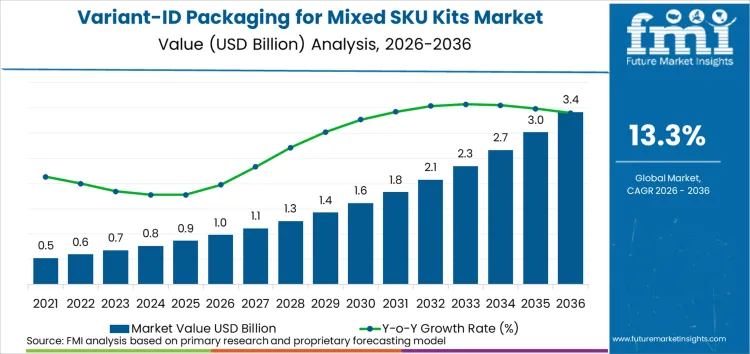
The global variant-ID packaging for mixed SKU kits market is forecast to reach a valuation of USD 980 million in 2026 and is projected to expand to USD 3,420 million by 2036, registering a 13.3% CAGR. This growth reflects a structural reclassification of variant-ID packaging from a discretionary error-reduction enhancement into mandatory compliance infrastructure across e-commerce fulfillment, regulated manufacturing, and omnichannel retail distribution networks.
The market’s inflection point is closely tied to marketplace and regulatory mandates that directly condition market access on unit-level identification capability. Amazon’s March 2026 Fulfilled by Amazon (FBA) policy eliminating commingled inventory and transferring full FNSKU labeling responsibility to third-party sellers represents a watershed moment. Sellers previously dependent on Amazon’s in-house labeling services must now internalize variant identification, verification, and compliance at unit level. Non-compliance results in shipment rejection and potential selling privilege suspension, effectively transforming variant-ID packaging into a prerequisite for participation in the world’s largest e-commerce marketplace.
Beyond Amazon-specific dynamics, the market is expanding under the weight of regulatory digital traceability frameworks. The EU Packaging and Packaging Waste Regulation (PPWR), becoming legally binding in August 2026, enforces minimal void space and digital information requirements for multi-component shipments.
Summary of Variant-ID Packaging for Mixed SKU Kits Market
- The variant-ID packaging for mixed SKU kits market comprises packaging-integrated identification systems engineered to enable unit-level traceability, automated verification, and error-proof fulfillment of kits containing two or more distinct stock-keeping units.
- Within FMI’s defined taxonomy, the market focuses exclusively on packaging-level identification technologies applied to mixed-SKU kits across electronics manufacturing, industrial spare parts distribution, promotional and seasonal kitting, pharmaceutical and medical device supply chains, and omnichannel retail fulfillment.
- FMI projects the market to grow at a 13.3% CAGR from 2026 to 2036, expanding from USD 980 million in 2026 to USD 3,420 million by 2036. Growth is structurally underpinned by three converging forces: marketplace compliance mandates that make unit-level identification a condition of sale; regulatory serialization and digital traceability requirements that institutionalize identifier usage across regulated industries; and the proliferation of automated fulfillment and packaging systems that depend on machine-readable identifiers for speed, accuracy, and labor reduction.
- Competition and value creation in the market are increasingly defined by system integration capability rather than label cost. As variant-ID packaging becomes a platform for automated verification, counterfeit prevention, and regulatory reporting, suppliers with multi-technology portfolios and integration expertise are capturing disproportionate value.
- China has emerged as the fastest-growing country market due to state-backed Smart Logistics initiatives and domestic equipment manufacturing strength, while North America remains the largest regional market, anchored by Amazon FBA enforcement and the professionalization of the third-party seller ecosystem.
These obligations cannot be satisfied through generic carton markings or post-hoc labeling; they require packaging-integrated identifiers that communicate kit composition, dimensional data, and recyclability information to automated packaging and sorting systems. Similar regulatory pressures are evident in India’s Plastic Waste Management Rules amendments and pharmaceutical serialization regimes in North America and Europe, each reinforcing the necessity of packaging-level identifiers rather than product-only labeling.
Technology evolution further amplifies demand. High-speed variable-data printing, vision-based verification and warehouse automation platforms increasingly operate as interdependent systems, with variant-ID packaging serving as the physical-digital interface between inventory data and physical fulfillment. Industry disclosures from Sino-Pack 2026 and corporate implementations by Japanese and Chinese packaging manufacturers demonstrate that SKU-specific coding at industrial speeds-exceeding 200 meters per minute while maintaining barcode quality thresholds-is now commercially viable. This capability allows variant-ID systems to scale alongside peak-season promotional kitting, electronics assembly, and medical kit distribution without sacrificing accuracy or throughput.
Variant-ID Packaging for Mixed SKU Kits Market Key Takeaways
| Metric | Value |
|---|---|
| Market Size (2026E) | USD 980 million |
| Market Size (2036F) | USD 3,420 million |
| CAGR (2026-2036) | 13.3% |
Source: Future Market Insights (FMI), based on proprietary forecasting and primary research
Why is the Variant-ID Packaging for Mixed SKU Kits Market Growing?
Growth in the variant-ID packaging for mixed SKU kits market is driven by the institutionalization of unit-level verification across fulfillment, manufacturing, and regulated supply chains. As mixed-SKU kits become more common-particularly in electronics accessories, industrial spare parts, medical kits, and promotional bundles-the operational and reputational cost of mis-shipments has escalated. Variant-ID packaging directly addresses this risk by enabling automated verification of kit completeness and correctness before shipment, reducing returns, regulatory penalties, and brand damage.
The single most powerful accelerator is Amazon’s March 2026 FBA mandate eliminating commingled inventory and transferring complete FNSKU labeling responsibility to third-party sellers. This policy shift compels approximately 2.1 million active sellers to deploy vision-integrated pack stations capable of automated label application and verification. Sellers lacking Brand Registry status-estimated at 1.4 million accounts-must now apply and verify identifiers on every unit regardless of existing manufacturer barcodes, fundamentally reshaping fulfillment economics and driving immediate demand for variant-ID substrates, printers, and verification systems.
Regulatory frameworks reinforce the same trajectory. India’s 2025-2026 Plastic Waste Management Rules amendments mandate machine-readable QR codes on all kit components, establishing digital twin requirements linking physical packaging to centralized traceability databases. The EU PPWR introduces digital information obligations and fit-to-size mandates that rely on accurate, machine-readable kit identification.
How is the Variant-ID Packaging for Mixed SKU Kits Market Segmented?
The variant-ID packaging for mixed SKU kits market is segmented by kit type, identification technology, and packaging substrate, reflecting the fact that variant complexity, verification speed requirements, and automation compatibility vary significantly across end-use environments. Unlike conventional labeling markets, segmentation here is driven less by material cost and more by error-risk exposure and compliance severity-that is, how costly a mis-pack, mis-ship, or non-compliant unit is once it enters the fulfillment or regulatory ecosystem.
Segmentation outcomes also reflect the transition from human-dependent verification to machine-enforced correctness. As automated vision systems, sortation logic, and marketplace ingestion rules increasingly rely on packaging-level identifiers, demand is concentrating in segments where identification must survive multiple scans, handling cycles, and data handoffs. This explains why electronically verifiable and redundancy-capable identification formats are gaining share across high-risk kit categories.
Why do Electronics Kits represent the leading kit-type segment?
Electronics kits account for 46% of total demand in 2026, making them the dominant kit-type segment. This leadership is driven by the inherent complexity of electronics bundles, which often combine multiple SKUs with different regulatory markings, country-of-origin disclosures, and compatibility dependencies. Examples include smartphone accessory kits, smart-home starter packs, PC peripheral bundles, and IoT deployment kits-each highly sensitive to missing or mismatched components.
Operationally, electronics kits are disproportionately exposed to returns and customer disputes when errors occur. Even a single missing cable or incompatible adapter can render the entire kit unusable, triggering refunds rather than partial replacements. As a result, manufacturers and sellers increasingly embed variant-ID logic directly into packaging, enabling automated verification at pack-out and inbound marketplace checkpoints. This error-prevention imperative, rather than volume alone, sustains electronics kits as the leading demand segment.
How are QR Codes and Data Matrix systems sustaining identification dominance?
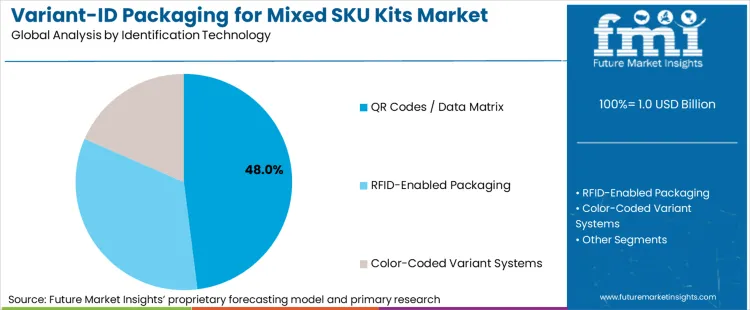
QR codes and Data Matrix identifiers together account for 48% of identification technology adoption, reflecting their unmatched compatibility with high-speed vision systems and regulatory traceability frameworks. These codes enable dense data encoding in compact footprints, allowing kit-level identifiers to carry variant composition, batch information, and marketplace-specific IDs without expanding label real estate-an essential advantage for compact cartons and polybags.
Their dominance is reinforced by marketplace and regulatory interoperability. Amazon FBA, Indian QR traceability systems, and EU digital information frameworks all rely on 2D codes as the primary machine-readable format. This interoperability minimizes rework and reduces the need for parallel identification layers. In practice, QR/Data Matrix systems act as the lowest-friction compliance layer, explaining why they continue to outpace RFID and color-coding in mixed-SKU environments.
Why does Paperboard remain the leading packaging substrate?
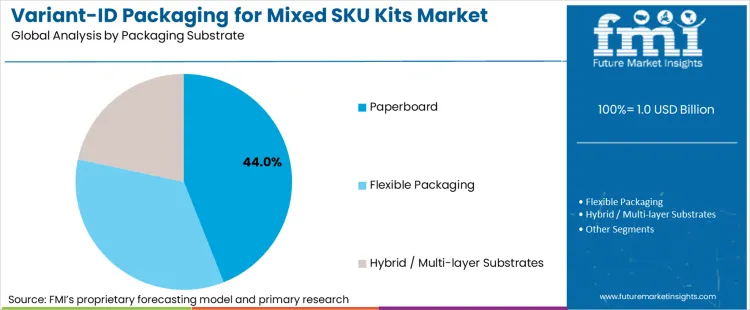
Paperboard represents 44% of substrate usage, reflecting its structural compatibility with high-quality print, scannability, and regulatory alignment. Carton-based kits provide flat, consistent surfaces that support reliable barcode contrast and scan angles, reducing read failures in automated tunnels and handheld verification stations.
From a compliance perspective, paperboard also aligns well with fit-to-size and recyclability mandates referenced in the document. As regulators and marketplaces discourage excess void space and non-recyclable packaging, paperboard cartons offer a compliant baseline that integrates seamlessly with variable-data printing and inline inspection systems. This combination of print fidelity, structural stability, and compliance defensibility sustains paperboard’s leadership despite growing experimentation with smart plastics and reusable containers.
What Drivers, Restraints, Opportunities, and Trends Shape the Variant-ID Packaging for Mixed SKU Kits Market?
The March 2026 Amazon FBA policy eliminating commingled inventory and enforcing seller-applied FNSKU labeling converts variant-ID packaging into a prerequisite for marketplace access. Because non-compliant units are rejected at inbound or suppressed post-listing, sellers are compelled to adopt packaging-integrated identifiers regardless of prior labeling practices. This driver is immediate, non-discretionary, and structurally durable. India’s Plastic Waste Management Rules amendments and EU PPWR digital information obligations institutionalize machine-readable identification at the kit level. These regulations require identifiers that persist across handling, sorting, and reporting workflows, elevating variant-ID packaging from an operational tool to a compliance instrument.
Deploying variant-ID packaging requires more than labels-it demands printer integration, vision verification, data synchronization, and exception handling. Smaller sellers with limited technical capacity may struggle to implement systems quickly, particularly when migrating from manual or post-hoc labeling workflows. In some supply chains, product-level identifiers applied by component manufacturers do not align with kit-level variant logic. Without harmonized data models, sellers may be forced to maintain parallel identification layers, increasing operational complexity and error risk during transition phases.
Vision-verified packaging stations offer scalable error elimination. Rapid deployment of camera-based verification systems capable of validating both kit completeness and identifier accuracy at pack-out. Suppliers that offer integrated packaging + verification solutions can capture outsized value by reducing false positives, rework, and inbound rejections. Regulated industries present expansion beyond e-commerce. Pharmaceutical kits, medical device bundles, and industrial maintenance kits increasingly require serialization and audit trails. Variant-ID packaging provides a transferable compliance layer across these sectors, enabling growth beyond marketplace-driven demand cycles.
Rather than applying identifiers as an afterthought, sellers are embedding variant logic into carton design, print layers, and sealing processes. This reduces handling steps and improves scan reliability across automated systems. High-risk kits increasingly deploy dual identifiers to ensure verification even if one identifier is damaged. This trend reflects the rising penalty of single-point identification failure in automated fulfilment environments.
Analysis of Variant-ID Packaging for Mixed SKU Kits Market by Key Countries
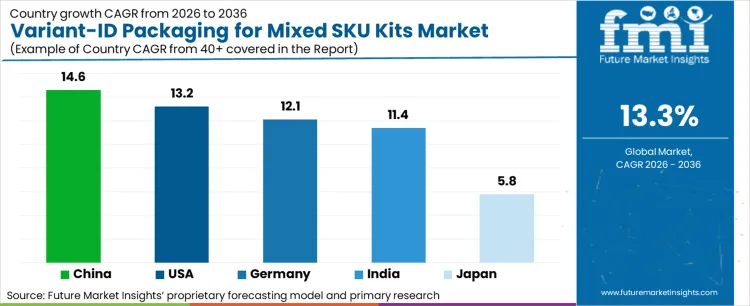
| Country | CAGR (2026-2036) |
|---|---|
| China | 14.6% |
| USA | 13.2% |
| Germany | 12.1% |
| India | 11.4% |
| Japan | 5.8% |
Source: Future Market Insights (FMI), based on document-cited primary and secondary references
Why is China the Fastest-Growing Market for Variant-ID Packaging in Mixed SKU Kits?
China is projected to expand at a 14.6% CAGR from 2026 to 2036, making it the fastest-growing national market for variant-ID packaging in mixed SKU kits. This growth is strongly linked to state-backed Smart Logistics initiatives and the rapid expansion of automated fulfillment infrastructure serving both domestic e-commerce platforms and export-oriented manufacturers. As mixed-SKU kits proliferate across consumer electronics, industrial spare parts, and medical equipment supply chains, the need for packaging-integrated identifiers that can be reliably scanned and verified at high speeds has become non-negotiable.
In addition, Chinese packaging and automation suppliers have aggressively scaled variable-data printing and inline inspection capabilities, enabling SKU-level differentiation at industrial throughputs. This capability allows variant-ID packaging to be deployed not only for high-margin products but also for high-volume promotional kits and seasonal assortments. The combination of regulatory encouragement, equipment availability, and manufacturing scale underpins China’s outsized growth trajectory.
How is Marketplace Enforcement Sustaining Strong Growth in USA?
USA is forecasted to grow at a 13.2% CAGR during the forecast period, primarily driven by enforcement-led adoption linked to Amazon’s March 2026 FBA policy changes. The elimination of commingled inventory and the mandatory application of seller-specific FNSKU labels have fundamentally altered fulfillment economics for third-party sellers. Mixed-SKU kits, which were previously vulnerable to mislabeling and misrouting under commingled systems, now require packaging-integrated variant identification to ensure acceptance at inbound fulfillment centers.
Beyond Amazon, the U.S. market is seeing broader adoption across regulated and enterprise supply chains. Medical kits, industrial maintenance bundles, and subscription-based product assortments increasingly rely on variant-ID packaging to reduce returns and audit risk. This combination of immediate compliance pressure and transferable operational benefits sustains double-digit growth through 2036.
Why is Germany Experiencing Steady Uptake Despite a Smaller Fulfillment Base?
Germany is expected to expand at a 12.1% CAGR from 2026 to 2036, reflecting value-led adoption rather than sheer volume growth. German mixed-SKU kit applications are concentrated in industrial automation, automotive aftermarket kits, and regulated manufacturing environments where documentation accuracy and traceability are prioritized. In these contexts, variant-ID packaging supports audit readiness, recall management, and cross-border compliance within the EU.
Regulatory frameworks referenced in the document-particularly EU digital information and packaging efficiency requirements-encourage packaging-level identification rather than ad hoc labeling. As a result, German manufacturers are upgrading from manual or component-level identifiers to integrated kit-level systems, driving sustained demand growth despite a comparatively smaller e-commerce seller base.
What is Driving India’s Accelerating Adoption of Variant-ID Packaging?
India is projected to grow at an 11.4% CAGR between 2026 and 2036, supported by expanding e-commerce penetration and regulatory traceability mandates. Amendments to India’s Plastic Waste Management Rules referenced in the document require QR-code-based identification on kits, linking physical packaging to centralized databases. This requirement directly elevates demand for packaging substrates capable of consistent, high-contrast variable-data printing and scan reliability.
Operationally, India’s mixed-SKU kits are increasingly distributed across long-distance logistics corridors with multiple handoffs. Variant-ID packaging reduces error rates and simplifies reconciliation at downstream checkpoints, making it particularly attractive for sellers operating at scale across multiple states and fulfillment partners.
Why does Japan Exhibit Moderate Growth Despite High Automation Levels?
Japan is expected to grow at a 5.8% CAGR through 2036, reflecting a mature market where high standards of process control and labeling discipline are already established. Many Japanese manufacturers adopted kit-level identification earlier than their counterparts elsewhere, limiting the scope for rapid penetration-driven growth.
Incremental growth persists as packaging systems evolve toward greater automation compatibility and data richness. Upgrades from static barcodes to more data-dense QR and Data Matrix formats, along with redundancy architectures, support continued value growth even as overall market expansion remains moderate.
What is the Competition Outlook for Variant-ID Packaging for Mixed SKU Kits Market?
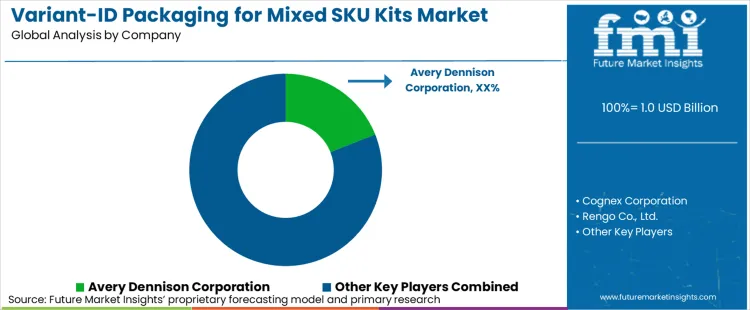
Competition in the variant-ID packaging for mixed SKU kits market is defined less by packaging material cost and more by system-level interoperability with marketplace rules, automation platforms, and regulatory databases. As variant-ID packaging becomes a compliance prerequisite rather than an operational enhancement, suppliers are increasingly evaluated on their ability to deliver end-to-end identification reliability-from print quality and data integrity to scan success rates at inbound fulfillment, sortation, and last-mile nodes.
A key competitive differentiator is integration depth with vision and verification systems. Suppliers that offer packaging substrates and labels engineered specifically for high-speed camera verification, meeting contrast, quiet-zone, and decode-rate thresholds, are gaining preference among sellers and manufacturers operating under Amazon FBA and similar enforcement regimes. In these environments, a label failure is not a recoverable defect but a shipment-blocking event. This shifts procurement away from generic label converters toward vendors capable of validating real-world performance within automated pack-out and inspection stations.
Another defining axis of competition is multi-technology capability. As referenced in the document, leading suppliers combine QR/Data Matrix labeling with optional RFID, color-coding, or internal redundancy architectures to reduce single-point failure risk. This is particularly relevant for high-value electronics kits and regulated medical or industrial bundles, where mis-shipments trigger not only returns but compliance audits. Competitive advantage therefore accrues to firms that can support hybrid identification strategies and integrate packaging design with customer data models, rather than those offering isolated identification components.
Key Players Referenced in the Variant-ID Packaging for Mixed SKU Kits Market
- Avery Dennison Corporation
- Cognex Corporation
- Rengo Co., Ltd.
- SATO Holdings Corporation
- Toppan Inc.
Market Definition
The variant-ID packaging for mixed SKU kits market comprises packaging-integrated identification systems designed to enable unit-level verification, traceability, and error-proof fulfillment of kits containing multiple distinct SKUs. These systems embed machine-readable identifiers-such as QR codes, Data Matrix symbols, RFID inlays, and color-coded visual cues-directly into packaging substrates to ensure kit completeness, correctness, and compliance across automated and manual handling environments.
The scope includes variant-ID solutions applied at the kit or bundle level, covering electronics kits, industrial spare-parts assortments, medical and pharmaceutical kits, promotional bundles, and omnichannel retail packs. The scope excludes product-level serialization applied by original component manufacturers, single-SKU shipments, non-packaging asset-tracking RFID systems, and downstream logistics services.
Scope of the Report
| Attribute | Details |
|---|---|
| Base Year | 2026 |
| Forecast Period | 2026-2036 |
| Market Size (2026) | USD 980 million |
| Market Size (2036) | USD 3,420 million |
| CAGR | 13.3% |
| Kit Types Covered | Electronics Kits, Industrial Spare Kits, Medical & Pharma Kits, Promotional Bundles |
| Identification Technologies | QR Codes, Data Matrix, RFID, Color-Coded Systems |
| Packaging Substrates | Paperboard, Flexible Packaging, Hybrid Substrates |
| Regions Covered | North America, Europe, East Asia, South Asia, Japan, Rest of the World |
| Key Countries | China, United States, Germany, India, Japan |
Source: Future Market Insights (FMI), based on document-referenced analysis
Variant-ID Packaging for Mixed SKU Kits Market Key Segments
By Kit Type
- Electronics Kits
- Industrial Spare Parts Kits
- Medical & Pharmaceutical Kits
- Promotional / Seasonal Kits
By Identification Technology
- QR Codes / Data Matrix
- RFID-Enabled Packaging
- Color-Coded Variant Systems
By Packaging Substrate
- Paperboard
- Flexible Packaging
- Hybrid / Multi-layer Substrates
By Region
- North America
- Europe
- East Asia
- South Asia
- Japan
- Rest of the World
Bibliography
- Amazon Seller Central. (2026). FBA inventory placement and labeling policy update: Elimination of commingled inventory. Amazon.com, Inc.
- Ministry of Environment, Forest and Climate Change (MoEFCC), Government of India. (2025). Plastic Waste Management Rules (Amendment): QR code and traceability requirements for packaged goods. Government of India Gazette.
- European Commission. (2024). Packaging and Packaging Waste Regulation (PPWR): Digital information and packaging efficiency provisions. Official Journal of the European Union.
- Sino-Pack Exhibition Organizing Committee. (2026). Industrial variable-data printing and verification systems showcased at Sino-Pack 2026. Sino-Pack Official Proceedings.
- Avery Dennison Corporation. (2025). Variable data labeling and RFID solutions for e-commerce and mixed SKU fulfillment. Corporate technical briefing.
- Cognex Corporation. (2025). Machine vision-based verification of barcodes and Data Matrix codes in high-speed packaging lines. Technical white paper.
Frequently Asked Questions
How large is the market expected to be by 2036?
FMI projects the market will reach USD 3,420 million by 2036, up from USD 980 million in 2026.
Which country is growing the fastest?
China is the fastest-growing market, expanding at a 14.6% CAGR, supported by Smart Logistics initiatives and large-scale automated fulfilment infrastructure.
What is driving growth in the variant-ID packaging for mixed SKU kits market?
Growth is driven by marketplace enforcement (notably Amazon FBA labeling mandates), regulatory QR-based traceability requirements, and the expansion of automated fulfillment systems that require packaging-integrated identifiers.
Which identification technology dominates the market?
QR codes and Data Matrix systems lead adoption due to their compatibility with marketplace, regulatory, and automation platforms.
Why is variant-ID packaging considered compliance infrastructure rather than optional packaging?
Because non-compliance now results in shipment rejection, listing suppression, or regulatory penalties, variant-ID packaging has become a prerequisite for market access rather than an operational enhancement.
Preview the report firsthand - request a free sample
Get SampleGet the brochure for pricing and purchase details.
Get PDFTable of Content
- Executive Summary
- Global Market Outlook
- Demand-side Trends
- Supply-side Trends
- Technology Roadmap Analysis
- Analysis and Recommendations
- Market Overview
- Market Coverage / Taxonomy
- Market Definition / Scope / Limitations
- Research Methodology
- Chapter Orientation
- Analytical Lens and Working Hypotheses
- Market Structure, Signals, and Trend Drivers
- Benchmarking and Cross-market Comparability
- Market Sizing, Forecasting, and Opportunity Mapping
- Research Design and Evidence Framework
- Desk Research Programme (Secondary Evidence)
- Company Annual and Sustainability Reports
- Peer-reviewed Journals and Academic Literature
- Corporate Websites, Product Literature, and Technical Notes
- Earnings Decks and Investor Briefings
- Statutory Filings and Regulatory Disclosures
- Technical White Papers and Standards Notes
- Trade Journals, Industry Magazines, and Analyst Briefs
- Conference Proceedings, Webinars, and Seminar Materials
- Government Statistics Portals and Public Data Releases
- Press Releases and Reputable Media Coverage
- Specialist Newsletters and Curated Briefings
- Sector Databases and Reference Repositories
- FMI Internal Proprietary Databases and Historical Market Datasets
- Subscription Datasets and Paid Sources
- Social Channels, Communities, and Digital Listening Inputs
- Additional Desk Sources
- Expert Input and Fieldwork (Primary Evidence)
- Primary Modes
- Qualitative Interviews and Expert Elicitation
- Quantitative Surveys and Structured Data Capture
- Blended Approach
- Why Primary Evidence is Used
- Field Techniques
- Interviews
- Surveys
- Focus Groups
- Observational and In-context Research
- Social and Community Interactions
- Stakeholder Universe Engaged
- C-suite Leaders
- Board Members
- Presidents and Vice Presidents
- R&D and Innovation Heads
- Technical Specialists
- Domain Subject-matter Experts
- Scientists
- Physicians and Other Healthcare Professionals
- Governance, Ethics, and Data Stewardship
- Research Ethics
- Data Integrity and Handling
- Primary Modes
- Tooling, Models, and Reference Databases
- Desk Research Programme (Secondary Evidence)
- Data Engineering and Model Build
- Data Acquisition and Ingestion
- Cleaning, Normalisation, and Verification
- Synthesis, Triangulation, and Analysis
- Quality Assurance and Audit Trail
- Market Background
- Market Dynamics
- Drivers
- Restraints
- Opportunity
- Trends
- Scenario Forecast
- Demand in Optimistic Scenario
- Demand in Likely Scenario
- Demand in Conservative Scenario
- Opportunity Map Analysis
- Product Life Cycle Analysis
- Supply Chain Analysis
- Investment Feasibility Matrix
- Value Chain Analysis
- PESTLE and Porter’s Analysis
- Regulatory Landscape
- Regional Parent Market Outlook
- Production and Consumption Statistics
- Import and Export Statistics
- Market Dynamics
- Global Market Analysis 2021 to 2025 and Forecast, 2026 to 2036
- Historical Market Size Value (USD Million) Analysis, 2021 to 2025
- Current and Future Market Size Value (USD Million) Projections, 2026 to 2036
- Y-o-Y Growth Trend Analysis
- Absolute $ Opportunity Analysis
- Global Market Pricing Analysis 2021 to 2025 and Forecast 2026 to 2036
- Global Market Analysis 2021 to 2025 and Forecast 2026 to 2036, By Kit Type
- Introduction / Key Findings
- Historical Market Size Value (USD Million) Analysis By Kit Type , 2021 to 2025
- Current and Future Market Size Value (USD Million) Analysis and Forecast By Kit Type , 2026 to 2036
- Electronics Kits
- Industrial Spare Parts Kits
- Medical & Pharmaceutical Kits
- Promotional / Seasonal Kits
- Electronics Kits
- Y-o-Y Growth Trend Analysis By Kit Type , 2021 to 2025
- Absolute $ Opportunity Analysis By Kit Type , 2026 to 2036
- Global Market Analysis 2021 to 2025 and Forecast 2026 to 2036, By Identification Technology
- Introduction / Key Findings
- Historical Market Size Value (USD Million) Analysis By Identification Technology, 2021 to 2025
- Current and Future Market Size Value (USD Million) Analysis and Forecast By Identification Technology, 2026 to 2036
- QR Codes / Data Matrix
- RFID-Enabled Packaging
- Color-Coded Variant Systems
- QR Codes / Data Matrix
- Y-o-Y Growth Trend Analysis By Identification Technology, 2021 to 2025
- Absolute $ Opportunity Analysis By Identification Technology, 2026 to 2036
- Global Market Analysis 2021 to 2025 and Forecast 2026 to 2036, By Packaging Substrate
- Introduction / Key Findings
- Historical Market Size Value (USD Million) Analysis By Packaging Substrate, 2021 to 2025
- Current and Future Market Size Value (USD Million) Analysis and Forecast By Packaging Substrate, 2026 to 2036
- Paperboard
- Flexible Packaging
- Hybrid / Multi-layer Substrates
- Paperboard
- Y-o-Y Growth Trend Analysis By Packaging Substrate, 2021 to 2025
- Absolute $ Opportunity Analysis By Packaging Substrate, 2026 to 2036
- Global Market Analysis 2021 to 2025 and Forecast 2026 to 2036, By Region
- Introduction
- Historical Market Size Value (USD Million) Analysis By Region, 2021 to 2025
- Current Market Size Value (USD Million) Analysis and Forecast By Region, 2026 to 2036
- North America
- Latin America
- Western Europe
- Eastern Europe
- East Asia
- South Asia and Pacific
- Middle East & Africa
- Market Attractiveness Analysis By Region
- North America Market Analysis 2021 to 2025 and Forecast 2026 to 2036, By Country
- Historical Market Size Value (USD Million) Trend Analysis By Market Taxonomy, 2021 to 2025
- Market Size Value (USD Million) Forecast By Market Taxonomy, 2026 to 2036
- By Country
- USA
- Canada
- Mexico
- By Kit Type
- By Identification Technology
- By Packaging Substrate
- By Country
- Market Attractiveness Analysis
- By Country
- By Kit Type
- By Identification Technology
- By Packaging Substrate
- Key Takeaways
- Latin America Market Analysis 2021 to 2025 and Forecast 2026 to 2036, By Country
- Historical Market Size Value (USD Million) Trend Analysis By Market Taxonomy, 2021 to 2025
- Market Size Value (USD Million) Forecast By Market Taxonomy, 2026 to 2036
- By Country
- Brazil
- Chile
- Rest of Latin America
- By Kit Type
- By Identification Technology
- By Packaging Substrate
- By Country
- Market Attractiveness Analysis
- By Country
- By Kit Type
- By Identification Technology
- By Packaging Substrate
- Key Takeaways
- Western Europe Market Analysis 2021 to 2025 and Forecast 2026 to 2036, By Country
- Historical Market Size Value (USD Million) Trend Analysis By Market Taxonomy, 2021 to 2025
- Market Size Value (USD Million) Forecast By Market Taxonomy, 2026 to 2036
- By Country
- Germany
- UK
- Italy
- Spain
- France
- Nordic
- BENELUX
- Rest of Western Europe
- By Kit Type
- By Identification Technology
- By Packaging Substrate
- By Country
- Market Attractiveness Analysis
- By Country
- By Kit Type
- By Identification Technology
- By Packaging Substrate
- Key Takeaways
- Eastern Europe Market Analysis 2021 to 2025 and Forecast 2026 to 2036, By Country
- Historical Market Size Value (USD Million) Trend Analysis By Market Taxonomy, 2021 to 2025
- Market Size Value (USD Million) Forecast By Market Taxonomy, 2026 to 2036
- By Country
- Russia
- Poland
- Hungary
- Balkan & Baltic
- Rest of Eastern Europe
- By Kit Type
- By Identification Technology
- By Packaging Substrate
- By Country
- Market Attractiveness Analysis
- By Country
- By Kit Type
- By Identification Technology
- By Packaging Substrate
- Key Takeaways
- East Asia Market Analysis 2021 to 2025 and Forecast 2026 to 2036, By Country
- Historical Market Size Value (USD Million) Trend Analysis By Market Taxonomy, 2021 to 2025
- Market Size Value (USD Million) Forecast By Market Taxonomy, 2026 to 2036
- By Country
- China
- Japan
- South Korea
- By Kit Type
- By Identification Technology
- By Packaging Substrate
- By Country
- Market Attractiveness Analysis
- By Country
- By Kit Type
- By Identification Technology
- By Packaging Substrate
- Key Takeaways
- South Asia and Pacific Market Analysis 2021 to 2025 and Forecast 2026 to 2036, By Country
- Historical Market Size Value (USD Million) Trend Analysis By Market Taxonomy, 2021 to 2025
- Market Size Value (USD Million) Forecast By Market Taxonomy, 2026 to 2036
- By Country
- India
- ASEAN
- Australia & New Zealand
- Rest of South Asia and Pacific
- By Kit Type
- By Identification Technology
- By Packaging Substrate
- By Country
- Market Attractiveness Analysis
- By Country
- By Kit Type
- By Identification Technology
- By Packaging Substrate
- Key Takeaways
- Middle East & Africa Market Analysis 2021 to 2025 and Forecast 2026 to 2036, By Country
- Historical Market Size Value (USD Million) Trend Analysis By Market Taxonomy, 2021 to 2025
- Market Size Value (USD Million) Forecast By Market Taxonomy, 2026 to 2036
- By Country
- Kingdom of Saudi Arabia
- Other GCC Countries
- Turkiye
- South Africa
- Other African Union
- Rest of Middle East & Africa
- By Kit Type
- By Identification Technology
- By Packaging Substrate
- By Country
- Market Attractiveness Analysis
- By Country
- By Kit Type
- By Identification Technology
- By Packaging Substrate
- Key Takeaways
- Key Countries Market Analysis
- USA
- Pricing Analysis
- Market Share Analysis, 2025
- By Kit Type
- By Identification Technology
- By Packaging Substrate
- Canada
- Pricing Analysis
- Market Share Analysis, 2025
- By Kit Type
- By Identification Technology
- By Packaging Substrate
- Mexico
- Pricing Analysis
- Market Share Analysis, 2025
- By Kit Type
- By Identification Technology
- By Packaging Substrate
- Brazil
- Pricing Analysis
- Market Share Analysis, 2025
- By Kit Type
- By Identification Technology
- By Packaging Substrate
- Chile
- Pricing Analysis
- Market Share Analysis, 2025
- By Kit Type
- By Identification Technology
- By Packaging Substrate
- Germany
- Pricing Analysis
- Market Share Analysis, 2025
- By Kit Type
- By Identification Technology
- By Packaging Substrate
- UK
- Pricing Analysis
- Market Share Analysis, 2025
- By Kit Type
- By Identification Technology
- By Packaging Substrate
- Italy
- Pricing Analysis
- Market Share Analysis, 2025
- By Kit Type
- By Identification Technology
- By Packaging Substrate
- Spain
- Pricing Analysis
- Market Share Analysis, 2025
- By Kit Type
- By Identification Technology
- By Packaging Substrate
- France
- Pricing Analysis
- Market Share Analysis, 2025
- By Kit Type
- By Identification Technology
- By Packaging Substrate
- India
- Pricing Analysis
- Market Share Analysis, 2025
- By Kit Type
- By Identification Technology
- By Packaging Substrate
- ASEAN
- Pricing Analysis
- Market Share Analysis, 2025
- By Kit Type
- By Identification Technology
- By Packaging Substrate
- Australia & New Zealand
- Pricing Analysis
- Market Share Analysis, 2025
- By Kit Type
- By Identification Technology
- By Packaging Substrate
- China
- Pricing Analysis
- Market Share Analysis, 2025
- By Kit Type
- By Identification Technology
- By Packaging Substrate
- Japan
- Pricing Analysis
- Market Share Analysis, 2025
- By Kit Type
- By Identification Technology
- By Packaging Substrate
- South Korea
- Pricing Analysis
- Market Share Analysis, 2025
- By Kit Type
- By Identification Technology
- By Packaging Substrate
- Russia
- Pricing Analysis
- Market Share Analysis, 2025
- By Kit Type
- By Identification Technology
- By Packaging Substrate
- Poland
- Pricing Analysis
- Market Share Analysis, 2025
- By Kit Type
- By Identification Technology
- By Packaging Substrate
- Hungary
- Pricing Analysis
- Market Share Analysis, 2025
- By Kit Type
- By Identification Technology
- By Packaging Substrate
- Kingdom of Saudi Arabia
- Pricing Analysis
- Market Share Analysis, 2025
- By Kit Type
- By Identification Technology
- By Packaging Substrate
- Turkiye
- Pricing Analysis
- Market Share Analysis, 2025
- By Kit Type
- By Identification Technology
- By Packaging Substrate
- South Africa
- Pricing Analysis
- Market Share Analysis, 2025
- By Kit Type
- By Identification Technology
- By Packaging Substrate
- USA
- Market Structure Analysis
- Competition Dashboard
- Competition Benchmarking
- Market Share Analysis of Top Players
- By Regional
- By Kit Type
- By Identification Technology
- By Packaging Substrate
- Competition Analysis
- Competition Deep Dive
- Avery Dennison Corporation
- Overview
- Product Portfolio
- Profitability by Market Segments (Product/Age /Sales Channel/Region)
- Sales Footprint
- Strategy Overview
- Marketing Strategy
- Product Strategy
- Channel Strategy
- Cognex Corporation
- Rengo Co., Ltd.
- SATO Holdings Corporation
- Toppan Inc.
- Avery Dennison Corporation
- Competition Deep Dive
- Assumptions & Acronyms Used


