

- Industry Size (2026)
- USD 466.9 Mn
- Forecast (2036)
- USD 1113.3 Mn
- CAGR (2026 to 2036)
- 9.1%
Warehouse Picking AI Workforce Assistants Market Forecast and Outlook 2026 to 2036
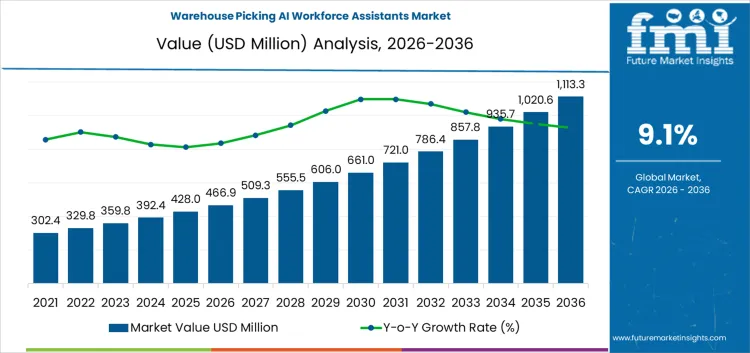
The warehouse picking AI workforce assistants market is valued at USD 466.9 million in 2026 and is projected to reach USD 1,113.3 million by 2036, reflecting a CAGR of 9.1%. Market performance is shaped by high capital investment in robotics, AI software, and integration with warehouse management systems. Cost structures are influenced by algorithm development, fleet coordination, and maintenance requirements. Pricing authority is concentrated among suppliers offering validated, scalable solutions. Margin concentration favors operators that combine system deployment, software updates, and technical support, capturing value from operational efficiency rather than the number of units deployed.
Market outcomes depend on alignment with major logistics and e-commerce operators, warehouse automation programs, and throughput targets. Adoption varies by warehouse size, technology readiness, and regional labor dynamics. Operators delivering certified, multi-platform AI assistants with proven task optimization achieve higher margins. Smaller or emerging providers face constraints in scaling, integration, and reliability certification. Concentrated value accrues to firms controlling design, deployment, and operational validation, while fleet size alone does not determine market positioning or financial performance.
Quick Stats of the Warehouse Picking AI Workforce Assistants Market
- Warehouse Picking AI Workforce Assistants Market Value (2026): USD 466.9 million
- Warehouse Picking AI Workforce Assistants Forecast Value (2036): USD 1,113.3 million
- Warehouse Picking AI Workforce Assistants Forecast CAGR 2026 to 2036: 9.1%
- Leading Function in Warehouse AI Workforce Assistants Market: Vision Pick Assist (31 % share)
- Leading Deployment Segment in Warehouse AI Workforce Assistants Market: Retrofit (61 % share)
- Key Growth Regions in Warehouse AI Workforce Assistants Market: USA, Germany, China, UK
- Top Players in Warehouse Picking AI Workforce Assistants Market: Dematic, SSI Schaefer, Daifuku, Vanderlande, Honeywell Intelligrated, TGW Logistics
What is the Growth Forecast for Warehouse Picking AI Workforce Assistants Market through 2036?
Between 2026 and 2031, the warehouse picking AI workforce assistants market is projected to grow from USD 466.9 million to USD 661.3 million, generating an absolute increase of USD 194.4 million and reflecting a CAGR of 9.1%. Growth is driven by adoption of vision pick assist, voice-directed picking, AR pick guidance, and task orchestration AI across retrofit and new-build deployments. E-commerce fulfillment centers, 3PL warehouses, retail, and manufacturing DCs are primary applications. Expansion is supported by demand for operational efficiency, accuracy, and labor cost optimization. Suppliers focus on AI performance, integration, and seamless workflow management.
From 2031 to 2036, the market is expected to expand from USD 661.3 million to USD 1,113.3 million, adding USD 452.5 million. Growth is fueled by broader adoption across warehouse types, increased automation in fulfillment operations, and advanced AI capabilities for error detection and task orchestration. Competitive advantage favors suppliers providing validated AI algorithms, integration expertise, and scalability for diverse warehouse environments. Leading companies include Dematic, SSI Schaefer, Daifuku, Vanderlande, Honeywell Intelligrated, and TGW Logistics.
Warehouse Picking AI Workforce Assistants Market Key Takeaways
| Metric | Value |
|---|---|
| Market Value (2026) | USD 466.9 million |
| Forecast Value (2036) | USD 1,113.3 million |
| Forecast CAGR 2026 to 2036 | 9.10% |
What Is Driving Demand for Warehouse Picking AI Workforce Assistants?
Warehouse picking AI workforce assistants are increasingly adopted to improve order fulfillment speed, accuracy, and operational efficiency in logistics and distribution centers. Historically, manual picking relied entirely on human labor, leading to errors, slower throughput, and higher labor costs. Modern AI-driven assistants integrate robotics, computer vision, and machine learning algorithms to guide or automate picking tasks, optimize route planning, and reduce operational downtime. E-commerce operators, third-party logistics providers, and manufacturing warehouses prioritize system reliability, ease of integration, and safety compliance. Early adoption focused on high-volume fulfillment centers, while current demand spans retail, e-commerce, and industrial warehouses, driven by labor shortages, rising order volumes, and the need for faster delivery times. Task adaptability, navigation accuracy, and system interoperability influence deployment.
Increasing e-commerce penetration, demand for rapid fulfillment, and cost optimization are shaping market growth. Compared with traditional manual or semi-automated systems, AI workforce assistants emphasize real-time decision-making, adaptive routing, and scalable deployment across warehouse layouts. Cost structures depend on robotic hardware, AI software, and maintenance, concentrating margins among suppliers capable of providing reliable, high-performance solutions. Warehouse operators adopt these assistants to increase picking accuracy, reduce labor dependency, and optimize throughput. By 2036, AI-driven warehouse picking assistants are expected to become standard in distribution operations, supporting operational efficiency, accuracy, and scalable labor solutions.
What Factors Are Shaping the Demand for Warehouse Picking AI Workforce Assistants in Terms of Function and Deployment?
The demand for warehouse picking AI workforce assistants is segmented by function and deployment type. Functions include vision pick assist, voice-directed picking, AR pick guidance, task orchestration AI, and error detection AI. Deployment types cover retrofit systems and new-build warehouse installations. Adoption is influenced by operational efficiency, error reduction, and workforce augmentation. Uptake is driven by labor shortages, increasing order volumes, and automation objectives. Function and deployment selection depend on warehouse layout, integration complexity, and throughput requirements, ensuring reliable, scalable, and efficient operations in fulfillment centers, logistics hubs, and industrial warehouses.
Why Is Vision Pick Assist Leading the Function Segment in Warehouse AI Workforce Assistants?
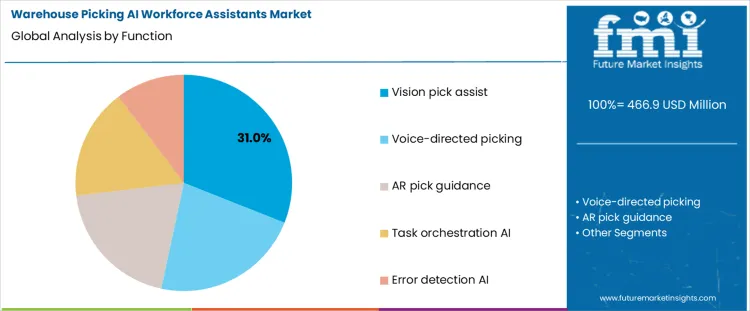
Vision pick assist accounts for approximately 31% of total function demand, making it the leading category. This technology uses computer vision and machine learning to guide operators toward the correct items, improving accuracy and speed. Adoption is driven by high SKU volumes, frequent order changes, and the need for error reduction. Vision systems integrate cameras, AI algorithms, and handheld or wearable devices to provide real-time picking guidance. Operational planning includes calibration of vision sensors, workflow optimization, and continuous learning updates to adapt to warehouse changes. The segment leads because vision pick assist provides measurable improvements in speed, accuracy, and operational efficiency.
Operational factors further shape adoption. Systems must maintain high recognition accuracy, operate under variable lighting, and integrate with warehouse management systems. Calibration and training are required to ensure correct identification across diverse product types. Vision pick assist leads because it reduces picking errors, increases throughput, and delivers predictable, scalable efficiency improvements for warehouse operations, supporting both labor and cost optimization goals.
Why Is Retrofit Deployment Representing the Largest Deployment Segment in Warehouse AI Workforce Assistants?
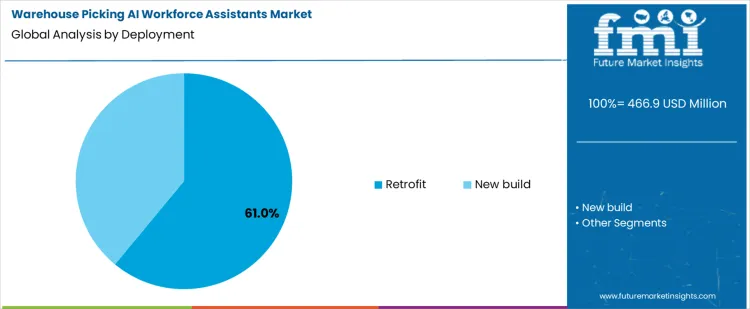
Retrofit deployment accounts for approximately 61% of total deployment demand, making it the largest category. Adoption is driven by the need to integrate AI picking assistance into existing warehouse infrastructure without major facility redesigns. Retrofit systems allow operators to upgrade workflows, introduce AI-guided picking, and enhance throughput without extensive construction. Vehicles and wearable devices are installed with minimal disruption, integrating with existing racks, conveyors, and warehouse management software. Operational protocols include device installation, software integration, and system testing to ensure reliable performance.
Functional and operational factors further influence adoption. Systems must interface with existing IT infrastructure, adapt to current layouts, and support varied workflows. Retrofit deployment leads because it enables rapid implementation, minimizes downtime, and scales AI assistance across multiple warehouse zones. This approach ensures efficiency, accuracy, and workforce productivity improvements while maintaining operational continuity.
How Are AI Workforce Assistants Redefining Decision-Making in Warehouses?
AI workforce assistants are increasingly deployed to make real-time picking decisions, dynamically adjusting routes, task priorities, and item handling sequences. Adoption is strongest in warehouses managing high SKU diversity, unpredictable order patterns, and rapid product turnover. Systems are selected for cognitive adaptability, multi-tasking ability, and integration with edge computing platforms. Growth is driven by the need to maintain operational fluidity in fluctuating warehouse conditions, reduce human cognitive load, and optimize throughput without rigid automation. Operators prioritize assistants that learn from operational data, adapt to process changes, and enhance overall task intelligence.
Why Are Cognitive Adaptability and Human-Robot Synergy Driving Adoption?
Demand is influenced by warehouses seeking to combine human judgment with AI decision-making for complex picking scenarios. AI assistants capable of collaborating seamlessly with human operators, recognizing exceptions, and adjusting to variable workflows gain preference. Adoption is concentrated in regions with high-value logistics operations and complex supply chains. Operational flexibility, reduction in human error, and improved real-time decision-making drive procurement more than cost. Providers offering assistants that enhance human-robot synergy gain competitive advantage in large-scale and high-speed fulfillment environments.
What Operational and Cognitive Constraints Limit Adoption?
Integration with unpredictable human workflows, handling exceptions, and interpreting visual or sensor data adds complexity. AI assistants may underperform if warehouse layouts, labeling, or item placements change rapidly. Training systems to recognize edge-case scenarios and maintain adaptive learning requires high upfront effort. Smaller warehouses or facilities with low digital maturity adopt solutions more slowly. These constraints concentrate early deployment among large e-commerce centers, high-throughput distribution hubs, and regions with advanced robotics and AI integration capabilities.
How Are Modular Deployment and Learning Algorithms Shaping Market Trends?
Recent innovations include modular AI assistants that can be rapidly redeployed to different zones, continuous reinforcement learning to optimize picking strategies, and predictive routing for dynamic inventory replenishment. Collaboration between AI developers, warehouse operators, and cognitive robotics labs ensures operational adaptability and process intelligence validation. Pilot testing evaluates decision-making accuracy, human-robot interaction quality, and adaptive workflow optimization. Focus is on intelligent task handling, workflow flexibility, and operator augmentation rather than cost or speed. These approaches enable broader adoption of AI workforce assistants that can adapt cognitively, collaborate effectively, and optimize complex warehouse environments.
What is the Demand for Warehouse Picking AI Workforce Assistants by Country?
| Country | CAGR (%) |
|---|---|
| USA | 9.0% |
| Germany | 8.5% |
| China | 8.0% |
| UK | 7.5% |
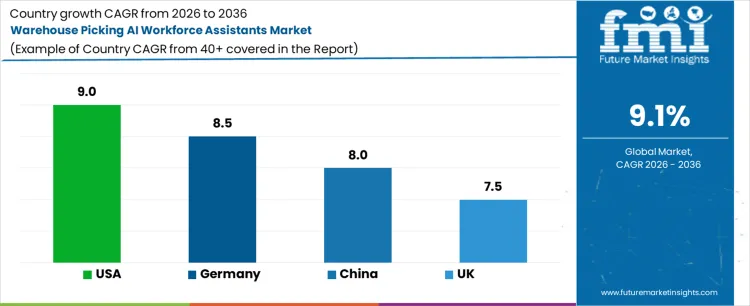
Demand for warehouse picking AI workforce assistants is rising as logistics and e-commerce companies adopt automation to enhance picking efficiency, reduce labor costs, and improve accuracy. The USA leads with a 9.0% CAGR, driven by rapid e-commerce growth, adoption of AI-enabled robotics, and integration in large-scale fulfillment centers. Germany follows at 8.5%, supported by advanced logistics infrastructure, automation initiatives, and warehouse modernization. China records 8.0% growth, shaped by high-volume distribution centers, increasing demand for AI-assisted automation, and e-commerce expansion. The UK shows 7.5% CAGR, reflecting gradual adoption of AI workforce assistants in warehouses and distribution facilities to optimize order fulfillment and operational efficiency.
How Is the United States Experiencing Growth in the Warehouse Picking AI Workforce Assistants Market?
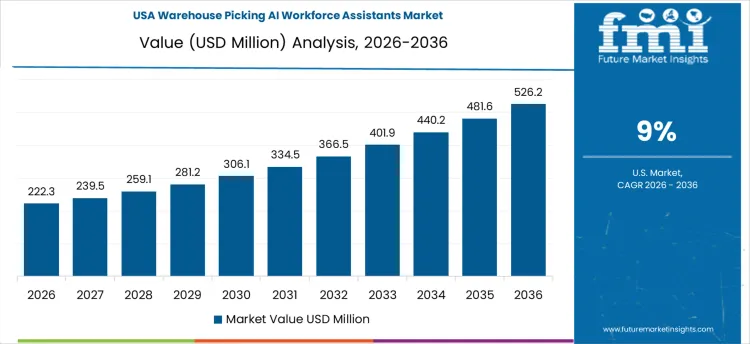
United States is experiencing growth at a CAGR of 9%, supported by adoption of AI-powered workforce assistants in warehouses to improve picking efficiency, reduce labor costs, and enhance operational accuracy. Robotics and automation providers are deploying systems optimized for navigation, item recognition, and integration with warehouse management software. Demand is concentrated in e-commerce fulfillment centers, logistics hubs, and industrial warehouses. Investments focus on AI system performance, reliability, and compliance with safety standards rather than large-scale fleet expansion. Growth reflects rising e-commerce volumes, industrial adoption of automation, and increasing demand for faster, error-free warehouse operations.
- E-commerce growth drives adoption.
- AI assistants optimize picking efficiency and accuracy.
- Fulfillment centers and logistics hubs concentrate demand.
- AI system performance and safety compliance guide investment.
How Is Germany Witnessing Steady Growth with Warehouse Automation?
Germany is witnessing growth at a CAGR of 8.5%, supported by adoption of AI workforce assistants in warehouses for automated picking, inventory management, and operational efficiency. Robotics providers and logistics companies are deploying systems optimized for object recognition, navigation, and integration with warehouse management systems. Demand is concentrated in industrial warehouses, logistics hubs, and fulfillment centers. Investments prioritize AI reliability, material handling safety, and regulatory compliance rather than fleet-scale deployment. Growth reflects industrial adoption of automation, demand for efficient warehouse operations, and integration of AI-driven solutions to optimize productivity.
- Warehouse automation drives adoption.
- AI assistants improve picking accuracy and inventory handling.
- Industrial warehouses and logistics hubs concentrate demand.
- AI reliability and safety compliance guide investment.
How Is China Experiencing Growth with AI-Driven Fulfillment Systems?
China is experiencing growth at a CAGR of 8%, fueled by adoption of AI workforce assistants in warehouses to enhance picking efficiency, reduce operational errors, and streamline logistics. Robotics providers and e-commerce fulfillment operators are producing AI systems optimized for navigation, item recognition, and real-time warehouse integration. Demand is concentrated in metropolitan fulfillment centers, logistics hubs, and industrial warehouses. Investments focus on AI system performance, operational reliability, and regulatory compliance rather than large-scale deployment. Growth reflects rapid e-commerce expansion, industrial adoption of AI technologies, and increasing demand for automated, precise warehouse operations.
- AI-driven fulfillment systems drive adoption.
- Assistants optimize picking efficiency and accuracy.
- Fulfillment centers and logistics hubs concentrate demand.
- AI system performance and regulatory compliance guide investment.
How Is the United Kingdom Witnessing Moderate Growth with Intelligent Warehouse Solutions?
United Kingdom is witnessing growth at a CAGR of 7.5%, supported by adoption of AI-powered workforce assistants in warehouses for automated picking, inventory management, and operational efficiency. Robotics and logistics providers are deploying systems optimized for navigation, item recognition, and integration with warehouse software. Demand is concentrated in fulfillment centers, industrial warehouses, and logistics hubs. Investments prioritize system reliability, material handling safety, and regulatory compliance rather than fleet-scale expansion. Growth reflects e-commerce growth, adoption of intelligent warehouse solutions, and industrial focus on automation to improve accuracy and productivity.
- Intelligent warehouse solutions drive adoption.
- AI assistants enhance picking accuracy and efficiency.
- Fulfillment centers and logistics hubs concentrate demand.
- System reliability and regulatory compliance guide investment.
Who Competes in the Warehouse Picking AI Workforce Assistants Market and What Defines Their Capabilities?
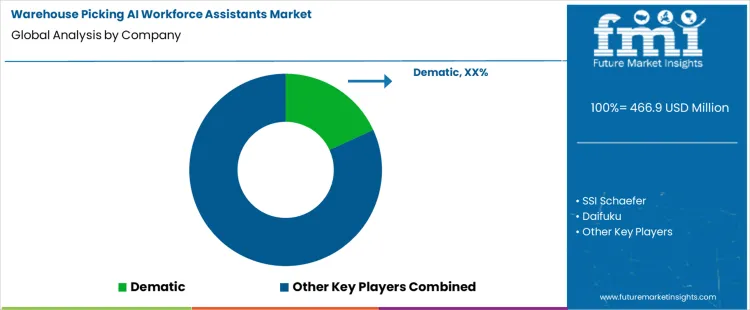
Competition in the warehouse picking AI workforce assistants market is defined by robotic picking precision, AI integration, and compatibility with warehouse management systems. Dematic provides AI-powered picking solutions combining machine vision, robotics, and software integration for high-throughput fulfillment centers. SSI Schaefer develops robotic picking systems integrated with warehouse software to optimize order accuracy and route planning. Daifuku offers automated picking modules with robotic manipulators and AI-driven inventory tracking for efficient warehouse operations.
Vanderlande delivers AI-assisted picking solutions emphasizing scalability and modular deployment for complex warehouse layouts. Honeywell Intelligrated supplies AI-driven picking systems integrated with conveyors and warehouse software for optimized throughput.
TGW Logistics provides intelligent picking solutions that combine robotics, AI, and software to enhance operational efficiency and accuracy. Other competitors include regional integrators and system providers offering AI-enabled picking solutions tailored for mid-sized warehouses or specialized industries. Differentiation arises from AI algorithm sophistication, robotic precision, integration with existing warehouse management systems, scalability, and adaptability to varied SKU profiles. Market relevance is determined by reliability, ease of deployment, adaptability to different warehouse layouts, and the ability to support real-time order fulfillment in high-volume logistics operations.
Key Players in the Warehouse Picking AI Workforce Assistants Market
- Dematic
- SSI Schaefer
- Daifuku
- Vanderlande
- Honeywell Intelligrated
- TGW Logistics
Scope of the Report
| Items | Values |
|---|---|
| Quantitative Units (2026) | USD million |
| Function | Vision Pick Assist, Voice-Directed Picking, AR Pick Guidance, Task Orchestration AI, Error Detection AI |
| Deployment | Retrofit, New Build |
| Warehouse Type | E-commerce Fulfillment Centers, 3PL Warehouses, Retail Distribution Centers, Manufacturing Distribution Centers |
| Region | Asia Pacific, Europe, North America, Latin America, Middle East & Africa |
| Key Countries Covered | USA, Germany, China, UK, Japan, India, Australia, France, South Korea, Other |
| Key Companies Profiled | Dematic, SSI Schaefer, Daifuku, Vanderlande, Honeywell Intelligrated, TGW Logistics |
| Additional Attributes | Dollar sales by function, deployment, and warehouse type; regional CAGR, value and volume growth projections; adoption across e-commerce, 3PL, retail, and manufacturing DCs; integration with warehouse management systems; AI algorithm performance, machine vision, and task orchestration; operational efficiency and error reduction; modular deployment capability; predictive routing and reinforcement learning; cognitive adaptability and human-robot collaboration; maintenance and system update services. |
Warehouse Picking AI Workforce Assistants Market Segmentation
By Function:
- Vision pick assist
- Voice-directed picking
- AR pick guidance
- Task orchestration AI
- Error detection AI
By Deployment:
- Retrofit
- New build
By Warehouse Type:
- E-commerce FCs
- 3PL
- Retail DCs
- Manufacturing DCs
By Region
- Asia Pacific
- China
- Japan
- South Korea
- India
- Australia & New Zealand
- ASEAN
- Rest of Asia Pacific
- Europe
- Germany
- United Kingdom
- France
- Italy
- Spain
- Nordic
- BENELUX
- Rest of Europe
- North America
- United States
- Canada
- Mexico
- Latin America
- Brazil
- Chile
- Rest of Latin America
- Middle East & Africa
- Kingdom of Saudi Arabia
- Other GCC Countries
- Turkey
- South Africa
- Other African Union
- Rest of Middle East & Africa
Bibliography
- National Institute of Standards and Technology. (2024). Artificial intelligence and robotics in smart manufacturing. USA Department of Commerce.
- USA Bureau of Labor Statistics. (2024). Warehousing and storage employment and productivity trends.
- International Federation of Robotics. (2024). World robotics: Service robots and logistics automation.
- European Agency for Safety and Health at Work. (2024). Human-robot collaboration in logistics and warehousing.
Frequently Asked Questions
How big is the warehouse picking ai workforce assistants market in 2026?
The global warehouse picking ai workforce assistants market is estimated to be valued at USD 466.9 million in 2026.
What will be the size of warehouse picking ai workforce assistants market in 2036?
The market size for the warehouse picking ai workforce assistants market is projected to reach USD 1,113.3 million by 2036.
How much will be the warehouse picking ai workforce assistants market growth between 2026 and 2036?
The warehouse picking ai workforce assistants market is expected to grow at a 9.1% CAGR between 2026 and 2036.
What are the key product types in the warehouse picking ai workforce assistants market?
The key product types in warehouse picking ai workforce assistants market are vision pick assist, voice-directed picking, ar pick guidance, task orchestration ai and error detection ai.
Which deployment segment to contribute significant share in the warehouse picking ai workforce assistants market in 2026?
In terms of deployment, retrofit segment to command 61.0% share in the warehouse picking ai workforce assistants market in 2026.
Preview the report firsthand - request a free sample
Get SampleGet the brochure for pricing and purchase details.
Get PDFTable of Content
- Executive Summary
- Global Market Outlook
- Demand-side Trends
- Supply-side Trends
- Technology Roadmap Analysis
- Analysis and Recommendations
- Market Overview
- Market Coverage / Taxonomy
- Market Definition / Scope / Limitations
- Market Background
- Market Dynamics
- Drivers
- Restraints
- Opportunity
- Trends
- Scenario Forecast
- Demand in Optimistic Scenario
- Demand in Likely Scenario
- Demand in Conservative Scenario
- Opportunity Map Analysis
- Product Life Cycle Analysis
- Supply Chain Analysis
- Investment Feasibility Matrix
- Value Chain Analysis
- PESTLE and Porter’s Analysis
- Regulatory Landscape
- Regional Parent Market Outlook
- Production and Consumption Statistics
- Import and Export Statistics
- Market Dynamics
- Global Market Analysis 2021 to 2025 and Forecast, 2026 to 2036
- Historical Market Size Value (USD Million) Analysis, 2021 to 2025
- Current and Future Market Size Value (USD Million) Projections, 2026 to 2036
- Y-o-Y Growth Trend Analysis
- Absolute $ Opportunity Analysis
- Global Market Pricing Analysis 2021 to 2025 and Forecast 2026 to 2036
- Global Market Analysis 2021 to 2025 and Forecast 2026 to 2036, By Function
- Introduction / Key Findings
- Historical Market Size Value (USD Million) Analysis By Function , 2021 to 2025
- Current and Future Market Size Value (USD Million) Analysis and Forecast By Function , 2026 to 2036
- Vision pick assist
- Voice-directed picking
- AR pick guidance
- Task orchestration AI
- Error detection AI
- Vision pick assist
- Y-o-Y Growth Trend Analysis By Function , 2021 to 2025
- Absolute $ Opportunity Analysis By Function , 2026 to 2036
- Global Market Analysis 2021 to 2025 and Forecast 2026 to 2036, By Deployment
- Introduction / Key Findings
- Historical Market Size Value (USD Million) Analysis By Deployment, 2021 to 2025
- Current and Future Market Size Value (USD Million) Analysis and Forecast By Deployment, 2026 to 2036
- Retrofit
- New build
- Retrofit
- Y-o-Y Growth Trend Analysis By Deployment, 2021 to 2025
- Absolute $ Opportunity Analysis By Deployment, 2026 to 2036
- Global Market Analysis 2021 to 2025 and Forecast 2026 to 2036, By Warehouse Type
- Introduction / Key Findings
- Historical Market Size Value (USD Million) Analysis By Warehouse Type, 2021 to 2025
- Current and Future Market Size Value (USD Million) Analysis and Forecast By Warehouse Type, 2026 to 2036
- E-commerce FCs
- 3PL
- Retail DCs
- Manufacturing DCs
- E-commerce FCs
- Y-o-Y Growth Trend Analysis By Warehouse Type, 2021 to 2025
- Absolute $ Opportunity Analysis By Warehouse Type, 2026 to 2036
- Global Market Analysis 2021 to 2025 and Forecast 2026 to 2036, By Region
- Introduction
- Historical Market Size Value (USD Million) Analysis By Region, 2021 to 2025
- Current Market Size Value (USD Million) Analysis and Forecast By Region, 2026 to 2036
- North America
- Latin America
- Western Europe
- Eastern Europe
- East Asia
- South Asia and Pacific
- Middle East & Africa
- Market Attractiveness Analysis By Region
- North America Market Analysis 2021 to 2025 and Forecast 2026 to 2036, By Country
- Historical Market Size Value (USD Million) Trend Analysis By Market Taxonomy, 2021 to 2025
- Market Size Value (USD Million) Forecast By Market Taxonomy, 2026 to 2036
- By Country
- USA
- Canada
- Mexico
- By Function
- By Deployment
- By Warehouse Type
- By Country
- Market Attractiveness Analysis
- By Country
- By Function
- By Deployment
- By Warehouse Type
- Key Takeaways
- Latin America Market Analysis 2021 to 2025 and Forecast 2026 to 2036, By Country
- Historical Market Size Value (USD Million) Trend Analysis By Market Taxonomy, 2021 to 2025
- Market Size Value (USD Million) Forecast By Market Taxonomy, 2026 to 2036
- By Country
- Brazil
- Chile
- Rest of Latin America
- By Function
- By Deployment
- By Warehouse Type
- By Country
- Market Attractiveness Analysis
- By Country
- By Function
- By Deployment
- By Warehouse Type
- Key Takeaways
- Western Europe Market Analysis 2021 to 2025 and Forecast 2026 to 2036, By Country
- Historical Market Size Value (USD Million) Trend Analysis By Market Taxonomy, 2021 to 2025
- Market Size Value (USD Million) Forecast By Market Taxonomy, 2026 to 2036
- By Country
- Germany
- UK
- Italy
- Spain
- France
- Nordic
- BENELUX
- Rest of Western Europe
- By Function
- By Deployment
- By Warehouse Type
- By Country
- Market Attractiveness Analysis
- By Country
- By Function
- By Deployment
- By Warehouse Type
- Key Takeaways
- Eastern Europe Market Analysis 2021 to 2025 and Forecast 2026 to 2036, By Country
- Historical Market Size Value (USD Million) Trend Analysis By Market Taxonomy, 2021 to 2025
- Market Size Value (USD Million) Forecast By Market Taxonomy, 2026 to 2036
- By Country
- Russia
- Poland
- Hungary
- Balkan & Baltic
- Rest of Eastern Europe
- By Function
- By Deployment
- By Warehouse Type
- By Country
- Market Attractiveness Analysis
- By Country
- By Function
- By Deployment
- By Warehouse Type
- Key Takeaways
- East Asia Market Analysis 2021 to 2025 and Forecast 2026 to 2036, By Country
- Historical Market Size Value (USD Million) Trend Analysis By Market Taxonomy, 2021 to 2025
- Market Size Value (USD Million) Forecast By Market Taxonomy, 2026 to 2036
- By Country
- China
- Japan
- South Korea
- By Function
- By Deployment
- By Warehouse Type
- By Country
- Market Attractiveness Analysis
- By Country
- By Function
- By Deployment
- By Warehouse Type
- Key Takeaways
- South Asia and Pacific Market Analysis 2021 to 2025 and Forecast 2026 to 2036, By Country
- Historical Market Size Value (USD Million) Trend Analysis By Market Taxonomy, 2021 to 2025
- Market Size Value (USD Million) Forecast By Market Taxonomy, 2026 to 2036
- By Country
- India
- ASEAN
- Australia & New Zealand
- Rest of South Asia and Pacific
- By Function
- By Deployment
- By Warehouse Type
- By Country
- Market Attractiveness Analysis
- By Country
- By Function
- By Deployment
- By Warehouse Type
- Key Takeaways
- Middle East & Africa Market Analysis 2021 to 2025 and Forecast 2026 to 2036, By Country
- Historical Market Size Value (USD Million) Trend Analysis By Market Taxonomy, 2021 to 2025
- Market Size Value (USD Million) Forecast By Market Taxonomy, 2026 to 2036
- By Country
- Kingdom of Saudi Arabia
- Other GCC Countries
- Turkiye
- South Africa
- Other African Union
- Rest of Middle East & Africa
- By Function
- By Deployment
- By Warehouse Type
- By Country
- Market Attractiveness Analysis
- By Country
- By Function
- By Deployment
- By Warehouse Type
- Key Takeaways
- Key Countries Market Analysis
- USA
- Pricing Analysis
- Market Share Analysis, 2025
- By Function
- By Deployment
- By Warehouse Type
- Canada
- Pricing Analysis
- Market Share Analysis, 2025
- By Function
- By Deployment
- By Warehouse Type
- Mexico
- Pricing Analysis
- Market Share Analysis, 2025
- By Function
- By Deployment
- By Warehouse Type
- Brazil
- Pricing Analysis
- Market Share Analysis, 2025
- By Function
- By Deployment
- By Warehouse Type
- Chile
- Pricing Analysis
- Market Share Analysis, 2025
- By Function
- By Deployment
- By Warehouse Type
- Germany
- Pricing Analysis
- Market Share Analysis, 2025
- By Function
- By Deployment
- By Warehouse Type
- UK
- Pricing Analysis
- Market Share Analysis, 2025
- By Function
- By Deployment
- By Warehouse Type
- Italy
- Pricing Analysis
- Market Share Analysis, 2025
- By Function
- By Deployment
- By Warehouse Type
- Spain
- Pricing Analysis
- Market Share Analysis, 2025
- By Function
- By Deployment
- By Warehouse Type
- France
- Pricing Analysis
- Market Share Analysis, 2025
- By Function
- By Deployment
- By Warehouse Type
- India
- Pricing Analysis
- Market Share Analysis, 2025
- By Function
- By Deployment
- By Warehouse Type
- ASEAN
- Pricing Analysis
- Market Share Analysis, 2025
- By Function
- By Deployment
- By Warehouse Type
- Australia & New Zealand
- Pricing Analysis
- Market Share Analysis, 2025
- By Function
- By Deployment
- By Warehouse Type
- China
- Pricing Analysis
- Market Share Analysis, 2025
- By Function
- By Deployment
- By Warehouse Type
- Japan
- Pricing Analysis
- Market Share Analysis, 2025
- By Function
- By Deployment
- By Warehouse Type
- South Korea
- Pricing Analysis
- Market Share Analysis, 2025
- By Function
- By Deployment
- By Warehouse Type
- Russia
- Pricing Analysis
- Market Share Analysis, 2025
- By Function
- By Deployment
- By Warehouse Type
- Poland
- Pricing Analysis
- Market Share Analysis, 2025
- By Function
- By Deployment
- By Warehouse Type
- Hungary
- Pricing Analysis
- Market Share Analysis, 2025
- By Function
- By Deployment
- By Warehouse Type
- Kingdom of Saudi Arabia
- Pricing Analysis
- Market Share Analysis, 2025
- By Function
- By Deployment
- By Warehouse Type
- Turkiye
- Pricing Analysis
- Market Share Analysis, 2025
- By Function
- By Deployment
- By Warehouse Type
- South Africa
- Pricing Analysis
- Market Share Analysis, 2025
- By Function
- By Deployment
- By Warehouse Type
- USA
- Market Structure Analysis
- Competition Dashboard
- Competition Benchmarking
- Market Share Analysis of Top Players
- By Regional
- By Function
- By Deployment
- By Warehouse Type
- Competition Analysis
- Competition Deep Dive
- Dematic
- Overview
- Product Portfolio
- Profitability by Market Segments (Product/Age /Sales Channel/Region)
- Sales Footprint
- Strategy Overview
- Marketing Strategy
- Product Strategy
- Channel Strategy
- SSI Schaefer
- Daifuku
- Vanderlande
- Honeywell Intelligrated
- TGW Logistics
- Dematic
- Competition Deep Dive
- Assumptions & Acronyms Used
- Research Methodology


