

- Market Size (2026)
- USD 0.50 Bn
- Forecast (2036)
- USD 1.63 Bn
- CAGR (2026 to 2036)
- 12.50%
AI Surgical Video Intelligence System Market Size, Forecast and Outlook by FMI
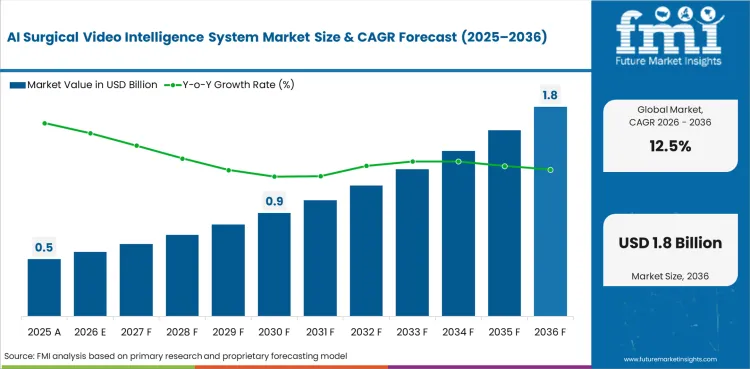
The AI surgical video intelligence system market size was valued at USD 0.44 billion in 2025. Industry valuation is projected to reach USD 0.50 billion in 2026. Global market value is forecast to reach USD 1.63 billion by 2036 at a 12.50% CAGR. As per FMI analysis, there is around USD 1.13 billion in absolute dollar opportunity expected between 2026 and 2036. Video retrieval quality and permissions governance are changing buying priorities across hospitals. Clinical teams and IT owners are evaluating whether indexed video can support review and documentation without creating a second storage-heavy workflow.
Summary of AI Surgical Video Intelligence System Market
- The AI surgical video intelligence system market is forecast to reach USD 1.63 billion by 2036.
- Industry is expected to grow at a CAGR of 12.50% from 2026 to 2036.
- Market valuation was estimated at USD 0.44 billion in 2025.
- Incremental opportunity across the forecast period totals USD 1.13 billion.
- Software platforms are projected to account for 42.0% of component demand in 2026.
- Cloud is expected to contribute 56.0% of deployment demand in 2026.
- Laparoscopy is likely to represent 34.0% of procedure type demand in 2026.
- Hospitals are forecast to hold 68.0% of end-use demand in 2026.
Key Takeaways, Market Size, and Forecast - AI Surgical Video Intelligence System Market
- The AI surgical video intelligence system market was valued at USD 0.44 billion in 2025.
- The market is set to reach USD 0.50 billion by 2026-end and grow at a CAGR of 12.50% between 2026-2036 to reach USD 1.63 billion by 2036.
- Cloud deployment will dominate with a 56.0% share, while hospitals will lead with a 68.0% share.
- The AI surgical video intelligence system market was valued at USD 0.44 billion in 2025.
- By 2036, the market is expected to be worth USD 1.63 billion.
- From 2026 to 2036, the market is projected to expand at a CAGR of 12.50%.
- The market is projected to create an incremental opportunity of USD 1.13 billion between 2026 and 2036.
- In 2026, software platforms are expected to account for 42.0% of the component segment, driven by demand for video retrieval, permissions control, and structured review workflows in hospitals.
- India (14.8%) and China (14.1%) are among the fastest growing markets globally.
AI Surgical Video Intelligence System Market Key Takeaways
| Parameter | Details |
|---|---|
| Market Value (2026) | USD 0.50 billion |
| Forecast Value (2036) | USD 1.63 billion |
| CAGR (2026 to 2036) | 12.50% |
| Estimated Market Value (2025) | USD 0.44 billion |
| Incremental Opportunity | USD 1.13 billion |
| Leading Component | Software platforms (42.0% of component segment) |
| Leading Deployment | Cloud (56.0% of deployment segment) |
| Leading Procedure Type | Laparoscopy (34.0% of procedure type segment) |
| Leading End Use | Hospitals (68.0% of end-use segment) |
| Key Players | Medtronic, Caresyntax, Proximie, Theator, Intuitive Surgical |
Source: Future Market Insights, 2026
Hospitals are evaluating surgical video as a governed review layer across operating room management software and medical imaging software environments. India is projected to lead at 14.8% CAGR followed by China at 14.1% and South Korea at 13.2%. Larger vendors benefit when review workflow, archive control, and implementation discipline can be presented inside one software stack.
AI Surgical Video Intelligence System Market Definition
The AI surgical video intelligence system market covers software-led platforms and related hardware used to capture, structure, store, search, review, and analyze intraoperative video across operating room environments.
AI Surgical Video Intelligence System Market Inclusions
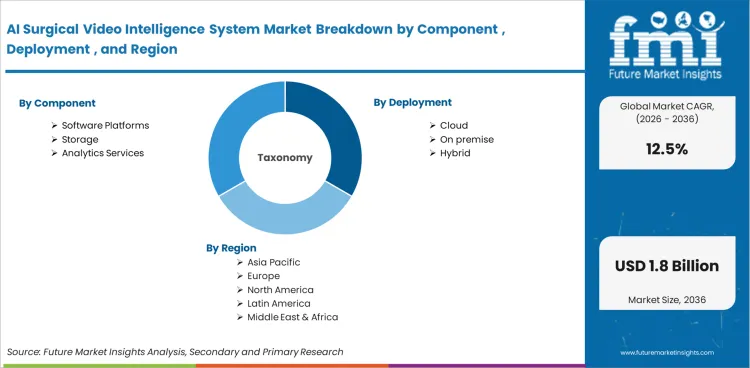
Market scope includes component segmentation across software platforms, capture hardware, storage, and analytics services. Coverage also includes deployment, procedure type, end use, application, and region across the 2026 to 2036 forecast period.
AI Surgical Video Intelligence System Market Exclusions
Scope excludes basic room recording systems without indexing, generic storage platforms without surgical workflow tools, and visualization hardware that does not support structured review or analytics.
AI Surgical Video Intelligence System Market Research Methodology
- Primary Research: FMI analysts interviewed surgical workflow leaders and digital OR product managers across North America, Europe, and Asia.
- Desk Research: Data from health ministries, hospital datasets, and company releases set the baseline parameters.
- Market Sizing and Forecasting: Baseline values come from software and platform attach estimates across procedure-linked video environments, adjusted using digital OR adoption and review workflow expansion.
- Data Validation and Update Cycle: A quarterly data refresh compares projections to vendor disclosures and public procedure or hospital activity indicators.
Growth Drivers for AI Surgical Video Intelligence System Market
- Hospital demand is rising as surgical teams look for video systems that support post-operative review, teaching, documentation, and workflow assessment in a more structured way.
- Searchability, replay quality, and permissions control are lifting software demand because recorded procedures need to function as usable clinical material.
- Hospital modernization in India, China, and South Korea is broadening the installed base for digital operating room tools and structured review systems.
Budget owners are evaluating whether captured video can support review and teaching without creating a second storage-heavy system. Comparisons across artificial intelligence in healthcare and clinical workflow software now focus on search quality, permissions, and post-case usability more than on capture alone. Approval is easier when the system can be framed as a review workflow tool and not another room-level accessory.
Intuitive secured FDA clearance for da Vinci 5 in March 2024 with more than 150 enhancements. New procedure platforms arrive with heavier software expectations from day one. Hospitals comparing solutions against surgical robot procedures and AI-based surgical robots categories are judging whether surgical video can function as a dependable review layer. Rollout slows when archive ownership, privacy review, and post-installation accountability are not assigned clearly.
Distalmotion partnered with Proximie in January 2024 to support the Dexter robotic surgery platform. That move showed how adoption improves once hospitals assign video intelligence to a defined workflow owner. Demand is widening fastest where digital operating room investment is already active across operating room equipment and adjacent software environments. Buying still stalls when the platform arrives as another IT request without clear clinical ownership or retrieval discipline.
Segmental Analysis
- Software platforms account for 42.0% of component demand in 2026 because hospitals can justify spending on retrieval, permissions, replay, and workflow control before replacing hardware.
- Cloud holds 56.0% of deployment demand in 2026 as surgical teams and quality reviewers need shared access to the same case library.
- Laparoscopy leads with 34.0% of procedure type demand in 2026 because video already anchors how these procedures are performed and taught.
Coverage runs across component, deployment, procedure type, end use, application, and region. Software platforms lead the component split while Cloud leads deployment. Laparoscopy and Hospitals hold the top positions in procedure type and end use. Post-op review leads the application view at 31.0%. Review usability and archive governance shape vendor selection more than capture hardware alone.
Insights into the Software Platforms Segment
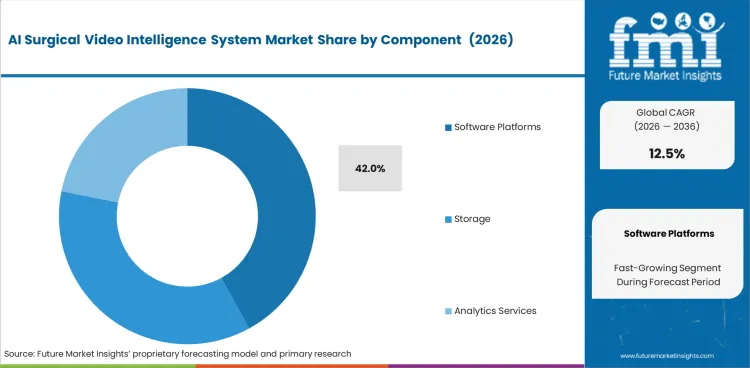
Software platforms are projected to lead the component segment with a 42.0% share in 2026. Their lead comes from search, replay, permissions, tagging, and review workflow control that capture hardware cannot deliver on its own. Buyers comparing options against medical imaging software and adjacent digital surgery tools focus on retrieval quality first. Within the component split, analytics services are expanding faster as hospitals ask vendors to support implementation, indexing discipline, and evidence-oriented use cases. Weak archive structure can leave clinical teams with more footage and no better review discipline.
Insights into the Cloud Segment
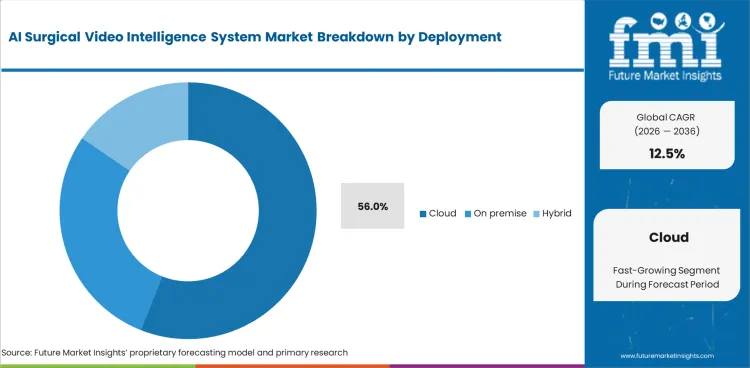
In 2026, Cloud is expected to account for 56.0% of the deployment segment. Shared access matters most for surgical services and quality teams that need the same case library at different workflow points. Hybrid and on-premise models find greater adoption in places where cybersecurity review runs deeper or local data rules slow full migration. Buying is consolidating around vendors that can support multi-room access without creating a separate storage-heavy operating model. Slower migration decisions usually reflect governance and IT sign-off issues more than weak product interest.
Insights into the Laparoscopy Segment
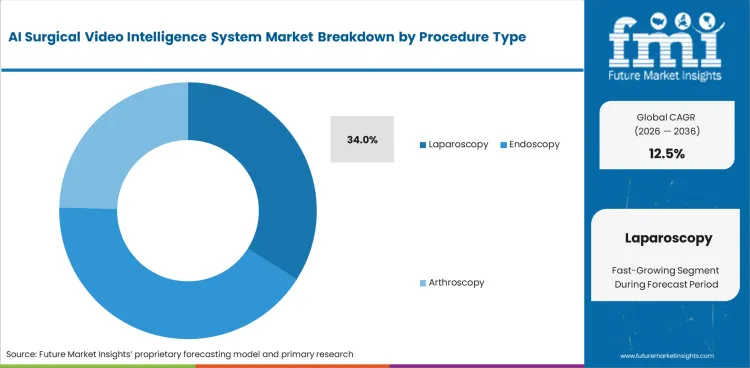
The procedure type segment is expected to lead the industry with a 34% share in 2026. Visual guidance already anchors how these procedures are performed, interpreted, documented, and taught. Hospitals comparing laparoscopic devices and imaging upgrades enter an environment where video is already operationally indispensable. Platform use widens after hospitals establish that first proof point in service lines that depend on video daily. Procedure-linked workflow fit keeps this segment ahead of robotic, endoscopic, and arthroscopic expansion in the near term.
Section 5
Market Drivers and Commercial Restraints
- Review, teaching, and documentation workflows are making searchable surgical video more valuable across hospitals and academic centers.
- Privacy review, storage ownership, and cross-department sign-off slow rollout where one workflow owner is not clearly defined.
- Partnerships and evidence programs are widening the role of surgical video from passive playback toward structured review and quality benchmarking.
Hospitals are moving toward video intelligence because recorded procedures need to function long after the case ends. Searchable structure, governed access, and usable review flow matter more than capture quality alone when enterprise rollout is being evaluated. Internal sign-off slows this category more than lack of clinical interest because surgical leadership, IT teams, privacy functions, and educators review the same platform through different operating lenses.
Review Workflow Ownership Drives Approval
Adoption improves once hospitals assign archive access, review workflow, and post-installation accountability to a defined owner. Software clears approval more easily when the platform supports case discussion and training without asking clinical teams to build a second system around stored footage. Budget scrutiny has moved toward archive usability and search quality because passive storage delivers limited clinical value.
Internal Sign-Off Slows Rollout
Rollout slows when privacy review, information security, education teams, and surgical leadership are not aligned on governance. Large provider networks evaluate the same platform through different operational needs and that stretches buying cycles. Platforms gain traction faster when they fit existing governance structures without imposing heavy change management across departments.
Evidence Programs Expand Platform Use
Caresyntax announced a collaboration with The Jacobs Institute in May 2025 and that pointed to the upside once governance hurdles clear. Procedural data becomes more valuable when it feeds evidence generation and product evaluation instead of sitting unused in storage. That direction overlaps with digital transformation in healthcare budgets where hospitals are looking for workflow value they can defend across administrative and clinical reviews.
Regional and Country Market Performance
- India is anticipated to grow at 14.8% CAGR because hospital modernization and digital operating room investment are widening the installed base for structured video review tools.
- China follows at 14.1% CAGR through 2036 as supportive healthcare AI guidance and large hospital systems broaden the formal space for AI-linked clinical software.
- South Korea posts 13.2% CAGR over the forecast because technology-rich surgical pathways and hospital IT maturity support wider review workflow adoption.
- United States, Germany, the United Kingdom, and Japan grow from larger installed bases with more governance-led buying cycles.
.webp "Top Country Growth Comparison Ai Surgical Video Intelligence System Market Cagr (2026 2036)")
| Country | CAGR |
|---|---|
| India | 14.8% |
| China | 14.1% |
| South Korea | 13.2% |
| Germany | 12.4% |
| United Kingdom | 12.1% |
| United States | 11.6% |
| Japan | 11.0% |
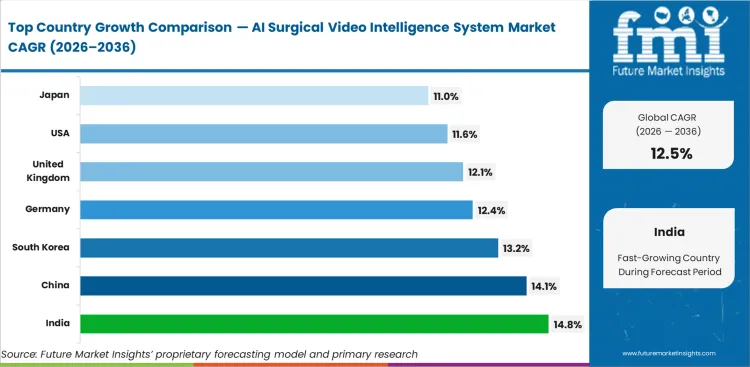
AI surgical video intelligence system demand is projected to grow globally at a CAGR of 12.50% from 2026 to 2036. India leads the tracked country set at 14.8%. China follows at 14.1% while South Korea posts 13.2%. Germany, the United Kingdom, the United States, and Japan expand from a larger installed base with longer approval cycles.
What Is Driving Growth in the United States?
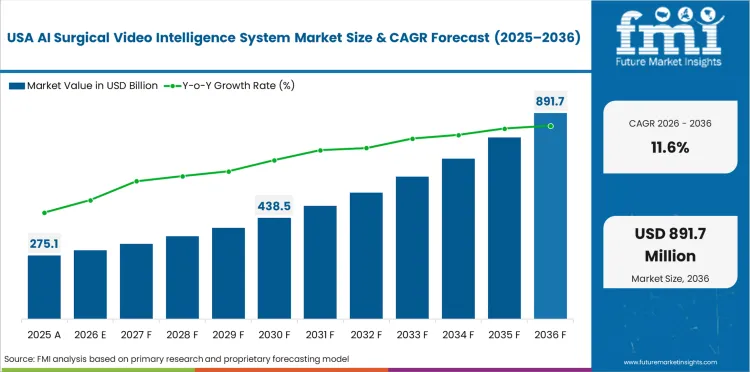
Outpatient case density gives the United States a structural base few markets can match. CMS stated in November 2024 that its CY 2025 payment policies affect about 3,500 hospitals and 6,100 ASCs. Demand for AI surgical video intelligence systems in the United States is expected to rise at a CAGR of 11.6% through 2036.
Large integrated delivery networks, teaching hospitals, and ambulatory networks already manage high procedural throughput and can support multi-site review use cases. Buyers still move cautiously where privacy review and legal oversight are split across departments. Platforms gain traction faster when they fit existing governance structures in large provider networks.
How Is Germany Approaching AI Surgical Video Adoption?
Germany brings a solid base for software-led review because procedure volume and clinical standardization run relatively deep. Destatis tracks the 20 most frequent operations for hospitalized patients in its 2024 hospital dataset. Germany is projected to record a CAGR of 12.4% during the forecast period. University, hospitals and regional care networks can absorb structured review tools when the workflow case is credible. Buyers are less persuaded by broad innovation language than by evidence that retrieval and permissions control will improve everyday case discussion without creating another administrative platform.
What Factors Are Shaping the UK Market?
Elective-care pressure shapes the buying logic in the United Kingdom more than headline technology enthusiasm. NHS England reported 7.61 million waits for procedures and appointments at the end of May 2024. AI surgical video intelligence systems in the United Kingdom are likely to increase at a CAGR of 12.1% through 2036.
Teaching hospitals have piloted video intelligence platforms, but scaling across NHS trusts depends on whether suppliers can show tangible workflow improvement without adding to already heavy administrative loads. Success in early trusts can accelerate adoption when suppliers support review discipline inside overstretched theatre operations.
Why Is India the Fastest-Growing Market?
India's growth case comes from expanding procedural scale and widening hospital modernization rather than from a saturated installed base. AB-PMJAY had authorized 7.37 crore hospital admissions worth Rs. 1 lakh crore by 30 June 2024. Through 2036, AI surgical video intelligence system sales in India are expected to grow at a CAGR of 14.8%.
Private hospital chains and digitally ambitious care networks are driving the first wave of demand. Metro-based tertiary centers create the strongest early opportunity, but wider rollout will depend on whether vendors can keep deployment practical and cost-aware in busy operating environments.
What Is the Outlook for China?
China has room to move quickly, but site-level execution will decide how much of that headroom converts into lasting software use. Healthcare AI guidance clarified 84 application scenarios across the sector in December 2024. China is expected to register 14.1% CAGR in AI surgical video intelligence systems through 2036.
Large public hospital systems and private hospital groups in tier-one cities show concentrated adoption where digital operating rooms are already active. Suppliers that localize implementation discipline will be better positioned than those relying on policy sentiment alone.
How Is Japan’s Mature Market Evolving?
Japan starts from procedural maturity rather than first-install scarcity. National Cancer Center Hospital reported in 2024 that 99% of gastrectomy was performed under laparoscopy or robot assistance. Japan is forecast to post 11.0% CAGR through 2036. Hospitals do not need convincing that AI based video surveillance are crucial. They need proof that another review layer will add teaching value or documentation depth beyond what advanced centers already do. Measured adoption fits a market where sophisticated hospitals examine utility carefully before widening access.
What Is Driving South Korea’s Growth?
Public funding for advanced procedure infrastructure gives South Korea a distinct entry point. Korea's 2024 Ministry of Health and Welfare budget included two units of robotic surgery equipment worth KRW 1.4 billion for epilepsy diagnosis and treatment. Demand for AI surgical video intelligence in South Korea is anticipated to grow at 13.2% CAGR during the study period.
Tertiary hospitals in Seoul and major academic medical centers already support technology-rich surgical pathways. Scale will depend on whether suppliers can move beyond specialist installations and show broader workflow value that administrators can defend across departments.
Competitive Landscape of AI Surgical Video Intelligence System Market
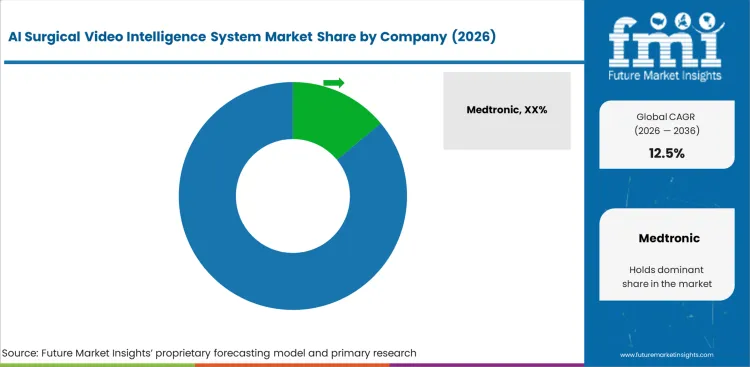
- Competitive positioning is being shaped by software depth, implementation fit, review usability, and evidence-oriented applications rather than installed hardware presence alone.
- Established suppliers benefit from channel reach and room-level credibility, while challengers win when implementation is cleaner and the review burden is lower.
- Partnerships, acquisitions, and evidence programs are pushing the category beyond passive replay toward governed review and workflow analytics.
Vendors that cannot make captured video easier to retrieve, review, and govern will struggle even if their installed hardware footprint is large. Buyers comparing options across operating room equipment and software-led categories want a platform that reduces review burden once daily use begins. Medtronic, Caresyntax, Proximie, Theator, Intuitive Surgical, KARL STORZ, and Olympus all hold visible positions across review, collaboration, workflow, and analytics use cases.
Established suppliers benefit from procurement familiarity and clinical credibility that challengers have to earn. Startups can still win when integration demands are lighter and the product team can explain exactly how the platform improves review workflow for hospitals, educators, and quality teams.
Category direction through 2036 will depend on whether large buyers continue favoring open review-focused platforms or let broader procedure ecosystems absorb more of the software stack. This pattern overlaps with AI in healthcare and digital surgery budgets where hospitals are narrowing software purchases toward practical workflow ownership. Fragmentation is likely to persist in the near term because hospitals, device companies, and specialty programs buy for different operating reasons.
Major Industry Players
- Medtronic, Caresyntax, Proximie, Theator, Intuitive Surgical, KARL STORZ, and Olympus hold visible positions in the market based on software depth and procedure-linked video relevance.
- Enterprise suppliers with stronger implementation discipline and workflow usability carry an advantage in large hospital accounts.
- Challenger vendors can win where teaching, evidence generation, or multi-site review creates a more defined workflow need.
Key Developments in AI Surgical Video Intelligence System Market
- In December 2024, Caresyntax joined the EU AI Pact and aligned its position with ethical AI development standards across healthcare applications.
- In January 2025, Proximie reported a year of growth and added technical capabilities that strengthened healthcare productivity and medtech partnership value.
- In September 2025, Intuitive Surgical introduced Real-Time Surgical Insights for da Vinci 5 including In-Console Video Replay and a Force Gauge.
- In January 2024, KARL STORZ acquired British AI specialist Innersight Labs to strengthen its position in procedure-linked software.
Key Players in the AI Surgical Video Intelligence System Market
Major Global Players
- Medtronic
- Caresyntax
- Proximie
- Theator
- Intuitive Surgical
Other Notable Participants
- KARL STORZ
- Olympus
- Section 9
Scope of the Report
| Metric | Value |
|---|---|
| Quantitative Units | USD 0.50 billion (2026) to USD 1.63 billion (2036) at a CAGR of 12.50% |
| Market Definition | Software-led platforms used to capture, structure, store, search, review, and analyze intraoperative video. |
| Segmentation | By Component
|
| Regions Covered | North America, Western Europe, Asia Pacific |
| Countries Covered | United States, Germany, United Kingdom, Japan, South Korea, China, India |
| Key Companies Profiled | Medtronic, Caresyntax, Proximie, Theator, Intuitive Surgical, KARL STORZ, Olympus |
| Forecast Period | 2026 to 2036 |
| Approach | The niche was modeled as the software and review layer within broader digital operating room and procedure-linked video workflows. |
AI Surgical Video Intelligence System Market by Segments
AI Surgical Video Intelligence System Market Segmented by Component:
- Software platforms
- Capture hardware
- Storage
- Analytics services
AI Surgical Video Intelligence System Market Classified by Deployment:
- Cloud
- On-premise
- Hybrid
AI Surgical Video Intelligence System Market Analyzed by Procedure Type:
- Laparoscopy
- Robotic surgery
- Endoscopy
- Arthroscopy
AI Surgical Video Intelligence System Market Classified by End Use:
- Hospitals
- Ambulatory centers
- Academic centers
AI Surgical Video Intelligence System Market Classified by Application:
- Post-op review
- Workflow analytics
- Training
- Remote collaboration
- Quality benchmarking
Bibliography
- Centers for Medicare & Medicaid Services. (2024, November). CY 2025 Medicare Hospital Outpatient Prospective Payment System and Ambulatory Surgical Center Payment System final rule.
- NHS England. (2024, July). Monthly operational statistics.
- Statistisches Bundesamt. (2025, January). Krankenhauser: Die 20 haufigsten Operationen insgesamt (OPS 5).
- National Cancer Center Hospital, Japan. (2024, January). Department of Gastric Surgery.
- Ministry of Health and Welfare, Republic of Korea. (2024, January). KRW 122,377.9 billion confirmed for MOHW's 2024 budget.
- State Council Information Office, China. (2024, December). China embraces AI-assisted healthcare with caution.
- Ministry of Health and Family Welfare, Government of India. (2024, August). Update on Ayushman Bharat Cards.
- Intuitive Surgical. (2024, March). Intuitive announces FDA clearance of fifth-generation robotic system, da Vinci 5.
- Proximie. (2024, January). Distalmotion announces partnership with Proximie.
- KARL STORZ. (2024, January). MedTech company KARL STORZ acquires British AI specialist Innersight Labs.
This Report Addresses
- Market size across 2025, 2026, and 2036 with a stated 12.50% CAGR.
- Why software platforms and cloud lead the segment structure in 2026.
- How laparoscopy anchors early adoption for review-led video intelligence.
- Why India, China, and South Korea outpace developed markets on growth rate.
- How governance, retrieval quality, and permissions control shape vendor competitiveness.
- Which hospital and academic workflows support budget approval most clearly.
- How evidence programs and workflow analytics widen platform use beyond playback.
- Where privacy review and cross-department sign-off slow adoption.
Frequently Asked Questions
How large is the AI Surgical Video Intelligence System market in 2026?
Demand for AI Surgical Video Intelligence System is estimated at USD 0.50 billion in 2026 across the global market.
What is the forecast for the AI Surgical Video Intelligence System market?
AI Surgical Video Intelligence System revenue is forecast to reach USD 1.63 billion by 2036 at a CAGR of 12.50%.
Which component leads the AI Surgical Video Intelligence System market?
Software platforms lead the component segment and are projected to account for 42.0% share in 2026 because review workflow control gets approved first.
Which deployment model leads the AI Surgical Video Intelligence System market?
Cloud leads deployment demand with 56.0% share in 2026 because multiple workflow teams need shared access to the same case library.
Which procedure type leads the AI Surgical Video Intelligence System market?
Laparoscopy leads the procedure type segment with 34.0% share in 2026 because visual guidance is already central to daily workflow.
Which end use leads the AI Surgical Video Intelligence System market?
Hospitals lead the end-use segment with 68.0% share in 2026 because quality review, IT sign-off, and teaching needs concentrate there.
Which country grows fastest in the AI Surgical Video Intelligence System market?
India posts the fastest tracked growth at 14.8% CAGR through 2036 because hospital modernization is widening the installed base for digital OR tools.
Who are the leading companies in the AI Surgical Video Intelligence System market?
Leading companies in AI Surgical Video Intelligence System include Medtronic, Caresyntax, Proximie, Theator, Intuitive Surgical, KARL STORZ, and Olympus.
Preview the report firsthand - request a free sample
Get SampleGet the brochure for pricing and purchase details.
Get PDFTable of Content
- Executive Summary
- Global Market Outlook
- Demand-side Trends
- Supply-side Trends
- Technology Roadmap Analysis
- Analysis and Recommendations
- Market Overview
- Market Coverage / Taxonomy
- Market Definition / Scope / Limitations
- Research Methodology
- Chapter Orientation
- Analytical Lens and Working Hypotheses
- Market Structure, Signals, and Trend Drivers
- Benchmarking and Cross-market Comparability
- Market Sizing, Forecasting, and Opportunity Mapping
- Research Design and Evidence Framework
- Desk Research Programme (Secondary Evidence)
- Company Annual and Sustainability Reports
- Peer-reviewed Journals and Academic Literature
- Corporate Websites, Product Literature, and Technical Notes
- Earnings Decks and Investor Briefings
- Statutory Filings and Regulatory Disclosures
- Technical White Papers and Standards Notes
- Trade Journals, Industry Magazines, and Analyst Briefs
- Conference Proceedings, Webinars, and Seminar Materials
- Government Statistics Portals and Public Data Releases
- Press Releases and Reputable Media Coverage
- Specialist Newsletters and Curated Briefings
- Additional Desk Sources
- Expert Input and Fieldwork (Primary Evidence)
- Primary Modes
- Qualitative Interviews and Expert Elicitation
- Quantitative Surveys and Structured Data Capture
- Blended Approach
- Why Primary Evidence is Used
- Field Techniques
- Interviews
- Surveys
- Focus Groups
- Observational and In-context Research
- Social and Community Interactions
- Stakeholder Universe Engaged
- C-suite Leaders
- Board Members
- Presidents and Vice Presidents
- R&D and Innovation Heads
- Technical Specialists
- Domain Subject-matter Experts
- Scientists
- Physicians and Other Healthcare Professionals
- Governance, Ethics, and Data Stewardship
- Research Ethics
- Data Integrity and Handling
- Primary Modes
- Tooling, Models, and Reference Databases
- Desk Research Programme (Secondary Evidence)
- Data Engineering and Model Build
- Data Acquisition and Ingestion
- Cleaning, Normalisation, and Verification
- Synthesis, Triangulation, and Analysis
- Quality Assurance and Audit Trail
- Market Background
- Market Dynamics
- Drivers
- Restraints
- Opportunity
- Trends
- Scenario Forecast
- Demand in Optimistic Scenario
- Demand in Likely Scenario
- Demand in Conservative Scenario
- Opportunity Map Analysis
- Product Life Cycle Analysis
- Supply Chain Analysis
- Investment Feasibility Matrix
- Value Chain Analysis
- PESTLE and Porter’s Analysis
- Regulatory Landscape
- Regional Parent Market Outlook
- Production and Consumption Statistics
- Import and Export Statistics
- Market Dynamics
- Global Market Analysis 2021 to 2025 and Forecast, 2026 to 2036
- Historical Market Size Value (USD Million) Analysis, 2021 to 2025
- Current and Future Market Size Value (USD Million) Projections, 2026 to 2036
- Y-o-Y Growth Trend Analysis
- Absolute $ Opportunity Analysis
- Global Market Pricing Analysis 2021 to 2025 and Forecast 2026 to 2036
- Global Market Analysis 2021 to 2025 and Forecast 2026 to 2036, By Component
- Introduction / Key Findings
- Historical Market Size Value (USD Million) Analysis By Component , 2021 to 2025
- Current and Future Market Size Value (USD Million) Analysis and Forecast By Component , 2026 to 2036
- Software Platforms
- Storage
- Analytics Services
- Software Platforms
- Y-o-Y Growth Trend Analysis By Component , 2021 to 2025
- Absolute $ Opportunity Analysis By Component , 2026 to 2036
- Global Market Analysis 2021 to 2025 and Forecast 2026 to 2036, By Deployment
- Introduction / Key Findings
- Historical Market Size Value (USD Million) Analysis By Deployment, 2021 to 2025
- Current and Future Market Size Value (USD Million) Analysis and Forecast By Deployment, 2026 to 2036
- Cloud
- On premise
- Hybrid
- Cloud
- Y-o-Y Growth Trend Analysis By Deployment, 2021 to 2025
- Absolute $ Opportunity Analysis By Deployment, 2026 to 2036
- Global Market Analysis 2021 to 2025 and Forecast 2026 to 2036, By Procedure Type
- Introduction / Key Findings
- Historical Market Size Value (USD Million) Analysis By Procedure Type, 2021 to 2025
- Current and Future Market Size Value (USD Million) Analysis and Forecast By Procedure Type, 2026 to 2036
- Laparoscopy
- Endoscopy
- Arthroscopy
- Laparoscopy
- Y-o-Y Growth Trend Analysis By Procedure Type, 2021 to 2025
- Absolute $ Opportunity Analysis By Procedure Type, 2026 to 2036
- Global Market Analysis 2021 to 2025 and Forecast 2026 to 2036, By Region
- Introduction
- Historical Market Size Value (USD Million) Analysis By Region, 2021 to 2025
- Current Market Size Value (USD Million) Analysis and Forecast By Region, 2026 to 2036
- North America
- Latin America
- Western Europe
- Eastern Europe
- East Asia
- South Asia and Pacific
- Middle East & Africa
- Market Attractiveness Analysis By Region
- North America Market Analysis 2021 to 2025 and Forecast 2026 to 2036, By Country
- Historical Market Size Value (USD Million) Trend Analysis By Market Taxonomy, 2021 to 2025
- Market Size Value (USD Million) Forecast By Market Taxonomy, 2026 to 2036
- By Country
- USA
- Canada
- Mexico
- By Component
- By Deployment
- By Procedure Type
- By Country
- Market Attractiveness Analysis
- By Country
- By Component
- By Deployment
- By Procedure Type
- Key Takeaways
- Latin America Market Analysis 2021 to 2025 and Forecast 2026 to 2036, By Country
- Historical Market Size Value (USD Million) Trend Analysis By Market Taxonomy, 2021 to 2025
- Market Size Value (USD Million) Forecast By Market Taxonomy, 2026 to 2036
- By Country
- Brazil
- Chile
- Rest of Latin America
- By Component
- By Deployment
- By Procedure Type
- By Country
- Market Attractiveness Analysis
- By Country
- By Component
- By Deployment
- By Procedure Type
- Key Takeaways
- Western Europe Market Analysis 2021 to 2025 and Forecast 2026 to 2036, By Country
- Historical Market Size Value (USD Million) Trend Analysis By Market Taxonomy, 2021 to 2025
- Market Size Value (USD Million) Forecast By Market Taxonomy, 2026 to 2036
- By Country
- Germany
- UK
- Italy
- Spain
- France
- Nordic
- BENELUX
- Rest of Western Europe
- By Component
- By Deployment
- By Procedure Type
- By Country
- Market Attractiveness Analysis
- By Country
- By Component
- By Deployment
- By Procedure Type
- Key Takeaways
- Eastern Europe Market Analysis 2021 to 2025 and Forecast 2026 to 2036, By Country
- Historical Market Size Value (USD Million) Trend Analysis By Market Taxonomy, 2021 to 2025
- Market Size Value (USD Million) Forecast By Market Taxonomy, 2026 to 2036
- By Country
- Russia
- Poland
- Hungary
- Balkan & Baltic
- Rest of Eastern Europe
- By Component
- By Deployment
- By Procedure Type
- By Country
- Market Attractiveness Analysis
- By Country
- By Component
- By Deployment
- By Procedure Type
- Key Takeaways
- East Asia Market Analysis 2021 to 2025 and Forecast 2026 to 2036, By Country
- Historical Market Size Value (USD Million) Trend Analysis By Market Taxonomy, 2021 to 2025
- Market Size Value (USD Million) Forecast By Market Taxonomy, 2026 to 2036
- By Country
- China
- Japan
- South Korea
- By Component
- By Deployment
- By Procedure Type
- By Country
- Market Attractiveness Analysis
- By Country
- By Component
- By Deployment
- By Procedure Type
- Key Takeaways
- South Asia and Pacific Market Analysis 2021 to 2025 and Forecast 2026 to 2036, By Country
- Historical Market Size Value (USD Million) Trend Analysis By Market Taxonomy, 2021 to 2025
- Market Size Value (USD Million) Forecast By Market Taxonomy, 2026 to 2036
- By Country
- India
- ASEAN
- Australia & New Zealand
- Rest of South Asia and Pacific
- By Component
- By Deployment
- By Procedure Type
- By Country
- Market Attractiveness Analysis
- By Country
- By Component
- By Deployment
- By Procedure Type
- Key Takeaways
- Middle East & Africa Market Analysis 2021 to 2025 and Forecast 2026 to 2036, By Country
- Historical Market Size Value (USD Million) Trend Analysis By Market Taxonomy, 2021 to 2025
- Market Size Value (USD Million) Forecast By Market Taxonomy, 2026 to 2036
- By Country
- Kingdom of Saudi Arabia
- Other GCC Countries
- Turkiye
- South Africa
- Other African Union
- Rest of Middle East & Africa
- By Component
- By Deployment
- By Procedure Type
- By Country
- Market Attractiveness Analysis
- By Country
- By Component
- By Deployment
- By Procedure Type
- Key Takeaways
- Key Countries Market Analysis
- USA
- Pricing Analysis
- Market Share Analysis, 2025
- By Component
- By Deployment
- By Procedure Type
- Canada
- Pricing Analysis
- Market Share Analysis, 2025
- By Component
- By Deployment
- By Procedure Type
- Mexico
- Pricing Analysis
- Market Share Analysis, 2025
- By Component
- By Deployment
- By Procedure Type
- Brazil
- Pricing Analysis
- Market Share Analysis, 2025
- By Component
- By Deployment
- By Procedure Type
- Chile
- Pricing Analysis
- Market Share Analysis, 2025
- By Component
- By Deployment
- By Procedure Type
- Germany
- Pricing Analysis
- Market Share Analysis, 2025
- By Component
- By Deployment
- By Procedure Type
- UK
- Pricing Analysis
- Market Share Analysis, 2025
- By Component
- By Deployment
- By Procedure Type
- Italy
- Pricing Analysis
- Market Share Analysis, 2025
- By Component
- By Deployment
- By Procedure Type
- Spain
- Pricing Analysis
- Market Share Analysis, 2025
- By Component
- By Deployment
- By Procedure Type
- France
- Pricing Analysis
- Market Share Analysis, 2025
- By Component
- By Deployment
- By Procedure Type
- India
- Pricing Analysis
- Market Share Analysis, 2025
- By Component
- By Deployment
- By Procedure Type
- ASEAN
- Pricing Analysis
- Market Share Analysis, 2025
- By Component
- By Deployment
- By Procedure Type
- Australia & New Zealand
- Pricing Analysis
- Market Share Analysis, 2025
- By Component
- By Deployment
- By Procedure Type
- China
- Pricing Analysis
- Market Share Analysis, 2025
- By Component
- By Deployment
- By Procedure Type
- Japan
- Pricing Analysis
- Market Share Analysis, 2025
- By Component
- By Deployment
- By Procedure Type
- South Korea
- Pricing Analysis
- Market Share Analysis, 2025
- By Component
- By Deployment
- By Procedure Type
- Russia
- Pricing Analysis
- Market Share Analysis, 2025
- By Component
- By Deployment
- By Procedure Type
- Poland
- Pricing Analysis
- Market Share Analysis, 2025
- By Component
- By Deployment
- By Procedure Type
- Hungary
- Pricing Analysis
- Market Share Analysis, 2025
- By Component
- By Deployment
- By Procedure Type
- Kingdom of Saudi Arabia
- Pricing Analysis
- Market Share Analysis, 2025
- By Component
- By Deployment
- By Procedure Type
- Turkiye
- Pricing Analysis
- Market Share Analysis, 2025
- By Component
- By Deployment
- By Procedure Type
- South Africa
- Pricing Analysis
- Market Share Analysis, 2025
- By Component
- By Deployment
- By Procedure Type
- USA
- Market Structure Analysis
- Competition Dashboard
- Competition Benchmarking
- Market Share Analysis of Top Players
- By Regional
- By Component
- By Deployment
- By Procedure Type
- Competition Analysis
- Competition Deep Dive
- Medtronic
- Overview
- Product Portfolio
- Profitability by Market Segments (Product/Age /Sales Channel/Region)
- Sales Footprint
- Strategy Overview
- Marketing Strategy
- Product Strategy
- Channel Strategy
- Caresyntax
- Proximie
- Theator
- Intuitive Surgical
- KARL STORZ
- Olympus
- Medtronic
- Competition Deep Dive
- Assumptions & Acronyms Used


