

- Industry Size (2025)
- USD 3.8 Bn
- Forecast (2035)
- USD 6.7 Bn
- CAGR (2025 to 2035)
- 5.7%
Aircraft Galley Systems Market Size and Share Forecast Outlook 2025 to 2035
The Aircraft Galley Systems Market is estimated to be valued at USD 3.8 billion in 2025 and is projected to reach USD 6.7 billion by 2035, registering a compound annual growth rate (CAGR) of 5.7% over the forecast period.
Quick Stats for Aircraft Galley Systems Market
- Aircraft Galley Systems Market Value (2025): USD 3.8 billion
- Aircraft Galley Systems Market Forecast Value (2035): USD 6.7 billion
- Aircraft Galley Systems Market Forecast CAGR: 5.7%
- Leading Segment in Aircraft Galley Systems Market in 2025: Galleys (32.5%)
- Key Growth Regions in Aircraft Galley Systems Market: North America, Asia-Pacific, Europe
- Top Key Players in Aircraft Galley Systems Market: Collins Aerospace (RTX Corporation), Safran SA, AVIC Cabin Systems Limited, JAMCO Corporation, Diehl Stiftung & Co. KG, Bucher Leichtbau AG, Aerolux Ltd., Miller Fabrication & Welding, Inc., Korita Aviation (Direct Aviation), Dynamo Aviation Inc., Turkish Airlines Technic Inc.
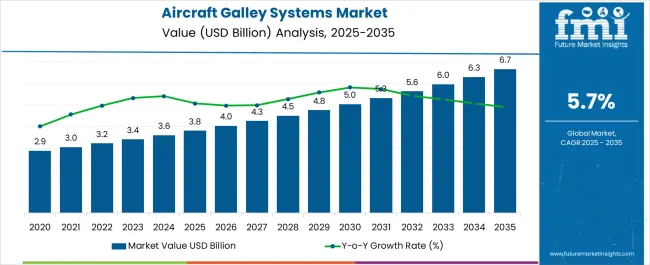
Aircraft Galley Systems Market Key Takeaways
| Metric | Value |
|---|---|
| Aircraft Galley Systems Market Estimated Value in (2025 E) | USD 3.8 billion |
| Aircraft Galley Systems Market Forecast Value in (2035 F) | USD 6.7 billion |
| Forecast CAGR (2025 to 2035) | 5.7% |
Why is the Aircraft Galley Systems Market Growing?
The Aircraft Galley Systems market is experiencing significant growth, driven by the increasing demand for modern and efficient onboard food and beverage management solutions across commercial airlines. Growth in passenger air traffic, expansion of airline fleets, and the focus on enhancing in-flight passenger experiences are key factors supporting adoption. Technological advancements in galley systems, including modular designs, space optimization, and automation for meal preparation and storage, are improving operational efficiency and reducing turnaround times.
Airlines are increasingly prioritizing lightweight, durable, and energy-efficient galley systems to reduce fuel consumption and operational costs. The integration of smart features, such as temperature control, energy management, and remote monitoring, is further enhancing the value proposition for airline operators.
Regulatory compliance, safety standards, and the growing need for customization based on aircraft type are shaping market demand With continued fleet modernization, expansion of commercial routes, and emphasis on passenger comfort, the Aircraft Galley Systems market is expected to maintain steady growth, supported by innovations in design, efficiency, and adaptability for different aircraft configurations.
Segmental Analysis
The aircraft galley systems market is segmented by product type, aircraft type, sales channel, and geographic regions. By product type, aircraft galley systems market is divided into Galleys, Galley Inserts, Galley Air Chillers, Trash Compactor, and Others. In terms of aircraft type, aircraft galley systems market is classified into Wide Body Aircraft, Narrow Body Aircraft, and Very Large Aircraft. Based on sales channel, aircraft galley systems market is segmented into OEM and Aftermarket. Regionally, the aircraft galley systems industry is classified into North America, Latin America, Western Europe, Eastern Europe, Balkan & Baltic Countries, Russia & Belarus, Central Asia, East Asia, South Asia & Pacific, and the Middle East & Africa.
Insights into the Galleys Product Type Segment
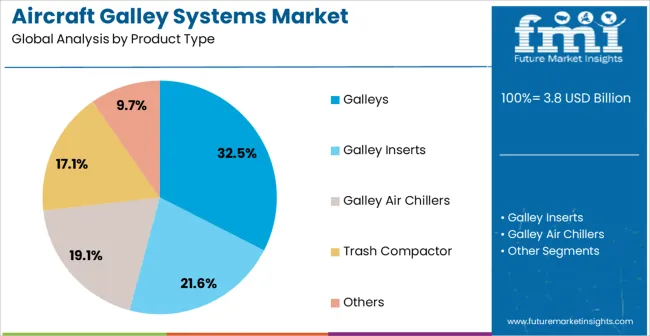
The galleys product type segment is projected to hold 32.5% of the market revenue in 2025, establishing it as the leading product category. Growth in this segment is being driven by the need for modular and flexible galley units that optimize space while supporting high operational efficiency in airline catering services. Galleys allow for better integration of food storage, heating, and preparation functions, improving in-flight service quality and reducing labor requirements.
The adoption of lightweight, durable materials and energy-efficient designs enhances fuel efficiency and lowers operating costs, which further supports market demand. Airlines are increasingly deploying galleys that can be customized based on aircraft configuration and service requirements.
Proven reliability, ease of maintenance, and compliance with safety regulations have strengthened preference for galleys among commercial operators As airline networks expand and passenger expectations increase, the galleys segment is expected to maintain its market leadership, driven by the need for operational efficiency, design flexibility, and integration with advanced aircraft systems.
Insights into the Wide Body Aircraft Segment
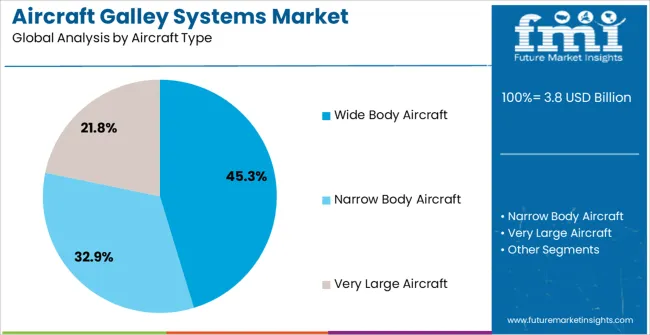
The wide body aircraft segment is anticipated to account for 45.3% of the market revenue in 2025, making it the largest aircraft type category. Growth is being supported by the increasing number of long-haul flights and the expansion of airline fleets operating wide body aircraft, which require advanced galley systems to efficiently manage onboard food and beverage operations.
Wide body aircraft offer greater space for modular galley configurations, enabling airlines to provide high-quality in-flight services while optimizing storage and preparation areas. The deployment of energy-efficient and lightweight galley units in wide body aircraft further reduces fuel consumption and operating costs.
Regulatory standards, passenger expectations, and airline preferences for enhanced service delivery reinforce adoption As airline operators focus on optimizing operational efficiency, safety, and passenger satisfaction, wide body aircraft continue to dominate galley system installations, driving the segment’s leading market share.
Insights into the OEM Sales Channel Segment
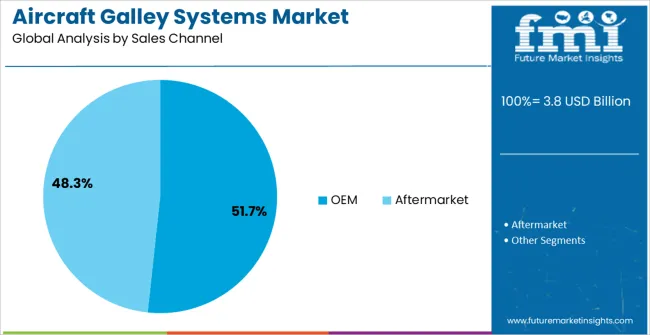
The OEM sales channel segment is projected to hold 51.7% of the market revenue in 2025, establishing it as the leading sales channel. Growth is being driven by airlines’ preference for original equipment manufacturer partnerships to ensure high-quality, reliable, and compliant galley systems that integrate seamlessly with aircraft designs.
OEM solutions provide airlines with customized and certified systems, enabling efficient installation, maintenance, and lifecycle support. Collaboration with OEMs allows operators to access the latest technology, innovative designs, and performance guarantees, reducing operational risks.
Airlines increasingly rely on OEM-supplied galleys to meet stringent safety standards and optimize in-flight service capabilities As demand for advanced, durable, and energy-efficient galley systems rises, the OEM channel is expected to maintain its dominant position, supported by long-term partnerships, certification compliance, and the need for integrated, high-performance onboard solutions.
Market Overview
Aircraft Galley Systems Market Overview
In the past, aircraft galley systems were primarily utilized for the cabin staff to heat up the water and food items. But nowadays, galley systems are the nerve centre of a cabin crew operations, galley systems have continue to meet strict weight and design criteria, in order to ensure that cabin space is a safe and well optimised environment.
Concentrating on the convenience and luxury of the people, it’s the commonplace for the galleys to boast the luxuries such as drinks chillers, espresso machines, and steam ovens along with the high performance drinks chillers. Aircraft galley systems are widely utilized in the various type of aircrafts such as commercial as well as military aircrafts.
Airline companies and aircraft galley system manufacturers consider that galley systems can have a significant effect on traveller’s flight experience.
There are various types of aircraft galley systems are available in the market which include galleys, galley inserts, galley air chillers etc. Galley inserts are utilized to cater the wide range of passengers. Galley inserts include a various luxurious items such as espresso machines, wine chiller inserts etc. With the help of these products, cabin staff can provide a memorable meal in the flight to the passengers.
Analysis of Aircraft Galley Systems Market By Key Countries
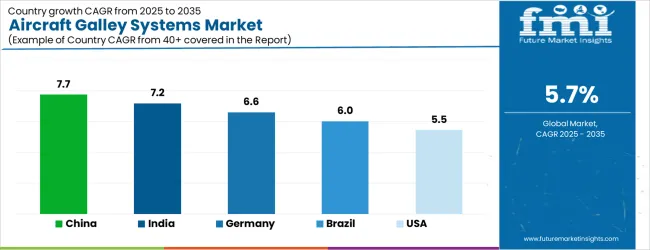
| Country | CAGR |
|---|---|
| China | 7.7% |
| India | 7.2% |
| Germany | 6.6% |
| Brazil | 6.0% |
| USA | 5.5% |
| UK | 4.9% |
| Japan | 4.3% |
Country-wise Analysis
The Aircraft Galley Systems Market is expected to register a CAGR of 5.7% during the forecast period, exhibiting varied country level momentum. China leads with the highest CAGR of 7.7%, followed by India at 7.2%. Developed markets such as Germany, France, and the UK continue to expand steadily, while the USA is likely to grow at consistent rates. Japan posts the lowest CAGR at 4.3%, yet still underscores a broadly positive trajectory for the global Aircraft Galley Systems Market. In 2024, Germany held a dominant revenue in the Western Europe market and is expected to grow with a CAGR of 6.6%. The USA Aircraft Galley Systems Market is estimated to be valued at USD 1.3 billion in 2025 and is anticipated to reach a valuation of USD 1.3 billion by 2035. Sales are projected to rise at a CAGR of 0.0% over the forecast period between 2025 and 2035. While Japan and South Korea markets are estimated to be valued at USD 172.0 million and USD 101.5 million respectively in 2025.
Key Players in the Aircraft Galley Systems Market
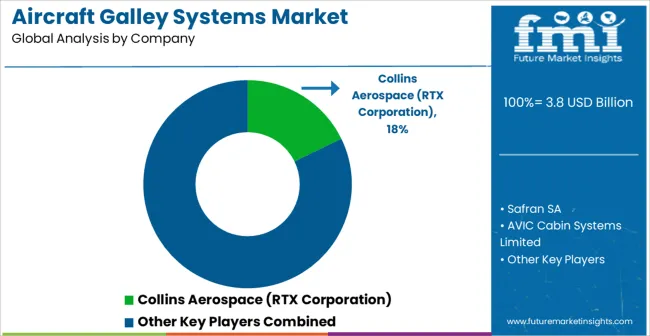
- Collins Aerospace (RTX Corporation)
- Safran SA
- AVIC Cabin Systems Limited
- JAMCO Corporation
- Diehl Stiftung & Co. KG
- Bucher Leichtbau AG
- Aerolux Ltd.
- Miller Fabrication & Welding, Inc.
- Korita Aviation (Direct Aviation)
- Dynamo Aviation Inc.
- Turkish Airlines Technic Inc.
Scope of the Report
| Item | Value |
|---|---|
| Quantitative Units | USD 3.8 Billion |
| Product Type | Galleys, Galley Inserts, Galley Air Chillers, Trash Compactor, and Others |
| Aircraft Type | Wide Body Aircraft, Narrow Body Aircraft, and Very Large Aircraft |
| Sales Channel | OEM and Aftermarket |
| Regions Covered | North America, Europe, Asia-Pacific, Latin America, Middle East & Africa |
| Country Covered | United States, Canada, Germany, France, United Kingdom, China, Japan, India, Brazil, South Africa |
| Key Companies Profiled | Collins Aerospace (RTX Corporation), Safran SA, AVIC Cabin Systems Limited, JAMCO Corporation, Diehl Stiftung & Co. KG, Bucher Leichtbau AG, Aerolux Ltd., Miller Fabrication & Welding, Inc., Korita Aviation (Direct Aviation), Dynamo Aviation Inc., and Turkish Airlines Technic Inc. |
Aircraft Galley Systems Market by Segments
Product Type:
- Galleys
- Galley Inserts
- Galley Air Chillers
- Trash Compactor
- Others
Aircraft Type:
- Wide Body Aircraft
- Narrow Body Aircraft
- Very Large Aircraft
Sales Channel:
- OEM
- Aftermarket
Region:
- North America
- USA
- Canada
- Mexico
- Latin America
- Brazil
- Chile
- Rest of Latin America
- Western Europe
- Germany
- UK
- Italy
- Spain
- France
- Nordic
- BENELUX
- Rest of Western Europe
- Eastern Europe
- Russia
- Poland
- Hungary
- Balkan & Baltic
- Rest of Eastern Europe
- East Asia
- China
- Japan
- South Korea
- South Asia and Pacific
- India
- ASEAN
- Australia & New Zealand
- Rest of South Asia and Pacific
- Middle East & Africa
- Kingdom of Saudi Arabia
- Other GCC Countries
- Turkiye
- South Africa
- Other African Union
- Rest of Middle East & Africa
Frequently Asked Questions
How big is the aircraft galley systems market in 2025?
The global aircraft galley systems market is estimated to be valued at USD 3.8 billion in 2025.
What will be the size of aircraft galley systems market in 2035?
The market size for the aircraft galley systems market is projected to reach USD 6.7 billion by 2035.
How much will be the aircraft galley systems market growth between 2025 and 2035?
The aircraft galley systems market is expected to grow at a 5.7% CAGR between 2025 and 2035.
What are the key product types in the aircraft galley systems market?
The key product types in aircraft galley systems market are galleys, galley inserts, galley air chillers, trash compactor and others.
Which aircraft type segment to contribute significant share in the aircraft galley systems market in 2025?
In terms of aircraft type, wide body aircraft segment to command 45.3% share in the aircraft galley systems market in 2025.
Preview the report firsthand - request a free sample
Get SampleGet the brochure for pricing and purchase details.
Get PDFTable of Content
- Executive Summary
- Global Market Outlook
- Demand-side Trends
- Supply-side Trends
- Technology Roadmap Analysis
- Analysis and Recommendations
- Market Overview
- Market Coverage / Taxonomy
- Market Definition / Scope / Limitations
- Market Background
- Market Dynamics
- Drivers
- Restraints
- Opportunity
- Trends
- Scenario Forecast
- Demand in Optimistic Scenario
- Demand in Likely Scenario
- Demand in Conservative Scenario
- Opportunity Map Analysis
- Product Life Cycle Analysis
- Supply Chain Analysis
- Investment Feasibility Matrix
- Value Chain Analysis
- PESTLE and Porter’s Analysis
- Regulatory Landscape
- Regional Parent Market Outlook
- Production and Consumption Statistics
- Import and Export Statistics
- Market Dynamics
- Global Market Analysis 2020 to 2024 and Forecast, 2025 to 2035
- Historical Market Size Value (USD Million) Analysis, 2020 to 2024
- Current and Future Market Size Value (USD Million) Projections, 2025 to 2035
- Y-o-Y Growth Trend Analysis
- Absolute $ Opportunity Analysis
- Global Market Pricing Analysis 2020 to 2024 and Forecast 2025 to 2035
- Global Market Analysis 2020 to 2024 and Forecast 2025 to 2035, By Product Type
- Introduction / Key Findings
- Historical Market Size Value (USD Million) Analysis By Product Type , 2020 to 2024
- Current and Future Market Size Value (USD Million) Analysis and Forecast By Product Type , 2025 to 2035
- Galleys
- Galley Inserts
- Galley Air Chillers
- Trash Compactor
- Others
- Y-o-Y Growth Trend Analysis By Product Type , 2020 to 2024
- Absolute $ Opportunity Analysis By Product Type , 2025 to 2035
- Global Market Analysis 2020 to 2024 and Forecast 2025 to 2035, By Aircraft Type
- Introduction / Key Findings
- Historical Market Size Value (USD Million) Analysis By Aircraft Type, 2020 to 2024
- Current and Future Market Size Value (USD Million) Analysis and Forecast By Aircraft Type, 2025 to 2035
- Wide Body Aircraft
- Narrow Body Aircraft
- Very Large Aircraft
- Y-o-Y Growth Trend Analysis By Aircraft Type, 2020 to 2024
- Absolute $ Opportunity Analysis By Aircraft Type, 2025 to 2035
- Global Market Analysis 2020 to 2024 and Forecast 2025 to 2035, By Sales Channel
- Introduction / Key Findings
- Historical Market Size Value (USD Million) Analysis By Sales Channel, 2020 to 2024
- Current and Future Market Size Value (USD Million) Analysis and Forecast By Sales Channel, 2025 to 2035
- OEM
- Aftermarket
- Y-o-Y Growth Trend Analysis By Sales Channel, 2020 to 2024
- Absolute $ Opportunity Analysis By Sales Channel, 2025 to 2035
- Global Market Analysis 2020 to 2024 and Forecast 2025 to 2035, By Region
- Introduction
- Historical Market Size Value (USD Million) Analysis By Region, 2020 to 2024
- Current Market Size Value (USD Million) Analysis and Forecast By Region, 2025 to 2035
- North America
- Latin America
- Western Europe
- Eastern Europe
- East Asia
- South Asia and Pacific
- Middle East & Africa
- Market Attractiveness Analysis By Region
- North America Market Analysis 2020 to 2024 and Forecast 2025 to 2035, By Country
- Historical Market Size Value (USD Million) Trend Analysis By Market Taxonomy, 2020 to 2024
- Market Size Value (USD Million) Forecast By Market Taxonomy, 2025 to 2035
- By Country
- USA
- Canada
- Mexico
- By Product Type
- By Aircraft Type
- By Sales Channel
- By Country
- Market Attractiveness Analysis
- By Country
- By Product Type
- By Aircraft Type
- By Sales Channel
- Key Takeaways
- Latin America Market Analysis 2020 to 2024 and Forecast 2025 to 2035, By Country
- Historical Market Size Value (USD Million) Trend Analysis By Market Taxonomy, 2020 to 2024
- Market Size Value (USD Million) Forecast By Market Taxonomy, 2025 to 2035
- By Country
- Brazil
- Chile
- Rest of Latin America
- By Product Type
- By Aircraft Type
- By Sales Channel
- By Country
- Market Attractiveness Analysis
- By Country
- By Product Type
- By Aircraft Type
- By Sales Channel
- Key Takeaways
- Western Europe Market Analysis 2020 to 2024 and Forecast 2025 to 2035, By Country
- Historical Market Size Value (USD Million) Trend Analysis By Market Taxonomy, 2020 to 2024
- Market Size Value (USD Million) Forecast By Market Taxonomy, 2025 to 2035
- By Country
- Germany
- UK
- Italy
- Spain
- France
- Nordic
- BENELUX
- Rest of Western Europe
- By Product Type
- By Aircraft Type
- By Sales Channel
- By Country
- Market Attractiveness Analysis
- By Country
- By Product Type
- By Aircraft Type
- By Sales Channel
- Key Takeaways
- Eastern Europe Market Analysis 2020 to 2024 and Forecast 2025 to 2035, By Country
- Historical Market Size Value (USD Million) Trend Analysis By Market Taxonomy, 2020 to 2024
- Market Size Value (USD Million) Forecast By Market Taxonomy, 2025 to 2035
- By Country
- Russia
- Poland
- Hungary
- Balkan & Baltic
- Rest of Eastern Europe
- By Product Type
- By Aircraft Type
- By Sales Channel
- By Country
- Market Attractiveness Analysis
- By Country
- By Product Type
- By Aircraft Type
- By Sales Channel
- Key Takeaways
- East Asia Market Analysis 2020 to 2024 and Forecast 2025 to 2035, By Country
- Historical Market Size Value (USD Million) Trend Analysis By Market Taxonomy, 2020 to 2024
- Market Size Value (USD Million) Forecast By Market Taxonomy, 2025 to 2035
- By Country
- China
- Japan
- South Korea
- By Product Type
- By Aircraft Type
- By Sales Channel
- By Country
- Market Attractiveness Analysis
- By Country
- By Product Type
- By Aircraft Type
- By Sales Channel
- Key Takeaways
- South Asia and Pacific Market Analysis 2020 to 2024 and Forecast 2025 to 2035, By Country
- Historical Market Size Value (USD Million) Trend Analysis By Market Taxonomy, 2020 to 2024
- Market Size Value (USD Million) Forecast By Market Taxonomy, 2025 to 2035
- By Country
- India
- ASEAN
- Australia & New Zealand
- Rest of South Asia and Pacific
- By Product Type
- By Aircraft Type
- By Sales Channel
- By Country
- Market Attractiveness Analysis
- By Country
- By Product Type
- By Aircraft Type
- By Sales Channel
- Key Takeaways
- Middle East & Africa Market Analysis 2020 to 2024 and Forecast 2025 to 2035, By Country
- Historical Market Size Value (USD Million) Trend Analysis By Market Taxonomy, 2020 to 2024
- Market Size Value (USD Million) Forecast By Market Taxonomy, 2025 to 2035
- By Country
- Kingdom of Saudi Arabia
- Other GCC Countries
- Turkiye
- South Africa
- Other African Union
- Rest of Middle East & Africa
- By Product Type
- By Aircraft Type
- By Sales Channel
- By Country
- Market Attractiveness Analysis
- By Country
- By Product Type
- By Aircraft Type
- By Sales Channel
- Key Takeaways
- Key Countries Market Analysis
- USA
- Pricing Analysis
- Market Share Analysis, 2024
- By Product Type
- By Aircraft Type
- By Sales Channel
- Canada
- Pricing Analysis
- Market Share Analysis, 2024
- By Product Type
- By Aircraft Type
- By Sales Channel
- Mexico
- Pricing Analysis
- Market Share Analysis, 2024
- By Product Type
- By Aircraft Type
- By Sales Channel
- Brazil
- Pricing Analysis
- Market Share Analysis, 2024
- By Product Type
- By Aircraft Type
- By Sales Channel
- Chile
- Pricing Analysis
- Market Share Analysis, 2024
- By Product Type
- By Aircraft Type
- By Sales Channel
- Germany
- Pricing Analysis
- Market Share Analysis, 2024
- By Product Type
- By Aircraft Type
- By Sales Channel
- UK
- Pricing Analysis
- Market Share Analysis, 2024
- By Product Type
- By Aircraft Type
- By Sales Channel
- Italy
- Pricing Analysis
- Market Share Analysis, 2024
- By Product Type
- By Aircraft Type
- By Sales Channel
- Spain
- Pricing Analysis
- Market Share Analysis, 2024
- By Product Type
- By Aircraft Type
- By Sales Channel
- France
- Pricing Analysis
- Market Share Analysis, 2024
- By Product Type
- By Aircraft Type
- By Sales Channel
- India
- Pricing Analysis
- Market Share Analysis, 2024
- By Product Type
- By Aircraft Type
- By Sales Channel
- ASEAN
- Pricing Analysis
- Market Share Analysis, 2024
- By Product Type
- By Aircraft Type
- By Sales Channel
- Australia & New Zealand
- Pricing Analysis
- Market Share Analysis, 2024
- By Product Type
- By Aircraft Type
- By Sales Channel
- China
- Pricing Analysis
- Market Share Analysis, 2024
- By Product Type
- By Aircraft Type
- By Sales Channel
- Japan
- Pricing Analysis
- Market Share Analysis, 2024
- By Product Type
- By Aircraft Type
- By Sales Channel
- South Korea
- Pricing Analysis
- Market Share Analysis, 2024
- By Product Type
- By Aircraft Type
- By Sales Channel
- Russia
- Pricing Analysis
- Market Share Analysis, 2024
- By Product Type
- By Aircraft Type
- By Sales Channel
- Poland
- Pricing Analysis
- Market Share Analysis, 2024
- By Product Type
- By Aircraft Type
- By Sales Channel
- Hungary
- Pricing Analysis
- Market Share Analysis, 2024
- By Product Type
- By Aircraft Type
- By Sales Channel
- Kingdom of Saudi Arabia
- Pricing Analysis
- Market Share Analysis, 2024
- By Product Type
- By Aircraft Type
- By Sales Channel
- Turkiye
- Pricing Analysis
- Market Share Analysis, 2024
- By Product Type
- By Aircraft Type
- By Sales Channel
- South Africa
- Pricing Analysis
- Market Share Analysis, 2024
- By Product Type
- By Aircraft Type
- By Sales Channel
- USA
- Market Structure Analysis
- Competition Dashboard
- Competition Benchmarking
- Market Share Analysis of Top Players
- By Regional
- By Product Type
- By Aircraft Type
- By Sales Channel
- Competition Analysis
- Competition Deep Dive
- Collins Aerospace (RTX Corporation)
- Overview
- Product Portfolio
- Profitability by Market Segments (Product/Age /Sales Channel/Region)
- Sales Footprint
- Strategy Overview
- Marketing Strategy
- Product Strategy
- Channel Strategy
- Safran SA
- AVIC Cabin Systems Limited
- JAMCO Corporation
- Diehl Stiftung & Co. KG
- Bucher Leichtbau AG
- Aerolux Ltd.
- Miller Fabrication & Welding, Inc.
- Korita Aviation (Direct Aviation)
- Dynamo Aviation Inc.
- Turkish Airlines Technic Inc.
- Collins Aerospace (RTX Corporation)
- Competition Deep Dive
- Assumptions & Acronyms Used
- Research Methodology


