

- Industry Size (2026)
- USD 276 Mn
- Forecast (2036)
- USD 1116.6 Mn
- CAGR (2026 to 2036)
- 15.0%
AI Powered Surgical Monitor Market Forecast and Outlook 2026 to 2036
The AI powered surgical monitor market is projected at USD 276 million in 2026 and is expected to reach USD 1,116.6 million by 2036, representing a CAGR of 15%. Integrated OR platforms account for 50% of the product segment, primarily supporting intraoperative applications (60%). Hospitals dominate end-user adoption at 70%, with ambulatory surgical centers and workflow analytics contributing to growth. Training modules and OEM partnerships enhance integration. Leading companies include Stryker, GE HealthCare, Philips, Medtronic, and Karl Storz.
Growth is fueled by rising demand for precision surgery, real-time decision support, and enhanced visualization. AI-enabled monitors improve surgical outcomes, reduce errors, and streamline intraoperative workflows. Adoption is accelerating in technologically advanced hospitals and high-volume surgical centers. The combination of integrated platforms with standalone and analytics-enabled monitors allows flexibility across surgical specialties. Continuous software upgrades, interoperability with hospital IT systems, and strategic OEM collaborations drive sustained market expansion over the forecast period.
Quick Stats for AI Powered Surgical Monitor Market
- AI Powered Surgical Monitor Market Value (2026): USD 276 million
- AI Powered Surgical Monitor Market Forecast Value (2036): USD 1,116.6 million
- AI Powered Surgical Monitor Market Forecast CAGR: 15.0%
- Leading Type in AI Powered Surgical Monitor Market: Integrated OR Platforms
- Key Growth Regions in AI Powered Surgical Monitor Market: North America, Europe, and Asia Pacific
- Top Players in AI Powered Surgical Monitor Market: Stryker, GE HealthCare, Philips, Medtronic, Karl Storz
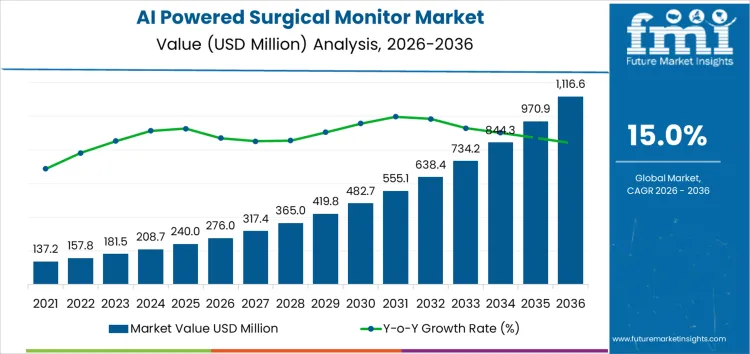
What is the Growth Forecast for the AI-Powered Surgical Monitor Market through 2036?
From 2026 to 2031, the AI-powered surgical monitor market grows from USD 276 million to approximately USD 482.7 million, representing the early to mid-stage adoption phase. Annual increments rise from USD 36 million in 2026 to USD 63 million in 2031. Growth is concentrated in hospitals, ambulatory surgical centers, and specialty clinics adopting AI-assisted visualization, predictive analytics, and real-time procedural monitoring to improve surgical outcomes. North America and Europe account for roughly 65% of early adoption, supported by regulatory approvals, pilot deployments in high-volume surgical facilities, and integration with robotic-assisted surgery platforms. Emerging uptake in Asia Pacific begins with high-value urban hospitals and advanced surgical centers.
Between 2031 and 2036, the market expands from roughly USD 482.7 million to USD 1,116.6 million, illustrating the late adoption and saturation phase. Annual increments increase from USD 63 million to USD 145 million by 2036. Saturation is first reached in developed regions by 2034, where AI-assisted monitoring becomes standard in operating rooms. Growth in Asia Pacific, Latin America, and the Middle East drives remaining expansion. Early adoption relied on selective high-value institutions, while later growth reflects full-scale deployment, portfolio-wide integration, and normalized adoption across global surgical facilities.
AI Powered Surgical Monitor Market Key Takeaways
| Metric | Value |
|---|---|
| Market Value (2026) | USD 276 million |
| Forecast Value (2036) | USD 1,116.6 million |
| Forecast CAGR (2026 to 2036) | 15.0% |
Why Is Demand Growing in the AI Powered Surgical Monitor Market?
Early demand for AI powered surgical monitors stemmed from practical limits in traditional intraoperative visualization systems rather than broad technology adoption goals. Conventional surgical displays presented raw imaging from endoscopes, microscopes, and cameras without contextual interpretation, requiring surgeons to locate, identify, and track anatomical structures manually. Complex procedures, variable anatomy, and subtle pathology increased cognitive load and extended operating times. Initial uptake of AI-enhanced monitors focused on systems that could highlight tissues, quantify margins, and alert to deviations during surgery, reducing the risk of oversight. Hospitals and surgical centres adopted these tools where procedural complexity and outcomes risk were highest rather than as a general standard across all operating rooms.
Future demand for AI powered surgical monitors will be shaped by documented performance expectations, clinical validation frameworks, and integration into surgical workflows rather than incremental image enhancement alone. Surgeons and health systems are seeking tools that provide evidence-based guidance, real-time error mitigation, and reproducible support across procedures. Regulatory bodies are establishing pathways for clinical evaluation, risk classification, and interoperability standards, which will influence adoption. Monitors that link AI interpretation with patient records, device telemetry, and quality metrics will be specified in surgical suites as part of performance and safety requirements. Unlike historical demand driven by isolated clinical need, future growth will reflect structured integration into operative protocols, defined outcome improvements, and alignment with hospital performance criteria rather than cosmetic or incremental technology interest.
What Factors Are Affecting the Demand for AI Powered Surgical Monitor Market in Terms of Product Type and Application?
The AI powered surgical monitor market is driven by increasing surgical complexity, tighter patient safety requirements, and the need for real time clinical decision support inside operating rooms. Demand concentrates on systems that directly influence outcomes during active procedures rather than retrospective analysis. Hospitals prioritize solutions that integrate multiple data streams, reduce cognitive burden, and support rapid intervention. As a result, market leadership is defined by clinical criticality, workflow integration, and risk mitigation value, rather than standalone analytics, administrative efficiency, or experimental digital features.
What Is Driving Leadership by Product Type in the AI Powered Surgical Monitor Market?
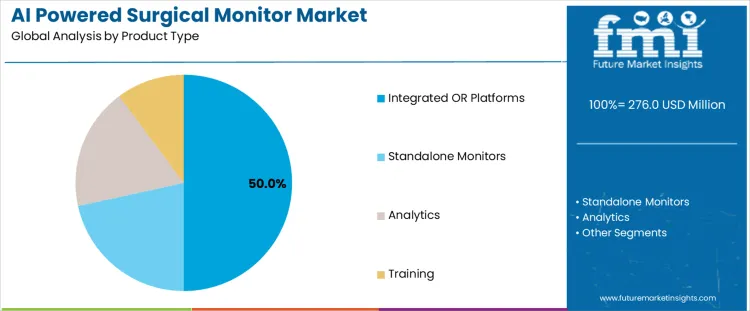
Integrated operating room platforms lead demand because they centralize AI monitoring, visualization, and device coordination during surgery. These systems aggregate patient vitals, imaging feeds, and instrument data into a single interface, reducing fragmentation during high pressure procedures. Hospitals favor integrated platforms to standardize operating rooms and limit reliance on manual interpretation. Adoption is strongest in tertiary care centers performing complex surgeries. Standalone monitors remain in use where incremental upgrades are preferred, while analytics and training tools support secondary functions. Leadership reflects operational centrality, system reliability, and long replacement cycles rather than modular flexibility.
Standalone monitors, analytics tools, and training systems play supporting roles but do not displace integrated platforms. Standalone monitors serve mixed technology environments where full integration is not feasible. Analytics solutions focus on post case review, compliance tracking, and performance benchmarking rather than live intervention. Training platforms support surgeon education and simulation but remain disconnected from active care delivery. These subsegments expand ecosystem maturity but lack direct influence during surgery. Procurement decisions therefore continue to prioritize platforms that directly support intraoperative safety, coordination, and real time clinical decision making within complex operating environments.
What Is Driving Leadership by Application in the AI Powered Surgical Monitor Market?
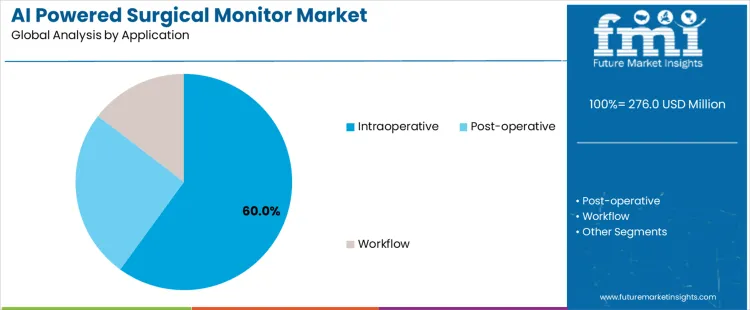
Intraoperative applications dominate demand because this phase carries the highest clinical risk and accountability. AI powered monitoring supports continuous assessment during active procedures, identifying physiological changes or procedural deviations when response time is limited. Hospitals assign highest value to tools that influence outcomes before complications occur. Intraoperative use cases justify investment due to measurable impact on safety and liability reduction. Post-operative and workflow applications are viewed as complementary, but they lack the immediacy and outcome sensitivity that drive purchasing priority in surgical technology investments.
Post-operative monitoring and workflow applications influence adoption but remain secondary. Post-operative AI tools assist with complication detection and recovery trends after surgery, when primary risk has already passed. Workflow applications improve scheduling, documentation, and resource utilization, offering operational benefits rather than direct clinical impact. Hospitals typically adopt these applications after establishing intraoperative monitoring capabilities. Application leadership therefore reflects concentration of risk and decision urgency during surgery, rather than total duration of care or administrative efficiency gains across the surgical pathway.
How Is the AI Powered Surgical Monitor Market Being Applied Across Operating Rooms?
Use appears in hospitals and surgical centers where real-time visualization and analytics enhance procedural accuracy. AI-powered monitors integrate live imaging, instrument tracking, and patient vitals to provide augmented guidance during minimally invasive, robotic, or complex surgeries. Surgeons leverage AI overlays for tissue differentiation, anatomical structure recognition, and predictive alerts to reduce intraoperative risks. These applications reflect operational and clinical priorities rather than administrative functions, with adoption driven by surgical precision, workflow efficiency, and patient safety outcomes.
What Operational and Material Conditions Support Adoption of AI Powered Surgical Monitors?
Selection aligns with operating rooms equipped with high-resolution imaging, endoscopic systems, and robotic surgical platforms. Algorithms are trained on diverse datasets to recognize anatomical variations and procedural steps. Monitors must be compatible with existing visualization equipment and integrated into surgical workflow software. Maintenance and IT teams monitor calibration, software updates, and data security to ensure continuous functionality. These conditions emerge from procedural reliability, operational efficiency, and clinical compliance priorities within structured surgical environments.
Which Practical Considerations Limit Wider Use of AI Powered Surgical Monitors?
High capital investment and integration complexity limit deployment to advanced surgical centers. Algorithm performance depends on image quality, patient variability, and data completeness. Regulatory approval and clinical validation are required for decision-support applications. Staff training is essential to correctly interpret AI guidance and alerts. These factors lead to selective adoption where improved surgical precision, patient safety, and workflow optimization justify incremental cost and operational adaptation.
What is the Demand for AI Powered Surgical Monitors by Country?
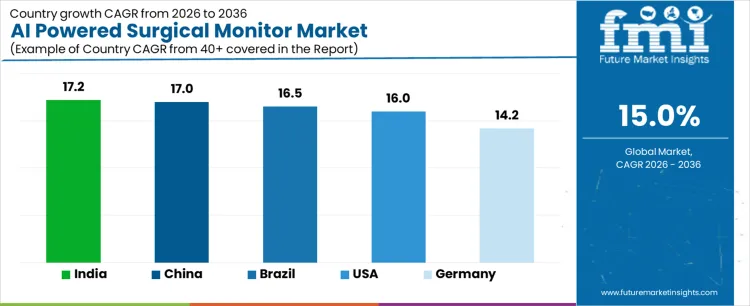
| Country | CAGR (%) |
|---|---|
| USA | 16.0% |
| Brazil | 16.5% |
| China | 17.0% |
| India | 17.2% |
| Germany | 14.2% |
The demand for AI powered surgical monitors varies across countries, driven by advanced healthcare adoption, surgical technology integration, and growing hospital infrastructure. India leads with a 17.2% CAGR, supported by increasing surgical procedures, adoption of AI for precision surgery, and expansion of healthcare facilities. China follows at 17.0%, driven by large scale hospital modernization and integration of smart surgical technologies. Brazil records 16.5%, shaped by growing investments in healthcare infrastructure and adoption of AI enabled surgical tools. The USA grows at 16.0%, reflecting steady adoption in advanced hospitals and surgical centers. Germany posts 14.2%, supported by mature healthcare infrastructure and consistent integration of AI in surgical monitoring.
How Is AI-Powered Surgical Monitoring Transforming Healthcare in the United States?
In the United States, revenue from the AI-Powered Surgical Monitor Market is expanding at a CAGR of 16% through 2036, driven by adoption of intelligent monitoring systems that enhance surgical precision, patient safety, and real-time decision-making. Hospitals and surgical centers are integrating AI-powered monitors to provide predictive analytics, automated alerts, and performance visualization during procedures. Demand is concentrated in urban hospitals, specialty surgical centers, and academic medical facilities. Domestic technology providers are supplying high-performance, IT-compatible systems suitable for integration with operating room infrastructure. Increasing surgical volumes, regulatory compliance, and recurring equipment upgrades are sustaining predictable adoption nationwide.
- Urban hospitals, surgical centers, and academic medical facilities drive adoption
- AI monitors improve surgical precision, safety, and real-time decisions
- Domestic providers supply IT-compatible, high-performance systems
- Recurring equipment upgrades sustain predictable adoption
How Are Healthcare Infrastructure and AI Integration Supporting Growth in Brazil?
In Brazil, the market is growing at a CAGR of 16.5% through 2036, supported by expanding hospital infrastructure and investment in AI-assisted surgical technologies. Manufacturers are deploying AI-powered monitors to enhance intraoperative visibility, predictive alerts, and procedural accuracy. Demand is concentrated in private hospitals, specialized surgical centers, and urban healthcare networks. Local technology providers are offering scalable, high-performance monitoring systems compatible with operating room IT infrastructure. Growth in surgical volumes, technology adoption, and recurring upgrades is sustaining robust adoption nationwide.
- Private hospitals, surgical centers, and urban healthcare networks drive adoption
- AI monitors enhance intraoperative visibility, predictive alerts, and accuracy
- Local providers offer scalable, high-performance monitoring systems
- Recurring upgrades sustain robust adoption
How Is Surgical Monitoring Expansion Accelerating Adoption in China?
China is witnessing growth at a CAGR of 17% through 2036, driven by rapid adoption of AI-powered surgical monitors in hospitals and high-volume surgical centers. Manufacturers are integrating intelligent monitoring solutions to improve patient safety, real-time decision-making, and workflow efficiency during operations. Demand is concentrated in urban hospitals, tertiary medical centers, and specialized surgical facilities. Domestic technology providers are scaling production of AI monitors compatible with operating room systems and surgical IT infrastructure. Expanding healthcare infrastructure, government support for AI integration, and recurring equipment updates are sustaining rapid adoption nationwide.
- Urban hospitals, tertiary centers, and surgical facilities drive adoption
- AI monitors enhance patient safety, workflow, and intraoperative decisions
- Domestic providers scale IT-compatible, high-performance monitoring systems
- Recurring equipment updates sustain rapid adoption
How Is AI Integration Supporting Surgical Innovation in India?
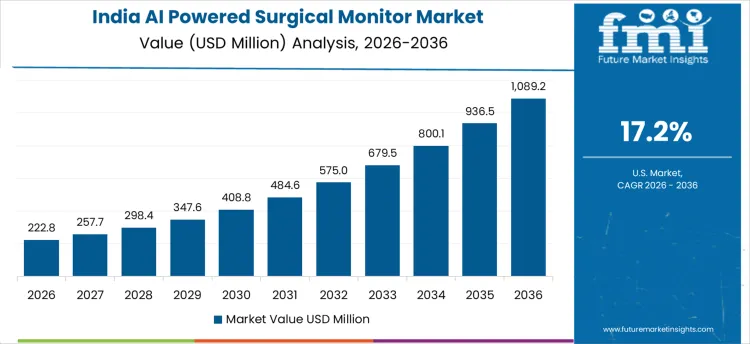
In India, revenue from the AI-Powered Surgical Monitor Market is expanding at a CAGR of 17.2% through 2036, supported by increasing surgical volumes, urban healthcare expansion, and adoption of advanced monitoring technologies. Hospitals are deploying AI-powered monitors to provide predictive alerts, real-time imaging, and analytics for enhanced surgical outcomes. Demand is concentrated in urban hospitals, specialty surgical centers, and teaching hospitals. Domestic technology providers offer high-performance, IT-compatible monitors suitable for integration into existing surgical infrastructure. Growth in healthcare services, technology adoption, and recurring equipment replacement cycles are sustaining robust adoption nationwide.
- Urban hospitals, specialty centers, and teaching hospitals drive adoption
- AI monitors provide predictive alerts, real-time imaging, and analytics
- Domestic providers offer IT-compatible, high-performance monitoring systems
- Recurring replacement cycles sustain robust adoption
How Are Hospital Standards and AI Technology Supporting Growth in Germany?
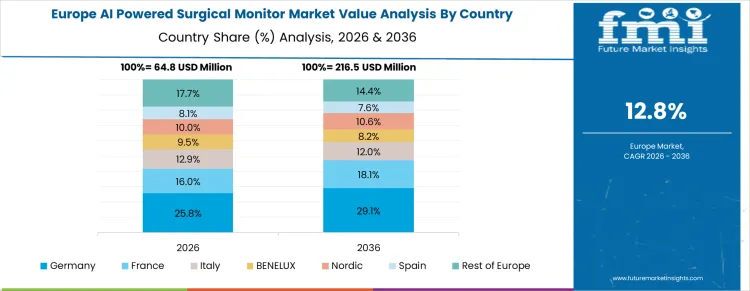
Germany is witnessing growth at a CAGR of 14.2% through 2036, driven by adoption of AI-powered surgical monitors to enhance procedure accuracy, safety, and operational efficiency. Hospitals and surgical centers are integrating intelligent monitoring solutions for predictive analytics, automated alerts, and real-time workflow support. Demand is concentrated in urban hospitals, specialized surgical units, and academic medical centers. Domestic providers supply high-performance, IT-compatible systems compatible with operating room infrastructure. Compliance with healthcare standards, technological adoption, and recurring equipment upgrades are sustaining consistent procurement nationwide.
- Urban hospitals, specialized surgical units, and academic centers anchor demand
- AI monitors enhance procedure accuracy, safety, and workflow efficiency
- Domestic providers supply IT-compatible, high-performance systems
- Recurring equipment upgrades sustain consistent procurement
Which Companies Shape Competition in The AI Powered Surgical Monitor Market Through Intraoperative Workflow and Clinical Trust?
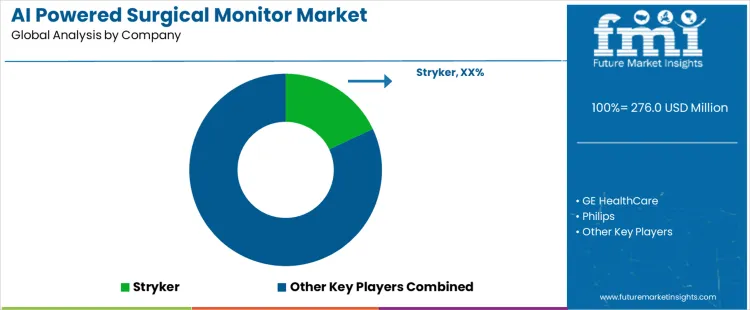
Competition in the AI Powered Surgical Monitor Market is shaped by how monitoring systems integrate into live surgical workflows without disrupting surgeon focus or procedural timing. Stryker, Medtronic, and Karl Storz influence adoption through visualization and monitoring platforms already embedded in operating rooms, where AI features are added incrementally rather than introduced as standalone systems. These companies benefit from surgeon familiarity, installed base continuity, and alignment with existing surgical instruments and displays. GE HealthCare and Philips approach the market from imaging and patient monitoring perspectives, extending AI capabilities into surgical environments through analytics, real time alerts, and decision support overlays. Acceptance depends on reliability under continuous use, clarity of outputs, and minimal false signaling during complex procedures.
Competitive differentiation increasingly reflects validation and governance rather than algorithm breadth. Hospitals and surgical teams prioritize systems that demonstrate measurable improvement in situational awareness, workflow coordination, or complication avoidance. AI powered monitors are evaluated through controlled deployments, with emphasis on explainability, regulatory clearance, and cybersecurity safeguards. Smaller and emerging players tend to participate through feature specific modules or partnerships rather than full platform replacement. Integration with electronic medical records, anesthesia systems, and imaging feeds influences purchasing decisions more than raw processing capability. Market positioning depends on clinical endorsement, training requirements, and compatibility with hospital procurement standards. Adoption remains cautious, driven by patient safety considerations and long approval cycles rather than rapid technology substitution.
Key Players in the AI Powered Surgical Monitor Market
- Stryker
- GE HealthCare
- Philips
- Medtronic
- Karl Storz
- Others
Scope of the Report
| Items | Values |
|---|---|
| Quantitative Units (2026) | USD million |
| Product Type | Integrated OR Platforms, Standalone Monitors, Analytics, Training |
| Application | Intraoperative, Post-operative, Workflow |
| End-Use Industry | Hospitals, Ambulatory Surgical Centers (ASCs), OEM Partnerships |
| Region | Asia Pacific (China, Japan, South Korea, India, Australia & New Zealand, ASEAN, Rest of Asia Pacific), Europe (Germany, United Kingdom, France, Italy, Spain, Nordic, BENELUX, Rest of Europe), North America (United States, Canada, Mexico), Latin America (Brazil, Chile, Rest of Latin America), Middle East & Africa (KSA, Other GCC Countries, Turkey, South Africa, Other African Union, Rest of Middle East & Africa) |
| Key Companies Profiled | Stryker, GE HealthCare, Philips, Medtronic, Karl Storz, Others |
| Additional Attributes | Dollar by sales by product type, Dollar by sales by application, Dollar by sales by end-user, Dollar by sales by region, Clinical validation and intraoperative performance, Integration with surgical workflow software, Real-time procedural analytics, Interoperability with hospital IT and imaging systems, Predictive alert accuracy, Training module adoption, OEM partnership contributions, Adoption in tertiary and specialty hospitals, Replacement and upgrade cycles, Operational efficiency and workflow standardization |
AI Powered Surgical Monitor Market Segmentation
Product Type:
- Integrated OR Platforms
- Standalone Monitors
- Analytics
- Training
Application:
- Intraoperative
- Post-operative
- Workflow
End User:
- Hospitals
- ASCs
- OEM Partnerships
Region
Asia Pacific
- China
- Japan
- South Korea
- India
- Australia & New Zealand
- ASEAN
- Rest of Asia Pacific
Europe
- Germany
- United Kingdom
- France
- Italy
- Spain
- Nordic
- BENELUX
- Rest of Europe
North America
- United States
- Canada
- Mexico
Latin America
- Brazil
- Chile
- Rest of Latin America
Middle East & Africa
- Kingdom of Saudi Arabia
- Other GCC Countries
- Turkey
- South Africa
- Other African Union
- Rest of Middle East & Africa
Bibliography
- Hashimoto, D. A., Rosman, G., Rus, D., & Meireles, O. R. (2018). Artificial intelligence in surgery: Promises and perils. Annals of Surgery, 268(1), 70-76.
- Maier-Hein, L., Vedula, S. S., Speidel, S., Navab, N., Kikinis, R., Park, A., & Jannin, P. (2017). Surgical data science for next-generation interventions. Nature Biomedical Engineering, 1(9), 691-696.
Frequently Asked Questions
How big is the ai powered surgical monitor market in 2026?
The global ai powered surgical monitor market is estimated to be valued at USD 276.0 million in 2026.
What will be the size of ai powered surgical monitor market in 2036?
The market size for the ai powered surgical monitor market is projected to reach USD 1,116.6 million by 2036.
How much will be the ai powered surgical monitor market growth between 2026 and 2036?
The ai powered surgical monitor market is expected to grow at a 15.0% CAGR between 2026 and 2036.
What are the key product types in the ai powered surgical monitor market?
The key product types in ai powered surgical monitor market are integrated or platforms, standalone monitors, analytics and training.
Which application segment to contribute significant share in the ai powered surgical monitor market in 2026?
In terms of application, intraoperative segment to command 60.0% share in the ai powered surgical monitor market in 2026.
Preview the report firsthand - request a free sample
Get SampleGet the brochure for pricing and purchase details.
Get PDFTable of Content
- Executive Summary
- Global Market Outlook
- Demand-side Trends
- Supply-side Trends
- Technology Roadmap Analysis
- Analysis and Recommendations
- Market Overview
- Market Coverage / Taxonomy
- Market Definition / Scope / Limitations
- Market Background
- Market Dynamics
- Drivers
- Restraints
- Opportunity
- Trends
- Scenario Forecast
- Demand in Optimistic Scenario
- Demand in Likely Scenario
- Demand in Conservative Scenario
- Opportunity Map Analysis
- Product Life Cycle Analysis
- Supply Chain Analysis
- Investment Feasibility Matrix
- Value Chain Analysis
- PESTLE and Porter’s Analysis
- Regulatory Landscape
- Regional Parent Market Outlook
- Production and Consumption Statistics
- Import and Export Statistics
- Market Dynamics
- Global Market Analysis 2021 to 2025 and Forecast, 2026 to 2036
- Historical Market Size Value (USD Million) Analysis, 2021 to 2025
- Current and Future Market Size Value (USD Million) Projections, 2026 to 2036
- Y-o-Y Growth Trend Analysis
- Absolute $ Opportunity Analysis
- Global Market Pricing Analysis 2021 to 2025 and Forecast 2026 to 2036
- Global Market Analysis 2021 to 2025 and Forecast 2026 to 2036, By Product Type
- Introduction / Key Findings
- Historical Market Size Value (USD Million) Analysis By Product Type , 2021 to 2025
- Current and Future Market Size Value (USD Million) Analysis and Forecast By Product Type , 2026 to 2036
- Integrated OR Platforms
- Standalone Monitors
- Analytics
- Training
- Integrated OR Platforms
- Y-o-Y Growth Trend Analysis By Product Type , 2021 to 2025
- Absolute $ Opportunity Analysis By Product Type , 2026 to 2036
- Global Market Analysis 2021 to 2025 and Forecast 2026 to 2036, By Application
- Introduction / Key Findings
- Historical Market Size Value (USD Million) Analysis By Application, 2021 to 2025
- Current and Future Market Size Value (USD Million) Analysis and Forecast By Application, 2026 to 2036
- Intraoperative
- Post-operative
- Workflow
- Intraoperative
- Y-o-Y Growth Trend Analysis By Application, 2021 to 2025
- Absolute $ Opportunity Analysis By Application, 2026 to 2036
- Global Market Analysis 2021 to 2025 and Forecast 2026 to 2036, By End User
- Introduction / Key Findings
- Historical Market Size Value (USD Million) Analysis By End User, 2021 to 2025
- Current and Future Market Size Value (USD Million) Analysis and Forecast By End User, 2026 to 2036
- Hospitals
- ASCs
- OEM Partnerships
- Hospitals
- Y-o-Y Growth Trend Analysis By End User, 2021 to 2025
- Absolute $ Opportunity Analysis By End User, 2026 to 2036
- Global Market Analysis 2021 to 2025 and Forecast 2026 to 2036, By Region
- Introduction
- Historical Market Size Value (USD Million) Analysis By Region, 2021 to 2025
- Current Market Size Value (USD Million) Analysis and Forecast By Region, 2026 to 2036
- North America
- Latin America
- Western Europe
- Eastern Europe
- East Asia
- South Asia and Pacific
- Middle East & Africa
- Market Attractiveness Analysis By Region
- North America Market Analysis 2021 to 2025 and Forecast 2026 to 2036, By Country
- Historical Market Size Value (USD Million) Trend Analysis By Market Taxonomy, 2021 to 2025
- Market Size Value (USD Million) Forecast By Market Taxonomy, 2026 to 2036
- By Country
- USA
- Canada
- Mexico
- By Product Type
- By Application
- By End User
- By Country
- Market Attractiveness Analysis
- By Country
- By Product Type
- By Application
- By End User
- Key Takeaways
- Latin America Market Analysis 2021 to 2025 and Forecast 2026 to 2036, By Country
- Historical Market Size Value (USD Million) Trend Analysis By Market Taxonomy, 2021 to 2025
- Market Size Value (USD Million) Forecast By Market Taxonomy, 2026 to 2036
- By Country
- Brazil
- Chile
- Rest of Latin America
- By Product Type
- By Application
- By End User
- By Country
- Market Attractiveness Analysis
- By Country
- By Product Type
- By Application
- By End User
- Key Takeaways
- Western Europe Market Analysis 2021 to 2025 and Forecast 2026 to 2036, By Country
- Historical Market Size Value (USD Million) Trend Analysis By Market Taxonomy, 2021 to 2025
- Market Size Value (USD Million) Forecast By Market Taxonomy, 2026 to 2036
- By Country
- Germany
- UK
- Italy
- Spain
- France
- Nordic
- BENELUX
- Rest of Western Europe
- By Product Type
- By Application
- By End User
- By Country
- Market Attractiveness Analysis
- By Country
- By Product Type
- By Application
- By End User
- Key Takeaways
- Eastern Europe Market Analysis 2021 to 2025 and Forecast 2026 to 2036, By Country
- Historical Market Size Value (USD Million) Trend Analysis By Market Taxonomy, 2021 to 2025
- Market Size Value (USD Million) Forecast By Market Taxonomy, 2026 to 2036
- By Country
- Russia
- Poland
- Hungary
- Balkan & Baltic
- Rest of Eastern Europe
- By Product Type
- By Application
- By End User
- By Country
- Market Attractiveness Analysis
- By Country
- By Product Type
- By Application
- By End User
- Key Takeaways
- East Asia Market Analysis 2021 to 2025 and Forecast 2026 to 2036, By Country
- Historical Market Size Value (USD Million) Trend Analysis By Market Taxonomy, 2021 to 2025
- Market Size Value (USD Million) Forecast By Market Taxonomy, 2026 to 2036
- By Country
- China
- Japan
- South Korea
- By Product Type
- By Application
- By End User
- By Country
- Market Attractiveness Analysis
- By Country
- By Product Type
- By Application
- By End User
- Key Takeaways
- South Asia and Pacific Market Analysis 2021 to 2025 and Forecast 2026 to 2036, By Country
- Historical Market Size Value (USD Million) Trend Analysis By Market Taxonomy, 2021 to 2025
- Market Size Value (USD Million) Forecast By Market Taxonomy, 2026 to 2036
- By Country
- India
- ASEAN
- Australia & New Zealand
- Rest of South Asia and Pacific
- By Product Type
- By Application
- By End User
- By Country
- Market Attractiveness Analysis
- By Country
- By Product Type
- By Application
- By End User
- Key Takeaways
- Middle East & Africa Market Analysis 2021 to 2025 and Forecast 2026 to 2036, By Country
- Historical Market Size Value (USD Million) Trend Analysis By Market Taxonomy, 2021 to 2025
- Market Size Value (USD Million) Forecast By Market Taxonomy, 2026 to 2036
- By Country
- Kingdom of Saudi Arabia
- Other GCC Countries
- Turkiye
- South Africa
- Other African Union
- Rest of Middle East & Africa
- By Product Type
- By Application
- By End User
- By Country
- Market Attractiveness Analysis
- By Country
- By Product Type
- By Application
- By End User
- Key Takeaways
- Key Countries Market Analysis
- USA
- Pricing Analysis
- Market Share Analysis, 2025
- By Product Type
- By Application
- By End User
- Canada
- Pricing Analysis
- Market Share Analysis, 2025
- By Product Type
- By Application
- By End User
- Mexico
- Pricing Analysis
- Market Share Analysis, 2025
- By Product Type
- By Application
- By End User
- Brazil
- Pricing Analysis
- Market Share Analysis, 2025
- By Product Type
- By Application
- By End User
- Chile
- Pricing Analysis
- Market Share Analysis, 2025
- By Product Type
- By Application
- By End User
- Germany
- Pricing Analysis
- Market Share Analysis, 2025
- By Product Type
- By Application
- By End User
- UK
- Pricing Analysis
- Market Share Analysis, 2025
- By Product Type
- By Application
- By End User
- Italy
- Pricing Analysis
- Market Share Analysis, 2025
- By Product Type
- By Application
- By End User
- Spain
- Pricing Analysis
- Market Share Analysis, 2025
- By Product Type
- By Application
- By End User
- France
- Pricing Analysis
- Market Share Analysis, 2025
- By Product Type
- By Application
- By End User
- India
- Pricing Analysis
- Market Share Analysis, 2025
- By Product Type
- By Application
- By End User
- ASEAN
- Pricing Analysis
- Market Share Analysis, 2025
- By Product Type
- By Application
- By End User
- Australia & New Zealand
- Pricing Analysis
- Market Share Analysis, 2025
- By Product Type
- By Application
- By End User
- China
- Pricing Analysis
- Market Share Analysis, 2025
- By Product Type
- By Application
- By End User
- Japan
- Pricing Analysis
- Market Share Analysis, 2025
- By Product Type
- By Application
- By End User
- South Korea
- Pricing Analysis
- Market Share Analysis, 2025
- By Product Type
- By Application
- By End User
- Russia
- Pricing Analysis
- Market Share Analysis, 2025
- By Product Type
- By Application
- By End User
- Poland
- Pricing Analysis
- Market Share Analysis, 2025
- By Product Type
- By Application
- By End User
- Hungary
- Pricing Analysis
- Market Share Analysis, 2025
- By Product Type
- By Application
- By End User
- Kingdom of Saudi Arabia
- Pricing Analysis
- Market Share Analysis, 2025
- By Product Type
- By Application
- By End User
- Turkiye
- Pricing Analysis
- Market Share Analysis, 2025
- By Product Type
- By Application
- By End User
- South Africa
- Pricing Analysis
- Market Share Analysis, 2025
- By Product Type
- By Application
- By End User
- USA
- Market Structure Analysis
- Competition Dashboard
- Competition Benchmarking
- Market Share Analysis of Top Players
- By Regional
- By Product Type
- By Application
- By End User
- Competition Analysis
- Competition Deep Dive
- Stryker
- Overview
- Product Portfolio
- Profitability by Market Segments (Product/Age /Sales Channel/Region)
- Sales Footprint
- Strategy Overview
- Marketing Strategy
- Product Strategy
- Channel Strategy
- GE HealthCare
- Philips
- Medtronic
- Karl Storz
- Others
- Stryker
- Competition Deep Dive
- Assumptions & Acronyms Used
- Research Methodology


