

- Industry Size (2025)
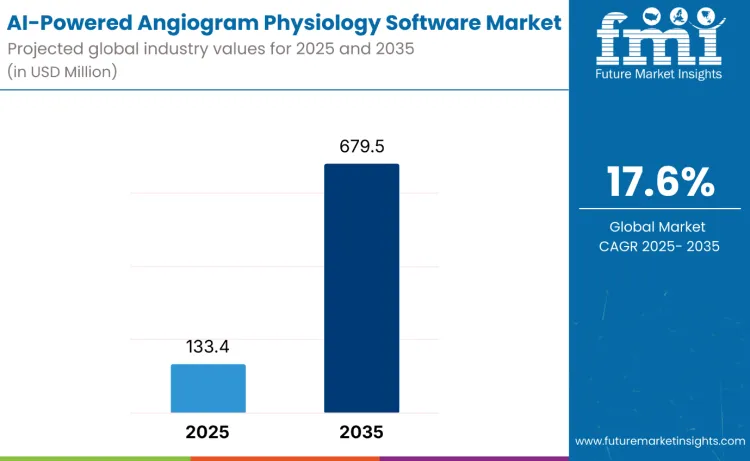
- USD 133.4 Mn
- Forecast (2035)
- USD 679.5 Mn
- CAGR (2025 to 2035)
- 17.6%
AI-Powered Angiogram Physiology Software Market Forecast and Outlook 2025 to 2035
Global AI-powered angiogram physiology software market is projected to reach USD 679.5 million by 2035, recording an absolute increase of USD 546.1 million over the forecast period. Demand is valued at USD 133.4 million in 2025 and is projected to grow at a CAGR of 17.6% over the assessment period. Market size is expected to expand by nearly 5.1x during this period, fueled by increasing deployment of computer-enabled coronary physiology solutions in catheterization labs, rising PCI procedural volumes, and accelerating global shift toward non-invasive and minimally invasive cardiac diagnostics. Growing focus on improving diagnostic accuracy while reducing reliance on pressure-wire FFR procedures and contrast volume is supporting adoption.
Expansion reflects evolving interventional cardiology workflows, where computer-based physiology software enables precise, wire-free functional assessment of coronary lesions using routine angiography videos. Hospitals and cardiology centers are under sustained pressure to improve PCI decision-making accuracy and procedural efficiency, with automated angiogram physiology tools demonstrating 20-40% improvement in diagnostic speed and enhanced lesion-specific evaluation versus conventional visual assessment.
Quick Stats for AI-Powered Angiogram Physiology Software Market
- AI-Powered Angiogram Physiology Software Market Value (2025): USD 133.4 million
- AI-Powered Angiogram Physiology Software Market Forecast Value (2035): USD 679.5 million
- AI-Powered Angiogram Physiology Software Market Forecast CAGR: 17.6%
- Leading Market Segment: Hospitals & Cath Labs (63.8% share)
- Key Growth Regions: North America, Europe, and Asia Pacific
- Top Players: CathWorks, Medis Medical Imaging (QFR), HeartFlow, Siemens Healthineers, Keya Medical
Government cardiac disease prevention programs and hospital digital transformation initiatives accelerate growth. Health systems globally are investing in computer-based cardiovascular imaging and physiology platforms to reduce unnecessary stenting, prevent restenosis events, and improve long-term patient outcomes.
AI-Powered Angiogram Physiology Software Market Year-over-Year Forecast (2025 to 2035)
Between 2025 and 2030, AI-powered angiogram physiology software market is projected to expand from USD 133.4 million to USD 301.1 million, resulting in a value increase of USD 167.7 million, which represents 30.7% of total forecast growth for the decade. This phase will be shaped by rising demand for wire-free coronary physiology assessment, increasing adoption of automated clinical decision support in cath-labs, and broader integration of quantitative coronary analysis into revascularization workflows.
From 2030 to 2035, growth is forecast to expand from USD 301.1 million to USD 679.5 million, adding another USD 378.4 million, which constitutes 69.3% of the overall ten-year expansion. This period will be marked by expanded deployment of hybrid imaging-and-physiology platforms, cloud-based coronary flow simulation engines, and automated physiology workflows designed for routine cath-lab use.
AI-Powered Angiogram Physiology Software Market Key Takeaways
| Metric | Value |
|---|---|
| Market Value (2025) | USD 133.4 million |
| Market Forecast Value (2035) | USD 679.5 million |
| Forecast CAGR (2025 to 2035) | 17.6% |
Why Is the AI-Powered Angiogram Physiology Software Market Growing Worldwide?
AI-powered angiogram physiology software market grows by enabling interventional cardiologists to achieve superior diagnostic precision and workflow efficiency while maintaining minimally invasive evaluation pathways for coronary artery disease. Cath-lab teams face increasing pressure to improve ischemia-guided PCI decision-making and procedural outcomes, with automated angiogram physiology platforms typically providing 20-40% faster lesion assessment and significantly higher diagnostic consistency compared to visual assessment alone, making these solutions essential for modern interventional practice.
Rising global incidence of coronary artery disease, expanding PCI volumes, and demand for non-wire, adenosine-free coronary physiology assessment continues to fuel adoption, particularly in settings seeking to optimize stent placement decisions and reduce unnecessary interventions. Government healthcare modernization initiatives and national cardiovascular disease management strategies accelerate implementation across tertiary cardiac hospitals, academic medical centers, and integrated cardiac networks where quantitative coronary physiology tools support guideline-aligned care and value-based reimbursement models.
How Is the AI-Powered Angiogram Physiology Software Market Segmented by Product Type, Application, End User and Region?
The AI-powered angiogram physiology software market is segmented by product type, clinical application, and end-user environment. By product type, it includes automated FFR/iFR computation platforms, computer-based flow and perfusion quantification modules, hybrid visualization and decision-support suites, and cloud/edge-enabled diagnostic systems. Based on application, the industry is categorized into coronary artery disease diagnosis, lesion assessment and stent optimization, and research-driven workflow integration. End-user segmentation covers hospitals and cath labs, cardiology diagnostic centers, and academic and research institutions. Regionally, it is divided into Asia Pacific, Europe, North America, Latin America, and Middle East & Africa.
By Product Type, Automated FFR/iFR Computation Platforms Hold 42.7% Share
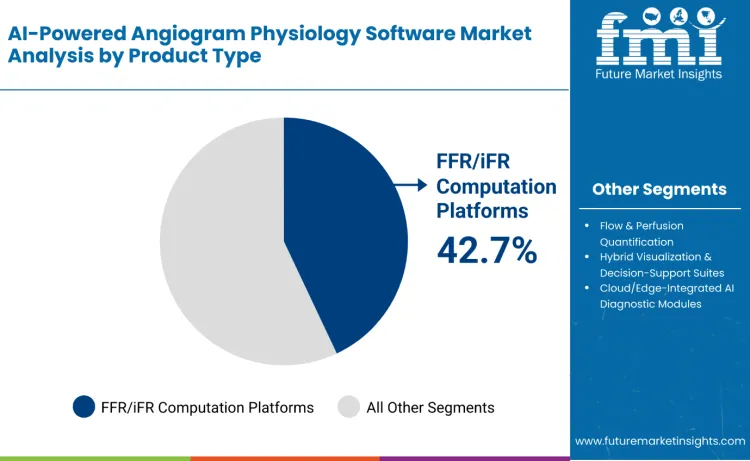
AI-based FFR/iFR computation platforms lead the AI angiogram physiology software market with 42.7% share in 2025, driven by wire-free fractional and instantaneous flow reserve calculations that eliminate pressure wires and hyperemia while enabling rapid, non-invasive lesion assessment in PCI workflows. AI-powered flow and perfusion quantification holds 23.4%, providing vessel-level perfusion and microvascular insights. Hybrid visualization and decision-support suites account for 18.6%, integrating AI overlays and automated lesion detection. Cloud and edge-enabled physiology modules represent 15.3%, supporting remote processing, cross-site scalability, and real-time synchronization.
By Application, Lesion Assessment & Stent Optimization Represents 44.1% Share
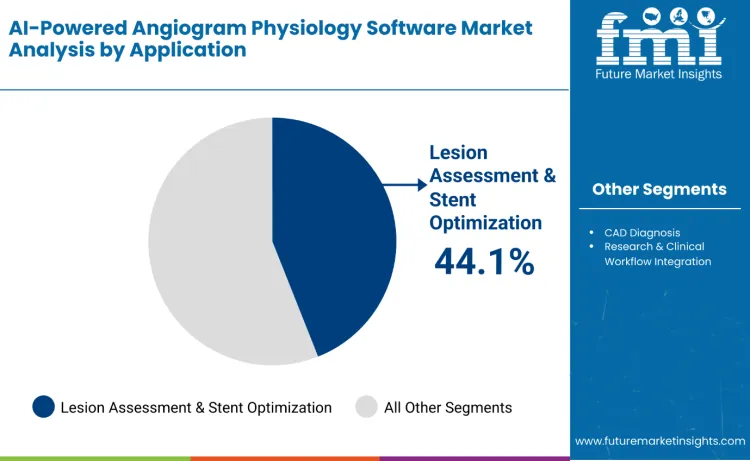
Lesion assessment and stent optimization dominate the AI angiogram physiology market with 44.1% usage in 2025, driven by AI-enabled functional lesion evaluation, stent sizing guidance, and post-PCI physiology validation that improve revascularization precision and reduce restenosis risk. Coronary artery disease diagnosis accounts for 38.9%, supported by adoption in early ischemia detection and triage workflows across cardiology centers. Research and clinical workflow integration represents 17%, reflecting growing academic use for model validation, multi-center collaboration, and AI-assisted cath-lab workflow enhancement in advanced cardiovascular programs.
By End User, Hospitals & Cath Labs Command 63.8% Share
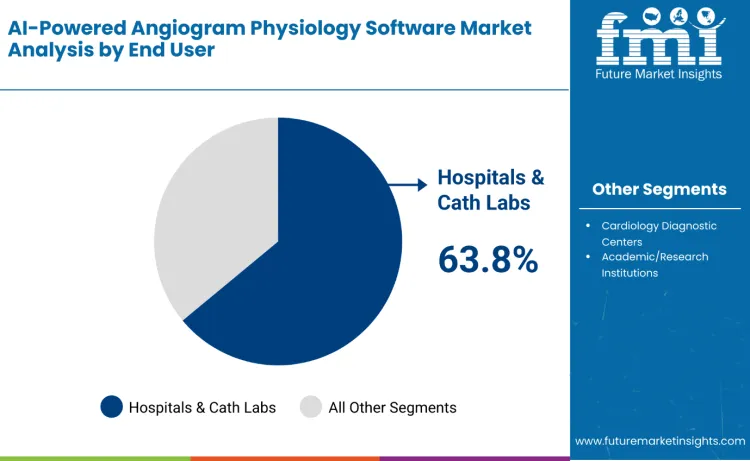
Hospitals and cath labs dominate adoption, representing 63.8% of global revenue in 2025. This segment leverages automated physiology platforms for on-table decision-making, PCI optimization, and acute coronary evaluation, supported by high procedure volumes and integrated cardiology IT systems. Cardiology diagnostic centers account for 24.7% through outpatient ischemia work-ups and referral-pathway optimization, while academic institutions contribute 11.5%, driven by validation research, multi-modality imaging studies, and training initiatives for computer-enabled PCI techniques.
What Are the Major Drivers, Restraints, and Emerging Trends Influencing the AI-Powered Angiogram Physiology Software Market?
The AI-powered angiogram physiology software market is driven by rising coronary artery disease prevalence, expanding PCI procedure volumes, and the shift toward ischemia-guided revascularization. Hospitals increasingly adopt quantitative angiogram physiology tools to enhance lesion assessment accuracy and reduce unnecessary stenting. Value-based care models and Enhanced Recovery in Cardiac Care programs accelerate uptake as providers seek faster, safer, and more precise diagnostic workflows. Growing clinical preference for non-wire, adenosine-free physiology further drives adoption, enabling automated functional assessments that reduce contrast load, improve workflow efficiency, and support evidence-based decision-making during intermediate lesion evaluation.
What Restraints Limit the Adoption of AI-Powered Angiogram Physiology Software?
Restraints include premium subscription pricing and capital investment requirements for advanced physiology platforms, creating adoption hurdles for smaller hospitals and budget-restricted cath-labs. Variability in reimbursement frameworks reduces financial predictability for health systems evaluating software-based physiology. Physician training requirements, workflow adaptation needs, and reliance on high-quality angiographic imaging restrict broader use in lower-resource environments. Some facilities continue relying on conventional angiography-guided PCI, slowing transition toward physiology-based evaluation. These economic, technical, and operational barriers collectively moderate adoption despite strong clinical benefits demonstrated in tertiary cardiac centers.
What Emerging Trends Are Shaping the AI-Powered Angiogram Physiology Software Market?
Key trends include accelerating adoption in Asia-Pacific and North America, where digital cardiology programs streamline deployment in advanced cath-lab ecosystems. Innovation focuses on algorithm-enhanced vessel segmentation, real-time physiology computation, and catheter-free functional assessment that improves intra-procedural precision. Integration of angiogram-based physiology with hybrid imaging, cardiac PACS, and interventional decision-support platforms is expanding. Cloud-enabled models, edge processing, and automated workflows are shaping next-generation solutions, enabling faster interpretation and reduced procedural variability. These advancements support broader adoption as hospitals modernize interventional cardiology infrastructure.
How Are Leading Countries Driving Growth in the AI-Powered Angiogram Physiology Software Market?
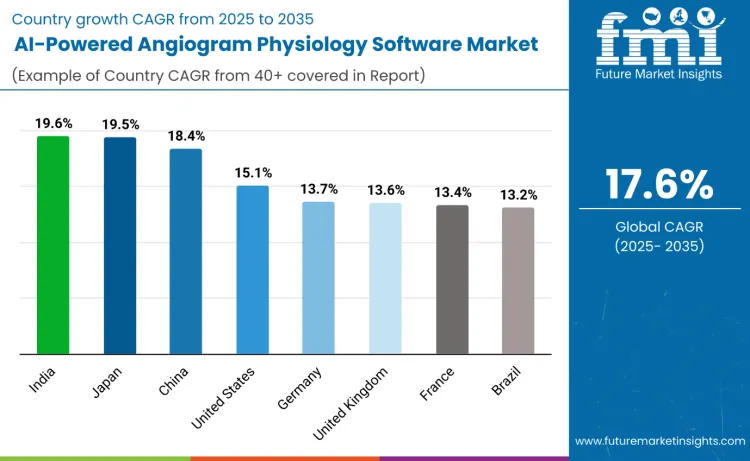
| Country/Region | CAGR (2025 to 2035) |
|---|---|
| India | 19.6% |
| Japan | 19.5% |
| China | 18.4% |
| USA | 15.1% |
| Germany | 13.7% |
| UK | 13.6% |
| France | 13.4% |
| Brazil | 13.2% |
The AI-powered angiogram physiology software market is expanding rapidly, led by India (19.6%) due to rising coronary disease burden, fast-growing cath-lab capacity, and clinician training in advanced physiology. China (18.4%) follows with strong cardiovascular modernization and digital-health initiatives. The USA (15.1%) advances through high PCI volumes and early adoption of computer-guided diagnostics. Europe (14.2%) grows steadily, with Germany (13.7%) and the UK (13.6%) supported by precision-driven cardiology ecosystems, while France holds 13.4%. Brazil (13.2%) gains momentum through expanding private cardiac centers and increasing minimally invasive procedure adoption.
How Is Cardiovascular Digitalization Accelerating Growth in China?
China shows the strongest growth potential in the AI-powered angiogram physiology software market, supported by a CAGR of 18.4% through 2035. Expansion is fueled by rapid cardiovascular infrastructure development, rising PCI volumes, and national digital-health priorities aimed at modernizing cardiac care. Adoption is concentrated in Beijing, Shanghai, Shenzhen, and Guangzhou, where leading hospitals deploy AI-enabled physiology to improve ischemia-guided decision-making and reduce reliance on invasive wire-based techniques. Government AI programs, large-scale clinical digitalization, and hospital investment in advanced cath-lab technology accelerate uptake, while domestic innovators and global technology providers strengthen China’s precision-cardiology ecosystem.
Why Are Digital Cardiology Programs Enhancing Adoption in India?
In key healthcare hubs such as Delhi-NCR, Mumbai, Bengaluru, and Hyderabad, adoption of AI-powered angiogram physiology software is rising across tertiary cardiac centers, corporate hospitals, and new cath labs. Growth is supported by a CAGR of 19.6% through 2035, driven by expanding catheterization capacity, increasing PCI volumes, and national digital-health initiatives under Digital India and Ayushman Bharat. Cardiologists are deploying AI-based physiology tools to improve ischemia-guided PCI planning and reduce reliance on pressure-wire studies. Government focus on healthcare digitalization and tele-cardiology further accelerates adoption across metro and tier-2 cardiac networks.
How Do Precision-Driven Standards Sustain Leadership in Germany?
Germany’s advanced cardiovascular ecosystem shows strong adoption of AI-powered angiogram physiology software, with evidence of improved diagnostic precision, faster cath-lab decision-making, and fewer unnecessary stenting procedures across major cardiac centers. Leading hubs such as Berlin, Munich, Hamburg, and Frankfurt integrate AI-driven coronary physiology into PCI workflows, supported by the country’s precision-medicine culture and rigorous clinical standards. German clinicians emphasize accuracy, reproducibility, and workflow reliability, sustaining demand for premium AI physiology platforms. Growth remains robust, driven by university hospitals and specialized cardiovascular institutes, supported by a CAGR of 13.7% through 2035.
Why Is Expanding Cardiac Care Capacity Fueling Demand in Brazil?
Brazil leads Latin American adoption of AI-powered angiogram physiology software, supported by rapid expansion of cardiovascular services and growing investment in catheterization labs across major cities including São Paulo, Rio de Janeiro, Brasília, and Porto Alegre. The market shows strong potential with a CAGR of 13.2% through 2035, driven by rising coronary disease burden, growth in private hospital networks, and adoption of advanced imaging and decision-support tools. Cardiology centers are implementing AI physiology solutions to enhance ischemia-guided PCI, reduce unnecessary stenting, and strengthen evidence-based coronary care. Training expansion and global technology partnerships further accelerate adoption.
How Do Advanced Networks Strengthen Performance in United States?
The USA AI-powered angiogram physiology software market shows mature adoption, supported by advanced interventional cardiology networks and deployment across high-volume PCI centers and leading cardiovascular institutes in states such as California, Texas, New York, and Massachusetts. Growth remains strong with a CAGR of 15.1% through 2035, driven by widespread use of quantitative coronary physiology, ischemia-guided PCI practices, and early regulatory support for AI-based decision tools. Major cardiovascular AI developers and imaging technology companies headquartered in the USA enable deep integration between imaging platforms, physiology engines, and clinical informatics systems to improve workflow efficiency and diagnostic accuracy.
How Is Workflow Modernization Supporting Growth in United Kingdom?
In major UK cardiovascular hubs such as London, Manchester, Birmingham, and Edinburgh, NHS cardiac centers, private hospitals, and interventional cardiology networks are adopting AI-powered angiogram physiology software to improve lesion-level assessment and streamline ischemia-guided PCI workflows. The market shows strong potential with a CAGR of 13.6% through 2035, supported by national digital-health modernization efforts, evidence-based cardiac pathways, and expanding precision-diagnostic initiatives. British interventional cardiologists are using AI-derived physiology insights to refine stent decisions, enhance outcomes, and align revascularization strategies with clinical guidelines amid rising demand for minimally invasive cardiac procedures.
How Are AI-Powered Angiogram Physiology Software market Expansion Across Europe?
The AI-powered angiogram physiology software market in Europe is set to grow from USD 29.5 million in 2025 to USD 142.7 million by 2035 at a CAGR of 17.0%. Germany leads with a 24% share in 2025, moderating to 23% by 2035, supported by advanced cardiovascular infrastructure and widespread university-hospital adoption.
France follows with an 18% share in 2025, adjusting to 17% by 2035 through structured cardiovascular programs and digital-health reimbursement pathways. Italy holds 9.5%, Spain shifts from 8% to 7.5%, the Netherlands maintains 15.5%, and Rest of Europe rises from 25.0% to 26.5% driven by Nordic and Central-Eastern digital cardiac initiatives.
Precision-Driven Clinical Adoption Shapes Market Maturity in Japan
Japan’s AI-powered angiogram physiology software market reflects a precision-oriented cardiovascular ecosystem where AI-based physiological assessment is deeply integrated into angiography suites across university hospitals, cardiovascular institutes, and private networks. Strong national focus on diagnostic accuracy, procedural efficiency, and patient safety drives preference for platforms delivering real-time lesion significance, quantitative physiology metrics, and automated ischemia mapping.
Collaboration between domestic medical institutions, global device manufacturers, and AI developers strengthens regulatory alignment and clinical reproducibility. Leading centers in Tokyo, Osaka, Kyoto, and Nagoya deploy AI physiology tools that reduce pressure-wire dependency, shorten procedures, enhance patient comfort, and complement OCT, IVUS, and advanced hemodynamic imaging.
International Innovation Partnerships Strengthen Clinical AI Deployment in South Korea
The South Korean AI-powered angiogram physiology software market is driven by strong participation from global cardiovascular technology developers and expanding domestic adoption across tertiary hospitals and advanced cardiac centers. Leading systems in Seoul, Busan, Daejeon, and Daegu increasingly integrate AI physiology tools into cath labs to enhance ischemia detection and reduce reliance on invasive pressure wires.
International vendors strengthen their presence through localized clinical support, regulatory alignment, and Korean-language interfaces. Government-backed medical AI initiatives, digital-health reimbursement pilots, and academic-industry collaborations accelerate uptake. Strategic alliances enable interoperability, remote diagnostics, hybrid workflows, and clinician training, reflecting Korea’s digitally mature cardiovascular ecosystem.
How Competitive Is the Global AI-Powered Angiogram Physiology Software Market and What Defines Its Structure?
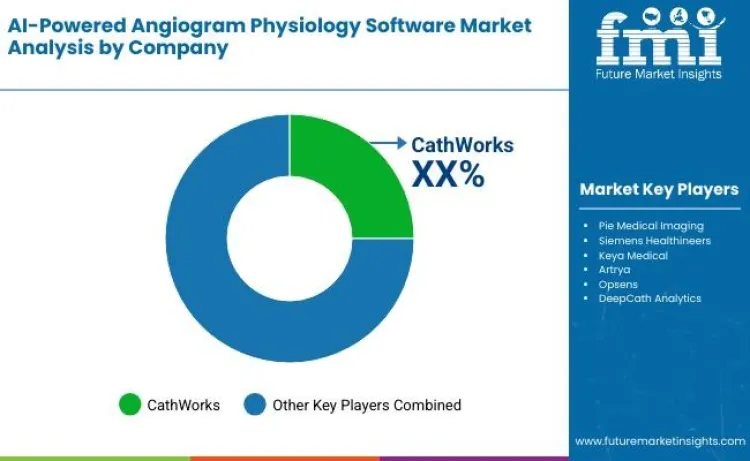
The AI-powered angiogram physiology software landscape is relatively concentrated but highly innovative, with a small group of specialized companies shaping most global adoption. Leadership is driven by CathWorks, known for its pioneering wire-free physiology technology and strong traction across major cardiac centers. Medis Medical Imaging and HeartFlow also hold prominent positions thanks to extensive clinical evidence, long-standing partnerships with hospital networks, and well-validated computational models.
Challengers such as Pie Medical Imaging, Siemens Healthineers modules, Keya Medical, and Artrya compete by offering hybrid imaging-analytics platforms, flexible integration options, and deployment models suited to diverse hospital IT environments. Emerging Asia-based vendors are adding competitive pressure with rapid product cycles and localized support. Overall, the market rewards companies that deliver accurate physiology insights, seamless angiography integration, and scalable clinical workflows.
Key Players in the AI-Powered Angiogram Physiology Software Market
- CathWorks (FFRangio)
- Medis Medical Imaging (QFR)
- HeartFlow (AI-FFR/Angio)
- Pie Medical Imaging
- Siemens Healthineers (AI modules)
- Keya Medical
- Artrya
- Opsens AI
- DeepCath Analytics & Others
Scope of the Report
| Items | Values |
|---|---|
| Quantitative Units | USD 133.4 million |
| Product Type | Automated FFR/ iFR Computation Platforms, Computer-Based Flow & Perfusion Quantification, Hybrid Visualization & Decision-Support Suites, Cloud/Edge-Integrated Diagnostic Modules |
| Application | CAD Diagnosis, Lesion Assessment & Stent Optimization, Research & Clinical Workflow Integration |
| End User | Hospitals & Cath Labs, Cardiology Diagnostic Centers, Academic/Research Institutions |
| Regions Covered | Asia Pacific, Europe, North America, Latin America, Middle East & Africa |
| Country Covered | China, India, Germany, Brazil, USA, UK, Japan, and 40+ countries |
| Key Companies Profiled | CathWorks (FFRangio), Medis Medical Imaging (QFR), HeartFlow (AI-FFR/ Angio), Pie Medical Imaging, Siemens Healthineers (I modules), Keya Medical, Artrya , Opsens AI, DeepCath Analytics |
| Additional Attributes | Dollar sales by AI-physiology module and deployment model, adoption trends across North America, Europe, and Asia-Pacific, competitive landscape of coronary physiology AI platforms, integration with angiography and PCI workflows, advances in non-invasive FFR/IFR, microvascular analytics, automated lesion assessment, and scalable cloud, edge, and on-premises deployment. |
AI-Powered Angiogram Physiology Software Market by Segments
Product Type:
- AI-Based FFR/IFR Computation Platforms
- AI-Based Flow & Perfusion Quantification
- Hybrid Visualization & Decision-Support Suites
- Cloud/Edge-Integrated AI Diagnostic Modules
Application:
- CAD Diagnosis
- Lesion Assessment & Stent Optimization
- Research & Clinical Workflow Integration
End User:
- Hospitals & Cath Labs
- Cardiology Diagnostic Centers
- Academic/Research Institutions
Region:
- Asia Pacific
- China
- India
- Japan
- South Korea
- Vietnam
- Australia & New Zealand
- ASEAN
- Rest of Asia Pacific
- Europe
- Germany
- United Kingdom
- France
- Italy
- Spain
- Netherlands
- Nordic
- BENELUX
- Rest of Europe
- North America
- United States
- Canada
- Mexico
- Latin America
- Brazil
- Argentina
- Rest of Latin America
- Middle East & Africa
- Kingdom of Saudi Arabia
- Other GCC Countries
- Turkey
- South Africa
- Other African Union
- Rest of Middle East & Africa
Frequently Asked Questions
How big is the AI-powered angiogram physiology software market in 2025?
The global AI-powered angiogram physiology software market is valued at USD 133.4 million in 2025.
What will be the size of the AI-powered angiogram physiology software market in 2035?
The market is projected to reach USD 679.5 million by 2035.
How fast will the AI-powered angiogram physiology software market grow between 2025 and 2035?
The market will grow at a CAGR of 17.6% from 2025 to 2035.
Which end-user segment leads the AI-powered angiogram physiology software market in 2025?
Hospitals & cath labs lead the market with a 63.8% share in 2025.
Who are the major players in the AI-powered angiogram physiology software market?
Key players include CathWorks, Medis Medical Imaging, HeartFlow, Siemens Healthineers, Keya Medical, Artrya, and Pie Medical Imaging.
Preview the report firsthand - request a free sample
Get SampleGet the brochure for pricing and purchase details.
Get PDFTable of Content
- Executive Summary
- Regional Level Market Outlook
- Demand-side Trends
- Supply-side Trends
- Technology Roadmap Analysis
- Analysis and Recommendations
- Market Overview
- Market Coverage / Taxonomy
- Market Definition / Scope / Limitations
- Market Background
- Market Dynamics
- Drivers
- Restraints
- Opportunity
- Trends
- Scenario Forecast
- Demand in Optimistic Scenario
- Demand in Likely Scenario
- Demand in Conservative Scenario
- Opportunity Assessment
- Market Trade Assessment
- Products Market Assessment
- Investment Feasibility Matrix
- Value Chain Analysis
- Participants and their Roles
- Profit Margin Analysis
- Operating Margins By Region
- PESTLE and Porter’s Analysis
- Regulatory Landscape
- By Key Regions
- By Key Countries
- Regional Parent Market Outlook
- Product Launches & Development
- Technological Innovation
- Market Dynamics
- Regional Level Market Analysis 2020-2024 and Forecast, 2025-2035
- Historical Market Size USD Million Analysis, 2020-2024
- Current and Future Market Size USD Million Projections, 2025-2035
- Y-o-Y Growth Trend Analysis
- Absolute $ Opportunity Analysis
- Regional Level Market Analysis 2020-2024 and Forecast 2025-2035, By Product Type
- Introduction / Key Findings
- Historical Market Size USD Million Analysis By Product Type, 2020-2024
- Current and Future Market Size USD Million Analysis and Forecast By Product Type, 2025-2035
- AI-Based FFR/IFR Computation Platforms
- AI-Based Flow & Perfusion Quantification
- Hybrid Visualization & Decision-Support Suites
- Cloud/Edge-Integrated AI Diagnostic Modules
- Y-o-Y Growth Trend Analysis By Product Type, 2020-2024
- Absolute $ Opportunity Analysis By Product Type, 2025-2035
- Regional Level Market Analysis 2020-2024 and Forecast 2025-2035, By Application
- Introduction / Key Findings
- Historical Market Size USD Million Analysis By Application, 2020-2024
- Current and Future Market Size USD Million Analysis and Forecast By Application, 2025-2035
- CAD Diagnosis
- Lesion Assessment & Stent Optimization
- Research & Clinical Workflow Integration
- Y-o-Y Growth Trend Analysis By Application, 2020-2024
- Absolute $ Opportunity Analysis By Application, 2025-2035
- Regional Level Market Analysis 2020-2024 and Forecast 2025-2035, By End User
- Introduction / Key Findings
- Historical Market Size USD Million Analysis By End User, 2020-2024
- Current and Future Market Size USD Million Analysis and Forecast By End User, 2025-2035
- Hospitals & Cath Labs
- Cardiology Diagnostic Centers
- Academic/Research Institutions
- Y-o-Y Growth Trend Analysis By End User, 2020-2024
- Absolute $ Opportunity Analysis By End User, 2025-2035
- Regional Level Market Analysis 2020-2024 and Forecast 2025-2035, By Region
- Introduction
- Historical Market Size USD Million Analysis By Region, 2020-2024
- Current Market Size USD Million Analysis and Forecast By Region, 2025-2035
- North America
- Latin America
- East Asia
- South Asia
- Western Europe
- Eastern Europe
- Middle East & Africa
- Market Attractiveness Analysis By Region
- North America Market Analysis 2020-2024 and Forecast 2025-2035, By Country
- Historical Market Size USD Million Trend Analysis By Market Taxonomy, 2020-2024
- Market Size USD Million Forecast By Market Taxonomy, 2025-2035
- By Country
- USA
- Canada
- Mexico
- By Product Type
- By Application
- By End User
- By Country
- Market Attractiveness Analysis
- By Country
- By Product Type
- By Application
- By End User
- Key Takeaways
- Latin America Market Analysis 2020-2024 and Forecast 2025-2035, By Country
- Historical Market Size USD Million Trend Analysis By Market Taxonomy, 2020-2024
- Market Size USD Million Forecast By Market Taxonomy, 2025-2035
- By Country
- Brazil
- Argentina
- Rest of Latin America
- By Product Type
- By Application
- By End User
- By Country
- Market Attractiveness Analysis
- By Country
- By Product Type
- By Application
- By End User
- Key Takeaways
- East Asia Market Analysis 2020-2024 and Forecast 2025-2035, By Country
- Historical Market Size USD Million Trend Analysis By Market Taxonomy, 2020-2024
- Market Size USD Million Forecast By Market Taxonomy, 2025-2035
- By Country
- China
- Japan
- South Korea
- By Product Type
- By Application
- By End User
- By Country
- Market Attractiveness Analysis
- By Country
- By Product Type
- By Application
- By End User
- Key Takeaways
- South Asia Market Analysis 2020-2024 and Forecast 2025-2035, By Country
- Historical Market Size USD Million Trend Analysis By Market Taxonomy, 2020-2024
- Market Size USD Million Forecast By Market Taxonomy, 2025-2035
- By Country
- India
- ASEAN Countries
- Australia & New Zealand
- Rest of South Asia
- By Product Type
- By Application
- By End User
- By Country
- Market Attractiveness Analysis
- By Country
- By Product Type
- By Application
- By End User
- Key Takeaways
- Western Europe Market Analysis 2020-2024 and Forecast 2025-2035, By Country
- Historical Market Size USD Million Trend Analysis By Market Taxonomy, 2020-2024
- Market Size USD Million Forecast By Market Taxonomy, 2025-2035
- By Country
- Germany
- UK
- France
- Italy
- Spain
- BENELUX
- Nordic Countries
- Rest of Western Europe
- By Product Type
- By Application
- By End User
- By Country
- Market Attractiveness Analysis
- By Country
- By Product Type
- By Application
- By End User
- Key Takeaways
- Eastern Europe Market Analysis 2020-2024 and Forecast 2025-2035, By Country
- Historical Market Size USD Million Trend Analysis By Market Taxonomy, 2020-2024
- Market Size USD Million Forecast By Market Taxonomy, 2025-2035
- By Country
- Russia
- Hungary
- Poland
- Rest of Eastern Europe
- By Product Type
- By Application
- By End User
- By Country
- Market Attractiveness Analysis
- By Country
- By Product Type
- By Application
- By End User
- Key Takeaways
- Middle East & Africa Market Analysis 2020-2024 and Forecast 2025-2035, By Country
- Historical Market Size USD Million Trend Analysis By Market Taxonomy, 2020-2024
- Market Size USD Million Forecast By Market Taxonomy, 2025-2035
- By Country
- Saudi Arabia
- Other GCC Countries
- Türkiye
- South Africa
- Rest of MEA
- By Product Type
- By Application
- By End User
- By Country
- Market Attractiveness Analysis
- By Country
- By Product Type
- By Application
- By End User
- Key Takeaways
- Market Structure Analysis
- Competition Dashboard
- Competition Benchmarking
- Market Share Analysis of Top Players
- By Regional
- By Product Type
- By Application
- By End User
- Competition Analysis
- Competition Deep Dive
- CathWorks (FFRangio)
- Overview
- Product Portfolio
- Key Financials
- Key Developments
- Global/Regional Footprint
- Strategy Overview
- Marketing Strategy
- SWOT
- Analyst Comment
- Medis Medical Imaging (QFR)
- Overview
- Product Portfolio
- Key Financials
- Key Developments
- Global/Regional Footprint
- Strategy Overview
- Marketing Strategy
- SWOT
- Analyst Comment
- HeartFlow (AI-FFR/Angio)
- Overview
- Product Portfolio
- Key Financials
- Key Developments
- Global/Regional Footprint
- Strategy Overview
- Marketing Strategy
- SWOT
- Analyst Comment
- Pie Medical Imaging
- Overview
- Product Portfolio
- Key Financials
- Key Developments
- Global/Regional Footprint
- Strategy Overview
- Marketing Strategy
- SWOT
- Analyst Comment
- Siemens Healthineers (AI modules)
- Overview
- Product Portfolio
- Key Financials
- Key Developments
- Global/Regional Footprint
- Strategy Overview
- Marketing Strategy
- SWOT
- Analyst Comment
- Keya Medical
- Overview
- Product Portfolio
- Key Financials
- Key Developments
- Global/Regional Footprint
- Strategy Overview
- Marketing Strategy
- SWOT
- Analyst Comment
- Artrya
- Overview
- Product Portfolio
- Key Financials
- Key Developments
- Global/Regional Footprint
- Strategy Overview
- Marketing Strategy
- SWOT
- Analyst Comment
- Opsens AI
- Overview
- Product Portfolio
- Key Financials
- Key Developments
- Global/Regional Footprint
- Strategy Overview
- Marketing Strategy
- SWOT
- Analyst Comment
- DeepCath Analytics & Others
- Overview
- Product Portfolio
- Key Financials
- Key Developments
- Global/Regional Footprint
- Strategy Overview
- Marketing Strategy
- SWOT
- Analyst Comment
- CathWorks (FFRangio)
- Competition Deep Dive
- Assumptions & Acronyms Used
- Research Methodology


