

- Industry Size (2026)
- USD 4.7 Bn
- Forecast (2036)
- USD 10.5 Bn
- CAGR (2026 to 2036)
- 8.4%
Home Healthcare Software Market Size, Market Forecast and Outlook By 2026 to 2036
Home healthcare software market was valued at USD 4.3 billion in 2025. Industry is set to reach USD 4.7 billion in 2026 and expand at a CAGR of 8.4% between 2026 and 2036 to reach USD 10.5 billion by 2036. Clinical homecare systems are expected to dominate with 52.0% usage share. Hospitals are expected to lead the end user segment with 48.9% share.
Summary of the Home Healthcare Software Market
- Demand and Growth Drivers
- Homecare agencies need digital records as payer checks become stricter across service claims.
- Hospital discharge teams use homecare software to manage follow-up outside acute care settings.
- Remote care programs reinforce demand for connected patient records and caregiver coordination tools.
- Product and Segment View
- Clinical management systems are projected to hold 34.4% of product revenue in 2026 as agencies centralize care notes and task records.
- Usage patterns favor clinical homecare systems, with 52.0% expected contribution in 2026 through visit planning and patient documentation.
- Cloud-based systems are forecast to capture 46.7% of technology preference in 2026 as field teams need remote record access.
- Hospitals are estimated to represent 48.9% of end-user in 2026 through discharge coordination and home follow-up needs.
- Geography and Competitive Outlook
- India is expected to record a CAGR of 8.7% through 2036, backed by organized homecare expansion.
- China is projected to expand at 8.1% CAGR by 2036, as elderly care programs need digital coordination.
- Companies combining clinical workflow depth with billing connectivity are strengthening their market position during the forecast period.
- Analyst Opinion
- Sabyasachi Ghosh, Principal Consultant for the Healthcare domain at FMI says, “Home healthcare software is becoming a control layer for agencies and hospitals managing off-site care. Care coordinators need visit records with billing support in one platform. Smaller agencies face onboarding costs while EHR integration and caregiver mobile use shape selection.”
- Home Healthcare Software Market Value Analysis
- The home healthcare software market is moving from basic scheduling tools into structured clinical workflow platforms.
- Service documentation needs are raising software use across home health and post-acute care programs.
- Broader use of remote healthcare is strengthening software demand across home-based clinical programs.
- Complete care records strengthen claim protection and help providers manage patient follow-up with better timing.
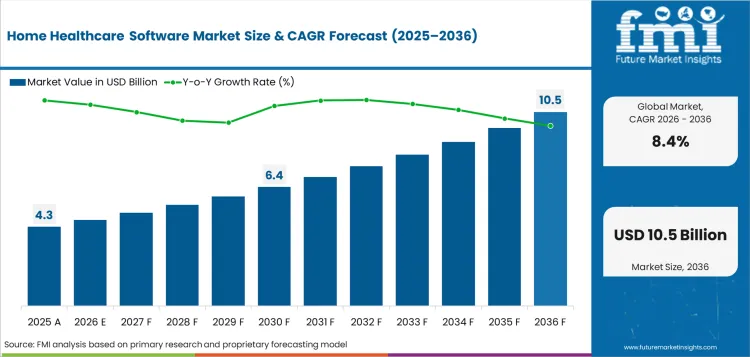
Key Takeaways, Market Size, and Forecast
| Metric | Value |
|---|---|
| Market Size (2025) | USD 4.3 Billion |
| Market Size (2036) | USD 10.5 Billion |
| CAGR (2026–2036) | 8.4% |
| Incremental Opportunity (2026–2036) | USD 5.82 Billion |
| Leading Usage (2026) | Clinical Homecare Systems |
| Clinical Homecare Systems Share (2026) | 52.0% |
| Fastest-Growing Country | India |
| India CAGR | 8.7% |
| 2nd Fastest-Growing Country | China |
| China CAGR | 8.1% |
Payment pressure is making claim accuracy a key requirement when selecting home healthcare software. In November 2025, the Centers for Medicare & Medicaid Services announced that Medicare payments to home health agencies will decrease by 1.3% (USD 220 million) in 2026. As a result, agencies are under tighter reimbursement conditions and need software that links care documentation directly to billing validation and claim support.
Documentation quality has become a critical selection factor. In February 2026, CMS reported that insufficient documentation accounted for 51.4% of improper payments in 2024. This is increasing demand for systems with guided workflows and audit-ready records to reduce claim errors. Integration capabilities are also gaining importance. CMS has set January 1, 2027 as a key milestone for interoperability and prior authorization APIs, requiring homecare platforms to support payer data exchange and reduce manual authorization processes.
Home Healthcare Software Market Definition
The home healthcare software market includes digital platforms used to manage care delivery outside hospital settings. Home healthcare platforms support clinical notes, visit schedules, patient monitoring, billing records, and care coordination. Scope includes home health agency software, hospital-linked homecare systems, and remote care platforms. Consumer wellness apps and physical home medical equipment are outside the scope.
Home Healthcare Software Market Inclusions
Market scope covers all commercially traded home healthcare software platforms categorized by product, including clinical management systems, electronic health record systems, patient monitoring systems, care coordination platforms, remote monitoring systems, telehealth integration systems, and data analytics platforms; usage, including clinical homecare systems, chronic disease management, post-acute care monitoring, elderly care support, and hospital-based systems; technology, including cloud-based systems, software as a service platforms, on-premise systems, and hybrid systems; and end users, including hospitals, homecare providers, clinics, and independent care providers. Revenue scope covers 2026 to 2036. Stakeholders include home healthcare software vendors, healthcare IT integrators, hospitals, homecare agencies, remote patient monitoring providers, cloud platform providers, billing software companies, care coordination teams, distributors, and regulatory bodies.
Home Healthcare Software Market Exclusions
Scope does not include home nursing labor, physical medical equipment, hospital-only EHR platforms, personal wellness apps, or insurance administration software.
Home Healthcare Software Market Research Methodology
Primary Research: FMI analysts talked to homecare agencies, hospital discharge teams, software vendors, and healthcare IT integration specialists in major markets.
Desk Research: Combined data from healthcare payment rules, digital health policies, public care programs, and company software portfolios.
Market sizing and forecasting: Added software use across product groups and end user groups from the bottom up.
Data validation: Cross-checked every three months against care delivery patterns and company portfolio coverage.
Why is the Home Healthcare Software Market Growing?
- Homecare providers use software earlier to reduce billing errors and claim rework.
- Hospitals rely on care coordination tools as more patients recover outside facilities.
- Agencies select cloud platforms to manage field caregivers and remote clinical records.
Home health providers need stronger documentation as service records now affect payment risk directly. The Centers for Medicare & Medicaid Services February 2026 provider compliance page states insufficient documentation accounted for 51.4% of improper payments for home health services during the 2024 reporting period. Payment exposure makes software-based care records important for agency revenue protection. Vendors with billing checks and clinician prompts can lower avoidable claim gaps. Agencies will prefer platforms linking daily care records directly to supporting payment documentation.
Visit verification has become a core operating need for Medicaid-funded homecare services. Medicaid.gov states that EVV use is required for Medicaid-funded home health care services from January 1, 2023, with incremental FMAP reductions up to 1% for noncompliant states. EVV regulation increases the need for software that captures caregiver visits and detailed service information. Providers need systems to reduce manual checks and align records with state requirements. Software vendors with EVV compatibility hold an advantage in Medicaid-heavy service networks.
Market Segmentation Analysis
- Clinical management systems are estimated to represent 34.4% of product revenue in 2026 as agencies centralize care notes and task records.
- Clinical homecare systems are expected to capture 52.0% of usage share in 2026 through direct use across home visits.
- Cloud-based systems are projected to hold 46.7% of technology preference in 2026 as field teams need remote record access.
- Hospitals are estimated to contribute 48.9% of end user share in 2026 as discharge teams extend follow-up into homecare settings.
- Direct sales are expected to account for 44.5% of channel share in 2026 through enterprise contracts needing rollout control.
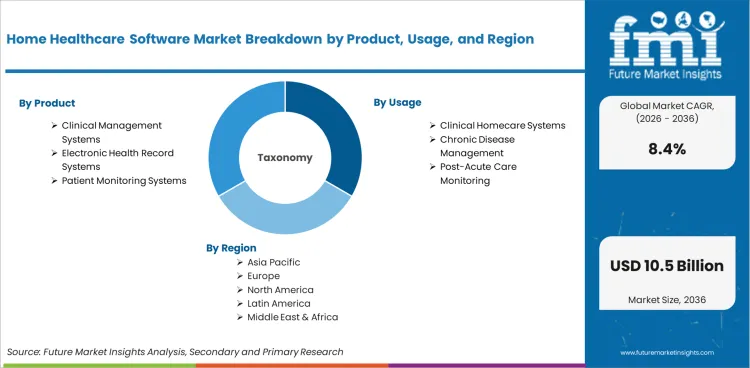
Home healthcare software is divided into six primary segment groups based on product, usage, technology, end user, distribution channel, and pricing model. Product includes clinical management systems, electronic health record systems, patient monitoring systems, care coordination platforms, and remote monitoring systems. Usage includes clinical homecare systems, chronic disease management, post-acute care monitoring, elderly care support, and hospital-based systems. Technology includes cloud-based systems, software as a service platforms, remote data access systems, on-premise systems, and hybrid systems. End user includes hospitals, homecare providers, independent care providers, agency-based providers, and clinics. Distribution channel includes direct sales, third-party vendors, system integrators, resellers, and online platforms.
Insights into Home Healthcare Software Market by Product
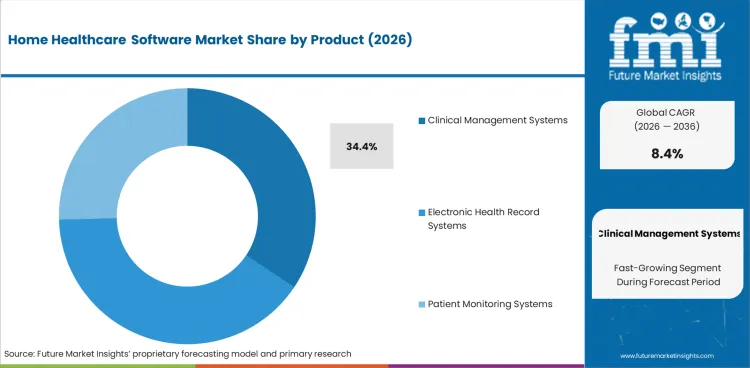
- In 2026, clinical management systems are forecast to make up 34.4% of the product segment. Clinical platforms bring care notes and task tracking into one operating base for homecare teams.
- Patient monitoring and dashboard tools address selected care review needs. Their use rises in agencies that require alerts and visibility across active patient cases.
Insights into Home Healthcare Software Market by Usage
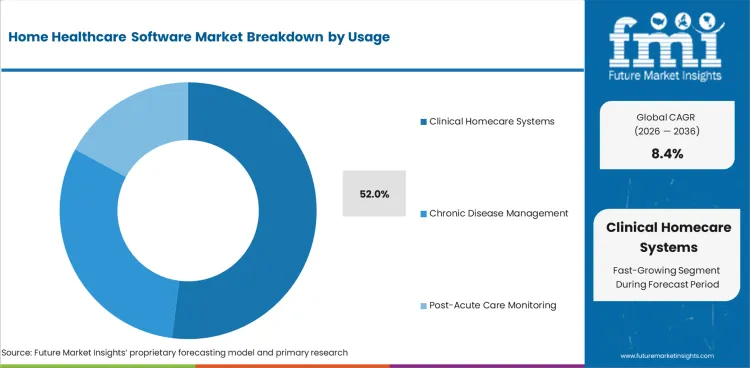
- Clinical homecare systems are projected to account for 52.0% of the usage segment in 2026. Homecare agencies use these systems to manage visits and patient records across routine care.
- Chronic disease management tools address longer care programs and repeat follow-up needs. Their use rises as providers manage recurring patient reviews and service documentation.
Insights into Home Healthcare Software Market by Technology
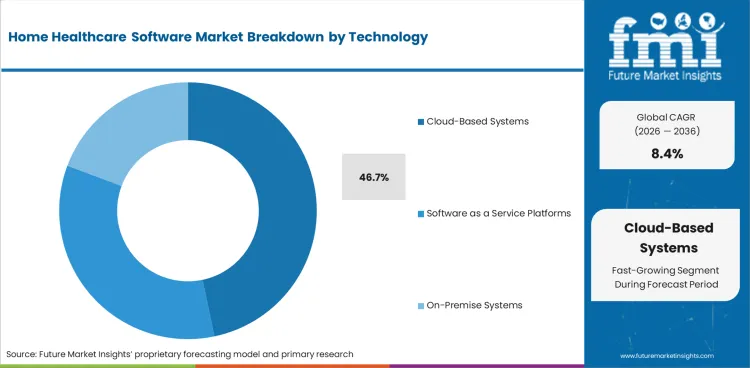
- In 2026, cloud-based systems are forecast to hold 46.7% of the technology segment. Cloud platforms help field caregivers access records and update care notes outside office locations.
- On-premise and hybrid systems address organizations with tighter internal IT control needs. Adoption improves in facilities requiring local data control and custom integration.
Insights into Home Healthcare Software Market by End User
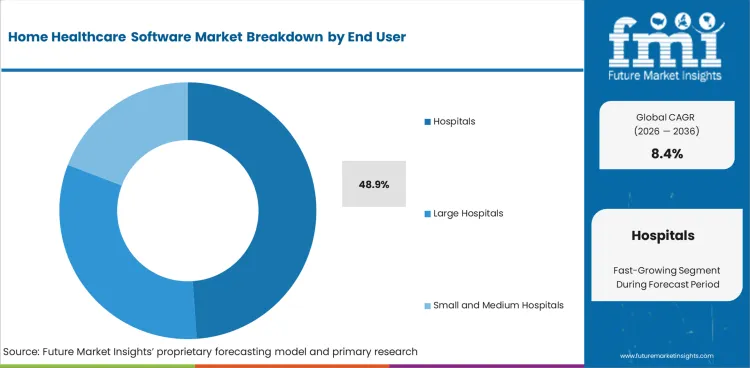
- Hospitals are forecast to account for 48.9% of the end user segment in 2026. Discharge teams need homecare coordination software to manage patient follow-up after facility treatment.
- Homecare providers and clinics address more focused service needs. Software use rises as visit planning and billing records become harder to manage manually.
Insights into Home Healthcare Software Market by Distribution Channel
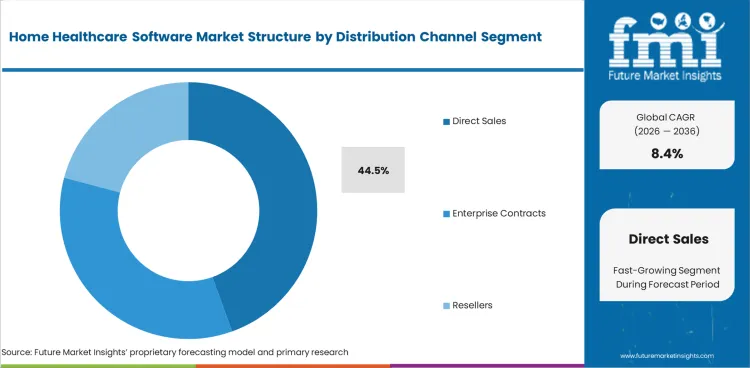
- Direct sales are forecast to hold 44.5% of the distribution channel segment in 2026. Large healthcare organizations prefer direct vendor contracts for rollout control and service accountability.
- Resellers and online platforms serve smaller providers needing faster access. Use is stronger in lower-complexity decisions with limited integration and lighter training needs.
Home Healthcare Software Market Drivers, Restraints, and Opportunities
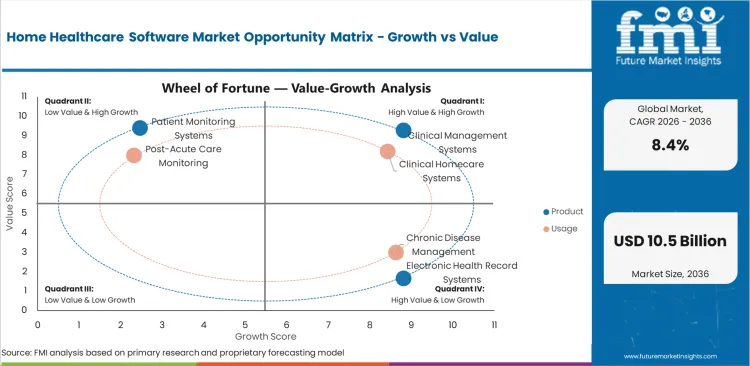
- Payment documentation pressure creates structured demand for homecare software across regulated service claims.
- The need for training and integration creates cost pressure for smaller homecare providers.
- Connected care creates service opportunities through monitoring dashboards and remote consultation workflows.
Home healthcare software continues expanding as agencies and hospitals need cleaner care records and stronger visit coordination outside facilities. Cost pressure and integration limits can slow adoption among smaller providers. Expansion continues through cloud platforms and remote patient monitoring workflows.
Reimbursement Compression Is Capping SaaS Renewal Inflation
Home healthcare software pricing is facing a more disciplined renewal environment as agencies enter 2026 with less room to absorb broad subscription increases. In November 2025, the Centers for Medicare & Medicaid Services finalized that Medicare payments to home health agencies would decrease by an estimated 1.3%, or USD 220 million, in CY 2026 compared with CY 2025. The rate calculation included a 2.4% payment update. Software vendors gain stronger pricing power through modules to prove billing accuracy and visit planning value. Documentation speed and denial prevention carry greater weight across agency contracts. Agencies may challenge bundled price uplifts unless vendors can tie fees to measurable administrative savings and revenue protection.
Medicaid Complexity Is Supporting Premium Compliance Modules
Medicaid program complexity keeps pricing firmer for home healthcare software platforms. Higher-value systems often pair configurable billing with EVV tools, then add authorization workflows and care-plan management. The Kaiser Family Foundation's January 2026 report states that 5.1 million people used Medicaid home care in 2023. States operated over 300 Medicaid home care programs in 2025. Agencies working across waivers and managed care plans often need configurable software. Configuration needs limit the value of low-cost generic platforms. Vendors with state-specific rules engines and payer connectivity can defend higher implementation and module fees. Smaller providers may push for phased deployment or per-location pricing to avoid heavy upfront costs.
Analysis of Home Healthcare Software Market By Key Countries
.webp "Top Country Growth Comparison Home Healthcare Software Market Cagr (2026 2036)")
| Country | CAGR |
|---|---|
| India | 8.7% |
| China | 8.1% |
| USA | 7.9% |
| Australia | 7.4% |
| Germany | 7.1% |
| Japan | 6.3% |
| UK | 5.4% |
Source: Future Market Insights, 2026.
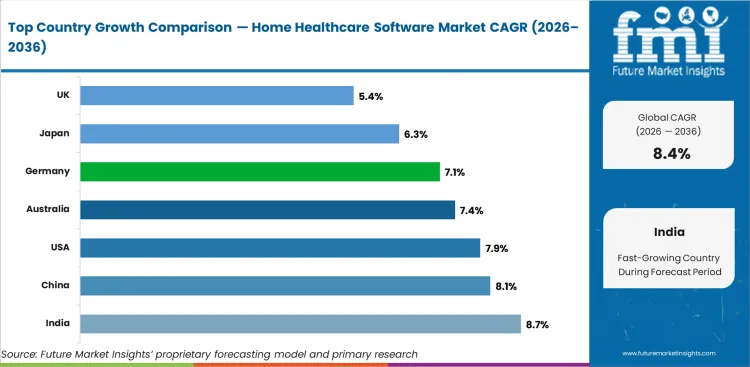
Home Healthcare Software Market CAGR Analysis By Country
- India leads the country outlook with an 8.7% CAGR through 2036 as organized homecare providers digitize care records and service planning.
- China is projected to advance at 8.1% CAGR during the forecast period, as elderly care scale and coordinated patient follow-up needs.
- USA demand is forecast to rise at 7.9% CAGR by 2036 as EVV rules and payment documentation influence software selection.
- Australia is expected to record 7.4% CAGR across 2026 to 2036 as community care programs increase use of home package administration tools.
- Germany’s market is set to expand at 7.1% CAGR over the assessment period, as digital health records and secure care data exchange.
- Japan is forecast at 6.3% CAGR by the end of 2036 as aging care needs increase healthcare IT modernization.
- UK demand is expected to expand at 5.4% CAGR across the forecast timeline as established digital health systems move through budget-controlled software upgrades.
Demand for home healthcare software is forecast to rise at 8.4% CAGR from 2026 to 2036. Country-level analysis covers the major markets contributing to this forecast, with the key markets listed below.
Demand Outlook for Home Healthcare Software Market in India
India’s home healthcare software industry is projected to record a CAGR of 8.7% through 2036. India’s Clinical Decision Support System integrated with eSanjeevani had benefited 26 crore telemedicine consultations as of December 2025. Service scale builds user familiarity with digital care delivery. Homecare providers can use software integrating scheduling with clinical follow-up. Local vendors need mobile-first workflows to fit agency staff working across patient homes.
- Private homecare providers need affordable software for visit planning and billing records.
- Hospital groups use homecare platforms to manage post-discharge follow-up and chronic care.
- Mobile caregiver tools can reduce missed updates during daily home visit operations.
Sales Analysis of Home Healthcare Software Market in China
The home healthcare software sector in China is expected to expand at a CAGR of 8.1% during the assessment period. By the end of 2025, China had 1.107 million medical and health institutions, including 38 thousand hospitals. Provider base creates a large addressable pool for digital care coordination. Elderly care programs raise the need for remote service records and home visit tracking. Software suppliers with local compliance fit can serve hospitals and community care providers.
- Elderly care expansion backs demand for scheduling and patient monitoring tools.
- Hospitals need software links with homecare providers for post-acute patient follow-up.
- Local language support and regional service access are important vendor selection points.
Demand Outlook for Home Healthcare Software Market in the United States
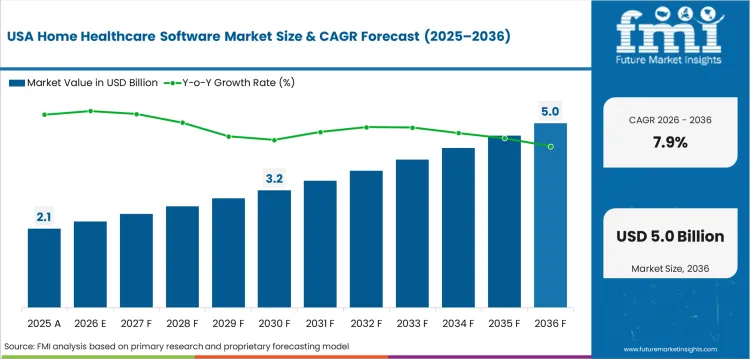
The U.S. home healthcare software industry is forecast to grow at a CAGR of 7.9% by 2036. The Centers for Medicare & Medicaid Services estimates CY 2026 Medicare payments to home health agencies will decrease by 1.3%, or USD 220 million, compared with CY 2025. Payment pressure increases the value of clean documentation and denial prevention. Homecare agencies need software to link clinical notes with claim records. Vendors with EVV and billing support can gain faster entry into large agency networks.
- EVV requirements increase demand for visit verification and service record tools.
- Payment pressure makes claim-ready documentation a core software selection factor.
- Hospital-at-home programs create demand for connected monitoring and care coordination systems.
Opportunity Analysis of Home Healthcare Software Market in Australia
The home healthcare software segment in Australia is forecast to advance at 7.4% CAGR from 2026 to 2036. Australia reported 933 approved Home Care Package providers with a home care service as of 30 September 2025. Provider base needs software for roster planning and care record management. Home Care Packages create recurring administrative needs for reporting and care plan updates. Vendors with aged care workflow depth can address community care and home support needs.
- Home care package administration increases demand for reporting and workflow platforms.
- Regional service delivery creates need for mobile access and care note sharing.
- Provider Management System updates raise software readiness needs across aged care providers.
Demand Outlook for Home Healthcare Software Market in Germany
The home healthcare software industry in Germany is expected to post 7.1% CAGR through 2036. Germany’s April 2026 digital health strategy noted around 74.5 million statutory insured people have an electronic patient record unless they object. This national record base encourages data exchange across care settings. Homecare software vendors need secure access control and interoperability with provider systems. German buyers will favor platforms that reduce manual records without increasing privacy risk.
- Electronic patient records increase demand for secure care data exchange.
- Homecare providers need software to work with payer and clinical systems.
- Privacy requirements make access control a major point in vendor evaluation.
Future Outlook for Home Healthcare Software Market in Japan
The Japan home healthcare software industry is expected to post 6.3% CAGR from 2026 to 2036. Ministry of Health, Labour and Welfare’s April 2024 healthcare startup policy document estimated Japan’s healthcare IT market at around JPY 400 billion by 2025. Market base gives software vendors a mature but careful buying environment. Aging care needs create demand for remote records and patient follow-up tools. Vendors need simple interfaces to reduce workload for clinical staff and care managers.
- Aging care programs need software to help nurses track home visits and care plans.
- Medical DX policy direction improves acceptance of electronic records and data sharing.
- Organizations prefer systems that reduce staff steps and fit existing clinical work habits.
Future Outlook for Home Healthcare Software Market in the United Kingdom
The UK home healthcare software industry is expected to post 5.4% CAGR by 2036. NHS Englanded report, 41 million people were registered with the NHS App. Every acute NHS trust was linked to referral and appointment access. The NHS App scale raises expectations for patient-facing health software. Homecare providers need platforms to connect with appointment records and care messages. Vendors with low training burden can serve budget-sensitive care organizations.
- NHS App expansion increases user comfort with digital health interactions.
- Homecare providers need systems to reduce paper records and phone-based coordination.
- Budget discipline favors subscription software with simple rollout and practical service support.
Competitive Landscape and Strategic Positioning
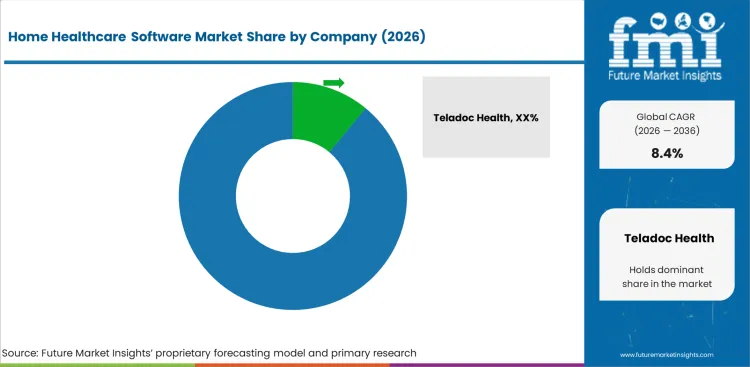
- Teladoc Health has a defined role through virtual care coverage and remote clinical workflow tools used by hospital-linked programs.
- Homecare Homebase and Kyruus compete through home health workflow depth and patient access capabilities for provider networks.
- Specialist providers focus on agency operations and remote patient monitoring with software designed around defined service needs.
Home healthcare software vendors are focusing on virtual care reach and clinical workflow depth across home-based service settings. For instance, Teladoc Health has a defined position in virtual care workflows and hospital-facing remote care tools. Homecare Homebase brings dedicated depth in home health and hospice software for agencies managing daily care operations. Kyruus adds patient access and provider data capability for healthcare organizations managing care navigation. HealthViewX and Aaniie serve provider teams through remote monitoring and care management workflows.
Integration cost and training effort can slow software replacement among smaller providers. Vendor priorities center on easier onboarding and stronger billing documentation across care delivery cycles. Healthcare organizations prefer platforms combining clinical records and payment functions in one system. Companies with more complete software menus and practical implementation teams are better placed to reduce coordination strain for homecare agencies.
Key Companies in the Home Healthcare Software Market
Key global companies leading the home healthcare software market include:
- Teladoc Health, Homecare Homebase, and Kyruus have software infrastructure for virtual care and homecare workflow delivery.
- HealthViewX, Loyal Health, and River Health serve providers through remote monitoring and patient access coverage.
- Aaniie, Hospice Tools, Enlite, and Log my Care hold specialist positions across caregiver workflows and agency operations.
Competitive Benchmarking: Home Healthcare Software Market
| Company | Clinical Workflow Depth | Homecare Integration Breadth Remote Care Capability | Geographic Footprint | |
|---|---|---|---|---|
| Teladoc Health | High | Strong | Strong | Global |
| Homecare Homebase | High | Strong | Medium | USA |
| Kyruus | Medium | Strong | Medium | USA |
| HealthViewX Remote Patient Monitoring | Medium | Medium | Strong | USA and India |
| Loyal Health | Medium | Medium | Medium | USA |
| River Health | Medium | Medium | Medium | USA |
| Aaniie | Medium | Strong | Medium | USA |
| Hospice Tools | Medium | Medium | Low | USA |
| Enlite | Medium | Medium | Medium | USA |
| Log my Care | Medium | Medium | Low | UK |
Source: Future Market Insights, 2026.
Key Developments in Home Healthcare Software Market
- In November 2024, Teladoc Health expanded AI capabilities for hospitals with a Virtual Sitter solution. The solution helps one remote staff member monitor up to 25% more patients.
- In September 2025, Homecare Homebase launched AI-driven tools within its HCHB Intelligence Suite. The tools are designed to reduce manual work across home-based care workflows.
- In September 2025, RevSpring announced an agreement to acquire Kyruus Health. The agreement would connect patient search, scheduling, communication, and payment workflows.
Key Players in the Home Healthcare Software Market
Major Global Players:
- Teladoc Health
- Homecare Homebase
- Kyruus
- HealthViewX Remote Patient Monitoring
Specialist Players:
- Loyal Health
- River Health
- Hospice Tools
- Aaniie
- Enlite
- Log my Care
Report Scope and Coverage
| Parameter | Details |
|---|---|
| Quantitative Units | USD 4.7 billion to USD 10.5 billion, at a CAGR of 8.4% |
| Market Definition | The home healthcare software market encompasses software used to manage home-based clinical care and provider workflows. |
| Regions Covered | North America, Latin America, Europe, East Asia, South Asia and Pacific, Middle East and Africa |
| Countries Covered | USA, Germany, Japan, UK, China, India, Australia, and 30 plus countries |
| Key Companies Profiled | Teladoc Health, Homecare Homebase, Kyruus, HealthViewX, Loyal Health, River Health, Aaniie, Hospice Tools, Enlite, Log my Care |
| Forecast Period | 2026 to 2036 |
| Approach | Hybrid bottom-up and top-down methodology starting with software demand and verified care delivery patterns. |
Home Healthcare Software Market Breakdown By Product, Usage, Technology, End User, Distribution Channel, Pricing Model, And Region
Home Healthcare Software Market Segmented by Product:
- Clinical Management Systems
- Electronic Health Record Systems
- Patient Monitoring Systems
- Care Coordination Platforms
- Remote Monitoring Systems
- Telehealth Integration Systems
- Data Analytics Platforms
- Predictive Analytics Tools
- Reporting and Dashboard Systems
Home Healthcare Software Market Segmented by Usage:
- Clinical Homecare Systems
- Chronic Disease Management
- Post-Acute Care Monitoring
- Elderly Care Support
- Hospital-Based Systems
- Inpatient Monitoring
- Outpatient Care Systems
- Ambulatory Care Systems
- Day Care Treatment Systems
- Remote Consultation Platforms
Home Healthcare Software Market Segmented by Technology:
- Cloud-Based Systems
- Software as a Service Platforms
- Remote Data Access Systems
- On-Premise Systems
- Hospital Installed Systems
- Local Data Storage Systems
- Hybrid Systems
- Integrated Cloud and On-Premise
Home Healthcare Software Market Segmented by End User:
- Hospitals
- Large Hospitals
- Small and Medium Hospitals
- Homecare Providers
- Independent Care Providers
- Agency-Based Providers
- Clinics
- Specialty Clinics
- Primary Care Clinics
Home Healthcare Software Market Segmented by Distribution Channel:
- Direct Sales
- Enterprise Contracts
- Direct Vendor Sales
- Third-Party Vendors
- System Integrators
- Resellers
- Online Platforms
- Cloud Marketplaces
Home Healthcare Software Market Segmented by Pricing Model:
- Subscription-Based
- Monthly Subscription
- Annual Subscription
- One-Time License
- Perpetual Licensing
- Pay-Per-Use
- Usage-Based Billing
Home Healthcare Software Market by Region:
- North America
- USA
- Canada
- Mexico
- Latin America
- Brazil
- Chile
- Rest of Latin America
- Europe
- Germany
- UK
- Italy
- Spain
- France
- Rest of Europe
- East Asia
- China
- Japan
- South Korea
- South Asia and Pacific
- India
- ASEAN
- Australia & New Zealand
- Rest of South Asia and Pacific
- Middle East and Africa
- Saudi Arabia
- Other GCC Countries
- South Africa
- Rest of Middle East and Africa
Research Sources and Bibliography
- KFF. (2026, January 5). Medicaid Home Care (HCBS) in 2025.
- Centers for Medicare & Medicaid Services. (2025, November). Calendar year 2026 home health prospective payment system final rule. CMS.
- Centers for Medicare & Medicaid Services. (2026, February). Home health services: Medicare provider compliance tips. CMS.
- Medicaid.gov. (2026). Electronic visit verification. Centers for Medicare & Medicaid Services.
- Office of Inspector General. (2026, March). Electronic visit verification system for Medicaid in-home services. USA Department of Health and Human Services.
- Office of Inspector General. (2026, April). CMS could strengthen Medicare program safeguards to prevent and detect potentially improper payments for virtual check-in and e-visit services. USA Department of Health and Human Services.
- Ministry of Health and Family Welfare. (2026, January). Ministry of Health and Family Welfare specific documents on eSanjeevani. Government of India.
- National Bureau of Statistics of China. (2026, February). Statistical communique of the People’s Republic of China on the 2025 national economic and social development. Government of China.
- Federal Ministry of Health. (2026, April). Digital Together: Germany’s digitalisation strategy for health and care. Government of Germany.
- Ministry of Health, Labour and Welfare. (2024, April). Policy recommendations to bolster Japan’s healthcare startup ecosystem. Government of Japan.
- NHS England. (2026, April). Hospital patients can now check appointments in the NHS App. NHS England.
- Department of Health, Disability and Ageing. (2025, December). Home Care Packages Program Data Report Quarter 1 2025-26. Australian Government.
- Teladoc Health. (2024, November). Teladoc Health expands AI capabilities for hospitals and health systems with advanced Virtual Sitter solution. Teladoc Health.
- Homecare Homebase. (2025, September 30). Homecare Homebase launches innovative AI-driven tools.
- RevSpring. (2025, September 23). RevSpring to acquire Kyruus Health, creating a connected care journey from search to final payment.
This Report Answers
- What is the current and future size of the home healthcare software market?
- How fast is the home healthcare software market expected to expand between 2026 and 2036?
- Which product segment is expected to lead the market by 2026?
- Which usage segment is expected to account for the highest demand by 2026?
- What factors are driving demand for home healthcare software globally?
- How are EVV requirements influencing adoption of homecare software?
- Why are hospitals the main end user base for home healthcare software?
- How are cloud-based systems changing homecare workflow management?
- Which countries are projected to record faster expansion through 2036?
- What is driving market expansion in India and China?
- Who are the key companies active in the home healthcare software market?
- How does FMI estimate and validate the market forecast?
Frequently Asked Questions
What is the global market demand for Home Healthcare Software in 2026?
In 2026, the global market for home healthcare software is forecast to be worth USD 4.7 billion.
How big will the market for Home Healthcare Software be in 2036?
By 2036, the market for home healthcare software is forecast to be worth USD 10.5 billion.
How much is demand for Home Healthcare Software expected to expand between 2026 and 2036?
Between 2026 and 2036, demand for home healthcare software is forecast to expand at a CAGR of 8.4%.
Which usage segment is likely to be the leading usage segment globally by 2026?
Clinical Homecare Systems will make up 52.0% of the usage segment in 2026.
What is causing demand to rise in India?
The India home healthcare software market is projected to record 8.7% CAGR through 2036, backed by organized homecare service expansion.
What is causing demand to rise in China?
The China home healthcare software market is projected to expand at 8.1% CAGR through 2036, backed by elderly care and hospital digitization needs.
What does this report mean by Home Healthcare Software Market definition?
The home healthcare software market includes digital platforms used to manage clinical care, patient monitoring, billing, and provider workflows outside hospitals.
How does FMI make the Home Healthcare Software forecast and check it?
Forecasting models use a hybrid bottom-up and top-down approach, starting with software demand and checking it against care delivery patterns.
Preview the report firsthand - request a free sample
Get SampleGet the brochure for pricing and purchase details.
Get PDFTable of Content
- Key Takeaways
- Market Size and CAGR
- Top Growth Driver
- Fastest Growing Segment
- Leading Region
- Key Companies
- Emerging Opportunities
- Executive Summary
- Global Market Outlook
- Demand-side Trends
- Supply-side Trends
- Technology Roadmap Analysis
- Analysis and Recommendations
- Analyst Perspective (What is happening? Why now? What should investors know?)
- Key Questions Answered
- How large is the market?
- What is the CAGR?
- What are key trends?
- Which region dominates?
- Who are the leaders?
- Market Overview
- Market Coverage / Taxonomy
- Market Definition / Scope / Limitations
- Research Methodology
- Chapter Orientation
- Analytical Lens and Working Hypotheses
- Market Structure, Signals, and Trend Drivers
- Benchmarking and Cross-market Comparability
- Market Sizing, Forecasting, and Opportunity Mapping
- Research Design and Evidence Framework
- Desk Research Programme (Secondary Evidence)
- Expert Input and Fieldwork (Primary Evidence)
- Tooling, Models, and Reference Databases
- Data Engineering and Model Build
- Quality Assurance and Audit Trail
- Market Background
- Market Dynamics (Drivers, Restraints, Opportunity, Trends)
- Scenario Forecast (Optimistic, Likely, Conservative)
- Impact Analysis
- AI Impact
- Sustainability Impact
- Regulatory Impact
- Technology Impact
- Consumer / Buyer Analysis
- Purchase Drivers
- Adoption Barriers
- Buyer Journey
- Opportunity Map Analysis
- Product Life Cycle Analysis
- Supply Chain Analysis
- Investment Feasibility Matrix
- Value Chain Analysis
- PESTLE and Porter's Analysis
- Regulatory Landscape
- Regional Parent Market Outlook
- Production and Consumption Statistics
- Import and Export Statistics
- Global Market Analysis and Forecast, 2021 to 2036
- Historical Market Size Value (USD Billion) Analysis, 2021 to 2025
- Current and Future Market Size Value (USD Billion) Projections, 2026 to 2036
- Y-o-Y Growth Trend Analysis
- Absolute $ Opportunity Analysis
- Global Market Pricing Analysis, 2021 to 2036
- Global Market Analysis and Forecast, By Product, 2021 to 2036
- Introduction / Key Findings
- Historical Market Size Value (USD Billion) Analysis By Product, 2021 to 2025
- Current and Future Market Size Value (USD Billion) Analysis and Forecast By Product, 2026 to 2036
- Clinical Management Systems
- Electronic Health Record Systems
- Patient Monitoring Systems
- Care Coordination Platforms
- Remote Monitoring Systems
- Telehealth Integration Systems
- Data Analytics Platforms
- Predictive Analytics Tools
- Reporting and Dashboard Systems
- Clinical Management Systems
- Y-o-Y Growth Trend Analysis By Product, 2021 to 2025
- Absolute $ Opportunity Analysis By Product, 2026 to 2036
- Global Market Analysis and Forecast, By Usage, 2021 to 2036
- Introduction / Key Findings
- Historical Market Size Value (USD Billion) Analysis By Usage, 2021 to 2025
- Current and Future Market Size Value (USD Billion) Analysis and Forecast By Usage, 2026 to 2036
- Clinical Homecare Systems
- Chronic Disease Management
- Post-Acute Care Monitoring
- Elderly Care Support
- Hospital-Based Systems
- Inpatient Monitoring
- Outpatient Care Systems
- Ambulatory Care Systems
- Day Care Treatment Systems
- Remote Consultation Platforms
- Clinical Homecare Systems
- Y-o-Y Growth Trend Analysis By Usage, 2021 to 2025
- Absolute $ Opportunity Analysis By Usage, 2026 to 2036
- Global Market Analysis and Forecast, By Technology, 2021 to 2036
- Introduction / Key Findings
- Historical Market Size Value (USD Billion) Analysis By Technology, 2021 to 2025
- Current and Future Market Size Value (USD Billion) Analysis and Forecast By Technology, 2026 to 2036
- Cloud-Based Systems
- Software as a Service Platforms
- Remote Data Access Systems
- On-Premise Systems
- Hospital Installed Systems
- Local Data Storage Systems
- Hybrid Systems
- Integrated Cloud and On-Premise
- Cloud-Based Systems
- Y-o-Y Growth Trend Analysis By Technology, 2021 to 2025
- Absolute $ Opportunity Analysis By Technology, 2026 to 2036
- Global Market Analysis and Forecast, By End User, 2021 to 2036
- Introduction / Key Findings
- Historical Market Size Value (USD Billion) Analysis By End User, 2021 to 2025
- Current and Future Market Size Value (USD Billion) Analysis and Forecast By End User, 2026 to 2036
- Hospitals
- Large Hospitals
- Small and Medium Hospitals
- Homecare Providers
- Independent Care Providers
- Agency-Based Providers
- Clinics
- Specialty Clinics
- Primary Care Clinics
- Hospitals
- Y-o-Y Growth Trend Analysis By End User, 2021 to 2025
- Absolute $ Opportunity Analysis By End User, 2026 to 2036
- Global Market Analysis and Forecast, By Distribution Channel, 2021 to 2036
- Introduction / Key Findings
- Historical Market Size Value (USD Billion) Analysis By Distribution Channel, 2021 to 2025
- Current and Future Market Size Value (USD Billion) Analysis and Forecast By Distribution Channel, 2026 to 2036
- Direct Sales
- Enterprise Contracts
- Direct Vendor Sales
- Third-Party Vendors
- System Integrators
- Resellers
- Online Platforms
- Cloud Marketplaces
- Direct Sales
- Y-o-Y Growth Trend Analysis By Distribution Channel, 2021 to 2025
- Absolute $ Opportunity Analysis By Distribution Channel, 2026 to 2036
- Global Market Analysis and Forecast, By Pricing Model
- Introduction / Key Findings
- Historical Market Size Value (USD Billion) Analysis By Pricing Model, 2021 to 2025
- Current and Future Market Size Value (USD Billion) Analysis and Forecast By Pricing Model, 2026 to 2036
- Subscription-Based
- Monthly Subscription
- Annual Subscription
- One-Time License
- Perpetual Licensing
- Pay-Per-Use
- Usage-Based Billing
- Subscription-Based
- Y-o-Y Growth Trend Analysis By Pricing Model, 2021 to 2025
- Absolute $ Opportunity Analysis By Pricing Model, 2026 to 2036
- Global Market Analysis and Forecast, By Region, 2021 to 2036
- Introduction
- Historical Market Size Value (USD Billion) Analysis By Region, 2021 to 2025
- Current Market Size Value (USD Billion) Analysis and Forecast By Region, 2026 to 2036
- North America
- Latin America
- Western Europe
- Eastern Europe
- East Asia
- South Asia and Pacific
- Middle East & Africa
- Market Attractiveness Analysis By Region
- North America Market Analysis and Forecast, By Country, 2021 to 2036
- Historical Market Size Value (USD Billion) Trend Analysis By Market Taxonomy, 2021 to 2025
- Market Size Value (USD Billion) Forecast By Market Taxonomy, 2026 to 2036
- By Country
- USA
- Canada
- By Product
- By Usage
- By Technology
- By End User
- By Distribution Channel
- By Pricing Model
- By Country
- Market Attractiveness Analysis
- By Country
- By Product
- By Usage
- By Technology
- By End User
- By Distribution Channel
- By Pricing Model
- Key Takeaways
- Latin America Market Analysis and Forecast, By Country
- Historical Market Size Value (USD Billion) Trend Analysis By Market Taxonomy, 2021 to 2025
- Market Size Value (USD Billion) Forecast By Market Taxonomy, 2026 to 2036
- By Country
- Brazil
- Mexico
- Chile
- Rest of Latin America
- By Product
- By Usage
- By Technology
- By End User
- By Distribution Channel
- By Pricing Model
- By Country
- Market Attractiveness Analysis
- By Country
- By Product
- By Usage
- By Technology
- By End User
- By Distribution Channel
- By Pricing Model
- Key Takeaways
- Western Europe Market Analysis and Forecast, By Country
- Historical Market Size Value (USD Billion) Trend Analysis By Market Taxonomy, 2021 to 2025
- Market Size Value (USD Billion) Forecast By Market Taxonomy, 2026 to 2036
- By Country
- Germany
- UK
- Italy
- Spain
- France
- Nordic
- BENELUX
- Rest of Western Europe
- By Product
- By Usage
- By Technology
- By End User
- By Distribution Channel
- By Pricing Model
- By Country
- Market Attractiveness Analysis
- By Country
- By Product
- By Usage
- By Technology
- By End User
- By Distribution Channel
- By Pricing Model
- Key Takeaways
- Eastern Europe Market Analysis and Forecast, By Country
- Historical Market Size Value (USD Billion) Trend Analysis By Market Taxonomy, 2021 to 2025
- Market Size Value (USD Billion) Forecast By Market Taxonomy, 2026 to 2036
- By Country
- Russia
- Poland
- Hungary
- Balkan & Baltic
- Rest of Eastern Europe
- By Product
- By Usage
- By Technology
- By End User
- By Distribution Channel
- By Pricing Model
- By Country
- Market Attractiveness Analysis
- By Country
- By Product
- By Usage
- By Technology
- By End User
- By Distribution Channel
- By Pricing Model
- Key Takeaways
- East Asia Market Analysis and Forecast, By Country
- Historical Market Size Value (USD Billion) Trend Analysis By Market Taxonomy, 2021 to 2025
- Market Size Value (USD Billion) Forecast By Market Taxonomy, 2026 to 2036
- By Country
- China
- Japan
- South Korea
- By Product
- By Usage
- By Technology
- By End User
- By Distribution Channel
- By Pricing Model
- By Country
- Market Attractiveness Analysis
- By Country
- By Product
- By Usage
- By Technology
- By End User
- By Distribution Channel
- By Pricing Model
- Key Takeaways
- South Asia and Pacific Market Analysis and Forecast, By Country
- Historical Market Size Value (USD Billion) Trend Analysis By Market Taxonomy, 2021 to 2025
- Market Size Value (USD Billion) Forecast By Market Taxonomy, 2026 to 2036
- By Country
- India
- ASEAN
- Australia & New Zealand
- Rest of South Asia and Pacific
- By Product
- By Usage
- By Technology
- By End User
- By Distribution Channel
- By Pricing Model
- By Country
- Market Attractiveness Analysis
- By Country
- By Product
- By Usage
- By Technology
- By End User
- By Distribution Channel
- By Pricing Model
- Key Takeaways
- Middle East & Africa Market Analysis and Forecast, By Country
- Historical Market Size Value (USD Billion) Trend Analysis By Market Taxonomy, 2021 to 2025
- Market Size Value (USD Billion) Forecast By Market Taxonomy, 2026 to 2036
- By Country
- Kingdom of Saudi Arabia
- Other GCC Countries
- Türkiye
- South Africa
- Other African Union
- Rest of Middle East & Africa
- By Product
- By Usage
- By Technology
- By End User
- By Distribution Channel
- By Pricing Model
- By Country
- Market Attractiveness Analysis
- By Country
- By Product
- By Usage
- By Technology
- By End User
- By Distribution Channel
- By Pricing Model
- Key Takeaways
- Key Countries Market Analysis
- USA
- Pricing Analysis
- Market Share Analysis, 2025
- By Product
- By Usage
- By Technology
- By End User
- By Distribution Channel
- By Pricing Model
- Canada
- Pricing Analysis
- Market Share Analysis, 2025
- By Product
- By Usage
- By Technology
- By End User
- By Distribution Channel
- By Pricing Model
- Mexico
- Pricing Analysis
- Market Share Analysis, 2025
- By Product
- By Usage
- By Technology
- By End User
- By Distribution Channel
- By Pricing Model
- Brazil
- Pricing Analysis
- Market Share Analysis, 2025
- By Product
- By Usage
- By Technology
- By End User
- By Distribution Channel
- By Pricing Model
- Chile
- Pricing Analysis
- Market Share Analysis, 2025
- By Product
- By Usage
- By Technology
- By End User
- By Distribution Channel
- By Pricing Model
- Germany
- Pricing Analysis
- Market Share Analysis, 2025
- By Product
- By Usage
- By Technology
- By End User
- By Distribution Channel
- By Pricing Model
- UK
- Pricing Analysis
- Market Share Analysis, 2025
- By Product
- By Usage
- By Technology
- By End User
- By Distribution Channel
- By Pricing Model
- Italy
- Pricing Analysis
- Market Share Analysis, 2025
- By Product
- By Usage
- By Technology
- By End User
- By Distribution Channel
- By Pricing Model
- Spain
- Pricing Analysis
- Market Share Analysis, 2025
- By Product
- By Usage
- By Technology
- By End User
- By Distribution Channel
- By Pricing Model
- France
- Pricing Analysis
- Market Share Analysis, 2025
- By Product
- By Usage
- By Technology
- By End User
- By Distribution Channel
- By Pricing Model
- India
- Pricing Analysis
- Market Share Analysis, 2025
- By Product
- By Usage
- By Technology
- By End User
- By Distribution Channel
- By Pricing Model
- ASEAN
- Pricing Analysis
- Market Share Analysis, 2025
- By Product
- By Usage
- By Technology
- By End User
- By Distribution Channel
- By Pricing Model
- Australia & New Zealand
- Pricing Analysis
- Market Share Analysis, 2025
- By Product
- By Usage
- By Technology
- By End User
- By Distribution Channel
- By Pricing Model
- China
- Pricing Analysis
- Market Share Analysis, 2025
- By Product
- By Usage
- By Technology
- By End User
- By Distribution Channel
- By Pricing Model
- Japan
- Pricing Analysis
- Market Share Analysis, 2025
- By Product
- By Usage
- By Technology
- By End User
- By Distribution Channel
- By Pricing Model
- South Korea
- Pricing Analysis
- Market Share Analysis, 2025
- By Product
- By Usage
- By Technology
- By End User
- By Distribution Channel
- By Pricing Model
- Russia
- Pricing Analysis
- Market Share Analysis, 2025
- By Product
- By Usage
- By Technology
- By End User
- By Distribution Channel
- By Pricing Model
- Poland
- Pricing Analysis
- Market Share Analysis, 2025
- By Product
- By Usage
- By Technology
- By End User
- By Distribution Channel
- By Pricing Model
- Hungary
- Pricing Analysis
- Market Share Analysis, 2025
- By Product
- By Usage
- By Technology
- By End User
- By Distribution Channel
- By Pricing Model
- Kingdom of Saudi Arabia
- Pricing Analysis
- Market Share Analysis, 2025
- By Product
- By Usage
- By Technology
- By End User
- By Distribution Channel
- By Pricing Model
- Türkiye
- Pricing Analysis
- Market Share Analysis, 2025
- By Product
- By Usage
- By Technology
- By End User
- By Distribution Channel
- By Pricing Model
- South Africa
- Pricing Analysis
- Market Share Analysis, 2025
- By Product
- By Usage
- By Technology
- By End User
- By Distribution Channel
- By Pricing Model
- USA
- Market Structure Analysis
- Competition Dashboard
- Competition Benchmarking
- Market Share Analysis of Top Players
- By Regional
- By Product
- By Usage
- By Technology
- By End User
- By Distribution Channel
- By Pricing Model
- Emerging Startups
- Innovation Benchmarking
- Competition Analysis
- Competition Deep Dive
- Teladoc Health
- Overview
- Product Portfolio
- Profitability by Market Segments
- Sales Footprint
- Strategy Overview
- Marketing Strategy
- Product Strategy
- Channel Strategy
- Homecare Homebase
- Kyruus
- HealthViewX Remote Patient Monitoring
- Teladoc Health
- Case Studies
- Success Stories
- Recent Developments
- Competition Deep Dive
- Assumptions & Acronyms Used


