

- Industry Size (2026)
- USD 4.7 Bn
- Forecast (2036)
- USD 12.1 Bn
- CAGR (2026 to 2036)
- 9.9%
AI-Powered Robotic Changeover Systems Demand Forecast and Outlook 2026 to 2036
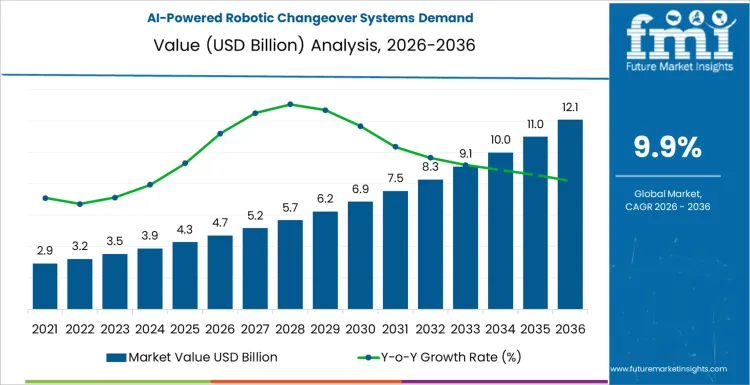
The demand for AI-powered robotic changeover systems is estimated to reach USD 4.7 billion in 2026 and expand to USD 12.1 billion by 2036, growing at a CAGR of 9.9%. Enterprise expenditure on AI-powered robotic changeover systems is allocated across several critical areas to ensure rapid production transitions, minimize downtime, and optimize manufacturing efficiency. A significant portion of the budget is dedicated to advanced robotic manipulation systems, which are essential for automated tooling changes, part positioning, and equipment reconfiguration during production transitions.
These systems play a crucial role in reducing changeover times from hours to minutes while maintaining precision and repeatability. Another substantial expenditure is directed toward the integration of AI-driven planning and scheduling algorithms within manufacturing execution systems, allowing the systems to not only execute changeovers but also predict optimal timing based on production schedules, inventory levels, and equipment availability patterns. The vision and sensing technologies also receive considerable investment, as these automated systems require precise object recognition, dimensional verification, and alignment capabilities to handle diverse tooling configurations and part geometries.
Quick Stats for AI-Powered Robotic Changeover Systems Demand
- Demand for AI-Powered Robotic Changeover Systems Value (2026): USD 4.7 billion
- Demand for AI-Powered Robotic Changeover Systems Forecast Value (2036): USD 12.1 billion
- Demand for AI-Powered Robotic Changeover Systems Forecast CAGR 2026 to 2036: 9.9%
- Leading Technology Type by Demand Share: AI-driven scheduling and optimization
- Fastest-Growing Applications: Automotive assembly, consumer electronics, pharmaceutical packaging
- Top Players in Global Demand: ABB Ltd., KUKA AG, FANUC Corporation, Universal Robots A/S, Yaskawa Electric Corporation
Ongoing maintenance and calibration of both the robotic hardware and AI software components are essential to ensure their accuracy and efficiency over time, requiring a steady flow of resources. Training and workforce enablement also form a critical part of the expenditure, as staff must be trained to program changeover sequences, manage exception handling, and understand the integration between robotic systems and production planning software. Lastly, enterprises allocate funds for cybersecurity and data protection to secure changeover recipes, production data, and system configurations from unauthorized access. This comprehensive approach ensures that AI-powered robotic changeover systems operate efficiently, reducing setup times and driving manufacturing flexibility.
Demand for AI-Powered Robotic Changeover Systems Key Takeaways
| Metric | Value |
|---|---|
| Demand Value (2026) | USD 4.7 billion |
| Demand Forecast Value (2036) | USD 12.1 billion |
| Forecast CAGR 2026 to 2036 | 9.9% |
What Benefits are Being Realized over Traditional Systems?
AI-powered robotic changeover systems are delivering several key benefits over traditional operations, transforming how manufacturing and production processes are managed. One of the primary advantages is reduced downtime. Traditional changeover processes often require manual adjustments, extensive operator intervention, and a significant amount of time to retool or reconfigure machinery. AI-driven systems can automate this process, quickly adjusting settings, tools, and machinery to accommodate new product configurations, reducing the time required for changeovers and keeping production lines running efficiently.
Another key benefit is increased flexibility. Traditional systems are often designed for specific products or production runs, making it difficult to quickly adapt to changes in demand or new product variations. AI-powered robots can seamlessly handle a wide variety of products with minimal reconfiguration, allowing for more agile manufacturing processes and better responsiveness to market demands.
How Will the Demand for AI-Powered Robotic Changeover Systems Structure?
AI-powered robotic changeover systems serve a critical function in reducing setup times, improving changeover consistency, and enabling flexible manufacturing operations across diverse product configurations. Adoption is influenced by changeover complexity requirements, production volume variability, integration challenges, and safety certification standards. Segmentation by technology type, automation function, and application reveals how manufacturers select specific robotic changeover architectures to meet speed targets, accuracy specifications, and safety requirements across different manufacturing environments.
Which Technology Type Holds the Largest Share in AI-Powered Robotic Changeover Systems?
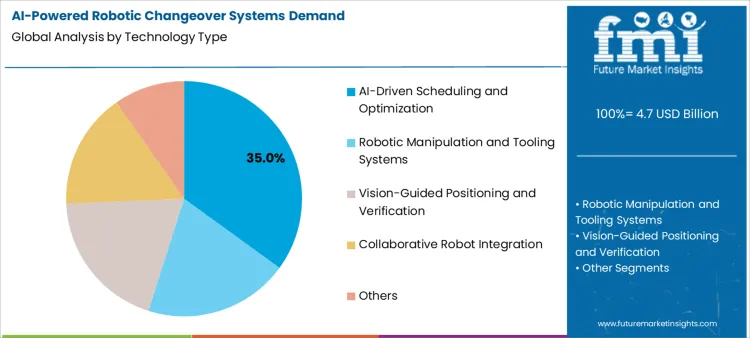
AI-driven scheduling and optimization accounts for 35.0%, driven by their ability to sequence changeover tasks efficiently and minimize total transition time across multiple production variables. Robotic manipulation and tooling systems hold 28.0%, supporting automated tool changes, fixture positioning, and part handling during production transitions. Vision-guided positioning and verification platforms represent 20.0%, favored for their capability to ensure accurate tool placement and dimensional verification during automated changeovers. Collaborative robot integration systems contribute 12.0%, used where human-robot collaboration enhances changeover flexibility and safety. Other automation technologies account for 5.0%.
Key Points
- AI-driven optimization dominates changeover sequencing applications.
- Robotic manipulation enables automated tooling and fixture changes.
- Vision guidance ensures positioning accuracy and quality verification.
How Do Automation Functions Influence Technology Selection?
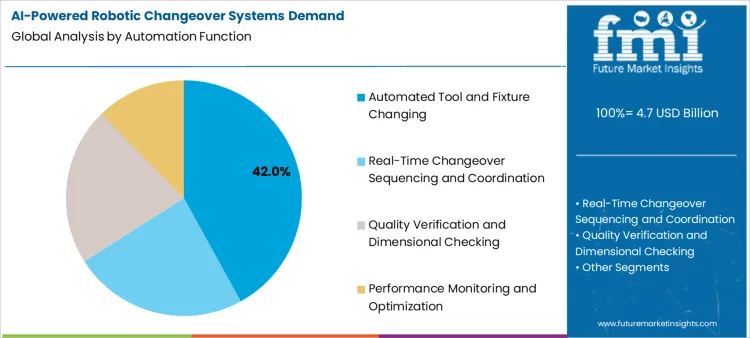
Automated tool and fixture changing represents 42.0%, reflecting priority on eliminating manual tooling operations and reducing changeover labor requirements. Real-time changeover sequencing and coordination account for 25.0%, essential for optimizing task order and minimizing total transition time. Quality verification and dimensional checking hold 20.0%, supporting automated validation of changeover accuracy without manual inspection. Performance monitoring and optimization represent 13.0%, addressing efficiency improvements through changeover data analysis and cycle time reduction.
Key Points
- Automated tool changing remains the foundation of robotic changeovers.
- Sequencing optimization directly impacts total changeover time reduction.
- Quality verification reduces manual inspection and validation requirements.
Which Applications Are Driving Demand for These Systems?
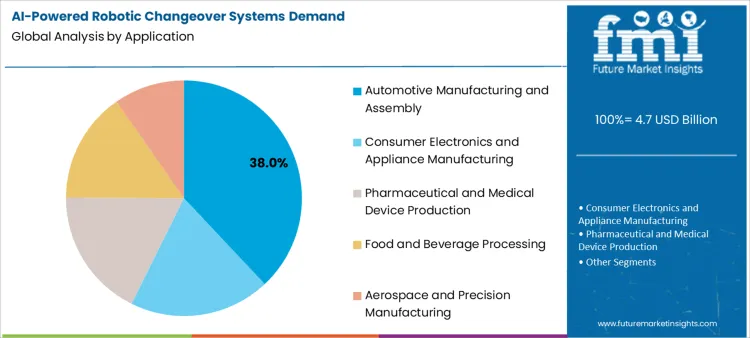
Automotive manufacturing and assembly lead with 38.0%, requiring frequent model changes and complex tooling configurations to support mixed-model production lines. Consumer electronics and appliance manufacturing account for 22.0%, using changeover automation for rapid product transitions and seasonal demand variations. Pharmaceutical and medical device production represent 18.0%, relying on changeover systems for contamination prevention and regulatory compliance during product switches. Food and beverage processing hold 15.0%, focused on packaging line changes and product format transitions in continuous operation environments. Aerospace and precision manufacturing account for 7.0%, where changeover accuracy and traceability drive specialized automation requirements.
Key Points
- Automotive applications emphasize mixed-model flexibility and speed.
- Electronics manufacturing prioritizes rapid product transition capabilities.
- Pharmaceutical sectors focus on contamination control and compliance.
What adoption horizon and timing milestones are being indicated by current deployments?
Current deployments indicate an adoption horizon driven by progressive validation milestones rather than immediate full-scale automation. A typical early milestone is changeover sequence validation in controlled conditions, where the system demonstrates reliable tool changes across known configurations, environmental variations, and operational parameters while maintaining acceptable accuracy rates. A second milestone is integration system validation, covering automated changeover coordination, safety system integration, emergency stop procedures, and documented performance in simulated production scenarios. Following validation, teams proceed to limited production deployment, where changeover sequences and robotic movements are refined through real operating conditions while maintaining human oversight and approval authority.
A subsequent milestone is autonomous changeover expansion, where system reliability and changeover time reduction justify reduced human supervision and increased automated decision authority. The point where adoption accelerates is system standardization: validated changeover recipes, proven robotic procedures, and reusable configuration templates that reduce deployment time for similar product families. Full deployment across production lines follows once changeover performance is documented, safety protocols are proven, and operational cost benefits are quantified through reduced setup labor and improved line efficiency.
How Is Demand for AI-Powered Robotic Changeover Systems Evolving Globally?
Global demand for AI-powered robotic changeover systems is expanding as manufacturers seek to reduce setup times while improving production flexibility and operational efficiency. Growth reflects rising adoption of artificial intelligence, collaborative robotics, and advanced vision systems across automotive, electronics, and consumer goods sectors. Technology selection focuses on changeover algorithms, robotic manipulation, and safety systems that operate reliably in production environments with minimal human intervention. USA. records 9.2% CAGR, China records 11.8% CAGR, Germany records 8.7% CAGR, Japan records 8.5% CAGR, and South Korea records 10.3% CAGR. Adoption remains driven by changeover time reduction and manufacturing flexibility rather than technology advancement alone.
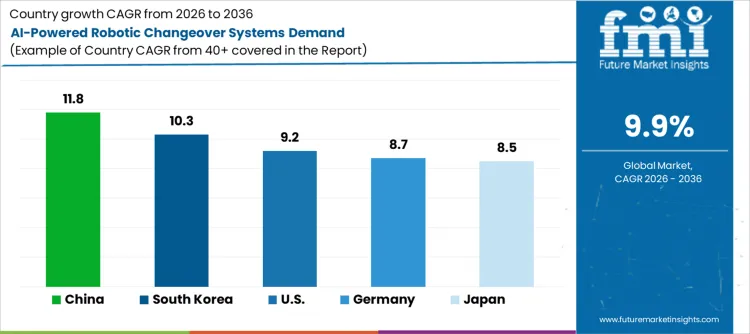
| Country | CAGR (%) |
|---|---|
| China | 11.8% |
| South Korea | 10.3% |
| USA. | 9.2% |
| Germany | 8.7% |
| Japan | 8.5% |
What is Driving Growth of AI-Powered Robotic Changeover Systems Demand In China?
Demand for AI-powered robotic changeover systems in China is set to expand as manufacturers scale production of flexible manufacturing systems and automated production equipment. Growth at 11.8% CAGR reflects rising adoption of changeover automation in electronics manufacturing, automotive production, and consumer goods applications. Production flexibility under high-volume conditions remains critical for meeting export requirements and domestic market demand variations. Cost efficiency drives selection of changeover systems delivering setup time reduction and labor cost improvement at competitive price points. Domestic automation companies prioritize systems compatible with existing production infrastructure and local technical support networks. Demand concentrates within export manufacturing facilities, state-owned enterprises, and industrial zones targeting advanced manufacturing capabilities.
- Expansion of flexible manufacturing initiatives
- Need for rapid product transition capabilities
- Cost-competitive changeover automation solutions
- Growth of mixed-model production deployment
Why is South Korea Seeing Expansion in AI-Powered Robotic Changeover Systems Adoption?
AI-powered robotic changeover systems demand in South Korea is positioned to grow as advanced manufacturing sectors integrate flexible production technologies. Growth at 10.3% CAGR reflects strong activity in semiconductor equipment, precision electronics, and advanced materials processing. Complex manufacturing processes require rapid changeover capabilities and precise positioning for yield protection and contamination prevention. Technology leadership drives adoption of cutting-edge changeover algorithms and collaborative robotic systems. Leading manufacturing companies invest in changeover automation for competitive advantage and operational excellence. Demand remains centered on high-precision manufacturing applications serving global technology markets.
- Advancement in semiconductor manufacturing processes
- Investment in precision electronics automation
- Leadership in changeover automation technology development
- Focus on high-precision manufacturing applications
What Factors are Shaping AI-Powered Robotic Changeover Systems Sales in the USA.?
Demand for AI-powered robotic changeover systems in the USA. is poised to strengthen as manufacturers integrate flexible automation across aerospace, automotive, and advanced manufacturing sectors. Growth at 9.2% CAGR reflects rising adoption in mixed-model production, consumer goods manufacturing, and pharmaceutical packaging applications. Labor shortage considerations and efficiency requirements drive selection of validated changeover systems with proven time reduction capabilities. Advanced research institutions and technology companies lead development of next-generation changeover algorithms and robotic integration. Large corporations prioritize changeover systems supporting both operational efficiency and regulatory compliance requirements. Demand remains strongest within industries facing skilled labor shortages and high changeover frequency environments.
- Growth in mixed-model production applications
- Expansion of consumer goods manufacturing automation
- Labor shortage driving changeover automation adoption
- Investment in advanced changeover capabilities
How is Germany supporting growth of AI-powered robotic changeover systems demand?
AI-powered robotic changeover systems demand in Germany is anticipated to grow as manufacturers integrate flexible automation capabilities across automotive, machinery, and industrial equipment sectors. Growth at 8.7% CAGR reflects strong adoption in precision manufacturing, automated assembly lines, and quality control applications. Industry 4.0 initiatives drive integration of changeover systems with existing manufacturing execution systems and enterprise resource planning platforms. Engineering excellence standards influence selection of high-reliability changeover technologies and robotic systems. Established manufacturing companies invest in changeover automation for operational optimization and competitive positioning. Demand is driven by precision requirements and efficiency improvement rather than labor cost reduction alone.
- Implementation of Industry 4.0 changeover integration
- Integration with existing manufacturing systems
- Focus on precision manufacturing applications
- Investment in changeover automation technologies
What are the Opportunities for AI-Powered Robotic Changeover Systems in Japan?
Demand for AI-powered robotic changeover systems in Japan is positioned to rise as precision manufacturing and industrial automation sectors adopt flexible production technologies. Growth at 8.5% CAGR reflects integration in automotive manufacturing, precision machinery, and industrial equipment production. Quality control standards drive adoption of changeover systems ensuring consistent production outcomes and equipment reliability. Established manufacturing industry provides foundation for advanced changeover automation deployment. Manufacturing companies prioritize systems supporting both automation efficiency and worker safety in aging workforce conditions. AI-driven predictive maintenance remains focused on applications requiring high precision and long-term reliability rather than rapid deployment.
- Advanced manufacturing industry foundation
- Integration in automotive and precision machinery
- Focus on quality control applications
- Emphasis on precision and long-term reliability
Which Companies are Active in AI-Powered Robotic Changeover Systems Space?
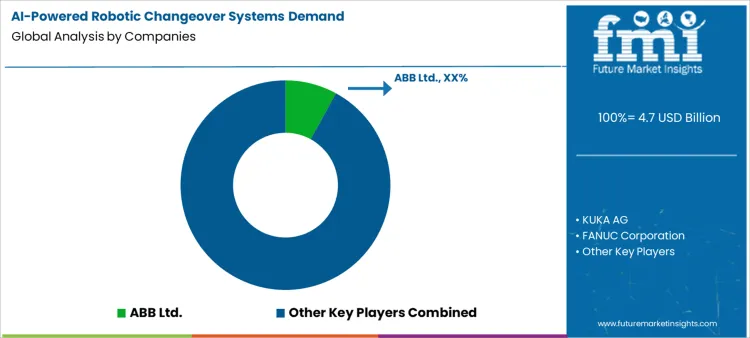
Companies active in the AI-powered robotic changeover systems space span robot OEMs, automation suppliers, integrators, and specialized AI platforms that enable flexible product changeovers with minimal downtime. Leading players include major industrial robotics manufacturers such as ABB, FANUC, KUKA, Yaskawa/Motoman, and Universal Robots, which offer robots equipped with adaptable control and sensing frameworks suited for changeover tasks. Automation and controls providers like Siemens, Rockwell Automation, and Schneider Electric support these systems with adaptive motion control, real-time decision engines, and digital twin capabilities that accelerate changeover sequencing.
Machine vision and AI solution providers such as Cognex and Keyence contribute perceptive systems that recognize parts, fixtures, and tooling variants during changeovers. Specialized software and AI platform companies including Bright Machines and Seebo (in discrete automation orchestration) are enabling intelligent sequencing, predictive maintenance adjustments, and process optimization during transitions. Turnkey system integrators and engineering houses also play a significant role, embedding AI-driven changeover logic into production lines across automotive, electronics, food and beverage, and consumer packaged goods. Standards bodies and research consortia, including industrial AI forums and robotics alliances, further shape interoperability and best practices for AI-enabled changeover solutions.
Key Players in AI-Powered Robotic Changeover Systems Demand
- ABB Ltd.
- KUKA AG
- FANUC Corporation
- Universal Robots A/S
- Yaskawa Electric Corporation
Scope of the Report
| Items | Values |
|---|---|
| Quantitative Units | USD billion |
| Technology Type | AI-Driven Scheduling and Optimization; Robotic Manipulation and Tooling Systems; Vision-Guided Positioning and Verification; Collaborative Robot Integration; Others |
| Automation Function | Automated Tool and Fixture Changing; Real-Time Changeover Sequencing and Coordination; Quality Verification and Dimensional Checking; Performance Monitoring and Optimization |
| Application | Automotive Manufacturing and Assembly; Consumer Electronics and Appliance Manufacturing; Pharmaceutical and Medical Device Production; Food and Beverage Processing; Aerospace and Precision Manufacturing |
| Regions Covered | Asia Pacific, Europe, North America, Latin America, Middle East & Africa |
| Countries Covered | China, South Korea, USA., Germany, Japan, and 40+ countries |
| Key Companies Profiled | ABB Ltd.; KUKA AG; FANUC Corporation; Universal Robots A/S; Yaskawa Electric Corporation; Others |
| Additional Attributes | Dollar sales by technology type, automation function, and application; performance in changeover time reduction and accuracy improvement across automotive, electronics, and pharmaceutical manufacturing; changeover speed, positioning reliability, and safety compliance under automated operation conditions; impact on setup labor costs, production flexibility, and operational efficiency during product transitions; compatibility with existing manufacturing execution systems and enterprise resource planning platforms; procurement dynamics driven by changeover complexity requirements, validation protocols, and long-term service partnerships. |
AI-Powered Robotic Changeover Systems Demand by Segment
Technology Type:
- AI-Driven Scheduling and Optimization
- Robotic Manipulation and Tooling Systems
- Vision-Guided Positioning and Verification
- Collaborative Robot Integration
- Others
Automation Function:
- Automated Tool and Fixture Changing
- Real-Time Changeover Sequencing and Coordination
- Quality Verification and Dimensional Checking
- Performance Monitoring and Optimization
Application:
- Automotive Manufacturing and Assembly
- Consumer Electronics and Appliance Manufacturing
- Pharmaceutical and Medical Device Production
- Food and Beverage Processing
- Aerospace and Precision Manufacturing
Region:
- Asia Pacific
- China
- Japan
- South Korea
- India
- Australia & New Zealand
- ASEAN
- Rest of Asia Pacific
- Europe
- Germany
- United Kingdom
- France
- Italy
- Spain
- Nordic
- BENELUX
- Rest of Europe
- North America
- USA.
- Canada
- Mexico
- Latin America
- Brazil
- Chile
- Rest of Latin America
- Middle East & Africa
- Kingdom of Saudi Arabia
- Other GCC Countries
- Turkey
- South Africa
- Other African Union
- Rest of Middle East & Africa
Bibliography
- International Organization for Standardization. (2024). ISO 10218: Robots and robotic devices - Safety requirements for industrial robots (updated edition for changeover applications). ISO.
- International Organization for Standardization. (2023). ISO 12100: Safety of machinery - General principles for design (automated changeover systems). ISO.
- Institute of Electrical and Electronics Engineers. (2024). IEEE Standards for Manufacturing Automation: Robotic Changeover Systems (IEEE 1872-2024). IEEE.
- Chen, L., & Rodriguez, M. (2024). AI-driven optimization algorithms for automated manufacturing changeovers. IEEE Transactions on Automation Science and Engineering, 21(3), 567-584.
- Thompson, K., Singh, A., & Mueller, H. (2023). Collaborative robot integration in flexible manufacturing changeover systems. Journal of Manufacturing Systems, 71, 189-203.
Frequently Asked Questions
How big is the ai-powered robotic changeover systems demand in 2026?
The global ai-powered robotic changeover systems demand is estimated to be valued at USD 4.7 billion in 2026.
What will be the size of ai-powered robotic changeover systems demand in 2036?
The market size for the ai-powered robotic changeover systems demand is projected to reach USD 12.1 billion by 2036.
How much will be the ai-powered robotic changeover systems demand growth between 2026 and 2036?
The ai-powered robotic changeover systems demand is expected to grow at a 9.9% CAGR between 2026 and 2036.
What are the key product types in the ai-powered robotic changeover systems demand?
The key product types in ai-powered robotic changeover systems demand are ai-driven scheduling and optimization, robotic manipulation and tooling systems, vision-guided positioning and verification, collaborative robot integration and others.
Which automation function segment to contribute significant share in the ai-powered robotic changeover systems demand in 2026?
In terms of automation function, automated tool and fixture changing segment to command 42.0% share in the ai-powered robotic changeover systems demand in 2026.
Preview the report firsthand - request a free sample
Get SampleGet the brochure for pricing and purchase details.
Get PDFTable of Content
- Executive Summary
- Global Market Outlook
- Demand-side Trends
- Supply-side Trends
- Technology Roadmap Analysis
- Analysis and Recommendations
- Market Overview
- Market Coverage / Taxonomy
- Market Definition / Scope / Limitations
- Market Background
- Market Dynamics
- Drivers
- Restraints
- Opportunity
- Trends
- Scenario Forecast
- Demand in Optimistic Scenario
- Demand in Likely Scenario
- Demand in Conservative Scenario
- Opportunity Map Analysis
- Product Life Cycle Analysis
- Supply Chain Analysis
- Investment Feasibility Matrix
- Value Chain Analysis
- PESTLE and Porter’s Analysis
- Regulatory Landscape
- Regional Parent Market Outlook
- Production and Consumption Statistics
- Import and Export Statistics
- Market Dynamics
- Global Market Analysis 2021 to 2025 and Forecast, 2026 to 2036
- Historical Market Size Value (USD Million) Analysis, 2021 to 2025
- Current and Future Market Size Value (USD Million) Projections, 2026 to 2036
- Y-o-Y Growth Trend Analysis
- Absolute $ Opportunity Analysis
- Global Market Pricing Analysis 2021 to 2025 and Forecast 2026 to 2036
- Global Market Analysis 2021 to 2025 and Forecast 2026 to 2036, By Technology Type
- Introduction / Key Findings
- Historical Market Size Value (USD Million) Analysis By Technology Type, 2021 to 2025
- Current and Future Market Size Value (USD Million) Analysis and Forecast By Technology Type, 2026 to 2036
- AI-Driven Scheduling and Optimization
- Robotic Manipulation and Tooling Systems
- Vision-Guided Positioning and Verification
- Collaborative Robot Integration
- Others
- AI-Driven Scheduling and Optimization
- Y-o-Y Growth Trend Analysis By Technology Type, 2021 to 2025
- Absolute $ Opportunity Analysis By Technology Type, 2026 to 2036
- Global Market Analysis 2021 to 2025 and Forecast 2026 to 2036, By Automation Function
- Introduction / Key Findings
- Historical Market Size Value (USD Million) Analysis By Automation Function, 2021 to 2025
- Current and Future Market Size Value (USD Million) Analysis and Forecast By Automation Function, 2026 to 2036
- Automated Tool and Fixture Changing
- Real-Time Changeover Sequencing and Coordination
- Quality Verification and Dimensional Checking
- Performance Monitoring and Optimization
- Automated Tool and Fixture Changing
- Y-o-Y Growth Trend Analysis By Automation Function, 2021 to 2025
- Absolute $ Opportunity Analysis By Automation Function, 2026 to 2036
- Global Market Analysis 2021 to 2025 and Forecast 2026 to 2036, By Application
- Introduction / Key Findings
- Historical Market Size Value (USD Million) Analysis By Application, 2021 to 2025
- Current and Future Market Size Value (USD Million) Analysis and Forecast By Application, 2026 to 2036
- Automotive Manufacturing and Assembly
- Consumer Electronics and Appliance Manufacturing
- Pharmaceutical and Medical Device Production
- Food and Beverage Processing
- Aerospace and Precision Manufacturing
- Automotive Manufacturing and Assembly
- Y-o-Y Growth Trend Analysis By Application, 2021 to 2025
- Absolute $ Opportunity Analysis By Application, 2026 to 2036
- Global Market Analysis 2021 to 2025 and Forecast 2026 to 2036, By Region
- Introduction
- Historical Market Size Value (USD Million) Analysis By Region, 2021 to 2025
- Current Market Size Value (USD Million) Analysis and Forecast By Region, 2026 to 2036
- North America
- Latin America
- Western Europe
- Eastern Europe
- East Asia
- South Asia and Pacific
- Middle East & Africa
- Market Attractiveness Analysis By Region
- North America Market Analysis 2021 to 2025 and Forecast 2026 to 2036, By Country
- Historical Market Size Value (USD Million) Trend Analysis By Market Taxonomy, 2021 to 2025
- Market Size Value (USD Million) Forecast By Market Taxonomy, 2026 to 2036
- By Country
- USA
- Canada
- Mexico
- By Technology Type
- By Automation Function
- By Application
- By Country
- Market Attractiveness Analysis
- By Country
- By Technology Type
- By Automation Function
- By Application
- Key Takeaways
- Latin America Market Analysis 2021 to 2025 and Forecast 2026 to 2036, By Country
- Historical Market Size Value (USD Million) Trend Analysis By Market Taxonomy, 2021 to 2025
- Market Size Value (USD Million) Forecast By Market Taxonomy, 2026 to 2036
- By Country
- Brazil
- Chile
- Rest of Latin America
- By Technology Type
- By Automation Function
- By Application
- By Country
- Market Attractiveness Analysis
- By Country
- By Technology Type
- By Automation Function
- By Application
- Key Takeaways
- Western Europe Market Analysis 2021 to 2025 and Forecast 2026 to 2036, By Country
- Historical Market Size Value (USD Million) Trend Analysis By Market Taxonomy, 2021 to 2025
- Market Size Value (USD Million) Forecast By Market Taxonomy, 2026 to 2036
- By Country
- Germany
- UK
- Italy
- Spain
- France
- Nordic
- BENELUX
- Rest of Western Europe
- By Technology Type
- By Automation Function
- By Application
- By Country
- Market Attractiveness Analysis
- By Country
- By Technology Type
- By Automation Function
- By Application
- Key Takeaways
- Eastern Europe Market Analysis 2021 to 2025 and Forecast 2026 to 2036, By Country
- Historical Market Size Value (USD Million) Trend Analysis By Market Taxonomy, 2021 to 2025
- Market Size Value (USD Million) Forecast By Market Taxonomy, 2026 to 2036
- By Country
- Russia
- Poland
- Hungary
- Balkan & Baltic
- Rest of Eastern Europe
- By Technology Type
- By Automation Function
- By Application
- By Country
- Market Attractiveness Analysis
- By Country
- By Technology Type
- By Automation Function
- By Application
- Key Takeaways
- East Asia Market Analysis 2021 to 2025 and Forecast 2026 to 2036, By Country
- Historical Market Size Value (USD Million) Trend Analysis By Market Taxonomy, 2021 to 2025
- Market Size Value (USD Million) Forecast By Market Taxonomy, 2026 to 2036
- By Country
- China
- Japan
- South Korea
- By Technology Type
- By Automation Function
- By Application
- By Country
- Market Attractiveness Analysis
- By Country
- By Technology Type
- By Automation Function
- By Application
- Key Takeaways
- South Asia and Pacific Market Analysis 2021 to 2025 and Forecast 2026 to 2036, By Country
- Historical Market Size Value (USD Million) Trend Analysis By Market Taxonomy, 2021 to 2025
- Market Size Value (USD Million) Forecast By Market Taxonomy, 2026 to 2036
- By Country
- India
- ASEAN
- Australia & New Zealand
- Rest of South Asia and Pacific
- By Technology Type
- By Automation Function
- By Application
- By Country
- Market Attractiveness Analysis
- By Country
- By Technology Type
- By Automation Function
- By Application
- Key Takeaways
- Middle East & Africa Market Analysis 2021 to 2025 and Forecast 2026 to 2036, By Country
- Historical Market Size Value (USD Million) Trend Analysis By Market Taxonomy, 2021 to 2025
- Market Size Value (USD Million) Forecast By Market Taxonomy, 2026 to 2036
- By Country
- Kingdom of Saudi Arabia
- Other GCC Countries
- Turkiye
- South Africa
- Other African Union
- Rest of Middle East & Africa
- By Technology Type
- By Automation Function
- By Application
- By Country
- Market Attractiveness Analysis
- By Country
- By Technology Type
- By Automation Function
- By Application
- Key Takeaways
- Key Countries Market Analysis
- USA
- Pricing Analysis
- Market Share Analysis, 2025
- By Technology Type
- By Automation Function
- By Application
- Canada
- Pricing Analysis
- Market Share Analysis, 2025
- By Technology Type
- By Automation Function
- By Application
- Mexico
- Pricing Analysis
- Market Share Analysis, 2025
- By Technology Type
- By Automation Function
- By Application
- Brazil
- Pricing Analysis
- Market Share Analysis, 2025
- By Technology Type
- By Automation Function
- By Application
- Chile
- Pricing Analysis
- Market Share Analysis, 2025
- By Technology Type
- By Automation Function
- By Application
- Germany
- Pricing Analysis
- Market Share Analysis, 2025
- By Technology Type
- By Automation Function
- By Application
- UK
- Pricing Analysis
- Market Share Analysis, 2025
- By Technology Type
- By Automation Function
- By Application
- Italy
- Pricing Analysis
- Market Share Analysis, 2025
- By Technology Type
- By Automation Function
- By Application
- Spain
- Pricing Analysis
- Market Share Analysis, 2025
- By Technology Type
- By Automation Function
- By Application
- France
- Pricing Analysis
- Market Share Analysis, 2025
- By Technology Type
- By Automation Function
- By Application
- India
- Pricing Analysis
- Market Share Analysis, 2025
- By Technology Type
- By Automation Function
- By Application
- ASEAN
- Pricing Analysis
- Market Share Analysis, 2025
- By Technology Type
- By Automation Function
- By Application
- Australia & New Zealand
- Pricing Analysis
- Market Share Analysis, 2025
- By Technology Type
- By Automation Function
- By Application
- China
- Pricing Analysis
- Market Share Analysis, 2025
- By Technology Type
- By Automation Function
- By Application
- Japan
- Pricing Analysis
- Market Share Analysis, 2025
- By Technology Type
- By Automation Function
- By Application
- South Korea
- Pricing Analysis
- Market Share Analysis, 2025
- By Technology Type
- By Automation Function
- By Application
- Russia
- Pricing Analysis
- Market Share Analysis, 2025
- By Technology Type
- By Automation Function
- By Application
- Poland
- Pricing Analysis
- Market Share Analysis, 2025
- By Technology Type
- By Automation Function
- By Application
- Hungary
- Pricing Analysis
- Market Share Analysis, 2025
- By Technology Type
- By Automation Function
- By Application
- Kingdom of Saudi Arabia
- Pricing Analysis
- Market Share Analysis, 2025
- By Technology Type
- By Automation Function
- By Application
- Turkiye
- Pricing Analysis
- Market Share Analysis, 2025
- By Technology Type
- By Automation Function
- By Application
- South Africa
- Pricing Analysis
- Market Share Analysis, 2025
- By Technology Type
- By Automation Function
- By Application
- USA
- Market Structure Analysis
- Competition Dashboard
- Competition Benchmarking
- Market Share Analysis of Top Players
- By Regional
- By Technology Type
- By Automation Function
- By Application
- Competition Analysis
- Competition Deep Dive
- ABB Ltd.
- Overview
- Product Portfolio
- Profitability by Market Segments (Product/Age /Sales Channel/Region)
- Sales Footprint
- Strategy Overview
- Marketing Strategy
- Product Strategy
- Channel Strategy
- KUKA AG
- FANUC Corporation
- Universal Robots A/S
- Yaskawa Electric Corporation
- ABB Ltd.
- Competition Deep Dive
- Assumptions & Acronyms Used
- Research Methodology


