

- Industry Size (2026)
- USD 928.2 Mn
- Forecast (2036)
- USD 2300.3 Mn
- CAGR (2026 to 2036)
- 9.5%
AI Hemo Monitoring Market Forecast and Outlook 2026 to 2036
The AI hemo monitoring market is expected to grow from USD 928.2 million in 2026 to USD 2,300.3 million by 2036, reflecting a compound annual growth rate (CAGR) of 9.5%. AI-driven hemoglobin monitoring systems are revolutionizing healthcare by providing more accurate, real-time monitoring of patients' blood parameters, enabling earlier detection of anemia and other related conditions. These systems leverage advanced machine learning algorithms and data analytics to interpret and analyze blood sample data, reducing the reliance on traditional diagnostic methods and improving patient outcomes through timely interventions.
The growth of this market is driven by the increasing demand for non-invasive, accurate, and real-time blood monitoring solutions, particularly in chronic disease management and personalized healthcare. As healthcare providers adopt AI technology to enhance patient care and streamline diagnostics, the need for advanced monitoring systems is expected to grow. Additionally, as AI and machine learning technologies continue to advance, their application in hemo monitoring will expand, further driving market growth in the coming decade.
Quick Stats for AI Hemo Monitoring Market
- AI Hemo Monitoring Market Value (2026): USD 928.2 million
- AI Hemo Monitoring Market Forecast Value (2036): USD 2,300.3 million
- AI Hemo Monitoring Market Global Forecast CAGR (2026–2036): 9.5%
- Top End Use Industry by Share in AI Hemo Monitoring Market: Hospitals ICU/OR (66%)
- Key Growth Regions in AI Hemo Monitoring Market: India, China, USA, UK, Germany
- Top Players in AI Hemo Monitoring Market: Edwards Lifesciences, Philips, GE HealthCare, Startups, Masimo/partners
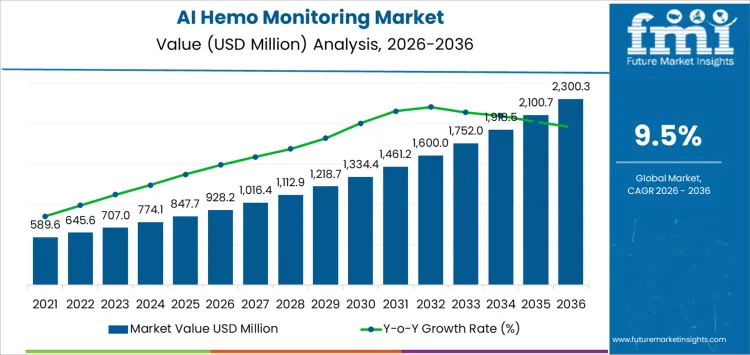
What is the Growth Forecast for the AI Hemo Monitoring Market through 2036?
The compound annual growth rate (CAGR) analysis for the AI hemo monitoring market shows steady, consistent growth over the forecast period. Starting at USD 928.2 million in 2026, the market grows to USD 1,025.7 million in 2027 and USD 1,133.4 million in 2028, reflecting a gradual increase in adoption as healthcare providers begin to integrate AI-driven solutions for hemoglobin monitoring.
From 2028 to 2030, the market continues to expand, reaching USD 1,252.4 million in 2029 and USD 1,383.9 million in 2030. This period marks an acceleration as the benefits of AI in diagnostics and patient monitoring become more widely recognized. From 2030 to 2035, the market experiences significant growth, reaching USD 1,529.2 million in 2031, USD 1,689.7 million in 2032, and USD 1,867.1 million in 2033. By 2035, the market is projected to reach USD 2,063.2 million, with the final value of USD 2,300.3 million expected in 2036. The CAGR analysis indicates that as AI-based hemo monitoring systems become integral to modern healthcare, the market will continue to experience substantial growth driven by technological advancements and increasing demand for personalized, efficient patient care solutions.
AI Hemo Monitoring Market Key Takeaways
| Metric | Value |
|---|---|
| Industry Sales Value (2026) | USD 928.2 million |
| Industry Forecast Value (2036) | USD 2,300.3 million |
| Industry Forecast CAGR (2026-2036) | 9.5% |
What Is Driving the Demand for the AI Hemo Monitoring Market Globally?
The global demand for AI hemo monitoring is driven by rising prevalence of cardiovascular conditions, increased focus on early detection of hemodynamic instability, and growing adoption of artificial intelligence in healthcare. Hemodynamic monitoring tracks blood pressure, cardiac output, and perfusion status in patients at risk of shock, heart failure, sepsis, and other acute conditions. Traditional monitoring systems generate large volumes of data that clinicians must interpret quickly. AI enabled hemo monitoring platforms use machine learning to analyse continuous physiologic data in real time, detect subtle changes, and support clinical decisions before overt deterioration occurs. This capability is valuable in critical care units, perioperative settings, and emergency departments where timely intervention can reduce morbidity and mortality. Healthcare providers are also adopting AI solutions to improve workflow efficiency, reduce cognitive burden on clinicians, and standardise interpretation of hemodynamic trends. The rise of connected monitoring devices and integration with electronic health records further supports use of AI analytics to enhance patient surveillance and alerting, making AI hemo monitoring an attractive option for hospitals focused on quality, safety, and resource optimisation.
Future demand for AI hemo monitoring is expected to grow as healthcare systems continue to prioritise value based care and digital transformation. Advances in AI algorithms and sensor technologies will improve predictive accuracy and expand applications beyond intensive care to include step down units, remote monitoring, and post acute care. Greater evidence of clinical benefit, cost effectiveness, and improved outcomes will encourage adoption among providers seeking to reduce complications and length of stay. Regulatory clarity and reimbursement pathways for AI assisted devices will also shape market growth, as will partnerships between technology developers and medical device manufacturers. As healthcare moves toward personalised and proactive care models, the integration of AI into hemodynamic monitoring platforms will play a central role in supporting early detection, targeted intervention, and improved patient management across care settings.
What Are the Key Segments in AI Hemo Monitoring Market?
The AI hemo monitoring market is segmented by product type and application. AI-driven ICU monitors lead the product type segment with 40% of the market share, offering advanced hemodynamic monitoring in intensive care units. ICU hemodynamic management dominates the application segment with 46%, focusing on the need for continuous monitoring of patient vitals in critical care. The market is expanding as healthcare facilities increasingly adopt AI-driven solutions to enhance patient monitoring, optimize decision-making, and improve clinical outcomes.
Which Product Type Drives AI Hemo Monitoring Market Demand Globally?
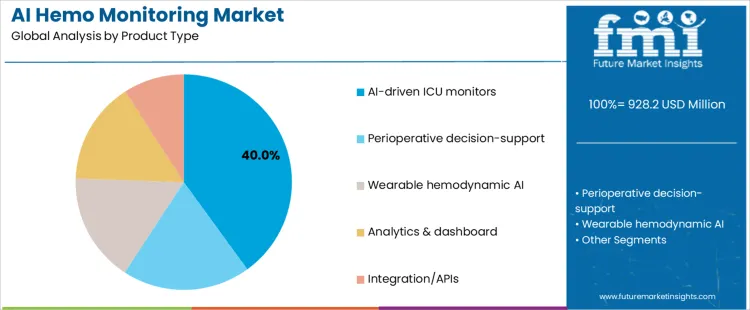
AI-driven ICU monitors account for 40% of the market share. These advanced monitors use artificial intelligence to analyze hemodynamic data in real-time, providing clinicians with critical insights into patient conditions in intensive care units (ICUs). AI-driven monitors enable more accurate and timely decision-making by detecting subtle changes in patient health and predicting potential complications. They also assist healthcare providers by alerting them to deterioration in a patient’s condition, reducing response times and improving clinical outcomes. The increasing adoption of AI technologies in critical care settings is driving the demand for AI-driven ICU monitors, as these systems offer improved monitoring capabilities and enhance overall patient safety. With the growing focus on personalized, data-driven healthcare, AI-driven ICU monitors are becoming integral to the management of critically ill patients.
Which Application Drives AI Hemo Monitoring Market Demand Globally?
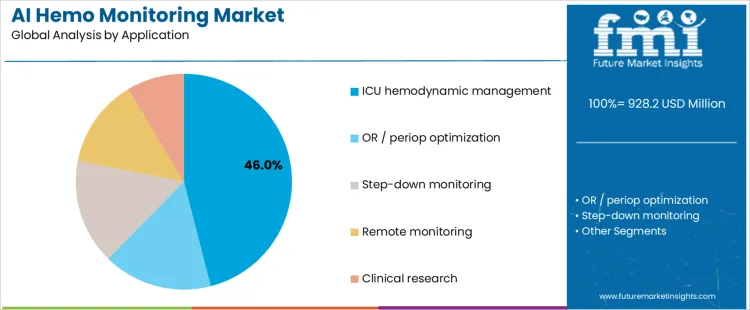
ICU hemodynamic management leads the application segment with 46% of the market share. The demand for AI-driven hemodynamic monitoring is particularly strong in ICU settings, where patients are critically ill and require constant, detailed monitoring of their vital signs. AI-powered systems enable real-time monitoring of heart rate, blood pressure, respiratory rate, and other hemodynamic parameters, providing healthcare providers with actionable insights to manage critical conditions more effectively. These systems help optimize fluid management, detect early signs of sepsis, and prevent adverse events by offering continuous, automated analysis of the patient’s condition. As healthcare systems strive to improve patient outcomes in high-risk environments like the ICU, the need for advanced AI hemodynamic management solutions is expected to grow. Other applications such as perioperative decision-support and remote monitoring also contribute to market demand but remain smaller segments compared to ICU hemodynamic management.
What are the Key Dynamics of the Global AI Hemo Monitoring Market?
The global AI hemo monitoring market is expanding as healthcare systems adopt intelligent solutions that support real time blood flow and hemodynamic assessment. These technologies integrate machine learning with physiological data to help clinicians detect changes in cardiac output, perfusion and circulatory status. Growth is supported by rising incidence of cardiovascular disease, critical care needs and demand for improved patient monitoring in perioperative and intensive care environments. Providers, hospitals and ambulatory care centres are investing in AI enabled platforms to enhance clinical insight and support timely therapy adjustments. Market activity spans developed and emerging healthcare markets.
What are the Key Drivers for the Global AI Hemo Monitoring Market?
Increasing prevalence of chronic cardiac conditions and critical care demand encourages use of advanced monitoring solutions that support patient safety. Clinicians and care teams seek tools that provide continuous hemodynamic insight without reliance on invasive procedures. Integration of artificial intelligence that analyses complex data patterns from sensors, wearable devices and clinical systems supports earlier detection of instability. Pressure to improve operational efficiency and reduce adverse events motivates investment in technology that enhances clinical decision support. Expansion of digital health infrastructure and adoption of predictive analytics in healthcare settings fosters broader uptake of AI hemo monitoring.
What are the Restraints for the Global AI Hemo Monitoring Market?
One restraint is the technical and regulatory complexity associated with validating and certifying AI driven clinical monitoring systems. Providers must demonstrate accuracy, reliability and safety before clinical use, and processes vary across regions. Concerns about interoperability with existing hospital information systems and device networks can slow integration. Some healthcare organisations face budget limitations that affect investment in advanced monitoring platforms. Skepticism among clinicians about algorithm driven interpretation and need for training in new tools may also limit uptake. Data privacy and governance requirements add planning demands for system implementation.
What is the Key Trends in the Global AI Hemo Monitoring Market?
A key trend is integration of AI models with multimodal data sources, including wearable sensors, bedside monitors and electronic health records to deliver richer hemodynamic context. Platforms are incorporating predictive insights that anticipate decline in circulatory function, guiding early intervention pathways. Remote monitoring and telehealth compatibility are gaining attention, enabling continuous oversight beyond traditional care settings. Collaboration is rising between technology developers, clinical researchers and healthcare institutions to refine algorithms and validate outcomes across diverse patient populations. Use of cloud based analytics and real time dashboards supports scalable deployment and clinician access to actionable insights at the point of care.
What is the Country-Wise Outlook for the AI Hemo Monitoring Market?
The AI Hemo Monitoring market is experiencing significant growth, driven by advancements in artificial intelligence (AI) and its application in healthcare, particularly in the monitoring of hemoglobin levels. This technology is increasingly being adopted for its ability to provide real-time, non-invasive, and accurate monitoring of hemoglobin levels, which is essential for managing various health conditions such as anemia and blood disorders. Countries like India, China, and the USA are at the forefront of this market, driven by the growing healthcare needs of large populations and the increasing demand for digital health solutions. As AI continues to evolve and healthcare systems embrace more advanced technologies, the AI Hemo Monitoring market is expected to expand rapidly across these regions.
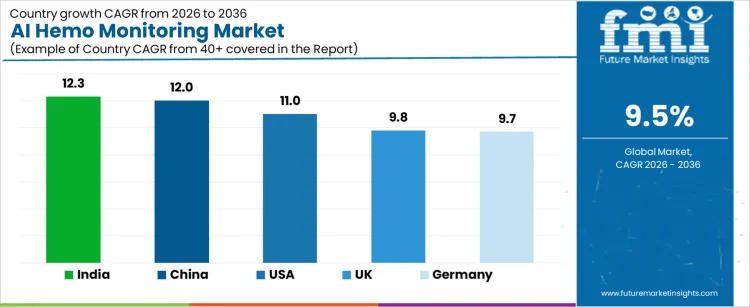
| Country | CAGR (2026 to 2036) |
|---|---|
| India | 12.3% |
| China | 12% |
| USA | 11% |
| UK | 9.8% |
| Germany | 9.7% |
What is Driving the Growth of AI Hemo Monitoring in India?
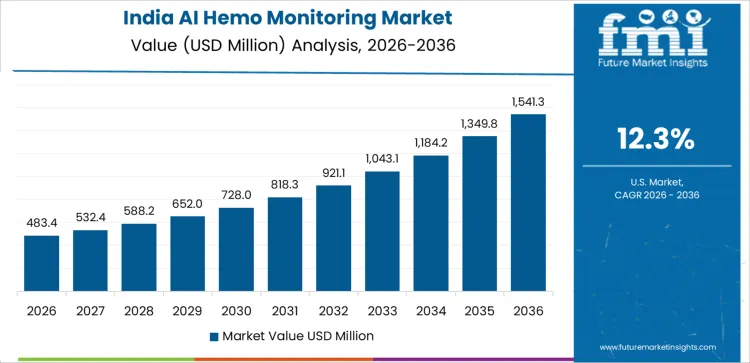
India’s AI Hemo Monitoring market is projected to grow at a CAGR of 12.3%. The rapid expansion of India’s healthcare sector, combined with the country’s large population and the rising prevalence of anemia and other blood-related disorders, is driving the demand for AI-powered monitoring solutions. AI Hemo Monitoring offers a non-invasive, real-time solution for tracking hemoglobin levels, making it particularly useful for populations in remote areas where traditional blood testing may not be accessible. Additionally, India’s growing digital healthcare infrastructure and the government’s push toward improving healthcare access are contributing to the adoption of AI-based medical technologies. As healthcare digitalization continues to expand, the market for AI Hemo Monitoring solutions is set to grow steadily.
What is Contributing to the Growth of AI Hemo Monitoring in China?
China’s AI Hemo Monitoring market is expected to grow at a CAGR of 12%. China’s rapidly growing healthcare sector and the rising prevalence of chronic diseases such as anemia and blood disorders are key drivers of market growth. AI-powered monitoring solutions are becoming increasingly popular due to their ability to provide accurate and timely results, essential for effective disease management. China’s increasing focus on improving healthcare access and infrastructure, coupled with a rising emphasis on digital health technologies, is driving the adoption of AI Hemo Monitoring solutions. The country’s substantial investments in healthcare and technology, combined with the growing acceptance of AI in medical applications, are further accelerating the market’s growth.
What is Driving the AI Hemo Monitoring Market Growth in the USA?
The USA AI Hemo Monitoring market is projected to grow at a CAGR of 11%. The growing demand for more efficient and accurate health monitoring systems, particularly for blood-related conditions such as anemia, is driving the adoption of AI-powered solutions in the USA The shift toward digital health solutions and the integration of AI in healthcare systems to provide non-invasive, real-time monitoring is transforming the way blood health is managed. As healthcare providers seek innovative ways to improve patient care and reduce costs, the demand for AI Hemo Monitoring solutions is expected to increase. Moreover, the USA government’s support for digital health and AI technology, along with advancements in healthcare technology, further supports market growth.
What is Influencing the Growth of AI Hemo Monitoring in the UK?
The UK’s AI Hemo Monitoring market is projected to grow at a CAGR of 9.8%. The adoption of AI in healthcare, combined with a growing focus on preventative health and non-invasive diagnostic tools, is driving the demand for AI Hemo Monitoring solutions. The increasing prevalence of anemia and blood disorders in the UK, coupled with the need for more efficient health monitoring systems, is contributing to the market’s growth. The UK government’s push for digital transformation in healthcare and the ongoing development of AI technologies for medical applications are further accelerating the market’s adoption. As healthcare providers seek to optimize patient care and improve health outcomes, the demand for AI-powered monitoring solutions is expected to rise.
What is Contributing to the Growth of AI Hemo Monitoring in Germany?
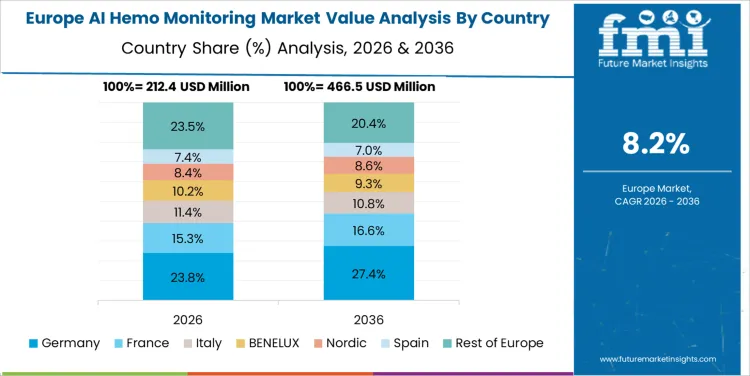
Germany’s AI Hemo Monitoring market is expected to grow at a CAGR of 9.7%. Germany’s strong healthcare infrastructure and its position as a leader in medical technology innovation are key factors driving the market for AI-based health solutions. The increasing focus on digital health technologies, coupled with the rising incidence of anemia and other blood-related conditions, is driving the adoption of AI Hemo Monitoring systems in the country. Germany’s robust healthcare system, coupled with a high level of acceptance for digital health technologies, makes it an attractive market for AI solutions. As the healthcare sector continues to adopt more advanced and efficient monitoring technologies, the demand for AI-powered tools to track hemoglobin levels is expected to grow steadily in Germany.
What is the Competitive Landscape for the AI Hemo Monitoring Market?
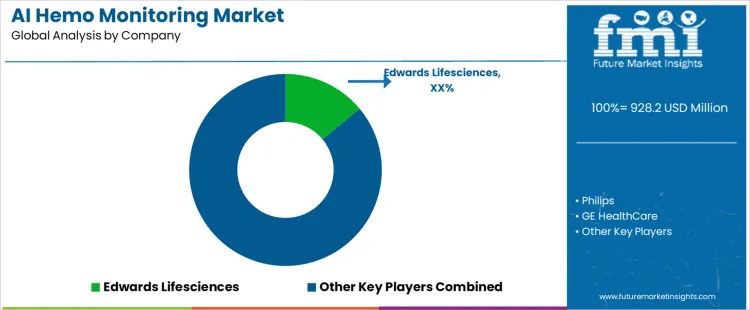
Global demand for AI powered hemodynamic monitoring solutions is rising as healthcare systems seek improved accuracy, predictive insights, and earlier detection of circulatory instability. Traditional hemodynamic monitoring focuses on basic vital signs and intermittent measurements, but AI enhanced platforms can continuously analyse complex physiological patterns to support critical care, perioperative management, and early warning systems. Rising prevalence of cardiovascular disease, growth in surgical procedures, ageing populations and demand for data driven clinical decision support are fuelling adoption. Hospitals and care centres in North America, Europe and Asia Pacific are increasingly evaluating AI augmented monitoring as part of broader digital health strategies aimed at improving patient outcomes while reducing length of stay and clinical workload.
Edwards Lifesciences is widely recognised as a leading player with strong clinical heritage in hemodynamic monitoring technologies and advancing systems that integrate AI for enhanced interpretation and predictive analytics. Other major competitors include Philips and GE HealthCare, each offering comprehensive patient monitoring suites that embed AI capabilities for trend analysis, early deterioration alerts and workflow integration. Masimo and its partners also contribute innovative signal processing and algorithm driven platforms focused on non invasive monitoring with AI enhancements. In addition to these established firms, a vibrant cohort of startups and others often specialised in niche AI algorithms, cloud based analytics, wearable sensors or machine learning driven risk scoring adds competitive dynamism. Competition among providers centres on the sophistication of AI models, clinical validation, integration with hospital systems, ease of use, and regulatory compliance across global markets. Firms that pair strong clinical evidence with scalable, interoperable technology and strategic partnerships with health systems are best positioned to capture growth in this rapidly evolving market.
Key Players of the AI Hemo Monitoring Market
- Edwards Lifesciences
- Philips
- GE HealthCare
- Startups
- Masimo/partners
- Others
Scope of the Report
| Items | Values |
|---|---|
| Quantitative Units (2026) | USD Million |
| Product Type | AI-driven ICU Monitors, Perioperative Decision-Support, Wearable Hemodynamic AI, Analytics & Dashboard, Integration/APIs |
| Application | ICU Hemodynamic Management, OR/Periop Optimization, Step-down Monitoring, Remote Monitoring |
| End User | Hospitals ICU/OR, Ambulatory Surgical Centers, Remote Monitoring Providers, Research Institutes, Clinical Research |
| Companies | Edwards Lifesciences (Leading), Philips, GE HealthCare, Startups, Masimo/Partners, Others |
| Regions Covered | North America, Latin America, Western Europe, Eastern Europe, South Asia and Pacific, East Asia, Middle East & Africa |
| Countries Covered | United States, Canada, Mexico, Brazil, Argentina, Germany, France, United Kingdom, Italy, Spain, Netherlands, China, India, Japan, South Korea, ANZ, GCC Countries, South Africa |
| Additional Attributes | Dollar by sales by product type, application, end-user, and region. Includes market trends in AI-driven hemodynamic monitoring, performance in ICU, OR, remote monitoring, and clinical research, demand for wearable AI technologies, cost-effectiveness, sustainability practices, regulatory compliance, market share and competitive positioning of key companies, and the role of AI hemo monitoring in enhancing patient care, optimizing clinical decision-making, and improving outcomes across various healthcare settings. |
AI Hemo Monitoring Market Segmentation
Product Type
- AI-driven ICU monitors
- Perioperative decision-support
- Wearable hemodynamic AI
- Analytics & dashboard
- Integration/APIs
Application
- ICU hemodynamic management
- OR / periop optimization
- Step-down monitoring
- Remote monitoring
- Clinical research
End User
- Hospitals ICU/OR
- Ambulatory surgical centers
- Remote monitoring providers
- Research institutes
Region
- Asia Pacific
- China
- Japan
- South Korea
- India
- Australia & New Zealand
- ASEAN
- Rest of Asia Pacific
- Europe
- Germany
- United Kingdom
- France
- Italy
- Spain
- Nordic
- BENELUX
- Rest of Europe
- North America
- United States
- Canada
- Mexico
- Latin America
- Brazil
- Chile
- Rest of Latin America
- Middle East & Africa
- Kingdom of Saudi Arabia
- Other GCC Countries
- Turkey
- South Africa
- Other African Union
- Rest of Middle East & Africa
Frequently Asked Questions
How big is the AI hemo monitoring market in 2026?
The global AI hemo monitoring market is estimated to be valued at USD 928.2 million in 2026.
What will be the size of AI hemo monitoring market in 2036?
The market size for the AI hemo monitoring market is projected to reach USD 2,300.3 million by 2036.
How much will be the AI hemo monitoring market growth between 2026 and 2036?
The AI hemo monitoring market is expected to grow at a 9.5% CAGR between 2026 and 2036.
What are the key product types in the AI hemo monitoring market?
The key product types in AI hemo monitoring market are ai-driven icu monitors, perioperative decision-support, wearable hemodynamic ai, analytics & dashboard and integration/apis.
Which application segment to contribute significant share in the AI hemo monitoring market in 2026?
In terms of application, icu hemodynamic management segment to command 46.0% share in the AI hemo monitoring market in 2026.
Preview the report firsthand - request a free sample
Get SampleGet the brochure for pricing and purchase details.
Get PDFTable of Content
- Executive Summary
- Global Market Outlook
- Demand-side Trends
- Supply-side Trends
- Technology Roadmap Analysis
- Analysis and Recommendations
- Market Overview
- Market Coverage / Taxonomy
- Market Definition / Scope / Limitations
- Market Background
- Market Dynamics
- Drivers
- Restraints
- Opportunity
- Trends
- Scenario Forecast
- Demand in Optimistic Scenario
- Demand in Likely Scenario
- Demand in Conservative Scenario
- Opportunity Map Analysis
- Product Life Cycle Analysis
- Supply Chain Analysis
- Investment Feasibility Matrix
- Value Chain Analysis
- PESTLE and Porter’s Analysis
- Regulatory Landscape
- Regional Parent Market Outlook
- Production and Consumption Statistics
- Import and Export Statistics
- Market Dynamics
- Global Market Analysis 2021 to 2025 and Forecast, 2026 to 2036
- Historical Market Size Value (USD Million) Analysis, 2021 to 2025
- Current and Future Market Size Value (USD Million) Projections, 2026 to 2036
- Y-o-Y Growth Trend Analysis
- Absolute $ Opportunity Analysis
- Global Market Pricing Analysis 2021 to 2025 and Forecast 2026 to 2036
- Global Market Analysis 2021 to 2025 and Forecast 2026 to 2036, By Product Type
- Introduction / Key Findings
- Historical Market Size Value (USD Million) Analysis By Product Type , 2021 to 2025
- Current and Future Market Size Value (USD Million) Analysis and Forecast By Product Type , 2026 to 2036
- AI-driven ICU monitors
- Perioperative decision-support
- Wearable hemodynamic AI
- Analytics & dashboard
- Integration/APIs
- Y-o-Y Growth Trend Analysis By Product Type , 2021 to 2025
- Absolute $ Opportunity Analysis By Product Type , 2026 to 2036
- Global Market Analysis 2021 to 2025 and Forecast 2026 to 2036, By Application
- Introduction / Key Findings
- Historical Market Size Value (USD Million) Analysis By Application, 2021 to 2025
- Current and Future Market Size Value (USD Million) Analysis and Forecast By Application, 2026 to 2036
- ICU hemodynamic management
- OR / periop optimization
- Step-down monitoring
- Remote monitoring
- Clinical research
- Y-o-Y Growth Trend Analysis By Application, 2021 to 2025
- Absolute $ Opportunity Analysis By Application, 2026 to 2036
- Global Market Analysis 2021 to 2025 and Forecast 2026 to 2036, By End User
- Introduction / Key Findings
- Historical Market Size Value (USD Million) Analysis By End User, 2021 to 2025
- Current and Future Market Size Value (USD Million) Analysis and Forecast By End User, 2026 to 2036
- Hospitals ICU/OR
- Ambulatory surgical centers
- Remote monitoring providers
- Research institutes
- Y-o-Y Growth Trend Analysis By End User, 2021 to 2025
- Absolute $ Opportunity Analysis By End User, 2026 to 2036
- Global Market Analysis 2021 to 2025 and Forecast 2026 to 2036, By Region
- Introduction
- Historical Market Size Value (USD Million) Analysis By Region, 2021 to 2025
- Current Market Size Value (USD Million) Analysis and Forecast By Region, 2026 to 2036
- North America
- Latin America
- Western Europe
- Eastern Europe
- East Asia
- South Asia and Pacific
- Middle East & Africa
- Market Attractiveness Analysis By Region
- North America Market Analysis 2021 to 2025 and Forecast 2026 to 2036, By Country
- Historical Market Size Value (USD Million) Trend Analysis By Market Taxonomy, 2021 to 2025
- Market Size Value (USD Million) Forecast By Market Taxonomy, 2026 to 2036
- By Country
- USA
- Canada
- Mexico
- By Product Type
- By Application
- By End User
- By Country
- Market Attractiveness Analysis
- By Country
- By Product Type
- By Application
- By End User
- Key Takeaways
- Latin America Market Analysis 2021 to 2025 and Forecast 2026 to 2036, By Country
- Historical Market Size Value (USD Million) Trend Analysis By Market Taxonomy, 2021 to 2025
- Market Size Value (USD Million) Forecast By Market Taxonomy, 2026 to 2036
- By Country
- Brazil
- Chile
- Rest of Latin America
- By Product Type
- By Application
- By End User
- By Country
- Market Attractiveness Analysis
- By Country
- By Product Type
- By Application
- By End User
- Key Takeaways
- Western Europe Market Analysis 2021 to 2025 and Forecast 2026 to 2036, By Country
- Historical Market Size Value (USD Million) Trend Analysis By Market Taxonomy, 2021 to 2025
- Market Size Value (USD Million) Forecast By Market Taxonomy, 2026 to 2036
- By Country
- Germany
- UK
- Italy
- Spain
- France
- Nordic
- BENELUX
- Rest of Western Europe
- By Product Type
- By Application
- By End User
- By Country
- Market Attractiveness Analysis
- By Country
- By Product Type
- By Application
- By End User
- Key Takeaways
- Eastern Europe Market Analysis 2021 to 2025 and Forecast 2026 to 2036, By Country
- Historical Market Size Value (USD Million) Trend Analysis By Market Taxonomy, 2021 to 2025
- Market Size Value (USD Million) Forecast By Market Taxonomy, 2026 to 2036
- By Country
- Russia
- Poland
- Hungary
- Balkan & Baltic
- Rest of Eastern Europe
- By Product Type
- By Application
- By End User
- By Country
- Market Attractiveness Analysis
- By Country
- By Product Type
- By Application
- By End User
- Key Takeaways
- East Asia Market Analysis 2021 to 2025 and Forecast 2026 to 2036, By Country
- Historical Market Size Value (USD Million) Trend Analysis By Market Taxonomy, 2021 to 2025
- Market Size Value (USD Million) Forecast By Market Taxonomy, 2026 to 2036
- By Country
- China
- Japan
- South Korea
- By Product Type
- By Application
- By End User
- By Country
- Market Attractiveness Analysis
- By Country
- By Product Type
- By Application
- By End User
- Key Takeaways
- South Asia and Pacific Market Analysis 2021 to 2025 and Forecast 2026 to 2036, By Country
- Historical Market Size Value (USD Million) Trend Analysis By Market Taxonomy, 2021 to 2025
- Market Size Value (USD Million) Forecast By Market Taxonomy, 2026 to 2036
- By Country
- India
- ASEAN
- Australia & New Zealand
- Rest of South Asia and Pacific
- By Product Type
- By Application
- By End User
- By Country
- Market Attractiveness Analysis
- By Country
- By Product Type
- By Application
- By End User
- Key Takeaways
- Middle East & Africa Market Analysis 2021 to 2025 and Forecast 2026 to 2036, By Country
- Historical Market Size Value (USD Million) Trend Analysis By Market Taxonomy, 2021 to 2025
- Market Size Value (USD Million) Forecast By Market Taxonomy, 2026 to 2036
- By Country
- Kingdom of Saudi Arabia
- Other GCC Countries
- Turkiye
- South Africa
- Other African Union
- Rest of Middle East & Africa
- By Product Type
- By Application
- By End User
- By Country
- Market Attractiveness Analysis
- By Country
- By Product Type
- By Application
- By End User
- Key Takeaways
- Key Countries Market Analysis
- USA
- Pricing Analysis
- Market Share Analysis, 2025
- By Product Type
- By Application
- By End User
- Canada
- Pricing Analysis
- Market Share Analysis, 2025
- By Product Type
- By Application
- By End User
- Mexico
- Pricing Analysis
- Market Share Analysis, 2025
- By Product Type
- By Application
- By End User
- Brazil
- Pricing Analysis
- Market Share Analysis, 2025
- By Product Type
- By Application
- By End User
- Chile
- Pricing Analysis
- Market Share Analysis, 2025
- By Product Type
- By Application
- By End User
- Germany
- Pricing Analysis
- Market Share Analysis, 2025
- By Product Type
- By Application
- By End User
- UK
- Pricing Analysis
- Market Share Analysis, 2025
- By Product Type
- By Application
- By End User
- Italy
- Pricing Analysis
- Market Share Analysis, 2025
- By Product Type
- By Application
- By End User
- Spain
- Pricing Analysis
- Market Share Analysis, 2025
- By Product Type
- By Application
- By End User
- France
- Pricing Analysis
- Market Share Analysis, 2025
- By Product Type
- By Application
- By End User
- India
- Pricing Analysis
- Market Share Analysis, 2025
- By Product Type
- By Application
- By End User
- ASEAN
- Pricing Analysis
- Market Share Analysis, 2025
- By Product Type
- By Application
- By End User
- Australia & New Zealand
- Pricing Analysis
- Market Share Analysis, 2025
- By Product Type
- By Application
- By End User
- China
- Pricing Analysis
- Market Share Analysis, 2025
- By Product Type
- By Application
- By End User
- Japan
- Pricing Analysis
- Market Share Analysis, 2025
- By Product Type
- By Application
- By End User
- South Korea
- Pricing Analysis
- Market Share Analysis, 2025
- By Product Type
- By Application
- By End User
- Russia
- Pricing Analysis
- Market Share Analysis, 2025
- By Product Type
- By Application
- By End User
- Poland
- Pricing Analysis
- Market Share Analysis, 2025
- By Product Type
- By Application
- By End User
- Hungary
- Pricing Analysis
- Market Share Analysis, 2025
- By Product Type
- By Application
- By End User
- Kingdom of Saudi Arabia
- Pricing Analysis
- Market Share Analysis, 2025
- By Product Type
- By Application
- By End User
- Turkiye
- Pricing Analysis
- Market Share Analysis, 2025
- By Product Type
- By Application
- By End User
- South Africa
- Pricing Analysis
- Market Share Analysis, 2025
- By Product Type
- By Application
- By End User
- USA
- Market Structure Analysis
- Competition Dashboard
- Competition Benchmarking
- Market Share Analysis of Top Players
- By Regional
- By Product Type
- By Application
- By End User
- Competition Analysis
- Competition Deep Dive
- Edwards Lifesciences
- Overview
- Product Portfolio
- Profitability by Market Segments (Product/Age /Sales Channel/Region)
- Sales Footprint
- Strategy Overview
- Marketing Strategy
- Product Strategy
- Channel Strategy
- Philips
- GE HealthCare
- Startups
- Masimo/partners
- Others
- Edwards Lifesciences
- Competition Deep Dive
- Assumptions & Acronyms Used
- Research Methodology


