

- Industry Size (2026)
- USD 1.9 Bn
- Forecast (2036)
- USD 4.7 Bn
- CAGR (2026 to 2036)
- 9.50%
Dynamic Warehouse AI-Powered AMRs Market Forecast and Outlook 2026 to 2036
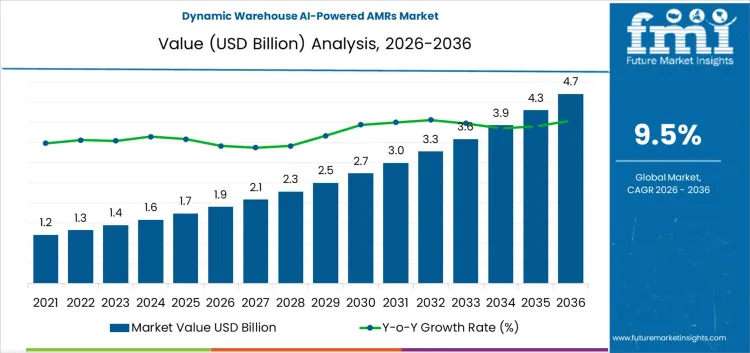
The dynamic warehouse AI-powered AMRs market is valued at USD 1.9 billion in 2026, is expected to reach USD 4.7 billion by 2036, and is projected to grow at a CAGR of 9.50% over the forecast period. Market performance between 2026 and 2036 is closely tied to production concentration and control over critical hardware-software integration rather than sheer deployment scale. Manufacturing remains concentrated among a limited group of suppliers with in-house capabilities for navigation software, fleet orchestration, and sensor integration, creating structural dependencies within the supply chain.
Regional manufacturing control, particularly in East Asia and parts of Europe, influences lead times, system customization, and long-term supply reliability for large warehouse operators. Supply stability is further shaped by reliance on advanced sensors, semiconductors, and battery components, where disruptions can directly affect delivery schedules and system availability. As warehouse operators demand consistent uptime and scalable fleet expansion, suppliers with resilient manufacturing networks and tightly controlled production ecosystems are better positioned to maintain operational continuity and performance consistency.
Quick Stats for Dynamic Warehouse AI-Powered AMRs Market
- Dynamic Warehouse AI-Powered AMRs Market Value (2026): USD 1.9 Billion
- Dynamic Warehouse AI-Powered AMRs Market Forecast Value (2036): USD 4.7 Billion
- Dynamic Warehouse AI-Powered AMRs Market Forecast CAGR 2026 to 2036: 9.50%
- Leading Navigation Technology in Dynamic Warehouse AI-Powered AMRs Market: SLAM-Based Navigation
- Leading End-Use Industry in Dynamic Warehouse AI-Powered AMRs Market: E-Commerce
- Key Growth Regions in Dynamic Warehouse AI-Powered AMRs Market: Asia Pacific, North America
- Top Key Players in Dynamic Warehouse AI-Powered AMRs Market: Locus Robotics, Geek+, GreyOrange, AutoStore, Swisslog, Hikrobot
Dynamic Warehouse AI-Powered AMRs Market Key Takeaways
| Metric | Value |
|---|---|
| Industry Value (2026) | USD 1.9 Billion |
| Forecast Value (2036) | USD 4.7 Billion |
| Forecast CAGR 2026 to 2036 | 9.50% |
How Is the Global Dynamic Warehouse AI-Powered AMRs Market Advancing?
The global dynamic warehouse AI-powered autonomous mobile robots (AMRs) market is advancing rapidly, driven by the increasing need for flexible and intelligent material handling solutions in modern warehouse operations. AI-powered AMRs are being widely adopted across e-commerce, retail, third-party logistics, and manufacturing warehouses to support order picking, sorting, inventory movement, and goods-to-person workflows. Their ability to navigate dynamically changing environments enables higher operational efficiency compared to fixed automation systems.
A key driver supporting market growth is the rising demand for scalable automation that can adapt to fluctuating order volumes and layout changes. AI-powered AMRs use machine learning, computer vision, and real-time data processing to optimize routes, avoid obstacles, and coordinate tasks without requiring physical infrastructure modifications. This flexibility allows warehouse operators to improve throughput while minimizing downtime and integration complexity.
Ongoing advancements in artificial intelligence, sensor fusion, and fleet management software are further strengthening market adoption. Enhanced navigation accuracy, improved battery performance, and cloud-based orchestration platforms enable large fleets of AMRs to operate collaboratively and efficiently. As warehouses continue to shift toward data-driven and highly automated operations, the AI-powered AMRs market is expected to register sustained growth over the forecast period.
What Is the Segment-Wise Analysis for the Dynamic Warehouse AI-Powered AMRs Market?
Navigation technology and end-use demand are key factors shaping the Dynamic Warehouse AI-Powered AMRs Market. SLAM-based navigation leads with a 54% share due to its ability to support real-time mapping, adaptive routing, and autonomous decision-making in dynamic warehouse environments. Its flexibility and reduced dependence on fixed infrastructure make it well suited for high-throughput operations. On the end-use side, e-commerce accounts for 45% of market demand, driven by rapid order fulfillment requirements, high SKU diversity, and labor constraints. The combined impact of advanced navigation systems and growing e-commerce automation needs is accelerating adoption of AI-powered AMRs across modern warehouse facilities.
Why Does SLAM-Based Navigation Lead the Dynamic Warehouse AI-Powered AMRs Market?
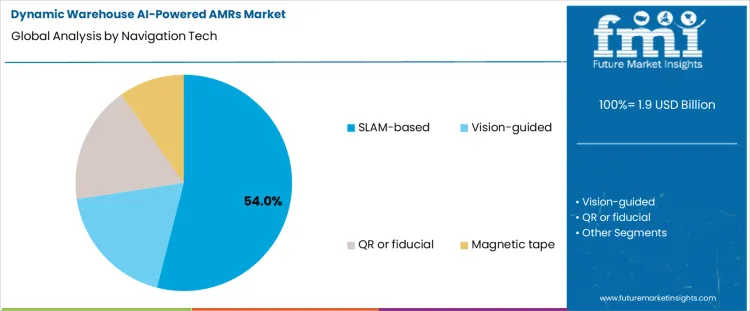
SLAM-based navigation accounts for 54% of the navigation technology segment in the Dynamic Warehouse AI-Powered AMRs Market due to its ability to enable real-time mapping, localization, and autonomous decision-making in complex warehouse environments. Unlike fixed-path systems, SLAM-based AMRs can dynamically adapt to layout changes, obstacles, and fluctuating traffic conditions, making them ideal for high-throughput distribution centers. AI-powered SLAM enhances route optimization, collision avoidance, and task prioritization, improving operational efficiency and uptime. As warehouses increasingly adopt flexible storage layouts and variable picking zones, SLAM-based systems offer superior scalability compared to QR, magnetic tape, or fiducial-based navigation. Their reduced reliance on physical markers also lowers maintenance requirements, reinforcing SLAM-based navigation as the preferred technology for next-generation warehouse automation.
How Does the E-commerce Sector Drive Adoption of AI-Powered AMRs in Dynamic Warehouses?
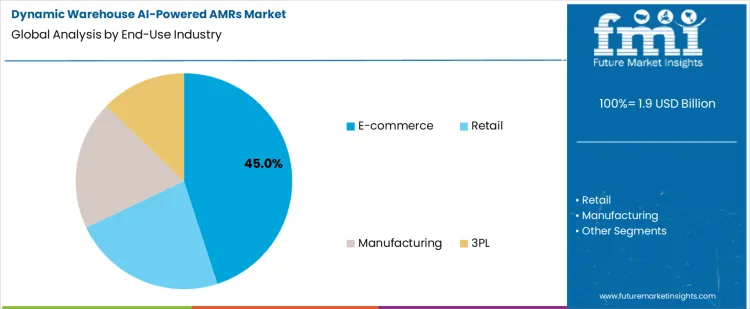
The e-commerce sector represents 45% of end-use demand in the Dynamic Warehouse AI-Powered AMRs Market, driven by rapid order fulfillment cycles, high SKU variability, and growing labor constraints. AI-powered AMRs are widely deployed in e-commerce warehouses to support picking, sorting, replenishment, and internal material movement. Their ability to operate continuously, navigate dynamic environments, and integrate with warehouse management systems improves order accuracy and throughput. E-commerce operations frequently experience seasonal demand spikes and layout adjustments, making flexible AMR solutions more effective than fixed automation. As same-day and next-day delivery models expand, e-commerce operators increasingly rely on AI-enabled AMRs to maintain speed, reliability, and operational efficiency across large-scale distribution facilities.
What Are the Key Dynamics for the Dynamic Warehouse AI-Powered AMRs Market?
The dynamic warehouse ai-powered autonomous mobile robots (AMRs) market is propelled by the increasing need for intelligent automation in logistics and fulfillment environments. AI-powered AMRs are deployed to enhance material movement, order picking, and in-warehouse transportation tasks without fixed infrastructure. Key market dynamics include the push for operational agility, reduction of manual labor, and the necessity to improve throughput and accuracy in dynamic warehouse settings. As e-commerce and omnichannel fulfillment grow, warehouses are adopting AI-enabled AMRs to manage complex workflows, optimize route planning, and support real-time decision making.
Why Is the Dynamic Warehouse AI-Powered AMRs Market Growing?
The market is growing due to expanding global e-commerce activity and the corresponding demand for flexible and scalable automation solutions. Traditional fixed conveyor systems have limitations in adaptability, whereas AI-powered AMRs adjust to changing warehouse layouts and evolving operational needs. These robots leverage machine learning and sensor fusion to navigate autonomously, avoid obstacles, and optimize task execution. Warehouse operators are increasingly investing in AI-driven robotics to improve order accuracy, reduce operational costs, and respond more effectively to labor shortages and peak demand cycles.
How Are the Key Drivers Shaping the Dynamic Warehouse AI-Powered AMRs Market?
Key drivers shaping the market include rising labor costs and workforce constraints, which incentivize warehouses to adopt robotics for repetitive and physically demanding tasks. Advancements in AI, computer vision, and sensing technologies are enhancing AMR capabilities, enabling robots to perform complex tasks with minimal human intervention. Integration with warehouse execution systems, real-time analytics, and scalable fleet management software are also contributing to broader adoption. Additionally, the need for rapid deployment and reconfiguration in response to fluctuating order volumes is encouraging operators to prefer AI-powered AMRs over conventional automation technologies.
What Is the Growth Outlook for the Dynamic Warehouse AI-Powered AMRs Market by Country?
| Country | CAGR (%) |
|---|---|
| USA | 9.5% |
| China | 9.0% |
| Germany | 8.8% |
| Japan | 8.5% |
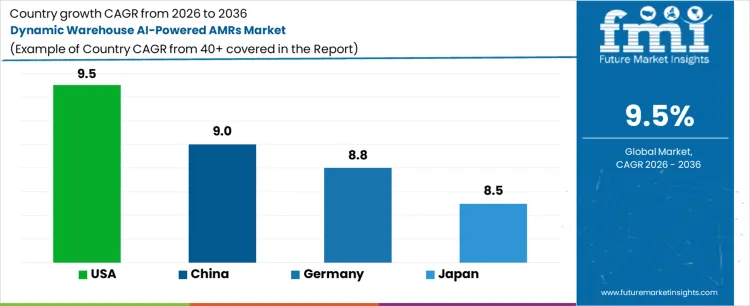
The dynamic warehouse AI-powered AMRs market is expanding rapidly across major regions as logistics operators prioritize intelligent and flexible automation. The USA leads at 9.5%, driven by large-scale e-commerce fulfillment, labor shortages, and strong investment in AI-enabled logistics technologies. China follows at 9.0%, supported by high-volume e-commerce operations, smart logistics initiatives, and growing availability of domestic AMR solutions. Germany grows at 8.8%, benefiting from Industry 4.0 adoption, high automation standards, and demand for data-driven warehouse operations. Japan expands at 8.5%, driven by workforce constraints, compact warehouse environments, and strong robotics expertise.
What Is Driving the Growth of the Dynamic Warehouse AI-Powered AMRs Market in the USA?
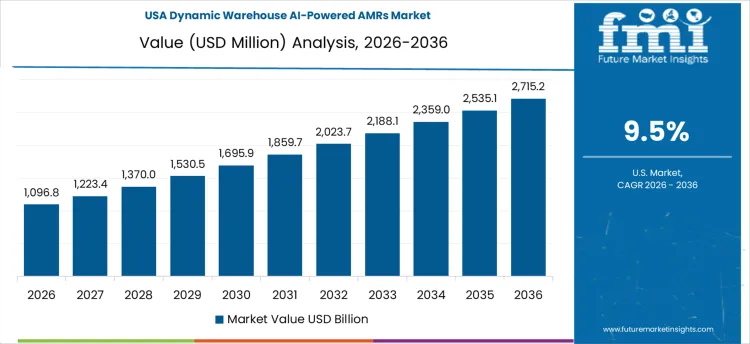
The dynamic warehouse AI-powered AMRs market in the USA is growing at a CAGR of 9.5%, driven by rapid automation across large e-commerce, retail, and third-party logistics warehouses. Rising order volumes, SKU proliferation, and demand for same-day or next-day delivery are pushing operators to adopt intelligent mobile robots that can dynamically navigate complex warehouse layouts. AI-powered AMRs enable real-time decision-making, adaptive routing, and efficient collaboration with human workers, significantly improving throughput and order accuracy. Labor shortages and rising operational costs further strengthen the case for flexible robotic automation. USA warehouses are also increasingly integrating AMRs with warehouse management and execution systems to enable end-to-end automation. Strong investment in AI, robotics startups, and digital supply chain platforms supports faster technology adoption. As warehouses prioritize scalability and operational resilience, demand for AI-powered AMRs is expected to remain strong.
How Is the Dynamic Warehouse AI-Powered AMRs Market Expanding in China?
The dynamic warehouse AI-Powered AMRs market in China is expanding at a CAGR of 9.0%, supported by the country’s massive e-commerce ecosystem and highly automated logistics infrastructure. Large fulfillment centers operated by leading online retail platforms are increasingly deploying AI-enabled AMRs to manage high order volumes and rapid throughput requirements. These robots support autonomous navigation, real-time obstacle avoidance, and intelligent task allocation, helping warehouses improve efficiency and reduce manual handling. Rising labor costs and workforce availability challenges are accelerating the shift toward flexible mobile robotics. Government initiatives promoting smart logistics and intelligent manufacturing further support adoption. The presence of domestic AMR manufacturers and AI technology providers is making advanced solutions more accessible. As China continues to expand its automated warehousing capacity, AI-powered AMRs are expected to play an increasingly central role in logistics operations.
What Is Supporting Growth of the Dynamic Warehouse AI-Powered AMRs Market in Germany?
The dynamic warehouse AI-Powered AMRs market in Germany is growing at a CAGR of 8.8%, driven by strong demand for intelligent automation in logistics, manufacturing, and distribution centers. Germany’s warehouses emphasize precision, reliability, and seamless integration with existing material-handling systems, making AI-powered AMRs an attractive solution. These robots enable flexible goods movement, dynamic routing, and efficient collaboration with human workers, supporting high-mix and variable-volume operations. High labor costs and strict workplace safety standards further encourage automation adoption. Germany’s Industry 4.0 initiatives are accelerating the deployment of connected, data-driven warehouse technologies. AI-enabled AMRs align well with these objectives by providing real-time operational insights and adaptive performance. As logistics operators focus on efficiency and resilience, demand for AI-powered AMRs in German warehouses is expected to grow steadily.
How Is the Dynamic Warehouse AI-Powered AMRs Market Developing in Japan?
The dynamic warehouse AI-Powered AMRs market in Japan is expanding at a CAGR of 8.5%, supported by increasing automation needs in logistics and distribution operations. Japan’s aging workforce and persistent labor shortages are major drivers encouraging adoption of AI-powered mobile robots. AMRs equipped with advanced navigation and machine-learning capabilities can operate safely alongside workers while optimizing material flows in real time. Japanese warehouses often operate in space-constrained environments, increasing demand for compact, intelligent robots that can adapt to changing layouts. Growth in e-commerce and omnichannel retailing is also increasing demand for flexible warehouse automation. Japan’s strong robotics and AI engineering capabilities further support innovation and system reliability. As logistics operators modernize facilities to improve productivity and workforce efficiency, adoption of AI-powered AMRs is expected to increase steadily.
How Are Companies Competing in the Dynamic Warehouse AI-Powered AMRs Market?
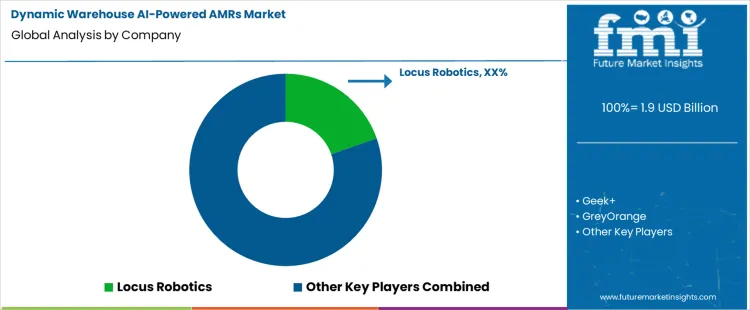
Competition in the dynamic warehouse AI-powered autonomous mobile robots (AMRs) market is centered on software intelligence, fleet orchestration depth, and the ability to scale performance in high-velocity fulfillment environments. Vendors differentiate by how effectively their AI platforms manage real-time routing, task allocation, congestion avoidance, and system uptime while integrating seamlessly with existing warehouse management and execution systems. As e-commerce and omnichannel operations demand rapid throughput changes and SKU variability, buyers increasingly favor AMR solutions that can be deployed quickly, reconfigured with minimal downtime, and expanded incrementally without major infrastructure redesign.
Locus Robotics, Geek+, and GreyOrange compete strongly on AI-driven coordination and operational flexibility. Locus Robotics emphasizes collaborative AMRs powered by adaptive algorithms that dynamically balance workloads between human pickers and robots, supporting rapid scaling during peak demand. Geek+ differentiates through a broad AMR portfolio, combining goods-to-person, tote handling, and visual navigation systems optimized by machine learning to reduce travel time and improve pick accuracy. GreyOrange positions its offering around an AI-native orchestration layer that integrates robots, sortation, and analytics, enabling warehouses to optimize flow based on real-time order priorities and inventory conditions.
AutoStore, Swisslog, and Hikrobot compete through system-level intelligence, integration expertise, and targeted deployment models. AutoStore stands out with its grid-based goods-to-robot architecture, using AI software to maximize storage density and retrieval efficiency in space-constrained warehouses. Swisslog leverages its SynQ software platform to unify AMRs with conveyors, shuttles, and picking technologies, appealing to complex, highly automated facilities. Hikrobot competes with cost-efficient, AI-enabled AMRs focused on fast deployment, flexible navigation, and reliable fleet coordination for mid-scale and growing warehouse operations. Across the market, competitive advantage is defined by AI sophistication, orchestration reliability, integration depth, and the ability to sustain performance during demand surges.
Key Players in Dynamic Warehouse AI-Powered AMRs Market
- Locus Robotics
- Geek+
- GreyOrange
- AutoStore
- Swisslog
- Hikrobot
Scope of Report
| Attributes | Description |
|---|---|
| Quantitative Unit (2026) | USD Billion |
| Navigation Tech | SLAM-Based, Vision-Guided, QR or Fiducial, Magnetic Tape |
| End-Use Industry | E-Commerce, Retail, Manufacturing, 3PL |
| Regions Covered | Asia Pacific, Europe, North America, Latin America, Middle East & Africa |
| Countries Covered | China, Japan, South Korea, India, Australia & New Zealand, ASEAN, Rest of Asia Pacific, Germany, United Kingdom, France, Italy, Spain, Nordic, BENELUX, Rest of Europe, United States, Canada, Mexico, Brazil, Chile, Rest of Latin America, Kingdom of Saudi Arabia, Other GCC Countries, Turkey, South Africa, Other African Union, Rest of Middle East & Africa |
| Key Companies Profiled | Locus Robotics, Geek+, GreyOrange, AutoStore, Swisslog, Hikrobot |
| Additional Attributes | Dollar sales by navigation technology and end-use industry; regional market size and forecast analysis; growth outlook across major regions; adoption trends of AI-powered autonomous mobile robots in dynamic warehouse environments; assessment of automation demand across e-commerce, retail, manufacturing, and third-party logistics operations. |
Dynamic Warehouse AI-Powered AMRs Market by Key Segments
Navigation Tech
- SLAM-based
- Vision-guided
- QR or fiducial
- Magnetic tape
End-Use Industry
- E-commerce
- Retail
- Manufacturing
- 3PL
Region
- Asia Pacific
- China
- Japan
- South Korea
- India
- Australia & New Zealand
- ASEAN
- Rest of Asia Pacific
- Europe
- Germany
- United Kingdom
- France
- Italy
- Spain
- Nordic
- BENELUX
- Rest of Europe
- North America
- United States
- Canada
- Mexico
- Latin America
- Brazil
- Chile
- Rest of Latin America
- Middle East & Africa
- Kingdom of Saudi Arabia
- Other GCC Countries
- Turkey
- South Africa
- Other African Union
- Rest of Middle East & Africa
Bibliography
AutoStore. (2024, September 12). AutoStore introduces new Grid capabilities including the Multi-Temperature Solution. AutoStore.
Association for Advancing Automation (A3). (2024, December 19). The Latest in Autonomous Mobile Robots: New safety standards, greater usability, and advanced features. Automate.
Geekplus. (2024, November 6). Geekplus debuts first Vision Only Robot Solution, in collaboration with Intel, to empower smart logistics with depth vision. Geekplus.
GreyOrange. (2024, March 5). GreyOrange demonstrates results-driven robotics during MODEX; showcases GreyMatter fulfillment orchestration platform. GreyOrange.
Hikrobot. (2024, May 20). Hikrobot hits 100,000th mobile robot milestone, marking a decade of innovation. Hikrobot.
Frequently Asked Questions
How big is the dynamic warehouse ai-powered amrs market in 2026?
The global dynamic warehouse ai-powered amrs market is estimated to be valued at USD 1.9 billion in 2026.
What will be the size of dynamic warehouse ai-powered amrs market in 2036?
The market size for the dynamic warehouse ai-powered amrs market is projected to reach USD 4.7 billion by 2036.
How much will be the dynamic warehouse ai-powered amrs market growth between 2026 and 2036?
The dynamic warehouse ai-powered amrs market is expected to grow at a 9.5% CAGR between 2026 and 2036.
What are the key product types in the dynamic warehouse ai-powered amrs market?
The key product types in dynamic warehouse ai-powered amrs market are slam-based, vision-guided, qr or fiducial and magnetic tape.
Which end-use industry segment to contribute significant share in the dynamic warehouse ai-powered amrs market in 2026?
In terms of end-use industry, e-commerce segment to command 45.0% share in the dynamic warehouse ai-powered amrs market in 2026.
Preview the report firsthand - request a free sample
Get SampleGet the brochure for pricing and purchase details.
Get PDFTable of Content
- Executive Summary
- Global Market Outlook
- Demand-side Trends
- Supply-side Trends
- Technology Roadmap Analysis
- Analysis and Recommendations
- Market Overview
- Market Coverage / Taxonomy
- Market Definition / Scope / Limitations
- Market Background
- Market Dynamics
- Drivers
- Restraints
- Opportunity
- Trends
- Scenario Forecast
- Demand in Optimistic Scenario
- Demand in Likely Scenario
- Demand in Conservative Scenario
- Opportunity Map Analysis
- Product Life Cycle Analysis
- Supply Chain Analysis
- Investment Feasibility Matrix
- Value Chain Analysis
- PESTLE and Porter’s Analysis
- Regulatory Landscape
- Regional Parent Market Outlook
- Production and Consumption Statistics
- Import and Export Statistics
- Market Dynamics
- Global Market Analysis 2021 to 2025 and Forecast, 2026 to 2036
- Historical Market Size Value (USD Million) Analysis, 2021 to 2025
- Current and Future Market Size Value (USD Million) Projections, 2026 to 2036
- Y-o-Y Growth Trend Analysis
- Absolute $ Opportunity Analysis
- Global Market Pricing Analysis 2021 to 2025 and Forecast 2026 to 2036
- Global Market Analysis 2021 to 2025 and Forecast 2026 to 2036, By Navigation Tech
- Introduction / Key Findings
- Historical Market Size Value (USD Million) Analysis By Navigation Tech , 2021 to 2025
- Current and Future Market Size Value (USD Million) Analysis and Forecast By Navigation Tech , 2026 to 2036
- SLAM-based
- Vision-guided
- QR or fiducial
- Magnetic tape
- SLAM-based
- Y-o-Y Growth Trend Analysis By Navigation Tech , 2021 to 2025
- Absolute $ Opportunity Analysis By Navigation Tech , 2026 to 2036
- Global Market Analysis 2021 to 2025 and Forecast 2026 to 2036, By End-Use Industry
- Introduction / Key Findings
- Historical Market Size Value (USD Million) Analysis By End-Use Industry, 2021 to 2025
- Current and Future Market Size Value (USD Million) Analysis and Forecast By End-Use Industry, 2026 to 2036
- E-commerce
- Retail
- Manufacturing
- 3PL
- E-commerce
- Y-o-Y Growth Trend Analysis By End-Use Industry, 2021 to 2025
- Absolute $ Opportunity Analysis By End-Use Industry, 2026 to 2036
- Global Market Analysis 2021 to 2025 and Forecast 2026 to 2036, By Region
- Introduction
- Historical Market Size Value (USD Million) Analysis By Region, 2021 to 2025
- Current Market Size Value (USD Million) Analysis and Forecast By Region, 2026 to 2036
- North America
- Latin America
- Western Europe
- Eastern Europe
- East Asia
- South Asia and Pacific
- Middle East & Africa
- Market Attractiveness Analysis By Region
- North America Market Analysis 2021 to 2025 and Forecast 2026 to 2036, By Country
- Historical Market Size Value (USD Million) Trend Analysis By Market Taxonomy, 2021 to 2025
- Market Size Value (USD Million) Forecast By Market Taxonomy, 2026 to 2036
- By Country
- USA
- Canada
- Mexico
- By Navigation Tech
- By End-Use Industry
- By Country
- Market Attractiveness Analysis
- By Country
- By Navigation Tech
- By End-Use Industry
- Key Takeaways
- Latin America Market Analysis 2021 to 2025 and Forecast 2026 to 2036, By Country
- Historical Market Size Value (USD Million) Trend Analysis By Market Taxonomy, 2021 to 2025
- Market Size Value (USD Million) Forecast By Market Taxonomy, 2026 to 2036
- By Country
- Brazil
- Chile
- Rest of Latin America
- By Navigation Tech
- By End-Use Industry
- By Country
- Market Attractiveness Analysis
- By Country
- By Navigation Tech
- By End-Use Industry
- Key Takeaways
- Western Europe Market Analysis 2021 to 2025 and Forecast 2026 to 2036, By Country
- Historical Market Size Value (USD Million) Trend Analysis By Market Taxonomy, 2021 to 2025
- Market Size Value (USD Million) Forecast By Market Taxonomy, 2026 to 2036
- By Country
- Germany
- UK
- Italy
- Spain
- France
- Nordic
- BENELUX
- Rest of Western Europe
- By Navigation Tech
- By End-Use Industry
- By Country
- Market Attractiveness Analysis
- By Country
- By Navigation Tech
- By End-Use Industry
- Key Takeaways
- Eastern Europe Market Analysis 2021 to 2025 and Forecast 2026 to 2036, By Country
- Historical Market Size Value (USD Million) Trend Analysis By Market Taxonomy, 2021 to 2025
- Market Size Value (USD Million) Forecast By Market Taxonomy, 2026 to 2036
- By Country
- Russia
- Poland
- Hungary
- Balkan & Baltic
- Rest of Eastern Europe
- By Navigation Tech
- By End-Use Industry
- By Country
- Market Attractiveness Analysis
- By Country
- By Navigation Tech
- By End-Use Industry
- Key Takeaways
- East Asia Market Analysis 2021 to 2025 and Forecast 2026 to 2036, By Country
- Historical Market Size Value (USD Million) Trend Analysis By Market Taxonomy, 2021 to 2025
- Market Size Value (USD Million) Forecast By Market Taxonomy, 2026 to 2036
- By Country
- China
- Japan
- South Korea
- By Navigation Tech
- By End-Use Industry
- By Country
- Market Attractiveness Analysis
- By Country
- By Navigation Tech
- By End-Use Industry
- Key Takeaways
- South Asia and Pacific Market Analysis 2021 to 2025 and Forecast 2026 to 2036, By Country
- Historical Market Size Value (USD Million) Trend Analysis By Market Taxonomy, 2021 to 2025
- Market Size Value (USD Million) Forecast By Market Taxonomy, 2026 to 2036
- By Country
- India
- ASEAN
- Australia & New Zealand
- Rest of South Asia and Pacific
- By Navigation Tech
- By End-Use Industry
- By Country
- Market Attractiveness Analysis
- By Country
- By Navigation Tech
- By End-Use Industry
- Key Takeaways
- Middle East & Africa Market Analysis 2021 to 2025 and Forecast 2026 to 2036, By Country
- Historical Market Size Value (USD Million) Trend Analysis By Market Taxonomy, 2021 to 2025
- Market Size Value (USD Million) Forecast By Market Taxonomy, 2026 to 2036
- By Country
- Kingdom of Saudi Arabia
- Other GCC Countries
- Turkiye
- South Africa
- Other African Union
- Rest of Middle East & Africa
- By Navigation Tech
- By End-Use Industry
- By Country
- Market Attractiveness Analysis
- By Country
- By Navigation Tech
- By End-Use Industry
- Key Takeaways
- Key Countries Market Analysis
- USA
- Pricing Analysis
- Market Share Analysis, 2025
- By Navigation Tech
- By End-Use Industry
- Canada
- Pricing Analysis
- Market Share Analysis, 2025
- By Navigation Tech
- By End-Use Industry
- Mexico
- Pricing Analysis
- Market Share Analysis, 2025
- By Navigation Tech
- By End-Use Industry
- Brazil
- Pricing Analysis
- Market Share Analysis, 2025
- By Navigation Tech
- By End-Use Industry
- Chile
- Pricing Analysis
- Market Share Analysis, 2025
- By Navigation Tech
- By End-Use Industry
- Germany
- Pricing Analysis
- Market Share Analysis, 2025
- By Navigation Tech
- By End-Use Industry
- UK
- Pricing Analysis
- Market Share Analysis, 2025
- By Navigation Tech
- By End-Use Industry
- Italy
- Pricing Analysis
- Market Share Analysis, 2025
- By Navigation Tech
- By End-Use Industry
- Spain
- Pricing Analysis
- Market Share Analysis, 2025
- By Navigation Tech
- By End-Use Industry
- France
- Pricing Analysis
- Market Share Analysis, 2025
- By Navigation Tech
- By End-Use Industry
- India
- Pricing Analysis
- Market Share Analysis, 2025
- By Navigation Tech
- By End-Use Industry
- ASEAN
- Pricing Analysis
- Market Share Analysis, 2025
- By Navigation Tech
- By End-Use Industry
- Australia & New Zealand
- Pricing Analysis
- Market Share Analysis, 2025
- By Navigation Tech
- By End-Use Industry
- China
- Pricing Analysis
- Market Share Analysis, 2025
- By Navigation Tech
- By End-Use Industry
- Japan
- Pricing Analysis
- Market Share Analysis, 2025
- By Navigation Tech
- By End-Use Industry
- South Korea
- Pricing Analysis
- Market Share Analysis, 2025
- By Navigation Tech
- By End-Use Industry
- Russia
- Pricing Analysis
- Market Share Analysis, 2025
- By Navigation Tech
- By End-Use Industry
- Poland
- Pricing Analysis
- Market Share Analysis, 2025
- By Navigation Tech
- By End-Use Industry
- Hungary
- Pricing Analysis
- Market Share Analysis, 2025
- By Navigation Tech
- By End-Use Industry
- Kingdom of Saudi Arabia
- Pricing Analysis
- Market Share Analysis, 2025
- By Navigation Tech
- By End-Use Industry
- Turkiye
- Pricing Analysis
- Market Share Analysis, 2025
- By Navigation Tech
- By End-Use Industry
- South Africa
- Pricing Analysis
- Market Share Analysis, 2025
- By Navigation Tech
- By End-Use Industry
- USA
- Market Structure Analysis
- Competition Dashboard
- Competition Benchmarking
- Market Share Analysis of Top Players
- By Regional
- By Navigation Tech
- By End-Use Industry
- Competition Analysis
- Competition Deep Dive
- Locus Robotics
- Overview
- Product Portfolio
- Profitability by Market Segments (Product/Age /Sales Channel/Region)
- Sales Footprint
- Strategy Overview
- Marketing Strategy
- Product Strategy
- Channel Strategy
- Geek+
- GreyOrange
- AutoStore
- Swisslog
- Hikrobot
- Locus Robotics
- Competition Deep Dive
- Assumptions & Acronyms Used
- Research Methodology


