

- Industry Size (2026)
- USD 0.7 Bn
- Forecast (2036)
- USD 3.1 Bn
- CAGR (2026 to 2036)
- 16.0%
Dynamic Slotting and Storage Optimization Software Market Size, Market Forecast and Outlook By FMI
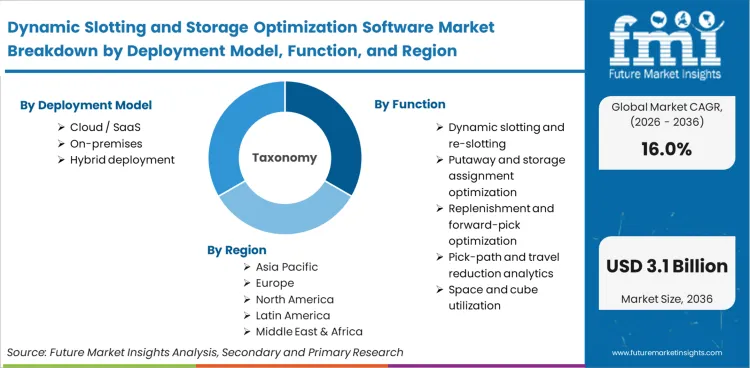
The dynamic slotting and storage optimization software market crossed a valuation of USD 0.6 billion in 2025. The industry is expected to reach USD 0.7 billion in 2026 at a CAGR of 16.0% during the forecast period. Demand outlook carries the market valuation to USD 3.1 billion by 2036 as fulfillment operators shift from static storage models to continuous, algorithm-driven inventory optimization.
Fulfillment directors face immediate pressure optimizing hyper-dense picking zones without expanding physical footprints. Relying on seasonal spreadsheet reorganizations forces operators into massive labor bottlenecks whenever SKU velocity profiles shift unexpectedly. Operations teams resolving this volume friction drive significant capital allocation across the dynamic slotting software market toward warehouse management system upgrades. Facilities deploying continuous algorithmic slotting prevent complete gridlock during promotional spikes by positioning fast-moving inventory exactly where pickers need it before demand surfaces.
Once a logistics network fully integrates autonomous transport with inventory data, static storage locations become obsolete. Master scheduling architects trigger growth across the storage optimization software market by abandoning fixed forward-pick locations. System orchestration subsequently depends entirely on real-time spatial analytics.
Summary of Dynamic Slotting and Storage Optimization Software Market
- Dynamic Slotting and Storage Optimization Software Market Definition
- This category captures the algorithmic intelligence engines that continuously evaluate and reassign physical inventory locations in response to changing demand velocity. It includes software logic built to improve slotting accuracy, reduce travel paths, and raise storage productivity across active warehouse environments. Value is created through constant optimization of inventory placement, allowing operators to respond faster to demand shifts and sustain fulfillment efficiency.
- Demand Drivers in the Market
- E-commerce piece-picking velocity requirements force logistics directors to eliminate wasted human travel time across massive footprints.
- Chronic warehouse labor shortages compel operations managers to maximize picker efficiency through hyper-optimized inventory positioning.
- Real estate cost escalation pushes supply chain planners to extract maximum cube utilization from existing facilities.
- Key Segments Analyzed in the FMI Report
- Deployment Model: Cloud / SaaS is expected to hold 61.0% share in 2026, dominating as enterprises demand multi-site visibility without maintaining local servers.
- Function: Dynamic slotting and re-slotting is projected to capture 29.0% share in 2026, reflecting intense focus on continuous rather than seasonal reorganization.
- Warehouse Type: E-commerce and omnichannel DCs is anticipated to lead with 37.0% share, transforming picker productivity profiles across immense SKU counts.
- Integration Scope: Native WMS module is set to command 54.0% share, minimizing complex third-party integration friction during deployment.
- Business Model: Subscription / recurring software is estimated to account for 58.0% share, aligning capital expenditure directly with operational budgets.
- India: 17.9% compound growth, driven by rapid formalization of regional distribution networks.
- Analyst Opinion at FMI
- Sudip Saha, Principal Analyst, Technology, at FMI, notes, "Supply chain executives assume adding more physical robots solves fulfillment latency. In reality, executing automated retrieval inside poorly slotted facilities just makes bad routing happen faster. Companies purchase massive automation grids but spend months trying to force obsolete spatial logic onto new equipment. Software controlling where inventory rests ultimately dictates how fast it ships."
- Strategic Implications / Executive Takeaways
- Facility design directors must prioritize spatial analytics integration before authorizing physical racking installations.
- Procurement heads evaluating warehouse robotics should mandate continuous re-slotting capabilities across vendor contracts.
- Operations managers running brownfield sites face unavoidable gridlock unless transitioning away from static seasonal bin planning.
- Methodology
- Primary Research: Consultations with logistics network IT directors determine genuine software implementation bottlenecks.
- Desk Research: Developer API documentation and interoperability standard whitepapers provide technical baseline data.
- Market-Sizing and Forecasting: Software-as-a-Service revenue disclosures establish accurate valuation models.
- Data Validation and Update Cycle: Automated storage shipment data corroborates underlying software license activation requirements.
Dynamic Slotting and Storage Optimization Software Market Key Takeaways
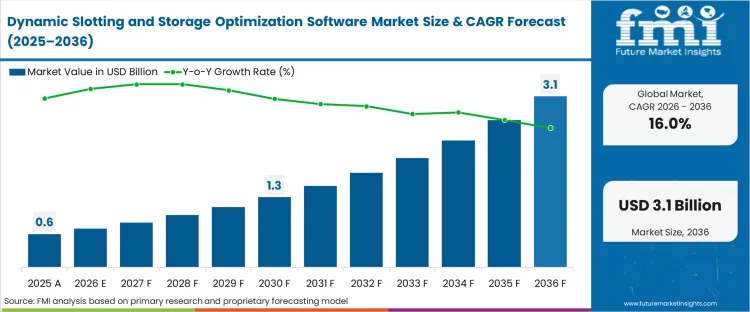
| Metric | Details |
|---|---|
| Industry Size (2026) | USD 0.7 billion |
| Industry Value (2036) | USD 3.1 billion |
| CAGR (2026 to 2036) | 16% |
Source: Future Market Insights (FMI) analysis, based on proprietary forecasting model and primary research
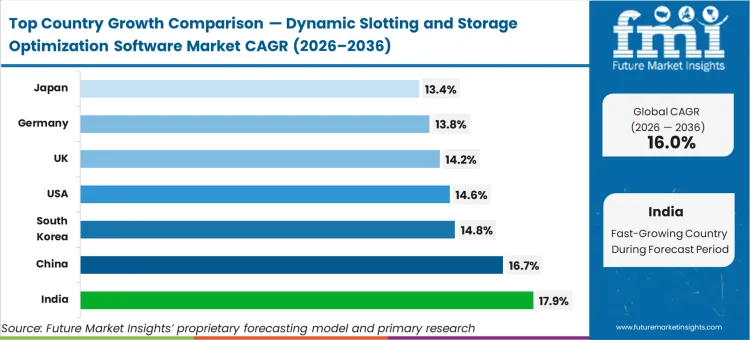
India tops the ranking at 17.9% as third-party logistics growth forces rapid modernization across facilities. China follows at 16.7% by optimizing massive urban fulfillment operations. South Korea records 14.8% through tighter coordination of high-velocity piece-picking tasks. The United States posts 14.6% while addressing chronic labor shortages. The United Kingdom reaches 14.2% through replacement of static legacy bin systems. Germany grows at 13.8% with rising demand for industrial part buffering. Japan stands at 13.4% through deployment of advanced retrieval architectures. Regional divergence is largely explained by the balance between greenfield projects and difficult brownfield retrofits.
Dynamic Slotting and Storage Optimization Software Market Definition
Dynamic Slotting and Storage Optimization Software encompasses algorithmic intelligence engines that continuously assign and reassign physical inventory locations based on real-time velocity data. Scope mandates active spatial recalculation and immediate putaway direction mapping. Purely static inventory counting tools fall outside this boundary. Continuous location reassignment distinguishes modern optimization logic from historical batch-based slotting routines.
Dynamic Slotting and Storage Optimization Software Market Inclusions
The market includes continuous re-slotting logic, pick-path reduction algorithms, heat-mapping visualization, and integrated 3D cube utilization tools. Deployments across inventory management software modules built around spatial intelligence remain fully within coverage. Professional services needed to translate physical facility dimensions into digital twin environments also fall strictly inside this boundary, as they directly support layout accuracy, storage optimization, and software-driven warehouse decision making.
Dynamic Slotting and Storage Optimization Software Market Exclusions
Standalone hardware scanners and radio frequency identification tags sit completely outside this analysis. Maintenance contracts for physical conveyor networks lack algorithmic placement logic. Base-level warehouse execution systems lacking dedicated continuous relocation capabilities belong in broader software categories. General enterprise resource planning deployments disconnected from precise warehouse spatial coordinates remain excluded.
Dynamic Slotting and Storage Optimization Software Market Research Methodology
- Primary Research: Fulfillment network directors, automation facility architects, and chief supply chain officers detail algorithmic deployment timelines.
- Desk Research: Software patent filings, integrator implementation disclosures, and retail compliance standards provide structural context.
- Market-Sizing and Forecasting: Declared software subscription volumes and enterprise license agreements baseline current spending.
- Data Validation and Update Cycle: Industrial automation hardware shipment metrics cross-validate spatial optimization software demand curves quarterly.
Segmental Analysis
Dynamic Slotting and Storage Optimization Software Market Analysis by Deployment Model
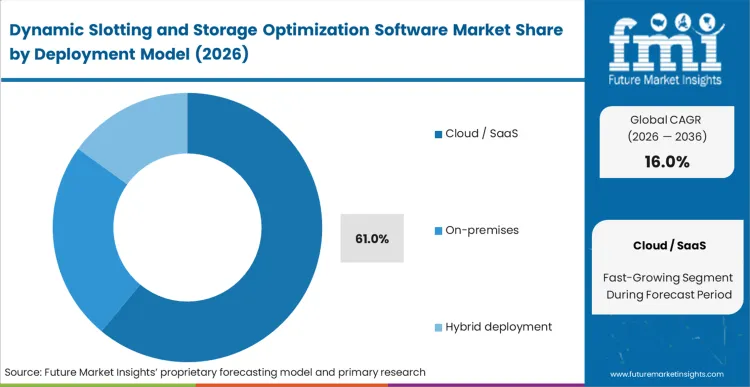
Cloud / SaaS commands 61.0% share in 2026 because chief information officers prioritize remote fleet monitoring across multiple geographic nodes simultaneously. FMI's analysis indicates operations directors managing regional distribution networks require unified dashboards tracking millions of discrete stock keeping units without installing massive local servers. Centralized processing allows continuous algorithm refinement utilizing aggregated fleet data. What enterprise IT teams rarely acknowledge is that cloud dependency introduces micro-latency into putaway routing decisions. Facilities deploying real-time slotting optimization software via cloud architecture frequently accept momentary scanner hesitations in hyper-dense receiving zones that on-premises localized servers would instantly resolve. Procurement planners overlooking this latency trade-off inevitably experience slight throughput degradation during extreme holiday volume spikes.
- Early adopters: Third-party logistics providers implement cloud architecture rapidly. Operations directors gain immediate visibility across disparate client facilities.
- Mainstream followers: Retail distribution networks transition toward SaaS models. IT managers eliminate expensive local server maintenance requirements.
- Late converts: High-security defense hubs finally embrace centralized orchestration. Compliance officers slowly approve heavily encrypted data streams.
Dynamic Slotting and Storage Optimization Software Market Analysis by Function
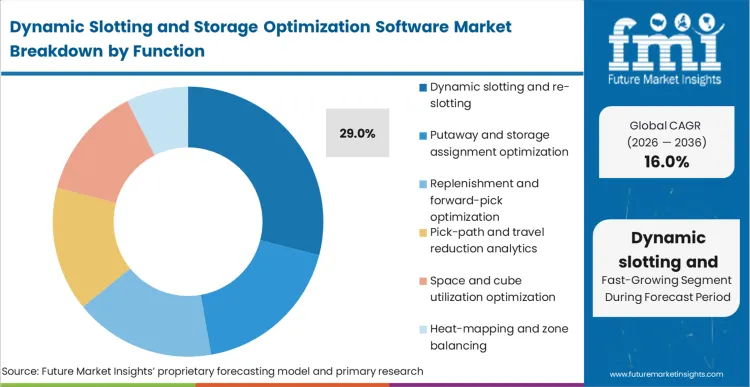
Reorganizing inventory locations constantly prevents facility paralysis. Dynamic slotting and re-slotting captures 29.0% share in 2026 as industrial engineers completely rework legacy assignment logic. According to FMI's estimates, facility managers driving demand in the warehouse slotting optimization software market drastically reduce deadhead travel time across massive smart warehouse technologies deployments. Integrating slotting and replenishment optimization software establishes a fundamental spatial hierarchy preventing overlapping picker congestion. Sophisticated orchestration engines look past immediate velocity, calculating ergonomic lift constraints and item crushability before dispatching a putaway task. Interestingly, highly optimized dynamic slotters frequently frustrate floor supervisors by intentionally placing high-velocity items in seemingly random locations to disperse picker density, a counterintuitive logic that actually prevents severe aisle gridlock during peak shifts. Brands delaying these software upgrades struggle permanently with inefficient space utilization.
- Threshold capability: Basic assignment logic meets minimum throughput requirements. Procurement directors approve initial software licensing budgets.
- Edge case degradation: Standard algorithms struggle managing sudden promotional volume spikes. Operations heads notice localized traffic gridlock.
- Qualification standard: Advanced predictive routing dictates vendor selection. Supply chain architects require guaranteed ergonomic compliance metrics.
Dynamic Slotting and Storage Optimization Software Market Analysis by Warehouse Type
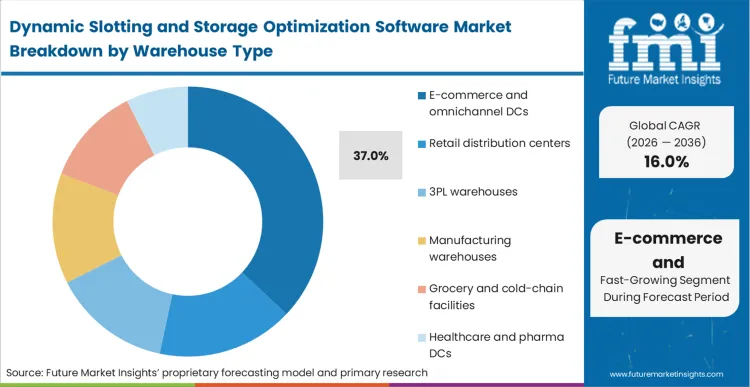
Intense piece-picking volume density creates extreme spatial constraints. E-commerce and omnichannel DCs account for 37.0% share in 2026 because online retailers aggressively deploy solutions maximizing individual worker efficiency. Fulfillment directors deploying slotting software for e-commerce warehouses completely redesign workflows around automated material handling systems to maintain acceptable delivery windows. Utilizing specialized warehouse pick-face optimization software requires continuous dynamic rerouting as order profiles change hourly. Traditional pallet-focused operations lacking these specialized routing demands face massive operational disadvantages when attempting individual item fulfillment. Third-party operators deploying slotting optimization for 3PL warehouses calculate immense labor expense reductions by maximizing storage density. Many warehouse operators mistakenly assume advanced optimization easily handles massive return processing, yet unpredictable reverse logistics item dimensions frequently crash rigid cube utilization algorithms. Operators attempting massive facility scaling face severe network architecture hurdles without flexible spatial logic.
- Procurement savings: Software centralization reduces overall travel time. Financial controllers calculate immense labor expense reductions.
- Hidden operational costs: Dedicated algorithmic tuning teams become necessary. Human resources directors struggle recruiting specialized spatial engineers.
- Lifecycle comparison: Continuous digital reorganization proves cheaper than physical building expansions. Technology officers redirect capital toward software instead of concrete.
Dynamic Slotting and Storage Optimization Software Market Analysis by Integration Scope
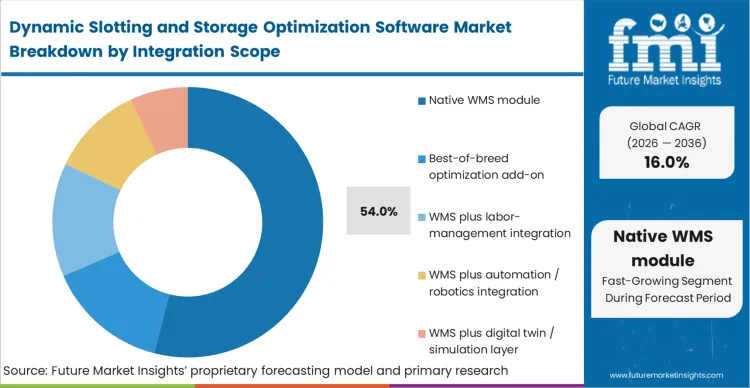
Native WMS module holds 54.0% share in 2026 because industrial buyers initially prefer keeping core execution capabilities within existing enterprise suites. In FMI's view, buying complete material handling integration capabilities natively guarantees immediate interoperability. Incumbent software providers absorb timeline risks while commanding premium suite fees. Sourcing managers conducting a rigorous WMS slotting module comparison frequently discover that native software promises immediate execution but quietly locks operators into specific ecosystem limitations, severely preventing the adoption of superior standalone slotting algorithms. Evaluating best-of-breed vs native WMS slotting software forces IT directors to balance immediate interoperability against long-term architectural flexibility. Operators relying on specialized putaway optimization software must implement overarching abstraction layers breaking vendor lock-in before scaling facilities. Sourcing managers regain critical flexibility only by prioritizing open architecture standards.
- Interoperability failure: Proprietary platforms reject third-party spatial algorithms. IT directors avoid custom middleware development entirely.
- Residual friction: Core execution systems struggle processing continuous dynamic recalculations. Operations managers discover unexpected latency gaps.
- Value capture: Operators must implement overarching abstraction layers breaking vendor lock-in. Supply chain executives maximize automated material handling equipment ROI.
Dynamic Slotting and Storage Optimization Software Market Analysis by Business Model
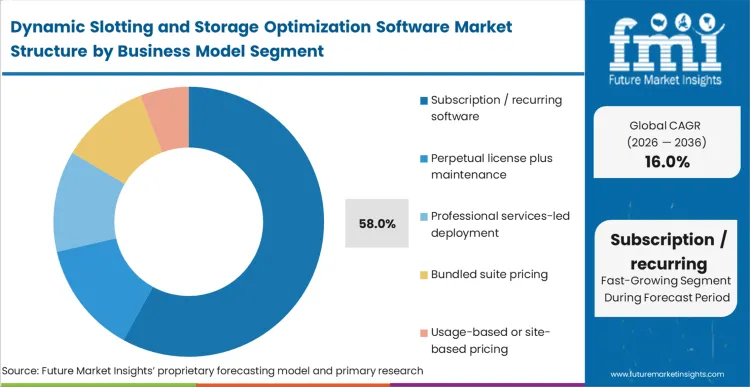
Shifting capital expenditure into predictable operating expenses dominates procurement strategy. Subscription / recurring software leads with 58.0% share in 2026 as risk-averse chief supply chain officers demand continuous updates without massive upfront licensing fees. Based on FMI's assessment, subscribing to warehouse design and layout intelligence ensures operators maintain access to the latest spatial algorithms. Software providers absorb upgrade risks while commanding steady monthly revenue streams. Rigid perpetual licenses requiring expensive manual patching consistently fail modern security audits. Enterprise buyers rarely calculate how compounding subscription fees over a ten-year facility lifecycle eventually dwarf the cost of perpetual licenses, effectively turning critical operational intelligence into an inescapable continuous tax. Companies attempting localized software ownership suffer massive technological obsolescence.
- Initial qualification: Subscription models lower deployment barriers significantly. Financial controllers approve operational expense budgets quickly.
- Validation phase: Cloud updates deploy seamlessly across multiple facilities. IT directors avoid disruptive manual server patching.
- Renewal driver: Continuous algorithm improvements justify ongoing costs. Operations heads demand access to predictive replenishment features.
Dynamic Slotting and Storage Optimization Software Market Drivers, Restraints, and Opportunities
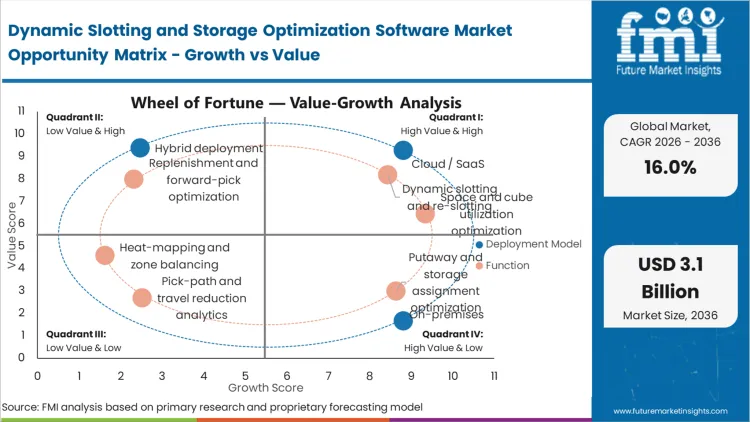
Consumer expectations around next-day delivery are compelling operations directors to deploy more dynamic inventory strategies immediately. Weak internal routing logic can quickly lead to missed dispatch windows and lower fulfillment reliability. Logistics architects increasingly require sophisticated software to position robots and labor efficiently within current floor plans. This operating pressure is strengthening demand for spatial optimization platforms, since manual reorganization often strains legacy warehouse systems and produces serious congestion during promotional surges.
Legacy warehouse management software architecture creates massive friction slowing algorithmic slotting deployment. Systems designed decades ago simply cannot process continuous spatial recalculation data generated by modern mobile robots. IT directors attempting to patch old execution systems inevitably face catastrophic system latency when continuous re-slotting logic overwhelms baseline database capacities. This structural software barrier severely throttles physical facility efficiency. Middleware bridges offer partial relief but introduce additional points of failure across critical operational pathways.
Opportunities in the Dynamic Slotting and Storage Optimization Software Market
- AI-driven spatial modeling: Facilities demand continuous layout testing prior to physical moves. Engineering teams developing AI-driven slotting optimization software capture premium revenue utilizing advanced retail warehouse management systems.
- Cold-chain zoning: Temperature-controlled facilities face extreme labor constraints. Software engineers deploying specialized cold-rated routing schedules secure high-margin regional contracts extending supply chain management capabilities.
- Digital twin simulation: Developers transitioning from pure execution to comprehensive supply chain visibility software build recurring revenue mapping virtual storage scenarios.
Regional Analysis
.webp "Top Country Growth Comparison Dynamic Slotting And Storage Optimization Software Market Cagr (2026 2036)")
Based on regional analysis, the warehouse storage optimization software market is segmented into North America, Europe, East Asia, and South Asia & Pacific across 40 plus countries.
| Country | CAGR (2026 to 2036) |
|---|---|
| India | 17.9% |
| China | 16.7% |
| South Korea | 14.8% |
| United States | 14.6% |
| United Kingdom | 14.2% |
| Germany | 13.8% |
| Japan | 13.4% |
Source: Future Market Insights (FMI) analysis, based on proprietary forecasting model and primary research
South Asia & Pacific Dynamic Slotting and Storage Optimization Software Market Analysis
Formalization across domestic retail supply chains is accelerating the need for software architectural transformation. According to FMI estimates, regional logistics conglomerates are abandoning loosely managed manual putaway in favor of high-throughput, algorithmically controlled nodes. Developers that support this technology shift are securing major baseline contracts. Local operations managers frequently struggle with integration complexity when specialized spatial expertise is not brought in during software deployment and layout planning.
- India: Aggressive intralogistics expansion fueling the India dynamic slotting software market requires immediate digital modernization. Supply chain directors facing massive e-commerce volume spikes commission advanced logistics visibility software rapidly. India expands at 17.9% compound growth. Software vendors establishing reliable local integration support networks dominate early infrastructure contracts.
East Asia Dynamic Slotting and Storage Optimization Software Market Analysis
Heavy piece-picking demand is pushing logistics infrastructure close to its physical threshold. According to FMI analysis, major regional e-commerce groups are installing dense robotic grids to maintain stable day-to-day operations. These large fleet deployments require sophisticated spatial orchestration and tighter layout control. Facility architects are under constant pressure to extract marginal storage density gains, particularly in high-density urban markets where vertical cube utilization is becoming essential in new site development.
- China: Immense manufacturing scale forces constant facility upgrades. The China warehouse slotting software market tracks at 16.7% compound growth as logistics architects deploy massive algorithms achieving unprecedented daily throughput metrics utilizing autonomous mobile robots. Domestic software developers export these hyper-dense operational models aggressively across neighboring regions.
- South Korea: High technological fluency accelerates complex software adoption. Operations managers require sophisticated middleware supporting dense urban micro fulfillment operations. South Korea advances at 14.8% compound growth. Facilities achieving seamless spatial integration operate extremely efficiently during peak seasons.
- Japan: Acute labor shortages are forcing full facility automation across Japan’s warehouse network. Operations directors facing persistent workforce gaps are moving quickly to implement algorithmic workflows across storage, picking, and retrieval functions. Japan is projected to record 13.4% CAGR as integrators deploy optimization platforms that reduce labor dependence. These solutions are helping operators respond to aging workforce pressures while sustaining throughput, accuracy, and daily execution stability across increasingly automated facilities.
North America Dynamic Slotting and Storage Optimization Software Market Analysis
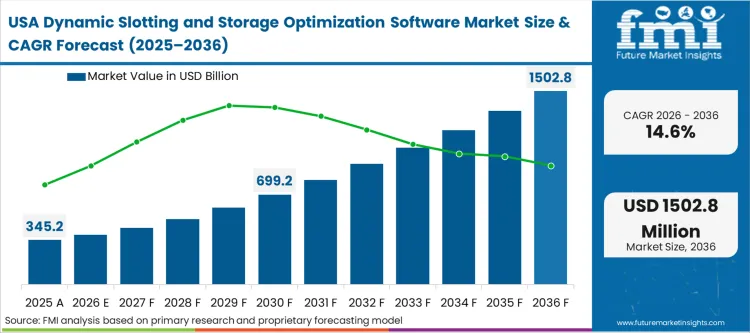
Legacy facility software is creating urgent need for complete technological modernization. FMI assessment indicates that major retail networks are moving away from obsolete static bin assignments and adopting dynamic spatial logic instead. Executing this shift without interrupting day-to-day warehouse activity requires exceptional software accuracy and disciplined rollout planning. Operations planners rely on algorithmic modeling to maintain continuity, and developers skilled in phased deployment are capturing a growing share of regional demand.
- United States: Coordinating massive third-party logistics networks dominates capital expenditure planning. Engineering directors execute complex brownfield software retrofits maintaining continuous daily shipping volume. Growth across the United States dynamic slotting software market registers 14.6% as middleware providers successfully orchestrating these seamless transitions secure lucrative long-term corporate partnerships.
Europe Dynamic Slotting and Storage Optimization Software Market Analysis
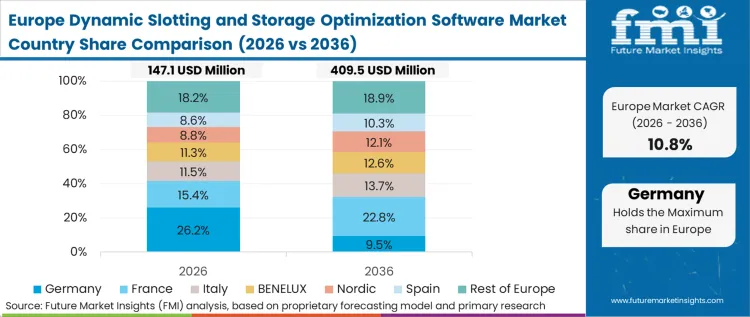
Strict labor regulations shape software deployment architecture heavily. FMI observes that European operations directors must balance maximum density against stringent ergonomic compliance requirements. Vendors modifying their spatial platforms addressing these heavy lifting hurdles capture significant enterprise contracts. Industrial manufacturing hubs demand extremely precise part buffering ensuring maximum assembly line flow.
- United Kingdom: Software investment is rising quickly as grocers work to ease distribution bottlenecks across the UK. Supply chain leaders are deploying advanced slotting orchestration platforms to manage perishable inventory movement more effectively. The UK market is expected to grow at 14.2% CAGR as grocery operators strengthen cold-chain coordination and warehouse responsiveness. Those that optimize these demanding environments are improving service levels, reducing waste, and building stronger competitive positions in time-sensitive food distribution.
- Germany: Integrating heavy industrial workflows dictates specific software requirements. Automotive manufacturers deploy complex algorithms demanding sophisticated part buffering utilizing storage and handling equipment. Germany advances at 13.8% compound growth. Precision engineering facilities avoid catastrophic assembly line delays through meticulous spatial routing.
FMI's report includes additional countries not in bullets. Rapid expansion of regional omnichannel fulfillment centers drives continuous demand for flexible mobile robot orchestration layers.
Competitive Aligners for Market Players
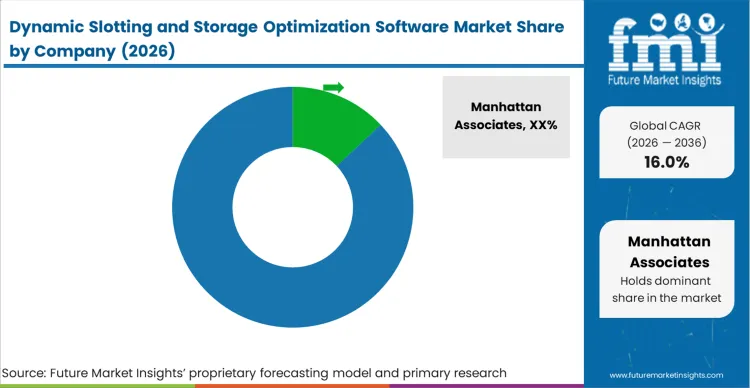
Integration between systems plays a major role in shaping success in this market. Buyers looking at warehouse slotting software usually care less about technical coding details and more about whether the software can improve daily space use. Companies such as Manhattan Associates and Blue Yonder continue to win large contracts because their tools connect well with different execution systems. By comparison, vendors offering only reporting tools often lose to providers that support wider in-plant logistics operations.
Top dynamic slotting software providers also benefit from strong integration experience that helps reduce deployment time. Körber Supply Chain and Tecsys have spent years building proven API connections, which helps them work faster across older facilities with different material handling systems. Newer providers building slotting software from the ground up often face pressure on margins while trying to match these established integration strengths. In many cases, operations leaders trust proven system reliability more than new optimization claims.
Large retail buyers are also careful about getting locked into one software provider. In major slotting software RFPs, sourcing teams often split purchases across several vendors, which pushes software developers to support open standards. This ongoing pull between built-in platform control and open system design continues to shape deployment choices. Providers using hardware-neutral logistics frameworks are gaining more attention from advanced networks that want greater flexibility while expanding warehouse picking AI workforce assistants.
Key Players in Dynamic Slotting and Storage Optimization Software Market
- Manhattan Associates
- Blue Yonder
- Körber Supply Chain
- Tecsys
- Softeon
- Made4net
- Generix Group
Scope of the Report
| Metric | Value |
|---|---|
| Quantitative Units | USD 0.7 billion to USD 3.1 billion, at a CAGR of 16% |
| Market Definition | Dynamic Slotting and Storage Optimization Software encompasses algorithmic intelligence engines that continuously assign and reassign physical inventory locations based on real-time velocity data. |
| Segmentation | Deployment Model, Function, Warehouse Type, Integration Scope, Business Model, Region |
| Regions Covered | North America, Europe, East Asia, South Asia & Pacific |
| Countries Covered | United States, China, India, Germany, Japan, United Kingdom, South Korea |
| Key Companies Profiled | Manhattan Associates, Blue Yonder, Körber Supply Chain, Tecsys, Softeon, Made4net, Generix Group |
| Forecast Period | 2026 to 2036 |
| Approach | Declared software subscription volumes and enterprise license agreements baseline current spending. |
Source: Future Market Insights (FMI) analysis, based on proprietary forecasting model and primary research
Dynamic Slotting and Storage Optimization Software Market Analysis by Segments
Deployment Model
- Cloud / SaaS
- On-premises
- Hybrid deployment
Function
- Dynamic slotting and re-slotting
- Putaway and storage assignment optimization
- Replenishment and forward-pick optimization
- Pick-path and travel reduction analytics
- Space and cube utilization optimization
- Heat-mapping and zone balancing
Warehouse Type
- E-commerce and omnichannel DCs
- Retail distribution centers
- 3PL warehouses
- Manufacturing warehouses
- Grocery and cold-chain facilities
- Healthcare and pharma DCs
Integration Scope
- Native WMS module
- Best-of-breed optimization add-on
- WMS plus labor-management integration
- WMS plus automation / robotics integration
- WMS plus digital twin / simulation layer
Business Model
- Subscription / recurring software
- Perpetual license plus maintenance
- Professional services-led deployment
- Bundled suite pricing
- Usage-based or site-based pricing
Region
- North America
- Europe
- East Asia
- South Asia & Pacific
Bibliography
- Duque-Jaramillo, J. C., Cogollo-Flórez, J. M., Gómez-Marín, C. G., & Correa-Espinal, A. A. (2024). Warehouse management optimization using a sorting-based slotting approach. Journal of Industrial Engineering and Management, 17(1), 133-150.
- Telha, C., & González-Ramírez, R. G. (2025). A constraint-programming approach for the storage space allocation problem in a distribution center. International Transactions in Operational Research, 32(6), 3474-3496.
- Hyder, J., & Hassini, E. (2025). Optimizing warehouse space allocation to maximize profit in the postal industry. Transportation Research Part E: Logistics and Transportation Review, 195, 103924.
- National Institute of Standards and Technology. (2024, October). Economics of digital twins: Costs, benefits, and economic decision making (NIST AMS 100-61).
- Shahroudnejad, A., Mousavi, P., Perepelytsia, O., Sahir, Staszak, D., Taylor, M. E., & Bawel, B. (2024). A novel framework for automated warehouse layout generation. Frontiers in Artificial Intelligence, 7, 1465186.
This bibliography is provided for reader reference. The full FMI report contains the complete reference list with primary source documentation.
This Report Addresses
- Cloud architecture adoption accelerating unified remote facility visualization metrics.
- Algorithm deployment eliminating severe seasonal inventory reorganization bottlenecks.
- Subscription billing models transforming traditional capital expenditure planning.
- Legacy warehouse software latency causing physical hardware integration friction.
- Predictive putaway routing reducing massive deadhead travel times.
- India leading regional compound growth through rapid digital modernization.
- Native module ecosystems generating significant operational lock-in friction.
- Grocers implementing specialized routing securing critical cold-chain advantages.
Frequently Asked Questions
What is dynamic slotting software?
These systems serve as algorithmic intelligence engines that continuously assign and reassign physical inventory locations based on real-time velocity data, ensuring optimal storage density before physical operations begin.
What is the difference between static and dynamic slotting?
Static slotting relies on seasonal spreadsheet reorganizations creating rigid bin assignments, whereas dynamic systems continuously reorganize picking zones algorithmically to prevent intense aisle congestion during unexpected promotional volume spikes.
How much does slotting optimization software cost?
Capital requirements range from USD 0.7 billion globally in 2026, scaling rapidly through 2036. Individual facility deployment costs vary dramatically based on the required depth of robotic integration, continuous recalculation processing, and physical spatial constraints confronting brownfield retrofits.
Which companies offer dynamic slotting software?
Major global players include Manhattan Associates, Blue Yonder, Körber Supply Chain, Tecsys, Softeon, Made4net, and Generix Group. Operations directors evaluate these firms based on their proprietary spatial libraries and proven ability to orchestrate complex equipment ecosystems without halting daily shipping volume.
How to choose dynamic slotting software?
Procurement heads should evaluate potential partners strictly on their architectural interoperability standards rather than native module convenience. Master integrators guaranteeing open API communication paths prevent costly vendor lock-in during future facility capacity expansions.
What value does Dynamic Slotting and Storage Optimization Software Market generate currently?
Valuation hits USD 0.7 billion in 2026. Rapidly scaling logistics networks demand precise spatial orchestration eliminating massive aisle congestion before physical operations begin.
What growth rate applies to storage optimization platforms?
Demand expands at a 16% CAGR through 2036. Logistics operators face immense pressure upgrading obsolete static layouts into highly fluid environments without halting daily operations.
Which deployment model captures highest spending?
Cloud / SaaS platforms hold 61.0% share in 2026. Chief information officers refuse authorizing massive local server installations preferring unified dashboards tracking immense inventory nodes remotely.
Why do native platforms dominate integration scope?
Native WMS module captures 54.0% share. Risk-averse logistics directors historically demanded single-contractor accountability avoiding massive API friction between disparate execution systems.
How does intense volume density influence routing strategy?
E-commerce and omnichannel DCs command 37.0% share across warehouse types. Processing direct-to-consumer orders requires extremely fluid physical layouts and highly sophisticated spatial routing logic managing continuous replenishment.
What structural constraint slows hardware deployment?
Legacy warehouse management software architecture causes immense friction. Older codebases cannot process massive real-time spatial datasets generated continuously by modern autonomous robot fleets.
Why does India lead regional growth trajectories?
India tracks at 17.9% compound growth. Rapid formalization across domestic logistics networks forces massive immediate software upgrades moving regional hubs from disorganized manual layouts toward algorithmically slotted facilities.
Why do e-commerce hubs require continuous dynamic rerouting?
E-commerce environments prioritize maximum individual worker efficiency. Traditional pallet-focused operations lacking specialized routing demands face massive operational disadvantages attempting individual piece-picking fulfillment.
How do operations directors validate algorithm performance?
Executives rely almost entirely on advanced predictive routing ensuring guaranteed ergonomic compliance metrics. Orchestration engines calculate lift constraints and crushability before dispatching tasks optimizing overall shift safety.
Why do brownfield retrofits present unique software challenges?
Updating existing facilities requires orchestrating complex algorithmic installations without stopping daily volume flows. Planners executing phased software deployment strategies successfully avoid devastating operational shutdowns.
What advantage do established developers hold over new entrants?
Incumbent providers control massive libraries containing validated API handshakes. Accessing these proven codebases allows operations directors accelerating deployment schedules significantly compared to building software architecture entirely from scratch.
How does SaaS software generate recurring revenue?
Facilities demand continuous algorithm optimization well past initial launch dates. Software providers transitioning traditional perpetual licenses toward ongoing monthly subscriptions build extremely stable recurring revenue models.
What friction do open API standards address directly?
Sourcing directors deliberately fragment digital purchases demanding open architecture. Forcing developers utilizing hardware-agnostic software frameworks ensures operators maintain maximum flexibility during future slotting expansions.
What drives orchestration demand across European markets?
Germany advances at 13.8% compound growth. Regional automotive manufacturers modernizing local distribution networks aggressively commission expert software services orchestrating complex industrial part buffering workflows.
How does ergonomic compliance influence software architecture?
Operators attempting high-density storage zones face severe regulatory scrutiny. Software engineers designing clear predictive boundaries preventing excessive human lifting successfully avoid devastating workplace safety fines.
What metric cross-validates software demand forecasting?
Automated material handling hardware shipment volumes track closely alongside integration software requirements. Surging robotic deliveries correlate directly with corresponding spatial optimization license activations securing physical deployment success.
Preview the report firsthand - request a free sample
Get SampleGet the brochure for pricing and purchase details.
Get PDFTable of Content
- Executive Summary
- Global Market Outlook
- Demand-side Trends
- Supply-side Trends
- Technology Roadmap Analysis
- Analysis and Recommendations
- Market Overview
- Market Coverage / Taxonomy
- Market Definition / Scope / Limitations
- Research Methodology
- Chapter Orientation
- Analytical Lens and Working Hypotheses
- Market Structure, Signals, and Trend Drivers
- Benchmarking and Cross-market Comparability
- Market Sizing, Forecasting, and Opportunity Mapping
- Research Design and Evidence Framework
- Desk Research Programme (Secondary Evidence)
- Company Annual and Sustainability Reports
- Peer-reviewed Journals and Academic Literature
- Corporate Websites, Product Literature, and Technical Notes
- Earnings Decks and Investor Briefings
- Statutory Filings and Regulatory Disclosures
- Technical White Papers and Standards Notes
- Trade Journals, Industry Magazines, and Analyst Briefs
- Conference Proceedings, Webinars, and Seminar Materials
- Government Statistics Portals and Public Data Releases
- Press Releases and Reputable Media Coverage
- Specialist Newsletters and Curated Briefings
- Sector Databases and Reference Repositories
- FMI Internal Proprietary Databases and Historical Market Datasets
- Subscription Datasets and Paid Sources
- Social Channels, Communities, and Digital Listening Inputs
- Additional Desk Sources
- Expert Input and Fieldwork (Primary Evidence)
- Primary Modes
- Qualitative Interviews and Expert Elicitation
- Quantitative Surveys and Structured Data Capture
- Blended Approach
- Why Primary Evidence is Used
- Field Techniques
- Interviews
- Surveys
- Focus Groups
- Observational and In-context Research
- Social and Community Interactions
- Stakeholder Universe Engaged
- C-suite Leaders
- Board Members
- Presidents and Vice Presidents
- R&D and Innovation Heads
- Technical Specialists
- Domain Subject-matter Experts
- Scientists
- Physicians and Other Healthcare Professionals
- Governance, Ethics, and Data Stewardship
- Research Ethics
- Data Integrity and Handling
- Primary Modes
- Tooling, Models, and Reference Databases
- Desk Research Programme (Secondary Evidence)
- Data Engineering and Model Build
- Data Acquisition and Ingestion
- Cleaning, Normalisation, and Verification
- Synthesis, Triangulation, and Analysis
- Quality Assurance and Audit Trail
- Market Background
- Market Dynamics
- Drivers
- Restraints
- Opportunity
- Trends
- Scenario Forecast
- Demand in Optimistic Scenario
- Demand in Likely Scenario
- Demand in Conservative Scenario
- Opportunity Map Analysis
- Product Life Cycle Analysis
- Supply Chain Analysis
- Investment Feasibility Matrix
- Value Chain Analysis
- PESTLE and Porter’s Analysis
- Regulatory Landscape
- Regional Parent Market Outlook
- Production and Consumption Statistics
- Import and Export Statistics
- Market Dynamics
- Global Market Analysis 2021 to 2025 and Forecast, 2026 to 2036
- Historical Market Size Value (USD Million) Analysis, 2021 to 2025
- Current and Future Market Size Value (USD Million) Projections, 2026 to 2036
- Y-o-Y Growth Trend Analysis
- Absolute $ Opportunity Analysis
- Global Market Pricing Analysis 2021 to 2025 and Forecast 2026 to 2036
- Global Market Analysis 2021 to 2025 and Forecast 2026 to 2036, By Deployment Model
- Introduction / Key Findings
- Historical Market Size Value (USD Million) Analysis By Deployment Model , 2021 to 2025
- Current and Future Market Size Value (USD Million) Analysis and Forecast By Deployment Model , 2026 to 2036
- Cloud / SaaS
- On-premises
- Hybrid deployment
- Cloud / SaaS
- Y-o-Y Growth Trend Analysis By Deployment Model , 2021 to 2025
- Absolute $ Opportunity Analysis By Deployment Model , 2026 to 2036
- Global Market Analysis 2021 to 2025 and Forecast 2026 to 2036, By Function
- Introduction / Key Findings
- Historical Market Size Value (USD Million) Analysis By Function, 2021 to 2025
- Current and Future Market Size Value (USD Million) Analysis and Forecast By Function, 2026 to 2036
- Dynamic slotting and re-slotting
- Putaway and storage assignment optimization
- Replenishment and forward-pick optimization
- Pick-path and travel reduction analytics
- Space and cube utilization optimization
- Heat-mapping and zone balancing
- Dynamic slotting and re-slotting
- Y-o-Y Growth Trend Analysis By Function, 2021 to 2025
- Absolute $ Opportunity Analysis By Function, 2026 to 2036
- Global Market Analysis 2021 to 2025 and Forecast 2026 to 2036, By Warehouse Type
- Introduction / Key Findings
- Historical Market Size Value (USD Million) Analysis By Warehouse Type, 2021 to 2025
- Current and Future Market Size Value (USD Million) Analysis and Forecast By Warehouse Type, 2026 to 2036
- E-commerce and omnichannel DCs
- Retail distribution centers
- 3PL warehouses
- Manufacturing warehouses
- Grocery and cold-chain facilities
- Healthcare and pharma DCs
- E-commerce and omnichannel DCs
- Y-o-Y Growth Trend Analysis By Warehouse Type, 2021 to 2025
- Absolute $ Opportunity Analysis By Warehouse Type, 2026 to 2036
- Global Market Analysis 2021 to 2025 and Forecast 2026 to 2036, By Integration Scope
- Introduction / Key Findings
- Historical Market Size Value (USD Million) Analysis By Integration Scope, 2021 to 2025
- Current and Future Market Size Value (USD Million) Analysis and Forecast By Integration Scope, 2026 to 2036
- Native WMS module
- Best-of-breed optimization add-on
- WMS plus labor-management integration
- WMS plus automation / robotics integration
- WMS plus digital twin / simulation layer
- Native WMS module
- Y-o-Y Growth Trend Analysis By Integration Scope, 2021 to 2025
- Absolute $ Opportunity Analysis By Integration Scope, 2026 to 2036
- Global Market Analysis 2021 to 2025 and Forecast 2026 to 2036, By Business Model
- Introduction / Key Findings
- Historical Market Size Value (USD Million) Analysis By Business Model, 2021 to 2025
- Current and Future Market Size Value (USD Million) Analysis and Forecast By Business Model, 2026 to 2036
- Subscription / recurring software
- Perpetual license plus maintenance
- Professional services-led deployment
- Bundled suite pricing
- Usage-based or site-based pricing
- Subscription / recurring software
- Y-o-Y Growth Trend Analysis By Business Model, 2021 to 2025
- Absolute $ Opportunity Analysis By Business Model, 2026 to 2036
- Global Market Analysis 2021 to 2025 and Forecast 2026 to 2036, By Region
- Introduction
- Historical Market Size Value (USD Million) Analysis By Region, 2021 to 2025
- Current Market Size Value (USD Million) Analysis and Forecast By Region, 2026 to 2036
- North America
- Latin America
- Western Europe
- Eastern Europe
- East Asia
- South Asia and Pacific
- Middle East & Africa
- Market Attractiveness Analysis By Region
- North America Market Analysis 2021 to 2025 and Forecast 2026 to 2036, By Country
- Historical Market Size Value (USD Million) Trend Analysis By Market Taxonomy, 2021 to 2025
- Market Size Value (USD Million) Forecast By Market Taxonomy, 2026 to 2036
- By Country
- USA
- Canada
- Mexico
- By Deployment Model
- By Function
- By Warehouse Type
- By Integration Scope
- By Business Model
- By Country
- Market Attractiveness Analysis
- By Country
- By Deployment Model
- By Function
- By Warehouse Type
- By Integration Scope
- By Business Model
- Key Takeaways
- Latin America Market Analysis 2021 to 2025 and Forecast 2026 to 2036, By Country
- Historical Market Size Value (USD Million) Trend Analysis By Market Taxonomy, 2021 to 2025
- Market Size Value (USD Million) Forecast By Market Taxonomy, 2026 to 2036
- By Country
- Brazil
- Chile
- Rest of Latin America
- By Deployment Model
- By Function
- By Warehouse Type
- By Integration Scope
- By Business Model
- By Country
- Market Attractiveness Analysis
- By Country
- By Deployment Model
- By Function
- By Warehouse Type
- By Integration Scope
- By Business Model
- Key Takeaways
- Western Europe Market Analysis 2021 to 2025 and Forecast 2026 to 2036, By Country
- Historical Market Size Value (USD Million) Trend Analysis By Market Taxonomy, 2021 to 2025
- Market Size Value (USD Million) Forecast By Market Taxonomy, 2026 to 2036
- By Country
- Germany
- UK
- Italy
- Spain
- France
- Nordic
- BENELUX
- Rest of Western Europe
- By Deployment Model
- By Function
- By Warehouse Type
- By Integration Scope
- By Business Model
- By Country
- Market Attractiveness Analysis
- By Country
- By Deployment Model
- By Function
- By Warehouse Type
- By Integration Scope
- By Business Model
- Key Takeaways
- Eastern Europe Market Analysis 2021 to 2025 and Forecast 2026 to 2036, By Country
- Historical Market Size Value (USD Million) Trend Analysis By Market Taxonomy, 2021 to 2025
- Market Size Value (USD Million) Forecast By Market Taxonomy, 2026 to 2036
- By Country
- Russia
- Poland
- Hungary
- Balkan & Baltic
- Rest of Eastern Europe
- By Deployment Model
- By Function
- By Warehouse Type
- By Integration Scope
- By Business Model
- By Country
- Market Attractiveness Analysis
- By Country
- By Deployment Model
- By Function
- By Warehouse Type
- By Integration Scope
- By Business Model
- Key Takeaways
- East Asia Market Analysis 2021 to 2025 and Forecast 2026 to 2036, By Country
- Historical Market Size Value (USD Million) Trend Analysis By Market Taxonomy, 2021 to 2025
- Market Size Value (USD Million) Forecast By Market Taxonomy, 2026 to 2036
- By Country
- China
- Japan
- South Korea
- By Deployment Model
- By Function
- By Warehouse Type
- By Integration Scope
- By Business Model
- By Country
- Market Attractiveness Analysis
- By Country
- By Deployment Model
- By Function
- By Warehouse Type
- By Integration Scope
- By Business Model
- Key Takeaways
- South Asia and Pacific Market Analysis 2021 to 2025 and Forecast 2026 to 2036, By Country
- Historical Market Size Value (USD Million) Trend Analysis By Market Taxonomy, 2021 to 2025
- Market Size Value (USD Million) Forecast By Market Taxonomy, 2026 to 2036
- By Country
- India
- ASEAN
- Australia & New Zealand
- Rest of South Asia and Pacific
- By Deployment Model
- By Function
- By Warehouse Type
- By Integration Scope
- By Business Model
- By Country
- Market Attractiveness Analysis
- By Country
- By Deployment Model
- By Function
- By Warehouse Type
- By Integration Scope
- By Business Model
- Key Takeaways
- Middle East & Africa Market Analysis 2021 to 2025 and Forecast 2026 to 2036, By Country
- Historical Market Size Value (USD Million) Trend Analysis By Market Taxonomy, 2021 to 2025
- Market Size Value (USD Million) Forecast By Market Taxonomy, 2026 to 2036
- By Country
- Kingdom of Saudi Arabia
- Other GCC Countries
- Turkiye
- South Africa
- Other African Union
- Rest of Middle East & Africa
- By Deployment Model
- By Function
- By Warehouse Type
- By Integration Scope
- By Business Model
- By Country
- Market Attractiveness Analysis
- By Country
- By Deployment Model
- By Function
- By Warehouse Type
- By Integration Scope
- By Business Model
- Key Takeaways
- Key Countries Market Analysis
- USA
- Pricing Analysis
- Market Share Analysis, 2025
- By Deployment Model
- By Function
- By Warehouse Type
- By Integration Scope
- By Business Model
- Canada
- Pricing Analysis
- Market Share Analysis, 2025
- By Deployment Model
- By Function
- By Warehouse Type
- By Integration Scope
- By Business Model
- Mexico
- Pricing Analysis
- Market Share Analysis, 2025
- By Deployment Model
- By Function
- By Warehouse Type
- By Integration Scope
- By Business Model
- Brazil
- Pricing Analysis
- Market Share Analysis, 2025
- By Deployment Model
- By Function
- By Warehouse Type
- By Integration Scope
- By Business Model
- Chile
- Pricing Analysis
- Market Share Analysis, 2025
- By Deployment Model
- By Function
- By Warehouse Type
- By Integration Scope
- By Business Model
- Germany
- Pricing Analysis
- Market Share Analysis, 2025
- By Deployment Model
- By Function
- By Warehouse Type
- By Integration Scope
- By Business Model
- UK
- Pricing Analysis
- Market Share Analysis, 2025
- By Deployment Model
- By Function
- By Warehouse Type
- By Integration Scope
- By Business Model
- Italy
- Pricing Analysis
- Market Share Analysis, 2025
- By Deployment Model
- By Function
- By Warehouse Type
- By Integration Scope
- By Business Model
- Spain
- Pricing Analysis
- Market Share Analysis, 2025
- By Deployment Model
- By Function
- By Warehouse Type
- By Integration Scope
- By Business Model
- France
- Pricing Analysis
- Market Share Analysis, 2025
- By Deployment Model
- By Function
- By Warehouse Type
- By Integration Scope
- By Business Model
- India
- Pricing Analysis
- Market Share Analysis, 2025
- By Deployment Model
- By Function
- By Warehouse Type
- By Integration Scope
- By Business Model
- ASEAN
- Pricing Analysis
- Market Share Analysis, 2025
- By Deployment Model
- By Function
- By Warehouse Type
- By Integration Scope
- By Business Model
- Australia & New Zealand
- Pricing Analysis
- Market Share Analysis, 2025
- By Deployment Model
- By Function
- By Warehouse Type
- By Integration Scope
- By Business Model
- China
- Pricing Analysis
- Market Share Analysis, 2025
- By Deployment Model
- By Function
- By Warehouse Type
- By Integration Scope
- By Business Model
- Japan
- Pricing Analysis
- Market Share Analysis, 2025
- By Deployment Model
- By Function
- By Warehouse Type
- By Integration Scope
- By Business Model
- South Korea
- Pricing Analysis
- Market Share Analysis, 2025
- By Deployment Model
- By Function
- By Warehouse Type
- By Integration Scope
- By Business Model
- Russia
- Pricing Analysis
- Market Share Analysis, 2025
- By Deployment Model
- By Function
- By Warehouse Type
- By Integration Scope
- By Business Model
- Poland
- Pricing Analysis
- Market Share Analysis, 2025
- By Deployment Model
- By Function
- By Warehouse Type
- By Integration Scope
- By Business Model
- Hungary
- Pricing Analysis
- Market Share Analysis, 2025
- By Deployment Model
- By Function
- By Warehouse Type
- By Integration Scope
- By Business Model
- Kingdom of Saudi Arabia
- Pricing Analysis
- Market Share Analysis, 2025
- By Deployment Model
- By Function
- By Warehouse Type
- By Integration Scope
- By Business Model
- Turkiye
- Pricing Analysis
- Market Share Analysis, 2025
- By Deployment Model
- By Function
- By Warehouse Type
- By Integration Scope
- By Business Model
- South Africa
- Pricing Analysis
- Market Share Analysis, 2025
- By Deployment Model
- By Function
- By Warehouse Type
- By Integration Scope
- By Business Model
- USA
- Market Structure Analysis
- Competition Dashboard
- Competition Benchmarking
- Market Share Analysis of Top Players
- By Regional
- By Deployment Model
- By Function
- By Warehouse Type
- By Integration Scope
- By Business Model
- Competition Analysis
- Competition Deep Dive
- Manhattan Associates
- Overview
- Product Portfolio
- Profitability by Market Segments (Product/Age /Sales Channel/Region)
- Sales Footprint
- Strategy Overview
- Marketing Strategy
- Product Strategy
- Channel Strategy
- Blue Yonder
- Körber Supply Chain
- Tecsys
- Softeon
- Made4net
- Generix Group
- Manhattan Associates
- Competition Deep Dive
- Assumptions & Acronyms Used


