

- Industry Size (2026)
- USD 147.4 Bn
- Forecast (2036)
- USD 536.2 Bn
- CAGR (2026 to 2036)
- 13.8%
Software Distribution Market Forecast and Outlook 2026 to 2036
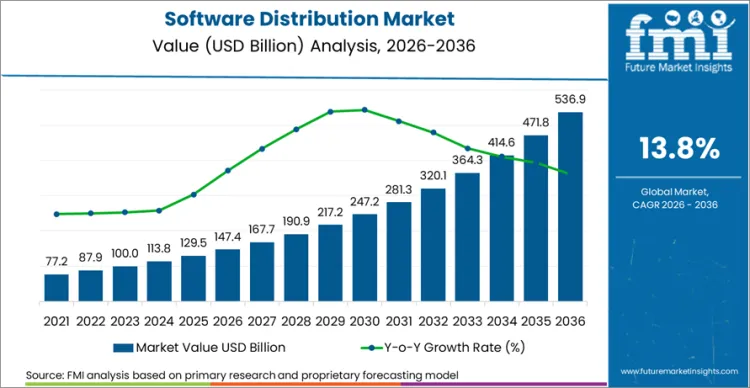
The global software distribution market is on track to achieve a valuation of USD 536.2 Billion by 2036, accelerating from USD 147.4 Billion in 2026 at a CAGR of 13.8%. As per Future Market Insights, expansion is structurally underpinned by enterprise migration to cloud-native software procurement, SaaS subscription management growth, and the increasing complexity of multi-vendor licensing that demands automated distribution platforms. Microsoft implemented mandatory multifactor authentication for all API access within its Partner Center in January 2026, a security-first distribution mandate forcing channel partners to upgrade integration infrastructure.
This compels distributors to invest in cloud marketplace platforms with embedded AI for license optimization and compliance. Simultaneously the competitive environment is shifting from volume-based reselling to platform-based orchestration where distributors managing multi-cloud subscription lifecycles capture the highest margins.
Eric Nowak, Global President of Arrow ECS, stated: 'Arrow has embraced the future and is delivering offerings like ArrowSphere AI that empower our customers and redefine the channel.' FMI opines that this reflects a broader structural shift where distribution is moving from logistics to intelligence, with AI-powered platforms becoming the primary competitive asset for channel intermediaries.
The operational reality for software distributors is defined by the convergence of cloud marketplace management, security-mandated authentication, and AI-driven license optimization into single platform offerings. Microsoft completed its mandatory MFA rollout for Partner Center API access in January 2026, coinciding with Agent Mode for Copilot enabling automated orchestration of partner workflows. Arrow Electronics continued expanding its ArrowSphere cloud marketplace platform in 2025, integrating AI-driven features for license compliance and spend optimization across multi-vendor environments.
TD SYNNEX expanded its StreamOne Ion platform in 2025, consolidating cloud, on-premise, and hybrid software distribution into a unified procurement experience. As per FMI, these moves confirm the sector is entering a phase of platform consolidation where AI-powered cloud marketplaces replace traditional reselling, and distributors unable to manage multi-vendor subscription lifecycle complexity face margin compression.
Summary of Software Distribution Market
What Is Growth Outlook for Software Distribution Market as per Future Market Insights Projection?
Future Market Insights projects the software distribution market to expand at a CAGR of 13.8% from 2026 to 2036, increasing from USD 147.4 Billion in 2026 to USD 536.2 Billion by 2036.
FMI Research Approach: FMI proprietary forecasting model based on enterprise SaaS spending growth and channel distribution revenue mix analysis.
How Do FMI Analysts Perceive Software Distribution Market to Evolve?
FMI analysts perceive the market evolving toward AI-powered cloud marketplace platforms where distributors manage multi-vendor subscription lifecycles, license compliance, and spend optimization, replacing traditional volume-based license reselling.
FMI Research Approach: Cloud marketplace adoption tracking and channel partner program analysis.
Which Country Holds Largest Share in Global Software Distribution Market?
The United States holds a significant share of the global software distribution market by value, supported by the headquarters of major cloud vendors and the largest enterprise software spending base globally.
FMI Research Approach: FMI country-level revenue modelling by enterprise software spending and cloud adoption rates.
How Large Will Software Distribution Market Be by 2036?
The global software distribution market is projected to reach USD 536.2 Billion by 2036.
FMI Research Approach: FMI long-term revenue forecast derived from cloud migration projections and software licensing model transition curves.
What Is Definition of Software Distribution Market?
The software distribution market includes revenue from the intermediation of software products and cloud services between vendors and end users, covering license fulfillment, cloud marketplace orchestration, subscription management, and value-added services by distributors and channel partners.
FMI Research Approach: FMI market taxonomy and inclusion-exclusion framework.
What Are Globally Unique Trends Shaping Software Distribution Market?
Globally unique trends include the enforcement of security-first channel mandates such as mandatory MFA for API access, integration of agentic AI into distribution platforms for automated procurement, and consolidation of multi-cloud subscription management under unified marketplace platforms.
FMI Research Approach: Vendor partner program update tracking and cloud marketplace platform analysis.
Software Distribution Market Key Takeaways
| Metric | Details |
|---|---|
| Industry Size (2026) | USD 147.4 Billion |
| Industry Value (2036) | USD 536.2 Billion |
| CAGR (2026 to 2036) | 13.8% |
Source: Future Market Insights (FMI) analysis, based on proprietary forecasting model and primary research
Semi Annual Market Update
The below table presents the expected CAGR for the global Software Distribution market over several semi-annual periods spanning from 2026 to 2036. In the first half (H1) of the year from 2026 to 2036, the business is predicted to surge at a CAGR of 11.4%, followed by a slightly higher growth rate of 11.8% in the second half (H2) of the same year.
| Particular | Value CAGR |
|---|---|
| H1, 2025 | 11.4% (2025 to 2035) |
| H2, 2025 | 11.8% (2025 to 2035) |
| H1, 2026 | 13.8%(2026 to 2036) |
| H2, 2026 | 14.3% (2026 to 2036) |
Moving into the subsequent period, from H1 2026 to H2 2036, the CAGR is projected to increase slightly to 13.8% in the first half and remain relatively moderate at 14.3% in the second half. In the first half (H1) the market witnessed a decrease of 50 BPS while in the second half (H2), the market witnessed an increase of 70 BPS.
Category-wise Insights
The section contains information about the leading segments in the Software Distribution industry. By Deployment, the Cloud-Based Distribution segment is estimated to grow at a CAGR of 65.0% during the forecasted period. moreover, by Organization Size, the Large Enterprises segment has holding the share of 39.7% in 2024.
Large Enterprises Segment by Organization Size Holds Leading Market Share in Software Distribution Market
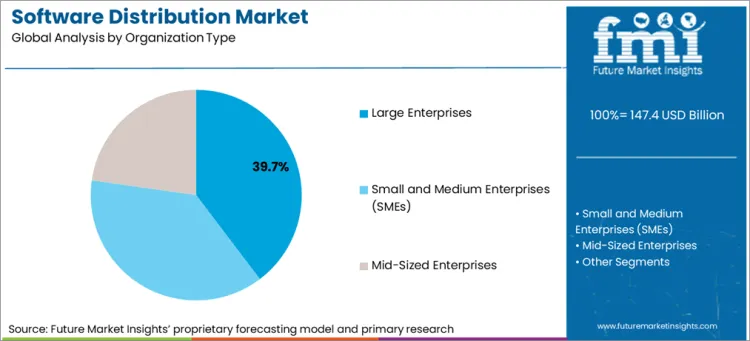
| By Organization Size | Share (2025) |
|---|---|
| Large Enterprises | 39.7% |
The large enterprises segment has an overwhelming market share of the software distribution market, owing to their wide and complex IT infrastructures requiring robust, scalable, and secure software delivery solutions. These companies typically operate globally and require more advanced tools to support multi-site deployments, ensure real-time updates, and ensure that regional regulations are followed.
Because large enterprises typically have substantial budgets for IT modernization and automation, these firms are usually at the forefront of newer technologies, such as artificial intelligence and machine learning, in the process of software distribution. An integral focus on upgrading operational efficiency along with reducing potential downtime further emphasizes the demand of high-end premium distribution platforms making them the maximum revenue contributors.
Cloud-Based Distribution Segment by Deployment Type Growing at the Highest CAGR During the Forecasted Period
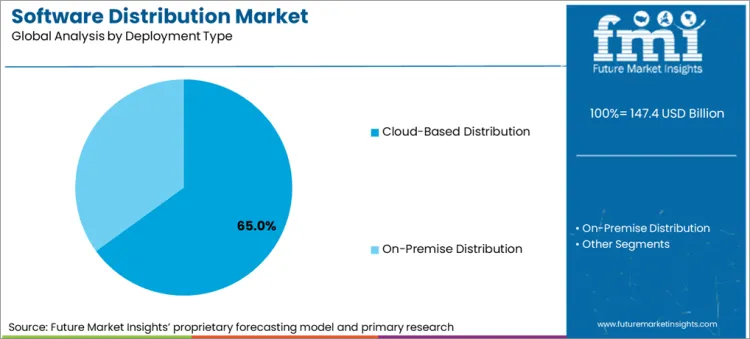
| By Deployment Type | CAGR (2026 to 2036) |
|---|---|
| Cloud-Based Distribution | 65.0% |
The cloud-based distribution segment would have the most significant CAGR in the entire software distribution marketplace. This fact is attributed mainly to the increasingly widespread adoption across industries of various cloud computing platforms and SaaS solutions. Companies are increasingly shifting from on premise systems to cloud-based platforms due to their flexibility, cost-efficiency and scalability.
Cloud-based distribution solutions enable seamless software delivery and updates in remote and hybrid work environments, which have gained significant momentum in recent years. Likewise, the integration of AI and automation into cloud distribution systems enhances operational efficiency and security, addressing the evolving needs of modern enterprises. Adding the growth preference of hybrid and multi-cloud strategies among businesses further accelerates the adoption of cloud-based software distribution models.
Key Industry Highlights
Increasing Adoption of Cloud-Based Solutions and SaaS Applications Across Industries
There is a lot of standardization towards cloud-based solutions and Software-as-a-Service models across the industry, which helps in driving the distribution of software on a large scale. Enterprises have gained confidence in shifting away from traditional on premise software deployment for the advantages such as scalability, cost efficiency, and immediate access.
The shift has further led to a need for robust software distribution platforms that can automatically deliver updates and manage the lifecycle of software easily in hybrid and multi-cloud environments. The integration of cloud services with enterprise resource planning, customer relationship management, and other critical systems is expanding rapidly; therefore, there is a need for effective tools in software distribution.
Rising Demand for Remote Work and BYOD (Bring Your Own Device) Culture in Enterprises
The globalization of remote working and the integration of Bring Your Own Device policies in most organizations, there is now a huge necessity for the adoption of secure yet flexible software distribution solutions. These organizations are pushing business-critical software to remote teams and devices, hence creating the need for platforms that maintain compatibility, ensure security, and synchronize data real-time.
Additionally, the rapid expansion of the gig economy and freelance workforce is contributing to this trend, as companies seek efficient ways to deploy software to a diverse and dynamic user base without compromising data integrity or user experience.
Growing Integration of AI and Automation in Software Distribution Processes
The incorporation of AI and automation technologies is transforming the software distribution market by streamlining operations and improving efficiency. AI-powered tools have enabled predictive analytics, smart prioritization of updates, and proactive error detection that reduces downtime and increases user satisfaction.
The role of automation is critical in making complex workflows in software deployment easy and manageable, from zero-touch provisioning and patch management to real-time monitoring. In this regard, it not only contributes to improved productivity but also to compliance needs and security mitigation in organizations.
Challenges in Managing Compatibility and Integration Across Diverse Systems
A significant restraint in the software distribution market is the difficulty of ensuring cross-platform compatibility and smooth integration with an increasingly heterogenous device ecosystem, operating system, and other software environments. Organizations are plagued by problems maintaining homogeneous performance and function when distributing application updates or upgrades across legacy infrastructure and newer systems.
Incompatibilities can cause breakages, incur additional support and repair costs, and erode user satisfaction. In addition, the lack of standard protocols and the fractured landscape of the world IT further heighten these difficulties, thus retarding the spread of sophisticated software distribution tools in some regions and industries.
2021 to 2025 Global Software Distribution Sales Outlook Compared to Demand Forecast from 2026 to 2036
The global Software Distribution industry recorded a CAGR of 13.8% during the historical period between 2020 and 2024. The growth of Software Distribution industry was positive as it reached a value of USD 129.6 billion in 2024 from USD 77.3 billion in 2020.
The Software Distribution Market experienced growth from 2020 to 2024 mainly due to increased adoption of cloud-based solutions, increased remote work following the COVID-19 pandemic, and growing demand for automated deployment tools for software.
During this period, the industries around the world heavily invested in digital transformation, focusing on scalability, security, and seamless integration, which fueled robust sales demand. However, the demand outlook for 2025 to 2035 is expected to surpass the earlier period, driven by advancements in artificial intelligence (AI), machine learning (ML), and automation within software distribution platforms.
Integration of 5G technology, IoT ecosystems, and edge computing will redefine the software delivery and update processes to enable fast and efficient distribution across devices and geographies. Also, with growing hybrid and multi-cloud infrastructures, the need for flexible and interoperable software distribution solutions will increase exponentially, with support from growing demand for robust cybersecurity frameworks and compliance management in an evolving regulatory landscape.
Market Concentration
Tier 1: It includes giants like Microsoft, IBM, Oracle, SAP, and Amazon Web Services. They provide massive software distribution platforms and services addressing a broad spectrum of industries and customer segments across the globe. Their comprehensive service portfolios address both cloud services and enterprise software along with strengthened distribution networks, meeting software deployment and management needs in scale. Their large market shares and substantial resources along with continued innovation establish them as leaders in the landscape of software distribution.
Tier 2 consists of major cloud service providers such as Google Cloud and Salesforce. Although they have significant market power, their software distribution services are more niche than Tier 1 companies. Google Cloud provides a variety of cloud-based tools and services that enable software distribution, especially in data analytics and machine learning areas. Salesforce offers distribution solutions mainly focused on customer relationship management (CRM) and related applications. Their focused products and solid customer markets play a huge role in the software distribution market.
Tier 3 includes companies such as Red Hat, VMware, and Adobe. These companies concentrate on niche segments of the software distribution market. Red Hat specializes in open-source solutions and enterprise software distribution, particularly in Linux distributions and cloud infrastructure. VMware offers virtualization and cloud computing solutions that enable the deployment of software across different environments. Adobe offers technological software products with good distribution channels, focusing mainly on design and media professionals. Their niche service provides some versatility and profundity to the software distribution ecosystem.
Country-wise Insights
The section below covers the industry analysis for the Software Distribution market for different countries. The market demand analysis on key countries in several countries of the globe, including USA, Germany, Italy, China and India are provided.
The united states are expected to remains at the forefront in North America, with a value share of 65.2% in 2025. In South Asia & Pacific, India is projected to witness a CAGR of 16.6% during the forecasted period.
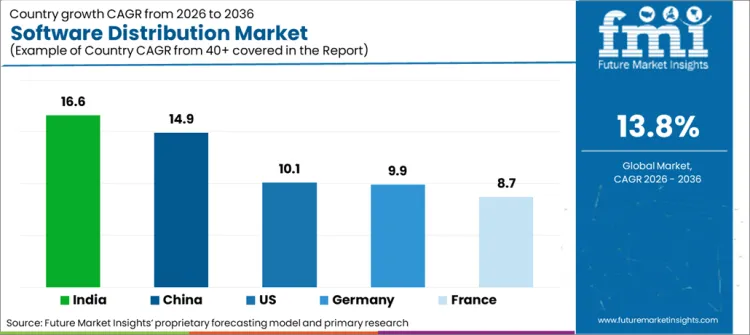
| Countries | Value CAGR (2025 to 2035) |
|---|---|
| USA | 10.1% |
| Germany | 9.9% |
| France | 8.7% |
| China | 14.9% |
| India | 16.6% |
The United States is the Epicenter of Technological Innovation and Cloud Adoption Driving the Software Distribution Market
The USA is in lead in the global software distribution market, driven by supreme technological innovations, an massive IT infrastructure, and the presence of market leaders such as Microsoft, IBM, Oracle, and Amazon Web Services. The country rapidly adopts cloud-based solutions, a culture of innovation, and pushes the demand forward for advanced tools in software distribution.
With most businesses moving into SaaS models and hybrid work environments, this USA market is gaining high investments on automation, cybersecurity, and integration of data analytics within software distribution platforms. Furthermore, the digital transformation of governments in different sectors strengthens the United States' leadership and acts as a significant growth driver for the global software distribution market.
UK is Hub for Digital Transformation and Enterprise Software Growth in the Software Distribution Market
The UK's digital transformation efforts, underpinned by cloud adoption across all levels and enterprise investment in IT infrastructure, makes it a rising force in the software distribution market. With a flourishing financial sector, advanced manufacturing, and strong government support for digital innovation, the UK market has rapidly adopted technologies such as artificial intelligence and automation in software deployment processes.
The country's focus on data compliance, especially with GDPR regulations, has also fueled demand for secure and efficient software distribution platforms. In addition, the demand for easy deployment of software from various devices to multiple locations further drives the market to grow exponentially.
India is Emerging as a Key Growth Market for Software Distribution with Digital Transformation and IT Outsourcing Boom
India has become an emerging growth market for software distribution; the country has transformed rapidly on the digital scale, and this coupled with increasing outsourcing of the IT industry and uptake of cloud by business houses irrespective of their sizes, is proving to be quite successful for the overall industry.
India, seeing high growth in the number of small and medium enterprises and startups due to the initiatives of Digital India and Startup India, is showing high demand for low-cost and scalable software distribution platforms. Additionally, India's global IT outsourcing hub has led to the creation and implementation of advanced software tools and distribution models, usually fashioned toward international users.
The vast adoption of work-from-home practices, along with a young and tech-savvy workforce, and rising penetration of the Internet, are signs of India's increasing dominance in the emerging markets of the software distribution landscape.
Competitive Landscape
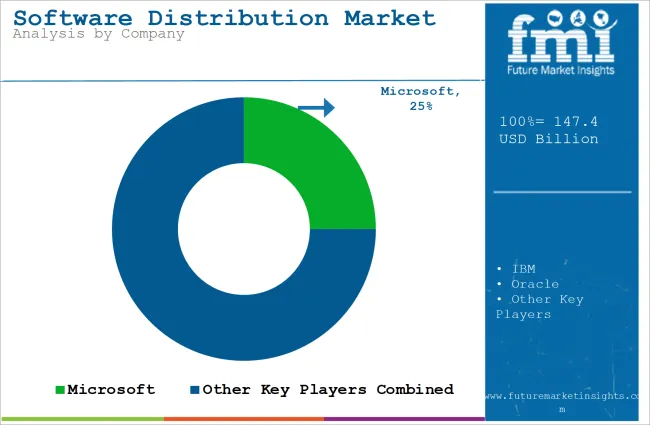
The highly competitive landscape of the Software Distribution Market is driven by global technology giants, cloud service providers, and specialized software vendors competing with each other in terms of differentiated offerings. The top market players are Microsoft, IBM, Oracle, and Amazon Web Services (AWS), who are very well equipped with their full distribution platforms and rich ecosystems catering to diverse industries.
Google Cloud and Salesforce utilize strong cloud infrastructure and domain-specific knowledge to lead in their markets. The additional players comprise of Red Hat, VMware, and Adobe, specializing in open-source solutions, virtualization, and creative software, respectively.
Rapid technical innovations have brought intense competition as companies are heavily investing in AI, automation, and cybersecurity to enhance their offerings. The Strategic partnerships, mergers, and acquisitions are prevalent as players seek to expand their capabilities and geographical reach in this dynamic and evolving market.
Recent Developments:
- In January 2026, Microsoft implemented mandatory multifactor authentication for all API access within its Partner Center and introduced Agent Mode for Copilot, enabling automated orchestration of partner workflows.
- In 2025, Arrow Electronics expanded its ArrowSphere cloud marketplace platform with AI-driven features for license compliance and spend optimization across multi-vendor environments.
- In 2025, TD SYNNEX expanded its StreamOne Ion platform, consolidating cloud, on-premise, and hybrid software distribution into a unified procurement experience for channel partners.
Key Players of Software Distribution Industry
- Microsoft
- IBM
- Oracle
- SAP
- Amazon Web Services (AWS)
- Google Cloud
- Red Hat
- VMware
- Salesforce
- Adobe
Market Definition
The software distribution market represents revenue from the intermediation of software products and cloud services between vendors and end users through distribution and channel partner networks. The market measures license fulfillment, cloud marketplace transaction fees, subscription management services, and value-added services by distributors.
Inclusions cover enterprise license agreements, cloud marketplace subscriptions, SaaS license management, volume licensing programs, and associated technical enablement and training services. Distributor-operated cloud marketplaces and AI-driven procurement platforms are also included.
Exclusions include direct vendor-to-customer software sales bypassing distribution, consumer app store transactions (Apple App Store, Google Play), custom enterprise software development, and IT consulting services not bundled with license distribution. Hardware distribution revenues are outside the scope.
Key Segments of Software Distribution Industry
By Deployment Type:
In terms of deployment type is segregated Cloud-Based Distribution and On-Premise Distribution.
By Organization Size:
In terms of Organization Size, is distributed into Small and Medium Enterprises (SMEs), Mid-Sized Enterprises and Large Enterprises.
By Industry Vertical:
In terms of Industry Vertical, is segregated IT & Telecom, BFSI (Banking, Financial Services, and Insurance), Healthcare, Retail and Education.
By Region:
Key countries of North America, Latin America, Western Europe, Eastern Europe, East Asia, South Asia & pacific, Middle East and Africa (MEA) have been covered in the report.
Bibliography
- Microsoft. (2026, January). Mandatory MFA for Partner Center API access and Agent Mode for Copilot. Microsoft partner documentation.
- Arrow Electronics. (2025). ArrowSphere cloud marketplace platform expansion. Arrow Electronics corporate disclosure.
- TD SYNNEX. (2025). StreamOne Ion platform expansion. TD SYNNEX corporate disclosure.
Frequently Asked Questions
What is the current global market size for the Software Distribution Market?
The market is valued at USD 147.4 Billion in 2026, driven by enterprise migration to cloud-native software procurement and the growing complexity of multi-vendor SaaS subscription management.
What is the projected Compound Annual Growth Rate (CAGR) for the market over the next 10 years?
The market is projected to grow at a CAGR of 13.8% from 2026 to 2036.
Which regions are experiencing the fastest expansion?
Asia Pacific leads with the highest growth rate, driven by rapid enterprise cloud adoption in India and Southeast Asia, followed by North America and Europe.
What are the primary market drivers?
Enterprise cloud migration, security-first channel mandates, and the shift from volume-based reselling to AI-powered marketplace orchestration are the primary drivers.
Who are the leading companies in the industry?
Arrow Electronics, TD SYNNEX, Ingram Micro, and Microsoft are key players, differentiating through AI-powered cloud marketplace platforms, multi-vendor lifecycle management, and security-first channel integration.
Preview the report firsthand - request a free sample
Get SampleGet the brochure for pricing and purchase details.
Get PDFTable of Content
- Executive Summary
- Global Market Outlook
- Demand-side Trends
- Supply-side Trends
- Technology Roadmap Analysis
- Analysis and Recommendations
- Market Overview
- Market Coverage / Taxonomy
- Market Definition / Scope / Limitations
- Research Methodology
- Chapter Orientation
- Analytical Lens and Working Hypotheses
- Market Structure, Signals, and Trend Drivers
- Benchmarking and Cross-market Comparability
- Market Sizing, Forecasting, and Opportunity Mapping
- Research Design and Evidence Framework
- Desk Research Programme (Secondary Evidence)
- Company Annual and Sustainability Reports
- Peer-reviewed Journals and Academic Literature
- Corporate Websites, Product Literature, and Technical Notes
- Earnings Decks and Investor Briefings
- Statutory Filings and Regulatory Disclosures
- Technical White Papers and Standards Notes
- Trade Journals, Industry Magazines, and Analyst Briefs
- Conference Proceedings, Webinars, and Seminar Materials
- Government Statistics Portals and Public Data Releases
- Press Releases and Reputable Media Coverage
- Specialist Newsletters and Curated Briefings
- Sector Databases and Reference Repositories
- FMI Internal Proprietary Databases and Historical Market Datasets
- Subscription Datasets and Paid Sources
- Social Channels, Communities, and Digital Listening Inputs
- Additional Desk Sources
- Expert Input and Fieldwork (Primary Evidence)
- Primary Modes
- Qualitative Interviews and Expert Elicitation
- Quantitative Surveys and Structured Data Capture
- Blended Approach
- Why Primary Evidence is Used
- Field Techniques
- Interviews
- Surveys
- Focus Groups
- Observational and In-context Research
- Social and Community Interactions
- Stakeholder Universe Engaged
- C-suite Leaders
- Board Members
- Presidents and Vice Presidents
- R&D and Innovation Heads
- Technical Specialists
- Domain Subject-matter Experts
- Scientists
- Physicians and Other Healthcare Professionals
- Governance, Ethics, and Data Stewardship
- Research Ethics
- Data Integrity and Handling
- Primary Modes
- Tooling, Models, and Reference Databases
- Desk Research Programme (Secondary Evidence)
- Data Engineering and Model Build
- Data Acquisition and Ingestion
- Cleaning, Normalisation, and Verification
- Synthesis, Triangulation, and Analysis
- Quality Assurance and Audit Trail
- Market Background
- Market Dynamics
- Drivers
- Restraints
- Opportunity
- Trends
- Scenario Forecast
- Demand in Optimistic Scenario
- Demand in Likely Scenario
- Demand in Conservative Scenario
- Opportunity Map Analysis
- Product Life Cycle Analysis
- Supply Chain Analysis
- Investment Feasibility Matrix
- Value Chain Analysis
- PESTLE and Porter’s Analysis
- Regulatory Landscape
- Regional Parent Market Outlook
- Production and Consumption Statistics
- Import and Export Statistics
- Market Dynamics
- Global Market Analysis 2021 to 2025 and Forecast, 2026 to 2036
- Historical Market Size Value (USD Million) Analysis, 2021 to 2025
- Current and Future Market Size Value (USD Million) Projections, 2026 to 2036
- Y-o-Y Growth Trend Analysis
- Absolute $ Opportunity Analysis
- Global Market Pricing Analysis 2021 to 2025 and Forecast 2026 to 2036
- Global Market Analysis 2021 to 2025 and Forecast 2026 to 2036, By Organization Type
- Introduction / Key Findings
- Historical Market Size Value (USD Million) Analysis By Organization Type , 2021 to 2025
- Current and Future Market Size Value (USD Million) Analysis and Forecast By Organization Type , 2026 to 2036
- Large Enterprises
- Small and Medium Enterprises (SMEs)
- Mid-Sized Enterprises
- Large Enterprises
- Y-o-Y Growth Trend Analysis By Organization Type , 2021 to 2025
- Absolute $ Opportunity Analysis By Organization Type , 2026 to 2036
- Global Market Analysis 2021 to 2025 and Forecast 2026 to 2036, By Deployment Type
- Introduction / Key Findings
- Historical Market Size Value (USD Million) Analysis By Deployment Type, 2021 to 2025
- Current and Future Market Size Value (USD Million) Analysis and Forecast By Deployment Type, 2026 to 2036
- Cloud-Based Distribution
- On-Premise Distribution
- Cloud-Based Distribution
- Y-o-Y Growth Trend Analysis By Deployment Type, 2021 to 2025
- Absolute $ Opportunity Analysis By Deployment Type, 2026 to 2036
- Global Market Analysis 2021 to 2025 and Forecast 2026 to 2036, By Region
- Introduction
- Historical Market Size Value (USD Million) Analysis By Region, 2021 to 2025
- Current Market Size Value (USD Million) Analysis and Forecast By Region, 2026 to 2036
- North America
- Latin America
- Western Europe
- Eastern Europe
- East Asia
- South Asia and Pacific
- Middle East & Africa
- Market Attractiveness Analysis By Region
- North America Market Analysis 2021 to 2025 and Forecast 2026 to 2036, By Country
- Historical Market Size Value (USD Million) Trend Analysis By Market Taxonomy, 2021 to 2025
- Market Size Value (USD Million) Forecast By Market Taxonomy, 2026 to 2036
- By Country
- USA
- Canada
- Mexico
- By Organization Type
- By Deployment Type
- By Country
- Market Attractiveness Analysis
- By Country
- By Organization Type
- By Deployment Type
- Key Takeaways
- Latin America Market Analysis 2021 to 2025 and Forecast 2026 to 2036, By Country
- Historical Market Size Value (USD Million) Trend Analysis By Market Taxonomy, 2021 to 2025
- Market Size Value (USD Million) Forecast By Market Taxonomy, 2026 to 2036
- By Country
- Brazil
- Chile
- Rest of Latin America
- By Organization Type
- By Deployment Type
- By Country
- Market Attractiveness Analysis
- By Country
- By Organization Type
- By Deployment Type
- Key Takeaways
- Western Europe Market Analysis 2021 to 2025 and Forecast 2026 to 2036, By Country
- Historical Market Size Value (USD Million) Trend Analysis By Market Taxonomy, 2021 to 2025
- Market Size Value (USD Million) Forecast By Market Taxonomy, 2026 to 2036
- By Country
- Germany
- UK
- Italy
- Spain
- France
- Nordic
- BENELUX
- Rest of Western Europe
- By Organization Type
- By Deployment Type
- By Country
- Market Attractiveness Analysis
- By Country
- By Organization Type
- By Deployment Type
- Key Takeaways
- Eastern Europe Market Analysis 2021 to 2025 and Forecast 2026 to 2036, By Country
- Historical Market Size Value (USD Million) Trend Analysis By Market Taxonomy, 2021 to 2025
- Market Size Value (USD Million) Forecast By Market Taxonomy, 2026 to 2036
- By Country
- Russia
- Poland
- Hungary
- Balkan & Baltic
- Rest of Eastern Europe
- By Organization Type
- By Deployment Type
- By Country
- Market Attractiveness Analysis
- By Country
- By Organization Type
- By Deployment Type
- Key Takeaways
- East Asia Market Analysis 2021 to 2025 and Forecast 2026 to 2036, By Country
- Historical Market Size Value (USD Million) Trend Analysis By Market Taxonomy, 2021 to 2025
- Market Size Value (USD Million) Forecast By Market Taxonomy, 2026 to 2036
- By Country
- China
- Japan
- South Korea
- By Organization Type
- By Deployment Type
- By Country
- Market Attractiveness Analysis
- By Country
- By Organization Type
- By Deployment Type
- Key Takeaways
- South Asia and Pacific Market Analysis 2021 to 2025 and Forecast 2026 to 2036, By Country
- Historical Market Size Value (USD Million) Trend Analysis By Market Taxonomy, 2021 to 2025
- Market Size Value (USD Million) Forecast By Market Taxonomy, 2026 to 2036
- By Country
- India
- ASEAN
- Australia & New Zealand
- Rest of South Asia and Pacific
- By Organization Type
- By Deployment Type
- By Country
- Market Attractiveness Analysis
- By Country
- By Organization Type
- By Deployment Type
- Key Takeaways
- Middle East & Africa Market Analysis 2021 to 2025 and Forecast 2026 to 2036, By Country
- Historical Market Size Value (USD Million) Trend Analysis By Market Taxonomy, 2021 to 2025
- Market Size Value (USD Million) Forecast By Market Taxonomy, 2026 to 2036
- By Country
- Kingdom of Saudi Arabia
- Other GCC Countries
- Turkiye
- South Africa
- Other African Union
- Rest of Middle East & Africa
- By Organization Type
- By Deployment Type
- By Country
- Market Attractiveness Analysis
- By Country
- By Organization Type
- By Deployment Type
- Key Takeaways
- Key Countries Market Analysis
- USA
- Pricing Analysis
- Market Share Analysis, 2025
- By Organization Type
- By Deployment Type
- Canada
- Pricing Analysis
- Market Share Analysis, 2025
- By Organization Type
- By Deployment Type
- Mexico
- Pricing Analysis
- Market Share Analysis, 2025
- By Organization Type
- By Deployment Type
- Brazil
- Pricing Analysis
- Market Share Analysis, 2025
- By Organization Type
- By Deployment Type
- Chile
- Pricing Analysis
- Market Share Analysis, 2025
- By Organization Type
- By Deployment Type
- Germany
- Pricing Analysis
- Market Share Analysis, 2025
- By Organization Type
- By Deployment Type
- UK
- Pricing Analysis
- Market Share Analysis, 2025
- By Organization Type
- By Deployment Type
- Italy
- Pricing Analysis
- Market Share Analysis, 2025
- By Organization Type
- By Deployment Type
- Spain
- Pricing Analysis
- Market Share Analysis, 2025
- By Organization Type
- By Deployment Type
- France
- Pricing Analysis
- Market Share Analysis, 2025
- By Organization Type
- By Deployment Type
- India
- Pricing Analysis
- Market Share Analysis, 2025
- By Organization Type
- By Deployment Type
- ASEAN
- Pricing Analysis
- Market Share Analysis, 2025
- By Organization Type
- By Deployment Type
- Australia & New Zealand
- Pricing Analysis
- Market Share Analysis, 2025
- By Organization Type
- By Deployment Type
- China
- Pricing Analysis
- Market Share Analysis, 2025
- By Organization Type
- By Deployment Type
- Japan
- Pricing Analysis
- Market Share Analysis, 2025
- By Organization Type
- By Deployment Type
- South Korea
- Pricing Analysis
- Market Share Analysis, 2025
- By Organization Type
- By Deployment Type
- Russia
- Pricing Analysis
- Market Share Analysis, 2025
- By Organization Type
- By Deployment Type
- Poland
- Pricing Analysis
- Market Share Analysis, 2025
- By Organization Type
- By Deployment Type
- Hungary
- Pricing Analysis
- Market Share Analysis, 2025
- By Organization Type
- By Deployment Type
- Kingdom of Saudi Arabia
- Pricing Analysis
- Market Share Analysis, 2025
- By Organization Type
- By Deployment Type
- Turkiye
- Pricing Analysis
- Market Share Analysis, 2025
- By Organization Type
- By Deployment Type
- South Africa
- Pricing Analysis
- Market Share Analysis, 2025
- By Organization Type
- By Deployment Type
- USA
- Market Structure Analysis
- Competition Dashboard
- Competition Benchmarking
- Market Share Analysis of Top Players
- By Regional
- By Organization Type
- By Deployment Type
- Competition Analysis
- Competition Deep Dive
- Microsoft
- Overview
- Product Portfolio
- Profitability by Market Segments (Product/Age /Sales Channel/Region)
- Sales Footprint
- Strategy Overview
- Marketing Strategy
- Product Strategy
- Channel Strategy
- IBM
- Oracle
- SAP
- Amazon Web Services (AWS)
- Google Cloud
- Microsoft
- Competition Deep Dive
- Assumptions & Acronyms Used


