

- Industry Size (2026)
- USD 220 Mn
- Forecast (2036)
- USD 299 Mn
- CAGR (2026 to 2036)
- 3.1%
Software Box Packaging Market Forecast and Outlook 2026 to 2036
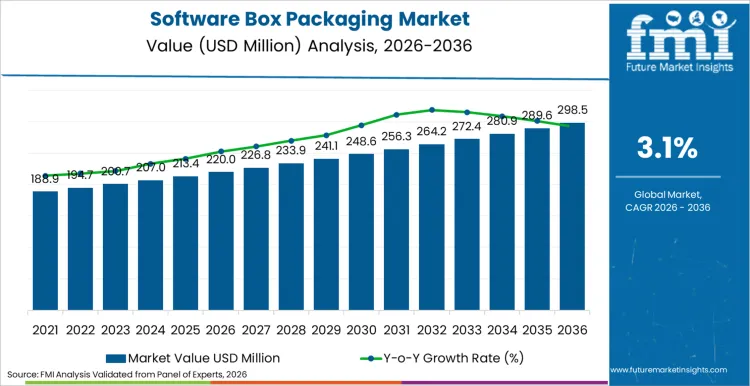
The software box packaging market is projected to experience a compound annual growth rate (CAGR) of 3.1%, reaching a valuation of USD 299 million by 2036, up from a USD 220 million in 2026. Demand dynamics highlights a strategic reallocation of spending towards packaging segments that effectively convert repeat usage into predictable sales volumes, underscoring the importance of long-term consumer engagement. A noteworthy example in this dynamic landscape is Nintendo, which has made significant strides in sustainability by prioritizing recycling and the reuse of materials in its packaging operations.
The company's impressive recycling achievements, 74.4 tonnes of metals and 414.2 tonnes of cardboard, serve as a benchmark within the industry. This focus on material recovery not only aligns with consumer preferences for eco-friendly practices but also sets a precedence for the forecast period.
In the gaming sector, trust and safety have become unexpected drivers of packaging design, influencing how physical bundles are marketed to families. Kim Kunes, VP Gaming Trust & Safety at Xbox, noted in January 2026: “This partnership reflects our dedication to collaborating on solutions that enhance player safety and ensure our games are welcoming for everyone. The video game industry has a strong legacy of prioritizing player safety, especially for children.” This focus forces packaging converters to integrate tamper-evident features and clear safety labelling directly into the structural design, moving beyond simple aesthetics to become a critical compliance tool that reassures parents at the point of purchase.
One trade-off dominates the operational landscape, which is the cost of decarbonization versus the speed of production. Sonoco achieved strong productivity from certain procurement savings, production efficiencies, and fixed cost reduction initiatives of USD 41 million during the fourth quarter and USD 183 million for 2024. That dynamic drives the market forward; as major players unlock capital through efficiency, they reinvest it into next-generation tooling capable of producing plastic-free rigid boxes at the speed of traditional plastic molding, ensuring the industry meets 2030 sustainability mandates without breaking the bank.
Summary of Software Box Packaging Market
What Is the Growth Outlook for the Software Box Packaging Market as per Future Market Insights Projection?
Future Market Insights projects the global software box packaging market to grow from USD 220 million in 2026 to USD 299 million by 2036, representing a 3.1% CAGR over the forecast period.
FMI Research Approach: Based on FMI’s proprietary global modeling framework incorporating major operator capex plans (Sonoco, Mondi), household spending indices on electronics, and funding inflows into the boxboard packaging startup ecosystem.
How Do FMI Analysts Perceive the Software Box Packaging Market to Evolve?
FMI analysts perceive the market transitioning away from generic plastic-heavy boxes toward specialized "skill-building" unboxing experiences and high-tech, digitally-integrated formats.
FMI Research Approach: Developed using analysis of patent filings (Solenis PFAS-free tech), venture capital trends in folding boxboard (Cirkla, Xampla), and enrollment data from early learning centers adapting digital tools.
Which Country Holds the Largest Share in the Global Software Box Packaging Market?
India holds a dominant value share, supported by record-breaking paperboard import defense measures and the presence of global entertainment giants investing billions in domestic infrastructure.
FMI Research Approach: Built using country-level participation reports (Directorate General of Trade Remedies), analysis of theme park revenue streams, and mapping of educational outreach spending by institutions like the SWITCH-Asia program.
How Large Will the Software Box Packaging Market Be by 2036?
The global software box packaging market is expected to reach USD 299 million by 2036, with the Folding Cartons segment currently commanding a 48.0% share.
FMI Research Approach: Long-term forecasts rely on demographic trends (gamer population), disposable income projections for family entertainment, and the scaling of digital booking platforms for physical collectors' editions.
What Is the Definition of the Software Box Packaging Market?
The software box packaging market encompasses revenue generated from commercial packaging activities designed for physical software media, gaming bundles, and enterprise software hardware tokens.
FMI Research Approach: Definition structured using FMI’s segmentation taxonomy covering box types, product tiers, and service delivery models explicitly including rigid collector boxes and excluding general packing boxes for non-media goods.
What Are Globally Unique Trends Shaping the Software Box Packaging Market?
Globally, the sector is shaped by the "Plastic-Free Pivot" in emerging economies and the "Collector Premium" in developed markets, where sustainability is becoming a key differentiator.
FMI Research Approach: Insights derived from global sustainability reports (Samsung, Google), startup funding patterns in India, and consumer behavior analysis regarding eco-friendly recreational materials.
Software Box Packaging Market Key Takeaways
| Metric | Value |
|---|---|
| Industry Size (2026) | USD 220 million |
| Industry Value (2036) | USD 299 million |
| CAGR (2026-2036) | 3.1% |
Source: Future Market Insights (FMI) analysis, based on proprietary forecasting model and primary research
Why Sustainable Material Is Replacing Plastic?
Consumer sentiment has shifted from passive acceptance of waste to active rejection of over-packaging. Nearly half (47%) of consumers would be put off buying again if there was too much packaging, according to Mondi’s 2024 eCommerce report. This metric anchors the design strategy for modern custom boxes, compelling publishers to eliminate void fill and plastic trays. For brands, the implication is immediate: sustainable design is no longer a "nice-to-have" but a gatekeeper for repeat purchase, specifically in the direct-to-consumer channel where the unboxing moment is the primary brand touchpoint.
As per FMI's projection, regulatory targets are tightening the noose around virgin plastics in electronics supply chains. Samsung Electronics has set a target to use 100% recycled plastic parts by 2050, aiming to apply recycled plastic to 50% of plastic parts in DX products by 2030. Such commitment influences the broader custom packaging boxes sector, forcing recreational service providers and software firms to audit their supply chains and eliminate single-use plastics from their operations. This pressure creates a competitive advantage for operators who can demonstrate a closed-loop sustainability model, turning eco-friendly practices from a regulatory burden into a marketable brand asset.
How Is Segment Mix Shifting Profit Pools?
The software box packaging market is segmented by box type, product tier, and sales channel, revealing a decisive shift toward premium, collector-focused formats. With folding cartons holding 48.0% and standard retail SKUs at 36.0%, the volume lies in efficiency, but the value is migrating toward rigid, high-fidelity structures that justify physical ownership in a digital age. By 2036, FMI expects the rigid boxes segment to expand as publishers monetize "super-fan" loyalty through elaborate physical editions, while the enterprise tier consolidates around functional, minimal-waste solutions.
Why Folding Cartons Command Volume Dominance?
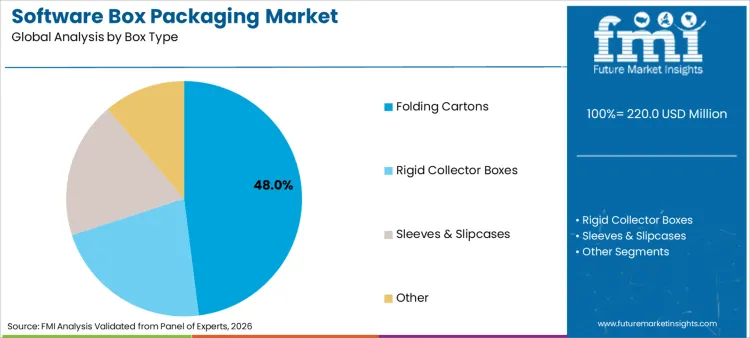
Folding cartons command 48.0% of the market, serving as the backbone of the retail ecosystem for standard software releases and lightweight bundles. In FY24, 74% of Amcor’s packaging production by weight met widely accepted industry recycling standards. This data point underscores why folding cartons dominate: they offer the path of least resistance for meeting recyclability goals while maintaining the structural integrity needed for global shipping. For publishers, this scalability allows for rapid deployment of titles across global regions without incurring the heavy logistics costs associated with luxury rigid boxes.
How Standard Retail SKUs Anchor Demand?
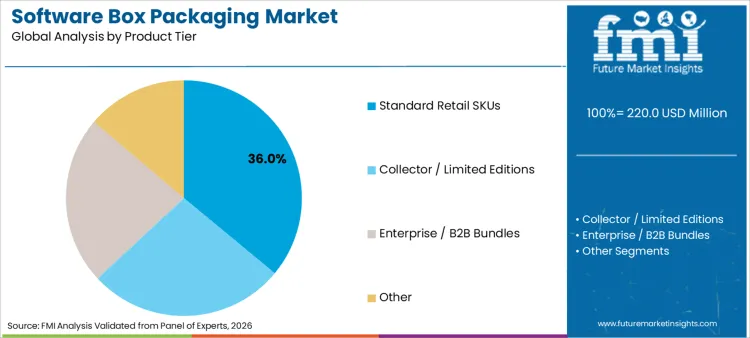
Standard Retail SKUs account for 36.0% of the market share, representing the high-turnover segment that demands consistent, shelf-ready packaging performance. In 2024, the manufacture of paper and paper products in China realized a total profit of 51.97 billion yuan, a year-on-year increase of 5.2 percent. This profitability signals that despite the digital shift, the physical manufacturing base for standard display packaging remains robust and profitable. Consequently, the standard tier acts as the stable revenue base that funds riskier, high-concept collector projects, ensuring that physical retail remains a viable channel for mass-market titles.
Where Is Online Retail Redirecting Value?
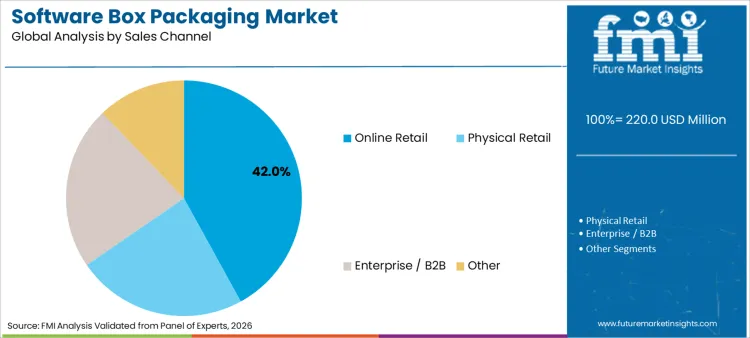
Online retail platforms now capture 42.0% of the sales channel, reflecting the digitization of software distribution and the consumer preference for direct-to-door delivery. The online retail sales in China reached 15,228.7 billion yuan in 2024, up by 7.2 percent over the previous year. That shift forces retail e-commerce packaging to evolve from "shelf-shouter" designs to "ship-in-own-container" (SIOC) utility, where the box must survive the courier network without external protection. Value pools expand for players that can deliver this durability without adding weight, as logistics costs become the primary constraint for digital-first retailers.
How Is The
One metric makes the point: Sony Group Corporation is aiming to reduce scope 3 GHG emissions during product use by 45% by 2040. This sustainability target drives the integration of intelligent packaging technologies that replace physical manuals and inserts with digital access points, effectively decarbonizing the box while enhancing utility. Manufacturers are now embedding NFC chips and QR codes directly into fiber-based substrates, creating a "phygital" bridge that allows users to access tutorials, DLC, and authentication services without the need for extra printed materials.
Innovation isn't innate, it's ignited by the need to differentiate in a crowded market. Startups like Cirkla are merging physical hardware kits with molded pulp designs, securing USD 3 million in pre-seed funding to scale these solutions. This investment emphasizes how hybrid platforms are scaling track and trace packaging to mass markets, effectively proving that the physical-digital divide is disappearing in favor of a cohesive, integrated user experience. The unboxing moment is no longer just about opening a package; it is about initiating a secure, verified digital session, making the packaging an active participant in the software ecosystem.
Where Is Regional Demand Concentrating?
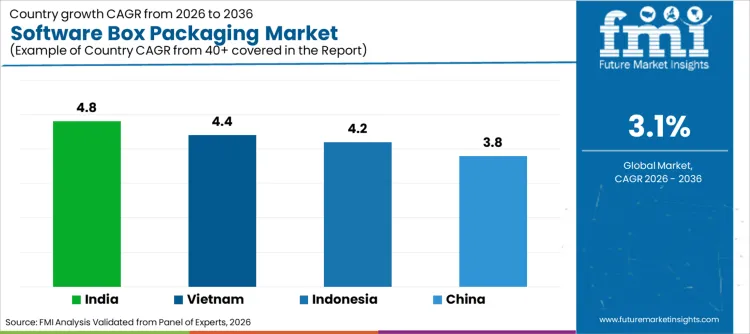
The demand for software box packaging is increasingly diverging, with a clear distinction emerging between high-volume manufacturing hubs in Asia and premium, regulation-intensive markets in the West. India is expected to take the lead, boasting a remarkable compound annual growth rate (CAGR) of 4.8%, thanks to its booming domestic manufacturing sector. Meanwhile, Vietnam is positioned to grow at 4.4%, capitalizing on the production shift from China. In contrast, the mature markets of the USA and China are experiencing steadier growth rates of 2.1% and 3.8% respectively, with a strong emphasis on integrating artificial intelligence into packaging design rather than focusing solely on volume expansion.
| Country | CAGR (2026 to 2036) |
|---|---|
| India | 4.8% |
| Vietnam | 4.4% |
| Indonesia | 4.2% |
| China | 3.8% |
| USA | 2.1% |
Source: Future Market Insights’ proprietary forecasting model and primary research
Why India Demand Is Accelerating?
Sales of software box packaging in India are set to rise at 4.8% CAGR. Trade barriers are reshaping the local supply chain; The Authority notified the Embassies of the subject countries in India about the receipt of the present anti-dumping application concerning imports of “Virgin Multi-Layer Paperboards” originating in or exported from Chile and China PR. This protectionist maneuver effectively walls off the domestic market, forcing local converters to upgrade their own boxboard packaging capabilities rather than relying on cheap Chinese imports. For domestic players like JK Paper, this policy creates a protected playground to scale capacity, ultimately reducing the cost gap between sustainable fiber solutions and traditional plastics.
What Makes Vietnam Production Resilient?
Demand for software box packaging in Vietnam is anticipated to grow at 4.4% CAGR. Vietnam is rapidly maturing from a basic assembly hub into a sophisticated packaging exporter, where the ability to source Forest Stewardship Council (FSC) certified materials locally is becoming the primary contract winner for Western software publishers. Industrial output data confirms the shift: the manufacturing and processing sector grew by 9.7% in late 2024, while the manufacture of paper and paper products also increased significantly. This surge is not accidental; it reflects a strategic migration of consumer electronics packaging assembly lines from Guangdong to Hanoi, seeking lower labor costs and tariff avoidance.
Which Policy Is Reshaping Indonesia?
Software box packaging in Indonesia is poised to register a 4.2% CAGR. The tension between rapid consumption and waste management defines this geography. An official statement from SWITCH-Asia in April 2025 noted: “The plastic industry in Indonesia plays a pivotal role in the country’s economy, driven by several key factors and sectors. The plastic industry in Indonesia is bolstered by continuous economic growth, added use cases, and an expanding consumer base”. While this growth fuels the packing boxes sector, it simultaneously triggers stricter extended producer responsibility (EPR) mandates. Local operators are thus pivoting toward hybrid materials, using abundant local seaweed or cassava starch, to satisfy both the economic imperative for cheap packaging and the regulatory demand for biodegradability.
How Is China Optimizing Efficiency?
The software box packaging industry in China is projected to expand at 3.8% CAGR. Rather than competing on razor-thin margins, Chinese manufacturers are moving up the value chain. The R&D expenditure of the Manufacture of Paper and Paper Products was 17.24 billion yuan in 2024, an increase of 1.18 percent. This capital is flowing into automated luxury rigid boxes lines that can produce intricate, collector-grade formats with zero human touch, preserving margins despite rising wages. The strategic implication is clear: China is transitioning from the world's volume factory to its premium packaging laboratory, focusing on high-complexity designs that other regions cannot yet replicate efficiently.
Where Is USA Value Migrating?
Software box packaging in the USA is set to rise at 2.1% CAGR. Corporate strategy here has pivoted entirely to circularity as a premium attribute. Value in the US market now concentrates with suppliers who can prove chain-of-custody for every fiber, turning the box itself into a verified component of the brand's ESG scorecard. A corporate statement from Sonoco in June 2024 highlighted this shift “We live in a world where consumers increasingly demand sustainable solutions, and the packaging industry must adapt its methods to meet these expectations. Sonoco’s Paper Can with a paper bottom container is a shining example of how circular packaging can not only satisfy consumers’ environmental concerns but also drive significant business value.” This mandates a move away from generic custom boxes toward proprietary, plastic-free structures.
How Is Competition Evolving in the Software Box Packaging Market
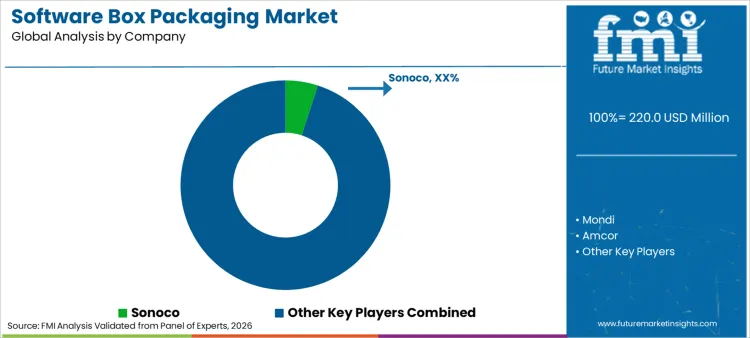
The competitive edge in software box packaging is shifting from the breadth of brand offerings to the entities that manage the constraints limiting scalability. This includes factors such as evidence, regulatory compliance, access to distribution channels, and production capacity. Sonoco achieved strong productivity from certain procurement savings, production efficiencies, and fixed cost reduction initiatives of USD 41 million during the fourth quarter and USD 183 million for 2024. This operational discipline allows incumbents to defend their margins while investing in new capabilities, creating a high barrier for smaller entrants who lack the capital to optimize their supply chains. Consequently, the market is bifurcating into massive, efficiency-driven integrators who dominate the volume trade and agile, innovation-led startups who capture the high-margin "unboxing" niche.
FMI analysts opine that strategy in software box packaging is set by a simple asymmetry: some players own distribution leverage, while others win through differentiated proof, capacity, or specialized workflows. Startups like Cirkla secured USD 3 million in pre-seed funding to expand sustainable packaging solutions and technological advancements in molded pulp. This influx of venture capital into niche material science challenges the dominance of traditional paperboard converters, offering software publishers new ways to differentiate their physical products. As cost and compliance pressures tighten, the market rewards companies that can defend performance claims and deliver consistent availability across priority computer peripherals channels.
Recent Developments
- In January 2026, Microsoft, Sony, and Nintendo published a joint update on player safety and platform accountability, reinforcing their shared commitment to safer gaming environments.
- In September 2025, DGTR India initiated an anti-dumping investigation concerning imports of "Virgin Multi-Layer Paperboards" from Chile and China to protect domestic producers.
- In December 2024, Sonoco completed the acquisition of Eviosys, scaling its metal packaging platform and transforming its portfolio to comprise more sustainable consumer and industrial packaging businesses.
Key Players in Software Box Packaging Market
- Sonoco
- Mondi
- Amcor
- Sealed Air / Huhtamaki
- Cirkla
- Bambrew
- CleanHub
- Xampla
- ReMatter
- Vytal
- JK Paper
- Samsung Electronics (Packaging Division)
- Nintendo (Packaging Operations)
- Google (Packaging Operations)
Market Definition
The software box packaging market encompasses revenue generated from the design, manufacture, and sale of physical packaging solutions specifically for software media, gaming titles, and related hardware bundles. It includes a broad spectrum of formats, ranging from standard folding cartons and sleeves to rigid collector's boxes and molded pulp inserts designed to protect optical discs, cartridges, and authentication tokens. This definition focuses on the service component of the value chain, measuring the revenue generated from the sale of these packaging units to software publishers, game developers, and hardware manufacturers.
The market is characterized by its dual focus on immediate protective value for the product and long-term branding benefits that appeal to the purchasing consumer. The scope of this market explicitly includes revenue streams derived from both traditional retail packaging and e-commerce specific "ship-in-own-container" (SIOC) formats. It also includes the burgeoning sector of smart packaging integrations, such as embedded NFC chips or QR codes, when these are sold as part of the primary packaging unit.
Furthermore, the market sizing incorporates spending on sustainable material innovation, such as the procurement of molded fiber or recycled paperboard, but explicitly excludes general shipping supplies like corrugated packing boxes used for bulk transport. Revenue from associated packing services is included when bundled with the manufacturing contract, but general third-party logistics fees are excluded. The market also excludes digital-only software sales revenue, focusing strictly on the physical packaging component of the industry.
Scope of Report
| Items | Values |
|---|---|
| Quantitative Units (2026) | USD 220 million |
| Product Type | Folding Cartons, Rigid Collector Boxes, Sleeves & Slipcases |
| Application or Procedure type | Standard Retail SKUs, Collector / Limited Editions, Enterprise / B2B Bundles |
| End user | Online Retail, Physical Retail, Enterprise / B2B |
| Regions covered | North America, Europe, Asia Pacific, Latin America, Middle East & Africa |
| Countries covered | India, Vietnam, China, Indonesia, USA |
| Key companies profiled | Sonoco, Mondi, Amcor, Sealed Air / Huhtamaki |
| Additional attributes | Revenue analysis by segments, adoption trends across settings, regulatory and compliance landscape (as relevant), pricing and reimbursement considerations (when relevant), channel mix economics, supply chain exposure, and competitive positioning analysis |
Software Box Packaging Market by Segments
By Box Type
- Folding Cartons
- Rigid Collector Boxes
- Sleeves & Slipcases
By Product Tier
- Standard Retail SKUs
- Collector / Limited Editions
- Enterprise / B2B Bundles
By Sales Channel
- Online Retail
- Physical Retail
- Enterprise / B2B
By Region
- North America
- Europe
- Asia Pacific
- Latin America
- Middle East & Africa
Bibliography
- United Nations Statistics Division (UNSD). (2024). UN Comtrade database update: HS codes for paperboard and packaging materials. United Nations.
- Japan External Trade Organization (JETRO). (2024). Japan packaging industry trade and material substitution trends. JETRO.
- United Nations Economic and Social Commission for Asia and the Pacific (UNESCAP). (2024). Sustainable packaging and circular economy practices in Asia-Pacific. UNESCAP.
- Statistics South Africa (Stats SA). (2024). Manufacturing production and packaging materials output. Government of South Africa.
- Directorate General of Trade Remedies, Government of India. (2025). Anti-dumping investigation concerning imports of Virgin Multi-Layer Paperboards.
Frequently Asked Questions
What is the current global market size for the Software Box Packaging Market?
The global market is valued at USD 220 million in 2026, driven by the persistent demand for physical collector's editions and enterprise hardware bundles.
What is the projected CAGR for the Software Box Packaging Market?
The market is projected to grow at a steady 3.1% CAGR from 2026 to 2036, supported by sustainable material innovation and premiumization trends.
Which box type segment dominates the market?
Folding Cartons account for the largest share at 48.0%, as manufacturers prioritize cost-effective, lightweight, and recyclable formats for standard releases.
Which country is experiencing the fastest growth?
India is growing at the fastest rate of 4.8%, fueled by a booming domestic manufacturing sector and protective trade policies for paperboard.
Who are the leading players in the Software Box Packaging Market?
Sonoco leads with a leading market share, followed by major operators like Mondi, Amcor, and emerging sustainable innovators like Cirkla.
Preview the report firsthand - request a free sample
Get SampleGet the brochure for pricing and purchase details.
Get PDFTable of Content
- Executive Summary
- Global Market Outlook
- Demand-side Trends
- Supply-side Trends
- Technology Roadmap Analysis
- Analysis and Recommendations
- Market Overview
- Market Coverage / Taxonomy
- Market Definition / Scope / Limitations
- Market Background
- Market Dynamics
- Drivers
- Restraints
- Opportunity
- Trends
- Scenario Forecast
- Demand in Optimistic Scenario
- Demand in Likely Scenario
- Demand in Conservative Scenario
- Opportunity Map Analysis
- Product Life Cycle Analysis
- Supply Chain Analysis
- Investment Feasibility Matrix
- Value Chain Analysis
- PESTLE and Porter’s Analysis
- Regulatory Landscape
- Regional Parent Market Outlook
- Production and Consumption Statistics
- Import and Export Statistics
- Market Dynamics
- Global Market Analysis 2021 to 2025 and Forecast, 2026 to 2036
- Historical Market Size Value (USD Million) Analysis, 2021 to 2025
- Current and Future Market Size Value (USD Million) Projections, 2026 to 2036
- Y-o-Y Growth Trend Analysis
- Absolute $ Opportunity Analysis
- Global Market Pricing Analysis 2021 to 2025 and Forecast 2026 to 2036
- Global Market Analysis 2021 to 2025 and Forecast 2026 to 2036, By Box Type
- Introduction / Key Findings
- Historical Market Size Value (USD Million) Analysis By Box Type , 2021 to 2025
- Current and Future Market Size Value (USD Million) Analysis and Forecast By Box Type , 2026 to 2036
- Folding Cartons
- Rigid Collector Boxes
- Sleeves & Slipcases
- Other
- Folding Cartons
- Y-o-Y Growth Trend Analysis By Box Type , 2021 to 2025
- Absolute $ Opportunity Analysis By Box Type , 2026 to 2036
- Global Market Analysis 2021 to 2025 and Forecast 2026 to 2036, By Product Tier
- Introduction / Key Findings
- Historical Market Size Value (USD Million) Analysis By Product Tier, 2021 to 2025
- Current and Future Market Size Value (USD Million) Analysis and Forecast By Product Tier, 2026 to 2036
- Standard Retail SKUs
- Collector / Limited Editions
- Enterprise / B2B Bundles
- Other
- Standard Retail SKUs
- Y-o-Y Growth Trend Analysis By Product Tier, 2021 to 2025
- Absolute $ Opportunity Analysis By Product Tier, 2026 to 2036
- Global Market Analysis 2021 to 2025 and Forecast 2026 to 2036, By Sales Channel
- Introduction / Key Findings
- Historical Market Size Value (USD Million) Analysis By Sales Channel, 2021 to 2025
- Current and Future Market Size Value (USD Million) Analysis and Forecast By Sales Channel, 2026 to 2036
- Online Retail
- Physical Retail
- Enterprise / B2B
- Other
- Online Retail
- Y-o-Y Growth Trend Analysis By Sales Channel, 2021 to 2025
- Absolute $ Opportunity Analysis By Sales Channel, 2026 to 2036
- Global Market Analysis 2021 to 2025 and Forecast 2026 to 2036, By Region
- Introduction
- Historical Market Size Value (USD Million) Analysis By Region, 2021 to 2025
- Current Market Size Value (USD Million) Analysis and Forecast By Region, 2026 to 2036
- North America
- Latin America
- Western Europe
- Eastern Europe
- East Asia
- South Asia and Pacific
- Middle East & Africa
- Market Attractiveness Analysis By Region
- North America Market Analysis 2021 to 2025 and Forecast 2026 to 2036, By Country
- Historical Market Size Value (USD Million) Trend Analysis By Market Taxonomy, 2021 to 2025
- Market Size Value (USD Million) Forecast By Market Taxonomy, 2026 to 2036
- By Country
- USA
- Canada
- Mexico
- By Box Type
- By Product Tier
- By Sales Channel
- By Country
- Market Attractiveness Analysis
- By Country
- By Box Type
- By Product Tier
- By Sales Channel
- Key Takeaways
- Latin America Market Analysis 2021 to 2025 and Forecast 2026 to 2036, By Country
- Historical Market Size Value (USD Million) Trend Analysis By Market Taxonomy, 2021 to 2025
- Market Size Value (USD Million) Forecast By Market Taxonomy, 2026 to 2036
- By Country
- Brazil
- Chile
- Rest of Latin America
- By Box Type
- By Product Tier
- By Sales Channel
- By Country
- Market Attractiveness Analysis
- By Country
- By Box Type
- By Product Tier
- By Sales Channel
- Key Takeaways
- Western Europe Market Analysis 2021 to 2025 and Forecast 2026 to 2036, By Country
- Historical Market Size Value (USD Million) Trend Analysis By Market Taxonomy, 2021 to 2025
- Market Size Value (USD Million) Forecast By Market Taxonomy, 2026 to 2036
- By Country
- Germany
- UK
- Italy
- Spain
- France
- Nordic
- BENELUX
- Rest of Western Europe
- By Box Type
- By Product Tier
- By Sales Channel
- By Country
- Market Attractiveness Analysis
- By Country
- By Box Type
- By Product Tier
- By Sales Channel
- Key Takeaways
- Eastern Europe Market Analysis 2021 to 2025 and Forecast 2026 to 2036, By Country
- Historical Market Size Value (USD Million) Trend Analysis By Market Taxonomy, 2021 to 2025
- Market Size Value (USD Million) Forecast By Market Taxonomy, 2026 to 2036
- By Country
- Russia
- Poland
- Hungary
- Balkan & Baltic
- Rest of Eastern Europe
- By Box Type
- By Product Tier
- By Sales Channel
- By Country
- Market Attractiveness Analysis
- By Country
- By Box Type
- By Product Tier
- By Sales Channel
- Key Takeaways
- East Asia Market Analysis 2021 to 2025 and Forecast 2026 to 2036, By Country
- Historical Market Size Value (USD Million) Trend Analysis By Market Taxonomy, 2021 to 2025
- Market Size Value (USD Million) Forecast By Market Taxonomy, 2026 to 2036
- By Country
- China
- Japan
- South Korea
- By Box Type
- By Product Tier
- By Sales Channel
- By Country
- Market Attractiveness Analysis
- By Country
- By Box Type
- By Product Tier
- By Sales Channel
- Key Takeaways
- South Asia and Pacific Market Analysis 2021 to 2025 and Forecast 2026 to 2036, By Country
- Historical Market Size Value (USD Million) Trend Analysis By Market Taxonomy, 2021 to 2025
- Market Size Value (USD Million) Forecast By Market Taxonomy, 2026 to 2036
- By Country
- India
- ASEAN
- Australia & New Zealand
- Rest of South Asia and Pacific
- By Box Type
- By Product Tier
- By Sales Channel
- By Country
- Market Attractiveness Analysis
- By Country
- By Box Type
- By Product Tier
- By Sales Channel
- Key Takeaways
- Middle East & Africa Market Analysis 2021 to 2025 and Forecast 2026 to 2036, By Country
- Historical Market Size Value (USD Million) Trend Analysis By Market Taxonomy, 2021 to 2025
- Market Size Value (USD Million) Forecast By Market Taxonomy, 2026 to 2036
- By Country
- Kingdom of Saudi Arabia
- Other GCC Countries
- Turkiye
- South Africa
- Other African Union
- Rest of Middle East & Africa
- By Box Type
- By Product Tier
- By Sales Channel
- By Country
- Market Attractiveness Analysis
- By Country
- By Box Type
- By Product Tier
- By Sales Channel
- Key Takeaways
- Key Countries Market Analysis
- USA
- Pricing Analysis
- Market Share Analysis, 2025
- By Box Type
- By Product Tier
- By Sales Channel
- Canada
- Pricing Analysis
- Market Share Analysis, 2025
- By Box Type
- By Product Tier
- By Sales Channel
- Mexico
- Pricing Analysis
- Market Share Analysis, 2025
- By Box Type
- By Product Tier
- By Sales Channel
- Brazil
- Pricing Analysis
- Market Share Analysis, 2025
- By Box Type
- By Product Tier
- By Sales Channel
- Chile
- Pricing Analysis
- Market Share Analysis, 2025
- By Box Type
- By Product Tier
- By Sales Channel
- Germany
- Pricing Analysis
- Market Share Analysis, 2025
- By Box Type
- By Product Tier
- By Sales Channel
- UK
- Pricing Analysis
- Market Share Analysis, 2025
- By Box Type
- By Product Tier
- By Sales Channel
- Italy
- Pricing Analysis
- Market Share Analysis, 2025
- By Box Type
- By Product Tier
- By Sales Channel
- Spain
- Pricing Analysis
- Market Share Analysis, 2025
- By Box Type
- By Product Tier
- By Sales Channel
- France
- Pricing Analysis
- Market Share Analysis, 2025
- By Box Type
- By Product Tier
- By Sales Channel
- India
- Pricing Analysis
- Market Share Analysis, 2025
- By Box Type
- By Product Tier
- By Sales Channel
- ASEAN
- Pricing Analysis
- Market Share Analysis, 2025
- By Box Type
- By Product Tier
- By Sales Channel
- Australia & New Zealand
- Pricing Analysis
- Market Share Analysis, 2025
- By Box Type
- By Product Tier
- By Sales Channel
- China
- Pricing Analysis
- Market Share Analysis, 2025
- By Box Type
- By Product Tier
- By Sales Channel
- Japan
- Pricing Analysis
- Market Share Analysis, 2025
- By Box Type
- By Product Tier
- By Sales Channel
- South Korea
- Pricing Analysis
- Market Share Analysis, 2025
- By Box Type
- By Product Tier
- By Sales Channel
- Russia
- Pricing Analysis
- Market Share Analysis, 2025
- By Box Type
- By Product Tier
- By Sales Channel
- Poland
- Pricing Analysis
- Market Share Analysis, 2025
- By Box Type
- By Product Tier
- By Sales Channel
- Hungary
- Pricing Analysis
- Market Share Analysis, 2025
- By Box Type
- By Product Tier
- By Sales Channel
- Kingdom of Saudi Arabia
- Pricing Analysis
- Market Share Analysis, 2025
- By Box Type
- By Product Tier
- By Sales Channel
- Turkiye
- Pricing Analysis
- Market Share Analysis, 2025
- By Box Type
- By Product Tier
- By Sales Channel
- South Africa
- Pricing Analysis
- Market Share Analysis, 2025
- By Box Type
- By Product Tier
- By Sales Channel
- USA
- Market Structure Analysis
- Competition Dashboard
- Competition Benchmarking
- Market Share Analysis of Top Players
- By Regional
- By Box Type
- By Product Tier
- By Sales Channel
- Competition Analysis
- Competition Deep Dive
- Sonoco
- Overview
- Product Portfolio
- Profitability by Market Segments (Product/Age /Sales Channel/Region)
- Sales Footprint
- Strategy Overview
- Marketing Strategy
- Product Strategy
- Channel Strategy
- Mondi
- Amcor
- Sealed Air / Huhtamaki
- Sonoco
- Competition Deep Dive
- Assumptions & Acronyms Used
- Research Methodology


