

- Industry Size (2026)
- USD 2.5 Bn
- Forecast (2036)
- USD 4.5 Bn
- CAGR (2026 to 2036)
- 6.2%
Demand for Boxboard Packaging in South Korea Size and Share Forecast Outlook 2026 to 2036
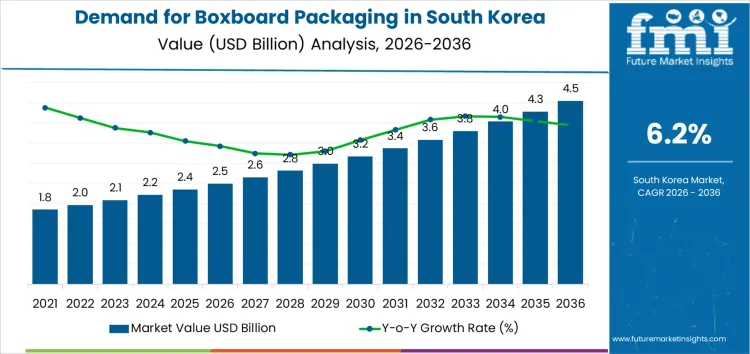
The demand for boxboard packaging in South Korea is forecasted to reach USD 2.5 billion in 2026 and grow to USD 4.5 billion by 2036, expanding at a CAGR of 6.2%. Production concentration will be a critical factor as a few large-scale manufacturers dominate the supply landscape, controlling the majority of capacity. This concentration increases the vulnerability of the supply chain to disruptions, particularly from raw material shortages or fluctuations in global demand
Regional manufacturing control will play a key role in managing these risks, with local production facilities benefiting from reduced transportation costs and more agile responses to domestic demand. However, the reliance on specific suppliers for high-quality boxboard will heighten dependencies, making procurement teams susceptible to price volatility and supply interruptions. Suppliers who can offer consistent reliability in production and delivery schedules will gain a competitive edge in this tightening environment.
Quick Stats for the Demand for Boxboard Packaging in South Korea
- Boxboard Packaging in South Korea Value (2026): USD 2.5 billion
- Boxboard Packaging in South Korea Forecast Value (2036): USD 4.5 billion
- Boxboard Packaging in South Korea Global Forecast CAGR (2026 to 2036): 6.2%
- Boxboard Packaging in South Korea Leading Segment: Food and Beverages (48%)
- Key Growth Regions of Boxboard Packaging in South Korea: Jeju (leading CAGR ~7.4%)
- Top Players of Boxboard Packaging in South Korea: International Paper, WestRock, Stora Enso, Smurfit Kappa, DS Smith, Mondi Group
What is the Growth Forecast for the Demand for Boxboard Packaging in South Korea through 2036?
The demand for boxboard packaging in South Korea is forecasted to experience steady growth, reaching USD 2.5 billion by 2026. The market is projected to expand at a 6.2% CAGR through 2036, driven by the strong adoption of eco-friendly packaging solutions. As companies prioritize sustainability, boxboard's recyclability and lightweight nature make it a key choice for reducing packaging waste. Additionally, industries like food and beverage, electronics, and consumer goods are expected to continue increasing their use of boxboard, as it offers an ideal balance of durability, cost-effectiveness, and environmental sustainability.
By 2036, the market for boxboard packaging in South Korea is expected to reach USD 4.5 billion, reflecting an absolute dollar opportunity driven by the growing preference for sustainable packaging solutions. The rise of e-commerce and demand for high-quality packaging in both domestic and export markets will further support the demand for boxboard products. As South Korean manufacturers continue to innovate and meet sustainability goals, the boxboard packaging industry will remain a critical sector within the broader packaging market.
Key Takeaways for Demand for Boxboard Packaging in South Korea
| Metric | Value |
|---|---|
| Industry Sales Value (2026) | USD 2.5 billion |
| Industry Forecast Value (2036) | USD 4.5 billion |
| Industry Forecast CAGR (2026 to 2036) | 6.2% |
Why is the Demand for Boxboard Packaging Growing in South Korea?
Demand for boxboard packaging in South Korea reflects shifts in manufacturing, retail, and consumer preferences toward materials that balance functionality and sustainability. Boxboard is widely used for products such as cosmetics, confectionery, pharmaceuticals, and consumer electronics because it combines strength with ease of printing and customization. South Korean producers appreciate the material for its ability to protect goods while supporting high resolution graphics that enhance shelf presence.
Retailers also favour boxboard because it performs well in automated packing lines and supports efficient stacking and storage. In sectors such as food and personal care, where package aesthetics influence purchasing decisions, boxboard offers versatility in design without compromising protection. Packaging engineers find that boxboard simplifies material sourcing and waste handling compared with complex multi material alternatives, making it an attractive choice for companies aiming for operational consistency.
Looking ahead, several factors are expected to support sustained demand for boxboard packaging across South Korea’s industrial landscape. Consumer awareness of environmental issues continues to rise, and manufacturers are adjusting packaging strategies to align with expectations for recyclability and reduced material waste. Boxboard, being widely recyclable and often sourced from renewable fibres, aligns with these environmental preferences and regulatory emphasis on circular materials.
In addition, growth in e commerce and direct to consumer channels adds pressure on packaging to withstand handling while offering lightweight characteristics that lower shipping costs. South Korean brands preparing products for online display also benefit from boxboard’s print clarity, which supports brand narratives even in digital storefronts. Production innovations that improve board strength and barrier properties further elevate its applicability to a broader range of products. These dynamics together support expanding use of boxboard packaging throughout manufacturing and distribution sectors in South Korea.
What is the Demand for Boxboard Packaging in South Korea?
The demand for boxboard packaging in South Korea is driven by two primary factors: the end-use industry and the grade type of boxboard used. The food and beverage industry leads the demand, while folding boxboard (FBB) is the most prevalent grade type. Together, these segments shape the market dynamics, with food and beverages representing 48% of the market share and folding boxboard holding a 47.4% share. These key segments play an essential role in the overall growth of boxboard packaging in the country, catering to a variety of consumer needs and industry requirements.
How Does the Food and Beverages Industry Drive the Boxboard Packaging Market?
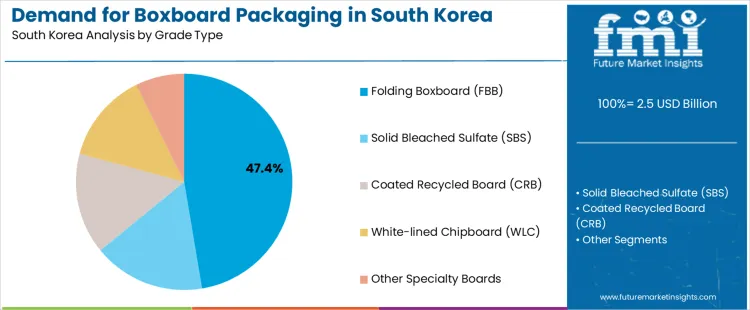
The food and beverages industry is the largest end-use sector for boxboard packaging in South Korea, accounting for 48% of the market share. The increasing demand for packaged food and beverage products, driven by consumer convenience and busy lifestyles, has significantly boosted the need for efficient and reliable packaging solutions. Boxboard packaging, particularly folding boxboard (FBB), is widely used in the industry due to its strength, printability, and cost-effectiveness. It is ideal for packaging products such as snacks, ready-to-eat meals, and beverages, which require sturdy yet lightweight materials.
Moreover, as sustainability becomes an increasing priority for consumers, the use of recyclable and eco-friendly boxboard options is gaining traction. South Korean manufacturers are opting for FBB due to its ability to provide a balance between performance and environmental responsibility. As the food and beverage market continues to grow, the demand for boxboard packaging, especially for folding boxboard, is expected to remain strong. This trend is likely to continue as consumer preferences shift toward more sustainable and attractive packaging solutions.
How Does the Folding Boxboard (FBB) Grade Type Shape the Boxboard Packaging Market?
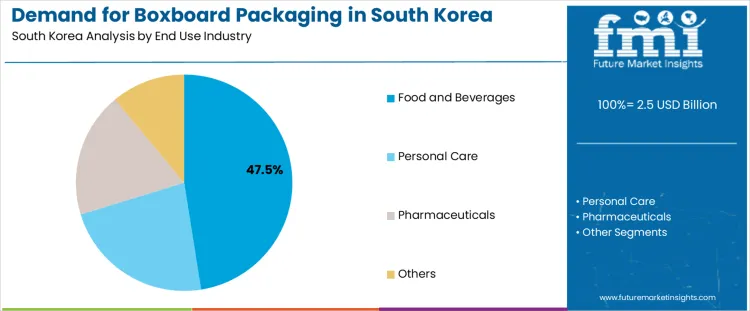
Folding boxboard (FBB) is the leading grade type in the boxboard packaging market in South Korea, holding a significant 47.4% share. FBB is preferred for its high-quality surface, which allows for superior printing and attractive packaging designs, making it especially suitable for the food and beverage sector. Its ability to offer excellent protection for products while being lightweight and cost-efficient has made it a popular choice among manufacturers.
Additionally, FBB is environmentally friendly, as it is often made from virgin fibers or recycled content, aligning with South Korea’s growing emphasis on sustainability. The versatility of FBB extends beyond the food and beverage industry, as it is also used in personal care and pharmaceuticals, providing a strong yet flexible packaging solution. The market for FBB continues to expand as manufacturers seek both cost-effective and sustainable packaging solutions. With the growing emphasis on aesthetics and sustainability in packaging design, folding boxboard is likely to remain the dominant grade type in South Korea's boxboard packaging market.
What Is the Current Demand for Boxboard Packaging in South Korea?
The demand for boxboard packaging in South Korea forms part of a broader paper and paperboard packaging landscape that has been expanding in recent years. Paper packaging formats, which include folding cartons and boxboard products used for consumer goods and retail packaging, are registering steady increases in uptake amid rising preferences for recyclable materials and environmentally aligned solutions. This pattern reflects manufacturers and brand owners placing greater emphasis on packaging that meets sustainability criteria and supports product protection in transit. Growth in e commerce and retail sectors has reinforced demand for sturdy, lightweight board packaging.
What Factors Are Driving Demand for Boxboard Packaging in South Korea?
Demand for boxboard packaging in South Korea is tied to shifts in production and consumption patterns that favour renewable and recyclable materials. End use sectors such as food and beverage, cosmetics, and consumer products are increasingly specifying board packaging to meet regulatory and consumer demands for reduced plastic use. E commerce growth contributes to demand for board formats that provide structural integrity and can withstand handling through logistics networks. Manufacturers are also adjusting to preferences for customizable and high print packaging solutions that support branding and product differentiation. Government and industry initiatives to reduce waste and increase recycled content in packaging have influenced preferences toward paper based materials.
What Are the Constraints on Boxboard Packaging Demand in South Korea?
Several pressures temper the expansion of boxboard packaging in South Korea. Competition from alternative materials, including plastics and composites, continues to affect adoption, especially where cost or barrier performance is a priority. Fluctuations in raw material costs for paperboard can influence pricing dynamics, constraining production scaling in certain segments. Regulatory frameworks aimed at food contact or material safety introduce compliance costs and procedural hurdles that influence material choice in specific applications. Infrastructure for recycling and collection also affects the economic calculus for manufacturers and converters, shaping the relative competitiveness of boxboard versus other formats.
What Trends Are Emerging in South Korea’s Boxboard Packaging Sector?
Distinct trends are emerging that influence boxboard packaging in South Korea. A pronounced shift toward sustainable packaging is evident, with recyclability and reduced carbon footprint becoming criteria for material selection. Advances in material technology and manufacturing are yielding lighter but stronger board products, responding to requirements from e commerce and logistics sectors for packaging that protects while minimizing weight. Growth in premium and high design packaging, particularly in cosmetics and consumer electronics segments, is driving demand for board formats that support high quality graphics and structural design. Finally, broader integration of board packaging into automated production and fulfilment systems in manufacturing and distribution facilities is shaping product specifications.
What is the Regional Outlook for the Demand for Boxboard Packaging in South Korea?
The demand for boxboard packaging in South Korea varies across its regions, driven by factors such as industrial activity, consumer behavior, and environmental trends. Jeju, South Gyeongsang, and South Jeolla show strong growth prospects, while North Jeolla is expected to see steady demand for this packaging solution. The food, beverage, and retail industries, which rely heavily on sustainable and cost-effective packaging, are key drivers of this demand. With increasing emphasis on eco-friendly solutions and a preference for recyclable materials, the regions are projected to see consistent growth in the adoption of boxboard packaging, especially in sectors requiring durable and lightweight packaging.
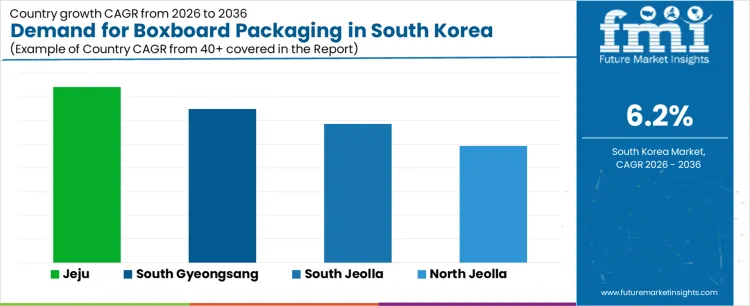
| Province | CAGR (2026 to 2036) |
|---|---|
| South Gyeongsang | 6.5% |
| North Jeolla | 4.9% |
| South Jeolla | 5.9% |
| Jeju | 7.4% |
What factors drive the demand for Boxboard Packaging in South Gyeongsang?
South Gyeongsang is projected to experience a CAGR of 6.5% in the demand for boxboard packaging from 2026 to 2036. The region’s strong manufacturing sector, particularly in food and beverage, electronics, and consumer goods, contributes significantly to this demand. Boxboard packaging is increasingly used due to its sustainability benefits, cost-effectiveness, and versatility. The food and beverage industry, in particular, relies on boxboard for packaging everything from dry goods to perishables, making it an essential packaging solution. Additionally, South Gyeongsang’s proximity to major transport hubs facilitates the efficient distribution of boxboard-packaged goods both domestically and internationally, boosting the region's demand. As sustainability becomes a more prominent focus in manufacturing practices, the demand for recyclable and eco-friendly packaging like boxboard is expected to continue growing.
What influences the growth of Boxboard Packaging demand in North Jeolla?
North Jeolla is expected to see a steady CAGR of 4.9% in boxboard packaging demand over the period from 2026 to 2036. This growth is driven by the region’s expanding food processing industry, which relies heavily on packaging that offers both durability and environmental responsibility. Boxboard, as a sustainable alternative to plastic, is becoming increasingly popular in the food and beverage sectors in North Jeolla, particularly for packaging products like dry foods, beverages, and dairy. Additionally, the region’s growing focus on eco-friendly production practices and recyclable materials aligns with the global trend towards reducing packaging waste. The demand for boxboard packaging in North Jeolla is also influenced by the region’s commitment to meeting local and international sustainability regulations, further supporting its growth.
What drives the demand for Boxboard Packaging in South Jeolla?
South Jeolla’s demand for boxboard packaging is expected to grow at a CAGR of 5.9% from 2026 to 2036. The region’s significant agricultural output, along with its expanding manufacturing sector, contributes to the rising demand for boxboard packaging. South Jeolla produces a wide range of agricultural products that require efficient and sustainable packaging solutions. Boxboard, being recyclable and sturdy, is increasingly used for packaging fruits, vegetables, and other agricultural products for both domestic consumption and export. The region’s rising food processing and retail industries further drive the adoption of boxboard as a preferred packaging option. As sustainability remains a key focus for consumers and businesses alike, the demand for eco-friendly packaging solutions, such as boxboard, is expected to continue growing in South Jeolla.
Why is Jeju’s demand for Boxboard Packaging the highest?
Jeju is projected to experience the highest growth in boxboard packaging demand, with a CAGR of 7.4% from 2026 to 2036. As a popular tourist destination, Jeju sees significant demand for packaged food and retail products, driving the need for boxboard packaging solutions. The region’s tourism-driven retail market increasingly favors boxboard packaging for its eco-friendly properties and ability to maintain product integrity. Additionally, Jeju’s strong export market for packaged goods, particularly in food and beverages, contributes to the rising demand for boxboard. The region's growing focus on sustainability, particularly in its tourism and hospitality sectors, aligns with global trends towards recyclable and biodegradable packaging materials. As consumer preferences shift towards more environmentally responsible packaging options, Jeju's demand for boxboard packaging is set to grow at a faster rate compared to other regions in South Korea.
How are Competitors Differentiating in the Boxboard Packaging Market in South Korea?
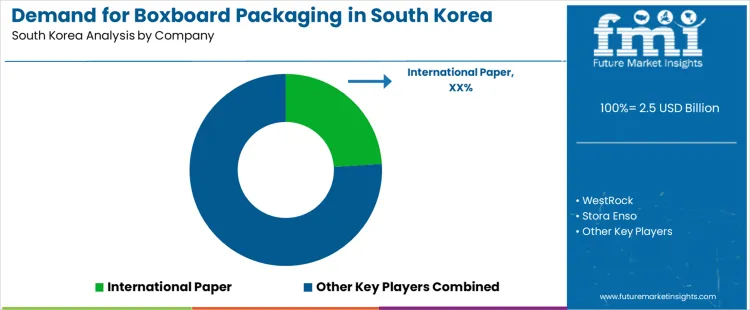
Competitive positioning in the South Korean boxboard packaging market revolves around product innovation, sustainability, and tailored solutions for various industries. International Paper, as the leading player, focuses on high-quality boxboard solutions designed to meet the diverse needs of the retail, food and beverage, and electronics industries. They emphasize sustainable production and offer lightweight yet strong packaging options that provide optimal protection. Other companies, such as WestRock and Stora Enso, are leveraging their strong sustainability initiatives, incorporating recycled materials and renewable packaging solutions. The growing demand for eco-friendly products has intensified competition, with companies offering customized packaging solutions that cater to South Korean consumer preferences for sustainability.
As competition increases, companies like Smurfit Kappa, DS Smith, and Mondi Group focus on differentiating themselves through packaging innovation and the use of advanced materials. These competitors integrate cutting-edge technologies to enhance the strength and recyclability of their boxboard products. Companies utilize product brochures to showcase their capabilities, with a strong emphasis on how their products align with environmental standards and help businesses meet regulatory requirements. These efforts help players build strong relationships with customers, establishing themselves as leaders in the competitive South Korean market.
Key Players of the Demand for Boxboard Packaging in South Korea
- International Paper
- WestRock
- Stora Enso
- Smurfit Kappa
- DS Smith
- Mondi Group
Scope of the Report
| Items | Values |
|---|---|
| Quantitative Units (2026) | USD Billion |
| End-Use Industry | Food and Beverages, Personal Care, Pharmaceuticals, Others |
| Grade Type | Folding Boxboard (FBB), Solid Bleached Sulfate (SBS), Coated Recycled Board (CRB), White-lined Chipboard (WLC), Other Specialty Boards |
| Companies | International Paper, WestRock, Stora Enso, Smurfit Kappa, DS Smith, Mondi Group |
| Region Covered | South Korea |
| Provinces Covered | South Gyeongsang, North Jeolla, South Jeolla, Jeju |
| Additional Attributes | Dollar sales by end-use industry and grade type. Growing demand for sustainable and eco-friendly packaging solutions drives adoption of recycled and specialty boards. Boxboard packaging remains a preferred choice for food, personal care, and pharmaceutical sectors due to its versatility, strength, and printability. |
Demand for Boxboard Packaging in South Korea
End-Use Industry:
- Food and Beverages
- Personal Care
- Pharmaceuticals
- Others
Grade Type:
- Folding Boxboard (FBB)
- Solid Bleached Sulfate (SBS)
- Coated Recycled Board (CRB)
- White-lined Chipboard (WLC)
- Other Specialty Boards
Provinces:
- South Gyeongsang
- North Jeolla
- South Jeolla
- Jeju
Bibliography
- International Paper. (2023). Boxboard packaging solutions for various industries.
- WestRock. (2023). Sustainable boxboard packaging solutions for food and beverage sectors.
- Stora Enso. (2023). Innovative packaging solutions using boxboard.
- Smurfit Kappa. (2023). Eco-friendly boxboard packaging solutions for food and beverages.
- DS Smith. (2023). Sustainability in boxboard packaging: Innovation and design for the food and beverage industries.
Frequently Asked Questions
How big is the demand for boxboard packaging in south korea in 2026?
The demand for boxboard packaging in south korea is estimated to be valued at USD 2.5 billion in 2026.
What will be the size of boxboard packaging in south korea in 2036?
The market size for the boxboard packaging in south korea is projected to reach USD 4.5 billion by 2036.
How much will be the demand for boxboard packaging in south korea growth between 2026 and 2036?
The demand for boxboard packaging in south korea is expected to grow at a 6.2% CAGR between 2026 and 2036.
What are the key product types in the boxboard packaging in south korea?
The key product types in boxboard packaging in south korea are food and beverages, personal care, pharmaceuticals and others.
Which grade type segment is expected to contribute significant share in the boxboard packaging in south korea in 2026?
In terms of grade type, folding boxboard (fbb) segment is expected to command 47.4% share in the boxboard packaging in south korea in 2026.
Preview the report firsthand - request a free sample
Get SampleGet the brochure for pricing and purchase details.
Get PDFTable of Content
- Executive Summary
- South Korea Market Outlook
- Demand-side Trends
- Supply-side Trends
- Technology Roadmap Analysis
- Analysis and Recommendations
- Market Overview
- Market Coverage / Taxonomy
- Market Definition / Scope / Limitations
- Market Background
- Market Dynamics
- Drivers
- Restraints
- Opportunity
- Trends
- Scenario Forecast
- Demand in Optimistic Scenario
- Demand in Likely Scenario
- Demand in Conservative Scenario
- Opportunity Map Analysis
- Product Life Cycle Analysis
- Supply Chain Analysis
- Investment Feasibility Matrix
- Value Chain Analysis
- PESTLE and Porter’s Analysis
- Regulatory Landscape
- Regional Parent Market Outlook
- Production and Consumption Statistics
- Import and Export Statistics
- Market Dynamics
- South Korea Market Analysis 2021 to 2025 and Forecast, 2026 to 2036
- Historical Market Size Value (USD Million) Analysis, 2021 to 2025
- Current and Future Market Size Value (USD Million) Projections, 2026 to 2036
- Y-o-Y Growth Trend Analysis
- Absolute $ Opportunity Analysis
- South Korea Market Pricing Analysis 2021 to 2025 and Forecast 2026 to 2036
- South Korea Market Analysis 2021 to 2025 and Forecast 2026 to 2036, By End Use Industry
- Introduction / Key Findings
- Historical Market Size Value (USD Million) Analysis By End Use Industry , 2021 to 2025
- Current and Future Market Size Value (USD Million) Analysis and Forecast By End Use Industry , 2026 to 2036
- Food and Beverages
- Personal Care
- Pharmaceuticals
- Others
- Food and Beverages
- Y-o-Y Growth Trend Analysis By End Use Industry , 2021 to 2025
- Absolute $ Opportunity Analysis By End Use Industry , 2026 to 2036
- South Korea Market Analysis 2021 to 2025 and Forecast 2026 to 2036, By Grade Type
- Introduction / Key Findings
- Historical Market Size Value (USD Million) Analysis By Grade Type, 2021 to 2025
- Current and Future Market Size Value (USD Million) Analysis and Forecast By Grade Type, 2026 to 2036
- Folding Boxboard (FBB)
- Solid Bleached Sulfate (SBS)
- Coated Recycled Board (CRB)
- White-lined Chipboard (WLC)
- Other Specialty Boards
- Folding Boxboard (FBB)
- Y-o-Y Growth Trend Analysis By Grade Type, 2021 to 2025
- Absolute $ Opportunity Analysis By Grade Type, 2026 to 2036
- Market Structure Analysis
- Competition Dashboard
- Competition Benchmarking
- Market Share Analysis of Top Players
- By Regional
- By End Use Industry
- By Grade Type
- Competition Analysis
- Competition Deep Dive
- International Paper
- Overview
- Product Portfolio
- Profitability by Market Segments (Product/Age /Sales Channel/Region)
- Sales Footprint
- Strategy Overview
- Marketing Strategy
- Product Strategy
- Channel Strategy
- WestRock
- Stora Enso
- Smurfit Kappa
- DS Smith
- Mondi Group
- International Paper
- Competition Deep Dive
- Assumptions & Acronyms Used
- Research Methodology


