

- Industry Size (2026)
- USD 4.3 Bn
- Forecast (2036)
- USD 12.0 Bn
- CAGR (2026 to 2036)
- 10.7%
Whiskey Industry Forecast and Outlook in South Korea 2026 to 2036
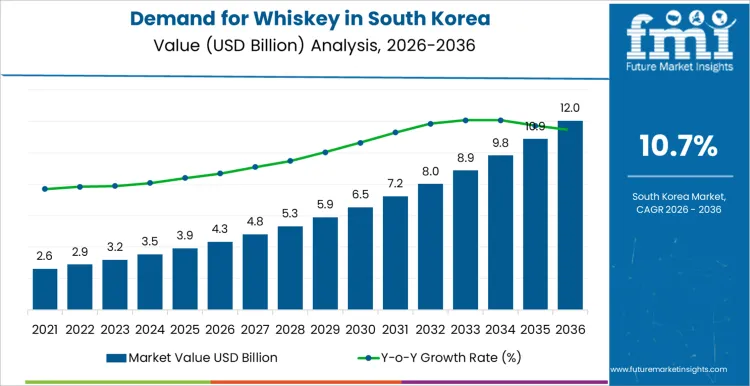
Demand for whiskey in South Korea is projected to reach a valuation of USD 4.3 billion in 2026. Sales of whiskey are anticipated to achieve a size of USD 12.0 billion by 2036, expanding at a compound annual growth rate of 10.7%. This growth trajectory is fueled by a profound cultural shift in alcohol consumption, characterized by a strong movement towards premiumization and experiential drinking.
The rising affluence of younger demographics, coupled with the influence of Western lifestyles and the aspirational appeal of whiskey as a symbol of sophistication, is driving exploration beyond traditional spirits. Strategic marketing, the growth of dedicated whiskey bars, and its increasing prominence in the social and business rituals of the hospitality sector amplify this trend.
Quick Stats for Whiskey Demand in South Korea
- Whiskey Sales Valuation in South Korea (2026): USD 4.3 billion
- Whiskey Sales Forecast Valuation in South Korea (2036): USD 12.0 billion
- Whiskey Industry in South Korea Forecast CAGR (2026 to 2036): 10.7%
- Leading Regional Growth: Jeju (CAGR 12.9%)
- Leading Beverage Type: Alcoholic Whiskey (86.6%)
- Leading Product Type: Bourbon Whiskey (30.0%)
- Leading Flavor: Unflavored/Traditional (65.0%)
- Leading End User: HoReCa (Hotels, Restaurants, Cafés) (55.0%)
- Leading Sales Channel: Business-to-Business (B2B) (52.0%)
- Key Companies Profiled: Diageo, Chivas Brothers, William Grant & Sons, Bacardi, La Martiniquaise
Why is Whiskey Consumption Rising So Prominently in South Korea?
The surge in whiskey demand represents a significant evolution in South Korean drinking culture. Moving beyond its previous niche status, whiskey is now embraced as a versatile spirit for casual socializing, gifting, and connoisseurship. This is heavily driven by the premium spirit consumption trend among millennials and Gen Z consumers who value brand heritage, authenticity, and quality.
Exposure through global media and travel has cultivated a more educated palate, encouraging experimentation with different styles from Scotch and Bourbon to Japanese whiskies. Furthermore, the spirit's role in the vibrant nightlife and dining scene, where craft cocktails are increasingly popular, solidifies its position as a key driver of beverage programs in the thriving hospitality industry.
How is the Whiskey Landscape Segmented by Type, Taste, and Channel?
The alcohol content, specific style, flavor profile, primary consumer setting, and route to market categorize the whiskey arena. This detailed segmentation reveals a complex picture where traditional, high-quality alcoholic whiskey dominates, but with clear sub-trends in style preference and purchasing behavior. The split between on-premise (HoReCa) and off-premise (retail) consumption, alongside the B2B and B2C sales models, highlights the distinct strategies required to capture value across the entire spectrum of whiskey consumption.
Which Beverage Type Overwhelmingly Defines the Sector?
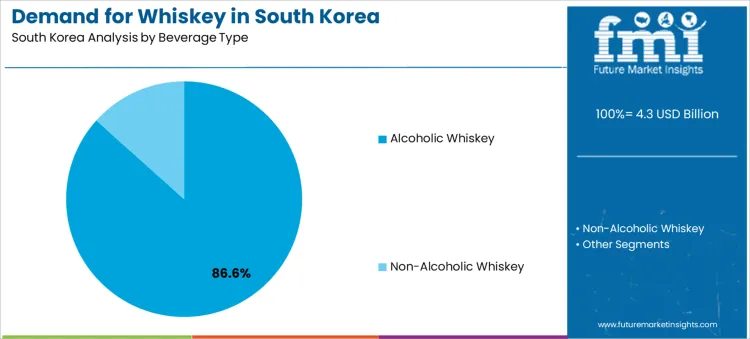
Alcoholic whiskey commands the sector with an overwhelming 86.6% share. This underscores the fundamental consumer desire for the authentic taste, complexity, and experiential quality associated with traditional whiskey. The growing, yet still niche, segment of non-alcoholic whiskey caters to the evolving health and wellness in beverages trend, appealing to consumers seeking sophisticated flavor experiences without alcohol, but it remains a secondary growth avenue within the broader landscape.
Which Product Style is Currently Most Favored?
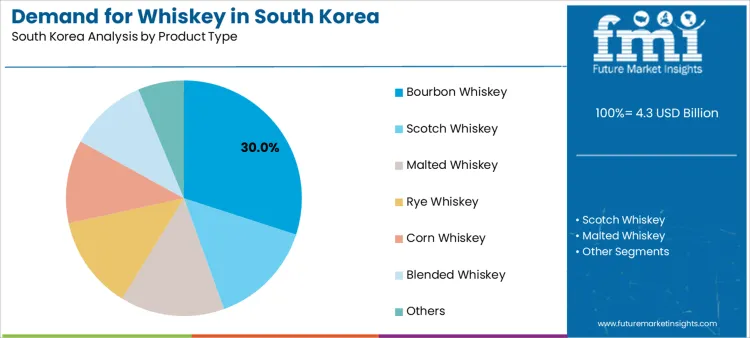
Bourbon whiskey leads among styles with a 30.0% share. Its sweeter, fuller-bodied profile often serves as an accessible entry point for new whiskey drinkers. Its prominence in classic and modern cocktails also boosts its volume in the HoReCa sector. Scotch whisky remains a highly prestigious segment associated with luxury and tradition, while blended, malted, and rye whiskies cater to more developed palates and specific cocktail applications, collectively contributing to a diverse and dynamic global whiskey styles environment.
Which Flavor Profile Maintains Consumer Loyalty?
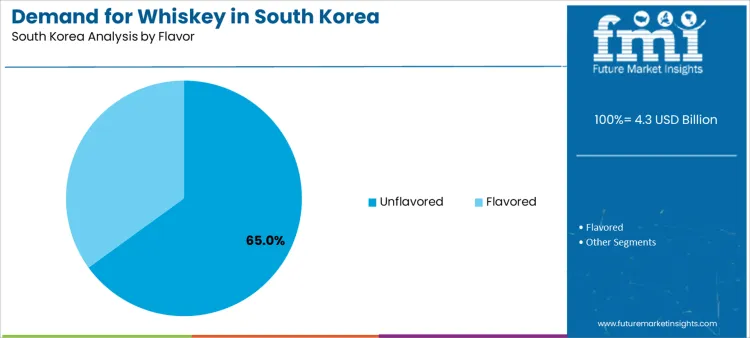
Unflavored, traditional whiskey holds a dominant 65.0% share of flavor preferences. This indicates that the core consumer base values the intrinsic, nuanced flavors derived from grains, aging, and distillation processes. The flavored whiskey segment, while smaller, attracts younger consumers and those seeking sweeter, more approachable mixers, illustrating a point of entry and innovation within the category.
Which End-User Setting is the Primary Consumption Engine?
The HoReCa sector is the leading end-user, accounting for 55.0% of demand. This highlights the social and experiential nature of whiskey consumption, where it is often consumed in bars, restaurants, and hotels for leisure, business entertainment, and as a key component in mixology. Household retail consumption is significant and growing, driven by at-home entertaining, gifting, and personal collection.
Which Sales Channel Facilitates the Largest Volume?
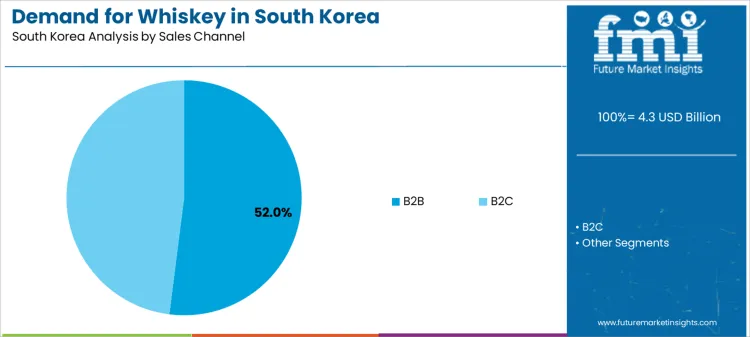
The B2B channel holds a slight lead with a 52.0% share. This reflects the critical role of distributors, wholesalers, and direct sales to the vast HoReCa network and large retail chains. The B2C channel, including e-commerce and direct retail, is vital for reaching individual consumers and is a rapidly evolving space, particularly through online platforms that offer education and discovery alongside sales, aligning with shifts in B2B alcohol distribution and digital retail.
What are the Dynamics, Restraints, Opportunities, and Threats Shaping this Sector?
How are Premiumization and Cultural Shifts Driving Exponential Growth?
The primary engine of growth is the powerful trend of premiumization, where consumers are trading up to higher-quality, older, and more prestigious whiskey expressions. The adoption of whiskey in sophisticated cocktail culture provides a versatile and high-margin option for bars. Its perception as a respectable gift, especially during holidays and corporate events, creates significant seasonal demand spikes and drives sales of premium bottles.
Do High Prices and Intense Competition Restrain Broader Adoption?
A significant restraint is the substantial price premium attached to imported whiskey due to high tariffs and taxes, which can limit everyday consumption and confine premium expressions to special occasions. The sector also faces intense competition from other premium spirits like craft gin, traditional soju, and wine. Deepening consumer knowledge also raises expectations for quality and authenticity, making it challenging for new or lesser-known brands to gain traction without substantial investment.
How are Digital Engagement and Niche Segments Creating New Potential?
Substantial opportunities exist in leveraging e-commerce and social media for direct consumer education, storytelling, and sales, particularly for limited editions and craft offerings. The development of the non-alcoholic spirit alternatives segment, while small, represents a strategic frontier for innovation. Furthermore, exploring and educating consumers about niche styles like single malts, Japanese, or Taiwanese whiskey can unlock high-value, enthusiast-driven demand.
What External Factors Could Challenge the Growth Trajectory?
The sector faces threats from potential increases in alcohol taxation or public health regulations aimed at curbing consumption. Economic downturns can disproportionately affect discretionary spending on luxury spirits. Global supply chain issues affecting the availability of aged stocks or packaging materials could also constrain the supply of key products, impacting growth and consumer choice.
How is Whiskey Consumption Evolving Across Key Regions in South Korea?
Growth varies by region, influenced by economic activity, tourism flows, and local nightlife culture. The projected compound annual growth rates from 2026 to 2036 illustrate these geographic distinctions.
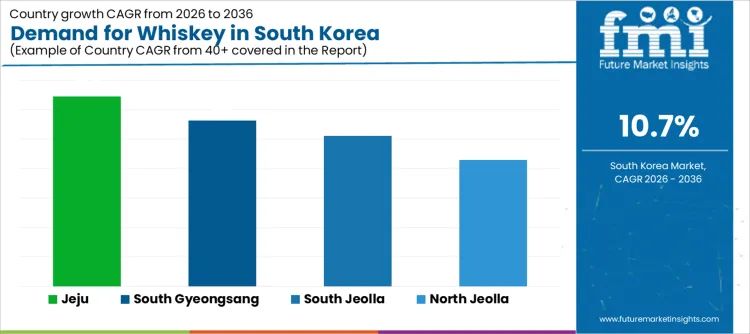
| Region | CAGR (2026 to 2036) |
|---|---|
| Jeju | 12.9% |
| South Gyeongsang | 11.3% |
| South Jeolla | 10.2% |
| North Jeolla | 8.6% |
What is Fueling Exceptional Growth on Jeju Island?
Jeju Island leads with a projected CAGR of 12.9%. This is directly tied to its status as a premier tourist destination, attracting both domestic and international visitors. The dense concentration of luxury resorts, duty-free shops, boutique bars, and golf courses creates a high-demand environment for premium whiskey for both on-site consumption and as luxury souvenirs. The tourism and hospitality industry on Jeju naturally drives exceptional volumes and exposure for high-end spirit brands.
Why is South Gyeongsang a High-Growth Consumption Hub?
South Gyeongsang exhibits a strong CAGR of 11.3%. This is powered by major industrial and port cities like Busan and Ulsan, which have a high concentration of affluent professionals, expatriates, and a vibrant urban nightlife and dining scene.
The presence of corporate headquarters fuels business entertainment expenses, while the ports facilitate direct import and distribution, making a wide variety of whiskeys readily available.
What Factors Underpin Strong Demand in the Jeolla Provinces?
The Jeolla provinces show robust growth. South Jeolla, with a CAGR of 10.2%, benefits from cultural tourism, a growing foodie scene, and cities like Gwangyang with significant industrial activity. North Jeolla, with a projected CAGR of 8.6%, reflects steady growth driven by university towns like Jeonju, where younger consumers are exploring whiskey, and by the gradual penetration of modern retail and bar culture into provincial urban centers.
What Defines the Competitive Landscape of the Whiskey Industry?
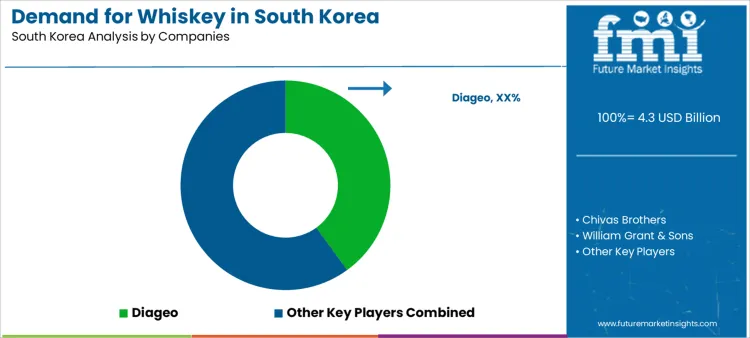
The competitive environment is defined by a clash between global spirits conglomerates and prestigious family-owned distilleries. Competition hinges on brand heritage, portfolio depth (from entry-level to ultra-premium), and mastery of storytelling that connects consumers to a whiskey’s origin and craftsmanship.
Success in the on-premise channel requires strong relationships with bar owners and mixologists, while retail success depends on eye-catching packaging and effective shelf presence. Innovation in limited releases, cask finishes, and regional expressions is a key tactic to drive engagement and perceived value among enthusiasts.
Key Industry Participants
- Diageo plc (Johnnie Walker, Singleton, Talisker)
- Chivas Brothers (Pernod Ricard) (Chivas Regal, The Glenlivet)
- William Grant & Sons Ltd. (Glenfiddich, Balvenie)
- Bacardi Limited (Dewar’s, Aberfeldy)
- La Martiniquaise (Label 5, Glen Moray)
Scope of Analysis
| Items | Values |
|---|---|
| Quantitative Units | USD Billion |
| Beverage Type | Alcoholic Whiskey, Non-Alcoholic Whiskey |
| Product Type | Bourbon, Scotch, Malted, Rye, Corn, Blended, Others |
| Flavor | Unflavored/Traditional, Flavored |
| End User | HoReCa (Hotels, Restaurants, Cafés), Household/Retail |
| Sales Channel | Business-to-Business (B2B), Business-to-Consumer (B2C) |
| Regions Covered | South Gyeongsang, North Jeolla, South Jeolla, Jeju |
Whiskey in South Korea by Segment
By Beverage Type
- Alcoholic Whiskey
- Non-Alcoholic Whiskey
By Product Type
- Bourbon Whiskey
- Scotch Whiskey
- Malted Whiskey
- Rye Whiskey
- Corn Whiskey
- Blended Whiskey
- Others
By Flavor
- Unflavored/Traditional
- Flavored
By End User
- HoReCa (Hotels, Restaurants, Cafés)
- Household/Retail
By Sales Channel
- Business-to-Business (B2B)
- Business-to-Consumer (B2C)
By Region
- Jeju
- South Gyeongsang
- South Jeolla
- North Jeolla
Bibliography
- Korea Alcohol & Liquor Industry Association (KALIA). (2023). Annual Report on Imported Spirits Consumption and Trends.
- National Tax Service, South Korea. (2024). Statistical Yearbook of Liquor Tax Revenue.
- Sommeliers Association of Korea. (2023). Survey on Premium Spirit Preferences and Consumption Habits in the HoReCa Sector.
Frequently Asked Questions
How big is the demand for whiskey in south korea in 2026?
The demand for whiskey in south korea is estimated to be valued at USD 4.3 billion in 2026.
What will be the size of whiskey in south korea in 2036?
The market size for the whiskey in south korea is projected to reach USD 12.0 billion by 2036.
How much will be the demand for whiskey in south korea growth between 2026 and 2036?
The demand for whiskey in south korea is expected to grow at a 10.7% CAGR between 2026 and 2036.
What are the key product types in the whiskey in south korea?
The key product types in whiskey in south korea are alcoholic whiskey and non-alcoholic whiskey.
Which product type segment is expected to contribute significant share in the whiskey in south korea in 2026?
In terms of product type, bourbon whiskey segment is expected to command 30.0% share in the whiskey in south korea in 2026.
Preview the report firsthand - request a free sample
Get SampleGet the brochure for pricing and purchase details.
Get PDFTable of Content
- Executive Summary
- South Korea Market Outlook
- Demand-side Trends
- Supply-side Trends
- Technology Roadmap Analysis
- Analysis and Recommendations
- Market Overview
- Market Coverage / Taxonomy
- Market Definition / Scope / Limitations
- Market Background
- Market Dynamics
- Drivers
- Restraints
- Opportunity
- Trends
- Scenario Forecast
- Demand in Optimistic Scenario
- Demand in Likely Scenario
- Demand in Conservative Scenario
- Opportunity Map Analysis
- Product Life Cycle Analysis
- Supply Chain Analysis
- Investment Feasibility Matrix
- Value Chain Analysis
- PESTLE and Porter’s Analysis
- Regulatory Landscape
- Regional Parent Market Outlook
- Production and Consumption Statistics
- Import and Export Statistics
- Market Dynamics
- South Korea Market Analysis 2021 to 2025 and Forecast, 2026 to 2036
- Historical Market Size Value (USD Million) Analysis, 2021 to 2025
- Current and Future Market Size Value (USD Million) Projections, 2026 to 2036
- Y-o-Y Growth Trend Analysis
- Absolute $ Opportunity Analysis
- South Korea Market Pricing Analysis 2021 to 2025 and Forecast 2026 to 2036
- South Korea Market Analysis 2021 to 2025 and Forecast 2026 to 2036, By Beverage Type
- Introduction / Key Findings
- Historical Market Size Value (USD Million) Analysis By Beverage Type, 2021 to 2025
- Current and Future Market Size Value (USD Million) Analysis and Forecast By Beverage Type, 2026 to 2036
- Alcoholic Whiskey
- Non-Alcoholic Whiskey
- Alcoholic Whiskey
- Y-o-Y Growth Trend Analysis By Beverage Type, 2021 to 2025
- Absolute $ Opportunity Analysis By Beverage Type, 2026 to 2036
- South Korea Market Analysis 2021 to 2025 and Forecast 2026 to 2036, By Product Type
- Introduction / Key Findings
- Historical Market Size Value (USD Million) Analysis By Product Type, 2021 to 2025
- Current and Future Market Size Value (USD Million) Analysis and Forecast By Product Type, 2026 to 2036
- Bourbon Whiskey
- Scotch Whiskey
- Malted Whiskey
- Rye Whiskey
- Corn Whiskey
- Blended Whiskey
- Others
- Bourbon Whiskey
- Y-o-Y Growth Trend Analysis By Product Type, 2021 to 2025
- Absolute $ Opportunity Analysis By Product Type, 2026 to 2036
- South Korea Market Analysis 2021 to 2025 and Forecast 2026 to 2036, By Flavor
- Introduction / Key Findings
- Historical Market Size Value (USD Million) Analysis By Flavor, 2021 to 2025
- Current and Future Market Size Value (USD Million) Analysis and Forecast By Flavor, 2026 to 2036
- Unflavored
- Flavored
- Unflavored
- Y-o-Y Growth Trend Analysis By Flavor, 2021 to 2025
- Absolute $ Opportunity Analysis By Flavor, 2026 to 2036
- South Korea Market Analysis 2021 to 2025 and Forecast 2026 to 2036, By End User
- Introduction / Key Findings
- Historical Market Size Value (USD Million) Analysis By End User, 2021 to 2025
- Current and Future Market Size Value (USD Million) Analysis and Forecast By End User, 2026 to 2036
- HoReCa
- Household Retail
- HoReCa
- Y-o-Y Growth Trend Analysis By End User, 2021 to 2025
- Absolute $ Opportunity Analysis By End User, 2026 to 2036
- South Korea Market Analysis 2021 to 2025 and Forecast 2026 to 2036, By Sales Channel
- Introduction / Key Findings
- Historical Market Size Value (USD Million) Analysis By Sales Channel, 2021 to 2025
- Current and Future Market Size Value (USD Million) Analysis and Forecast By Sales Channel, 2026 to 2036
- B2B
- B2C
- B2B
- Y-o-Y Growth Trend Analysis By Sales Channel, 2021 to 2025
- Absolute $ Opportunity Analysis By Sales Channel, 2026 to 2036
- Market Structure Analysis
- Competition Dashboard
- Competition Benchmarking
- Market Share Analysis of Top Players
- By Regional
- By Beverage Type
- By Product Type
- By Flavor
- By End User
- By Sales Channel
- Competition Analysis
- Competition Deep Dive
- Diageo
- Overview
- Product Portfolio
- Profitability by Market Segments (Product/Age /Sales Channel/Region)
- Sales Footprint
- Strategy Overview
- Marketing Strategy
- Product Strategy
- Channel Strategy
- Chivas Brothers
- William Grant & Sons
- Bacardi
- La Martiniquaise
- Diageo
- Competition Deep Dive
- Assumptions & Acronyms Used
- Research Methodology


